Deuteronomy 34:11

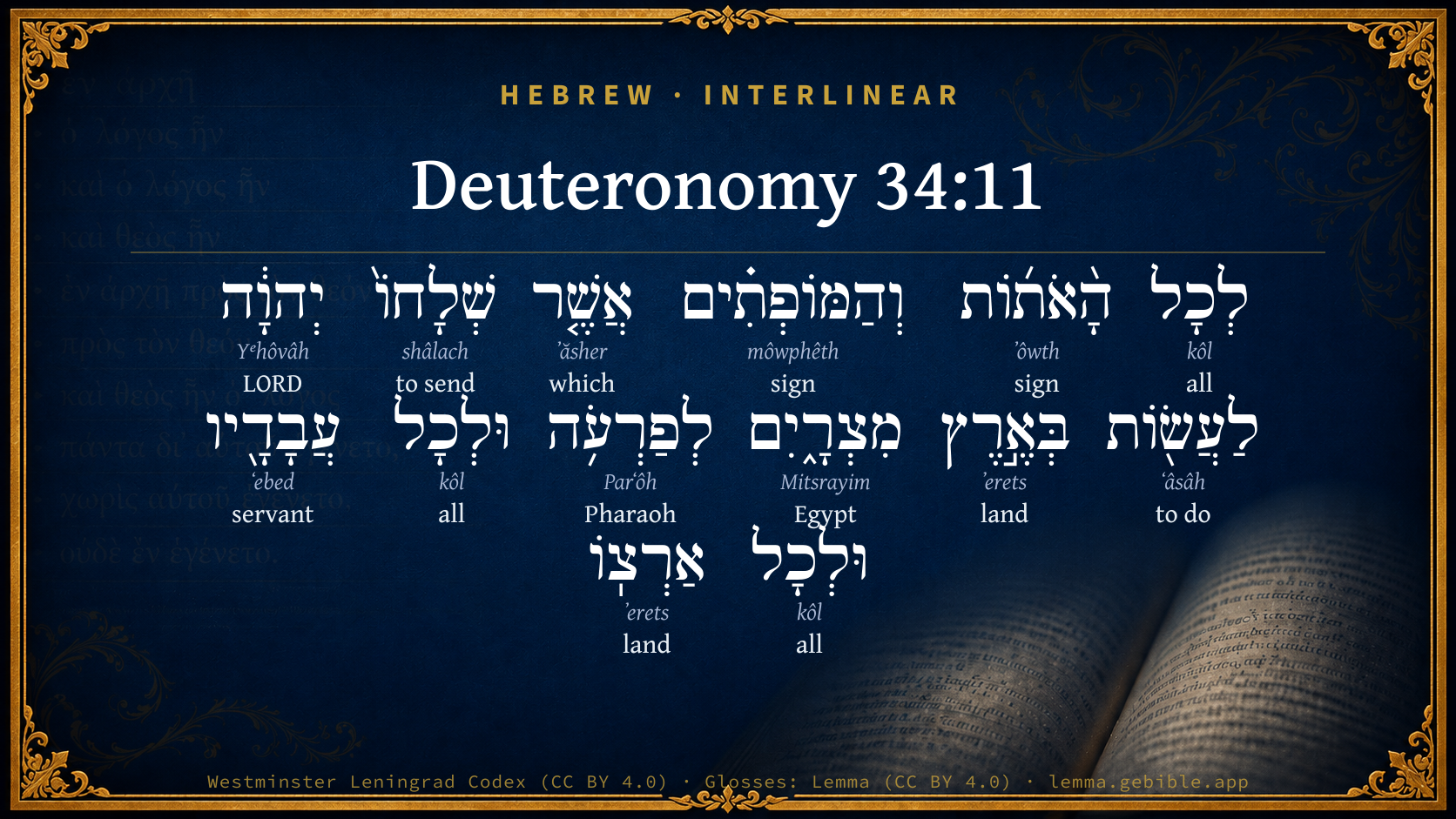
Hebrew (Westminster Leningrad Codex) Deuteronomy 34:11 appears in the Hebrew Old Testament. The text above is from the Westminster Leningrad Codex. Each word links to its Strong’s number, a concise gloss, and parsing drawn from the Open Scriptures Hebrew Bible morphology. Click any word for its full Brown-Driver-Briggs (BDB) entry.
Download image
Cite this verse

Deuteronomy 34:11 (World English Bible). Public Domain. Lemma interlinear Bible study tool, https://lemma.gebible.app/v/deuteronomy/34/11.

Show BibTeX & RIS
BibTeX
RIS
English Translation
in all the signs and the wonders, which Yahweh sent him to do in the land of Egypt, to Pharaoh, and to all his servants, and to all his land,
World English Bible · Public Domain
Download a study sheet

One document with this verse’s original text, its word-by-word gloss line, the meaning frame, cross-references with their text, attributed commentary, and full source and license credits — printable, and it pastes into notes with its structure intact.

This verse Autodidact and up

Study sheet (.html) Plain text (.txt)

A passage Seminary Student

Up to 50 verses in one chapter. A passage sheet keeps up to 6 commentary sources and 12 cross-references per verse, in the order this page ranks them, and says so on the sheet whenever that leaves anything out. Ask for a single verse and you get the Autodidact verse sheet above.

Everything on this page stays free to read, with no account — the sheet is a download of what is already on screen, not access to it.

Want to remove ads? Support Godless Engineer
Compare translations 3

The same verse in 3 English versions, stacked beneath the original-language interlinear above. Click any original word for its lexicon entry.

Each is an independent rendering of the whole verse — the interlinear is not word-aligned to these translations.

Highlighted words mark where these versions differ — a whole-verse word diff, not a word-by-word alignment.

  • World English Bible Public Domain
    in all the signs and the wonders, which Yahweh sent him to do in the land of Egypt, to Pharaoh, and to all his servants, and to all his land,
  • King James Version Public Domain
    In all the signs and the wonders, which the LORD sent him to do in the land of Egypt to Pharaoh, and to all his servants, and to all his land,
  • unfoldingWord Literal Text CC BY-SA 4.0
    for all the signs and wonders that Yahweh sent him to do in the land of Egypt, to Pharaoh, and to all his servants, and to all his land,

unfoldingWord Literal Text — © unfoldingWord, licensed CC BY-SA 4.0. Word-aligned USFM3 via Door43 (git.door43.org/unfoldingWord/en_ult).

Versions to compare (up to 4)

3 of 4 selected

Show all 18 translations

Every available English version of this verse, each an independent rendering of the whole verse.

  • World English Bible Public Domain
    in all the signs and the wonders, which Yahweh sent him to do in the land of Egypt, to Pharaoh, and to all his servants, and to all his land,
  • Berean Standard Bible Public Domain
    no prophet who did all the signs and wonders that the LORD sent Moses to do in the land of Egypt to Pharaoh and to all his officials and all his land,
  • Majority Standard Bible Public Domain
    no prophet who did all the signs and wonders that the LORD sent Moses to do in the land of Egypt to Pharaoh and to all his officials and all his land,
  • King James Version Public Domain
    In all the signs and the wonders, which the LORD sent him to do in the land of Egypt to Pharaoh, and to all his servants, and to all his land,
  • American Standard Version (1901) Public Domain
    in all the signs and the wonders, which Jehovah sent him to do in the land of Egypt, to Pharaoh, and to all his servants, and to all his land,
  • Revised Version (1885) Public Domain
    in all the signs and the wonders, which the LORD sent him to do in the land of Egypt, to Pharaoh, and to all his servants, and to all his land;
  • Geneva Bible (1599) Public Domain
    In all ye miracles and wonders which ye Lord sent him to do in ye land of Egypt before Pharaoh and before all his seruantes, and before al his land,
  • Douay-Rheims (1899) Public Domain
    In all the signs and wonders, which he sent by him, to do in the land of Egypt to Pharao, and to all his servants, and to his whole land,
  • Young's Literal Translation Public Domain
    in reference to all the signs and the wonders which Jehovah sent him to do in the land of Egypt, to Pharaoh, and to all his servants, and to all his land,
  • Literal Standard Version CC BY-SA 4.0
    in reference to all the signs and the wonders which YHWH sent him to do in the land of Egypt, to Pharaoh, and to all his servants, and to all his land,
  • Unlocked Literal Bible CC BY-SA 4.0
    There has never been any prophet like him in all the signs and wonders that Yahweh sent him to do in the land of Egypt, to Pharaoh, and to all his servants, and to all his land.
  • unfoldingWord Literal Text CC BY-SA 4.0
    for all the signs and wonders that Yahweh sent him to do in the land of Egypt, to Pharaoh, and to all his servants, and to all his land,
  • Darby Bible Public Domain
    according to all the signs and wonders that Jehovah had sent him to do in the land of Egypt, to Pharaoh, and to all his servants, and to all his land;
  • World Messianic Bible Public Domain
    in all the signs and the wonders which the LORD sent him to do in the land of Egypt, to Pharaoh, and to all his servants, and to all his land,
  • Webster's Bible Public Domain
    In all the signs and the wonders which the LORD sent him to do in the land of Egypt, to Pharaoh, and to all his servants, and to all his land,
  • Free Bible Version CC BY-SA 4.0
    The Lord sent him to carry out all the signs and miracles in Egypt to convince Pharaoh and his officials, and all the people in the country.
  • Bible in Basic English Public Domain
    In all the signs and wonders which the Lord sent him to do in the land of Egypt, to Pharaoh and to all his servants and all his land;
  • JPS Tanakh (1917) Public Domain
    in all the signs and the wonders, which the LORD sent him to do in the land of Egypt, to Pharaoh, and to all his servants, and to all his land;

Literal Standard Version (2020), Covenant Press — licensed CC BY-SA 4.0. Text via the HelloAO Bible API (eBible.org). Unlocked Literal Bible (unfoldingWord) — licensed CC BY-SA 4.0. Text via the HelloAO Bible API (eBible.org). unfoldingWord Literal Text — © unfoldingWord, licensed CC BY-SA 4.0. Word-aligned USFM3 via Door43 (git.door43.org/unfoldingWord/en_ult). Free Bible Version, Dr. Jonathan Gallagher — licensed CC BY-SA 4.0. Text via the HelloAO Bible API (eBible.org).

Word by word

More ways to search: Search by grammar → Find every occurrence → Compare this word →

Practice this passage: Drill this verse → Learn its vocabulary →

וְהַמּוֹפְתִ֗ים
môwphêth
H4159
“and · the · signs”
Conjunction + Particle, Definite Article + Noun, Common, Masculine, Plural, Absolute
Part of Speech
Conjunction + Particle + Noun
Type
Common
Gender
Masculine
Number
Plural
State
Absolute
Full BDB Definition

Origin: from H3302 in the sense of conspicuousness

TWOT: 152a

wonder, sign, miracle, portent - wonder (as a special display of God's power) - sign, token (of future event)
  1. לְכָל kôl H3605 “to/for · all of” Preposition + Noun, Common, Masculine, Singular, Construct
  2. הָ֨אֹת֜וֹת ʼôwth H226 “the · signs” Particle, Definite Article + Noun, Common, Both, Plural, Absolute
  3. אֲשֶׁ֤ר ʼăsher H834 “which” Particle, Relative
  4. שְׁלָחוֹ֙ shâlach H7971 “to send · him” Verb, Qal, Perfect, 3rd Person, Masculine, Singular + Suffix, Personal, 3rd Person, Masculine, Singular
  5. יְהוָ֔ה Yᵉhôvâh H3068 “LORD” Noun, Proper
  6. לַעֲשׂ֖וֹת ʻâsâh H6213 “to do” Preposition + Verb, Qal, Infinitive Construct
  7. בְּאֶ֣רֶץ ʼerets H776 “in/at · land of” Preposition + Noun, Common, Both, Singular, Construct
  8. מִצְרָ֑יִם Mitsrayim H4714 “Egypt” Noun, Proper
  9. לְפַרְעֹ֥ה Parʻôh H6547 “to/for · Pharaoh” Preposition + Noun, Proper
  10. וּלְכָל kôl H3605 “and · to/for · all of” Conjunction + Preposition + Noun, Common, Masculine, Singular, Construct
  11. עֲבָדָ֖יו ʻebed H5650 “servants · his” Noun, Common, Masculine, Plural, Construct + Suffix, Personal, 3rd Person, Masculine, Singular
  12. וּלְכָל kôl H3605 “and · to/for · all of” Conjunction + Preposition + Noun, Common, Masculine, Singular, Construct
  13. אַרְצֽוֹ ʼerets H776 “land · his” Noun, Common, Both, Singular, Construct + Suffix, Personal, 3rd Person, Masculine, Singular

About this verse

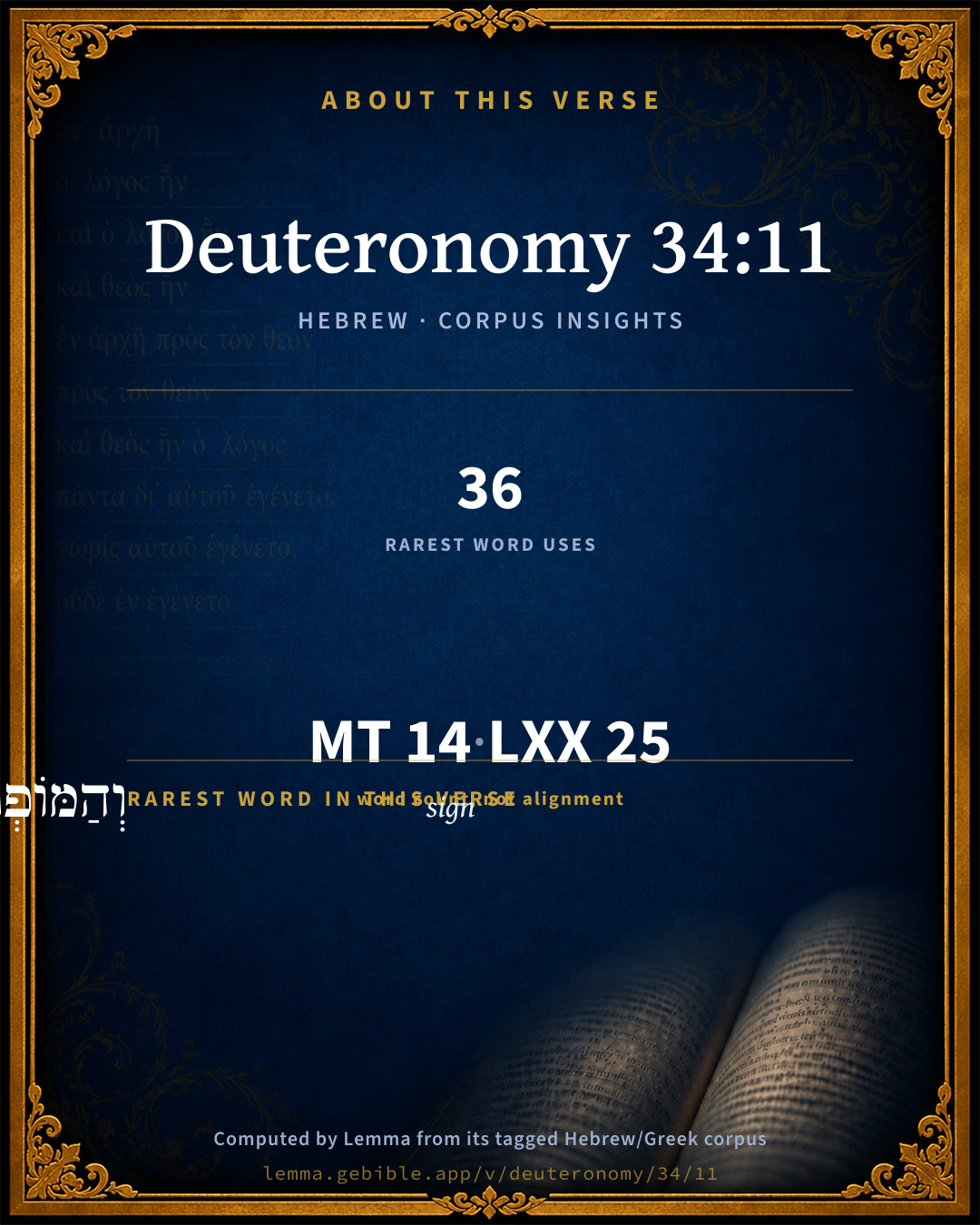
These counts appear in no published source. They are computed here, from the morphology-tagged text and Lemma’s own curated glosses. What Lemma adds →

14
words
11
distinct lemmas
Pentateuch
section

Shared distinctive vocabulary

וְהַמּוֹפְתִ֗ים sign H4159 occurs in 35 verses of the Hebrew Bible. Also found in:

Grammatical profile

  • 2 verbs
  • 11 nouns
  • 1 particle

Verb forms

  • שְׁלָחוֹ֙ Qal · Perfect
  • לַעֲשׂ֖וֹת Qal · Infinitive Construct

Repetition

Words recur within this verse — often emphatic in Hebrew:

  • לְכָל all H3605 ×3
  • בְּאֶ֣רֶץ land H776 ×2

Hebrew & Septuagint length

In English translation the verse runs 30 words from the Hebrew and 24 from the Septuagint (LXX English) — closely comparable.

A rough comparison of the two English renderings, which tokenize alike — not a word-level alignment.

Word counts can differ between the Hebrew and the Greek without any difference in meaning — e.g. the Hebrew direct-object marker אֵת has no separate Greek word, and Greek often adds the article ὁ.

In the original languages it is 14 Hebrew tokens and 25 Greek tokens — but the two are counted differently (Hebrew bundles its prefixes and suffixes into one token; the Greek is in lemma form), so that isn’t a like-for-like length.

Cross-references

4

Topical passages linked to Deuteronomy 34:11 in the Treasury of Scripture Knowledge — connected by theme and wording, ordered by reader-vote popularity; previews shown in the World English Bible.

  • Deuteronomy 4:34 Or has God tried to go and take him a nation from the midst of [another] nation, by trials, by signs, and by wonders, and by war, and by a mighty hand, and by an outstretched arm, and by great terrors, according to all that Yahweh your God did for you in Egypt before your eyes?
  • Deuteronomy 7:19 the great trials which your eyes saw, and the signs, and the wonders, and the mighty hand, and the outstretched arm, by which Yahweh your God brought you out: so shall Yahweh your God do to all the peoples of whom you are afraid.
  • Psalms 78:43–58 How he set his signs in Egypt, His wonders in the field of Zoan,
  • Psalms 105:26–38 He sent Moses, his servant, And Aaron, whom he had chosen.

Cross-references courtesy of OpenBible.info (CC BY 4.0).

Hebrew and Greek witnesses Masoretic Hebrew ↔ Greek Septuagint

The same verse in the two great witnesses to the Old Testament, shown verse-for-verse.

These are two independent witnesses, not word-aligned to each other, and the Septuagint is shown in lemma (dictionary) form.

Hebrew Deuteronomy 34:11 Masoretic · Westminster Leningrad Codex

לְכָל הָ֨אֹת֜וֹת וְהַמּוֹפְתִ֗ים אֲשֶׁ֤ר שְׁלָחוֹ֙ יְהוָ֔ה לַעֲשׂ֖וֹת בְּאֶ֣רֶץ מִצְרָ֑יִם לְפַרְעֹ֥ה וּלְכָל עֲבָדָ֖יו וּלְכָל אַרְצֽוֹ

in all the signs and the wonders, which Yahweh sent him to do in the land of Egypt, to Pharaoh, and to all his servants, and to all his land,

World English Bible · Public Domain

Greek LXX Deuteronomy 34:11 Septuagint · lemma form

ἐν πᾶς ὁ σημεῖον καί τέρας ὅς ἀποστέλλω αὐτός κύριος ποιέω αὐτός ἐν γῆ αἴγυπτος φαραώ καί ὁ θεράπων αὐτός καί πᾶς ὁ γῆ αὐτός

in all the signs and wonders, which the Lord sent him to work in Egypt on Pharao, and his servants, and all his land;

LXX2012 (modern English Septuagint) · Public Domain

On this verse, Trapp's Complete Commentary discusses the Septuagint’s reading. Read the note in Commentary ↓

Hebrew: Westminster Leningrad Codex (CC BY 4.0). Greek: Septuagint (public domain); English from LXX2012 (modern English Septuagint) (Public Domain). How the Septuagint differs from the Hebrew →

Targum (Aramaic paraphrase)

2

The Targum is the ancient Jewish Aramaic paraphrase of the Hebrew Scriptures — an interpretive translation, not the Hebrew text itself. Onkelos (literal) and Pseudo-Jonathan (expansive) render the Torah, and Jonathan the Prophets. Coverage is partial: where no permissively-licensed English translation exists for a verse, only the Aramaic is shown. This is verse-level text, not a word-by-word alignment to the Hebrew.

  1. Targum Onkelos Torah (Genesis–Deuteronomy)
    לְכָל אָתַיָא וּמוֹפְתַיָא דִי שָׁלְחֵהּ יְיָ לְמֶעְבַּד בְּאַרְעָא דְמִצְרָיִם לְפַרְעֹה וּלְכָל עַבְדוֹהִי וּלְכָל אַרְעֵהּ

    (no public-domain English translation for this verse)

    Targum Onkelos — Aramaic: “Onkelos Genesis” (public domain); “Onkelos Exodus” (public domain); “Onkelos Leviticus” (public domain); “Onkelos Numbers” (public domain); “Onkelos Deuteronomy” (public domain). English: “Sefaria Community Translation” (CC0 1.0 (public-domain dedication)); “J.W. Etheridge. The Targums of Onkelos and Jonathan Ben Uzziel on the Pentateuch. London: Longmans, Green, 1862” (public domain). Text via Sefaria.

  2. Targum Pseudo-Jonathan Torah (Genesis–Deuteronomy)
    לְכוּלְהוֹן אָתַיָא וְתִמְהֵי פְרִישָׁתָא דִי שַׁדְרֵיהּ מֵימְרָא דַיְיָ לְמֶעֱבַד בְּאַרְעָא דְמִצְרַיִם לְפַרְעה וּלְכָל עַבְדוֹי וּלְכָל עַם אַרְעֵיהּ

    in all the signs, and wonders, and manifestations which the Word of the Lord sent him to perform in the land of Mizraim upon Pharoh, and all his servants, and all the people of his land;

    Targum Pseudo-Jonathan — Aramaic: “Targum Jonathan on Genesis” (public domain); “Targum Jonathan on Exodus” (public domain); “Targum Jonathan on Leviticus” (public domain); “Targum Jonathan on Numbers” (public domain); “Targum Jonathan on Deuteronomy” (public domain). English: “The Targum of Jonathan ben Uzziel, trans. J. W. Etheridge, London, 1862” (public domain). Text via Sefaria.

Commentary

Notes on Deuteronomy 34:11 from classic Christian and Jewish commentators (each source and its license shown beneath its notes). The classic Christian expositions comment on the surrounding passage and are grouped to its opening verse, so a note may address several verses; the Jewish commentaries on the Tanakh (Rashi and others) are per-verse, so they appear only where the commentator wrote on this verse.

Lemma curates 59 commentaries, every one of them public domain or Creative Commons licensed, each selected and text-cleaned for this edition rather than reprinted as found. About our sources →

Trapp's Complete Commentary

John Trapp

Deu 34:11 In all the signs and the wonders, which the LORD sent him to do in the land of Egypt to Pharaoh, and to all his servants, and to all his land,

Ver. 11. In all the signs.] Here endeth the Pentateuch, which comprehendeth the history of 2552 years and a half, from the beginning of the world; and is all (as some hold) that was translated by the Septuagint. {a}

{a} Schickard.

John Trapp, A Commentary or Exposition upon All the Books of the Old and New Testament (1647–1656) — public domain. Text from a community e-Sword module.

Joseph Benson's Commentary

Deu 34:11-12. In all the signs, &c. — In these also Moses excelled all the prophets, doing more miracles than any, yea, than all that succeeded him. But the prophet whom God raised up like unto Moses in the latter days, not only equalled, but exceeded him in this, as well as in every other respect. Which Moses showed in the sight of all Israel — Moses wrought all his miracles publicly, the whole congregation being witnesses of them. But Moses was greater than any of the prophets of the Old Testament in another most important respect. By him God gave the law, and moulded and formed the Jewish Church; whereas, by the other prophets he only sent particular reproofs, directions, and predictions. But as far as the other prophets came short of him, our Lord Jesus went beyond him. Moses was faithful as a servant, but Christ as a son: Christ’s miracles were more illustrious, his communion with the Father more intimate: for he was in his bosom from eternity. Moses lies buried: but Christ is “sitting at the right hand of God.” and “of the increase of his government there shall be no end.” And thus, with the death of this eminent prophet and lawgiver, endeth the Pentateuch, containing the sacred history of the world, and of the Abrahamic family in particular, for the first two thousand five hundred and fifty-three years, namely, from the creation to the arrival of the Israelites in the land of Canaan.

Joseph Benson's Commentary on the Old and New Testaments (1811–1818) — public domain. Text from a community e-Sword module.

The Cambridge Bible for Schools and Colleges

gen. ed. J. J. S. Perowne

11, 12. These vv. are irrelevant to the more spiritual estimate of Moses’ prophetic rank in Deu_34:10, and therefore may be due to a later hand. On the deuteronomic phrases signs and wonders, mighty hand, great terror, see Deu_4:34, and on all Israel (not P’s children of Israel), see Deu_4:44, Deu_31:23. Thus the Book closes in characteristically deuteronomic style.

The Cambridge Bible for Schools and Colleges (gen. ed. J. J. S. Perowne; Cambridge University Press, 1878–1918) — public domain. Text from a community e-Sword module.

John Gill's Exposition

In all the signs and the wonders which the Lord sent him to do,.... The same Targums also paraphrase here,"which the Word of the Lord sent him to do;''for he it was that appeared to him in the bush, and sent him to Egypt to work miracles, which he did by him:

in the land of Egypt, to Pharaoh, and to all his servants, and to all his land; to whom they were visible, and who were all affected by them more or less: this respects chiefly the ten plagues inflicted on the Egyptians: the Jews observe that the superior excellency of Moses to the rest of the prophets lay chiefly in his superior degree of prophecy rather than in miracles, and not so much in the nature or the quality of the miracles; the stopping of the sun by Joshua, and the raising of the dead to life by Elijah and Elisha, being greater than his; but either in the duration of them, as the manna which continued near forty years; or especially in the quantity of them, he working more than all the rest put together: Manasseh Ben Israel (u) has collected all that the prophets wrought or were wrought for their sakes, and they came to seventy four; but those that were wrought by Moses or on his account make seventy six; but whether this is a just account I will not say.

(u) Conciliator in Deut. Qu. 11. sect. 4. p. 238, 239, 240.

John Gill's Exposition of the Whole Bible (1746–1763) — public domain (CC PDM 1.0). Text via the HelloAO Bible API.

Matthew Poole's English Annotations

In all the signs: this is to be joined, either,

1. With the words immediately foregoing, as an eminent instance wherein God did know or acknowledge and own or converse so familiarly with Moses, namely, in the working of all his signs and wonders in Egypt, where God spake to him so oft, and sometimes even in Pharaoh’s presence, and answered his requests so particularly and punctually, whether he called for vengeance or for deliverance. Or,

2. With the more remote words, there was none like unto Moses in regard of all the signs, &c., the words, whom the Lord knew face to face, coming in by way of parenthesis.

Matthew Poole's English Annotations on the Holy Bible (1683–1685) — public domain. Text from a community e-Sword/MySword module.

Ramban (Nachmanides)

Rabbi Moshe ben Nachman (Ramban / Nachmanides)

IN ALL THE SIGNS. This is connected with the [preceding] verse, And there hath not arisen a prophet since in Israel — in all the signs etc. Or the verse may be stating that the Eternal knew Moses face to face through the signs and wonders as they were all done with His Great Name [i.e., the Tetragrammaton], just as he said, and He brought thee out with His Presence, with His great power. Now, I have already explained, 4:32 and 13:2. that signs are the matters about which Moses warned [the Egyptians] before they took place, such as, by tomorrow shall this sign be, and the term is used for any phenomenon which the prophet forecasts saying, “Thus will it come and happen in the future.” Wonders imply a change in the natural order, such as the rod which was turned to a serpent., 7:15. Now, signs and wonders were also performed for the rest of the prophets, such as Elijah and Elisha who brought about many wonders [why is then the special significance attached to the signs and wonders of Moses]! However, the distinction of those [signs and wonders] of Moses our teacher is explained by the Rabbis in the Midrash: “All the prophets wrought miracles through prayer, such as the [halting of the] sun for Joshua, etc. (Joshua 10:12), which R’dak interprets as “prayed.” and [the revival of] the Zarephathite woman’s son, and the withholding of the rain by Elijah, Verse 1. and the [revival of the] Shunammite woman’s son by Elisha. But Moses performed [signs and miracles] immediately [without prayer].” Yet this Midrash is not clear.And the Rabbi [Moshe ben Maimon] stated in Moreh Nebuchim that “the distinction of Moses our teacher was that he spoke [publicly] to Pharaoh, and to all his servants, and to all his land, and in the sight of all Israel, for they [his signs and wonders] were in full view of his opponents and his followers. The rest of the prophets, however, performed them [the signs and wonders] in the presence of a few individuals, as it is said, Tell me, I pray thee, all the great things that Elisha had done.” indicates that they were not performed publicly in the presence of friend and enemy. But this does not appear to me to be correct [for the following reasons]: The withholding of the rain by Elijah — both the cessation and the coming — were very much publicized. It [the cessation of rain] was by his [Elijah’s] decree [rather than through prayer] as it is said, As the Eternal, the G-d of Israel, liveth, before whom I stand, there shall not be dew nor rain these years, but according to my word., Verse 1. And during its three year duration, the matter became very well known, and heard among the nations for it is written, there is no nation or kingdom, whither my lord [Ahab] hath not sent to seek thee etc., 18:10. And the climax of the affair occurred publicly in the presence of his opponents and his followers at one assembly, as it is written, Now therefore send, and gather to me all Israel unto Mount Carmel, and the prophets of Baal four hundred and fifty etc., Verse 19. So, too, the halting of the sun for Joshua was certainly in view of all Israel, (Joshua 10:12) and it does not specify “in the sight of ‘all’ Israel” as in the case of Moses — nevertheless Ramban points out that the very nature of the miracle dictates that it occurred “in view of all Israel,” etc. and all the kings of Canaan saw it — those who fought against him [on that day] as well as the remaining ones. Our Rabbis also mention that people saw it from one end of the earth to the other. Scripture also lauds it exceedingly, saying, And there was no day like that before it or after it, that the Eternal hearkened to the voice of a man. The splitting of the Jordan, like the splitting of the Red Sea, was not done for individuals, but for all Israel, and furthermore it is written, And it came to pass, when all the kings of the Amorites, that were beyond the Jordan westward, and all the kings of the Canaanites, that were by the sea, heard that the Eternal had dried up the waters of the Jordan., 5:1.But in line with the simple meaning of Scripture it is all tied and connected [with the preceding verse, And there hath not arisen a prophet since in Israel like unto Moses etc.], Scripture stating that no prophet has ever appeared in Israel like Moses whom the Eternal knew face to face and to perform signs and wonders with a mighty hand and great terror like Moses. If they brought about some of them [the signs and the wonders], they did not approach the number or great distinction of those [performed by Moses], for there was never a day like Sinai, before it or after it. So, also, the signs of the prophets did not extend for as long a period as did those of Moses, peace be upon him — for the sign of the manna continued steadily for forty years, as did the pillar of fire and the cloud, 13:21. and, in the opinion of our Rabbis, so did the well, and the quail. And their walking through the great and dreadful wilderness, wherein were serpents, fiery serpents, and scorpions, and thirsty ground where was no water, and yet they lacked nothing., 2:7.By way of the Truth, [the mystic teachings of the Cabala], the verse is stating that the signs and wonders of Moses were done face to face, as I have explained.

Ramban (Nachmanides) on the Tanakh — English translation: “Commentary on the Torah by Ramban (Nachmanides). Translated and annotated by Charles B. Chavel. New York, Shilo Pub. House, 1971-1976” (CC BY 4.0). Text via Sefaria.

Lesson kit

Teaching starters — assembled from the data on this page, not authored interpretation. Every prompt links to the verse data it draws on. Edit before teaching.

Deuteronomy, in the Pentateuch, opens this verse with 14 words (11 distinct Hebrew lemmas). Its most distinctive word is môwphêth (“sign”). A historical commentator’s framing appears above. Read the whole chapter for the surrounding context.

Discussion questions

  1. How does “sign” (môwphêth) shape what this verse is saying?
  2. Exodus 4:21 shares the word «sign» with this verse. How do the two illuminate each other?
  3. “all” occurs 3× in this one verse. What is the effect of the repetition?
  4. These translations render this verse differently. What is at stake in choosing one wording over another?
  5. The verb «שְׁלָחוֹ֙» is Qal Perfect. How does its form color the action?
  6. Reading how Trapp's Complete Commentary and Joseph Benson's Commentary read this verse, where do the two commentators agree and where do they part?

Things to notice

Reading settings

Reading text

Shown beneath each verse's original-language words.

Old Testament
Old Testament edition

Read the OT as the Masoretic Hebrew (MT) or the Greek Septuagint (LXX).

English shown for the Greek Septuagint (in the Hebrew ↔ Greek comparison).

Comparing translations? Open the Compare panel on any verse page to stack up to four side by side.