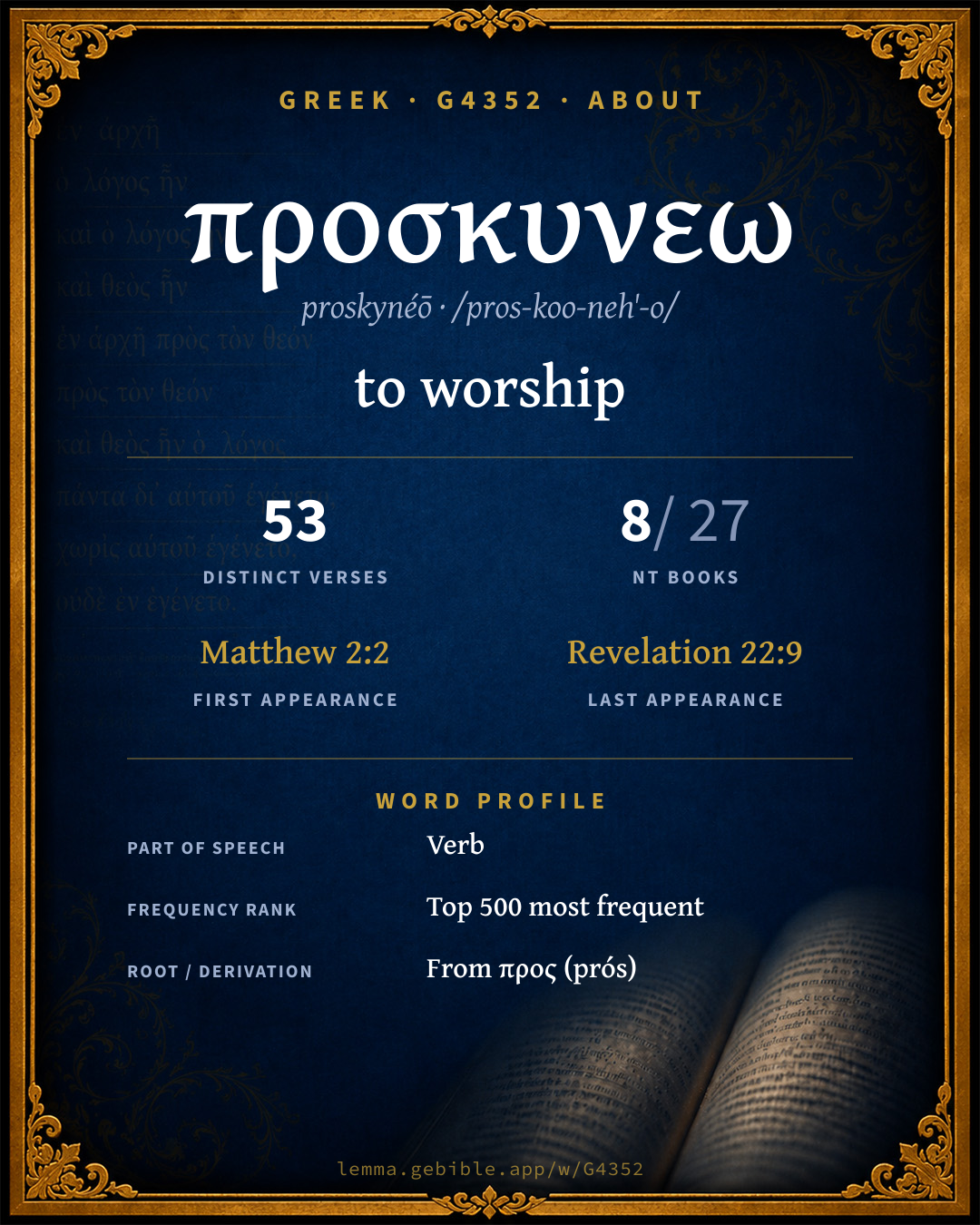
προσκυνέω
to worship
‘to worship’ is one of 3 main senses fuller range ↓
Full lexicon entry — Thayer's Greek Lexicon
From Thayer's Greek Lexicon
Where this word appears
See every Aorist-tense verb in the Greek New Testament →
Grammar key — what these labels mean
Part of speech
- Verb
- An action or state-of-being word.
Tense
- Aorist
- Action viewed as a simple whole, without regard to duration — often past (perfective aspect).
- Future
- Action expected in future time.
- Present
- Ongoing or general action in present time (imperfective aspect).
- Imperfect
- Continuous or repeated action in past time (“was writing”).
Voice
- Active
- The subject performs the action.
Mood
- Indicative
- States a fact or asks a factual question (the mood of reality).
- Participle
- A verbal adjective (“writing,” “having written”).
- Infinitive
- A verbal noun (“to write”), unmarked for person or number.
- Imperative
- Expresses a command or request.
- Subjunctive
- Expresses probability, purpose, or possibility (the mood of contingency).
Case
- Accusative
- The case of the direct object and of extent.
- Nominative
- The case of the subject (and the predicate nominative).
Person
- 3rd person
- The one spoken about (“he / she / it / they”).
- 2nd person
- The one addressed (“you”).
- 1st person
- The speaker (“I / we”).
Gender
- Masculine
- Grammatically masculine.
- Feminine
- Grammatically feminine.
Number
- Plural
- More than one.
- Singular
- One.
Grammatical forms 23 distinct
- Verb, Aorist, Active, Indicative, 3rd person, Plural 12 times (20%)
- Verb, Future, Active, Indicative, 3rd person, Plural 8 times (14%)
- Verb, Present, Active, Participle, Accusative, Plural, Masculine 5 times (8%)
- Verb, Aorist, Active, Indicative, 3rd person, Singular 4 times (7%)
- Verb, Imperfect, Active, Indicative, 3rd person, Singular 4 times (7%)
- Verb, Aorist, Active, Infinitive 3 times (5%)
- Verb, Present, Active, Infinitive 3 times (5%)
- Verb, Aorist, Active, Imperative, 2nd person, Singular 2 times (3%)
+15 more forms (18 occurrences)
Parsed forms decoded from the imported morphology (Robinson–Tischendorf, public domain), counted across 59 parsed occurrences — not distinct verses.
Every verse where G4352 appears — 53 distinct verses across 8 books. Click any verse to open its interlinear word-by-word view. Verse text shown in the World English Bible for context — . Each verse’s Greek form is shown with its reference; the English is not keyword-highlighted, since the data carries no word-level English alignment. Use “Compare translations” on any verse to read it across multiple English versions. This concordance covers the Greek New Testament; Septuagint (Greek Old Testament) occurrences of this word are not indexed here.
Matthew 13 verses
- Matthew 2:2 προσκυνῆσαι aor act inf "Where is he who is born King of the Jews? For we saw his star in the east, and have come to worship him."
- Matthew 2:8 προσκυνήσω aor act subj 1sg He sent them to Bethlehem, and said, "Go and search diligently for the young child. When you have found him, bring me word, so that I also may come and worship him."
- Matthew 2:11 προσεκύνησαν aor act ind 3pl They came into the house and saw the young child with Mary, his mother, and they fell down and worshiped him. Opening their treasures, they offered to him gifts: gold, frankincense, and myrrh.
- Matthew 4:9 προσκυνήσῃς aor act subj 2sg He said to him, "I will give you all of these things, if you will fall down and worship me."
- Matthew 4:10 προσκυνήσεις fut act ind 2sg Then Jesus said to him, "Get behind me, Satan! For it is written, 'You shall worship the Lord your God, and him only shall you serve.'"
- Matthew 8:2 προσεκύνει impf act ind 3sg Behold, a leper came to him and worshiped him, saying, "Lord, if you want to, you can make me clean."
- Matthew 9:18 προσεκύνει impf act ind 3sg While he told these things to them, behold, a ruler came and worshiped him, saying, "My daughter has just died, but come and lay your hand on her, and she will live."
- Matthew 14:33 προσεκύνησαν aor act ind 3pl Those who were in the boat came and worshiped him, saying, "You are truly the Son of God!"
- Matthew 15:25 προσεκύνει impf act ind 3sg But she came and worshiped him, saying, "Lord, help me."
- Matthew 18:26 προσεκύνει impf act ind 3sg The servant therefore fell down and kneeled before him, saying, 'Lord, have patience with me, and I will repay you all!'
- Matthew 20:20 προσκυνοῦσα pres act ptcp nom sg fem Then the mother of the sons of Zebedee came to him with her sons, kneeling and asking a certain thing of him.
- Matthew 28:9 προσεκύνησαν aor act ind 3pl As they went to tell his disciples, behold, Jesus met them, saying, "Rejoice!" They came and took hold of his feet, and worshiped him.
- Matthew 28:17 προσεκύνησαν aor act ind 3pl When they saw him, they bowed down to him, but some doubted.
Mark 2 verses
Luke 2 verses
John 7 verses
- John 4:20 προσεκύνησαν προσκυνεῖν aor act ind 3pl pres act inf Our fathers worshiped in this mountain, and you Jews say that in Jerusalem is the place where people ought to worship."
- John 4:21 προσκυνήσετε fut act ind 2pl Jesus said to her, "Woman, believe me, the hour comes, when neither in this mountain, nor in Jerusalem, will you worship the Father.
- John 4:22 προσκυνεῖτε προσκυνοῦμεν pres act ind 2pl pres act ind 1pl You worship that which you don't know. We worship that which we know; for salvation is from the Jews.
- John 4:23 προσκυνήσουσιν προσκυνοῦντας fut act ind 3pl pres act ptcp acc pl masc But the hour comes, and now is, when the true worshippers will worship the Father in spirit and truth, for the Father seeks such to be his worshippers.
- John 4:24 προσκυνοῦντας προσκυνεῖν pres act ptcp acc pl masc pres act inf God is spirit, and those who worship him must worship in spirit and truth."
- John 9:38 προσεκύνησεν aor act ind 3sg He said, "Lord, I believe!" and he worshiped him.
- John 12:20 προσκυνήσωσιν aor act subj 3pl Now there were certain Greeks among those that went up to worship at the feast.
Acts 4 verses
- Acts 7:43 προσκυνεῖν pres act inf You took up the tent of Moloch, The star of your god Rephan, The figures which you made to worship. I will carry you away beyond Babylon.'
- Acts 8:27 προσκυνήσων fut act ptcp nom sg masc He arose and went; and behold, there was a man of Ethiopia, a eunuch of great authority under Candace, queen of the Ethiopians, who was over all her treasure, who had come to Jerusalem to worship.
- Acts 10:25 προσεκύνησεν aor act ind 3sg When it happened that Peter entered, Cornelius met him, fell down at his feet, and worshiped him.
- Acts 24:11 προσκυνήσων fut act ptcp nom sg masc seeing that you can recognize that it is not more than twelve days since I went up to worship at Jerusalem.
1 Corinthians 1 verse
Hebrews 2 verses
- Hebrews 1:6 προσκυνησάτωσαν aor act impv 3pl Again, when he brings in the firstborn into the world he says, "Let all the angels of God worship him."
- Hebrews 11:21 προσεκύνησεν aor act ind 3sg By faith, Jacob, when he was dying, blessed each of the sons of Joseph, and worshiped, leaning on the top of his staff.
Revelation 22 verses
- Revelation 3:9 προσκυνήσουσιν fut act ind 3pl Behold, I give of the synagogue of Satan, of those who say they are Jews, and they are not, but lie. Behold, I will make them to come and worship before your feet, and to know that I have loved you.
- Revelation 4:10 προσκυνήσουσιν fut act ind 3pl the twenty-four elders fall down before him who sits on the throne, and worship him who lives forever and ever, and throw their crowns before the throne, saying,
- Revelation 5:14 προσεκύνησαν aor act ind 3pl The four living creatures said, "Amen!" The elders fell down and worshiped.
- Revelation 7:11 προσεκύνησαν aor act ind 3pl All the angels were standing around the throne, the elders, and the four living creatures; and they fell on their faces before his throne, and worshiped God,
- Revelation 9:20 προσκυνήσουσιν fut act ind 3pl The rest of mankind, who were not killed with these plagues, didn't repent of the works of their hands, that they wouldn't worship demons, and the idols of gold, and of silver, and of brass, and of stone, and of wood; which can neither see, nor hear, nor walk.
- Revelation 11:1 προσκυνοῦντας pres act ptcp acc pl masc A reed like a rod was given to me. Someone said, "Rise, and measure God's temple, and the altar, and those who worship in it.
- Revelation 11:16 προσεκύνησαν aor act ind 3pl The twenty-four elders, who sit on their thrones before God's throne, fell on their faces and worshiped God,
- Revelation 13:4 προσεκύνησαν προσεκύνησαν aor act ind 3pl aor act ind 3pl They worshiped the dragon, because he gave his authority to the beast, and they worshiped the beast, saying, "Who is like the beast? Who is able to make war with him?"
- Revelation 13:8 προσκυνήσουσιν fut act ind 3pl All who dwell on the earth will worship him, everyone whose name has not been written from the foundation of the world in the book of life of the Lamb who has been killed.
- Revelation 13:12 προσκυνήσουσιν fut act ind 3pl He exercises all the authority of the first beast in his presence. He makes the earth and those who dwell in it to worship the first beast, whose fatal wound was healed.
- Revelation 13:15 προσκυνήσουσιν fut act ind 3pl It was given to him to give breath to it, to the image of the beast, that the image of the beast should both speak, and cause as many as wouldn't worship the image of the beast to be killed.
- Revelation 14:7 προσκυνήσατε aor act impv 2pl He said with a loud voice, "Fear the Lord, and give him glory; for the hour of his judgment has come. Worship him who made the heaven, the earth, the sea, and the springs of waters!"
- Revelation 14:9 προσκυνεῖ pres act ind 3sg Another angel, a third, followed them, saying with a great voice, "If anyone worships the beast and his image, and receives a mark on his forehead, or on his hand,
- Revelation 14:11 προσκυνοῦντες pres act ptcp nom pl masc The smoke of their torment goes up forever and ever. They have no rest day and night, those who worship the beast and his image, and whoever receives the mark of his name.
- Revelation 15:4 προσκυνήσουσιν fut act ind 3pl Who wouldn't fear you, Lord, And glorify your name? For you only are holy. For all the nations will come and worship before you. For your righteous acts have been revealed."
- Revelation 16:2 προσκυνοῦντας pres act ptcp acc pl masc The first went, and poured out his bowl into the earth, and it became a harmful and evil sore on the people who had the mark of the beast, and who worshiped his image.
- Revelation 19:4 προσεκύνησαν aor act ind 3pl The twenty-four elders and the four living creatures fell down and worshiped God who sits on the throne, saying, "Amen! Hallelujah!"
- Revelation 19:10 προσκυνῆσαι προσκύνησον aor act inf aor act impv 2sg I fell down before his feet to worship him. He said to me, "Look! Don't do it! I am a fellow bondservant with you and with your brothers who hold the testimony of Jesus. Worship God, for the testimony of Jesus is the Spirit of Prophecy."
- Revelation 19:20 προσκυνοῦντας pres act ptcp acc pl masc The beast was taken, and with him the false prophet who worked the signs in his sight, with which he deceived those who had received the mark of the beast and those who worshiped his image. These two were thrown alive into the lake of fire that burns with sulfur.
- Revelation 20:4 προσεκύνησαν aor act ind 3pl I saw thrones, and they sat on them, and judgment was given to them. I saw the souls of those who had been beheaded for the testimony of Jesus, and for the word of God, and such as didn't worship the beast nor his image, and didn't receive the mark on their forehead and on their hand. They lived, and reigned with Christ for the thousand years.
- Revelation 22:8 προσκυνῆσαι aor act inf Now I, John, am the one who heard and saw these things. When I heard and saw, I fell down to worship before the feet of the angel who had shown me these things.
- Revelation 22:9 προσκύνησον aor act impv 2sg He said to me, "See you don't do it! I am a fellow bondservant with you and with your brothers, the prophets, and with those who keep the words of this book. Worship God."
About this entry
At a glance — auto-summarized from this page’s data, not written by a person. Every figure links to its source below. This summary describes the numbers; it doesn’t interpret them.
προσκυνεω (proskynéō) is a Greek verb most often rendered “to worship.” The King James Version also renders it “worshipped,” a usage modern versions have dropped for “worship” — see the renderings breakdown. It turns up in 53 verses across 8 books, a moderately common footprint. It concentrates in Revelation, which alone accounts for 42% of its uses. Ranging over 3 senses, it is not a single-sense word. For the data behind this summary, explore the sense tree and the renderings breakdown below.
Gloss history
Strong's 1890 vs modern scholarship
About this word
Strong's G4352 catalogs a Greek word from the Greek New Testament.
These counts are not copied from any lexicon or concordance. They are computed here, from the morphology-tagged Greek New Testament. What Lemma adds →
- 53
- distinct verses
- The word appears in 53 distinct verses.
- 8 / 27
- NT books
- The word appears in 8 of 27 New Testament books.
- #275
- by frequency
- Top 500 most frequent Greek words (rank 275 of 5,347 Greek words by occurrence).
View all 53 occurrences in the concordance →
Most concentrated in
- Revelation 22 verses 42%
- Matthew 13 verses 25%
- John 7 verses 13%
By section of the New Testament
By traditional corpus
Conventional, traditional groupings — biblical authorship is debated, so this is a traditional corpus grouping, not an authorship claim. Some books belong to more than one corpus (Luke is in both the Gospels and the Lukan corpus, and so on), so these shares overlap and need not total 100%. Each figure is a share of the word’s 53 distinct verses.
- Johannine 29 verses · 55%
- Gospels 24 verses · 45%
- Revelation 22 verses · 42%
- Lukan (Luke–Acts) 6 verses · 11%
- Hebrews 2 verses · 4%
- Pauline corpus 1 verse · 2%
How translations render this word
Counts come from each version’s own published word-to-Strong’s tagging or interlinear alignment — an approximate guide to how each version renders this word, not a word-level alignment the data otherwise carries. Because each total is that version’s own tagged count, the per-version totals vary from one another and need not match the appearance or distinct-verse counts above. These counts may also differ from a printed concordance because Lemma counts each distinctly tagged rendering and does not collapse phrase taggings into a single head-word total. This is a fixed set of word-tagged versions (KJV, ASV, BSB, ULT) and does not change with the reading translation you choose elsewhere. Each version’s license is shown beside its name below (and on Sources).
- King James Version: Worship 28×, Worshipped 20×, They worshipped 3×
- American Standard Version: Worship 24×, Worshipped 17×, Shall worship 3×
- Berean Standard Bible: Worship 26×, Worshiped 12×, Knelt before 2×
- unfoldingWord Literal Text: Worship 19×, Worshiped 8×, Ones worshiping 4×
King James Version Public Domain
Renders G4352 across 64 tagged occurrences — most commonly:
Plus 9 renderings that appear only once — usually multi-word phrases or single function words the recovered tagging swept in, not distinct renderings. Not rendered by a distinct English word in 1 further occurrence.
American Standard Version Public Domain
Renders G4352 across 63 tagged occurrences — most commonly:
Plus 14 renderings that appear only once — usually multi-word phrases or single function words the recovered tagging swept in, not distinct renderings.
Berean Standard Bible Public Domain
Renders G4352 across 60 tagged occurrences — most commonly:
Plus 14 renderings that appear only once — usually multi-word phrases or single function words the recovered tagging swept in, not distinct renderings.
unfoldingWord Literal Text CC BY-SA 4.0
Renders G4352 across 65 tagged occurrences — most commonly:
Plus 21 renderings that appear only once — usually multi-word phrases or single function words the recovered tagging swept in, not distinct renderings.
Senses in Thayer's
The 3 senses Thayer's distinguishes for this word, in lexicon order (not ranked by frequency or importance). The full entry — with sub-senses — is in the Lexicon Entry tab.
- to kiss the hand to (towards) one, in token of reverence
- among the Orientals…
- in the NT by kneeling or prostration to do homage (to one) or make obeisance…
Word origin
Derived from προς (prós) (G4314).
Forms in the corpus
The 23 distinct written forms G4352 takes in the Greek New Testament, most frequent first — each parse links to that tense’s occurrences in the concordance.
Same root — word family
Other Thayer's entries built from the same root as G4352, grouped by Strong’s listed origin. These share a root / origin per the lexicon — not necessarily a shared meaning. Each links to that word’s own entry.
Derives from
Shares the same root
- προσαγορευω prosagoreúō G4316 to address
- προσαγω proságō G4317 to bring
- προσαιτεω prosaitéō G4319 to ask alms
- προσαναβαινω prosanabaínō G4320 to go up higher
- προσαναλισκω prosanalískō G4321 to spend additionally
- προσαναπληροω prosanaplēróō G4322 to fill up
- προσανατιθημι prosanatíthēmi G4323 to lay upon
- προσαπειλεω prosapeiléō G4324 to threaten further
- προσδαπαναω prosdapanáō G4325 to spend besides
- προσδεομαι prosdéomai G4326 to need additionally
- προσδεχομαι prosdéchomai G4327 to receive to oneself
- προσδοκαω prosdokáō G4328 to expect
- προσεαω proseáō G4330 to permit approach
- προσεγγιζω prosengízō G4331 to approach
- προσεδρευω prosedreúō G4332 to sit near
- προσεργαζομαι prosergázomai G4333 to work besides
- προσερχομαι prosérchomai G4334 to draw near
- προσευχομαι proseúchomai G4336 to pray
- προσεχω proséchō G4337 to attend to
- προσηλοω prosēlóō G4338 to nail to
- προσκαιρος próskairos G4340 temporary
- προσκαλεομαι proskaléomai G4341 to call to
- προσκαρτερεω proskarteréō G4342 to adhere to
- προσκεφαλαιον proskephálaion G4344 pillow
+27 more words share this root (not shown).
Derived from this word
Compare all same-root words → Showing 4 of 54 — not the complete family. They share a root, not necessarily a meaning.
Septuagint usage
The same Greek word προσκυνεω appears 181 times in the Greek Old Testament (Septuagint), across 174 verses in 25 books.
- 181
- LXX occurrences
- Tagged occurrences of this Greek word in the Septuagint.
- 174
- verses
- Distinct Septuagint verses containing this word.
- 25 / 39
- OT books
- The word appears in 25 of the 39 Old Testament books.
Sample Septuagint occurrences
- Genesis 18:2 προςκυνέω
- Exodus 4:31 προςκυνέω
- Leviticus 26:1 προςκυνέω
- Numbers 22:31 προςκυνέω
- Deuteronomy 4:19 προςκυνέω
- Joshua 23:7 προςκυνέω
- Judges 2:2 προςκυνέω
- Ruth 2:10 προςκυνέω
- 1 Samuel 1:3 προςκυνέω
- 2 Samuel 1:2 προςκυνέω
- 1 Kings 1:16 προςκυνέω
- 2 Kings 2:15 προςκυνέω
Septuagint occurrences (same lexeme)
Every verse where the same Strong’s number (G4352) appears in the Greek Septuagint — showing the first 50 of 174. Verse text shown in the World English Bible for context; the Greek form is the matched word — the English is not keyword-highlighted.
- Genesis 18:2 προςκυνέω He lifted up his eyes and looked, and saw that three men stood opposite him. When he saw them, he ran to meet them from the tent door, and bowed himself to the earth,
- Genesis 19:1 προςκυνέω The two angels came to Sodom at evening. Lot sat in the gate of Sodom. Lot saw them, and rose up to meet them. He bowed himself with his face to the earth,
- Genesis 22:5 προςκυνέω Abraham said to his young men, "Stay here with the donkey. The boy and I will go yonder. We will worship, and come back to you.
- Genesis 23:7 προςκυνέω Abraham rose up, and bowed himself to the people of the land, even to the children of Heth.
- Genesis 23:12 προςκυνέω Abraham bowed himself down before the people of the land.
- Genesis 24:26 προςκυνέω The man bowed his head, and worshiped Yahweh.
- Genesis 24:48 προςκυνέω I bowed my head, and worshiped Yahweh, and blessed Yahweh, the God of my master Abraham, who had led me in the right way to take my master's brother's daughter for his son.
- Genesis 24:52 προςκυνέω It happened that when Abraham's servant heard their words, he bowed himself down to the earth to Yahweh.
- Genesis 27:29 προςκυνέω Let peoples serve you, Nations bow down to you. Be lord over your brothers, Let your mother's sons bow down to you. Cursed be everyone who curses you, Blessed be everyone who blesses you."
- Genesis 33:3 προςκυνέω He himself passed over in front of them, and bowed himself to the ground seven times, until he came near to his brother.
- Genesis 33:6 προςκυνέω Then the handmaids came near with their children, and they bowed themselves.
- Genesis 33:7 προςκυνέω Leah also and her children came near, and bowed themselves. After them, Joseph came near with Rachel, and they bowed themselves.
- Genesis 37:7 προςκυνέω for, behold, we were binding sheaves in the field, and behold, my sheaf arose and also stood upright; and behold, your sheaves came around, and bowed down to my sheaf."
- Genesis 37:9 προςκυνέω He dreamed yet another dream, and told it to his brothers, and said, "Behold, I have dreamed yet another dream: and behold, the sun and the moon and eleven stars bowed down to me."
- Genesis 37:10 προςκυνέω He told it to his father and to his brothers. His father rebuked him, and said to him, "What is this dream that you have dreamed? Will I and your mother and your brothers indeed come to bow ourselves down to you to the earth?"
- Genesis 42:6 προςκυνέω Joseph was the governor over the land. It was he who sold to all the people of the land. Joseph's brothers came, and bowed themselves down to him with their faces to the earth.
- Genesis 43:26 προςκυνέω When Joseph came home, they brought him the present which was in their hand into the house, and bowed down themselves to him to the earth.
- Genesis 43:28 προςκυνέω They said, "Your servant, our father, is well. He is still alive." They bowed the head, and did homage.
- Genesis 47:31 προςκυνέω He said, "Swear to me," and he swore to him. Israel bowed himself on the bed's head.
- Genesis 48:12 προςκυνέω Joseph brought them out from between his knees, and he bowed himself with his face to the earth.
- Genesis 49:8 προςκυνέω "Judah, your brothers will praise you: Your hand will be on the neck of your enemies; Your father's sons will bow down before you.
- Exodus 4:31 προςκυνέω The people believed, and when they heard that Yahweh had visited the children of Israel, and that he had seen their affliction, then they bowed their heads and worshiped.
- Exodus 12:27 προςκυνέω that you shall say, 'It is the sacrifice of Yahweh's Passover, who passed over the houses of the children of Israel in Egypt, when he struck the Egyptians, and spared our houses.'" The people bowed their heads and worshiped.
- Exodus 18:7 προςκυνέω Moses went out to meet his father-in-law, and bowed and kissed him. They asked each other of their welfare, and they came into the tent.
- Exodus 20:5 προςκυνέω you shall not bow yourself down to them, nor serve them, for I, Yahweh your God, am a jealous God, visiting the iniquity of the fathers on the children, on the third and on the fourth generation of those who hate me,
- Exodus 23:24 προςκυνέω You shall not bow down to their gods, nor serve them, nor follow their practices, but you shall utterly overthrow them and demolish their pillars.
- Exodus 24:1 προςκυνέω He said to Moses, "Come up to Yahweh, you, and Aaron, Nadab, and Abihu, and seventy of the elders of Israel; and worship from a distance.
- Exodus 32:8 προςκυνέω They have turned aside quickly out of the way which I commanded them. They have made themselves a molten calf, and have worshiped it, and have sacrificed to it, and said, 'These are your gods, Israel, which brought you up out of the land of Egypt.'"
- Exodus 33:10 προςκυνέω All the people saw the pillar of cloud stand at the door of the Tent, and all the people rose up and worshiped, everyone at their tent door.
- Exodus 34:8 προςκυνέω Moses hurried and bowed his head toward the earth, and worshiped.
- Exodus 34:14 προςκυνέω for you shall worship no other god: for Yahweh, whose name is Jealous, is a jealous God.
- Leviticus 26:1 προςκυνέω "'You shall make for yourselves no idols, neither shall you raise up an engraved image or a pillar, neither shall you place any figured stone in your land, to bow down to it: for I am Yahweh your God.
- Numbers 22:31 προςκυνέω Then Yahweh opened the eyes of Balaam, and he saw the angel of Yahweh standing in the way, with his sword drawn in his hand; and he bowed his head, and fell on his face.
- Numbers 25:2 προςκυνέω for they called the people to the sacrifices of their gods; and the people ate, and bowed down to their gods.
- Deuteronomy 4:19 προςκυνέω and lest you lift up your eyes to the sky, and when you see the sun and the moon and the stars, even all the host of the sky, you are drawn away and worship them, and serve them, which Yahweh your God has allotted to all the peoples under the whole sky.
- Deuteronomy 5:9 προςκυνέω you shall not bow down yourself to them, nor serve them; for I, Yahweh, your God, am a jealous God, visiting the iniquity of the fathers on the children, and on the third and on the fourth generation of those who hate me;
- Deuteronomy 8:19 προςκυνέω It shall be, if you shall forget Yahweh your God, and walk after other gods, and serve them, and worship them, I testify against you this day that you shall surely perish.
- Deuteronomy 11:16 προςκυνέω Take heed to yourselves, lest your heart be deceived, and you turn aside, and serve other gods, and worship them;
- Deuteronomy 17:3 προςκυνέω and has gone and served other gods, and worshiped them, or the sun, or the moon, or any of the host of the sky, which I have not commanded;
- Deuteronomy 26:10 προςκυνέω Now, behold, I have brought the first of the fruit of the ground, which you, Yahweh, have given me. You shall set it down before Yahweh your God, and worship before Yahweh your God:
- Deuteronomy 29:25 προςκυνέω Then men shall say, Because they forsook the covenant of Yahweh, the God of their fathers, which he made with them when he brought them forth out of the land of Egypt,
- Deuteronomy 30:17 προςκυνέω But if your heart turn away, and you will not hear, but shall be drawn away, and worship other gods, and serve them;
- Deuteronomy 32:43 προςκυνέω Rejoice, you nations, [with] his people: For he will avenge the blood of his servants, Will render vengeance to his adversaries, Will make expiation for his land, for his people.
- Joshua 23:7 προςκυνέω that you not come among these nations, these that remain among you; neither make mention of the name of their gods, nor cause to swear [by them], neither serve them, nor bow down yourselves to them;
- Joshua 23:16 προςκυνέω When you disobey the covenant of Yahweh your God, which he commanded you, and go and serve other gods, and bow down yourselves to them; then will the anger of Yahweh be kindled against you, and you shall perish quickly from off the good land which he has given to you.
- Judges 2:2 προςκυνέω and you shall make no covenant with the inhabitants of this land; you shall break down their altars. But you have not listened to my voice: why have you done this?
- Judges 2:12 προςκυνέω and they forsook Yahweh, the God of their fathers, who brought them out of the land of Egypt, and followed other gods, of the gods of the peoples who were round about them, and bowed themselves down to them: and they provoked Yahweh to anger.
- Judges 2:17 προςκυνέω Yet they didn't listen to their judges; for they played the prostitute after other gods, and bowed themselves down to them: they turned aside quickly out of the way in which their fathers walked, obeying the commandments of Yahweh; [but] they didn't do so.
- Judges 2:19 προςκυνέω But it happened, when the judge was dead, that they turned back, and dealt more corruptly than their fathers, in following other gods to serve them, and to bow down to them; they didn't cease from their doings, nor from their stubborn way.
- Judges 7:15 προςκυνέω It was so, when Gideon heard the telling of the dream, and the interpretation of it, that he worshiped; and he returned into the camp of Israel, and said, Arise; for Yahweh has delivered into your hand the host of Midian.
These are occurrences of the same Greek lexeme (G4352) in the Septuagint — not a translation of any one Hebrew word. The store carries no word-level Hebrew↔Greek alignment, so no Hebrew original is asserted here. Counts come from the recovered LXX Strong's tagging — high-frequency vocabulary is well covered, while rare or late forms may be untagged — so they reflect tagged occurrences and may slightly undercount.