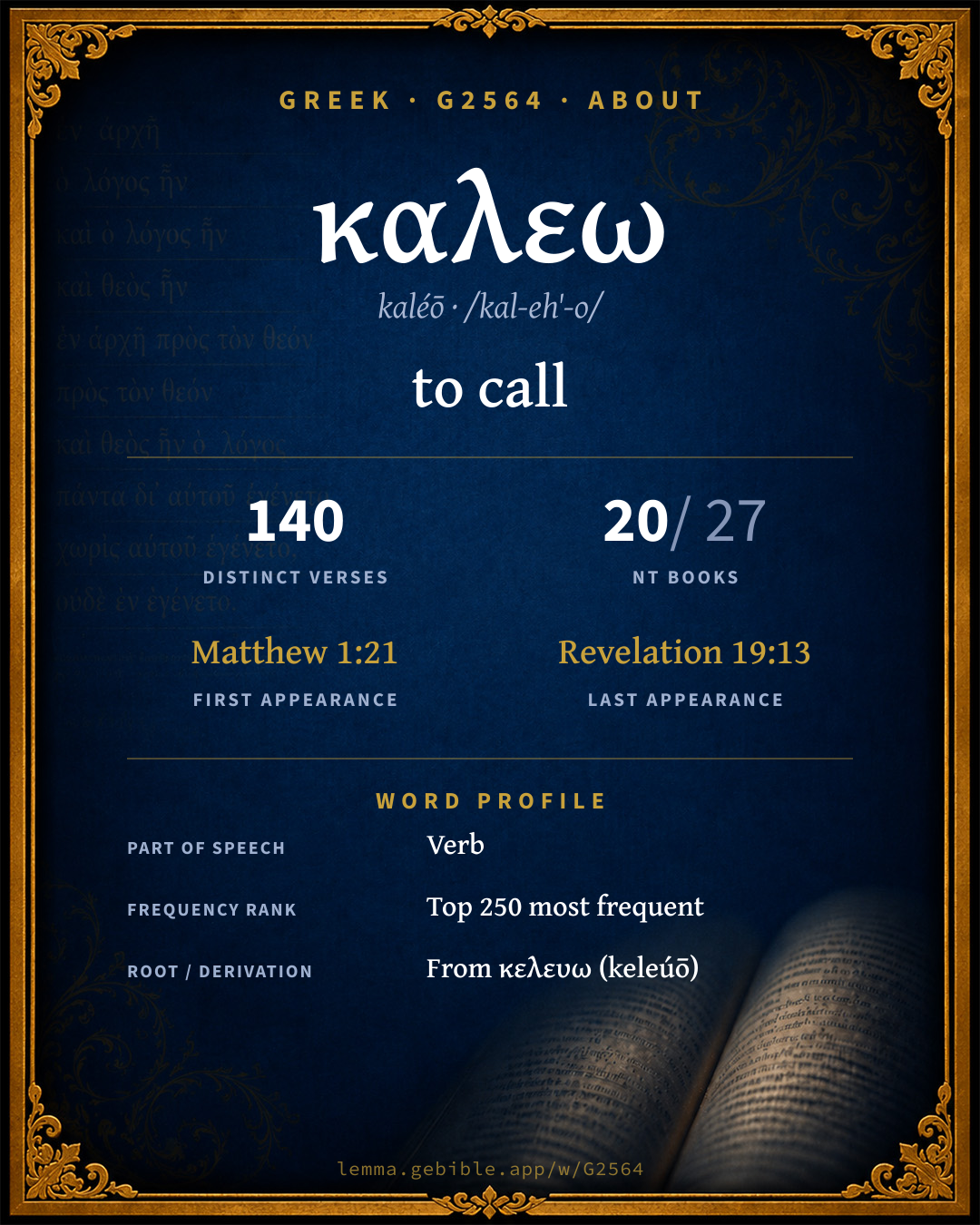
καλέω
to call
‘to call’ is one of 3 main senses fuller range ↓
Full lexicon entry — Thayer's Greek Lexicon
From Thayer's Greek Lexicon
Where this word appears
See every Aorist-tense verb in the Greek New Testament →
Grammar key — what these labels mean
Part of speech
- Verb
- An action or state-of-being word.
Tense
- Future
- Action expected in future time.
- Aorist
- Action viewed as a simple whole, without regard to duration — often past (perfective aspect).
- Present
- Ongoing or general action in present time (imperfective aspect).
- Perfect
- A completed past action with continuing present results.
- Imperfect
- Continuous or repeated action in past time (“was writing”).
Voice
- Passive
- The subject receives the action.
- Active
- The subject performs the action.
Mood
- Indicative
- States a fact or asks a factual question (the mood of reality).
- Participle
- A verbal adjective (“writing,” “having written”).
- Infinitive
- A verbal noun (“to write”), unmarked for person or number.
- Subjunctive
- Expresses probability, purpose, or possibility (the mood of contingency).
- Imperative
- Expresses a command or request.
Case
- Accusative
- The case of the direct object and of extent.
- Nominative
- The case of the subject (and the predicate nominative).
- Genitive
- The case of source, possession, or “of” — answers “whose / from what.”
- Dative
- The case of the indirect object, means, or location — “to / for / with / in.”
Person
- 3rd person
- The one spoken about (“he / she / it / they”).
- 2nd person
- The one addressed (“you”).
- 1st person
- The speaker (“I / we”).
Gender
- Masculine
- Grammatically masculine.
- Feminine
- Grammatically feminine.
- Neuter
- Grammatically neuter.
Number
- Singular
- One.
- Plural
- More than one.
1 verse where G2564 appears in the Present tense in the Book of 1 Peter. Filtered view — show all forms. Click any verse to open its interlinear word-by-word view. Verse text shown in the World English Bible for context — . Each verse’s Greek form is shown with its reference; the English is not keyword-highlighted, since the data carries no word-level English alignment. Use “Compare translations” on any verse to read it across multiple English versions. This concordance covers the Greek New Testament; Septuagint (Greek Old Testament) occurrences of this word are not indexed here.
1 Peter
About this entry
At a glance — auto-summarized from this page’s data, not written by a person. Every figure links to its source below. This summary describes the numbers; it doesn’t interpret them.
At its core, καλεω (kaléō) means “to call.” Scripture first uses it in Matthew 1:21. Spanning 140 verses in 20 books, it ranks among the common words of the Greek New Testament. Its uses concentrate in Luke (29% of all occurrences). Catalogued under 3 senses, its meaning is not single-sense. Each statement above links to its evidence; the full detail follows below.
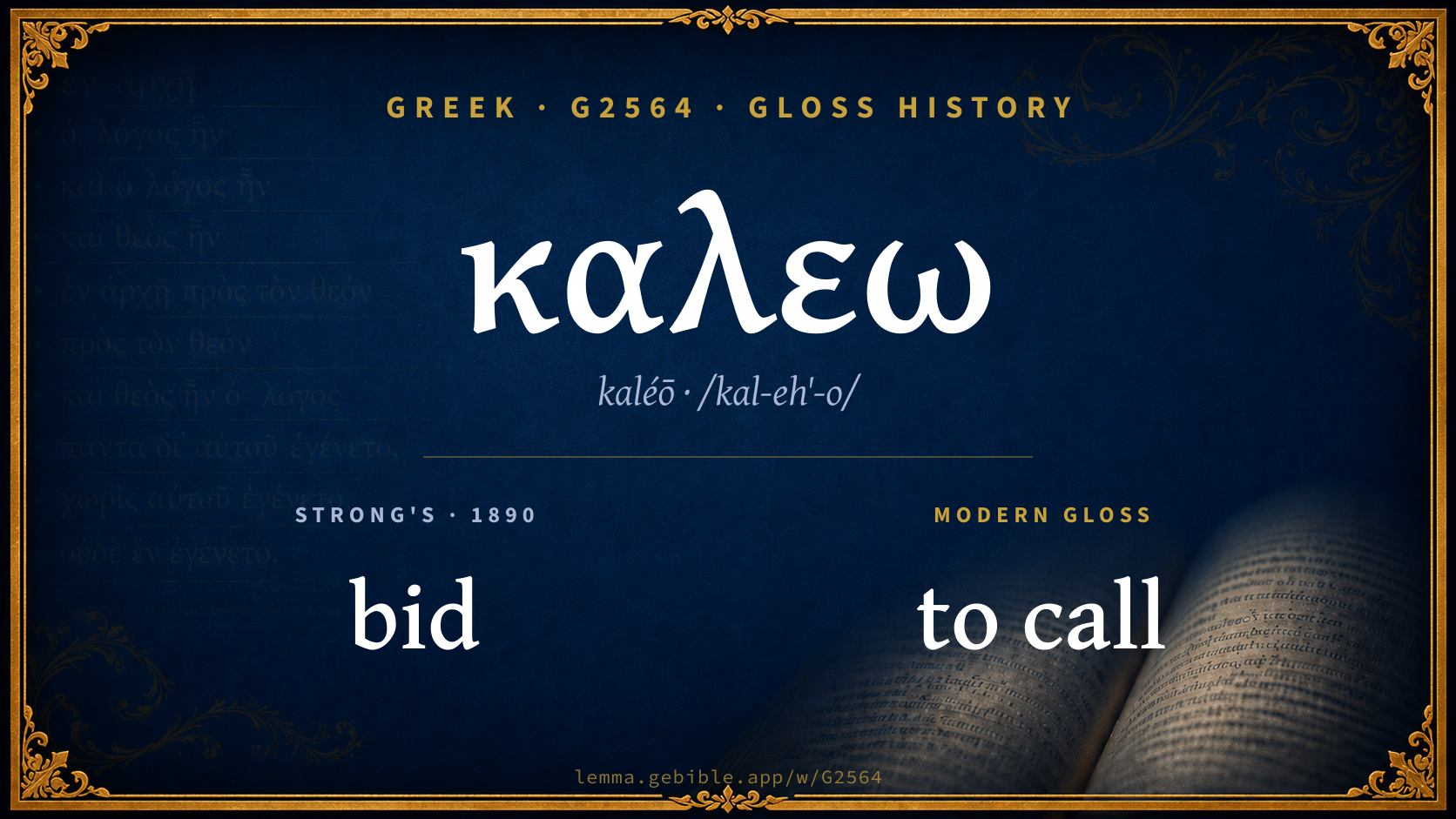
Gloss history
Strong's 1890 vs modern scholarship
About this word
Strong's G2564 catalogs a Greek word from the Greek New Testament.
These counts are not copied from any lexicon or concordance. They are computed here, from the morphology-tagged Greek New Testament. What Lemma adds →
- 140
- distinct verses
- The word appears in 140 distinct verses.
- 20 / 27
- NT books
- The word appears in 20 of 27 New Testament books.
- #108
- by frequency
- Top 250 most frequent Greek words (rank 108 of 5,347 Greek words by occurrence).
View all 140 occurrences in the concordance →
By section of the New Testament
By traditional corpus
Conventional, traditional groupings — biblical authorship is debated, so this is a traditional corpus grouping, not an authorship claim. Some books belong to more than one corpus (Luke is in both the Gospels and the Lukan corpus, and so on), so these shares overlap and need not total 100%. Each figure is a share of the word’s 140 distinct verses.
- Gospels 70 verses · 50%
- Lukan (Luke–Acts) 58 verses · 41%
- Pauline corpus 30 verses · 21%
- Johannine 10 verses · 7%
- General (Catholic) Epistles 9 verses · 6%
- Revelation 7 verses · 5%
- Hebrews 6 verses · 4%
How translations render this word
Counts come from each version’s own published word-to-Strong’s tagging or interlinear alignment — an approximate guide to how each version renders this word, not a word-level alignment the data otherwise carries. Because each total is that version’s own tagged count, the per-version totals vary from one another and need not match the appearance or distinct-verse counts above. These counts may also differ from a printed concordance because Lemma counts each distinctly tagged rendering and does not collapse phrase taggings into a single head-word total. This is a fixed set of word-tagged versions (KJV, ASV, BSB, ULT) and does not change with the reading translation you choose elsewhere. Each version’s license is shown beside its name below (and on Sources).
- King James Version: Called 25×, Is called 13×, Call 10×
- American Standard Version: Called 20×, Is called 13×, Was called 11×
- Berean Standard Bible: Called 33×, Will be called 9×, Call 7×
- unfoldingWord Literal Text: Called 28×, Will be called 11×, Call 10×
King James Version Public Domain
Renders G2564 across 154 tagged occurrences — most commonly:
Plus other, less common renderings. Plus 35 renderings that appear only once — usually multi-word phrases or single function words the recovered tagging swept in, not distinct renderings. Not rendered by a distinct English word in 1 further occurrence.
American Standard Version Public Domain
Renders G2564 across 153 tagged occurrences — most commonly:
Plus other, less common renderings. Plus 46 renderings that appear only once — usually multi-word phrases or single function words the recovered tagging swept in, not distinct renderings.
Berean Standard Bible Public Domain
Renders G2564 across 144 tagged occurrences — most commonly:
Plus other, less common renderings. Plus 42 renderings that appear only once — usually multi-word phrases or single function words the recovered tagging swept in, not distinct renderings. Not rendered by a distinct English word in 4 further occurrences.
unfoldingWord Literal Text CC BY-SA 4.0
Renders G2564 across 163 tagged occurrences — most commonly:
Plus other, less common renderings. Plus 35 renderings that appear only once — usually multi-word phrases or single function words the recovered tagging swept in, not distinct renderings.
Senses in Thayer's
The 3 senses Thayer's distinguishes for this word, in lexicon order (not ranked by frequency or importance). The full entry — with sub-senses — is in the Lexicon Entry tab.
- to call aloud, utter in a loud voice
- to invite
- to call i.e. to name, by name
Word origin
Derived from κελευω (keleúō) (G2753) — to command.
Akin to the base of G2753 ; to call (properly aloud but used in a variety of applications directly or otherwise): - bid call (forth) (whose whose sur-) name (was [called]).
— Strong’s Exhaustive Concordance (1890), public domain.
Forms in the corpus
The 56 distinct written forms G2564 takes in the Greek New Testament, most frequent first — each parse links to that tense’s occurrences in the concordance.
Same root — word family
Other Thayer's entries built from the same root as G2564, grouped by Strong’s listed origin. These share a root / origin per the lexicon — not necessarily a shared meaning. Each links to that word’s own entry.
Derives from
Shares the same root
Derived from this word
Compare all same-root words → Showing 4 of 5 — not the complete family. They share a root, not necessarily a meaning.
Septuagint usage
The same Greek word καλεω appears 398 times in the Greek Old Testament (Septuagint), across 374 verses in 29 books.
- 398
- LXX occurrences
- Tagged occurrences of this Greek word in the Septuagint.
- 374
- verses
- Distinct Septuagint verses containing this word.
- 29 / 39
- OT books
- The word appears in 29 of the 39 Old Testament books.
Sample Septuagint occurrences
- Genesis 1:5 καλέω
- Exodus 1:18 καλέω
- Leviticus 9:1 καλέω
- Numbers 11:3 καλέω
- Deuteronomy 5:1 καλέω
- Joshua 5:3 καλέω
- Judges 1:17 καλέω
- Ruth 1:20 καλέω
- 1 Samuel 1:20 καλέω
- 2 Samuel 1:7 καλέω
- 1 Kings 1:9 καλέω
- 2 Kings 1:9 καλέω
Septuagint occurrences (same lexeme)
Every verse where the same Strong’s number (G2564) appears in the Greek Septuagint — showing the first 50 of 374. Verse text shown in the World English Bible for context; the Greek form is the matched word — the English is not keyword-highlighted.
- Genesis 1:5 καλέω God called the light Day, and the darkness he called Night. There was evening and there was morning, one day.
- Genesis 1:8 καλέω God called the expanse sky. There was evening and there was morning, a second day.
- Genesis 1:10 καλέω God called the dry land Earth, and the gathering together of the waters he called Seas. God saw that it was good.
- Genesis 2:19 καλέω Out of the ground Yahweh God formed every animal of the field, and every bird of the sky, and brought them to the man to see what he would call them. Whatever the man called every living creature, that was its name.
- Genesis 2:20 καλέω The man gave names to all cattle, and to the birds of the sky, and to every animal of the field; but for man there was not found a helper suitable for him.
- Genesis 2:23 καλέω The man said, "This is now bone of my bones, and flesh of my flesh. She will be called Woman, because she was taken out of Man."
- Genesis 3:9 καλέω Yahweh God called to the man, and said to him, "Where are you?"
- Genesis 3:20 καλέω The man called his wife Eve, because she was the mother of all living.
- Genesis 11:9 καλέω Therefore the name of it was called Babel, because Yahweh confused the language of all the earth, there. From there, Yahweh scattered them abroad on the surface of all the earth.
- Genesis 12:18 καλέω Pharaoh called Abram, and said, "What is this that you have done to me? Why didn't you tell me that she was your wife?
- Genesis 16:11 καλέω The angel of Yahweh said to her, "Behold, you are with child, and will bear a son. You shall call his name Ishmael, because Yahweh has heard your affliction.
- Genesis 16:13 καλέω She called the name of Yahweh who spoke to her, "You are a God who sees," for she said, "Have I even stayed alive after seeing him?"
- Genesis 16:14 καλέω Therefore the well was called Beer Lahai Roi. Behold, it is between Kadesh and Bered.
- Genesis 16:15 καλέω Hagar bore a son for Abram. Abram called the name of his son, whom Hagar bore, Ishmael.
- Genesis 17:5 καλέω Neither will your name any more be called Abram, but your name will be Abraham; for the father of a multitude of nations have I made you.
- Genesis 17:15 καλέω God said to Abraham, "As for Sarai your wife, you shall not call her name Sarai, but her name will be Sarah.
- Genesis 17:19 καλέω God said, "No, but Sarah, your wife, will bear you a son. You shall call his name Isaac. I will establish my covenant with him for an everlasting covenant for his seed after him.
- Genesis 19:22 καλέω Hurry, escape there, for I can't do anything until you get there." Therefore the name of the city was called Zoar.
- Genesis 19:37 καλέω The firstborn bore a son, and named him Moab. The same is the father of the Moabites to this day.
- Genesis 19:38 καλέω The younger also bore a son, and called his name Ben Ammi. The same is the father of the children of Ammon to this day.
- Genesis 20:8 καλέω Abimelech rose early in the morning, and called all his servants, and told all these things in their ear. The men were very scared.
- Genesis 20:9 καλέω Then Abimelech called Abraham, and said to him, "What have you done to us? How have I sinned against you, that you have brought on me and on my kingdom a great sin? You have done deeds to me that ought not to be done!"
- Genesis 21:3 καλέω Abraham called his son who was born to him, whom Sarah bare to him, Isaac.
- Genesis 21:12 καλέω God said to Abraham, "Don't let it be grievous in your sight because of the boy, and because of your handmaid. In all that Sarah says to you, listen to her voice. For from Isaac will your seed be called.
- Genesis 21:17 καλέω God heard the voice of the boy. The angel of God called to Hagar out of the sky, and said to her, "What ails you, Hagar? Don't be afraid. For God has heard the voice of the boy where he is.
- Genesis 22:11 καλέω The angel of Yahweh called to him out of the sky, and said, "Abraham, Abraham!" He said, "Here I am."
- Genesis 22:14 καλέω Abraham called the name of that place Yahweh-Jireh. As it is said to this day, "In Yahweh's mountain it will be provided.
- Genesis 22:15 καλέω The angel of Yahweh called to Abraham a second time out of the sky,
- Genesis 24:57 καλέω They said, "We will call the young lady, and ask her."
- Genesis 24:58 καλέω They called Rebekah, and said to her, "Will you go with this man?" She said, "I will go."
- Genesis 25:26 καλέω After that, his brother came out, and his hand had hold on Esau's heel. He was named Jacob. Isaac was sixty years old when she bore them.
- Genesis 25:30 καλέω Esau said to Jacob, "Please feed me with that same red stew, for I am famished." Therefore his name was called Edom.
- Genesis 26:9 καλέω Abimelech called Isaac, and said, "Behold, surely she is your wife. Why did you say, 'She is my sister?'" Isaac said to him, "Because I said, 'Lest I die because of her.'"
- Genesis 26:20 καλέω The herdsmen of Gerar argued with Isaac's herdsmen, saying, "The water is ours." He called the name of the well Esek, because they contended with him.
- Genesis 26:33 καλέω He called it Shibah. Therefore the name of the city is Beersheba to this day.
- Genesis 27:1 καλέω It happened, that when Isaac was old, and his eyes were dim, so that he could not see, he called Esau his elder son, and said to him, "My son?" He said to him, "Here I am."
- Genesis 27:36 καλέω He said, "Isn't he rightly named Jacob? For he has supplanted me these two times. He took away my birthright. See, now he has taken away my blessing." He said, "Haven't you reserved a blessing for me?"
- Genesis 27:42 καλέω The words of Esau, her elder son, were told to Rebekah. She sent and called Jacob her younger son, and said to him, "Behold, your brother Esau comforts himself about you by planning to kill you.
- Genesis 28:19 καλέω He called the name of that place Bethel, but the name of the city was Luz at the first.
- Genesis 29:32 καλέω Leah conceived, and bore a son, and she named him Reuben. For she said, "Because Yahweh has looked at my affliction. For now my husband will love me."
- Genesis 29:33 καλέω She conceived again, and bare a son, and said, "Because Yahweh has heard that I am hated, he has therefore given me this son also." She named him Simeon.
- Genesis 29:34 καλέω She conceived again, and bare a son. Said, "Now this time will my husband be joined to me, because I have borne him three sons." Therefore was his name called Levi.
- Genesis 29:35 καλέω She conceived again, and bare a son. She said, "This time will I praise Yahweh." Therefore she named him Judah. Then she stopped bearing.
- Genesis 30:6 καλέω Rachel said, "God has judged me, and has also heard my voice, and has given me a son." Therefore called she his name Dan.
- Genesis 30:8 καλέω Rachel said, "With mighty wrestlings have I wrestled with my sister, and have prevailed." She named him Naphtali.
- Genesis 30:13 καλέω Leah said, "Happy am I, for the daughters will call me happy." She named him Asher.
- Genesis 30:18 καλέω Leah said, "God has given me my hire, because I gave my handmaid to my husband." She named him Issachar.
- Genesis 30:20 καλέω Leah said, "God has endowed me with a good dowry. Now my husband will live with me, because I have borne him six sons." She named him Zebulun.
- Genesis 30:21 καλέω Afterwards, she bore a daughter, and named her Dinah.
- Genesis 30:24 καλέω She named him Joseph, saying, "May Yahweh add another son to me."
These are occurrences of the same Greek lexeme (G2564) in the Septuagint — not a translation of any one Hebrew word. The store carries no word-level Hebrew↔Greek alignment, so no Hebrew original is asserted here. Counts come from the recovered LXX Strong's tagging — high-frequency vocabulary is well covered, while rare or late forms may be untagged — so they reflect tagged occurrences and may slightly undercount.