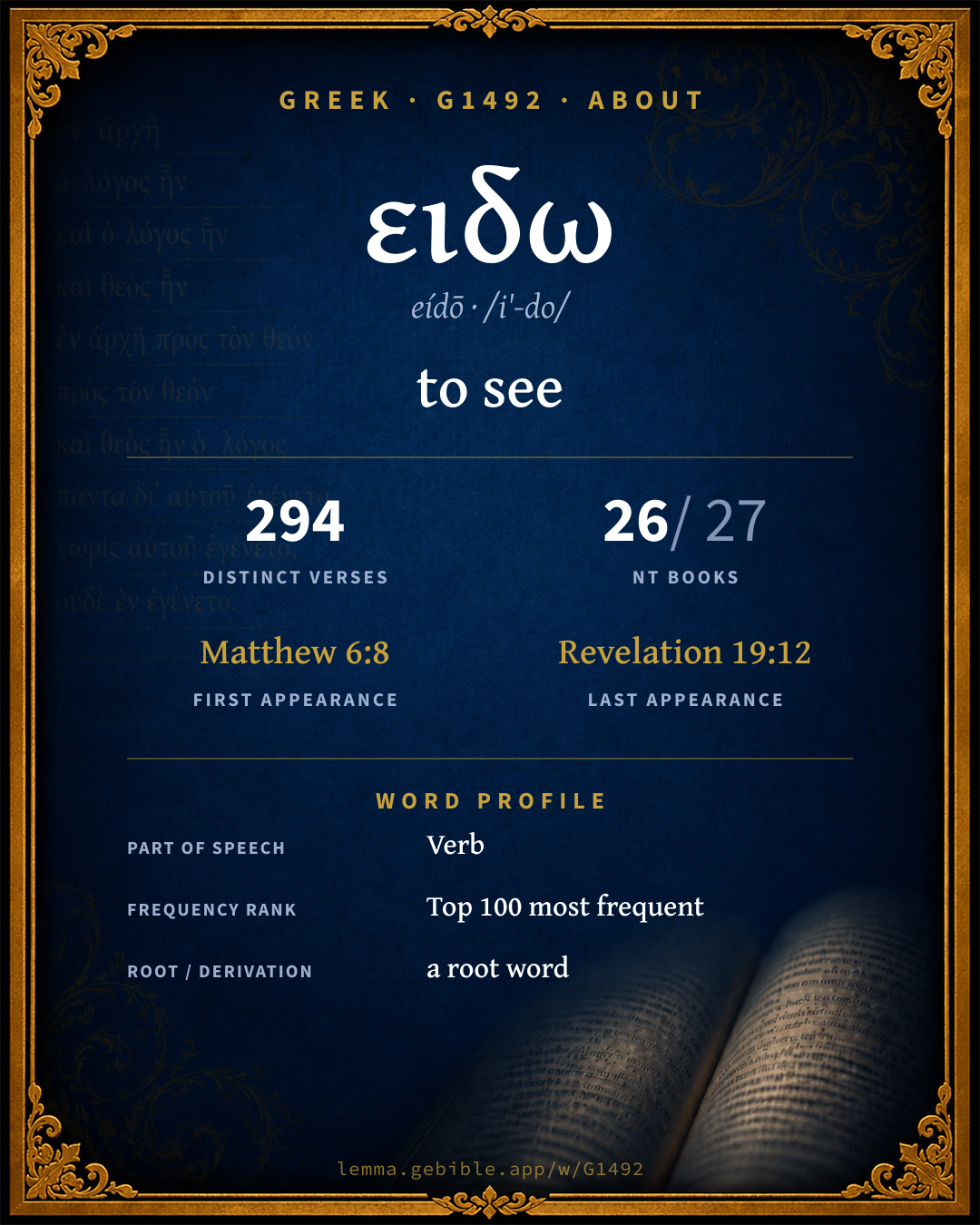
εἴδω
to see
‘to see’ is one of 8 main senses fuller range ↓
Full lexicon entry — Thayer's Greek Lexicon
From Thayer's Greek Lexicon
Where this word appears
Grammar key — what these labels mean
Part of speech
- Verb
- An action or state-of-being word.
Tense
- Perfect
- A completed past action with continuing present results.
- Pluperfect
- A past action completed before another past point (“had written”).
- Future
- Action expected in future time.
Voice
- Active
- The subject performs the action.
Mood
- Indicative
- States a fact or asks a factual question (the mood of reality).
- Participle
- A verbal adjective (“writing,” “having written”).
- Infinitive
- A verbal noun (“to write”), unmarked for person or number.
- Subjunctive
- Expresses probability, purpose, or possibility (the mood of contingency).
- Imperative
- Expresses a command or request.
Case
- Nominative
- The case of the subject (and the predicate nominative).
- Accusative
- The case of the direct object and of extent.
- Dative
- The case of the indirect object, means, or location — “to / for / with / in.”
Person
- 2nd person
- The one addressed (“you”).
- 1st person
- The speaker (“I / we”).
- 3rd person
- The one spoken about (“he / she / it / they”).
Gender
- Masculine
- Grammatically masculine.
- Feminine
- Grammatically feminine.
- Neuter
- Grammatically neuter.
Number
- Plural
- More than one.
- Singular
- One.
Every verse where G1492 appears in the Book of 1 Corinthians — 24 distinct verses. Click any verse to open its interlinear word-by-word view. Verse text shown in the World English Bible for context — . Each verse’s Greek form is shown with its reference; the English is not keyword-highlighted, since the data carries no word-level English alignment. Use “Compare translations” on any verse to read it across multiple English versions. This concordance covers the Greek New Testament; Septuagint (Greek Old Testament) occurrences of this word are not indexed here.
1 Corinthians
- 1 Corinthians 1:16 οἶδα perf act ind 1sg (I also baptized the household of Stephanas; besides them, I don't know whether I baptized any other.)
- 1 Corinthians 2:2 εἰδέναι perf act inf For I determined not to know anything among you, except Jesus Christ, and him crucified.
- 1 Corinthians 2:11 οἶδεν perf act ind 3sg For who among men knows the things of a man, except the spirit of the man, which is in him? Even so, no one knows the things of God, except God's Spirit.
- 1 Corinthians 2:12 εἰδῶμεν perf act subj 1pl But we received, not the spirit of the world, but the Spirit which is from God, that we might know the things that were freely given to us by God.
- 1 Corinthians 3:16 οἴδατε perf act ind 2pl Don't you know that you are a temple of God, and that God's Spirit lives in you?
- 1 Corinthians 5:6 οἴδατε perf act ind 2pl Your boasting is not good. Don't you know that a little yeast leavens the whole lump?
- 1 Corinthians 6:2 οἴδατε perf act ind 2pl Don't you know that the saints will judge the world? And if the world is judged by you, are you unworthy to judge the smallest matters?
- 1 Corinthians 6:3 οἴδατε perf act ind 2pl Don't you know that we will judge angels? How much more, things that pertain to this life?
- 1 Corinthians 6:9 οἴδατε perf act ind 2pl Or don't you know that the unrighteous will not inherit the Kingdom of God? Don't be deceived. Neither the sexually immoral, nor idolaters, nor adulterers, nor male prostitutes, nor homosexuals,
- 1 Corinthians 6:15 οἴδατε perf act ind 2pl Don't you know that your bodies are members of Christ? Shall I then take the members of Christ, and make them members of a prostitute? May it never be!
- 1 Corinthians 6:16 οἴδατε perf act ind 2pl Or don't you know that he who is joined to a prostitute is one body? For, "The two," says he, "will become one flesh."
- 1 Corinthians 6:19 οἴδατε perf act ind 2pl Or don't you know that your body is a temple of the Holy Spirit which is in you, which you have from God? You are not your own,
- 1 Corinthians 7:16 οἶδας οἶδας perf act ind 2sg perf act ind 2sg For how do you know, wife, whether you will save your husband? Or how do you know, husband, whether you will save your wife?
- 1 Corinthians 8:1 οἴδαμεν perf act ind 1pl Now concerning things sacrificed to idols: We know that we all have knowledge. Knowledge puffs up, but love builds up.
- 1 Corinthians 8:4 οἴδαμεν perf act ind 1pl Therefore concerning the eating of things sacrificed to idols, we know that no idol is anything in the world, and that there is no other God but one.
- 1 Corinthians 9:13 οἴδατε perf act ind 2pl Don't you know that those who serve around sacred things eat from the things of the temple, and those who wait on the altar have their portion with the altar?
- 1 Corinthians 9:24 οἴδατε perf act ind 2pl Don't you know that those who run in a race all run, but one receives the prize? Run like that, that you may win.
- 1 Corinthians 11:3 εἰδέναι perf act inf But I would have you know that the head of every man is Christ, and the head of the woman is the man, and the head of Christ is God.
- 1 Corinthians 12:2 οἴδατε perf act ind 2pl You know that when you were heathen, you were led away to those mute idols, however you might be led.
- 1 Corinthians 13:2 εἰδῶ perf act subj 1sg If I have the gift of prophecy, and know all mysteries and all knowledge; and if I have all faith, so as to remove mountains, but don't have love, I am nothing.
- 1 Corinthians 14:11 εἰδῶ perf act subj 1sg If then I don't know the meaning of the sound, I would be to him who speaks a foreigner, and he who speaks would be a foreigner to me.
- 1 Corinthians 14:16 οἶδεν perf act ind 3sg Otherwise if you bless with the spirit, how will he who fills the place of the unlearned say the "Amen" at your giving of thanks, seeing he doesn't know what you say?
- 1 Corinthians 15:58 εἰδότες perf act ptcp nom pl masc Therefore, my beloved brothers, be steadfast, immovable, always abounding in the Lord's work, because you know that your labor is not in vain in the Lord.
- 1 Corinthians 16:15 οἴδατε perf act ind 2pl Now I beg you, brothers (you know the house of Stephanas, that it is the first fruits of Achaia, and that they have set themselves to minister to the saints),
About this entry
At a glance — auto-summarized from this page’s data, not written by a person. Every figure links to its source below. This summary describes the numbers; it doesn’t interpret them.
ειδω — transliterated eídō — is a Greek verb carrying the sense “to see.” Translators differ — “saw” in the King James Version, then “know” (Berean Standard Bible), as the renderings breakdown shows. With 294 verses in 26 books, it is a common word in the Greek New Testament. It first appears in Matthew 6:8. Its lexical range runs to 8 senses. See the sense tree, 294-verse concordance, and the renderings breakdown below.
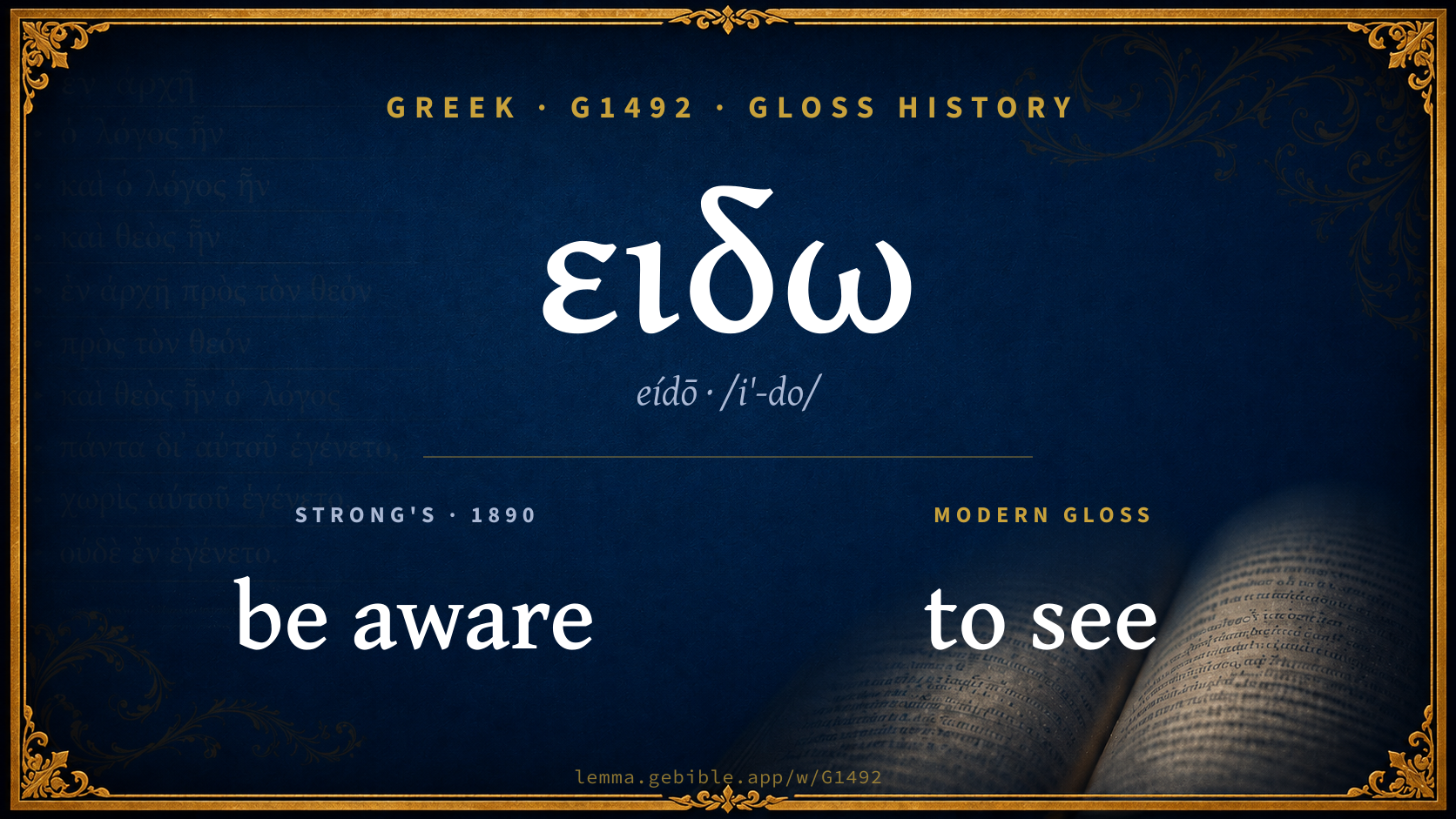
Gloss history
Strong's 1890 vs modern scholarship
About this word
Strong's G1492 catalogs a Greek word from the Greek New Testament.
These counts are not copied from any lexicon or concordance. They are computed here, from the morphology-tagged Greek New Testament. What Lemma adds →
- 294
- distinct verses
- The word appears in 294 distinct verses.
- 26 / 27
- NT books
- The word appears in 26 of 27 New Testament books.
- #57
- by frequency
- Top 100 most frequent Greek words (rank 57 of 5,347 Greek words by occurrence).
View all 294 occurrences in the concordance →
By section of the New Testament
By traditional corpus
Conventional, traditional groupings — biblical authorship is debated, so this is a traditional corpus grouping, not an authorship claim. Some books belong to more than one corpus (Luke is in both the Gospels and the Lukan corpus, and so on), so these shares overlap and need not total 100%. Each figure is a share of the word’s 294 distinct verses.
- Gospels 139 verses · 47%
- Johannine 97 verses · 33%
- Pauline corpus 96 verses · 33%
- Lukan (Luke–Acts) 43 verses · 15%
- General (Catholic) Epistles 25 verses · 9%
- Revelation 12 verses · 4%
- Hebrews 3 verses · 1%
How translations render this word
Counts come from each version’s own published word-to-Strong’s tagging or interlinear alignment — an approximate guide to how each version renders this word, not a word-level alignment the data otherwise carries. Because each total is that version’s own tagged count, the per-version totals vary from one another and need not match the appearance or distinct-verse counts above. These counts may also differ from a printed concordance because Lemma counts each distinctly tagged rendering and does not collapse phrase taggings into a single head-word total. This is a fixed set of word-tagged versions (KJV, ASV, BSB, ULT) and does not change with the reading translation you choose elsewhere. Each version’s license is shown beside its name below (and on Sources).
- King James Version: Saw 79×, See 51×, I know 43×
- American Standard Version: Saw 71×, See 57×, I saw 53×
- Berean Standard Bible: Know 39×, You know 35×, We know 31×
- unfoldingWord Literal Text: Know 118×, Knowing 39×, I know 31×
King James Version Public Domain
Renders G1492 across 687 tagged occurrences — most commonly:
Plus other, less common renderings. Plus 63 renderings that appear only once — usually multi-word phrases or single function words the recovered tagging swept in, not distinct renderings. Not rendered by a distinct English word in 5 further occurrences.
American Standard Version Public Domain
Renders G1492 across 726 tagged occurrences — most commonly:
Plus other, less common renderings. Plus 66 renderings that appear only once — usually multi-word phrases or single function words the recovered tagging swept in, not distinct renderings.
Berean Standard Bible Public Domain
Renders G1492 across 317 tagged occurrences — most commonly:
Plus other, less common renderings. Plus 51 renderings that appear only once — usually multi-word phrases or single function words the recovered tagging swept in, not distinct renderings. Not rendered by a distinct English word in 2 further occurrences.
unfoldingWord Literal Text CC BY-SA 4.0
Renders G1492 across 425 tagged occurrences — most commonly:
Plus other, less common renderings. Plus 23 renderings that appear only once — usually multi-word phrases or single function words the recovered tagging swept in, not distinct renderings.
8 senses in Thayer's, in lexicon order
The 8 senses Thayer's distinguishes for this word, in lexicon order (not ranked by frequency or importance). The full entry — with sub-senses — is in the Lexicon Entry tab.
- to perceive with the eyes
- to perceive by any of the senses
- to perceive, notice, discern, discover
- to see
- i.e. to ascertain what must be done about it
- to know of anything
- to know, i.e. get knowledge of, understand, perceive
- to have regard for one, cherish, pay attention to ( 1Th. 5:4 ).
Word origin
Origin: a root word
A primary verb; used only in certain past tenses the others being borrowed from the equivalent G3700 and G3708 ; properly to see (literally or figuratively); by implication (in the perfect only) to know : - be aware behold X can (+ not tell) consider (have) known (-ledge) look (on) perceive see be sure tell understand wist wot. Compare G3700 .
— Strong’s Exhaustive Concordance (1890), public domain.
Forms in the corpus
The 35 distinct written forms G1492 takes in the Greek New Testament, most frequent first — each parse links to that tense’s occurrences in the concordance.
Same root — word family
Other Thayer's entries built from the same root as G1492, grouped by Strong’s listed origin. These share a root / origin per the lexicon — not necessarily a shared meaning. Each links to that word’s own entry.
Derived from this word
- ειδος eîdos G1491 appearance
- ιδε íde G2396 behold
- ιδεα idéa G2397 appearance
- ιδου idoú G2400 behold
- ισος ísos G2470 equal
- ιστορεω historéō G2477 to examine
Compare all same-root words → Showing 4 of 7 — not the complete family. They share a root, not necessarily a meaning.
Septuagint usage
The same Greek word ειδω appears 211 times in the Greek Old Testament (Septuagint), across 201 verses in 25 books.
- 211
- LXX occurrences
- Tagged occurrences of this Greek word in the Septuagint.
- 201
- verses
- Distinct Septuagint verses containing this word.
- 25 / 39
- OT books
- The word appears in 25 of the 39 Old Testament books.
Sample Septuagint occurrences
- Genesis 2:9 οἶδα
- Exodus 1:8 οἶδα
- Leviticus 5:18 οἶδα
- Numbers 11:16 οἶδα
- Deuteronomy 1:39 οἶδα
- Joshua 8:14 οἶδα
- Judges 4:8 οἶδα
- Ruth 2:11 οἶδα
- 1 Samuel 16:16 οἶδα
- 2 Samuel 1:5 οἶδα
- 1 Kings 2:15 οἶδα
- 2 Kings 6:32 οἶδα
Septuagint occurrences (same lexeme)
Every verse where the same Strong’s number (G1492) appears in the Greek Septuagint — showing the first 50 of 201. Verse text shown in the World English Bible for context; the Greek form is the matched word — the English is not keyword-highlighted.
- Genesis 2:9 οἶδα Out of the ground Yahweh God made every tree to grow that is pleasant to the sight, and good for food; the tree of life also in the midst of the garden, and the tree of the knowledge of good and evil.
- Genesis 3:5 οἶδα for God knows that in the day you eat it, your eyes will be opened, and you will be like God, knowing good and evil."
- Genesis 18:19 οἶδα For I have known him, to the end that he may command his children and his household after him, that they may keep the way of Yahweh, to do righteousness and justice; to the end that Yahweh may bring on Abraham that which he has spoken of him."
- Genesis 19:33 οἶδα They made their father drink wine that night: and the firstborn went in, and lay with her father. He didn't know when she lay down, nor when she arose.
- Genesis 19:35 οἶδα They made their father drink wine that night also. The younger arose, and lay with him. He didn't know when she lay down, nor when she arose.
- Genesis 25:27 οἶδα The boys grew. Esau was a skillful hunter, a man of the field. Jacob was a quiet man, living in tents.
- Genesis 28:16 οἶδα Jacob awakened out of his sleep, and he said, "Surely Yahweh is in this place, and I didn't know it."
- Genesis 31:6 οἶδα You know that I have served your father with all of my strength.
- Genesis 31:32 οἶδα With whoever you find your gods, he shall not live. Before our relatives, discern what is yours with me, and take it." For Jacob didn't know that Rachel had stolen them.
- Genesis 39:3 οἶδα His master saw that Yahweh was with him, and that Yahweh made all that he did prosper in his hand.
- Genesis 39:6 οἶδα He left all that he had in Joseph's hand. He didn't concern himself with anything, except for the food which he ate. Joseph was well-built and handsome.
- Genesis 42:23 οἶδα They didn't know that Joseph understood them; for there was an interpreter between them.
- Genesis 43:7 οἶδα They said, "The man asked directly concerning ourselves, and concerning our relatives, saying, 'Is your father still alive? Have you another brother?' We just answered his questions. Is there any way we could know that he would say, 'Bring your brother down?'"
- Genesis 43:22 οἶδα We have brought down other money in our hand to buy food. We don't know who put our money in our sacks."
- Genesis 44:15 οἶδα Joseph said to them, "What deed is this that you have done? Don't you know that such a man as I can indeed divine?"
- Genesis 48:19 οἶδα His father refused, and said, "I know, my son, I know. He also will become a people, and he also will be great. However, his younger brother will be greater than he, and his seed will become a multitude of nations."
- Exodus 1:8 οἶδα Now there arose a new king over Egypt, who didn't know Joseph.
- Exodus 3:7 οἶδα Yahweh said, "I have surely seen the affliction of my people who are in Egypt, and have heard their cry because of their taskmasters, for I know their sorrows.
- Exodus 3:19 οἶδα I know that the king of Egypt won't give you permission to go, no, not by a mighty hand.
- Exodus 5:2 οἶδα Pharaoh said, "Who is Yahweh, that I should listen to his voice to let Israel go? I don't know Yahweh, and moreover I will not let Israel go."
- Exodus 8:6 οἶδα Aaron stretched out his hand over the waters of Egypt; and the frogs came up, and covered the land of Egypt.
- Exodus 8:18 οἶδα The magicians tried with their enchantments to bring forth lice, but they couldn't. There were lice on man, and on animal.
- Exodus 9:14 οἶδα For this time I will send all my plagues against your heart, against your officials, and against your people; that you may know that there is none like me in all the earth.
- Exodus 10:7 οἶδα Pharaoh's servants said to him, "How long will this man be a snare to us? Let the men go, that they may serve Yahweh, their God. Don't you yet know that Egypt is destroyed?"
- Exodus 10:26 οἶδα Our cattle also shall go with us. There shall not a hoof be left behind, for of it we must take to serve Yahweh our God; and we don't know with what we must serve Yahweh, until we come there."
- Exodus 11:7 οἶδα But against any of the children of Israel a dog won't even bark or move its tongue, against man or animal; that you may know that Yahweh makes a distinction between the Egyptians and Israel.
- Exodus 16:15 οἶδα When the children of Israel saw it, they said one to another, "What is it?" For they didn't know what it was. Moses said to them, "It is the bread which Yahweh has given you to eat."
- Exodus 23:9 οἶδα "You shall not oppress an alien, for you know the heart of an alien, seeing you were aliens in the land of Egypt.
- Exodus 32:1 οἶδα When the people saw that Moses delayed to come down from the mountain, the people gathered themselves together to Aaron, and said to him, "Come, make us gods, which shall go before us; for as for this Moses, the man who brought us up out of the land of Egypt, we don't know what has become of him."
- Exodus 32:22 οἶδα Aaron said, "Don't let the anger of my lord grow hot. You know the people, that they are set on evil.
- Exodus 32:23 οἶδα For they said to me, 'Make us gods, which shall go before us; for as for this Moses, the man who brought us up out of the land of Egypt, we don't know what has become of him.'
- Exodus 33:12 οἶδα Moses said to Yahweh, "Behold, you tell me, 'Bring up this people:' and you haven't let me know whom you will send with me. Yet you have said, 'I know you by name, and you have also found favor in my sight.'
- Exodus 33:17 οἶδα Yahweh said to Moses, "I will do this thing also that you have spoken; for you have found favor in my sight, and I know you by name."
- Exodus 34:29 οἶδα It happened, when Moses came down from Mount Sinai with the two tablets of the testimony in Moses' hand, when he came down from the mountain, that Moses didn't know that the skin of his face shone by reason of his speaking with him.
- Leviticus 5:18 οἶδα He shall bring a ram without blemish from of the flock, according to your estimation, for a trespass offering, to the priest; and the priest shall make atonement for him concerning the thing in which he sinned and didn't know it, and he will be forgiven.
- Numbers 11:16 οἶδα Yahweh said to Moses, Gather to me seventy men of the elders of Israel, whom you know to be the elders of the people, and officers over them; and bring them to the tent of meeting, that they may stand there with you.
- Numbers 14:23 οἶδα surely they shall not see the land which I swore to their fathers, neither shall any of those who despised me see it:
- Numbers 22:6 οἶδα Please come now therefore curse me this people; for they are too mighty for me: peradventure I shall prevail, that we may strike them, and that I may drive them out of the land; for I know that he whom you bless is blessed, and he whom you curse is cursed.
- Numbers 31:18 οἶδα But all the girls, who have not known man by lying with him, keep alive for yourselves.
- Numbers 35:23 οἶδα or with any stone, by which a man may die, not seeing him, and cast it on him, so that he died, and he was not his enemy, neither sought his harm;
- Deuteronomy 1:39 οἶδα Moreover your little ones, whom you said should be a prey, and your children, who this day have no knowledge of good or evil, they shall go in there, and to them will I give it, and they shall possess it.
- Deuteronomy 3:19 οἶδα But your wives, and your little ones, and your cattle, (I know that you have much cattle), shall abide in your cities which I have given you,
- Deuteronomy 4:35 οἶδα To you it was shown, that you might know that Yahweh he is God; there is none else besides him.
- Deuteronomy 4:42 οἶδα that the manslayer might flee there, who kills his neighbor unawares, and didn't hate him in time past; and that fleeing to one of these cities he might live:
- Deuteronomy 9:2 οἶδα a people great and tall, the sons of the Anakim, whom you know, and of whom you have heard say, Who can stand before the sons of Anak?
- Deuteronomy 11:2 οἶδα Know you this day: for I don't speak with your children who have not known, and who have not seen the chastisement of Yahweh your God, his greatness, his mighty hand, and his outstretched arm,
- Deuteronomy 11:28 οἶδα and the curse, if you shall not listen to the commandments of Yahweh your God, but turn aside out of the way which I command you this day, to go after other gods, which you have not known.
- Deuteronomy 13:3 οἶδα you shall not listen to the words of that prophet, or to that dreamer of dreams: for Yahweh your God proves you, to know whether you love Yahweh your God with all your heart and with all your soul.
- Deuteronomy 13:4 οἶδα You shall walk after Yahweh your God, and fear him, and keep his commandments, and obey his voice, and you shall serve him, and cleave to him.
- Deuteronomy 13:7 οἶδα of the gods of the peoples who are round about you, near to you, or far off from you, from the one end of the earth even to the other end of the earth;
These are occurrences of the same Greek lexeme (G1492) in the Septuagint — not a translation of any one Hebrew word. The store carries no word-level Hebrew↔Greek alignment, so no Hebrew original is asserted here. Counts come from the recovered LXX Strong's tagging — high-frequency vocabulary is well covered, while rare or late forms may be untagged — so they reflect tagged occurrences and may slightly undercount.