Revelation 2:9

Greek (Tischendorf 8th ed.) Revelation 2:9 appears in the Greek New Testament. The text above is from the Tischendorf 8th edition. Each word links to its Strong’s number and a concise gloss. Click any word for its full Thayer’s Greek Lexicon entry.
Download image
Cite this verse

Revelation 2:9 (World English Bible). Public Domain. Lemma interlinear Bible study tool, https://lemma.gebible.app/v/revelation/2/9.

Show BibTeX & RIS
BibTeX
RIS
English Translation
"I know your works, oppression, and your poverty (but you are rich), and the blasphemy of those who say they are Jews, and they are not, but are a synagogue of Satan.
World English Bible · Public Domain
Download a study sheet

One document with this verse’s original text, its word-by-word gloss line, the meaning frame, cross-references with their text, attributed commentary, and full source and license credits — printable, and it pastes into notes with its structure intact.

This verse Autodidact and up

Study sheet (.html) Plain text (.txt)

A passage Seminary Student

Up to 50 verses in one chapter. A passage sheet keeps up to 6 commentary sources and 12 cross-references per verse, in the order this page ranks them, and says so on the sheet whenever that leaves anything out. Ask for a single verse and you get the Autodidact verse sheet above.

Everything on this page stays free to read, with no account — the sheet is a download of what is already on screen, not access to it.

Want to remove ads? Support Godless Engineer
Compare translations 3

The same verse in 3 English versions, stacked beneath the original-language interlinear above. Click any original word for its lexicon entry.

Each is an independent rendering of the whole verse — the interlinear is not word-aligned to these translations.

Highlighted words mark where these versions differ — a whole-verse word diff, not a word-by-word alignment.

  • World English Bible Public Domain
    "I know your works, oppression, and your poverty (but you are rich), and the blasphemy of those who say they are Jews, and they are not, but are a synagogue of Satan.
  • King James Version Public Domain
    I know thy works, and tribulation, and poverty, (but thou art rich) and I know the blasphemy of them which say they are Jews, and are not, but are the synagogue of Satan.
  • unfoldingWord Literal Text CC BY-SA 4.0
    “I know your affliction and poverty—but you are rich—and the slander of the ones saying themselves to be Jews, but they are not, but a synagogue of Satan.

unfoldingWord Literal Text — © unfoldingWord, licensed CC BY-SA 4.0. Word-aligned USFM3 via Door43 (git.door43.org/unfoldingWord/en_ult).

Versions to compare (up to 4)

3 of 4 selected

Show all 19 translations

Every available English version of this verse, each an independent rendering of the whole verse.

  • World English Bible Public Domain
    "I know your works, oppression, and your poverty (but you are rich), and the blasphemy of those who say they are Jews, and they are not, but are a synagogue of Satan.
  • Berean Standard Bible Public Domain
    I know your affliction and your poverty—though you are rich! And I am aware of the slander of those who falsely claim to be Jews, but are in fact a synagogue of Satan.
  • Majority Standard Bible Public Domain
    I know your works and your affliction and your poverty—though you are rich! And I am aware of the slander of those who falsely claim to be Jews, but are in fact a synagogue of Satan.
  • King James Version Public Domain
    I know thy works, and tribulation, and poverty, (but thou art rich) and I know the blasphemy of them which say they are Jews, and are not, but are the synagogue of Satan.
  • American Standard Version (1901) Public Domain
    I know thy tribulation, and thy poverty (but thou art rich), and the blasphemy of them that say they are Jews, and they art not, but are a synagogue of Satan.
  • Revised Version (1885) Public Domain
    I know thy tribulation, and thy poverty (but thou art rich), and the blasphemy of them which say they are Jews, and they are not, but are a synagogue of Satan.
  • Geneva Bible (1599) Public Domain
    I knowe thy workes and tribulation, and pouertie (but thou art riche) and I knowe the blasphemie of them, which say they are Iewes, and are not, but are the Synagogue of Satan.
  • Douay-Rheims (1899) Public Domain
    I know thy tribulation and thy poverty, but thou art rich: and thou art blasphemed by them that say they are Jews and are not, but are the synagogue of Satan.
  • Young's Literal Translation Public Domain
    I have known thy works, and tribulation, and poverty -- yet thou art rich -- and the evil-speaking of those saying themselves to be Jews, and are not, but `are' a synagogue of the Adversary.
  • Literal Standard Version CC BY-SA 4.0
    I have known your works, and tribulation, and poverty—yet you are rich—and the slander of those saying themselves to be Jews, and are not, but [are] a synagogue of Satan.
  • Unlocked Literal Bible CC BY-SA 4.0
    “I know your sufferings and your poverty, but you are rich. I know the slander of those who say they are Jews, but they are not. They are a synagogue of Satan.
  • unfoldingWord Literal Text CC BY-SA 4.0
    “I know your affliction and poverty—but you are rich—and the slander of the ones saying themselves to be Jews, but they are not, but a synagogue of Satan.
  • Darby Bible Public Domain
    I know thy tribulation and thy poverty; but thou art rich; and the railing of those who say that they themselves are Jews, and are not, but a synagogue of Satan.
  • World Messianic Bible Public Domain
    “I know your works, oppression, and your poverty (but you are rich), and the blasphemy of those who say they are Jews, and they are not, but are a synagogue of Satan.
  • Webster's Bible Public Domain
    I know thy works, and tribulation, and poverty, (but thou art rich) and I know the blasphemy of them who say they are Jews, and are not, but are the synagogue of Satan.
  • Free Bible Version CC BY-SA 4.0
    I know the troubles you are going through, and how poor you are (but you are rich), and the abuse from those who say they are Jews but are not, but belong to Satan's synagogue.
  • Bible in Basic English Public Domain
    I have knowledge of your troubles and how poor you are (but you have true wealth), and the evil words of those who say they are Jews, and are not, but are a Synagogue of Satan.
  • Text-Critical English NT CC BY 4.0
    I know yoʋr works, yoʋr tribulation, and yoʋr poverty—yet yoʋ are rich! I know the slander of those who declare themselves to be Jews and are not, but are a synagogue of Satan.
  • Tyndale New Testament (1534) Public Domain
    I knowe thy workes and tribulacion and poverte but thou art ryche: And I knowe the blaspemy of them whiche call them selves Iewes and are not: but are the congregacion of sathan.

Literal Standard Version (2020), Covenant Press — licensed CC BY-SA 4.0. Text via the HelloAO Bible API (eBible.org). Unlocked Literal Bible (unfoldingWord) — licensed CC BY-SA 4.0. Text via the HelloAO Bible API (eBible.org). unfoldingWord Literal Text — © unfoldingWord, licensed CC BY-SA 4.0. Word-aligned USFM3 via Door43 (git.door43.org/unfoldingWord/en_ult). Free Bible Version, Dr. Jonathan Gallagher — licensed CC BY-SA 4.0. Text via the HelloAO Bible API (eBible.org).

Word by word

More ways to search: Search by grammar → Find every occurrence → Compare this word →

Practice this passage: Drill this verse → Learn its vocabulary →

πτωχείαν
ptōcheía
G4432
“poverty”
Noun, Accusative, Singular, Feminine
Part of Speech
Noun
Case
Accusative
Number
Singular
Gender
Feminine
Full Thayer's Definition

Origin: from G4433

TDNT: 20:46,0

1. beggary 2. in the NT poverty a. the condition of one destitute of riches and abundance
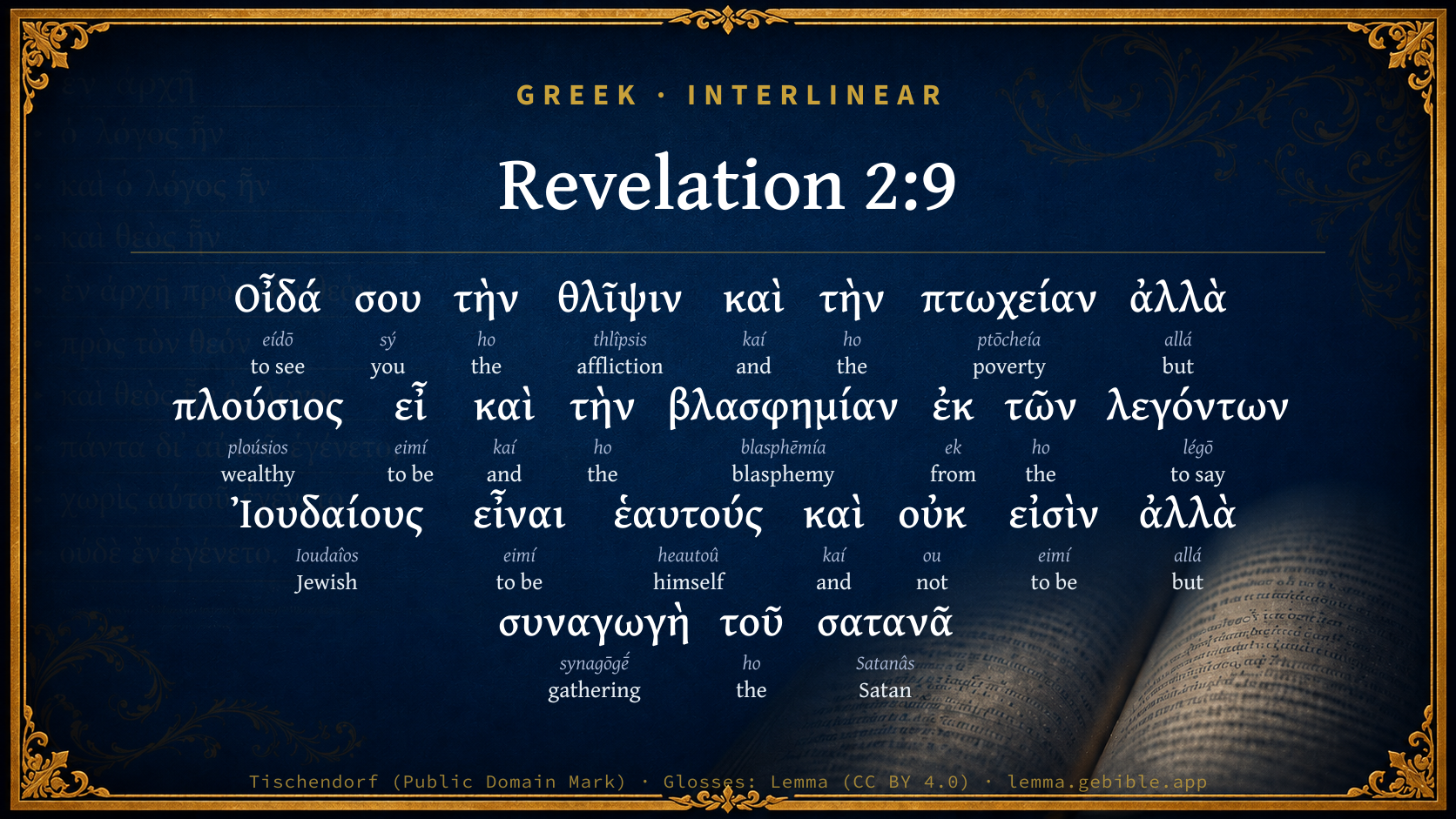
  1. Οἶδά eídō G1492 “to see” Verb, Perfect, Active, Indicative, 1st person, Singular
  2. σου sý G4771 “you” Personal pronoun, 2nd person, Genitive, Singular
  3. τὴν ho G3588 “the” Article, Accusative, Singular, Feminine
  4. θλῖψιν thlîpsis G2347 “affliction” Noun, Accusative, Singular, Feminine
  5. καὶ kaí G2532 “and” Conjunction
  6. τὴν ho G3588 “the” Article, Accusative, Singular, Feminine
  7. ἀλλὰ allá G235 “but” Conjunction
  8. πλούσιος ploúsios G4145 “wealthy” Adjective, Nominative, Singular, Masculine
  9. εἶ eimí G1510 “to be” Verb, Present, Active, Indicative, 2nd person, Singular
  10. καὶ kaí G2532 “and” Conjunction
  11. τὴν ho G3588 “the” Article, Accusative, Singular, Feminine
  12. βλασφημίαν blasphēmía G988 “blasphemy” Noun, Accusative, Singular, Feminine
  13. ἐκ ek G1537 “from” Preposition
  14. τῶν ho G3588 “the” Article, Genitive, Plural, Masculine
  15. λεγόντων légō G3004 “to say” Verb, Present, Active, Participle, Genitive, Plural, Masculine
  16. Ἰουδαίους Ioudaîos G2453 “Jewish” Adjective, Accusative, Plural, Masculine
  17. εἶναι eimí G1510 “to be” Verb, Present, Active, Infinitive
  18. ἑαυτούς heautoû G1438 “himself” Reflexive pronoun, 3rd person, Accusative, Plural, Masculine
  19. καὶ kaí G2532 “and” Conjunction
  20. οὐκ ou G3756 “not” Particle, Negative
  21. εἰσὶν eimí G1510 “to be” Verb, Present, Active, Indicative, 3rd person, Plural
  22. ἀλλὰ allá G235 “but” Conjunction
  23. συναγωγὴ synagōgḗ G4864 “gathering” Noun, Nominative, Singular, Feminine
  24. τοῦ ho G3588 “the” Article, Genitive, Singular, Masculine
  25. σατανᾶ Satanâs G4567 “Satan” Noun, Genitive, Singular, Masculine

About this verse

These counts appear in no published source. They are computed here, from the morphology-tagged text and Lemma’s own curated glosses. What Lemma adds →

26
words
17
distinct lemmas
Revelation
section

Notable vocabulary

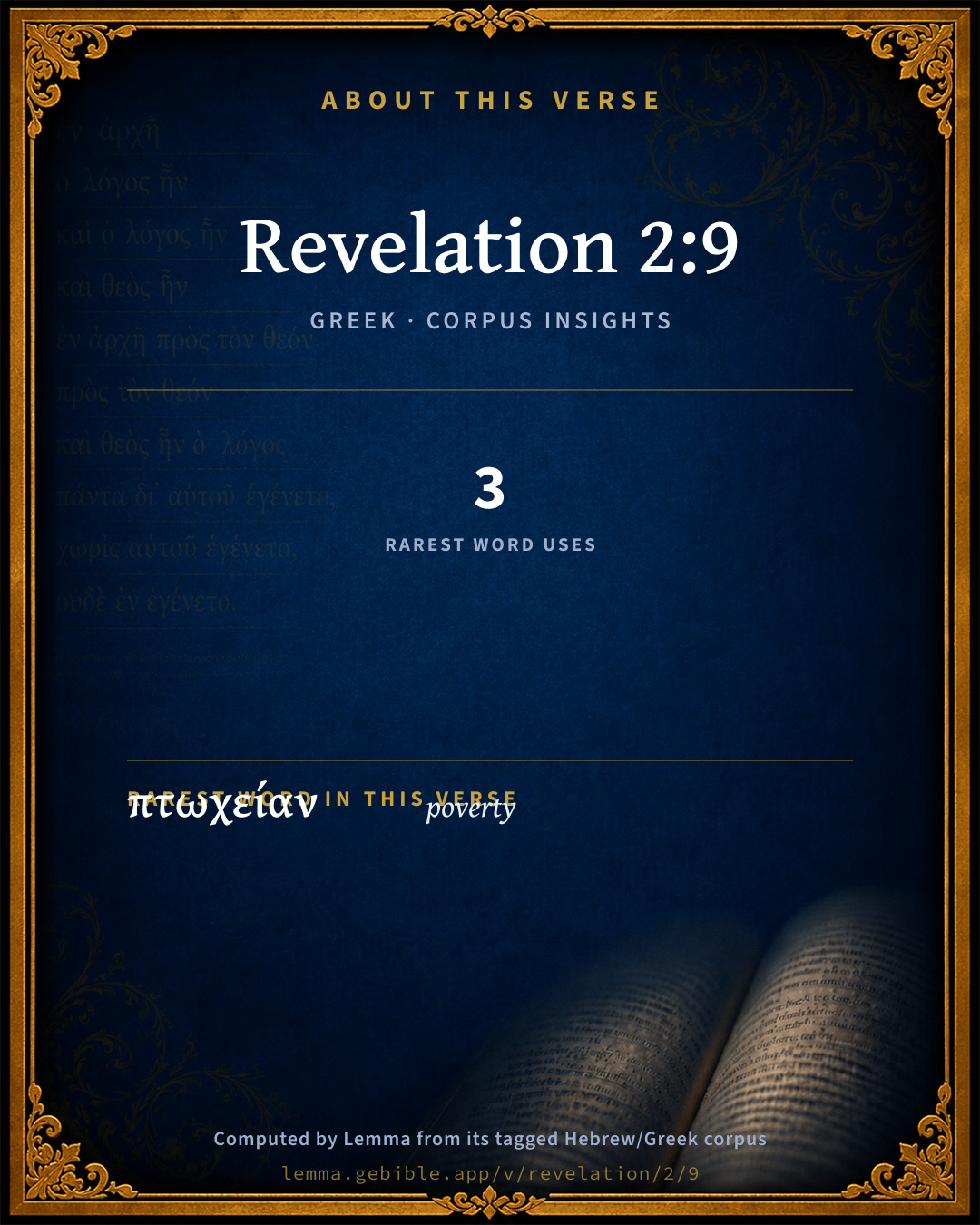
The rarest word here is πτωχείαν poverty G4432 — appearing just 3 times in the whole Greek New Testament.

Shared distinctive vocabulary

πτωχείαν poverty G4432 occurs in 3 verses of the Greek New Testament. Also found in:

Repetition

Words recur within this verse:

Cross-references

26

Topical passages linked to Revelation 2:9 in the Treasury of Scripture Knowledge — connected by theme and wording, ordered by reader-vote popularity; previews shown in the World English Bible.

  • Revelation 3:9 Behold, I give of the synagogue of Satan, of those who say they are Jews, and they are not, but lie. Behold, I will make them to come and worship before your feet, and to know that I have loved you.
  • James 2:5–6 Listen, my beloved brothers. Didn't God choose those who are poor in this world to be rich in faith, and heirs of the Kingdom which he promised to those who love him?
  • 2 Corinthians 8:9 For you know the grace of our Lord Jesus Christ, that, though he was rich, yet for your sakes he became poor, that you through his poverty might become rich.
  • Romans 9:6 But it is not as though the word of God has come to nothing. For they are not all Israel, that are of Israel.
  • 2 Corinthians 6:10 as sorrowful, yet always rejoicing; as poor, yet making many rich; as having nothing, and yet possessing all things.
  • Romans 2:28–29 For he is not a Jew who is one outwardly, neither is that circumcision which is outward in the flesh;
  • Luke 4:18 "The Spirit of the Lord is on me, Because he has anointed me to preach good news to the poor. He has sent me to heal the brokenhearted, To proclaim release to the captives, Recovering of sight to the blind, To deliver those who are crushed,
  • 1 Timothy 6:18 that they do good, that they be rich in good works, that they be ready to distribute, willing to communicate;
  • Revelation 2:2 "I know your works, and your toil and perseverance, and that you can't tolerate evil men, and have tested those who call themselves apostles, and they are not, and found them false.
  • Luke 6:20 He lifted up his eyes to his disciples, and said, "Blessed are you who are poor, For yours is the Kingdom of God.
  • Romans 5:3 Not only this, but we also rejoice in our sufferings, knowing that suffering works perseverance;
  • Romans 12:12 rejoicing in hope; enduring in troubles; continuing steadfastly in prayer;
  • Revelation 3:17–18 Because you say, 'I am rich, and have gotten riches, and have need of nothing;' and don't know that you are the wretched one, miserable, poor, blind, and naked;
  • Romans 8:35 Who shall separate us from the love of Christ? Could oppression, or anguish, or persecution, or famine, or nakedness, or peril, or sword?
  • 2 Corinthians 8:2 how that in much proof of affliction the abundance of their joy and their deep poverty abounded to the riches of their liberality.
  • 1 Thessalonians 3:4 For most assuredly, when we were with you, we told you beforehand that we are to suffer affliction, even as it happened, and you know.
  • 1 Timothy 1:13 although I was before a blasphemer, a persecutor, and insolent. However, I obtained mercy, because I did it ignorantly in unbelief.
  • Luke 22:65 They spoke many other things against him, insulting him.
  • Luke 12:21 So is he who lays up treasure for himself, and is not rich toward God."
  • Acts 14:22 confirming the souls of the disciples, exhorting them to continue in the faith, and that through many afflictions we must enter into the Kingdom of God.
  • 2 Thessalonians 1:6–7 Since it is a righteous thing with God to repay affliction to those who afflict you,
  • Revelation 7:14 I told him, "My lord, you know." He said to me, "These are those who came out of the great tribulation. They washed their robes, and made them white in the Lamb's blood.
  • John 16:33 I have told you these things, that in me you may have peace. In the world you have oppression; but cheer up! I have overcome the world."
  • Acts 26:11 Punishing them often in all the synagogues, I tried to make them blaspheme. Being exceedingly enraged against them, I persecuted them even to foreign cities.
  • Romans 2:17 Indeed you bear the name of a Jew, and rest on the law, and glory in God,
  • Matthew 4:10 Then Jesus said to him, "Get behind me, Satan! For it is written, 'You shall worship the Lord your God, and him only shall you serve.'"

Cross-references courtesy of OpenBible.info (CC BY 4.0).

Where the printed editions differ

1 variant

Places in this verse where the major printed Greek editions disagree on the wording in a way that affects the translation — a comparison of editions, not a manuscript-by-manuscript collation. The editions are the modern critical texts (Nestlé-Aland 28/27, SBL, Westcott-Hort, Tregelles, Tyndale House) and the traditional texts behind the KJV (the Textus Receptus and the Byzantine/Majority text). It is not a claim about which reading is original.

  1. Extra text
    τὰ ἔργα καὶ

    “<the> works and”

    In TRByz Not in NA28NA27TynSBLWHTreg

    τὰ ἔργα καὶ (ta erga kai) 'works and' is only in traditional manuscripts (TR+Byz)

Textual data: Translators Amalgamated Greek New Testament (STEPBible TAGNT) · CC BY 4.0.

Commentary

Notes on Revelation 2:9 from classic Christian and Jewish commentators (each source and its license shown beneath its notes). The classic Christian expositions comment on the surrounding passage and are grouped to its opening verse, so a note may address several verses; the Jewish commentaries on the Tanakh (Rashi and others) are per-verse, so they appear only where the commentator wrote on this verse.

Lemma curates 59 commentaries, every one of them public domain or Creative Commons licensed, each selected and text-cleaned for this edition rather than reprinted as found. About our sources →

The Pulpit Commentary

I know thy tribulation, and thy poverty. "Thy works" has been inserted here and in ver. 13 in order to make the opening of all seven epistles alike. The uncials A, C, P, and the Vulgate, Coptic, and Aethiopic Versions omit the words in each place. The Sinaiticus inserts them here and omits them in ver. 13, where they are plainly awkward in construction. Like all wealthy cities, Smyrna showed the extremes of wealth and poverty side by side. It would be among the poor that Christians would in the first instance be found, and their Christianity would lead to their spoliation; in this much of their "tribulation" would consist. But thou art rich. (compare the close parallel, 2Co_6:10 2Co_8:2 Mat_6:20) And the blasphemy from them which say they are Jews, and they are not. We have here strong evidence of the early date of the Apocalypse. Throughout this book "Jew" is an honourable name for the worshippers of the Christ; "Gentiles," a name of reproach for those who oppose the Christ. (Rev_2:9 Rev_3:9 Rev_11:2, 18 12:5 16:19 18:3, 23 19:15, etc.) These persecutors of the Church of Smyrna are Jews in name, but in reality are rather Gentiles opponents, and not worshippers of the Messiah. The view taken in the Fourth Gospel is utterly different. There "the Jews" are almost invariably the opponents of Christ; the word occurs about seventy times, and nearly always with this shade of meaning. Assume that the Gospel was written a quarter of a century later than the Apocalypse, and there is nothing strange in this. Long experience of Jewish malignity in opposing the gospel has changed the apostle"s views respecting his countrymen. He has become fully convinced of the inveterate and widespread character of the national apostasy. To him "the Jews" have become synonymous with the enemies of the cross of Christ. Assume that the Apocalypse was written about the same time as the Gospel, and how shall we account for this utter difference of view in the two books? Assume that the Gospel was written long before the Apocalypse, and how shall we explain the fact that experience of Jewish hostility has turned the apostle"s abhorrence of "the Jews" into such admiration that to him a Jew has become synonymous with a believer in Jesus Christ? It is remarkable that, in the "Martyrdom of St. Polycarp," the Jews are said to have been present in great numbers, and to have been foremost (malista Ioudaiouv proyumwv) in collecting wood with which to burn him alive. A synagogue of Satan. (comp. Rev_3:9 Joh_8:44) This is in marked contrast to "the synagogue of the Lord". (Num_16:3 Num_20:4 Num_31:16) With the exception of Jam_2:2, sunagwgh is, in the New Testament, always used of Jewish assemblies, never of Christian. This usage soon became habitual in the Church (see Trench, "Synonyms of the New Testament," p. 4).

The Pulpit Commentary (1880–1919), ed. H.D.M. Spence-Jones & Joseph S. Exell — public domain. Text from a community e-Sword module.

Tyndale Open Study Notes

Tyndale Open Resources

2:9 Jesus connected material poverty with the blessing of being rich in God’s Kingdom (Matt 5:3, 10-12; Luke 6:20). • Jews who had no faith are condemned for aligning themselves with Satan in hostile opposition to the Christian faith (Rev 3:9; see John 8:44; Acts 14:2-5; 17:13; 18:6; 20:3; Gal 5:11; 1 Thes 2:14-16). At the Jewish council of Jamnia, the Jews excluded Christians as unholy heretics. John was not anti-Semitic; he was a Jew describing the actions of fellow Jews against Jewish and Gentile Christians.

Tyndale Open Study Notes — © Tyndale Open Resources, licensed CC BY-SA 4.0. Text via the HelloAO Bible API.

Meyer's Critical & Exegetical Commentary

Heinrich August Wilhelm Meyer

Rev_2:9. τ. θλὶψιν. Altogether general.[1040] To this, affliction, imprisonment, and death (Rev_2:10), disgrace and need, belong. If it be possible for the ΠΤΩΧΕΊΑ to be connected with the ΘΛῖΨΙς, and to originate from the fact that Christians were despoiled of their property,[1041] yet, also,[1042] that on account of their poverty the Christians were utterly helpless when their Jewish enemies possibly supported their calumnious charges before the heathen rulers with money;[1043] yet this inner connection of ΘΛῖΨΙς, ΠΤΩΧΕΊΑ, and ΒΛΑΣΦΗΜΊΑ is in no way indicated, and the simple admission is sufficient, that, besides the troubles occasioned by Jews and heathen, the Church was under the burden of poverty. To this it is immediately added parenthetically, in a consolatory antithesis: ἈΛΛᾺ ΠΛΟΎΣΙΟς ΕἸ, viz., in spiritual goods or in God.[1044] To endeavor to find here an allusion to the name Polycarp[1045] (rich in fruit), is arbitrary. In what the ΒΛΑΣΦΗΜΊΑ which Christians had to suffer consisted, can only be conjectured with any certainty if the ΛΈΓΟΝΤΕς ʼΙΟΥΔΑΊΟΥς ΕἾΝΑΙ ἙΑΥΤΟΎς,[1046] from whom they went forth,[1047] are regarded not as Christians[1048] but as actual Jews; which the wording and the historical relations, as they were still at the time of the apologists, support. The carnal pride of the Jews, and their godless zeal for the law,[1049] were already, at the time of Paul, the cause of their unbelief, and hostility to Christians which they published in false and calumnious charges, among which was the one brought of old,[1050] viz., of exciting seditions, which generally had the greater weight with the heathen,[1051] as this occurred at a time in which the Roman rulers, because of the war in Judaea, had to be doubly watchful and suspicious in all places.[1052] Even the martyrdom of Polycarp occurred with the essential participation of the Jews.[1053]

As, to the proud claim of those who boasted of the theocratic name of Jews, the judgment is added that they are not,[1054] so also what is positively said concerning their true nature, ἀλλὰ συναγωγὴ τοῦ σατανᾶ, contains a sharp opposition to the claim of being the συναγωγὴ κυρίου[1055] which essentially concurs with the former boast. But they are rather the synagogue of Satan, because they do the antichristian works of Satan,[1056] to which also belongs the βλασφημεῖν with its lies and hatred.[1057] The expression συναγωγή, which in the N. T. only once in James[1058] designates the Christian congregational assembly,yet even there is combined not with τοῦ θεοῦ, etc., but with ὑμῶν,has in itself a significative antithesis to the true ἐκκλησία τ. θεοῦ or τ. κυρίου. We can scarcely suppose that John could have changed the expression ἐκκλησία τοῦ θεοῦ, which was a fixed designation for the Christian Church, as it is used even of the O. T. people of God, into ἐκκλησία τοῦ σατανᾶ.[1059] There is an allusion of similar severity in Hosea,[1060] when he writes בֵּית אָוֶן instead of בֵּית־אֵל.

[1040] Cf. Rev_1:9.

[1041] Heb_10:34. Primas, Beda, C. a Lap., Tirni, De Wette.

[1042] Hengstenb.

[1043] Cf. Jam_2:5 sqq. Hengstenb.

[1044] Cf. Rev_3:18; Mat_6:20; Luk_12:21; 1Co_1:5; 2Co_6:10.

[1045] Hengstenb.

[1046] Cf. on Rev_2:2.

[1047] ἐκ. Winer, p. 344.

[1048] Vitr., etc.

[1049] Cf. Rom_2:28; Mat_3:9; Joh_8:33; 2Co_11:22; Php_3:4 sqq.

[1050] Luk_23:2.

[1051] Cf. Act_17:6 sqq.

[1052] Against Hengstenb.

[1053] Martyr., c. 12, 13.

[1054] Cf. Rev_3:9.

[1055] Num_16:3; Num_20:4; Num_31:16.

[1056] Cf. Rev_2:10.

[1057] Joh_8:41 sqq.

[1058] Rev_2:2.

[1059] Cf. Trench, Synonymes of the N. T., § 3.

[1060] Hos_4:15.

Meyer — Critical and Exegetical Commentary on the New Testament — English translation by Peter Christie, edited by Frederick Crombie (T&T Clark, 1880) — public domain. Text from a community e-Sword module.

Geneva Bible (1599)

Geneva Bible translators

The proposition of praise is in this verse and of exhortation joined with promise, is in the next verse.

Geneva Bible (1599) marginal notes — public domain. Text via Bolls.life.

Jamieson, Fausset & Brown

Robert Jamieson, A. R. Fausset & David Brown

thy works, and--omitted in two oldest manuscripts, Vulgate, and Coptic. Supported by one oldest manuscript.

tribulation--owing to persecution.

poverty--owing to "the spoiling of their goods."

but thou art rich--in grace. Contrast Laodicea, rich in the world's eyes and her own, poor before God. "There are both poor rich-men, and rich poor-men in God's sight" [TRENCH].

blasphemy of them--blasphemous calumny of thee on the part of (or arising from) them.

say they are Jews, and are not--Jews by national descent, but not spiritually of "the true circumcision." The Jews blaspheme Christ as "the hanged one." As elsewhere, so at Smyrna they bitterly opposed Christianity; and at POLYCARP'S martyrdom they joined the heathens in clamoring for his being cast to the lions; and when there was an obstacle to this, for his being burnt alive; and with their own hands they carried logs for the pile.

synagogue of Satan--Only once is the term "synagogue" in the New Testament used of the Christian assembly, and that by the apostle who longest maintained the union of the Church and Jewish Synagogue. As the Jews more and more opposed Christianity, and it more and more rooted itself in the Gentile world, the term "synagogue" was left altogether to the former, and Christians appropriated exclusively the honorable term "Church"; contrast an earlier time when the Jewish theocracy is called "the Church in the wilderness." Compare Num 16:3; Num 20:4, "congregation of the Lord." Even in Jam 2:2 it is "your (not the Lord's) assembly." The Jews, who might have been "the Church of God," had now, by their opposition and unbelief, become the synagogue of Satan. So "the throne of Satan" (Rev 2:13) represents the heathens' opposition to Christianity; "the depths of Satan" (Rev 2:24), the opposition of heretics.

Jamieson, Fausset & Brown — Commentary Critical and Explanatory on the Whole Bible (1871) — public domain (CC PDM 1.0). Text via the HelloAO Bible API.

Adam Clarke's Commentary

Verse 9. I know thy works] As he had spoken to the preceding Church, so he speaks to this: I know all that ye have done, and all that ye have suffered. The tribulation here mentioned must mean persecution, either from the Jews, the heathens, or from the heretics, who, because of their flesh-pampering doctrines might have had many partisans at Smyrna.

And poverty] Stripped probably of all their temporal possessions, because of their attachment to the Gospel.

But thou art rich] Rich in faith, and heir of the kingdom of Christ.

The blasphemy of them which say they are Jews] There were persons there who professed Judaism, and had a synagogue in the place, and professed to worship the true God; but they had no genuine religion, and they served the devil rather than God. They applied a sacred name to an unholy thing: and this is one meaning of the word blasphemy in this book.

Adam Clarke's Commentary on the Bible (1810–1826) — public domain. Text from a community e-Sword/MySword module.

Ellicott's Commentary for English Readers

(9) I know thy works.—Some would omit the word “works;” but the phrase “I know thy works” is admitted to be genuine in five out of the seven epistles; and it certainly seems natural to conclude that it was intended to be common to all, and to remind the Christian communities that whatever their state it was known to Him whose eyes were as a flame of fire. “We go from one hour to another, from one day and year to another, and what is once fairly past in our doing and omitting and suffering is scarcely regarded by us any more; it is like water that has flowed away. But into the omniscience of Christ all things are taken up” (Bengel).

Tribulation.—If persecution brought upon them poverty, it was the means also of unfolding to view their possession of the “true riches;” they were rich in honour, in that they were counted worthy to suffer; they would also grow rich in the graces which sufferings bring (Rom_5:3-5; Jas_1:2-4).

Blasphemy.—They had to endure reviling as well as tribulation and poverty; and, harder still, to hear some who blasphemed that worthy name by which they were called.

Jews.—The Jews were foremost in this. “It was in the synagogue that they heard words which reproached them as Nazarenes, Galileans, Christians, Disciples of the Crucified” (Plumptre). Comp. Jas_2:7. It is interesting to notice that this characteristic hostility of the Jews was illustrated in the martyrdom of Polycarp. The Jews, “as was their wont,” were foremost in bringing logs for the pile.

Synagogue of Satan.—The word “synagogue” is only once used to describe the Christian assembly (Jas_2:2); and even there it is called “your synagogue,” not the “synagogue of God.” In all other instances the “word is abandoned by the Jews.” With the “synagogue of Satan” here, compare “the throne of Satan” (Rev_2:13), “the depths of Satan” (Rev_2:24).

A Bible Commentary for English Readers, edited by Charles John Ellicott (1878–1897) — public domain. Text from a community e-Sword module.

The Cambridge Bible for Schools and Colleges

gen. ed. J. J. S. Perowne

9. thy works, and] Should be omitted.

poverty] Perhaps the effect of the persecution, Jewish converts being, as in Heb_10:34, deprived of their property when put out of the synagogue on their conversion. Or perhaps rather the cause of the persecution being more intense here—the Christians being people of no dignity or influence, it was safe to attack them.

but thou art rich] Contrast Rev_3:17, and compare Jas_2:5.

blasphemy] Probably rather in the sense of calumny, coarse slanders against them, than blasphemy against their Lord: though of course both may have been combined, as when Christians were ridiculed as worshippers of the Crucified.

of them] We should read [coming] from them—i.e. the calumny not only uttered by them, but originating from them, and very likely received and repeated among the heathen.

which say they are jews] No doubt the persons meant are real Jews by birth as well as by profession, but are denied to be worthy of the name. It is treated as still an honourable one, implying religious privileges, as by St Paul in Rom_2:17; Rom_2:28-29; Rom_3:1. Contrast the way that “the Jews” are spoken of in St John’s Gospel—always meaning the chief priests and scribes, the persistent enemies of the Gospel. Hence is drawn an argument, that this Book could not be written by the author of the Gospel, at any rate after he had written it: though if this Book were written before the fall of Jerusalem, and the Gospel long after, the change in his point of view will be intelligible.

and are not] Better, and they are not—the relative construction is not continued, at least if we suppose the sentence to be grammatical.

the synagogue of Satan] For an instance of the same severity from the same mouth, see Joh_8:44. While they claimed to be, as the old Jewish Church was, “the congregation of the Lord.” Synagogue is etymologically almost equivalent to congregation, and is, as St Augustine observes, a less noble word than that used for the Christian Church, Ecclesia, a summoned assembly: for while brutes may be “gathered together,” reason (and we may add, freedom) is implied in being summoned together. But the distinction between the two words is not always maintained: Israel is called “the Church” in Act_7:38, and the assembly of Christian Jews is called a “synagogue” in St Jas_2:2, and almost in Heb_10:25.

The Cambridge Bible for Schools and Colleges (gen. ed. J. J. S. Perowne; Cambridge University Press, 1878–1918) — public domain. Text from a community e-Sword module.

John Gill's Exposition

I know thy works,.... Good works, as before in Rev 2:2,

and tribulation; this is Christ's legacy to his people, and which lies in their way to heaven; and never was the way of any to heaven more strewed with it than was the way of the saints in this period. But Christ took notice of it, and of them in it; he knew their souls in adversity, and remarked their patience under it, and their constancy, and close adherence to him:

and poverty; which was true in a literal sense, through the spoiling of their goods, to which they were exposed for the profession of Christ: nothing is more contemptible among men than poverty, yet Christ takes notice of it, and owns his people in it; for this poverty came not by sin, but by sufferings for his sake:

but thou art rich; they were rich, in faith, and heirs of a kingdom, though poor in this world; they were rich with the riches of Christ, with the blessings of the covenant, with the graces of the Spirit, and in good works; they were kings and priests unto God, had a kingdom of grace here, and a right to the kingdom of glory hereafter; and were heirs of God, and joint heirs with Christ,

And I know the blasphemy of them which say they are Jews, and are not; who asserted themselves to be the true Israel of God, Jews that were so inwardly, regenerate persons, or truly Christians; for the Christians, baptized persons (m), were by the Heathens called Jews; but these were not, they professed Christianity in words, but in works denied it; they were men of bad principles and practices, and both blasphemed the ways and doctrines of Christ themselves, and caused them to be blasphemed by others also; they were false Christians, nominal professors, and shunned persecution for the Gospel; who were not what they would be thought to be: these were the broachers of heresies in this period of time, in which there was a multitude of them, and which chiefly respected the doctrine of the Trinity, and the person of Christ; and they were introducers of Pagan and Jewish rites into the church, and were men of flagitious lives and conversations, and paved the way for the man of sin:

but are the synagogue of Satan: were the children of the devil, imitated him, and were influenced by him, and were the forerunners of antichrist, whose coming was after the working of Satan,

(m) Vid. Arrian. Epictet. l. 2. c. 9.

John Gill's Exposition of the Whole Bible (1746–1763) — public domain (CC PDM 1.0). Text via the HelloAO Bible API.

Trapp's Complete Commentary

John Trapp

9 I know thy works, and tribulation, and poverty, (but thou art rich) and I know the blasphemy of them which say they are Jews, and are not, but are the synagogue of Satan.

Ver. 9. I know thy works and tribulations] Mark (saith one) the conjunction, "works and tribulations." Active stirring Christians are like to suffer much. Of Sardis and Laodicea only, we read not of any troubles they had.

And poverty, but thou art rich.] Poverty discommends not any to Christ; money bears no mastery in his kingdom. Thou art poor, saith he here; but that is neither here nor there; it is a matter of nothing, that, stumble not therefore at the Church’s poverty. She is ever rich: 1. In reversion, and hath heaven and happiness; she is ever rich in bills and bonds. 2. In an apparent pledge that is worth all the world besides; that is, in Christ. If he have given us his Son, &c. All is yours who are Christ’s, &c.

That say they are Jews] That is, right worshippers, as the Turks at this day style themselves Mussulmans, that is, the only true believers; Papists, the only Catholics. Faciunt et vespae favos, et simiae imitantur homines. Cyprian.

John Trapp, A Commentary or Exposition upon All the Books of the Old and New Testament (1647–1656) — public domain. Text from a community e-Sword module.

Albert Barnes' Notes on the Bible

I know thy works - The uniform method of introducing these epistles, implying a most intimate acquaintance with all that pertained to the church. See the notes on Rev 2:2.

And tribulation - This word is of a general signification, and probably includes all that they suffered in any form, whether from persecution, poverty, or the blasphemy of opposers.

And poverty - It would seem that this church, at that time, was eminently poor, for this is not specified in regard to any one of the others. No reason is suggested why they were particularly poor. It was not, indeed, an uncommon characteristic of early Christians (compare 1Co 1:26-28), but there might have Been some special reasons why that church was eminently so. It is, however, the only church of the seven which has survived, and perhaps in the end its poverty was no disadvantage.

But thou art rich - Not in this world’s goods, but in a more important respect - in the grace and favor of God. These things are not infrequently united. Poverty is no hindrance to the favor of God, and there are some things in it which are favorable to the promotion of a right spirit toward God which are not found where there is abundant wealth. The Saviour was eminently poor, and not a few of his most devoted and useful followers have had as little of this world’s goods as he had. The poor should always be cheerful and happy, if they can hear their Saviour saying unto them, “I know thy poverty - but thou art rich.” However keen the feeling arising from the reflection “I am a poor man,” the edge of the sorrow is taken off if the mind can be turned to a brighter image - “but thou art rich.”

And I know the blasphemy - The reproaches; the harsh and bitter revilings. On the word “blasphemy,” see the notes on Mat 9:3; Mat 26:65. The word here does not seem to refer to blasphemy against God, but to bitter reproaches against themselves. The reason of these reproaches is not stated, but it was doubtless on account of their religion.

Of them which say they are Jews - Who profess to be Jews. The idea seems to be that though they were of Jewish extraction, and professed to be Jews, they were not true Jews; they indulged in a bitterness of reproach, and a severity of language, which showed that they had not the spirit of the Jewish religion; they had nothing which became those who were under the guidance of the spirit of their own Scriptures. That would have inculcated and fostered a milder temper; and the meaning here is, that although they were of Jewish origin, they were not worthy of the name. That spirit of bitter opposition was indeed often manifested in their treatment of Christians, as it had been of the Saviour, but still it was foreign to the true nature of their religion. There were Jews in all parts of Asia Minor, and the apostles often encountered them in their journeyings, but it would seem that there was something which had particularly embittered those of Smyrna against Christianity. What this was is now unknown.

It may throw some light on the passage, however, to remark that at a somewhat later period - in the time of the martyrdom of Polycarp - the Jews of Smyrna were among the most bitter of the enemies of Christians, and among the most violent in demanding the death of Polycarp. Eusebius (Eccl. Hist. 4:15) says,. that when Polycarp was apprehended, and brought before the proconsul at Smyrna, the Jews were the most furious of all in demanding his condemnation. When the mob, after his condemnation to death, set about gathering fuel to burn him, “the Jews,” says he, “being especially zealous, as was their custom - μάλιστα προθύμως, ὡς ἔθος αὐτοῖς malista prothumōs, hōs ethos autois - ran to procure fuel.” And when, as the burning failed, the martyr was transfixed with weapons, the Jews urged and besought the magistrate that his body might not be given up to Christians. Possibly at the time when this epistle was directed to be sent to Smyrna, there were Jews there who manifested the same spirit which those of their countrymen did afterward, who urged on the death of Polycarp.

But are the synagogue of Satan - Deserve rather to be called the synagogue of Satan. The synagogue was a Jewish place of worship (compare the notes on Mat 4:23), but the word originally denoted “the assembly” or “the congregation.” The meaning here is plain, that though they worshipped in a synagogue, and professed to be the worshippers of God, yet they were not worthy of the name, and deserved rather to be regarded as in the service of Satan. “Satan” is the word that is properly applied to the great evil spirit, elsewhere called the devil. See the Luk 22:3 note, and Job 1:6 note.

Albert Barnes' Notes on the Bible (1834–1885) — public domain. Text from a community e-Sword/MySword module.

Matthew Poole's English Annotations

I know thy works, and tribulation: though the term know doth not necessarily signify approbation, yet, both as to the church of Ephesus and Smyrna, the particular works mentioned assure us, that God approved their patient suffering affliction for his name.

And poverty; and the poor condition (as to outward things) into which they had brought themselves, for their owning and profession of the gospel of Christ, having their estates rent from them, &c.

But thou art rich; but yet they were rich, both really in the love and favour of God, and also in the esteem of God, who accounteth them rich who abound in spiritual habits, and good works, the exercise of those habits.

And I know the blasphemy of them which say they are Jews, and are not: God also knows the evil speeches of his church’s enemies, whether native Jews, glorying in circumcision and the law, and that they were descended from Abraham; or false Christians, who may be here meant (called Jews by a figure; the Jews being once the only church of God).

But are the synagogue of Satan; but are indeed a collection of devils, or the children of the devil, whose works they do, continually reviling true Christians, and murdering the saints, after the manner of their father, who was a murderer from the beginning.

Matthew Poole's English Annotations on the Holy Bible (1683–1685) — public domain. Text from a community e-Sword/MySword module.

Whedon's Commentary on the Bible

Daniel D. Whedon

9. But thou art rich—The parenthetic words, flung in as if to correct his own language. Their poverty, like their death, was only phenomenal. Their death was truly an immortal life, and their poverty an infinite treasure. Doubtless their poverty and their death came from the same cause—the oppression of their persecutors. Among all the commendations to the seven, perhaps this, but thou art rich, is the brightest stroke. It was the consolation for their deepest sorrow, and it was of all joys their highest joy.

Note that here it was tribulation and poverty on one side, and blasphemy on the other; blasphemy alike against the Lord and against his followers.

Say they are Jews—And, doubtless, were Jews by descent from Abraham, but not in character. They are unnatural sons of their natural father, since they rejected the Messiah whom Abraham foresaw and predicted. One of the most interesting remains of early Christian literature is a letter written by this Church of Smyrna to the Church at Philomelum as a circular to be sent the round of sister Churches. It relates that after Polycarp was apprehended and condemned to death by fire: “This, then, was done with greater speed than it was spoken, the whole multitude instantly gathering together wood and fagots out of the workshops and booths; the Jews especially, according to their custom, assisting them in doing it.” After his death the governor was dissuaded from giving his remains to his friends under pretence that he refused lest, forsaking Him who was crucified, they should begin to worship Polycarp. “This he did at the suggestion of the Jews, who also watched us that we should not take him out of the fire, not considering that it is impossible for us either to forsake Christ, who suffered for the salvation of all such as shall be saved throughout the world, or to worship any other.”

The synagogue of Satan—How truly they deserved this severe title the previous narrative shows. So hostile were the Jews to the Christians of this first age, that the term synagogue is seldom applied to a Christian Church, the general Church preferring the classic term ecclesia. Trench finely remarks, “As we have here ‘the synagogue of Satan,’ so, presently, ‘the throne of Satan,’ (Rev_2:13,) and then, lastly, ‘the depths of Satan,’ (Rev_2:24;) the synagogue of Satan, representing the Jewish antagonism to the Church; the throne of Satan, the heathen; and the depths of Satan, the heretical.”

Daniel D. Whedon (gen. ed.), Commentary on the Old and New Testaments (1874–1909) — public domain. Text from a community e-Sword module.

John Wesley's Explanatory Notes

I know thy affliction and poverty - A poor prerogative in the eyes of the world! The angel at Philadelphia likewise had in their sight but "a little strength." And yet these two were the most honourable of all in the eyes of the Lord. But thou art rich - In faith and love, of more value than all the kingdoms of the earth. Who say they are Jews - God's own people. And are not - They are not Jews inwardly, not circumcised in heart. But a synagogue of Satan - Who, like them, was a liar and a murderer from the beginning.

John Wesley, Explanatory Notes Upon the Whole Bible (1754–1765) — public domain. Text via the GEBible commentary corpus.

The People's New Testament

B. W. Johnson

9. Thy tribulation. Affliction. And thy poverty. Most of those first enlisted for Christ were poor. See 1 Cor. 1:26–29. But thou art rich. Rich in faith, hope and fruits. And I know the blasphemy. Reviling of the Jews against the Lord. Say they are Jews. Those who say that they are Jews were of the Jewish race, but were not of the true Israel. “He is not a (true) Jew who is one outwardly,” etc. (Rom. 2:28). John denies the right of these Jewish opposers to use the term “Jews” in the sense of God's chosen people. Their synagogue was the synagogue of Satan. Such strong language implies a complete separation of the church and synagogue, an event that occurred at the period of the destruction of Jerusalem. See Acts 21:20–26.

B. W. Johnson's The People's New Testament with Notes (1889–1891) — public domain. Electronic text from the Christian Classics Ethereal Library (CCEL) ThML edition.

Cambridge Greek Testament for Schools and Colleges

9. πτωχείαν. Means no more than poverty: πενία, the Greek word for ordinary poverty is unknown to the New Testament, and πένης only occurs once in a quotation from the LXX. (where πτωχεία is a synonym of θλίψις). Here the poverty is perhaps the effect of the persecution, Jewish converts being, as in Heb 10:34, deprived of their property when put out of the synagogue on their conversion: or perhaps rather the cause of the persecution being more intense here, the Christians being people of no dignity or influence, it was safe to attack them.

ἀλλὰ πλούσιος εἶ. Contrast 1Ti 6:17. Compare Jas 2:5.

βλασφημίαν. Probably rather in the sense of calumny, coarse slanders against them, than blasphemy against their Lord: though of course both may have been combined, as when Christians were ridiculed as worshippers of the Crucified.

ἐκ τῶν λεγόντων Ἰουδαίους εἶναι ἑαυτούς. ἐκ because the calumny is not only uttered by them, but originates from them, and is very likely received and repeated among the heathen. εἶναι belongs to the oldest text here (though not sup. Rev 2:2), because Ἰουδαίους stands before ἑαυτούς, or perhaps because λεγόντων is in the genitive. No doubt the persons meant are real Jews by birth as well as by profession, but are denied to be worthy of the name. It is treated as still an honourable title, implying religious privileges; as by St Paul in Rom 2:17; Rom 2:28-29; Rom 3:1. Contrast the way that “the Jews” are spoken of in St John’s Gospel—always meaning the chief priests and scribes, the persistent enemies of the Gospel. Hence is drawn an argument, that this book could not be written after the Gospel by the same author: though if this book were written before the fall of Jerusalem, and the Gospel long after, the change in his point of view will be intelligible.

καὶ οὐκ εἰσίν. “And they are not”—the relative construction is not continued. For similarly broken constructions cf. Rev 1:6 καὶ ἐποίησεν, and perhaps Rev 1:18, sup. Rev 2:3.

συναγωγὴ τοῦ Σατανᾶ. For an instance of the same severity from the same mouth, see Joh 8:44. While they claimed to be, as the old Jewish Church was, “the congregation of the Lord.” Synagogue is etymologically almost equivalent to congregation, and is, as St Augustin observes, a less noble word than that used for the Christian Church, Ecclesia, a summoned assembly: for while brutes may be “gathered together,” reason (and we may add, freedom) is implied in being summoned together. But the distinction between the two words is not always maintained: Israel is called “the Church” in Act 7:38, and the assembly of Christian Jews is called a “synagogue” in St Jas 2:2, and almost in Heb 10:25.

Cambridge Greek Testament for Schools and Colleges (Cambridge University Press, 1896; 21 vols, various authors incl. Carr, Maclear, Plummer, Farrar, Lumby, Moule, M. R. James, Simcox) — public domain. Text from a community e-Sword module.

Vincent's Word Studies in the New Testament

Marvin R. Vincent

Thy works and. Omit.

Tribulation [θλιψιν] . See on Mt 13:21. Referring to the persecutions of Jewish and heathen oppressors. See on Smyrna, verse 8. Poverty [πτωχειαν] . Because, like all the other early Christian churches, the majority of its members were of the poorer classes, and also, perhaps, with reference to their robbery by persecutors. See on poor, Mt 5:3. Rich. In faith and grace. Compare Jas 2:6, 7; 1Ti 6:17, 18; Luk 12:21; Mt 19:21.

Blasphemy [βλασφημιαν] . See on Mr 7:22. Not primarily direct blasphemy against God, but reviling at believers.

Jews. Literally. Not Christians, as in Phi 3:3; Rom 2:28, 29. Actually Jews by birth, but not spiritually. The title is not given them by the Spirit, nor by the seer, but by themselves; and none would use that title except such as were Jews by birth and by religion. The enmity of the Jews against Christians is a familiar fact to all readers of the book of Acts; and it is a matter of history that their malignity was especially displayed toward the Church of Smyrna. In the circular letter addressed by the Church of Smyrna to the churches in the Christian world, it is related that Jews joined with heathen in clamoring that Polycarp should be cast to the lions or burned alive, and were foremost wJv eqov aujtoiv (as was their wont) in bringing logs for the pile, and in the endeavor to prevent the remains of the martyr from being delivered to his Christian associates for burial.

Synagogue of Satan. For synagogue, see on assembly, Jas 2:2, the only passage in which the word is used for a Christian assembly. This fact goes to support the literal explanation of the term Jews. For Satan, see on Luk 10:18. For John's use of the expression the Jews, see on Joh 1:19. The use of the word here in an honorable sense, so different from John's custom, has been urged against his authorship of Revelation. But John here only quotes the word, and, further, employs it without the article.

Marvin R. Vincent, Word Studies in the New Testament (1887–1900) — public domain. Text from a community e-Sword/MySword module.

Lesson kit

Teaching starters — assembled from the data on this page, not authored interpretation. Every prompt links to the verse data it draws on. Edit before teaching.

Revelation, in the Revelation, opens this verse with 26 words (17 distinct Greek lemmas). Its most distinctive word is ptōcheía (“poverty”). A historical commentator’s framing appears above. Read the whole chapter for the surrounding context.

Discussion questions

  1. How does “poverty” (ptōcheía) shape what this verse is saying?
  2. 2 Corinthians 8:2 shares the word «poverty» with this verse. How do the two illuminate each other?
  3. “to be” occurs 3× in this one verse. What is the effect of the repetition?
  4. These translations render this verse differently. What is at stake in choosing one wording over another?
  5. Reading how The Pulpit Commentary and Tyndale Open Study Notes read this verse, where do the two commentators agree and where do they part?

Things to notice

Reading settings

Reading text

Shown beneath each verse's original-language words.

Old Testament
Old Testament edition

Read the OT as the Masoretic Hebrew (MT) or the Greek Septuagint (LXX).

English shown for the Greek Septuagint (in the Hebrew ↔ Greek comparison).

Comparing translations? Open the Compare panel on any verse page to stack up to four side by side.