ἴσος
equal
Full lexicon entry — Thayer's Greek Lexicon
From Thayer's Greek Lexicon
Where this word appears
See every Accusative-case word in the Greek New Testament →
Grammar key — what these labels mean
Part of speech
- Adjective
- A word that describes or qualifies a noun.
Case
- Nominative
- The case of the subject (and the predicate nominative).
- Accusative
- The case of the direct object and of extent.
Gender
- Neuter
- Grammatically neuter.
- Masculine
- Grammatically masculine.
- Feminine
- Grammatically feminine.
Number
- Plural
- More than one.
- Singular
- One.
Grammatical forms
- Adjective, Nominative, Plural, Neuter 2 times (25%)
- Adjective, Accusative, Plural, Masculine 1 time (13%)
- Adjective, Accusative, Plural, Neuter 1 time (13%)
- Adjective, Accusative, Singular, Feminine 1 time (13%)
- Adjective, Accusative, Singular, Masculine 1 time (13%)
- Adjective, Nominative, Plural, Feminine 1 time (13%)
- Adjective, Nominative, Singular, Feminine 1 time (13%)
Parsed forms decoded from the imported morphology (Robinson–Tischendorf, public domain), counted across 8 parsed occurrences — not distinct verses.
Every verse where G2470 appears — 8 distinct verses across 7 books. Click any verse to open its interlinear word-by-word view. Verse text shown in the World English Bible for context — . Each verse’s Greek form is shown with its reference; the English is not keyword-highlighted, since the data carries no word-level English alignment. Use “Compare translations” on any verse to read it across multiple English versions. This concordance covers the Greek New Testament; Septuagint (Greek Old Testament) occurrences of this word are not indexed here.
Matthew 1 verse
Mark 2 verses
Luke 1 verse
John 1 verse
Acts 1 verse
Philippians 1 verse
Revelation 1 verse
About this entry
At a glance — auto-summarized from this page’s data, not written by a person. Every figure links to its source below. This summary describes the numbers; it doesn’t interpret them.
“equal” is the headline sense of the Greek adjective ισος (ísos). Scripture first uses it in Matthew 20:12. It appears 8 verses across 7 books of the Greek New Testament, among its uncommon vocabulary. More than a quarter of its appearances fall in Mark. It shares a root with ειδω, ειδος and ιδε. See the sense tree, 8-verse concordance, and the renderings breakdown below.
Gloss history
Strong's 1890 vs modern scholarship
About this word
Strong's G2470 catalogs a Greek word from the Greek New Testament.
These counts are not copied from any lexicon or concordance. They are computed here, from the morphology-tagged Greek New Testament. What Lemma adds →
- 8
- distinct verses
- The word appears in 8 distinct verses.
- 7 / 27
- NT books
- The word appears in 7 of 27 New Testament books.
- #1,240
- by frequency
- Top 2500 most frequent Greek words (rank 1,240 of 5,347 Greek words by occurrence).
View all 8 occurrences in the concordance →
By section of the New Testament
By traditional corpus
Conventional, traditional groupings — biblical authorship is debated, so this is a traditional corpus grouping, not an authorship claim. Some books belong to more than one corpus (Luke is in both the Gospels and the Lukan corpus, and so on), so these shares overlap and need not total 100%. Each figure is a share of the word’s 8 distinct verses.
- Gospels 5 verses · 63%
- Lukan (Luke–Acts) 2 verses · 25%
- Johannine 2 verses · 25%
- Pauline corpus 1 verse · 13%
- Revelation 1 verse · 13%
How translations render this word
Counts come from each version’s own published word-to-Strong’s tagging or interlinear alignment — an approximate guide to how each version renders this word, not a word-level alignment the data otherwise carries. Because each total is that version’s own tagged count, the per-version totals vary from one another and need not match the appearance or distinct-verse counts above. These counts may also differ from a printed concordance because Lemma counts each distinctly tagged rendering and does not collapse phrase taggings into a single head-word total. This is a fixed set of word-tagged versions (KJV, ASV, BSB, ULT) and does not change with the reading translation you choose elsewhere. Each version’s license is shown beside its name below (and on Sources).
- King James Version: Equal 4×
- American Standard Version: Equal 3×, Together 2×
- Berean Standard Bible: Equal 3×, Inconsistent 2×
- unfoldingWord Literal Text: Equal 3×, Same 3×
King James Version Public Domain
Renders G2470 across 8 tagged occurrences — most commonly:
Plus 4 renderings that appear only once — usually multi-word phrases or single function words the recovered tagging swept in, not distinct renderings. Not rendered by a distinct English word in 1 further occurrence.
American Standard Version Public Domain
Renders G2470 across 9 tagged occurrences — most commonly:
Plus 4 renderings that appear only once — usually multi-word phrases or single function words the recovered tagging swept in, not distinct renderings.
Berean Standard Bible Public Domain
Renders G2470 across 8 tagged occurrences — most commonly:
Plus 3 renderings that appear only once — usually multi-word phrases or single function words the recovered tagging swept in, not distinct renderings.
unfoldingWord Literal Text CC BY-SA 4.0
Renders G2470 across 7 tagged occurrences — most commonly:
Plus 1 rendering that appears only once — usually multi-word phrases or single function words the recovered tagging swept in, not distinct renderings.
Senses in Thayer's
The 1 sense Thayer's distinguishes for this word, in lexicon order (not ranked by frequency or importance). The full entry — with sub-senses — is in the Lexicon Entry tab.
- equal, in quantity or quality
Word origin
Derived from ειδω (eídō) (G1492) — to see.
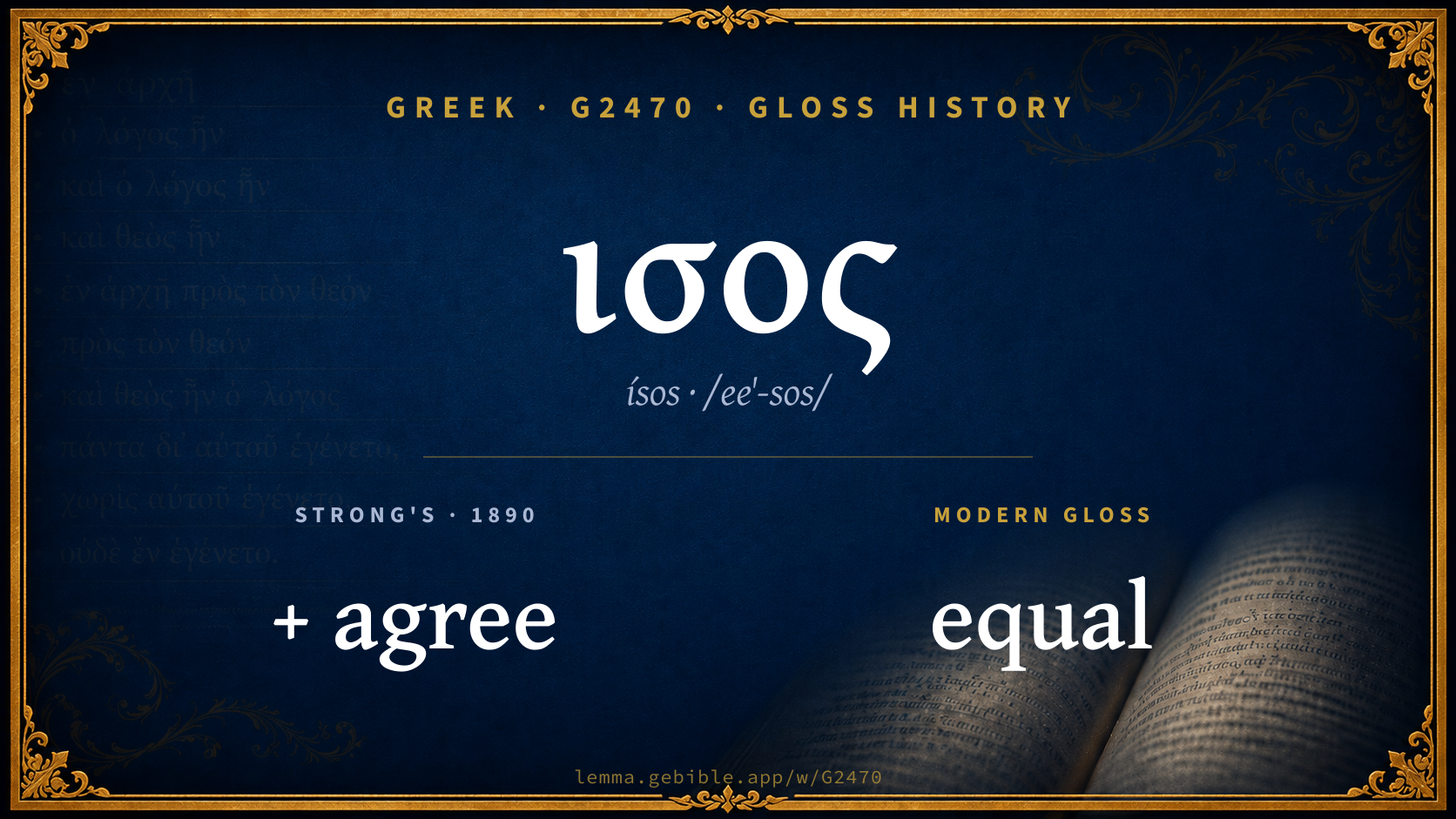
Probably from G1492 (through the idea of seeming ); similar (in amount or kind): - + agree as much equal like.
— Strong’s Exhaustive Concordance (1890), public domain.
Forms in the corpus
The 6 distinct written forms G2470 takes in the Greek New Testament, most frequent first — each parse links to that case’s occurrences in the concordance.
| Form | Parsing | Example | Uses |
|---|---|---|---|
| ἴσα ísa | Adjective, Nominative, Plural, Neuter | Philippians 2:6 | 3 |
| ἴσαι ísai | Adjective, Nominative, Plural, Feminine | Mark 14:56 | 1 |
| ἴση ísē | Adjective, Nominative, Singular, Feminine | Mark 14:59 | 1 |
| ἴσην ísēn | Adjective, Accusative, Singular, Feminine | Acts 11:17 | 1 |
| ἴσον íson | Adjective, Accusative, Singular, Masculine | John 5:18 | 1 |
| ἴσους ísous | Adjective, Accusative, Plural, Masculine | Matthew 20:12 | 1 |
Same root — word family
Other Thayer's entries built from the same root as G2470, grouped by Strong’s listed origin. These share a root / origin per the lexicon — not necessarily a shared meaning. Each links to that word’s own entry.
Derives from
Shares the same root
- ειδος eîdos G1491 appearance
- ιδε íde G2396 behold
- ιδεα idéa G2397 appearance
- ιδου idoú G2400 behold
- ιστορεω historéō G2477 to examine
Derived from this word
- ισαγγελος isángelos G2465 like angels
- ισοτιμος isótimos G2472 equally precious
- ισοψυχος isópsychos G2473 like-minded
- ισως ísōs G2481 equally
Compare all same-root words → Showing 4 of 11 — not the complete family. They share a root, not necessarily a meaning.
Septuagint usage
The same Greek word ισος appears 33 times in the Greek Old Testament (Septuagint), across 26 verses in 8 books.
- 33
- LXX occurrences
- Tagged occurrences of this Greek word in the Septuagint.
- 26
- verses
- Distinct Septuagint verses containing this word.
- 8 / 39
- OT books
- The word appears in 8 of the 39 Old Testament books.
Sample Septuagint occurrences
- Exodus 26:24 ἴσος
- Leviticus 7:10 ἴσος
- Numbers 12:12 ἴσος
- Deuteronomy 13:7 ἴσος
- Job 5:14 ἴσος
- Proverbs 25:10 ἴσος
- Isaiah 51:23 ἴσος
- Ezekiel 40:5 ἴσος
Septuagint occurrences (same lexeme)
Every verse where the same Strong’s number (G2470) appears in the Greek Septuagint. Verse text shown in the World English Bible for context; the Greek form is the matched word — the English is not keyword-highlighted.
- Exodus 26:24 ἴσος They shall be double beneath, and in like manner they shall be entire to the top of it to one ring: thus shall it be for them both; they shall be for the two corners.
- Exodus 30:34 ἴσος Yahweh said to Moses, "Take to yourself sweet spices, gum resin, and onycha, and galbanum; sweet spices with pure frankincense: of each shall there be an equal weight;
- Leviticus 7:10 ἴσος Every meal offering, mixed with oil or dry, belongs to all the sons of Aaron, one as well as another.
- Numbers 12:12 ἴσος Let her not, I pray, be as one dead, of whom the flesh is half consumed when he comes out of his mother's womb.
- Deuteronomy 13:7 ἴσος of the gods of the peoples who are round about you, near to you, or far off from you, from the one end of the earth even to the other end of the earth;
- Job 5:14 ἴσος They meet with darkness in the day-time, And grope at noonday as in the night.
- Job 10:10 ἴσος Haven't you poured me out like milk, And curdled me like cheese?
- Job 11:12 ἴσος But vain man can become wise If a man can be born as a wild donkey's colt.
- Job 13:12 ἴσος Your memorable sayings are proverbs of ashes, Your defenses are defenses of clay.
- Job 13:28 ἴσος Though I am decaying like a rotten thing, Like a garment that is moth-eaten.
- Job 15:16 ἴσος How much less one who is abominable and corrupt, A man who drinks iniquity like water!
- Job 24:20 ἴσος The womb shall forget him. The worm shall feed sweetly on him. He shall be no more remembered. Unrighteousness shall be broken as a tree.
- Job 27:16 ἴσος Though he heap up silver as the dust, And prepare clothing as the clay;
- Job 28:2 ἴσος Iron is taken out of the earth, And copper is smelted out of the ore.
- Job 29:14 ἴσος I put on righteousness, and it clothed me. My justice was as a robe and a diadem.
- Job 30:19 ἴσος He has cast me into the mire. I have become like dust and ashes.
- Job 40:15 ἴσος "See now, behemoth, which I made as well as you. He eats grass as an ox.
- Job 41:4 ἴσος Will he make a covenant with you, That you should take him for a servant forever?
- Proverbs 25:10 ἴσος Lest one who hears it put you to shame, And your bad reputation never depart.
- Isaiah 51:23 ἴσος and I will put it into the hand of those who afflict you, who have said to your soul, Bow down, that we may go over; and you have laid your back as the ground, and as the street, to those who go over.
- Ezekiel 40:5 ἴσος Behold, a wall on the outside of the house round about, and in the man's hand a measuring reed six cubits long, of a cubit and a handbreadth each: so he measured the thickness of the building, one reed; and the height, one reed.
- Ezekiel 40:6 ἴσος Then came he to the gate which looks toward the east, and went up the steps of it: and he measured the threshold of the gate, one reed broad; and the other threshold, one reed broad.
- Ezekiel 40:7 ἴσος Every lodge was one reed long, and one reed broad; and [the space] between the lodges was five cubits; and the threshold of the gate by the porch of the gate toward the house was one reed.
- Ezekiel 40:8 ἴσος He measured also the porch of the gate toward the house, one reed.
- Ezekiel 41:8 ἴσος I saw also that the house had a raised base round about: the foundations of the side-chambers were a full reed of six great cubits.
- Ezekiel 45:11 ἴσος The ephah and the bath shall be of one measure, that the bath may contain the tenth part of a homer, and the ephah the tenth part of a homer: the measure of it shall be after the homer.
These are occurrences of the same Greek lexeme (G2470) in the Septuagint — not a translation of any one Hebrew word. The store carries no word-level Hebrew↔Greek alignment, so no Hebrew original is asserted here. Counts come from the recovered LXX Strong's tagging — high-frequency vocabulary is well covered, while rare or late forms may be untagged — so they reflect tagged occurrences and may slightly undercount.