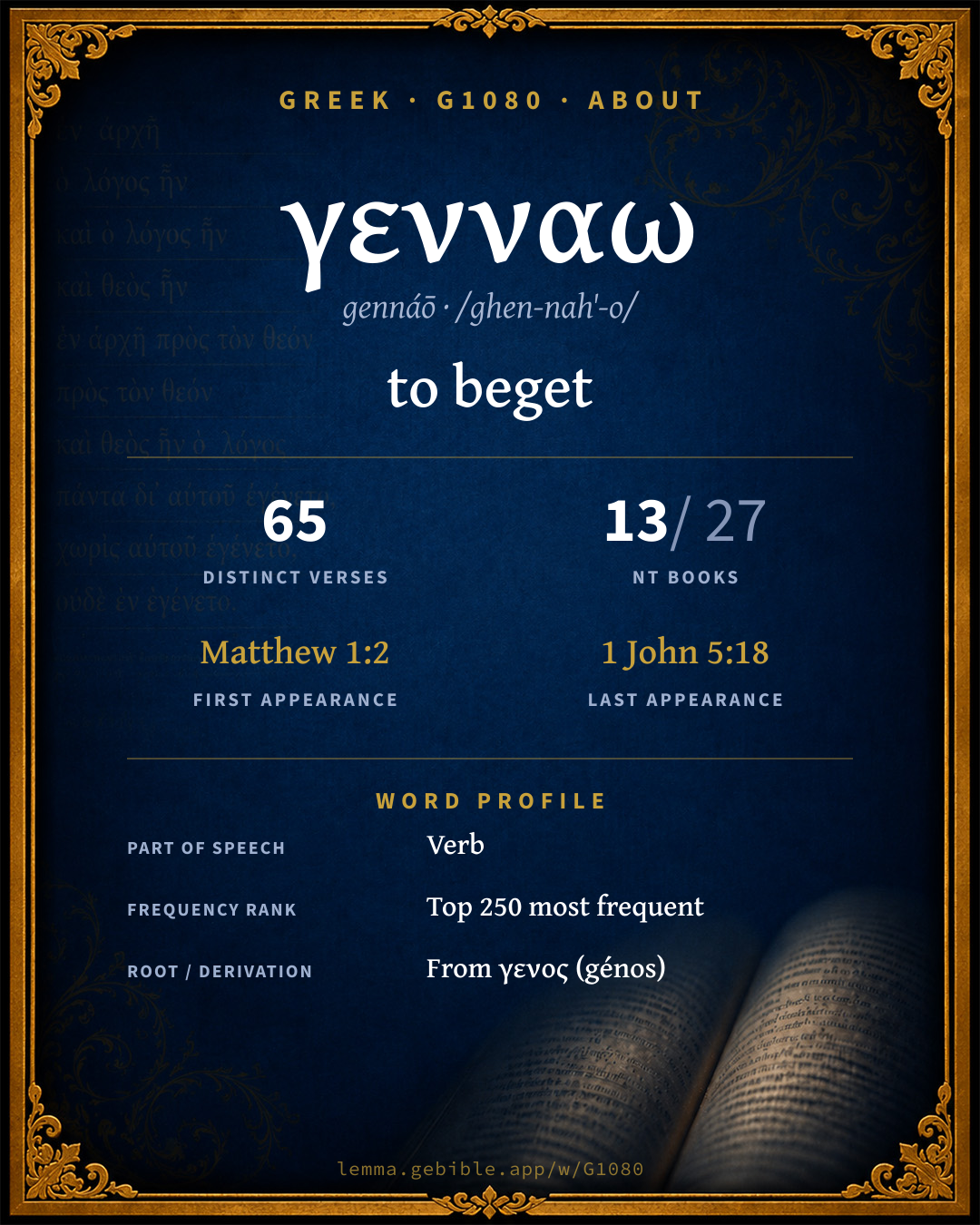
γεννάω
to beget
‘to beget’ is one of 2 main senses fuller range ↓
Full lexicon entry — Thayer's Greek Lexicon
From Thayer's Greek Lexicon
Where this word appears
See every Aorist-tense verb in the Greek New Testament →
Grammar key — what these labels mean
Part of speech
- Verb
- An action or state-of-being word.
Tense
- Aorist
- Action viewed as a simple whole, without regard to duration — often past (perfective aspect).
- Perfect
- A completed past action with continuing present results.
- Future
- Action expected in future time.
- Present
- Ongoing or general action in present time (imperfective aspect).
Voice
- Active
- The subject performs the action.
- Passive
- The subject receives the action.
Mood
- Indicative
- States a fact or asks a factual question (the mood of reality).
- Participle
- A verbal adjective (“writing,” “having written”).
- Infinitive
- A verbal noun (“to write”), unmarked for person or number.
- Subjunctive
- Expresses probability, purpose, or possibility (the mood of contingency).
Case
- Nominative
- The case of the subject (and the predicate nominative).
- Accusative
- The case of the direct object and of extent.
- Genitive
- The case of source, possession, or “of” — answers “whose / from what.”
Person
- 3rd person
- The one spoken about (“he / she / it / they”).
- 1st person
- The speaker (“I / we”).
- 2nd person
- The one addressed (“you”).
Gender
- Masculine
- Grammatically masculine.
- Neuter
- Grammatically neuter.
- Feminine
- Grammatically feminine.
Number
- Singular
- One.
- Plural
- More than one.
Grammatical forms 29 distinct
- Verb, Aorist, Active, Indicative, 3rd person, Singular 42 times (43%)
- Verb, Aorist, Passive, Indicative, 3rd person, Singular 7 times (7%)
- Verb, Perfect, Passive, Indicative, 3rd person, Singular 5 times (5%)
- Verb, Perfect, Passive, Participle, Nominative, Singular, Masculine 4 times (4%)
- Verb, Aorist, Passive, Indicative, 3rd person, Plural 3 times (3%)
- Verb, Aorist, Passive, Infinitive 3 times (3%)
- Verb, Aorist, Passive, Participle, Nominative, Singular, Masculine 3 times (3%)
- Verb, Aorist, Passive, Subjunctive, 3rd person, Singular 3 times (3%)
+21 more forms (27 occurrences)
Parsed forms decoded from the imported morphology (Robinson–Tischendorf, public domain), counted across 97 parsed occurrences — not distinct verses.
Every verse where G1080 appears — 65 distinct verses across 13 books. Click any verse to open its interlinear word-by-word view. Verse text shown in the World English Bible for context — . Each verse’s Greek form is shown with its reference; the English is not keyword-highlighted, since the data carries no word-level English alignment. Use “Compare translations” on any verse to read it across multiple English versions. This concordance covers the Greek New Testament; Septuagint (Greek Old Testament) occurrences of this word are not indexed here.
Matthew 20 verses
- Matthew 1:2 ἐγέννησεν ἐγέννησεν ἐγέννησεν aor act ind 3sg aor act ind 3sg aor act ind 3sg Abraham became the father of Isaac. Isaac became the father of Jacob. Jacob became the father of Judah and his brothers.
- Matthew 1:3 ἐγέννησεν ἐγέννησεν ἐγέννησεν aor act ind 3sg aor act ind 3sg aor act ind 3sg Judah became the father of Perez and Zerah by Tamar. Perez became the father of Hezron. Hezron became the father of Ram.
- Matthew 1:4 ἐγέννησεν ἐγέννησεν ἐγέννησεν aor act ind 3sg aor act ind 3sg aor act ind 3sg Ram became the father of Amminadab. Amminadab became the father of Nahshon. Nahshon became the father of Salmon.
- Matthew 1:5 ἐγέννησεν ἐγέννησεν ἐγέννησεν aor act ind 3sg aor act ind 3sg aor act ind 3sg Salmon became the father of Boaz by Rahab. Boaz became the father of Obed by Ruth. Obed became the father of Jesse.
- Matthew 1:6 ἐγέννησεν ἐγέννησεν aor act ind 3sg aor act ind 3sg Jesse became the father of David the king. David became the father of Solomon by her who had been the wife of Uriah.
- Matthew 1:7 ἐγέννησεν ἐγέννησεν ἐγέννησεν aor act ind 3sg aor act ind 3sg aor act ind 3sg Solomon became the father of Rehoboam. Rehoboam became the father of Abijah. Abijah became the father of Asa.
- Matthew 1:8 ἐγέννησεν ἐγέννησεν ἐγέννησεν aor act ind 3sg aor act ind 3sg aor act ind 3sg Asa became the father of Jehoshaphat. Jehoshaphat became the father of Joram. Joram became the father of Uzziah.
- Matthew 1:9 ἐγέννησεν ἐγέννησεν ἐγέννησεν aor act ind 3sg aor act ind 3sg aor act ind 3sg Uzziah became the father of Jotham. Jotham became the father of Ahaz. Ahaz became the father of Hezekiah.
- Matthew 1:10 ἐγέννησεν ἐγέννησεν ἐγέννησεν aor act ind 3sg aor act ind 3sg aor act ind 3sg Hezekiah became the father of Manasseh. Manasseh became the father of Amon. Amon became the father of Josiah.
- Matthew 1:11 ἐγέννησεν aor act ind 3sg Josiah became the father of Jechoniah and his brothers, at the time of the exile to Babylon.
- Matthew 1:12 ἐγέννησεν ἐγέννησεν aor act ind 3sg aor act ind 3sg After the exile to Babylon, Jechoniah became the father of Shealtiel. Shealtiel became the father of Zerubbabel.
- Matthew 1:13 ἐγέννησεν ἐγέννησεν ἐγέννησεν aor act ind 3sg aor act ind 3sg aor act ind 3sg Zerubbabel became the father of Abiud. Abiud became the father of Eliakim. Eliakim became the father of Azor.
- Matthew 1:14 ἐγέννησεν ἐγέννησεν ἐγέννησεν aor act ind 3sg aor act ind 3sg aor act ind 3sg Azor became the father of Sadoc. Sadoc became the father of Achim. Achim became the father of Eliud.
- Matthew 1:15 ἐγέννησεν ἐγέννησεν ἐγέννησεν aor act ind 3sg aor act ind 3sg aor act ind 3sg Eliud became the father of Eleazar. Eleazar became the father of Matthan. Matthan became the father of Jacob.
- Matthew 1:16 ἐγέννησεν ἐγεννήθη aor act ind 3sg aor pass ind 3sg Jacob became the father of Joseph, the husband of Mary, from whom was born Jesus, who is called Christ.
- Matthew 1:20 γεννηθὲν aor pass ptcp nom sg neut But when he thought about these things, behold, an angel of the Lord appeared to him in a dream, saying, "Joseph, son of David, don't be afraid to take to yourself Mary, your wife, for that which is conceived in her is of the Holy Spirit.
- Matthew 2:1 γεννηθέντος aor pass ptcp gen sg masc Now when Jesus was born in Bethlehem of Judea in the days of Herod the king, behold, wise men from the east came to Jerusalem, saying,
- Matthew 2:4 γεννᾶται pres pass subj 3sg Gathering together all the chief priests and scribes of the people, he asked them where the Christ would be born.
- Matthew 19:12 ἐγεννήθησαν aor pass ind 3pl For there are eunuchs who were born that way from their mother's womb, and there are eunuchs who were made eunuchs by men; and there are eunuchs who made themselves eunuchs for the Kingdom of Heaven's sake. He who is able to receive it, let him receive it."
- Matthew 26:24 ἐγεννήθη aor pass ind 3sg The Son of Man goes, even as it is written of him, but woe to that man through whom the Son of Man is betrayed! It would be better for that man if he had not been born."
Mark 1 verse
Luke 4 verses
- Luke 1:13 γεννήσει fut act ind 3sg But the angel said to him, "Don't be afraid, Zacharias, because your request has been heard, and your wife, Elizabeth, will bear you a son, and you shall call his name John.
- Luke 1:35 γεννώμενον pres pass ptcp nom sg neut The angel answered her, "The Holy Spirit will come on you, and the power of the Most High will overshadow you. Therefore also the holy one who is born from you will be called the Son of God.
- Luke 1:57 ἐγέννησεν aor act ind 3sg Now the time that Elizabeth should give birth was fulfilled, and she brought forth a son.
- Luke 23:29 ἐγέννησαν aor act ind 3pl For behold, the days are coming in which they will say, 'Blessed are the barren, the wombs that never bore, and the breasts that never nursed.'
John 15 verses
- John 1:13 ἐγεννήθησαν aor pass ind 3pl who were born not of blood, nor of the will of the flesh, nor of the will of man, but of God.
- John 3:3 γεννηθῇ aor pass subj 3sg Jesus answered him, "Most assuredly, I tell you, unless one is born anew, he can't see the Kingdom of God."
- John 3:4 γεννηθῆναι γεννηθῆναι aor pass inf aor pass inf Nicodemus said to him, "How can a man be born when he is old? Can he enter a second time into his mother's womb, and be born?"
- John 3:5 γεννηθῇ aor pass subj 3sg Jesus answered, "Most assuredly I tell you, unless one is born of water and spirit, he can't enter into the Kingdom of God!
- John 3:6 γεγεννημένον γεγεννημένον perf pass ptcp nom sg neut perf pass ptcp nom sg neut That which is born of the flesh is flesh. That which is born of the Spirit is spirit.
- John 3:7 γεννηθῆναι aor pass inf Don't marvel that I said to you, 'You must be born anew.'
- John 3:8 γεγεννημένος perf pass ptcp nom sg masc The wind blows where it wants to, and you hear its sound, but don't know where it comes from and where it is going. So is everyone who is born of the Spirit."
- John 8:41 γεγεννήμεθα perf pass ind 1pl You do the works of your father." They said to him, "We were not born of sexual immorality. We have one Father, God."
- John 9:2 γεννηθῇ aor pass subj 3sg His disciples asked him, "Rabbi, who sinned, this man or his parents, that he was born blind?"
- John 9:19 ἐγεννήθη aor pass ind 3sg and asked them, "Is this your son, who you say was born blind? How then does he now see?"
- John 9:20 ἐγεννήθη aor pass ind 3sg His parents answered them, "We know that this is our son, and that he was born blind;
- John 9:32 γεγεννημένου perf pass ptcp gen sg masc Since the world began it has never been heard of that anyone opened the eyes of someone born blind.
- John 9:34 ἐγεννήθης aor pass ind 2sg They answered him, "You were altogether born in sins, and do you teach us?" They threw him out.
- John 16:21 γεννήσῃ ἐγεννήθη aor act subj 3sg aor pass ind 3sg A woman, when she gives birth, has sorrow, because her time has come. But when she has delivered the child, she doesn't remember the anguish any more, for the joy that a human being is born into the world.
- John 18:37 γεγέννημαι perf pass ind 1sg Pilate therefore said to him, "Are you a king then?" Jesus answered, "You say that I am a king. For this reason I have been born, and for this reason I have come into the world, that I should testify to the truth. Everyone who is of the truth listens to my voice."
Acts 7 verses
- Acts 2:8 ἐγεννήθημεν aor pass ind 1pl How do we hear, everyone in our own native language?
- Acts 7:8 ἐγέννησεν aor act ind 3sg He gave him the covenant of circumcision. So Abraham became the father of Isaac, and circumcised him the eighth day. Isaac became the father of Jacob, and Jacob became the father of the twelve patriarchs.
- Acts 7:20 ἐγεννήθη aor pass ind 3sg At that time Moses was born, and was exceedingly handsome. He was nourished three months in his father's house.
- Acts 7:29 ἐγέννησεν aor act ind 3sg Moses fled at this saying, and became a stranger in the land of Midian, where he became the father of two sons.
- Acts 13:33 γεγέννηκά perf act ind 1sg that God has fulfilled the same to us, their children, in that he raised up Jesus. As it is also written in the second psalm, 'You are my Son. Today I have become your father.'
- Acts 22:3 γεγεννημένος perf pass ptcp nom sg masc "I am indeed a Jew, born in Tarsus of Cilicia, but brought up in this city at the feet of Gamaliel, instructed according to the strict manner of the law of our fathers, being zealous for God, even as you all are this day.
- Acts 22:28 γεγέννημαι perf pass ind 1sg The commanding officer answered, "I bought my citizenship for a great price." Paul said, "But I was born a Roman."
Romans 1 verse
1 Corinthians 1 verse
Galatians 3 verses
- Galatians 4:23 γεγέννηται perf pass ind 3sg However, the son by the handmaid was born according to the flesh, but the son by the free woman was born through promise.
- Galatians 4:24 γεννῶσα pres act ptcp nom sg fem These things contain an allegory, for these are two covenants. One is from Mount Sinai, bearing children to bondage, which is Hagar.
- Galatians 4:29 γεννηθεὶς aor pass ptcp nom sg masc But as then, he who was born according to the flesh persecuted him who was born according to the Spirit, so also it is now.
2 Timothy 1 verse
Philemon 1 verse
Hebrews 4 verses
- Hebrews 1:5 γεγέννηκά perf act ind 1sg For to which of the angels did he say at any time, "You are my Son, Today have I become your father?" and again, "I will be to him a Father, And he will be to me a Son?"
- Hebrews 5:5 γεγέννηκά perf act ind 1sg So also Christ didn't glorify himself to be made a high priest, but it was he who said to him, "You are my Son. Today I have become your father."
- Hebrews 11:12 ἐγεννήθησαν aor pass ind 3pl Therefore as many as the stars of the sky in multitude, and as innumerable as the sand which is by the sea shore, were fathered by one man, and him as good as dead.
- Hebrews 11:23 γεννηθεὶς aor pass ptcp nom sg masc By faith, Moses, when he was born, was hidden for three months by his parents, because they saw that he was a beautiful child, and they were not afraid of the king's commandment.
2 Peter 1 verse
1 John 6 verses
- 1 John 2:29 γεγέννηται perf pass ind 3sg If you know that he is righteous, you know that everyone who practices righteousness is born of him.
- 1 John 3:9 γεγεννημένος γεγέννηται perf pass ptcp nom sg masc perf pass ind 3sg Whoever is born of God doesn't commit sin, because his seed remains in him; and he can't sin, because he is born of God.
- 1 John 4:7 γεγέννηται perf pass ind 3sg Beloved, let us love one another, for love is of God; and everyone who loves is born of God, and knows God.
- 1 John 5:1 γεγέννηται γεννήσαντα γεγεννημένον perf pass ind 3sg aor act ptcp acc sg masc perf pass ptcp acc sg masc Whoever believes that Jesus is the Christ is born of God. Whoever loves the father also loves the child who is born of him.
- 1 John 5:4 γεγεννημένον perf pass ptcp nom sg neut For whatever is born of God overcomes the world. This is the victory that has overcome the world: your faith.
- 1 John 5:18 γεγεννημένος γεννηθεὶς perf pass ptcp nom sg masc aor pass ptcp nom sg masc We know that whoever is born of God doesn't sin, but he who was born of God keeps himself, and the evil one doesn't touch him.
About this entry
At a glance — auto-summarized from this page’s data, not written by a person. Every figure links to its source below. This summary describes the numbers; it doesn’t interpret them.
The Greek verb γενναω centers on the idea of “to beget.” Where the King James Version says “begat,” newer translations reach for “father of” (Berean Standard Bible) and “fathered” (unfoldingWord Literal Text); the renderings breakdown has the detail. The Greek New Testament uses it across 65 verses — moderately common. Matthew dominates its distribution — 20 of 65 verses. Lexicons map it across 2 senses. Dig into 65-verse concordance and the renderings breakdown below.
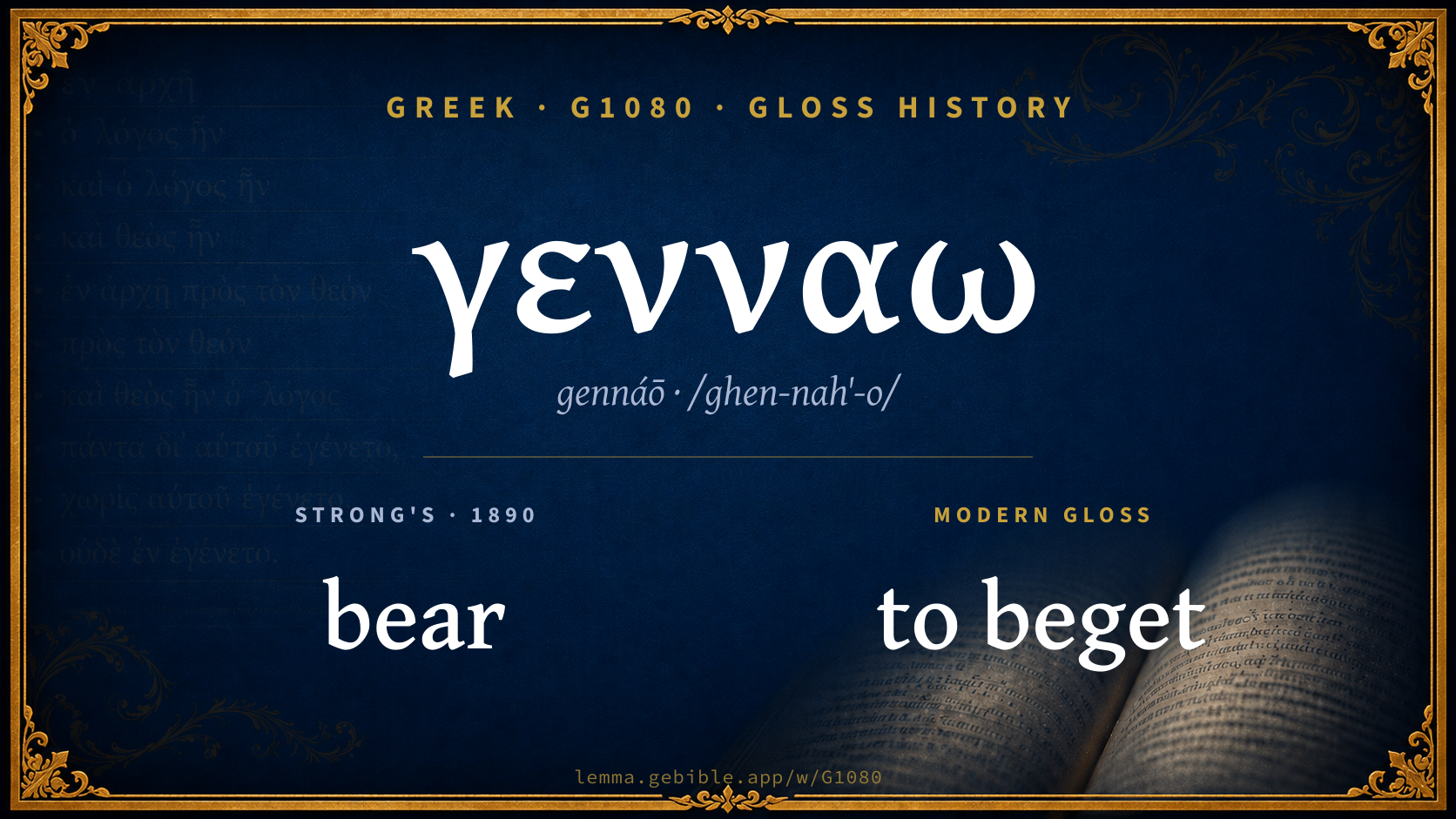
Gloss history
Strong's 1890 vs modern scholarship
About this word
Strong's G1080 catalogs a Greek word from the Greek New Testament.
These counts are not copied from any lexicon or concordance. They are computed here, from the morphology-tagged Greek New Testament. What Lemma adds →
- 65
- distinct verses
- The word appears in 65 distinct verses.
- 13 / 27
- NT books
- The word appears in 13 of 27 New Testament books.
- #174
- by frequency
- Top 250 most frequent Greek words (rank 174 of 5,347 Greek words by occurrence).
View all 65 occurrences in the concordance →
By section of the New Testament
By traditional corpus
Conventional, traditional groupings — biblical authorship is debated, so this is a traditional corpus grouping, not an authorship claim. Some books belong to more than one corpus (Luke is in both the Gospels and the Lukan corpus, and so on), so these shares overlap and need not total 100%. Each figure is a share of the word’s 65 distinct verses.
- Gospels 40 verses · 62%
- Johannine 21 verses · 32%
- Lukan (Luke–Acts) 11 verses · 17%
- Pauline corpus 7 verses · 11%
- General (Catholic) Epistles 7 verses · 11%
- Hebrews 4 verses · 6%
How translations render this word
Counts come from each version’s own published word-to-Strong’s tagging or interlinear alignment — an approximate guide to how each version renders this word, not a word-level alignment the data otherwise carries. Because each total is that version’s own tagged count, the per-version totals vary from one another and need not match the appearance or distinct-verse counts above. These counts may also differ from a printed concordance because Lemma counts each distinctly tagged rendering and does not collapse phrase taggings into a single head-word total. This is a fixed set of word-tagged versions (KJV, ASV, BSB, ULT) and does not change with the reading translation you choose elsewhere. Each version’s license is shown beside its name below (and on Sources).
- King James Version: Begat 40×, Is born 10×, Born 6×
- American Standard Version: Begat 41×, Born 8×, Is begotten 7×
- Berean Standard Bible: Father of 28×, Born 11×, Was the father of 11×
- unfoldingWord Literal Text: Fathered 40×, Having been born 5×, Was born 5×
King James Version Public Domain
Renders G1080 across 105 tagged occurrences — most commonly:
Plus 27 renderings that appear only once — usually multi-word phrases or single function words the recovered tagging swept in, not distinct renderings.
American Standard Version Public Domain
Renders G1080 across 108 tagged occurrences — most commonly:
Plus 24 renderings that appear only once — usually multi-word phrases or single function words the recovered tagging swept in, not distinct renderings.
Berean Standard Bible Public Domain
Renders G1080 across 96 tagged occurrences — most commonly:
Plus 20 renderings that appear only once — usually multi-word phrases or single function words the recovered tagging swept in, not distinct renderings. Not rendered by a distinct English word in 1 further occurrence.
unfoldingWord Literal Text CC BY-SA 4.0
Renders G1080 across 104 tagged occurrences — most commonly:
Plus other, less common renderings. Plus 21 renderings that appear only once — usually multi-word phrases or single function words the recovered tagging swept in, not distinct renderings.
Senses in Thayer's
The 2 senses Thayer's distinguishes for this word, in lexicon order (not ranked by frequency or importance). The full entry — with sub-senses — is in the Lexicon Entry tab.
- of men who fathered children
- metaph.
Word origin
Derived from γενος (génos) (G1085) — nation.
From a variation of G1085 ; to procreate (properly of the father but by extension of the mother); figuratively to regenerate : - bear beget be born bring forth conceive be delivered of gender make spring.
— Strong’s Exhaustive Concordance (1890), public domain.
Forms in the corpus
The 28 distinct written forms G1080 takes in the Greek New Testament, most frequent first — each parse links to that tense’s occurrences in the concordance.
Same root — word family
Other Thayer's entries built from the same root as G1080, grouped by Strong’s listed origin. These share a root / origin per the lexicon — not necessarily a shared meaning. Each links to that word’s own entry.
Derives from
Shares the same root
Derived from this word
Compare all same-root words → Showing 4 of 6 — not the complete family. They share a root, not necessarily a meaning.
Septuagint usage
The same Greek word γενναω appears 230 times in the Greek Old Testament (Septuagint), across 164 verses in 21 books.
- 230
- LXX occurrences
- Tagged occurrences of this Greek word in the Septuagint.
- 164
- verses
- Distinct Septuagint verses containing this word.
- 21 / 39
- OT books
- The word appears in 21 of the 39 Old Testament books.
Sample Septuagint occurrences
- Genesis 4:18 γεννάω
- Exodus 6:20 γεννάω
- Leviticus 18:9 γεννάω
- Numbers 26:33 γεννάω
- Deuteronomy 4:25 γεννάω
- Judges 11:1 γεννάω
- Ruth 4:18 γεννάω
- 2 Samuel 5:14 γεννάω
- 2 Kings 20:18 γεννάω
- 1 Chronicles 1:10 γεννάω
- 2 Chronicles 11:21 γεννάω
- Ezra 10:44 γεννάω
Septuagint occurrences (same lexeme)
Every verse where the same Strong’s number (G1080) appears in the Greek Septuagint — showing the first 50 of 164. Verse text shown in the World English Bible for context; the Greek form is the matched word — the English is not keyword-highlighted.
- Genesis 4:18 γεννάω To Enoch was born Irad. Irad became the father of Mehujael. Mehujael became the father of Methushael. Methushael became the father of Lamech.
- Genesis 5:3 γεννάω Adam lived one hundred thirty years, and became the father of a son in his own likeness, after his image, and named him Seth.
- Genesis 5:4 γεννάω The days of Adam after he became the father of Seth were eight hundred years, and he became the father of sons and daughters.
- Genesis 5:6 γεννάω Seth lived one hundred five years, and became the father of Enosh.
- Genesis 5:7 γεννάω Seth lived after he became the father of Enosh eight hundred seven years, and became the father of sons and daughters.
- Genesis 5:9 γεννάω Enosh lived ninety years, and became the father of Kenan.
- Genesis 5:10 γεννάω Enosh lived after he became the father of Kenan, eight hundred fifteen years, and became the father of sons and daughters.
- Genesis 5:12 γεννάω Kenan lived seventy years, and became the father of Mahalalel.
- Genesis 5:13 γεννάω Kenan lived after he became the father of Mahalalel eight hundred forty years, and became the father of sons and daughters
- Genesis 5:15 γεννάω Mahalalel lived sixty-five years, and became the father of Jared.
- Genesis 5:16 γεννάω Mahalalel lived after he became the father of Jared eight hundred thirty years, and became the father of sons and daughters.
- Genesis 5:18 γεννάω Jared lived one hundred sixty-two years, and became the father of Enoch.
- Genesis 5:19 γεννάω Jared lived after he became the father of Enoch eight hundred years, and became the father of sons and daughters.
- Genesis 5:21 γεννάω Enoch lived sixty-five years, and became the father of Methuselah.
- Genesis 5:22 γεννάω Enoch walked with God after he became the father of Methuselah three hundred years, and became the father of sons and daughters.
- Genesis 5:25 γεννάω Methuselah lived one hundred eighty-seven years, and became the father of Lamech.
- Genesis 5:26 γεννάω Methuselah lived after he became the father of Lamech seven hundred eighty-two years, and became the father of sons and daughters.
- Genesis 5:28 γεννάω Lamech lived one hundred eighty-two years, and became the father of a son,
- Genesis 5:30 γεννάω Lamech lived after he became the father of Noah five hundred ninety-five years, and became the father of sons and daughters.
- Genesis 5:32 γεννάω Noah was five hundred years old, and Noah became the father of Shem, Ham, and Japheth.
- Genesis 6:4 γεννάω The Nephilim were in the earth in those days, and also after that, when God's sons came to men's daughters. They bore children to them: the same were the mighty men who were of old, men of renown.
- Genesis 6:10 γεννάω Noah became the father of three sons: Shem, Ham, and Japheth.
- Genesis 10:8 γεννάω Cush became the father of Nimrod: he began to be a mighty one in the earth.
- Genesis 10:13 γεννάω Mizraim became the father of Ludim, Anamim, Lehabim, Naphtuhim,
- Genesis 10:15 γεννάω Canaan became the father of Sidon (his firstborn), Heth,
- Genesis 10:24 γεννάω Arpachshad became the father of Shelah. Shelah became the father of Eber.
- Genesis 10:26 γεννάω Joktan became the father of Almodad, Sheleph, Hazarmaveth, Jerah,
- Genesis 11:10 γεννάω This is the history of the generations of Shem. Shem was one hundred years old, and became the father of Arpachshad two years after the flood.
- Genesis 11:11 γεννάω Shem lived after he became the father of Arpachshad five hundred years, and became the father of sons and daughters.
- Genesis 11:12 γεννάω Arpachshad lived thirty-five years, and became the father of Shelah.
- Genesis 11:13 γεννάω Arpachshad lived after he became the father of Shelah four hundred three years, and became the father of sons and daughters.
- Genesis 11:14 γεννάω Shelah lived thirty years, and became the father of Eber:
- Genesis 11:15 γεννάω and Shelah lived after he became the father of Eber four hundred three years, and became the father of sons and daughters.
- Genesis 11:16 γεννάω Eber lived thirty-four years, and became the father of Peleg.
- Genesis 11:17 γεννάω Eber lived after he became the father of Peleg four hundred thirty years, and became the father of sons and daughters.
- Genesis 11:18 γεννάω Peleg lived thirty years, and became the father of Reu.
- Genesis 11:19 γεννάω Peleg lived after he became the father of Reu two hundred nine years, and became the father of sons and daughters.
- Genesis 11:20 γεννάω Reu lived thirty-two years, and became the father of Serug.
- Genesis 11:21 γεννάω Reu lived after he became the father of Serug two hundred seven years, and became the father of sons and daughters.
- Genesis 11:22 γεννάω Serug lived thirty years, and became the father of Nahor.
- Genesis 11:23 γεννάω Serug lived after he became the father of Nahor two hundred years, and became the father of sons and daughters.
- Genesis 11:24 γεννάω Nahor lived twenty-nine years, and became the father of Terah.
- Genesis 11:25 γεννάω Nahor lived after he became the father of Terah one hundred nineteen years, and became the father of sons and daughters.
- Genesis 11:26 γεννάω Terah lived seventy years, and became the father of Abram, Nahor, and Haran.
- Genesis 11:27 γεννάω Now this is the history of the generations of Terah. Terah became the father of Abram, Nahor, and Haran. Haran became the father of Lot.
- Genesis 17:20 γεννάω As for Ishmael, I have heard you. Behold, I have blessed him, and will make him fruitful, and will multiply him exceedingly. He will become the father of twelve princes, and I will make him a great nation.
- Genesis 22:23 γεννάω Bethuel became the father of Rebekah. These eight Milcah bore to Nahor, Abraham's brother.
- Genesis 25:3 γεννάω Jokshan became the father of Sheba, and Dedan. The sons of Dedan were Asshurim, Letushim, and Leummim.
- Genesis 25:19 γεννάω This is the history of the generations of Isaac, Abraham's son. Abraham became the father of Isaac.
- Genesis 46:20 γεννάω To Joseph in the land of Egypt were born Manasseh and Ephraim, whom Asenath, the daughter of Potiphera, priest of On, bore to him.
These are occurrences of the same Greek lexeme (G1080) in the Septuagint — not a translation of any one Hebrew word. The store carries no word-level Hebrew↔Greek alignment, so no Hebrew original is asserted here. Counts come from the recovered LXX Strong's tagging — high-frequency vocabulary is well covered, while rare or late forms may be untagged — so they reflect tagged occurrences and may slightly undercount.