
Numbers 26:33

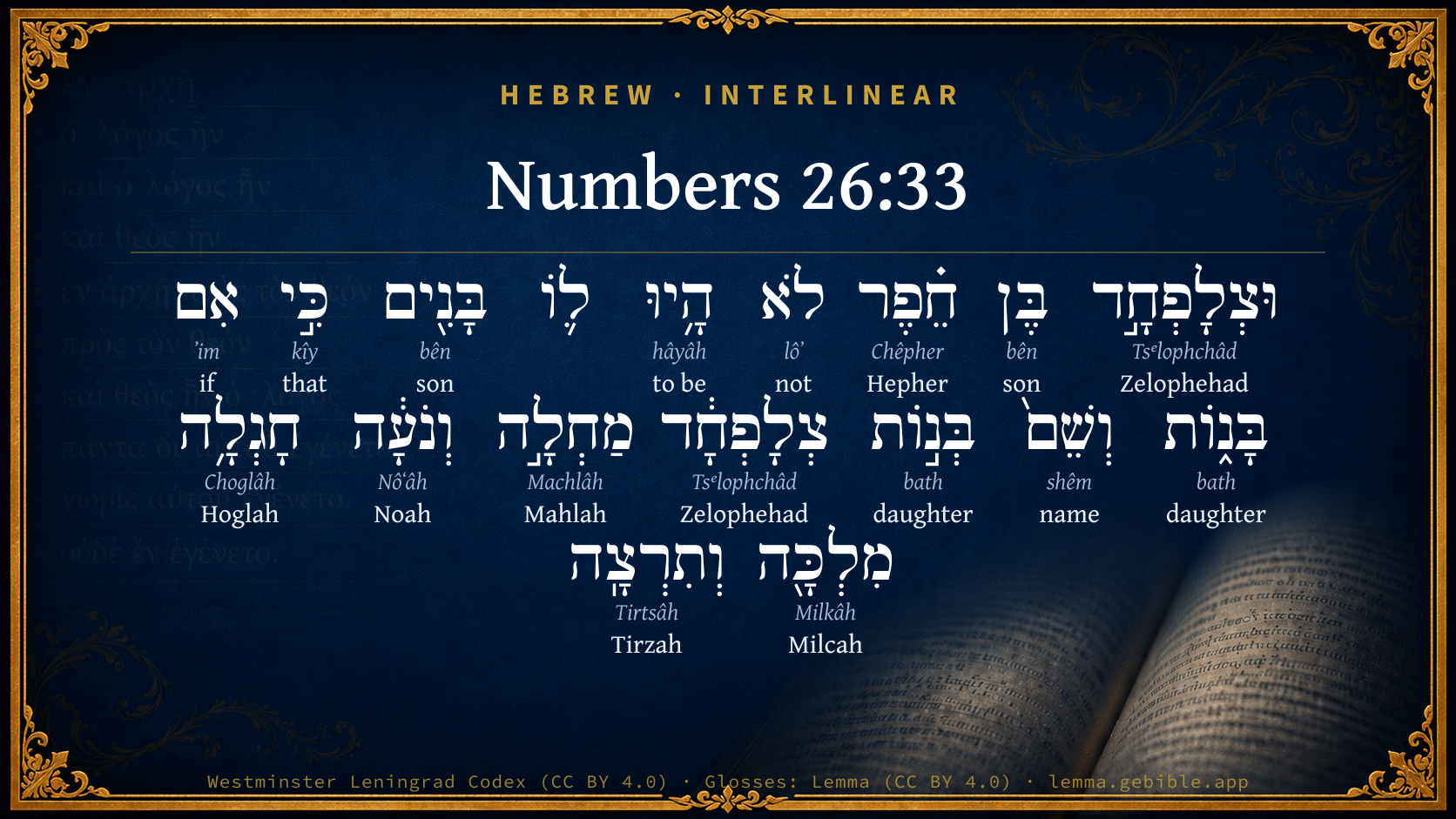
Hebrew (Westminster Leningrad Codex) Numbers 26:33 appears in the Hebrew Old Testament. The text above is from the Westminster Leningrad Codex. Each word links to its Strong’s number, a concise gloss, and parsing drawn from the Open Scriptures Hebrew Bible morphology. Click any word for its full Brown-Driver-Briggs (BDB) entry.
Download image
Cite this verse

Numbers 26:33 (World English Bible). Public Domain. Lemma interlinear Bible study tool, https://lemma.gebible.app/v/numbers/26/33.

Show BibTeX & RIS
BibTeX
RIS
English Translation
Zelophehad the son of Hepher had no sons, but daughters: and the names of the daughters of Zelophehad were Mahlah, and Noah, Hoglah, Milcah, and Tirzah.
World English Bible · Public Domain
Highlights
  • 5 first appearances in the Hebrew Bible
Full analysis ↓
Download a study sheet

One document with this verse’s original text, its word-by-word gloss line, the meaning frame, cross-references with their text, attributed commentary, and full source and license credits — printable, and it pastes into notes with its structure intact.

This verse Autodidact and up

Study sheet (.html) Plain text (.txt)

A passage Seminary Student

Up to 50 verses in one chapter. A passage sheet keeps up to 6 commentary sources and 12 cross-references per verse, in the order this page ranks them, and says so on the sheet whenever that leaves anything out. Ask for a single verse and you get the Autodidact verse sheet above.

Everything on this page stays free to read, with no account — the sheet is a download of what is already on screen, not access to it.

Want to remove ads? Support Godless Engineer
Compare translations 3

The same verse in 3 English versions, stacked beneath the original-language interlinear above. Click any original word for its lexicon entry.

Each is an independent rendering of the whole verse — the interlinear is not word-aligned to these translations.

Highlighted words mark where these versions differ — a whole-verse word diff, not a word-by-word alignment.

  • World English Bible Public Domain
    Zelophehad the son of Hepher had no sons, but daughters: and the names of the daughters of Zelophehad were Mahlah, and Noah, Hoglah, Milcah, and Tirzah.
  • King James Version Public Domain
    And Zelophehad the son of Hepher had no sons, but daughters: and the names of the daughters of Zelophehad were Mahlah, and Noah, Hoglah, Milcah, and Tirzah.
  • unfoldingWord Literal Text CC BY-SA 4.0
    And there were no sons for Zelophehad the son of Hepher, but daughters. And the names of the daughters of Zelophehad were Mahlah, and Noah, Hoglah, Milkah, and Tirzah.

unfoldingWord Literal Text — © unfoldingWord, licensed CC BY-SA 4.0. Word-aligned USFM3 via Door43 (git.door43.org/unfoldingWord/en_ult).

Versions to compare (up to 4)

3 of 4 selected

Show all 18 translations

Every available English version of this verse, each an independent rendering of the whole verse.

  • World English Bible Public Domain
    Zelophehad the son of Hepher had no sons, but daughters: and the names of the daughters of Zelophehad were Mahlah, and Noah, Hoglah, Milcah, and Tirzah.
  • Berean Standard Bible Public Domain
    Now Zelophehad son of Hepher had no sons but only daughters. The names of his daughters were Mahlah, Noah, Hoglah, Milcah, and Tirzah.
  • Majority Standard Bible Public Domain
    Now Zelophehad son of Hepher had no sons but only daughters. The names of his daughters were Mahlah, Noah, Hoglah, Milcah, and Tirzah.
  • King James Version Public Domain
    And Zelophehad the son of Hepher had no sons, but daughters: and the names of the daughters of Zelophehad were Mahlah, and Noah, Hoglah, Milcah, and Tirzah.
  • American Standard Version (1901) Public Domain
    And Zelophehad the son of Hepher had no sons, but daughters: and the names of the daughters of Zelophehad were Mahlah, and Noah, Hoglah, Milcah, and Tirzah.
  • Revised Version (1885) Public Domain
    And Zelophehad the son of Hepher had no sons, but daughters: and the names of the daughters of Zelophehad were Mahlah, and Noah, Hoglah, Milcah, and Tirzah.
  • Geneva Bible (1599) Public Domain
    And Zelophehad the sonne of Hepher had no sonnes, but daughters: and the names of the daughters of Zelophehad were Mahlah, and Noah, Hoglah, Milcah and Tirzah.
  • Douay-Rheims (1899) Public Domain
    And Hepher was the father of Salphaad, who had no sons, but only daughters, whose names are these: Maala, and Noa, and Hegla, and Melcha, and Thersa.
  • Young's Literal Translation Public Domain
    And Zelophehad son of Hepher had no sons but daughters, and the names of the daughters of Zelophehad `are' Mahlah, and Noah, Hoglah, Milcah, and Tirzah.
  • Literal Standard Version CC BY-SA 4.0
    And Zelophehad son of Hepher had no sons, but [only] daughters, and the names of the daughters of Zelophehad [are] Mahlah, and Noah, Hoglah, Milcah, and Tirzah.
  • Unlocked Literal Bible CC BY-SA 4.0
    Zelophehad son of Hepher had no sons, but only daughters. The names of his daughters were Mahlah, Noah, Hoglah, Milkah, and Tirzah.
  • unfoldingWord Literal Text CC BY-SA 4.0
    And there were no sons for Zelophehad the son of Hepher, but daughters. And the names of the daughters of Zelophehad were Mahlah, and Noah, Hoglah, Milkah, and Tirzah.
  • Darby Bible Public Domain
    -- And Zelophehad the son of Hepher had no sons, but daughters; and the names of the daughters of Zelophehad were Mahlah, and Noah, Hoglah, Milcah, and Tirzah.
  • World Messianic Bible Public Domain
    Zelophehad the son of Hepher had no sons, but daughters: and the names of the daughters of Zelophehad were Mahlah, Noah, Hoglah, Milcah, and Tirzah.
  • Webster's Bible Public Domain
    And Zelophehad the son of Hepher had no sons, but daughters: and the names of the daughters of Zelophehad were Mahlah, and Noah, Hoglah, Milcah, and Tirzah.
  • Free Bible Version CC BY-SA 4.0
    (Zelophehad, son of Hepher, didn't have any sons, only daughters. Their names were Mahlah, Noah, Hoglah, Milcah, and Tirzah.)
  • Bible in Basic English Public Domain
    And Zelophehad, the son of Hepher, had no sons, but only daughters, and the names of the daughters of Zelophehad were Mahlah, and Noah, Hoglah, Milcah, and Tirzah.
  • JPS Tanakh (1917) Public Domain
    And Zelophehad the son of Hepher had no sons, but daughters; and the names of the daughters of Zelophehad were Mahlah, and Noah, Hoglah, Milcah, and Tirzah.

Literal Standard Version (2020), Covenant Press — licensed CC BY-SA 4.0. Text via the HelloAO Bible API (eBible.org). Unlocked Literal Bible (unfoldingWord) — licensed CC BY-SA 4.0. Text via the HelloAO Bible API (eBible.org). unfoldingWord Literal Text — © unfoldingWord, licensed CC BY-SA 4.0. Word-aligned USFM3 via Door43 (git.door43.org/unfoldingWord/en_ult). Free Bible Version, Dr. Jonathan Gallagher — licensed CC BY-SA 4.0. Text via the HelloAO Bible API (eBible.org).

Word by word

More ways to search: Search by grammar → Find every occurrence → Compare this word →

Practice this passage: Drill this verse → Learn its vocabulary →

וְנֹעָ֔ה
Nôʻâh
H5270
“and · Noah”
Conjunction + Noun, Proper
Part of Speech
Conjunction + Noun
Type
Proper
Full BDB Definition

Origin: from H5128

TWOT: None

Noah = "motion" - one of the 5 daughters of Zelophehad in the time of the exodus
  1. וּצְלָפְחָ֣ד Tsᵉlophchâd H6765 “and · Zelophehad” Conjunction + Noun, Proper
  2. בֶּן bên H1121 “son of” Noun, Common, Masculine, Singular, Construct
  3. חֵ֗פֶר Chêpher H2660 “Hepher” Noun, Proper
  4. לֹא lôʼ H3808 “not” Particle, Negative
  5. הָ֥יוּ hâyâh H1961 “to be” Verb, Qal, Perfect, 3rd Person, Common, Plural
  6. בָּנִ֖ים bên H1121 “sons” Noun, Common, Masculine, Plural, Absolute
  7. כִּ֣י kîy H3588 “that” Conjunction
  8. אִם ʼim H518 “if” Conjunction
  9. בָּנ֑וֹת bath H1323 “daughters” Noun, Common, Feminine, Plural, Absolute
  10. וְשֵׁם֙ shêm H8034 “and · name of” Conjunction + Noun, Common, Masculine, Singular, Construct
  11. בְּנ֣וֹת bath H1323 “daughters of” Noun, Common, Feminine, Plural, Construct
  12. צְלָפְחָ֔ד Tsᵉlophchâd H6765 “Zelophehad” Noun, Proper
  13. מַחְלָ֣ה Machlâh H4244 “Mahlah” Noun, Proper
  14. חָגְלָ֥ה Choglâh H2295 “Hoglah” Noun, Proper
  15. מִלְכָּ֖ה Milkâh H4435 “Milcah” Noun, Proper
  16. וְתִרְצָֽה Tirtsâh H8656 “and · Tirzah” Conjunction + Noun, Proper

About this verse

These counts appear in no published source. They are computed here, from the morphology-tagged text and Lemma’s own curated glosses. What Lemma adds →

18
words
14
distinct lemmas
Pentateuch
section

Notable vocabulary

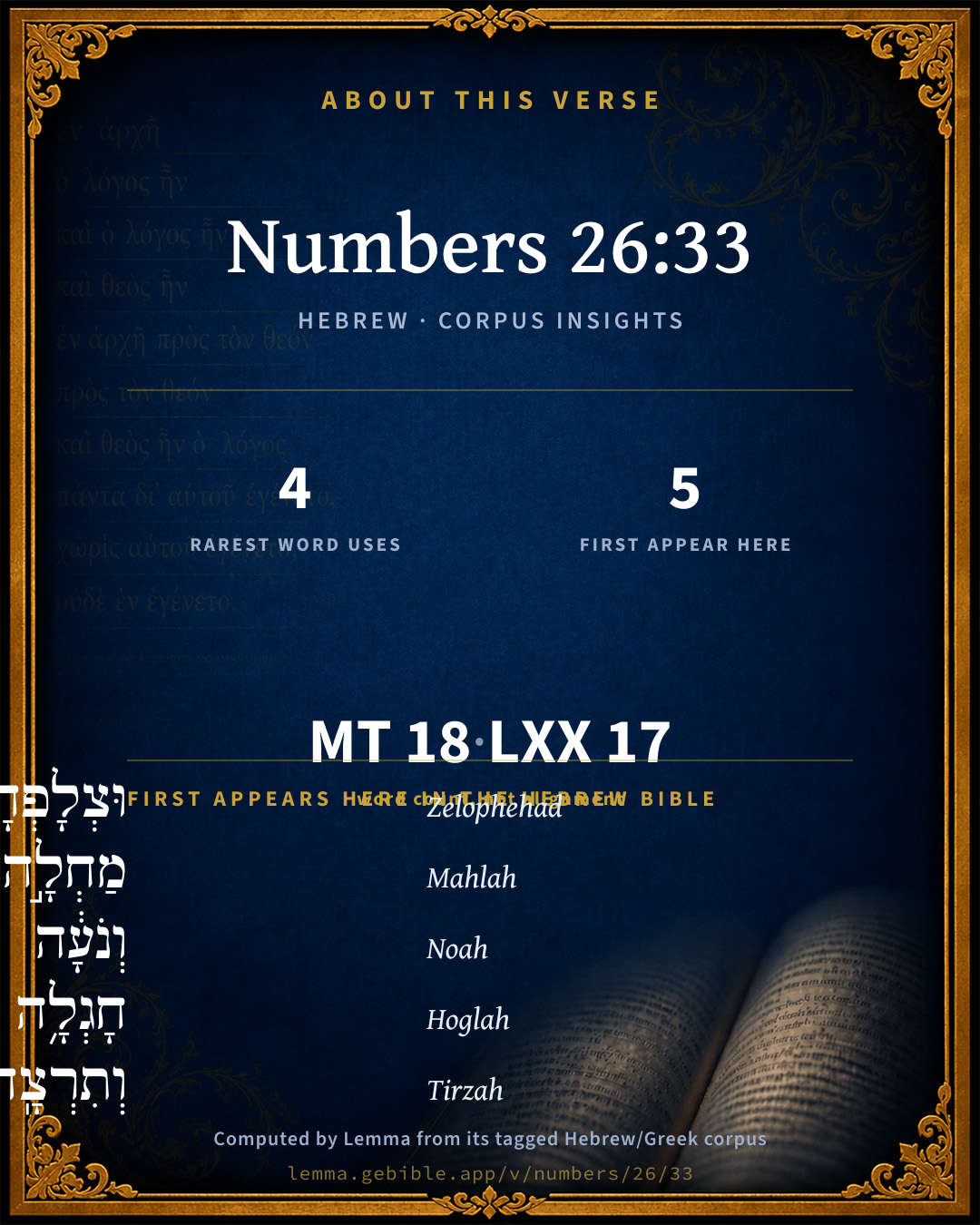
The rarest word here is וְנֹעָ֔ה Noah H5270 — appearing just 4 times in the whole Hebrew Bible.

First appearance in Scripture

These words make their first canonical appearance in the Hebrew Bible here:

  • וּצְלָפְחָ֣ד Zelophehad H6765
  • מַחְלָ֣ה Mahlah H4244
  • וְנֹעָ֔ה Noah H5270
  • חָגְלָ֥ה Hoglah H2295
  • וְתִרְצָֽה Tirzah H8656

Shared distinctive vocabulary

וְנֹעָ֔ה Noah H5270 occurs in 4 verses of the Hebrew Bible. Also found in:

Grammatical profile

  • 1 verb
  • 13 nouns
  • 1 preposition
  • 2 conjunctions
  • 1 particle

Verb forms

  • הָ֥יוּ Qal · Perfect

Repetition

Words recur within this verse — often emphatic in Hebrew:

  • וּצְלָפְחָ֣ד Zelophehad H6765 ×2
  • בֶּן son H1121 ×2
  • בָּנ֑וֹת daughter H1323 ×2

Hebrew & Septuagint length

In English translation the verse runs 26 words from the Hebrew and 22 from the Septuagint (LXX English) — closely comparable.

A rough comparison of the two English renderings, which tokenize alike — not a word-level alignment.

Word counts can differ between the Hebrew and the Greek without any difference in meaning — e.g. the Hebrew direct-object marker אֵת has no separate Greek word, and Greek often adds the article ὁ.

In the original languages it is 18 Hebrew tokens and 17 Greek tokens — but the two are counted differently (Hebrew bundles its prefixes and suffixes into one token; the Greek is in lemma form), so that isn’t a like-for-like length.

Cross-references

2

Topical passages linked to Numbers 26:33 in the Treasury of Scripture Knowledge — connected by theme and wording, ordered by reader-vote popularity; previews shown in the World English Bible.

  • Numbers 27:1 Then drew near the daughters of Zelophehad, the son of Hepher, the son of Gilead, the son of Machir, the son of Manasseh, of the families of Manasseh the son of Joseph; and these are the names of his daughters: Mahlah, Noah, and Hoglah, and Milcah, and Tirzah.
  • Numbers 36:10–12 Even as Yahweh commanded Moses, so did the daughters of Zelophehad:

Cross-references courtesy of OpenBible.info (CC BY 4.0).

Hebrew and Greek witnesses Masoretic Hebrew ↔ Greek Septuagint

The same verse in the two great witnesses to the Old Testament, shown verse-for-verse.

These are two independent witnesses, not word-aligned to each other, and the Septuagint is shown in lemma (dictionary) form.

Hebrew Numbers 26:33 Masoretic · Westminster Leningrad Codex

וּצְלָפְחָ֣ד בֶּן חֵ֗פֶר לֹא הָ֥יוּ ל֛וֹ בָּנִ֖ים כִּ֣י אִם בָּנ֑וֹת וְשֵׁם֙ בְּנ֣וֹת צְלָפְחָ֔ד מַחְלָ֣ה וְנֹעָ֔ה חָגְלָ֥ה מִלְכָּ֖ה וְתִרְצָֽה

Zelophehad the son of Hepher had no sons, but daughters: and the names of the daughters of Zelophehad were Mahlah, and Noah, Hoglah, Milcah, and Tirzah.

World English Bible · Public Domain

Greek LXX Numbers 26:33 Septuagint · lemma form

υἱός μανασσή ὁ μαχιρ δῆμος ὁ μαχιρι καί μαχιρ γεννάω ὁ γαλαάδ ὁ γαλαάδ δῆμος ὁ γαλααδί

The sons of Manasse. To Machir the family of the Machirites; and Machir begot Galaad: to Galaad, the family of the Galaadites.

LXX2012 (modern English Septuagint) · Public Domain

Hebrew: Westminster Leningrad Codex (CC BY 4.0). Greek: Septuagint (public domain); English from LXX2012 (modern English Septuagint) (Public Domain). How the Septuagint differs from the Hebrew →

Targum (Aramaic paraphrase)

2

The Targum is the ancient Jewish Aramaic paraphrase of the Hebrew Scriptures — an interpretive translation, not the Hebrew text itself. Onkelos (literal) and Pseudo-Jonathan (expansive) render the Torah, and Jonathan the Prophets. Coverage is partial: where no permissively-licensed English translation exists for a verse, only the Aramaic is shown. This is verse-level text, not a word-by-word alignment to the Hebrew.

  1. Targum Onkelos Torah (Genesis–Deuteronomy)
    וּצְלָפְחָד בַּר חֵפֶר לָא הֲווֹ לֵיהּ בְּנִין אֱלָהֵין בְּנָן וְשׁוּם בְּנַת צְלָפְחָד מַחְלָה וְנוֹעָה חָגְלָה מִלְכָּה וְתִרְצָה

    (no public-domain English translation for this verse)

    Targum Onkelos — Aramaic: “Onkelos Genesis” (public domain); “Onkelos Exodus” (public domain); “Onkelos Leviticus” (public domain); “Onkelos Numbers” (public domain); “Onkelos Deuteronomy” (public domain). English: “Sefaria Community Translation” (CC0 1.0 (public-domain dedication)); “J.W. Etheridge. The Targums of Onkelos and Jonathan Ben Uzziel on the Pentateuch. London: Longmans, Green, 1862” (public domain). Text via Sefaria.

  2. Targum Pseudo-Jonathan Torah (Genesis–Deuteronomy)
    וּצְלָפְחָד בַּר חֵפֶר לָא הֲווֹ לֵיהּ בְּנִין אֱלָהֵן בְּנָן וְשׁוּם בְּנַת צְלָפְחָד מַחְלָה נוֹעָה חָגְלָה מִלְכָּה וְתִרְצָה

    But Zelophehad bar Hepher had no sons, but daughters only; and the names of the daughters of Zelophebad were, Mahelah, Nohah, Hogelah, Milchah, and Thirzah.

    Targum Pseudo-Jonathan — Aramaic: “Targum Jonathan on Genesis” (public domain); “Targum Jonathan on Exodus” (public domain); “Targum Jonathan on Leviticus” (public domain); “Targum Jonathan on Numbers” (public domain); “Targum Jonathan on Deuteronomy” (public domain). English: “The Targum of Jonathan ben Uzziel, trans. J. W. Etheridge, London, 1862” (public domain). Text via Sefaria.

Commentary

Notes on Numbers 26:33 from classic Christian and Jewish commentators (each source and its license shown beneath its notes). The classic Christian expositions comment on the surrounding passage and are grouped to its opening verse, so a note may address several verses; the Jewish commentaries on the Tanakh (Rashi and others) are per-verse, so they appear only where the commentator wrote on this verse.

Lemma curates 59 commentaries, every one of them public domain or Creative Commons licensed, each selected and text-cleaned for this edition rather than reprinted as found. About our sources →

Joseph Benson's Commentary

Num 26:33. Zelophehad had no sons, but daughters — It is remarkable that in so many heads of families there was only one to whom no sons were born. To what other cause can this be ascribed but to a peculiar providence, whereby many more males than females were born, for the strength and increase of the Jewish nation?

Joseph Benson's Commentary on the Old and New Testaments (1811–1818) — public domain. Text from a community e-Sword module.

Tyndale Open Study Notes

Tyndale Open Resources

26:33 The daughters of Zelophehad initiated important legal reform (see 27:1-11; 36:1-12).

Tyndale Open Study Notes — © Tyndale Open Resources, licensed CC BY-SA 4.0. Text via the HelloAO Bible API.

Whedon's Commentary on the Bible

Daniel D. Whedon

33. The names of the daughters of Zelophehad, who had no sons, are recorded preparatory to the new legislation respecting the inheritance of brotherless daughters. Chaps. 27 and 36.

Daniel D. Whedon (gen. ed.), Commentary on the Old and New Testaments (1874–1909) — public domain. Text from a community e-Sword module.

The Pulpit Commentary

Zelophehad...had no sons, but daughters. This is mentioned here because the case was to come prominently before the lawgiver and the nation. (cf. Num_27:1 Num_36:1 1Ch_7:15)

The Pulpit Commentary (1880–1919), ed. H.D.M. Spence-Jones & Joseph S. Exell — public domain. Text from a community e-Sword module.

unfoldingWord translationNotes

Door43 World Missions Community

General Information:

The leaders of Israel are counting the men, 20 years old and older, according to their tribes and families. (See: How to Translate Names and Numbers)

52,700 men

"fifty-two thousand seven hundred men" (See: Numbers)

translationWords

name

unfoldingWord translationNotes — © Distant Shores Media and the Door43 World Missions Community, licensed CC BY-SA 4.0. Source: git.door43.org/Door43/en_tn.

Lesson kit

Teaching starters — assembled from the data on this page, not authored interpretation. Every prompt links to the verse data it draws on. Edit before teaching.

Numbers, in the Pentateuch, opens this verse with 18 words (14 distinct Hebrew lemmas). Its most distinctive word is Nôʻâh (“Noah”). A historical commentator’s framing appears above. Read the whole chapter for the surrounding context.

Discussion questions

  1. What does “Noah” (Nôʻâh) contribute to the verse as a whole?
  2. 5 words here appear for the first time in Scripture. What is being introduced at this debut?
  3. Numbers 27:1 shares the word «Noah» with this verse. How do the two illuminate each other?
  4. “Zelophehad” occurs 2× in this one verse. What is the effect of the repetition?
  5. These translations render this verse differently. What is at stake in choosing one wording over another?
  6. The verb «הָ֥יוּ» is Qal Perfect. How does its form color the action?
  7. Reading how Joseph Benson's Commentary and Tyndale Open Study Notes read this verse, where do the two commentators agree and where do they part?

Things to notice

Reading settings

Reading text

Shown beneath each verse's original-language words.

Old Testament
Old Testament edition

Read the OT as the Masoretic Hebrew (MT) or the Greek Septuagint (LXX).

English shown for the Greek Septuagint (in the Hebrew ↔ Greek comparison).

Comparing translations? Open the Compare panel on any verse page to stack up to four side by side.