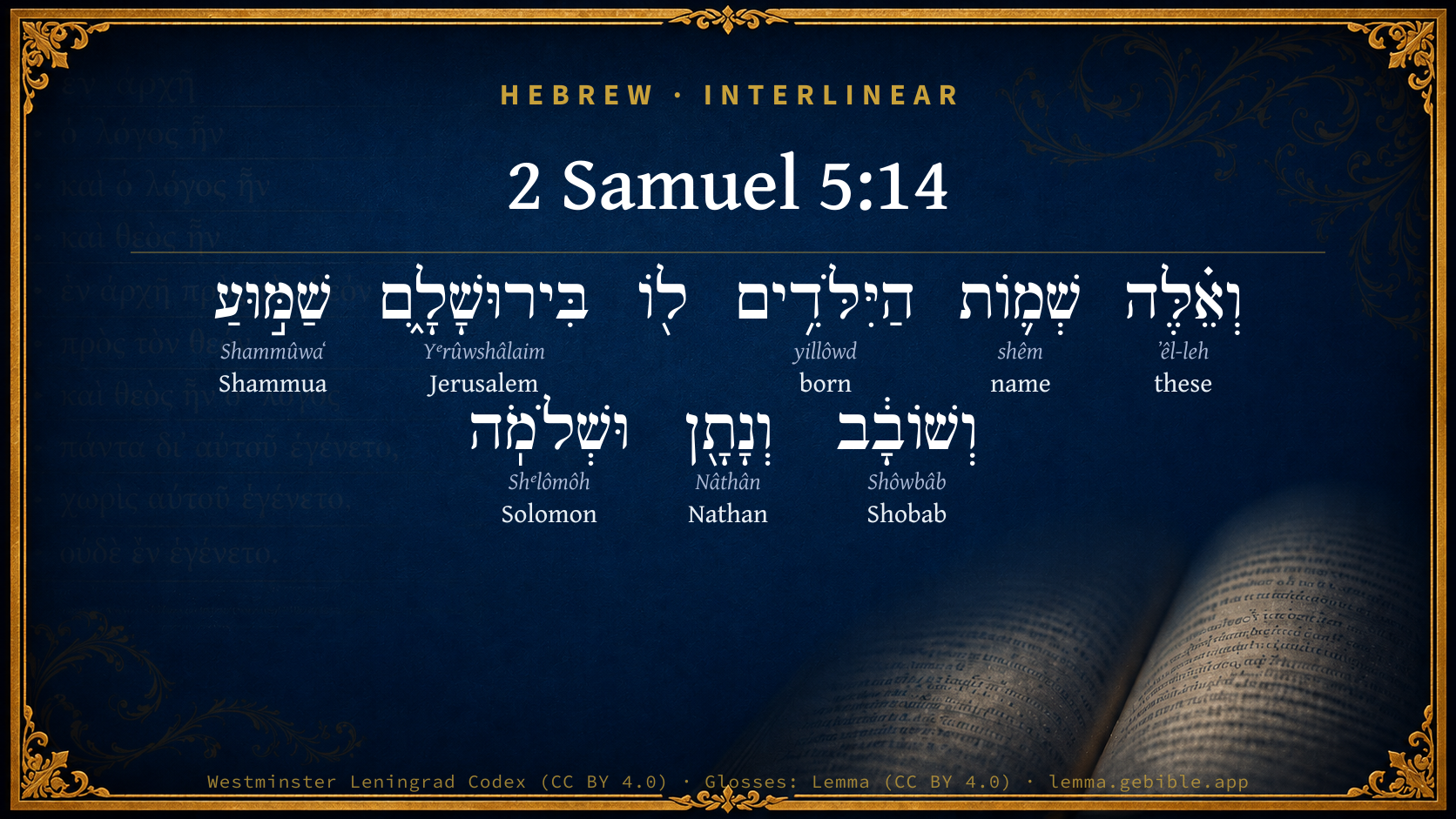
2 Samuel 5:14

Hebrew (Westminster Leningrad Codex) 2 Samuel 5:14 appears in the Hebrew Old Testament. The text above is from the Westminster Leningrad Codex. Each word links to its Strong’s number, a concise gloss, and parsing drawn from the Open Scriptures Hebrew Bible morphology. Click any word for its full Brown-Driver-Briggs (BDB) entry.
Download image
Cite this verse

2 Samuel 5:14 (World English Bible). Public Domain. Lemma interlinear Bible study tool, https://lemma.gebible.app/v/2-samuel/5/14.

Show BibTeX & RIS
BibTeX
RIS
English Translation
These are the names of those who were born to him in Jerusalem: Shammua, and Shobab, and Nathan, and Solomon,
World English Bible · Public Domain
Highlights
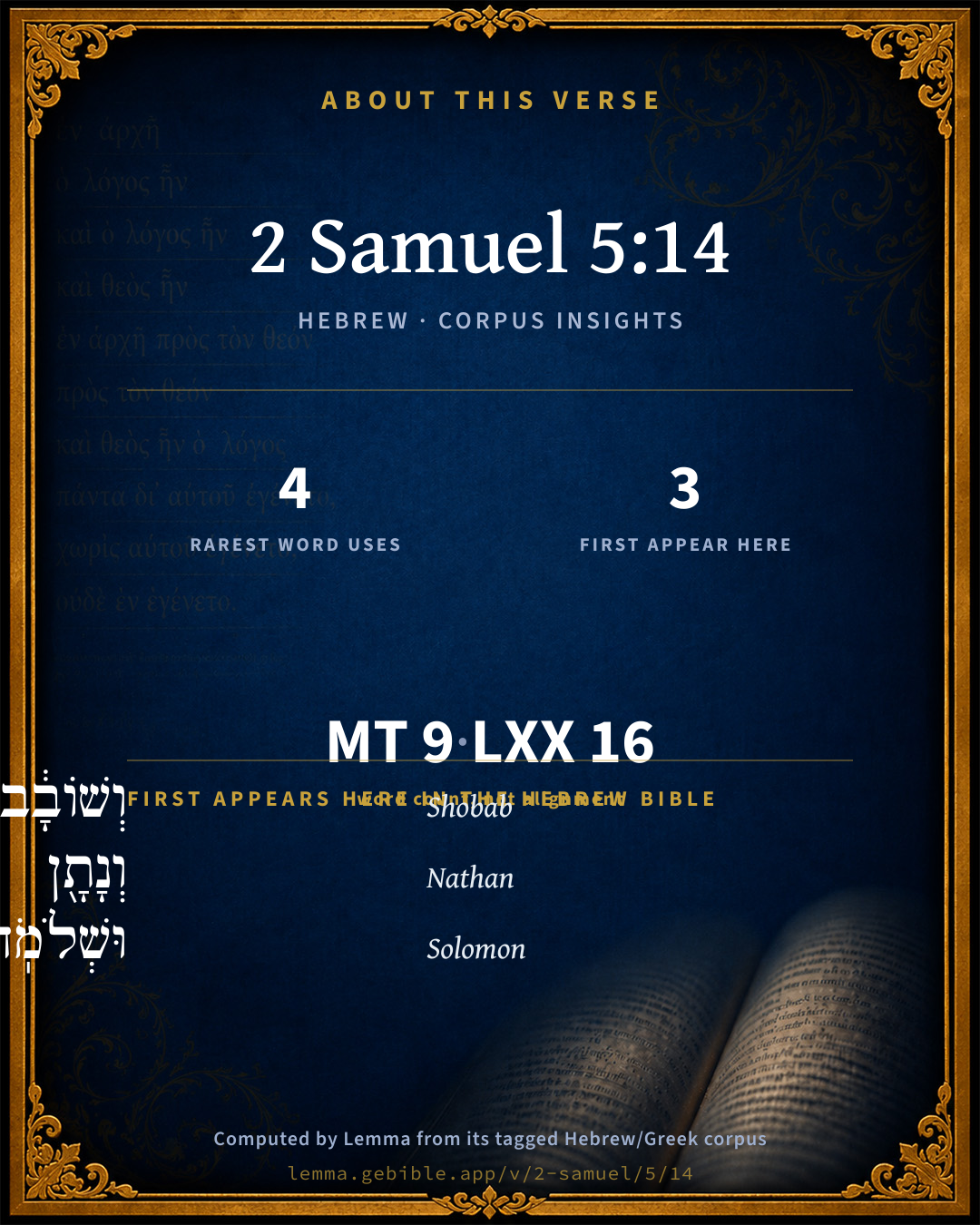
  • 3 first appearances in the Hebrew Bible
Full analysis ↓
Download a study sheet

One document with this verse’s original text, its word-by-word gloss line, the meaning frame, cross-references with their text, attributed commentary, and full source and license credits — printable, and it pastes into notes with its structure intact.

This verse Autodidact and up

Study sheet (.html) Plain text (.txt)

A passage Seminary Student

Up to 50 verses in one chapter. A passage sheet keeps up to 6 commentary sources and 12 cross-references per verse, in the order this page ranks them, and says so on the sheet whenever that leaves anything out. Ask for a single verse and you get the Autodidact verse sheet above.

Everything on this page stays free to read, with no account — the sheet is a download of what is already on screen, not access to it.

Want to remove ads? Support Godless Engineer
Compare translations 3

The same verse in 3 English versions, stacked beneath the original-language interlinear above. Click any original word for its lexicon entry.

Each is an independent rendering of the whole verse — the interlinear is not word-aligned to these translations.

Highlighted words mark where these versions differ — a whole-verse word diff, not a word-by-word alignment.

  • World English Bible Public Domain
    These are the names of those who were born to him in Jerusalem: Shammua, and Shobab, and Nathan, and Solomon,
  • King James Version Public Domain
    And these be the names of those that were born unto him in Jerusalem; Shammuah, and Shobab, and Nathan, and Solomon,
  • unfoldingWord Literal Text CC BY-SA 4.0
    And these the names of the ones born to him in Jerusalem: Shammua and Shobab and Nathan and Solomon

unfoldingWord Literal Text — © unfoldingWord, licensed CC BY-SA 4.0. Word-aligned USFM3 via Door43 (git.door43.org/unfoldingWord/en_ult).

Versions to compare (up to 4)

3 of 4 selected

Show all 18 translations

Every available English version of this verse, each an independent rendering of the whole verse.

  • World English Bible Public Domain
    These are the names of those who were born to him in Jerusalem: Shammua, and Shobab, and Nathan, and Solomon,
  • Berean Standard Bible Public Domain
    These are the names of the children born to him in Jerusalem: Shammua, Shobab, Nathan, Solomon,
  • Majority Standard Bible Public Domain
    These are the names of the children born to him in Jerusalem: Shammua, Shobab, Nathan, Solomon,
  • King James Version Public Domain
    And these be the names of those that were born unto him in Jerusalem; Shammuah, and Shobab, and Nathan, and Solomon,
  • American Standard Version (1901) Public Domain
    And these are the names of those that were born unto him in Jerusalem: Shammua, and Shobab, and Nathan, and Solomon,
  • Revised Version (1885) Public Domain
    And these be the names of those that were born unto him in Jerusalem; Shammua, and Shobab, and Nathan, and Solomon,
  • Geneva Bible (1599) Public Domain
    And these bee the names of the sonnes that were borne vnto him in Ierusale: Shammua, and Shobab, and Nathan, and Salomon,
  • Douay-Rheims (1899) Public Domain
    And David took more concubines and wives of Jerusalem, after he was come from Hebron: and there were born to David other sons also and daughters:
  • Young's Literal Translation Public Domain
    And these `are' the names of those born to him in Jerusalem: Shammuah, and Shobab, and Nathan, and Solomon,
  • Literal Standard Version CC BY-SA 4.0
    And these [are] the names of those born to him in Jerusalem: Shammuah, and Shobab, and Nathan, and Solomon,
  • Unlocked Literal Bible CC BY-SA 4.0
    These were the names of the children who were born to him in Jerusalem: Shammua, Shobab, Nathan, Solomon,
  • unfoldingWord Literal Text CC BY-SA 4.0
    And these the names of the ones born to him in Jerusalem: Shammua and Shobab and Nathan and Solomon
  • Darby Bible Public Domain
    And these are the names of those that were born to him in Jerusalem: Shammua, and Shobab, and Nathan, and Solomon,
  • World Messianic Bible Public Domain
    These are the names of those who were born to him in Jerusalem: Shammua, Shobab, Nathan, Solomon,
  • Webster's Bible Public Domain
    And these are the names of those that were born to him in Jerusalem; Shammuah, and Shobab, and Nathan, and Solomon,
  • Free Bible Version CC BY-SA 4.0
    These are the names of his children born in Jerusalem: Shammua, Shobab, Nathan, Solomon,
  • Bible in Basic English Public Domain
    These are the names of those whose birth took place in Jerusalem: Shammua and Shobab and Nathan and Solomon
  • JPS Tanakh (1917) Public Domain
    And these are the names of those that were born unto him in Jerusalem: Shammua, and Shobab, and Nathan, and Solomon;

Literal Standard Version (2020), Covenant Press — licensed CC BY-SA 4.0. Text via the HelloAO Bible API (eBible.org). Unlocked Literal Bible (unfoldingWord) — licensed CC BY-SA 4.0. Text via the HelloAO Bible API (eBible.org). unfoldingWord Literal Text — © unfoldingWord, licensed CC BY-SA 4.0. Word-aligned USFM3 via Door43 (git.door43.org/unfoldingWord/en_ult). Free Bible Version, Dr. Jonathan Gallagher — licensed CC BY-SA 4.0. Text via the HelloAO Bible API (eBible.org).

Word by word

More ways to search: Search by grammar → Find every occurrence → Compare this word →

Practice this passage: Drill this verse → Learn its vocabulary →

About this verse

These counts appear in no published source. They are computed here, from the morphology-tagged text and Lemma’s own curated glosses. What Lemma adds →

9
words
8
distinct lemmas
Historical
section

Notable vocabulary

The rarest word here is הַיִּלֹּדִ֥ים born H3209 — appearing just 4 times in the whole Hebrew Bible.

First appearance in Scripture

These words make their first canonical appearance in the Hebrew Bible here:

  • וְשׁוֹבָ֔ב Shobab H7727
  • וְנָתָ֖ן Nathan H5416
  • וּשְׁלֹמֹֽה Solomon H8010

Shared distinctive vocabulary

הַיִּלֹּדִ֥ים born H3209 occurs in 4 verses of the Hebrew Bible. Also found in:

Grammatical profile

  • 6 nouns
  • 1 adjective
  • 1 pronoun
  • 1 preposition

Hebrew & Septuagint length

In English translation the verse runs 20 words from the Hebrew and 21 from the Septuagint (LXX English) — closely comparable.

A rough comparison of the two English renderings, which tokenize alike — not a word-level alignment.

Word counts can differ between the Hebrew and the Greek without any difference in meaning — e.g. the Hebrew direct-object marker אֵת has no separate Greek word, and Greek often adds the article ὁ.

In the original languages it is 9 Hebrew tokens and 16 Greek tokens — but the two are counted differently (Hebrew bundles its prefixes and suffixes into one token; the Greek is in lemma form), so that isn’t a like-for-like length.

Cross-references

6

Topical passages linked to 2 Samuel 5:14 in the Treasury of Scripture Knowledge — connected by theme and wording, ordered by reader-vote popularity; previews shown in the World English Bible.

  • 1 Chronicles 3:5–9 and these were born to him in Jerusalem: Shimea, and Shobab, and Nathan, and Solomon, four, of Bathshua the daughter of Ammiel;
  • 2 Samuel 12:1–7 Yahweh sent Nathan to David. He came to him, and said to him, "There were two men in one city; the one rich, and the other poor.
  • 2 Samuel 12:24–25 David comforted Bathsheba his wife, and went in to her, and lay with her: and she bore a son, and he called his name Solomon. Yahweh loved him;
  • 1 Chronicles 14:4 These are the names of the children whom he had in Jerusalem: Shammua, and Shobab, Nathan, and Solomon,
  • Matthew 1:6 Jesse became the father of David the king. David became the father of Solomon by her who had been the wife of Uriah.
  • Luke 2:31 Which you have prepared before the face of all peoples;

Cross-references courtesy of OpenBible.info (CC BY 4.0).

Hebrew and Greek witnesses Masoretic Hebrew ↔ Greek Septuagint

The same verse in the two great witnesses to the Old Testament, shown verse-for-verse.

These are two independent witnesses, not word-aligned to each other, and the Septuagint is shown in lemma (dictionary) form.

Hebrew 2 Samuel 5:14 Masoretic · Westminster Leningrad Codex

וְאֵ֗לֶּה שְׁמ֛וֹת הַיִּלֹּדִ֥ים ל֖וֹ בִּירוּשָׁלִָ֑ם שַׁמּ֣וּעַ וְשׁוֹבָ֔ב וְנָתָ֖ן וּשְׁלֹמֹֽה

These are the names of those who were born to him in Jerusalem: Shammua, and Shobab, and Nathan, and Solomon,

World English Bible · Public Domain

Greek LXX 2 Samuel 5:14 Septuagint · lemma form

καί οὗτος ὁ ὄνομα ὁ γεννάω αὐτός ἐν ἰερουσαλήμ σαμμους καί σωβαβ καί ναθαν καί σαλωμών

And these are the names of those that were born to him in Jerusalem; Sammus, and Sobab, and Nathan, and Solomon.

LXX2012 (modern English Septuagint) · Public Domain

On this verse, Adam Clarke's Commentary discusses the Septuagint’s reading. Read the note in Commentary ↓

Hebrew: Westminster Leningrad Codex (CC BY 4.0). Greek: Septuagint (public domain); English from LXX2012 (modern English Septuagint) (Public Domain). How the Septuagint differs from the Hebrew →

Targum (Aramaic paraphrase)

1

The Targum is the ancient Jewish Aramaic paraphrase of the Hebrew Scriptures — an interpretive translation, not the Hebrew text itself. Onkelos (literal) and Pseudo-Jonathan (expansive) render the Torah, and Jonathan the Prophets. Coverage is partial: where no permissively-licensed English translation exists for a verse, only the Aramaic is shown. This is verse-level text, not a word-by-word alignment to the Hebrew.

  1. Targum Jonathan Prophets (Joshua–Malachi)
    וְאִלֵין שְׁמָהַת דְאִתְיְלִידוּ לֵיהּ בִּירוּשְׁלֵם שַׁמוּעַ וְשׁוֹבָב וְנָתָן וּשְׁלֹמֹה:

    (no public-domain English translation for this verse)

    Targum Jonathan — Aramaic: “Mikraot Gedolot” (public domain). English: “Sefaria Community Translation” (CC0 1.0 (public-domain dedication)); “London "Chaldee Paraphrase," 1871” (public domain). Text via Sefaria.

Commentary

Notes on 2 Samuel 5:14 from classic Christian and Jewish commentators (each source and its license shown beneath its notes). The classic Christian expositions comment on the surrounding passage and are grouped to its opening verse, so a note may address several verses; the Jewish commentaries on the Tanakh (Rashi and others) are per-verse, so they appear only where the commentator wrote on this verse.

Lemma curates 59 commentaries, every one of them public domain or Creative Commons licensed, each selected and text-cleaned for this edition rather than reprinted as found. About our sources →

Trapp's Complete Commentary

John Trapp

2Sa 5:14 And these [be] the names of those that were born unto him in Jerusalem; Shammua, and Shobab, and Nathan, and Solomon,

Ver. 14. And Nathan.] Who therefore cannot be the same with Ithream, born of Eglah, David’s wife, {2Sa 3:5} as some would have it.

John Trapp, A Commentary or Exposition upon All the Books of the Old and New Testament (1647–1656) — public domain. Text from a community e-Sword module.

Adam Clarke's Commentary

Verse 14. These be the names] Eleven children are here enumerated in the Hebrew text; but the Septuagint has no less than twenty-four. I shall insert their names, and the reader if he please may collate them with the text: Sammus, Sobab, Nathan, Solomon, Ebear, Elisue, Naphek, Jephies, Elisama, Elidae, Eliphalath, Samae, Jessibath, Nathan, Galimaan, Jebaar, Theesus, Eliphalat, Naged, Naphek, Jonathan, Leasamus, Baalimath, and Eliphaath. There is no doubt some corruption in these names; there are two of the name of Nathan, two of Eliphalath, and two of Naphek; and probably Sammus and Samae are the same.

Adam Clarke's Commentary on the Bible (1810–1826) — public domain. Text from a community e-Sword/MySword module.

Ellicott's Commentary for English Readers

(14) These be the names.—The same list, with some variations, is given in 1Ch_3:5-8; 1Ch_14:5-7. According to 1Ch_3:5, the first four were children of Bathsheba (Bath-shua), and were consequently not born until a later period of David’s reign. Solomon and Nathan are the two sons through whom St. Matthew and St. Luke trace our Lord’s genealogy. Although Solomon is placed last in all the lists, he appears, from 2Sa_12:24, to have been the oldest of Bathsheba’s sons, and could otherwise hardly have been old enough to take charge of the kingdom at his father’s death. The variations in the names are chiefly mere differences of spelling. The first, Elishama, in 1Ch_3:6, is evidently a copyist’s mistake for Elishua, since Elishama occurs again in 2Sa_5:8; and the names of Eliphalet and Nogah, given in both lists in Chronicles, are omitted here, probably because they died young, the name of the former being given again to the last son in all the lists. In 1Ch_3:9, it is said that all these were sons of David’s wives, besides those of his concubines.

A Bible Commentary for English Readers, edited by Charles John Ellicott (1878–1897) — public domain. Text from a community e-Sword module.

The Cambridge Bible for Schools and Colleges

gen. ed. J. J. S. Perowne

14. And these, &c.] The list of David’s sons is given again in 1Ch_3:5-8, as well as in 1Ch_14:4-7. The first four were sons of Bathsheba, and as Solomon is always placed last it is natural to suppose that he was the youngest. See note on ch. 2Sa_12:24. Josephus distinctly calls him David’s youngest son (Ant. VII. 14, 2). In 1 Chronicles 3. Shammua is called Shimea, and Elishua appears as Elishama, probably by a scribe’s error. Both lists in Chron. insert two more names, Eliphalet or Elpalet and Nogah. It is possible that they are omitted here because they died in infancy, and that the second Eliphalet was named after his dead brother. Beeliada in 1 Chronicles 14 is another form for Eliada compounded with Baal = lord instead of El = God.

Nothing is known of any of these sons except Solomon and Nathan. It was through the latter that Joseph traced his lineal descent from David, according to the genealogy of our Lord given by St Luke (2Sa_3:31).

The Cambridge Bible for Schools and Colleges (gen. ed. J. J. S. Perowne; Cambridge University Press, 1878–1918) — public domain. Text from a community e-Sword module.

John Gill's Exposition

And these be the names of those that were born unto him in Jerusalem,.... The names of his sons, for his daughters are not mentioned, and these seem to be such only that were born of his wives, see Ch1 3:9,

Shammua, and Shobab, and Nathan, and Solomon; these four were by Bathsheba; the first of these is called Shimea, Ch1 3:5.

John Gill's Exposition of the Whole Bible (1746–1763) — public domain (CC PDM 1.0). Text via the HelloAO Bible API.

Whedon's Commentary on the Bible

Daniel D. Whedon

14. The names — A comparison of these names with the lists in Chronicles will show some discrepancies, for which at this day we are unable to account. Some of them are, perhaps, errors of copyists, but this must not always be supposed. Children who died in infancy were registered in some tables, and in others not.

Daniel D. Whedon (gen. ed.), Commentary on the Old and New Testaments (1874–1909) — public domain. Text from a community e-Sword module.

Lesson kit

Teaching starters — assembled from the data on this page, not authored interpretation. Every prompt links to the verse data it draws on. Edit before teaching.

2 Samuel, in the Historical, opens this verse with 9 words (8 distinct Hebrew lemmas). Its most distinctive word is yillôwd (“born”). A historical commentator’s framing appears above. Read the whole chapter for the surrounding context.

Discussion questions

  1. The word yillôwd carries the sense “born.” How does it shape the verse?
  2. 3 words make their first appearance in Scripture here. What does this debut establish?
  3. How does Exodus 1:22, which shares the word «born», read alongside this verse?
  4. These translations render this verse differently; the difference is in the English rendering, not the original. What questions does that raise?
  5. Compare how Trapp's Complete Commentary and Adam Clarke's Commentary read this verse. Where do they agree or differ?

Things to notice

Reading settings

Reading text

Shown beneath each verse's original-language words.

Old Testament
Old Testament edition

Read the OT as the Masoretic Hebrew (MT) or the Greek Septuagint (LXX).

English shown for the Greek Septuagint (in the Hebrew ↔ Greek comparison).

Comparing translations? Open the Compare panel on any verse page to stack up to four side by side.