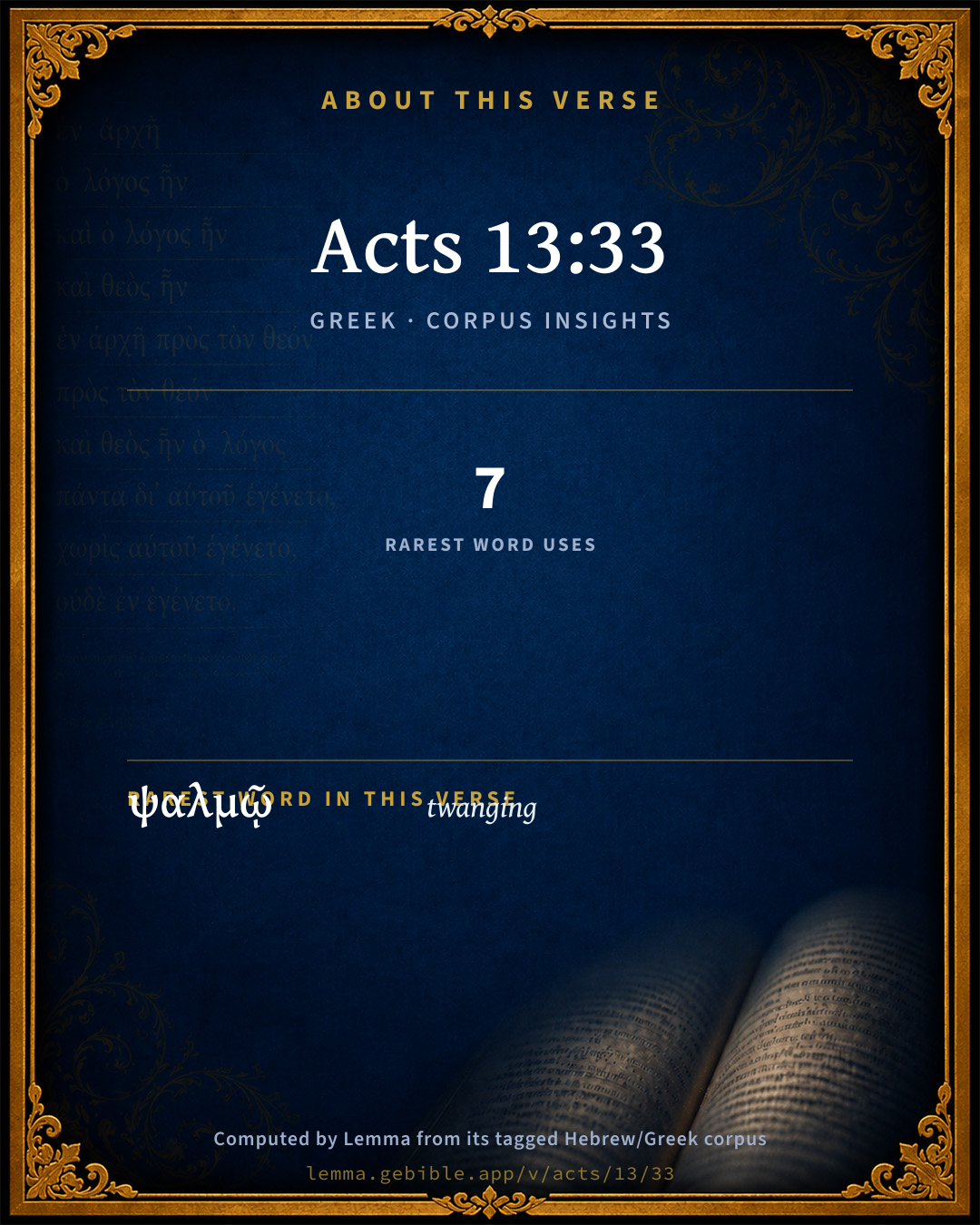
Acts 13:33

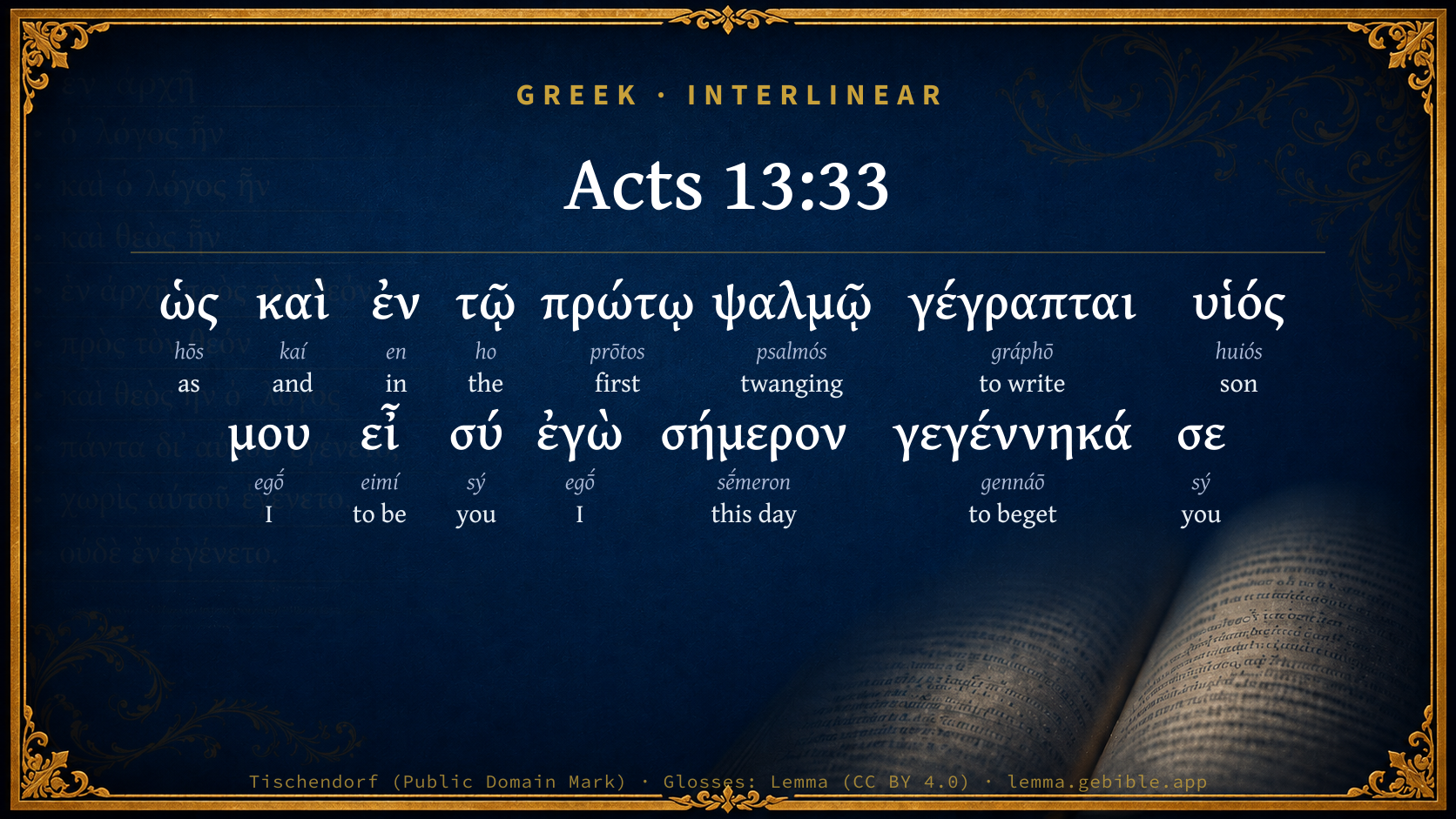
Greek (Tischendorf 8th ed.) Acts 13:33 appears in the Greek New Testament. The text above is from the Tischendorf 8th edition. Each word links to its Strong’s number and a concise gloss. Click any word for its full Thayer’s Greek Lexicon entry.
Download image
Cite this verse

Acts 13:33 (World English Bible). Public Domain. Lemma interlinear Bible study tool, https://lemma.gebible.app/v/acts/13/33.

Show BibTeX & RIS
BibTeX
RIS
English Translation
that God has fulfilled the same to us, their children, in that he raised up Jesus. As it is also written in the second psalm, 'You are my Son. Today I have become your father.'
World English Bible · Public Domain
Download a study sheet

One document with this verse’s original text, its word-by-word gloss line, the meaning frame, cross-references with their text, attributed commentary, and full source and license credits — printable, and it pastes into notes with its structure intact.

This verse Autodidact and up

Study sheet (.html) Plain text (.txt)

A passage Seminary Student

Up to 50 verses in one chapter. A passage sheet keeps up to 6 commentary sources and 12 cross-references per verse, in the order this page ranks them, and says so on the sheet whenever that leaves anything out. Ask for a single verse and you get the Autodidact verse sheet above.

Everything on this page stays free to read, with no account — the sheet is a download of what is already on screen, not access to it.

Want to remove ads? Support Godless Engineer
Compare translations 3

The same verse in 3 English versions, stacked beneath the original-language interlinear above. Click any original word for its lexicon entry.

Each is an independent rendering of the whole verse — the interlinear is not word-aligned to these translations.

Highlighted words mark where these versions differ — a whole-verse word diff, not a word-by-word alignment.

  • World English Bible Public Domain
    that God has fulfilled the same to us, their children, in that he raised up Jesus. As it is also written in the second psalm, 'You are my Son. Today I have become your father.'
  • King James Version Public Domain
    God hath fulfilled the same unto us their children, in that he hath raised up Jesus again; as it is also written in the second psalm, Thou art my Son, this day have I begotten thee.
  • unfoldingWord Literal Text CC BY-SA 4.0
    that God has completely fulfilled this for our children, raising up Jesus. As it is also written in the second Psalm: ‘You are my Son; today I have fathered you.’

unfoldingWord Literal Text — © unfoldingWord, licensed CC BY-SA 4.0. Word-aligned USFM3 via Door43 (git.door43.org/unfoldingWord/en_ult).

Versions to compare (up to 4)

3 of 4 selected

Show all 19 translations

Every available English version of this verse, each an independent rendering of the whole verse.

  • World English Bible Public Domain
    that God has fulfilled the same to us, their children, in that he raised up Jesus. As it is also written in the second psalm, 'You are my Son. Today I have become your father.'
  • Berean Standard Bible Public Domain
    He has fulfilled for us, their children, by raising up Jesus. As it is written in the second Psalm: ‘You are My Son; today I have become Your Father.’
  • Majority Standard Bible Public Domain
    He has fulfilled for us, their children, by raising up Jesus. As it is written in the second Psalm: ‘You are My Son; today I have become Your Father.’
  • King James Version Public Domain
    God hath fulfilled the same unto us their children, in that he hath raised up Jesus again; as it is also written in the second psalm, Thou art my Son, this day have I begotten thee.
  • American Standard Version (1901) Public Domain
    that God hath fulfilled the same unto our children, in that he raised up Jesus; as also it is written in the second psalm, Thou art my Son, this day have I begotten thee.
  • Revised Version (1885) Public Domain
    how that God hath fulfilled the same unto our children, in that he raised up Jesus; as also it is written in the second psalm, Thou art my Son, this day have I begotten thee.
  • Geneva Bible (1599) Public Domain
    God hath fulfilled it vnto vs their children, in that he raised vp Iesus, euen as it is written in the seconde Psalme, Thou art my Sonne: this day haue I begotten thee.
  • Douay-Rheims (1899) Public Domain
    This same God hath fulfilled to our children, raising up Jesus, as in the second psalm also is written: Thou art my Son, this day have I begotten thee.
  • Young's Literal Translation Public Domain
    God hath in full completed this to us their children, having raised up Jesus, as also in the second Psalm it hath been written, My Son thou art -- I to-day have begotten thee.
  • Literal Standard Version CC BY-SA 4.0
    God has completed this in full to us their children, having raised up Jesus, as also in the second Psalm it has been written: You are My Son—I have begotten You today.
  • Unlocked Literal Bible CC BY-SA 4.0
    he has fulfilled for us, their children, by raising up Jesus. As it is written in the second Psalm: 'You are my Son, today I have become your Father.'
  • unfoldingWord Literal Text CC BY-SA 4.0
    that God has completely fulfilled this for our children, raising up Jesus. As it is also written in the second Psalm: ‘You are my Son; today I have fathered you.’
  • Darby Bible Public Domain
    that God has fulfilled this to us their children, having raised up Jesus; as it is also written in the second psalm, *Thou* art my Son: this day have *I* begotten thee.
  • World Messianic Bible Public Domain
    that God has fulfilled this to us, their children, in that he raised up Yeshua. As it is also written in the second psalm, ‘You are my Son. Today I have become your father.’
  • Webster's Bible Public Domain
    God hath fulfilled the same to us their children, in that he hath raised up Jesus again; as it is also written in the second psalm, Thou art my Son, this day have I begotten thee.
  • Free Bible Version CC BY-SA 4.0
    that he has now fulfilled to us their children by raising Jesus from the dead. As it is written in Psalm 2: ‘You are my Son; today I have become your Father.’
  • Bible in Basic English Public Domain
    Which God has now put into effect for our children, by sending Jesus; as it says in the second Psalm, You are my Son; this day I have given you being.
  • Text-Critical English NT CC BY 4.0
    just as it is written in the second Psalm, ‘Yoʋ are my son; today I have begotten yoʋ.’
  • Tyndale New Testament (1534) Public Domain
    God hath fulfilled vnto vs their chyldren in that he reysed vp Iesus agayne even as it is written in the fyrste psalme: Thou arte my sonne this same daye begat I the.

Literal Standard Version (2020), Covenant Press — licensed CC BY-SA 4.0. Text via the HelloAO Bible API (eBible.org). Unlocked Literal Bible (unfoldingWord) — licensed CC BY-SA 4.0. Text via the HelloAO Bible API (eBible.org). unfoldingWord Literal Text — © unfoldingWord, licensed CC BY-SA 4.0. Word-aligned USFM3 via Door43 (git.door43.org/unfoldingWord/en_ult). Free Bible Version, Dr. Jonathan Gallagher — licensed CC BY-SA 4.0. Text via the HelloAO Bible API (eBible.org).

Word by word

More ways to search: Search by grammar → Find every occurrence → Compare this word →

Practice this passage: Drill this verse → Learn its vocabulary →

ψαλμῷ
psalmós
G5568
“twanging”
Noun, Dative, Singular, Masculine
Part of Speech
Noun
Case
Dative
Number
Singular
Gender
Masculine
Full Thayer's Definition

Origin: from G5567

TDNT: 16:09,1

1. a striking, twanging a. of a striking the chords of a musical instrument b. of a pious song, a psalm
  1. ὡς hōs G5613 “as” Adverb
  2. καὶ kaí G2532 “and” Conjunction
  3. ἐν en G1722 “in” Preposition
  4. τῷ ho G3588 “the” Article, Dative, Singular, Masculine
  5. πρώτῳ prōtos G4413 “first” Adjective, Dative, Singular, Masculine, Superlative
  6. γέγραπται gráphō G1125 “to write” Verb, Perfect, Passive, Indicative, 3rd person, Singular
  7. υἱός huiós G5207 “son” Noun, Nominative, Singular, Masculine
  8. μου egṓ G1473 “I” Personal pronoun, 1st person, Genitive, Singular
  9. εἶ eimí G1510 “to be” Verb, Present, Active, Indicative, 2nd person, Singular
  10. σύ sý G4771 “you” Personal pronoun, 2nd person, Nominative, Singular
  11. ἐγὼ egṓ G1473 “I” Personal pronoun, 1st person, Nominative, Singular
  12. σήμερον sḗmeron G4594 “this day” Adverb
  13. γεγέννηκά gennáō G1080 “to beget” Verb, Perfect, Active, Indicative, 1st person, Singular
  14. σε sý G4771 “you” Personal pronoun, 2nd person, Accusative, Singular

About this verse

These counts appear in no published source. They are computed here, from the morphology-tagged text and Lemma’s own curated glosses. What Lemma adds →

15
words
13
distinct lemmas
Acts
section

Notable vocabulary

The rarest word here is ψαλμῷ twanging G5568 — appearing just 7 times in the whole Greek New Testament.

Shared distinctive vocabulary

ψαλμῷ twanging G5568 occurs in 7 verses of the Greek New Testament. Also found in:

Repetition

Words recur within this verse:

Cross-references

3

Topical passages linked to Acts 13:33 in the Treasury of Scripture Knowledge — connected by theme and wording, ordered by reader-vote popularity; previews shown in the World English Bible.

  • Psalms 2:7 I will tell of the decree. Yahweh said to me, "You are my son. Today I have become your father.
  • Hebrews 5:5 So also Christ didn't glorify himself to be made a high priest, but it was he who said to him, "You are my Son. Today I have become your father."
  • Hebrews 1:5–6 For to which of the angels did he say at any time, "You are my Son, Today have I become your father?" and again, "I will be to him a Father, And he will be to me a Son?"

Cross-references courtesy of OpenBible.info (CC BY 4.0).

Where the printed editions differ

2 variants

Places in this verse where the major printed Greek editions disagree on the wording in a way that affects the translation — a comparison of editions, not a manuscript-by-manuscript collation. The editions are the modern critical texts (Nestlé-Aland 28/27, SBL, Westcott-Hort, Tregelles, Tyndale House) and the traditional texts behind the KJV (the Textus Receptus and the Byzantine/Majority text). It is not a claim about which reading is original.

  1. Different wording
    ἡμῖν

    “to us”

    In NA28NA27TynTRByz Not in SBLWHTreg

    ἡμῶν (hēmōn) 'of us' occurs in a few manuscripts (SBL+WH+Treg) instead of ἡμῖν (hēmin) 'to us' in older manuscripts (NA28+NA27+Tyn+TR+Byz)

  2. Different wording
    δευτέρῳ·

    “second”

    In NA28NA27TynSBLWHTR«3Byz«3 Not in TregTRByz

    πρώτῳ (prōtō) 'first' occurs in a few manuscripts (Treg) instead of δευτέρῳ· (deuterō) 'second' in older manuscripts (NA28+NA27+Tyn+SBL+WH+TR+Byz)

Textual data: Translators Amalgamated Greek New Testament (STEPBible TAGNT) · CC BY 4.0.

Commentary

Notes on Acts 13:33 from classic Christian and Jewish commentators (each source and its license shown beneath its notes). The classic Christian expositions comment on the surrounding passage and are grouped to its opening verse, so a note may address several verses; the Jewish commentaries on the Tanakh (Rashi and others) are per-verse, so they appear only where the commentator wrote on this verse.

Lemma curates 59 commentaries, every one of them public domain or Creative Commons licensed, each selected and text-cleaned for this edition rather than reprinted as found. About our sources →

Whedon's Commentary on the Bible

Daniel D. Whedon

33. Raised up Jesus again—The word again is here unauthorized by the Greek. We do not understand the passage here quoted from the second Psalm to describe or prove the resurrection of Christ, but his birth and consequent inauguration as king upon Zion. Paul in the three Act_13:33-35 quotes three proof texts in the order of a beautiful climax. This first quotation proves the divine Sonship of Christ, which prepares us to accept the proof of his superiority to death and corruption. The second, from Isa_55:3, (Septuagint version,) proves the everlasting kingdom of the Messiah, and his consequent personal immortality. The third, from Psa_16:10, directly proves the exemption of Messiah from bodily corruption, thus bringing the argument to its complete point.

Thou art my Son—In this second Psalm, which was applied by the Jewish Church to the Messiah, Jehovah is introduced as inaugurating his Son upon Mount Zion. That Son is heir to the uttermost parts of the earth; the Gentiles, with all their kings, are bidden to forestall a forced subjection by a voluntary obedience. It is this Messiah whom Paul this day proclaims to Antioch.

Daniel D. Whedon (gen. ed.), Commentary on the Old and New Testaments (1874–1909) — public domain. Text from a community e-Sword module.

Bengel's Gnomon

Johann Albrecht Bengel

Act 13:33. Ἐν τῷ ψαλμῷ, in the Psalm) Kimichi thinks that this Psalm was written by David about the beginning of his reign. However, that it was written at Jerusalem, may be inferred from the words in Act 4:27, in this city.[78] For Sion is mentioned in Psa 2:6. Luke mentioned the Psalm without the numeral epithet[79] (see Appar. Crit. p. 622; Ed. ii. pp. 294, 295. Add Hesychius the Presbyter, in the Anecdota Græca of Wolf, T. iii. p. 175): otherwise the word first would not have been written by some, and second by others afterwards; nay, the doubt whether it was the first or second Psalm would have never arisen among the ancients. Why should not Luke have also specifically said, at least (if he specified the Psalm in the former case) at Act 13:35, which makes reference to this Act 13:33, the 15th or 16th Psalm? [Whereas he only says, “In another Psalm.”]—Υἱός μου εἶ σύ· ἐγὼ σήμερον γεγέννηκά σε) So the LXX., Psa 2:7.—Υἱός μου, My Son) This is the sentiment, Thou, Jesus, art My Son, and therefore the true Messiah. Comp. note on Heb 5:5, “Christ glorified not Himself to be made an High Priest, but He that said unto Him, Thou art My Son” (not meaning that the priesthood was conferred on Him at the time when the Father said, Thou art My Son, for the Sonship is prior to the Priesthood; but that the Son, who alone was capable of that Priesthood, as such received it from the Father).[80]—σὺ) Thou, alone, the Messiah. Paul refers, whilst he quotes the chief point, to the whole Psalm, which was well known to his hearers, and especially the second verse, where there is express mention of the Messiah, “The Lord and His Anointed.” The pronouns, σὺ, ἐγὼ, thou, I, are put together in succession with marvellous force.—σήμερον, this day) The Son of God is indeed from everlasting: but His everlasting nature is never signified by the expression, this day. Wherefore the words, This day have I begotten Thee, are used in this sense: This day I have definitely declared, that Thou art My Son. The generation, properly so called, is presupposed. The Lord said, Thou art My Son, at the time when the psalm was sung: comp. Heb 4:7-9, note: and also at the time when Christ was born as the Son of David. Moreover, a thing is often said to be done then, when it is vividly presented to the eyes as one or about to done: 2Ch 9:6, The Queen of Sheba to Solomon, “I believed not—until—mine eyes had seen: and the one half—was not told me; for thou hast added to, προσέθηκας (i.e. I see there is additional greatness in thee besides), the fame that I heard:” Jos 22:31, ἐῤῥύσασθε, ye have delivered (ye have shown yourselves as delivering: Phinehas to the children of Reuben): and so Heb 1:6, “When He bringeth the first-begotten into the world;” Act 1:18, note, where Judas is said to have purchased the field, because he was the occasion of its being purchased, and had himself designed to purchase it: a condensed mode of expression. Glassius has collected more examples out of the sacred writings, l. 3, tr. 3, can. 15; and Linacer, l. 2, at the end, some out of profane authors. The expression this day, which occurs, Luk 2:11, “Unto you is born this day,” may be compared. Comp. ibid. ch. Luk 1:32-33; Luk 1:35. Often the particle to-day expresses present time, as Deu 31:2, “I am an hundred and twenty years old this day:” Jos 14:11, so Caleb, this day. It is therefore an abbreviated expression, as Joh 8:58, Before that Abraham was made, I (was, and to-day) am. So I have begotten Thee; and that fact is this day visible, that I have begotten Thee. Comp. Heb 10:8-9, note (the authority of the Psalms is shown, in that the declaration of the Son of God was made at the time that the second Psalm was composed, as the oath of Jehovah as to His Priesthood was made when the 110th Psalm was composed).

[78] Rec. Text in Act 4:27 omits the words ἐν τῇ πόλει ταύτῃ. But ABDEde Vulg. Hilar. Iren. and Lucif., the weightiest authorities, support them.—E. and T.

[79] Which is more openly shown by the margin of Ed. 2, than by the margin of the larger Ed.—E. B.

[80] I think the connection of the Sonship with the Resurrection of Jesus (for so I take ἀναστήσας), according to the apostle’s reasoning, is, that the latter was the manifestation of the former to all. So Rom 1:4 : Declared to be the Son of God with power—by the resurrection from the dead. The same connection exists between the believer’s sonship (heretofore hidden) and his future resurrection, which shall manifest it; Luk 20:36; 1Pe 1:3; Rev 1:5; 1Jn 3:2; Rom 8:23.—E. and T.

Lachm. reads ὡς καὶ ἐν τῷ ψαλμῷ γέγραπται τῷ πρώτῳ, following (1) the order of the words in ABC, and (2) the numeral which Origen expressly mentions as being the reading of the passage, 2,538a; also Dd Hilar. 27,42, though not in the same order. Tisch. has ὡς καὶ ἐν τῷ πρώτῳ ψαλμῷ γέγραπται, following D and Hilar, as above. Rec. Text has τῷ δευτέρῳ, with Ee Vulg.; but Jerome supports πρώτῳ. The reading of Rec. Text no doubt was a correction to suit the present order and division of the Psalms.—E. and T.

Bengel's Gnomon of the New Testament — English translation (T&T Clark, Edinburgh, 1860) — public domain. Text from a community e-Sword module.

Expositor's Greek Testament

ed. W. Robertson Nicoll

Act 13:33 . ἐκπεπλήρωκε : “hath fulfilled to the utmost,” cf. Mal 1:2Mal 1:2 ; 3Ma 1:22 , Polyb., i., 67, 1, τὰς ἐπαγγελίας ἐκπ . τοῖς τέκνοις αὐτῶν ἡμῖν , see critical notes. ἀναστήσας : “in that he raised up Jesus,” R.V.; “in that he hath raised up Jesus again,” A.V. The former rendering is quite compatible with the view that the reference of the word here is not to the resurrection of Jesus, but to the raising up of Jesus as the Messiah, cf. Act 3:22 , Act 7:37 , Deu 18:15 . The first prophecy, Act 13:33 , would be fulfilled in this way, whilst in Act 13:34-35 the prophecy would be fulfilled by the resurrection from the dead, ἀνασ . ἐκ νεκρῶν (see Knabenbauer in loco , p. 233 ff.). Wendt argues that Heb 1:5 , where the same prophecy is quoted as in Act 13:33 , also refers to the raising up as the Messiah, but see on the other hand Westcott, Hebrews, in loco .

The Expositor's Greek Testament, edited by W. Robertson Nicoll (1897–1910) — public domain. Text from a community e-Sword module.

Geneva Bible (1599)

Geneva Bible translators

If Christ had tarried in death, he had not been the true Son of God, neither had the covenant, which was made with David, been sure.

For then he appeared plainly and manifestly as that only Son of God, when as he left off his weakness, and came out of the grave, having conquered death.

Geneva Bible (1599) marginal notes — public domain. Text via Bolls.life.

Jamieson, Fausset & Brown

Robert Jamieson, A. R. Fausset & David Brown

God hath fulfilled the same--"hath completely fulfilled."

in that he hath raised up Jesus again--literally, "raised up"; but the meaning is (notwithstanding the contrary opinion of many excellent interpreters) "from the dead"; as the context plainly shows.

as it is written in the second psalm--in many manuscripts "the first Psalm"; what we call the first being regarded by the ancient Jews as only an introduction to the Psalter, which was considered to begin with the second.

this day have I begotten thee--As the apostle in Rom 1:4 regards the resurrection of Christ merely as the manifestation of a prior Sonship, which he afterwards (Act 8:32) represents as essential, it is plain that this is his meaning here. (Such declarative meaning of the verb "to be" is familiar to every reader of the Bible). See Joh 15:8, "So shall ye be," that is, be seen to be "My disciples." It is against the whole sense of the New Testament to ascribe the origin of Christ's Sonship to His resurrection.

Jamieson, Fausset & Brown — Commentary Critical and Explanatory on the Whole Bible (1871) — public domain (CC PDM 1.0). Text via the HelloAO Bible API.

Adam Clarke's Commentary

Verse 33. Written in the second Psalm] Instead of τω ψαλμω τω δευτερω the second Psalm, πρωτω ψαλμω, the first Psalm, is the reading of D, and its Itala version, and several of the primitive fathers. Griesbach has received it into the text; but not, in my opinion, on sufficient evidence. The reason of these various readings is sufficiently evident to those who are acquainted with Hebrew MSS. In many of these, two Psalms are often written as one; and the first and second Psalms are written as one in seven of Kennicott's and De Rossi's MSS. Those who possessed such MSS. would say, as it is written in the FIRST Psalm; those who referred to MSS. where the two Psalms were separate, would say, in the SECOND Psalm, as they would find the quotation in question in the first verse of the second Psalm. There is, therefore, neither contradiction nor difficulty here; and it is no matter which reading we prefer, as it depends on the simple circumstance, whether we consider these two Psalms as parts of one and the same, or whether we consider them as two distinct Psalms.

Thou art my Son, this day have I begotten thee.] It has been disputed whether this text should be understood of the incarnation or of the resurrection of our Lord. If understood of his incarnation, it can mean no more than this, that the human nature of our blessed Lord was begotten by the energy of the Holy Spirit in the womb of the blessed virgin; for as to his Divine nature, which is allotted to be God, it could neither be created nor begotten. See some reasons offered for this on Lu 1:35; and, if those be deemed insufficient, a thousand more may be added. But in the above reasons it is demonstrated that the doctrine of the eternal Sonship of Christ is absolutely irreconcilable to reason, and contradictory to itself. ETERNITY is that which has had no beginning, nor stands in any reference to time: SON supposes time, generation, and father; and time also antecedent to such generation: therefore the rational conjunction of these two terms, Son and eternity, is absolutely impossible, as they imply essentially different and opposite ideas.

If the passage in question be understood of the resurrection of Christ, it points out that the human nature, which was produced by the power of God in the womb of the virgin, and which was the Son of God, could see no corruption; and therefore, though it died for sin, must be raised from the dead before it saw corruption. Thus God owned that human nature to be peculiarly his own; and therefore Jesus Christ was declared to be the Son of God with power, by the resurrection from the dead, Ro 1:4.

Adam Clarke's Commentary on the Bible (1810–1826) — public domain. Text from a community e-Sword/MySword module.

John Calvin's Commentaries

33. To their children, namely, to us. It is certain that Paul speaketh of natural children, who had their beginning of the holy fathers, which we must therefore note, because certain brain-sick men, drawing all things unto allegories, dream that there is no respect to be had in this place of kindred, but only of faith. And with such an invention they make the holy covenant of God of none effect, where it is said,

“I will be thy God, and the God of thy seed,” (Genesis 17:7.)

It is faith (say they) alone which maketh us the children of Abraham. But I say, on the other side, that even those who are born the children of Abraham according to the flesh, are also counted the spiritual children of God, unless they grow out of kind through unbelief For the boughs be naturally holy, because they spring from a holy root, until they become profane through their own fault, (Romans 11:16.) And assuredly it is Paul’s drift to allure the Jews unto Christ; and that he may do this, they must be distinguished from the common sort by some privilege. And yet it followeth not thereupon (which these knaves do odiously object) that the grace of God is tied to the carnal seed; because, though the promise of life came by inheritance to the posterity of Abraham, yet many were deprived by their unbelief. Therefore faith is the cause, that of a great multitude only a few are counted children. And that is the double election whereof I spake before. The one common to the whole nation alike; because the first adoption of God containeth the whole family of Abraham. The other, which is restrained unto the secret counsel of God, and is at length established by faith, that it may be confirmed to men.

Therefore Paul doth well and truly affirm that that was performed to the Jews which God had promised to the fathers. For it was promised to them also, as Zacharias saith in his song, “The oath which he sware to our father Abraham, that he would give himself for us,” etc. And yet the worthiness of that nation doth not hinder but that the grace of Christ may also spread itself throughout the whole world; because the first-begotten hath the first degree of honor, so that he doth, notwithstanding, leave the second place to his brethren. For in that after the old people were cast off, the possession of the church was left empty for strangers, it began to be a new occasion of gathering the Church of the Gentiles; but and if that people had stood in the faith, the Gentiles had been joined into the common society of honor.

After that he had raised Christ. The word raised, in my judgment reacheth farther than it doth where it is shortly after repeated. For he doth not only say that Christ rose from the dead, but that he was appointed of God, and, as it were, brought to light by the hand of God, that he might fulfill the office of the Messiah, as the Scripture teacheth everywhere that kings and prophets are raised up. For the word αναστησαι is sometimes taken in this sense: And this reason moveth me thus to think, because God, by sending his Son into the world, did fulfill his promise made to his servants in times past, by the effect itself.

Likeas, in the second Psalm. Though the Greek books, agree in the number, yet we must not pass over that which Erasmus saith, that many of the old writers read the first Psalm. And it may be that Luke wrote so; for that which at this day is counted the second Psalm, might have been called the first not without reason, seeing that it is likely that the first Psalm was added instead of a proem by the scribes and priests, by whose industry the Psalms were gathered into one body. For the name of the author is not set to it, and it doth only exhort to meditate upon the law of God. But there is no great weight in that matter. For this is the chiefest thing, that we know how properly and how well Paul applieth the testimony taken out of the Psalm unto the matter which he hath in hand. We do not deny that David, when he saw that he was on every side assailed by his enemies, and that they were of greater power and might than that he was able to resist them, doth set against them God’s aid, who he knew was the author of his kingdom and reign. But forasmuch as he was a figure of the true Messiah, we know that those things were shadowed in his person, which do appertain, wholly and perfectly to the Messiah alone. And the text itself doth prove sufficiently that there is not only a simple and bare thanksgiving contained there, agreeable to David’s kingdom, but it is a higher prophecy. For it is well known that David did in his life scarce taste of the hundredth part of the glory which is spoken of in this place, concerning which we have spoken more at large, chapter 4.

Now let us look higher into the words: Kings are indeed called sons of God, (Psalm 82:6.) But seeing that God doth intend to prefer David before all other kings, and to exempt him out of the number of them, this title of honor is given to him principally above all other; not because so great honor resteth in his person, because by this means he should pass the angels, as it is in the Epistle to the Hebrews, 1st chapter. Therefore he is thus gorgeously set out in respect of Christ, whose image he was, that God doth not take him for one of the common sort, or for some one of a great multitude, but he doth, as it were, acknowledge him to be his only begotten Son. The proof followeth, because God did beget him when he established the kingdom in his hand. For that was not done by man’s industry, but God showed from heaven the invincible power of his hand, whereby it might plainly appear that he reigned according to God’s counsel. Therefore this begetting, by him mentioned, must be referred unto the understanding of knowledge of men; to wit, because it was then openly known that he was begotten of God, when as he was set upon the throne of the kingdom wonderfully, contrary to the hope of all men, and did, by the heavenly power of the Spirit, break infinite conspiracies; because he could not reign until he had brought all nations round about him in subjection, as if a certain world were subdued.

Now, let us come unto Christ. He came not into the world without testimony, whereby he did prove that he was the Son of God. For his glory did appear as became the only begotten Son of God, as it is written, John 1:14, and he saith everywhere that he hath God for the witness and maintainer of this honor. Therefore God begat Christ, when he gave him certain marks, whereby he might be known to be his true and lively image and Son. And yet this doth not let but that Christ is the Wisdom begotten of the Eternal Father before time. But that is the secret generation; and now David declareth that it was revealed to men; so that the relation is, as we have said, unto men and not unto God; because that which was hidden in the heart of God was make known to men. And it is a very fine figure, because Christ’s divinity was no less declared and established, than if he had been begotten of God before the eyes of men. I know that Augustine’s deep sight doth please some, that by today is meant perpetuity. But when as the Spirit of God himself is his own interpreter, and whereas he doth expound that by the mouth of Paul which he had said by David, we must not invent any other sense. And forasmuch (as the same Paul doth witness) that Christ was declared to be the Son of God in power when he rose from the dead, (Romans 1:4,) we gather that this was the principal token of celestial excellency, and that the Father did then bring him truly to light, that the world might know that he was begotten of him. Therefore, though God began to raise Christ when he came into the world, yet his raising was then, as it were, perfect and full; because whereas he was humbled before, having taken, as it were, the form of a servant, (Philippians 2:7,) he did then appear to be the conqueror of death and the Lord of life; so that he wanted nothing of that majesty which was meet for the Son of God, and that for the only begotten Son.

John Calvin's Commentaries (1540-1563) — public domain. Text from the Calvin Translation Society English edition (1840s-50s) via the Christian Classics Ethereal Library (ccel.org). Calvin's coverage is partial (roughly two-thirds of the Bible); uncommented books and verses are honest gaps, never fabricated. The 19th-century editor's footnotes and remarks are omitted so the notes are faithfully Calvin's own voice.

Ellicott's Commentary for English Readers

(33) God hath fulfilled the same unto us their children.—The better MSS. give, with hardly an exception, unto our children, and the Received text must be regarded as having been made to obtain what seemed a more natural meaning. St. Paul’s language, however, is but an echo of St. Peter’s “to us and to our children,” in Act_2:39.

As it is also written in the second psalm.—The various-reading, “in the first Psalm,” given by some MSS. is interesting, as showing that in some copies of the Old Testament, what is now the first Psalm was treated as a kind of prelude to the whole book, the numeration beginning with what is now the second.

Thou art my Son, this day have I begotten thee.—Historically, Psalms 2 appears as a triumph-song, written to celebrate the victory of a king of Israel or Judah—David, or Solomon, or another—over his enemies. The king had been shown by that day of victory to have been the chosen son of God—the day itself was a new begetting, manifesting the sonship. So, in the higher fulfilment which St. Paul finds in Christ, he refers the words, not primarily to the Eternal Generation of the Son of God, “begotten before all worlds,” nor to the Incarnation, but to the day of victory over rulers and priests, over principalities and powers, over death and Hades. The Resurrection manifested in the antitype, as the victory had done in the type, a pre-existing sonship; but it was to those who witnessed it, or heard of it, as the ground on which their faith in that sonship rested. Christ was to them the “firstborn of every creature,” because He was also “the firstborn from the dead.” (See Notes on Col_1:15; Col_1:18.)

A Bible Commentary for English Readers, edited by Charles John Ellicott (1878–1897) — public domain. Text from a community e-Sword module.

The Cambridge Bible for Schools and Colleges

gen. ed. J. J. S. Perowne

33. God hath fulfilled the same] Better, “how that God hath,” &c. The “glad tidings” are concerning the promise, and the precise message which is the cause for gladness is contained in the announcement that the promise has been fulfilled.

hath fulfilled] The verb in the original is a strengthened form and indicates “complete fulfilment.”

unto us their children] The Greek order of the words is emphatic, “unto their children, even us.’ There are some good MSS. which read “unto our children,” but this weakens the language greatly, for what the audience whom St Paul addressed would desire was a fulfilment for themselves. Their children would inherit what they received, but a promise to be fulfilled to their children would not move them so much as one of which they were to be sharers themselves.

in that he hath raised up Jesus again] i.e. from the dead. This is necessary to the Apostle’s argument, which is on the resurrection of Jesus as a proof that He was the Messiah. The quotation which follows need not refer alone to the birth of Jesus into this world. He was also the first-begotten from the dead, the firstfruits of them that slept.

as it is also written in the second psalm] The reading of many good MSS. is “in the first psalm.” What we now call the first psalm was formerly regarded as an introduction to the whole and not counted in the numbering. The quotation which follows is, according to the present order of the Psalms, taken from Psa_2:7.

The Cambridge Bible for Schools and Colleges (gen. ed. J. J. S. Perowne; Cambridge University Press, 1878–1918) — public domain. Text from a community e-Sword module.

John Gill's Exposition

Or the men of that age and generation in which he lived, the subjects of his kingdom; by governing them with wholesome laws, protecting them in their rights and properties, defending them against their enemies, and regulating and promoting the worship of God among them:

by the will of God; this clause may be read in connection with the preceding words, as it is in the Syriac version thus, "after he had in his own age served the will of God"; acted according to it, fulfilled it, and did what the Lord declared to him, or he knew to be the will of God; or with the following words, as in the Vulgate Latin version, "by the will of God fell on sleep", or died; and then the sense is, that after he had done the work of his generation, which was appointed and cut out for him, he died by the decree and counsel of God, which has set bounds to man's life, and has fixed the time of his death; no man dies before, or lives longer than the time it is the will of God he should. David lived according to the will of God's command, and he died by the will of his decree. Death is expressed by falling asleep; a way of speaking very common with the eastern nations, and which represents it in an easy and familiar manner: it is not an annihilation of men; the dead are only fallen asleep, and will wake again in the resurrection; till which time the grave is their restingplace, and out of which the saints will rise fresh and cheerful; and yet, as a time of sleep is a time of inactivity, so no work is done in the grave; and therefore whatever we find to do, should be done in life. It is a long sleep; David has been many hundred years, even thousands, in it; and there will be no awaking out of it till Christ comes again: but this is to be understood of the body only, which only is capable of sleeping the sleep of death, and not of the soul, which dies not with the body, nor continues with it in the grave in a state of insensibility and inactivity, but immediately returns to God; and being happy, is employed in the vision of God, and Christ, in the fellowship of saints and angels, and in the work of praise and thanksgiving: thus, though David is fallen asleep in his body, he is present in spirit with the Lord; and that sweet psalmist of Israel is singing the songs of God in a much better manner than when here on earth. Blessed are they that sleep in Jesus, for they not only sleep quietly and safely, but shall surely rise again, for God will bring them with him; Christ is the first fruits of them, and they shall awake in his likeness. It is further said of David, "and was laid unto his fathers", or was buried; his sepulchre is said to be in Mount Zion (q), where the kings of the house of David were buried; and his sepulchre Peter says in Act 2:29 remained till his time.

And saw corruption; his body putrefied in the grave, became the repast of worms, and was reduced to rottenness and dust; and therefore the words could not be spoken of him cited from Psa 16:10.

(q) Cippi Hebr. p. 24.

John Gill's Exposition of the Whole Bible (1746–1763) — public domain (CC PDM 1.0). Text via the HelloAO Bible API.

Trapp's Complete Commentary

John Trapp

33 God hath fulfilled the same unto us their children, in that he hath raised up Jesus again; as it is also written in the second psalm, Thou art my Son, this day have I begotten thee.

Ver. 33. In the second Psalm] Erasmus testifieth, that some ancient copies here have it, "in the first Psalm;" either because the first and second were of old but one Psalm, or because the first is not properly a Psalm, but a preface to the Psalms; like as the 119th Psalm is set (saith one) as a poem of commendation before the book of God, mentioning it in every verse, testimonies, laws, statutes, word, &c.

This day have I begotten thee] That is, I have this day of thy manifestation in the flesh made known that thou art my Son, as well by my testimony of thee as by thine assumption of humun nature.

John Trapp, A Commentary or Exposition upon All the Books of the Old and New Testament (1647–1656) — public domain. Text from a community e-Sword module.

Albert Barnes' Notes on the Bible

God hath fulfilled - God has completed or carried into effect by the resurrection of Jesus. He does not say that every part of the promise had reference to his resurrection; but his being raised up completed or perfected the fulfillment of the promises which had been made respecting him.

In the second psalm - Act 13:7.

Thou art my Son - This psalm has been usually understood as referring to the Messiah. See the notes on Act 4:25.

This day have I begotten thee - It is evident that Paul uses the expression here as implying that the Lord Jesus is called the Son of God because he raised him up from the dead, and that he means to imply that it was for this reason that he is so called. This interpretation of an inspired apostle fixes the meaning of this passage in the psalm, and proves that it is not there used with reference to the doctrine of eternal generation, or to his incarnation, but that he is called his Son because he was raised from the dead. And this interpretation accords with the scope of the psalm. In Act 13:1-3 the psalmist records the combination of the rulers of the earth against the Messiah, and their efforts to cast off his reign. This was done, and the Messiah was rejected. All this pertains, not to his previous existence, but to the Messiah on the earth. In Act 13:4-5, the psalmist shows that their efforts would not be successful; that God would laugh at their designs; that is, that their plans should not succeed.

In Act 13:6-7, he shows that the Messiah would be established as a king; that this was the fixed decree, and that he had been begotten for this. All this is represented as subsequent to the raging of the pagan, and to the counsel of the kings against him, and must, therefore, refer, not to his eternal generation or his incarnation, but to something succeeding his death; that is, to his resurrection, and his establishment as King at the right hand of God. This interpretation by the apostle Paul proves, therefore, that this passage is not to be used to establish the doctrine of the eternal generation of Christ. Christ is called the Son of God for various reasons. In Luk 1:35, because he was begotten by the Holy Spirit. In this place, on account of his resurrection. In Rom 1:4 it is also said that he was declared to be the Son of God by the resurrection from the dead. See the notes on that place. The resurrection from the dead is represented as in some sense the beginning of life, and it is with reference to this that the terms “Son,” and “begotten from the dead,” are used, as the birth of a child is the beginning of life. Thus, Christ is said, Col 1:18, to be “the first-born from the dead”; and thus, in Rev 1:5; he is called “the firsthegotten of the dead”; and with reference to this renewal or beginning of life he is called a Son. In whatever other senses he is called a Son in the New Testament, yet it is here proved:

(1) That he is called a Son from his resurrection; and,

(2) That this is the sense in which the expression in the psalm is to be used.

This day - The words “this day” would naturally, in the connection in which they are found, refer to the time when the “decree” was made. The purpose was formed before Christ came into the world; it was executed or carried into effect by the resurrection from the dead. See the notes on Psa 2:7.

Have I begotten thee - This evidently cannot be understood in a literal sense. It literally refers to the relation of an earthly father to his children; but in no such sense can it be applied to the relation of God the Father to the Son. It must, therefore, be figurative. The word sometimes figuratively means “to produce, to cause to exist in any way”; 2Ti 2:23, “Unlearned questions avoid, knowing that they do gender (beget) strifes.” It refers also to the labors of the apostles in securing the conversion of sinners to the gospel: 1Co 4:15, “In Christ Jesus I have begotten you through the gospel”; Phm 1:10, Whom (Onesimus) I have begotten in my bonds. It is applied to Christians: Joh 1:13, “Which were born (begotten), not of blood, etc., but of God”; Joh 3:3, Except a man be born (begotten) again,” etc. In all these places it is used in a figurative sense to denote “the commencement of spiritual life by the power of God; so raising up stoners from the death of sin, or so producing spiritual life that they should sustain to him the relation of sons.” Thus, he raised up Christ from the dead, and imparted life to his body; and hence, he is said figuratively to have begotten him from the dead, and thus sustains toward the risen Saviour the relation of father. Compare Col 1:18; Rev 1:5; Heb 1:5.

Albert Barnes' Notes on the Bible (1834–1885) — public domain. Text from a community e-Sword/MySword module.

Haydock's Catholic Bible Commentary

He then shews them that Jesus was their Messias, and the Son of God, begotten of his Father from eternity, who rose from the dead, and he applies these words, (Psalm ii. 7.) to prove Christ’s resurrection, thou art my son, this day have I begotten thee. It is true, these words regard chiefly the eternal generation of Christ, as they are applied by St. Paul, (Hebrews v. 5.) but the resurrection was a necessary consequence of his divinity, since death could have no power over him. St. Paul here also proves Christ’s resurrection by the following predictions. (Witham) --- Second psalm. The oldest copy reads, first psalm. The difference is merely in words; for the division of the psalter at present is very different from what it formerly was: sometimes a single psalm of ours being divided into many, and many of our divisions making only one, according to the Hebrews. The latter are not even now agreed among themselves on the same division of the psalms. (Calmet) --- Some suppose, that what we call the first psalm was originally looked upon as a preface to the psalter; others, that our first and second psalms united in one. (Mat. Polus.)

George Leo Haydock (1774–1849), Haydock's Catholic Family Bible and Commentary, 1859 edition — public domain. Excludes Psalms (Douay-Rheims chapter numbering differs from Protestant) and Deuterocanonical books (Catholic canon only).

Matthew Poole's English Annotations

Raised up Jesus again; some refer these words to the incarnation, others to the resurrection, of our Saviour: our translators lay the stress upon the preposition, with which the verb is compounded, and by adding again, intend it to be understood of the resurrection; and there is ground for it in the context; for the resurrection of Christ is that which in Act 13:30 is propounded by St. Paul as his theme or argument to preach upon.

Thou art my Son; these words quoted, though they do not seem to be a proof of Christ’s resurrection at the first view, yet if we weigh them well, they answer St. Paul’s purpose:

Thou art my Son, Psa 2:7, is ushered in with, I have made thee king, Act 13:6, and followed with, I will give thee the heathen for thine inheritance; which was in an especial manner to be fulfilled after the resurrection, as our Saviour manifests, Mat 28:18,19.

This day have I begotten thee; not as if Christ at his resurrection began to be the Son of God; but then he was manifested to be so, Rom 1:4; which before, whilst he was in a suffering condition was not so apparent. Some of the ancients have understood these words, of the eternal generation of the Son of God; eternity being an everlasting point, and one and the same day for ever.

Matthew Poole's English Annotations on the Holy Bible (1683–1685) — public domain. Text from a community e-Sword/MySword module.

The Pulpit Commentary

How that God for God, A.V. ("how that" being in ver. 32); our children for us their children, A.V. and T.R.; raised up for hath raised up... again, A.V.; as also it is for as it is also, A.V. Our children. The reading of the R.T. is not adopted by Meyer or Alford, and is scarcely an improvement upon the T.R. There can be no reasonable doubt that ajnasthsav, raised up, means here, as in ver. 44, raised from the dead. Observe with what skill the apostle speaks of the resurrection of Jesus Christ as the fulfillment of God"s promise to their fathers, which it was to be presumed they were anxiously expecting. The second psalm. Many manuscripts and editions have, "the first," because the first psalm was often reckoned not numerically but as an introduction to the whole book, so that the second psalm was numbered as the first. This is probably the reason why the eighteen psalms as reckoned by the Jews include Psalm 19., though Joshua ben Levi explains it by the rejection of the second psalm, on account, no doubt, of its testimony to Messiah as God"s begotten Son. But the rabbins generally acknowledge the application of this psalm to Messiah (Lightfoot, "Exercit. on the Acts"). Thou art my Son, etc. This application of the second psalm to the Resurrection is best explained by Rom_1:4. The reference in both passages to David is remarkable (vers. 22, 23).Christ, who was begotten of the Father before all worlds, was declared before men and angels to be the Son of God, when he was raised from the dead in the power of an endless life.

The Pulpit Commentary (1880–1919), ed. H.D.M. Spence-Jones & Joseph S. Exell — public domain. Text from a community e-Sword module.

John Wesley's Explanatory Notes

Thou art my Son, this day have I begotten thee - It is true, he was the Son of God from eternity. The meaning therefore is, I have this day declared thee to be my Son. As St. Paul elsewhere, declared to be the Son of God with power, by the resurrection from the dead, Rom. i, 4. And it is with peculiar propriety and beauty that God is said to have begotten him, on the day when he raised him from the dead, as he seemed then to be born out of the earth anew. Psalm ii, 7.

John Wesley, Explanatory Notes Upon the Whole Bible (1754–1765) — public domain. Text via the GEBible commentary corpus.

McGarvey & Pendleton's Commentaries

J. W. McGarvey

See notes one verse 30

J. W. McGarvey (with Philip Y. Pendleton), Commentaries on the New Testament (The Fourfold Gospel, 1914; Acts; and the epistles) — public domain. Text from a community e-Sword/MySword module.

Cambridge Greek Testament for Schools and Colleges

33. τοῖς τέκνοις ἡμῶν with אABCD. Vulg. ‘filiis nostris.’

ἐν τῷ πρώτῳ ψαλμῷ with D. Vulg. ‘in Psalmo secundo.’ But see notes.

33. ὅτι ταύτην ὁ θεὸς ἐκπεπλήρωκεν. Render, how that God hath completely fulfilled this. The ‘glad tidings’ are about the promise, and the precise message which is the cause for gladness is contained in the announcement that the promise has been fulfilled, and the strengthened form of the verb (ἐκπεπλήρωκεν) marks the completeness of this fulfilment.

τοῖς τέκνοις ἡμῶν, unto our children. This well-supported reading certainly merits Tischendorf’s remark, ‘insolenter illud quidem dictum est.’ We should naturally expect what the Text. recept. has given, ‘to us their children.’ But when the complete force of the preceding verb is taken into account, the sentence may be explained. The promise was made to Abraham, and generation after generation was born and passed away, having received the promises only by faith. Even the generation contemporary with Jesus was not born to the complete fulfilment, but now after Christ’s resurrection Christians may say ‘for our children’ the promises are utterly fulfilled.

ἀναστήσας Ἰησοῦν, in that He hath raised up Jesus again, i.e. from the dead. This is necessary to the Apostle’s argument, which is on the resurrection of Jesus as a proof that He was the Messiah. The quotation which follows need not refer alone to the birth of Jesus into this world. He was also the first-begotten from the dead, the first-fruits of them that slept.

ἐν τῷ πρώτῳ ψαλμῷ, in the first Psalm. What we now call the first and second Psalms were originally joined into one, which will account for what is now Psa 2:7 being named as in the text. Justin Martyr (Apol. I. 40) treats the whole from μακάριος ἀνήρ (‘Blessed is the man’ &c.) to μακάριοι πάντες οἱ πεποιθότες ἐπ’ αὐτόν (the close of the present second Psalm) as all one composition and on one subject. So Tertullian (Adv. Marc. IV. 22) writes ‘in primo psalmo, “filius meus es tu, hodie genui te.” ’

Cambridge Greek Testament for Schools and Colleges (Cambridge University Press, 1896; 21 vols, various authors incl. Carr, Maclear, Plummer, Farrar, Lumby, Moule, M. R. James, Simcox) — public domain. Text from a community e-Sword module.

Alford’s Greek Testament

Henry Alford

33.] The reading ἐν τῷ πρώτεῳ ψαλμῷ is explained thus: “hic psalmus qui nobis secundus est olim primus fuit, quod is qui præcedit, tanquam proœmium, numeratus non esset.” Rosenm. Arg. Psa_2 St. Paul refers the prophecy in its full completion to the Resurrection of our Lord: similarly in Rom 1:4, ὁρισθέντος υἱοῦ θεοῦ ἐν δυνάμει … ἑξ ἀναστάσεως νεκρῶν.

Henry Alford, The Greek Testament (1849–1861) — public domain. Text from a community e-Sword module.

Vincent's Word Studies in the New Testament

Marvin R. Vincent

Hath fulfilled [εκπεπληρωκε] . Completely fulfilled; force of ejk, out and out.

Marvin R. Vincent, Word Studies in the New Testament (1887–1900) — public domain. Text from a community e-Sword/MySword module.

Lesson kit

Teaching starters — assembled from the data on this page, not authored interpretation. Every prompt links to the verse data it draws on. Edit before teaching.

Acts, in the Acts, opens this verse with 15 words (13 distinct Greek lemmas). Its most distinctive word is psalmós (“twanging”). A historical commentator’s framing appears above. Read the whole chapter for the surrounding context.

Discussion questions

  1. How does “twanging” (psalmós) shape what this verse is saying?
  2. How does Luke 20:42, which shares the word «twanging», read alongside this verse?
  3. What does the repetition of “I” (2× in this one verse) do in this verse?
  4. The translations on this page render this verse differently — a whole-verse word diff, not a word-by-word alignment. What might account for the different wordings?
  5. Compare how Whedon's Commentary on the Bible and Bengel's Gnomon read this verse. Where do they agree or differ?

Things to notice

Reading settings

Reading text

Shown beneath each verse's original-language words.

Old Testament
Old Testament edition

Read the OT as the Masoretic Hebrew (MT) or the Greek Septuagint (LXX).

English shown for the Greek Septuagint (in the Hebrew ↔ Greek comparison).

Comparing translations? Open the Compare panel on any verse page to stack up to four side by side.