John 3:7

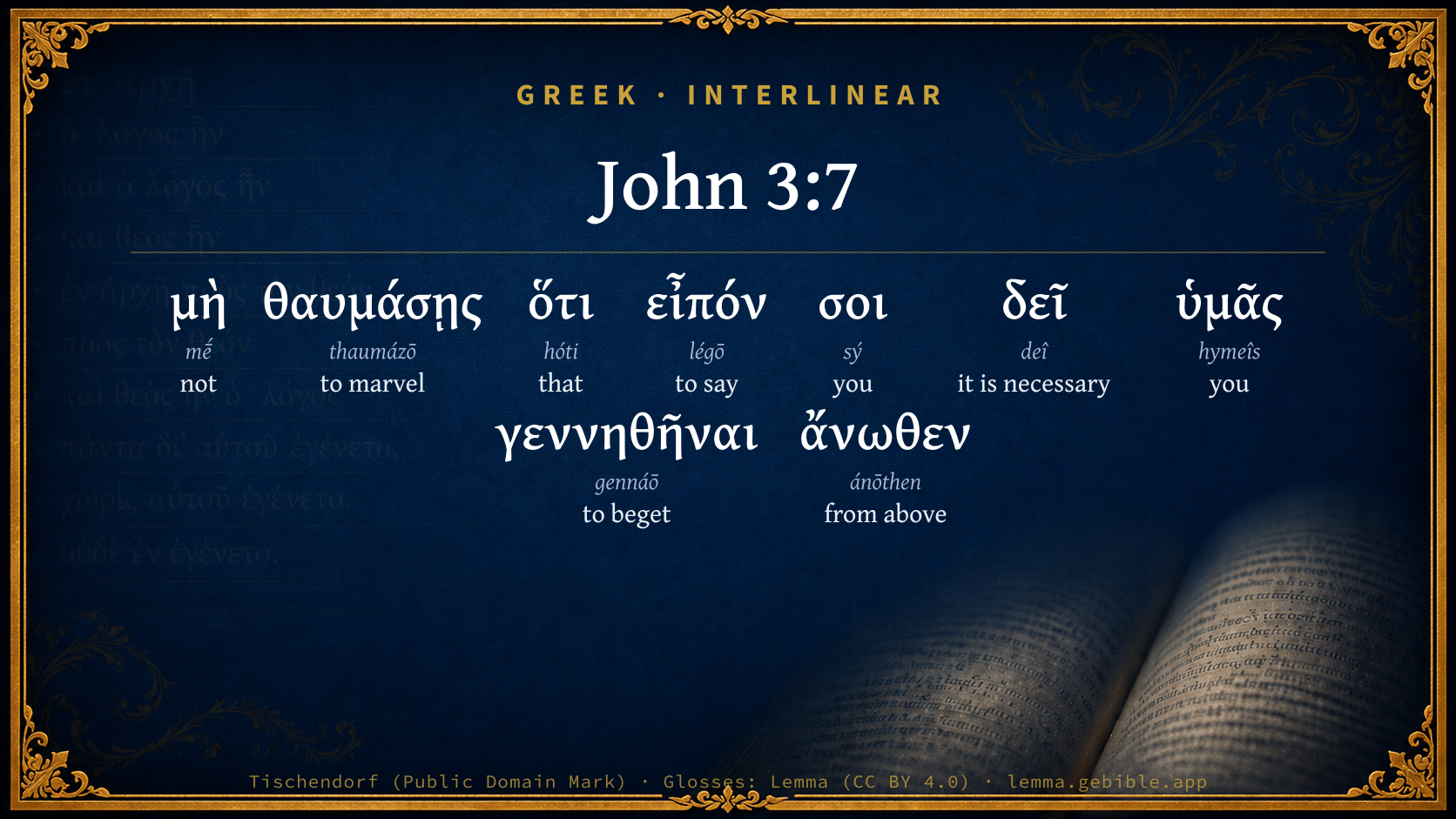
Greek (Tischendorf 8th ed.) John 3:7 appears in the Greek New Testament. The text above is from the Tischendorf 8th edition. Each word links to its Strong’s number and a concise gloss. Click any word for its full Thayer’s Greek Lexicon entry.
Download image
Cite this verse

John 3:7 (World English Bible). Public Domain. Lemma interlinear Bible study tool, https://lemma.gebible.app/v/john/3/7.

Show BibTeX & RIS
BibTeX
RIS
English Translation
Don't marvel that I said to you, 'You must be born anew.'
World English Bible · Public Domain
Download a study sheet

One document with this verse’s original text, its word-by-word gloss line, the meaning frame, cross-references with their text, attributed commentary, and full source and license credits — printable, and it pastes into notes with its structure intact.

This verse Autodidact and up

Study sheet (.html) Plain text (.txt)

A passage Seminary Student

Up to 50 verses in one chapter. A passage sheet keeps up to 6 commentary sources and 12 cross-references per verse, in the order this page ranks them, and says so on the sheet whenever that leaves anything out. Ask for a single verse and you get the Autodidact verse sheet above.

Everything on this page stays free to read, with no account — the sheet is a download of what is already on screen, not access to it.

Want to remove ads? Support Godless Engineer
Compare translations 3

The same verse in 3 English versions, stacked beneath the original-language interlinear above. Click any original word for its lexicon entry.

Each is an independent rendering of the whole verse — the interlinear is not word-aligned to these translations.

Highlighted words mark where these versions differ — a whole-verse word diff, not a word-by-word alignment.

  • World English Bible Public Domain
    Don't marvel that I said to you, 'You must be born anew.'
  • King James Version Public Domain
    Marvel not that I said unto thee, Ye must be born again.
  • unfoldingWord Literal Text CC BY-SA 4.0
    Do not be amazed that I said to you, ‘It is necessary for you to be born again.’

unfoldingWord Literal Text — © unfoldingWord, licensed CC BY-SA 4.0. Word-aligned USFM3 via Door43 (git.door43.org/unfoldingWord/en_ult).

Versions to compare (up to 4)

3 of 4 selected

Show all 19 translations

Every available English version of this verse, each an independent rendering of the whole verse.

  • World English Bible Public Domain
    Don't marvel that I said to you, 'You must be born anew.'
  • Berean Standard Bible Public Domain
    Do not be amazed that I said, ‘You must be born again.’
  • Majority Standard Bible Public Domain
    Do not be amazed that I said, ‘You must be born again.’
  • King James Version Public Domain
    Marvel not that I said unto thee, Ye must be born again.
  • American Standard Version (1901) Public Domain
    Marvel not that I said unto thee, Ye must be born anew.
  • Revised Version (1885) Public Domain
    Marvel not that I said unto thee, Ye must be born anew.
  • Geneva Bible (1599) Public Domain
    Marueile not that I said to thee, Yee must be borne againe.
  • Douay-Rheims (1899) Public Domain
    Wonder not, that I said to thee, you must be born again.
  • Young's Literal Translation Public Domain
    `Thou mayest not wonder that I said to thee, It behoveth you to be born from above;
  • Literal Standard Version CC BY-SA 4.0
    You may not wonder that I said to you, It is required for you to be born from above;
  • Unlocked Literal Bible CC BY-SA 4.0
    Do not be amazed that I said to you, 'You must be born again.'
  • unfoldingWord Literal Text CC BY-SA 4.0
    Do not be amazed that I said to you, ‘It is necessary for you to be born again.’
  • Darby Bible Public Domain
    Do not wonder that I said to thee, It is needful that *ye* should be born anew.
  • World Messianic Bible Public Domain
    Don’t marvel that I said to you, ‘You must be born anew.’
  • Webster's Bible Public Domain
    Marvel not that I said to thee, Ye must be born again.
  • Free Bible Version CC BY-SA 4.0
    Don't be surprised at my telling you, ‘You must be reborn.’
  • Bible in Basic English Public Domain
    Do not be surprised that I say to you, It is necessary for you to have a second birth.
  • Text-Critical English NT CC BY 4.0
    Do not be amazed that I said to yoʋ, ‘You must be born again.’
  • Tyndale New Testament (1534) Public Domain
    Marvayle not that I sayd to the ye must be boren a newe.

Literal Standard Version (2020), Covenant Press — licensed CC BY-SA 4.0. Text via the HelloAO Bible API (eBible.org). Unlocked Literal Bible (unfoldingWord) — licensed CC BY-SA 4.0. Text via the HelloAO Bible API (eBible.org). unfoldingWord Literal Text — © unfoldingWord, licensed CC BY-SA 4.0. Word-aligned USFM3 via Door43 (git.door43.org/unfoldingWord/en_ult). Free Bible Version, Dr. Jonathan Gallagher — licensed CC BY-SA 4.0. Text via the HelloAO Bible API (eBible.org).

Word by word

More ways to search: Search by grammar → Find every occurrence → Compare this word →

Practice this passage: Drill this verse → Learn its vocabulary →

About this verse

These counts appear in no published source. They are computed here, from the morphology-tagged text and Lemma’s own curated glosses. What Lemma adds →

9
words
9
distinct lemmas
Gospels
section

Notable vocabulary

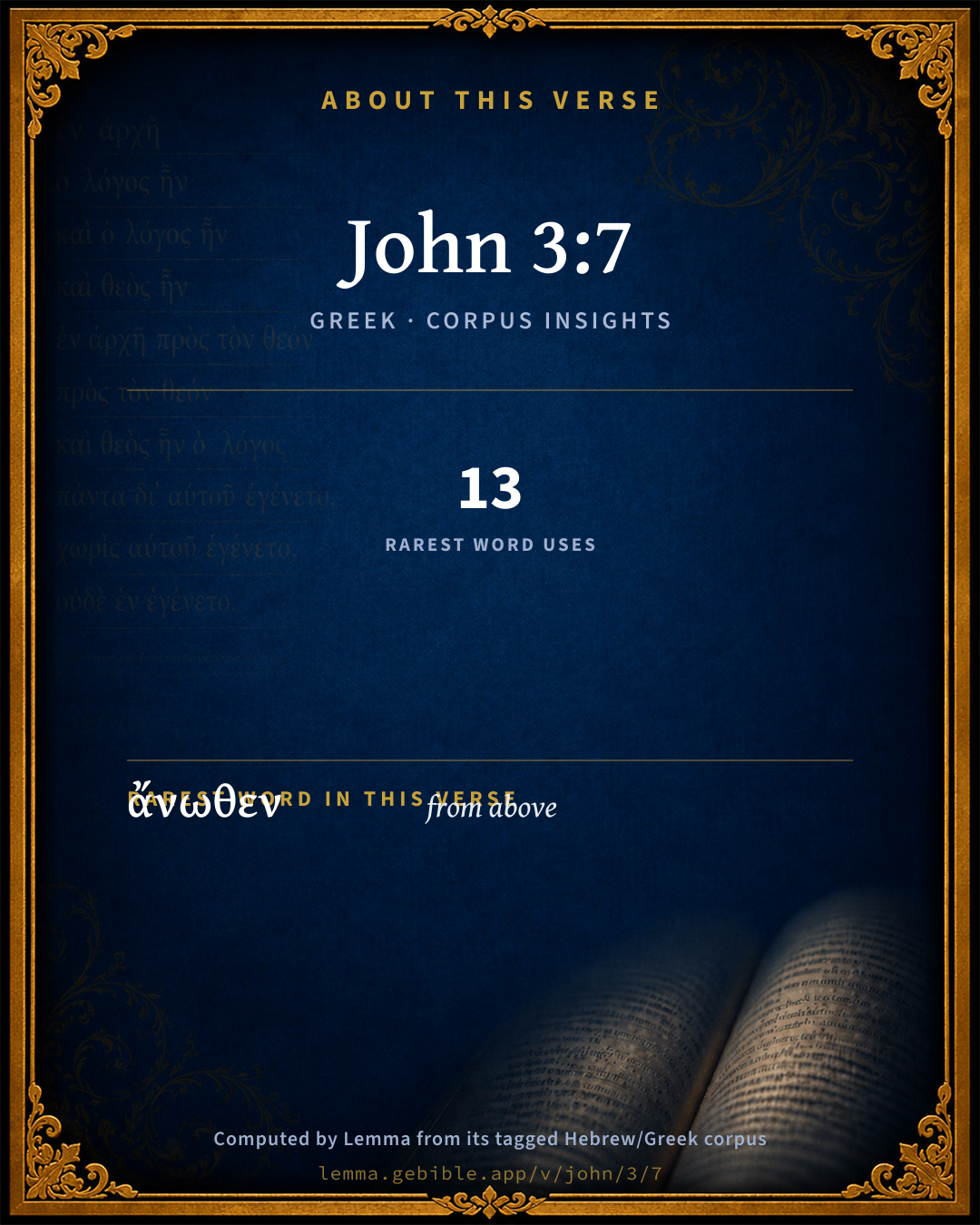
The rarest word here is ἄνωθεν from above G509 — appearing just 13 times in the whole Greek New Testament.

Shared distinctive vocabulary

ἄνωθεν from above G509 occurs in 13 verses of the Greek New Testament. Also found in:

Cross-references

15

Topical passages linked to John 3:7 in the Treasury of Scripture Knowledge — connected by theme and wording, ordered by reader-vote popularity; previews shown in the World English Bible.

  • John 3:3 Jesus answered him, "Most assuredly, I tell you, unless one is born anew, he can't see the Kingdom of God."
  • Ephesians 4:22–24 that you put away, as concerning your former way of life, the old man, that grows corrupt after the lusts of deceit;
  • Romans 12:1–2 Therefore I urge you, brothers, by the mercies of God, to present your bodies a living sacrifice, holy, acceptable to God, which is your spiritual service.
  • John 3:12 If I told you earthly things and you don't believe, how will you believe if I tell you heavenly things?
  • 1 Peter 1:22 Seeing you have purified your souls in your obedience to the truth through the Spirit in sincere brotherly affection, love one another from the heart fervently:
  • Revelation 21:27 There will in no way enter into it anything profane, or one who causes an abomination or a lie, but only those who are written in the Lamb's book of life.
  • Matthew 13:33–35 He spoke another parable to them. "The Kingdom of Heaven is like yeast, which a woman took, and hid in three measures of meal, until it was all leavened."
  • Colossians 1:12 giving thanks to the Father, who made us fit to be partakers of the inheritance of the saints in light;
  • Hebrews 12:14 Follow after peace with all men, and the sanctification without which no man will see the Lord,
  • 1 Peter 1:14–16 as children of obedience, not conforming yourselves according to your former lusts as in your ignorance,
  • Job 15:14 What is man, that he should be clean? He who is born of a woman, that he should be righteous?
  • John 6:61–63 But Jesus knowing in himself that his disciples murmured at this, said to them, "Does this cause you to stumble?
  • Romans 3:9–19 What then? Are we better than they? No, in no way. For we previously charged both Jews and Greeks, that they are all under sin.
  • John 5:28 Don't marvel at this, for the hour comes, in which all that are in the tombs will hear his voice,
  • Romans 9:22–25 What if God, willing to show his wrath, and to make his power known, endured with much patience vessels of wrath made for destruction,

Cross-references courtesy of OpenBible.info (CC BY 4.0).

Commentary

Notes on John 3:7 from classic Christian and Jewish commentators (each source and its license shown beneath its notes). The classic Christian expositions comment on the surrounding passage and are grouped to its opening verse, so a note may address several verses; the Jewish commentaries on the Tanakh (Rashi and others) are per-verse, so they appear only where the commentator wrote on this verse.

Lemma curates 59 commentaries, every one of them public domain or Creative Commons licensed, each selected and text-cleaned for this edition rather than reprinted as found. About our sources →

The Biblical Illustrator

Joseph S. Exell

Joh_3:7

Marvel not that I said unto thee, Ye must be born again

Every mans necessity

When men are perishing it would be cruel to interest their minds or amuse their fancies.

We must give earnest heed to their necessities. Is it famine that slays them? We must give them food. Is it disease? Let us give the medicine. Now the spiritual needs of men are urgent, and the most pressing is their regeneration: they must be born again or lost. The change wrought in regeneration is

I. Most THOROUGH.

1. It is more than reformation.

2. More than change of opinion even on the best topics. Notions may be altered again and again and yet a man be no nearer sonship with God.

3. More than priests can convey or ordinances effect.

4. It is a new creature created in us. At every birth a life comes into the world which was not there before,

5. A new experience. To the new-born child everything is new--pain and pleasure.

6. A new world. When a young girl found the Saviour, she said, Either I am altogether changed or else the world is. In fact both are.

7. A new force. At every birth a new worker comes into the world. He is feeble at first, but those tiny hands and feet soon become dexterous. And so when a soul is born a power is put forth from it of which it was unconscious before.

II. Most WONDERFUL.

1. As to the manner of it.

2. As to the supernaturalness of its operation. No doubt moral suasion, influence of association, education, do much, and much may be developed in mankind that is admirable. But this is not what Christ meant. The Holy Spirit must come to work upon us as God came forth to work on this world at creation.

3. As to the grandeur of the relationship to which it introduces us. To God as children, to Christ as brethren. What privileges spring out of this relationship? Paupers have mounted from the dunghill to the throne, but a stride from nothingness to greatness is trifling compared with rising from being a slave of Satan to become a son of God.

III. MOST MANIFEST. The house knows when a child is born. The birth may be mysterious, but the fact is apparent. So we know not how the Spirit works, but the change which comes over the subject shows that He has operated. Elstow knew when Bunyan had found the Saviour. Every soul that is born again

1. Repents of his sin.

2. Has faith.

3. Prays.

4. Develops the spiritual power that has been imparted.

IV. MOST IMPERATIVE. You may be rich or poor, wise or ignorant-many things are desirable, one thing is needful Ye must be born again. If you are not

1. You have no spiritual life, and without that you are dead in trespasses and sins.

2. No spiritual capacity, and so no power to receive the blessing. When the gracious rain comes they are not like Gideons fleece, ready to drink it in, but like a hard stone, neither saturated nor softened. No spiritual inheritance. None can come in for the eterna1 portion but such as are born in the house.

V. EMINENTLY PERSONAL. The idea of proxy is quite foreign. No other can be born for a man: so the great change must be individually experienced. (C. H. Spurgeon.)

(See Rev_22:17 in connection with the text).

The necessity and possibility of the new birth

I. MUST be born again, and MAY be born again, are truths which should never be separated.

II. MUST without MAY leads to despair.

III. MAY without MUST leads to presumption.

IV. We MUST, therefore we CAN be born again through the grace vouchsafed from heaven. (Homiletic Monthly.)

No entrance to heaven without regeneration

Like the rocks which sometimes guard the entrance to a safe and spacious harbour, these words stand. A ship must enter here, or turn back to the wide ocean with no haven or home. Ye must be born again. Of course this does not apply to a man unless he is going in. If any one is quite contented to stay without; if he is well pleased to sail up and down amid storm and calm, thinking that the end of his voyage is well enough attained without making for a port; rounding the world for ever, or at least until a grave shall open by land or sea, and end his travel in the waves or in the dust; if any man deliberately takes that view of his own life, then this law does not touch him. But if he desires to see the kingdom of God, and enter in, he must be born again. That law will not bend, it will not break, it will not stand out of the way. It is inexorable. (A. Raleigh, D. D.)

Conversion is a great change

I passed by a piece of common which some lord of the manor or other had been enclosing, as those rascals always will if they can, to rob the poor of their rights, and filch every morsel of green grass upon which we may freely plant our feet; but I noticed that the enclosers,had only railed it round, but had not dug it up, nor ploughed it, nor planted it; and though they had cut down the gorse, it was coming up again; of course it would, for it was common still, and a bit of fence or rail could not alter it; the furze would come peeping up, and ere long the enclosure would be as wild as the heath outside. But this is not Gods way of working. When God encloseth a heart that has laid common with sin, does He cut down the thorns and the briars and then plant fir trees? (Isa_55:13). No, no; but He so changeth the soil, that from the ground itself, from its own vitality, there spontaneously starts up the fir tree and the myrtle. This is a most wonderful result. (C. H. Spurgeon.)

Morality is good, but insufficient

Is not morality good aa far as it goes? say you. Yes, certainly, as far as it goes. Isnt my cable as good as yours, as far as it goes? says the sailor who has a short cable to him who has one very long. Yes, says the other, as far as it goes; but what of that, when it wont go within fifty fathoms of bottom? And of what use, oh moralist, is your cable, when it will not go within fifty fathoms of the place where it can take hold upon the souls anchorage? (H. W.Beecher.)

Conversion necessary

You may put what you please on a wild colt, a fractious horse from the desert, and it will make no difference with his nature. Put a gold harness on him--a silver harness--a velvet harness. Does one subdue his spirit more than another? I tell you, the horse is mightier than the harness that you put on him. Cover it with ornaments, make it brilliant with rosettes, put on what you please--but there is the horse with his unsubdued nature. And human nature is a wild asss colt. Now, the mere harness of the Church, its external framework, and its outward procedure, are good enough if the men that are under them are good, and they are bad if the men that are under them are bad. It is not anything outside of men, it is the Spirit of God in them--that is the only hope for any Church, sect, or community. (H. W. Beecher.)

Conversion a necessity

Ive seen luxuriant grasses growing on the tops of graves; Ive seen flowers springing from the crevices of tombs; and like these are the fair and lovely moralities, and the social virtues which adorn the character of him who is not born of Gods Spirit. The corpse, with its corruptions, its wasting flesh, and its decaying bones, is beneath the fragrant flowers. (H. W. Beecher.)

Conversion a necessity

As it would be impossible for the insect in its chrysalis state to observe the laws which are made for the transformed state--for the worm to know the laws which make the summer fly seek the sunshine and live upon the flower--as it must be born again, and enter upon a new existence before it can keep the laws of that new existence; so only the new creature can keep a new commandment--love. (C. Stanford.)

Why conversion is necessary

As a dead man cannot inherit an estate, no more can a dead soul (and every soul is spiritually dead until quickened and born again of the Holy Ghost) inherit the kingdom of God. Yet sanctification and holiness of life do not constitute any part of our title to the heavenly inheritance, any more than mere animal life entitles a man of fortune to the estate he enjoys. He could not, indeed, enjoy his estate if he did not live; but his claim to his estate arises from some other quarter. In like manner, it is not our holiness that entitles us to heaven; though no man can enter into heaven without holiness. The new birth a necessity:--Suppose a Red Indian should come to this country and should endeavour to obtain the privileges of citizenship, well knowing that a man must be a born subject or he cannot enjoy them. Suppose he says, I will change my name, I will take up the name of an Englishman--I have been called the Son of the Great West Wind--but I will take an English name, I will be called a Christian man, an English subject. Will that admit him? (C. H.Spurgeon.)

The wind bloweth where it listeth

The Spirit of God

Nicodemus was a member of the Jewish Church, and had participated in its rites. He had probably been a listener to John and possibly had been baptized by him. He came to Christ in the spirit of a man who should say, What lack I yet? In reply Christ puts no stress on baptism, because this was the ground on which Nicodemus stood, viz., that he was initiated and had observed the required ordinances of religion. So He said in effect, Except a man baptized with water be likewise baptized with the Spirit, etc. The truth of the Divine influence enforced by Christ

I. IS NOT UNSCIENTIFIC. Among modern discoveries nothing is more striking than the fact that there is a spiritual as well as a physical unity.

Nothing is better attested than that upon the minds of men there are influences which spring from invisible sources. Nor is there anything which men more need, or aught so much to desire to be true and accept so willingly as this doctrine that there is a Divine power which wakes up the better part of mans nature. Then, again, we are conscious of its inspiring yearnings and longings which we know not how to locate or proportion.

II. IS UNIVERSAL. The fact that the universal tendency of the human mind has been away from the physical and toward the spiritual has to be accounted for. It is not to suffer doubt because fantastic notions have prevailed respecting it. Men sought chemistry through alchemy and astronomy through astrology. But the fact is that as far back as we have records there has been the conception of a free spirit. Where did it come from?

III. DOES NOT SUPERSEDE THE NATURAL FACULTIES. It is not an attempt of the Divine mind to put its action in the place of our action; but lifts our mind into a sphere of activity it has not known before, so changing its feelings and experiences that it is called a new birth. Society ministers to our social wants--but only the Spirit can lift our spirits toward the great realm of truth in which it is to develop and live. The physical globe makes provision for the body, but to rise to the invisible and infinite, we need the Spirit who gives vitality and force to all those elements which go with the moral sentiment.

IV. REQUIRES PREPARATION AND CO-OPERATION. Man may prepare himself for friendship and society according to the nature of the relations into which he is going. So may a man prepare his soul to be acted on by the Divine Spirit. There would be summer if there were no farmer; but the farmer knows how to make summer work to advantage for him as otherwise it would not have done. So there would be the universal influence of the Spirit of God if every human being were swept from the earth; but by meeting the Divine Spirit, by opening the soul to and cooperating with Him, men have made themselves the recipients of blessings they would not otherwise have known.

V. MAY BE RESISTED as well as co-operated with. It is not irresistible; where men set their wills against it, put themselves under antagonistic feelings, resist the tendencies it would have developed, they certainly can set it aside. The strivings of Gods Spirit have proved futile in thousands of instances. How many have yearnings for something better, and sweep them away by social jollity!

VI. IS INSCRUTABLE. Every man is more or less the subject of it, but may not recognize it, and cannot analyse it. If you ask the flower, How can you tell that which the sun does in you? the flower cannot tell. The sun wakes it up, that is all.

VII. IS THE GREATEST BOON, AND ITS LOSS THE GREATEST MISFORTUNE.

VIII. WORKS CHIEFLY THROUGH GODS WORD. (H. W. Beecher.)

The freedom of the Spirit

This wind blows where it lists, as it lists, when it lists, as much as it lists, in what manner it lists, and on whom it lists. This Spirit is a gift, and gifts are free (1Co_12:1-11). (Wm. Austin.)

If the Spirit bloweth where it listeth, we are not certainly to exclude any place or nation from these blessed gales, or to the Church or congregation we are of; as if He could blow nowhere else. Learn charity.

1. If the Spirit bloweth how He listeth, we do but show our folly to prescribe to Him His way. He knows what best He has to do, how best to manage us to salvation. Learn discretion.

2. If it be as much too only as He lists, it is not sure our merit or desert, if we have more of Him than others, nor perhaps their demerit always, who have less. Whatever it is, it is more than we deserve, both they and we. Learn humility.

3. If it be only upon whom He pleases, it is certainly sometimes upon some we know not. So we have no reason to pass a censure upon any mans soul. Learn to think well of all And so much the rather, in that

4. He bloweth when He will. If He has not already, He may hereafter breathe upon him or her thou doubtest most. If thou, perhaps thyself, feelest Him not within thee now, thou mayest ere long. Learn hence to despair, neither of thyself nor any one else (Psa_139:6-8; 1Co_12:5; Rom_11:33; Rom_9:18). (Dr. Mark Frank.)

The mysteriousness, reality, and variableness of the Spirits working

While Christ spoke, I imagine the spring night breeze, it might be the first air of dawn, came sighing up the Kedron glen below the city. It sighed among the young fig leaves; it made the olive branches toss and moan; it shook the casement, and the lamp-light flickered. Whence comes it? In what far-off land of the East did it first awake to run before the sunrise? Where will it die away in the West, over the hills, beyond the sea? Whence, oh viewless winds, and whither? Christ lets the emblem speak: what does it say? Like an atmosphere the Spirit of Divine life is everywhere. He envelopes the globes. He touches every man. He penetrates us. Why should not that living Spirit beget us, creating a Divine life within these ribs of carnal death? The manner of His working may be as untraceable as the path of free winds that blow about the mountain tops, and chase each other over the plain; but what of that? His results may be as unmistakable as theirs. The movements of a spiritual power among men, again, vary as the airs of heaven do. Alone in her closet, e.g., a girl is bending over her open Bible; and as she reads, her young face grows solemn, the full eyes gather, till the page is blurred with tears that are not wholly sad; and on her knees she weeps out her godly sorrow for little daily faults which the world would count trifles, till with sweet thankfulness in her purified spirit and all the peace of heaven within her bosom, she rises to go forth to her lowly day of toil and uncomplaining service. This is not the way of the flesh. It was the breath of God that stole into her heart, just as outside the summer air was stirring among the leaves of the garden. But also I have seen a strong man, hardened through thirty years of open reckless sin, kneel in another inner room by night crushed by the agony of an awakened conscience, and gasping forth unwonted confessions in a voice hoarse with suppressed emotion. This, too, is not the way of the flesh. There I saw the same breath of God, but strong this time, and loud as when on wintry Appenines the great north blast makes the pine trees writhe and creak before it tears them from the rock clefts. Such things are, and they show that there is a Holy Ghost. (J. Oswald Dykes, D. D.)

Diversity of the Spirits operation

God hath divers ways into divers men. Into some He comes at noon, in the sunshine of prosperity; to some in the dark and heavy clouds of adversity. Some He affects with the music of the Church; some, with some particular collect or prayer; some, with some passage in a sermon, which takes no hold of him that stands next to him. Watch the way of the Spirit of God into thee; that way, which He makes His path, in which Be comes oftenest to thee, and by which thou findest thyself most affected and best disposed towards Him; and pervert not that path, foul not that way. Make straight His paths; that is, keep them straight; and when thou observest which is His path in thee (by what means especially He works upon thee), meet Him in that path; embrace Him in those means, and always bring a facile, a fusile, a ductile, a tractable soul to the offers of His grace in His way (Heb_1:1; Psa_85:8). (Dr. Donne.)

Spiritual movement an effect of the Spirits working

Just as when we see the leaves of a wood moved to and fro, we know the wind is there; so when we see a man moved out of the careless routine of a natural life and leading a new life, we may say the Spirit of God, the Spirit of life, is there. (G. J. Brown, M. A.)

Spiritual life a Divine inspiration

Here we have that aspect of regeneration which is so incomprehensible to the world. Men can understand reformation through fear of perdition and hope of immortality; but the great revolution of a new life inspired by God appears mystical and impossible. We speak of the age of inspiration being over. That of inspired writing is, but that of inspired living is not.

I. SPIRITUAL LIFE IS A DIRECT INSPIRATION FROM GOD.

1. That life is impossible without this inspiration. Spiritual life is an elevation above the natural will, inclination, tendency. Men have tried to reach this without the Spirit, by asceticism, but after all they have been still in the sphere of self. All they have done has been merely a self.culture which does not rise above the natural life. Try to change a mans character. Take a man worldly and selfish, and try to convince him by reasoning that his course is a wrong one. Perhaps he admits it: your logic has carried the outworks of intellect, but left the deeper nature untouched. Point out his degradation. He may admit that too, and hate you. Appeal to his interest with warnings of hell and promises of heaven. Suppose you have convinced him you have not elevated him--he is selfish still. Try another illustration. Men feel that they can do no great and noble deeds until raised above the natural level of life by a possessing Spirit. This is the great feature of all genius, poetic, artistic, political. So is Christian life. Gods Spirit must enter us, or our endeavours will never raise us. We have instances of this in all ages, e.g., Jacob, Paul.

2. This inspiration enters man in mystery.

(1) We cannot tell whence it cometh. We may trace the early signs of the Spirits power, but cannot penetrate the mystery of its origin. Just as the spring is a revelation of the secret energies which have been working in darkness through the cold winter gloom, until under the influences of sun and air the hidden power bursts into leaf and flower; so is spiritual life.

(2) Whither it goeth we cannot tell; its impulse ever advances amidst all impediments through the long, cold, dark watchings of life, waiting for the adoption.

II. THE RESULTS OF REALIZING THIS TRUST. It would work a mighty change.

1. In our faith.

2. In our prayers.

3. In the ease and joy it gives to the discharge of duty.

4. In the strength it imparts to manhood. (E. L. Hull, B. A.)

Nature, evidences, and necessity of regeneration

I. INQUIRE WHAT IT IS TO BE BORN AGAIN.

1. It is a Divine and supernatural change, effected by the agency of the Holy Spirit.

2. It is an instantaneous change; and herein it differs from sanctification, which is a progressive work.

3. It is an internal and invisible change, yet may be known by its effects.

4. The change is universal, extending to the heart and life. Universal beauty spread over the whole man.

5. It is an abiding change.

II. NOTICE SOME OF THE EVIDENCES OF THE NEW BIRTH. These we shall chiefly select from the First Epistle of John.

1. Those who are born of God do not commit sin; yea, they cannot sin, because they are born of God (Joh_3:9; Joh_5:18). The principle of grace will be always rising up against sin, and at length will triumph over it Rom_7:14-25).

2. They have overcome the world--its frowns and smiles, hopes and 1Jn_5:4).

3. They have a sincere love to all the saints; for every one that loveth is born of God (1Jn_4:7).

4. All their hope of salvation is founded on the meditation of Christ (1Jn_5:1).

5. Their walk and conversation is holy and exemplary. Every one that doeth righteousness is born of God (1Jn_2:29).

III. CONSIDER THE REASONABLENESS AND IMPORTANCE OF THIS CHANGE: Marvel not that I said unto thee, Ye must be born again.

1. Do not marvel at it as if the doctrine were new and strange.

2. Marvel not as if the doctrine were unintelligible.

3. Do not consider this new birth to be impossible. With men, and with angels it may be so; but not with God.

4. Marvel not at this change as if it were unnecessary. (B. Beddome, M. A.)

The new birth

Christ taught Nicodemus that this new birth is not a developing of some latent power; it is not bringing out the constitutional tendency, and guiding it. It is a new nature, a new level, a new plane, a new sphere, into which human nature is to be exalted by the power of God. It is a birth, with all which that implies. Just consider for a moment, in the light of this principle which Christ laid down, the much debated question of morality. A man says, Are we to understand that a man is to substitute this, if I may so say, second nature, which is born in him, or rather out of which he is born by the operation of the Holy Ghost, for morality? I answer that the point is here: That which is born of the flesh is flesh; a man is amiable from good digestion; a kind and generous friend from an active circulation and because he is successful in life. He is a temperate man because wine is distasteful to him; he is a chaste man because he has a phlegmatic, a cold nature. These things are matters of temperament, good, excellent, much to be desired. But often they are granted to people like their complexions and the shape of their hands and feet, while to others they are vouchsafed by the grace of God after the labour of the new birth. These moralities in either case bear the same relation to the after life which the lower leaves of a plant bear to its blossoming. What is my morality worth, then? you ask. The Indian in his wigwam knows a great many things, but he is not a civilized man. Suppose he should put this question, What is all I do know worth, if this is not civilization? If I am brought out of this state, am I to leave all these things and count them as nothing? Certainly he is not. Relatively to his condition, they are unspeakably important, but as compared with a higher development, they are of very little value. That is to say, if he should become noble and refined in civilized life, he would look back with pity upon the condition that he was in when wigwam and wampum were home and means. Not because they were in, and of themselves, bad, but because he was so far from having attained by growth and development that which was possible to him. When we began to learn to write, our letters were crooked enough, our sentences all went up-hill--the writing was a hideous scrawl. But would we say to our children, It is good for nothing, your cramped and crude beginnings? Not at all. They are good to commence with--and good to end with so soon as you can go on to perfection, making the lines of beauty and a fair page. Moralities are the embryo children--the ground leaves--the cramped writing--the wigwam and the wampum; but they must not be confounded with the higher developments of the new manhood which has its birth out of the water and the Spirit. When, therefore, our Lord says, that morality is not sufficient--and that is what He says, substantially, to Nicodemus--He is the truest friend of man; and among men, he is the most generous and kind who maintains that ideal and shows his fellowmen, not that the things which belong to the body are worthless, but that true manhood is far higher than the body can reach, and far higher than ordinary reason can attain--so high that it can only be groped after, like the newly-born infant stretches out its untried hands toward the first glimmering of the shaded light--only reached by the power of God developing the nascent nature of the new-born soul--a mystery no more profound than that which surrounds the entrance into the natural life which every one must concede. It is not that we have developed very much. It is not that we have a point of development established in us that determines our safety. It is that the Spirit of God has gained a lodgment in the soul; that the leaven is there; that the root is thrown down, and the germ is pointed up, that gives us ground for hope. That being secured, there is an infinite space, called Eternity for men to develop in. God has promised to give His Holy Spirit to them that simply ask for it. He has chosen, and that is enough for us; He has chosen to couple the gift with the baptism of water in the Triune name. The seed is sown then. How? I do not know, for God is silent there. (F. L. Norton, D. D.)

Spiritual influence

The difficulties connected with the regenerating operation of the Spirit of God are

I. ITS SUPERNATURALNESS. There is a certain shrinking from the supernatural, which renders such doctrines as this peculiarly distasteful.

1. If, for the ignorant and superstitious, the invisible world possess a strange attraction, there is an opposite class of minds in which the tendency is equally strong to explain everything by natural causes. It is the tendency of the religion of an unenlightened age to translate every unexplained fact or phenomenon into the immediate interposition of the Deity. But as society advances in knowledge, and as many of those events, formerly attributed to supernatural agency, are discovered to be the result of natural causes, it too often happens that, with the superstitious recognition, all practical acknowledgment of the Divine presence and agency is lost. The voice of God is no longer heard in the thunder when the laws of electricity begin to be known. The old gods of heathenism have long vanished from the woods and meadows and fountains; but it is not that the one living and true God, but only gravitation, light, heat, magnetism, may be recognized as reigning in their forsaken haunts.

2. And we carry the same tendency into the moral world. To the power of motives, the influence of education, etc., we are apt to trace changes of character, h child grows up gentle, amiable, pious; and when we say that he had the benefit of a careful and religious education, we seem to ourselves to have given the whole account of the matter. An irreligious man becomes devout, and the severe affliction, or the influence of a Christian friend, has made him a wiser and a better man. Seldom does the mind naturally turn to the thought--the finger of God is here. The idea of a mysterious Holy Spirit working in the mans mind is too often regarded as a strange mystical notion, having nothing in common with the plain realities of everyday life.

3. It is to this habit of mind that the text suggests a most striking corrective. For it brings before us the consideration that the supernatural is not confined to religion; it bids us see in the most familiar processes of nature the proofs of a Divine agency as inexplicable as any to which religion appeals. Science, with all its triumphs, is compelled to admit the immediate presence of a supernatural power in the most ordinary movements of nature. Gravitation, light, heat, chemical affinity, are only abstractions; they are nothing without a living agent, whose mode of working they express. Dead matter, however arranged, can never act of itself. A human machinist may leave his machine to work alone, because when he leaves it Gods laws take it up, and by their aid the materials retain their characteristics, the vapour keeps its expansive power. But when God has constructed His machine of the universe, He cannot so leave it; for, if He retire, there is no second God to take care of it. The signs of an all pervading supernatural energy meets us wherever we turn. If every echoing wind bespeak a-present Deity, shall it seem strange to appeal to His power in the regeneration of a soul? Each time the sail of the vessel expands the breeze, we call in the aid of a mysterious agency, without which human efforts were vain. Can it be a matter of surprise that the same mysterious agency must be invoked to communicate to the dull and moveless spirit an impulse towards a nobler than earthly destiny?

II. ITS SOVEREIGNTY.

1. How very much, to the human eye, have the relations of God with man, as a religious being, been characterized by an aspect of strange uncertainty! Religion has not been communicated indiscriminately. While a few favoured regions have felt its reviving presence, others, unvisited by its quickening power, remain from age to age moral wastes. Nor can human research discover any law by which this inequality is ordered. And as little in the case of individuals as of nations can we explain on what principle it is that the gracious influences of the Spirit are vouchsafed. In equal possession of the outward means of improvement some are benefited whilst others continue unaffected. A word, a mere look, will fly straight to the core of some human spirit; whilst, on others, all the strength of reason and the power of eloquence may be spent, only to recoil ineffective as arrows from proof-mail. From the furnace of affliction one heart will come forth softened, whilst others cool down into hardness and insensibility. Is the hand of Jehovah ever shortened that it cannot save? Or can we ascribe to Infinite Love the wayward fitfulness of earthly beneficence--to Infinite Wisdom the unreasoning favouritism of erring men? If grace be necessary to conversion, why--are we not tempted to ask--is not the Spirit of God poured forth without measure wherever unconverted souls are to be found? To all such questions we must reply in the words of the text.

2. The force of this illustration it will need little reflection to perceive.

(1) For what so fitful, wayward, incalculable, as the operations of the wind? Who can for a single hour foresee what its course will be? And the argument is--If even this simple agent so baffle mans highest wisdom, shall it he thought strange that the ways of the unsearchable Spirit of God are governed by no rules which finite minds can discern?

(2) But the illustration may suggest that the arbitrariness which characterizes the Spirits work is, after all, only apparent, and that, beneath seeming irregularity, there is real and unvarying law. It is so with the material agent. The wind never does really act at random. Its unaccountable changes are the result of material laws as fixed and stable as that by which the planets revolve. Science has made hut slight progress in the attempt to trace out the laws of winds; but it is only because of the limits of our faculties. So, too, it is with that of which the wind is set forth as the type. In His most mysterious dealings with the souls of men God never acts without a reason. Where, to us, there seems inconstancy, to Him all is order. A time was when the firmament presented only the aspect of a maze of luminous points, scattered hap-hazard; but at length the great thought was struck out which evolved from all this seeming confusion the most perfect order and harmony. And so, perhaps, a time may come when light shall be thrown on many things that seem mysterious in the dispensation of grace. But meanwhile, in presence of the inscrutable order of Gods government, it is the befitting attitude of a creature so weak and ignorant as man not to criticize, but to submit and to adore.

III. ITS SECRECY.

1. Momentous though the change be in regeneration, it is one of which we have no immediate evidence. We are accustomed to associate great events in mans history with outward stir and show, and we can scarcely divest ourselves of the notion that external significance is inseparable from real importance. When the heir to earthly wealth or grandeur is born, the earliest cry is the signal for loud and universal gratulation. How strange to be told that an event, infinitely more momentous than these in mans history, that a Child of the living God--the heir of an inheritance, before which earthly splendours pale--has been born, and yet the event been unnoticed and unknown!

2. But let us turn to the simple argument of the text; for here we are taught that the association on which all such incredulity is based is an altogether fallacious one. For the proof that visibility and greatness are far from inseparable we are pointed to one out of many similar phenomena which daily meet our observation. In nature greatest powers are invisible. When the magnet draws the iron, who sees the strange influence by which the attraction is effected? What keenest optics can see gravitation? So, too, the wind, visible in its manifold influences, it is in its essence and operation imperceptible. So it is with every one that is born of the Spirit. You cannot see this mysterious agent any more than those natural agents. But, as in the one case, so in the other, though the agent is invisible, the effects of his operation are manifest. You do not see the gale from heaven, wafted over any sinners soul, but ever and anon, if you watch carefully the moral history of your fellow-men, you may perceive the visible witness of a hidden and invisible work. Conclusion: This is a doctrine fraught with many obvious practical lessons.

1. If the agency of the Spirit be supernatural, how urgent the necessity for securing the Spirits intervention! What an arrest would be laid upon many of the works of man if that natural agent were suspended! If the wind of heaven ceased to blow, conceive how abortive, in many cases, would be all human industry and skill. But equally fatal, in the spiritual world, to the success of all human endeavours, would be the withholding of the supernatural grace of the Spirit of God. Pray, then, for the Spirit. Despair of success apart from it; rest not till you have obtained it. The wind comes not at the sailors or the husbandmans call; but the believer is possessed of a spell that can summon the gracious aid of the Spirit in every time of need. And if the doctrine of the text furnishes us with a motive to prayer, not less suggestive is it of encouragement to effort. For whilst our natural powers soon reach their limit, to the supernatural aid on which we are encouraged to depend there is none. Self-reformation soon proves a vain attempt; but the effort to repent and turn to God cannot fail, when the very Power that fashioned our mysterious being prompts and aids in the work of restoration.

2. If the agency of the Spirit is sovereign, too, the subject is replete with practical significance, nor does not the very uncertainty of natures influences act as a stimulus to the exertions of man? The fair wind that has long been waited for, and may speedily die away. And so if there is any similar variableness in the times and seasons of religious influence, how urgent the motive thus presented to Christian vigilance in waiting for every favourable opportunity, and to diligence in improving it!

3. If the Spirits work be secret in itself, yet manifest by its effects, it suggests the important inquiry, Can I discern in my character and life the signs of the Spirits presence? (J. Caird, D. D.)

The heavenly wind

I. Take the text in reference to THE HOLY SPIRIT HIMSELF. The wind is an emblem of the Holy Ghost.

1. In its freeness. The wind is the very image of freedom. No one can fetter it. Caesar may decree what he pleases, but the wind will blow in his face if he looks that way. So the Spirit is most free and absolute. He visits one nation and not another. Of two men one receives His blessing and not another. One man wins souls, another seems to miss them. And the same minister will one day speak like the voice of God, and another be but a reed shaken by the wind. Yet while absolutely free He is not arbitrary.

(1) The wind has a law of its own, and the Spirit is a law to Himself. He does as He wills, but He wills that which is best.

(2) There are certain places where you will always find a breeze, on the mountains, in the morning or evening on the seashore. So in communion with God you will ever find the Spirit in motion.

(3) The wind in some lands has its seasons. There are trade winds, etc., which may be counted on. So there are certain times in, and certain conditions under which He visits the Churches--times of mighty prayer and exceptional faithfulness in preaching,

(4) The wind may blow, but the sailor may be asleep. Never suffer the Spirit to be with us and find us regardless of His presence. When the windmill was more in use than now, some parishes would be half starved when week after week there was no wind. The miller would look anxiously by day, and if the breezes stirred at dead of night, somebody would run and knock him up. Be on the look out. Hoist sail when the wind favours.

2. In its maul-festations--Thou hearest, etc. Our Lord spoke of the gentle zephyr which is heard. The hearing ear is intended to be the disceruer of the Spirit. Faith cometh by hearing.

(1) Many get no further than hearing.

(2) Others hear the sound in their consciences and are disturbed.

(3) The man who is saved hears

(a) The threatening wind.

(b) The destroying wind.

(c) The invigorating wind.

(d) The sound of a going in the mulberry trees which summons us to victory.

3. In its mystery--Thou canst not tell. We may tell that the wind comes from a certain quarter, but we cannot tell at what point it begins or where it ends. So with the Spirit we cannot tell

(1) Whence He cometh. His first movements are hidden in mystery. Why is it that you obtained a blessing under one sermon and not under another, and yet when you spoke to your sister she had been blessed under the other?

(2) Nor whither it goeth.

(a) When we let loose the truth in the power of the Spirit we never know where it may fly. A child takes a downy seed, but who knows where it will settle? Whole continents have been covered with strange flowers simply by the Winds wafting foreign seeds thither. Fling the truth, then, to the winds.

(b) Nor can we tell whither it will carry us. When Carey gave his young heart to Christ, he never thought the Spirit would carry him to Serampore.

II. The text relates to THOSE WHO ARE BORN OF THE SPIRIT. The birth partakes of the nature of the parent.

1. As to freedom: where the Spirit is there is liberty from the bondage of the law, custom, sin, fear of death and dread of hell

2. As to manifestation. The regenerate are known by their sound. The secret life will speak by voice, action, influence.

3. As to mystery

(1) Thou knowest not whence He cometh from the throne of grace.

(2) Thou knowest not whither He goeth--to the secret place of the Most High. (C. H. Spurgeon.)

The operations of the wind

I. The wind SOUNDS.

1. Sometimes it wails, and so the Spirit sets men mourning for sin.

2. Sometimes its sound is triumphant, and so the Spirit inspires in us the shout of victory over sin and death.

II. The wind is a great LEVELLER. It aims at things high. If you are down low in the street you escape its fury, but climb the height and you will scarcely stand. Even so the Spirit. He makes every high thought bow before the majesty of His might.

III. The wind PURFIES the atmosphere. In the Swiss valleys there is a heaviness which makes the inhabitants unhealthy. They take quinine and have big swellings in their necks. The air does not circulate; but if there is a great storm it is a great blessing to the people. So the Spirit cleanses out our evil and brings health to the soul.

IV. The wind is a GREAT TRIER OF THE NATURE OF THINGS. It sweeps over heaps of rubbish and scatters the dust, etc., but iron and stone remain unmoved. The Holy Ghost is similarly a testing power, both of men and doctrines.

V. The wind is HELPFUL. In Lincolnshire, where the country is flat and below the sea level, they are obliged to dry the land by means of windmills. In many parts all the corn is ground by means of the wind. The Spirit is also a mighty helper. You are inundated by a flood of iniquity which you can never bale out; or you need some power to prepare your spiritual food, and you will never find better help than that which the Spirit can give.

VI. MAN MUST CO-OPERATE WITH THE WIND, and so Christians with the Spirit.

1. In all spiritual work: as the sailor has to raise his sails.

2. In growth in grace. We are to work out what He works in.

VII. MEN ARE COMPLETELY DEPENDENT ON THE WIND. They are entirely at its mercy as to time, direction, and strength. So we are compelled to wait the pleasure of the Spirit. But just as the sailor anxiously looks up at the mast-head to see how the breeze is shifting, so should we look up to heaven and observe the movement of the Spirit of God. (J. Caird, D. D.)

The work of the Holy Spirit is a hidden work

As oftentimes, when walking in a wood near sunset, though the sun himself be hid by the height and bushiness of the trees around, yet we know that he is still above the horizon, from seeing his beams in the open glades before us, illuming a thousand leaves, the several brightnesses of which are so many evidences of his presence. Thus it is with the Holy Spirit. He works in secret; but His work is manifest in the lives of all true Christians. Lamps so heavenly must have been lit from on high. (J. C. Hare.)

Methods of conversion vary

Mens convictions of sin differ with their characters. One man says, In such a sermon, a lion-like conviction sprang out upon me, and seized my soul in its grasp, and had nearly torn it asunder. And another says, The twilight of Gods love fell upon me; but when the eclipse was over, the sun shone out again, and I was happy.

Terror, or only sadness, anguish, grief, and love, are all alike really conviction. (H. W. Beecher.)

The preciousness of Divine influence

Watch, therefore, the gales of grace: we cannot purchase this wind for any money. This bird when flown will not easily be brought back again. (J. Trapp.)

The wind an emblem of the Spirit

The work of the Spirit is compared

I. To the BLOWING of the wind.

1. The wind blows vitally and refreshingly, causing the earth to fructify. So it is the Spirit of God who imparts vital grace and makes us bring forth Son_4:16). When a man is drowsy a blast of wind freshens him: so doth the Spirit awaken us from our spiritual slumberings. As God used the wind to bring quails, and still does to bring in great tides of water; so by His Spirit doth He bring all blessings to us, and the tides of repenting tears. The wind from the bellows revives the fire--so does the Spirit the sparks of heavenly fire in us. How soon would the smoking flax be quenched but for this!

2. Winds dissolve the clouds and cause an irrigation of the earth; this spiritual wind causes rain also, even the tears of penitence.

3. Winds cause clearness and sereneness of the air: likewise the Spirit having dissolved our iniquities causes the beauty and sunshine of Gods favour to cheer the believer.

4. Winds refrigerate. In the heat of summer how acceptable their comfort! So the Spirit allays the heat of our temptations and afflictions, that we may with patience endure and overcome them. How could the martyrs have so triumphed in the flames but for this?

5. Winds penetrate. So the Word of the Spirit (Heb_4:12).

6. Winds terrify by their destructive power. So under the power of the Spirit sinners tremble.

7. Winds carry all before them: with what ease doth the spirit perform its duties when under the power of the Spirit.

II. To the LIBERTY of the wind. No creature has any power to raise or check either.

1. In regard of the outward means of the ministry, for it is in that blessed trumpet that the Spirit commonly blows. Once this wind blew in the East, and how famous were those Churches i But it is now turned into the West.

2. In regard to the efficacy of the means.

3. In regard to the measure of the efficacy, piercing deeper, purging cleaner, acts more vitally in some than in others (1Co_12:11).

4. In regard to the manner of His working. Sometimes using means, sometimes not.

5. In regard of the time of working.

III. To the SENSIBLENESS of the wind. This voice is

1. Secret, within the heart of the regenerate.

(1) Arousing, as in conviction of sin.

(2) Mild and sweet, alluring to holiness (Isa_30:31; Hos_2:14).

(3) Comforting (Mat_9:2; Rom_8:16).

(4) Fervent, as in prayer.

2. Open. (J. Dyke.)

The wind a symbol of the Spirit s working

I. LET US FORM SOME PRECISE IDEA OF THE WIND; which is just the atmosphere in motion. The atmosphere is an envelopment of air that enwraps our globe and rises to the height of from forty to fifty miles. It gets lighter and thinner as we ascend, till it gradually disappears. The air consists chiefly of two gases in the proportion of about one-fourth of the one to three-fourths of the other. It is the element in which alone it is possible for us to live. It is just this air in motion that constitutes wind. As still water stagnates, so would still air. A benevolent Creator, therefore, has seen to it that it shall never be long still. And this motion is produced mainly by changes of temperature.

II. Let us now pass to THE REALITY ILLUSTRATED--the influences of the Divine Spirit in regeneration. These influences, like the wind, are

1. Vital--absolutely essential to spiritual life (Gen_1:2; Gen_2:7; Psa_104:29-30; Eze_38:8-10). But will the Spirit come to me? Do you ever ask, Will the vital air come?

2. Sovereign. For aught that we can do it bloweth where it listeth. Come on us where it may, when, whence, and with what result. It is absolutely beyond our control. We may indeed turn it to account, and ought; and this very sovereignty of it is the strongest reason why we should. Equally sovereign is the Spirit: He divideth to every man severally as He will. Nevertheless, He is benignly here for us all. Though absolutely sovereign He is Love; and it sovereignly pleases Him to be here, striving at every heart. When sovereign love has done its best, vain will be our cries and tears.

3. Mysterious (Ecc_11:4-6). Wind, Spirit, Birth, all are here. These strongly set forth that so far from discouraging action, they are strongest incentives to it. For the wind is not mysterious in any such sense as to mean causeless or capricious. It is not independent of law. Mathematicians can go far in describing the properties of curves; but fire a rifle, twirl a half-crown, or toss a ball into the air, which are the simplest and most familiar of acts, and though every convolution exactly obeys mathematical and physical laws, yet where is the Newton or the Leibnitz that could trace these in detail, and sum up for us so complex and intervolved a computation? So the Spirits influences are inscrutable, in great part, from the nature of the case. They deal with the most involved and interwarped of all problems. They have to do with free agency, duty, destiny, and diversities of individual temperament and circumstances. How stumbling oftentimes to see some highly privileged one resisting to tim last the influences of the Spirit; while another, much less privileged, or a third, even openly profligate, is seen to surrender himself to the overpowering influence of gospel truth and love. But this is the time for such mysteries now that the mystery of iniquity doth work. Only the antagonistic mystery of godliness can counterwork it.

4. Discernible. With all its mystery there is no mystery about its presence. A regenerated man will not be able to veil off his character. Sound is itself a sort of wind, in its vibration on the auditory nerve: therefore genuine Christians will tell personally on others with the self-same influence in varying degrees that told on themselves.

5. Benignant (Psa_135:7). The breeze is

(1) Healthful and reviving.

(2) Purifying.

6. Universal--where it listeth; yes, but then it listeth to blow everywhere; not in short detached breaths, but in broad, boundless, interblending currents that benignly embrace, belt, and begirdle the globe. So is it with the Holy Spirit (Heb_3:7; Act_2:17; Act_7:51; Rev_22:17). (T. Guthrie, D. D.)

The Biblical Illustrator, edited by Joseph S. Exell (c. 1880s–1900s) — public domain. Text from a community e-Sword module.

Bengel's Gnomon

Johann Albrecht Bengel

Joh 3:7. Ὑμᾶς, ye) Thee, and those in whose name thou hast spoken (Joh 3:2, “We know,” etc.): Ye, Jesus says; not, we.

Bengel's Gnomon of the New Testament — English translation (T&T Clark, Edinburgh, 1860) — public domain. Text from a community e-Sword module.

Meyer's Critical & Exegetical Commentary

Heinrich August Wilhelm Meyer

Joh_3:7-8. To allay still more the astonishment of Nicodemus (Joh_3:4) at the requirement of Joh_3:3, Jesus subjoins an analogy drawn from nature, illustrating the operation of the Holy Spirit of which He is speaking. The man is seized by the humanly indefinable Spirit, but knows not whence He cometh to him, and whither He leadeth him.

ὑμᾶς] individualizing the general statement: te et eos, quorum nomine locutus es, Bengel. Jesus could not have expressed Himself in the first person.

τὸ πνεῦμα] This, as is evident from πνεῖ, means the wind (Gen_8:1; Job_30:15; Wis_13:2; Heb_1:7; often in the classics), not the Spirit (Steinfass). It is the double sense of the word (comp. רוּחַ) which gave rise to this very analogy from nature. For a similar comparison, but between the human soul, so far as it participates in the divine nature, and the well-known but inexplicable agency of wind, see, e.g., Xen. Mem. 4. 3. 14. Comp. also Ecc_11:5; Psa_135:7. On the expression τὸ πνεῦμα πνεῖ, see Lobeck, Paral. 503.

ὅπου θέλει] The wind blowing now here, now there, is personified as a free agent, in keeping with the comparison of the personal Holy Spirit (1Co_12:2).[156]

ποῦ] with a verb of motion. Comp. Hom. Il. 13. 219; Soph. Trach. 40: κεῖνος δʼ ὅπου βέβηκεν, οὐδεὶς οἶδε; and see Lobeck ad Phryn. 45; Mätzn. ad Antiph. 169, § 8. Expressing by anticipation the state of rest following upon the movement. Often in the N. T. as in John (Joh_7:35, Joh_8:14, Joh_12:35) and Heb_11:8.

οὕτως ἐστὶ πᾶς, κ.τ.λ.] A popular and concrete mode of expression (Mat_13:19, etc.): so is it, i.e. with reference experimentally to the course of his higher birth, with every one who has been born (perfect) of the Spirit. The points of resemblance summed up in the οὕτως are: (1) the free self-determining action of the Holy Spirit (ὅπου θέλει, comp. 1Co_12:11; Joh_5:21), not merely the greatness of this power, Tholuck; (2) the felt experience of His operations by the subject of them (τὴν φωνὴν αὐτοῦ ἀκ.); and (3) yet their incomprehensibleness as to their origin and their end (ἀλλʼ οὐκ οἶδας, κ.τ.λ.), the latter pertaining to the moral sphere and reaching unto eternal life, the former proceeding from God, and requiring, in order to understand it, the previously experienced workings of divine grace, and faith ensuing thereupon. The man feels the working of grace within, coming to him as a birth from above, but he knows not whence it comes; he feels its attraction, but he knows not whither it leads. These several elements in the delineation are so distinctly indicated by Jesus, that we cannot be satisfied with the mere general point of incomprehensibleness in the comparison (Hengstenberg), upon the basis of Ecc_11:5.

[156] Concerning the personality of the Holy Spirit as taught in John, see especially 1416.

Meyer — Critical and Exegetical Commentary on the New Testament — English translation by Peter Christie, edited by Frederick Crombie (T&T Clark, 1880) — public domain. Text from a community e-Sword module.

Expositor's Greek Testament

ed. W. Robertson Nicoll

Joh 3:7 . Therefore it was no cause for wonder that a new birth was required for entrance into the spiritual kingdom. The argument implies that natural birth produces only σάρξ , not spirit. By his natural birth man is an animal, with a nature fitting him to live in the material world in which he finds himself and with capacities for spiritual life in a spiritual world. These capacities may or may not be developed. If they are developed, the Spirit of God is the Agent, and the change wrought by their development may fitly be called a new birth, because it gives a man entrance into a new world and imparts new life to live in it. ( Cf. the second birth and second life of many insects.)

The Expositor's Greek Testament, edited by W. Robertson Nicoll (1897–1910) — public domain. Text from a community e-Sword module.

Jamieson, Fausset & Brown

Robert Jamieson, A. R. Fausset & David Brown

Marvel not, &c.--If a spiritual nature only can see and enter the kingdom of God; if all we bring into the world with us be the reverse of spiritual; and if this spirituality be solely of the Holy Ghost, no wonder a new birth is indispensable.

Ye must--"Ye, says Jesus, not we" [BENGEL]. After those universal propositions, about what "a man" must be, to "enter the kingdom of God" (Joh 3:5) --this is remarkable, showing that our Lord meant to hold Himself forth as "separate from sinners."

Jamieson, Fausset & Brown — Commentary Critical and Explanatory on the Whole Bible (1871) — public domain (CC PDM 1.0). Text via the HelloAO Bible API.

John Calvin's Commentaries

7. Wonder not. This passage has been tortured by commentators in various ways. Some think that Christ reproves the gross ignorance of Nicodemus and other persons of the same class, by saying that it is not wonderful, if they do not comprehend that heavenly mystery of regeneration, since even in the order of nature they do not perceive the reason of those things which fall under the cognizance of the senses. Others contrive a meaning which, though ingenious, is too much forced: that, “as the wind blows freely, so by the regeneration of the Spirit we are set at liberty, and, having been freed from the yoke of sin, run voluntarily to God. Equally removed from Christ’s meaning is the exposition given by Augustine, that the Spirit of God exerts his power according to his own pleasure. A better view is given by Chrysostom and Cyril, who say that the comparison is taken from the wind, and apply it thus to the present passage: though its power be felt, we know not its source and cause.” While I do not differ greatly from their opinion, I shall endeavor to explain the meaning of Christ with greater clearness and certainty.

I hold by this principle, that Christ borrows a comparison from the order of nature. Nicodemus reckoned that what he had heard about regeneration and a new life was incredible, because the manner of this regeneration exceeded his capacity. To prevent him from entertaining any scruple of this sort, Christ shows that even in the bodily life there is displayed an amazing power of God, the reason of which is concealed. For all draw from the air their vital breath; we perceive the agitation of the air, but know not whence it comes to us or whither it departs. If in this frail and transitory life God acts so powerfully that we are constrained to admire his power, what folly is it to attempt to measure by the perception of our own mind his secret work in the heavenly and supernatural life, so as to believe no more than what we see? Thus Paul, when he breaks out into indignation against those who reject the doctrine of the resurrection, on the ground of its being impossible that the body which is now subject to putrefaction, after having been reduced to dust and to nothing, should be clothed with a blessed immortality, reproaches them for stupidity in not considering that a similar display of the power of God may be seen in a grain of wheat; for the seed does not spring until it; has been putrefied, (1 Corinthians 15:36, 37.) This is the astonishing wisdom of which David exclaims,

O Lord, how manifold are thy works! in wisdom hast thou made them all, (Psalm 104:24)

They are therefore excessively stupid who, having been warned by the common order of nature, do not rise higher, so as to acknowledge that the hand of God is far more powerful in the spiritual kingdom of Christ. When Christ says to Nicodemus that he ought not to wonder, we must not understand it in such a manner as if he intended that we should despise a work of God, which is so illustrious, and which is worthy of the highest admiration; but he means that we ought not to wonder with that kind of admiration which hinders our faith. For many reject as fabulous what they think too lofty and difficult. In a word, let us not doubt that by the Spirit of God we are formed again and made new men, though his manner of doing this be concealed from us.

John Calvin's Commentaries (1540-1563) — public domain. Text from the Calvin Translation Society English edition (1840s-50s) via the Christian Classics Ethereal Library (ccel.org). Calvin's coverage is partial (roughly two-thirds of the Bible); uncommented books and verses are honest gaps, never fabricated. The 19th-century editor's footnotes and remarks are omitted so the notes are faithfully Calvin's own voice.

Ellicott's Commentary for English Readers

(7) Ye must be born again.—The laws of natural and spiritual generation have been stated as general truths, holding good for all mankind, “that which is born.” But there is a special application to the present case, “Marvel not that I said unto thee (teacher as thou art) that ye (children of Abraham as ye are) must be born again.” In so far as they were children of Abraham according to the flesh, they were children of Abraham’s physical and sinful nature. The law of that, as of all human nature, was that flesh ruled animal life, and animal life ruled spirit, and the whole man became carnal, bringing forth the fruits of the flesh. The law of the regenerate nature was that the spirit, born by the influence of the Divine Spirit, rose to a new life of communion with God, controlled the lower life, with its affections, feelings, and desires, and that these thus controlled became the motive power of the body; the whole man thus became spiritual, bringing forth the fruits of the Spirit. (Comp. Note on 1Th_5:23.) For them, then, as for all, it was no matter of wonder, it was an absolute necessity of their true life, that they should be born anew.

A Bible Commentary for English Readers, edited by Charles John Ellicott (1878–1897) — public domain. Text from a community e-Sword module.

The Cambridge Bible for Schools and Colleges

gen. ed. J. J. S. Perowne

7. Ye must] The declaration is brought more closely home. In Joh_3:3; Joh_3:5 Christ had made a very general statement, ‘except a man.’ He now shews that none are exempt from it. ‘Ye, the chosen people, ye, the Pharisees, ye, the rulers, must all be born from above.’

The Cambridge Bible for Schools and Colleges (gen. ed. J. J. S. Perowne; Cambridge University Press, 1878–1918) — public domain. Text from a community e-Sword module.

John Gill's Exposition

The wind bloweth where it listeth,.... For ought any mortal can say, or do to the contrary: and so the Spirit of God is a free agent in regeneration; he works how, and where, and when he pleases; he acts freely in the first operation of his grace on the heart, and in all after influences of it; as well as in the donation of his gifts to men, for different purposes; see Co1 12:11; and this grace of the Spirit in regeneration, like the wind, is powerful and irresistible; it carries all before it; there is no withstanding it; it throws down Satan's strong holds, demolishes the fortifications of sin; the whole posse of hell, and the corruptions of a man's heart, are not a match for it; when the Spirit works, who can let?

and thou hearest the sound thereof, but canst not tell whence it cometh, nor whither it goeth; as the wind, though its sound is heard, and its force felt, it cannot be seen; nor is it known certainly, from whence it comes, and where are the treasures of it; from whence it begins, and where it ends; so is the grace of the Spirit of God in regeneration to a natural man; it is imperceptible, indiscernible, and unaccountable by him, Co1 2:14.

So is every one that is born of the Spirit: he is regenerated by grace, that is, as free and sovereign, as powerful and irresistible, and as secret and imperceptible, as the wind is: and seeing so ordinary a thing as the blowing of the wind is of such a nature, and so little to be accounted for; regeneration by the Spirit of God, who is comparable to the wind, and whose name so signifies, need not be thought so marvellous and astonishing, though the natural man discerns it not, and cannot account for it. The beauty and propriety of this simile will more appear by observing, that the same Hebrew word, is used both for the wind, and for the Spirit of God; it is used for the "wind", in Gen 3:8; and in other places, and for the Spirit of God, in Gen 1:2, and elsewhere: and so likewise the Greek word is used for them both, for the wind in this place, and often for the Holy Ghost: and it may be observed, that the Holy Spirit, because of his powerful, comfortable, and quickening influences, is compared to the wind, especially to the south wind, in some passages of the Old Testament, which Christ might have in view, Sol 4:16. What our Lord here says, concerning the wind, is confirmed by all experience, and philosophical observations; the rise of winds, from whence they come, and whither they go, cannot be ascertained; the treasures of them are only with God, and known to him; see Ecc 11:5.

John Gill's Exposition of the Whole Bible (1746–1763) — public domain (CC PDM 1.0). Text via the HelloAO Bible API.

Trapp's Complete Commentary

John Trapp

7 Marvel not that I said unto thee, Ye must be born again.

Ver. 7. Marrel not, &c.] viz. Through unbelief, for otherwise it is a just wonder, far beyond that of a natural birth, which, but that it is so ordinary, would surely seem a miracle; Miracula assiduitate vilescunt.

John Trapp, A Commentary or Exposition upon All the Books of the Old and New Testament (1647–1656) — public domain. Text from a community e-Sword module.

Albert Barnes' Notes on the Bible

Marvel not - Wonder not. It is possible that Nicodemus in some way still expressed a doubt of the doctrine, and Jesus took occasion in a very striking manner to illustrate it.

Albert Barnes' Notes on the Bible (1834–1885) — public domain. Text from a community e-Sword/MySword module.

Matthew Poole's English Annotations

There is a twofold admiration, that which is joined with infidelity, and that which is the effect of faith. Our Saviour forbids Nicodemus to marvel at the doctrine of regeneration, as strange and incredible, upon an imaginary impossibility supposed by him of the thing itself. But he that believes will judge that supernatural work of the Spirit, whereby a sinful man is made a partaker of the Divine nature, worthy of the highest admiration. And what our Saviour had said in the general before, that a man must be born again, he now particularly applies to Nicodemus, with those of his order,

Ye must be born again. For Nicodemus would easily consent that the pagans, and possibly the vulgar Jews, had need of regeneration, to partake of the kingdom of God; but that the doctors of the law, (of which number himself was), esteemed the lights of the world, should be under the same necessity, was astonishing to him. Therefore our Saviour, to undeceive and humble him, saith,

Ye must be born again, for that all are defiled with the corruption that is universal to mankind.

Matthew Poole's English Annotations on the Holy Bible (1683–1685) — public domain. Text from a community e-Sword/MySword module.

Whedon's Commentary on the Bible

Daniel D. Whedon

7. Marvel not—When, in Joh_3:4, Nicodemus in surprise demands how a man could be born again, Jesus in Joh_3:5 reiterates the statement, and in Joh_3:6 explains it: but so explains it as to leave it in its own true mystery. It is by nature indeed a second birth; not of body, but something in itself quite as wonderful and far more radical; namely, a second birth of spirit, and by the Spirit. Nicodemus pauses in an utter marvel! Jesus then finally and calmly utters this Marvel not; and then proceeds to reaffirm the doctrine, with an illustration intended to soothe his perturbation.

Ye must— Must, and not ye, is the emphatic word. The protest of Nicodemus is not (as Alford imagines) against his own being born again; whether as an old man, or as a doctor, or as a duly circumcised Jew. It is against a renovation of the soul by the Holy Spirit in ANY case. This is clear from the fact that the illustration which now follows touches not merely the regeneration of a Jew, but of a human being.

Daniel D. Whedon (gen. ed.), Commentary on the Old and New Testaments (1874–1909) — public domain. Text from a community e-Sword module.

The Pulpit Commentary

Marvel not that I said unto thee, Ye must be born anew. Nicodemus had revealed, by his expressions of countenance or unrecorded words, his surprise. This further explanation deepened the solemnity of the first assertion by a bold antithesis between the birth of flesh producing nothing but flesh, however high its culture, and the birth of spirit from the Spirit himself, the heavenly and Divine Originator of all genuine repentance, and the sole Cause of the new life. Nicodemus was clinging more and more eagerly to the old ideas of national privilege, of sacramental purification, of soundly taught principles and habits. He marvelled at such representation which took the heart out of all his previous training. The Messianic kingdom for which he had been looking and longing seemed to fade away in the clouds of an utter mysticism, and to vanish out of his power of recognition. Our Lord gently reproved the expression of his surprise, and reminded him of the previous utterance, I said to thee, Ye," etc. Nicodemus had come in the name of others. Jesus replies, and reasserts the principles for the entire group of persons which Nicodemus might be supposed to represent. We must not fail to notice that, whereas in other parts of the discourse our Lord speaks in the plural first person, yet be discriminates himself from. others in this statement. He does not say, We must," etc., but Ye must," etc. He had no consciousness of personal need of regeneration, nor was he in the first case born as flesh from flesh. His flesh was itself the work of the Spirit.

"Born anew!

The turn which our Lord Jesus gave to this conversation with Nicodemus must have been a great surprise to the "teacher of Israel." The thoughts of the rabbi seem to have run, naturally enough, upon outward and tangible realities. To him a prophet was authenticated by "signs;" a "kingdom" was something of political interest, "birth" was physical, etc. Christ"s way of looking at religion, and at the religious life, evidently perplexed him. Yet it would seem that afterwards, when these new ideas had penetrated his mind, he came to sympathize with the mission and the methods of the Messiah. He exchanged his carnal views for such as were spiritual, his timidity for boldness, his questioning for a confident faith.

I THE SUBJECT OF THE NEW BIRTH. In opposition to the prejudices of Nicodemus, who at first could think only of a body as susceptible of birth, our Lord taught that the spirit of man may be born anew, and must be so born in order to the experience of highest blessing.

II THE NEED OF THE NEW BIRTH. This is to be remarked in the nature of the old and unregenerate life. The soul which is misled by error, which is abandoned to sin, which is strange to the favour of God, needs to be born anew. Carnal views of religion, selfish principles of life, need to be eradicated from the soul. But evil is so inwrought into man"s constitution and habits that he needs to be spiritually reconstructed in order that he may see as God sees, feel as God. feels, act as God wills.

III THE POWER OF THE NEW BIRTH. The change to be effected is so radical and so complete that no human means can avail to bring it about. Hence, as our Lord teaches, the necessity for the operations of the Spirit of God mighty, though mysterious, as the rush of the wind when it bends the trees of the forest and roars in its fierceness, though man can neither see nor comprehend it. This we know: that if the spirit of man is the scene of transforming operations, if spiritual results are to be wrought, the Spirit of God alone can account for such a process.

IV THE PROOF OF THE NEW BIRTH. In a word, this is the new life. The interest of birth lies in the life to which it is the introduction. So is it in the spiritual realm. The higher, the spiritual life, is a contrast to the old; it is marked by all that is divinely excellent and beautiful, and it is immortal, being perfected only in the presence and the fellowship of God himself. T.

The Pulpit Commentary (1880–1919), ed. H.D.M. Spence-Jones & Joseph S. Exell — public domain. Text from a community e-Sword module.

John Wesley's Explanatory Notes

Ye must be born again - To be born again, is to be inwardly changed from all sinfulness to all holiness. It is fitly so called, because as great a change then passes on the soul as passes on the body when it is born into the world.

John Wesley, Explanatory Notes Upon the Whole Bible (1754–1765) — public domain. Text via the GEBible commentary corpus.

Burkitt's Expository Notes on the New Testament

William Burkitt

Nicodemus making an exception against our Saviour’s notion of regeneration, from the absurdity and impossibility of it, (as he thought,) our Saviour therefore proceeds to clear the matter by a similtude taken from the wind, which at once declares the author and describes the manner of spiritual regeneration. The author of it is the Holy Spirit of God, compared to the wind; First, for the quality of its motion, Its blows when and where it listeth.

Secondly, From the sensibleness of its effect, Thou hearest the sound thereof.

Thirdly, From the intricacy or mysteriousness of its proceeding, Thou knowest not whence it cometh, nor whither it goeth. As the natural wind is not under the power of man, either to send it out or restrain it; it bloweth where it listeth for all us, though not where it listeth in regard to God.

In like manner, the Holy Spirit is as wind in the freeness of its motion, and in the variableness of its motion also.

Learn hence, That the way and work of the Holy Spirit of God, in the soul’s regeneration, is oft-times very secret, and usually exceedingly various.

Various as to the time: some are wrought upon in youth, others in old age.

Various in his methods of working; some are wrought upon by the corrosives of the law, others by the lenitives of the gospel.

Various in the manner of his working, and in the means by which he works: upon some by a powerful ordinance, upon others by an awakening providence.

But though there be such variety in the method of the Spirit’s working, yet is the work in all still the same. There is no variety in the work wrought. The effect produced by the Holy Spirit in the work of regeneration is alike, and the same in all; namely, likeness to God; a conformity in our natures to the holy nature of God; and a conformity in our lives to the will of God.

Again, It is a very secret work, and therefore compared to the wind. We hear the wind blow, we feel it blow, we observe its mighty force, and admire its strange effects; but we cannot describe its nature, nor declare its original.

Thus the Holy Spirit, in a secret hidden manner quickens and influences our souls. The effects of its operations we sensibly discern; but how and after what manner he doth it, we know no more than how the bones do grow in the womb of her that is with child. Therefore it is called an hidden life, 1Co 2:7

It is not only totally hidden from carnal men, but in part hidden and unknown to spiritual men, though they themselves are the subject of it.

William Burkitt's Expository Notes on the New Testament (1700–1703) — public domain. Text from a community e-Sword module.

The People's New Testament

B. W. Johnson

7. Marvel not that I said unto thee, Ye must be born again. The necessity is implied in the word kingdom. No one born a citizen of England can become a citizen of the United States without complying with our naturalization laws. The kingdom of God has its naturalization laws, and there is no other way of entrance than to be born of water and of the Spirit. We may not understand all the mysteries of the new birth, any more than we do those of the natural birth, but we can understand what has to be done and what is necessary. Two things are needful: the spirit must be renewed; we must be baptized.

B. W. Johnson's The People's New Testament with Notes (1889–1891) — public domain. Electronic text from the Christian Classics Ethereal Library (CCEL) ThML edition.

unfoldingWord translationNotes

Door43 World Missions Community

Connecting Statement:

Jesus continues speaking to Nicodemus.

You must be born again

"You must be born from above"

The wind blows wherever it wishes

In the source language, wind and Spirit are the same word. The speaker here refers to the wind as if it were a person. AT: "The Holy Spirit is like a wind that blows wherever it wants" (See: Personification)

translationWords

born again

Holy Spirit

amazed

unfoldingWord translationNotes — © Distant Shores Media and the Door43 World Missions Community, licensed CC BY-SA 4.0. Source: git.door43.org/Door43/en_tn.

Cambridge Greek Testament for Schools and Colleges

7. εἶπ. σοι. Δεῖ ὑμᾶς. Note the change of number and comp. Joh 1:51. The declaration is pressed home: τις in Joh 3:3; Joh 3:5 is no vague generality; excepting Him who says ‘ye,’ it is of universal application. ‘Ye, the chosen people, ye, the Pharisees, ye, the rulers, who know so much (Joh 3:2), must all be born of water and spirit.’

Cambridge Greek Testament for Schools and Colleges (Cambridge University Press, 1896; 21 vols, various authors incl. Carr, Maclear, Plummer, Farrar, Lumby, Moule, M. R. James, Simcox) — public domain. Text from a community e-Sword module.

Alford’s Greek Testament

Henry Alford

7.] The weightiest word here is ὑμᾶς. The Lord did not, could not, say this of Himself. Why?—Because in the full sense in which the flesh is incapacitated from entering the kingdom of God, He was not born of the flesh. He inherited the weakness of the flesh, but His spirit was not, like that of sinful man, alien from holiness and God; and therefore on Him no second birth passed; when the Holy Spirit descended on Him at His baptism, the words spoken by the Father were indicative of past approval, not of renewal. His obedience was accepted as perfect, and the good pleasure of the Father rested on Him. Therefore He includes not Himself in this necessity for the new birth.

The μὴ θαυμάσῃς applies to the next verse, in which Nicodemus is told that he has things as wonderful around him every day in the natural world.

Henry Alford, The Greek Testament (1849–1861) — public domain. Text from a community e-Sword module.

International Critical Commentary

7. μὴ θαυμάσῃς κτλ. “Marvel not that I said to thee, You must be begotten from above.” The aphorism is repeated in the original form (v. 3), which we have shown reason for supposing to have been amplified in v. 5. ὑμᾶς, includes all men, and not Nicodemus only; observe that it is not ἡμᾶς, for Jesus Himself did not need re-birth. Of His natural birth it could be said τὸ γὰρ ἐν αὐτῇ γεννηθὲν ἐκ πνεύματός ἐστιν ἁγίου (Mat 1:20).

μὴ θαυμάσῃς: cf. 5:28, 1Jn 3:13. θαυμάζειν in Jn. generally indicates unintelligent wonder.

δεῖ ὑμᾶς … See on 3:14 (cf. 2:4, 4:24) for the thought of the Divine necessity involved in Jn.’s use of δεῖ.

International Critical Commentary — older volumes (1896–1929), various authors — public domain. Text from a community e-Sword module.

Vincent's Word Studies in the New Testament

Marvin R. Vincent

Unto thee - ye must. Note the change from the singular to the plural pronoun. In his address to Nicodemus (thee) the Lord had spoken also to those whom Nicodemus represented, and whom he had included when he said "we know" (ver. 2). His error was the error of his class.

Marvin R. Vincent, Word Studies in the New Testament (1887–1900) — public domain. Text from a community e-Sword/MySword module.

Godet's Commentaries

Frédéric Louis Godet

Vv. 7, 8. “Marvel not at that which I have said unto thee: ye must be born anew. The wind bloweth where it listeth, and thou hearest the sound thereof, but knowest not whence it cometh nor whither it goeth. So is every one that is born of the Spirit.

By the expression: “Ye must be born,” Jesus exempts Himself from this general condition. It was necessary for Him to grow spiritually, no doubt, (Luk 2:40; Luk 2:52); but He did not need to be born again. The gift of the Holy Spirit at His baptism was not a regeneration, but the crowning of a perfectly normal previous development under the constant influence of the Spirit.

Jesus directs the attention of Nicodemus to a fact which, like the new birth, escapes the observation of the senses, and which is proved only by its effects, the blowing of the wind.

The Greek word πνεῦμα has, as well as the Hebrew word רוּחַ, H8120, the twofold meaning of windand spirit. As it appears from the following so that there is a comparison, this term is certainly taken here in the sense of wind. Tholuck (first edition) supposed that, at that very moment, the wind was heard blowing in the streets of Jerusalem. This supposition gives more of reality to the words: and thou hearest the sound thereof.

When he says: thou knowest not ...Jesus does not speak of the explanation of the wind in general. He calls to mind only that, in each particular case, it is impossible to determine exactly the point where this breath is formed and the one where it ends. Perhaps there is an allusion to Ecc 11:5: “As thou knowest not the way of the wind...” While the development of all natural life connects itself with an organic visible germ and ends in a product which falls under the senses, the wind appears and subsides as if a free irruption of the infinite into the finite. There is, therefore, in nature no more striking example of the action of the Spirit. The operation of the regenerating principle is not bound to any rule appreciable by the senses; it is perceived only by its action on the human soul. But the man in whom this action works does not understand either from whence these new impressions which he feels proceed, nor whither they lead him. He is only conscious of a profound work which is wrought within him and which radically renews him. The adverb of rest ποῦ, with the verb of motion ὑπάγει, is a frequent construction in Greek. It is, as it were, the anticipation of the state of rest which will follow the motion when it has reached its end. The application of the comparison, in the second part of the verse, is not expressed altogether correctly. It would have been necessary to say: so it takes place in every man who is born...But it is not in the genius of the Greek language to make a comparison and its application correspond symmetrically; comp., in the New Testament, Mat 13:19 f., Mat 25:1, etc.—The perfect participle γεγεννημένος denotes the completed fact: The eye has seen nothing, the ear has heard nothing. And yet there is a man born anew and one who has entered into the eternal kingdom? All is done, and nothing has been visible! What a contrast with the noisy and pompous appearance of the divine kingdom according to the Pharisaic programme!

Frédéric Louis Godet — Commentaries on Luke, John, Romans, and 1 Corinthians — English translation (T&T Clark, Edinburgh, 1870s–1890s) — public domain. Text from a community e-Sword module.

Lesson kit

Teaching starters — assembled from the data on this page, not authored interpretation. Every prompt links to the verse data it draws on. Edit before teaching.

John, in the Gospels, opens this verse with 9 words (9 distinct Greek lemmas). Its most distinctive word is ánōthen (“from above”). A historical commentator’s framing appears above. Read the whole chapter for the surrounding context.

Discussion questions

  1. How does “from above” (ánōthen) shape what this verse is saying?
  2. How does Matthew 27:51, which shares the word «from above», read alongside this verse?
  3. These translations render this verse differently. What is at stake in choosing one wording over another?
  4. Compare how The Biblical Illustrator and Bengel's Gnomon read this verse. Where do they agree or differ?

Things to notice

Reading settings

Reading text

Shown beneath each verse's original-language words.

Old Testament
Old Testament edition

Read the OT as the Masoretic Hebrew (MT) or the Greek Septuagint (LXX).

English shown for the Greek Septuagint (in the Hebrew ↔ Greek comparison).

Comparing translations? Open the Compare panel on any verse page to stack up to four side by side.