
2 Timothy 2:23

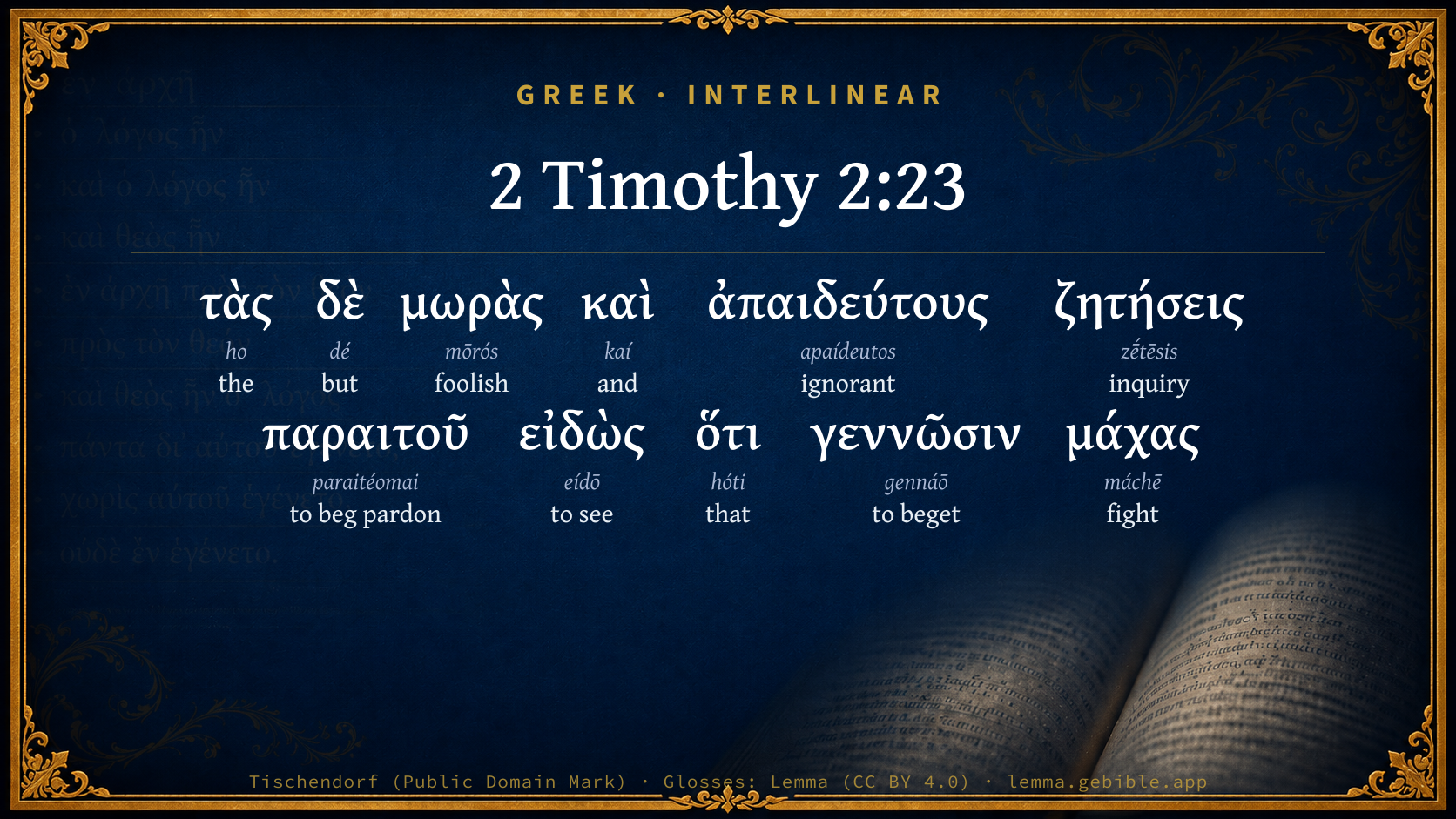
Greek (Tischendorf 8th ed.) 2 Timothy 2:23 appears in the Greek New Testament. The text above is from the Tischendorf 8th edition. Each word links to its Strong’s number and a concise gloss. Click any word for its full Thayer’s Greek Lexicon entry.
Download image
Cite this verse

2 Timothy 2:23 (World English Bible). Public Domain. Lemma interlinear Bible study tool, https://lemma.gebible.app/v/2-timothy/2/23.

Show BibTeX & RIS
BibTeX
RIS
English Translation
But refuse foolish and ignorant questionings, knowing that they generate strife.
World English Bible · Public Domain
Highlights
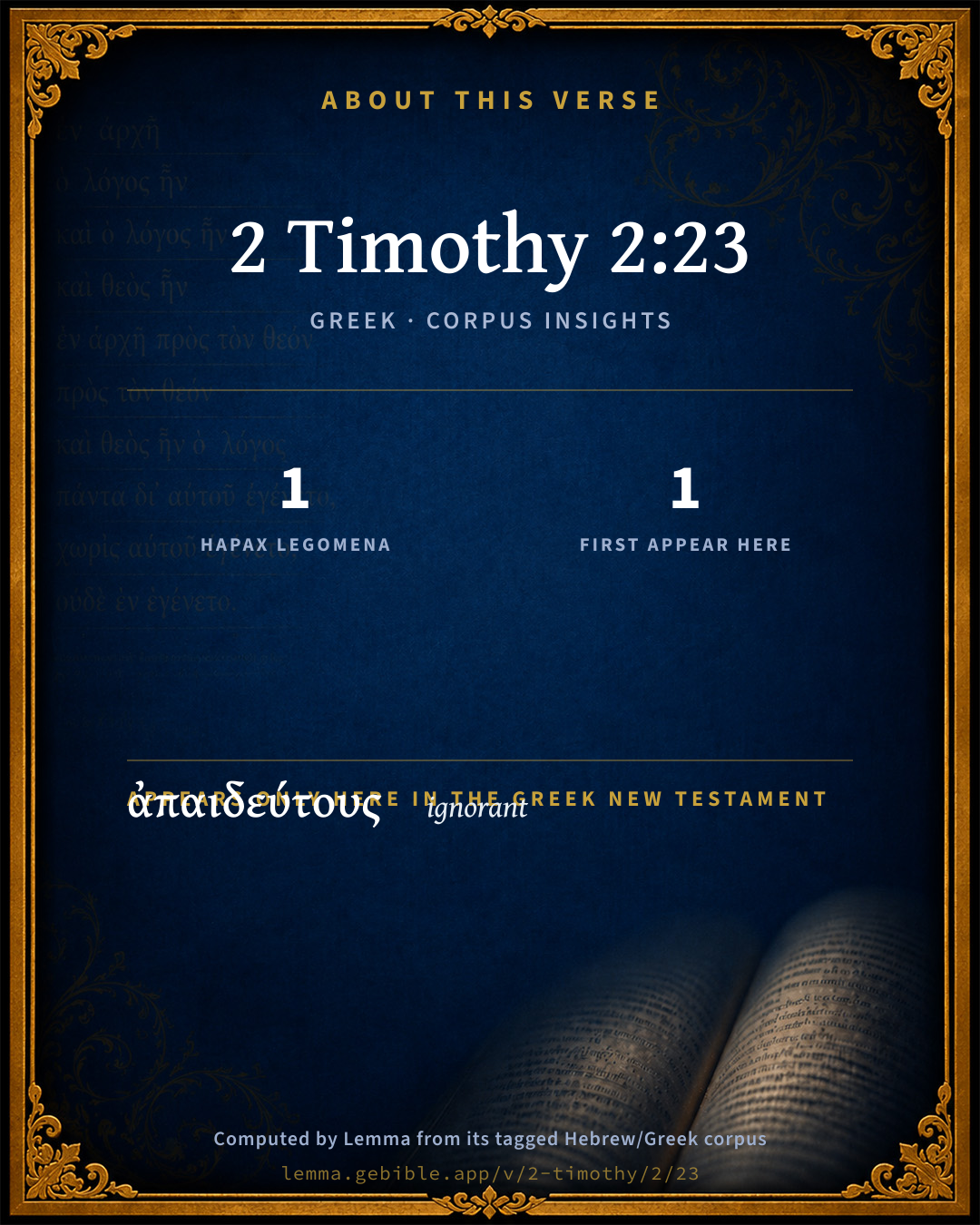
  • 1 hapax legomenon — only here in the Greek New Testament
  • 1 first appearance in the Greek New Testament
Full analysis ↓
Download a study sheet

One document with this verse’s original text, its word-by-word gloss line, the meaning frame, cross-references with their text, attributed commentary, and full source and license credits — printable, and it pastes into notes with its structure intact.

This verse Autodidact and up

Study sheet (.html) Plain text (.txt)

A passage Seminary Student

Up to 50 verses in one chapter. A passage sheet keeps up to 6 commentary sources and 12 cross-references per verse, in the order this page ranks them, and says so on the sheet whenever that leaves anything out. Ask for a single verse and you get the Autodidact verse sheet above.

Everything on this page stays free to read, with no account — the sheet is a download of what is already on screen, not access to it.

Want to remove ads? Support Godless Engineer
Compare translations 3

The same verse in 3 English versions, stacked beneath the original-language interlinear above. Click any original word for its lexicon entry.

Each is an independent rendering of the whole verse — the interlinear is not word-aligned to these translations.

Highlighted words mark where these versions differ — a whole-verse word diff, not a word-by-word alignment.

  • World English Bible Public Domain
    But refuse foolish and ignorant questionings, knowing that they generate strife.
  • King James Version Public Domain
    But foolish and unlearned questions avoid, knowing that they do gender strifes.
  • unfoldingWord Literal Text CC BY-SA 4.0
    But reject foolish and ignorant controversies, knowing that they give birth to battles.

unfoldingWord Literal Text — © unfoldingWord, licensed CC BY-SA 4.0. Word-aligned USFM3 via Door43 (git.door43.org/unfoldingWord/en_ult).

Versions to compare (up to 4)

3 of 4 selected

Show all 19 translations

Every available English version of this verse, each an independent rendering of the whole verse.

  • World English Bible Public Domain
    But refuse foolish and ignorant questionings, knowing that they generate strife.
  • Berean Standard Bible Public Domain
    But reject foolish and ignorant speculation, for you know that it breeds quarreling.
  • Majority Standard Bible Public Domain
    But reject foolish and ignorant speculation, for you know that it breeds quarreling.
  • King James Version Public Domain
    But foolish and unlearned questions avoid, knowing that they do gender strifes.
  • American Standard Version (1901) Public Domain
    But foolish and ignorant questionings refuse, knowing that they gender strifes.
  • Revised Version (1885) Public Domain
    But foolish and ignorant questionings refuse, knowing that they gender strifes.
  • Geneva Bible (1599) Public Domain
    And put away foolish and vnlearned questions, knowing that they ingender strife.
  • Douay-Rheims (1899) Public Domain
    And avoid foolish and unlearned questions, knowing that they beget strifes.
  • Young's Literal Translation Public Domain
    and the foolish and uninstructed questions be avoiding, having known that they beget strife,
  • Literal Standard Version CC BY-SA 4.0
    and be avoiding the foolish and uninstructed questions, having known that they beget strife,
  • Unlocked Literal Bible CC BY-SA 4.0
    But refuse foolish and ignorant questions. You know that they give birth to arguments.
  • unfoldingWord Literal Text CC BY-SA 4.0
    But reject foolish and ignorant controversies, knowing that they give birth to battles.
  • Darby Bible Public Domain
    But foolish and senseless questionings avoid, knowing that they beget contentions.
  • World Messianic Bible Public Domain
    But refuse foolish and ignorant questionings, knowing that they generate strife.
  • Webster's Bible Public Domain
    But foolish and unlearned questions avoid, knowing that they gender contentions.
  • Free Bible Version CC BY-SA 4.0
    Avoid foolish and childish debates, for you know they only lead to fights.
  • Bible in Basic English Public Domain
    And put away foolish and uncontrolled questionings, seeing that they are a cause of trouble.
  • Text-Critical English NT CC BY 4.0
    Have nothing to do with foolish and ignorant controversies, knowing that they breed quarrels.
  • Tyndale New Testament (1534) Public Domain
    Folisshe and vnlearned questions put from the remebrynge that they do but gendre stryfe.

Literal Standard Version (2020), Covenant Press — licensed CC BY-SA 4.0. Text via the HelloAO Bible API (eBible.org). Unlocked Literal Bible (unfoldingWord) — licensed CC BY-SA 4.0. Text via the HelloAO Bible API (eBible.org). unfoldingWord Literal Text — © unfoldingWord, licensed CC BY-SA 4.0. Word-aligned USFM3 via Door43 (git.door43.org/unfoldingWord/en_ult). Free Bible Version, Dr. Jonathan Gallagher — licensed CC BY-SA 4.0. Text via the HelloAO Bible API (eBible.org).

Word by word

More ways to search: Search by grammar → Find every occurrence → Compare this word →

Practice this passage: Drill this verse → Learn its vocabulary →

About this verse

These counts appear in no published source. They are computed here, from the morphology-tagged text and Lemma’s own curated glosses. What Lemma adds →

11
words
11
distinct lemmas
Pauline Epistles
section

Notable vocabulary

1 hapax legomenon — a word that appears only here in the entire Greek New Testament:

  • ἀπαιδεύτους ignorant G521

First appearance in Scripture

This word makes its first canonical appearance in the Greek New Testament here:

  • ἀπαιδεύτους ignorant G521

Shared distinctive vocabulary

μάχας fight G3163 occurs in 4 verses of the Greek New Testament. Also found in:
Cross-references

6

Topical passages linked to 2 Timothy 2:23 in the Treasury of Scripture Knowledge — connected by theme and wording, ordered by reader-vote popularity; previews shown in the World English Bible.

  • 2 Timothy 2:14 Remind them of these things, charging them in the sight of the Lord, that they don't argue about words, to no profit, to the subverting of those who hear.
  • Titus 3:9 but shun foolish questionings, genealogies, strife, and disputes about the law; for they are unprofitable and vain.
  • 1 Timothy 4:7 But refuse profane and old wives' fables. Exercise yourself toward godliness.
  • 1 Timothy 6:4–5 he is conceited, knowing nothing, but obsessed with arguments, disputes, and word battles, from which come envy, strife, reviling, evil suspicions,
  • 1 Timothy 1:4 neither to pay attention to myths and endless genealogies, which cause disputes, rather than God's stewardship, which is in faith--
  • 2 Timothy 2:16 But shun empty chatter, for they will proceed further in ungodliness,

Cross-references courtesy of OpenBible.info (CC BY 4.0).

Commentary

Notes on 2 Timothy 2:23 from classic Christian and Jewish commentators (each source and its license shown beneath its notes). The classic Christian expositions comment on the surrounding passage and are grouped to its opening verse, so a note may address several verses; the Jewish commentaries on the Tanakh (Rashi and others) are per-verse, so they appear only where the commentator wrote on this verse.

Lemma curates 59 commentaries, every one of them public domain or Creative Commons licensed, each selected and text-cleaned for this edition rather than reprinted as found. About our sources →

The Biblical Illustrator

Joseph S. Exell

2Ti_2:23

Foolish and unlearned questions avoid.

The Greek word translated unlearned, is better rendered ignorant. These questions, which the false teachers, with whom Timothy was so much thrown, loved to put forward for discussion, could hardly be termed unlearned--much useless learning being often thrown away in these disputings of the schools--but were rather pointless, stupid, as well as foolish. (H. D. M. Spence, M. A.)

Ignorant questionings

I. Unadvised and unlearned questions are to be avoided.

1. For the ground of them is not good: such spring either from curiosity or ignorance.

2. The fruit therefore will be bitter; for nothing profitable.

II. Sin in the first causes is to be prevented. What of less motion or power than a word--a question? yet such of all men are to be regarded.

III. The causes of sin once discerned are to be resisted, shunned. Thou knowest that fond reasonings, unadvised disputings, beget quarrels, stir up strifes: therefore reject them, flee from them.

IV. Foolish questions raise contentions. It is a wonder to see what abundance of ill fruit one branch of fond reasoning hath produced. Like a bone cast amongst curs, an unlearned question will cause men to snarl, bite, and quarrel. (J. Barlow, D. D.)

Foolish questionings

A lady, of whom we beard in our travels, had worried several ministers who sought her good by always telling them that she could not believe till they could explain to her how God could be without a beginning. For, said she, if He never began, then He has not begun, and there can be no God at all. Very dexterous are certain persons in blocking up their own road, and yet, perhaps, there is no great dexterity in it, for the proverb says, A fool may put questions which a wise man cannot answer. In the Vatican at Rome we saw the renowned statue of the boy who has a thorn in his foot, and is busy extracting if. He was doing this when we first saw him, and three years after he was attempting the same operation. We have good reason for believing that he is even now in the same posture, and will be found in like attitude fifty years hence. He is carved in marble, and therefore is excused for making no progress; but what shall be said of living, thoughtful individuals who year after year are trifling with imaginary difficulties, and never set foot on the road to heaven? (C. H. Spurgeon.)

Unwise curiosity

The over-curious are not over-wise. (Massinger.)

Metaphysical subtleties

Defend me, therefore, common sense, say I,

From reveries so airy, from the toil

Of dropping buckets into empty wells,

And growing old in drawing nothing up.

(Cowper.)

Religious strife

Huxley came to Baltimore to attend a general conference in 1820. A discussion arose on a question of order, whether presiding elders should be elected by preachers or not, and the dispute had waxed warm, not to say hot. Brother Huxley had said not a word through it all, but at the close of the session the Bishop called upon him to make the concluding prayer. He knelt and said, Now, O Lord, Thou knowest what a time weve had here discussing and arguing about this eider question, and Thou knowest what our feelings are. We do not care what becomes of the ark; its only who drives the oxen. (Christian Age.)

The Biblical Illustrator, edited by Joseph S. Exell (c. 1880s–1900s) — public domain. Text from a community e-Sword module.

Joseph Benson's Commentary

2Ti 2:23-25. But foolish and unlearned questions — Or unimportant subjects of inquiry and debate; avoid, knowing that they gender strifes — Or contentions in the church; and certainly it is a most important part of the duty of a Christian minister to guard against all occasions of offence and mischief. For the servant of the Lord must not strive — Or contend eagerly and passionately, as do the vain wranglers spoken of in the preceding verse; but be gentle — Or mild, forbearing, and long-suffering; unto all men; apt to teach — Chiefly by patience and unwearied assiduity. In meekness — Of which he has always need; instructing those who oppose themselves — Or who set themselves in opposition to the doctrines of the gospel; if peradventure — Or by any means; God may give them repentance to the acknowledgment — The belief and profession; of the truth — In these verses, “the apostle seems to have had Christ’s example as a teacher in his eye, proposing it as a model to all who are employed in teaching. The virtues here mentioned, our Lord generally exercised in teaching. Yet, on some occasions, he departed from his usual mildness, and with great severity reproved notorious sinners; such as the scribes and Pharisees. In the same manner, the prophets and apostles used strong speech in checking obstinate offenders; while those who showed any candour and honesty in their opposition to the truth, they instructed with the greatest meekness.” — Macknight. That they may recover themselves — Or rather, may awake, and deliver themselves; out of the snare of the devil — In which they have lain sleeping, and, as it were, intoxicated. “In order to understand this beautiful image,” says Doddridge,” it is proper to observe, that the word ανανηψωσιν properly signifies to awake from a deep sleep, or from a fit of intoxication, and refers to an artifice of fowlers to scatter seeds impregnated with some drugs intended to lay birds asleep, that they may draw the net over them with the greater security.” Who are taken captive by him — Greek, εζωγρημενοι, caught alive. The word denotes the action of a fisher, or hunter, who takes his prey alive in order to kill it; which is properly applied to Satan’s insnaring men in order to destroy them. And the snares in which he takes them are those prejudices, errors, lusts, and vices, in which he entangles, and by which he detains them his captives, in the most shameful bondage, danger, and misery, while they have been dreaming, perhaps, of liberty and happiness.

Joseph Benson's Commentary on the Old and New Testaments (1811–1818) — public domain. Text from a community e-Sword module.

The Preacher's Complete Homiletical Commentary

Joseph S. Exell (gen. ed.)

CRITICAL AND EXPLANATORY NOTES

2Ti_2:24. And the servant of the Lord must not strive.—The wrangling spirit that delights in strife should never be seen in the messenger of the gospel of peace and good-will. But be gentle.—The word occurs again in New Testament only at 1Th_2:7. “It is used of an amiable conduct or disposition of a superior towards an inferior,” or “an outward mildness and gentleness especially in bearing with others.” Apt to teach.—He must be didactic—not only having the ability but the willingness to teach. Though the public address in the congregation was permitted to every one with a charisma, still the bishop in particular had to know how to handle doctrine. Patient.—Able to endure evil, as it is directed against himself. On the necessity of a high priest being compassionate to the erring see Heb_5:2.

2Ti_2:25. Those that oppose themselves.—When a man imagines those who are bent on his welfare are his worst enemies, he sets himself with very determined opposition.

2Ti_2:26. That they may recover themselves.—A.V. margin, “awake.” R.V. margin, “Gr. return to soberness.” The preposition in the compound word may express motion from beneath, and so the word would mean that they may come up out of the stupefaction which holds them down, but the classical meaning is, to become sober again. Heretical teaching, like intoxication, clouds men’s wits. Who are taken captive by him at his will.—R.V. “having been taken captive by the Lord’s servant unto the will of God.” The sense conveyed by the A.V. (which is the interpretation given by most modern commentators) is singularly flat and insipid, says Bishop Ellicott. The R.V., which gives the interpretation of Wetstein, Bengel, and others, is equally objectionable, says the same authority, who adopts with but little hesitation the interpretation of Beza. This connects “that they may recover themselves out of the snare of the devil” with “unto His will,” i.e. unto God’s will. So we get the translation, “And that they may return to soberness out of the snare of the devil, though holden captive by him to do his will.” See R.V. marginal note.

MAIN HOMILETICS OF THE PARAGRAPH.—2Ti_2:23-26

The Duty of the Gospel Teacher.

I. To remember that he is the servant of the Lord (2Ti_2:24).—The minister of the gospel is not the servant of man, or of a clique or party, nor is he the servant of the Church excepting so far as in serving the Church he is serving the Lord. His high distinction is to be the servant of the Lord; from Him he receives his commission and authority, and to Him he is accountable. The servant should seek to imitate the spirit and example of his Master.

II. To be careful to avoid themes provocative of useless contention (2Ti_2:23).—A spark will raise a conflagration; a single word may light the lurid torch of war. “You may tame the wild beast; the conflagration of the American forest will cease when all the timber and the dry wood is consumed; but you cannot arrest the progress of that cruel word you uttered carelessly yesterday or this morning” (Robertson). Of all men the minister of the gospel should be cautious and circumspect in speech. An indiscreet word may lead to endless contention.

III. To mingle gentleness and patience with sound and faithful instruction (2Ti_2:24-25).—The successful teacher must have not only intelligence and ability, but the aptitude that comes from patient study and the gentleness which is the fruit of stern self-discipline. He is to be gentle that he may not be the cause of wrong, and patient so as to endure wrong. To gain influence with others we must practise much self-suppression. The simplest statement of truth will sometimes raise opposition. It should be our aim to allay or disarm opposition, so that the taught may receive with meekness the engrafted word. Truth is most effective in the mind prepared for its reception. The judicious teacher will know when and how to speak.

IV. To aim at the moral rescue of those ensnared in error (2Ti_2:25-26).—The gospel teacher has to contend not only with subtle phases of error, but with the devil, the great master-spirit of all error. To rescue man from sin is to snatch him from the clutches of the evil one. Everything depends on the manner and spirit in which the truth is presented, and every possible means should be used to ensure success. Anthony Blane, one of Felix Neff’s earlier converts, was very earnest in winning souls for Christ. The enemies of the gospel were angry at his success, and treated him with scoffs and threats. One night he was followed by a man in a rage, who struck him a violent blow on the head. “May God forgive and bless you!” was Anthony’s quiet and Christian rejoinder. A few days after the same man met him in a narrow road, and stretching out his hand beseechingly, cried in a tremulous voice, “Mr. Blane, forgive me, and let all be over!” Thus did this disciple of Christ, by gentle and peaceful words, make a friend of an enemy.

Lessons.—

1. The best teacher is always anxious to learn.

2. To teach others to profit we must be masters of ourselves.

3. The highest end of teaching is the salvation of others.

GERM NOTES ON THE VERSES

2Ti_2:23-26. The Model Preacher—

I. Avoids occasions of strife.

II. Understands the use and power of gentleness.

III. Is thoroughly master of his theme.

IV. Aims at the immediate rescue of men from the thraldom of sin and Satan.

The Preacher's Complete Homiletical Commentary (gen. ed. Joseph S. Exell; Funk & Wagnalls, c. 1892) — public domain (pre-1929). A full-Bible homiletical/sermon-outline anthology covering 65 of 66 books (2 John is absent from the source module). Text from a community e-Sword module.

Bengel's Gnomon

Johann Albrecht Bengel

2Ti 2:23. Μωρὰς καὶ ἀπαιδεύτους, foolish and unlearned) For thou oughtest παιδεύειν, to instruct, 2Ti 2:25, and to be wise, 2Ti 3:15; comp. foolish, Tit 3:9.—μάχας, strifes) Ibidem.

Bengel's Gnomon of the New Testament — English translation (T&T Clark, Edinburgh, 1860) — public domain. Text from a community e-Sword module.

Meyer's Critical & Exegetical Commentary

Heinrich August Wilhelm Meyer

2Ti_2:23 is in contrast (δέ) with 2Ti_2:22. As in 1Ti_1:4; 1Ti_6:4, ζητήσεις are brought forward as the characteristic of heresy. Paul calls them μωραὶ καὶ ἀπαίδευτοι] μωραί, Tit_3:9.

ἀπαίδευτοι, properly, uninstructed; in N. T. ἅπ. λεγ.; more frequently found in LXX. and Apocrypha, but only in reference to persons. It is synonymous with μωρός (כְּסִיל); even here, where it refers to things, it is synonymous with μωρός (= ineptus). There is no just ground for Hofmanns supposition, that it is to be derived here not from παιδεύεσθαι, but from παιδεύειν, and hence that it means unsuited for educating spiritually (Mosheim, Heydenreich, Mack, Matthies).

On παραιτοῦ, comp. 1Ti_4:7; 1Ti_5:11.

εἰδώς does not give the reason why Timothy should follow the exhortation (equivalent to since, or because, you know); it forms part of the exhortation in the sense: as you know (consider); comp. Tit_3:11; 1Co_15:58; Col_3:24; Col_4:1.

ὅτι γεννῶσι μάχας] μάχαι, Jam_4:1, synonymous with πόλεμοι; opposed to εἰρήνη, 2Ti_2:22.

Meyer — Critical and Exegetical Commentary on the New Testament — English translation by Peter Christie, edited by Frederick Crombie (T&T Clark, 1880) — public domain. Text from a community e-Sword module.

Expositor's Greek Testament

ed. W. Robertson Nicoll

2Ti 2:23 . ἀπαιδεύτους : ignorant . An ignorant question is one that arises from a misunderstanding of the matter in dispute. Misunderstandings are a fruitful source of strife. Cf. 1Ti 6:4 .

παραιτοῦ : refuse, i.e. , Such questions will be brought before you: refuse to discuss them. The A.V., avoid might mean merely, Evade the necessity of meeting them.

γεννῶσι : There is no other instance of the metaphorical use of this word in the N.T.

μάχας : in the weaker sense of contention, quarrel , as in 2Co 7:5 , Tit 3:9 ; but not Jas 4:1 .

The Expositor's Greek Testament, edited by W. Robertson Nicoll (1897–1910) — public domain. Text from a community e-Sword module.

Jamieson, Fausset & Brown

Robert Jamieson, A. R. Fausset & David Brown

(Tit 3:9.)

unlearned--Greek, "undisciplined"; not tending to promote the discipline of faith and morals (Pro 5:23). "Uninstructive"; in contrast with "instructing" (Ti2 2:25), and "wise unto salvation" (Ti2 3:15).

avoid--"decline."

Jamieson, Fausset & Brown — Commentary Critical and Explanatory on the Whole Bible (1871) — public domain (CC PDM 1.0). Text via the HelloAO Bible API.

Adam Clarke's Commentary

Verse 23. Foolish and unlearned questions] See the notes on 1Ti 1:4; "1Ti 4:7", and "Tit 3:9".

Adam Clarke's Commentary on the Bible (1810–1826) — public domain. Text from a community e-Sword/MySword module.

John Calvin's Commentaries

23 But avoid foolish and uninstructive questions He calls them foolish, because they are uninstructive; that is, they contribute nothing to godliness, whatever show of acuteness they may hold out. When we are wise in a useful manner, then alone are we truly wise. This ought to be carefully observed; for we see what foolish admiration the world entertains for silly trifles, and how eagerly it runs after them. That an ambition to please may not urge us to seek the favor of men by such display, let us always remember this remarkable testimony of Paul, that questions, which are held in high estimation, are nevertheless foolish, because they are unprofitable.

Knowing that they beget quarrels Next, he expresses the evil which they commonly produce. And here he says nothing else than what we experience every day, that they give occasion for jangling and debates. And yet the greater part of men, after having received so many instructions, do not at all profit by them.

John Calvin's Commentaries (1540-1563) — public domain. Text from the Calvin Translation Society English edition (1840s-50s) via the Christian Classics Ethereal Library (ccel.org). Calvin's coverage is partial (roughly two-thirds of the Bible); uncommented books and verses are honest gaps, never fabricated. The 19th-century editor's footnotes and remarks are omitted so the notes are faithfully Calvin's own voice.

Ellicott's Commentary for English Readers

(23) But foolish and unlearned questions avoid.—The Greek word translated “unlearned” is better rendered ignorant. These “questions” which, as we have seen above, the false teachers, with whom Timothy was so much thrown, loved to put forward for discussion, could hardly be termed “unlearned”—much useless learning being often thrown away in these disputing of the schools—but were rather “pointless,” “stupid,” as well as foolish. The nature of these questions of controversy has been discussed above.

Knowing that they do gender strifes.—Knowing—as thou dost—from sad and frequent experience, what conflicts, heart-burnings, estrangements, these abstract questions between rival teachers and rival sects engendered.

A Bible Commentary for English Readers, edited by Charles John Ellicott (1878–1897) — public domain. Text from a community e-Sword module.

The Cambridge Bible for Schools and Colleges

gen. ed. J. J. S. Perowne

23. But foolish and unlearned questions] But those foolish and ignorant questionings steadily refuse; as above ‘beware their bad doctrine; their foolish questioning decline.’

unlearned] The word occurs nowhere else in N.T., its meaning ‘indoctus’ and then ‘ineptus’ is seen in Pro_8:5, ‘Ye fools, be ye of an understanding heart.’ Hence its appropriate union here with ‘foolish.’ ‘Ignorant’ has a shade of moral fault very frequently, which makes it a better rendering than ‘unlearned.’ Cf. Psa_49:10, ‘the ignorant and foolish’ (Pr.-B. V.).

questions] ‘Questionings,’ see note on 1Ti_1:4.

avoid] ‘Decline,’ see note on 1Ti_4:7 where the form of the sentence is very similar to 2Ti_2:22.

knowing] Seems to require some such addition as ‘as thou dost’ to render the original; ‘knowing that’ being a weak and colloquial phrase by itself.

The Cambridge Bible for Schools and Colleges (gen. ed. J. J. S. Perowne; Cambridge University Press, 1878–1918) — public domain. Text from a community e-Sword module.

John Gill's Exposition

But foolish and unlearned questions avoid,.... Such as have no solid wisdom in them, and are foreign from the Gospel, the wisdom of God in a mystery, and are not useful and unedifying; such ought to be avoided, publicly and privately; they should not be started in the public ministry, nor attended to in private conversation; as being unworthy of the notice of a minister of the Gospel wise and learned, and useless to the church, and to his hearers.

Knowing that they do gender strife; about words, and contentions, which break the peace of churches, and hinder the profit of souls, and the progress of the Gospel.

John Gill's Exposition of the Whole Bible (1746–1763) — public domain (CC PDM 1.0). Text via the HelloAO Bible API.

Trapp's Complete Commentary

John Trapp

23 But foolish and unlearned questions avoid, knowing that they do gender strifes.

Ver. 23. But foolish and unlearned, &c.] παραιτου. Vitiligatorum naenias devita. Shift them off, set them by as seeds of sedition. Shake off vain questionists as great triflers. Such were the schoolmen, in detestation of whose vain jangling and doting about questions Luther saith, Prope est ut iurem nullum esse Theologum Scholasticum qui unum caput Evangelii intelligat; I could almost swear that there is not a schoolman that understands one chapter of the New Testament. One of their doctors said, that he had publicly expounded the Book of Job; but by that time he came to the 10th and 11th chapters, he did verily believe that Job was more vexed and tortured by his interpretations than ever he had been by his botches and ulcers. (Joh. Manl. loc. com.)

John Trapp, A Commentary or Exposition upon All the Books of the Old and New Testament (1647–1656) — public domain. Text from a community e-Sword module.

Albert Barnes' Notes on the Bible

But foolish and unlearned questions avoid; - see the notes at 2Ti 2:16; compare the notes at 1Ti 1:4, 1Ti 1:6; 1Ti 4:7. The word “unlearned,” here, means “trifling; that which does not tend to edification; stupid.” The Greeks and the Hebrews were greatly given to controversies of various kinds, and many of the questions discussed pertained to points which could not be settled, or which, if settled, were of no importance. Such has been the character of no small part of the disputes which have agitated the world. Paul correctly says that the only effect of such disputes is to engender harsh contention. Points of real importance can be discussed with no injury to the temper; but people cannot safely dispute about trifles.

Albert Barnes' Notes on the Bible (1834–1885) — public domain. Text from a community e-Sword/MySword module.

Matthew Poole's English Annotations

It is a precept or caution of the same nature with those, 1Ti 1:4; 4:7; and 2Ti 2:16. The repetition of this precept of the apostle four times in these two short Epistles, lets us know how important a thing he judged it, that ministers of the gospel should not spend their time in their discourses to their congregations, in things that tend nothing to the building up of their hearers in faith or holiness, being either old wives’ fables, like the stories in the popish legends, or the apocryphal stories of Bel and the Dragon, Tobit and his dog, and the swallows dunging in his eye, &c.; or sifting out genealogies, or vain and impertinent discourses, or idle, fruitless questions, which tend not to edifying, but to satisfy curiosity, and increase strife and ungodliness; which kind of preaching the apostle also had defamed, 1Ti 6:4, as the issue of pride, and ignorance, and dotage, and here he calls such questions

unlearned in the same sense, because impertinent to the end of preaching. The vanity of human nature, and their non-subjection to the will of God, appeareth much in this, that notwithstanding the unreasonableness of such preaching, and the direct opposition of it to the so often repeated precepts of the apostle, and to Titus, Tit 3:9, and Paul’s proposing of his own example to the contrary, 1Co 2:1-4; yet for many years in the times of popery the people were fed with little besides these husks; and too many yet, either out of pride, to show their parts and reading, or ignorance of the mysteries of godliness, and the true end of preaching, or dotage about unprofitable speculations and niceties, can find little better food than these husks for poor people’s souls.

Matthew Poole's English Annotations on the Holy Bible (1683–1685) — public domain. Text from a community e-Sword/MySword module.

Whedon's Commentary on the Bible

Daniel D. Whedon

23. But—In order to attain peace, even with these, avoid foolish questions, inquiries, and discussions about subtle unrealities.

Strifes— Literally, fights; that is, quarrels; contests where truth is not the object, but in which the selfish or malign emotions are engaged.

Daniel D. Whedon (gen. ed.), Commentary on the Old and New Testaments (1874–1909) — public domain. Text from a community e-Sword module.

The Pulpit Commentary

Ignorant questionings for unlearned questions, A.V; refuse for avoid, A.V; gender for do gender, A.V Ignorant (ajpaideutouv); only here in the New Testament, but not uncommon in the LXX, applied to persons, and in classical Greek. Unlearned is quite as good a rendering as ignorant. It is a term applied properly to ill-educated, ill-disciplined people, and thence, by an easy metonymy, to the questions such persons delight in. Questionings (zhthseiv); see 1Ti_1:4, note, andtou); Tit_3:9. Refuse (parai) "have nothing to do with" (see 1Ti_4:7; Tit_3:10) Gender (gennwsi). This is the only place in the New Testament where gennaw is used in this metaphorical sense, Gal_4:24 is included. (For the sentiment, see 1Ti_6:4, "Whereof cometh envy, strife," etc.) Strifes (macav); compare macav nomikav, "fightings about the Law"; (Tit_3:9) and "wars and fightings". (Jam_4:1, Jam_4:2) Compare, too, the verb logomacein, in ver. 14. Nothing can be more emphatic than St. Paul"s warnings against foolishand angry controversies about words, and yet nothing has been more neglected in the Church, in all ages.

A warning against contentious questionings.

I THE MINISTER OF CHRIST MUST AVOID INAPT DISCUSSIONS. "But foolish and ignorant questions avoid." The false teachers wasted their energies upon questions of this class, because they had no just idea of the relative importance of truth, taking small things for great and great things for small. The matters in dispute were useless and unedifying, being foreign to the true wisdom of the gospel. Four times in these two Epistles does the apostle repeat this grave warning.

II THE TENDENCY OF SUCH DISCUSSIONS. "Knowing that they do gender strifes." They break the peace of Churches, alienate the hearts of ministers, and impede the progress of the gospel. T.C.

The Pulpit Commentary (1880–1919), ed. H.D.M. Spence-Jones & Joseph S. Exell — public domain. Text from a community e-Sword module.

Fairbairn on Ezekiel, Jonah & the Pastoral Epistles

Patrick Fairbairn

Ver. 23. But foolish and ignorant questions avoid, knowing that they do gender strifes. The same advice substantially was given to Titus (Tit 3:9); and the tendency of discussions about questions of the kind here indicated to give rise to fruitless contention, is distinctly stated at 1Ti 6:4. The only point which calls for explanation is the precise meaning of the second epithet applied to the questions—ἀπαιδεύτους. Our translators have rendered it unlearned, which may be said to express the etymological sense, like the Vulgate’s sine disciplina, or Alford’s undisciplined. But to proscribe unlearned or undisciplined questions, with an implied sanction of such as could fitly be called learned or disciplined, is certainly not what the apostle meant, in the ordinary sense of such expressions. The Greek word nowhere else occurs in the New Testament; but in the Septuagint it is employed in a considerable variety of significations (if we may judge from the Hebrew terms it is taken to represent)—not only untaught or undisciplined (Pro 5:23), but worthless (1Sa 1:16), senseless or foolish (Pro 8:5, Pro 15:13, Pro 15:15), etc. (See Schleusner, Lex., on the word.) Ignorant is probably as good a secondary meaning, and as suitable to the connection here, as any that can be employed,—understanding thereby something closely allied to the other epithet, foolish, with which it is conjoined—senseless, stupid; such questions as might be raised by persons who had undergone no proper instruction or training in the things of God. Questions of that description the thoughtful and earnest minister of God’s word will do well to eschew: he should feel like one that has no heart or time for them; and a little observation will soon convince him that they are, when entertained, as the apostle intimates, a fruitful source of strife.

Patrick Fairbairn — An Exposition of Ezekiel (1851), Jonah (1849), and The Pastoral Epistles (1874) — public domain. Text from a community e-Sword module.

Godbey's Commentary on the New Testament

William B. Godbey

ARGUMENT 5

THE VICTORY OF THE LORD’S SERVANT

23. “Avoid foolish and unlearned questions, knowing that they gender strifes.” The great Spurgeon said when his members backslid they always became much concerned to know who Cain’s wife and Melchizedek were. Satan uses all sorts of silly, foolish, and worthless questions to tangle weak Christians and attract their attention from Christ, and plunge them into hell. These foolish questions are not answered in the Bible, from the simple fact that they are not worth answering.

24. “It does not behoove the servant of the Lord to strive, but to be gentle toward all, competent to teach, enduring evil.” Never argue with any one. You see here you are positively forbidden to contend with any person. Be thoroughly posted in God’s Word, and competent to teach the people; but be sure you teach them in an uncontroversial way. Utterly ignore their spirit of controversy. Like a Christian gentleman, teach all you meet the simple truth of God in a kind, frank, and uncontroversial spirit. These disputers are all idolaters, worshipping their creed, and trying to bend the Bible to it. They need your prayers for personal salvation, instead of the cudgel of controversy. Teach them the Word of God; patiently endure all their abuse for Christ’s sake, and pray for them with your might.

25. “In meekness instructing the opposers, lest at some time God may give unto them repentance unto the perfect knowledge of the truth.” We receive

knowledge of the truth in regeneration and perfect knowledge; i.e., we reach experimental certainty in sanctification. John Wesley preached the “repentance of Christians.” In that case we call it consecration, which is but a continuation of the repentance we began when a sinner, both being generically identical; i.e., a giving up; e.g., the sinner giving all of his bad things (for he has nothing else) to the devil, where they belong, and leaving him and his sins with him forever, and the Christian giving up all of his good things (in consecration) to the Lord, to be used for his glory forever.

26. “They may escape from the snare of the devil, having been led captive by same [servant of the Lord] at his will;” i.e., the will of this servant of the Lord. (See R.V.) Of course, these wicked disputers have been captivated by the devil and led away, but this “servant of the Lord,” in patience, love, and kindness, suffering all their abuses and persecutions by the grace of God out generals the devil, captivating them and leading them away from Satan to God, and receiving a crown of glory for saving them, which he never could have done if he had antagonized them in controversy.

William B. Godbey, Commentary on the New Testament (1896–1900) — public domain. Text from a community e-Sword module.

The People's New Testament

B. W. Johnson

23–26. Foolish and unlearned questions avoid. Such unprofitable questions and speculations as the false teachers raise.

B. W. Johnson's The People's New Testament with Notes (1889–1891) — public domain. Electronic text from the Christian Classics Ethereal Library (CCEL) ThML edition.

Cambridge Greek Testament for Schools and Colleges

23–26. TAKE NO PART IN IDLE CONTROVERSY

23. τὰς δὲ μωρὰς καὶ ἀπαιδεύτους ζητήσεις παραιτοῦ, but foolish and ignorant questionings refuse. The irrelevancy of much of the controversy then prevalent among Christians seems to have deeply impressed St Paul; again and again he returns to this charge against the heretical teachers, that their doctrines are unprofitable and vain, and that they breed strife about questions either unimportant or insoluble. See 1Ti 1:4; 1Ti 1:7; 1Ti 4:7; 1Ti 6:4; 1Ti 6:20; Tit 3:9 &c. The adj. ἀπαίδευτος (undisciplined, or untaught, and so ignorant) does not occur again in the N.T. For παραιτοῦ see on 1Ti 4:7.

εἰδὼς ὅτι γεννῶσιν μάχας, knowing that they gender strifes. A seemingly harmless speculation as to obscure problems of theology or sacred history may become directly injurious to true religion, if it issue in verbal controversies. Cp. 2Ti 2:14.

Cambridge Greek Testament for Schools and Colleges (Cambridge University Press, 1896; 21 vols, various authors incl. Carr, Maclear, Plummer, Farrar, Lumby, Moule, M. R. James, Simcox) — public domain. Text from a community e-Sword module.

Alford’s Greek Testament

Henry Alford

23.] But (contrast again to the hypothesis of the contrary of the last exhortation) foolish (Tit 3:9) and undisciplined (ἀπαίδευτος can hardly be wrested from its proper sense and made to mean ‘unprofitable πρὸς παιδείαν,’ but, as in reff., must mean lacking παιδεία, shewing want of wholesome discipline. Grot. limits it too narrowly, when he says, “Intelligit hic Paulus quæstiones immodestas: nam et Græci pro ἀκόλαστον dicunt ἀπαίδευτον (sine disciplina): quia idem est κολάζειν et παιδεύειν”) questionings decline (reff.), being aware that they gender strifes (reff.): but (contrast to the fact of μάχαι) the (better than a, as De W. The meaning being much the same, and δοῦλον in the emphatic place representing τὸν δοῦλον, the definite art., in rendering, gives the emphasis, and points out the individual servant, better than the indefinite) servant of the Lord (Jesus; see 1Co 7:22. It is evident from what follows, that the servant of the Lord here, in the Apostle’s view, is not so much every true Christian,—however applicable such a maxim may be to him also,—but the minister of Christ, as Timotheus was: cf. διδακτικόν, &c. below) must not strive (the argument is in the form of an enthymeme:—‘propositionem ab experientia manifestam relinquit. Assumptio vero tacitam sui probationem includit, eamque hujusmodi: servum oportet imitari Dominum suum.’ Estius), but be gentle (ref.) towards all, apt to teach (ref.:—so E. V. well: for, as Bengel, ‘hoc non solum soliditatem et facilitatem in docendo, sed vel maxime patientiam et assiduitatem significat.’ In fact these latter must be, on account of the contrast which the Apostle is bringing out, regarded as prominent here), patient of wrong (so Conyb., and perhaps we can hardly find a better expression, though ‘wrong’ does not by any means cover the meaning of the κακόν: ‘long-suffering’ would be unobjectionable, were it not that we have μακρόθυμος, to which that word is already appropriated. Plutarch, Coriolan. c. 15, says, that he did not repress his temper, οὐδὲ τὴν ἐρημίᾳ ξύνοικον, ὡς Πλάτων ἔλεγεν, αὐθάδειαν εἰδὼς ὅτι δεῖ μάλιστα διαφεύγειν ἐπιχειροῦντα πράγμασι κοινοῖς καὶ ἀνθρώποις ὁμιλεῖν, καὶ γενέσθαι τῆς πολλὰ γελωμένης ὑπʼ ἐνίων ἀνεξικακίας ἐραστήν), in meekness correcting (not ‘instructing,’ see reff., and note on ἀπαιδεύτους, ver. 23) those who oppose themselves (better than as Ambrst., ‘eos qui diversa sentiunt:’ to take the general meaning of διατίθεσθαι, satisfies the context better, than to supply τὸννοῦν. The Vulg., ‘eos qui resistunt veritati,’ particularizes too much in another way), if at any time (literally, ‘lest at any time:’ but μήποτε in later Greek sometimes loses this aversative meaning and is almost equivalent to εἴποτε. Cf. Viger, p. 457, where the annotator says of μήποτε, ‘vocula tironibus sæpissime crucem figens, cum significat fortasse, vel si quando,’ and he then cites this passage. The account to be given of the usage is that, from μή being commonly used after verbs of fearing, &c.,—then after verbs expressing anxiety of any kind (φροντίζω, μὴ … Xen.: σκοπῶ, μὴ … Plato: ὑποπτεύειν, μὴ … Xen.: αἰσχύνομαι, μὴ … Plato) its proper aversative force by degrees became forgotten, and thus it, and words compounded with it, were used in later Greek in sentences where no such force can be intended. De W. refers to Kypke for examples of this usage from Plut. and Athenæus: but Kypke does not notice the word here at all) God may give them repentance (because their consciences were impure (see above on ver. 22) and lives evil. Cf. Ellic.’s remarks on μετάν.) in order to the knowledge of (the) truth (see note, 1Ti 2:4), and they may awake sober (from their moral and spiritual intoxication: so ἐκνήφ., in ref. 1 Cor., and this same word in Jos.: the θρῆνοι there, as the ensnarement by the devil here, being regarded as a kind of intoxication. There is no one word in English which will express ἀνανήψαι: Conyb. has paraphrased it by ‘escape, restored to soberness’ (‘return to soberness,’ Ellic.): perhaps the E. V., ‘recover themselves,’ is as near an approach to the meaning as we can get. We have the word used literally by Plutarch, Camillus, c. 23: ὁ Κάμιλλος … περὶ μέσας τὰς νύκτας προσέμιξε τῷ χάρακι … ἐκταράττων ἀνθρώπους κακῶς ὑπὸ μέθης κ. μόλις ἐκ τῶν ὕπνων ἀναφέροντας πρὸς τὸν θόρυβον. ὀλίγοι μὲν οὖν ἀνανήψαντες ἐν τῷ φόβῳ κ. διασκευασάμενοι, τοὺς περὶ τὸν Κάμιλλον ὑπέστησαν.… Sir Thomas North renders it, ‘There were some notwithstanding did bustle up at the sudden noise.’ See also examples in Wetst.) out of the snare of the devil (gen. subj., ‘the snare which the devil laid for them.’ There is properly no confusion of metaphor, the idea being that these persons have in a state of intoxication been entrapped, and are enabled, at their awaking sober, to escape. But the construction is elliptic, ἀνανήψωσιν ἐκ = ἐκφύγωσιν ἀνανήψαντες ἐκ), having been (during their spiritual μέθη) taken captive by him unto (for the fulfilment of, in pursuance of) the will of Him (viz. God: that Other, indicated by ἐκείνου. Thus I am now persuaded the words must be rendered: αὐτοῦ, referring to the devil, and it being signified that the taking captive of these men by him only takes place as far as God permits; according to His will. Rendering it thus, as do Aret., Estius, and Ellicott, I do not hold the other view, which makes αὐτοῦ and ἐκείνου both refer to the devil, to be untenable. I therefore give my note much as it stood before, that the student may have both sides before him. The difficulty is of course to determine whether the pronouns are used of the same person, or of different persons. From the Greek expositors downwards, some have held a very different rendering of the words from either of those here indicated: Thl. e.g.,—ἐν πλάνῃ, φησί, νήψονται, ἀλλὰ ζωγρηθέντες ὑπὸ θεοῦ εἰς τὸ ἐκείνου θέλημα, τουτέστι τοῦ θεοῦ, ἴσως ἀνανήψουσιν ἀπὸ τῶν ὑδάτων τῆς πλάνης. This, it is true, does not get rid of the difficulty respecting the pronouns, but it pointed a way towards doing so: and thus Wetst., Bengel, and Mack, understand αὐτοῦ to apply to the δοῦλος κυρίου,—ἐκείνου to God—‘taken prisoners by God’s servant according to His will.’ (Bengel however, as Beza, Grot., joins εἰς τὸ ἐκ. θέλ. with ἀνανήψωσιν, which is unnatural, leaving ἐζωγρ. ὑπʼ αὐτοῦ standing alone.) The great objection to this is, the exceeding confusion which it introduces into the figure, in representing men who are just recovering their sense and liberty, as ἐζωγρημένοι,—and in applying that participle, occurring as it does just after the mention of παγίς, not to that snare, but to another which does not appear at all. Aret. and Estius proposed the rendering given above;—‘taken captive by the devil according to God’s will,’ i.e. as Est., ‘quamdiu Deus voluerit, cujus voluntati nec diabolus resistere potest.’ De W. charges this with rendering εἰς as if it were κατά, but the charge is not just: for the permitting the devil to hold them captive, on this view, would be strictly εἰς, ‘in pursuance of,’ ‘so as to follow,’ God’s purpose. The real objection perhaps is, that it introduces a new and foreign element, viz. the fact that this capture is overruled by God—of which matter there is here no question. There is no real difficulty whatever in the application of αὐτοῦ and ἐκείνου to the same person. Kühner, § 629, anm. 3, gives from Plato, Cratyl. p. 430, δεῖξαι αὐτῷ ἂν μὲν τύχῃ, ἐκείνου εἰκόνα, ἂν δὲ τύχῃ, γυναικός (where the reason for the use of ἐκείνου, viz. to emphasize the pronoun, is precisely as here: see below): from Lysias, c. Eratosth. p. 429, ἕως ὁ λεγόμενος ὑπʼ ἐκείνου καιρὸς ἐπιμελῶς ὑπʼ αὐτοῦ ἐτηρήθη (which cases of ἐκεῖνος followed by αὐτός must not be dismissed, as Ellic., as inapplicable: they shew at all events that there was no absolute objection to using the two pronouns of the same person. See below). But he does not give an account of the idiom, which seems to be this: ἐκεῖνος, from its very meaning, always carries somewhat of emphasis with it; it is therefore unfit for mere reflexive or unemphatic use, and accordingly when the subject pointed out by ἐκεῖνος occurs in such unemphatic position, ἐκεῖνος is replaced by αὐτός. On the other hand, where emphasis is required, ἐκεῖνος is repeated: e.g. Soph. Aj. 1039, κεῖνος τὰ κείνου στεργέτω, κἀγὼτάδε. And this emphatic or unemphatic use is not determined by priority of order, but by logical considerations. So here in ἐζωγρημένοι ὑπʼ αὐτοῦ, the αὐτοῦ is the mere reflex of διαβόλου which has just occurred,—whereas in εἰς τὸ ἐκεινου θέλημα, the ἐκείνου would, according to this rendering, bring out and emphasize the danger and degradation of these persons, who had been, in their spiritual μέθη, just taken captive at the pleasure of ἐκεῖνος, their mortal foe. Still, it now seems to me it is better to adhere to the common meaning of the two pronouns, even though it should seem to introduce a new idea. The novelty however may be somewhat removed by remembering that God’s sovereign power as the giver of repentance was already before the Apostle’s mind).

Henry Alford, The Greek Testament (1849–1861) — public domain. Text from a community e-Sword module.

International Critical Commentary

23. Cf. I 1:4, 4:7, 6:4, Tit 3:9. ἀπαιδεύτους here only in N.T but frequent in Wisdom literature, always of persons, “sine disciplina,” Vulg.; “ineruditos,” Ambros.

International Critical Commentary — older volumes (1896–1929), various authors — public domain. Text from a community e-Sword module.

Vincent's Word Studies in the New Testament

Marvin R. Vincent

Foolish [μωρας] . In Pastorals only here and Tit 3:9. Mwrov means dull, sluggish, stupid : applied to the taste, flat, insipid : comp. mwranqh have lost his savor, Mt 5:13. In Pastorals never substantively, a fool, but so in 1Co 3:18; 1Co 4:10. Comp. afrwn, 1Co 14:36.

Unlearned [απαιδευτους] . Rev. ignorant is better; but the meaning at bottom is undisciplined : questions of an untrained mind, carried away with novelties : questions which do not proceed from any trained habit of thinking.

Questions [ζητησεις] . Better, questionings. See on 1Ti 6:4. Avoid [παραιτου] . See on 1Ti 4:7 Better, refuse or decline. Gender [γεννωσι] . Only here in Pastorals. In Paul, metaphorically, 1Co 4:15; Phl 1:10; Gal 4:24.

Marvin R. Vincent, Word Studies in the New Testament (1887–1900) — public domain. Text from a community e-Sword/MySword module.

Lesson kit

Teaching starters — assembled from the data on this page, not authored interpretation. Every prompt links to the verse data it draws on. Edit before teaching.

2 Timothy, in the Pauline Epistles, opens this verse with 11 words (11 distinct Greek lemmas). Its most distinctive word is apaídeutos (“ignorant”). A historical commentator’s framing appears above. Read the whole chapter for the surrounding context.

Discussion questions

  1. The word apaídeutos carries the sense “ignorant.” How does it shape the verse?
  2. 1 word here appears nowhere else in the Greek New Testament. Why might the author reach for such rare wording?
  3. This is the first place “ignorant” appears in Scripture (first appears here). What does its debut here establish?
  4. How does 2 Corinthians 7:5, which shares the word «fight», read alongside this verse?
  5. The translations on this page render this verse differently — a whole-verse word diff, not a word-by-word alignment. What might account for the different wordings?
  6. Compare how The Biblical Illustrator and Joseph Benson's Commentary read this verse. Where do they agree or differ?

Things to notice

  • 1 word in this verse appears nowhere else in the Greek New Testament.
  • 1 word makes its first canonical appearance in Scripture here.
  • These translations choose different wording for 16 words in this verse.
  • 11 distinct Greek lemmas span 11 words in this verse.

Reading settings

Reading text

Shown beneath each verse's original-language words.

Old Testament
Old Testament edition

Read the OT as the Masoretic Hebrew (MT) or the Greek Septuagint (LXX).

English shown for the Greek Septuagint (in the Hebrew ↔ Greek comparison).

Comparing translations? Open the Compare panel on any verse page to stack up to four side by side.