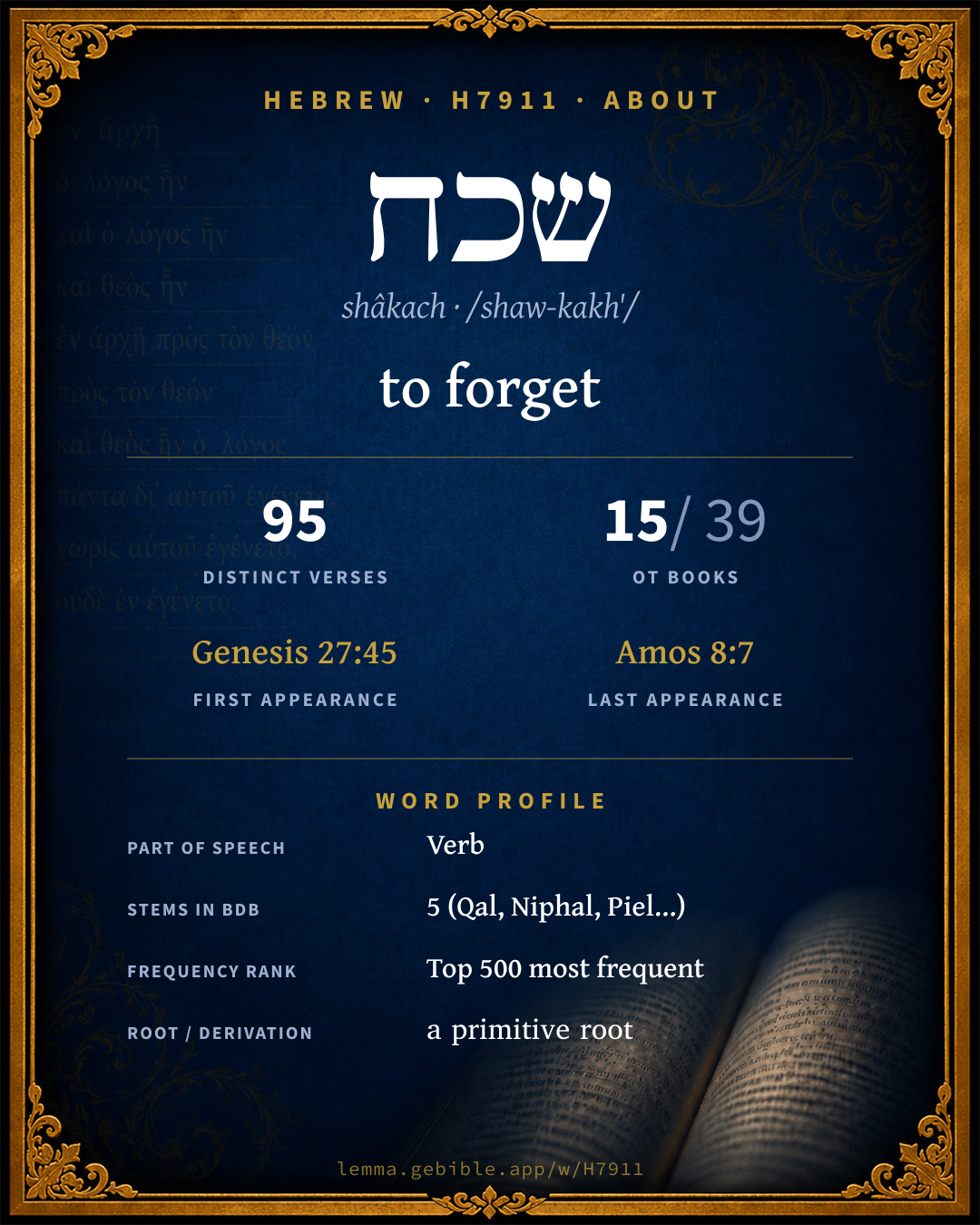
שָׁכַח
to forget
also: ignore, wither fuller range ↓
Full lexicon entry — Brown-Driver-Briggs (BDB)
From Brown-Driver-Briggs (BDB)
Where this word appears
See every Qal verb in the Hebrew Bible →
Grammar key — what these labels mean
Part of speech
- Verb
- An action or state-of-being word.
Stem
- Qal
- The basic, simple active stem — the plain form of the verb (“he wrote”). Here: ‘subj. man’
- Niphal
- Usually the simple passive or reflexive of the Qal (“he was written”).
- Hithpael
- The reflexive or reciprocal stem (the subject acts on itself).
- Hiphil
- The causative active stem (“he caused / brought about”).
- Piel
- An intensive or resultative active stem.
Form
- Imperfect
- An incomplete, ongoing, or future action (“he will / would write”).
- Perfect
- A completed action or state — Hebrew marks aspect (completeness) more than strict tense (“he wrote”).
- Jussive
- A third- or second-person volitional form expressing wish or command (“let him write”).
- Sequential Imperfect
- An imperfect with prefixed waw — the standard past-narrative form (waw-consecutive imperfect).
- Sequential Perfect
- A perfect with prefixed waw continuing a preceding imperfect or command (waw-consecutive perfect).
- Participle Active
- A verbal adjective expressing ongoing or characteristic action (“writing / one who writes”).
- Imperative
- A direct command (“write!”).
- Infinitive Construct
- A bound verbal noun, frequently with prepositions (“to write / in writing”).
- Infinitive Absolute
- An unbound verbal noun, often intensifying or standing in for a finite verb.
- Cohortative
- A first-person volitional form expressing wish or resolve (“let me / let us write”).
State
- Construct
- A noun bound to a following noun in a possessive / “of” relationship (the construct chain).
- Absolute
- The independent form of a noun, not bound to a following word.
Person
- 2nd Person
- The one addressed (“you”).
- 1st Person
- The speaker (“I / we”).
- 3rd Person
- The one spoken about (“he / she / it / they”).
Gender
- Masculine
- Grammatically masculine.
- Common
- Either gender — not distinguished for this form.
- Feminine
- Grammatically feminine.
Number
- Singular
- One.
- Plural
- More than one (in Hebrew, generally three or more).
Grammatical forms 40 distinct
- Verb, Qal, Perfect, 3rd Person, Common, Plural 11 times (11%)
- Verb, Qal, Imperfect, 2nd Person, Masculine, Singular 10 times (10%)
- Verb, Qal, Perfect, 1st Person, Common, Singular 8 times (8%)
- Verb, Qal, Jussive, 2nd Person, Masculine, Singular 6 times (6%)
- Verb, Qal, Imperfect, 1st Person, Common, Singular 6 times (6%)
- Verb, Niphal, Imperfect, 3rd Person, Feminine, Singular 4 times (4%)
- Verb, Qal, Perfect, 2nd Person, Feminine, Singular 4 times (4%)
- Verb, Qal, Imperfect, 3rd Person, Masculine, Singular 4 times (4%)
+32 more forms (49 occurrences)
Parsed forms decoded from the imported morphology (morphhb / Westminster Leningrad Codex — WLC text public domain, morphhb tagging CC BY 4.0), counted across 102 parsed occurrences — not distinct verses.
Every verse where H7911 appears — 95 distinct verses across 15 books. Click any verse to open its interlinear word-by-word view. Verse text shown in the World English Bible for context — . Each verse’s Hebrew form is shown with its reference; the English is not keyword-highlighted, since the data carries no word-level English alignment. Use “Compare translations” on any verse to read it across multiple English versions. This concordance covers the Hebrew Bible; Septuagint (Greek Old Testament) occurrences are not indexed here.
Genesis 3 verses
- Genesis 27:45 וְ/שָׁכַח֙ conj + Qal wpf 3ms until your brother's anger turn away from you, and he forgets what you have done to him. Then I will send, and get you from there. Why should I be bereaved of you both in one day?"
- Genesis 40:23 וַ/יִּשְׁכָּחֵֽ/הוּ conj + Qal wimpf 3ms + sfx pers 3ms Yet the chief cupbearer didn't remember Joseph, but forgot him.
- Genesis 41:30 וְ/נִשְׁכַּ֥ח conj + Niphal wpf 3ms There will arise after them seven years of famine, and all the plenty will be forgotten in the land of Egypt. The famine will consume the land,
Deuteronomy 13 verses
- Deuteronomy 4:9 תִּשְׁכַּ֨ח Qal impf 2ms Only take heed to yourself, and keep your soul diligently, lest you forget the things which your eyes saw, and lest they depart from your heart all the days of your life; but make them known to your children and your children's children;
- Deuteronomy 4:23 תִּשְׁכְּחוּ֙ Qal impf 2mp Take heed to yourselves, lest you forget the covenant of Yahweh your God, which he made with you, and make you an engraved image in the form of anything which Yahweh your God has forbidden you.
- Deuteronomy 4:31 יִשְׁכַּח֙ Qal impf 3ms for Yahweh your God is a merciful God; he will not fail you, neither destroy you, nor forget the covenant of your fathers which he swore to them.
- Deuteronomy 6:12 תִּשְׁכַּ֖ח Qal impf 2ms then beware lest you forget Yahweh, who brought you forth out of the land of Egypt, out of the house of bondage.
- Deuteronomy 8:11 תִּשְׁכַּ֖ח Qal impf 2ms Beware lest you forget Yahweh your God, in not keeping his commandments, and his ordinances, and his statutes, which I command you this day:
- Deuteronomy 8:14 וְ/שָֽׁכַחְתָּ֙ conj + Qal wpf 2ms then your heart be lifted up, and you forget Yahweh your God, who brought you forth out of the land of Egypt, out of the house of bondage;
- Deuteronomy 8:19 שָׁכֹ֤חַ תִּשְׁכַּח֙ Qal inf.abs Qal impf 2ms It shall be, if you shall forget Yahweh your God, and walk after other gods, and serve them, and worship them, I testify against you this day that you shall surely perish.
- Deuteronomy 9:7 תִּשְׁכַּ֔ח Qal juss 2ms Remember, don't forget, how you provoked Yahweh your God to wrath in the wilderness: from the day that you went forth out of the land of Egypt, until you came to this place, you have been rebellious against Yahweh.
- Deuteronomy 24:19 וְ/שָֽׁכַחְתָּ֧ conj + Qal wpf 2ms When you reap your harvest in your field, and have forgot a sheaf in the field, you shall not go again to get it: it shall be for the foreigner, for the fatherless, and for the widow; that Yahweh your God may bless you in all the work of your hands.
- Deuteronomy 25:19 תִּשְׁכָּֽח Qal impf 2ms Therefore it shall be, when Yahweh your God has given you rest from all your enemies round about, in the land which Yahweh your God gives you for an inheritance to possess it, that you shall blot out the memory of Amalek from under the sky; you shall not forget.
- Deuteronomy 26:13 שָׁכָֽחְתִּי Qal pf 1cs You shall say before Yahweh your God, I have put away the holy things out of my house, and also have given them to the Levite, and to the foreigner, to the fatherless, and to the widow, according to all your commandment which you have commanded me: I have not transgressed any of your commandments, neither have I forgotten them:
- Deuteronomy 31:21 תִשָּׁכַ֖ח Niphal impf 3fs It shall happen, when many evils and troubles are come on them, that this song shall testify before them as a witness; for it shall not be forgotten out of the mouths of their seed: for I know their imagination which they frame this day, before I have brought them into the land which I swore.
- Deuteronomy 32:18 וַ/תִּשְׁכַּ֖ח conj + Qal wimpf 2ms Of the Rock that became your father, you are unmindful, Have forgotten God who gave you birth.
Judges 1 verse
1 Samuel 2 verses
- 1 Samuel 1:11 תִשְׁכַּ֣ח Qal impf 2ms She vowed a vow, and said, Yahweh of hosts, if you will indeed look on the affliction of your handmaid, and remember me, and not forget your handmaid, but will give to your handmaid a man-child, then I will give him to Yahweh all the days of his life, and there shall no razor come on his head.
- 1 Samuel 12:9 וַֽ/יִּשְׁכְּח֖וּ conj + Qal wimpf 3mp But they forgot Yahweh their God; and he sold them into the hand of Sisera, captain of the host of Hazor, and into the hand of the Philistines, and into the hand of the king of Moab; and they fought against them.
2 Kings 1 verse
Job 7 verses
- Job 8:13 שֹׁ֣כְחֵי Qal ptcp.act mp cs So are the paths of all who forget God. The hope of the godless man shall perish,
- Job 9:27 אֶשְׁכְּחָ֣ה Qal coh 1cs If I say, 'I will forget my complaint, I will put off my sad face, and cheer up;'
- Job 11:16 תִּשְׁכָּ֑ח Qal impf 2ms For you shall forget your misery; You shall remember it as waters that are passed away,
- Job 19:14 שְׁכֵחֽוּ/נִי Qal pf 3cp + sfx pers 1cs My relatives have gone away. My familiar friends have forgotten me.
- Job 24:20 יִשְׁכָּ֘חֵ֤/הוּ Qal impf 3ms + sfx pers 3ms The womb shall forget him. The worm shall feed sweetly on him. He shall be no more remembered. Unrighteousness shall be broken as a tree.
- Job 28:4 הַֽ/נִּשְׁכָּחִ֥ים ptcl def.art + Niphal ptcp.act mp He breaks open a shaft away from where people live. They are forgotten by the foot. They hang far from men, they swing back and forth.
- Job 39:15 וַ֭/תִּשְׁכַּח conj + Qal wimpf 3fs And forgets that the foot may crush them, Or that the wild animal may trample them.
Psalms 32 verses
- Psalms 9:12 שָׁ֝כַ֗ח Qal pf 3ms For he who avenges blood remembers them. He doesn't forget the cry of the afflicted.
- Psalms 9:18 יִשָּׁכַ֣ח Niphal impf 3ms For the needy shall not always be forgotten, Nor the hope of the poor perish forever.
- Psalms 10:11 שָׁ֣כַֽח Qal pf 3ms He says in his heart, "God has forgotten. He hides his face. He will never see it."
- Psalms 10:12 תִּשְׁכַּ֥ח Qal juss 2ms Arise, Yahweh! God, lift up your hand! Don't forget the helpless.
- Psalms 13:1 תִּשְׁכָּחֵ֣/נִי Qal impf 2ms + sfx pers 1cs How long, Yahweh? Will you forget me forever? How long will you hide your face from me?
- Psalms 31:12 נִ֭שְׁכַּחְתִּי Niphal pf 1cs I am forgotten from their hearts like a dead man. I am like broken pottery.
- Psalms 42:9 שְׁכַ֫חְתָּ֥/נִי Qal pf 2ms + sfx pers 1cs I will ask God, my rock, "Why have you forgotten me? Why do I go mourning because of the oppression of the enemy?"
- Psalms 44:17 שְׁכַחֲנ֑וּ/ךָ Qal pf 1cp + sfx pers 2ms All this has come on us, Yet have we not forgotten you, Neither have we been false to your covenant.
- Psalms 44:20 שָׁ֭כַחְנוּ Qal pf 1cp If we have forgotten the name of our God, Or spread forth our hands to a strange god;
- Psalms 44:24 תִּשְׁכַּ֖ח Qal impf 2ms Why do you hide your face, And forget our affliction and our oppression?
- Psalms 45:10 וְ/שִׁכְחִ֥י conj + Qal impv 2fs Listen, daughter, consider, and turn your ear. Forget your own people, and also your father's house.
- Psalms 50:22 שֹׁכְחֵ֣י Qal ptcp.act mp cs "Now consider this, you who forget God, Lest I tear you into pieces, and there be none to deliver.
- Psalms 59:11 יִשְׁכְּח֬וּ Qal impf 3mp Don't kill them, or my people may forget. Scatter them by your power, and bring them down, Lord our shield.
- Psalms 74:19 תִּשְׁכַּ֥ח Qal juss 2ms Don't deliver the soul of your dove to wild beasts. Don't forget the life of your poor forever.
- Psalms 74:23 תִּ֭שְׁכַּח Qal juss 2ms Don't forget the voice of your adversaries. The tumult of those who rise up against you ascends continually.
- Psalms 77:9 הֲ/שָׁכַ֣ח ptcl inter + Qal pf 3ms Has God forgotten to be gracious? Has he, in anger, withheld his compassion?" Selah.
- Psalms 78:7 יִ֭שְׁכְּחוּ Qal impf 3mp That they might set their hope in God, And not forget the works of God, But keep his commandments,
- Psalms 78:11 וַ/יִּשְׁכְּח֥וּ conj + Qal wimpf 3mp They forgot his doings, His wondrous works that he had shown them.
- Psalms 102:4 שָׁ֝כַ֗חְתִּי Qal pf 1cs My heart is blighted like grass, and withered, For I forget to eat my bread.
- Psalms 103:2 תִּ֝שְׁכְּחִ֗י Qal juss 2fs Praise Yahweh, my soul, And don't forget all his benefits;
- Psalms 106:13 שָׁכְח֣וּ Qal pf 3cp They soon forgot his works. They didn't wait for his counsel,
- Psalms 106:21 שָׁ֭כְחוּ Qal pf 3cp They forgot God, their Savior, Who had done great things in Egypt,
- Psalms 119:16 אֶשְׁכַּ֣ח Qal impf 1cs I will delight myself in your statutes. I will not forget your word.
- Psalms 119:61 שָׁכָֽחְתִּי Qal pf 1cs The ropes of the wicked bind me, But I won't forget your law.
- Psalms 119:83 שָׁכָֽחְתִּי Qal pf 1cs For I have become like a wineskin in the smoke. I don't forget your statutes.
- Psalms 119:93 אֶשְׁכַּ֣ח Qal impf 1cs I will never forget your precepts, For with them, you have revived me.
- Psalms 119:109 שָׁכָֽחְתִּי Qal pf 1cs My soul is continually in my hand, Yet I won't forget your law.
- Psalms 119:139 שָׁכְח֖וּ Qal pf 3cp My zeal wears me out, Because my enemies ignore your words.
- Psalms 119:141 שָׁכָֽחְתִּי Qal pf 1cs I am small and despised. I don't forget your precepts.
- Psalms 119:153 שָׁכָֽחְתִּי Qal pf 1cs Consider my affliction, and deliver me, For I don't forget your law.
- Psalms 119:176 שָׁכָֽחְתִּי Qal pf 1cs I have gone astray like a lost sheep. Seek your servant, for I don't forget your commandments.
- Psalms 137:5 אֶשְׁכָּחֵ֥/ךְ תִּשְׁכַּ֥ח Qal impf 1cs + sfx pers 2fs Qal impf 3fs If I forget you, Jerusalem, Let my right hand forget its skill.
Proverbs 5 verses
- Proverbs 2:17 שָׁכֵֽחָה Qal pf 3fs Who forsakes the friend of her youth, And forgets the covenant of her God:
- Proverbs 3:1 תִּשְׁכָּ֑ח Qal juss 2ms My son, don't forget my teaching; But let your heart keep my commandments:
- Proverbs 4:5 תִּשְׁכַּ֥ח Qal juss 2ms Get wisdom. Get understanding. Don't forget, neither swerve from the words of my mouth.
- Proverbs 31:5 וְ/יִשְׁכַּ֣ח conj + Qal impf 3ms Lest they drink, and forget the law, And pervert the justice due to anyone who is afflicted.
- Proverbs 31:7 וְ/יִשְׁכַּ֣ח conj + Qal impf 3ms Let him drink, and forget his poverty, And remember his misery no more.
Ecclesiastes 3 verses
- Ecclesiastes 2:16 נִשְׁכָּ֔ח Niphal pf 3ms For of the wise man, even as of the fool, there is no memory for ever, seeing that in the days to come all will have been long forgotten. Indeed, the wise man must die just like the fool!
- Ecclesiastes 8:10 וְ/יִֽשְׁתַּכְּח֥וּ conj + Hithpael impf 3mp So I saw the wicked buried. Indeed they came also from holiness. They went and were forgotten in the city where they did this. This also is vanity.
- Ecclesiastes 9:5 נִשְׁכַּ֖ח Niphal pf 3ms For the living know that they will die, but the dead don't know anything, neither do they have any more a reward; for the memory of them is forgotten.
Isaiah 8 verses
- Isaiah 17:10 שָׁכַ֨חַתְּ֙ Qal pf 2fs For you have forgotten the God of your salvation, and have not been mindful of the rock of your strength; therefore you plant pleasant plants, and set it with strange slips.
- Isaiah 23:15 וְ/נִשְׁכַּ֤חַת conj + Niphal wpf 3fs It shall come to pass in that day, that Tyre shall be forgotten seventy years, according to the days of one king: after the end of seventy years it shall be to Tyre as in the song of the prostitute.
- Isaiah 23:16 נִשְׁכָּחָ֑ה Niphal ptcp.act fs Take a harp, go about the city, you prostitute that has been forgotten; make sweet melody, sing many songs, that you may be remembered.
- Isaiah 49:14 שְׁכֵחָֽ/נִי Qal pf 3ms + sfx pers 1cs But Zion said, Yahweh has forsaken me, and the Lord has forgotten me.
- Isaiah 49:15 הֲ/תִשְׁכַּ֤ח תִשְׁכַּ֔חְנָה אֶשְׁכָּחֵֽ/ךְ ptcl inter + Qal impf 3fs Qal impf 3fp Qal impf 1cs + sfx pers 2fs Can a woman forget her sucking child, that she should not have compassion on the son of her womb? yes, these may forget, yet I will not forget you.
- Isaiah 51:13 וַ/תִּשְׁכַּ֞ח conj + Qal wimpf 2ms and have forgotten Yahweh your Maker, who stretched forth the heavens, and laid the foundations of the earth; and fear continually all the day because of the fury of the oppressor, when he makes ready to destroy? and where is the fury of the oppressor?
- Isaiah 54:4 תִּשְׁכָּ֔חִי Qal impf 2fs Don't be afraid; for you shall not be ashamed: neither be confounded; for you shall not be disappointed: for you shall forget the shame of your youth; and the reproach of your widowhood shall you remember no more.
- Isaiah 65:16 נִשְׁכְּח֗וּ Niphal pf 3cp so that he who blesses himself in the earth shall bless himself in the God of truth; and he who swears in the earth shall swear by the God of truth; because the former troubles are forgotten, and because they are hid from my eyes.
Jeremiah 11 verses
- Jeremiah 2:32 הֲ/תִשְׁכַּ֤ח שְׁכֵח֔וּ/נִי ptcl inter + Qal impf 3fs Qal pf 3cp + sfx pers 1cs Can a virgin forget her ornaments, or a bride her attire? yet my people have forgotten me days without number.
- Jeremiah 3:21 שָׁכְח֖וּ Qal pf 3cp A voice is heard on the bare heights, the weeping [and] the petitions of the children of Israel; because they have perverted their way, they have forgotten Yahweh their God.
- Jeremiah 13:25 שָׁכַ֣חַתְּ Qal pf 2fs This is your lot, the portion measured to you from me, says Yahweh; because you have forgotten me, and trusted in falsehood.
- Jeremiah 18:15 שְׁכֵחֻ֥/נִי Qal pf 3cp + sfx pers 1cs For my people have forgotten me, they have burned incense to false [gods]; and they have been made to stumble in their ways, in the ancient paths, to walk in byways, in a way not built up;
- Jeremiah 20:11 תִשָּׁכֵֽחַ Niphal impf 3fs But Yahweh is with me as an awesome mighty one: therefore my persecutors shall stumble, and they shall not prevail; they shall be utterly disappointed, because they have not dealt wisely, even with an everlasting dishonor which shall never be forgotten.
- Jeremiah 23:27 לְ/הַשְׁכִּ֤יחַ שָׁכְח֧וּ prep + Hiphil inf.cs Qal pf 3cp who think to cause my people to forget my name by their dreams which they tell every man to his neighbor, as their fathers forgot my name for Baal.
- Jeremiah 23:40 תִשָּׁכֵֽחַ Niphal impf 3fs and I will bring an everlasting reproach on you, and a perpetual shame, which shall not be forgotten.
- Jeremiah 30:14 שְׁכֵח֔וּ/ךְ Qal pf 3cp + sfx pers 2fs All your lovers have forgotten you; they don't seek you: for I have wounded you with the wound of an enemy, with the chastisement of a cruel one, for the greatness of your iniquity, because your sins were increased.
- Jeremiah 44:9 הַֽ/שְׁכַחְתֶּם֩ ptcl inter + Qal pf 2mp Have you forgotten the wickedness of your fathers, and the wickedness of the kings of Judah, and the wickedness of their wives, and your own wickedness, and the wickedness of your wives which they committed in the land of Judah, and in the streets of Jerusalem?
- Jeremiah 50:5 תִשָּׁכֵֽחַ Niphal impf 3fs They shall inquire concerning Zion with their faces turned toward it, [saying], Come you, and join yourselves to Yahweh in an everlasting covenant that shall not be forgotten.
- Jeremiah 50:6 שָׁכְח֖וּ Qal pf 3cp My people have been lost sheep: their shepherds have caused them to go astray; they have turned them away on the mountains; they have gone from mountain to hill; they have forgotten their resting-place.
Lamentations 2 verses
- Lamentations 2:6 שִׁכַּ֨ח Piel pf 3ms He has violently taken away his tent, as if it were of a garden; he has destroyed his place of assembly: Yahweh has caused solemn assembly and Sabbath to be forgotten in Zion, Has despised in the indignation of his anger the king and the priest.
- Lamentations 5:20 תִּשְׁכָּחֵ֔/נוּ Qal impf 2ms + sfx pers 1cp Why do you forget us forever, [And] forsake us so long time?
Ezekiel 2 verses
- Ezekiel 22:12 שָׁכַ֔חַתְּ Qal pf 2fs In you have they taken bribes to shed blood; you have taken interest and increase, and you have greedily gained of your neighbors by oppression, and have forgotten me, says the Lord Yahweh.
- Ezekiel 23:35 שָׁכַ֣חַתְּ Qal pf 2fs Therefore thus says the Lord Yahweh: Because you have forgotten me, and cast me behind your back, therefore bear you also your lewdness and your prostitution.
Hosea 4 verses
- Hosea 2:13 שָׁכְחָ֖ה Qal pf 3fs I will visit on her the days of the Baals, To which she burned incense, When she decked herself with her earrings and her jewels, And went after her lovers, And forgot me," says Yahweh.
- Hosea 4:6 וַ/תִּשְׁכַּח֙ אֶשְׁכַּ֥ח conj + Qal wimpf 2ms Qal impf 1cs My people are destroyed for lack of knowledge. Because you have rejected knowledge, I will also reject you, That you may be no priest to me. Because you have your God's law, I will also forget your children.
- Hosea 8:14 וַ/יִּשְׁכַּ֨ח conj + Qal wimpf 3ms For Israel has forgotten his Maker and built palaces; And Judah has multiplied fortified cities; But I will send a fire on his cities, And it will devour its fortresses."
- Hosea 13:6 שְׁכֵחֽוּ/נִי Qal pf 3cp + sfx pers 1cs According to their pasture, so were they filled; They were filled, and their heart was exalted. Therefore they have forgotten me.
Amos 1 verse
About this entry
At a glance — auto-summarized from this page’s data, not written by a person. Every figure links to its source below. This summary describes the numbers; it doesn’t interpret them.
שכח (shâkach) is a Hebrew verb most often rendered “to forget.” Across 5 stems, its meaning turns on the binyan (Qal, Niphal). The Hebrew Bible uses it across 95 verses — moderately common. Psalms dominates its distribution — 32 of 95 verses. Debuting at Genesis 27:45, it then recurs through the corpus. The sections below give every sense, occurrence, and version rendering.
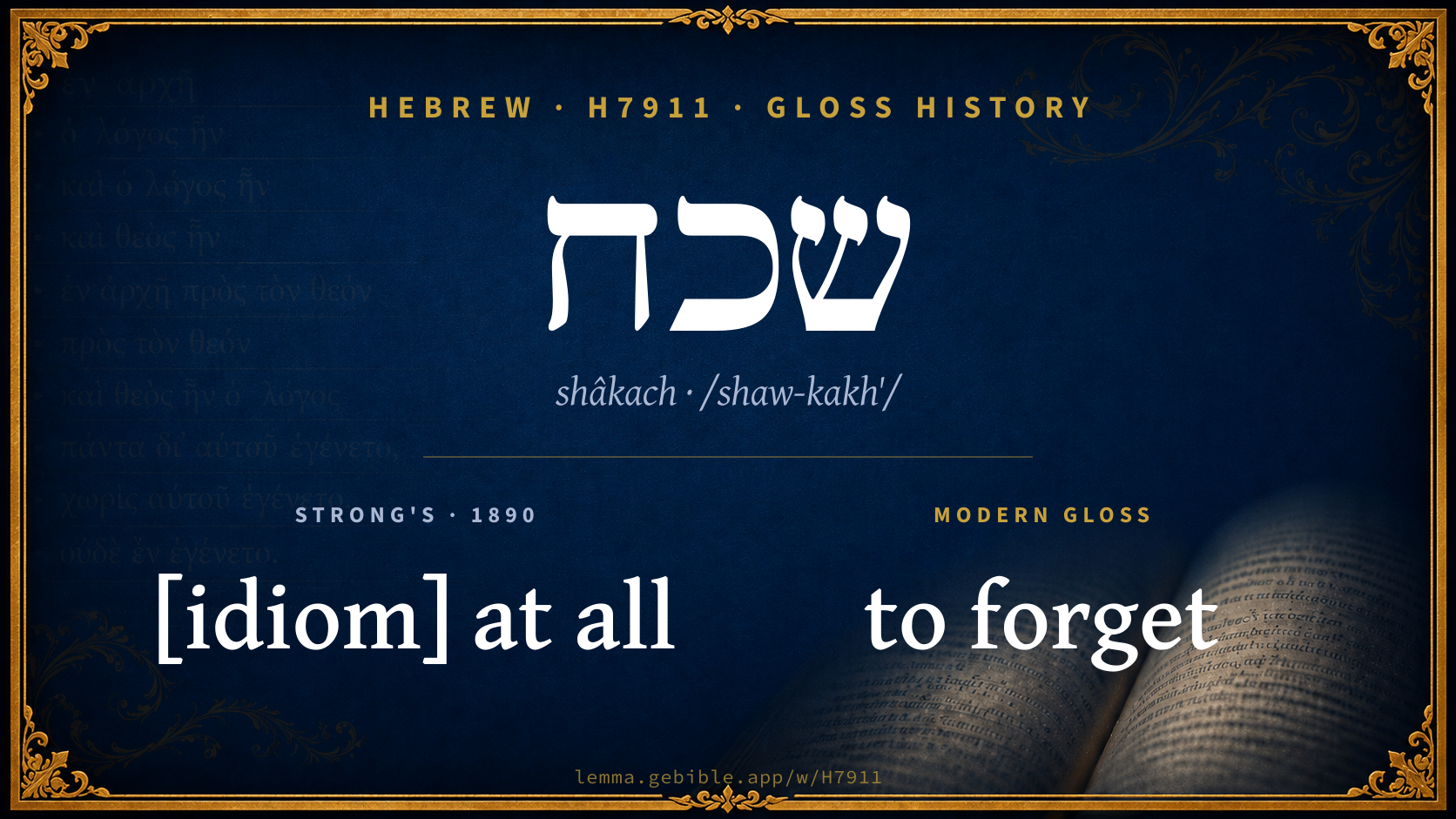
Gloss history
Strong's 1890 vs modern scholarship
About this word
Strong's H7911 catalogs a Hebrew word from the Hebrew Old Testament.
These counts are not copied from any lexicon or concordance. They are computed here, from the morphology-tagged Hebrew Old Testament. What Lemma adds →
- 95
- distinct verses
- The word appears in 95 distinct verses.
- 15 / 39
- OT books
- The word appears in 15 of 39 Old Testament books.
- #418
- by frequency
- Top 500 most frequent Hebrew words (rank 418 of 8,640 Hebrew words by occurrence).
View all 95 occurrences in the concordance →
Most concentrated in
- Psalms 32 verses 34%
- Deuteronomy 13 verses 14%
- Jeremiah 11 verses 12%
By section of the Old Testament
By traditional corpus
Conventional, traditional groupings — biblical authorship is debated, so this is a traditional corpus grouping, not an authorship claim. Each share is this word’s portion of its verses in that division of the Hebrew canon. Each figure is a share of the word’s 95 distinct verses.
- Writings (Ketuvim) 49 verses · 52%
- Prophets (Nevi'im) 30 verses · 32%
- Torah (Pentateuch) 16 verses · 17%
How translations render this word
Counts come from each version’s own published word-to-Strong’s tagging or interlinear alignment — an approximate guide to how each version renders this word, not a word-level alignment the data otherwise carries. Because each total is that version’s own tagged count, the per-version totals vary from one another and need not match the appearance or distinct-verse counts above. These counts may also differ from a printed concordance because Lemma counts each distinctly tagged rendering and does not collapse phrase taggings into a single head-word total. This is a fixed set of word-tagged versions (KJV, ASV, BSB, ULT) and does not change with the reading translation you choose elsewhere. Each version’s license is shown beside its name below (and on Sources).
- King James Version: Forget 19×, Forgat 5×, Have forgotten 5×
- American Standard Version: Forget 16×, Forgat 4×, Do i not forget 3×
- Berean Standard Bible: Forget 32×, Forgotten 5×, Be forgotten 4×
- unfoldingWord Literal Text: Forget 30×, You forget 7×, Do 5×
King James Version Public Domain
Renders H7911 across 102 tagged occurrences — most commonly:
Plus other, less common renderings. Plus 37 renderings that appear only once — usually multi-word phrases or single function words the recovered tagging swept in, not distinct renderings.
American Standard Version Public Domain
Renders H7911 across 102 tagged occurrences — most commonly:
Plus other, less common renderings. Plus 45 renderings that appear only once — usually multi-word phrases or single function words the recovered tagging swept in, not distinct renderings.
Berean Standard Bible Public Domain
Renders H7911 across 101 tagged occurrences — most commonly:
Plus 35 renderings that appear only once — usually multi-word phrases or single function words the recovered tagging swept in, not distinct renderings. Not rendered by a distinct English word in 1 further occurrence.
unfoldingWord Literal Text CC BY-SA 4.0
Renders H7911 across 138 tagged occurrences — most commonly:
Plus other, less common renderings. Plus 44 renderings that appear only once — usually multi-word phrases or single function words the recovered tagging swept in, not distinct renderings.
14 senses and sub-senses in the full BDB
Hebrew verbs can shift meaning by stem (binyan): Qal is the basic action, Niphal is often passive or reflexive, Piel often intensifies or makes it factitive, and Hiphil is typically causative. The senses below are grouped under the stem BDB assigns to each. This entry also uses Hithpael (reflexive or reciprocal).
What do BDB’s symbols mean?
BDB uses these scholarly abbreviations:
| Symbol | Meaning |
|---|---|
| 𝔊 | the Septuagint (the ancient Greek translation, LXX) |
| 𝔙 | the Vulgate (the Latin translation) |
| 𝔖 | the Syriac version (the Peshitta) |
| 𝔗 | the Targum (the Aramaic translation) |
| ψ | the Psalms |
| √ | root (the underlying root or stem) |
| ‖ | parallel passage (a synonymous or contrasted parallel) |
| † | the dagger: every passage where the word occurs is cited |
The 14 senses and sub-senses the full Brown-Driver-Briggs lexicon distinguishes for this word, in lexicon order (not ranked by frequency), with BDB’s own verbatim wording and sub-sense lettering. Shown in Hebrew script with BDB’s own scholarly abbreviations. The condensed entry is in the Lexicon Entry tab. See also the Forms in the corpus table below.
Qal
- Pf. 3 ms. שׁ׳ ψ 9:13 +, sf. שְׁכֵחָ֑נִי Is 49:14; 2 fs. שָׁכַחַתְּ Je 13:25; 1 pl. sf. שְׁכַחֲנוּךָ ψ 44:18, etc.; Impf. יִשְׁכַּח Dt 4:31 +, etc.; Imv. fs. שִׁכְחִי ψ 45:11; Inf. abs. שָׁכֹחַ; Pt. pl. cstr. שֹׁכְחֵי Jb 8:13 ψ 50:22;—forget: e.g. Psalms 9:13
- 1. subj. man,
- a. acc. rei Gn 27:45 (E), Dt 4:9; 9:7 (opp. זָכַר) +, = forget and leave, ב loc., 24:19; c. obj. cl. c. כִּי Jb 39:15; c. מִן inf. ψ 102:5. e.g. Genesis 27:45
- b. c. acc. pers., involving forgetting to mention, Gn 40:23 (E; opp. זכר), ceasing to care for Je 30:14 (fig.), Is 49:15(×2) (acc. om.), v 15 Jb 19:14 ψ 45:11; c. acc. Jerusalem 137:5a; יִשְׁכָּחֵהוּ רֶחֶם Jb 24:20; abs. ψ 137:5b תִּשְׁכַּח יְמִינִי: AE Ki supply הַמַּעֲשֶׂה or הַנִּגּוּן (whence AV her cunning), but forced: 𝔊 תִּשָּׁכַח; read prob. (Gr Bu al.) תִּכְחַשׁ let it grow lean (109:24, cf. Zc 11:17), or (Che) תְּכַחֵשׁ let it disappoint (me), fail (Hb 3:17). e.g. Genesis 40:23
- c. especially c. acc. י׳ (God), Ho 2:15; 8:14; 13:6; Ju 3:7; 1 S 12:9; Is 17:10; Dt 8:19 (שָׁכֹהַ תִּשׁ׳) + 16 times (5 times Dt, 4 times Je), + ψ 59:12 (acc. om.); also acc. of divine name Je 23:27 (בַּבַּעַל), ψ 44:21; commands of י׳ Ho 4:6; Dt 26:13 (acc. om.) ψ 119:16 + 7 times ψ 119, his doings and ways, v 139; 78:7, 11; 103:2; 106:13, his covenant Dt 4:23, 31; 2 K 17:38; Pr 2:17; law of wisdom 3:1, sc. acc. בִּינָה 4:6. e.g. Hosea 2:15
- 2. subj. י׳ (God):
- a. acc. pers. Ho 4:6 1 S 1:11 (opp. זָכַר), La 5:20; Is 49:14 (‖ עָזַב), ψ 10:12; 13:2; 42:10. e.g. Hosea 4:6
- b. acc. of sins Am 8:7 ψ 10:11 (acc. om.), cry ψ 9:13 (opp. זָכַר), cf., of distress, 44:25. e.g. Amos 8:7
- c. voice of foes ψ 74:23. e.g. Psalms 74:23
- d. sq. inf. ψ 77:10. e.g. Psalms 77:10
Niphal
- Pf. 3 ms. נִשְׁכַּה Ec 9:5, etc.; Impf. יִשָּׁכַח ψ 9:19, 3 fs. תִּשָּׁכֵחַ Je 20:11, etc.; Pt. fs. נִשְׁכָּחָה Is 23:16, נִשְׁכַּחַת v 15, pl. נִשְׁכָּחִים Jb 28:4;—be forgotten: subj. rei Gn 41:30 (E), Dt 31:21; Je 20:11; 23:40; 50:5; Is 65:11; subj. pers. ψ 9:19; 31:13; Ec 2:16, Tyre Is 23:15, 16 (under fig. of harlot), subj. זִכְרָם Ec 9:5; הַנִּשׁ׳ מִנִּי רָ֑גֶל Jb 28:4. e.g. Ecclesiastes 9:5
Piel
- Pf. 3 ms. שִׁכַּח י׳ וגו׳ La 2:6 י׳ hath caused to forget (be forgotten) in Zion assembly and sabbath. e.g. Lamentations 2:6
Hiphil
- Inf. לְהַשְׁכִּיחַ Je 23:27 to make my people forget my name (2 acc.). e.g. Jeremiah 23:27
Hithpael
- Impf. 3 mpl. יִשְׁתַּכְּחוּ Ec 8:10 they were forgotten in the city. e.g. Ecclesiastes 8:10
Senses from the full Brown-Driver-Briggs lexicon (Brown, Driver, Briggs; Oxford 1906 — public domain), digitized via Sefaria, supplemented by the OpenScriptures HebrewLexicon (CC BY 4.0). Full attribution on Sources.
Word origin
vb. forget (NH id.; Ecclus 45:26c and (Pi.) 11:25(×2); Aramaic שְׁכַח, ܫܟܰܚ is find);—
— Brown-Driver-Briggs (Oxford 1906, public domain), digitized via Sefaria, supplemented by the OpenScriptures HebrewLexicon (CC BY 4.0). See Sources.
Origin: a primitive root
Jastrow Dictionary
A second Hebrew/Aramaic lexicon for comparison, covering Aramaic and post-biblical (Talmudic, Targumic, Midrashic) usage that the biblical-Hebrew BDB does not. Matched by lemma rather than by Strong’s number, so a lemma may carry more than one Jastrow headword (shown separately below), and the entries cover usage well beyond the Bible.
שָׁכַח
- [to sink,] to forget, discard. Ber. 32ᵇ (ref. to Is. XLIX, 14) אדם … אתה עזבתני ושְׁכַחְתָּנִי if a man marries a woman after abandoning his first wife, he remembers the doings of his first wife, but thou hast abandoned me and also forgotten me. Ib. כלום אֶשְׁכַּח עולות וכ׳ will I ever forget the burnt-offerings of rams and the first born that thou didst offer &c.? Ib. שמא תִשְׁכַּח … סיני wilt thou forget what I did at Sinai? Peah V, 7 העומר ששְׁכָחוּהוּ … ולא ש׳ וכ׳ a sheaf which the laborers overlooked in collecting, but the employer had not overlooked. Ib. VII, 1 ושְׁכָחוֹ and he forgot it (left it on the tree). Ab. III, 8 כל השׁוֹכֵחַ וכ׳, v. מִשְׁנָה. Midd. II, 5 שָׁכַחְתִּי מה וכ׳ I forgot what purpose it served; Yoma 16ᵃ; a. v. fr.—Part. pass. שָׁכוּחַ; f. שְׁכוּחָה, a) (cmp. זָכוּר) forgetting. Y. Sabb. VI, 7ᵈ והיא ש׳ and she may forget herself, v. שַׁחֲצָנִית.—b) forgotten. B. Mets. 11ᵃ ש׳ מעיקרו a sheaf forgotten at the start (overlooked in collecting); זכור ולבסוף ש׳, v. זָכַר. Ber. l. c. (ref. to Is. l. c.) היינו עזובה היינו ש׳ is not abandoned the same as forgotten? (Ms. O. עֲזִיבָה … שְׁכִיחָה …). e.g. Isaiah 49:14
- 1. same. Y. Ber. V, 9ᵃ top לא במהרה הוא מְשַׁכֵּחַ will not easily forget it. Snh. 99ᵃ כל … ומְשַׁכְּחָהּ וכ׳ he who studied the Law and neglects it (fails to review it) is like a woman that gives birth and buries; a. e.
- 2. to cause forgetting. Ab. II, 2 שיגיעת … מְשַׁכַּחַת עון (or מַשְׁכַּחַת) the employment of the mind in both of them causes man to forget sin. Tosef. Sot. III, 12 אתם מְשַׁכְּחִין … אני אֲשַׁכֵּחַ וכ׳ you make the law of free trade forgotten among you, I will cause you to be forgotten in the world; Snh. 109ᵃ, a. e. באו ונְשַׁכֵּחַ וכ׳, v. רֶגֶל; a. fr.
- same. Bets. 15ᵇ להַשְׁכִּיחוֹ, v. זָכַר. Ab. l. c., v. supra; a. e.
- , Nithpa. נִשְׁתַּכֵּחַ to be forgotten. Tem. 14ᵇ מוטב … ואל תִּשְׁתַּכֵּחַ וכ׳ (some ed. תִּשָּׁבֵחַ) it is better that a law be uprooted (disregarded) than that the Law be forgotten in Israel. Ib. 15ᵇ שלשה … נִשְׁתַּכְּחוּ וכ׳ three thousand traditional rules were forgotten during the days of mourning for Moses. Ib. 16ᵃ אף … נִשְׁתַּכְּחָה וכ׳ also the rule concerning a sin offering whose owner died (before it was brought) was forgotten during &c. Ib. שלא יִשְׁתַּכֵּחַ … מלבי that what I have learned be not forgotten out of my mind. Pes. 54ᵇ על המת שישתכח מן הלב that the dead should be forgotten out of mind; a. fr.
שְׁכַח
- I ch. (Hebraism) same. Y. B. Kam. IV, 4ᵇ עד דשַׁכְחוּן כולן, v. סוּלָּמָא
- same. Y. Erub. I, 18ᵈ top [read:] דאין … ולא מְשַכַּח יתיה that he may not have forgotten it, if Rab should ask him; a. e.
- to be forgotten. Tem. 15ᵇ דאי׳ להו א׳ וכ׳ that which they forgot remained forgotten &c. B. Mets. 85ᵃ יתיב … דלִשְׁתַּכַּח גמרא וכ׳ he fasted … praying that he may forget the Babylonian teaching. Ib.ᵇ אי מִשְׁתַּכְּחַת תורה וכ׳ (Keth. 103ᵇ אם נשתכחה וכ׳), v. פִּלְפּוּלָא. Ib. עבדי … דלא תִשְׁתַּכַּח וכ׳ I brought it about that the Law be not forgotten &c.; a. e.
שְׁכַח II
- Af. אַשְׁכַּח (הַשְׁכַּח) (preced.) [to uncover,] to find. Targ. Ps. XXXVI, 3 למַשְׁכַּח (ed. Wil. למִ׳). Targ. Koh. I, 17 (ed. Vien. למִ׳). Ib. VIII, 17 (Pe interch. with Af.). Targ. Gen. II, 20. Ib. VIII, 9 (Y. some ed. הַשְׁ׳). Targ. O. ib. XLI, 38 הנַשְׁכַּח ed. Berl. (ed. Vien. a. oth. היִשְׁ׳, corr. acc.); Y. הנִשְׁ׳; a. fr.—Gitt. 56ᵇ ליקלויה … דלא לַשְׁכְּחֵיה וכ׳ burn this man (me, Titus), and scatter the ashes …, that the God of the Jews may not find him and place him before judgment. Y. Erub. I, 18ᵈ top א׳ תני וכ׳ he found that it was taught (in the Boraitha), Rabbi says &c. Yeb. 110ᵇ אַשְׁכְּחִתֵיה לרב וכ׳ I found Rab A. and &c. Ab. Zar. 10ᵃ, a. fr. נפק דק וא׳ וכ׳ he went forth, investigated, and found that &c. Macc. 21ᵇ מי מַשְׁכַּחַת וכ׳ wouldst thou have found the jewel beneath?; B. Mets. 17ᵇ לא משכחת, v. דְּלֵי. Gitt. 68ᵃ אַשְׁכְּחֵיה חמרא he found it to be wine; Midr. Till. to Ps. LXXVIII, 45; Yalk. Kings 182 אשכח. Y. Ḥag. II, 77ᵇ וי דמובדין ולא מַשְׁכְּחִין woe for those who lose and do not find (who suffer an irretrievable loss)!; a. fr.—Macc. l. c., a. fr. היכי משכחת לה how wilt thou find it, i.e. to what practical case can this be applied? Pes. 7ᵃ בשלמא שבת משכחת לה וכ׳ as to the Sabbath, there may be a case, as, for instance, when the fourteenth day occurs on a Sabbath. Ab. Zar. 40ᵇ; a. v. fr.
- to be found. Targ. Ex. XXI, 16. Ib. XXII, 1; 3; a. fr.—Targ. Y. I Deut. XXXIV, 8 הִשְׁתְּכָחוּ אכלין וכ׳ (= h. נמצא) consequently they ate &c., v. מָצָא.—B. Mets. 16ᵇ הנהו … דמִשְׁתַּכְּחֵי בשוקא deeds of purchase that were found in the street. Sabb. 90ᵃ; Nidd. 62ᵃ מִשְׁתַּכַּח, v. אַשְׁלְגָא. Snh. 111ᵃ; Ex. R. s. 6, a. e. ולא מִשְׁתַּכְּחִין and are not found again (cannot be replaced), v. חֲבַל II; a. fr.
A Dictionary of the Targumim, the Talmud Babli and Yerushalmi, and the Midrashic Literature (Marcus Jastrow; London, Luzac, 1903) — Public Domain. Digitized via Sefaria. Digitized via Sefaria. Full attribution on Sources.
Forms in the corpus
The 79 distinct written forms H7911 takes in the Hebrew Bible, most frequent first — each parse links to that stem’s occurrences in the concordance. Hebrew forms include their vowel points and cantillation, so a single lemma takes many written forms.
The 60 most common forms are shown; 19 rarer forms follow in the full concordance.
Same root — word family
Other BDB entries built from the same root as H7911, grouped by Strong’s listed origin. These share a root / origin per the lexicon — not necessarily a shared meaning. Each links to that word’s own entry.
Derived from this word
Compare all same-root words → They share a root, not necessarily a meaning.
Septuagint verse parallels
This word appears in 77 verses that also exist in the Greek Old Testament (Septuagint), out of the 95 Hebrew verses it occurs in. You can read those verses in Greek by switching the Old Testament edition to the Septuagint.
Read these verses in the Septuagint
- Genesis 27:45
- Deuteronomy 4:9
- Judges 3:7
- 1 Samuel 1:11
- 2 Kings 17:38
- Job 8:13
- Psalms 9:12
- Proverbs 2:17
- Ecclesiastes 2:16
- Isaiah 17:10
- Jeremiah 2:32
- Lamentations 2:6
This is a verse-level parallel only — the same verses exist in both the Hebrew and Greek Old Testaments. No word-level Hebrew↔Greek correspondence is claimed: the data carries no such alignment, so no Greek word is shown as this Hebrew word’s translation. Coverage is not total — the Septuagint omits the deuterocanon and renumbers the Psalms, so some Hebrew verses have no direct Greek parallel.