
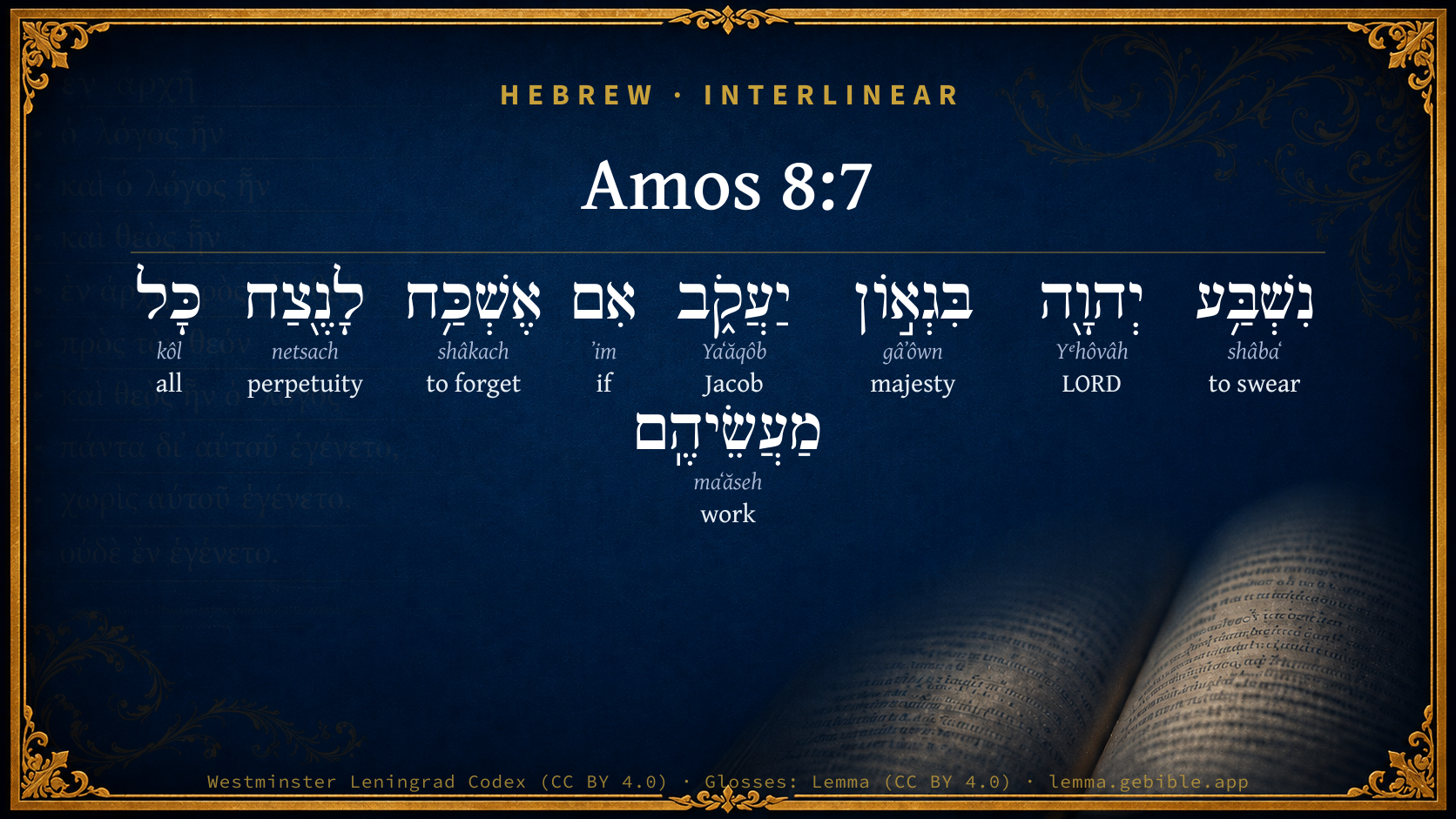
Amos 8:7

Hebrew (Westminster Leningrad Codex) Amos 8:7 appears in the Hebrew Old Testament. The text above is from the Westminster Leningrad Codex. Each word links to its Strong’s number, a concise gloss, and parsing drawn from the Open Scriptures Hebrew Bible morphology. Click any word for its full Brown-Driver-Briggs (BDB) entry.
Download image
Cite this verse

Amos 8:7 (World English Bible). Public Domain. Lemma interlinear Bible study tool, https://lemma.gebible.app/v/amos/8/7.

Show BibTeX & RIS
BibTeX
RIS
English Translation
Yahweh has sworn by the pride of Jacob, "Surely I will never forget any of their works.
World English Bible · Public Domain
Download a study sheet

One document with this verse’s original text, its word-by-word gloss line, the meaning frame, cross-references with their text, attributed commentary, and full source and license credits — printable, and it pastes into notes with its structure intact.

This verse Autodidact and up

Study sheet (.html) Plain text (.txt)

A passage Seminary Student

Up to 50 verses in one chapter. A passage sheet keeps up to 6 commentary sources and 12 cross-references per verse, in the order this page ranks them, and says so on the sheet whenever that leaves anything out. Ask for a single verse and you get the Autodidact verse sheet above.

Everything on this page stays free to read, with no account — the sheet is a download of what is already on screen, not access to it.

Want to remove ads? Support Godless Engineer
Compare translations 3

The same verse in 3 English versions, stacked beneath the original-language interlinear above. Click any original word for its lexicon entry.

Each is an independent rendering of the whole verse — the interlinear is not word-aligned to these translations.

Highlighted words mark where these versions differ — a whole-verse word diff, not a word-by-word alignment.

  • World English Bible Public Domain
    Yahweh has sworn by the pride of Jacob, "Surely I will never forget any of their works.
  • King James Version Public Domain
    The LORD hath sworn by the excellency of Jacob, Surely I will never forget any of their works.
  • unfoldingWord Literal Text CC BY-SA 4.0
    Yahweh has sworn by the pride of Jacob, “Surely I will never forget any of their actions.”

unfoldingWord Literal Text — © unfoldingWord, licensed CC BY-SA 4.0. Word-aligned USFM3 via Door43 (git.door43.org/unfoldingWord/en_ult).

Versions to compare (up to 4)

3 of 4 selected

Show all 18 translations

Every available English version of this verse, each an independent rendering of the whole verse.

  • World English Bible Public Domain
    Yahweh has sworn by the pride of Jacob, "Surely I will never forget any of their works.
  • Berean Standard Bible Public Domain
    The LORD has sworn by the Pride of Jacob: “I will never forget any of their deeds.
  • Majority Standard Bible Public Domain
    The LORD has sworn by the Pride of Jacob: “I will never forget any of their deeds.
  • King James Version Public Domain
    The LORD hath sworn by the excellency of Jacob, Surely I will never forget any of their works.
  • American Standard Version (1901) Public Domain
    Jehovah hath sworn by the excellency of Jacob, Surely I will never forget any of their works.
  • Revised Version (1885) Public Domain
    The LORD hath sworn by the excellency of Jacob, Surely I will never forget any of their works.
  • Geneva Bible (1599) Public Domain
    The Lord hath sworne by the excellencie of Iaakob, Surely I will neuer forget any of their workes.
  • Douay-Rheims (1899) Public Domain
    The Lord hath sworn against the pride of Jacob: surely I will never forget all their works.
  • Young's Literal Translation Public Domain
    Sworn hath Jehovah by the excellency of Jacob: `I forget not for ever any of their works.
  • Literal Standard Version CC BY-SA 4.0
    YHWH has sworn by the excellence of Jacob: “I do not forget any of their works forever.
  • Unlocked Literal Bible CC BY-SA 4.0
    Yahweh has sworn by the pride of Jacob, “Surely I will never forget any of their actions.”
  • unfoldingWord Literal Text CC BY-SA 4.0
    Yahweh has sworn by the pride of Jacob, “Surely I will never forget any of their actions.”
  • Darby Bible Public Domain
    Jehovah hath sworn by the glory of Jacob, Certainly I will never forget any of their works.
  • World Messianic Bible Public Domain
    The LORD has sworn by the pride of Jacob, “Surely I will never forget any of their works.
  • Webster's Bible Public Domain
    The LORD hath sworn by the excellence of Jacob, Surely I will never forget any of their works.
  • Free Bible Version CC BY-SA 4.0
    The Lord God, of whom the descendants of Jacob are so proud, has sworn an oath: I will never forget the evil you have done.
  • Bible in Basic English Public Domain
    The Lord has taken an oath by the pride of Jacob, Truly I will ever keep in mind all their works.
  • JPS Tanakh (1917) Public Domain
    The LORD hath sworn by the pride of Jacob: Surely I will never forget any of their works.

Literal Standard Version (2020), Covenant Press — licensed CC BY-SA 4.0. Text via the HelloAO Bible API (eBible.org). Unlocked Literal Bible (unfoldingWord) — licensed CC BY-SA 4.0. Text via the HelloAO Bible API (eBible.org). unfoldingWord Literal Text — © unfoldingWord, licensed CC BY-SA 4.0. Word-aligned USFM3 via Door43 (git.door43.org/unfoldingWord/en_ult). Free Bible Version, Dr. Jonathan Gallagher — licensed CC BY-SA 4.0. Text via the HelloAO Bible API (eBible.org).

Word by word

More ways to search: Search by grammar → Find every occurrence → Compare this word →

Practice this passage: Drill this verse → Learn its vocabulary →

לָנֶ֖צַח
netsach
H5331
“to/for · perpetuity”
Preposition + Noun, Common, Masculine, Singular, Absolute
Part of Speech
Preposition + Noun
Type
Common
Gender
Masculine
Number
Singular
State
Absolute
Full BDB Definition

Origin: from H5329

TWOT: 1402a

eminence, perpetuity, strength, victory, enduring, everlastingness - eminence - enduring of life - endurance in time, perpetual, continual, unto the end - everlastingness, ever
  1. נִשְׁבַּ֥ע shâbaʻ H7650 “to swear” Verb, Niphal, Perfect, 3rd Person, Masculine, Singular
  2. יְהוָ֖ה Yᵉhôvâh H3068 “LORD” Noun, Proper
  3. בִּגְא֣וֹן gâʼôwn H1347 “in/at · majesty of” Preposition + Noun, Common, Masculine, Singular, Construct
  4. יַעֲקֹ֑ב Yaʻăqôb H3290 “Jacob” Noun, Proper
  5. אִם ʼim H518 “if” Conjunction
  6. אֶשְׁכַּ֥ח shâkach H7911 “to forget” Verb, Qal, Imperfect, 1st Person, Common, Singular
  7. כָּל kôl H3605 “all of” Noun, Common, Masculine, Singular, Construct
  8. מַעֲשֵׂיהֶֽם maʻăseh H4639 “works · their” Noun, Common, Masculine, Plural, Construct + Suffix, Personal, 3rd Person, Masculine, Plural

About this verse

These counts appear in no published source. They are computed here, from the morphology-tagged text and Lemma’s own curated glosses. What Lemma adds →

9
words
9
distinct lemmas
Prophets
section

Shared distinctive vocabulary

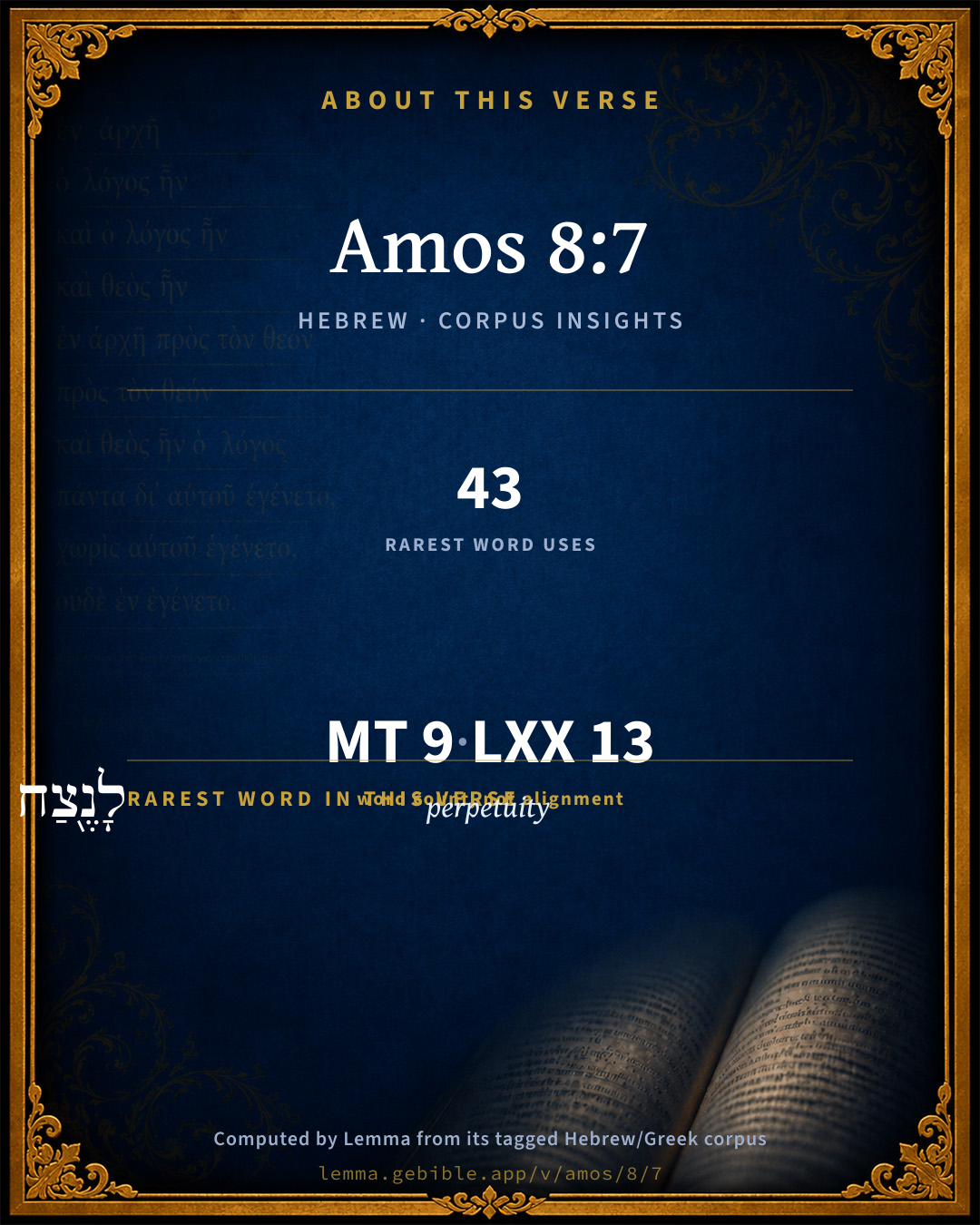
לָנֶ֖צַח perpetuity H5331 occurs in 42 verses of the Hebrew Bible. Also found in:

Grammatical profile

  • 2 verbs
  • 6 nouns
  • 1 conjunction

Verb forms

  • נִשְׁבַּ֥ע Niphal · Perfect
  • אֶשְׁכַּ֥ח Qal · Imperfect

Hebrew & Septuagint length

In English translation the verse runs 17 words from the Hebrew and 16 from the Septuagint (LXX English) — closely comparable.

A rough comparison of the two English renderings, which tokenize alike — not a word-level alignment.

Word counts can differ between the Hebrew and the Greek without any difference in meaning — e.g. the Hebrew direct-object marker אֵת has no separate Greek word, and Greek often adds the article ὁ.

In the original languages it is 9 Hebrew tokens and 13 Greek tokens — but the two are counted differently (Hebrew bundles its prefixes and suffixes into one token; the Greek is in lemma form), so that isn’t a like-for-like length.

Cross-references

14

Topical passages linked to Amos 8:7 in the Treasury of Scripture Knowledge — connected by theme and wording, ordered by reader-vote popularity; previews shown in the World English Bible.

  • Amos 6:8 "The Lord Yahweh has sworn by himself," says Yahweh, the God of hosts: "I abhor the pride of Jacob, And detest his fortresses. Therefore I will deliver up the city with all that is in it.
  • Hosea 9:9 They have deeply corrupted themselves, As in the days of Gibeah. He will remember their iniquity. He will punish them for their sins.
  • Hosea 8:13 As for the sacrifices of my offerings, they sacrifice flesh and eat it; But Yahweh doesn't accept them. Now he will remember their iniquity, And punish their sins. They will return to Egypt.
  • Hosea 7:2 They don't consider in their hearts that I remember all their wickedness. Now their own deeds have engulfed them. They are before my face.
  • Psalms 10:11 He says in his heart, "God has forgotten. He hides his face. He will never see it."
  • Deuteronomy 33:26–29 There is none like God, Jeshurun, Who rides on the heavens for your help, In his excellency on the skies.
  • Psalms 47:4 He chooses our inheritance for us, The glory of Jacob whom he loved. Selah.
  • Isaiah 43:25 I, even I, am he who blots out your transgressions for my own sake; and I will not remember your sins.
  • Jeremiah 17:1 The sin of Judah is written with a pen of iron, [and] with the point of a diamond: it is engraved on the tablet of their heart, and on the horns of your altars;
  • Jeremiah 31:34 and they shall teach no more every man his neighbor, and every man his brother, saying, Know Yahweh; for they shall all know me, from the least of them to the greatest of them, says Yahweh: for I will forgive their iniquity, and their sin will I remember no more.
  • Psalms 68:34 Ascribe strength to God! His excellency is over Israel, His strength is in the skies.
  • Luke 2:32 A light for revelation to the Gentiles, And the glory of your people Israel."
  • Exodus 17:16 He said, "Yah has sworn: 'Yahweh will have war with Amalek from generation to generation.'"
  • 1 Samuel 15:2–3 Thus says Yahweh of Hosts, I have marked that which Amalek did to Israel, how he set himself against him in the way, when he came up out of Egypt.

Cross-references courtesy of OpenBible.info (CC BY 4.0).

Hebrew and Greek witnesses Masoretic Hebrew ↔ Greek Septuagint

The same verse in the two great witnesses to the Old Testament, shown verse-for-verse.

These are two independent witnesses, not word-aligned to each other, and the Septuagint is shown in lemma (dictionary) form.

Hebrew Amos 8:7 Masoretic · Westminster Leningrad Codex

נִשְׁבַּ֥ע יְהוָ֖ה בִּגְא֣וֹן יַעֲקֹ֑ב אִם אֶשְׁכַּ֥ח לָנֶ֖צַח כָּל מַעֲשֵׂיהֶֽם

Yahweh has sworn by the pride of Jacob, "Surely I will never forget any of their works.

World English Bible · Public Domain

Greek LXX Amos 8:7 Septuagint · lemma form

ὄμνυμι κύριος κατά ὑπερηφανία ἰακώβ εἰ ἐπιλανθάνω εἰς νεῖκος πᾶς ὁ ἔργον σύ

The Lord swears against the pride of Jacob, None of your works shall ever be forgotten.

LXX2012 (modern English Septuagint) · Public Domain

On this verse, The Pulpit Commentary discusses the Septuagint’s reading. Read the note in Commentary ↓

Hebrew: Westminster Leningrad Codex (CC BY 4.0). Greek: Septuagint (public domain); English from LXX2012 (modern English Septuagint) (Public Domain). How the Septuagint differs from the Hebrew →

Targum (Aramaic paraphrase)

1

The Targum is the ancient Jewish Aramaic paraphrase of the Hebrew Scriptures — an interpretive translation, not the Hebrew text itself. Onkelos (literal) and Pseudo-Jonathan (expansive) render the Torah, and Jonathan the Prophets. Coverage is partial: where no permissively-licensed English translation exists for a verse, only the Aramaic is shown. This is verse-level text, not a word-by-word alignment to the Hebrew.

  1. Targum Jonathan Prophets (Joshua–Malachi)
    קַיֵם יְיָ דִיהַב רְבוּתָא לְיַעֲקֹב אִם יִתְנְשׁוּן לְעָלְמִין כָּל עוֹבָדֵיהוֹן:

    (no public-domain English translation for this verse)

    Targum Jonathan — Aramaic: “Mikraot Gedolot” (public domain). English: “Sefaria Community Translation” (CC0 1.0 (public-domain dedication)); “London "Chaldee Paraphrase," 1871” (public domain). Text via Sefaria.

Commentary

Notes on Amos 8:7 from classic Christian and Jewish commentators (each source and its license shown beneath its notes). The classic Christian expositions comment on the surrounding passage and are grouped to its opening verse, so a note may address several verses; the Jewish commentaries on the Tanakh (Rashi and others) are per-verse, so they appear only where the commentator wrote on this verse.

Lemma curates 59 commentaries, every one of them public domain or Creative Commons licensed, each selected and text-cleaned for this edition rather than reprinted as found. About our sources →

Trapp's Complete Commentary

John Trapp

Amo 8:7 The LORD hath sworn by the excellency of Jacob, Surely I will never forget any of their works.

Ver. 7. The Lord hath sworn by the excellency of Jacob] i.e. by himself, the matter of Jacob’s chief boasting, there being no God like unto their God (their enemies themselves being judges, Deu 32:31), neither any nation so great as to have God so nigh unto them as Israel had, in all things that they called upon him for, Deu 4:7. So that this oath of God grates upon their ingratitude for such imparallel privileges, and it is uttered in great wrath, as appeareth by the following angry aposiopesis, {a} wherein the apodosis {b} is not set down but understood.

lf I ever forget any of their works] Forget to punish them. These oaths, cum reticentia, are very dreadful. Take heed lest by stubbornness we provoke God to swear in his wrath that we shall not enter into his rest, Psa 95:11. Take heed lest a promise of entering being left us, and a proffer made us, we should seem to come short of it, to come lag or late, Heb 4:1, υστερηκεναι, a day after the fair, an hour after the feast. God is now more quick and peremptory than ever in rejecting men that neglect so great salvation, Heb 2:3; the time is shorter, he will not wait so long as he was wont to do. "He that believeth and is baptized shall be saved; he that believeth not shall be damned," Mar 16:16. Surely God "will finish the work, and cut it short in righteousness: because a short work will he make in the earth," Rom 9:28. "The time is short," saith the apostle, 1Co 7:29, a metaphor, say some, from a piece of cloth rolled up (συνεσταλμενος), only a little left at the end. "Let us therefore fear" (as the same apostle inferreth upon the consideration of God’s oath, Heb 3:18; Heb 4:1, and let our fear not weaken but waken our diligence in well doing, lest he swear and repent not, lest he come to a resolution and decree (God’s oath is nothing else but his inviolable and invariable decree) to cast us off as he did Saul, for his wilful disobedience, 1Sa 15:20-23. Saul lived long after his utter rejection, and men could see no alteration in his outward condition; but God had sworn, as here, never to forget any of his works. Now, saith Samuel to him (and it is fearful), the eternity of Israel (the excellency of Jacob) "will not lie nor repent: for he is not a man, that he should repent," 1Sa 15:29. Do not think this a case that seldom comes; it is done every day upon some or other, saith a great Divine; but woe be to that man upon whom it is done! it had been much better for him that he had not been born, Mat 26:24. Oh consider this all ye that forget God, lest he swear by his excellency, "Surely I will never forget any of your works."

{a} A rhetorical artifice, in which the speaker comes to a sudden halt, as if unable or unwilling to proceed. ŒD

{b} The concluding clause of a sentence, as contrasted with the introductory clause or protasis; now usually restricted to the consequent clause in a conditional sentence, as ‘If thine enemy hunger, feed him.’ ŒD

John Trapp, A Commentary or Exposition upon All the Books of the Old and New Testament (1647–1656) — public domain. Text from a community e-Sword module.

Joseph Benson's Commentary

Amo 8:7. The Lord hath sworn by the excellency of Jacob — That is, by himself; Surely I will never forget any of their works — God is said to remember men’s sins when he punishes them. We may learn by this passage, and many others in Scripture, that however slightly men may think of it, God takes particular notice of, and will certainly punish, all extortions and over-reachings in trade, and more particularly when they are used in regard of the poor. They shall have judgment without mercy, who have showed no mercy. It is to be wished that persons would always consider themselves as the fathers of the poor, when they deal with them; and rather give them measure pressed down and running over, than mete to them with a scanty hand.

Joseph Benson's Commentary on the Old and New Testaments (1811–1818) — public domain. Text from a community e-Sword module.

Keil & Delitzsch

C. F. Keil & F. Delitzsch

Such wickedness as this would be severely punished by the Lord. Amo 8:7. "Jehovah hath sworn by the pride of Jacob, Verily I will not forget all their deeds for ever. Amo 8:8. Shall the earth not tremble for this, and every inhabitants upon it mourn? and all of it rises like the Nile, and heaves and sinks like the Nile of Egypt." The pride of Jacob is Jehovah, as in Hos 5:5 and Hos 7:10. Jehovah swears by the pride of Jacob, as He does by His holiness in Amo 4:2, or by His soul in Amo 6:8, i.e., as He who is the pride and glory of Israel: i.e., as truly as He is so, will He and must He punish such acts as these. By overlooking such sins, or leaving them unpunished, He would deny His glory in Israel. שׁכח, to forget a sin, i.e., to leave it unpunished. In Amo 8:8 the negative question is an expression denoting strong assurance. "For this" is generally supposed to refer to the sins; but this is a mistake, as the previous verse alludes not to the sins themselves, but to the punishment of them; and the solemn oath of Jehovah does not contain so subordinate and casual a thought, that we can pass over Amo 8:7, and take על זאת as referring back to Amo 8:4-6. It rather refers to the substance of the oath, i.e., to the punishment of the sins which the Lord announces with a solemn oath. This will be so terrible that the earth will quake, and be resolved, as it were, into its primeval condition of chaos. Râgaz, to tremble, or, when applied to the earth, to quake, does not mean to shudder, or to be shocked, as Rosenmller explains it after Jer 2:12. Still less can the idea of the earth rearing and rising up in a stormy manner to cast them off, which Hitzig supports, be proved to be a biblical idea from Isa 24:20. The thought is rather that, under the weight of the judgment, the earth will quake, and all its inhabitants will be thrown into mourning, as we may clearly see from the parallel passage in Amo 9:5. In Amo 8:8 this figure is carried out still further, and the whole earth is represented as being turned into a sea, heaving and falling in a tempestuous manner, just as in the case of the flood. כּלּהּ, the totality of the earth, the entire globe, will rise, and swell and fall like waters lashed into a storm. This rising and falling of the earth is compared to the rising and sinking of the Nile. According to the Parallel passage in Amo 9:5, כּאר is a defective form for כּיאר, just as בּוּל is for יבוּל in Job 40:20, and it is still further defined by the expression כּיאור מצרים, which follows. All the ancient versions have taken it as יאור, and many of the Hebrew codd. (in Kennicott and De Rossi) have this reading. Nigrash, to be excited, a term applied to the stormy sea (Isa 57:20). נשׁקה is a softened form for נשׁקעה, as is shown by שׁקעה in Amo 9:5.

Keil & Delitzsch — Biblical Commentary on the Old Testament (1861–1891) — public domain (CC PDM 1.0). Text via the HelloAO Bible API. (Old Testament only.)

Tyndale Open Study Notes

Tyndale Open Resources

8:7 the Pride of Israel: The same Hebrew phrase alludes in 6:8 to Israel’s arrogance. Here, the phrase is probably a name for God, who is the legitimate object of Israel’s pride. Elsewhere (Ps 47:4; Nah 2:2), this phrase refers to the Promised Land under a king from David’s line (cp. Jer 13:9; Ezek 32:12). If the phrase here means the land, it would spotlight Israel’s perverse pride in its national and geographic identity.

Tyndale Open Study Notes — © Tyndale Open Resources, licensed CC BY-SA 4.0. Text via the HelloAO Bible API.

Jamieson, Fausset & Brown

Robert Jamieson, A. R. Fausset & David Brown

Lord hath sworn by the excellency of Jacob--that is by Himself, in whom Jacob's seed glory [MAURER]. Rather, by the spiritual privileges of Israel, the adoption as His peculiar people [CALVIN], the temple, and its Shekinah symbol of His presence. Compare Amo 6:8, where it means Jehovah's temple (compare Amo 4:2).

never forget--not pass by without punishing (Amo 8:2; Hos 8:13; Hos 9:9).

Jamieson, Fausset & Brown — Commentary Critical and Explanatory on the Whole Bible (1871) — public domain (CC PDM 1.0). Text via the HelloAO Bible API.

Adam Clarke's Commentary

Verse 7. By the excellency of Jacob] By the state of eminence to which he had raised the descendants of Jacob; or, by the excellent ONE of Jacob, that is, HIMSELF. The meaning is: "As surely as I have raised you to such a state of eminence, so surely will I punish you in proportion to your advantages and your crimes."

Adam Clarke's Commentary on the Bible (1810–1826) — public domain. Text from a community e-Sword/MySword module.

John Calvin's Commentaries

God, having made known the vices of the rich, now shows that he would be their judge and avenger: for were they only reproved, they would not have cared much, like the usurer mentioned by Horace, who said, “The people may hiss me, but I felicitate myself.” So also these robbers were wont to do, when they were filled: though the whole people exclaimed against them, though God thundered from heaven, they laughed everything to scorn; for they were utterly destitute of every shame; and they were also become hardened; and insatiable cupidity had so blinded and demented them, that they had cast aside every care for what was right and becoming. Since it was so, God now declares that they could not escape punishment; and that this threatening might more effectually penetrate into their hearts, the Prophet makes use of an oath in the name of God, Jehovah, he says, hath sworn by the excellency of Jacob

An old interpreter has rendered the words, “He has sworn against the pride of Jacob:” but he did not sufficiently consider the design of the Prophet; for he speaks not here of vice, but of that dignity which the Lord had conferred on the posterity of Abraham; for we have before seen this expression, ‘I abhor the excellency of Jacob.’ Some give this rendering, “I abhor the pride of Jacob,” as though God were speaking there of perverse haughtiness. But he, on the contrary, means, that the Israelites were deceived, for they thought themselves safe and secure, because they were introduced into great favor by a singular privilege. “This,” the Lord says, “will profit them nothing: I have hitherto been kind and bountiful to the children of Abraham; but I now abhor this whole dignity.” So also he says now in this place, Jehovah hath sworn by the excellency of Jacob. They were proud of their dignity which yet was the free gift of God, hence God interposes a form of oath, the fittest to reprove their presumption. Some at the same time give this translation, “By myself, (at least they give this explanation,) by myself have I sworn:” for God was the glory of Jacob. Others think that by this word, גאון, gaun, is designated the sanctuary; for this was the excellency of Jacob, because God had chosen it as a habitation for himself in the midst of his people: hence, also, He is often said to dwell between the cherubim; not that he was inclosed in the sanctuary, but because the people perceived there his presence, his favor, and his power. But I rather understand by the term, excellency, in this place, the adoption, by which God had separated for himself that people from the rest of the world. Sworn then hath Jehovah. How? By the excellency of Jacob: and thus he glances in a severe manner at the ingratitude of the people, as they did not own themselves to be in every respect bound to God; for they had been peculiarly chosen, when yet other nations in many things excelled them. It was doubtless an invaluable favor for that ignoble people to have been chosen to be God’s peculiar possession and heritage. Hence the Prophet now rightly introduces God as being angry; and the form of the oath is suited to set forth the people’s ingratitude: “What! do ye now rise up against me, and elevate your horns? By what right? Under what pretext? Who are ye? I chose you, and ye truly repay me with this reward, — that though ye owe me all things, ye seek to defraud me of my right. I therefore swear by the excellency of Jacob, — I swear by the benefits which I conferred on you, — that I will not allow that which is justly precious in my sight to be disgracefully profaned. Whatever then I have hitherto bestowed on you, I will return on your own heads, and, as ye deserve, ye shall miserably perish.” This is the meaning.

We hence see that the oath which the Prophet uses, ought to be applied to the present case. He says, I shall never forget all your works, that is, none of your works shall be passed by unpunished. For though conscience sometimes disturbs hypocrites yet they think that many things may be concealed; and if the hundredth part, or at farthest the tenth, must be accounted for, they think this to be quite enough: “Why! God may perhaps observe this or that, but many faults will escape him.” Since then hypocrites thus heedlessly deceive themselves, the Prophet says, “Nothing can ever be hid from my sight; nay, as I now know all their works, I will show that all their sins are recorded in my books, in my memory, so that all things shall at last be called to an account.” It now follows —

John Calvin's Commentaries (1540-1563) — public domain. Text from the Calvin Translation Society English edition (1840s-50s) via the Christian Classics Ethereal Library (ccel.org). Calvin's coverage is partial (roughly two-thirds of the Bible); uncommented books and verses are honest gaps, never fabricated. The 19th-century editor's footnotes and remarks are omitted so the notes are faithfully Calvin's own voice.

Ellicott's Commentary for English Readers

(7) Excellency of Jacob.—In the previous use of this remarkable expression (Amo_6:8) Jehovah is said to abhor it, but here He swears by it. The “excellency” which He abhorred was the miserable substitute which they had made for His great Name. Here He gives it the value which, in itself, it ought to possess.

A Bible Commentary for English Readers, edited by Charles John Ellicott (1878–1897) — public domain. Text from a community e-Sword module.

The Cambridge Bible for Schools and Colleges

gen. ed. J. J. S. Perowne

7. Such heartless dishonesty arouses Jehovah’s indignation; and He swears by the pride of Jacob, that He will never forget any of their works, but bring them, namely, into account. The pride of Jacob may be Jehovah Himself (cf. 1Sa_15:29 “the splendour of Israel,” of Jehovah; and for the oath by Himself, Amo_6:8); or, as the expression is not elsewhere used of Jehovah, but denotes Israel’s vain-glorious self-confidence (Amo_6:8; cf. Hos_5:5; Hos_7:10), it may have that sense here: Jehovah swears—ironically—by that which, however deeply He disapproves of it, He knows to be unalterable. The oath, as Amo_4:2, Amo_6:8,—each time provoked by the spectacle of some crying moral wrong.

The Cambridge Bible for Schools and Colleges (gen. ed. J. J. S. Perowne; Cambridge University Press, 1878–1918) — public domain. Text from a community e-Sword module.

John Gill's Exposition

The Lord hath sworn by the excellency of Jacob,.... Not by the ark, as R. Japhet; nor by the temple, as Kimchi; but by himself; which sense Kimchi also mentions, and Aben Ezra; the God of Jacob and his glory, the most excellent of all Jacob's enjoyments, and of whom he had reason to boast and glory; see Amo 6:8;

surely I will never forget any of their works; their wicked works, especially those now mentioned; God forgets when he forgives them, or suffers them to go unpunished; but though he had done so long, he would do so no more; on which they might depend, since he had not only said it, but swore to it.

John Gill's Exposition of the Whole Bible (1746–1763) — public domain (CC PDM 1.0). Text via the HelloAO Bible API.

Albert Barnes' Notes on the Bible

By the excellency of Jacob - that is, by Himself who was its Glory, as Samuel calls Him “the Strength” 1Sa 15:29 or the Glory of Israel. Amos had before said, “God sware by His Holiness” and “by Himself” or “His soul.” Now, in like way, He pledges that Glory wherewith He was become the Glory of His people. He reminds them, who was the sole Source of their glory; not their calves, but Himself, their Creator; and that He would not forget their deeds. “I will not forget any,” literally, “all;” as David and Paul say, “all flesh,” all living men, “shall not be justified,” that is, none, no one, neither the whole nor any of its parts. Amos brings before the mind all their actions, and then says of all and each, the Lord will not forget them. God must cease to be God, if He did not do what He sware to do, punish the oppressors and defrauders of the poor.

Albert Barnes' Notes on the Bible (1834–1885) — public domain. Text from a community e-Sword/MySword module.

Haydock's Catholic Bible Commentary

Jacob, because the rich despise the poor. It may also mean, that he swore by heaven, or the temple, (Leviticus xxvi. 19.) or that he would destroy the high places. (Calmet)

George Leo Haydock (1774–1849), Haydock's Catholic Family Bible and Commentary, 1859 edition — public domain. Excludes Psalms (Douay-Rheims chapter numbering differs from Protestant) and Deuterocanonical books (Catholic canon only).

Matthew Poole's English Annotations

The Lord; who changeth not, whose words and purposes are immutably true and stedfast, who hath often told you, that unless you repent he will punish for your sins, now he hath sworn it, and sends you word by me, that he hath in most solemn and irrevocable manner determined, published, and expressly declared that he will visit all your sins upon you.

By the excellency of Jacob; by himself, for God cannot swear by any greater, and he is called the excellency of Jacob, Psa 47:4.

Surely, Heb. If; if I am a God, I will remember and punish.

I will never forget, or let pass unpunished; I will never remit the punishment by an act of pardon, nor ever omit to punish by an act of forgetfulness.

Any of their works; not one of all those their abominable injustices and irreligion, not one of these cruelties.

Matthew Poole's English Annotations on the Holy Bible (1683–1685) — public domain. Text from a community e-Sword/MySword module.

Whedon's Commentary on the Bible

Daniel D. Whedon

7. The heartless greed and dishonesty has aroused the indignation of Jehovah and makes judgment inevitable.

Hath sworn — See on Amo_4:2.

Excellency of Jacob — Jehovah (Amo_6:8). The word translated “excellency” is used nowhere else in this sense, but a warrant for the translation is found in 1Sa_15:29, where Jehovah is called “strength (literally, splendor) of Israel.” The common meaning of the word is “pride” (Amo_6:8, R.V. margin; Hos_5:5; Hos_7:10). If so here, the oath would be by the pride and arrogance of Israel. Jehovah sees this pride deeply ingrained in the very nature of the people; he knows it to be permanent and incurable, and for this reason he selects it in scorn as an object by which to swear.

Any of their works — Of dishonesty and injustice. All will be remembered and punished (Hos_7:2).

Daniel D. Whedon (gen. ed.), Commentary on the Old and New Testaments (1874–1909) — public domain. Text from a community e-Sword module.

The Pulpit Commentary

Such crimes as these, which sap the very foundations of social life, shall meet with vengeance. The Excellency of Jacob. This is a title of God himself, as in Hos_5:5 Hos_7:10, where it is rendered "pride." Thus the Lord is said to swear by his holiness, (Amo_4:2) by his soul (Amo_6:8; comp. 1Sa_15:29) So here he swears by himself, who is the Glory and Pride of Israel; as truly as he is this, he will punish. The Vulgate treats the sentence differently, Juravit in superbium Jacob, i.e. "The Lord hath sworn against the pride of Jacob," against the arrogancy with which they treat the poor, and trust in their riches, and deem themselves scours. So the Septuagint, jOmnuei Kuriov kataav jIakwb, I will never forget, so as to leave unpunished. Literally, if I forget, equivalent to a most decided denial, as Heb_4:8, Heb_4:5, etc. "Nec mirum est, si Deus jurare dicatur; quum dormientibus dormiat et vigilantibus vigilet; hisque qui sibi thesaurizaverunt iram in die irae dicatur irasci" (St. Jerome)

Confirming by an oath.

God"s judgments sometimes take, and will continue to take, the wicked by surprise. (Mat_24:36-39) But this need not be, and should not be, and can be only where blindness, or heedlessness, or incredulity make warning useless. God always warns before he strikes. Sometimes he warns by divers methods at once. Often he warns again and again. Invariably he warns with a solemnity that makes disbelief a crime and stupid. Here is a case in point.

I THE OATH THAT CANNOT BE BROKEN. "God is not a man, that he should lie." To do so would be a natural impossibility, a contradiction of himself. For the same reason his truthfulness can have no degrees; his slightest word is absolutely inviolable. Yet to human apprehension an oath is peculiarly convincing, and, accommodating himself to men"s weakness, God condescends, on peculiarly, solemn occasions, not merely to say, but swear. Here he swears:

1. By himself. "The Pride of Jacob" is Jehovah himself. Elsewhere explicitly God swears by "himself", (Jer_51:14) by his "great, (Jer_44:26) by his "holiness", (Amo_4:2) by his life". (Eze_33:11) This is of necessity. Men "swear by the greater." God, "because he can swear by no greater, swears by himself". (Heb_6:17, Heb_6:13) In this form of oath the greatest Being is invoked, and so the maximum of solemnity is reached, whether it is God who swears or man.

2. By himself in his ideal relation to Israel. "By the Pride of Jacob" Israel, alas! did not "glory in the Lord." They gloried in their idols. "These be thy gods, which brought thee out of the land of Egypt," they had said, in their blind fatuity, of the molten calf. God had been forgotten and his wonders ignored before they were many days accomplished, and in this forgetfulness they had persistently gone on. Yet was he none the less their Glory still, the Strength of Israel, their Light and Life, the Founder, Builder, Sustainer, of their kingdom, the one Source and Spring of all that made them great, This fundamental relation he emphasizes here in vowing vengeance on their sin. By this character, as their Life and Strength and Excellence, he swears he will now degrade and destroy them utterly. The nearer God"s tie to the rebels, the greaser outrage is their rebellion, and the more embittered the after relations. It is on the ruins of violated friendship that the most irreconcilable enmity arises. Not even the heathen is as hateful, or doomed to a fate as direful, as the apostate.

II THE RECORD THAT CANNOT BE ERASED. "I will not forget and forever." To forget is to forgive, put out of sight, treat as non-existent. "I will remember their iniquities no more." Sin unatoned for cannot be forgiven. God must be just in his justifying, and justice demands satisfaction. From the provided satisfaction the unbelieving sinner has turned away, and so from the grace of his own salvation. Neither can sin unforsaken. The sinner is in actual conflict with God, and the rebel may not he forgiven with arms in his hands. Neither can sin unrelated of. Still loving sin, the impenitent is not in a moral condition to appreciate pardon, and the gift of God is not to be thrown away. By such a threefold cord was Israel bound to inevitable destruction.

III THE WORKS THAT CANNOT BE FORGOTTEN. There are sins more heinous, and for the authors of which it will be less tolerable in the judgment than for others. (Mat_11:22)

1. Such are the sins committed against the poor and needy. "God hath chosen the poor of this world" Their poverty presents the minimum of resistance to his grace. Their hardships excite his special pity. Their helplessness commends them to his special protection. He gives them the most prominent place in his religion. He champions them against their enemies. He requires his people to do the same. He identifies himself with them in the judgment, and he deals with men then in terms of their relation to the duties they owe the needy. (Mat_25:35-45) While God is "the Avenger of all such," oppression of the poor shall not go unpunished.

2. Such especially are the sins committed against the poor by those who bear his Name. The clement of beneficence bulked large in Judaism. Besides the general injunctions to regard the poor, (Deu_15:7-11) there were special enactments allocating to them a poor tithe (Deu_14:28, Deu_14:29) the spontaneous produce of the soil, (Lev_25:5) the droppings from the sheaves, and the produce of the corners of the fields, (Lev_19:9, 10 23:22) also sheaves accidentally dropped, (Deu_24:19) as much from vineyard or field as the hungry wayfarer required to eat on the spot, (Deu_23:24, Deu_23:25) and periodical entertainments at the tables of the rich. (Deu_16:10, Deu_16:11) Thus nothing could be more utterly antagonistic to the genius of the Jewish religion than to rob or oppress the poor. The Israelite guilty of it sinned against Scripture, against custom, against education, against every deterrent powerful with men and increasing guilt before God. Christianity, too, is essentially benevolent. To "love one another," and "do good unto all," is the very spirit and essence of the religion of Christ. Injustice or oppression under Christian auspices is sin in its most abominable and heinous form.

The mercy of God.

This language is actual truth, although it is based upon and accords with the experience of created intelligences. Memory is one of the primitive endowments of intellect, admitted to be such even by philosophers, who are very loth to admit that the mind of man can possess any such endowments. A man who should never forget would indeed be a marvel, a miracle. But it would be inconsistent with our highest conceptions of God to suppose it possible for anything to escape his memory. In his mind there is, of course, neither past nor future, for time is a limitation and condition of finite intelligence. To the Eternal all is present; all events to him are one eternal now.

I A GENERAL TRUTH CONCERNING THE DIVINE NATURE AND GOVERNMENT. Nothing is unobserved by God, and nothing is forgotten by him. All men"s actions as they are performed photograph themselves indelibly upon the very nature of the Omniscient and Eternal. Nothing needs to be revived, for nothing ever becomes dim.

II A SOLEMN TRUTH CONCERNING THE CONDUCT AND PROSPECTS OF THE SINFUL. Parents forget the wrong doing of their children, and rulers those of their subjects. Hence many evil deeds escape the recompense which is their due. But Jehovah, who "remembered" (to use the expression necessarily accommodated to our infirmity) all the acts of rebellion of which the chosen people had been guilty, does not lose the record of any of the offences committed by men. On the contrary, they are written "in a Book of remembrance a book one day to he unrolled before the eyes of the righteous Judge.

III A PRECIOUS ASSURANCE CONCERNING THE GOOD PURPOSES AND ACTIONS WHICH GOD DISCERNS AND REMARKS IN HIS PEOPLE. Thus we find saintly men of old in their prayers beseeching the Lord to remember them: "Remember me, O Lord, for good;" "Remember me with the favour thou showest unto thy people." He who said, "I know thy works," who said, "I will never forget any of their works," is a Being to whom we may safely commend ourselves and all that is ours which he himself creates and which he approves.

APPLICATION.

1. In our confessions let us be frank and open with God, who searcheth theheart, and who forgetteth nothing. It would be folly to suppose that he forgets our sins; it would be wickedness to strive to forget them ourselves. "If we confess our sins, he is faithful and just to forgive.

2. In our prayers for pardon let us bear in mind that there is a sense inwhich he will "remember no more" the offences of his penitent and believing people. He will treat us as if he had forgotten all our rebellion, and as if he remembered only our purposes and vows of loyalty. T.

The Pulpit Commentary (1880–1919), ed. H.D.M. Spence-Jones & Joseph S. Exell — public domain. Text from a community e-Sword module.

John Wesley's Explanatory Notes

Hath sworn - By himself. Forget - Suffer to pass unpunished.

John Wesley, Explanatory Notes Upon the Whole Bible (1754–1765) — public domain. Text via the GEBible commentary corpus.

unfoldingWord translationNotes

Door43 World Missions Community

Yahweh has sworn by the pride of Jacob

Here "pride of Jacob" is a title for Yahweh. Also "Jacob" represents his descendants, the Israelites. AT: "Yahweh has sworn by himself, saying" or "Yahweh, of whom the Israelites are so proud, has sworn" (See: Metonymy)

Will not the land quake for this, and every one who lives in it mourn?

Amos uses a question to emphasize that these things will certainly happen. AT: "Yahweh will cause the land to shake, and every one who lives in it will mourn." (See: Rhetorical Question)

All of it will rise up like the Nile River ... like the river of Egypt

Amos compares the rising and sinking of the waters of the Nile River to how Yahweh will cause the land to shake when he judges the people. (See: Simile)

river of Egypt

This is another name for the Nile River.

translationWords

Yahweh

oath

proud

Jacob

mourn

Nile River

Egypt

unfoldingWord translationNotes — © Distant Shores Media and the Door43 World Missions Community, licensed CC BY-SA 4.0. Source: git.door43.org/Door43/en_tn.

Lesson kit

Teaching starters — assembled from the data on this page, not authored interpretation. Every prompt links to the verse data it draws on. Edit before teaching.

Amos, in the Prophets, opens this verse with 9 words (9 distinct Hebrew lemmas). Its most distinctive word is netsach (“perpetuity”). A historical commentator’s framing appears above. Read the whole chapter for the surrounding context.

Discussion questions

  1. The word netsach carries the sense “perpetuity.” How does it shape the verse?
  2. How does 1 Samuel 15:29, which shares the word «perpetuity», read alongside this verse?
  3. The translations on this page render this verse differently — a whole-verse word diff, not a word-by-word alignment. What might account for the different wordings?
  4. «נִשְׁבַּ֥ע» is a Niphal Perfect verb. How does that grammatical form shape the action described?
  5. Compare how Trapp's Complete Commentary and Joseph Benson's Commentary read this verse. Where do they agree or differ?

Things to notice

Reading settings

Reading text

Shown beneath each verse's original-language words.

Old Testament
Old Testament edition

Read the OT as the Masoretic Hebrew (MT) or the Greek Septuagint (LXX).

English shown for the Greek Septuagint (in the Hebrew ↔ Greek comparison).

Comparing translations? Open the Compare panel on any verse page to stack up to four side by side.