Job 24:20

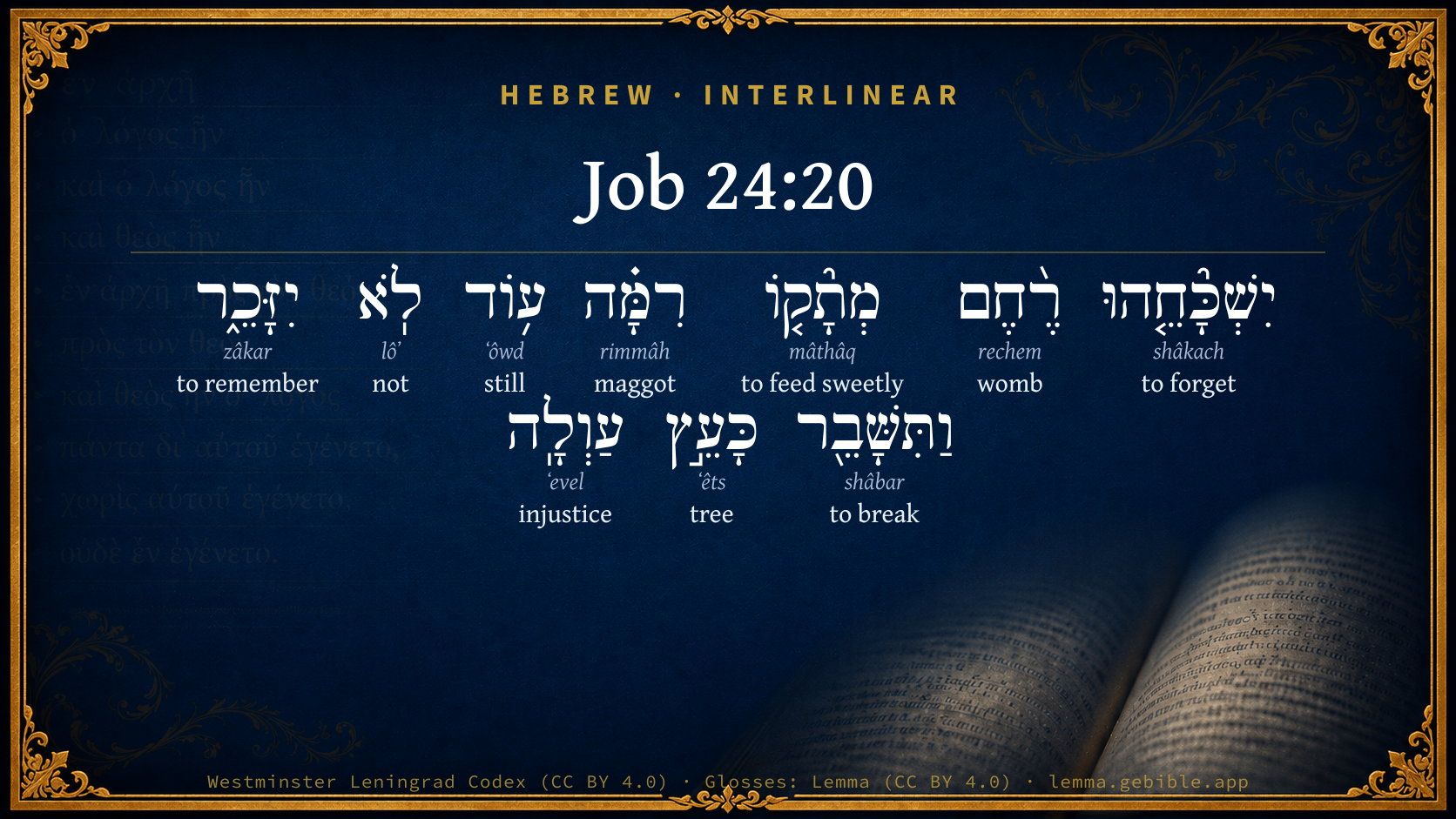
Hebrew (Westminster Leningrad Codex) Job 24:20 appears in the Hebrew Old Testament. The text above is from the Westminster Leningrad Codex. Each word links to its Strong’s number, a concise gloss, and parsing drawn from the Open Scriptures Hebrew Bible morphology. Click any word for its full Brown-Driver-Briggs (BDB) entry.
Download image
Cite this verse

Job 24:20 (World English Bible). Public Domain. Lemma interlinear Bible study tool, https://lemma.gebible.app/v/job/24/20.

Show BibTeX & RIS
BibTeX
RIS
English Translation
The womb shall forget him. The worm shall feed sweetly on him. He shall be no more remembered. Unrighteousness shall be broken as a tree.
World English Bible · Public Domain
Highlights Full analysis ↓
Download a study sheet

One document with this verse’s original text, its word-by-word gloss line, the meaning frame, cross-references with their text, attributed commentary, and full source and license credits — printable, and it pastes into notes with its structure intact.

This verse Autodidact and up

Study sheet (.html) Plain text (.txt)

A passage Seminary Student

Up to 50 verses in one chapter. A passage sheet keeps up to 6 commentary sources and 12 cross-references per verse, in the order this page ranks them, and says so on the sheet whenever that leaves anything out. Ask for a single verse and you get the Autodidact verse sheet above.

Everything on this page stays free to read, with no account — the sheet is a download of what is already on screen, not access to it.

Want to remove ads? Support Godless Engineer
Compare translations 3

The same verse in 3 English versions, stacked beneath the original-language interlinear above. Click any original word for its lexicon entry.

Each is an independent rendering of the whole verse — the interlinear is not word-aligned to these translations.

Highlighted words mark where these versions differ — a whole-verse word diff, not a word-by-word alignment.

  • World English Bible Public Domain
    The womb shall forget him. The worm shall feed sweetly on him. He shall be no more remembered. Unrighteousness shall be broken as a tree.
  • King James Version Public Domain
    The womb shall forget him; the worm shall feed sweetly on him; he shall be no more remembered; and wickedness shall be broken as a tree.
  • unfoldingWord Literal Text CC BY-SA 4.0
    The womb will forget him, the worm will dine on him, until he is not remembered and wickedness is broken like a tree,

unfoldingWord Literal Text — © unfoldingWord, licensed CC BY-SA 4.0. Word-aligned USFM3 via Door43 (git.door43.org/unfoldingWord/en_ult).

Versions to compare (up to 4)

3 of 4 selected

Show all 18 translations

Every available English version of this verse, each an independent rendering of the whole verse.

  • World English Bible Public Domain
    The womb shall forget him. The worm shall feed sweetly on him. He shall be no more remembered. Unrighteousness shall be broken as a tree.
  • Berean Standard Bible Public Domain
    The womb forgets them; the worm feeds on them; they are remembered no more. So injustice is like a broken tree.
  • Majority Standard Bible Public Domain
    The womb forgets them; the worm feeds on them; they are remembered no more. So injustice is broken like a tree.
  • King James Version Public Domain
    The womb shall forget him; the worm shall feed sweetly on him; he shall be no more remembered; and wickedness shall be broken as a tree.
  • American Standard Version (1901) Public Domain
    The womb shall forget him; The worm shall feed sweetly on him; He shall be no more remembered; And unrighteousness shall be broken as a tree.
  • Revised Version (1885) Public Domain
    The womb shall forget him; the worm shall feed sweetly on him; he shall be no more remembered: and unrighteousness shall be broken as a tree.
  • Geneva Bible (1599) Public Domain
    The pitifull man shall forget him: the worme shall feele his sweetenes: he shalbe no more remembered, and the wicked shalbe broke like a tree.
  • Douay-Rheims (1899) Public Domain
    Let mercy forget him: may worms be his sweetness: let him be remembered no more, but be broken in pieces as an unfruitful tree.
  • Young's Literal Translation Public Domain
    Forget him doth the womb, Sweeten `on' him doth the worm, No more is he remembered, And broken as a tree is wickedness.
  • Literal Standard Version CC BY-SA 4.0
    The womb forgets him, || The worm sweetens [on] him, || He is remembered no more, || And wickedness is broken as a tree.
  • Unlocked Literal Bible CC BY-SA 4.0
    The womb that bore him will forget him; the worm will feed sweetly on him; he will be remembered no more; in this way, wickedness will be broken like a tree.
  • unfoldingWord Literal Text CC BY-SA 4.0
    The womb will forget him, the worm will dine on him, until he is not remembered and wickedness is broken like a tree,
  • Darby Bible Public Domain
    The womb forgetteth him; the worm feedeth sweetly on him: he shall be no more remembered; and unrighteousness is broken as a tree, --
  • World Messianic Bible Public Domain
    The womb will forget him. The worm will feed sweetly on him. He will be no more remembered. Unrighteousness will be broken as a tree.
  • Webster's Bible Public Domain
    The womb shall forget him; the worm shall feed sweetly on him; he shall be no more remembered; and wickedness shall be broken as a tree.
  • Free Bible Version CC BY-SA 4.0
    Even their mothers forget them, maggots feast on them, they are no longer remembered, and their wickedness becomes like a tree that is broken into pieces.
  • Bible in Basic English Public Domain
    The public place of his town has no more knowledge of him, and his name has gone from the memory of men: he is rooted up like a dead tree.
  • JPS Tanakh (1917) Public Domain
    The womb forgetteth him; the worm feedeth sweetly on him; he shall be no more remembered; and unrighteousness is broken as a tree.

Literal Standard Version (2020), Covenant Press — licensed CC BY-SA 4.0. Text via the HelloAO Bible API (eBible.org). Unlocked Literal Bible (unfoldingWord) — licensed CC BY-SA 4.0. Text via the HelloAO Bible API (eBible.org). unfoldingWord Literal Text — © unfoldingWord, licensed CC BY-SA 4.0. Word-aligned USFM3 via Door43 (git.door43.org/unfoldingWord/en_ult). Free Bible Version, Dr. Jonathan Gallagher — licensed CC BY-SA 4.0. Text via the HelloAO Bible API (eBible.org).

Word by word

More ways to search: Search by grammar → Find every occurrence → Compare this word →

Practice this passage: Drill this verse → Learn its vocabulary →

מְתָ֘ק֤וֹ
mâthâq
H4988
“to feed sweetly · him”
Verb, Qal, Perfect, 3rd Person, Masculine, Singular + Suffix, Personal, 3rd Person, Masculine, Singular
Part of Speech
Verb
Stem
Qal
Form
Perfect
Person
3rd Person
Gender
Masculine
Number
Singular
Full BDB Definition

Origin: from H4985

TWOT: 1268c ?

(Qal) to feed sweetly
  1. יִשְׁכָּ֘חֵ֤הוּ shâkach H7911 “to forget · him” Verb, Qal, Imperfect, 3rd Person, Masculine, Singular + Suffix, Personal, 3rd Person, Masculine, Singular
  2. רֶ֨חֶם rechem H7358 “womb” Noun, Common, Masculine, Singular, Absolute
  3. רִמָּ֗ה rimmâh H7415 “maggot” Noun, Common, Feminine, Singular, Absolute
  4. ע֥וֹד ʻôwd H5750 “still” Adverb
  5. לֹֽא lôʼ H3808 “not” Particle, Negative
  6. יִזָּכֵ֑ר zâkar H2142 “to remember” Verb, Niphal, Imperfect, 3rd Person, Masculine, Singular
  7. וַתִּשָּׁבֵ֖ר shâbar H7665 “and · to break” Conjunction + Verb, Niphal, Sequential Imperfect, 3rd Person, Feminine, Singular
  8. כָּעֵ֣ץ ʻêts H6086 “like/as the · tree” Preposition, Determined + Noun, Common, Masculine, Singular, Absolute
  9. עַוְלָֽה ʻevel H5766 “injustice” Noun, Common, Both, Singular, Absolute

About this verse

These counts appear in no published source. They are computed here, from the morphology-tagged text and Lemma’s own curated glosses. What Lemma adds →

10
words
10
distinct lemmas
Wisdom
section

Notable vocabulary

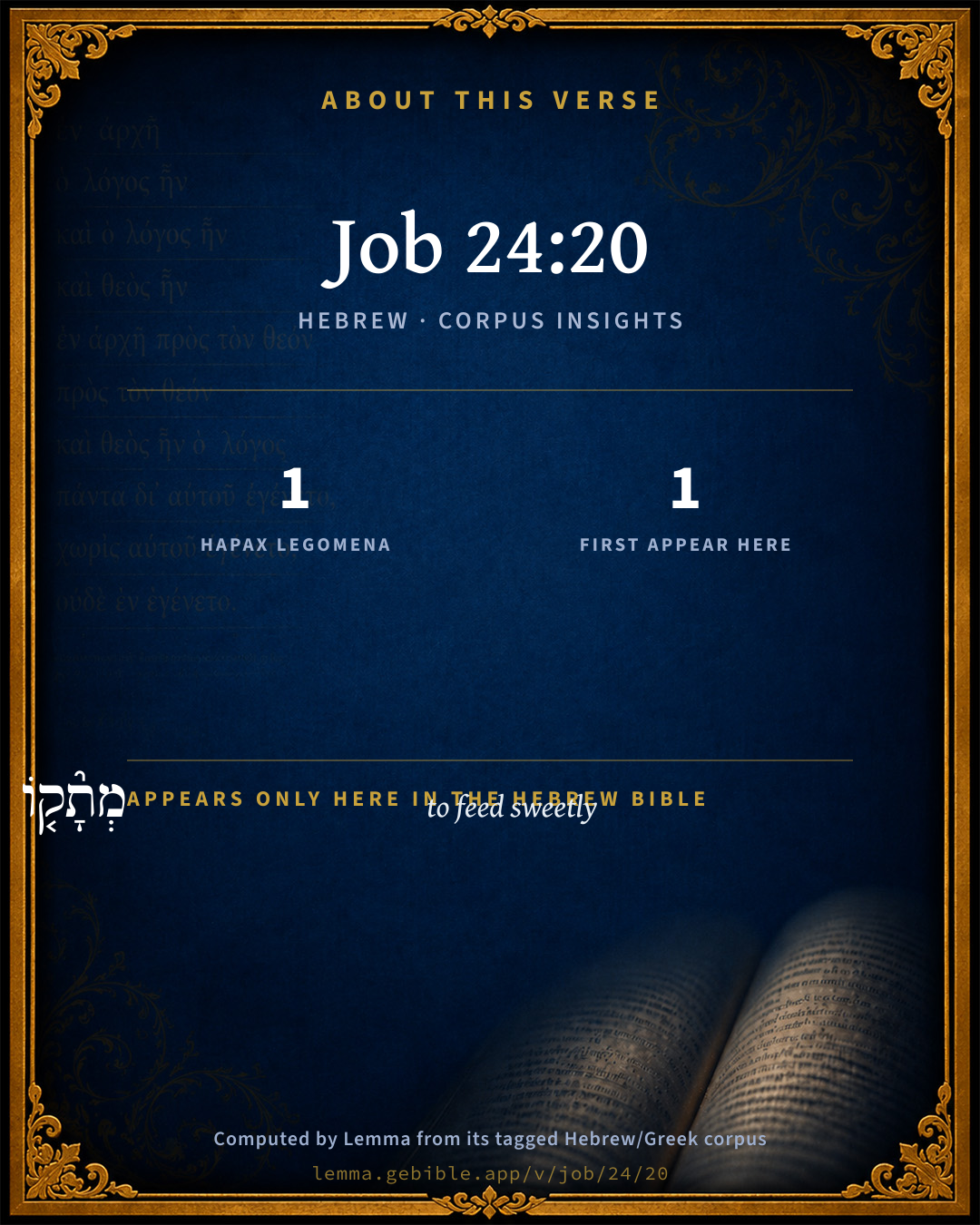
1 hapax legomenon — a word that appears only here in the entire Hebrew Bible:

  • מְתָ֘ק֤וֹ to feed sweetly H4988

First appearance in Scripture

This word makes its first canonical appearance in the Hebrew Bible here:

  • מְתָ֘ק֤וֹ to feed sweetly H4988

Shared distinctive vocabulary

רִמָּ֗ה maggot H7415 occurs in 7 verses of the Hebrew Bible. Also found in:

Grammatical profile

  • 4 verbs
  • 4 nouns
  • 1 adverb
  • 1 particle

Verb forms

  • יִשְׁכָּ֘חֵ֤הוּ Qal · Imperfect
  • מְתָ֘ק֤וֹ Qal · Perfect
  • יִזָּכֵ֑ר Niphal · Imperfect
  • וַתִּשָּׁבֵ֖ר Niphal · Sequential Imperfect

Hebrew & Septuagint length

In English translation the verse runs 25 words from the Hebrew and 35 from the Septuagint (LXX English) — the Septuagint runs noticeably longer here. See the side-by-side →

A rough comparison of the two English renderings, which tokenize alike — not a word-level alignment.

Word counts can differ between the Hebrew and the Greek without any difference in meaning — e.g. the Hebrew direct-object marker אֵת has no separate Greek word, and Greek often adds the article ὁ.

Cross-references

9

Topical passages linked to Job 24:20 in the Treasury of Scripture Knowledge — connected by theme and wording, ordered by reader-vote popularity; previews shown in the World English Bible.

  • Proverbs 10:7 The memory of the righteous is blessed, But the name of the wicked will rot.
  • Daniel 4:14 He cried aloud, and said thus, Hew down the tree, and cut off its branches, shake off its leaves, and scatter its fruit: let the animals get away from under it, and the fowls from its branches.
  • Job 18:16–17 His roots shall be dried up beneath, Above shall his branch be cut off.
  • Job 14:7–10 "For there is hope for a tree, If it is cut down, that it will sprout again, That the tender branch of it will not cease.
  • Job 17:14 If I have said to corruption, 'You are my father;' To the worm, 'My mother,' and 'my sister;'
  • Job 19:26 After my skin is destroyed, Then in my flesh shall I see God,
  • Ecclesiastes 8:10 So I saw the wicked buried. Indeed they came also from holiness. They went and were forgotten in the city where they did this. This also is vanity.
  • Isaiah 26:14 [They are] dead, they shall not live; [they are] deceased, they shall not rise: therefore have you visited and destroyed them, and made all memory of them to perish.
  • Matthew 3:10 "Even now the axe lies at the root of the trees. Therefore, every tree that doesn't bring forth good fruit is cut down, and cast into the fire.

Cross-references courtesy of OpenBible.info (CC BY 4.0).

Hebrew and Greek witnesses Masoretic Hebrew ↔ Greek Septuagint

The same verse in the two great witnesses to the Old Testament, shown verse-for-verse.

Here the Septuagint runs noticeably longer than the Hebrew — LXX2012 (modern English Septuagint) 35 words vs World English Bible 25. A rough length comparison of the two English translations, not a word-level alignment — read both below.

These are two independent witnesses, not word-aligned to each other, and the Septuagint is shown in lemma (dictionary) form.

Hebrew Job 24:20 Masoretic · Westminster Leningrad Codex

יִשְׁכָּ֘חֵ֤הוּ רֶ֨חֶם מְתָ֘ק֤וֹ רִמָּ֗ה ע֥וֹד לֹֽא יִזָּכֵ֑ר וַתִּשָּׁבֵ֖ר כָּעֵ֣ץ עַוְלָֽה

The womb shall forget him. The worm shall feed sweetly on him. He shall be no more remembered. Unrighteousness shall be broken as a tree.

World English Bible · Public Domain

Greek LXX Job 24:20 Septuagint · lemma form

εἶτα ἀναμιμνήσκω αὐτός ὁ ἁμαρτία ὥσπερ δέ ὁμίχλη δρόσος ἀφανής γίγνομαι ἀποδίδωμι δέ αὐτός ὅς πράσσω συντρίβω δέ πᾶς ἄδικος ἴσος ξύλον ἀνίατος

Then is his sin brought to remembrance, and he vanishes like a vapor of dew: but let what he has done be recompensed to him, and let every unrighteous one be crushed like rotten wood.

LXX2012 (modern English Septuagint) · Public Domain

Hebrew: Westminster Leningrad Codex (CC BY 4.0). Greek: Septuagint (public domain); English from LXX2012 (modern English Septuagint) (Public Domain). How the Septuagint differs from the Hebrew →

Commentary

Notes on Job 24:20 from classic Christian and Jewish commentators (each source and its license shown beneath its notes). The classic Christian expositions comment on the surrounding passage and are grouped to its opening verse, so a note may address several verses; the Jewish commentaries on the Tanakh (Rashi and others) are per-verse, so they appear only where the commentator wrote on this verse.

Lemma curates 59 commentaries, every one of them public domain or Creative Commons licensed, each selected and text-cleaned for this edition rather than reprinted as found. About our sources →

Trapp's Complete Commentary

John Trapp

Job 24:20 The womb shall forget him; the worm shall feed sweetly on him; he shall be no more remembered; and wickedness shall be broken as a tree.

Ver. 20. The womb shall forget him] Some read it, The merciful man forgetteth him; sc. because he himself was merciless. Or because he was a trouble to the world, and a common pest, therefore good men are glad to be so rid of him; and instead of sighing over him, say, Let the worm feed sweetly on him, it is well he is gone; as he lived wickedly so he died wickedly; let him be no more remembered or honourably mentioned, but moulder away, and fall as a rotten tree. Others interpret the words of the sudden and easy death of the wicked, thus, The womb shall forget him; that is, saith Beza, being once dead, neither his mother nor his wife do bewail and lament his death, because without that pain and torment that many suffer when they depart the world.

The worm shall feed sweetly on him] Morifur impunitus, be maketh the worms a feast with his fat corpse (as Dr Taylor, martyr, made account to have done, if buried in Hadleigh churchyard), and feels no pain.

He shall be no more remembered] And this is reckoned up as a piece of his happiness. See Ecc 8:10. {See Trapp on "Ecc 8:10"}

And wickedness] That is, the wicked person, that crooked piece, that can hardly ever be set straight again.

Shall be broken as a tree] As a rotten tree blown down by the wind.

John Trapp, A Commentary or Exposition upon All the Books of the Old and New Testament (1647–1656) — public domain. Text from a community e-Sword module.

Joseph Benson's Commentary

Job 24:20. The womb shall forget him — His mother that bare him, and much more the rest of his friends, shall seldom or never mention or remember him, but shall rather be ashamed to own their relation to one that lived such a vile and wretched life, and died such an accursed death. This portion he shall have, instead of that honour and renown which he thirsted and laboured for, and expected should perfume his name and memory. The worm shall feed sweetly on him — This proud and insolent tyrant, that preyed upon all his neighbours, shall himself become a prey to the contemptible worms; he shall be no more remembered — Namely, with honour, or so as to be desired; but his name shall rot, and scarcely ever be mentioned but with infamy. And wickedness shall be broken — The wicked man shall be broken to pieces, or violently broken down, as the word תשׁבר, tishaber, signifies; shall be utterly and irrecoverably destroyed; as a tree — Which being once broken never groweth again.

Joseph Benson's Commentary on the Old and New Testaments (1811–1818) — public domain. Text from a community e-Sword module.

Geneva Bible (1599)

Geneva Bible translators

Though God suffer the wicked for a time, yet their end shall be most vile destruction, and in this point Job commiteth to himself, and showeth his confidence.

Geneva Bible (1599) marginal notes — public domain. Text via Bolls.life.

Jamieson, Fausset & Brown

Robert Jamieson, A. R. Fausset & David Brown

The womb--The very mother that bare him, and who is the last to "forget" the child that sucked her (Isa 49:15), shall dismiss him from her memory (Job 18:17; Pro 10:7). The worm shall suck, that is, "feed sweetly" on him as a delicate morsel (Job 21:33).

wickedness--that is, the wicked; abstract for concrete (as Job 5:16).

as a tree--utterly (Job 19:10); UMBREIT better, "as a staff." A broken staff is the emblem of irreparable ruin (Isa 14:5; Hos 4:12).

Jamieson, Fausset & Brown — Commentary Critical and Explanatory on the Whole Bible (1871) — public domain (CC PDM 1.0). Text via the HelloAO Bible API.

Adam Clarke's Commentary

Verse 20. The womb shall forget him] The mother that bare him shall have no affection for him, nor be afflicted at his death. But the word רחם rechem signifies compassion, mercy. Mercy shall be unmindful of him. How dreadful such a state! When mercy itself forgets the sinner, his perdition slumbereth not.

The worm shall feed sweetly on him] The Chaldee has, "The cruel, who have neglected to commiserate the poor, shall be sweet to the worms." He shall be brought into a state of the greatest degradation, and shall be no more remembered.

And wickedness shall be broken as a tree.] He shall be as a rotten or decayed tree, easily broken to pieces. If it were clear that עולה avlah, here rendered wickedness, has the same sense as עלה aleh, a leaf, sucker, or shoot, then we might translate according to the ingenious version of Mr. Good; viz., But the shoot shall be broken off as a tree; which might, in this case, be supposed to refer to illicit commerce, the fruit of the womb becoming abortive.

Adam Clarke's Commentary on the Bible (1810–1826) — public domain. Text from a community e-Sword/MySword module.

Ellicott's Commentary for English Readers

(20) The womb shall forget him.—Some understand this verse as expressing what ought rather to be the doom of the wicked. “His own mother should forget him; the worm should feed sweetly on him; he should be no more remembered; and then unrighteousness would be broken as a tree.”

A Bible Commentary for English Readers, edited by Charles John Ellicott (1878–1897) — public domain. Text from a community e-Sword module.

The Cambridge Bible for Schools and Colleges

gen. ed. J. J. S. Perowne

20. Even she whose womb bore the sinner shall forget him; none shall find pleasure in him but the worm, to whose taste he shall be sweet.

The Cambridge Bible for Schools and Colleges (gen. ed. J. J. S. Perowne; Cambridge University Press, 1878–1918) — public domain. Text from a community e-Sword module.

John Gill's Exposition

The womb shall forget him,.... His mother that bore him; or his wife, by whom he had many children; or his friend, as Gersom, who had a tender and affectionate respect for him; these all, and each of them, either because of his wicked life and infamous death, care not to speak of him, but bury him in oblivion; or because of his quiet and easy death, are not distressed with it, but soon forget him; unless this is to be understood of the womb of the earth, in which being buried, he lies forgotten, to which the next clause agrees; though some interpret it of God himself the word having the signification of mercy (b); who, though mercy itself, is rich and abundant in it, yet has no mercy for, nor shows any favour to, such men; but they lie in the grave among those whom he remembers no more in a way of grace and favour, Psa 85:5;

the worm shall feed sweetly on him; for being brought to the grave at once, without any wasting distemper, is a fine repast for worms, his breasts being full of milk, and his bones moistened with marrow, and full of flesh; or "the worm is sweet unto him" (c); he feels no pain by its feeding on him, and so the sense is just the same with that expression, "the clods of the valley shall be sweet unto him", Job 21:33;

he shall be no more remembered; with any mark of honour and respect; his memory shall rot with him, while the righteous are had in everlasting remembrance; or rather dying a common death, and not made a public example of:

and wickedness shall be broken as a tree; that is, wicked men, who are wickedness itself, extremely wicked, and are like to a tree, sometimes flourishing in external prosperity, having an affluence of the things of this world, and always like barren and unfruitful trees, with respect to grace and good works; these, when the axe of death is laid to the root of them, they are cut down, and their substance comes to nothing, and their families are destroyed, and so they become like trees struck with thunder and lightning, and broken into ten thousand shivers; or as the trees in Egypt were broken to pieces by the plague of hail, Exo 9:25.

(b) "misericordia", V. L. "miseratio", Montanus, Bolducius; so Tigurine version, Grotius. (c) "dulcescit ei", Beza, Piscator; "suavis", Cocceius; so Michaelis, Schultens.

John Gill's Exposition of the Whole Bible (1746–1763) — public domain (CC PDM 1.0). Text via the HelloAO Bible API.

Albert Barnes' Notes on the Bible

The womb shall forget him - His mother who bare him shall forget him. The idea here seems to be, that he shall fade out of the memory, just as other persons do. He shall not be overtaken with any disgraceful punishment, thus giving occasion to remember him by a death of ignominy. At first view it would seem to be a calamity to be soon forgotten by a mother; but if the above interpretation be correct, then it means that the condition of his death would be such that there would be no occasion for a mother to remember him with sorrow and shame, as she would one who was ignominiously executed for his crimes. This interpretation was proposed by Mercer, and has been adopted by Rosenmuller, Noyes, and others. It accords with the general scope of the passage, and is probably correct. Various other interpretations, however, have been proposed, which may be seen in Good, and in the Critici Sacri.

The worm shall feed sweetly on him - As on others. He shall die and be buried in the usual manner. He shall lie quietly in the grave, and there return to his native dust. He shall not be suspended on a gibbet, or torn and devoured by wild beasts; but his death and burial shall be peaceful and calm; see Job 21:26, note; Job 19:26, note.

He shall be no more remembered - As having been a man of eminent guilt, or as ignominiously punished. The meaning is, that there is nothing marked and distinguishing in his death. There is no special manifestation of the divine displeasure. There is some truth in this, that the wicked cease to be remembered. People hasten to forget them; and having done no good that makes them the objects of grateful reminiscence, their memory fades away. This, so far from being a calamity and a curse, Job regards as a favor. It would be a calamity to be remembered as a bad man, and as having died an ignominious death.

And wickedness shall be broken as a tree - Evil here or wickedness (עולה ‛avlâh) means an evil or wicked man. The idea seems to be, that such a man would die as a tree that is stripped of its leaves and branches is broken down. He is not like a green tree that is violently torn up by the roots in a storm, or twisted off in a tempest, but like a dry tree that begins to decay, and that falls down gently by its own weight. It lives to be old, and then quietly sinks on the ground and dies. So Job says it is with the wicked. They are not swept away by the divine judgments, as the trees of the forest are torn up by the roots or twisted off by the tornado.

Albert Barnes' Notes on the Bible (1834–1885) — public domain. Text from a community e-Sword/MySword module.

Haydock's Catholic Bible Commentary

Sweetness. These will inherit him; (Haydock) for here all his pleasures will terminate. (Calmet)

George Leo Haydock (1774–1849), Haydock's Catholic Family Bible and Commentary, 1859 edition — public domain. Excludes Psalms (Douay-Rheims chapter numbering differs from Protestant) and Deuterocanonical books (Catholic canon only).

Matthew Poole's English Annotations

His mother that bare him in her womb, and much more the rest of his friends, shall seldom or never remember or mention him, to wit, with honour and comfort, but shall rather be afraid and ashamed to own their relation to one that lived such a vile and wretched life, and died such an accursed death. This he shall have instead of all that honour and renown which he thirsted and laboured for, and expected should perfume his name and memory. This proud and insolent tyrant that preyed upon all his neighbours, Job 24:2,3, &c., shall himself become a prey and a sweet morsel to the contemptible worms.

He shall be no more remembered, to wit, with honour, or so as he desired and hoped; but his name shall rot, and scarce ever be mentioned but with infamy and execration.

Wickedness, i.e. the wicked man, of whom he is here treating; the abstract being put for the concrete, of which many instances have been formerly given;

shall be broken to pieces, or violently broken down, as the word signifies. He shall be utterly and irrecoverably destroyed. And this expression plainly showeth first the former clauses are not to be understood of the sinner’s happiness in an easy and comfortable death, but of his cursed and miserable end.

As a tree; which being once broken, either by its own weight, or by some violent wind, or by the hand of man, never groweth again.

Matthew Poole's English Annotations on the Holy Bible (1683–1685) — public domain. Text from a community e-Sword/MySword module.

Whedon's Commentary on the Bible

Daniel D. Whedon

20. No more remembered — Nothing he recks, though a mother forget, and his name be blotted out from among men. Sweet to him shall be the worm, that is, the grave. Like a tree has the wicked man (wickedness) been broken suddenly from life, from its responsibilities and its tribunals. See note on Job_21:13.

Daniel D. Whedon (gen. ed.), Commentary on the Old and New Testaments (1874–1909) — public domain. Text from a community e-Sword module.

The Pulpit Commentary

The womb shall forget him: Some regard this as equivalent to "Earth shall forget him;" but most suppose "the womb" to mean "his own mother." The worm shall feed sweetly on him. (comp. Job_17:14) He shall be no more remembered. Oblivion shall fall upon him and his doings. And wickedness shall be broken as a tree. As a strong wind suddenly snaps off a tree at the root, so wickedness, in the person of the wicked man the abstract for the concrete shall be overtaken by death, and perish in a moment (comp. ver. 24).

The Pulpit Commentary (1880–1919), ed. H.D.M. Spence-Jones & Joseph S. Exell — public domain. Text from a community e-Sword module.

John Wesley's Explanatory Notes

Womb - His mother that bare him in her womb. Wickedness - The wicked man. Broken - Broken to pieces, or violently broken down, as the word signifies. Tree - Which being once broken down never grows again.

John Wesley, Explanatory Notes Upon the Whole Bible (1754–1765) — public domain. Text via the GEBible commentary corpus.

unfoldingWord translationNotes

Door43 World Missions Community

Connecting Statement:

Job continues speaking.

The womb

This refers to the mother. AT: "The mother" (See: Synecdoche)

the worm will feed sweetly on him

This means that he will die and worms will eat his body. AT: "the worm will enjoy eating his dead body" or "he will die and then his body will be eaten by worms" (See: Idiom)

he will be remembered no more

This can be stated in active form. AT: "no one will remember him anymore" (See: Active or Passive)

wickedness will be broken like a tree

God's destruction of the wicked man is describes as if he were cutting down a tree. This can be stated in active form. AT: "God will destroy the wicked as if he were a tree" (See: Metaphor and Active or Passive)

The wicked one devours

This metaphor emphasizes how ruthless the wicked man is. AT: "Just like a wild animal kills its prey, so the wicked person harms" (See: Metaphor)

the barren women who have not borne children

The people of that day considered that a woman who was barren was cursed by God. Therefore, this represents the most unfortunate women.

widow

a woman whose husband has died

translationWords

womb

evil

devour

barren

good

unfoldingWord translationNotes — © Distant Shores Media and the Door43 World Missions Community, licensed CC BY-SA 4.0. Source: git.door43.org/Door43/en_tn.

Rashi

Rabbi Shlomo Yitzchaki (Rashi)

The womb forgets him [i.e., the womb of] his mother. Rabbi Tanchum expounded that the generation of the Flood would take their children and place them underneath themselves in order to stop up the windows of the deep, and even his mother would have no mercy on him.

he is sweet to the worms to die, and for the worms to eat their (sic) flesh.

he will no longer be remembered In one year they were [to be] uprooted, but Job was complaining about the reprieve that was given them [the wicked] from the start, for many died and did not see this retribution.

Rashi on the Tanakh — English translations: “The Judaica Press complete Tanach with Rashi, translated by A. J. Rosenberg” (CC BY 4.0); “Pentateuch with Rashi's commentary by M. Rosenbaum and A.M. Silbermann, 1929-1934” (public domain); “The Metsudah Tanach series, Lakewood, N.J” (CC BY 4.0); and “The Book of Joshua, Metsudah Publications, 1997” (CC BY 4.0). Text via Sefaria.

Lesson kit

Teaching starters — assembled from the data on this page, not authored interpretation. Every prompt links to the verse data it draws on. Edit before teaching.

Job, in the Wisdom, opens this verse with 10 words (10 distinct Hebrew lemmas). Its most distinctive word is mâthâq (“to feed sweetly”). The Greek Septuagint runs longer here. A historical commentator’s framing appears above. Read the whole chapter for the surrounding context.

Discussion questions

  1. The word mâthâq carries the sense “to feed sweetly.” How does it shape the verse?
  2. 1 word here appears nowhere else in the Hebrew Bible. Why might the author reach for such rare wording?
  3. This is the first place “to feed sweetly” appears in Scripture (first appears here). What does its debut here establish?
  4. How does Exodus 16:24, which shares the word «maggot», read alongside this verse?
  5. The Septuagint runs longer here than the Hebrew. What might account for the difference?
  6. These translations render this verse differently; the difference is in the English rendering, not the original. What questions does that raise?
  7. «יִשְׁכָּ֘חֵ֤הוּ» is a Qal Imperfect verb. How does that grammatical form shape the action described?
  8. Compare how Trapp's Complete Commentary and Joseph Benson's Commentary read this verse. Where do they agree or differ?

Things to notice

  • 1 word in this verse appears nowhere else in the Hebrew Bible.
  • 1 word makes its first canonical appearance in Scripture here.
  • These translations choose different wording for 10 words in this verse.
  • 10 distinct Hebrew lemmas span 10 words in this verse.

Reading settings

Reading text

Shown beneath each verse's original-language words.

Old Testament
Old Testament edition

Read the OT as the Masoretic Hebrew (MT) or the Greek Septuagint (LXX).

English shown for the Greek Septuagint (in the Hebrew ↔ Greek comparison).

Comparing translations? Open the Compare panel on any verse page to stack up to four side by side.