
Isaiah 17:10

Hebrew (Westminster Leningrad Codex) Isaiah 17:10 appears in the Hebrew Old Testament. The text above is from the Westminster Leningrad Codex. Each word links to its Strong’s number, a concise gloss, and parsing drawn from the Open Scriptures Hebrew Bible morphology. Click any word for its full Brown-Driver-Briggs (BDB) entry.
Download image
Cite this verse

Isaiah 17:10 (World English Bible). Public Domain. Lemma interlinear Bible study tool, https://lemma.gebible.app/v/isaiah/17/10.

Show BibTeX & RIS
BibTeX
RIS
English Translation
For you have forgotten the God of your salvation, and have not been mindful of the rock of your strength; therefore you plant pleasant plants, and set it with strange slips.
World English Bible · Public Domain
Highlights
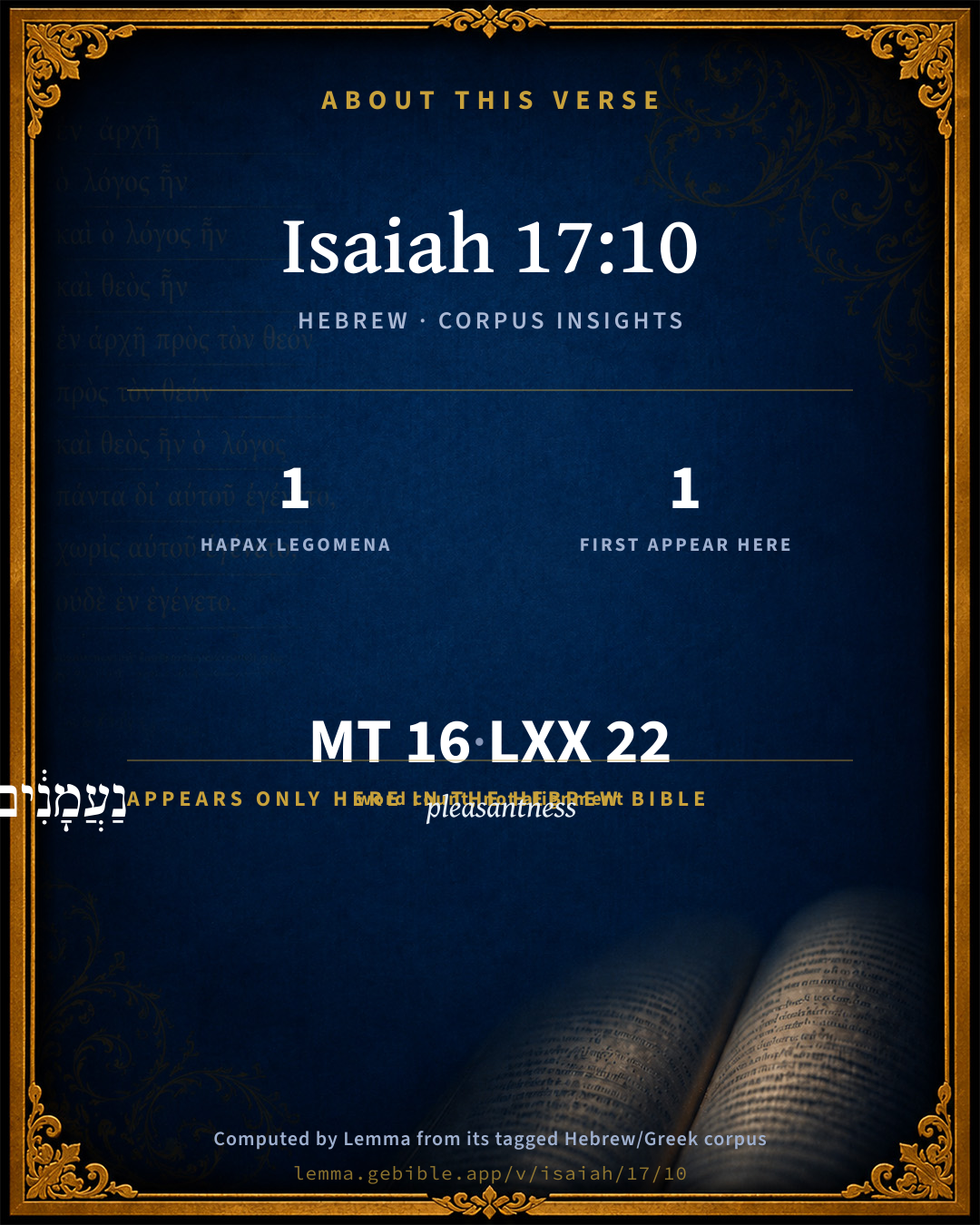
  • 1 hapax legomenon — only here in the Hebrew Bible
  • 1 first appearance in the Hebrew Bible
Full analysis ↓
Download a study sheet

One document with this verse’s original text, its word-by-word gloss line, the meaning frame, cross-references with their text, attributed commentary, and full source and license credits — printable, and it pastes into notes with its structure intact.

This verse Autodidact and up

Study sheet (.html) Plain text (.txt)

A passage Seminary Student

Up to 50 verses in one chapter. A passage sheet keeps up to 6 commentary sources and 12 cross-references per verse, in the order this page ranks them, and says so on the sheet whenever that leaves anything out. Ask for a single verse and you get the Autodidact verse sheet above.

Everything on this page stays free to read, with no account — the sheet is a download of what is already on screen, not access to it.

Want to remove ads? Support Godless Engineer
Compare translations 3

The same verse in 3 English versions, stacked beneath the original-language interlinear above. Click any original word for its lexicon entry.

Each is an independent rendering of the whole verse — the interlinear is not word-aligned to these translations.

Highlighted words mark where these versions differ — a whole-verse word diff, not a word-by-word alignment.

  • World English Bible Public Domain
    For you have forgotten the God of your salvation, and have not been mindful of the rock of your strength; therefore you plant pleasant plants, and set it with strange slips.
  • King James Version Public Domain
    Because thou hast forgotten the God of thy salvation, and hast not been mindful of the rock of thy strength, therefore shalt thou plant pleasant plants, and shalt set it with strange slips:
  • unfoldingWord Literal Text CC BY-SA 4.0
    For you have forgotten the God of your salvation, and you have not remembered the rock of your refuge. Therefore, you will plant plantings of pleasantness, and you will sow it, a foreign vine;

unfoldingWord Literal Text — © unfoldingWord, licensed CC BY-SA 4.0. Word-aligned USFM3 via Door43 (git.door43.org/unfoldingWord/en_ult).

Versions to compare (up to 4)

3 of 4 selected

Show all 18 translations

Every available English version of this verse, each an independent rendering of the whole verse.

  • World English Bible Public Domain
    For you have forgotten the God of your salvation, and have not been mindful of the rock of your strength; therefore you plant pleasant plants, and set it with strange slips.
  • Berean Standard Bible Public Domain
    For you have forgotten the God of your salvation and failed to remember the Rock of your refuge. Therefore, though you cultivate delightful plots and set out cuttings from exotic vines—
  • Majority Standard Bible Public Domain
    For you have forgotten the God of your salvation and failed to remember the Rock of your refuge. Therefore, though you cultivate delightful plots and set out cuttings from exotic vines—
  • King James Version Public Domain
    Because thou hast forgotten the God of thy salvation, and hast not been mindful of the rock of thy strength, therefore shalt thou plant pleasant plants, and shalt set it with strange slips:
  • American Standard Version (1901) Public Domain
    For thou hast forgotten the God of thy salvation, and hast not been mindful of the rock of thy strength; therefore thou plantest pleasant plants, and settest it with strange slips.
  • Revised Version (1885) Public Domain
    For thou hast forgotten the God of thy salvation, and hast not been mindful of the rock of thy strength; therefore thou plantest pleasant plants, and settest it with strange slips:
  • Geneva Bible (1599) Public Domain
    Because thou hast forgotten the God of thy saluation, and hast not remembred the God of thy strength, therefore shalt thou set pleasant plantes, and shalt graffe strange vine branches:
  • Douay-Rheims (1899) Public Domain
    Because thou hast forgotten God thy saviour, and hast not remembered thy strong helper: therefore shalt thou plant good plants, and shalt sow strange seed.
  • Young's Literal Translation Public Domain
    Because thou hast forgotten the God of thy salvation, And the rock of thy strength hast not remembered, Therefore thou plantest plants of pleasantness, And with a strange slip sowest it,
  • Literal Standard Version CC BY-SA 4.0
    Because you have forgotten the God of your salvation, || And have not remembered the Rock of your strength, || Therefore you plant plants of pleasantness, || And sow it with a strange shoot,
  • Unlocked Literal Bible CC BY-SA 4.0
    For you have forgotten the God of your salvation, and have ignored the rock of your strength. So you plant pleasant plants, and set out vine branches received from a stranger,
  • unfoldingWord Literal Text CC BY-SA 4.0
    For you have forgotten the God of your salvation, and you have not remembered the rock of your refuge. Therefore, you will plant plantings of pleasantness, and you will sow it, a foreign vine;
  • Darby Bible Public Domain
    For thou hast forgotten the God of thy salvation, and hast not been mindful of the rock of thy strength; therefore shalt thou plant pleasant plantations, and shalt set them with foreign slips:
  • World Messianic Bible Public Domain
    For you have forgotten the God of your salvation, and have not remembered the rock of your strength. Therefore you plant pleasant plants, and set out foreign seedlings.
  • Webster's Bible Public Domain
    Because thou hast forgotten the God of thy salvation, and hast not been mindful of the rock of thy strength, therefore shalt thou plant pleasant plants, and shalt set it with foreign slips:
  • Free Bible Version CC BY-SA 4.0
    You have forgotten the God who saves you; you have not remembered the Rock who protects you. So, even though you plant beautiful plants and grow exotic vines,
  • Bible in Basic English Public Domain
    For you have not given honour to the God of your salvation, and have not kept in mind the Rock of your strength; for this cause you made a garden of Adonis, and put in it the vine-cuttings of a strange god;
  • JPS Tanakh (1917) Public Domain
    For thou hast forgotten the God of thy salvation, and thou hast not been mindful of the Rock of thy stronghold; therefore thou didst plant plants of pleasantness, and didst set it with slips of a stranger;

Literal Standard Version (2020), Covenant Press — licensed CC BY-SA 4.0. Text via the HelloAO Bible API (eBible.org). Unlocked Literal Bible (unfoldingWord) — licensed CC BY-SA 4.0. Text via the HelloAO Bible API (eBible.org). unfoldingWord Literal Text — © unfoldingWord, licensed CC BY-SA 4.0. Word-aligned USFM3 via Door43 (git.door43.org/unfoldingWord/en_ult). Free Bible Version, Dr. Jonathan Gallagher — licensed CC BY-SA 4.0. Text via the HelloAO Bible API (eBible.org).

Word by word

More ways to search: Search by grammar → Find every occurrence → Compare this word →

Practice this passage: Drill this verse → Learn its vocabulary →

נַעֲמָנִ֔ים
naʻămân
H5282
“pleasantness”
Noun, Common, Masculine, Plural, Absolute
Part of Speech
Noun
Type
Common
Gender
Masculine
Number
Plural
State
Absolute
Full BDB Definition

Origin: from H5276

TWOT: 1384c

pleasantness
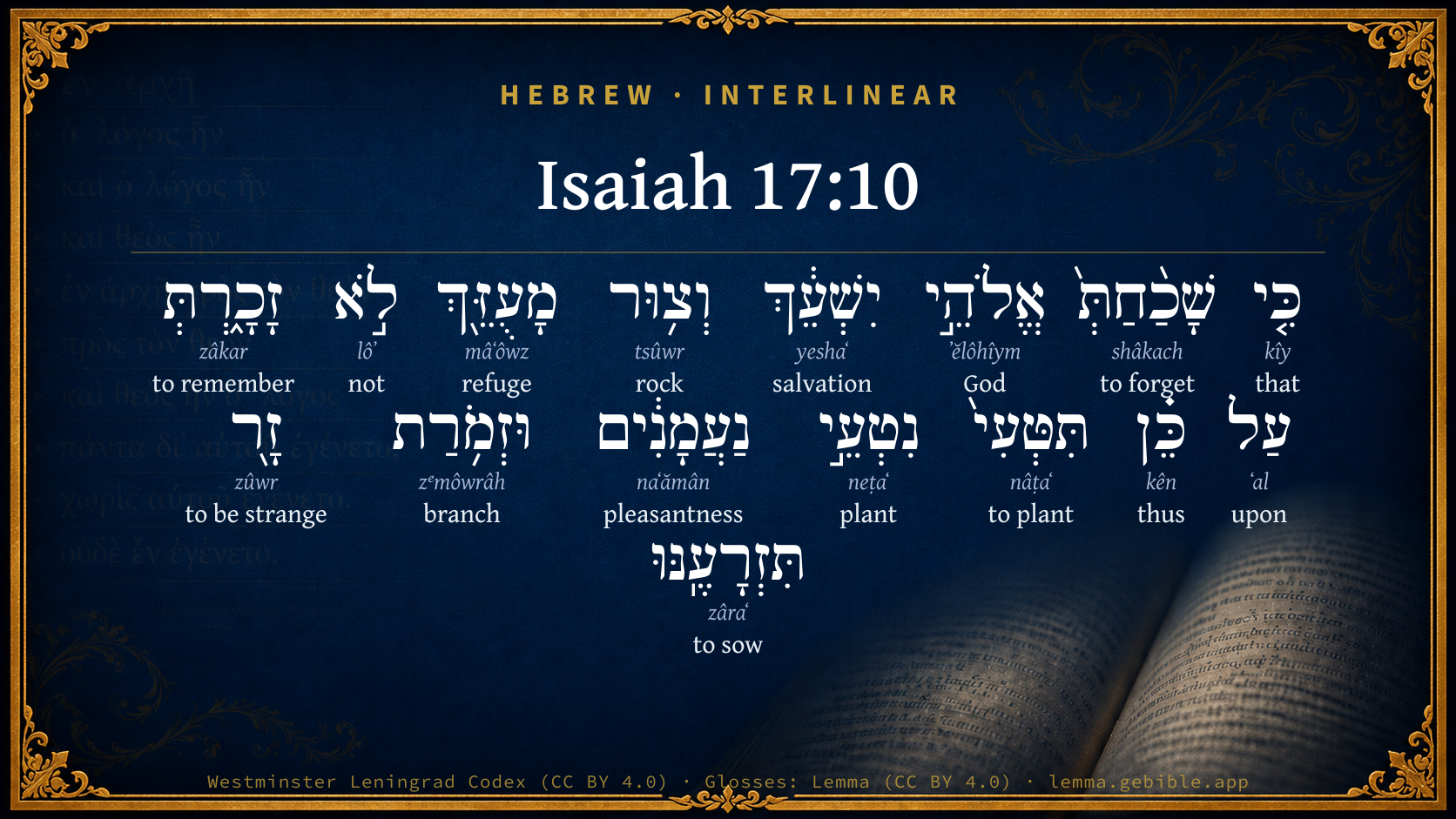
  1. כִּ֤י kîy H3588 “that” Conjunction
  2. שָׁכַ֨חַתְּ֙ shâkach H7911 “to forget” Verb, Qal, Perfect, 2nd Person, Feminine, Singular
  3. אֱלֹהֵ֣י ʼĕlôhîym H430 “God(s) of” Noun, Common, Masculine, Plural, Construct
  4. יִשְׁעֵ֔ךְ yeshaʻ H3468 “salvation · your” Noun, Common, Masculine, Singular, Construct + Suffix, Personal, 2nd Person, Feminine, Singular
  5. וְצ֥וּר tsûwr H6697 “and · rock of” Conjunction + Noun, Common, Masculine, Singular, Construct
  6. מָעֻזֵּ֖ךְ mâʻôwz H4581 “refuge · your” Noun, Common, Masculine, Singular, Construct + Suffix, Personal, 2nd Person, Feminine, Singular
  7. לֹ֣א lôʼ H3808 “not” Particle, Negative
  8. זָכָ֑רְתְּ zâkar H2142 “to remember” Verb, Qal, Perfect, 2nd Person, Feminine, Singular
  9. עַל ʻal H5921 “upon” Preposition
  10. כֵּ֗ן kên H3651 “thus” Particle, Demonstrative
  11. תִּטְּעִי֙ nâṭaʻ H5193 “to plant” Verb, Qal, Imperfect, 2nd Person, Feminine, Singular
  12. נִטְעֵ֣י neṭaʻ H5194 “plants of” Noun, Common, Masculine, Plural, Construct
  13. וּזְמֹ֥רַת zᵉmôwrâh H2156 “and · branch of” Conjunction + Noun, Common, Feminine, Singular, Construct
  14. זָ֖ר zûwr H2114 “strange” Adjective, Adjective, Masculine, Singular, Absolute
  15. תִּזְרָעֶֽנּוּ zâraʻ H2232 “to sow · him” Verb, Qal, Imperfect, 2nd Person, Masculine, Singular + Suffix, Personal, 3rd Person, Masculine, Singular

About this verse

These counts appear in no published source. They are computed here, from the morphology-tagged text and Lemma’s own curated glosses. What Lemma adds →

16
words
16
distinct lemmas
Prophets
section

Notable vocabulary

1 hapax legomenon — a word that appears only here in the entire Hebrew Bible:

  • נַעֲמָנִ֔ים pleasantness H5282

First appearance in Scripture

This word makes its first canonical appearance in the Hebrew Bible here:

  • נַעֲמָנִ֔ים pleasantness H5282

Shared distinctive vocabulary

נִטְעֵ֣י plant H5194 occurs in 4 verses of the Hebrew Bible. Also found in:

Grammatical profile

  • 4 verbs
  • 7 nouns
  • 1 adjective
  • 1 preposition
  • 1 conjunction
  • 2 particles

Verb forms

  • שָׁכַ֨חַתְּ֙ Qal · Perfect
  • זָכָ֑רְתְּ Qal · Perfect
  • תִּטְּעִי֙ Qal · Imperfect
  • תִּזְרָעֶֽנּוּ Qal · Imperfect

Hebrew & Septuagint length

In English translation the verse runs 31 words from the Hebrew and 28 from the Septuagint (LXX English) — closely comparable.

A rough comparison of the two English renderings, which tokenize alike — not a word-level alignment.

Word counts can differ between the Hebrew and the Greek without any difference in meaning — e.g. the Hebrew direct-object marker אֵת has no separate Greek word, and Greek often adds the article ὁ.

In the original languages it is 16 Hebrew tokens and 22 Greek tokens — but the two are counted differently (Hebrew bundles its prefixes and suffixes into one token; the Greek is in lemma form), so that isn’t a like-for-like length.

Cross-references

36

Topical passages linked to Isaiah 17:10 in the Treasury of Scripture Knowledge — connected by theme and wording, ordered by reader-vote popularity; previews shown in the World English Bible.

  • Deuteronomy 32:18 Of the Rock that became your father, you are unmindful, Have forgotten God who gave you birth.
  • Psalms 106:21 They forgot God, their Savior, Who had done great things in Egypt,
  • Isaiah 26:4 Trust in Yahweh forever; for in Yah, Yahweh, is an everlasting Rock.
  • Jeremiah 2:32 Can a virgin forget her ornaments, or a bride her attire? yet my people have forgotten me days without number.
  • Deuteronomy 32:4 The Rock, his work is perfect; For all his ways are justice: A God of faithfulness and without iniquity, Just and right is he.
  • Hosea 13:6–7 According to their pasture, so were they filled; They were filled, and their heart was exalted. Therefore they have forgotten me.
  • Deuteronomy 32:31 For their rock is not as our Rock, Even our enemies themselves being judges.
  • Psalms 85:4 Turn us, God of our salvation, And cause your indignation toward us to cease.
  • Psalms 106:13 They soon forgot his works. They didn't wait for his counsel,
  • Isaiah 12:2 Behold, God is my salvation. I will trust, and will not be afraid; for Yah, Yahweh, is my strength and song; and he has become my salvation."
  • Isaiah 51:13 and have forgotten Yahweh your Maker, who stretched forth the heavens, and laid the foundations of the earth; and fear continually all the day because of the fury of the oppressor, when he makes ready to destroy? and where is the fury of the oppressor?
  • Jeremiah 12:13 They have sown wheat, and have reaped thorns; they have put themselves to pain, and profit nothing: and you shall be ashamed of your fruits, because of the fierce anger of Yahweh.
  • Jeremiah 17:13 Yahweh, the hope of Israel, all who forsake you shall be disappointed. Those who depart from me shall be written in the earth, because they have forsaken Yahweh, the spring of living waters.
  • Hosea 8:14 For Israel has forgotten his Maker and built palaces; And Judah has multiplied fortified cities; But I will send a fire on his cities, And it will devour its fortresses."
  • Leviticus 26:16 I also will do this to you: I will appoint terror over you, even consumption and fever, that shall consume the eyes, and make the soul to pine away; and you will sow your seed in vain, for your enemies will eat it.
  • Leviticus 26:20 and your strength will be spent in vain; for your land won't yield its increase, neither will the trees of the land yield their fruit.
  • Deuteronomy 6:12 then beware lest you forget Yahweh, who brought you forth out of the land of Egypt, out of the house of bondage.
  • Deuteronomy 8:11 Beware lest you forget Yahweh your God, in not keeping his commandments, and his ordinances, and his statutes, which I command you this day:
  • Deuteronomy 8:14 then your heart be lifted up, and you forget Yahweh your God, who brought you forth out of the land of Egypt, out of the house of bondage;
  • Deuteronomy 8:19 It shall be, if you shall forget Yahweh your God, and walk after other gods, and serve them, and worship them, I testify against you this day that you shall surely perish.
  • Deuteronomy 28:30 You shall betroth a wife, and another man shall lie with her: you shall build a house, and you shall not dwell therein: you shall plant a vineyard, and shall not use the fruit of it.
  • Deuteronomy 28:38–42 You shall carry much seed out into the field, and shall gather little in; for the locust shall consume it.
  • Deuteronomy 32:15 But Jeshurun grew fat, and kicked: You have grown fat, you are grown thick, you are become sleek; Then he forsook God who made him, Lightly esteemed the Rock of his salvation.
  • 1 Chronicles 16:35 Say you, Save us, God of our salvation, Gather us together and deliver us from the nations, To give thanks to your holy name, To triumph in your praise.
  • Psalms 68:19–20 Blessed be the Lord, who daily bears our burdens, Even the God who is our salvation. Selah.
  • Psalms 79:9 Help us, God of our salvation, for the glory of your name. Deliver us, and forgive our sins, for your name's sake.
  • Isaiah 65:21–22 They shall build houses, and inhabit them; and they shall plant vineyards, and eat the fruit of them.
  • Psalms 9:17 The wicked shall be turned back to Sheol, Even all the nations that forget God.
  • Psalms 18:2 Yahweh is my rock, my fortress, and my deliverer; My God, my rock, in whom I take refuge; My shield, and the horn of my salvation, my high tower.
  • Psalms 31:2 Bow down your ear to me. Deliver me speedily. Be to me a strong rock, A house of defense to save me.
  • Psalms 65:5 By awesome deeds of righteousness, you answer us, God of our salvation. You who are the hope of all the ends of the earth, Of those who are far away on the sea;
  • Hosea 2:13–14 I will visit on her the days of the Baals, To which she burned incense, When she decked herself with her earrings and her jewels, And went after her lovers, And forgot me," says Yahweh.
  • Hosea 4:6 My people are destroyed for lack of knowledge. Because you have rejected knowledge, I will also reject you, That you may be no priest to me. Because you have your God's law, I will also forget your children.
  • Amos 5:11 Forasmuch therefore as you trample on the poor, And take taxes from him of wheat: You have built houses of hewn stone, But you will not dwell in them. You have planted pleasant vineyards, But you shall not drink their wine.
  • Habakkuk 3:18 Yet I will rejoice in Yahweh. I will be joyful in the God of my salvation!
  • Zephaniah 1:13 Their wealth will become a spoil, and their houses a desolation. Yes, they will build houses, but won't inhabit them. They will plant vineyards, but won't drink their wine.

Cross-references courtesy of OpenBible.info (CC BY 4.0).

Hebrew and Greek witnesses Masoretic Hebrew ↔ Greek Septuagint

The same verse in the two great witnesses to the Old Testament, shown verse-for-verse.

These are two independent witnesses, not word-aligned to each other, and the Septuagint is shown in lemma (dictionary) form.

Hebrew Isaiah 17:10 Masoretic · Westminster Leningrad Codex

כִּ֤י שָׁכַ֨חַתְּ֙ אֱלֹהֵ֣י יִשְׁעֵ֔ךְ וְצ֥וּר מָעֻזֵּ֖ךְ לֹ֣א זָכָ֑רְתְּ עַל כֵּ֗ן תִּטְּעִי֙ נִטְעֵ֣י נַעֲמָנִ֔ים וּזְמֹ֥רַת זָ֖ר תִּזְרָעֶֽנּוּ

For you have forgotten the God of your salvation, and have not been mindful of the rock of your strength; therefore you plant pleasant plants, and set it with strange slips.

World English Bible · Public Domain

Greek LXX Isaiah 17:10 Septuagint · lemma form

διότι καταλείπω ὁ θεός ὁ σωτήρ σύ καί κύριος ὁ βοηθός σύ οὐ μιμνήσκω διά οὗτος φυτεύω φύτευμα ἄπιστος καί σπέρμα ἄπιστος

Because you have forsaken God your Saviour, and have not been mindful of the Lord your helper; therefore shall you plant a false plant, and a false seed.

LXX2012 (modern English Septuagint) · Public Domain

On this verse, Haydock's Catholic Bible Commentary discusses the Septuagint’s reading. Read the note in Commentary ↓

Hebrew: Westminster Leningrad Codex (CC BY 4.0). Greek: Septuagint (public domain); English from LXX2012 (modern English Septuagint) (Public Domain). How the Septuagint differs from the Hebrew →

Targum (Aramaic paraphrase)

1

The Targum is the ancient Jewish Aramaic paraphrase of the Hebrew Scriptures — an interpretive translation, not the Hebrew text itself. Onkelos (literal) and Pseudo-Jonathan (expansive) render the Torah, and Jonathan the Prophets. Coverage is partial: where no permissively-licensed English translation exists for a verse, only the Aramaic is shown. This is verse-level text, not a word-by-word alignment to the Hebrew.

  1. Targum Jonathan Prophets (Joshua–Malachi)
    אֲרֵי שְׁבַקְתְּ אֱלָהָא דְפוּרְקָנִיךְ וְדַחְלַת תַּקִיפָא דִי מֵימְרֵיהּ בְּסַעֲדָךְ לָא אִדְכַּרְתְּ בְּדִיל דְאַתְּ נְצִיבָא נִצְבָא בְּחִירָא וְעוֹבְדֵין מְקַלְקְלִין אַסְגֵית:

    Because thou hast forsaken the God of thy salvation, and thou hast not remembered the fear of the Mighty One, whose Word was thy support; therefore thou hast planted a choice plant, and hast multiplied despicable works.

    Targum Jonathan — Aramaic: “Mikraot Gedolot” (public domain). English: “Sefaria Community Translation” (CC0 1.0 (public-domain dedication)); “London "Chaldee Paraphrase," 1871” (public domain). Text via Sefaria.

Commentary

Notes on Isaiah 17:10 from classic Christian and Jewish commentators (each source and its license shown beneath its notes). The classic Christian expositions comment on the surrounding passage and are grouped to its opening verse, so a note may address several verses; the Jewish commentaries on the Tanakh (Rashi and others) are per-verse, so they appear only where the commentator wrote on this verse.

Lemma curates 59 commentaries, every one of them public domain or Creative Commons licensed, each selected and text-cleaned for this edition rather than reprinted as found. About our sources →

Trapp's Complete Commentary

John Trapp

Isa 17:10 Because thou hast forgotten the God of thy salvation, and hast not been mindful of the rock of thy strength, therefore shalt thou plant pleasant plants, and shalt set it with strange slips:

Ver. 10. Because thou hast forgotten the God of thy salvation.] Thou hast disloyally departed from him, as a wife doth from her husband, though he were both able and ready to have saved thee.

Therefore shalt thou plant pleasant plants.] But all to no purpose. Hoc patres familias pro regula habeant aeconomica. There is a curse upon the wicked, though never so industrious. All will not do. God cannot abide to be forgotten.

And shall set it with strange slips,] {a} i.e., Rare and excellent ones, but for the enemies’ use. {as Isa 17:11 Deu 28:29}

{a} Exotica fere non nisi preciosa afferuntur. - Jun.

John Trapp, A Commentary or Exposition upon All the Books of the Old and New Testament (1647–1656) — public domain. Text from a community e-Sword module.

The Biblical Illustrator

Joseph S. Exell

Isa_17:10-11

Because thou hast forgotten the God of thy salvation.

Forgetfulness of God punished

I. THE MAGNITUDE OF THE SIN HERE SPOKEN OF. Forgetfulness of God.

1. What is this forgetfulness of God? It has been defined as such a habitual inattention to His existence and character, as leads the individual under its influence to a mode of thinking, feeling, and acting, which would be consistent only on the supposition that there were no God, or that God is a very different Being from what the Scriptures represent Him to be.

2. It is a startling sin. Everything around us is designed and fitted to remind us of God. The Bible unfolds the moral character of God. Sharp dispensations of providence remind us of His existence. Preachers enforce His claims. Each returning Sabbath, with its closed shutters, the sound of the church going bell, and the voice of praise from the lips of the pious, says, Worship God. But many would rather think about anything, or nothing, than about God.

3. It is a fearfully prevalent sin.

4. It is an ungrateful sin (Isa_1:2-3).

5. It is a highly punishable sin. Many people imagine that none are sinners but those who openly sin. But what of the moral man, who does his duty towards his fellow men, but who forgets God?

II. THE RESULTS OF THIS FORGETFULNESS OF GOD.

1. Dwarfed powers. Men cannot, if they wish, be totally inactive. If activity be not devoted to God, it will be devoted to the world, to planting pleasant plants.

2. Secular knowledge is a pleasant plant.

3. Wealth is a pleasant plant.

4. Ambition is a pleasant plant.

5. Amusement is a pleasant plant.

6. Hence observe the ultimate result of this conduct. The harvest shall be a heap, etc. Sooner or later men reap what they sow. Sin and suffering are bound together by an unbreakable chain. The gods are just, says Shakespeare, and of our pleasant vices make instruments to scourge us. Gal_6:7-8.) Men break Gods physical laws, and they suffer in their bodies and circumstances. They violate His moral laws, and personal debasement ensues. George Eliot says, That is the bitterest of all--to wear the yoke of our own wrong-doing. (H. Woodcock.)

Evils of forgetting God

I. FORGETFULNESS OF GOD IS AN EVIL WHICH TOO GENERALLY PREVAILS AMONG MEN. The text does not so much charge with positive wickedness (though it is implied) as forgetfulness of God, which supposes folly, because He is the God of salvation, and the Rock of strength. Consider these relations--

1. The God of thy salvation.

(1) He is infinitely able to save His creatures, whether the salvation required be temporal, spiritual, or eternal.

(2) He is always willing to save them. How inexcusable is maul

How criminal to forget, to be unmindful of Him!

2. The Rock of thy strength. Here we may build, and the fabric will never be shaken. Here we may shelter, as in the cleft of a rock, and no evil shall prevail against us. For so helpless and weak a creature as man to have such a refuge, such a support, and to be unmindful of it, how great is his folly! But when may we be said to forget, and to be unmindful of God? When we live without thinking of Him--without praying to Him--without seeking His glory--without surrendering our souls, bodies, and all our cares into His hands.

II. THE ATTENTION THUS DRAWN FROM GOD AND HIS SERVICE IS TRANSFERRED TO WORLDLY AND SENSUAL PLEASURES. The soul of man in this case strives to supply its want of happiness from the world: therefore shalt thou plant pleasant plants. Infinitely varied are the objects of the attention or culture of men, but they all proceed from the above principle, or rather have the same end in view. Some seek their pleasure in learning, others in the arts, riches, honours, employments, amusements. But they are strange slips, not natural, not designed to answer the intended purpose. The sons of men are determined to prove what the world can do for them. In the day THE CONSEQUENCES OF SUCH CONDUCT. The harvest shall be a heap, etc. (J. Walker, D. D.)

Prosperity in the seeming only

These occasional sun gleams may foretoken the thunderstorm. God can mock, God can lead the bullock to the knife by the way of a fat pasture. There is, therefore, a promise here, but the promise is limited. You shall have mushroom growths, you shall see wonderful things within the span of a single day; but what shall the harvest be? The meaning is, we may be infatuated by appearances, by immediate successes, by flowers and strange slips growing up within the compass of one little day. (J. Parker, D. D.)

Gods righteousness in His dealings with men

Happily, this is only one aspect of the Divine government; we are entitled to reverse this text, and say, Because thou hast remembered the God of thy salvation, and hast been mindful of the Rock of thy strength, therefore shall thy barns be filled with plenty, and thy presses burst out with new wine. Thou hast not withheld from God the gladness and the service of thine heart, and He will not withhold from thee the music and the rapture and the abundance of harvest.. The way of the Lord is equal. (J. Parker, D. D.)

Pleasant plants and strange slips

They made for themselves all kinds of sensuous cults in conformity with their heathen inclination. (F. Delitzsch.)

The temporary success of an evil alliance

The foreign slip has shot up like a hothouse plant, i.e., the alliance has rapidly become a happy agreement, and has also already shot forth a blossom, which is the common plan directed against Judah. (F. Delitzsch.)

Lives of disappointment

The world is full of people who are engaged in planting their slips. Fortunes, luxurious homes, great reputations--such are some of the slips; but what disappointment succeeds--desperate sorrow. The egg turns cue to be rottenness; the fair landscape a Sahara, from which the mirage is gone; the beautiful globe of changing colour, only a drop of dirty soap and water. We remember the story of Faust, who sold himself to Satan, but the day of bitter reaping came. We remember the cry of Byron over his wasted years; of Laurence Oliphant, the bright versatile son of Piccadilly, who in his varied career had tasted life in many of its brightest aspects; of Solomon, whose Ecclesiastes is one long record of slip planting. Nothing less than God, our Maker, can suffice the souls which He has made. Apart from Him life may at first promise well, but the end, inevitably, will be desperate sorrow. (P. B. Meyer, B. A.)

The harvest shall be a heap

The harvest of sorrow

A harvest field is a suggestive place.

I. TO EVERY LIFE THERE IS A HARVEST, EITHER OF JOY OR OF SORROW. Life on earth is introductory and probationary. It is but the seed time for eternity. All our actions, words, thoughts, have a bearing upon the future. God is our moral Governor, as well as our loving Father. We are, therefore, accountable to Him for the disposal of every moment of our existence. Belonging to a depraved and fallen race, we are necessarily sinners; but this has been provided for. To every life there is a harvest. When? Sometimes in this world. Both the righteous and the wicked reap on earth to a certain degree that which they have sown. But still it is most strictly true that the great and final harvest commences when life on earth terminates and life in eternity begins. This great fact invests life with unspeakable grandeur. Every day and hour we are preparing for the realities of eternity. This should moderate our expectations concerning the present life. That which is probationary is necessarily incomplete. We should, therefore, expect trials and disappointments.

II. THE HARVEST OF SORROW MAY, IN EVERY CASE, BE TRACED TO ONE GREAT CAUSE--forgetfulness of God. The ruin of the Ten Tribes is traced to this (Isa_17:10-11). Jeremiah brings the same charge against them Jer_2:12-13). Hosea also says (Hos_8:14), For Israel hath forgotten his Maker, and buildeth temples. At first, it seems impossible that they could ever have done this. Had they not the history of the great and eventful past? Did they not know they were depending on Him for everything they enjoyed? Surely, those who had such a God should never have forgotten Him. The fact stated in the text is one of deep significance. It shows us the desperate wickedness of the human heart. The Israelites were so estranged from Jehovah that they acted as though He did not exist. It is so in every such case. Forgetfulness of God always leads to this terrible result. No one can be unmindful of Him with impunity. Forgetfulness of God produces in the heart such feelings and induces men to follow such a line of conduct, that their lives must be a failure. It is, however, worthy of notice, that these persons are as anxious to be happy during life, and at its end, as any of their fellows. They do not resign themselves to despair. On the contrary, they fancy that all is well. Their hearts beat high with hope. True, they have not the help and protection which the Lords people enjoy, but they do all they can to supply its place. The people of Israel did all they could to make their position a strong one. They made an alliance with Syria, and thought, with her help, they would be able to overcome their foes. So men in the present day, who forget God, avail themselves of the dictates of worldly prudence. In the day they make their plant to grow, and in the evening they make their seed to flourish. Here we have an affecting description of the anxiety and feverish effort of the men that know not God. We may plant pleasant plants, we may set strange slips, but they will not compensate us for the absence of the plants of righteousness. He who forgets the God of his salvation, and is unmindful of the Rock of his strength, must be without His favour, and at last must reap a harvest of grief and desperate sorrow.

III. THE HARVEST OF SORROW INVOLVES THE SOUL IN UTTER AND IRREMEDIABLE RUIN. It is no slight matter--it is the loss of all things or the failure of every effort--the disappointment of every hope, the destruction of every joy, the development and perpetuation of every sorrow. The language of the prophet is very striking. The common idea of harvest is that of a joyous nature. But here we have an idea of the very opposite character. The harvest is a heap. There is no golden grain worthy of being housed in everlasting habitations. The soul sees with amazement that all her efforts have been fruitless, and cries, Is this all; has my life on earth produced nothing more than this? And the answer is, Nothing more; and that which it has produced is only fit for the burning. (H. B.Ingram.)

Gods love in the deprivations of life

There is only one way of getting at some men. Once we could have appealed to their higher nature; once they were subject to the pleasure and the eloquence of reason; once they had a conscience tender, sensitive, responsive; now they are spiritually dead, no conscience, no reason, no unselfishness; the whole nature has gone down in volume and in quality into a terrible emaciation: what shall be done? Smite their harvest! then like beasts they will miss their food. God does not delight in this; it is the poorest violence, it is the feeblest department of His providence; but He knows that it is the only providence some men can understand. (J. Parker, D. D.)

Reclamation by punishment

God got you back to the Church through inflammation, through fever, through paralysis, through pain, through loss, through desolation; you came back over the graveyard. No matter, said God; when He got you into His house again He said, This My son was dead, and is alive again; he was lost, and is found. It is in the reclamation, not in the punishment, that God takes pleasure. (J. Parker, D. D.)

The Biblical Illustrator, edited by Joseph S. Exell (c. 1880s–1900s) — public domain. Text from a community e-Sword module.

Joseph Benson's Commentary

Isa 17:10-11. Because thou, O Israel, hast forgotten the God of thy salvation — That God, who was thy only sure defence; therefore shalt thou plant pleasant plants — Fetched from far countries, and therefore highly esteemed. The sense is, Thou shalt use much industry and cost, but to no purpose, as it follows. In the day shalt thou make thy plant to grow, &c. — Beginning early in the morning, thou shalt, from day to day, use all care and diligence, that what thou hast planted and sown may thrive; but the harvest shall be a heap, &c. — But in the time of your grief, or when this grievous calamity shall come, all your harvest shall be but one heap, very inconsiderable in itself, and easily carried away by your enemies: in other words, “when thou expectest to reap the fruit of thy labours, thou shalt find nothing but loss and disappointment.” — Lowth. See the margin, where the day of inheritance means the time of enjoying any thing which we have taken pains for.

Joseph Benson's Commentary on the Old and New Testaments (1811–1818) — public domain. Text from a community e-Sword module.

The Preacher's Complete Homiletical Commentary

Joseph S. Exell (gen. ed.)

FORGETFULNESS OF GOD

Isa_17:10-11. Because thou hast forgotten, &c.

I. It is possible to forget the God of our salvation.

1. The majority of men habitually forget Him. He very seldom holds a real and commanding place in the hearts of any of us. We are all prone to have our hearts wholly filled with the cares or pleasures of life. Even if our aims be in themselves lawful, we seldom recognise God in framing or prosecuting them. Hence the shock which the thought of God’s nearness gives us in times of calamity, sickness, or expected death. The very shock shows that we are open to the prophet’s charge.

2. This forgetfulness of God, to which we are all so prone, should be recognised to be a state of peril and guilt. Who is so near to us as God? who so essential to us? who has so many claims upon our grateful and continued remembrance? To be forgetful of Him is a sin of which we should think with shame.

II. This forgetfulness of God leads to false trusts. The throne of our heart cannot remain vacant; if God be not there, unworthy objects will surely take His place. The “pleasant plants” and foreign shoots (or “strange slips”) here represent the pursuit of lust and idolatry, and that fatal reliance on human help which is so often denounced (chap. Isa_2:22; Jer_17:5). The sin denounced by the prophet has not become obsolete. All round about us are men who have forgotten God, and are seeking and putting their trust in pleasure, pomp, money, or knowledge. There is a pursuit of knowledge, even a “science” falsely so called that deliberately excludes God from its range, and pronounces Him unknowable! These are the things for which men live, to which they devote all they are and have, from which they look for the happiness for which their hearts crave; these are their gods! Forgetfulness of God necessarily leads to idolatry in some form or other; desires and tendencies, in themselves right when under right control, become occasions of guilt; God is shifted from the centre of operations, and the trust of men fixes itself inevitably on unworthy objects (H. E. I., 39).

III. These false trusts lead to bitter disappointments. “The harvest shall be a heap in the day of grief and of desperate sorrow.” At the very time when abundance of fruit was expected, nothing awaits the anxious toiler but disappointment and failure. Mildew, or blight, or drought, or fire has done its deadly work, and nothing is left but rotting masses, heaps of useless and decaying vegetation. What a sad picture! barrenness and dearth where there should be life and plenty! Yet this is a true picture of the fate of many who have persisted in their rejection of God, and in their clinging to false hopes. A life dedicated to fashion, pleasure, money-getting, or worldly ambition, necessarily ends in a reaping-time of blighted hopes, of darkened prospects, of remorse and despair (H. E. I., 246–248, 5021–5025; P. D., 138, 162, 255, 3592).

1. This result of a godless life will be found even in those cases where all the good that was striven after has been realised; the heart is still left unsatisfied (Ecc_1:12 to Ecc_2:17).

2. “Desperate sorrow” is the natural result of discovering that the time for securing a profitable harvest is gone (Jer_8:20; P. D., 2254).

Earnestly consider God’s claims upon you; renounce all false trusts; sow for that harvest in which there can be no real disappointment (Gal_6:6). Redeem the time that yet remains; to the worst of us a gracious promise is still held out (Mal_3:7; Psa_116:7).—William Manning.

The Preacher's Complete Homiletical Commentary (gen. ed. Joseph S. Exell; Funk & Wagnalls, c. 1892) — public domain (pre-1929). A full-Bible homiletical/sermon-outline anthology covering 65 of 66 books (2 John is absent from the source module). Text from a community e-Sword module.

MacLaren's Expositions of Holy Scripture

Alexander MacLaren

Isaiah

THE HARVEST OF A GODLESS LIFE

Isa 17:10 - Isa 17:11.

The original application of these words is to Judah’s alliance with Damascus, which Isaiah was dead against. He saw that it would only precipitate the Assyrian invasion, as in fact it did. Judah had forsaken God, and because they had done so, they had gone to seek for themselves delights-alliance with Damascus. The image of planting a garden of pleasures, and ‘vine slips of a stranger’ refers to sensuous idolatry as well as to the entangling alliance. Then follows a contemptuous description of the rapid growth of this alliance and of the care with which Israel cultivated it. ‘In a day thou makest thy plant to grow’ {or fencest it}, and next morning it was in blossom, so sedulously had they nursed and fostered it. Then comes the smiting contrast of what it was all for-’A harvest heap in the day of sickness and incurable pain.’

Now we may take this in a more general way as containing large truths which affect the life of every one of us.

I. The Sin of a Godless Life.

{a} Notice the Sin charged. It is merely negative-forgettest. There is no charge of positive hostility or of any overt act. This forgetfulness is most natural and easy to be fallen into. The constant pressure of the world. It indicates alienation of heart from God.

It is most common among us, far more so than active infidelity, far more so than gross sin, far more so than conscious hostility.

{b} The implied Criminality of it. He is the ‘Rock of thy strength’ and the ‘God of thy salvation.’ Rock is the grand Old Testament name of God, expressing in a pregnant metaphor both what He is in Himself and what in relation to those who trust Him. It speaks of stability, elevation, massiveness, and of defence and security. The parallel title sets Him forth as the Giver of salvation; and both names set in clear light the sinful ingratitude of forgetting God, and force home the question: ‘Do ye thus requite the Lord, oh foolish people and unwise?’

{c} The implied Absurdity of it. What a contrast between the safe ‘munitions of rocks’ and the unsheltered security of these Damascene gardens! What fools to leave the heights and come down into the plain! Think of the contrast between the sufficiency of God and the emptiness of the substitutes. Forgetfulness of Him and preference of creatures cannot be put into language which does not convict it of absurdity.

II. The Busy Effort and Apparent Success of a Godless Life.

{a} If a man loses his hold on God and has not Him to stay himself on, he is driven to painful efforts to make up the loss. God is needed by every soul. If the soul is not satisfied in Him, then there are hungry desires. This is the explanation of the feverish activity of much of our life.

{b} Such work is far harder than the work of serving God. It takes a great deal of toil to make that garden grow. The world is a hard taskmaster. God’s service is easy. He sets us in Eden to till and dress it, but when we forget Him, the ground is cursed, and bears thorns and thistles, and sweat drips from our brows.

Men take more pains to damn themselves than to save themselves. There is nothing more wearying than the pursuit of pleasure. ‘Pleasant plants’-that is a hopeless kind of gardening. There is nothing more degrading.

‘Ye lust and desire to have,’-what a contrast is in, Ask and have! We might live even as the lilies or the ravens, or with only this difference, that we laboured, but were as uncaring and as peaceful as they.

God is given. The world has to be bought. Its terms are ‘Nothing for nothing.’

{c} Such work has sometimes quick, present success.

‘In the day.’ It is hard for men to labour towards far-off unseen good. We like to have what will grow up in a night, like Jonah’s gourd. So these present satisfactions in a worldly life appeal to worldly, sensuous natures. And it is hard to set over against these a plant which grows slowly, and only bears fruit in the next world.

III. The End of it all.

‘A harvest heap in the day of grief.’ This clearly points on to a solemn ending-the day of judgment.

{a} How poor the fruit will he that a God-forgetting man will take out of life! There is but one heap from all the long struggle. He has ‘sowed much and brought home little.’ What shall we take with us out of our busy years as their net result? A very small sack will be large enough to hold the harvest that many of us have reaped.

{b} All this God-forgetting life of pleasure-seeking and idolatry is bringing on a terrible, inevitable consummation.

‘Put in the sickle, for the harvest is ripe.’

No doubt there is often a harvest of grief and desperate sorrow springing, even in this life, from forgetting God. For it is only they who set their hopes on Him that are never disappointed, and only they who have chosen Him for their portion who can always say, ‘I have a goodly heritage.’ But the real harvest is not reaped till death has separated the time of sowing from that of ingathering. The sower shall reap; i.e. every man shall inherit the consequences of his deeds. ‘They that have planted it shall eat it.’

{c} That harvest home will be a day of sadness to some. These are terrible words-’grief and desperate sorrow,’ or ‘pain and incurable sickness.’ We dare not dilate on this. But if we trust in Christ and sow to the Spirit, we shall then ‘rejoice before God as with the joy of harvest,’ and ‘return with joy, bringing our sheaves with us.’

Alexander MacLaren, Expositions of Holy Scripture (1904–1910) — public domain. Text from a community e-Sword module.

Tyndale Open Study Notes

Tyndale Open Resources

17:10 The Israelites had mixed faith in the Lord with elements of Baal worship. They turned from the Lord, who alone is God and will not be held alongside an idol in people’s hearts. • The term Rock refers to the Lord’s ability to provide refuge (see 26:4; 30:29; Ps 18:2, 46).

Tyndale Open Study Notes — © Tyndale Open Resources, licensed CC BY-SA 4.0. Text via the HelloAO Bible API.

Geneva Bible (1599)

Geneva Bible translators

Which are excellent, and brought out of other countries.

Geneva Bible (1599) marginal notes — public domain. Text via Bolls.life.

Jamieson, Fausset & Brown

Robert Jamieson, A. R. Fausset & David Brown

forgotten . . . God of . . . salvation . . . rock-- (Deu 32:15, Deu 32:18).

plants--rather, "nursery grounds," "pleasure-grounds" [MAURER].

set in--rather, "set them," the pleasure-grounds.

strange slips--cuttings of plants from far, and therefore valuable.

Jamieson, Fausset & Brown — Commentary Critical and Explanatory on the Whole Bible (1871) — public domain (CC PDM 1.0). Text via the HelloAO Bible API.

Adam Clarke's Commentary

Verse 10. Strange slips - "Shoots from a foreign soil."] The pleasant plants, and shoots from a foreign soil, are allegorical expressions for strange and idolatrous worship; vicious and abominable practices connected with it; reliance on human aid, and on alliances entered into with the neighbouring nations, especially Egypt; to all which the Israelites were greatly addicted, and in their expectations from which they should be grievously disappointed.

Adam Clarke's Commentary on the Bible (1810–1826) — public domain. Text from a community e-Sword/MySword module.

Ellicott's Commentary for English Readers

(10) Hast not been mindful of the rock of thy strength.—Jehovah, as the true defence, the fortress rock of His people (Deu_32:4), is contrasted with the rock-fortresses in which the people had put their trust. They had forsaken the One, and therefore, by a just retribution, the others should be forsaken.

Therefore shalt thou plant pleasant plants.—Better, thou didst plant. The word for “pleasant” is found here only as a common noun. The singular appears as a proper name in Gen_46:21, Num_26:40, and in the more familiar instance of Naaman the Syrian (2Ki_5:1). It would appear that the prophet chose the peculiar term to indicate the foreign, in this case the Syrian, character of the worship to which he refers as the “plant” which Israel had adopted. Mr. Cheyne, following an ingenious suggestion of Lagarde’s, connects it (1) with the Arabic Nahr No’man, the name of the river Belus near Acre, and (2) with the Arabic name (Shakaiku-’n-nomân) for the red anemone. The former was near the head-quarters of the worship of Thammuz, the Phœnician Adonis, and the flower was sacred to him, and so it is inferred that the prophet refers to “the gardens of Adonis,” fair but perishable (Plato, Phœdr. p. 276 B), in which Israel had delighted (Eze_8:14). The addition of “strange slips,” literally, vine-slips of a strange one—i.e., of a strange god (comp. Jer_2:21)—confirms at least the general drift of this interpretation.

A Bible Commentary for English Readers, edited by Charles John Ellicott (1878–1897) — public domain. Text from a community e-Sword module.

The Cambridge Bible for Schools and Colleges

gen. ed. J. J. S. Perowne

10. God of thy salvation] The only occasion on which this important term (Heb. yesha‘) is used by Isaiah, although it forms an element of his own name.

rock of thy strength] A very frequent name of God, cf. ch. Isa_30:29, Isa_44:8 (R.V.); Deuteronomy 32. (passim); Psa_19:14; Psa_27:5; Psa_31:2-3, &c.

shalt thou plant pleasant plants] R.V. marg. gives thou plantest plantings of Adonis. The supposed reference is to the Adonis-gardens mentioned by Greek writers (see Plato, Phaedrus 276). They were “pots of quickly withering flowers which the ancients used to set at their doors or in the courts of temples.” It cannot be denied that such an allusion furnishes the most striking image conceivable of the futility of all human projects which (like the Syro-Ephraimitish alliance) are not grounded in the eternal moral purpose of Jehovah. The question is whether it is a fair interpretation of the text. Now, there are a number of scattered proofs, slight but very interesting, that the Syrian deity known to the Greeks as Adonis, actually bore the name here rendered “pleasantness” (Na‘ǎmân). It has been suggested, e.g. that the anemone, the flower sacred to Adonis, derives its name from this title of the god; and in Arabic the red anemone is called by a name which is explained to mean “wounds of Adonis.” For other arguments see Cheyne’s Comm. and the references there. Adonis being a Syrian deity, his worship in Israel was a necessary consequence of the alliance with Damascus. His worship was practised chiefly by women, Eze_8:14. The rendering may at least be accepted as giving significance to a metaphor which is otherwise somewhat colourless.

set it with strange slips] or, plant it with vine-branches of a strange (god); see Num_13:23; Nah_2:2.

The Cambridge Bible for Schools and Colleges (gen. ed. J. J. S. Perowne; Cambridge University Press, 1878–1918) — public domain. Text from a community e-Sword module.

John Gill's Exposition

Because thou hast forgotten the God of thy salvation,.... Who had been the author of salvation to them many a time, in Egypt, at the Red Sea, and in various instances since; and yet they had forgot his works of mercy and goodness, and had left his worship, and gone after idols; and this was the cause of their cities being forsaken, and becoming a desolation:

and hast not been mindful of the rock of thy strength; or strong Rock, who had supplied and supported them, protected and defended them:

therefore shalt thou plant pleasant plants; or "plants of pleasant fruit" (s), or "plants of Naamanim"; and so Aben Ezra takes it to be the proper name of a plant in the Arabic language, and which he says is a plant that grows very quick; perhaps he means "Anemone", which is so called in that language (t), and is near to it in sound; though rather, not any particular plant is meant, but all sorts of pleasant plants, flowers, and fruit trees, with which the land of Israel abounded:

and shall set it with strange slips; with foreign ones, such as are brought from other countries, and are scarce and dear, and highly valued; and by "plants" and "slips" may be meant false and foreign doctrines, inculcating idolatry and superstition, which are pleasing to the flesh (u).

(s) "plantas amaenorum fructuum", Piscator. (t) Alnaaman "Anemone", in Avicenna, l. 256. 1. "vel a colore sanguineo, vel quod ab illo adamaretur rege", Golius, col. 2409. Castel. col. 2346. (u) So Vitringa.

John Gill's Exposition of the Whole Bible (1746–1763) — public domain (CC PDM 1.0). Text via the HelloAO Bible API.

Albert Barnes' Notes on the Bible

Because thou ... - Because the kingdom of Israel or Samaria had done it.

The God of thy salvation - The God in whom alone was salvation; or who alone could protect thee (compare Mic 7:7; Hos 2:15).

The rock of thy strength - God. A rock of strength is a strongly fortified place; or a rock which an enemy could not successfully assail. High rocks were selected as a place of refuge from an invading foe (see the notes at Isa 1:10, Isa 1:21). In allusion to this, God is often called “a Rock,” and a strong tower Deu 32:4, Deu 32:15, Deu 32:18, Deu 32:30-31, Deu 32:37; 1Sa 2:2; 2Sa 22:2-3, 2Sa 22:32; Psa 18:31, Psa 18:46; Psa 19:14; Psa 28:1; Psa 30:1-2.

Shalt thou plant pleasant plants - Plants that are suited to produce pleasure or delight; that is, you shall cultivate your fields, and set them out with choice vines and plants in hope of a future harvest, but you shall be disappointed.

And shall set it with strange slips - The word ‘slips’ means the “cuttings” of the vine that are set in the ground to grow; or the shoot or sucker that is taken off and “set out,” or put in the earth to take root and grow, as is often done by farmers and gardeners. The word ‘strange’ here means “foreign,” those which are procured from a distance, and which are, therefore, esteemed valuable; plants selected with care. This does not mean, as Lowth supposes, strange and idolatrous worship, and the vicious practices connected with it; but it means that, though they should be at great pains and expense in cultivating their land, yet the enemy would come in and make it desolate.

Albert Barnes' Notes on the Bible (1834–1885) — public domain. Text from a community e-Sword/MySword module.

Haydock's Catholic Bible Commentary

Good. Septuagint, "fruitless." Israel had abandoned the Lord; and could expect nothing but the fruits of death. (Calmet)

George Leo Haydock (1774–1849), Haydock's Catholic Family Bible and Commentary, 1859 edition — public domain. Excludes Psalms (Douay-Rheims chapter numbering differs from Protestant) and Deuterocanonical books (Catholic canon only).

Matthew Poole's English Annotations

Thou, O Israel. The Rock of thy strength; that God Who was thy only sure defence.

Pleasant plants; excellent flowers and fruit trees.

Strange slips; fetched from far countries. and therefore highly esteemed. The sense is, Thou shalt use much industry and cost, but to no purpose, as it follows.

Matthew Poole's English Annotations on the Holy Bible (1683–1685) — public domain. Text from a community e-Sword/MySword module.

Whedon's Commentary on the Bible

Daniel D. Whedon

10. Because thou — Ephraim, Israel.

Hast forgotten… salvation — Explanation of the preceding verse. The Israelites were to be punished as there described. But the other result was to follow first, namely, they fell into idolatry.

Not been mindful… Rock of thy strength — The Lord, Jehovah. Weary of the wholesome discipline of serving him, they pandered to the lustful pleasures of a false religion. They plant pleasant plants, or pleasant plantations, perhaps groves for illicit pleasures connected with idolatrous worship, for to this view the next phrase allies itself.

Set it with strange slips — In the midst of their idolatrous garden-grounds they inserted vines from Syria and Damascus. Ephraim sought help and protection from Damascus and Syria rather than from Jehovah, his own covenant God.

Daniel D. Whedon (gen. ed.), Commentary on the Old and New Testaments (1874–1909) — public domain. Text from a community e-Sword module.

The Pulpit Commentary

Because thou hast forgotten; rather, because thou didst forget. The late repentance of a "remnant" which "looked to their Maker" (ver. 7) could not cancel the long catalogue of former sins, (2Ki_17:8-17) foremost among which was their rejection of God, or, at any rate, their complete forgetfulness of his claims upon them. The Rock of thy strength. God is first called "a Rock" in Deu_32:4, Deu_32:15, Deu_32:18, Deu_32:30, Deu_32:31. The image is caught up by the psalmists, (2Sa_22:2, 2Sa_22:32, 47 23:3 Psa_16:1, Psa_16:2, Psa 16:31, 46 19:14 28:1, etc.) and from them passes to Isaiah (see, besides the present passage, Isa_26:4 Isa_30:29; and 44:8). Among the later prophets only Habakkuk uses it. (Hab_1:12) Israel, instead of looking to this "Rock," had looked to their rock-fortresses (ver. 9). Therefore shalt thou plant pleasant plants; rather, dost thou plant, or hast thou planted. Forgetfulness of Jehovah has led to the adoption of a voluptuous religion one of debased foreign rites. There is possibly, as Mr. Cheyne thinks, a special reference to the cult of Adonis. Shall set it; rather, settest it, or hast set it . "It" must refer to "field" or "garden" understood. The later Israelite religion has been a sort of pleasant garden, planted with exotic slips from various quarters Phoenicia, Syria, Moab, etc. It has been thought permissible to introduce into it any new cult that took the fancy. Hence the multiplication of altars complained of by Hosea. (Hos_8:11 Hos_10:1 Hos_12:11)

The Rock of our strength.

Irreligious men have many "rocks of strength," or at any rate think that they have many.

1. "Some put their trust in chariots and in horses," believe in "big battalions" as really ruling the world, and think they have only to swell their armies in order to sway the course of events at their pleasure. Tell them that "it is nothing with God to help, whether with many or with them that have no power"; (2Ch_14:11) assure them that "it is no hard matter for many to be shut up in the hands of a few, and with the God of heaven it is all one to deliver with a great multitude or a small company, for the victory of battle standeth not in the multitude of a host, but strength cometh from heaven"; (RAPC 1Ma 3:18, 19) and they open their eyes wide with astonishment, and set down the speaker as a dreamy fanatic.

2. Others regard wealth as a tower of strength, a "rock" that will never fail them. Three things alone are wanted to secure complete success in life, and these are "Money, money, money." Their highest idea of perfect safety and security is "the Bank of England." No qualms of fear assail them so long as they have a good balance at their bankers. "Soul," they say to themselves, thou hast much goods laid up for many years; take thine ease, eat, drink, and be merry". (Luk_12:19) Tell them that riches make themselves wings, talk to them of failures, bankruptcies, revolutions, and they will laugh you to scorn; theirs are safe, they are quite certain, and that is enough for them.

3. A third class "trust in princes," or great men. They have a patron, a protector, a "friend at court;" and all must necessarily go well with them. Nay, perhaps they have two or three strings to their bow powerful friends belonging to both parties; how, then, is it possible that they should not be secure? Christian men have, on the other hand, but one "Rock of strength," but one Trust, but one Stay, and that is God. God is their "Rock

I As BEING FIRM AND IMMOVABLE. All else is shifting and changing. Men die, even though they be princes or primo ministers. Armies melt away, suffer defeat, mutiny. Wealth becomes the prey of the spoiler, is lost through fraud, or taken away by violence. God always remains the same firm, solid, substantial; something on which we can count, something that will not disappear, that will not change, that we can rely upon as a sure foundation.

II As BEING A STRONGHOLD AND DEFENSE. The Israelites looked to their fortified cities to protect them (ver. 9). The Christian looks to God. God"s strength is such that nothing can prevail against it. He is an absolutely sure Defense, able to save men "to the uttermost." No one that has relied wholly and solely upon God, has ever found his reliance misplaced or his defense fail him. If we make God our Refuge, we place ourselves in an impregnable citadel. He is omnipotent, and therefore ever able to save; he is faithful, and therefore ever willing to save.

III As BEING A SHADOW FROM THE HEAT, A SHELTER FROM THE TEMPEST. God not only protects but consoles, not only saves but comforts. He is "the Shadow of a great Rock in a weary land." When dangers threaten, when calamities come, when we are drooping beneath the noonday heat, or chilled by the pitiless storm, we can rest on him, and he will cheer us; we can make our appeal to him, and he will give us relief and refreshment. It is promised that, ultimately, "God shall wipe away tears from all eyes". (Rev_21:4) Already he does this to a large extent. Not only is he our Defense and Stay, but he is a "Rock" that "follows us" (1Co_10:14) through the wilderness of human life, assuaging our griefs, taking away our sorrows, giving us shelter, comfort, satisfaction, peace, happiness. He is himself an ever-present Joy, possessing which, whatsoever happened to us, we should be content.

Vers. 10, 11. The sin and doom of ungodliness.

We learn

I THAT GOD IS WRONGED AND GRIEVED BY OUR NEGLECT OF HIMSELF AS WELL AS BY OUR DISOBEDIENCE TO HIS LAWS. Men sometimes mistakenly suppose that their sin is limited by the number of their transgressions of God"s positive enactments. They make a very serious mistake in so judging. Great guilt, indeed, is contracted by the breach of Divine commandment, by setting at defiance the "Thou shalt not" of sacred Scripture. But our obligation strikes deeper far, and, when we flail, our sin includes immeasurably more than this. God deserves, and he desires, and he even demands, that we, his human children, should render to him, himself, all that filial love and fellowship which is due from such beloved and enriched ones to such a gracious and bountiful Father. His charge against us is not merely that we have done numbers of things which he has prohibited; it is that we have lived on through days, weeks, months, years, through whole periods and stages of our life, and have forgotten him, the God of our salvation, have not been mindful of him, the Rock of our strength; it is that we have taken blessings and deliverances from his strong, redeeming hand, and have been content to spend our days in ungodliness, withholding the gratitude, the affection, the submission, the willing and joyous service which a relationship so near as is ours to him, and which benefits so great as are his to us, do emphatically demand. The simple and true answer to the question, "What have we failed to render to our redeeming and our beneficent God?" should cover us with shame and send us to our knees in penitence.

II THAT AN UNGODLY LIFE IS NOT ONLY A PROLONGED INIQUITY, BUT IS ALSO A SUPREME MISTAKE. "Because thou hast forgotten... therefore shalt thou plant pleasant plants... but the harvest shall be a heap," etc. The mistake of ungodliness is seen in that:

1. It leaves out and loses all the real nobility from human life all that which raises man"s nature above the brutes, and connects it with the angelic and Divine.

2. It includes only that which is absolutely insufficient and unsatisfactory. It supplies treasures which the thief can steal, joys which pall and perish, friendships which linger only for a few passing years. It has nothing which fills and satisfies the human soul, made, as that is made, for heavenly wisdom, for holy service, for the worship and the love of God. Its harvest is only a heap of husks, and not the granary of life-sustaining corn.

3. It makes no provision for the time of trial for "the day of grief and of desperate sorrow," for the day of death, for the day of judgment. C.

God our Rock.

Here called the "Rock of thy fortress; "and contrasting with the fortress-cities, which proved no defense, and the fortress-rocks, in which the refugees had found safe shelter. The city represented man"s power to defend; the rock represents God"s power. According to the circumstances of the age, and in view of the machinery of war then in use, the steep rock was a better safety than the walled city. The figure of God as a Rock is found very early in Scripture, and was perhaps associated with the fact of God"s revealing himself from the mount, or rock, of Sinai. Moses pleads in striking similarity with Isaiah, saying, "Then he forsook God which made him, and lightly esteemed the Rock of his salvation;" Of the Rock that begat thee thou art unmindful, and hast forgotten God that formed thee". (Deu_32:15, Deu_32:18)

I MAN"S PERILS AS A MORAL BEING. These can be illustrated from the evils and the perils of social and national life. They can be opened out fully under three headings:

(1) intellectual;

(2) moral;

(3) religious.

II FOR SUCH PERILS MAN CAN NEVER PROVIDE EFFICIENT DEFENCES. Intellectual safeguards fail before the subtleties of aggressive unbelief. Moral safeguards fail before the uprising swell of passions. Formal religious safeguards fail to satisfy when heart begins to cry. In the dangerous ways of an earth full of temptation and evil, "it is not in man that walketh to direct his steps.

III MAN"S SAFETY FROM ALL PERILS IS IN GOD HIS ROCK. On God a man may stand secure, though the wild storm-waves beat around him. In God a man may hide quite safely until all the calamities be overpast. His house may feel the blowing of the mighty winds; but it falls not, for it is founded on a rock. "God is my strong Salvation; What foe have I to fear? In darkness and temptation, My Light, my Help, is near. Though hosts encamp around me, Firm to the fight I stand; What terror can confound me, With God at my right hand? R.T.

The Pulpit Commentary (1880–1919), ed. H.D.M. Spence-Jones & Joseph S. Exell — public domain. Text from a community e-Sword module.

John Wesley's Explanatory Notes

Thou - O Israel. The rock - That God who was thy only sure defense. Plants - Excellent flowers and fruit-trees. Strange - Fetched from far countries, and therefore highly esteemed.

John Wesley, Explanatory Notes Upon the Whole Bible (1754–1765) — public domain. Text via the GEBible commentary corpus.

J. A. Alexander on Isaiah

Joseph Addison Alexander

“Because thou hast forgotten the God of thy salvation, and the Rock of thy strength hast not remembered, therefore thou wilt plant plants of pleasantness (or pleasant plantations) and with a strange slip set it.” The planting here described is the sin of the people, not their punishment. Those who think a literal planting to be meant, understand ‘strange’ to signify exotic, foreign, and by implication valuable, costly; but upon the supposition that a moral or spiritual planting is intended, it has its frequent emphatic sense of alien from God, (i.e., wicked, or more specifically idolatrous). The foreign growth introduced is understood by some to be idolatry, by others foreign alliance; but these two things, as we have seen before, were inseparably blended in the history and policy of Israel. (See above, Isa 2:6-8)

Joseph Addison Alexander, The Prophecies of Isaiah (1846–1847; New York: Scribner, 1870–1878) — public domain. Text from a community e-Sword module.

unfoldingWord translationNotes

Door43 World Missions Community

For you have forgotten

Here "you" refers to the people of Israel. The word "forgotten" does not mean they have no memory of God. It means they no longer obey him. AT: "For you no longer obey"

the God of your salvation

"the God who saves you"

have ignored the rock of your strength

This compares God to a large rock which people could climb on to get away from their enemies or hide behind. AT: "have ignored God, who is like a rock that protects you" or "have ignored the one who protects you" (See: Metaphor)

the harvest will fail

"there will not be much fruit for you to harvest"

translationWords

God

save

harvest

unfoldingWord translationNotes — © Distant Shores Media and the Door43 World Missions Community, licensed CC BY-SA 4.0. Source: git.door43.org/Door43/en_tn.

Rashi

Rabbi Shlomo Yitzchaki (Rashi)

because I planted you Because, when I planted you in the beginning, I planted a pleasant planting, twelve sons of Jacob, and when your saplings raised branches, they gave forth improper seed, like strange branches which are not of the species of the vine but resemble the vine.

you sow it You give your seed into that sapling. [It is also possible to say that “and with the branch of a stranger you sow it,” means that you intermarry with the nations and they mingled with you.]

Rashi on the Tanakh — English translations: “The Judaica Press complete Tanach with Rashi, translated by A. J. Rosenberg” (CC BY 4.0); “Pentateuch with Rashi's commentary by M. Rosenbaum and A.M. Silbermann, 1929-1934” (public domain); “The Metsudah Tanach series, Lakewood, N.J” (CC BY 4.0); and “The Book of Joshua, Metsudah Publications, 1997” (CC BY 4.0). Text via Sefaria.

Ibn Ezra

Rabbi Abraham ibn Ezra

Because thou hast forgotten, etc. The prophet turns now to the people of Samaria, and rebukes them.

נעמנים The same as in Arabic; a plant that grows quickly. זר means likewise growing quickly. וזמורת שורק זר ═ וזמורת זר And a branch of a thriving vine-tree.

Ibn Ezra on the Tanakh — English translations: “Sefaria Community Translation” (CC0 1.0 (public-domain dedication)); “Yalkut, Sifsei Chachomim Chumash, Metsudah Publications, 2009” (CC BY 4.0); and “Commentary of Ibn Ezra on Isaiah - trans. by M. Friedlander, 1873” (public domain). Text via Sefaria.

Lesson kit

Teaching starters — assembled from the data on this page, not authored interpretation. Every prompt links to the verse data it draws on. Edit before teaching.

Isaiah, in the Prophets, opens this verse with 16 words (16 distinct Hebrew lemmas). Its most distinctive word is naʻămân (“pleasantness”). A historical commentator’s framing appears above. Read the whole chapter for the surrounding context.

Discussion questions

  1. The word naʻămân carries the sense “pleasantness.” How does it shape the verse?
  2. This verse holds 1 word here found nowhere else in the Hebrew Bible. What might the rare word draw attention to?
  3. The word “pleasantness” first appears here in Scripture. What is being introduced at this debut?
  4. Job 14:9 shares the word «plant» with this verse. How do the two illuminate each other?
  5. These translations render this verse differently; the difference is in the English rendering, not the original. What questions does that raise?
  6. The verb «שָׁכַ֨חַתְּ֙» is Qal Perfect. How does its form color the action?
  7. Reading how Trapp's Complete Commentary and The Biblical Illustrator read this verse, where do the two commentators agree and where do they part?

Things to notice

Reading settings

Reading text

Shown beneath each verse's original-language words.

Old Testament
Old Testament edition

Read the OT as the Masoretic Hebrew (MT) or the Greek Septuagint (LXX).

English shown for the Greek Septuagint (in the Hebrew ↔ Greek comparison).

Comparing translations? Open the Compare panel on any verse page to stack up to four side by side.