Isaiah 49:15

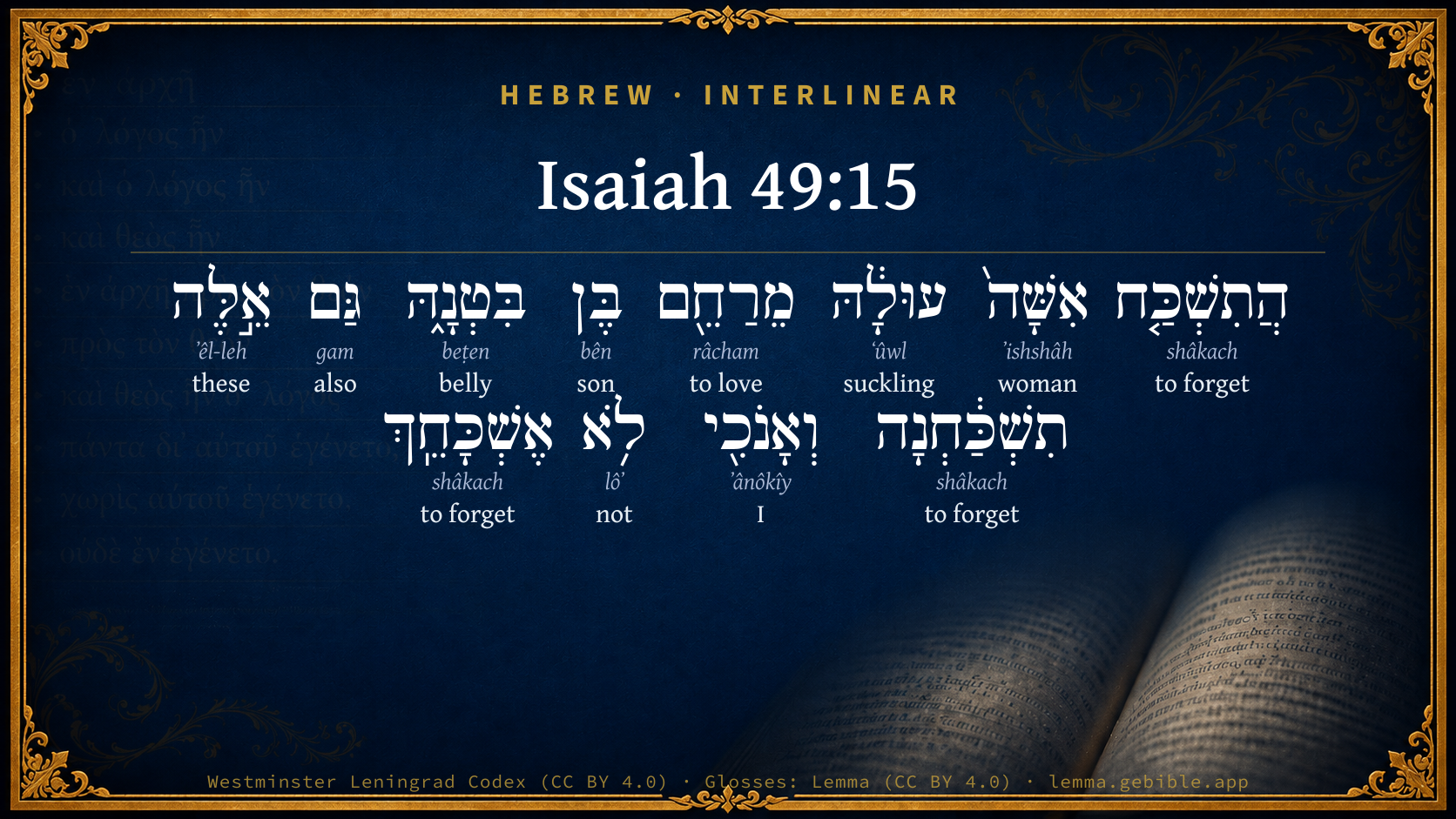
Hebrew (Westminster Leningrad Codex) Isaiah 49:15 appears in the Hebrew Old Testament. The text above is from the Westminster Leningrad Codex. Each word links to its Strong’s number, a concise gloss, and parsing drawn from the Open Scriptures Hebrew Bible morphology. Click any word for its full Brown-Driver-Briggs (BDB) entry.
Download image
Cite this verse

Isaiah 49:15 (World English Bible). Public Domain. Lemma interlinear Bible study tool, https://lemma.gebible.app/v/isaiah/49/15.

Show BibTeX & RIS
BibTeX
RIS
English Translation
Can a woman forget her sucking child, that she should not have compassion on the son of her womb? yes, these may forget, yet I will not forget you.
World English Bible · Public Domain
Download a study sheet

One document with this verse’s original text, its word-by-word gloss line, the meaning frame, cross-references with their text, attributed commentary, and full source and license credits — printable, and it pastes into notes with its structure intact.

This verse Autodidact and up

Study sheet (.html) Plain text (.txt)

A passage Seminary Student

Up to 50 verses in one chapter. A passage sheet keeps up to 6 commentary sources and 12 cross-references per verse, in the order this page ranks them, and says so on the sheet whenever that leaves anything out. Ask for a single verse and you get the Autodidact verse sheet above.

Everything on this page stays free to read, with no account — the sheet is a download of what is already on screen, not access to it.

Want to remove ads? Support Godless Engineer
Compare translations 3

The same verse in 3 English versions, stacked beneath the original-language interlinear above. Click any original word for its lexicon entry.

Each is an independent rendering of the whole verse — the interlinear is not word-aligned to these translations.

Highlighted words mark where these versions differ — a whole-verse word diff, not a word-by-word alignment.

  • World English Bible Public Domain
    Can a woman forget her sucking child, that she should not have compassion on the son of her womb? yes, these may forget, yet I will not forget you.
  • King James Version Public Domain
    Can a woman forget her sucking child, that she should not have compassion on the son of her womb? yea, they may forget, yet will I not forget thee.
  • unfoldingWord Literal Text CC BY-SA 4.0
    “Does a woman forget her nursing child, from having compassion on the son of her womb? Even these may forget, but I, I will not forget you.

unfoldingWord Literal Text — © unfoldingWord, licensed CC BY-SA 4.0. Word-aligned USFM3 via Door43 (git.door43.org/unfoldingWord/en_ult).

Versions to compare (up to 4)

3 of 4 selected

Show all 18 translations

Every available English version of this verse, each an independent rendering of the whole verse.

  • World English Bible Public Domain
    Can a woman forget her sucking child, that she should not have compassion on the son of her womb? yes, these may forget, yet I will not forget you.
  • Berean Standard Bible Public Domain
    “Can a woman forget her nursing child, or lack compassion for the son of her womb? Even if she could forget, I will not forget you!
  • Majority Standard Bible Public Domain
    “Can a woman forget her nursing child, or lack compassion for the son of her womb? Even if she could forget, I will not forget you!
  • King James Version Public Domain
    Can a woman forget her sucking child, that she should not have compassion on the son of her womb? yea, they may forget, yet will I not forget thee.
  • American Standard Version (1901) Public Domain
    Can a woman forget her sucking child, that she should not have compassion on the son of her womb? yea, these may forget, yet will not I forget thee.
  • Revised Version (1885) Public Domain
    Can a woman forget her sucking child, that she should not have compassion on the son of her womb? yea, these may forget, yet will not I forget thee.
  • Geneva Bible (1599) Public Domain
    Can a woman forget her childe, and not haue compassion on the sonne of her wombe? though they should forget, yet wil I not forget thee.
  • Douay-Rheims (1899) Public Domain
    Can a woman forget her infant, so as not to have pity on the son of her womb? and if she should forget, yet will not I forget thee.
  • Young's Literal Translation Public Domain
    Forget doth a woman her suckling, The loved one -- the son of her womb? Yea, these forget -- but I -- I forget not thee.
  • Literal Standard Version CC BY-SA 4.0
    “Does a woman forget her suckling, || The loved one—the son of her womb? Indeed, these forget—but I do not forget you.
  • Unlocked Literal Bible CC BY-SA 4.0
    “Can a woman forget her baby, nursing at her breast, so she does not have compassion on the son she has borne? Yes, they may forget, but I will not forget you.
  • unfoldingWord Literal Text CC BY-SA 4.0
    “Does a woman forget her nursing child, from having compassion on the son of her womb? Even these may forget, but I, I will not forget you.
  • Darby Bible Public Domain
    Can a woman forget her sucking child, that she should not have compassion on the son of her womb? Even these forget, but I will not forget thee.
  • World Messianic Bible Public Domain
    “Can a woman forget her nursing child, that she should not have compassion on the son of her womb? Yes, these may forget, yet I will not forget you!
  • Webster's Bible Public Domain
    Can a woman forget her sucking child, that she should not have compassion on the son of her womb? yes, they may forget, yet I will not forget thee.
  • Free Bible Version CC BY-SA 4.0
    Really? Can a mother forget her nursing baby? Can she forget to be kind to the child she carried in her womb? Even if she could forget, I will never forget you!
  • Bible in Basic English Public Domain
    Will a woman give up the child at her breast, will she be without pity for the fruit of her body? yes, these may, but I will not let you go out of my memory.
  • JPS Tanakh (1917) Public Domain
    Can a woman forget her sucking child, that she should not have compassion on the son of her womb? Yea, these may forget, yet will not I forget thee.

Literal Standard Version (2020), Covenant Press — licensed CC BY-SA 4.0. Text via the HelloAO Bible API (eBible.org). Unlocked Literal Bible (unfoldingWord) — licensed CC BY-SA 4.0. Text via the HelloAO Bible API (eBible.org). unfoldingWord Literal Text — © unfoldingWord, licensed CC BY-SA 4.0. Word-aligned USFM3 via Door43 (git.door43.org/unfoldingWord/en_ult). Free Bible Version, Dr. Jonathan Gallagher — licensed CC BY-SA 4.0. Text via the HelloAO Bible API (eBible.org).

Word by word

More ways to search: Search by grammar → Find every occurrence → Compare this word →

Practice this passage: Drill this verse → Learn its vocabulary →

עוּלָ֔הּ
ʻûwl
H5764
“suckling · her”
Noun, Common, Masculine, Singular, Construct + Suffix, Personal, 3rd Person, Feminine, Singular
Part of Speech
Noun
Type
Common
Gender
Masculine
Number
Singular
State
Construct
Full BDB Definition

Origin: from H5763

TWOT: 1579a

suckling, sucking child
  1. הֲתִשְׁכַּ֤ח shâkach H7911 “to forget” Particle, Interrogative + Verb, Qal, Imperfect, 3rd Person, Feminine, Singular
  2. אִשָּׁה֙ ʼishshâh H802 “woman” Noun, Common, Feminine, Singular, Absolute
  3. מֵרַחֵ֖ם râcham H7355 “from · to love” Preposition + Verb, Piel, Infinitive Construct
  4. בֶּן bên H1121 “son of” Noun, Common, Masculine, Singular, Construct
  5. בִּטְנָ֑הּ beṭen H990 “belly · her” Noun, Common, Feminine, Singular, Construct + Suffix, Personal, 3rd Person, Feminine, Singular
  6. גַּם gam H1571 “also” Particle, Accusative
  7. אֵ֣לֶּה ʼêl-leh H428 “these” Pronoun, Demonstrative, Common, Plural
  8. תִשְׁכַּ֔חְנָה shâkach H7911 “to forget” Verb, Qal, Imperfect, 3rd Person, Feminine, Plural
  9. וְאָנֹכִ֖י ʼânôkîy H595 “and · I” Conjunction + Pronoun, Personal, 1st Person, Common, Singular
  10. לֹ֥א lôʼ H3808 “not” Particle, Negative
  11. אֶשְׁכָּחֵֽךְ shâkach H7911 “to forget · you” Verb, Qal, Imperfect, 1st Person, Common, Singular + Suffix, Personal, 2nd Person, Feminine, Singular

About this verse

These counts appear in no published source. They are computed here, from the morphology-tagged text and Lemma’s own curated glosses. What Lemma adds →

12
words
10
distinct lemmas
Prophets
section

Notable vocabulary

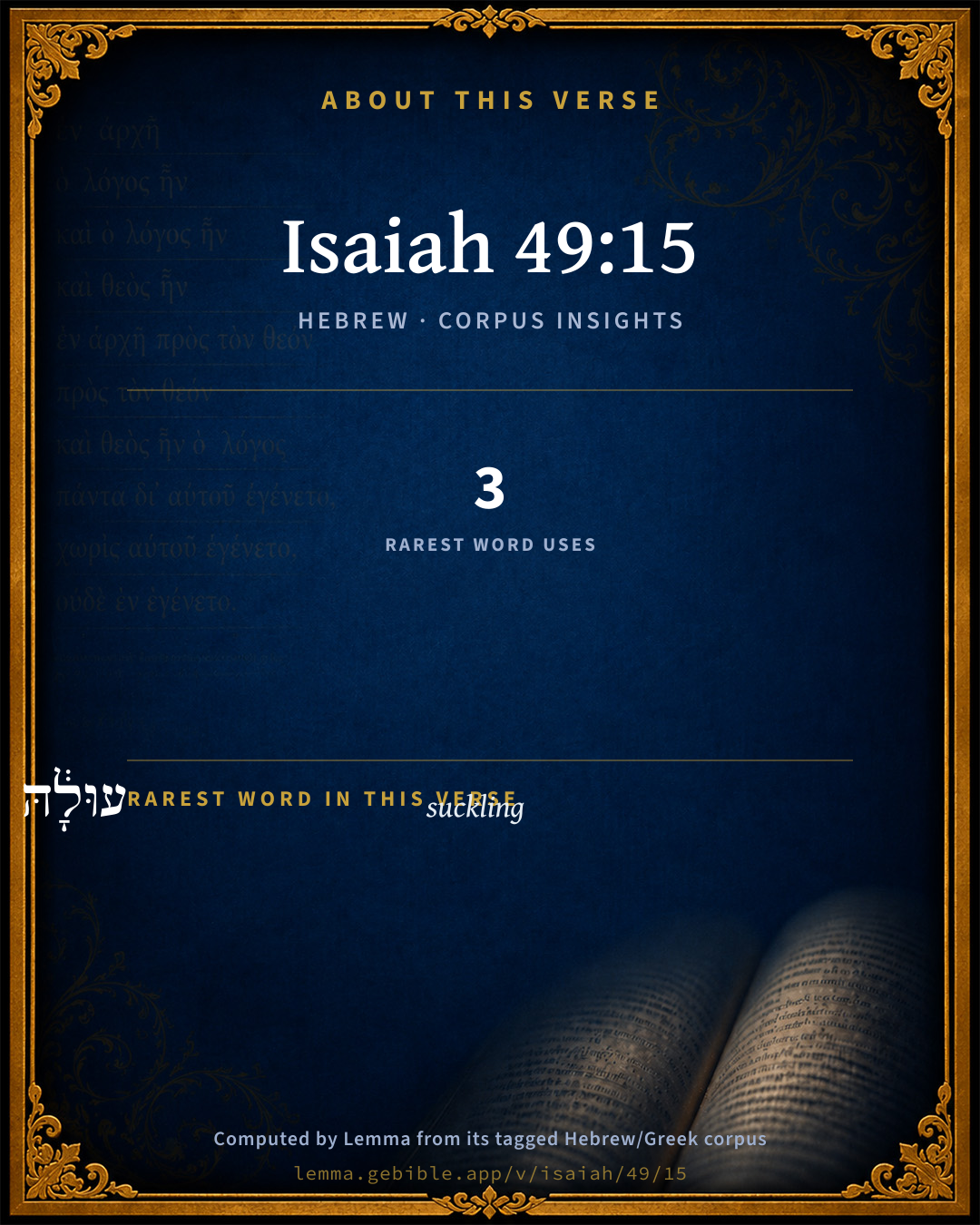
The rarest word here is עוּלָ֔הּ suckling H5764 — appearing just 3 times in the whole Hebrew Bible.

Shared distinctive vocabulary

עוּלָ֔הּ suckling H5764 occurs in 3 verses of the Hebrew Bible. Also found in:

Grammatical profile

  • 4 verbs
  • 4 nouns
  • 2 pronouns
  • 2 particles

Verb forms

  • הֲתִשְׁכַּ֤ח Qal · Imperfect
  • מֵרַחֵ֖ם Piel · Infinitive Construct
  • תִשְׁכַּ֔חְנָה Qal · Imperfect
  • אֶשְׁכָּחֵֽךְ Qal · Imperfect

Repetition

A word recurs within this verse — often emphatic in Hebrew:

  • הֲתִשְׁכַּ֤ח to forget H7911 ×3

Hebrew & Septuagint length

In English translation the verse runs 29 words from the Hebrew and 35 from the Septuagint (LXX English) — closely comparable.

A rough comparison of the two English renderings, which tokenize alike — not a word-level alignment.

Word counts can differ between the Hebrew and the Greek without any difference in meaning — e.g. the Hebrew direct-object marker אֵת has no separate Greek word, and Greek often adds the article ὁ.

Cross-references

11

Topical passages linked to Isaiah 49:15 in the Treasury of Scripture Knowledge — connected by theme and wording, ordered by reader-vote popularity; previews shown in the World English Bible.

  • Psalms 103:13 Like a father has compassion on his children, So Yahweh has compassion on those who fear him.
  • Isaiah 44:21 Remember these things, Jacob, and Israel; for you are my servant: I have formed you; you are my servant: Israel, you shall not be forgotten by me.
  • Matthew 7:11 If you then, being evil, know how to give good gifts to your children, how much more will your Father who is in heaven give good things to those who ask him!
  • Jeremiah 31:20 Is Ephraim my dear son? is he a darling child? for as often as I speak against him, I do earnestly remember him still: therefore my heart yearns for him; I will surely have mercy on him, says Yahweh.
  • Hosea 11:1 "When Israel was a child, then I loved him, And called my son out of Egypt.
  • Malachi 3:17 They shall be mine," says Yahweh of Hosts, "my own possession in the day that I make, and I will spare them, as a man spares his own son who serves him.
  • Lamentations 4:10 The hands of the pitiful women have boiled their own children; They were their food in the destruction of the daughter of my people.
  • 1 Kings 3:26–27 Then spoke the woman whose the living child was to the king, for her heart yearned over her son, and she said, Oh, my lord, give her the living child, and in no way kill it. But the other said, It shall be neither mine nor yours; divide it.
  • 2 Kings 6:28–29 The king said to her, What ails you? She answered, This woman said to me, Give your son, that we may eat him today, and we will eat my son tomorrow.
  • 2 Kings 11:1–2 Now when Athaliah the mother of Ahaziah saw that her son was dead, she arose and destroyed all the seed royal.
  • Romans 11:28–29 Concerning the Gospel, they are enemies for your sake. But concerning the election, they are beloved for the fathers' sake.

Cross-references courtesy of OpenBible.info (CC BY 4.0).

Hebrew and Greek witnesses Masoretic Hebrew ↔ Greek Septuagint

The same verse in the two great witnesses to the Old Testament, shown verse-for-verse.

These are two independent witnesses, not word-aligned to each other, and the Septuagint is shown in lemma (dictionary) form.

Hebrew Isaiah 49:15 Masoretic · Westminster Leningrad Codex

הֲתִשְׁכַּ֤ח אִשָּׁה֙ עוּלָ֔הּ מֵרַחֵ֖ם בֶּן בִּטְנָ֑הּ גַּם אֵ֣לֶּה תִשְׁכַּ֔חְנָה וְאָנֹכִ֖י לֹ֥א אֶשְׁכָּחֵֽךְ

Can a woman forget her sucking child, that she should not have compassion on the son of her womb? yes, these may forget, yet I will not forget you.

World English Bible · Public Domain

Greek LXX Isaiah 49:15 Septuagint · lemma form

μή ἐπιλανθάνω γυνή ὁ παιδίον αὐτός ὁ μή ἐλεέω ὁ ἔκγονος ὁ κοιλία αὐτός εἰ δέ καί ἐπιλανθάνω οὗτος γυνή ἀλλά ἐγώ οὐ ἐπιλανθάνω σύ εἶπον κύριος

Will a woman forget her child, so as not to have compassion upon the offspring of her womb? but if a woman should even forget these, yet I will not forget you, says the Lord.

LXX2012 (modern English Septuagint) · Public Domain

Hebrew: Westminster Leningrad Codex (CC BY 4.0). Greek: Septuagint (public domain); English from LXX2012 (modern English Septuagint) (Public Domain). How the Septuagint differs from the Hebrew →

Targum (Aramaic paraphrase)

1

The Targum is the ancient Jewish Aramaic paraphrase of the Hebrew Scriptures — an interpretive translation, not the Hebrew text itself. Onkelos (literal) and Pseudo-Jonathan (expansive) render the Torah, and Jonathan the Prophets. Coverage is partial: where no permissively-licensed English translation exists for a verse, only the Aramaic is shown. This is verse-level text, not a word-by-word alignment to the Hebrew.

  1. Targum Jonathan Prophets (Joshua–Malachi)
    הַאֶפְשַׁר דְתִתְנְשֵׁי אִתְּתָא בְּרָהּ מִלְרַחָמָא עַל בַּר מְעָהָא מְתִיבָא כְּנִשְׁתָּא דְיִשְׂרָאֵל וַאֲמַרַת אִם לֵית קֳדָמוֹהִי אִתְנַשָׁאָה דִלְמָא לָא מִתְנַשֵׁי לִי יַת דַעֲבָדִית עֵגֶל דִדְהַב אֲמַר לָהּ נְבִיָא אַף אִלֵין אִתְנַשְׁיָן מְתִיבָא וְאֶמְרָה לֵיהּ אִם אִית קֳדָמוֹהִי אִתְנְשָׁאָה דִלְמָא מִתְנְשֵׁי לִי יַת דַאֲמָרִית בְּסִינַי נַעְבֵּד וּנְקַבֵּל מֵיתִיב וְאָמַר לָהּ מֵימְרִי לָא יְרַחֲקִינָךְ:

    Is it possible that a mothers can forget her child, that she should not have compassion on the son of her womb? The congregation of Israel answered and said: If there is no forgetfulness with Him, perhaps He will not forget that I have made a calf of gold? The prophet said to her, Yea, these things shall be forgotten. And she said to him, If there is forgetfulness with Him, perhaps it will be forgotten that I said on Sinai: We will do and obey? He answered and said to her: My Word shall not cast you off.

    Targum Jonathan — Aramaic: “Mikraot Gedolot” (public domain). English: “Sefaria Community Translation” (CC0 1.0 (public-domain dedication)); “London "Chaldee Paraphrase," 1871” (public domain). Text via Sefaria.

Commentary

Notes on Isaiah 49:15 from classic Christian and Jewish commentators (each source and its license shown beneath its notes). The classic Christian expositions comment on the surrounding passage and are grouped to its opening verse, so a note may address several verses; the Jewish commentaries on the Tanakh (Rashi and others) are per-verse, so they appear only where the commentator wrote on this verse.

Lemma curates 59 commentaries, every one of them public domain or Creative Commons licensed, each selected and text-cleaned for this edition rather than reprinted as found. About our sources →

Trapp's Complete Commentary

John Trapp

Isa 49:15 Can a woman forget her sucking child, that she should not have compassion on the son of her womb? yea, they may forget, yet will I not forget thee.

Ver. 15. Can a woman forget her sucking child?] It were a wonder she should grow out of kind as to be so unkind. The mother fasteth that her child may eat, waketh that he may sleep, is poor to make him rich, slighted to make him glorious. Occidar mode imperet, said she in story. God’s love to his is more than maternal. All the mercies of all the mothers in the world being put together would not make the tithe of his mercy. David saith much, {Psa 103:13} "as a father pitieth his children," &c. Great was Jacob’s love to Benjamin, David’s to Absalom, so that Joab upbraideth him with it. {2Sa 19:6} But God here saith more, "Can a woman forget," &c. The harlot could not yield to have her child divided. Arsinoe interposed her own body between the sword of the murderer and her dear children. Melanchthon telleth of a countess of Thuringia, who being compelled by her husband’s cruelty to go into banishment from her children, when she took leave of her eldest son she bit a piece of his cheek out, amoris notam cruento morsu imprimens, and so marked him for her own. {a} This is somewhat; but what is all this to the infinite? Was there ever love like God’s love in sending his Son to die for sinners? Christ himself wondereth at it; {Joh 3:16} this was a sic so, without a sicut, just as, there being nothing in nature wherewith to parallel it. See Rom 8:32.

Yea, they may forget.] They may put off natural affection, as some did in times of Popish persecution; Julius Palmer’s mother for instance. King Edward the martyr was basely murdered by his own mother. Egelred succeeded him, and much mourned for his brother, being but ten years old, which so enraged his mother, that taking wax candles, which were readiest at hand, she therewith scourged him so sore, that he could never after endure wax candles to be burnt before him.

{a} Chronic., lib. v.

John Trapp, A Commentary or Exposition upon All the Books of the Old and New Testament (1647–1656) — public domain. Text from a community e-Sword module.

The Biblical Illustrator

Joseph S. Exell

Isa_49:15-16

Can a woman forget her sucking child?

--

Unforgetting love

1. As. Jehovah,, had just been announcing His purposes of world-wide mercy--salvation to the ends of the earth--we may take these words, in the first instance, as the plaint of literal Israel: The Lord has chosen the

Gentile, and in doing so, He has forgotten me. The wild olive has been grafted in; will not the natural olive be rejected?

2. Or it may be taken as the wail of the Church universal, prompted in times of rebuke and blasphemy, defection and apostasy, cruelty and persecution, when blood is flowing and martyr-fires are lighted; or worse, when faith is weak, and love is waxing cold, and knees are bowing to Baal.

3. Or again, the utterance may be regarded as the exclamation of the individual soul, amid frowning providences and baffling dispensations. In all the three cases Jehovahs reply is the same--the assurance of His inviolable, unchanging, everlasting love. This He enforces by two arguments.

I. THE MOTHERS INSTINCTIVE FONDNESS FOR HER BABE.

II. THE GRAVERS ART (Isa_49:16). (J. R. Macduff, D. D.)

Maternal love and tenderness

Maternal love and tenderness is the strongest and most enduring of instincts. It holds potent sway even in the brute creation, and among the lower tribes of animated being. We see it exemplified in the timid bird hovering with wailing cry over the threatened or despoiled nest, and, despite its feebleness and weakness, ready to give battle to the invader. We see it in the familiar scriptural emblem of the hen gathering her brood of chickens under her wings in threatening storm, or in the hour of danger. We see it in the bolder watch the mother of the eaglets keeps over her young in the eyry on cliff or mountain-side, as she disputes, with ruffled plumage, the assault of the plunderer. We see it in the proverbial fierceness of the bear robbed of her whelps, or in the maddened roar of the lioness bereaved of her cubs, as she lashes her sides with her tail, and makes mountain and forest ring with the proclamation of her wrongs. But it is the mother and her infant babe (the human parent) in whom this deep-seated instinct has its highest, truest illustration. (J. R. Macduff, D. D.)

Maternal affection the moat appropriate image of Divine benevolence

I. MARK SOME STRIKING POINTS OF RESEMBLANCE BETWEEN THE COMPASSION OF A MOTHER AND THE COMPASSION OF GOD.

1. The first distinctive feature in the affection of a mother is, that it is coeval with the maternal character. It springs at once into existence, vigorous and perfect, and becomes henceforth a permanent and essential part of her constitution. Other affections are produced, and nourished by degrees. Love to parents, gratitude to benefactors, sympathy with the afflicted, and benevolence to our kind, are all, in a very considerable degree, the offspring of instruction and of association. But of maternal tenderness, it may be truly said that it is an instantaneous creation; the stamp of heaven, impressed upon a mothers heart, and acting in all its vigour the moment she hears the cry of helplessness. Just, but fair, representations of that love of God, which is far above all similitude, as it passes all understanding! In implanting this affection in a mothers bosom, He has furnished the best and most winning image of His own benignity; and by interweaving it in her constitution, He intends to show that His own love is not a feeling, adventitious or fluctuating; but an unchangeable attribute of His being--that predominating principle, of which His other attributes are nothing more than varied ramifications. A mother, however, is frail and fallible. She may forget even her sucking child. But God cannot forget to love.

2. The next quality distinctive in the love of a mother is that of all affections with which we are acquainted it is the purest in its source, and the most disinterested in its exercise. No created being can, in any way, be profitable unto God, for He is independent and unchangeable, both in nature and in happiness. All the life which He communicates; all the means of enjoyment which He spreads through creation; every faculty and every affection that ennobles and blesses the rational soul in its highest advances to perfection, springs from the exhaustless source of unmixed and unbounded benevolence.

3. The last quality I shall remark as peculiarly striking in the love of a mother is, that its exertions and sacrifices are not only disinterested, but, beyond every other example, patient and persevering. And as the love of a mother is not overcome by provocation, neither is it chilled by absence. Such is the almost unconquerable patience of a mothers love. Still it may be conquered; and she may cease to have compassion. But God cannot forget His children- How beautifully do the temper and conduct of Jesus display the riches and the perseverance of Divine love! It is said of Him by an evangelist, that having loved His own, He loved them to the end: and the remark is verified by His whole life.

II. DRAW FROM THE SUBJECT SOME PRACTICAL CONCLUSIONS. It is impossible not to advert to the design and uses of this wonderful affection, as indicating, in the most striking manner, the unbounded wisdom and benignity of Providence. If we had but this one evidence, it would be sufficient to convince a reflecting mind that a paternal care is exercised in the government of the world, and that the tender mercies of God are over all His works. Take away the strong instinctive feelings of a mother, and what becomes of the living creation? But whilst man, in common with other animals, owes to this instinctive feeling, the preservation, growth, and vigour of his body, he owes to it, what is still more important, the commencement of those moral affections which constitute, in their progressive development, the strength and the glory of his moral and social life. It is in the bosom of a mother that these affections are generated. Accustomed to look to that bosom for nourishment, protection, and pleasure, it raises thence its infant smiles; it catches answering smiles of complacency and joy; its heart begins to dilate with instinctive gladness; its sensations of delight are gradually modified into those of fondness and gratitude; and as it continues to mark the love of a mother, it learns from her the art of loving. Reflections--

1. As we owe everything to a mother, we should be as unwearied in paying the debt, as she was in the acts of tenderness by which it is contracted.

2. Let us learn to form just conceptions of the Divine nature, and of the great ends of the Divine government. (J. Lindsay, D. D.)

Better than a mother

Our subject is the superiority of an utter over an almost impossibility.

I. ALMOST AN IMPOSSIBILITY. If it is not an impossibility for a woman to forget her sucking child, it is certainly next door to one, and the Lord could not have obtained any higher earthly illustration of His tenderness and love. In order to show it you will see the Lord has pressed into His service a variety of words, all serving to increase the beauty of the simile.

1. Woman. God who made the heart of woman as well as man, knows that there is a tenderness in her disposition exceeding that of mans, and therefore He chooses the highest type to illustrate His sympathy.

2. It is not merely the tenderness of the woman, but the tenderness of the woman who is a mother. God not only employs the highest type, but the highest specimen of that type. Mother! What associations of loving tenderness are in the very name. The word touches a secret spring in the heart, and conjures back scenes of the past. It brings to view in the dim distance a sweet face that used to bend over our little cot at eventide, and impress a kiss upon our brow. It reminds of one who used to smile when we were happy, and weep when obliged to correct us. It calls to remembrance one who always seemed interested in our little tales of adventure, and never laughed at our little sorrows that seemed to us so large. It was her face we gazed last upon when we went away to school, and it was into her arms we first rushed when the holidays brought us home. It was thought of her that kept us in the house of business, and held us back from sin with unseen silken cords; and when those dark locks of hers became silvered with advancing age, we only thought an extra charm had crowned her brow. You forget not the love that was strong as death, and escaped from her dying lips in words you treasure to this day. Her name has still a magic power. There is one feature in a mothers love that must be mentioned, as it constitutes the chiefest beauty of the type. Her love is not love drawn forth by prosperity or dispelled by adversity. She loves her son not because of what he has, but because of what he is.

3. There is yet one other delicate touch in the picture which gives to it the perfection of beauty. The tenderness described is not only that of a woman, or even that of a mother, but of a mother towards her sucking child. This crowns the description, and should drive away the last remnant of unbelief. I can imagine a mother sometimes forgetting her grownup son, who has long since attained the age of manhood, and is himself the head of a family. I can believe that the daughter, married into some other family and well provided for, is not always in the thoughts of her mother, but it is almost impossible to conceive the sucking child for a moment forgotten Its very life is dependent on the mothers thoughtfulness, and its utter helplessness becomes its security. Yea, she could not forget it even if she desired; nature itself would become a sharp reminder, and her own pain would plead her infants cause. Behold, how God has strengthened His illustration by every possible means. Then comes the question, Can she forget? There is s moments pause, and the answer is heard, She may. Mothers may forget their sucking children, either literally, or by acting as if they did.

II. AN UTTER IMPOSSIBILITY. The true magnitude of an object can only be understood by comparison, and it is by contrast the mind grasps the reality. God only knows the love of God. Its height and depth, its length and breadth defy all measurement. They may forget. Yet, and it is this word that shoots aloft beyond all human sight, will I not forget thee.

1. His nature forbids it. God is love. Not loving, poor mortal can be that, but love itself.

2. His promises forbid it.

3. The travail of the Redeemers soul is alone sufficient argument, that they for whom it was endured shall be remembered.

4. His honour renders it an utter impossibility. (A. G. Brown.)

Gods love greater than a mothers

I. A MOTHERS LOVE FOR HER CHILD IS BUT A FRACTION DERIVED FROM GODS LOVE FOR MAN.

II. THE STRONGEST AFFECTION OF A MOTHER IS SUBJECT TO MUTATIONS.

1. The conduct of the mother may cool or even quench this spark within her. In some cases debauchery, intemperance, and vice have extinguished this sacred fire, and the parent has become unnatural and cruel to her offspring.

2. The conduct of the child may cool or even quench this spark within her. But the affection of the Eternal is subject to no such mutation. Who, then, shall separate us from the love of God, &c.

III. THE OBJECT OF THE MOTHERS LOVE IS NOT SO NEAR TO HER AS THE OBJECT OF THE DIVINE AFFECTION.

1. The mother is not the owner of the child. His limbs, faculties, being, are not hers. But God is the absolute proprietor of man. All souls are His.

2. The mother is not the life of the child. Her life is distinct from that of her offspring. But God is the very life of man.

IV. THE FAILURE OF THE MOTHERS AFFECTION TOWARDS HER OFFSPRING WOULD NOT BE SO TERRIBLE AS THE FAILURE OF GODS AFFECTION TOWARDS THE GOOD. If God forsakes a man, he is ruined inevitably, and for ever. (Homilist.)

A mothers love

The following touching incident was related by the Rev. Norman Macleod, of Glasgow:--His father was preaching on the love of God, and to illustrate his subject, referred to a poor widow in Scotland, who, being distressed for rent, resolved to go, carrying her helpless babe with her, and borrow of a friend that lived ten miles from her home. The journey lay across a bleak mountain, and the day was rough and snowy. Soon after her departure, the neighbours felt it would be impossible for her to reach her destination, and feared that her very life was endangered by the snowstorm that was rapidly gaining in violence. Twelve strong men resolved to go in search; far away on the mountain they found the poor woman lying in the snow, sleeping the sleep of death. Where was the babe? In a sheltered nook in the rock, close by, warm and alive, because wrapped in the garments of which the mother had deprived herself. A mothers love unchangeable:--As I was walking down our street the other day, I saw a woman, good and pure, refined and cultured, walking with a man whose face was red with drink, whose form and look bore marks of deepest dissipation. I stepped to her side, and said, Woman, why are you with this man? She little heeded me at first, as she supported his unsteady steps Woman, why do you not hand him over to the police? She drew herself up, and with a righteously indignant anger, mixed with pathos, said, Sir! I am his mother. (C. S. Macfarland, Ph. D.)

The Biblical Illustrator, edited by Joseph S. Exell (c. 1880s–1900s) — public domain. Text from a community e-Sword module.

Joseph Benson's Commentary

Isa 49:15-16. Can a woman forget her sucking child — God is often represented as bearing a fatherly affection toward his people, but here the comparison is raised higher, and he speaks of himself as having a tenderness for them, similar to that which a mother hath toward the fruit of her womb. “The image is common and frequent; yet it is wrought up with so much grace, embellished with so much elegance, and expressed in such pathetic terms, that nothing can exceed it in beauty and force; nothing can convey a stronger idea of the maternal, the more than maternal regard, which God hath for his people.” Yea, they may forget, yet will I not forget thee — The turn in this clause is more expressive than a volume. As if he had said, Earthly parents sometimes are so unnatural and monstrous; but do not entertain such unworthy thoughts of me. Behold, I have graven thee upon the palms, &c. — Mine eye and heart are constantly upon thee. “This is certainly an allusion,” says Bishop Lowth, “to some practice, common among the Jews at that time, of making marks on their hands or arms by punctures on the skin, rendered indelible by fire or staining, with some sort of sign, or representation of the city or temple, to show their affection and zeal for it. It is well known that the pilgrims at the holy sepulchre get themselves marked in this manner with what are called the ensigns of Jerusalem. Maundrell, p. 75; where he tells us how it is performed: and this art is practised by travelling Jews all over the world at this day.” See also Vitringa and Michaelis’s notes. Or the allusion may be merely to the common practice of men, who use to put signs upon their hands or fingers, of such things as they especially wish to remember. Thy walls are continually before me — The ruins and desolations of my church are always in my thoughts, nor shall I forget or neglect to repair them, and grant her deliverance from her enemies, and protection at the proper time.

Joseph Benson's Commentary on the Old and New Testaments (1811–1818) — public domain. Text from a community e-Sword module.

Jamieson, Fausset & Brown

Robert Jamieson, A. R. Fausset & David Brown

(Isa 44:21; Psa 103:13; Mat 7:11).

Jamieson, Fausset & Brown — Commentary Critical and Explanatory on the Whole Bible (1871) — public domain (CC PDM 1.0). Text via the HelloAO Bible API.

Ellicott's Commentary for English Readers

(15) Can a woman forget . . .?—The love of Jehovah for His chosen ones is more than that of a father, more tender and unchangeable even than the maternal love which exists often in the most depraved. Even that may perish, but not so His pitying affection.

A Bible Commentary for English Readers, edited by Charles John Ellicott (1878–1897) — public domain. Text from a community e-Sword module.

The Cambridge Bible for Schools and Colleges

gen. ed. J. J. S. Perowne

15. Jehovah’s remembrance of Zion is more enduring than the strongest human affection. Even a mother’s pity for an infant may fail. yea, they may forget] Or, should even these forget (Cheyne).

yet will I not forget thee] See on ch. Isa_44:21.

The Cambridge Bible for Schools and Colleges (gen. ed. J. J. S. Perowne; Cambridge University Press, 1878–1918) — public domain. Text from a community e-Sword module.

John Gill's Exposition

Can a woman forget her sucking child, that she should not have compassion on the son of her womb?.... This is the Lord's answer to the church's complaint, instancing in the care and affection of a mother to her child, thereby illustrating his love to his people; he instances in a "woman", the tender sex; in a "child" of her's, an infant, not one grown up, from which her affections might be alienated by disobedience; her suckling child, she had in her arms, and on her knees, and whom her breasts would put her in mind of; and since one that is not an own child may be suckled, it is called "the son of her womb"; and is it possible for such an one to be forgotten?

yea, they may forget; through inadvertency, want of affection, a cruel disposition, hurry of business, sickness, public calamities, &c. Lam 4:3, such monsters in nature there may be, though rare:

yet will I not forget thee; he cannot forget, because of is nature, on which forgetfulness cannot properly fall; he will not, because of his promise, which never fails; he may seem to his people to have forgotten them, and he may be thought to have done so by others; he forgets their sins, but not their persons; he cannot forget his love, nor his covenant with them, nor his promises made to them; nor does he forget their love to him, nor their works, words, and thoughts; the righteous are had by him in everlasting remembrance. All this suggests that the Lord stands in the relation of a parent to his people, and they stand in the relation of children to him; they are born of him, and are as it were pieces of himself, and little images of him, and dear to him as the apple of his eye; they are like sucking children, that suck in the milk of his word, and suck at the breasts of his ordinances; and they are used by him in the most tender manner, as infants are; they are kissed by him, and dandled on the knee; they are led by him, and taught to go; he delights in them when they begin to speak in prayer or praise, though in a lisping and stammering manner; all their little actions are engaging, their works done by them, though imperfect, and a great deal of childishness in them; when anything ails them, he sympathizes with them, he takes care of them, and provides for them; and it is a concern to him whenever he is obliged to chastise them, and can he therefore forget them?

John Gill's Exposition of the Whole Bible (1746–1763) — public domain (CC PDM 1.0). Text via the HelloAO Bible API.

Albert Barnes' Notes on the Bible

Can a woman forget her sucking child? - The design of this verse is apparent. It is to show that the love which God has for his people is stronger than that which is produced by the most tender ties created by any natural relation. The love of a mother for her infant child is the strongest attachment in nature. The question here implies that it was unusual for a mother to be unmindful of that tie, and to forsake the child that she should nourish and love.

That she should not have compassion - That she should not pity and succor it in times of sickness and distress; that she should see it suffer without any attempt to relieve it, and turn away, and see it die unpitied and unalleviated.

Yea, they may forget - They will sooner forget their child than God will forget his afflicted and suffering people. The phrase ‘they may forget,’ implies that such a thing may occur. In pagan lands, strong as is the instinct which binds a mother to her offspring, it has not been uncommon for a mother to expose her infant child, and to leave it to die. In illustration of this fact, see the notes at Rom 1:31.

Albert Barnes' Notes on the Bible (1834–1885) — public domain. Text from a community e-Sword/MySword module.

Matthew Poole's English Annotations

Earthly parents sometimes are so unnatural and monstrous; but do not entertain such unworthy thoughts of me. I will remember thee effectually, to bring thee out of Babylon, and, which is infinitely greater, to send my Son into the world to work out eternal redemption for thee.

Matthew Poole's English Annotations on the Holy Bible (1683–1685) — public domain. Text from a community e-Sword/MySword module.

Whedon's Commentary on the Bible

Daniel D. Whedon

15. Can a woman forget, etc. — The Lord’s yearning over his children is far greater than a human mother’s for her own offspring: impossible, therefore, is it for him to forget the people he covenanted to save, if they also would keep covenant with him.

Daniel D. Whedon (gen. ed.), Commentary on the Old and New Testaments (1874–1909) — public domain. Text from a community e-Sword module.

The Pulpit Commentary

Can a woman forget?.... yea, they may forget. In the siege of Samaria by Benhadad, King of Syria, a mother, we are told, (2Ki_6:28, 2Ki_6:29) boiled her son for food. In the last siege of Jerusalem similar horrors are reported (Joseph., "Bell. Jud:," 6:3, 4). Mothers have even been known in England who have forced their tender and innocent daughters to commit deadly sin. Yet will I not forget, The love of God surpasses that of either father or mother. "When my father and my mother forsake me," says David, "then the Lord will take me up". (Psa_27:10) "God is 1Jn_4:8) in his very essence; and his infinite love is deeper, tenderer, truer, than finite love can ever be. Still, that which is nearest to it upon earth is, doubtless, the love of a mother for her children. (see Isa_66:13)

Vers. 15, 16. God thinking upon us.

No language could be stronger than that which is here employed to assure us of God"s remembrance of us. We are thankful for the fulness and force of the promise; for there are at least

I THREE TEMPTATIONS TO THINK OTHERWISE. There is:

1. A consciousness of our littleness. Thinking of the smallness of this earth as one little planet among the Whole stellar universe; of the insignificance of any nation, group, or family of mankind; of the infinitesimal character of the individual, we are apt to suppose that each one of us is, in the matter of intrinsic worth, undeserving of God"s regard. This is very shallow reasoning; but it is not uncommon, nor is it without influence among men.

2. A sense of our sin. It is natural enough that we should conclude that our guilt in God"s sight has so "separated between us and him" that he banishes us from his thought, as a human father who has been grievously wronged by his son dismisses him from his mind.

3. An appearance off desertion. When trial comes upon trial, when all the waves and billows of affliction go over our soul, when all things seem to be against us as they seemed of old to Jacob, it is not surprising if we look up despondently, or even despairingly, to heaven and say, "Hath God forgotten to be gracious?" "My God, my God, why hast thou forsaken me?" There may come times to us, as to others, when we shall seem abandoned by men, and at length deserted of God the darkest,. bitterest, saddest hour of our life, even as it was of his. (Mat_27:26)

II THE STRONG DIVINE REASSURANCE. The tone of the text is as pathetic as its argument is convincing. The appeal is made to the tenderest human affection that of motherly love. God says to us, "Though your love for one another may fail, even where the tie is the tenderest and strongest, yet my remembrance of you shall not fail." Human attachments do not suffice to indicate the fulness of Divine fidelity; that surpasses anything which our experience will illustrate. He further grants us the assurance that he is as one who has taken the most effective measures to secure the necessary mindfulness; he has, so to speak, made indelible impressions where he cannot fail to see them. He goes as far as language can go to implant in our minds the conviction that, however our logical understanding may argue, however appearances may be against it, we are never out of his mind; he always has us in his heart. The extremity will never come in which we may not say, "I am poor and needy, but the Lord thinketh upon me. C.

The Pulpit Commentary (1880–1919), ed. H.D.M. Spence-Jones & Joseph S. Exell — public domain. Text from a community e-Sword module.

J. A. Alexander on Isaiah

Joseph Addison Alexander

“Will a woman forget her suckling, from having mercy (i.e., so as not to have mercy) on the son of her womb? Also (or even) these will forget, and I will not forget thee.” The constancy of God’s affection for His people is expressed by the strongest possible comparison derived from human instincts. There is a climax in the thought, if not in the expression. What is indirectly mentioned as impossible in one clause, is declared to be real in the other. He first declares that He can no more forget them than a woman can forget her child; He then rises higher and declares that He is still more mindful of them than a mother. The future verb at the beginning implies without expressing a potential sense. If she will, she can; if she cannot, then of course she will not. For the negative use of the preposition ‘from’, see above, on Isa 44:18. There is no need of departing from the obvious meaning of the prophet’s language, which is not hypothetical but categorical. He does not say that if or though a woman could forget her child He would not follow her example, but asserts directly that she can and will, and puts this fact in contrast with His own unwavering constancy. The plural in the last clause, like the singular in the first, denotes the whole class. He does not say that all mothers thus forget their children, nor that mothers generally do so, but that such oblivion is not unknown to the experience of mothers as a class, or of woman as an ideal individual. The primitive simplicity with which the Hebrew idiom employs the simple copulative and, where we feel the strongest adversative expression to be necessary, really adds to the force of the language, when it is once understood and familiar. The ‘and’ may be retained, and yet the antithesis expressed in English by supplying ‘yet’: and (yet) I will not forget thee.

Joseph Addison Alexander, The Prophecies of Isaiah (1846–1847; New York: Scribner, 1870–1878) — public domain. Text from a community e-Sword module.

Rashi

Rabbi Shlomo Yitzchaki (Rashi)

Shall a woman forget her sucking child Heb. עוּלָהּ, similar to עוֹלֵל.

from having mercy on the child of her womb Heb. מֵרֶחֶם בֶּן-בִּטְנָהּ.

These too shall forget Even if these forget, I will not forget you.

Rashi on the Tanakh — English translations: “The Judaica Press complete Tanach with Rashi, translated by A. J. Rosenberg” (CC BY 4.0); “Pentateuch with Rashi's commentary by M. Rosenbaum and A.M. Silbermann, 1929-1934” (public domain); “The Metsudah Tanach series, Lakewood, N.J” (CC BY 4.0); and “The Book of Joshua, Metsudah Publications, 1997” (CC BY 4.0). Text via Sefaria.

Ibn Ezra

Rabbi Abraham ibn Ezra

Can a woman, etc. This is mentioned, because God has given to woman a natural disposition to have pity on her children.

עולל═עול Sucking child. Comp. Jer. 6:11; Is. 65:20.

That she should not have compassion, etc. Repetition of the same idea.

גם אלח תשכחנה Yea, they may forget. There are cruel women, that forget their children or themselves; or there are women that forget these,

yet will I not forget thee. Her sucking child is mentioned, because the mother has usually more compassion for the little one that has no strength.

Ibn Ezra on the Tanakh — English translations: “Sefaria Community Translation” (CC0 1.0 (public-domain dedication)); “Yalkut, Sifsei Chachomim Chumash, Metsudah Publications, 2009” (CC BY 4.0); and “Commentary of Ibn Ezra on Isaiah - trans. by M. Friedlander, 1873” (public domain). Text via Sefaria.

Lesson kit

Teaching starters — assembled from the data on this page, not authored interpretation. Every prompt links to the verse data it draws on. Edit before teaching.

Isaiah, in the Prophets, opens this verse with 12 words (10 distinct Hebrew lemmas). Its most distinctive word is ʻûwl (“suckling”). A historical commentator’s framing appears above. Read the whole chapter for the surrounding context.

Discussion questions

  1. The word ʻûwl carries the sense “suckling.” How does it shape the verse?
  2. Job 24:9 shares the word «suckling» with this verse. How do the two illuminate each other?
  3. “to forget” occurs 3× in this one verse. What is the effect of the repetition?
  4. These translations render this verse differently; the difference is in the English rendering, not the original. What questions does that raise?
  5. The verb «הֲתִשְׁכַּ֤ח» is Qal Imperfect. How does its form color the action?
  6. Reading how Trapp's Complete Commentary and The Biblical Illustrator read this verse, where do the two commentators agree and where do they part?

Things to notice

Reading settings

Reading text

Shown beneath each verse's original-language words.

Old Testament
Old Testament edition

Read the OT as the Masoretic Hebrew (MT) or the Greek Septuagint (LXX).

English shown for the Greek Septuagint (in the Hebrew ↔ Greek comparison).

Comparing translations? Open the Compare panel on any verse page to stack up to four side by side.