Jeremiah 2:32

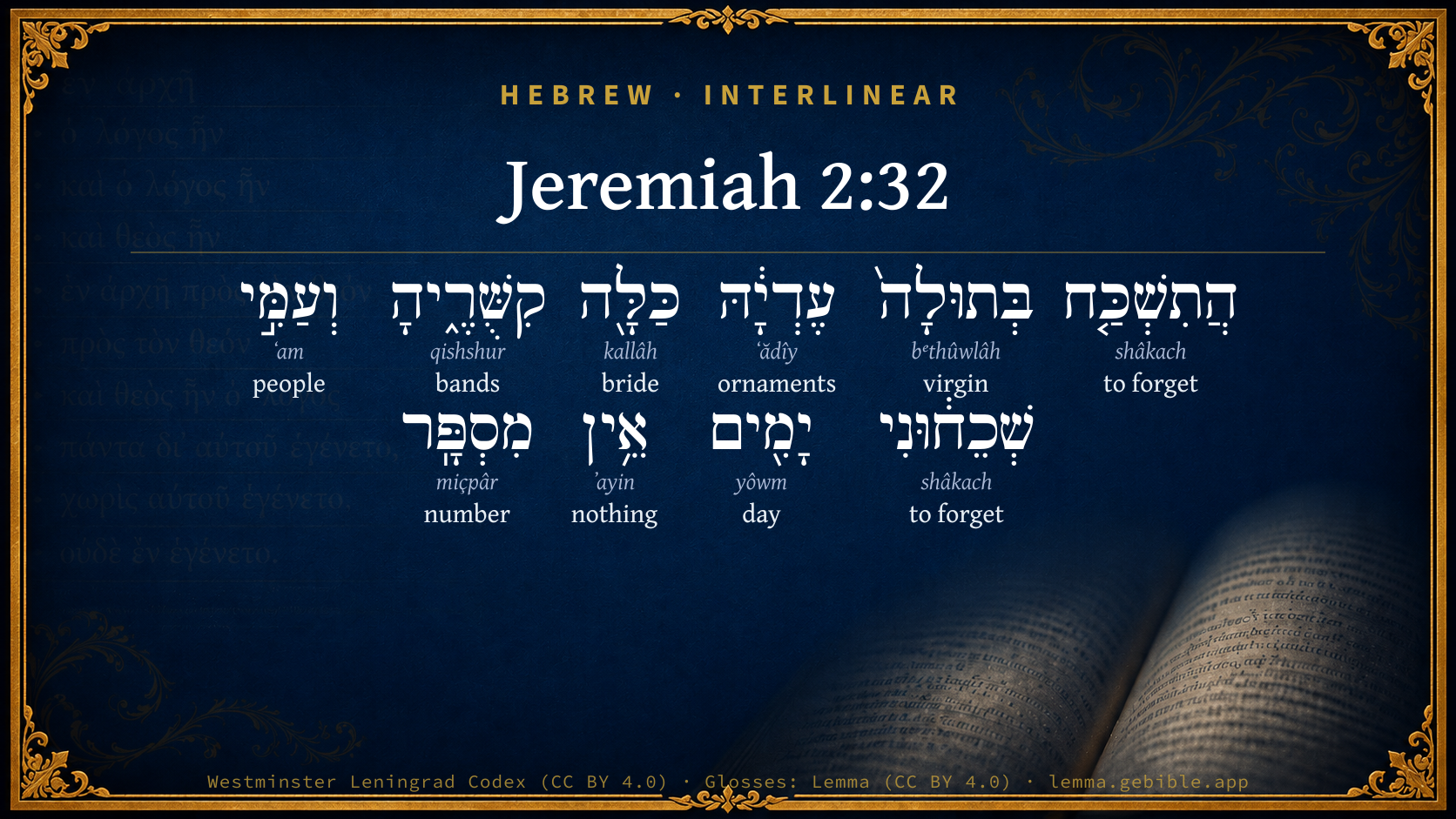
Hebrew (Westminster Leningrad Codex) Jeremiah 2:32 appears in the Hebrew Old Testament. The text above is from the Westminster Leningrad Codex. Each word links to its Strong’s number, a concise gloss, and parsing drawn from the Open Scriptures Hebrew Bible morphology. Click any word for its full Brown-Driver-Briggs (BDB) entry.
Download image
Cite this verse

Jeremiah 2:32 (World English Bible). Public Domain. Lemma interlinear Bible study tool, https://lemma.gebible.app/v/jeremiah/2/32.

Show BibTeX & RIS
BibTeX
RIS
English Translation
Can a virgin forget her ornaments, or a bride her attire? yet my people have forgotten me days without number.
World English Bible · Public Domain
Download a study sheet

One document with this verse’s original text, its word-by-word gloss line, the meaning frame, cross-references with their text, attributed commentary, and full source and license credits — printable, and it pastes into notes with its structure intact.

This verse Autodidact and up

Study sheet (.html) Plain text (.txt)

A passage Seminary Student

Up to 50 verses in one chapter. A passage sheet keeps up to 6 commentary sources and 12 cross-references per verse, in the order this page ranks them, and says so on the sheet whenever that leaves anything out. Ask for a single verse and you get the Autodidact verse sheet above.

Everything on this page stays free to read, with no account — the sheet is a download of what is already on screen, not access to it.

Want to remove ads? Support Godless Engineer
Compare translations 3

The same verse in 3 English versions, stacked beneath the original-language interlinear above. Click any original word for its lexicon entry.

Each is an independent rendering of the whole verse — the interlinear is not word-aligned to these translations.

Highlighted words mark where these versions differ — a whole-verse word diff, not a word-by-word alignment.

  • World English Bible Public Domain
    Can a virgin forget her ornaments, or a bride her attire? yet my people have forgotten me days without number.
  • King James Version Public Domain
    Can a maid forget her ornaments, or a bride her attire? yet my people have forgotten me days without number.
  • unfoldingWord Literal Text CC BY-SA 4.0
    Will a virgin forget her jewelry, a bride her sashes? Yet my people have forgotten me days without number!

unfoldingWord Literal Text — © unfoldingWord, licensed CC BY-SA 4.0. Word-aligned USFM3 via Door43 (git.door43.org/unfoldingWord/en_ult).

Versions to compare (up to 4)

3 of 4 selected

Show all 18 translations

Every available English version of this verse, each an independent rendering of the whole verse.

  • World English Bible Public Domain
    Can a virgin forget her ornaments, or a bride her attire? yet my people have forgotten me days without number.
  • Berean Standard Bible Public Domain
    Does a maiden forget her jewelry or a bride her wedding sash? Yet My people have forgotten Me for days without number.
  • Majority Standard Bible Public Domain
    Does a maiden forget her jewelry or a bride her wedding sash? Yet My people have forgotten Me for days without number.
  • King James Version Public Domain
    Can a maid forget her ornaments, or a bride her attire? yet my people have forgotten me days without number.
  • American Standard Version (1901) Public Domain
    Can a virgin forget her ornaments, or a bride her attire? yet my people have forgotten me days without number.
  • Revised Version (1885) Public Domain
    Can a maid forget her ornaments, or a bride her attire? yet my people have forgotten me days without number.
  • Geneva Bible (1599) Public Domain
    Can a maid forget her ornament, or a bride her attire? yet my people haue forgotten me, daies without number.
  • Douay-Rheims (1899) Public Domain
    Will a virgin forget her ornament, or a bride her stomacher? but my people hath forgotten me days without number.
  • Young's Literal Translation Public Domain
    Doth a virgin forget her ornaments? A bride her bands? And My people have forgotten Me days without number.
  • Literal Standard Version CC BY-SA 4.0
    Does a virgin forget her ornaments? A bride her bands? And My people have forgotten Me [for] days without number.
  • Unlocked Literal Bible CC BY-SA 4.0
    Will a virgin forget her jewelry, a bride her veils? Yet my people have forgotten me for days without number!
  • unfoldingWord Literal Text CC BY-SA 4.0
    Will a virgin forget her jewelry, a bride her sashes? Yet my people have forgotten me days without number!
  • Darby Bible Public Domain
    Doth a virgin forget her ornaments, a bride her attire? But my people have forgotten me days without number.
  • World Messianic Bible Public Domain
    “Can a virgin forget her ornaments, or a bride her attire? Yet my people have forgotten me for days without number.
  • Webster's Bible Public Domain
    Can a maid forget her ornaments, or a bride her attire? yet my people have forgotten me days without number.
  • Free Bible Version CC BY-SA 4.0
    Does a girl forget her jewelry or a bride her wedding dress? Yet my people have forgotten me for too many years to count.
  • Bible in Basic English Public Domain
    Is it possible for a virgin to put out of her memory her ornaments, or a bride her robes? but my people have put me out of their memories for unnumbered days.
  • JPS Tanakh (1917) Public Domain
    Can a maid forget her ornaments, or a bride her attire? Yet My people have forgotten Me days without number.

Literal Standard Version (2020), Covenant Press — licensed CC BY-SA 4.0. Text via the HelloAO Bible API (eBible.org). Unlocked Literal Bible (unfoldingWord) — licensed CC BY-SA 4.0. Text via the HelloAO Bible API (eBible.org). unfoldingWord Literal Text — © unfoldingWord, licensed CC BY-SA 4.0. Word-aligned USFM3 via Door43 (git.door43.org/unfoldingWord/en_ult). Free Bible Version, Dr. Jonathan Gallagher — licensed CC BY-SA 4.0. Text via the HelloAO Bible API (eBible.org).

Word by word

More ways to search: Search by grammar → Find every occurrence → Compare this word →

Practice this passage: Drill this verse → Learn its vocabulary →

קִשֻּׁרֶ֑יהָ
qishshur
H7196
“bands · her”
Noun, Common, Masculine, Plural, Construct + Suffix, Personal, 3rd Person, Feminine, Singular
Part of Speech
Noun
Type
Common
Gender
Masculine
Number
Plural
State
Construct
Full BDB Definition

Origin: from H7194

TWOT: 2090b

bands, sashes, headbands - ornaments that are bound on
  1. הֲתִשְׁכַּ֤ח shâkach H7911 “to forget” Particle, Interrogative + Verb, Qal, Imperfect, 3rd Person, Feminine, Singular
  2. בְּתוּלָה֙ bᵉthûwlâh H1330 “virgin” Noun, Common, Feminine, Singular, Absolute
  3. עֶדְיָ֔הּ ʻădîy H5716 “ornaments · her” Noun, Common, Masculine, Singular, Construct + Suffix, Personal, 3rd Person, Feminine, Singular
  4. כַּלָּ֖ה kallâh H3618 “bride” Noun, Common, Feminine, Singular, Absolute
  5. וְעַמִּ֣י ʻam H5971 “and · people · my” Conjunction + Noun, Common, Masculine, Singular, Construct + Suffix, Personal, 1st Person, Common, Singular
  6. שְׁכֵח֔וּנִי shâkach H7911 “to forget · me” Verb, Qal, Perfect, 3rd Person, Common, Plural + Suffix, Personal, 1st Person, Common, Singular
  7. יָמִ֖ים yôwm H3117 “days” Noun, Common, Masculine, Plural, Absolute
  8. אֵ֥ין ʼayin H369 “nothing” Particle, Negative
  9. מִסְפָּֽר miçpâr H4557 “number” Noun, Common, Masculine, Singular, Absolute

About this verse

These counts appear in no published source. They are computed here, from the morphology-tagged text and Lemma’s own curated glosses. What Lemma adds →

10
words
9
distinct lemmas
Prophets
section

Notable vocabulary

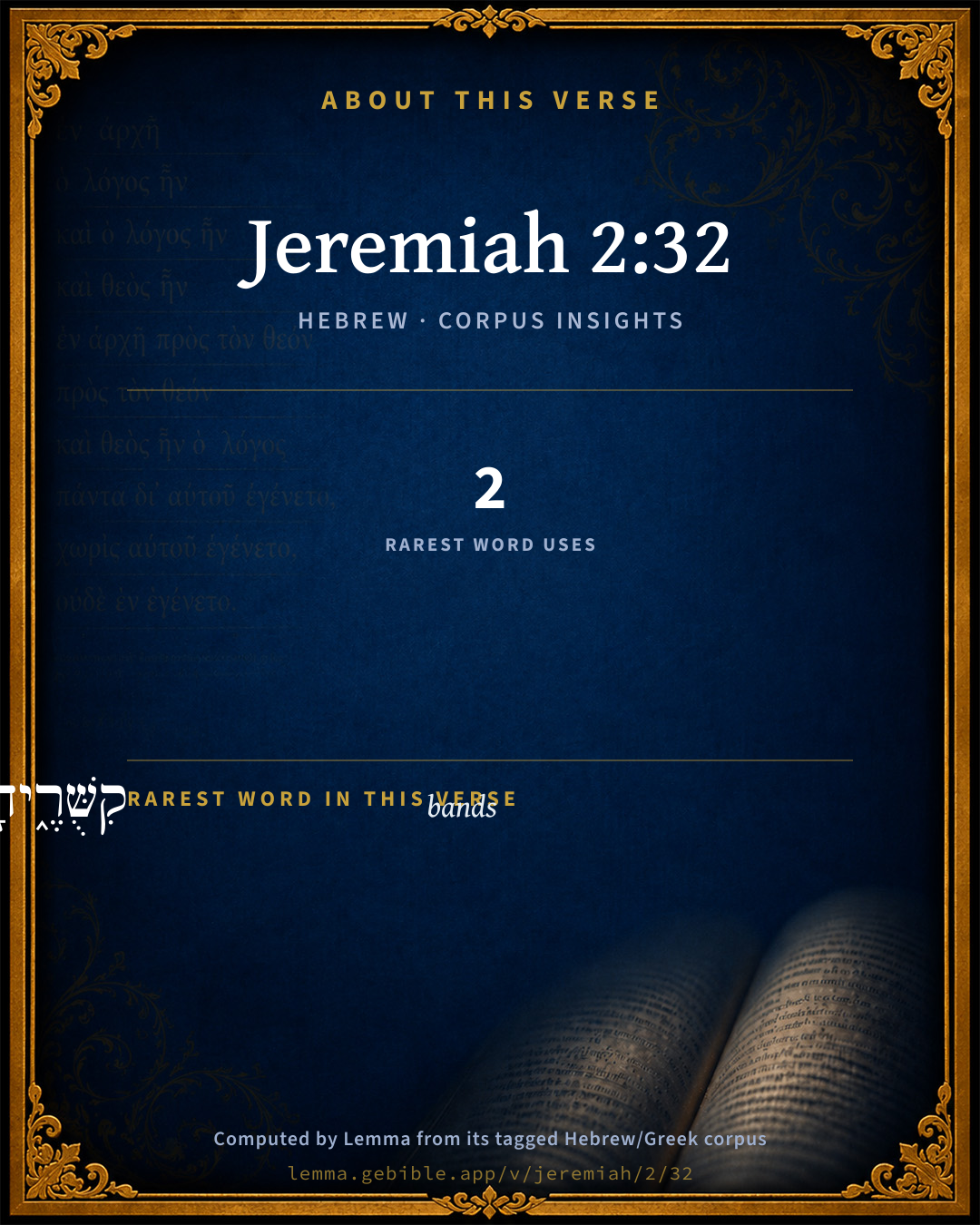
The rarest word here is קִשֻּׁרֶ֑יהָ bands H7196 — appearing just 2 times in the whole Hebrew Bible.

Shared distinctive vocabulary

קִשֻּׁרֶ֑יהָ bands H7196 occurs in 2 verses of the Hebrew Bible. Also found in:

Grammatical profile

  • 2 verbs
  • 7 nouns
  • 1 particle

Verb forms

  • הֲתִשְׁכַּ֤ח Qal · Imperfect
  • שְׁכֵח֔וּנִי Qal · Perfect

Repetition

A word recurs within this verse — often emphatic in Hebrew:

  • הֲתִשְׁכַּ֤ח to forget H7911 ×2

Cross-references

14

Topical passages linked to Jeremiah 2:32 in the Treasury of Scripture Knowledge — connected by theme and wording, ordered by reader-vote popularity; previews shown in the World English Bible.

  • Psalms 106:21 They forgot God, their Savior, Who had done great things in Egypt,
  • Jeremiah 13:25 This is your lot, the portion measured to you from me, says Yahweh; because you have forgotten me, and trusted in falsehood.
  • Jeremiah 2:11 Has a nation changed [its] gods, which yet are no gods? but my people have changed their glory for that which does not profit.
  • Jeremiah 3:21 A voice is heard on the bare heights, the weeping [and] the petitions of the children of Israel; because they have perverted their way, they have forgotten Yahweh their God.
  • Isaiah 17:10 For you have forgotten the God of your salvation, and have not been mindful of the rock of your strength; therefore you plant pleasant plants, and set it with strange slips.
  • Psalms 9:17 The wicked shall be turned back to Sheol, Even all the nations that forget God.
  • Isaiah 61:10 I will greatly rejoice in Yahweh, my soul shall be joyful in my God; for he has clothed me with the garments of salvation, he has covered me with the robe of righteousness, as a bridegroom decks himself with a garland, and as a bride adorns herself with her jewels.
  • Hosea 8:14 For Israel has forgotten his Maker and built palaces; And Judah has multiplied fortified cities; But I will send a fire on his cities, And it will devour its fortresses."
  • Jeremiah 13:10 This evil people, who refuse to hear my words, who walk in the stubbornness of their heart, and are gone after other gods to serve them, and to worship them, shall even be as this belt, which is profitable for nothing.
  • Jeremiah 18:15 For my people have forgotten me, they have burned incense to false [gods]; and they have been made to stumble in their ways, in the ancient paths, to walk in byways, in a way not built up;
  • Genesis 24:22 It happened, as the camels had done drinking, that the man took a golden ring of half a shekel weight, and two bracelets for her hands of ten shekels weight of gold,
  • Ezekiel 22:12 In you have they taken bribes to shed blood; you have taken interest and increase, and you have greedily gained of your neighbors by oppression, and have forgotten me, says the Lord Yahweh.
  • 1 Peter 3:3–5 Let your beauty be not just the outward adorning of braiding the hair, and of wearing jewels of gold, or of putting on fine clothing;
  • Revelation 21:2 I saw the holy city, New Jerusalem, coming down out of heaven from God, made ready like a bride adorned for her husband.

Cross-references courtesy of OpenBible.info (CC BY 4.0).

Hebrew and Greek witnesses Masoretic Hebrew ↔ Greek Septuagint

The same verse in the two great witnesses to the Old Testament, shown verse-for-verse.

These are two independent witnesses, not word-aligned to each other, and the Septuagint is shown in lemma (dictionary) form.

Hebrew Jeremiah 2:32 Masoretic · Westminster Leningrad Codex

הֲתִשְׁכַּ֤ח בְּתוּלָה֙ עֶדְיָ֔הּ כַּלָּ֖ה קִשֻּׁרֶ֑יהָ וְעַמִּ֣י שְׁכֵח֔וּנִי יָמִ֖ים אֵ֥ין מִסְפָּֽר

Can a virgin forget her ornaments, or a bride her attire? yet my people have forgotten me days without number.

World English Bible · Public Domain

Greek LXX Structure differs

In the Septuagint, Jeremiah is about an eighth shorter than the Hebrew and arranges its material differently — the Oracles Against the Nations (Hebrew chapters 46–51) appear in the middle of the Greek book, after 25:13. Because the chapter and verse boundaries do not line up, a verse-for-verse comparison with the Hebrew is not shown.

A verse-for-verse comparison isn’t shown here because the chapters and verses don’t line up. Switch to the LXX edition with the MT / LXX toggle above to read the Greek directly.

On this verse, John Gill's Exposition discusses the Septuagint’s reading. Read the note in Commentary ↓

Hebrew: Westminster Leningrad Codex (CC BY 4.0). Greek: Septuagint (public domain); English from a public-domain English Septuagint. How the Septuagint differs from the Hebrew →

Targum (Aramaic paraphrase)

1

The Targum is the ancient Jewish Aramaic paraphrase of the Hebrew Scriptures — an interpretive translation, not the Hebrew text itself. Onkelos (literal) and Pseudo-Jonathan (expansive) render the Torah, and Jonathan the Prophets. Coverage is partial: where no permissively-licensed English translation exists for a verse, only the Aramaic is shown. This is verse-level text, not a word-by-word alignment to the Hebrew.

  1. Targum Jonathan Prophets (Joshua–Malachi)
    הַאֶפְשַׁר דְתִתְנְשֵׁי בְתוּלְתָא תִקּוּנָהּ כַּלְתָא קִישׁוֹטְהָא וְעַמִי שְׁבָקוּ פּוּלְחָנִי יוֹמִין דְלָא מִנְיָן:

    (no public-domain English translation for this verse)

    Targum Jonathan — Aramaic: “Mikraot Gedolot” (public domain). English: “Sefaria Community Translation” (CC0 1.0 (public-domain dedication)); “London "Chaldee Paraphrase," 1871” (public domain). Text via Sefaria.

Commentary

Notes on Jeremiah 2:32 from classic Christian and Jewish commentators (each source and its license shown beneath its notes). The classic Christian expositions comment on the surrounding passage and are grouped to its opening verse, so a note may address several verses; the Jewish commentaries on the Tanakh (Rashi and others) are per-verse, so they appear only where the commentator wrote on this verse.

Lemma curates 59 commentaries, every one of them public domain or Creative Commons licensed, each selected and text-cleaned for this edition rather than reprinted as found. About our sources →

Trapp's Complete Commentary

John Trapp

Jer 2:32 Can a maid forget her ornaments, [or] a bride her attire? yet my people have forgotten me days without number.

Ver. 32. Can a maid forget her ornaments?] Not lightly or easily, as minding them many times more than is meet, and then their ornaments are but the nest of pride; and while they think to gain more credit by their garments than by their graces, they are much mistaken.

Yet my people have forgotten me, days without number,] i.e., Time out of mind, whenas God should be remembered at every breath we draw, since from him we have ζωην και πνοην, "life and breath," as the apostle saith elegantly. {Act 17:25} But into such a dead lethargy hath sin cast most people, that God is forgotten by them, and his service neglected.

John Trapp, A Commentary or Exposition upon All the Books of the Old and New Testament (1647–1656) — public domain. Text from a community e-Sword module.

The Biblical Illustrator

Joseph S. Exell

Jer_2:32

Can a maid forget her ornaments, or a bride her attire?

yet My people have forgotten Me.

The bride and her ornaments: the sin of forgetting God

It is a clear proof of the great love of God to His people that He will not lose their love without earnest expostulation. He loves us too well to suffer us to go on in our iniquity. He will scourge rather than abandon; chide rather than lose.

I. A very grievous sin. My people have forgotten Me days without number.

1. Observe whom they had forgotten: it will help us to see the sin of it. It would not have mattered half as much if they had forgotten their dearest friends--the husband his wife, or the mother her child; but here are favoured men and women who have forgotten their God, their Father, their life, their all. God, the good, the best, who has a chief right to be remembered. There is great evil in our hearts, or it would be so hard to forget God as to be impossible. A friend has gone away from us, and we do not see him; but he has left so many tokens of his goodness that we are reminded of him every day. Is it not so with God? Has He not left us innumerable tokens of His affection for us? Ought we to forget when so many forget-me-nots are round about us? But, supposing that friend has not gone away at all, but is living with us in the house, and enters even into our chamber, what shall we say if we forget one who is constantly with us? No man is so present with his friend as God is with His people.

2. Who were they that forgot God? Not strangers, not heathen; but My people. That is to say, a people not only chosen and redeemed, but brought to know Him, brought into fellowship with Him, brought into relationship with Him, brought absolutely into union with Him,--they have forgotten Me.

3. Observe sadly the space in which they had forgotten: in the case of Israel, it is added, days without number. How long is it since you were in the habit of walking with God? How long is it since you have seen the face of the Well-Beloved? I ventured to put that question once to a professor, and, shaking his head, he replied, Dont ask me that: if you will ask me whether I have been a drunkard, whether I have been dishonest in business, whether I have done any positive action by which I have degraded the Christian name, I can answer you without fear; but if you ask, How long since I have had fellowship with Christ, I cannot--I dare not--answer you.

4. How is God forgotten? What are the manifestations of this offence?

(1) Some professors evidently forget God by their worldliness They have been fattened with the treasures of the world, but their souls have been starved to very skeletons, for they have not fed upon the things of God.

(2) Some have forgotten God by self-seeking. They live unto themselves.

(3) Some, too, show that they forget God by the failure of their trust. They are in trouble, and they are very anxious. Why? Because they have forgotten God, though He has promised to help them.

(4) Alas, there are some who add to this a forgetfulness of God through neglect of private devotion. Prayers are slurred over; drawing near to God becomes a form and a pretence.

(5) And you and I can do it in a very high sense by a breach of communion, by getting out of fellowship with God, by walking contrary to Him, so that He walks contrary to us. It is very bad walking and very bad living when God and ourselves are at cross purposes.

5. If ever we do forget God, it leads to all sorts of mischief. We lose our joy and our comfort; and then we lose our strength and our watchfulness; and then we backslide by little and little; and then, probably, we fall into one sin, and then into another sin, if not into a third more grievous still

II. The chiding question which is the very marrow of the text. Can a maid forget her ornaments, or a bride her attire?

1. I suppose that question is put, first, because there are many trivial things which occupy minds so that they cannot forget them. How sad it is that the grandest things, the best things, should not equally engross our thoughts!

2. If a bride did forget her attire, or a maid did forget her ornaments, it would be very unreasonable behaviour. But how infinitely more unreasonable it is that you and I should forget God. He is our diadem of glory: He is our beauty of holiness. In Christ we are arrayed in raiment of needlework, and our garments are of wrought gold. Can we, shall we forget Him?

3. It would have been a most unseasonable thing for a maid to forget her attire at her wedding. A bride who forgets her attire would be something like the foolish virgins who forgot to take oil in their vessels with their lamps. And, certainly, it is a most unseasonable thing for me and you to forget our God while we are here. Let the soldier, when the arrow is flying from every bush, forget his armour, but let us not forget our God. Let the hungry man, when famine rages through the land, forget his store of bread, but let us not forget the food of our souls, which is our Lord Jesus.

4. Notice the conduct of the maid or the conduct of the bride, with regard to her ornaments.

(1) She labours hard to obtain her ornaments and to gain her attire. Many women in the East save up every coin that they have, and turn all into silver. It is their lifes work to provide themselves with ornaments against the marriage day. While they do this, let us do better: let us store up the thoughts of Christ, and the words of Christ, and the things of Christ, and let us labour to get more and more of Christ, that we may be adorned with Him and made comely in His comeliness.

(2) When the Eastern woman has with great difficulty obtained her ornaments and her attire, then she thinks a great deal of them: she preserves them with much care; she will, if possible, prevent a thief from taking away a ring or gem; she locks them up carefully. Oh, that we did store up every bit we get of our Lords loves and put it by to keep it, never losing any pearl that we find, or any ring that we fashion by experience.

(3) How joyfully the Eastern woman puts on her jewels, puts on her attire. She has these things to wear them. I am ashamed of those Christians who are ashamed of Christ. They have jewels: I hope they have; but they are very chary of ever showing them.

III. A few words of call to repentance, if we have in any measure forgotten God. I am sure, first, that our God does not deserve to be treated so. You use no other friend so ill. Have you forgotten? Will not the time past suffice for that? A half a minutes forgetfulness of God is half a minute too long. Let it not come to be days without number. But, if the number be ever so small, let us weep to think we should have forgotten Him at all. Think, if He had forgotten you--forgotten you in your merriest moment, ay, in your holiest moment, what would have been your portion? (C. H. Spurgeon.)

Forgetfulness

The Almighty entered this grave charge against His ancient favoured nation, My people have forgotten Me days without number.

I. The same charge lies with too great force against all Christendom. The true secret of this lurks in the obstinate ungodliness of the carnal mind. This hinders the recollection of God in the following modes--

1. In habitual inattention to Divine truth, when presented to the mind. Some try to excuse their ignorance of God and His inspired Word, pleading, I have such a bad memory, when the memory is quite good enough, if Divine truths were once welt lodged in it by due attention. No memory, however excellent, can retain that which was never allowed to make an impression (Heb_2:1).

2. In neglect of reflection on Divine truth read or heard. Where there is little meditation on God and His Word, it is vain to expect a rich experience, or a solid religious character.

3. In the occupation of the mind with comparative trifles. Filling our measures with chaff, we leave no room for good and solid grain. The maid thinks of her ornaments, and the bride of her attire. The young--and not they only, but many to whom increasing years have brought no wisdom--fill their thoughts and conversation with the fashions, the amusements, and entertainments of the season; and so can have, in their foolishly occupied minds, no grave recollection of that God with whom they have to do. It was a judicious answer of Themistocles to Simonides, who had offered to teach him the art of memory, Rather teach me the art of forgetfulness; for the things which I would not I remember, and cannot forget the things I would.

4. In excess of worldly cares. There are grave anxieties regarding success in business, or the attainment of a coveted position, that so press upon the soul as to preclude the earnest recollection of religious truth. Hence it happens that shrewd men, who easily remember whatever affects the markets, cannot remember how to buy the truth; and readily quoting the stock and share lists of commercial enterprise, cannot accurately quote the verses of the blessed Word of God.

II. To show the evil of forgetfulness, let it be considered how much a religiously stored memory tells on the development of the Christian mind and formation of the Christian character. It constitutes knowledge, it deepens repentance, it fortifies faith, it supplies comfort, and moves continual thankfulness. (D. Fraser, M. A.)

The Biblical Illustrator, edited by Joseph S. Exell (c. 1880s–1900s) — public domain. Text from a community e-Sword module.

Tyndale Open Study Notes

Tyndale Open Resources

2:32 For centuries, the Israelites had forgotten the Lord, their husband (13:25; Ps 106:21; Hos 8:14).

Tyndale Open Study Notes — © Tyndale Open Resources, licensed CC BY-SA 4.0. Text via the HelloAO Bible API.

Jamieson, Fausset & Brown

Robert Jamieson, A. R. Fausset & David Brown

Oriental women greatly pride themselves on their ornaments (compare Isa 61:10).

attire--girdles for the breast.

forgotten me-- (Jer 13:25; Hos 8:14).

Jamieson, Fausset & Brown — Commentary Critical and Explanatory on the Whole Bible (1871) — public domain (CC PDM 1.0). Text via the HelloAO Bible API.

Adam Clarke's Commentary

Verse 32. Can a maid forget her ornaments] This people has not so much attachment to me as young females have to their dress and ornaments. They never forget them; and even when arrived at old age, look with pleasure on the dress and ornaments which they have worn in their youth.

Days without number.] That is, for many years; during the whole reign of Manasses, which was fifty-five years, the land was deluged with idolatry, from which the reform by good King Josiah his grandson had not yet purified it.

Adam Clarke's Commentary on the Bible (1810–1826) — public domain. Text from a community e-Sword/MySword module.

John Calvin's Commentaries

God here confirms what is said in the last verse, and would make his people ashamed, because they valued him less than girls are wont to value their ornaments. The necklaces of young women are indeed nothing but mere trifles, and yet we see that girls are so taken with them through a foolish passion, that they value such trinkets more than their very life. “How then is it, “says God, “that my people have forgotten me? Is there to be found any such ornament? Can anything be found among the most valuable jewels and the most precious stones which can be compared with me?”

God shews by this comparison how perverted the minds of the Jews were, when they renounced and rejected a benefit so invaluable as to have God as their Father, and to be prosperous under his dominion; for nothing necessary for a blessed life had been wanting to them as long as they continued the recipients of that paternal favor, which God had manifested towards them, and wished to shew to them to the end. As then they had found God to have been so bountiful, must they not have been more than mad, when they willfully rejected his favor? while yet young women commonly set their thoughts and affections strongly and permanently on such trifles as are of no value. But the Prophet designedly used this similitude, that he might introduce what is contained in the next verse: his object was to compare the Jews to adulterous women, who being led away by unbridled lust, follow wanton lovers. As then he intended to bring this charge against the Jews, he spoke expressly of the ornaments of young women; and hence it follows —

John Calvin's Commentaries (1540-1563) — public domain. Text from the Calvin Translation Society English edition (1840s-50s) via the Christian Classics Ethereal Library (ccel.org). Calvin's coverage is partial (roughly two-thirds of the Bible); uncommented books and verses are honest gaps, never fabricated. The 19th-century editor's footnotes and remarks are omitted so the notes are faithfully Calvin's own voice.

Ellicott's Commentary for English Readers

(32) Or a bride her attire.—The word is rendered “headbands” in Isa_3:20, but here it probably means the “girdle” which formed the special distinction of the wife as contrasted with the maiden. Such a girdle, like the marriage ring with us, would be treasured by the bride all her life long. Even the outward memorial of her union with her husband would be dear to her. But Israel had forgotten her lord and husband Himself.

A Bible Commentary for English Readers, edited by Charles John Ellicott (1878–1897) — public domain. Text from a community e-Sword module.

The Cambridge Bible for Schools and Colleges

gen. ed. J. J. S. Perowne

32. attire] sash, and so rendered by R.V. in Isa_3:20. The exact meaning is unknown, but it was plainly an indispensable part of a bride’s costume.

The Cambridge Bible for Schools and Colleges (gen. ed. J. J. S. Perowne; Cambridge University Press, 1878–1918) — public domain. Text from a community e-Sword module.

John Gill's Exposition

Why trimmest thou thy way to seek love?.... To seek the love, and gain the affections and esteem, of the idolatrous nations; as a lascivious woman dresses herself out in the best manner to excite the lust and move the affections of her lovers; and as Jezebel, who painted her face, and tired her head, Kg2 9:30 or dressed it in the best manner, where the same word is used as here; so the Targum,

"why dost thou make thy way beautiful, to procure loves (or lovers) to be joined to the people?''

or the sense is, why art thou so diligent and industrious to make thy way, which is exceeding bad, look a good one, by sacrifices and ceremonies, oblations and ablutions, in order to seek and obtain my love and favour, which is all in vain? it is not to be gained by such methods:

therefore hast thou also taught the wicked ones thy ways; the wicked idolatrous nations, to whom they joined themselves; these they taught their ways of sacrificing, their rites, ceremonies, and superstitions; or, as Jarchi interprets it, thou hast taught thyself the worst way among them all; that is, thou hast used thyself to it: there is a double reading in this clause. The Cetib, or writing, is "I have taught"; as if they were the words of God, saying, "wherefore I have taught"; or, "will teach"; that is, by punishing thee;

that thy ways are evil; or, as Kimchi explains it,

"I have taught thee by thy ways that they are evil, and evil shall come unto thee because of them.''

The Keri, or reading, is "thou hast taught"; which is confirmed by the Targum; and is followed by the Septuagint, Vulgate Latin, and other versions. It is by some rendered, "seeing thou hast taught others thy evil ways" (p); not content to sin themselves, but taught others to do so, and yet would be thought good.

(p) "Quandoquidem etiam (alios) malas docuisti vias tuas", Noldius, p. 507. vid. No. 1998.

John Gill's Exposition of the Whole Bible (1746–1763) — public domain (CC PDM 1.0). Text via the HelloAO Bible API.

Albert Barnes' Notes on the Bible

A bride treasures all her life the girdle, which first indicated that she was a married woman, just as brides now treasure the wedding ring; but Israel, Yahweh’s bride Jer 2:2, cherishes no fond memorials of past affection.

Albert Barnes' Notes on the Bible (1834–1885) — public domain. Text from a community e-Sword/MySword module.

Matthew Poole's English Annotations

Can a maid forget her ornaments? how seldom is it, and how unlikely, that a maid should forget her ornaments!

Or a bride her attire? whether it belongs to the head, or the breast, or arms, whether bracelets or jewels, wherever worn, is not worth the disputing; but understand those rich jewels which the bridegroom was wont to present his bride with, partly for a general obligation, and partly of particular signification, and all of them ornamental, whatever may render her amiable in the eyes of her bridegroom; virgins, and especially brides, will not usually neglect any thing that may make them comely.

Have forgotten me, viz. in the neglect of my worship; me, who was not only their defence, but their glory, Jer 2:11, &c., that for which other nations honoured them, Psa 148:14; Eze 16:10-14.

Days without number, i.e. for a long time past, time out of mind, or, as the Hebrew, days of which there is no number.

Matthew Poole's English Annotations on the Holy Bible (1683–1685) — public domain. Text from a community e-Sword/MySword module.

Whedon's Commentary on the Bible

Daniel D. Whedon

32. More tenderly does God appeal to them in the comparison of this verse.

Can a maid forget her ornaments, or a bride her attire — This last term means a sash or girdle which a bride puts on on her wedding-day, answering somewhat in significance and preciousness to the marriage ring.

So God is his people’s best adornment and choicest treasure, and yet they have turned away from him.

Daniel D. Whedon (gen. ed.), Commentary on the Old and New Testaments (1874–1909) — public domain. Text from a community e-Sword module.

The Pulpit Commentary

Or a bride her attire. The prophet perhaps means the magnificently adorned girdle which the bride wore on her wedding day. (Isa_49:18) But the word only occurs again in Isa_3:20, and its precise signification is uncertain.

The Pulpit Commentary (1880–1919), ed. H.D.M. Spence-Jones & Joseph S. Exell — public domain. Text from a community e-Sword module.

John Wesley's Explanatory Notes

A maid - How unlikely is it, that a maid should forget her ornaments? A bride - Those jewels which the bridegroom was wont to present his bride with. Forgotten - In the neglect of my worship; me, who was not only their defense, but their glory.

John Wesley, Explanatory Notes Upon the Whole Bible (1754–1765) — public domain. Text via the GEBible commentary corpus.

unfoldingWord translationNotes

Door43 World Missions Community

Will a virgin forget her jewelry, a bride her veils

The words "will" and "forget" are understood to be part of the second phrase also. AT: "Will a virgin forget her jewelry, and will a bride forget her veils" (See: Ellipsis)

Will a virgin forget her jewelry, a bride her veils?

God uses this question to introduce the idea of remembering things that are important to someone. AT: "You know that a virgin would never forget to put on her jewelry, and a bride would never forget to put on her veils." (See: Rhetorical Question)

days without number

"a very long time"

How well you make your way to look for love

God appears to be praising his people for looking for love, but this is irony. He was showing that he was angry with them for being unfaithful to him. (See: Irony)

to look for love

God speaks of his people worshiping other gods as if they were a woman who is unfaithful to her husband and is looking for other men to love her. (See: Metaphor)

You have even taught your ways to wicked women

God speaks of how unfaithful his people are to him as though they were even teaching prostitutes how to be unfaithful to their husbands and find other men to be their lovers. (See: Irony)

The blood that was the life of innocent, poor people has been found on your clothes

Blood on their clothes was evidence that they had killed people. AT: "The blood of innocent, poor people on your clothes shows that you are guilty of killing them" or "You are guilty of killing poor and innocent people" (See: Assumed Knowledge and Implicit Information)

The blood that was the life

"The blood that represents the life"

These people were not discovered in acts of burglary

If they found people in an act of burglary, this might have been an excuse for killing them. But the people that they murdered were innocent. This can be translated in active form. AT: "You did not discover these people stealing things" or "But you killed them even though they were not even stealing anything" (See: Active or Passive)

translationWords

virgin

bride

veil

love

evil

blood

innocent

unfoldingWord translationNotes — © Distant Shores Media and the Door43 World Missions Community, licensed CC BY-SA 4.0. Source: git.door43.org/Door43/en_tn.

Lesson kit

Teaching starters — assembled from the data on this page, not authored interpretation. Every prompt links to the verse data it draws on. Edit before teaching.

Jeremiah, in the Prophets, opens this verse with 10 words (9 distinct Hebrew lemmas). Its most distinctive word is qishshur (“bands”). A historical commentator’s framing appears above. Read the whole chapter for the surrounding context.

Discussion questions

  1. How does “bands” (qishshur) shape what this verse is saying?
  2. Isaiah 3:20 shares the word «bands» with this verse. How do the two illuminate each other?
  3. “to forget” occurs 2× in this one verse. What is the effect of the repetition?
  4. These translations render this verse differently. What is at stake in choosing one wording over another?
  5. The verb «הֲתִשְׁכַּ֤ח» is Qal Imperfect. How does its form color the action?
  6. Reading how Trapp's Complete Commentary and The Biblical Illustrator read this verse, where do the two commentators agree and where do they part?

Things to notice

  • These translations choose different wording for 8 words in this verse.
  • “to forget” occurs 2× in this single verse.
  • 9 distinct Hebrew lemmas span 10 words in this verse.

Reading settings

Reading text

Shown beneath each verse's original-language words.

Old Testament
Old Testament edition

Read the OT as the Masoretic Hebrew (MT) or the Greek Septuagint (LXX).

English shown for the Greek Septuagint (in the Hebrew ↔ Greek comparison).

Comparing translations? Open the Compare panel on any verse page to stack up to four side by side.