
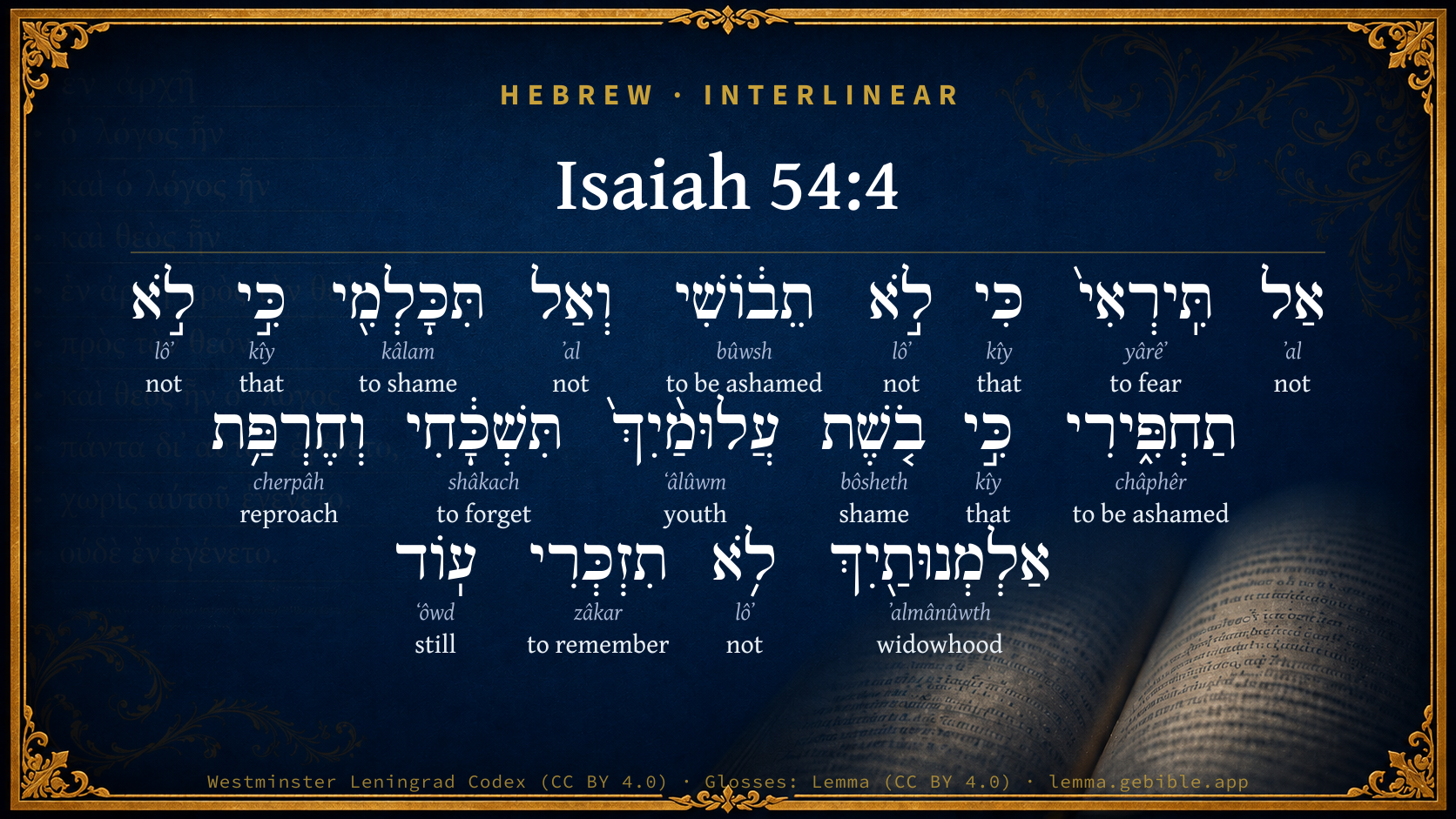
Isaiah 54:4

Hebrew (Westminster Leningrad Codex) Isaiah 54:4 appears in the Hebrew Old Testament. The text above is from the Westminster Leningrad Codex. Each word links to its Strong’s number, a concise gloss, and parsing drawn from the Open Scriptures Hebrew Bible morphology. Click any word for its full Brown-Driver-Briggs (BDB) entry.
Download image
Cite this verse

Isaiah 54:4 (World English Bible). Public Domain. Lemma interlinear Bible study tool, https://lemma.gebible.app/v/isaiah/54/4.

Show BibTeX & RIS
BibTeX
RIS
English Translation
Don't be afraid; for you shall not be ashamed: neither be confounded; for you shall not be disappointed: for you shall forget the shame of your youth; and the reproach of your widowhood shall you remember no more.
World English Bible · Public Domain
Download a study sheet

One document with this verse’s original text, its word-by-word gloss line, the meaning frame, cross-references with their text, attributed commentary, and full source and license credits — printable, and it pastes into notes with its structure intact.

This verse Autodidact and up

Study sheet (.html) Plain text (.txt)

A passage Seminary Student

Up to 50 verses in one chapter. A passage sheet keeps up to 6 commentary sources and 12 cross-references per verse, in the order this page ranks them, and says so on the sheet whenever that leaves anything out. Ask for a single verse and you get the Autodidact verse sheet above.

Everything on this page stays free to read, with no account — the sheet is a download of what is already on screen, not access to it.

Want to remove ads? Support Godless Engineer
Compare translations 3

The same verse in 3 English versions, stacked beneath the original-language interlinear above. Click any original word for its lexicon entry.

Each is an independent rendering of the whole verse — the interlinear is not word-aligned to these translations.

Highlighted words mark where these versions differ — a whole-verse word diff, not a word-by-word alignment.

  • World English Bible Public Domain
    Don't be afraid; for you shall not be ashamed: neither be confounded; for you shall not be disappointed: for you shall forget the shame of your youth; and the reproach of your widowhood shall you remember no more.
  • King James Version Public Domain
    Fear not; for thou shalt not be ashamed: neither be thou confounded; for thou shalt not be put to shame: for thou shalt forget the shame of thy youth, and shalt not remember the reproach of thy widowhood any more.
  • unfoldingWord Literal Text CC BY-SA 4.0
    May you not fear, for you will not have shame, and may you not be humiliated, for you will not display disgrace. For you will forget the shame of your youth, and you will not remember the disgrace of your widowhood anymore.

unfoldingWord Literal Text — © unfoldingWord, licensed CC BY-SA 4.0. Word-aligned USFM3 via Door43 (git.door43.org/unfoldingWord/en_ult).

Versions to compare (up to 4)

3 of 4 selected

Show all 18 translations

Every available English version of this verse, each an independent rendering of the whole verse.

  • World English Bible Public Domain
    Don't be afraid; for you shall not be ashamed: neither be confounded; for you shall not be disappointed: for you shall forget the shame of your youth; and the reproach of your widowhood shall you remember no more.
  • Berean Standard Bible Public Domain
    Do not be afraid, for you will not be put to shame; do not be intimidated, for you will not be humiliated. For you will forget the shame of your youth and will remember no more the reproach of your widowhood.
  • Majority Standard Bible Public Domain
    Do not be afraid, for you will not be put to shame; do not be intimidated, for you will not be humiliated. For you will forget the shame of your youth and will remember no more the reproach of your widowhood.
  • King James Version Public Domain
    Fear not; for thou shalt not be ashamed: neither be thou confounded; for thou shalt not be put to shame: for thou shalt forget the shame of thy youth, and shalt not remember the reproach of thy widowhood any more.
  • American Standard Version (1901) Public Domain
    Fear not; for thou shalt not be ashamed: neither be thou confounded; for thou shalt not be put to shame: for thou shalt forget the shame of thy youth; and the reproach of thy widowhood shalt thou remember no more.
  • Revised Version (1885) Public Domain
    Fear not; for thou shalt not be ashamed: neither be thou confounded; for thou shalt not be put to shame: for thou shalt forget the shame of thy youth, and the reproach of thy widowhood shalt thou remember no more.
  • Geneva Bible (1599) Public Domain
    Feare not: for thou shalt not be ashamed, neither shalt thou be confounded: for thou shalt not bee put to shame: yea, thou shalt forget the shame of thy youth, and shalt not remember the reproch of thy widdowhoode any more.
  • Douay-Rheims (1899) Public Domain
    Fear not, for thou shalt not be confounded, nor blush: for thou shalt not be put to shame, because thou shalt forget the shame of thy youth, and shalt remember no more the reproach of thy widowhood.
  • Young's Literal Translation Public Domain
    And desolate cities they cause to be inhabited. Fear not, for thou art not ashamed, Nor blush, for thou art not confounded, For the shame of thy youth thou forgettest, And the reproach of thy widowhood Thou dost not remember any more.
  • Literal Standard Version CC BY-SA 4.0
    And they cause desolate cities to be inhabited. Do not fear, for you are not ashamed, || Nor blush, for you are not confounded, || For you forget the shame of your youth, || And the reproach of your widowhood || You do not remember anymore.
  • Unlocked Literal Bible CC BY-SA 4.0
    Do not fear for you will not be ashamed, nor be discouraged for you will not be disgraced; you will forget the shame of your youth and the disgrace of your abandonment.
  • unfoldingWord Literal Text CC BY-SA 4.0
    May you not fear, for you will not have shame, and may you not be humiliated, for you will not display disgrace. For you will forget the shame of your youth, and you will not remember the disgrace of your widowhood anymore.
  • Darby Bible Public Domain
    Fear not, for thou shalt not be ashamed; neither be thou confounded, for thou shalt not be put to shame: for thou shalt forget the shame of thy youth, and shalt not remember the reproach of thy widowhood any more.
  • World Messianic Bible Public Domain
    “Don’t be afraid, for you will not be ashamed. Don’t be confounded, for you will not be disappointed. For you will forget the shame of your youth. You will remember the reproach of your widowhood no more.
  • Webster's Bible Public Domain
    Fear not; for thou shalt not be ashamed: neither be thou confounded; for thou shalt not be put to shame; for thou shalt forget the shame of thy youth, and shalt not remember the reproach of thy widowhood any more.
  • Free Bible Version CC BY-SA 4.0
    Do not be afraid, for you won't be humiliated; don't be upset, for you won't be disgraced. You will forget about the shame of your youth, and you won't remember the embarrassment of your widowhood any longer.
  • Bible in Basic English Public Domain
    Have no fear; for you will not be shamed or without hope: you will not be put to shame, for the shame of your earlier days will go out of your memory, and you will no longer keep in mind the sorrows of your widowed years.
  • JPS Tanakh (1917) Public Domain
    Fear not, for thou shalt not be ashamed. Neither be thou confounded, for thou shalt not be put to shame; for thou shalt forget the shame of thy youth, and the reproach of thy widowhood shalt thou remember no more.

Literal Standard Version (2020), Covenant Press — licensed CC BY-SA 4.0. Text via the HelloAO Bible API (eBible.org). Unlocked Literal Bible (unfoldingWord) — licensed CC BY-SA 4.0. Text via the HelloAO Bible API (eBible.org). unfoldingWord Literal Text — © unfoldingWord, licensed CC BY-SA 4.0. Word-aligned USFM3 via Door43 (git.door43.org/unfoldingWord/en_ult). Free Bible Version, Dr. Jonathan Gallagher — licensed CC BY-SA 4.0. Text via the HelloAO Bible API (eBible.org).

Word by word

More ways to search: Search by grammar → Find every occurrence → Compare this word →

Practice this passage: Drill this verse → Learn its vocabulary →

אַלְמְנוּתַ֖יִךְ
ʼalmânûwth
H491
“widowhood · your”
Noun, Common, Feminine, Plural, Construct + Suffix, Personal, 2nd Person, Feminine, Singular
Part of Speech
Noun
Type
Common
Gender
Feminine
Number
Plural
State
Construct
Full BDB Definition

Origin: from H488

TWOT: 106

widowhood
  1. אַל ʼal H408 “not” Particle, Negative
  2. תִּֽירְאִי֙ yârêʼ H3372 “to fear” Verb, Qal, Jussive, 2nd Person, Feminine, Singular
  3. כִּי kîy H3588 “that” Conjunction
  4. לֹ֣א lôʼ H3808 “not” Particle, Negative
  5. תֵב֔וֹשִׁי bûwsh H954 “to be ashamed” Verb, Qal, Imperfect, 2nd Person, Feminine, Singular
  6. וְאַל ʼal H408 “and · not” Conjunction + Particle, Negative
  7. תִּכָּלְמִ֖י kâlam H3637 “to shame” Verb, Niphal, Jussive, 2nd Person, Feminine, Singular
  8. כִּ֣י kîy H3588 “that” Conjunction
  9. לֹ֣א lôʼ H3808 “not” Particle, Negative
  10. תַחְפִּ֑ירִי châphêr H2659 “to be ashamed” Verb, Hiphil, Imperfect, 2nd Person, Feminine, Singular
  11. כִּ֣י kîy H3588 “that” Conjunction
  12. בֹ֤שֶׁת bôsheth H1322 “shame of” Noun, Common, Feminine, Singular, Construct
  13. עֲלוּמַ֨יִךְ֙ ʻâlûwm H5934 “youth · your” Noun, Common, Masculine, Plural, Construct + Suffix, Personal, 2nd Person, Feminine, Singular
  14. תִּשְׁכָּ֔חִי shâkach H7911 “to forget” Verb, Qal, Imperfect, 2nd Person, Feminine, Singular
  15. וְחֶרְפַּ֥ת cherpâh H2781 “and · reproach of” Conjunction + Noun, Common, Feminine, Singular, Construct
  16. לֹ֥א lôʼ H3808 “not” Particle, Negative
  17. תִזְכְּרִי zâkar H2142 “to remember” Verb, Qal, Imperfect, 2nd Person, Feminine, Singular
  18. עֽוֹד ʻôwd H5750 “still” Adverb

About this verse

These counts appear in no published source. They are computed here, from the morphology-tagged text and Lemma’s own curated glosses. What Lemma adds →

19
words
14
distinct lemmas
Prophets
section

Notable vocabulary

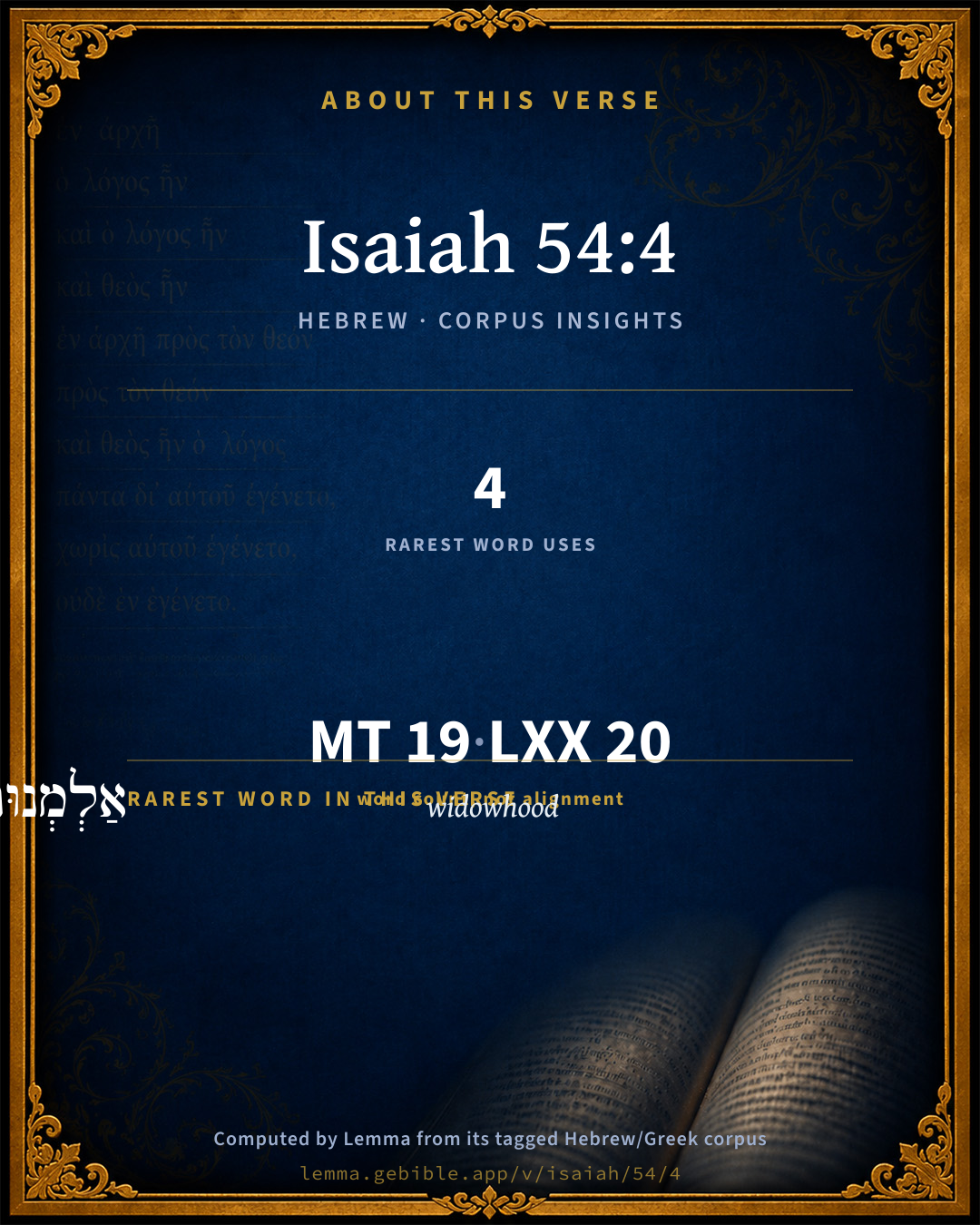
The rarest word here is אַלְמְנוּתַ֖יִךְ widowhood H491 — appearing just 4 times in the whole Hebrew Bible.

Shared distinctive vocabulary

אַלְמְנוּתַ֖יִךְ widowhood H491 occurs in 4 verses of the Hebrew Bible. Also found in:

Grammatical profile

  • 6 verbs
  • 4 nouns
  • 3 conjunctions
  • 1 adverb
  • 5 particles

Verb forms

  • תִּֽירְאִי֙ Qal · Jussive
  • תֵב֔וֹשִׁי Qal · Imperfect
  • תִּכָּלְמִ֖י Niphal · Jussive
  • תַחְפִּ֑ירִי Hiphil · Imperfect
  • תִּשְׁכָּ֔חִי Qal · Imperfect
  • תִזְכְּרִי Qal · Imperfect

Repetition

Words recur within this verse — often emphatic in Hebrew:

Hebrew & Septuagint length

In English translation the verse runs 38 words from the Hebrew and 35 from the Septuagint (LXX English) — closely comparable.

A rough comparison of the two English renderings, which tokenize alike — not a word-level alignment.

Word counts can differ between the Hebrew and the Greek without any difference in meaning — e.g. the Hebrew direct-object marker אֵת has no separate Greek word, and Greek often adds the article ὁ.

In the original languages it is 19 Hebrew tokens and 20 Greek tokens — but the two are counted differently (Hebrew bundles its prefixes and suffixes into one token; the Greek is in lemma form), so that isn’t a like-for-like length.

Cross-references

11

Topical passages linked to Isaiah 54:4 in the Treasury of Scripture Knowledge — connected by theme and wording, ordered by reader-vote popularity; previews shown in the World English Bible.

  • Isaiah 41:10 Don't you be afraid, for I am with you; don't be dismayed, for I am your God; I will strengthen you; yes, I will help you; yes, I will uphold you with the right hand of my righteousness.
  • 1 Peter 2:6 Because it is contained in Scripture, "Behold, I lay in Zion a chief cornerstone, chosen, and precious: He who believes in him will not be disappointed."
  • Jeremiah 31:19 Surely after that I was turned, I repented; and after that I was instructed, I struck on my thigh: I was ashamed, yes, even confounded, because I did bear the reproach of my youth.
  • Isaiah 61:7 Instead of your shame [you shall have] double; and instead of dishonor they shall rejoice in their portion: therefore in their land they shall possess double; everlasting joy shall be to them.
  • Isaiah 45:16–17 They shall be disappointed, yes, confounded, all of them; they shall go into confusion together who are makers of idols.
  • Isaiah 51:7 Listen to me, you who know righteousness, the people in whose heart is my law; don't you fear the reproach of men, neither be you dismayed at their insults.
  • Isaiah 41:14 Don't be afraid, you worm Jacob, and you men of Israel; I will help you, says Yahweh, and your Redeemer is the Holy One of Israel.
  • Ezekiel 16:60–63 Nevertheless I will remember my covenant with you in the days of your youth, and I will establish to you an everlasting covenant.
  • Hosea 3:1–5 Yahweh said to me, "Go again, love a woman loved by another, and an adulteress, even as Yahweh loves the children of Israel, though they turn to other gods, and love cakes of raisins."
  • Ezekiel 16:43 Because you have not remembered the days of your youth, but have raged against me in all these things; therefore, behold, I also will bring your way on your head, says the Lord Yahweh: and you shall not commit this lewdness with all your abominations.
  • Ezekiel 16:22 In all your abominations and your prostitution you have not remembered the days of your youth, when you were naked and bare, and was weltering in your blood.

Cross-references courtesy of OpenBible.info (CC BY 4.0).

Hebrew and Greek witnesses Masoretic Hebrew ↔ Greek Septuagint

The same verse in the two great witnesses to the Old Testament, shown verse-for-verse.

These are two independent witnesses, not word-aligned to each other, and the Septuagint is shown in lemma (dictionary) form.

Hebrew Isaiah 54:4 Masoretic · Westminster Leningrad Codex

אַל תִּֽירְאִי֙ כִּי לֹ֣א תֵב֔וֹשִׁי וְאַל תִּכָּלְמִ֖י כִּ֣י לֹ֣א תַחְפִּ֑ירִי כִּ֣י בֹ֤שֶׁת עֲלוּמַ֨יִךְ֙ תִּשְׁכָּ֔חִי וְחֶרְפַּ֥ת אַלְמְנוּתַ֖יִךְ לֹ֥א תִזְכְּרִי עֽוֹד

Don't be afraid; for you shall not be ashamed: neither be confounded; for you shall not be disappointed: for you shall forget the shame of your youth; and the reproach of your widowhood shall you remember no more.

World English Bible · Public Domain

Greek LXX Isaiah 54:4 Septuagint · lemma form

μή φοβέω ὅτι κατααἰσχύνω μηδέ ἐντρέπω ὅτι ὀνειδίζω ὅτι αἰσχύνη αἰώνιος ἐπιλανθάνω καί ὄνειδος ὁ χήρειος σύ οὐ μή μιμνήσκω

Fear not, because you have been put to shame, neither be confounded, because you were reproached: for you shall forget your former shame, and shall no more at all remember the reproach of your widowhood.

LXX2012 (modern English Septuagint) · Public Domain

Hebrew: Westminster Leningrad Codex (CC BY 4.0). Greek: Septuagint (public domain); English from LXX2012 (modern English Septuagint) (Public Domain). How the Septuagint differs from the Hebrew →

Targum (Aramaic paraphrase)

1

The Targum is the ancient Jewish Aramaic paraphrase of the Hebrew Scriptures — an interpretive translation, not the Hebrew text itself. Onkelos (literal) and Pseudo-Jonathan (expansive) render the Torah, and Jonathan the Prophets. Coverage is partial: where no permissively-licensed English translation exists for a verse, only the Aramaic is shown. This is verse-level text, not a word-by-word alignment to the Hebrew.

  1. Targum Jonathan Prophets (Joshua–Malachi)
    לָא תִדְחֲלִין אֲרֵי לָא תִבְהֲתִין וְלָא תִתְכַּנְעִין אֲרֵי לָא תִתְכַּלְמִין אֲרֵי בַהֲתַת עוּלֵמוּתִיךְ תִּתְנְשִׁין וְחִיסוּדֵי אַרְמְלוּתִיךְ לָא תִדְכְּרִין עוֹד:

    Fear not, for thou shalt not be ashamed; neither be thou confounded, for thou shalt not be put to shame: for thou shalt forget the shame of thy youth, and shalt not remember the reproaches of thy widowhood any more.

    Targum Jonathan — Aramaic: “Mikraot Gedolot” (public domain). English: “Sefaria Community Translation” (CC0 1.0 (public-domain dedication)); “London "Chaldee Paraphrase," 1871” (public domain). Text via Sefaria.

Commentary

Notes on Isaiah 54:4 from classic Christian and Jewish commentators (each source and its license shown beneath its notes). The classic Christian expositions comment on the surrounding passage and are grouped to its opening verse, so a note may address several verses; the Jewish commentaries on the Tanakh (Rashi and others) are per-verse, so they appear only where the commentator wrote on this verse.

Lemma curates 59 commentaries, every one of them public domain or Creative Commons licensed, each selected and text-cleaned for this edition rather than reprinted as found. About our sources →

Trapp's Complete Commentary

John Trapp

Isa 54:4 Fear not; for thou shalt not be ashamed: neither be thou confounded; for thou shalt not be put to shame: for thou shalt forget the shame of thy youth, and shalt not remember the reproach of thy widowhood any more.

Ver. 4. Fear not, for thou shalt not be ashamed.] As widows and barren women wont to be. Thou hast been "without God and without Christ in the world"; but henceforth thou shalt be "married to him who is raised from the dead, that thou mayest bring forth fruit unto God." {Rom 7:4} Ipse enim quod vult iubet, et dat quod iubet. {a} When you would and should be certain and quiet in conscience, saith Mr Bradford, martyr, in a sweet letter of his to a woman troubled in mind, then should your faith burst through all things until it come to Christ crucified, and the eternal sweet mercies and goodness of God in Christ. Here, here is the bridal bed, here is your spouse’s resting place; creep into it, and in your arms of faith embrace him. Bewail your weakness, your unworthiness, your diffidence, &c., and you shall see he will turn to you. What said I, you shall see? Nay, I should have said, you shall feel he will turn to you. {b}

{a} Augustine.

{b} Acts and Mon., 1490.

John Trapp, A Commentary or Exposition upon All the Books of the Old and New Testament (1647–1656) — public domain. Text from a community e-Sword module.

The Biblical Illustrator

Joseph S. Exell

Isa_54:4

Fear not; for thou shalt net be ashamed

Shame

Here, as in many other cases, shame includes the disappointment of the hopes, hut with specific reference to previous misconduct (Job_6:20).

The first clause declares that the Church has nocause for despondency, the second disposes of the causes which might seem to be suggested by her history. The essential meaning is, thy former experience of My displeasure. (J. A. Alexander.)

Thou shalt forget the shame of thy youth

Shall I remember my sins in heaven?

In looking forward to heaven, two questions have stirred the minds and hearts of most Christians: Shall I remember my sins in heaven? and If I remember my sins in heaven, will not the recollection mar my joy, and interfere with my blessedness? These

questions are not idle. They originate with that consciousness of depravity which is the first step towards our personal salvation, and they recur in connection with the dispensation of Divine mercy. Our condition prompts the inquiry, and the reply will reveal to us the unsearchable riches of Divine grace. The questions resolve themselves into this: Will the dispensation of Divine mercy, when it has done its work, blot out all the mischievous consequences of sin? The text guides our reply. There was a people taken up by God when in circumstances of great degradation. They are brought into the closest connection with Him--into such a connection as that the conjugal union is the best possible representation of it.. God is faithful to this people, but they are faithless to Him. He institutes means to bring them back to Himself, and He does bring them back. Then, speaking of their restoration, He says, Fear not, for thou shalt not be ashamed, etc. In the realization of their restoration, they shall (in a certain sense) forget their apostacy. We declare our belief that, in heaven, you will not so remember your sins as to have your happiness interfered with by the recollection, and that whatever remembrance you have of the apostacy and depravity, will rather be the occasion of increasing your blessedness and joy, than of interfering with the one, or of marring the other. The remembrance of sin did exist under the Levitical dispensation; but in the dispensation of Christ there is nothing at all analogous to the annually recurring day of atonement Heb_10:17). So far as our intercourse with God and the cherishing of bright prospects are concerned there is to be a complete forgetfulness of sin. With respect to heaven, we put before you two remarks.

I. THERE IS A RECOLLECTION INEVITABLE. The identity of passions will involve an identity of consciousness. What are the recollections which are inevitable?

1. I was a sinner.

2. I was restored to God by such means and under such influences.

II. THERE IS A REMEMBRANCE OF SINS IMPOSSIBLE. There is one suggestion that seems of importance here. It is that by and by memory will not be the faculty chiefly exercised and put forth. When is it that we live most in the past? It is when we are sad. In heaven there will be no sadness, no solitude, no fear, no carefulness. Memory, therefore, will not be goaded as now. Memory will then have an inferior place. Observation and penetration will be the chief mental exercises of heaven. A man will be surrounded by objects of intense interest, all connected with God. The commanding recollection of sin will therefore be impossible. The remembrance of sin in heaven will always be connected with the consciousness that sin has been blotted out. This will awaken thankfulness; and joy, with gratitude, will flow through the soul as a large and mighty river. Nothing in Gods conduct in heaven will put sin forward. Then, within yourselves there will be complete and conscious holiness. Look at another fact. You may have had companions here in iniquity, but you will have no unsaved companions in sin with you there. You may recognize persons with whom you trod the broad road, but you will there recognize them as redeemed beings; and, just as in your own case, the commanding thought is not sin but forgiveness, so with them the commanding association will be the wonderfulness of their redemption; not the depth of their apostacy and the length of their wanderings; so that their presence, instead of forcing upon you a remembrance of guilt, will only magnify before your eye and your heart the unsearchable riches of Gods grace and mercy. You will be employed by and by. Your employment will be all-absorbing, and it will be constant. Why should we talk to you about this? If you have a secret idea, or rather an impression, that there must be some limitation to Gods mercy, that it will not secure all this blotting out, what is the consequence? The effect is to limit your application to this pro-vision--you do not take full advantage of the riches of Gods mercy. (S. Martin.)

Gods gift of forgetfulness

To many religious people the burden of the past is the heaviest of their lives. No difficulties and trials of the present can match it for bitterness. They look forward calmly and hopefully to whatever the years may bring. Even the valley of the shadow has little terror for them, believing as they do that they will be shepherded through that to the eternal fold. And yet they are often weighted by a sore burden of the past; they are hag-ridden by shadows of dead days. Sometimes it is the very greatness and success and joy of the past which induce this constant recollection. But the burden of the past, which is more in keeping with the thought of our text, is not the recollection of some joy or success, but of some failure, some sorrow, some loss, some sin, some shame. And to some who live ever under the shadow of this memory it would mean new life to them if the promise came to them with the meaning it had in the prophets lips, Thou shalt forget the shame of thy youth, and shalt not remember the reproach of thy widowhood any more. Of course, there is a certain sense in which we cannot forget, and are not meant to forget. Experience has its lessons to teach. All religion begins with repentance, and the appeal to repentance is an appeal to memory. But the promise of our text is a tacit condemnation of the sentimental brooding on the past, whatever that past may be, which weakens the present life, which keeps a man from gathering up the fragments of his life that remain, keeps him from doing his duty calmly, and giving himself to whatsoever things are true and pure and lovely and of good report. If we believe in the eternal love of God we must not let any pale ghost of the past, spectral figures of the night, chill our blood and keep us from our pilgrimage. 1)o not fear that this Christian doctrine of the forgiveness of sin will make sin easy; it is the only thing that can make sin impossible--the light that drives out the darkness, the love of God that fills the heart and leaves no room for evil, not even for evil memory. (Hugh Black, M. A.)

A blessed forgetfulness

The reproach of thy widowhood clearly refers to the period of the exile when Zion regarded herself as cast off by Jehovah. The sense of the shame of thy youth is less obvious. Since the conception has some affinities with the striking allegory in Eze_16:1-63., it is probable that the reference goes back to the origin of the nation Eze_16:4-8), the reference being rather to the Egyptian oppression. (Prof. J. Skinner, D. D.)

Forgetting the shame of youth

A man who had lived for many years the Christian life, told me how there was a place in a street in Edinburgh which was associated with a sin. Every time in his early life he passed it, it brought back again the keen remorse and shame. It seemed to stain his life afresh whenever he saw the very place. But when he came to God and gave his heart and life to Christ, the first time he passed that place afterwards his soul was filled by a great transport of joy that all that was done, that it was no longer part of his life, that God had forgiven and forgotten and cast it behind His back. And he entered, for a moment at least in foretaste, into the perfect joy of soul, and he forgot the shame of his youth and remembered the reproach no more. (Hugh Black, M. A.)

The Biblical Illustrator, edited by Joseph S. Exell (c. 1880s–1900s) — public domain. Text from a community e-Sword module.

Joseph Benson's Commentary

Isa 54:4-5. Thou shalt not be ashamed — As formerly, of the straitness of thy borders, and the fewness of thy children. Thou shalt forget the reproach of thy youth — Thy barrenness in former times: so great shall be thy fertility and felicity, that it shall cause thee to forget thy former unfruitfulness and misery. And shalt not remember the reproach of thy widowhood — That time and state when thou wast like a widow, disconsolate and desolate, deprived or forsaken of her husband, and having few or no children. For thy Maker — He who made thee out of nothing, and therefore can fulfil all these promises, how improbable soever their fulfilment may appear; is thy husband — Will own thee for his spouse, and give thee proof of his conjugal affection. The Lord of hosts — Who hath the sovereign command of all men and creatures, and therefore can subdue the Gentiles to thee, and can make thee to increase and multiply in so prodigious a measure, even in thy old age, notwithstanding thy barrenness in the days of thy youth, of which he speaks in the foregoing verse. The God of the whole earth shall he be called — The God and Father of all nations. Whereas formerly he was called the God of Israel only, and the Gentiles had no special relation to him, the time is now coming when he shall be called the God of the Gentiles also, having admitted them into the same covenant relation to himself with the Jews, and the partition wall between Jews and Gentiles being broken down. See Zec 14:9; Rom 3:29; Eph 2:11-16.

Joseph Benson's Commentary on the Old and New Testaments (1811–1818) — public domain. Text from a community e-Sword module.

Keil & Delitzsch

C. F. Keil & F. Delitzsch

The encouraging promise is continued in Isa 54:4 : "Fear not, for thou wilt not be put to shame; and bid defiance to reproach, for thou wilt not blush: no, thou wilt forget the shame of thy youth, and wilt no more remember the reproach of thy widowhood." Now that redemption was before the door, Israel was not to fear any more, or to be overcome (as the niphal nikhlam implies) by a felling of the shame consequent upon her state of punishment, or so to behave herself as to leave no room for hope. For a state of things was about to commence, in which she would have no need to be ashamed (on bōsh and châphēr or hechpı̄r), but which, on the contrary (כּי, imo, as in Isa 10:7; Isa 55:9), would be so glorious that she would forget the shame of her youth, i.e., of the Egyptian bondage, in which the national community of Israel was still but like a virgin (‛almâh), who entered into a betrothal when redeemed by Jehovah, and became His youthful wife through a covenant of love (ehe = berı̄th) when the law was given at Sinai (Jer 2:2; Eze 16:60); so glorious indeed, that she would never again remember the shame of her widowhood, i.e., of the Babylonian captivity, in which she, the wife whom Jehovah had taken to Himself, was like a widow whose husband had died.

Keil & Delitzsch — Biblical Commentary on the Old Testament (1861–1891) — public domain (CC PDM 1.0). Text via the HelloAO Bible API. (Old Testament only.)

Geneva Bible (1599)

Geneva Bible translators

The afflictions which thou suffered at the beginning.

When as thou wast refused for thy sins, Isa. 50:1.

Geneva Bible (1599) marginal notes — public domain. Text via Bolls.life.

Jamieson, Fausset & Brown

Robert Jamieson, A. R. Fausset & David Brown

(Isa 41:10, Isa 41:14).

shame of thy youth--Israel's unfaithfulness as wife of Jehovah, almost from her earliest history.

reproach of widowhood--Israel's punishment in her consequent dismissal from God and barrenness of spiritual children in Babylon and her present dispersion (Isa 54:1; Isa 49:21; Jer 3:24-25; Jer 31:19; Hos 2:2-5).

Jamieson, Fausset & Brown — Commentary Critical and Explanatory on the Whole Bible (1871) — public domain (CC PDM 1.0). Text via the HelloAO Bible API.

Adam Clarke's Commentary

Verse 4. For thou shalt forget the shame of thy youth] That is, "The bondage of Egypt: widowhood, the captivity of Babylon." - Secker.

Adam Clarke's Commentary on the Bible (1810–1826) — public domain. Text from a community e-Sword/MySword module.

Ellicott's Commentary for English Readers

(4) Thou shalt forget.—The “shame of thy youth,” was the Egyptian bondage, from which Jehovah chose Israel to be His bride (Jer_3:1-11; Eze_16:1-14). The “reproach of widowhood” was the captivity in Babylon.

A Bible Commentary for English Readers, edited by Charles John Ellicott (1878–1897) — public domain. Text from a community e-Sword module.

The Cambridge Bible for Schools and Colleges

gen. ed. J. J. S. Perowne

4. the reproach of thy widowhood clearly refers to the period of the Exile when Zion regarded herself as cast off by Jehovah. The sense of the shame of thy youth is less obvious. Since the conception has some affinities with the striking allegory in Ezekiel 16 it is probable that the reference goes back to the origin of the nation (cf. Eze_16:4-8); the reference being to the Egyptian oppression.

4–6. Zion shall forget her former shame in the joy of reconciliation to her God.

The Cambridge Bible for Schools and Colleges (gen. ed. J. J. S. Perowne; Cambridge University Press, 1878–1918) — public domain. Text from a community e-Sword module.

John Gill's Exposition

Fear not,.... The fulfilment of these things; however unlikely and unpromising they might seem, yet God was able to perform them; and therefore way should not be given to a fearful, distrustful, and unbelieving heart:

for thou shall not be ashamed; as men are, when disappointed of what they have been hoping for and expecting; but so it should not be with the church, she should not be ashamed of her hope, faith, and confidence; for there would be a performance of all that the Lord had spoken: nor should she be ashamed of her barrenness, which should cease; and of the fewness of her children or converts, which would be many; and of the straitness of the place of her tent or habitation, which would now be enlarged:

neither be thou confounded, for thou shalt not be put to shame; other words made use of to express the same thing, and for the further confirmation of it, that she needed not, and that she should not be put to the blush, or to shame and confusion, on the above accounts:

for thou shalt forget the shame of thy youth; by which may be meant either the small number of converts at the first preaching of the Gospel; or more especially that there were so few of the wise and learned, the rich and noble, that embraced it, with which the first Christians were greatly upbraided; or those persecutions which attended them the three first centuries, which, being now at an end, shall be forgotten:

and shalt not remember the reproach of thy widowhood any more; which signifies much the same as before, the seeming desolate estate of the church upon the death of Christ; when she seemed to be deprived of her husband, and forsaken by him, and left as a widow, and without children, barren and unfruitful; which was reckoned reproachful with the Jews, Luk 1:25.

John Gill's Exposition of the Whole Bible (1746–1763) — public domain (CC PDM 1.0). Text via the HelloAO Bible API.

Albert Barnes' Notes on the Bible

Fear not ... - (See Isa 41:10, note, Isa 41:14, note).

Neither shalt thou be confounded - All these words mean substantially the same thing; and the design of the prophet is to affirm, in the strongest possible manner, that the church of God should be abundantly prospered and enlarged. The image of the female that was barren is kept up, and the idea is, that there should be no occasion of the shame which she felt who had no children.

For thou shalt forget the shame of thy youth - In the abundant increase and glory of future times, the circumstances of shame which attended their early history shall be forgotten. The ‘youth’ of the Jewish people refers doubtless to the bondage of Egypt, and the trials and calamities which came upon them there. So great should be their future prosperity and glory, that all this should be forgotten.

The reproach of thy widowhood - The captivity at Babylon, when they were like a woman bereft of her husband and children (see the notes at Isa 49:21).

Albert Barnes' Notes on the Bible (1834–1885) — public domain. Text from a community e-Sword/MySword module.

Haydock's Catholic Bible Commentary

Widowhood. Thy former excesses shall be forgotten. (Calmet)

George Leo Haydock (1774–1849), Haydock's Catholic Family Bible and Commentary, 1859 edition — public domain. Excludes Psalms (Douay-Rheims chapter numbering differs from Protestant) and Deuterocanonical books (Catholic canon only).

Matthew Poole's English Annotations

Thou shalt not be ashamed for that barrenness and widowhood, which once was the matter of thy grief and shame, because now thou shalt be delivered from it, and God will own thee for his wife, and beget children of thee; as it is explained in the following words.

Thou shalt forget the shame of thy youth; it shall be forgotten both by thee and others: thou shalt not be upbraided with thy former barrenness in thy youthful state, nor confounded and tormented with the remembrance of it; both remembering and forgetting in Scripture use connote or comprehend those affections which naturally and usually follow upon them; so great shall be thy fertility and felicity, that it shall cause thee to forget thy former unfruitfulness and misery, as men commonly do in like cases, as Gen 41:51; Job 11:16; Isa 65:16; Joh 16:21.

The reproach of thy widowhood; that time and state when thou wert like a widow, disconsolate and desolate, forsaken by her husband, and having in a manner no children; which was a great reproach, especially among the Jews.

Matthew Poole's English Annotations on the Holy Bible (1683–1685) — public domain. Text from a community e-Sword/MySword module.

Whedon's Commentary on the Bible

Daniel D. Whedon

4. Fear not… not be ashamed — Keywords to what follows. Childlessness was a reproach among orientals, and especially so among Jews.

Thy youth — That is, in years when family barrenness came as a judgment.

Widowhood — When sin caused thee to become bereft of Jehovah, thy proper husband. The figures here, of course, cover spiritual conditions. Defection from God is, plainly enough, the meaning. The times when this condition was very marked in Israel cover many periods during the monarchy. Backsliding from Jehovah was the rule among them; spiritual worship and fidelity the exception. The exile period alone was distinguished for the deepest and most radical reform.

Daniel D. Whedon (gen. ed.), Commentary on the Old and New Testaments (1874–1909) — public domain. Text from a community e-Sword module.

The Pulpit Commentary

Thou shalt forget the shame of thy youth; rather, of thy maidenhood; i.e. of the time when thou wert a maiden, before by the covenant of Sinai Jehowth became thy Husband (ver. 5). The "shame" of this period was "the Egyptian bondage. Israel"s later condition would be such that the very recollection of this bondage would fade away and cease. The reproach of thy widowhood. Israel became a "widow" when Jehovah withdrew his presence from her, when the Shechinah disappeared from the temple, and the temple itself was destroyed, and Jerusalem was a desolation, and the people captives in a far land. The special "reproach of her widowhood" was the Babylonian captivity, with the sins that had brought it about. This too would be forgotten in the good time to come, amid the glories of the Messianic kingdom.

The Pulpit Commentary (1880–1919), ed. H.D.M. Spence-Jones & Joseph S. Exell — public domain. Text from a community e-Sword module.

John Wesley's Explanatory Notes

Ashamed - For the barrenness and widowhood, which once was the matter of thy grief and shame. Forget - Thou shalt not be upbraided with thy former barrenness in thy youthful state.

John Wesley, Explanatory Notes Upon the Whole Bible (1754–1765) — public domain. Text via the GEBible commentary corpus.

J. A. Alexander on Isaiah

Joseph Addison Alexander

“Fear not, for thou shalt not be ashamed, and be not abashed, for thou shalt not blush; for the shame of thy youth thou shalt forget, and the reproach of thy widowhood thou shalt not remember any more.” Here, as in many other cases, shame includes the disappointment of the hopes, but with specific reference to previous misconduct. (See Job 6:20). The first clause declares that she has no cause for despondency, the second disposes of the causes which might seem to be suggested by her history.

The essential meaning of the last clause is, ‘thy former experience of my displeasure.’ The figurative form of the expression is accommodated to the chosen metaphor of a wife forsaken and restored to her husband. The specific reference of youth to the Egyptian bondage, and of widowhood to the Babylonian exile, is artificial and forbidden by the context.

Joseph Addison Alexander, The Prophecies of Isaiah (1846–1847; New York: Scribner, 1870–1878) — public domain. Text from a community e-Sword module.

unfoldingWord translationNotes

Door43 World Missions Community

General Information:

Yahweh continues speaking to the people of Jerusalem.

you will forget the shame of your youth and the disgrace of your abandonment

Yahweh telling the people that in the future they will not even think about the shame they experienced when their enemies defeated them is spoken of as if Yahweh were telling a woman that she will no longer think about the shame she experienced from being unable to have children and having her husband abandon her. (See: Metaphor)

translationWords

fear

shame

unfoldingWord translationNotes — © Distant Shores Media and the Door43 World Missions Community, licensed CC BY-SA 4.0. Source: git.door43.org/Door43/en_tn.

Rashi

Rabbi Shlomo Yitzchaki (Rashi)

your youth Heb. עֲלוּמַיִךְ, your youth.

Rashi on the Tanakh — English translations: “The Judaica Press complete Tanach with Rashi, translated by A. J. Rosenberg” (CC BY 4.0); “Pentateuch with Rashi's commentary by M. Rosenbaum and A.M. Silbermann, 1929-1934” (public domain); “The Metsudah Tanach series, Lakewood, N.J” (CC BY 4.0); and “The Book of Joshua, Metsudah Publications, 1997” (CC BY 4.0). Text via Sefaria.

Ibn Ezra

Rabbi Abraham ibn Ezra

לא תחפירי Thou shalt not be ashamed. Comp. וחפרה and shall be confounded (24:23). Fear not, while being in exile.

The shame of thy youth. The exile of the youths is to be understood; or the phrase refers to the period of the first and second temple,

אלמנותיך, thy widowhood, to a later period, when they had been dispossessed of it. when the Israelites were sometimes visited with great calamities. Thy widowhood. The loss of thy independence.

Ibn Ezra on the Tanakh — English translations: “Sefaria Community Translation” (CC0 1.0 (public-domain dedication)); “Yalkut, Sifsei Chachomim Chumash, Metsudah Publications, 2009” (CC BY 4.0); and “Commentary of Ibn Ezra on Isaiah - trans. by M. Friedlander, 1873” (public domain). Text via Sefaria.

Lesson kit

Teaching starters — assembled from the data on this page, not authored interpretation. Every prompt links to the verse data it draws on. Edit before teaching.

Isaiah, in the Prophets, opens this verse with 19 words (14 distinct Hebrew lemmas). Its most distinctive word is ʼalmânûwth (“widowhood”). A historical commentator’s framing appears above. Read the whole chapter for the surrounding context.

Discussion questions

  1. What does “widowhood” (ʼalmânûwth) contribute to the verse as a whole?
  2. Genesis 38:14 shares the word «widowhood» with this verse. How do the two illuminate each other?
  3. “that” occurs 3× in this one verse. What is the effect of the repetition?
  4. These translations render this verse differently; the difference is in the English rendering, not the original. What questions does that raise?
  5. The verb «תִּֽירְאִי֙» is Qal Jussive. How does its form color the action?
  6. Reading how Trapp's Complete Commentary and The Biblical Illustrator read this verse, where do the two commentators agree and where do they part?

Things to notice

Reading settings

Reading text

Shown beneath each verse's original-language words.

Old Testament
Old Testament edition

Read the OT as the Masoretic Hebrew (MT) or the Greek Septuagint (LXX).

English shown for the Greek Septuagint (in the Hebrew ↔ Greek comparison).

Comparing translations? Open the Compare panel on any verse page to stack up to four side by side.