
Psalms 10:11

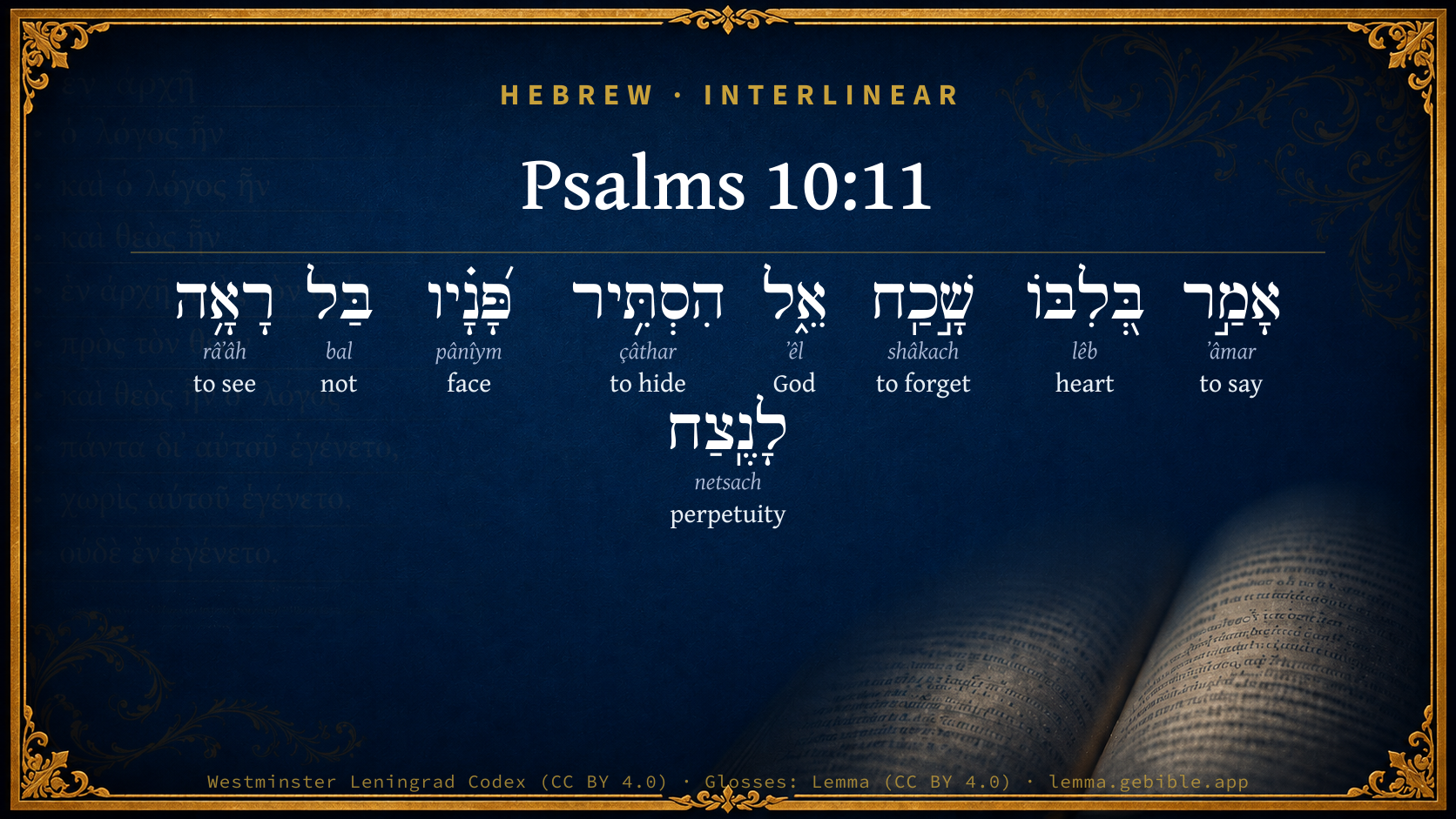
Hebrew (Westminster Leningrad Codex) Psalms 10:11 appears in the Hebrew Old Testament. The text above is from the Westminster Leningrad Codex. Each word links to its Strong’s number, a concise gloss, and parsing drawn from the Open Scriptures Hebrew Bible morphology. Click any word for its full Brown-Driver-Briggs (BDB) entry.
Download image
Cite this verse

Psalms 10:11 (World English Bible). Public Domain. Lemma interlinear Bible study tool, https://lemma.gebible.app/v/psalms/10/11.

Show BibTeX & RIS
BibTeX
RIS
English Translation
He says in his heart, "God has forgotten. He hides his face. He will never see it."
World English Bible · Public Domain
Download a study sheet

One document with this verse’s original text, its word-by-word gloss line, the meaning frame, cross-references with their text, attributed commentary, and full source and license credits — printable, and it pastes into notes with its structure intact.

This verse Autodidact and up

Study sheet (.html) Plain text (.txt)

A passage Seminary Student

Up to 50 verses in one chapter. A passage sheet keeps up to 6 commentary sources and 12 cross-references per verse, in the order this page ranks them, and says so on the sheet whenever that leaves anything out. Ask for a single verse and you get the Autodidact verse sheet above.

Everything on this page stays free to read, with no account — the sheet is a download of what is already on screen, not access to it.

Want to remove ads? Support Godless Engineer
Compare translations 3

The same verse in 3 English versions, stacked beneath the original-language interlinear above. Click any original word for its lexicon entry.

Each is an independent rendering of the whole verse — the interlinear is not word-aligned to these translations.

Highlighted words mark where these versions differ — a whole-verse word diff, not a word-by-word alignment.

  • World English Bible Public Domain
    He says in his heart, "God has forgotten. He hides his face. He will never see it."
  • King James Version Public Domain
    He hath said in his heart, God hath forgotten: he hideth his face; he will never see it.
  • unfoldingWord Literal Text CC BY-SA 4.0
    He says in his heart, “God has forgotten; he has hidden his face; to perpetuity he sees not.”

unfoldingWord Literal Text — © unfoldingWord, licensed CC BY-SA 4.0. Word-aligned USFM3 via Door43 (git.door43.org/unfoldingWord/en_ult).

Versions to compare (up to 4)

3 of 4 selected

Show all 17 translations

Every available English version of this verse, each an independent rendering of the whole verse.

  • World English Bible Public Domain
    He says in his heart, "God has forgotten. He hides his face. He will never see it."
  • Berean Standard Bible Public Domain
    He says to himself, “God has forgotten; He hides His face and never sees.”
  • Majority Standard Bible Public Domain
    He says to himself, “God has forgotten; He hides His face and never sees.”
  • King James Version Public Domain
    He hath said in his heart, God hath forgotten: he hideth his face; he will never see it.
  • American Standard Version (1901) Public Domain
    He saith in his heart, God hath forgotten; He hideth his face; he will never see it.
  • Revised Version (1885) Public Domain
    He saith in his heart, God hath forgotten: he hideth his face; he will never see it.
  • Geneva Bible (1599) Public Domain
    He hath said in his heart, God hath forgotten, he hideth away his face, and will neuer see.
  • Young's Literal Translation Public Domain
    He said in his heart, `God hath forgotten, He hath hid His face, He hath never seen.'
  • Literal Standard Version CC BY-SA 4.0
    He said in his heart, “God has forgotten, || He has hid His face, || He has never seen.”
  • Unlocked Literal Bible CC BY-SA 4.0
    He says in his heart, “God has forgotten; he covers his face; he will not bother to look.”
  • unfoldingWord Literal Text CC BY-SA 4.0
    He says in his heart, “God has forgotten; he has hidden his face; to perpetuity he sees not.”
  • Darby Bible Public Domain
    He saith in his heart, ùGod hath forgotten, he hideth his face, he will never see [it].
  • World Messianic Bible Public Domain
    He says in his heart, “God has forgotten. He hides his face. He will never see it.”
  • Webster's Bible Public Domain
    He hath said in his heart, God hath forgotten: he hideth his face; he will never see it.
  • Free Bible Version CC BY-SA 4.0
    They tell themselves, “God won't notice. He's looking the other way. He won't ever see anything.”
  • Bible in Basic English Public Domain
    He says in his heart, God has no memory of me: his face is turned away; he will never see it.
  • JPS Tanakh (1917) Public Domain
    He hath said in his heart: 'God hath forgotten; He hideth His face; He will never see.'

Literal Standard Version (2020), Covenant Press — licensed CC BY-SA 4.0. Text via the HelloAO Bible API (eBible.org). Unlocked Literal Bible (unfoldingWord) — licensed CC BY-SA 4.0. Text via the HelloAO Bible API (eBible.org). unfoldingWord Literal Text — © unfoldingWord, licensed CC BY-SA 4.0. Word-aligned USFM3 via Door43 (git.door43.org/unfoldingWord/en_ult). Free Bible Version, Dr. Jonathan Gallagher — licensed CC BY-SA 4.0. Text via the HelloAO Bible API (eBible.org).

Word by word

More ways to search: Search by grammar → Find every occurrence → Compare this word →

Practice this passage: Drill this verse → Learn its vocabulary →

לָנֶֽצַח
netsach
H5331
“to/for · perpetuity”
Preposition + Noun, Common, Masculine, Singular, Absolute
Part of Speech
Preposition + Noun
Type
Common
Gender
Masculine
Number
Singular
State
Absolute
Full BDB Definition

Origin: from H5329

TWOT: 1402a

eminence, perpetuity, strength, victory, enduring, everlastingness - eminence - enduring of life - endurance in time, perpetual, continual, unto the end - everlastingness, ever
  1. אָמַ֣ר ʼâmar H559 “to say” Verb, Qal, Perfect, 3rd Person, Masculine, Singular
  2. בְּ֭לִבּוֹ lêb H3820 “in/at · heart · his” Preposition + Noun, Common, Masculine, Singular, Construct + Suffix, Personal, 3rd Person, Masculine, Singular
  3. שָׁ֣כַֽח shâkach H7911 “to forget” Verb, Qal, Perfect, 3rd Person, Masculine, Singular
  4. אֵ֑ל ʼêl H410 “God” Noun, Common, Masculine, Singular, Absolute
  5. הִסְתִּ֥יר çâthar H5641 “to hide” Verb, Hiphil, Perfect, 3rd Person, Masculine, Singular
  6. פָּ֝נָ֗יו pânîym H6440 “face(s) · his” Noun, Common, Both, Plural, Construct + Suffix, Personal, 3rd Person, Masculine, Singular
  7. בַּל bal H1077 “not” Particle, Negative
  8. רָאָ֥ה râʼâh H7200 “to see” Verb, Qal, Perfect, 3rd Person, Masculine, Singular

About this verse

These counts appear in no published source. They are computed here, from the morphology-tagged text and Lemma’s own curated glosses. What Lemma adds →

9
words
9
distinct lemmas
Wisdom
section

Shared distinctive vocabulary

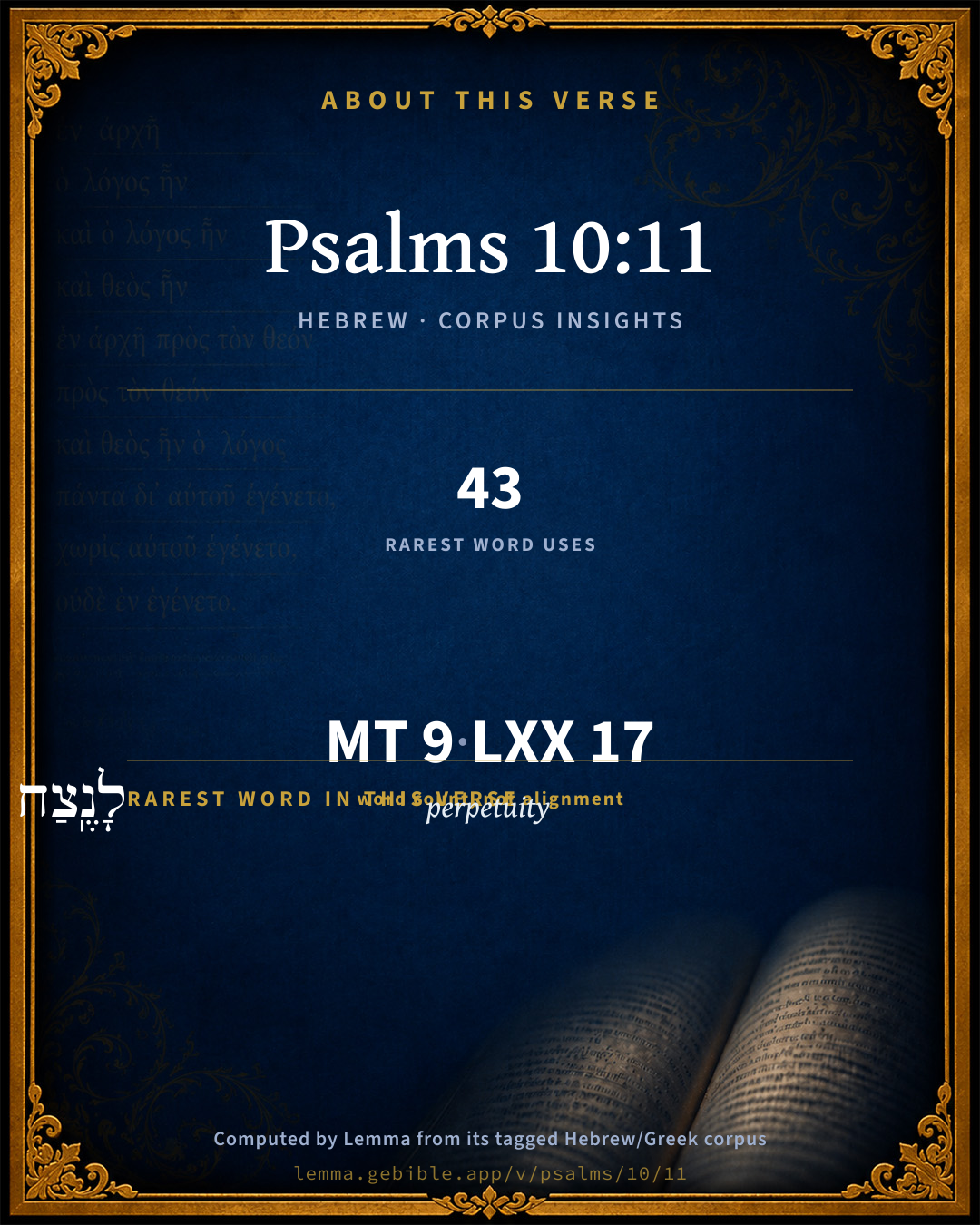
לָנֶֽצַח perpetuity H5331 occurs in 42 verses of the Hebrew Bible. Also found in:

Grammatical profile

  • 4 verbs
  • 4 nouns
  • 1 particle

Verb forms

  • אָמַ֣ר Qal · Perfect
  • שָׁ֣כַֽח Qal · Perfect
  • הִסְתִּ֥יר Hiphil · Perfect
  • רָאָ֥ה Qal · Perfect

Hebrew & Septuagint length

In English translation the verse runs 17 words from the Hebrew and 15 from the Septuagint (LXX English) — closely comparable.

A rough comparison of the two English renderings, which tokenize alike — not a word-level alignment.

Word counts can differ between the Hebrew and the Greek without any difference in meaning — e.g. the Hebrew direct-object marker אֵת has no separate Greek word, and Greek often adds the article ὁ.

In the original languages it is 9 Hebrew tokens and 17 Greek tokens — but the two are counted differently (Hebrew bundles its prefixes and suffixes into one token; the Greek is in lemma form), so that isn’t a like-for-like length.

Cross-references

10

Topical passages linked to Psalms 10:11 in the Treasury of Scripture Knowledge — connected by theme and wording, ordered by reader-vote popularity; previews shown in the World English Bible.

  • Ezekiel 8:12 Then said he to me, Son of man, have you seen what the elders of the house of Israel do in the dark, every man in his chambers of imagery? for they say, Yahweh doesn't see us; Yahweh has forsaken the land.
  • Psalms 94:7 They say, "Yah will not see, Neither will Jacob's God consider."
  • Psalms 10:6 He says in his heart, "I shall not be shaken; For generations I shall have no trouble."
  • Psalms 73:11 They say, "How does God know? Is there knowledge in the Most High?"
  • Psalms 64:5 They encourage themselves in evil plans. They talk about laying snares secretly. They say, "Who will see them?"
  • Ecclesiastes 8:11 Because sentence against an evil work is not executed speedily, therefore the heart of the sons of men is fully set in them to do evil.
  • Ezekiel 9:9 Then said he to me, The iniquity of the house of Israel and Judah is exceeding great, and the land is full of blood, and the city full of wrestling [of judgment]: for they say, Yahweh has forsaken the land, and Yahweh doesn't see.
  • Job 22:13–14 You say, 'What does God know? Can he judge through the thick darkness?
  • Mark 2:6 But there were some of the scribes sitting there, and reasoning in their hearts,
  • Luke 7:39 Now when the Pharisee who had invited him saw it, he said to himself, "This man, if he were a prophet, would have perceived who and what kind of woman this is who touches him, that she is a sinner."

Cross-references courtesy of OpenBible.info (CC BY 4.0).

Hebrew and Greek witnesses Masoretic Hebrew ↔ Greek Septuagint

The same verse in the two great witnesses to the Old Testament, shown verse-for-verse.

You’re reading Greek Psalm 9 (Hebrew Psalm 10). The Septuagint counts the superscription, so verse numbers can differ from the Hebrew — chapter-level alignment, not verse-by-verse. Numbering follows Rahlfs.

These are two independent witnesses, not word-aligned to each other, and the Septuagint is shown in lemma (dictionary) form.

Hebrew Psalms 10:11 Masoretic · Westminster Leningrad Codex

אָמַ֣ר בְּ֭לִבּוֹ שָׁ֣כַֽח אֵ֑ל הִסְתִּ֥יר פָּ֝נָ֗יו בַּל רָאָ֥ה לָנֶֽצַח

He says in his heart, "God has forgotten. He hides his face. He will never see it."

World English Bible · Public Domain

Greek LXX Greek Psalm 9:11 Septuagint · lemma form

καί ἐλπίζω ἐπί σύ ὁ γιγνώσκω ὁ ὄνομα σύ ὅτι οὐ ἐν καταλείπω ὁ ἐκζητέω σύ κύριος

Sing praises to the Lord, who dwells in Sion: declare his dealings among the nations.

LXX2012 (modern English Septuagint) · Public Domain

Hebrew: Westminster Leningrad Codex (CC BY 4.0). Greek: Septuagint (public domain); English from LXX2012 (modern English Septuagint) (Public Domain). How the Septuagint differs from the Hebrew →

Commentary

Notes on Psalms 10:11 from classic Christian and Jewish commentators (each source and its license shown beneath its notes). The classic Christian expositions comment on the surrounding passage and are grouped to its opening verse, so a note may address several verses; the Jewish commentaries on the Tanakh (Rashi and others) are per-verse, so they appear only where the commentator wrote on this verse.

Lemma curates 59 commentaries, every one of them public domain or Creative Commons licensed, each selected and text-cleaned for this edition rather than reprinted as found. About our sources →

Trapp's Complete Commentary

John Trapp

Psa 10:11 He hath said in his heart, God hath forgotten: he hideth his face; he will never see [it].

Ver. 11. He hath said in his heart, God hath forgotten] That is, he knoweth it not, regardeth it not. To learn is nothing else but to remember, said Socrates; and what a man hath utterly forgotten it is all one as if he had never known it; 2Pe 1:9, he "hath forgotten that he was purged from his old sins," that is, he was never purged. See Psa 10:4.

John Trapp, A Commentary or Exposition upon All the Books of the Old and New Testament (1647–1656) — public domain. Text from a community e-Sword module.

The Treasury of David

Charles H. Spurgeon

Ver. 11. As upon the former count, so upon this one; a witness is forthcoming, who has been listening at the keyhole of the heart. Speak up, friend, and let us hear your story. He hath said in his heart, God hath forgotten: he hideth his face; he will never see it. This cruel man comforts himself with the idea that God is blind, or, at least, forgetful: a fond and foolish fancy, indeed. Men doubt Omniscience when they persecute the saints. If we had a sense of God's presence with us, it would be impossible for us to ill treat his children. In fact, there can scarcely be a greater preservation from sin than the constant thought of "Thou, God, seest me." Thus has the trial proceeded. The case has been fully stated; and now it is but little wonder that the oppressed petitioner lifts up the cry for judgment, which we find in the following verse:

Ver. 11. He hath said in his heart, God hath forgotten. Is it not a senseless thing to be careless of sins committed long ago? The old sins forgotten by men, stick fast in an infinite understanding. Time cannot raze out that which hath been known from eternity. Why should they be forgotten many years after they were acted, since they were foreknown in an eternity before they were committed, or the criminal capable to practice them? Amalek must pay their arrears of their ancient unkindness to Israel in the time of Saul, though the generation that committed them were rotten in their graves. 1Sa 15:2. Old sins are written in a book, which lies always before God; and not only our own sins, but the sins of our fathers, to be requited upon their posterity. "Behold it is written." Isa 65:6. What a vanity is it then to be regardless of the sins of an age that went before us; because they are in some measure out of our knowledge, are they therefore blotted out of God's remembrance? Sins are bound up with him, as men do bonds, till they resolve to sue for the debt. "The iniquity of Ephraim is bound up." Ho 13:12. As his foreknowledge extends to all acts that shall be done, so his remembrance extends to all acts that have been done. We may as well say, God foreknows nothing that shall be done to the end of the world, as that he forgets anything that hath been done from the beginning of the world. Stephen Charnock.

Ver. 11. He hath said in his heart, God hath forgotten: he hideth his face; he will never see it. Many say in their hearts, "God seeth them not, "while with their tongues they confess he is an all seeing God. The heart hath a tongue in it as well as the head, and these two tongues seldom speak the same language. While the head tongue saith, "We cannot hide ourselves from the sight of God, "the heart tongue of wicked men will say, "God will hide himself from us, he will not see." But if their heart speak not thus, then as the prophet saith (Isa 29:15), "They dig deep to hide their counsel from the Lord; "surely they have a hope to hide their counsels, else they would not dig deep to hide them. Their digging is not proper, but tropical; as men dig deep to hide what they would not have in the earth, so they by their wits, plots, and devices, do their best to hide their counsels from God, and they say, "Who seeth, who knoweth? We, surely, are not seen either by God or man." Joseph Caryl.

Ver. 11. The Scripture everywhere places sin upon this root. God hath forgotten: he hideth his face; he will never see it. He hath turned his back upon the world. This was the ground of the oppression of the poor by the wicked, which he mentions, Ps 10:9-10. There is no sin but receives both its birth and nourishment from this bitter root. Let the notion of providence be once thrown out, or the belief of it faint, how will ambition, covetousness, neglect of God, distrust, impatience, and all other bitter gourds, grow up in a night! It is from this topic all iniquity will draw arguments to encourage itself; for nothing so much discountenances those rising corruptions, and puts them out of heart, as an actuated belief that God takes care of human affairs. Stephen Charnock.

Ver. 11. He hath said in his heart, etc. "Because sentence against an evil work is not executed speedily, therefore the heart of the sons of men is fully set in them to do evil." Ec 8:11. God forbears punishing, therefore men forbear repenting. He doth not smite upon their back by correction, therefore they do not smite upon their thigh by humiliation. Jer 31:19. The sinner thinks thus,: "God hath spared me all this while, he hath eked out patience into longsuffering; surely he will not punish." He hath said in his heart, God hath forgotten. God sometimes in infinite patience adjourns his judgments and puts off the sessions a while longer, he is not willing to punish. 2Pe 3:9. The bee naturally gives honey, but stings only when it is angered. The Lord would have men make their peace with him. Isa 27:5. God is not like a hasty creditor that requires the debt, and will give no time for the payment; he is not only gracious, but "waits to be gracious" (Isa 30:18); but God by his patience would bribe sinners to repentance; but alas! how is this patience abused. God's longsuffering hardens: because God stops the vials of his wrath, sinners stop the conduit of tears. Thomas Watson.

Ver. 11. He hath said in his heart, God hath forgotten: he hideth his face; he will never see it. Because the Lord continues to spare them, therefore they go on to provoke him. As he adds to their lives, so they add to their lusts. What is this, but as if a man should break all his bones because there is a surgeon who is able to set them again?... Because justice seems to wink, men suppose her blind; because she delays punishment, they imagine she denies to punish them; because she does not always reprove them for their sins, they suppose she always approves of their sins, But let such know, that the silent arrow can destroy as well as the roaring cannon. Though the patience of God be lasting, yet it is not everlasting. William Secker.

Ver. 11-13. The atheist denies God's ordering of sublunary matters. "Tush, doth the Lord see, or is there knowledge in the Most High?" making him a maimed Deity, without an eye of providence, or an arm of power, and at most restraining him only to matters above the clouds. But he that dares to confine the King of heaven, will soon after endeavour to depose him, and fall at last flatly to deny him. Thomas Fuller.

Ver. 11. Divine omniscience and the astounding presumption of sinners.

Ver. 12. With what bold language will faith address its God! and yet what unbelief is mingled with our strongest confidence. Fearlessly the Lord is stirred up to arise and lift up his hand, yet timidly he is begged not to forget the humble; as if Jehovah could ever be forgetful of his saints. This verse is the incessant cry of the Church, and she will never refrain therefrom until her Lord shall come in his glory to avenge her of all her adversaries.

Ver. 11-13. See Psalms on "Ps 10:11" for further information.

Ver. 12. Arise, O Lord. A prayer needful, allowable, seasonable, etc.

Ver. 13. In these verses the description of the wicked is condensed, and the evil of his character traced to its source, viz., atheistical ideas with regard to the government of the world. We may at once perceive that this is intended to be another urgent plea with the Lord to show his power, and reveal his justice. When the wicked call God's righteousness in question, we may well beg him to teach them terrible things in righteousness. In Ps 10:13, the hope of the infidel and his heart wishes are laid bare. He despises the Lord, because he will not believe that sin will meet with punishment:

he hath said in his heart, Thou wilt not require it. If there were no hell for other men, there ought to be one for those who question the justice of it.

Ver. 11-13. See Psalms on "Ps 10:11" for further information.

Ver. 13 He hath said in his heart, Thou wilt not require it. As when the desperate pirate, ransacking and rifling a bottom was told by the master, that though no law could touch him for the present, he should answer it at the day of judgment, replied, "If I may stay so long ere I come to it, I will take thee and thy vessel too." A conceit wherewith too many land thieves and oppressors flatter themselves in their hearts, though they dare not utter it with their lips. Thomas Adams.

Ver. 13-14. What, do you think that God doth not remember our sins which we do not regard? for while we sin the score runs on, and the Judge setteth down all in the table of remembrance, and his scroll reacheth up to heaven. Item, for lending to usury; item, for racking of rents; item, for starching thy ruffs; item, for curling thy hair; item, for painting thy face; item, for selling of benefices; item, for starving of souls; item, for playing at cards; item, for sleeping in the church; item, for profaning the Sabbath day, with a number more hath God to call to account, for every one must answer for himself. The fornicator, for taking of filthy pleasure; the careless prelate, for murdering so many thousand souls; the landlord, for getting money from his poor tenants by racking of his rents; see the rest, all they shall come like very sheep when the trumpet shall sound and the heaven and the earth shall come to judgment against them; when the heavens shall vanish like a scroll, and the earth shall consume like fire, and all the creatures standing against them; the rocks shall cleave asunder, and the mountains shake, and the foundation of the earth shall tremble, and they shall say to the mountains, Cover us, fall upon us, and hide us from the presence of his anger and wrath whom we have not cared to offend. But they shall not be covered and hid; but then shall they go the back way, to the snakes and serpents, to be tormented of devils for ever. Henry Smith.

Ver. 13 (first clause). An astounding fact, and a reasonable enquiry.

Charles H. Spurgeon's The Treasury of David (1869–1885) — public domain. Psalms only. Text from a community e-Sword/MySword module.

Joseph Benson's Commentary

Psa 10:11. He hath said in his heart, God hath forgotten — Namely, the poor, (Psa 10:10,) or, the humble. He forgets or neglects their oppressions and prayers, and doth not avenge their cause, as he hath said he would do. He hideth his face — Lest he should see. He takes no notice of their sufferings, lest he should be engaged to help them. He will not encumber himself with the care of things done upon the earth, but leaves it wholly to men to manage their affairs as they think fit. He will never see it — Namely, the oppression of the poor, or the design of oppressors against them.

Joseph Benson's Commentary on the Old and New Testaments (1811–1818) — public domain. Text from a community e-Sword module.

Jamieson, Fausset & Brown

Robert Jamieson, A. R. Fausset & David Brown

As before, such conduct implies disbelief or disregard of God's government.

Jamieson, Fausset & Brown — Commentary Critical and Explanatory on the Whole Bible (1871) — public domain (CC PDM 1.0). Text via the HelloAO Bible API.

Adam Clarke's Commentary

Verse 11. God hath forgotten] He hath cast off this people, and he will never more re-establish them. So Sanballat thought.

Adam Clarke's Commentary on the Bible (1810–1826) — public domain. Text from a community e-Sword/MySword module.

John Calvin's Commentaries

11. He hath said in his heart. The Psalmist again points out the source from which the presumption of the ungodly proceeds. Because God seems to take no notice of their wicked practices, they flatter themselves with the hope of escaping unpunished. As, however, they do not openly utter with their mouth the detestable blasphemy, that God hath forgotten their conduct, and hath shut his eyes that he may never see it, but hide their thoughts in the deep recesses of their own hearts, as Isaiah declares, (Isaiah 29:15) the Psalmist uses the same form of expression which he used before, and which he repeats a little after the third time, namely, that the ungodly say to themselves, in their hearts, that God takes no concern whatever in the affairs of men. And it is to be observed, that the ungodly, when all things happen to them according to their wishes, form such a judgment of their prosperity as to persuade themselves that God is in a manner bound or obliged to them. “Or il faut noter que les meschans voyans que tout leur vient ‘X souchair sont tellement estat de leur prosperite, qu’ils se sont a croire que Dieu est aucunement obligd a eux.” — Fr.

“Qu’ils vivent sans crainte ne souci de l’advenir.” — Fr. “That they live without any fear or concern about the future.”

John Calvin's Commentaries (1540-1563) — public domain. Text from the Calvin Translation Society English edition (1840s-50s) via the Christian Classics Ethereal Library (ccel.org). Calvin's coverage is partial (roughly two-thirds of the Bible); uncommented books and verses are honest gaps, never fabricated. The 19th-century editor's footnotes and remarks are omitted so the notes are faithfully Calvin's own voice.

Ellicott's Commentary for English Readers

(11) Hideth.—Better, hath hidden.

A Bible Commentary for English Readers, edited by Charles John Ellicott (1878–1897) — public domain. Text from a community e-Sword module.

The Cambridge Bible for Schools and Colleges

gen. ed. J. J. S. Perowne

11. He saith in his heart, God (El) hath forgotten:

He hath hidden his face; he hath not seen nor ever will.

Experience, he thinks, confirms the assumption from which he started (Psa_10:4), that God will not trouble Himself to interfere: the exact opposite of the faith of the saints (Psa_9:12; Psa_9:18). The last clause means literally, He hath not seen for ever: i.e. hath not seen hitherto nor will hereafter.

The Cambridge Bible for Schools and Colleges (gen. ed. J. J. S. Perowne; Cambridge University Press, 1878–1918) — public domain. Text from a community e-Sword module.

John Gill's Exposition

He hath said in his heart, God hath forgotten,.... Meaning either his own sins, because they are not immediately punished; wherefore he hopes to go on for ever with impunity, but will be mistaken, for God will remember the iniquities of Babylon, and render to her double, Rev 18:5; see Amo 7:17; or else the poor ones he oppresses; for though they seem for a while to be forgotten by God, they are not, a book of remembrance is written for them;

he hideth his face; that is, from his poor saints, which is true oftentimes; but then the use the wicked one makes of it is bad, namely, to insult them on that account, and to imagine that it is grateful to God, and doing him good service, to afflict and persecute them; and that God will never regard them, nor return to them more, as follows;

he will never see it; or them; he will never more look upon the poor, he will no more regard them, and take notice of them and their afflictions; than which nothing is more false; for though he hides his face for a moment, yet with everlasting kindness will he gather them to himself; and he beholds all their oppressions and afflictions, and not as a bare spectator; he sympathizes with them, and delivers them out of them. Or "he will never" the wickedness committed by the wicked; which is a very foolish thought, since what is done in the dark, and in the most secret manner, is seen by God, the darkness and the light are alike to him; he is all-seeing and ever-seeing, and everywhere seeing; and he it is that has made the eye, and shall not he see? Psa 94:5; the sense of the whole in general is, that God takes no notice of good men or bad men, nor of what is done by either of them; he does not concern himself with the affairs of this world, which is an impious denial of divine Providence; see Eze 9:9.

John Gill's Exposition of the Whole Bible (1746–1763) — public domain (CC PDM 1.0). Text via the HelloAO Bible API.

Albert Barnes' Notes on the Bible

He hath said in his heart, God hath forgotten - That is, this is his practical, habitual feeling. He acts as if God had forgotten, or as if God takes no knowledge of what is occurring in the earth. Compare Psa 10:6.

He hideth his face - God has hidden his face; that is, he does not look on what is occurring.

He will never see it - That is, he will never see what is done. It cannot be supposed that any man would deliberately say either that the memory of God has failed, or that he will not see what is done upon the earth, but the meaning is, that this is the practical feeling of the wicked man; he acts as if this were so. He is no more restrained in his conduct than he would be if this were his deliberate conviction, or than if he had settled it in his mind that God is regardless of human actions. It is hardly necessary to say that this is a correct description of the conduct of wicked men. If they deliberately believed that God was regardless of human conduct, if they were certain that he would not behold what is done, their conduct would not be different from what it is now. They do not act as if his eye were upon them; they are not restrained by any sense of his presence.

Albert Barnes' Notes on the Bible (1834–1885) — public domain. Text from a community e-Sword/MySword module.

Matthew Poole's English Annotations

God hath forgotten, to wit, the poor, Psa 10:10; or the humble, which we are taught to supply out of Psa 10:12, where he saith, forget not the humble. He forgets and neglects all their oppressions and prayers, and doth not avenge their cause, as he hath said he would do; nor execute judgments upon their oppressors, as he hath sometimes done or been thought to do.

He hideth his face, lest he should see. He takes no notice of their sufferings, lest he should be engaged to help them. He will not encumber himself with the care of things done upon earth, but leaves it wholly to men to manage their affairs as they think fit.

He will never see it, to wit, the oppression of the poor, or the design of oppressors against them, which is the chief subject of the whole Psalm, and is particularly expressed Psa 10:10.

Matthew Poole's English Annotations on the Holy Bible (1683–1685) — public domain. Text from a community e-Sword/MySword module.

Whedon's Commentary on the Bible

Daniel D. Whedon

11. God hath forgotten—This is the common error of the wicked. Because judgment is delayed they are emboldened to say, “God hideth his face,” does not see it, takes no legal notice of crime. See Psa_10:13; Psa_73:11; Eze_8:12.

Daniel D. Whedon (gen. ed.), Commentary on the Old and New Testaments (1874–1909) — public domain. Text from a community e-Sword module.

The Pulpit Commentary

He hath said in his heart, God hath forgotten (comp. vers. 4, 13). "The wish is father to the thought." As Delitzsch says, "The true personal God would disturb his plans, so he denies him. "There is naught," he says, "but destiny, and that is blind; an absolute, and that has no eyes; an idea, and that has no grasp. He hideth his face. He looks away; he does not wish to be troubled or disturbed by what occurs on earth. So the Epicureans in later times. He win never see it. (comp. Job_22:12 Psa_73:11 Psa_94:7)

The Pulpit Commentary (1880–1919), ed. H.D.M. Spence-Jones & Joseph S. Exell — public domain. Text from a community e-Sword module.

J. A. Alexander on Psalms

Joseph Addison Alexander

11. He hath said in his heart, God hath forgotten, he hath hidden his face, he hath not seen, doth not see, and will not see, for ever. The opening words are the same, and have the same sense, as in Psa 10:6 above. The three parallel clauses which follow all express the same idea, namely, that God takes no note of human offences. This is first expressed by the figure of forgetfulness; then by that of deliberately refusing to see, as in Psa 10:1 above; then by a literal and direct affirmation that he does not see, either the sufferings of his people or the malice of their enemies; and that this is not a transient or occasional neglect, but one likely to continue for ever.

Joseph Addison Alexander, The Psalms Translated and Explained (1850) — public domain. Text from a community e-Sword module.

unfoldingWord translationNotes

Door43 World Missions Community

He says

The word "He" refers to the wicked person, and to wicked people in general. (See: Generic Noun Phrases)

God has forgotten

Refusing to pay attention to what people do is spoken of as forgetting. AT: "God does not pay attention" or "God does not care about what I do" (See: Metaphor)

he covers his face

Refusing to pay attention to what someone does is spoken of as covering one's face. AT: "God refuses to see what is happening" (See: Metaphor)

he will not bother to look

Paying attention to what someone does is spoken of as looking at it. AT: "he will not bother to pay attention" or "he will not care" (See: Metaphor)

Arise

Starting to do something is spoken of as getting up. AT: "Do something" (See: Metaphor)

Lift up your hand

Here lifting the hand to hit someone represents punishing him. AT: "Hit him hard" or "Punish the wicked person" (See: Metonymy)

translationWords

heart

God

face

raise

unfoldingWord translationNotes — © Distant Shores Media and the Door43 World Missions Community, licensed CC BY-SA 4.0. Source: git.door43.org/Door43/en_tn.

Radak

Rabbi David Kimhi (Radak)

He says in his heart, God hath forgotten: He hideth His face; He will never see. – If He knows, He has forgotten. Or its interpretation is: that He does not know at all, like the man who has forgotten a matter and does not know it, or like the man who knows a matter, but hides his face and is unwilling ever to see it; therefore he says:

Radak on the Tanakh — English translations: “Sefaria Community Translation” (CC0 1.0 (public-domain dedication)); “Eliyahu Munk, HaChut Hameshulash” (CC BY 4.0); “Rabbi Mike Feuer, Jerusalem Anthology” (CC BY 4.0); and “R. David Kimhi on the first book of Psalms, Translated by R.G. Finch, London, 1919” (public domain). Text via Sefaria.

Lesson kit

Teaching starters — assembled from the data on this page, not authored interpretation. Every prompt links to the verse data it draws on. Edit before teaching.

Psalms, in the Wisdom, opens this verse with 9 words (9 distinct Hebrew lemmas). Its most distinctive word is netsach (“perpetuity”). A historical commentator’s framing appears above. Read the whole chapter for the surrounding context.

Discussion questions

  1. The word netsach carries the sense “perpetuity.” How does it shape the verse?
  2. How does 1 Samuel 15:29, which shares the word «perpetuity», read alongside this verse?
  3. These translations render this verse differently; the difference is in the English rendering, not the original. What questions does that raise?
  4. «אָמַ֣ר» is a Qal Perfect verb. How does that grammatical form shape the action described?
  5. Compare how Trapp's Complete Commentary and The Treasury of David read this verse. Where do they agree or differ?

Things to notice

Reading settings

Reading text

Shown beneath each verse's original-language words.

Old Testament
Old Testament edition

Read the OT as the Masoretic Hebrew (MT) or the Greek Septuagint (LXX).

English shown for the Greek Septuagint (in the Hebrew ↔ Greek comparison).

Comparing translations? Open the Compare panel on any verse page to stack up to four side by side.