
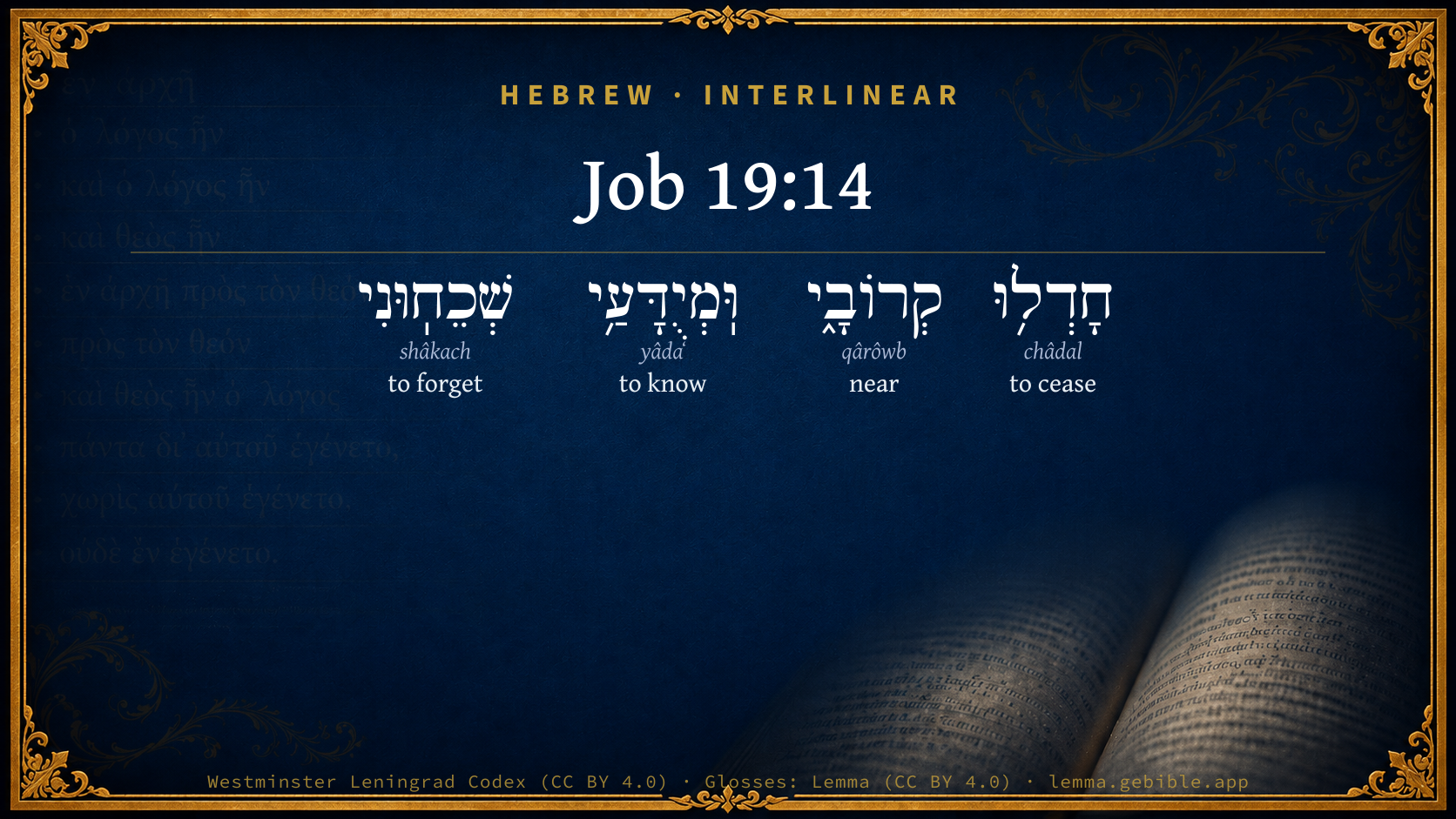
Job 19:14

Hebrew (Westminster Leningrad Codex) Job 19:14 appears in the Hebrew Old Testament. The text above is from the Westminster Leningrad Codex. Each word links to its Strong’s number, a concise gloss, and parsing drawn from the Open Scriptures Hebrew Bible morphology. Click any word for its full Brown-Driver-Briggs (BDB) entry.
Download image
Cite this verse

Job 19:14 (World English Bible). Public Domain. Lemma interlinear Bible study tool, https://lemma.gebible.app/v/job/19/14.

Show BibTeX & RIS
BibTeX
RIS
English Translation
My relatives have gone away. My familiar friends have forgotten me.
World English Bible · Public Domain
Download a study sheet

One document with this verse’s original text, its word-by-word gloss line, the meaning frame, cross-references with their text, attributed commentary, and full source and license credits — printable, and it pastes into notes with its structure intact.

This verse Autodidact and up

Study sheet (.html) Plain text (.txt)

A passage Seminary Student

Up to 50 verses in one chapter. A passage sheet keeps up to 6 commentary sources and 12 cross-references per verse, in the order this page ranks them, and says so on the sheet whenever that leaves anything out. Ask for a single verse and you get the Autodidact verse sheet above.

Everything on this page stays free to read, with no account — the sheet is a download of what is already on screen, not access to it.

Want to remove ads? Support Godless Engineer
Compare translations 3

The same verse in 3 English versions, stacked beneath the original-language interlinear above. Click any original word for its lexicon entry.

Each is an independent rendering of the whole verse — the interlinear is not word-aligned to these translations.

Highlighted words mark where these versions differ — a whole-verse word diff, not a word-by-word alignment.

  • World English Bible Public Domain
    My relatives have gone away. My familiar friends have forgotten me.
  • King James Version Public Domain
    My kinsfolk have failed, and my familiar friends have forgotten me.
  • unfoldingWord Literal Text CC BY-SA 4.0
    My kin have forsaken me, and my familiar friends have forgotten me.

unfoldingWord Literal Text — © unfoldingWord, licensed CC BY-SA 4.0. Word-aligned USFM3 via Door43 (git.door43.org/unfoldingWord/en_ult).

Versions to compare (up to 4)

3 of 4 selected

Show all 18 translations

Every available English version of this verse, each an independent rendering of the whole verse.

  • World English Bible Public Domain
    My relatives have gone away. My familiar friends have forgotten me.
  • Berean Standard Bible Public Domain
    My kinsmen have failed me, and my friends have forgotten me.
  • Majority Standard Bible Public Domain
    My kinsmen have failed me, and my friends have forgotten me.
  • King James Version Public Domain
    My kinsfolk have failed, and my familiar friends have forgotten me.
  • American Standard Version (1901) Public Domain
    My kinsfolk have failed, And my familiar friends have forgotten me.
  • Revised Version (1885) Public Domain
    My kinsfolk have failed, and my familiar friends have forgotten me.
  • Geneva Bible (1599) Public Domain
    My neighbours haue forsaken me, and my familiars haue forgotten me.
  • Douay-Rheims (1899) Public Domain
    My kinsmen have forsaken me, and they that knew me, have forgotten me.
  • Young's Literal Translation Public Domain
    Ceased have my neighbours And my familiar friends have forgotten me,
  • Literal Standard Version CC BY-SA 4.0
    My neighbors have ceased || And my familiar friends have forgotten me,
  • Unlocked Literal Bible CC BY-SA 4.0
    My kinsfolk have failed me; my close friends have forgotten me.
  • unfoldingWord Literal Text CC BY-SA 4.0
    My kin have forsaken me, and my familiar friends have forgotten me.
  • Darby Bible Public Domain
    My kinsfolk have failed, and my known friends have forgotten me.
  • World Messianic Bible Public Domain
    My relatives have gone away. My familiar friends have forgotten me.
  • Webster's Bible Public Domain
    My kinsmen have failed, and my familiar friends have forgotten me.
  • Free Bible Version CC BY-SA 4.0
    My relatives have abandoned me; my close friends have forgotten me.
  • Bible in Basic English Public Domain
    My relations and my near friends have given me up, and those living in my house have put me out of their minds.
  • JPS Tanakh (1917) Public Domain
    My kinsfolk have failed, and my familiar friends have forgotten me.

Literal Standard Version (2020), Covenant Press — licensed CC BY-SA 4.0. Text via the HelloAO Bible API (eBible.org). Unlocked Literal Bible (unfoldingWord) — licensed CC BY-SA 4.0. Text via the HelloAO Bible API (eBible.org). unfoldingWord Literal Text — © unfoldingWord, licensed CC BY-SA 4.0. Word-aligned USFM3 via Door43 (git.door43.org/unfoldingWord/en_ult). Free Bible Version, Dr. Jonathan Gallagher — licensed CC BY-SA 4.0. Text via the HelloAO Bible API (eBible.org).

Word by word

More ways to search: Search by grammar → Find every occurrence → Compare this word →

Practice this passage: Drill this verse → Learn its vocabulary →

About this verse

These counts appear in no published source. They are computed here, from the morphology-tagged text and Lemma’s own curated glosses. What Lemma adds →

4
words
4
distinct lemmas
Wisdom
section

Shared distinctive vocabulary

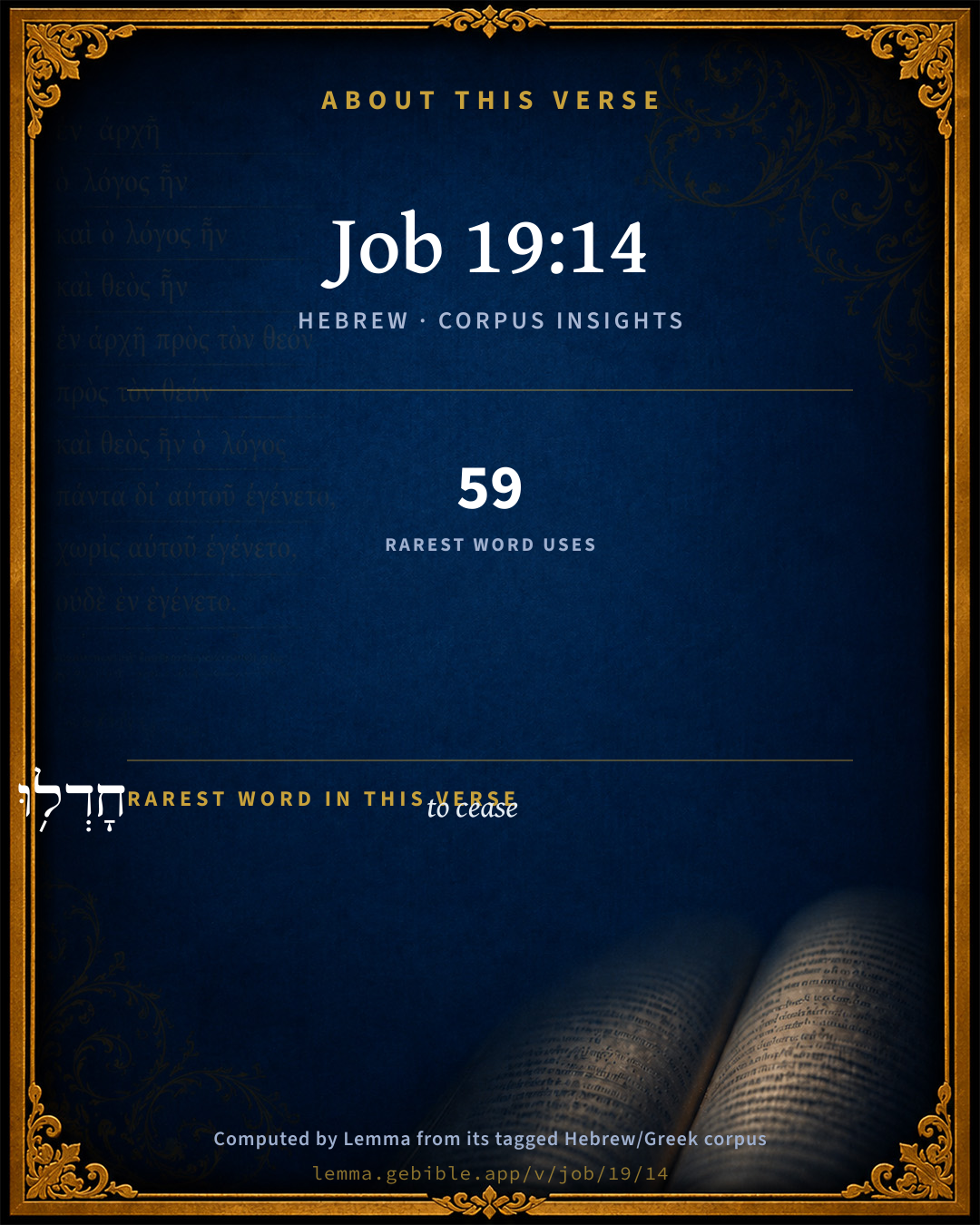
חָדְל֥וּ to cease H2308 occurs in 56 verses of the Hebrew Bible. Also found in:

Grammatical profile

  • 3 verbs
  • 1 adjective

Verb forms

  • חָדְל֥וּ Qal · Perfect
  • וּֽמְיֻדָּעַ֥י Pual · Participle Passive
  • שְׁכֵחֽוּנִי Qal · Perfect

Hebrew & Septuagint length

In English translation the verse runs 11 words from the Hebrew and 17 from the Septuagint (LXX English) — the Septuagint runs noticeably longer here. See the side-by-side →

A rough comparison of the two English renderings, which tokenize alike — not a word-level alignment.

Word counts can differ between the Hebrew and the Greek without any difference in meaning — e.g. the Hebrew direct-object marker אֵת has no separate Greek word, and Greek often adds the article ὁ.

Cross-references

8

Topical passages linked to Job 19:14 in the Treasury of Scripture Knowledge — connected by theme and wording, ordered by reader-vote popularity; previews shown in the World English Bible.

  • Psalms 38:11 My lovers and my friends stand aloof from my plague. My kinsmen stand far away.
  • 2 Samuel 16:23 The counsel of Ahithophel, which he gave in those days, was as if a man inquired at the oracle of God: so was all the counsel of Ahithophel both with David and with Absalom.
  • Psalms 55:12–14 For it was not an enemy who insulted me, Then I could have endured it. Neither was it he who hated me who raised himself up against me, Then I would have hid myself from him.
  • Proverbs 18:24 A man of many companions may be ruined, But there is a friend who sticks closer than a brother.
  • Jeremiah 20:10 For I have heard the defaming of many, terror on every side. Denounce, and we will denounce him, [say] all my familiar friends, those who watch for my fall; peradventure he will be persuaded, and we shall prevail against him, and we shall take our revenge on him.
  • Micah 7:5–6 Don't trust in a neighbor. Don't put confidence in a friend. With the woman lying in your embrace, Be careful of the words of your mouth!
  • Matthew 10:21 "Brother will deliver up brother to death, and the father his child. Children will rise up against parents, and cause them to be put to death.
  • John 13:18 I don't speak concerning all of you. I know whom I have chosen. But that the Scripture may be fulfilled, 'He who eats bread with me has lifted up his heel against me.'

Cross-references courtesy of OpenBible.info (CC BY 4.0).

Hebrew and Greek witnesses Masoretic Hebrew ↔ Greek Septuagint

The same verse in the two great witnesses to the Old Testament, shown verse-for-verse.

Here the Septuagint runs noticeably longer than the Hebrew — LXX2012 (modern English Septuagint) 17 words vs World English Bible 11. A rough length comparison of the two English translations, not a word-level alignment — read both below.

These are two independent witnesses, not word-aligned to each other, and the Septuagint is shown in lemma (dictionary) form.

Hebrew Job 19:14 Masoretic · Westminster Leningrad Codex

חָדְל֥וּ קְרוֹבָ֑י וּֽמְיֻדָּעַ֥י שְׁכֵחֽוּנִי

My relatives have gone away. My familiar friends have forgotten me.

World English Bible · Public Domain

Greek LXX Job 19:14 Septuagint · lemma form

οὐ προςποιέω ἐγώ ὁ ἐγγύς ἐγώ καί ὁ οἶδα ἐγώ ὁ ὄνομα ἐπιλανθάνω ἐγώ

My nearest of kin have not acknowledged me, and they that knew my name, have forgotten me.

LXX2012 (modern English Septuagint) · Public Domain

On this verse, John Gill's Exposition discusses the Septuagint’s reading. Read the note in Commentary ↓

Hebrew: Westminster Leningrad Codex (CC BY 4.0). Greek: Septuagint (public domain); English from LXX2012 (modern English Septuagint) (Public Domain). How the Septuagint differs from the Hebrew →

Commentary

Notes on Job 19:14 from classic Christian and Jewish commentators (each source and its license shown beneath its notes). The classic Christian expositions comment on the surrounding passage and are grouped to its opening verse, so a note may address several verses; the Jewish commentaries on the Tanakh (Rashi and others) are per-verse, so they appear only where the commentator wrote on this verse.

Lemma curates 59 commentaries, every one of them public domain or Creative Commons licensed, each selected and text-cleaned for this edition rather than reprinted as found. About our sources →

Trapp's Complete Commentary

John Trapp

Job 19:14 My kinsfolk have failed, and my familiar friends have forgotten me.

Ver. 14. My kinsfolk have failed] scil. In courtesy, as Ruth’s kinsman did. Job had many kinsfolk, but few friends; and this was a great grief to him, as it was afterwards also to David, Psa 31:11; Psa 38:11; Psa 69:8; to Heman, Psa 88:8; and to Paul, 2Ti 4:16.

And my familiar friends] They whom I favoured, saith Broughton, according to Psa 11:7.

Have forgotten me] Out of sight out of mind. A thing forgotten is as if it had never been. All Job’s courtesies were cast away upon these summer birds, who had well nigh forgotten there was ever such a man in the world as Job.

John Trapp, A Commentary or Exposition upon All the Books of the Old and New Testament (1647–1656) — public domain. Text from a community e-Sword module.

The Biblical Illustrator

Joseph S. Exell

Job_19:14

My kinsfolk have failed.

Fickleness of friends

What is sweeter than a well-tuned lute, and what is more delightful than a faithful friend, who can cheer us in sorrow with wise and affectionate discourse? Nothing, however, is sooner untuned than a lute, and nothing is more fickle than a friend. The tone of the one changes with the weather, that of the other with fortune. With a clear sky, and a bright sun, and a gentle breeze, you will have friends in plenty; but let fortune frown, and the firmament be overcast, and then your friends will prove like the strings of the lute, of which you will tighten ten before you will find one that will bear the tension, or keep the pitch. (Gotthold.)

The Biblical Illustrator, edited by Joseph S. Exell (c. 1880s–1900s) — public domain. Text from a community e-Sword module.

Joseph Benson's Commentary

Job 19:14. My kinsfolk — Whom nature inclined to love and befriend me; have failed — To perform the offices of humanity which they owed me: and my familiar friends — To whom I was united by a stronger bond than that of nature; have forgotten me — Have neglected and disregarded me as much as if they had quite forgotten the friendship there was between us.

Joseph Benson's Commentary on the Old and New Testaments (1811–1818) — public domain. Text from a community e-Sword module.

Adam Clarke's Commentary

Verse 14. My kinsfolk have failed] Literally, departed: they have all left my house, now there is no more hope of gain.

Adam Clarke's Commentary on the Bible (1810–1826) — public domain. Text from a community e-Sword/MySword module.

John Gill's Exposition

They that dwell in mine house,.... Not his neighbours, as the Septuagint; for though they dwelt near his house, they did not dwell in it; nor inmates and sojourners, lodgers with him, to whom he let out apartments in his house; this cannot be supposed to have been his case, who was the greatest man in all the east; nor even tenants, that hired houses and lands of him; for the phrase is not applicable to them; it designs such who were inhabitants in his house. Job amidst all his calamities had an house to dwell in; it is a tradition mentioned by Jerom (c), that Job's house was in Carnea, a large village in his time, in a corner of Batanea, beyond the floods of Jordan; and he had people dwelling with him in it, who are distinct from his wife, children, and servants after mentioned; and are either "strangers" (d) as the word sometimes signifies, he had taken into his house in a way of hospitality, and had given them lodging, and food, and raiment, as the light of nature and law of God required, Deu 10:18; or else proselytes, of whom this word (e) is sometimes used, whom he had been the instrument of converting from idolatry, superstition, and profaneness, and of gaining them over to the true religion; and whom he had taken into his house, to instruct them more and more in the ways of God, such as were the trained servants in Abraham's family: these, says he,

and my maids, count me for a stranger; both the one and the other, the strangers he took out of the streets, and the travellers he opened his doors unto, and entertained in a very generous and hospitable manner; the proselytes he had made, and with whom he had taken so much pains, and to whom he had shown so much kindness and goodness, and been the means of saving their souls from death; and his maidens he had hired into his house, to do the business of it, and who ought to have been obedient and respectful to him, and whose cause he had not despised, but had treated them with great humanity and concern; the Targum wrongly renders the word, "my concubines"; yet these one and another looked upon him with an air of the utmost indifference, not as if he was the master of the house, but a stranger in it, as one that did not belong unto it, and they had scarce ever seen with their eyes before; which was very ungrateful, and disrespectful to the last degree; and if they reckoned him a stranger to God, to his grace, to true religion and godliness, this was worse still; and especially in the proselytes of his house, who owed their conversion, their light and knowledge in divine things, to him as an instrument:

I am an alien in their sight; as a foreigner, one of another kingdom and nation, of a different habit, speech, religion, and manners; they stared at him as if they had never seen him before, as some strange object to be looked at, an uncommon spectacle, that had something in him or about him unusual and frightful; at least contemptible and to be disdained, and not to be spoke to and familiarly conversed with, but to be shunned and despised.

(c) De loc. Heb. fol. 89. M. (d) "peregrini", Schmidt, Schultens. (e) Apud Rabbinos, passim.

John Gill's Exposition of the Whole Bible (1746–1763) — public domain (CC PDM 1.0). Text via the HelloAO Bible API.

Albert Barnes' Notes on the Bible

My kinsfolk have failed - My neighbors (קרובי qârôbāy), those who were near to me. It may refer to “nearness” of affinity, friendship, or residence. The essential idea is that of “nearness” - whether by blood, affection, or vicinity. In Psa 38:11, it denotes near friends.

And my familiar friends - Those who knew me - מידעי myudā‛ay. The allusion is to those who were “intimately” acquainted with him, or who were his bosom friends.

Albert Barnes' Notes on the Bible (1834–1885) — public domain. Text from a community e-Sword/MySword module.

Matthew Poole's English Annotations

My kinsfolk have failed, to wit, to perform the offices of humanity and friendship which they owe to me.

Have forgotten me, i.e. neglect and disregard me as much as if they had quite forgotten me.

Matthew Poole's English Annotations on the Holy Bible (1683–1685) — public domain. Text from a community e-Sword/MySword module.

The Pulpit Commentary

My kinsfolk have failed, and my familiar friends have forgotten me. (see Psa_41:9)

The Pulpit Commentary (1880–1919), ed. H.D.M. Spence-Jones & Joseph S. Exell — public domain. Text from a community e-Sword module.

Lesson kit

Teaching starters — assembled from the data on this page, not authored interpretation. Every prompt links to the verse data it draws on. Edit before teaching.

Job, in the Wisdom, opens this verse with 4 words (4 distinct Hebrew lemmas). Its most distinctive word is châdal (“to cease”). The Greek Septuagint runs longer here. A historical commentator’s framing appears above. Read the whole chapter for the surrounding context.

Discussion questions

  1. What does “to cease” (châdal) contribute to the verse as a whole?
  2. Genesis 11:8 shares the word «to cease» with this verse. How do the two illuminate each other?
  3. Compared with the Hebrew, the Septuagint runs longer here. What questions does that raise?
  4. These translations render this verse differently; the difference is in the English rendering, not the original. What questions does that raise?
  5. The verb «חָדְל֥וּ» is Qal Perfect. How does its form color the action?
  6. Reading how Trapp's Complete Commentary and The Biblical Illustrator read this verse, where do the two commentators agree and where do they part?

Things to notice

Reading settings

Reading text

Shown beneath each verse's original-language words.

Old Testament
Old Testament edition

Read the OT as the Masoretic Hebrew (MT) or the Greek Septuagint (LXX).

English shown for the Greek Septuagint (in the Hebrew ↔ Greek comparison).

Comparing translations? Open the Compare panel on any verse page to stack up to four side by side.