Deuteronomy 6:12

Hebrew (Westminster Leningrad Codex) Deuteronomy 6:12 appears in the Hebrew Old Testament. The text above is from the Westminster Leningrad Codex. Each word links to its Strong’s number, a concise gloss, and parsing drawn from the Open Scriptures Hebrew Bible morphology. Click any word for its full Brown-Driver-Briggs (BDB) entry.
Download image
Cite this verse

Deuteronomy 6:12 (World English Bible). Public Domain. Lemma interlinear Bible study tool, https://lemma.gebible.app/v/deuteronomy/6/12.

Show BibTeX & RIS
BibTeX
RIS
English Translation
then beware lest you forget Yahweh, who brought you forth out of the land of Egypt, out of the house of bondage.
World English Bible · Public Domain
Download a study sheet

One document with this verse’s original text, its word-by-word gloss line, the meaning frame, cross-references with their text, attributed commentary, and full source and license credits — printable, and it pastes into notes with its structure intact.

This verse Autodidact and up

Study sheet (.html) Plain text (.txt)

A passage Seminary Student

Up to 50 verses in one chapter. A passage sheet keeps up to 6 commentary sources and 12 cross-references per verse, in the order this page ranks them, and says so on the sheet whenever that leaves anything out. Ask for a single verse and you get the Autodidact verse sheet above.

Everything on this page stays free to read, with no account — the sheet is a download of what is already on screen, not access to it.

Want to remove ads? Support Godless Engineer
Compare translations 3

The same verse in 3 English versions, stacked beneath the original-language interlinear above. Click any original word for its lexicon entry.

Each is an independent rendering of the whole verse — the interlinear is not word-aligned to these translations.

Highlighted words mark where these versions differ — a whole-verse word diff, not a word-by-word alignment.

  • World English Bible Public Domain
    then beware lest you forget Yahweh, who brought you forth out of the land of Egypt, out of the house of bondage.
  • King James Version Public Domain
    Then beware lest thou forget the LORD, which brought thee forth out of the land of Egypt, from the house of bondage.
  • unfoldingWord Literal Text CC BY-SA 4.0
    Guard yourselves, lest you forget Yahweh who brought you out from the land of Egypt, from the house of slaves.

unfoldingWord Literal Text — © unfoldingWord, licensed CC BY-SA 4.0. Word-aligned USFM3 via Door43 (git.door43.org/unfoldingWord/en_ult).

Versions to compare (up to 4)

3 of 4 selected

Show all 18 translations

Every available English version of this verse, each an independent rendering of the whole verse.

  • World English Bible Public Domain
    then beware lest you forget Yahweh, who brought you forth out of the land of Egypt, out of the house of bondage.
  • Berean Standard Bible Public Domain
    be careful not to forget the LORD who brought you out of the land of Egypt, out of the house of slavery.
  • Majority Standard Bible Public Domain
    be careful not to forget the LORD who brought you out of the land of Egypt, out of the house of slavery.
  • King James Version Public Domain
    Then beware lest thou forget the LORD, which brought thee forth out of the land of Egypt, from the house of bondage.
  • American Standard Version (1901) Public Domain
    then beware lest thou forget Jehovah, who brought thee forth out of the land of Egypt, out of the house of bondage.
  • Revised Version (1885) Public Domain
    then beware lest thou forget the LORD, which brought thee forth out of the land of Egypt, out of the house of bondage.
  • Geneva Bible (1599) Public Domain
    Beware least thou forget the Lord, which brought thee out of the land of Egypt, from the house of bondage.
  • Douay-Rheims (1899) Public Domain
    And thou shalt have eaten and be full:
  • Young's Literal Translation Public Domain
    `Take heed to thyself lest thou forget Jehovah who hath brought thee out of the land of Egypt, out of a house of servants;
  • Literal Standard Version CC BY-SA 4.0
    Take heed to yourself lest you forget YHWH who has brought you out of the land of Egypt, out of a house of servants.
  • Unlocked Literal Bible CC BY-SA 4.0
    then be careful so that you do not forget Yahweh, who brought you out of the land of Egypt, out of the house of bondage.
  • unfoldingWord Literal Text CC BY-SA 4.0
    Guard yourselves, lest you forget Yahweh who brought you out from the land of Egypt, from the house of slaves.
  • Darby Bible Public Domain
    [then] beware lest thou forget Jehovah who brought thee forth out of the land of Egypt, out of the house of bondage.
  • World Messianic Bible Public Domain
    then beware lest you forget the LORD, who brought you out of the land of Egypt, out of the house of bondage.
  • Webster's Bible Public Domain
    Then beware lest thou shouldst forget the LORD, who brought thee forth from the land of Egypt, from the house of bondage.
  • Free Bible Version CC BY-SA 4.0
    make sure you don't forget the Lord who led you out of Egypt, out of the prison-house of slavery.
  • Bible in Basic English Public Domain
    Then take care that you keep your hearts true to the Lord, who took you out of the land of Egypt, out of the prison-house.
  • JPS Tanakh (1917) Public Domain
    then beware lest thou forget the LORD, who brought thee forth out of the land of Egypt, out of the house of bondage.

Literal Standard Version (2020), Covenant Press — licensed CC BY-SA 4.0. Text via the HelloAO Bible API (eBible.org). Unlocked Literal Bible (unfoldingWord) — licensed CC BY-SA 4.0. Text via the HelloAO Bible API (eBible.org). unfoldingWord Literal Text — © unfoldingWord, licensed CC BY-SA 4.0. Word-aligned USFM3 via Door43 (git.door43.org/unfoldingWord/en_ult). Free Bible Version, Dr. Jonathan Gallagher — licensed CC BY-SA 4.0. Text via the HelloAO Bible API (eBible.org).

Word by word

More ways to search: Search by grammar → Find every occurrence → Compare this word →

Practice this passage: Drill this verse → Learn its vocabulary →

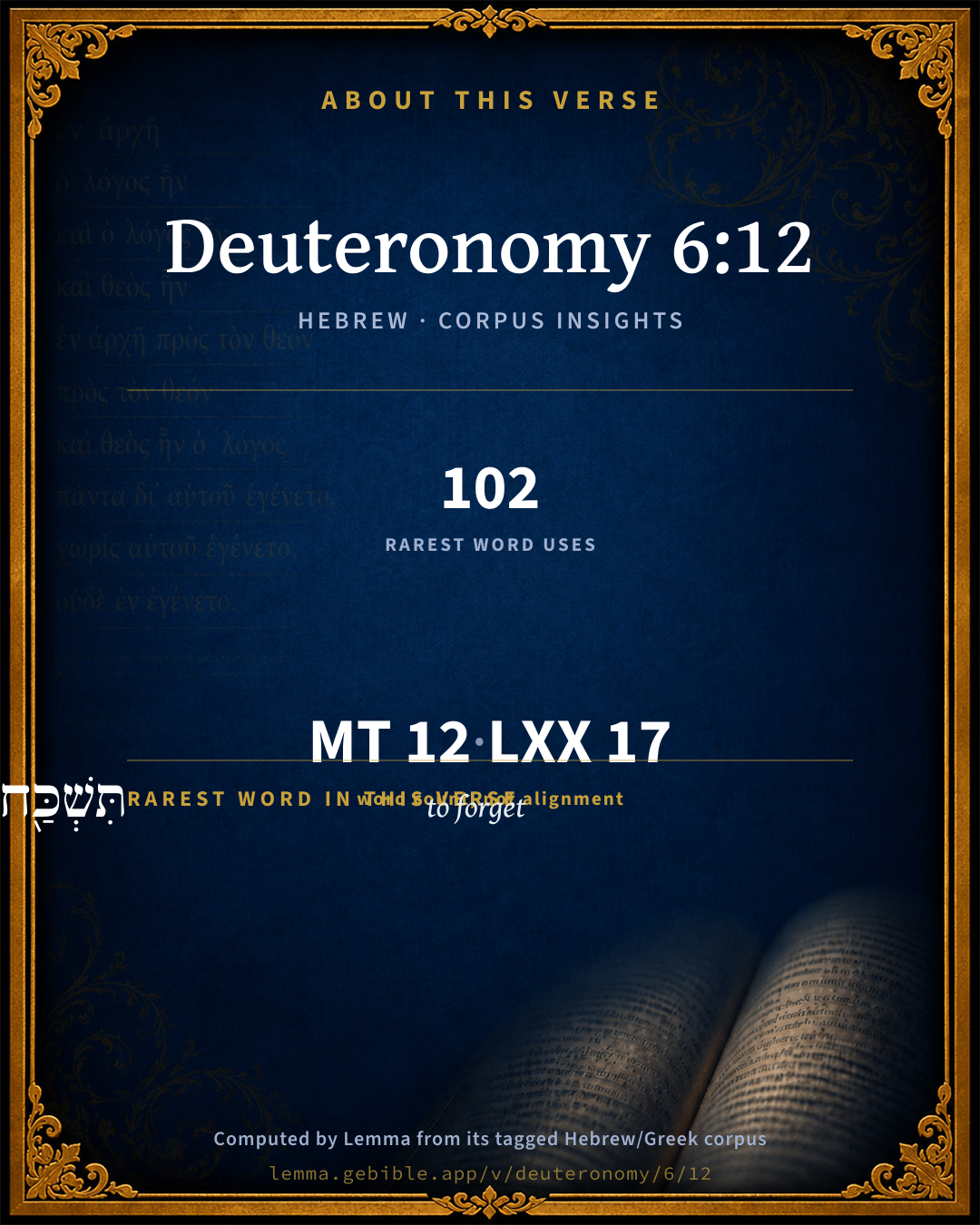
תִּשְׁכַּ֖ח
shâkach
H7911
“to forget”
Verb, Qal, Imperfect, 2nd Person, Masculine, Singular
Part of Speech
Verb
Stem
Qal
Form
Imperfect
Person
2nd Person
Gender
Masculine
Number
Singular
Full BDB Definition

Origin: a primitive root

TWOT: 2383

to forget, ignore, wither - (Qal) - to forget - to cease to care - (Niphal) to be forgotten - (Piel) to cause to forget - (Hiphil) to make or cause to forget - (Hithpael) to be forgotten
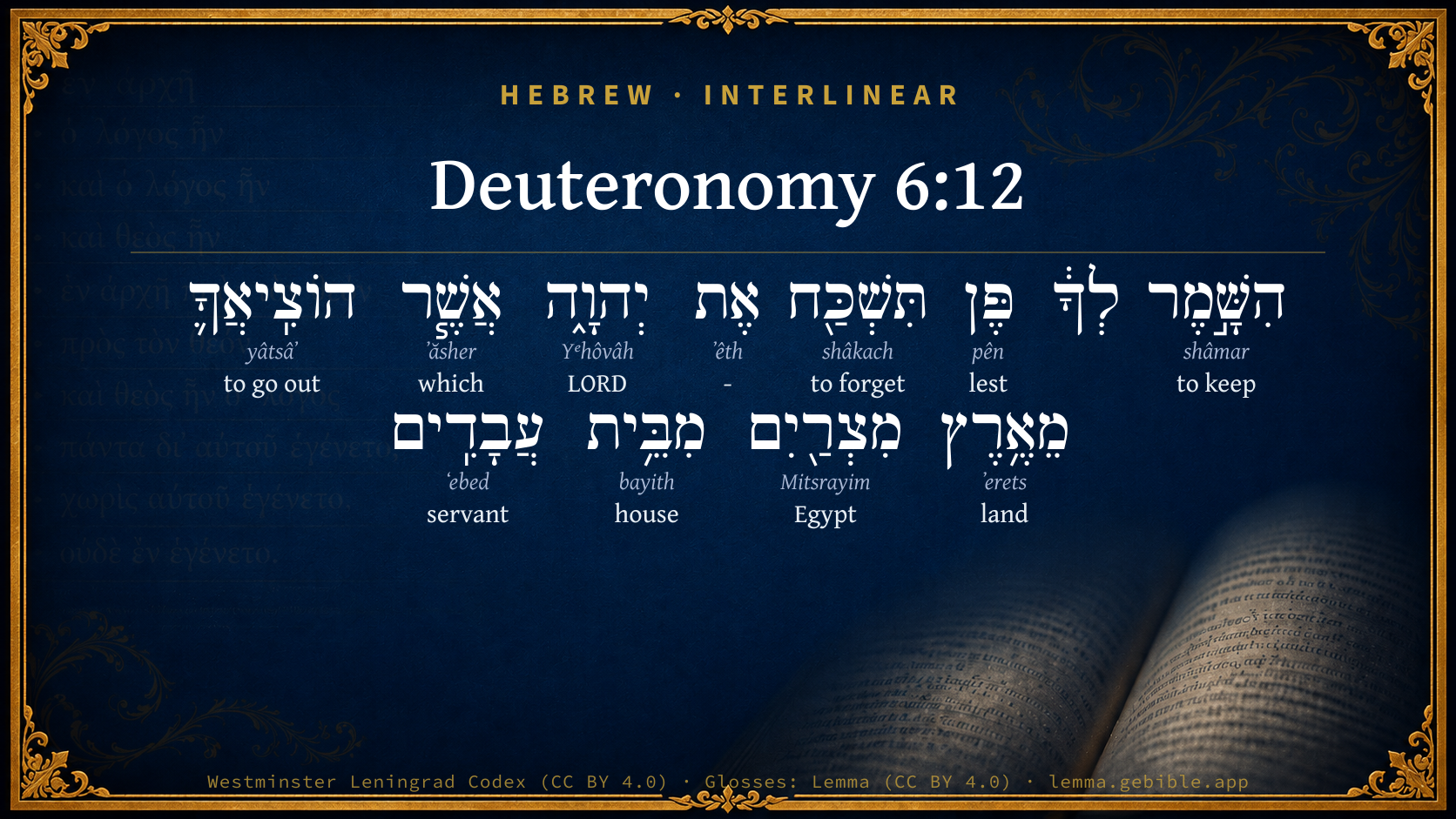
  1. הִשָּׁ֣מֶר shâmar H8104 “keep” Verb, Niphal, Imperative, 2nd Person, Masculine, Singular
  2. פֶּן pên H6435 “lest” Conjunction
  3. אֶת ʼêth H853 “-” Particle, Direct Object
  4. יְהוָ֑ה Yᵉhôvâh H3068 “LORD” Noun, Proper
  5. אֲשֶׁ֧ר ʼăsher H834 “which” Particle, Relative
  6. הוֹצִֽיאֲךָ֛ yâtsâʼ H3318 “to go out · you” Verb, Hiphil, Perfect, 3rd Person, Masculine, Singular + Suffix, Personal, 2nd Person, Masculine, Singular
  7. מֵאֶ֥רֶץ ʼerets H776 “from · land of” Preposition + Noun, Common, Both, Singular, Construct
  8. מִצְרַ֖יִם Mitsrayim H4714 “Egypt” Noun, Proper
  9. מִבֵּ֥ית bayith H1004 “from · house of” Preposition + Noun, Common, Masculine, Singular, Construct
  10. עֲבָדִֽים ʻebed H5650 “servants” Noun, Common, Masculine, Plural, Absolute

About this verse

These counts appear in no published source. They are computed here, from the morphology-tagged text and Lemma’s own curated glosses. What Lemma adds →

12
words
11
distinct lemmas
Pentateuch
section

Grammatical profile

  • 3 verbs
  • 5 nouns
  • 1 preposition
  • 1 conjunction
  • 2 particles

Verb forms

  • הִשָּׁ֣מֶר Niphal · Imperative
  • תִּשְׁכַּ֖ח Qal · Imperfect
  • הוֹצִֽיאֲךָ֛ Hiphil · Perfect

Hebrew & Septuagint length

In English translation the verse runs 22 words from the Hebrew and 24 from the Septuagint (LXX English) — closely comparable.

A rough comparison of the two English renderings, which tokenize alike — not a word-level alignment.

Word counts can differ between the Hebrew and the Greek without any difference in meaning — e.g. the Hebrew direct-object marker אֵת has no separate Greek word, and Greek often adds the article ὁ.

In the original languages it is 12 Hebrew tokens and 17 Greek tokens — but the two are counted differently (Hebrew bundles its prefixes and suffixes into one token; the Greek is in lemma form), so that isn’t a like-for-like length.

Hebrew and Greek witnesses Masoretic Hebrew ↔ Greek Septuagint

The same verse in the two great witnesses to the Old Testament, shown verse-for-verse.

These are two independent witnesses, not word-aligned to each other, and the Septuagint is shown in lemma (dictionary) form.

Hebrew Deuteronomy 6:12 Masoretic · Westminster Leningrad Codex

הִשָּׁ֣מֶר לְךָ֔ פֶּן תִּשְׁכַּ֖ח אֶת יְהוָ֑ה אֲשֶׁ֧ר הוֹצִֽיאֲךָ֛ מֵאֶ֥רֶץ מִצְרַ֖יִם מִבֵּ֥ית עֲבָדִֽים

then beware lest you forget Yahweh, who brought you forth out of the land of Egypt, out of the house of bondage.

World English Bible · Public Domain

Greek LXX Deuteronomy 6:12 Septuagint · lemma form

προςἔχω σεαυτοῦ μή ἐπιλανθάνω κύριος ὁ θεός σύ ὁ ἐκἄγω σύ ἐκ γῆ αἴγυπτος ἐκ οἶκος δουλεία

beware lest you forget the Lord your God that brought you forth out of the land of Egypt, out of the house of bondage.

LXX2012 (modern English Septuagint) · Public Domain

Hebrew: Westminster Leningrad Codex (CC BY 4.0). Greek: Septuagint (public domain); English from LXX2012 (modern English Septuagint) (Public Domain). How the Septuagint differs from the Hebrew →

Targum (Aramaic paraphrase)

2

The Targum is the ancient Jewish Aramaic paraphrase of the Hebrew Scriptures — an interpretive translation, not the Hebrew text itself. Onkelos (literal) and Pseudo-Jonathan (expansive) render the Torah, and Jonathan the Prophets. Coverage is partial: where no permissively-licensed English translation exists for a verse, only the Aramaic is shown. This is verse-level text, not a word-by-word alignment to the Hebrew.

  1. Targum Onkelos Torah (Genesis–Deuteronomy)
    אִסְתַּמַר לָךְ דִילְמָא תִנְשֵׁי יָת (דַחַלְתָּא דַ) יְיָ דִי אַפְּקָךְ מֵאַרְעָא דְמִצְרַיִם מִבֵּית עַבְדוּתָא

    (no public-domain English translation for this verse)

    Targum Onkelos — Aramaic: “Onkelos Genesis” (public domain); “Onkelos Exodus” (public domain); “Onkelos Leviticus” (public domain); “Onkelos Numbers” (public domain); “Onkelos Deuteronomy” (public domain). English: “Sefaria Community Translation” (CC0 1.0 (public-domain dedication)); “J.W. Etheridge. The Targums of Onkelos and Jonathan Ben Uzziel on the Pentateuch. London: Longmans, Green, 1862” (public domain). Text via Sefaria.

  2. Targum Pseudo-Jonathan Torah (Genesis–Deuteronomy)
    אִסְתַּמָּרוּ לְכוֹן דִּלְמָא תִתְנְשׁוּן דַּחַלְתָּא דַיְיָ אֱלָהָכוֹן דִּפְרַק וְאַפֵּיק יַתְכוֹן פְּרִיקִין מֵאַרְעָא דְמִצְרַיִם מִן בֵּית שִׁעֲבּוּד עַבְדַיָא

    beware lest you forget the fear of the Lord your God, who delivered and led you out free from the land of Mizraim, from the house of the affliction of slaves;

    Targum Pseudo-Jonathan — Aramaic: “Targum Jonathan on Genesis” (public domain); “Targum Jonathan on Exodus” (public domain); “Targum Jonathan on Leviticus” (public domain); “Targum Jonathan on Numbers” (public domain); “Targum Jonathan on Deuteronomy” (public domain). English: “The Targum of Jonathan ben Uzziel, trans. J. W. Etheridge, London, 1862” (public domain). Text via Sefaria.

Commentary

Notes on Deuteronomy 6:12 from classic Christian and Jewish commentators (each source and its license shown beneath its notes). The classic Christian expositions comment on the surrounding passage and are grouped to its opening verse, so a note may address several verses; the Jewish commentaries on the Tanakh (Rashi and others) are per-verse, so they appear only where the commentator wrote on this verse.

Lemma curates 59 commentaries, every one of them public domain or Creative Commons licensed, each selected and text-cleaned for this edition rather than reprinted as found. About our sources →

The Cambridge Bible for Schools and Colleges

gen. ed. J. J. S. Perowne

12. beware] give heed to thyself or be on guard with respect to thyself, apparently a common phrase from one person to another, Exo_10:28 (J), etc.; addressed to Israel in the editorial passage, Exo_34:12 and frequently in D: Deu_4:9, Deu_8:11 (both followed, as here, by lest thou forget), Deu_12:13; Deu_12:19; Deu_12:30, Deu_15:9, all Sg. and in the Pl. Deu_4:23; Deu_9:16 (cp. Deu_4:15).

which brought thee, etc.] Once more an emphasis on the providence of Israel’s God.

house of bondmen] So in J, Exo_13:3; Exo_13:14; in Deut. only in Sg.: Deu_5:6; Deu_6:12; Deu_7:8; Deu_8:14; Deu_13:5; Deu_13:10; the slaves’ quarter (ergastulum).

The Cambridge Bible for Schools and Colleges (gen. ed. J. J. S. Perowne; Cambridge University Press, 1878–1918) — public domain. Text from a community e-Sword module.

Trapp's Complete Commentary

John Trapp

Deu 6:12 [Then] beware lest thou forget the LORD, which brought thee forth out of the land of Egypt, from the house of bondage.

Ver. 12. Lest thou forget the Lord.] Should we, with the fed hawk, forget our master? Or being full with God’s benefits, like the moon, be then most removed from the sun, from whom she hath all her light? See Pro 30:8-9. Postquam locupletati sumus, saith Luther, hanc odiosam particulam addimus, Ego feci; We are no sooner grown rich, but we are apt to utter that ugly word, This I may thank myself for.

John Trapp, A Commentary or Exposition upon All the Books of the Old and New Testament (1647–1656) — public domain. Text from a community e-Sword module.

Geneva Bible (1599)

Geneva Bible translators

Let not wealth and ease cause thee forget God’s mercies, whereby thou wast delivered out of misery.

Geneva Bible (1599) marginal notes — public domain. Text via Bolls.life.

Adam Clarke's Commentary

Verse 12. Beware lest thou forget the Lord] In earthly prosperity men are apt to forget heavenly things. While the animal senses have every thing they can wish, it is difficult for the soul to urge its way to heaven; the animal man is happy, and the desires of the soul are absorbed in those of the flesh. God knows this well; and therefore, in his love to man, makes comparative poverty and frequent affliction his general lot. Should not every soul therefore magnify God for this lot in life? "Before I was afflicted," says David, "I went astray;" and had it not been for poverty and affliction, as instruments in the hands of God's grace, multitudes of souls now happy in heaven would have been wretched in hell. It is not too much to speak thus far; because we ever see that the rich and the affluent are generally negligent of God and the interests of their souls. It must however be granted that extreme poverty is as injurious to religion as excessive affluence. Hence the wisdom as well as piety of Agur's prayer, Pr 30:7-9: "Give me neither poverty nor riches, lest I be full and deny thee, or lest I be poor and steal," &c.

Adam Clarke's Commentary on the Bible (1810–1826) — public domain. Text from a community e-Sword/MySword module.

John Gill's Exposition

Then beware lest thou forget the Lord,.... To love, fear, and worship him, and keep his commands; creature enjoyments being apt to get possession of the heart, and the affections of it; Pro 30:9.

which brought thee forth out of the land of Egypt, out of the house of bondage; into a land abounding with all the above good things, and therefore under the highest obligations to remember the Lord and his kindnesses, and to serve and glorify him: Exo 20:2.

John Gill's Exposition of the Whole Bible (1746–1763) — public domain (CC PDM 1.0). Text via the HelloAO Bible API.

Haydock's Catholic Bible Commentary

Full. Our Saviour seems to apply this to his disciples, in a spiritual sense, remarking that Moses and the prophets had prepared the way for them. Others have laboured, and you have entered into their labours, John iv. 38. (Haydock)

George Leo Haydock (1774–1849), Haydock's Catholic Family Bible and Commentary, 1859 edition — public domain. Excludes Psalms (Douay-Rheims chapter numbering differs from Protestant) and Deuterocanonical books (Catholic canon only).

Keil & Delitzsch

C. F. Keil & F. Delitzsch

"House of bondage," as in Exo 13:3. "Not forgetting" is described from a positive point of view, as fearing God, serving Him, and swearing by His name. Fear is placed first, as the fundamental characteristic of the Israelitish worship of God; it was no slavish fear, but simply the holy awe of a sinner before the holy God, which includes love rather than excludes it. "Fearing" is a matter of the heart; "serving," a matter of working and striving; and "swearing in His name," the practical manifestation of the worship of God in word and conversation. It refers not merely to a solemn oath before a judicial court, but rather to asseverations on oath in the ordinary intercourse of life, by which the religious attitude of a man involuntarily reveals itself.

Keil & Delitzsch — Biblical Commentary on the Old Testament (1861–1891) — public domain (CC PDM 1.0). Text via the HelloAO Bible API. (Old Testament only.)

Rashi

Rabbi Shlomo Yitzchaki (Rashi)

מבית עבדים — Understand this as the Targum does: from the house of slavery, i.e. a place where ye were slaves (not from the house that belonged to slaves; cf. Rashi on Exodus 20:2).

Rashi on the Tanakh — English translations: “The Judaica Press complete Tanach with Rashi, translated by A. J. Rosenberg” (CC BY 4.0); “Pentateuch with Rashi's commentary by M. Rosenbaum and A.M. Silbermann, 1929-1934” (public domain); “The Metsudah Tanach series, Lakewood, N.J” (CC BY 4.0); and “The Book of Joshua, Metsudah Publications, 1997” (CC BY 4.0). Text via Sefaria.

Lesson kit

Teaching starters — assembled from the data on this page, not authored interpretation. Every prompt links to the verse data it draws on. Edit before teaching.

Deuteronomy, in the Pentateuch, opens this verse with 12 words (11 distinct Hebrew lemmas). Its most distinctive word is shâkach (“to forget”). A historical commentator’s framing appears above. Read the whole chapter for the surrounding context.

Discussion questions

  1. What does “to forget” (shâkach) contribute to the verse as a whole?
  2. These translations render this verse differently; the difference is in the English rendering, not the original. What questions does that raise?
  3. The verb «הִשָּׁ֣מֶר» is Niphal Imperative. How does its form color the action?
  4. Reading how The Cambridge Bible for Schools and Colleges and Trapp's Complete Commentary read this verse, where do the two commentators agree and where do they part?

Things to notice

Reading settings

Reading text

Shown beneath each verse's original-language words.

Old Testament
Old Testament edition

Read the OT as the Masoretic Hebrew (MT) or the Greek Septuagint (LXX).

English shown for the Greek Septuagint (in the Hebrew ↔ Greek comparison).

Comparing translations? Open the Compare panel on any verse page to stack up to four side by side.