
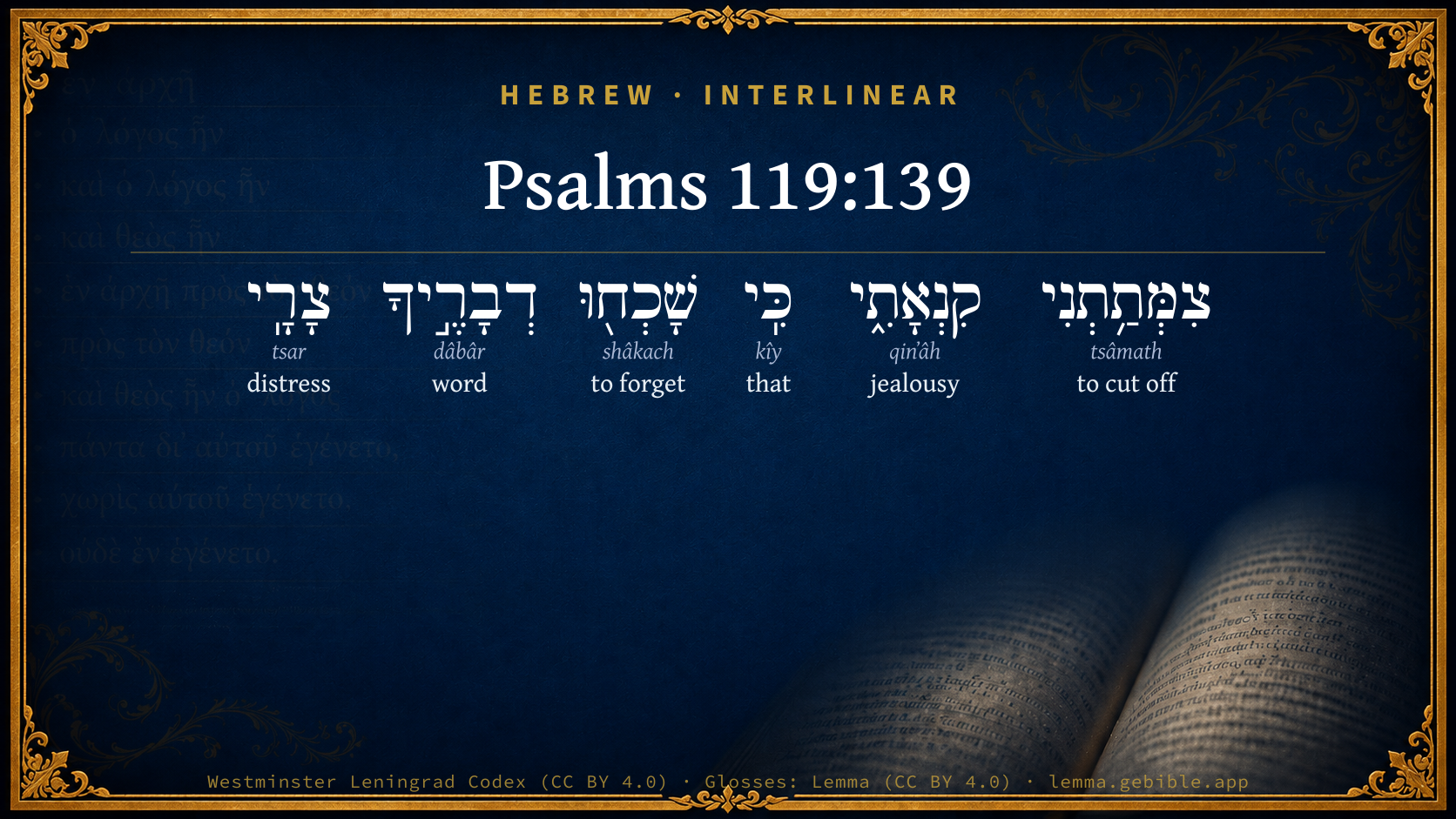
Psalms 119:139

Hebrew (Westminster Leningrad Codex) Psalms 119:139 appears in the Hebrew Old Testament. The text above is from the Westminster Leningrad Codex. Each word links to its Strong’s number, a concise gloss, and parsing drawn from the Open Scriptures Hebrew Bible morphology. Click any word for its full Brown-Driver-Briggs (BDB) entry.
Download image
Cite this verse

Psalms 119:139 (World English Bible). Public Domain. Lemma interlinear Bible study tool, https://lemma.gebible.app/v/psalms/119/139.

Show BibTeX & RIS
BibTeX
RIS
English Translation
My zeal wears me out, Because my enemies ignore your words.
World English Bible · Public Domain
Download a study sheet

One document with this verse’s original text, its word-by-word gloss line, the meaning frame, cross-references with their text, attributed commentary, and full source and license credits — printable, and it pastes into notes with its structure intact.

This verse Autodidact and up

Study sheet (.html) Plain text (.txt)

A passage Seminary Student

Up to 50 verses in one chapter. A passage sheet keeps up to 6 commentary sources and 12 cross-references per verse, in the order this page ranks them, and says so on the sheet whenever that leaves anything out. Ask for a single verse and you get the Autodidact verse sheet above.

Everything on this page stays free to read, with no account — the sheet is a download of what is already on screen, not access to it.

Want to remove ads? Support Godless Engineer
Compare translations 3

The same verse in 3 English versions, stacked beneath the original-language interlinear above. Click any original word for its lexicon entry.

Each is an independent rendering of the whole verse — the interlinear is not word-aligned to these translations.

Highlighted words mark where these versions differ — a whole-verse word diff, not a word-by-word alignment.

  • World English Bible Public Domain
    My zeal wears me out, Because my enemies ignore your words.
  • King James Version Public Domain
    My zeal hath consumed me, because mine enemies have forgotten thy words.
  • unfoldingWord Literal Text CC BY-SA 4.0
    My zeal consumes me, for my adversaries have forgotten your words.

unfoldingWord Literal Text — © unfoldingWord, licensed CC BY-SA 4.0. Word-aligned USFM3 via Door43 (git.door43.org/unfoldingWord/en_ult).

Versions to compare (up to 4)

3 of 4 selected

Show all 17 translations

Every available English version of this verse, each an independent rendering of the whole verse.

  • World English Bible Public Domain
    My zeal wears me out, Because my enemies ignore your words.
  • Berean Standard Bible Public Domain
    My zeal has consumed me because my foes forget Your words.
  • Majority Standard Bible Public Domain
    My zeal has consumed me because my foes forget Your words.
  • King James Version Public Domain
    My zeal hath consumed me, because mine enemies have forgotten thy words.
  • American Standard Version (1901) Public Domain
    My zeal hath consumed me, Because mine adversaries have forgotten thy words.
  • Revised Version (1885) Public Domain
    My zeal hath consumed me, because mine adversaries have forgotten thy words.
  • Geneva Bible (1599) Public Domain
    My zeale hath euen consumed mee, because mine enemies haue forgotten thy wordes.
  • Young's Literal Translation Public Domain
    Cut me off hath my zeal, For mine adversaries forgot Thy words.
  • Literal Standard Version CC BY-SA 4.0
    My zeal has cut me off, || For my adversaries forgot Your words.
  • Unlocked Literal Bible CC BY-SA 4.0
    Anger has destroyed me because my adversaries forget your words.
  • unfoldingWord Literal Text CC BY-SA 4.0
    My zeal consumes me, for my adversaries have forgotten your words.
  • Darby Bible Public Domain
    My zeal destroyeth me, because mine oppressors have forgotten thy words.
  • World Messianic Bible Public Domain
    My zeal wears me out, because my enemies ignore your words.
  • Webster's Bible Public Domain
    My zeal hath consumed me; because my enemies have forgotten thy words.
  • Free Bible Version CC BY-SA 4.0
    My devotion is burning me up inside because my enemies ignore your words.
  • Bible in Basic English Public Domain
    My passion has overcome me; because my haters are turned away from your words.
  • JPS Tanakh (1917) Public Domain
    My zeal hath undone me, because mine adversaries have forgotten Thy words.

Literal Standard Version (2020), Covenant Press — licensed CC BY-SA 4.0. Text via the HelloAO Bible API (eBible.org). Unlocked Literal Bible (unfoldingWord) — licensed CC BY-SA 4.0. Text via the HelloAO Bible API (eBible.org). unfoldingWord Literal Text — © unfoldingWord, licensed CC BY-SA 4.0. Word-aligned USFM3 via Door43 (git.door43.org/unfoldingWord/en_ult). Free Bible Version, Dr. Jonathan Gallagher — licensed CC BY-SA 4.0. Text via the HelloAO Bible API (eBible.org).

Word by word

More ways to search: Search by grammar → Find every occurrence → Compare this word →

Practice this passage: Drill this verse → Learn its vocabulary →

צִמְּתַ֥תְנִי
tsâmath
H6789
“to cut off · me”
Verb, Piel, Perfect, 3rd Person, Feminine, Singular + Suffix, Personal, 1st Person, Common, Singular
Part of Speech
Verb
Stem
Piel
Form
Perfect
Person
3rd Person
Gender
Feminine
Number
Singular
Full BDB Definition

Origin: a primitive root

TWOT: 1932

to put an end to, cut off, destroy, exterminate, extirpate - (Qal) to put an end to, terminate - (Niphal) to be ended, be annihilated, be exterminated - (Piel) to put an end to - (Pilel) to be exterminated, be annihilated - (Hiphil) to exterminate, annihilate
  1. קִנְאָתִ֑י qinʼâh H7068 “jealousy · my” Noun, Common, Feminine, Singular, Construct + Suffix, Personal, 1st Person, Common, Singular
  2. כִּֽי kîy H3588 “that” Conjunction
  3. שָׁכְח֖וּ shâkach H7911 “to forget” Verb, Qal, Perfect, 3rd Person, Common, Plural
  4. דְבָרֶ֣יךָ dâbâr H1697 “words · your” Noun, Common, Masculine, Plural, Construct + Suffix, Personal, 2nd Person, Masculine, Singular
  5. צָרָֽי tsar H6862 “distresses · my” Noun, Common, Masculine, Plural, Construct + Suffix, Personal, 1st Person, Common, Singular

About this verse

These counts appear in no published source. They are computed here, from the morphology-tagged text and Lemma’s own curated glosses. What Lemma adds →

6
words
6
distinct lemmas
Wisdom
section

Notable vocabulary

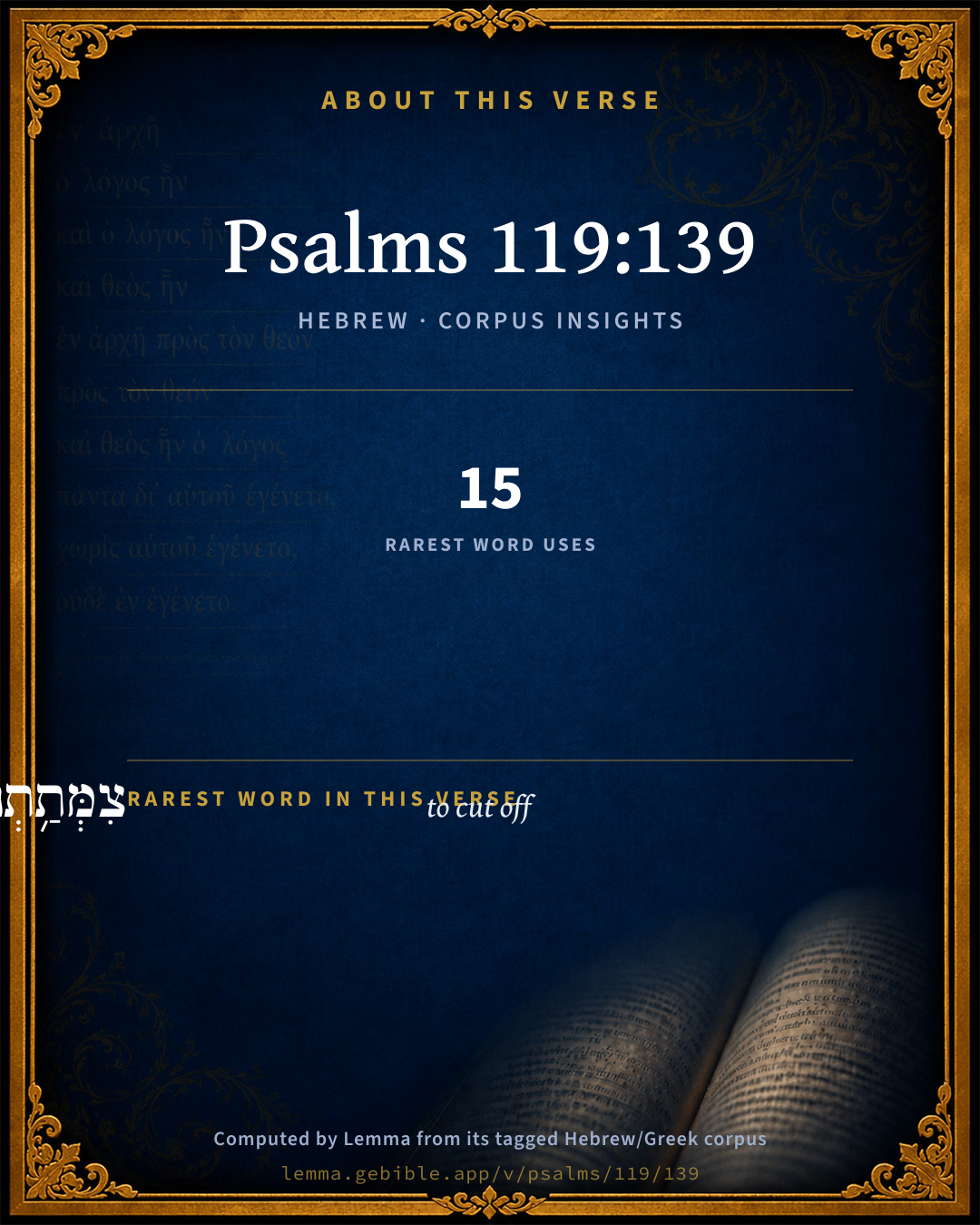
The rarest word here is צִמְּתַ֥תְנִי to cut off H6789 — appearing just 15 times in the whole Hebrew Bible.

Shared distinctive vocabulary

צִמְּתַ֥תְנִי to cut off H6789 occurs in 14 verses of the Hebrew Bible. Also found in:

Grammatical profile

  • 2 verbs
  • 3 nouns
  • 1 conjunction

Verb forms

  • צִמְּתַ֥תְנִי Piel · Perfect
  • שָׁכְח֖וּ Qal · Perfect

Hebrew & Septuagint length

In English translation the verse runs 11 words from the Hebrew and 13 from the Septuagint (LXX English) — closely comparable.

A rough comparison of the two English renderings, which tokenize alike — not a word-level alignment.

Word counts can differ between the Hebrew and the Greek without any difference in meaning — e.g. the Hebrew direct-object marker אֵת has no separate Greek word, and Greek often adds the article ὁ.

Cross-references

14

Topical passages linked to Psalms 119:139 in the Treasury of Scripture Knowledge — connected by theme and wording, ordered by reader-vote popularity; previews shown in the World English Bible.

  • Psalms 69:9 For the zeal of your house consumes me. The reproaches of those who reproach you have fallen on me.
  • John 2:17 His disciples remembered that it was written, "Zeal for your house will eat me up."
  • 1 Kings 19:10 He said, I have been very jealous for Yahweh, the God of hosts; for the children of Israel have forsaken your covenant, thrown down your altars, and slain your prophets with the sword: and I, even I only, am left; and they seek my life, to take it away.
  • Acts 13:27 For those who dwell in Jerusalem, and their rulers, because they didn't know him, nor the voices of the prophets which are read every Sabbath, fulfilled them by condemning him.
  • 1 Kings 19:14 He said, I have been very jealous for Yahweh, the God of hosts; for the children of Israel have forsaken your covenant, thrown down your altars, and slain your prophets with the sword; and I, even I only, am left; and they seek my life, to take it away.
  • Psalms 53:4 Have the workers of iniquity no knowledge, Who eat up my people as they eat bread, And don't call on God?
  • Matthew 9:13 But you go and learn what this means: 'I desire mercy, and not sacrifice,' for I came not to call the righteous, but sinners to repentance."
  • Matthew 12:3–5 But he said to them, "Haven't you read what David did, when he was hungry, and those who were with him;
  • Matthew 15:4–6 For God commanded, 'Honor your father and your mother,' and, 'He who speaks evil of father or mother, let him be put to death.'
  • Matthew 21:13 He said to them, "It is written, 'My house shall be called a house of prayer,' but you have made it a den of robbers!"
  • Matthew 21:16 and said to him, "Do you hear what these are saying?" Jesus said to them, "Yes. Did you never read, 'Out of the mouth of babes and nursing babies you have perfected praise?'"
  • Matthew 21:42 Jesus said to them, "Did you never read in the Scriptures, 'The stone which the builders rejected, The same was made the head of the corner. This was from the Lord. It is marvelous in our eyes?'
  • Matthew 22:29 But Jesus answered them, "You are mistaken, not knowing the Scriptures, nor the power of God.
  • Acts 28:23–27 When they had appointed him a day, many people came to him at his lodging. He explained to them, testifying about the Kingdom of God, and persuading them concerning Jesus, both from the law of Moses and from the prophets, from morning until evening.

Cross-references courtesy of OpenBible.info (CC BY 4.0).

Hebrew and Greek witnesses Masoretic Hebrew ↔ Greek Septuagint

The same verse in the two great witnesses to the Old Testament, shown verse-for-verse.

You’re reading Greek Psalm 118 (Hebrew Psalm 119). The Septuagint counts the superscription, so verse numbers can differ from the Hebrew — chapter-level alignment, not verse-by-verse. Numbering follows Rahlfs.

These are two independent witnesses, not word-aligned to each other, and the Septuagint is shown in lemma (dictionary) form.

Hebrew Psalms 119:139 Masoretic · Westminster Leningrad Codex

צִמְּתַ֥תְנִי קִנְאָתִ֑י כִּֽי שָׁכְח֖וּ דְבָרֶ֣יךָ צָרָֽי

My zeal wears me out, Because my enemies ignore your words.

World English Bible · Public Domain

Greek LXX Greek Psalm 118:139 Septuagint · lemma form

ἐκτήκω ἐγώ ὁ ζῆλος ὁ οἶκος σύ ὅτι ἐπιλανθάνω ὁ λόγος σύ ὁ ἐχθρός ἐγώ

Your zeal has quite wasted me: because my enemies have forgotten your words.

LXX2012 (modern English Septuagint) · Public Domain

Hebrew: Westminster Leningrad Codex (CC BY 4.0). Greek: Septuagint (public domain); English from LXX2012 (modern English Septuagint) (Public Domain). How the Septuagint differs from the Hebrew →

Commentary

Notes on Psalms 119:139 from classic Christian and Jewish commentators (each source and its license shown beneath its notes). The classic Christian expositions comment on the surrounding passage and are grouped to its opening verse, so a note may address several verses; the Jewish commentaries on the Tanakh (Rashi and others) are per-verse, so they appear only where the commentator wrote on this verse.

Lemma curates 59 commentaries, every one of them public domain or Creative Commons licensed, each selected and text-cleaned for this edition rather than reprinted as found. About our sources →

Trapp's Complete Commentary

John Trapp

Psa 119:139 My zeal hath consumed me, because mine enemies have forgotten thy words.

Ver. 139. My zeal hath consumed me] Hath meagred and impaired me much. In the Hebrew the last letter is doubled, to increase the signification. {Hebrew Text Note} Zeal is the extreme heat of all the affections.

John Trapp, A Commentary or Exposition upon All the Books of the Old and New Testament (1647–1656) — public domain. Text from a community e-Sword module.

Joseph Benson's Commentary

Psa 119:139-141. My zeal hath consumed me — My zeal toward thy law, which my enemies violate and contemn. “Zeal is a high degree of love; and when the object of that love is ill treated, it vents itself in a mixture of grief and indignation, which are sufficient to wear and consume the heart. This will be the case when men rightly conceive of that dishonour which is continually done to God by creatures whom he hath made and redeemed. But never could the verse be uttered with such fulness of truth and propriety by any one, as by the Son of God, who had such a sense of his Father’s glory, and of man’s sin, as no person else ever had. And, accordingly, when his zeal had exerted itself in purging the temple, St. John tells us, his disciples remembered that it was written, The zeal of thy house hath eaten me up.” — Horne. Thy word is very pure — Without the least mixture of any falsehood or sin; therefore thy servant loveth it — Because of that exact purity and holiness of it; although, for that very reason, ungodly men either despise or hate it. I am small — Hebrew, צעיר, a little one; not for age, but, in respect of my condition in the world, mean and obscure; yet do I not forget thy precepts — As my conscience bears me witness. If we are small and despised, we have the more need to remember God’s precepts, that we may have them to support us under the pressures of a low condition.

Joseph Benson's Commentary on the Old and New Testaments (1811–1818) — public domain. Text from a community e-Sword module.

J. A. Alexander on Psalms

Joseph Addison Alexander

139. (Psa 119:139) My zeal consumes me, because my adversaries forget thy word. The verbs strictly mean, has consumed, have forgotten, but without excluding the present, as they might seem to do, if rendered literally into English. Zeal, jealous regard for God's authority and honour. See above, on Psa 69:9. The first Hebrew verb occurs above, Psa 88:16. The last clause gives the reason or occasion of his jealousy. Adversaries, persecutors or oppressors. Thy word, includes thy promise to me and thy command to them.

Joseph Addison Alexander, The Psalms Translated and Explained (1850) — public domain. Text from a community e-Sword module.

Tyndale Open Study Notes

Tyndale Open Resources

119:139 The psalmist’s indignation (cp. 69:9) comes from seeing the wicked disregard God’s word.

Tyndale Open Study Notes — © Tyndale Open Resources, licensed CC BY-SA 4.0. Text via the HelloAO Bible API.

Matthew Henry's Commentary

Here is, 1. The great contempt which wicked men put upon religion: My enemies have forgotten thy words. They have often heard them, but so little did they heed them that they soon forgot them, they willingly forgot them, not only through carelessness let them slip out of their minds, but contrived how to cast them behind their backs. This is at the bottom of all the wickedness of the wicked, and particularly of their malignity and enmity to the people of God; they have forgotten the words of God, else those would give check to their sinful courses. 2. The great concern which godly men show for religion. David reckoned those his enemies who forgot the words of God because they were enemies to religion, which he had entered into a league with, offensive and defensive. And therefore his zeal even consumed him, when he observed their impieties. He conceived such an indignation at their wickedness as preyed upon his spirits, even ate them up (as Christ's zeal, Joh 2:17), swallowed up all inferior considerations, and made him forget himself. My zeal has pressed or constrained me (so Dr. Hammond reads it), Act 18:5. Zeal against sin should constrain us to do what we can against it in our places, at least to do so much the more in religion ourselves. The worse others are the better we should be.

Matthew Henry's Commentary on the Whole Bible (1708–1710) — public domain (CC PDM 1.0). Text via the HelloAO Bible API.

Adam Clarke's Commentary

Verse 139. My zeal hath consumed me] My earnest desire to promote thy glory, and the pain I feel at seeing transgressions multiplied, have worn down both my flesh and spirits.

Adam Clarke's Commentary on the Bible (1810–1826) — public domain. Text from a community e-Sword/MySword module.

John Calvin's Commentaries

139. My zeal hath consumed me. “Hath consumed me. The strong term here made use of corresponds very well with the forcible language of the preceding verse. My zeal for thy word is so great, that when I see how my enemies disregard it, I am overpowered by feelings of shame at their neglect.” — Phillips.

John Calvin's Commentaries (1540-1563) — public domain. Text from the Calvin Translation Society English edition (1840s-50s) via the Christian Classics Ethereal Library (ccel.org). Calvin's coverage is partial (roughly two-thirds of the Bible); uncommented books and verses are honest gaps, never fabricated. The 19th-century editor's footnotes and remarks are omitted so the notes are faithfully Calvin's own voice.

The Cambridge Bible for Schools and Colleges

gen. ed. J. J. S. Perowne

139. Cp. Psa_69:9.

The Cambridge Bible for Schools and Colleges (gen. ed. J. J. S. Perowne; Cambridge University Press, 1878–1918) — public domain. Text from a community e-Sword module.

John Gill's Exposition

Trouble and anguish have taken hold on me,.... Or, "found me" (a). Outward troubles and inward distress; troubles arising from his enemies, the men of the world, that hated and persecuted him; and from a body of sin and death, from the temptations of Satan, and divine desertions; some from without, and others from within; troubles both of body and mind, which is what all good men are liable to;

yet thy commandments are my delights; so far from being grievous, that they were a pleasure to him; yea, exceedingly delighted him, and cheered and refreshed his spirits amidst all his troubles.

(a) "invenerunt me", V. L. Pagninus, Montanus, Musculus, Gejerus, Michaelis.

John Gill's Exposition of the Whole Bible (1746–1763) — public domain (CC PDM 1.0). Text via the HelloAO Bible API.

Albert Barnes' Notes on the Bible

My zeal hath consumed me - Margin, “cut me off.” The word which is here translated “consumed” is rendered “cut off” in Lam 3:53; Job 23:17; Psa 54:5; Psa 88:16; Psa 94:23; Psa 101:5; Psa 143:12; “vanish,” Job 6:17; “destroyed,” Psa 73:27; 2Sa 22:41; Psa 18:40; Psa 101:8; Psa 69:4. It means here, that he pined away; that his strength was exhausted; that he was sinking under the efforts which he had put forth as expressive of his deep interest in the cause of God and of truth. On the sentiment here expressed, see the notes at Psa 69:9.

Because mine enemies have forgotten thy words - Thy law; thy commands. It was not because they were his foes - not because he was endeavoring to destroy them, or to take vengeance on them - but because they were unmindful of God, and of the claims of his law. It is a great triumph which religion gains over a man’s soul, when, in looking on the conduct of persecutors, calumniators, and slanderers - of those who are constantly doing us wrong - we are more grieved because they violate the law of God than because they injure us; when our solicitude is turned from ourselves, and terminates on our regard for the honor of God and his law. Yet that is the nature of true religion; and that we should be able to find in ourselves in such circumstances. A man should doubt the evidence of his personal religion, if all his feelings terminate on the wrong done to himself by the wicked conduct of others; if he has no feeling of solicitude because the law of God has been violated, and God has been dishonored. Compare the notes at Psa 119:136.

Albert Barnes' Notes on the Bible (1834–1885) — public domain. Text from a community e-Sword/MySword module.

Matthew Poole's English Annotations

Hath consumed me; I am tormented and cut to the heart with grief and anger at it.

Have forgotten thy words, i.e. despise and disobey them; which in Scripture use is oft called a forgetting of them, as the remembering of them is oft put for loving and practising them.

Matthew Poole's English Annotations on the Holy Bible (1683–1685) — public domain. Text from a community e-Sword/MySword module.

The Treasury of David

Charles H. Spurgeon

Ver. 139. In the last two verses David spoke concerning his God and his law; here he speaks of himself, and says,

My zeal hath consumed me, because mine enemies have forgotten thy words: this was no doubt occasioned by his having so clear a sense of the admirable character of God's word. His zeal was like a fire burning within his soul. The sight of man's forgetfulness of God acted as a fierce blast to excite the fire to a more vehement flame, and it blazed until it was ready to consume him. David could not bear that men should forget God's words. He was ready to forget himself, aye, to, consume himself, because these men forgot God. The ungodly were David s enemies: his enemies, because they hated him for his godliness; his enemies, because he abhorred them for their ungodliness. These men had gone so far in iniquity that they not only violated and neglected the commands of God, but they appeared actually to have forgotten them. This put David into a great heat; he burned with indignation. How dare they trample on sacred things! How could they utterly ignore the commands of God himself! He was astonished, and filled with holy anger.

Ver. 139. My zeal hath consumed me. "Zeal" is a high degree of love; and when the object of that love is ill treated, it vents itself in a mixture of grief and indignation, which are sufficient to wear and "consume" the heart. This will be the case where men rightly conceive of that dishonour which is continually done to God by creatures whom he hath made and redeemed. But never could the verse be uttered, with such fulness of truth and propriety, by any one, as by the Son of God, who had such a sense of his Father's glory, and of man's sin, as no person else ever had. And, accordingly, when his zeal had exerted itself in purging the temple, St. John tells us, "his disciples remembered that it was written, The zeal thine house hath eaten me up." The place where it is so written Ps 69:9, and the passage is exactly parallel to this before us. Horne.

Ver. 139. My zeal hath consumed me, etc. Zeal is the heat or tension of the affections; it is a holy warmth, whereby our love and an are drawn out to the utmost for God, and his glory. Now, our love to and his ways, and our hatred of wickedness, should be increased, because ungodly men. Cloudy and dark colours in a table, make those that are and lively to appear more beautiful; others' sin should make God and godliness more amiable in thine eyes. Thy heart should take fire by striking on such cold flints. David by a holy antiperistasis, did kindle from of coldness: "My zeal hath consumed me, because mine enemies have forgotten words." Cold blasts make a fire to flame the higher, and burn the hotter George Swinnock.

Ver. 139. My zeal hath consumed me. The fire of zeal, like the fire which consumed Solomon's sacrifice, cometh down from heaven; and zealots are not those salamanders that always live in the fire of hatred contention; but seraphs, burning with the spiritual fire of divine And there true zeal inflames the desires and affections of the soul. If it be true zeal, then tract of time, multitude of discouragements, falseness of deserting the cause, strength of oppositions, will not tire out a man's s Zeal makes men resolute, difficulties are but whetstones to their fortitude steels men's spirits with an undaunted resolution. This was the zeal burned in the disciples (Luke 24), that consumed David here, and up the very marrow of Christ: Joh 2:17. Abraham Wright.

Ver. 139. My zeal hath consumed me. There are divers kinds of there is a zeal of the world, there is a zeal of the flesh, there is a zeal of religion, there is a zeal of heresy, and there is a zeal of the true God. First, we see the zeal of the world maketh men to labour day night to get a transitory thing. The zeal of the flesh torments me minds early and late for a momentary pleasure. The zeal of heresy maketh travel and compass sea and land, for the maintaining and increasing of opinion. Thus we see every man is eaten up with some kind of zeal. The drunkard is consumed with drunkenness, the whoremonger is spent with his whoredom, the heretic is eaten with heresies. Oh, how ought this to ashamed, who are so little eaten, spent, and consumed with the zeal of word! And so much the rather, because godly zeal leaveth in us advantage and a recompence, which the worldly and carnally zealous have not. For when they have spent all the strength of their bodies, powers of their mind, they have no gain or comfort left, but torment conscience; and when they are outwardly spent, they are inwardly never better: whereas the godly being concerned for a good thing, and eaten with the zeal of God's glory, have this notable privilege and profit, howsoever their outward man perisheth and decayeth, yet their inward is still refreshed and nourished to everlasting life. Oh, what a benefit to be eaten up with the love and zeal of a good thing! Richard Greenham.

Ver. 139. Have forgotten thy words. A proper phrase to set forth in the bosom of the visible church who do not wholly deny and reject word and rule of Scripture, but yet live on as though they had it: they do not observe it; as if God had never spoken any such thing, given them any such rule. They that reject and condemn such things as word enforces, surely do not remember to do them. Thomas Manton.

Ver. 139. Zeal.

1. Consuming self.

2. Inflamed by that which would naturally quench it.

3. Fed upon God's words.

Ver. 139. Zeal.

1. Flourishing in an unpromising atmosphere.

2. Attaining an astonishing growth.

3. Accomplishing a blessed work the consumption of self. C.A.D.

Ver. 139.

1. The object of his zeal: "Thy words."

2. The occasion of his zeal: "Mine enemies, "etc.

3. The fervour of his zeal: "My zeal hath consumed me." G.R.

Psalms 119:140*

Charles H. Spurgeon's The Treasury of David (1869–1885) — public domain. Psalms only. Text from a community e-Sword/MySword module.

The Pulpit Commentary

My zeal hath consumed me. (comp. Psa_69:9) Because mine enemies have forgotten thy words (see above, vers. 53, 136). The psalmist was at once grieved and angered by man"s disobedience to God"s commandments. (comp. Psa_139:21)

The Pulpit Commentary (1880–1919), ed. H.D.M. Spence-Jones & Joseph S. Exell — public domain. Text from a community e-Sword module.

unfoldingWord translationNotes

Door43 World Missions Community

Anger has destroyed me

This is an idiom. The phrase is an exaggeration for "I am extremely angry." (See: Idiom and Hyperbole and Generalization)

has been tested very much

This can be stated in active form. AT: "I have tested your word many times" (See: Active or Passive)

your servant loves

The writer speaks of himself as if he were another person. AT: "I, your servant, love" or "I love" (See: Pronouns)

translationWords

anger

adversary

word of God

test

servant

love

unfoldingWord translationNotes — © Distant Shores Media and the Door43 World Missions Community, licensed CC BY-SA 4.0. Source: git.door43.org/Door43/en_tn.

Rashi

Rabbi Shlomo Yitzchaki (Rashi)

My zeal incenses me Heb. קנאתי. The zeal with which I am zealous for Your name against those who forget Your words, cuts me and incenses me against them.

Rashi on the Tanakh — English translations: “The Judaica Press complete Tanach with Rashi, translated by A. J. Rosenberg” (CC BY 4.0); “Pentateuch with Rashi's commentary by M. Rosenbaum and A.M. Silbermann, 1929-1934” (public domain); “The Metsudah Tanach series, Lakewood, N.J” (CC BY 4.0); and “The Book of Joshua, Metsudah Publications, 1997” (CC BY 4.0). Text via Sefaria.

Lesson kit

Teaching starters — assembled from the data on this page, not authored interpretation. Every prompt links to the verse data it draws on. Edit before teaching.

Psalms, in the Wisdom, opens this verse with 6 words (6 distinct Hebrew lemmas). Its most distinctive word is tsâmath (“to cut off”). A historical commentator’s framing appears above. Read the whole chapter for the surrounding context.

Discussion questions

  1. What does “to cut off” (tsâmath) contribute to the verse as a whole?
  2. 2 Samuel 22:41 shares the word «to cut off» with this verse. How do the two illuminate each other?
  3. These translations render this verse differently; the difference is in the English rendering, not the original. What questions does that raise?
  4. The verb «צִמְּתַ֥תְנִי» is Piel Perfect. How does its form color the action?
  5. Reading how Trapp's Complete Commentary and Joseph Benson's Commentary read this verse, where do the two commentators agree and where do they part?

Things to notice

Reading settings

Reading text

Shown beneath each verse's original-language words.

Old Testament
Old Testament edition

Read the OT as the Masoretic Hebrew (MT) or the Greek Septuagint (LXX).

English shown for the Greek Septuagint (in the Hebrew ↔ Greek comparison).

Comparing translations? Open the Compare panel on any verse page to stack up to four side by side.