
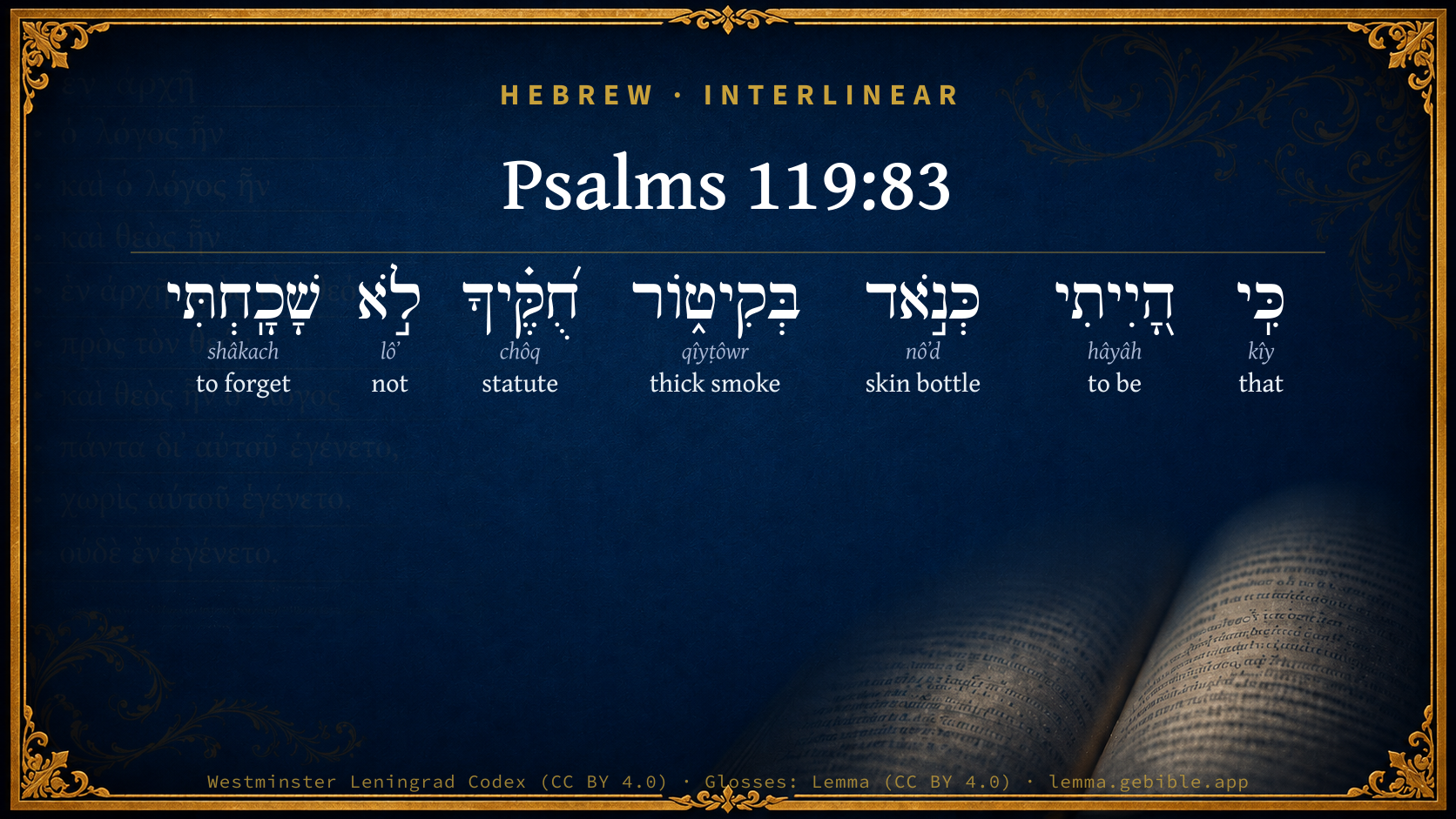

Psalms 119:83

Hebrew (Westminster Leningrad Codex) Psalms 119:83 appears in the Hebrew Old Testament. The text above is from the Westminster Leningrad Codex. Each word links to its Strong’s number, a concise gloss, and parsing drawn from the Open Scriptures Hebrew Bible morphology. Click any word for its full Brown-Driver-Briggs (BDB) entry.
Download image
Cite this verse

Psalms 119:83 (World English Bible). Public Domain. Lemma interlinear Bible study tool, https://lemma.gebible.app/v/psalms/119/83.

Show BibTeX & RIS
BibTeX
RIS
English Translation
For I have become like a wineskin in the smoke. I don't forget your statutes.
World English Bible · Public Domain
Download a study sheet

One document with this verse’s original text, its word-by-word gloss line, the meaning frame, cross-references with their text, attributed commentary, and full source and license credits — printable, and it pastes into notes with its structure intact.

This verse Autodidact and up

Study sheet (.html) Plain text (.txt)

A passage Seminary Student

Up to 50 verses in one chapter. A passage sheet keeps up to 6 commentary sources and 12 cross-references per verse, in the order this page ranks them, and says so on the sheet whenever that leaves anything out. Ask for a single verse and you get the Autodidact verse sheet above.

Everything on this page stays free to read, with no account — the sheet is a download of what is already on screen, not access to it.

Want to remove ads? Support Godless Engineer
Compare translations 3

The same verse in 3 English versions, stacked beneath the original-language interlinear above. Click any original word for its lexicon entry.

Each is an independent rendering of the whole verse — the interlinear is not word-aligned to these translations.

Highlighted words mark where these versions differ — a whole-verse word diff, not a word-by-word alignment.

  • World English Bible Public Domain
    For I have become like a wineskin in the smoke. I don't forget your statutes.
  • King James Version Public Domain
    For I am become like a bottle in the smoke; yet do I not forget thy statutes.
  • unfoldingWord Literal Text CC BY-SA 4.0
    For I have become like a wineskin in the smoke; I do not forget your statutes.

unfoldingWord Literal Text — © unfoldingWord, licensed CC BY-SA 4.0. Word-aligned USFM3 via Door43 (git.door43.org/unfoldingWord/en_ult).

Versions to compare (up to 4)

3 of 4 selected

Show all 17 translations

Every available English version of this verse, each an independent rendering of the whole verse.

  • World English Bible Public Domain
    For I have become like a wineskin in the smoke. I don't forget your statutes.
  • Berean Standard Bible Public Domain
    Though I am like a wineskin dried up by smoke, I do not forget Your statutes.
  • Majority Standard Bible Public Domain
    Though I am like a wineskin dried up by smoke, I do not forget Your statutes.
  • King James Version Public Domain
    For I am become like a bottle in the smoke; yet do I not forget thy statutes.
  • American Standard Version (1901) Public Domain
    For I am become like a wine-skin in the smoke; Yet do I not forget thy statutes.
  • Revised Version (1885) Public Domain
    For I am become like a bottle in the smoke; yet do I not forget thy statutes.
  • Geneva Bible (1599) Public Domain
    For I am like a bottell in the smoke: yet doe I not forget thy statutes.
  • Young's Literal Translation Public Domain
    For I have been as a bottle in smoke, Thy statutes I have not forgotten.
  • Literal Standard Version CC BY-SA 4.0
    For I have been as a bottle in smoke, || I have not forgotten Your statutes.
  • Unlocked Literal Bible CC BY-SA 4.0
    For I have become like a wineskin in the smoke; I do not forget your statutes.
  • unfoldingWord Literal Text CC BY-SA 4.0
    For I have become like a wineskin in the smoke; I do not forget your statutes.
  • Darby Bible Public Domain
    For I am become like a bottle in the smoke; I do not forget thy statutes.
  • World Messianic Bible Public Domain
    For I have become like a wineskin in the smoke. I don’t forget your statutes.
  • Webster's Bible Public Domain
    For I am become like a bottle in the smoke; yet I do not forget thy statutes.
  • Free Bible Version CC BY-SA 4.0
    I've become like a wineskin that's been shriveled up by smoke, but I have not forgotten to do as you say.
  • Bible in Basic English Public Domain
    For I have become like a wine-skin black with smoke; but I still keep the memory of your rules.
  • JPS Tanakh (1917) Public Domain
    For I am become like a wine-skin in the smoke; yet do I not forget Thy statutes.

Literal Standard Version (2020), Covenant Press — licensed CC BY-SA 4.0. Text via the HelloAO Bible API (eBible.org). Unlocked Literal Bible (unfoldingWord) — licensed CC BY-SA 4.0. Text via the HelloAO Bible API (eBible.org). unfoldingWord Literal Text — © unfoldingWord, licensed CC BY-SA 4.0. Word-aligned USFM3 via Door43 (git.door43.org/unfoldingWord/en_ult). Free Bible Version, Dr. Jonathan Gallagher — licensed CC BY-SA 4.0. Text via the HelloAO Bible API (eBible.org).

Word by word

More ways to search: Search by grammar → Find every occurrence → Compare this word →

Practice this passage: Drill this verse → Learn its vocabulary →

About this verse

These counts appear in no published source. They are computed here, from the morphology-tagged text and Lemma’s own curated glosses. What Lemma adds →

7
words
7
distinct lemmas
Wisdom
section

Notable vocabulary

The rarest word here is בְּקִיט֑וֹר thick smoke H7008 — appearing just 4 times in the whole Hebrew Bible.

Shared distinctive vocabulary

בְּקִיט֑וֹר thick smoke H7008 occurs in 3 verses of the Hebrew Bible. Also found in:

Grammatical profile

  • 2 verbs
  • 3 nouns
  • 1 conjunction
  • 1 particle

Verb forms

  • הָ֭יִיתִי Qal · Perfect
  • שָׁכָֽחְתִּי Qal · Perfect

Hebrew & Septuagint length

In English translation the verse runs 15 words from the Hebrew and 17 from the Septuagint (LXX English) — closely comparable.

A rough comparison of the two English renderings, which tokenize alike — not a word-level alignment.

Word counts can differ between the Hebrew and the Greek without any difference in meaning — e.g. the Hebrew direct-object marker אֵת has no separate Greek word, and Greek often adds the article ὁ.

In the original languages it is 7 Hebrew tokens and 11 Greek tokens — but the two are counted differently (Hebrew bundles its prefixes and suffixes into one token; the Greek is in lemma form), so that isn’t a like-for-like length.

Cross-references

6

Topical passages linked to Psalms 119:83 in the Treasury of Scripture Knowledge — connected by theme and wording, ordered by reader-vote popularity; previews shown in the World English Bible.

  • Job 30:30 My skin grows black and peels from me. My bones are burned with heat.
  • Psalms 119:176 I have gone astray like a lost sheep. Seek your servant, for I don't forget your commandments.
  • Psalms 102:3–4 For my days consume away like smoke. My bones are burned as a firebrand.
  • Psalms 119:16 I will delight myself in your statutes. I will not forget your word.
  • Psalms 119:61 The ropes of the wicked bind me, But I won't forget your law.
  • Psalms 22:15 My strength is dried up like a potsherd. My tongue sticks to the roof of my mouth. You have brought me into the dust of death.

Cross-references courtesy of OpenBible.info (CC BY 4.0).

Hebrew and Greek witnesses Masoretic Hebrew ↔ Greek Septuagint

The same verse in the two great witnesses to the Old Testament, shown verse-for-verse.

You’re reading Greek Psalm 118 (Hebrew Psalm 119). The Septuagint counts the superscription, so verse numbers can differ from the Hebrew — chapter-level alignment, not verse-by-verse. Numbering follows Rahlfs.

These are two independent witnesses, not word-aligned to each other, and the Septuagint is shown in lemma (dictionary) form.

Hebrew Psalms 119:83 Masoretic · Westminster Leningrad Codex

כִּֽי הָ֭יִיתִי כְּנֹ֣אד בְּקִיט֑וֹר חֻ֝קֶּ֗יךָ לֹ֣א שָׁכָֽחְתִּי

For I have become like a wineskin in the smoke. I don't forget your statutes.

World English Bible · Public Domain

Greek LXX Greek Psalm 118:83 Septuagint · lemma form

ὅτι γίγνομαι ὡς ἀσκός ἐν πάχνη ὁ δικαίωμα σύ οὐ ἐπιλανθάνω

For I am become as a bottle in the frost: yet I have not forgotten your ordinances.

LXX2012 (modern English Septuagint) · Public Domain

On this verse, Ellicott's Commentary for English Readers discusses the Septuagint’s reading. Read the note in Commentary ↓

Hebrew: Westminster Leningrad Codex (CC BY 4.0). Greek: Septuagint (public domain); English from LXX2012 (modern English Septuagint) (Public Domain). How the Septuagint differs from the Hebrew →

Commentary

Notes on Psalms 119:83 from classic Christian and Jewish commentators (each source and its license shown beneath its notes). The classic Christian expositions comment on the surrounding passage and are grouped to its opening verse, so a note may address several verses; the Jewish commentaries on the Tanakh (Rashi and others) are per-verse, so they appear only where the commentator wrote on this verse.

Lemma curates 59 commentaries, every one of them public domain or Creative Commons licensed, each selected and text-cleaned for this edition rather than reprinted as found. About our sources →

Trapp's Complete Commentary

John Trapp

Psa 119:83 For I am become like a bottle in the smoke; [yet] do I not forget thy statutes.

Ver. 83. For I am become like a bottle in the smoke] Shrivelled, wrinkled, withered, dried up. My body by long suffering is but a bag of bones, and that black and sooty; confer Psa 32:3; Psa 102:3. My soul in danger of being bereft of all spiritual moisture.

Yet do I not forget thy statutes] Nay, I do the rather remember them, and fetch relief from them.

John Trapp, A Commentary or Exposition upon All the Books of the Old and New Testament (1647–1656) — public domain. Text from a community e-Sword module.

The Biblical Illustrator

Joseph S. Exell

Psa_119:83

For I am become like a bottle in the smoke.

The wineskin in the smoke

Ewald and Delitzsch read, Although I am become as a wineskin hung in the smoke, yet do I not forget Thy statutes. As a possible alternative read, For I am become as a wineskin in the smoke, because I do not forget Thy statutes. The allusion is to the fidelity of a good man under severe pressures of trial and affliction. Though under these pressures he shrinks and wastes, and blackens like a wineskin hung in the smoke of the chimney fire, he still remembers the Divine statutes; he still holds fast his faith in God and duty. Or the allusion is to the secret and reward of this fidelity. For it was a custom of the ancients (Rosenmuller) to hang wineskins in the smoke of a fire for very much the same reason that we sometimes stand a claret bottle on the hearth, in order to mellow the wine by a gradual and moderate warmth, and to bring it to an earlier perfection. In that custom the psalmist finds an illustration of the meaning, and of the mercy of the afflictions to which he has been exposed. They have been sent to act on him like the warm smoke on the wine, to refine, mellow, and ripen his character; and because, under them all, he has refused to part with his faith in God and duty, because he has been true to God and Gods statutes, they have had their intended and proper effect upon him.

1. What was the character of the man who uses this quaint and homely figure? He lived in one of the latest periods of Hebrew literature; when the Jews were groaning under the tyranny of foreign, i.e. of Gentile, rulers, who hated the Hebrew superstition almost as much as the Hebrew obstinacy; and thus we get a valuable glimpse into the larger outward conditions of his life, which every section of the psalm verifies and confirms. He evidently loved the Word of God so dearly that he was never weary of meditating on its different aspects of law and promise, comfort and judgment. His love of Gods Word, his confidence in God, had been profoundly tried. The time was out of joint. The wicked were in power, and strained their power to injure and abase him. It was his very righteousness, his deference to Gods authority rather than theirs, his devotion to Gods will, which provoked their hostility. And yet no comfort came to him through prayer; there was no comfort, save from the Word, which he would not let go. Note one special quality in this man. He is not only a poet, and a man well versed in affairs; he is a poet of a quaint, a peculiar turn, who loves to set himself difficult feats, and takes a singular pleasure in achieving them. He is one who can express a very sincere and even passionate love in an elaborate artifice. We have all known a few such men as this. They have a remarkable power over as many as love them.

2. It is this psalmists constant loyalty of soul, his profound and steadfast devotion to God, Gods will, and Gods Word, which we most need to bear in mind. It is his good fidelity which entitles him to teach, and enables him to comfort us.

3. Turn the verse round, and let it suggest the reason of his indomitable faith, his brave and cheerful confidence under the sharpest pressures of trial. Read because I do not forget Thy statutes. Remember what has been said of the customs of the ancient vintners, and you will see the figure of the text suggests to those who do not forget Gods statutes, that trials are a discipline which refines, mellows, ripens their character, brings them to an earlier perfection than they could otherwise reach, and fits them more rapidly for the service of God and man. (Samuel Cox, D. D.)

A picture of a sad life

I. Here is a Shrivelled life. The empty leathern bottles, hung up in the unchimneyed houses of the East, get shrivelled in the heat. There are human lives--

1. Shrivelled in their thoughts. There is nothing broad or elastic in their conceptions, their whole mental natures run into a few miserable smoky dogmas.

2. Shrivelled in their sympathies. Narrow thinkings and selfish habits contract the soul that should expand into a seraph into a miserable grub.

II. Here is an unlovely life. A shrivelled leathern bottle, black with smoke, has nothing in it to admire, nothing to charm the eye or even to invite the touch. Unlovely lives are by no means uncommon.

III. Here is a useless life. So long as the bottle is hung up, shrivelled and black in the smoky apartment, it is of no service whatever. What millions there are of every generation who have been of no service to the universe. (Homilist.)

A bottle in the smoke

I. Gods people have their trials.

1. Sometimes these trials arise from poverty. It is the poverty of the Arab that puts his bottle in the Smoke; so the poverty of Christians exposes them to much trouble, and inasmuch as Gods people are for the most part poor, for that reason must they always be for the most part in affliction.

2. Our trials frequently result from our comforts. Christian men l you have extraordinary fires, which others have never kindled; expect them to have extraordinary smoke. You have the presence of Christ; but then you will have the smoke of fear lest you should lose it. You have the joy of assurance; but you have also the smoke of doubt, which blows into your eyes and well nigh blinds you. You have your trials, and your trials arise from your comforts. The more comfort you have, the more fire you have, the more sorrows shall you have, and the more smoke.

3. The poor bottle in the smoke keeps there for a long time till it gets black; it is not just one puff of smoke that comes upon it; the smoke is always going up, always girding the poor bottle; it lives in an atmosphere of smoke. So some of us hang up like bottles in the smoke for months, or for a whole year. No sooner do you get out of one trouble than you tumble into another. Well, that was the condition of David; he was not just sometimes in trial, but it seemed as if trials came to him every day. Well, if this is your case, fear not, you are not alone in your trials; but you see the truth of what is uttered here: you are become like bottles in the smoke.

II. Christian men feel their troubles. They are in the smoke; and they are like bottles in the smoke. There are some things that you might hang up in the smoke for many a day, and they would never be much changed, because they are so black now that they could never be made any blacker, and so shrivelled now that they never could become any worse. But the poor skin bottle shrivels up in the heat, gets blacker, and shows at once the effect of the smoke; it is not an unfeeling thing, like a stone, but it is at once affected. Now, some men think that grace makes a man unable to feel suffering; I have heard people insinuate that the martyrs did not endure much pain when they were being burned to death; but this is a mistake, Christian men are not like stones; they are like bottles in the smoke. In fact, if there be any difference, a Christian man feels his trials more than another, because he traces them to God.

III. Christians, though they have troubles, and feel their troubles, do not in their troubles forget Gods statutes. What are Gods statutes? God has two kinds of statutes, both of them engraved in eternal brass. The first are the statutes of His commands; and of these He has said, Heaven and earth shall pass away, but not one jot or tittle of the law shall fail till all be fulfilled. These statutes are like the statutes of the Medea and Persians; they are binding upon all His people. Well, the psalmist said, In the midst of my trials I have not swerved from Thy statutes; I have not attempted to violate Thy commands; I have not in any way moved from the strict path of integrity; and in the midst of all my persecutions I have gone straight on, never once forgetting Gods statutes or commands. And then again: there are statutes of promise which are equally firm, each of them as immortal as God who uttered them. David did not forget these; for he said of them, Thy statutes have been my song in the house of my pilgrimage; and he could not have sung about them if he had forgotten them. Why was it David still held fast by Gods statutes? First of all, David was not a bottle in the fire, or else he would have forgotten them. Our trials are smoke, but not fire; they are very uncomfortable, but they do not consume us. Another reason why, when David was in the smoke, he did not forget Gods statutes was this, that Jesus Christ was in the smoke with him, and the statutes were in the smoke with him too. Gods statutes have been in the fire, as well as Gods people. Both the promise and the precept are in the furnace; and if I hang up in the smoke, like a bottle, I see hanging up by my side Gods commands, covered with soot and smoke, subject to the same perils. Suppose I am persecuted: it is a comfort to know that men do not persecute me, but my Masters truth. Another reason why David did not forget the statutes was, they were in the soul, where the smoke does not enter. Smoke does not enter the interior of the bottle; it only affects the exterior. So it is with Gods children: the smoke does not enter into their hearts; Christ is there, and grace is there, and Christ and grace are both unaffected by the smoke. Come up, clouds of smoke! curl upward till ye envelop me! Still will I hang on the Nail, Christ Jesus--that sure Nail, which never can be moved from its place--and I will feel, that while the outward man decayeth, the inward man is renewed day by day; and the statutes being there, I do not forget them. (C. H. Spurgeon.)

The Biblical Illustrator, edited by Joseph S. Exell (c. 1880s–1900s) — public domain. Text from a community e-Sword module.

J. A. Alexander on Psalms

Joseph Addison Alexander

83. (Psa 119:83) For I have been like a bottle in the smoke; thy statutes I have not forgotten. The bottle meant is one of skin, still common in the east. The comparison is not entirely clear. Some suppose that the blackening and shrivelling effect of the smoke upon the skin is simply used as a figure for distress. Others understand the words as conveying the additional idea, that as wine-skins are not meant to be involved in smoke, so distress is not the normal or natural condition of God's people. Others, assuming that the skins were intentionally smoked by way of seasoning, suppose the principal idea to be that of painful but salutary discipline. There can be no doubt that the clause relates, in some way, to the afflictions, Either of the chosen people, or of individual believers, or of both. The meaning of the last clause is that, notwithstanding these afflictions, the sufferer has not forgotten God's commandments.

Joseph Addison Alexander, The Psalms Translated and Explained (1850) — public domain. Text from a community e-Sword module.

Geneva Bible (1599)

Geneva Bible translators

Like a skin bottle or bladder that is parched in the smoke.

Geneva Bible (1599) marginal notes — public domain. Text via Bolls.life.

Matthew Henry's Commentary

David begs God would make haste to comfort him, 1. Because his affliction was great, and therefore he was an object of God's pity: Lord, make haste to help me, for I have become like a bottle in the smoke, a leathern bottle, which, if it hung any while in the smoke, was not only blackened with soot, but dried, and parched, and shrivelled up. David was thus wasted by age, and sickness, and sorrow. See how affliction will mortify the strongest and stoutest of men! David had been of a ruddy countenance, as fresh as a rose; but now he is withered, his colour is gone, his cheeks are furrowed. Thus does man's beauty consume under God's rebukes, as a moth fretting a garment. A bottle, when it is thus wrinkled with smoke, is thrown by, and there is no more use of it. Who will put wine into such old bottles? Thus was David, in his low estate, looked upon as a despised broken vessel, and as a vessel in which there was no pleasure. Good men, when they are drooping and melancholy, sometimes think themselves more slighted than really they are. 2. Because, though his affliction was great, yet it had not driven him from his duty, and therefore he was within the reach of God's promise: Yet do I not forget thy statutes. Whatever our outward condition is we must not cool in our affection to the word of God, nor let that slip out of our minds; no care, no grief, must crowd that out. As some drink and forget the law (Pro 31:5), so others weep and forget the law; but we must in every condition, both prosperous and adverse, have the things of God in remembrance; and, if we be mindful of God's statutes, we may pray and hope that he will be mindful of our sorrows, though for a time he seems to forget us.

Matthew Henry's Commentary on the Whole Bible (1708–1710) — public domain (CC PDM 1.0). Text via the HelloAO Bible API.

Adam Clarke's Commentary

Verse 83. Like a bottle in the smoke] In the eastern countries their bottles are made of skins; one of these hung in the smoke must soon be parched and shrivelled up. This represents the exhausted state of his body and mind by long bodily affliction and mental distress.

Adam Clarke's Commentary on the Bible (1810–1826) — public domain. Text from a community e-Sword/MySword module.

John Calvin's Commentaries

83. For I have been as a bottle in the smoke. The particle כי, ki, translated for, might also, not improperly, be resolved into the adverb of time, when; so that we might read the verse in one connected sentence, thus’ When I was like a dried bottle, I, nevertheless, did not forget thy law. The obvious design of the Psalmist is to teach us, that, although he had been proved by severe trials, and wounded to the quick, he yet had not been withdrawn from the fear of God. In comparing himself to a bottle or bladder, he intimates that he was, as it were, parched by the continual heat of adversities. Whence we learn, that that sorrow must have been intense which reduced him to such a state of wretchedness and emaciation, that like a shriveled bottle he was almost dried up. It, however, appears that he intends to point cut, not only the severity of his affliction, but also its lingering nature that he was tormented, as it were, at a slow fire; even as the smoke which proceeds from heat dries bladders by slow degrees. The prophet experienced a long series of grief’s, which might have consumed him a hundred times, and that, by their protracted and lingering nature, had he not been sustained by the word of God. In short, it is a genuine evidence of true godliness, when, although plunged into the deepest afflictions, we yet cease not to submit ourselves to God.

John Calvin's Commentaries (1540-1563) — public domain. Text from the Calvin Translation Society English edition (1840s-50s) via the Christian Classics Ethereal Library (ccel.org). Calvin's coverage is partial (roughly two-thirds of the Bible); uncommented books and verses are honest gaps, never fabricated. The 19th-century editor's footnotes and remarks are omitted so the notes are faithfully Calvin's own voice.

Ellicott's Commentary for English Readers

(83) A bottle in the smoke.—The insertion of yet by our translators shows that they understood this as a figure of abject misery. The wine-skin would, of course, shrivel, if hung above a fire, and would afford an apt image of the effect of trouble on an individual or community. “As wine-skin in the smoke my heart is sere and dried.” Some think that as a bottle hung up anywhere in an ancient house would be in the smoke, nothing more is implied than its being set aside; but this is too weak.

We find in the ancient poets allusion to the custom of mellowing wine by heat:

“Prodit fumoso condita vina cado.”—OVID: Fast. v. 517.

(Comp. Hor. Ode iii. 8, 9, 10). And so some understand the image here of the good results of the discipline of suffering. The LXX. and Vulg., instead of smoke, have “hoar-frost.” The Hebrew word has this meaning in Psa_148:8, but in the only other place where it occurs (Gen_19:28) it is smoke. The possibility of rendering hoar-frost here suggests another explanation. The word nôd (bottle) may be used of a cloud, and as the psalmist has just spoken of his eyes failing, we may have here only another expression for weeping.

A Bible Commentary for English Readers, edited by Charles John Ellicott (1878–1897) — public domain. Text from a community e-Sword module.

The Cambridge Bible for Schools and Colleges

gen. ed. J. J. S. Perowne

83. For I am become like a wineskin in the smoke; yet &c.] As a wineskin out of use hung up among the rafters of the roof grows shrivelled and blackened by the smoke till it almost loses its original appearance, so the Psalmist is growing emaciated and disfigured by suffering and sorrow till he can scarcely be recognised. Cp. Psa_109:24. Some commentators suppose that there is a reference to the custom of mellowing wine by putting it in the smoke (cp. “amphorae fumum bibere institutae,” Horace, Odes, iii. 8. 11), and that the figure means that the Psalmist is being exposed to suffering to soften and mature his character, though the process is being continued so long that he is becoming unsightly and unrecognisable. At first sight this explanation is attractive, but the simile is clearly intended to describe bad not good effects of suffering. In spite of these, he does not forget God’s commandments. The curious rendering of LXX, Symm., Syr., Jer., like a wineskin in hoar frost, has no claim to consideration.

The Cambridge Bible for Schools and Colleges (gen. ed. J. J. S. Perowne; Cambridge University Press, 1878–1918) — public domain. Text from a community e-Sword module.

John Gill's Exposition

They had almost consumed me upon earth,.... Almost destroyed his good name, wasted his substance, took away his crown and kingdom, and even his life; it was within a little of it, his soul had almost dwelt in silence; they had almost cast him down to the ground, and left him there. But all this was only on earth; they could not reach any thing that belonged to him in heaven; not his name, which was written there in the Lamb's book of life; nor his riches and inheritance there, the never fading crown of glory laid up for him there; or that eternal life, which is hid with Christ in God for him;

but I forsook not thy precepts; did not decline the service and worship of God, nor neglect his word and ordinances, though thus persecuted, and all these things came upon him for the sake of religion; see Psa 44:17.

John Gill's Exposition of the Whole Bible (1746–1763) — public domain (CC PDM 1.0). Text via the HelloAO Bible API.

Albert Barnes' Notes on the Bible

For I am become like a bottle in the smoke - Bottles in the East were commonly made of skins. See the notes at Mat 9:17. Such “bottles,” hanging in tents where the smoke had little opportunity to escape, would, of course, become dark and dingy, and would thus be emblems of distress, discomfort, and sorrow. The meaning here is, that, by affliction and sorrow, the psalmist had been reduced to a state which would be well represented by such a bottle. A somewhat similar idea occurs in Psa 22:15 : “My strength is dried up like a potsherd.” See the notes at that place.

Yet do I not forget thy statutes - Compare the notes at Psa 119:51. Though thus deeply afflicted, though without comfort or peace, yet I do, I will, maintain allegiance to thee and thy law. The doctrine is that distress, poverty, sorrow, penury, and rags - the most abject circumstances of life - will not turn away a true child of God from obeying and serving him. True religion will abide all these tests. Lazarus from the deepest poverty - from beggary - from undressed sores - went up to Abraham’s bosom.

Albert Barnes' Notes on the Bible (1834–1885) — public domain. Text from a community e-Sword/MySword module.

Matthew Poole's English Annotations

In the smoke; hung up in a smoking chimney. My natural moisture is dried and burnt up; I am withered, and deformed, and despised, and my case grows worse and worse every day.

Matthew Poole's English Annotations on the Holy Bible (1683–1685) — public domain. Text from a community e-Sword/MySword module.

The Treasury of David

Charles H. Spurgeon

Ver. 83. For I am become like a bottle in the smoke. The skins used for containing wine, when emptied, were hung up in the tent, and when the place reeked with smoke the skins grew black and sooty, and in the heat they became wrinkled and worn. The Psalmist's face through sorrow had become dark and dismal, furrowed and lined; indeed, his whole body had so sympathized with his sorrowing mind as to have lost its natural moisture, and to have become like a skin dried and tanned. His character had been smoked with slander, and his mind parched with persecution; he was half afraid that he would become useless and incapable through so much mental suffering, and that men would look upon him as an old worn out skin bottle, which could hold nothing and answer no purpose. What a metaphor for a man to use who was certainly a poet, a divine, and a master in Israel, if not a king, and a man after God's own heart! It is little wonder if we, commoner folk, are made to think very little of ourselves, and are filled with distress of mind. Some of us know the inner meaning of this simile, for we, too, have felt dinghy, mean, and worthless, only fit to be cast away. Very black and hot has been the smoke which has enveloped us; it seemed to come not alone from the Egyptian furnace, but from the bottomless pit; and it had a clinging power which made the soot of it fasten upon us and blacken us with miserable thoughts.

Yet do I not forget thy statutes. Here is the patience of the saints and the victory of faith. Blackened the man of God might be by falsehood, but the truth was in him, and he never gave it up. He was faithful to his King when he seemed deserted and left to the vilest uses. The promises came to his mind, and, what was a still better evidence of his loyalty, the statutes were there too: he stuck to his duties as well as to his comforts. The worst circumstances cannot destroy the true believer's hold upon his God. Grace is a living power which survives that which would suffocate all other forms of existence. Fire cannot consume it, and smoke cannot smother it. A man may be reduced to skin and bone, and all his comfort may be dried out of him, and yet he may hold fast his integrity and glorify his God. It is, however, no marvel that in such a case the eyes which are tormented with the smoke cry out for the Lord's delivering hand, and the heart heated and faint longs for the divine salvation.

Ver. 83. A bottle in the smoke. Sleep was out of the question, for I was...almost smothered with the smoke from a wood fire, for there was no chimney. I was indeed "like a bottle in the smoke, " turned black and dried almost to cracking; for this was something of what the Psalmist had in view. The bottles being of leather, and being hung up in rooms with large fires of wood, and without chimneys, they became smoke-dried, shrivelled, and unfit for use. From "My Wanderings", by John Gadby, 1860.

Ver. 83. Like a bottle in the smoke. The tent of a common Arab is so smoky a habitation, that I consider the expression of a bottle in the smoke, to be equivalent to that of a bottle in the tent of an Arab. There was a fire, we find, in that Arab tent to which Bishop Peteeke was conducted when he was going to Jerusalem. How smoky must such an habitation be, and how black all its utensils! Le Bruyn in going from Aleppo to Standcroon was made sufficiently sensible of this: for being obliged to pass a whole night in a hut of reeds, in the middle of which there was a fire, to boil a kettle of meat that hung over it, and to bake some bread among the ashes, he found the smoke intolerable, the door being the only place by which it could get out of the hut.

To the blackness of a goat skin bottle, in a tent, but to the meanness also of such a drinking vessel, the Psalmist seems to refer, and it was a most natural image for him to make use of, driven from among the vessels of silver and gold in the palace of Saul, to live as the Arabs do and did, and consequently often obliged to drink out of a smoked leather bottle. Thomas Harmer, 1719-1788.

Ver. 83. For I am become like a bottle in the smoke. A bottle in the smoke has very little inflation, fatness, moisture, beauty. Thus God wastes away, debases, and empties his people, while he exercises them with tribulations and the disquiet of hoping and waiting. The glory and eagerness of the flesh must be emptied, that the Divine gifts may find room, and the remembrance of the commandments of God may be restrained, which cannot be well kept in bottles which are swollen, inflated, and filled. Wolfgang Musculus.

Ver. 83. A bottle in the smoke. One object amongst the ancients of such exposure was to mellow the wine by the gradual ascent of the heat and smoke from the fire over which the skin was suspended; and thus the words teach us the uses of affliction in ripening and improving the soul. Rosenmuller, quoted in Neale and Littledale.

Ver. 83. For I am become like a bottle in the smoke, etc. Satan can afflict the body by the mind. For these two are so closely bound together that their good and bad estate is shared between them. If the heart be merry the countenance is cheerful, the strength is renewed, the bones do flourish like an herb. If the heart be troubled, the health is impaired, the strength is dried up, the marrow of the bones wasted, etc. Grief in the heart is like a moth in the garment, it insensibly consumeth the body and disorders it. This advantage of weakening the body falls into Satan's hands by necessary consequence, as the prophet's ripe figs, that fell into the mouth of the eater. And surely he is well pleased with it, as he is an enemy both to body and soul. But it is a greater satisfaction to him, in that as he can make the sorrows of the mind produce the weakness and sickness of the body; so can he make the distemper of the body (by a reciprocal requital) to augment the trouble of the mind. How little can a sickly body do? it disables a man for all services; he cannot, oft pray, nor read, nor hear. Sickness takes away the sweetness and comfort of religious exercises; this gives occasion for them to think the worst of themselves; they think the soul is weary of the ways of God when the body cannot hold out. Richard Gilpin, in "A Treatise of Satan's Temptations, "1677.

Ver. 83. Like a bottle in the smoke. In this did the afflicted Psalmist find a striking emblem of his own spiritual state. He waited for the Lord to come. In spirit he was dried up by pressure upon him; and he still waited for the Lord to come, declaring his shrivelled condition. Perhaps his outward man partook of the same sad qualities at this time... The outward appearance of the man of God, to which he may be alluding, was, however, but the semblance of his spiritual nature at this period, whatever may have been the visible effects. David was exposed to the calumnious reports of evil minded men, and to the hot persecution of relentless enemies, till the effect upon his mind was such that his whole spiritual nature resembled, in his own mind, a skin hung up in the smoke for a length of time. Not only was he shrivelled in public estimation, but also in his own mind; not indeed because at this time, and on the ground of the charges made against him, he felt that he deserved it; but because so incessant and multifarious was the bitter invasion of his spirit, that even with all his faith in God, he well nigh literally sunk under it. The term given in our translation to the original would imply, that he bore himself well notwithstanding

For I am become like a bottle in the smoke; yet do not forget thy statutes. Whereas the words rendered more literally would convey the important all this happened to him even while he was in the very way of duty: "I am become like a bottle in the smoke I do not forget thy statutes." He was directly in the way of the Lord's appointments for all salvation; yet trouble came. It is sad when our spiritual man becomes shrivelled and dried up because of our falling into sin, or because of guilty omissions; but here seems to be a falling off of the spiritual man, and of the physical man, while the believer is conscious that he is not forgetting the statutes of his gracious God. John Stephen.

Ver. 83. Observe here the difference between the beauty and strength of the body and of the soul: the beauty of the soul groweth fairer by afflictions, whereas that of the body is blasted. David was a bottle shrivelled and shrunk up; yet the holy frame of his soul was not altered; his beauty was gone, but not his grace. Thomas Manton.

Ver. 83. I am become like a bottle in the frost (so the Seventy translate it). When spiritual desires burn, carnal desires without doubt cool: on this account followeth, "Since I am become like a bottle in the frost I do not forget thy righteousnesses." Truly he desireth this mortal flesh to be understood by the bottle, the heavenly blessing by the frost, whereby the lusts of the flesh as it were by the binding of the frost become sluggish: and hence it ariseth that the righteousnesses of God do not slip from the memory, so long as we do not meditate apart from them; since what the apostle saith (Ro 13:14) is brought to pass: "Make not provision for the flesh, to fulfil the lusts thereof." Therefore when he had said, "For I have become like a bottle in the frost, "he added, "and I do not forget thy righteousnesses, "that is, I forget them not, because I have become such. For the fervour of lust had cooled, that the memory of love might glow. Augustine.

Ver. 83.

1. The outward man in ill case.

2. Character blackened.

3. Constantly exposed to discomfort.

4. Contents maturing.

Ver. 83. A bottle in the smoke.

1. God's people have their trials.

(a) From the poverty of their condition.

(b) Our trials frequently result from our comforts.

(c) The ministry hath much smoke with it.

(d) The poor bottle in the smoke keeps there for a long

time, until it gets black.

2. Christian men feel their troubles; they are like "bottles" in the smoke.

(a) The trial that we do not feel is no trial at all.

(b) Trials which are not felt are unprofitable trials. A

bottle in the smoke gets very black, becomes very useless,

in an empty bottle.

3. Christians do not, in their troubles, forget God's statutes the statutes of command, the statutes of promise. Why was it that David still held fast by God's statutes?

(a) He was not a bottle in the fire, or he would have

forgotten them.

(b) Jesus Christ was in the smoke with him, and the

statutes were in the smoke with him, too.

(c) The statutes were in the soul, where the smoke does

not enter. From "Spurgeon's Sermons." No. 71.

Psalms 119:84*

Charles H. Spurgeon's The Treasury of David (1869–1885) — public domain. Psalms only. Text from a community e-Sword/MySword module.

The Pulpit Commentary

For I am become like a bottle in the smoke. Keble"s paraphrase brings out the true sense"As wine-skin in the smoke, My heart is sere and dried.

Wine-skins were smoked to toughen and harden them. Yet do I not forget thy statutes. The severity of the discipline does not alienate me from thee, or cause me to depart from thy Law (comp. vers. 23, 51, 161).

The wine-skin in the smoke.

The wine-bottles of the East were skins. Rosenm tells us that it was a custom of the ancients to hang skins of wine in the smoke of a fire, for very much the same reason that we stand a bottle of claret on the hearth, in order to mellow the wine by a gradual and moderate warmth, and to bring it to an earlier perfection. And in that custom the psalmist finds an illustration of the meaning, and of the mercy, of the afflictions to which he has been exposed. They have been sent to act on him like the warm smoke on the wine to refine, mellow, and ripen his character; and because, under them all, he has refused to part with his faith in God and duty; because he has been true to God and God"s statutes, they have had their intended and proper effect upon him (S. Cox). This explanation gives a fresh suggestion to the text, but it may be doubted whether the mood of the psalmist is fairly represented by it. The older view seems more in harmony with the general tone of the stanza. Though, under the severe pressures of trial and affliction, the good man shrinks and wastes and blackens like a wine-skin hung in the smoke of the chimney, he still remembers the Divine statutes, and holds fast his faith in God and duty. What seems to be in mind is a long waiting-time, which was also a time of suffering and strain. The watching for God was prolonged; no response seemed to come; much had to be borne while he was waiting; he seemed to get dry, shriveled, and blackened, like the wine-skin in the chimney that had waited so long (and seemed to get tired of waiting, even as he did) for the moisture and refreshing of being used, and filled again with wine. But the question of supreme importance was this What was he doing during this hard waiting-time? He has the joy of this confident assurance he was holding fast his integrity; he was keeping on his obedience and trust; he was persistently ordering his life according to the Divine statutes.

I WAITING-TIMES ARE A PART OF THE DIVINE AFFLICTIVE DISPENSATIONS. It sometimes seems as if God would do more for a man by making him wait than by making him suffer.

II WAITING-TIMES HAVE A PECULIAR INFLUENCE ON A MAN"S SPIRIT. It may be represented by the effect of smoke on an empty wine-skin.

III WAITING-TIMES SHOULD THROW US UPON THE COMFORTING AND STRENGTHENING OF THE DIVINE WORD. Everything for us depends on the cherished moods of our waiting-times. R.T.

The Pulpit Commentary (1880–1919), ed. H.D.M. Spence-Jones & Joseph S. Exell — public domain. Text from a community e-Sword module.

John Wesley's Explanatory Notes

Bottle - A leathern bottle. My natural moisture is dryed and burnt up.

John Wesley, Explanatory Notes Upon the Whole Bible (1754–1765) — public domain. Text via the GEBible commentary corpus.

unfoldingWord translationNotes

Door43 World Missions Community

I have become like a wineskin in the smoke

A wineskin is ruined when it hangs for a long time in a smoke-filled place. The writer compares himself to a wineskin that has been ruined by smoke to emphasize that he feels useless. (See: Simile)

How long must your servant endure this; when will you judge those who persecute me?

The writer uses a question to request God to punish those who persecute him. This rhetorical question can be translated as a statement. AT: "Please do not make wait any longer. Punish those who persecute me." (See: Rhetorical Question)

must your servant

The writer refers to himself as "your servant." AT: "must I, your servant" or "must I" (See: First, Second, or Third Person)

translationWords

wine

statute

servant

endure

judge

persecute

unfoldingWord translationNotes — © Distant Shores Media and the Door43 World Missions Community, licensed CC BY-SA 4.0. Source: git.door43.org/Door43/en_tn.

Rashi

Rabbi Shlomo Yitzchaki (Rashi)

like a wineskin in smoke Like a flask of skin that dries in smoke.

Rashi on the Tanakh — English translations: “The Judaica Press complete Tanach with Rashi, translated by A. J. Rosenberg” (CC BY 4.0); “Pentateuch with Rashi's commentary by M. Rosenbaum and A.M. Silbermann, 1929-1934” (public domain); “The Metsudah Tanach series, Lakewood, N.J” (CC BY 4.0); and “The Book of Joshua, Metsudah Publications, 1997” (CC BY 4.0). Text via Sefaria.

Lesson kit

Teaching starters — assembled from the data on this page, not authored interpretation. Every prompt links to the verse data it draws on. Edit before teaching.

Psalms, in the Wisdom, opens this verse with 7 words (7 distinct Hebrew lemmas). Its most distinctive word is qîyṭôwr (“thick smoke”). A historical commentator’s framing appears above. Read the whole chapter for the surrounding context.

Discussion questions

  1. The word qîyṭôwr carries the sense “thick smoke.” How does it shape the verse?
  2. Genesis 19:28 shares the word «thick smoke» with this verse. How do the two illuminate each other?
  3. These translations render this verse differently; the difference is in the English rendering, not the original. What questions does that raise?
  4. The verb «הָ֭יִיתִי» is Qal Perfect. How does its form color the action?
  5. Reading how Trapp's Complete Commentary and The Biblical Illustrator read this verse, where do the two commentators agree and where do they part?

Things to notice

Reading settings

Reading text

Shown beneath each verse's original-language words.

Old Testament
Old Testament edition

Read the OT as the Masoretic Hebrew (MT) or the Greek Septuagint (LXX).

English shown for the Greek Septuagint (in the Hebrew ↔ Greek comparison).

Comparing translations? Open the Compare panel on any verse page to stack up to four side by side.