
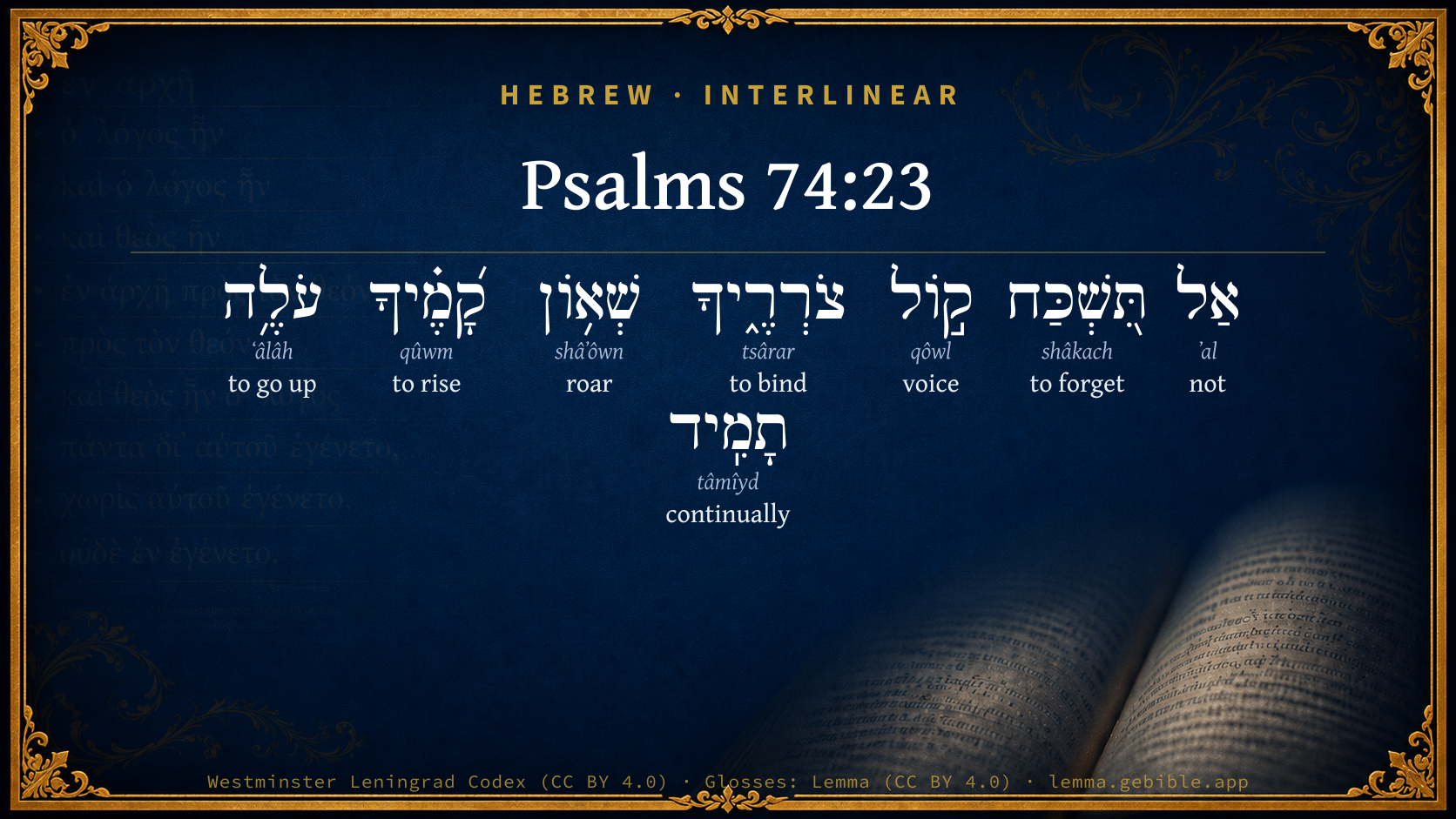
Psalms 74:23

Hebrew (Westminster Leningrad Codex) Psalms 74:23 appears in the Hebrew Old Testament. The text above is from the Westminster Leningrad Codex. Each word links to its Strong’s number, a concise gloss, and parsing drawn from the Open Scriptures Hebrew Bible morphology. Click any word for its full Brown-Driver-Briggs (BDB) entry.
Download image
Cite this verse

Psalms 74:23 (World English Bible). Public Domain. Lemma interlinear Bible study tool, https://lemma.gebible.app/v/psalms/74/23.

Show BibTeX & RIS
BibTeX
RIS
English Translation
Don't forget the voice of your adversaries. The tumult of those who rise up against you ascends continually.
World English Bible · Public Domain
Download a study sheet

One document with this verse’s original text, its word-by-word gloss line, the meaning frame, cross-references with their text, attributed commentary, and full source and license credits — printable, and it pastes into notes with its structure intact.

This verse Autodidact and up

Study sheet (.html) Plain text (.txt)

A passage Seminary Student

Up to 50 verses in one chapter. A passage sheet keeps up to 6 commentary sources and 12 cross-references per verse, in the order this page ranks them, and says so on the sheet whenever that leaves anything out. Ask for a single verse and you get the Autodidact verse sheet above.

Everything on this page stays free to read, with no account — the sheet is a download of what is already on screen, not access to it.

Want to remove ads? Support Godless Engineer
Compare translations 3

The same verse in 3 English versions, stacked beneath the original-language interlinear above. Click any original word for its lexicon entry.

Each is an independent rendering of the whole verse — the interlinear is not word-aligned to these translations.

Highlighted words mark where these versions differ — a whole-verse word diff, not a word-by-word alignment.

  • World English Bible Public Domain
    Don't forget the voice of your adversaries. The tumult of those who rise up against you ascends continually.
  • King James Version Public Domain
    Forget not the voice of thine enemies: the tumult of those that rise up against thee increaseth continually.
  • unfoldingWord Literal Text CC BY-SA 4.0
    Do not forget the voice of your adversaries, the uproar of the ones rising against you, going up continually.

unfoldingWord Literal Text — © unfoldingWord, licensed CC BY-SA 4.0. Word-aligned USFM3 via Door43 (git.door43.org/unfoldingWord/en_ult).

Versions to compare (up to 4)

3 of 4 selected

Show all 18 translations

Every available English version of this verse, each an independent rendering of the whole verse.

  • World English Bible Public Domain
    Don't forget the voice of your adversaries. The tumult of those who rise up against you ascends continually.
  • Berean Standard Bible Public Domain
    Do not disregard the clamor of Your adversaries, the uproar of Your enemies that ascends continually.
  • Majority Standard Bible Public Domain
    Do not disregard the clamor of Your adversaries, the uproar of Your enemies that ascends continually.
  • King James Version Public Domain
    Forget not the voice of thine enemies: the tumult of those that rise up against thee increaseth continually.
  • American Standard Version (1901) Public Domain
    Forget not the voice of thine adversaries: The tumult of those that rise up against thee ascendeth continually. Psalm 75 For the Chief Musician; `set to' Al-tash-heth. A Psalm of Asaph; a song.
  • Revised Version (1885) Public Domain
    Forget not the voice of thine adversaries: the tumult of those that rise up against thee ascendeth continually.
  • Geneva Bible (1599) Public Domain
    Forget not the voyce of thine enemies: for the tumult of them, that rise against thee, ascendeth continually.
  • Douay-Rheims (1899) Public Domain
    Forget not the voices of thy enemies: the pride of them that hate thee ascendeth continually.
  • Young's Literal Translation Public Domain
    Forget not the voice of Thine adversaries, The noise of Thy withstanders is going up continually!
  • Literal Standard Version CC BY-SA 4.0
    Do not forget the voice of Your adversaries, || The noise of Your withstanders is going up continually!
  • Unlocked Literal Bible CC BY-SA 4.0
    Do not forget the voice of your adversaries or the uproar of those who continually defy you.
  • unfoldingWord Literal Text CC BY-SA 4.0
    Do not forget the voice of your adversaries, the uproar of the ones rising against you, going up continually.
  • Darby Bible Public Domain
    Forget not the voice of thine adversaries: the tumult of those that rise up against thee ascendeth continually.
  • World Messianic Bible Public Domain
    Don’t forget the voice of your adversaries. The tumult of those who rise up against you ascends continually.
  • Webster's Bible Public Domain
    Forget not the voice of thy enemies: the tumult of those that rise against thee increaseth continually.
  • Free Bible Version CC BY-SA 4.0
    Don't ignore what your enemies have said, for their loud accusations against you are getting worse and worse!
  • Bible in Basic English Public Domain
    Keep in mind the voice of your haters; the outcry of those who come against you goes up every day.
  • JPS Tanakh (1917) Public Domain
    Forget not the voice of Thine adversaries, the tumult of those that rise up against Thee which ascendeth continually.

Literal Standard Version (2020), Covenant Press — licensed CC BY-SA 4.0. Text via the HelloAO Bible API (eBible.org). Unlocked Literal Bible (unfoldingWord) — licensed CC BY-SA 4.0. Text via the HelloAO Bible API (eBible.org). unfoldingWord Literal Text — © unfoldingWord, licensed CC BY-SA 4.0. Word-aligned USFM3 via Door43 (git.door43.org/unfoldingWord/en_ult). Free Bible Version, Dr. Jonathan Gallagher — licensed CC BY-SA 4.0. Text via the HelloAO Bible API (eBible.org).

Word by word

More ways to search: Search by grammar → Find every occurrence → Compare this word →

Practice this passage: Drill this verse → Learn its vocabulary →

About this verse

These counts appear in no published source. They are computed here, from the morphology-tagged text and Lemma’s own curated glosses. What Lemma adds →

8
words
8
distinct lemmas
Wisdom
section

Notable vocabulary

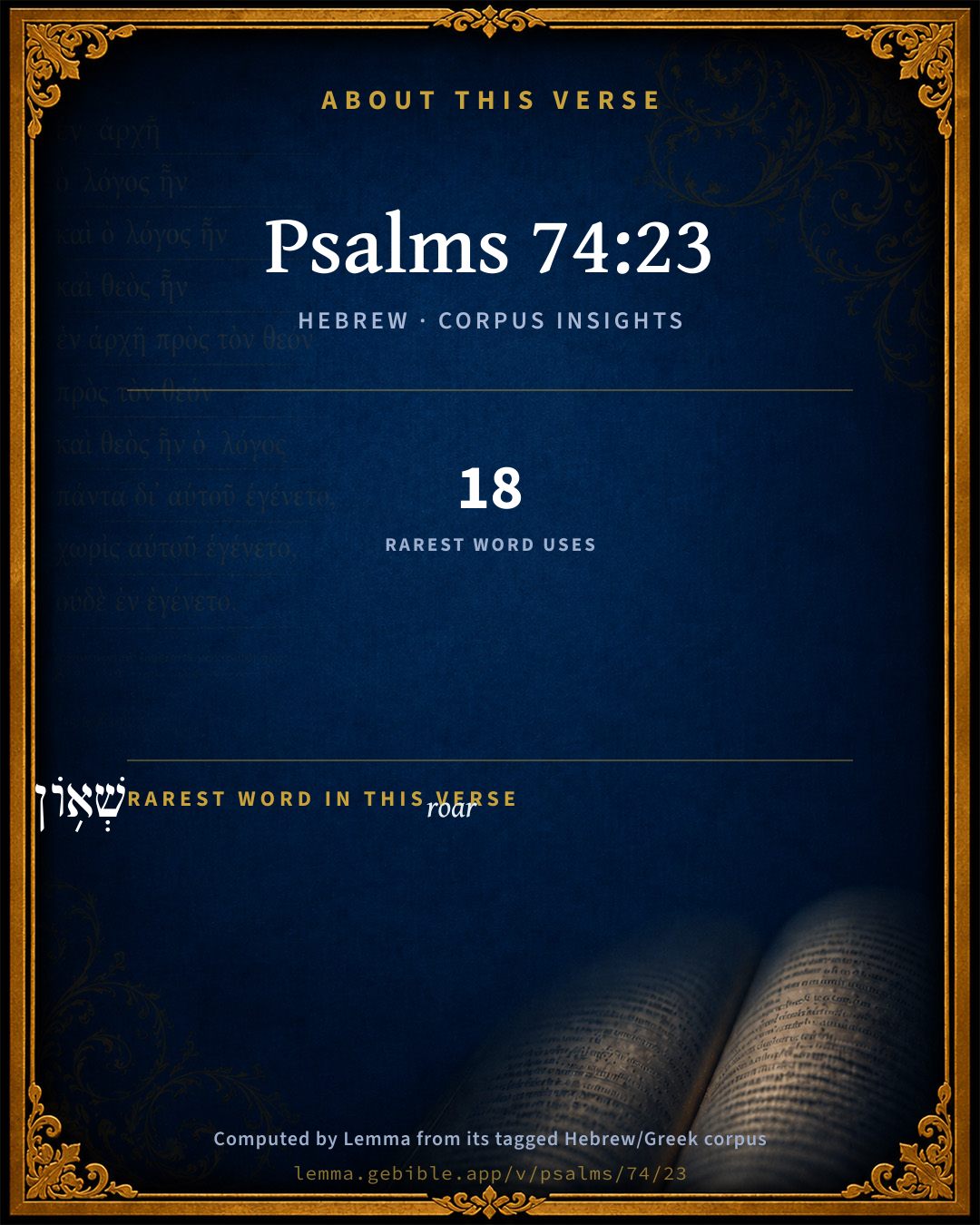
The rarest word here is שְׁא֥וֹן roar H7588 — appearing just 18 times in the whole Hebrew Bible.

Shared distinctive vocabulary

שְׁא֥וֹן roar H7588 occurs in 16 verses of the Hebrew Bible. Also found in:

Grammatical profile

  • 4 verbs
  • 3 nouns
  • 1 particle

Verb forms

  • תִּ֭שְׁכַּח Qal · Jussive
  • צֹרְרֶ֑יךָ Qal · Participle Active
  • קָ֝מֶ֗יךָ Qal · Participle Active
  • עֹלֶ֥ה Qal · Participle Active

Hebrew & Septuagint length

In English translation the verse runs 18 words from the Hebrew and 19 from the Septuagint (LXX English) — closely comparable.

A rough comparison of the two English renderings, which tokenize alike — not a word-level alignment.

Word counts can differ between the Hebrew and the Greek without any difference in meaning — e.g. the Hebrew direct-object marker אֵת has no separate Greek word, and Greek often adds the article ὁ.

Cross-references

9

Topical passages linked to Psalms 74:23 in the Treasury of Scripture Knowledge — connected by theme and wording, ordered by reader-vote popularity; previews shown in the World English Bible.

  • Psalms 65:7 Who stills the roaring of the seas, The roaring of their waves, And the turmoil of the nations.
  • Isaiah 37:29 Because of your raging against me, and because your arrogance is come up into my ears, therefore will I put my hook in your nose, and my bridle in your lips, and I will turn you back by the way by which you came.
  • Psalms 2:1–2 Why do the nations rage, And the peoples plot a vain thing?
  • Psalms 10:11–12 He says in his heart, "God has forgotten. He hides his face. He will never see it."
  • Psalms 13:1 How long, Yahweh? Will you forget me forever? How long will you hide your face from me?
  • Psalms 74:4 Your adversaries have roared in the midst of your assembly. They have set up their standards as signs.
  • Lamentations 2:16 All your enemies have opened their mouth wide against you; They hiss and gnash the teeth; they say, We have swallowed her up; Certainly this is the day that we looked for; we have found, we have seen it.
  • Jonah 1:2 "Arise, go to Nineveh, that great city, and preach against it, for their wickedness has come up before me."
  • Revelation 17:14 These will war against the Lamb, and the Lamb will overcome them, for he is Lord of lords, and King of kings. They also will overcome who are with him, called and chosen and faithful."

Cross-references courtesy of OpenBible.info (CC BY 4.0).

Hebrew and Greek witnesses Masoretic Hebrew ↔ Greek Septuagint

The same verse in the two great witnesses to the Old Testament, shown verse-for-verse.

You’re reading Greek Psalm 73 (Hebrew Psalm 74). The Septuagint counts the superscription, so verse numbers can differ from the Hebrew — chapter-level alignment, not verse-by-verse. Numbering follows Rahlfs.

These are two independent witnesses, not word-aligned to each other, and the Septuagint is shown in lemma (dictionary) form.

Hebrew Psalms 74:23 Masoretic · Westminster Leningrad Codex

אַל תִּ֭שְׁכַּח ק֣וֹל צֹרְרֶ֑יךָ שְׁא֥וֹן קָ֝מֶ֗יךָ עֹלֶ֥ה תָמִֽיד

Don't forget the voice of your adversaries. The tumult of those who rise up against you ascends continually.

World English Bible · Public Domain

Greek LXX Greek Psalm 73:23 Septuagint · lemma form

μή ἐπιλανθάνω ὁ φωνή ὁ ἱκετής σύ ὁ ὑπερηφανία ὁ μισέω σύ ἀναβαίνω διά πᾶς πρός σύ

Forget not the voice of your suppliants: let the pride of them that hate you continually ascend before you.

LXX2012 (modern English Septuagint) · Public Domain

Hebrew: Westminster Leningrad Codex (CC BY 4.0). Greek: Septuagint (public domain); English from LXX2012 (modern English Septuagint) (Public Domain). How the Septuagint differs from the Hebrew →

Commentary

Notes on Psalms 74:23 from classic Christian and Jewish commentators (each source and its license shown beneath its notes). The classic Christian expositions comment on the surrounding passage and are grouped to its opening verse, so a note may address several verses; the Jewish commentaries on the Tanakh (Rashi and others) are per-verse, so they appear only where the commentator wrote on this verse.

Lemma curates 59 commentaries, every one of them public domain or Creative Commons licensed, each selected and text-cleaned for this edition rather than reprinted as found. About our sources →

Trapp's Complete Commentary

John Trapp

Psa 74:23 Forget not the voice of thine enemies: the tumult of those that rise up against thee increaseth continually.

Ver. 23. The tumult of those that rise up against thee increaseth daily] Heb. ascendeth, viz. up to heaven, as Jon 1:2, there is no ho with them. Mundi laetitia est impunita nequitia, If the Lord take them not a link lower, as we say, they will grow intolerably insolent.

John Trapp, A Commentary or Exposition upon All the Books of the Old and New Testament (1647–1656) — public domain. Text from a community e-Sword module.

J. A. Alexander on Psalms

Joseph Addison Alexander

Psa 74:23. Forget not the voice of thy foes, the noise of thy assailants, ascending always. The voice and noise here meant are the clamorous revilings and blasphemies of wicked men, continually going up into the ears of God, and calling down his wrath upon them. This striking figure, representing gross sin as a vocal and audible witness against him who commits it, is a common one in Scripture, from the earliest books downwards. See Gen 4:10; Gen 18:21; Gen 19:13, and compare Jon 1:2. Thy assailants, or more literally thy insurgents, those who rise up against thee, in the way not only of attack but of rebellion. See above, on Psa 3:1; Psa 18:40,. Psa 18:39; Psa 18:48; Psa 44:5, and compare Exo 15:7, Deu 33:11, 2Sa 22:49. All this the Psalmist, or rather the Church, in whose behalf he speaks, recalls to the divine remembrance, as a ground or reason for immediate interference.

Joseph Addison Alexander, The Psalms Translated and Explained (1850) — public domain. Text from a community e-Sword module.

Geneva Bible (1599)

Geneva Bible translators

Or, increaseth more and more.

Geneva Bible (1599) marginal notes — public domain. Text via Bolls.life.

Adam Clarke's Commentary

Verse 23. Forget not the voice] While we pray to thee for our own salvation, we call upon thee to vindicate thy injured honour: and let all the nations see that thou lovest thy followers, and hatest those who are thy enemies. Let not man prevail against thee or thine.

ANALYSIS OF THE SEVENTY-FOURTH PSALM

This Psalm divides itself into two parts: -

I. The Psalmist's complaint, Ps 74:1-10.

II. His prayer, Ps 74:10-23.

Both the complaint and petition are summarily comprised in the three first verses; and afterwards amplified throughout the Psalm.

I. He expostulates with God about their calamity.

1. From the author of it: "Thou, O God."

2. From the extremity of it: "Cast us not off."

3. From the duration of it: "For ever."

4. From the cause: "Thy anger smokes against us."

5. From the object of it: "The sheep of thy pasture."

To his complaint he subjoins his petition; in which every word has the strength of an argument.

1. "Remember thy congregation:" Thy chosen people.

2. "Whom thou hast purchased: " By a mighty hand from Pharaoh.

3. "Of old:" Thy people ever since thy covenant with Abraham.

4. "The rod of thine inheritance;" dwelling in that land which thou didst measure out to them.

5. "Whom thou hast redeemed:" From the Canaanites, c.

6. "This Mount Zion, wherein thou hast dwelt:" Where we gave thee the worship which belonged to the true God and thou wert pleased with our sacrifices and services. Remember this people, and all these engagements; and "cast us not off for ever."

7. Lift up thy feet:" Consider thy own dishonour; they are thy enemies as well as ours. See what they have done against thee, thy temple, thy ordinances. Look at their blasphemies, and avenge the quarrel of thy covenant, Ps 74:3-11.

Consider what thou hast done for our fore-fathers.

1. Thou hast been long our King and Deliverer. See the proofs, Ps 74:12-16.

2. Thy general providence respects all men. Thou hast given them light; the sun and moon, the vicissitude of seasons, c., Ps 74:16-17.

II. The psalmist's prayer: -

1. That God would remember the reproaches of his enemies, Ps 74:18.

2. That he would deliver the souls of his children, Ps 74:19.

3. That he would not forget "the congregation of the poor," Ps 74:19.

4. That he would remember his covenant with Abram, to make them an innumerable people, and a blessing to all mankind, Ps 74:20.

5. That, when they did return, they might not be a diminished people for their enemies were determined to destroy them, Ps 74:21.

6. That they might be led from all considerations to praise his name, Ps 74:21.

At the conclusion he urges his petition: -

1. "Arise, - plead thine own cause."

2. "Remember the foolish."

3. "Forget not thine enemies."

4. They make a tumult, and their partisans daily increase, Ps 74:22-23.

Adam Clarke's Commentary on the Bible (1810–1826) — public domain. Text from a community e-Sword/MySword module.

The Cambridge Bible for Schools and Colleges

gen. ed. J. J. S. Perowne

23. thine enemies] Thine adversaries, as in Psa_74:4.

increaseth] Rather, ascendeth (R.V.), to heaven, challenging Thee to act. Cp. Isa_37:29.

The Cambridge Bible for Schools and Colleges (gen. ed. J. J. S. Perowne; Cambridge University Press, 1878–1918) — public domain. Text from a community e-Sword module.

Albert Barnes' Notes on the Bible

Forget not the voice of thine enemies - The voice of thine enemies clamoring for the destruction of thy people. Compare Psa 137:7. The prayer is, that God would bring deserved chastisement upon them for their purposes and their aims against his people. It is not necessarily a prayer for vengeance; it is a prayer for just retribution.

The tumult of those that rise up against thee - Of those that make war on thee, and on thy people. The word ““tumult” here means clamor or shout - as the shout of battle. The reference is to the movement of a host pressing on to conquest, encouraging and exciting each other, and endeavoring to intimidate their enemies by the loud clamor of the war-cry. It is a description of what had occurred among the main events referred to in the psalm, when the enemy came in to lay waste the capital, and to spread desolation throughout the land.

Increaseth continually - Margin, as in Hebrew, “Ascendeth.” That is, it seems to go up; it is the swelling clamor of a great multitude of warriors intent on conquest. A cry or clamor thus seems to swell or rise on the air, and (as it were) to ascend to God. The prayer here is, that God would regard that cry, not in the sense that he would grant them the fulfillment of their wishes, but in the sense that he would recompense them as they deserved. It is in this sense that the clamors of the wicked ascend to heaven - in this sense that God will regard them, as if they were a prayer for just retribution.

Albert Barnes' Notes on the Bible (1834–1885) — public domain. Text from a community e-Sword/MySword module.

Matthew Poole's English Annotations

The voice; their insulting and reproachful expressions against time, as well as against us.

The tumult, i.e. the tumultuous noise of the loud clamours.

Increaseth, Heb. ascendeth, to wit, into heaven, being either directed thither by them; their mouth being set against heaven, as theirs was, Psa 73:9; or at least being perceived there by God, whose ears were pierced with the loud cry of their sins. See Gen 4:10; 18:20. Or ascending may be here put for increasing, as it is Isa 55:13; Jer 46:7. So the sense is, They grow worse and worse, encouraging and hardening themselves in their wicked courses by their continual success and prosperity, and by thy patience extended to them.

Matthew Poole's English Annotations on the Holy Bible (1683–1685) — public domain. Text from a community e-Sword/MySword module.

The Treasury of David

Charles H. Spurgeon

Ver. 23. Forget not the voice of thine enemies. Great warrior let the enemy's taunt provoke thee to the fray. They challenge thee; accept thou the gage of battle, and smite them with thy terrible hand. If the cries of thy children are too feeble to be heard, be pleased to note the loud voices of thy foes and silence their profanities for ever.

The tumult of those that rise up against thee increaseth continually. The ungodly clamour against thee and thy people, their blasphemies are loud and incessant, they defy thee, even thee, and because thou repliest not they laugh thee to scorn. They go from bad to worse, from worse to worst; their fury swells like the thunders of an advancing tempest. What will it come too? What infamy will next be hurled at thee and thine? O God, wilt thou for ever bear this? Hast thou no regard for thine honour, no respect for thy glory? Much of this Psalm has passed over our mind while beholding the idolatries of Rome, (the author visited Rome in November and December, 1871, while this portion of the Treasury of David was in progress) and remembering her bloody persecution of the saints. O Lord, how long shall it be ere thou wilt ease thyself of those profane wretches, the priests, and cast the harlot of Babylon into the ditch of corruption? May the church never cease to plead with thee till judgment shall be executed, and the Lord avenged upon Antichrist.

Ver. 23. If we are compelled to close our most solemn and urgent devotions, and our most earnest supplications, without seeing one ray of light beaming upon our path, it may comfort us to remember that so the pious psalmist closed this complaint. To hope against hope is the most blessed kind of hope. William S. Plumer.

None.

Charles H. Spurgeon's The Treasury of David (1869–1885) — public domain. Psalms only. Text from a community e-Sword/MySword module.

The Pulpit Commentary

Forget not the voice of thine enemies. God does not forget insults of this kind, but punishes them. (see 2Ki_19:28, "Because thy rage against me, and thy tumult, is come up into my ears, therefore I will put my hook in thy nose, and my bridle in thy lips, and I will turn thee back by the way by which thou earnest He punished Babylon after a time with extreme severity. (see Jer 50 and Jer 51) The tumult of those that rise up against thee increaseth continually; rather, ascendeth continually goes up before God"s throne, crying for vengeance. (comp. Gen_4:10 Gen_18:20, 21 Exo_3:9, etc.)

The Pulpit Commentary (1880–1919), ed. H.D.M. Spence-Jones & Joseph S. Exell — public domain. Text from a community e-Sword module.

Lesson kit

Teaching starters — assembled from the data on this page, not authored interpretation. Every prompt links to the verse data it draws on. Edit before teaching.

Psalms, in the Wisdom, opens this verse with 8 words (8 distinct Hebrew lemmas). Its most distinctive word is shâʼôwn (“roar”). A historical commentator’s framing appears above. Read the whole chapter for the surrounding context.

Discussion questions

  1. How does “roar” (shâʼôwn) shape what this verse is saying?
  2. Psalms 40:2 shares the word «roar» with this verse. How do the two illuminate each other?
  3. These translations render this verse differently. What is at stake in choosing one wording over another?
  4. The verb «תִּ֭שְׁכַּח» is Qal Jussive. How does its form color the action?
  5. Reading how Trapp's Complete Commentary and J. A. Alexander on Psalms read this verse, where do the two commentators agree and where do they part?

Things to notice

Reading settings

Reading text

Shown beneath each verse's original-language words.

Old Testament
Old Testament edition

Read the OT as the Masoretic Hebrew (MT) or the Greek Septuagint (LXX).

English shown for the Greek Septuagint (in the Hebrew ↔ Greek comparison).

Comparing translations? Open the Compare panel on any verse page to stack up to four side by side.