
Isaiah 65:16

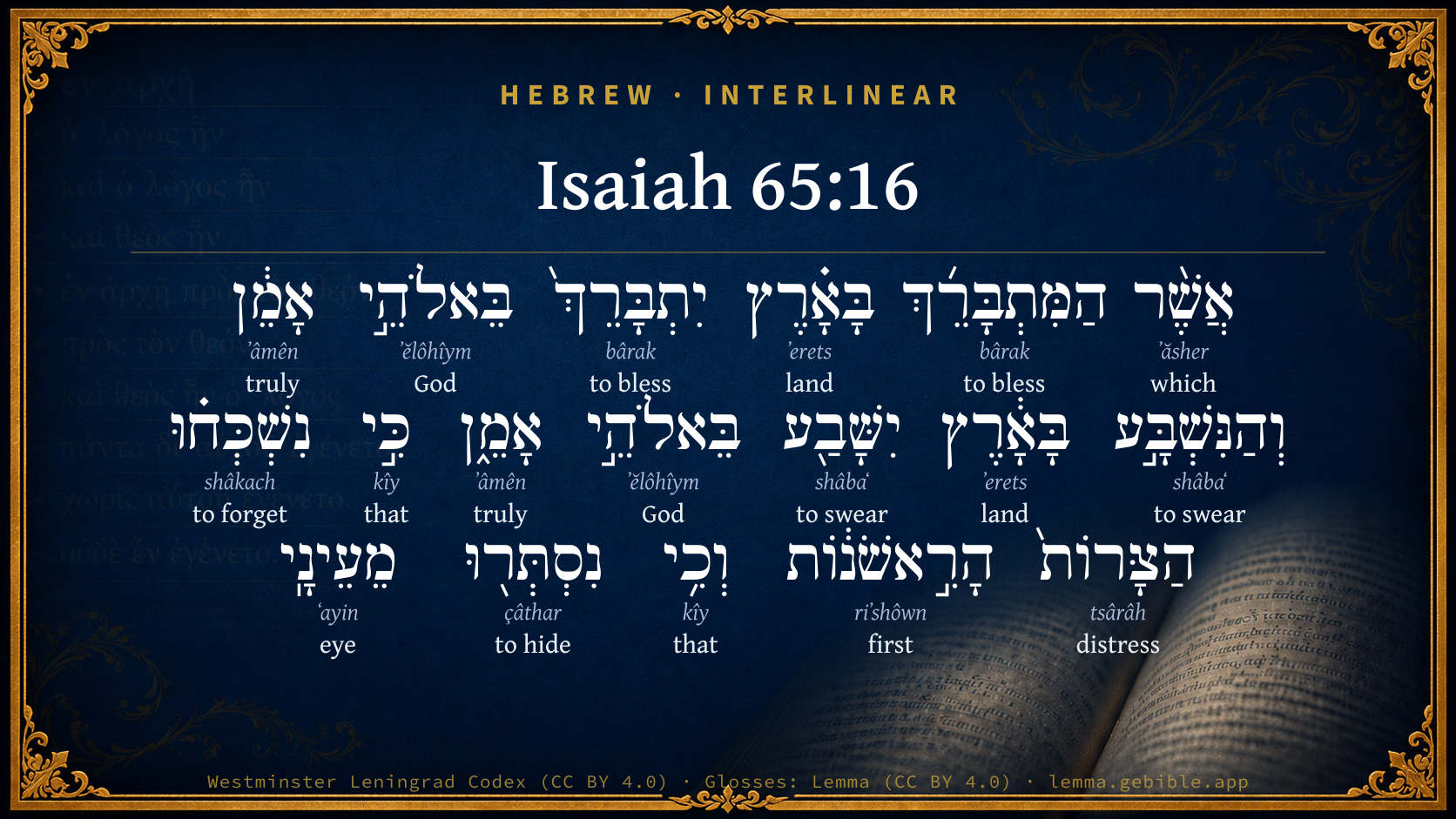
Hebrew (Westminster Leningrad Codex) Isaiah 65:16 appears in the Hebrew Old Testament. The text above is from the Westminster Leningrad Codex. Each word links to its Strong’s number, a concise gloss, and parsing drawn from the Open Scriptures Hebrew Bible morphology. Click any word for its full Brown-Driver-Briggs (BDB) entry.
Download image
Cite this verse

Isaiah 65:16 (World English Bible). Public Domain. Lemma interlinear Bible study tool, https://lemma.gebible.app/v/isaiah/65/16.

Show BibTeX & RIS
BibTeX
RIS
English Translation
so that he who blesses himself in the earth shall bless himself in the God of truth; and he who swears in the earth shall swear by the God of truth; because the former troubles are forgotten, and because they are hid from my eyes.
World English Bible · Public Domain
Download a study sheet

One document with this verse’s original text, its word-by-word gloss line, the meaning frame, cross-references with their text, attributed commentary, and full source and license credits — printable, and it pastes into notes with its structure intact.

This verse Autodidact and up

Study sheet (.html) Plain text (.txt)

A passage Seminary Student

Up to 50 verses in one chapter. A passage sheet keeps up to 6 commentary sources and 12 cross-references per verse, in the order this page ranks them, and says so on the sheet whenever that leaves anything out. Ask for a single verse and you get the Autodidact verse sheet above.

Everything on this page stays free to read, with no account — the sheet is a download of what is already on screen, not access to it.

Want to remove ads? Support Godless Engineer
Compare translations 3

The same verse in 3 English versions, stacked beneath the original-language interlinear above. Click any original word for its lexicon entry.

Each is an independent rendering of the whole verse — the interlinear is not word-aligned to these translations.

Highlighted words mark where these versions differ — a whole-verse word diff, not a word-by-word alignment.

  • World English Bible Public Domain
    so that he who blesses himself in the earth shall bless himself in the God of truth; and he who swears in the earth shall swear by the God of truth; because the former troubles are forgotten, and because they are hid from my eyes.
  • King James Version Public Domain
    That he who blesseth himself in the earth shall bless himself in the God of truth; and he that sweareth in the earth shall swear by the God of truth; because the former troubles are forgotten, and because they are hid from mine eyes.
  • unfoldingWord Literal Text CC BY-SA 4.0
    Whoever blesses himself in the land will bless himself by the God of truth, and the one swearing in the land will swear by the God of truth, for the former troubles will be forgotten, for they will also be hidden from my eyes.

unfoldingWord Literal Text — © unfoldingWord, licensed CC BY-SA 4.0. Word-aligned USFM3 via Door43 (git.door43.org/unfoldingWord/en_ult).

Versions to compare (up to 4)

3 of 4 selected

Show all 18 translations

Every available English version of this verse, each an independent rendering of the whole verse.

  • World English Bible Public Domain
    so that he who blesses himself in the earth shall bless himself in the God of truth; and he who swears in the earth shall swear by the God of truth; because the former troubles are forgotten, and because they are hid from my eyes.
  • Berean Standard Bible Public Domain
    Whoever invokes a blessing in the land will do so by the God of truth, and whoever takes an oath in the land will swear by the God of truth. For the former troubles will be forgotten and hidden from My sight.
  • Majority Standard Bible Public Domain
    Whoever invokes a blessing in the land will do so by the God of truth, and whoever takes an oath in the land will swear by the God of truth. For the former troubles will be forgotten and hidden from My sight.
  • King James Version Public Domain
    That he who blesseth himself in the earth shall bless himself in the God of truth; and he that sweareth in the earth shall swear by the God of truth; because the former troubles are forgotten, and because they are hid from mine eyes.
  • American Standard Version (1901) Public Domain
    so that he who blesseth himself in the earth shall bless himself in the God of truth; and he that sweareth in the earth shall swear by the God of truth; because the former troubles are forgotten, and because they are hid from mine eyes.
  • Revised Version (1885) Public Domain
    so that he who blesseth himself in the earth shall bless himself in the God of truth; and he that sweareth in the earth shall swear by the God of truth; because the former troubles are forgotten, and because they are hid from mine eyes.
  • Geneva Bible (1599) Public Domain
    He that shall blesse in the earth, shall blesse himselfe in the true God, and he that sweareth in the earth, shall sweare by the true God: for the former troubles are forgotten, and shall surely hide themselues from mine eyes.
  • Douay-Rheims (1899) Public Domain
    In which he that is blessed upon the earth, shall be blessed in God, amen: and he that sweareth in the earth, shall swear by God, amen: because the former distresses are forgotten, and because they are hid from my eyes.
  • Young's Literal Translation Public Domain
    So that he who is blessing himself in the earth, Doth bless himself In the God of faithfulness, And he who is swearing in the earth, Doth swear by the God of faithfulness, Because the former distresses have been forgotten, And because they have been hid from Mine eyes.
  • Literal Standard Version CC BY-SA 4.0
    So that he who is blessing himself in the earth, || Blesses himself in the God of faithfulness, || And he who is swearing in the earth, || Swears by the God of faithfulness, || Because the former distresses have been forgotten, || And because they have been hid from My eyes.
  • Unlocked Literal Bible CC BY-SA 4.0
    Whoever pronounces a blessing on the earth will be blessed by me, the God of truth. Whoever takes an oath on the earth will swear by me, the God of truth, because the former troubles will be forgotten, for they will be hidden from my eyes.
  • unfoldingWord Literal Text CC BY-SA 4.0
    Whoever blesses himself in the land will bless himself by the God of truth, and the one swearing in the land will swear by the God of truth, for the former troubles will be forgotten, for they will also be hidden from my eyes.
  • Darby Bible Public Domain
    so that he who blesseth himself in the land shall bless himself by the God of truth; and he that sweareth in the land shall swear by the God of truth: because the former troubles shall be forgotten, and because they shall be hidden from mine eyes.
  • World Messianic Bible Public Domain
    so that he who blesses himself in the earth will bless himself in the God of truth; and he who swears in the earth will swear by the God of truth; because the former troubles are forgotten, and because they are hidden from my eyes.
  • Webster's Bible Public Domain
    That he who blesseth himself in the earth shall bless himself in the God of truth; and he that sweareth in the earth shall swear by the God of truth; because the former troubles are forgotten, and because they are hid from my eyes.
  • Free Bible Version CC BY-SA 4.0
    Whoever asks a blessing or takes an oath in the land will do so by the one true God, for I have forgotten the troubles of the past—I don't look on them anymore.
  • Bible in Basic English Public Domain
    So that he who is requesting a blessing will make use of the name of the true God, and he who takes an oath will do so by the true God; because the past troubles are gone out of mind, and because they are covered from my eyes.
  • JPS Tanakh (1917) Public Domain
    So that he who blesseth himself in the earth shall bless himself by the God of truth; and he that sweareth in the earth shall swear by the God of truth; because the former troubles are forgotten, and because they are hid from Mine eyes.

Literal Standard Version (2020), Covenant Press — licensed CC BY-SA 4.0. Text via the HelloAO Bible API (eBible.org). Unlocked Literal Bible (unfoldingWord) — licensed CC BY-SA 4.0. Text via the HelloAO Bible API (eBible.org). unfoldingWord Literal Text — © unfoldingWord, licensed CC BY-SA 4.0. Word-aligned USFM3 via Door43 (git.door43.org/unfoldingWord/en_ult). Free Bible Version, Dr. Jonathan Gallagher — licensed CC BY-SA 4.0. Text via the HelloAO Bible API (eBible.org).

Word by word

More ways to search: Search by grammar → Find every occurrence → Compare this word →

Practice this passage: Drill this verse → Learn its vocabulary →

אָמֵ֔ן
ʼâmên
H543
“truly”
Adverb
Part of Speech
Adverb
Full BDB Definition

Origin: from H539

TWOT: 116b

verily, truly, amen, so be it
  1. אֲשֶׁ֨ר ʼăsher H834 “which” Particle, Relative
  2. הַמִּתְבָּרֵ֜ךְ bârak H1288 “the · blessing” Particle, Definite Article + Verb, Hithpael, Participle Active, Masculine, Singular, Absolute
  3. בָּאָ֗רֶץ ʼerets H776 “in/at the · land” Preposition, Determined + Noun, Common, Both, Singular, Absolute
  4. יִתְבָּרֵךְ֙ bârak H1288 “to bless” Verb, Hithpael, Imperfect, 3rd Person, Masculine, Singular
  5. בֵּאלֹהֵ֣י ʼĕlôhîym H430 “in/at · God(s) of” Preposition + Noun, Common, Masculine, Plural, Construct
  6. וְהַנִּשְׁבָּ֣ע shâbaʻ H7650 “and · the · swearing” Conjunction + Particle, Definite Article + Verb, Niphal, Participle Active, Masculine, Singular, Absolute
  7. בָּאָ֔רֶץ ʼerets H776 “in/at the · land” Preposition, Determined + Noun, Common, Both, Singular, Absolute
  8. יִשָּׁבַ֖ע shâbaʻ H7650 “to swear” Verb, Niphal, Imperfect, 3rd Person, Masculine, Singular
  9. בֵּאלֹהֵ֣י ʼĕlôhîym H430 “in/at · God(s) of” Preposition + Noun, Common, Masculine, Plural, Construct
  10. אָמֵ֑ן ʼâmên H543 “truly” Adverb
  11. כִּ֣י kîy H3588 “that” Conjunction
  12. נִשְׁכְּח֗וּ shâkach H7911 “to forget” Verb, Niphal, Perfect, 3rd Person, Common, Plural
  13. הַצָּרוֹת֙ tsârâh H6869 “the · distresses” Particle, Definite Article + Noun, Common, Feminine, Plural, Absolute
  14. הָרִ֣אשֹׁנ֔וֹת riʼshôwn H7223 “the · first” Particle, Definite Article + Adjective, Adjective, Feminine, Plural, Absolute
  15. וְכִ֥י kîy H3588 “and · that” Conjunction + Conjunction
  16. נִסְתְּר֖וּ çâthar H5641 “to hide” Verb, Niphal, Perfect, 3rd Person, Common, Plural
  17. מֵעֵינָֽי ʻayin H5869 “from · eyes · my” Preposition + Noun, Common, Both, Dual, Construct + Suffix, Personal, 1st Person, Common, Singular

About this verse

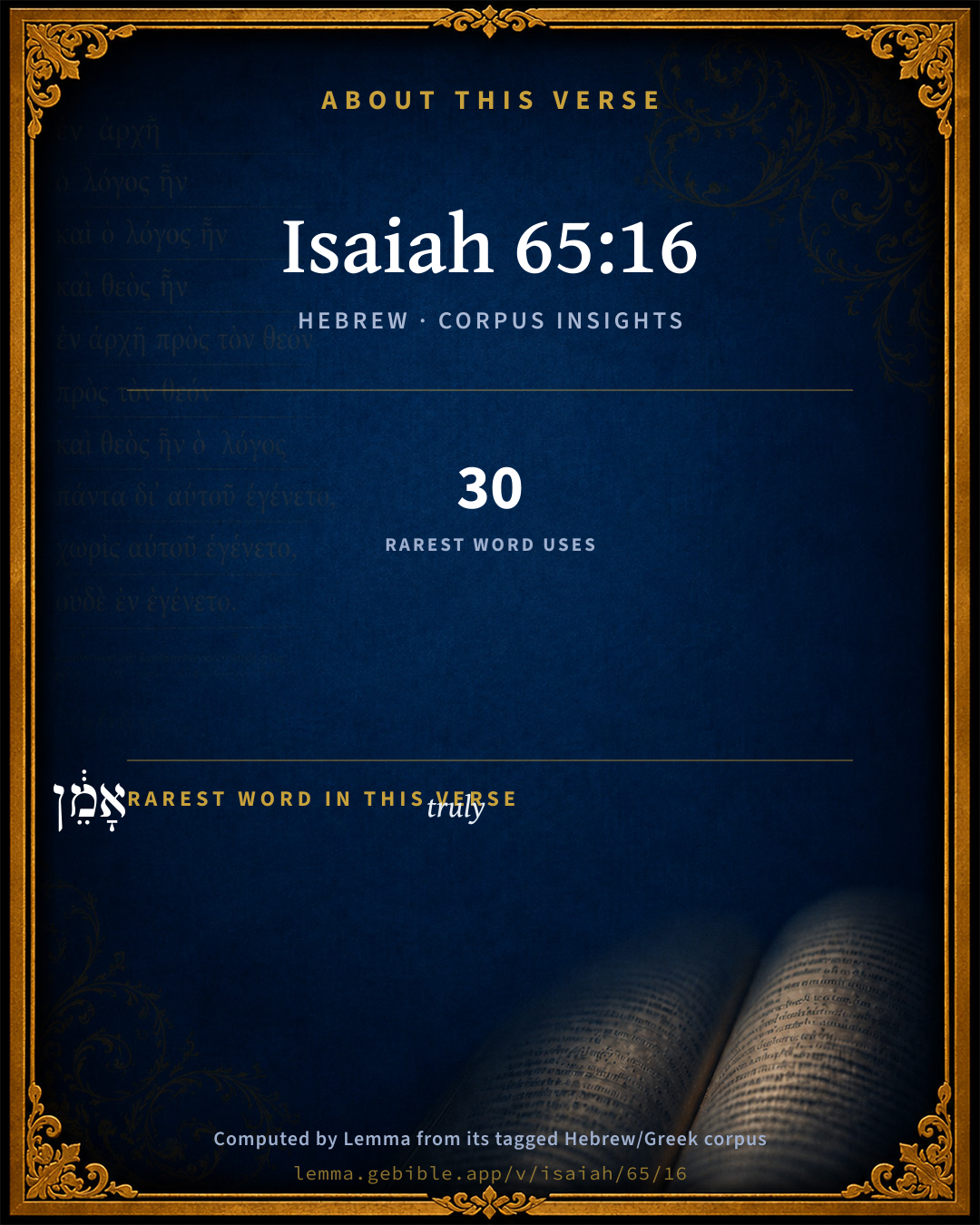
These counts appear in no published source. They are computed here, from the morphology-tagged text and Lemma’s own curated glosses. What Lemma adds →

18
words
12
distinct lemmas
Prophets
section

Shared distinctive vocabulary

אָמֵ֔ן truly H543 occurs in 24 verses of the Hebrew Bible. Also found in:

Grammatical profile

  • 6 verbs
  • 6 nouns
  • 1 adjective
  • 2 conjunctions
  • 2 adverbs
  • 1 particle

Verb forms

  • הַמִּתְבָּרֵ֜ךְ Hithpael · Participle Active
  • יִתְבָּרֵךְ֙ Hithpael · Imperfect
  • וְהַנִּשְׁבָּ֣ע Niphal · Participle Active
  • יִשָּׁבַ֖ע Niphal · Imperfect
  • נִשְׁכְּח֗וּ Niphal · Perfect
  • נִסְתְּר֖וּ Niphal · Perfect

Repetition

Words recur within this verse — often emphatic in Hebrew:

  • הַמִּתְבָּרֵ֜ךְ to bless H1288 ×2
  • בָּאָ֗רֶץ land H776 ×2
  • בֵּאלֹהֵ֣י God H430 ×2
  • אָמֵ֔ן truly H543 ×2
  • וְהַנִּשְׁבָּ֣ע to swear H7650 ×2
  • כִּ֣י that H3588 ×2

Hebrew & Septuagint length

In English translation the verse runs 45 words from the Hebrew and 41 from the Septuagint (LXX English) — closely comparable.

A rough comparison of the two English renderings, which tokenize alike — not a word-level alignment.

Word counts can differ between the Hebrew and the Greek without any difference in meaning — e.g. the Hebrew direct-object marker אֵת has no separate Greek word, and Greek often adds the article ὁ.

Cross-references

30

Topical passages linked to Isaiah 65:16 in the Treasury of Scripture Knowledge — connected by theme and wording, ordered by reader-vote popularity; previews shown in the World English Bible.

  • Isaiah 19:18 In that day there shall be five cities in the land of Egypt that speak the language of Canaan, and swear to Yahweh of hosts; one shall be called The city of destruction.
  • Jeremiah 4:2 and you shall swear, As Yahweh lives, in truth, in justice, and in righteousness; and the nations shall bless themselves in him, and in him shall they glory.
  • Psalms 31:5 Into your hand I commend my spirit. You redeem me, Yahweh, God of truth.
  • Philippians 2:11 and that every tongue should confess that Jesus Christ is Lord, to the glory of God the Father.
  • Hebrews 6:17–18 In this way God, being determined to show more abundantly to the heirs of the promise the immutability of his counsel, interposed with an oath;
  • Deuteronomy 32:4 The Rock, his work is perfect; For all his ways are justice: A God of faithfulness and without iniquity, Just and right is he.
  • Isaiah 45:23–25 By myself have I sworn, the word is gone forth from my mouth [in] righteousness, and shall not return, that to me every knee shall bow, every tongue shall swear.
  • Isaiah 65:19 I will rejoice in Jerusalem, and joy in my people; and there shall be heard in her no more the voice of weeping and the voice of crying.
  • John 1:17 For the law was given through Moses. Grace and truth came through Jesus Christ.
  • Romans 14:11 For it is written, "'As I live,' says the Lord, 'to me every knee will bow. Every tongue will confess to God.'"
  • Revelation 20:4 I saw thrones, and they sat on them, and judgment was given to them. I saw the souls of those who had been beheaded for the testimony of Jesus, and for the word of God, and such as didn't worship the beast nor his image, and didn't receive the mark on their forehead and on their hand. They lived, and reigned with Christ for the thousand years.
  • Deuteronomy 6:13 You shall fear Yahweh your God; and him shall you serve, and shall swear by his name.
  • Deuteronomy 10:20 You shall fear Yahweh your God; him shall you serve; and to him shall you cleave, and by his name shall you swear.
  • Psalms 63:11 But the king shall rejoice in God. Everyone who swears by him will praise him, For the mouth of those who speak lies shall be silenced.
  • Psalms 72:17 His name endures forever. His name continues as long as the sun. Men shall be blessed by him. All nations will call him blessed.
  • Psalms 86:15 But you, Lord, are a merciful and gracious God, Slow to anger, and abundant in loving kindness and truth.
  • Isaiah 11:16–12:1 There shall be a highway for the remnant of his people, who shall remain, from Assyria; like as there was for Israel in the day that he came up out of the land of Egypt.
  • Isaiah 35:10 and the ransomed of Yahweh shall return, and come with singing to Zion; and everlasting joy shall be on their heads: they shall obtain gladness and joy, and sorrow and sighing shall flee away.
  • Isaiah 48:1 Hear you this, house of Jacob, who are called by the name of Israel, and are come forth out of the waters of Judah; who swear by the name of Yahweh, and make mention of the God of Israel, but not in truth, nor in righteousness
  • Isaiah 54:4 Don't be afraid; for you shall not be ashamed: neither be confounded; for you shall not be disappointed: for you shall forget the shame of your youth; and the reproach of your widowhood shall you remember no more.
  • Jeremiah 10:10 But Yahweh is the true God; he is the living God, and an everlasting King: at his wrath the earth trembles, and the nations are not able to abide his indignation.
  • Jeremiah 12:16 It shall happen, if they will diligently learn the ways of my people, to swear by my name, As Yahweh lives; even as they taught my people to swear by Baal; then shall they be built up in the midst of my people.
  • Jeremiah 31:12 They shall come and sing in the height of Zion, and shall flow to the goodness of Yahweh, to the grain, and to the new wine, and to the oil, and to the young of the flock and of the herd: and their soul shall be as a watered garden; and they shall not sorrow any more at all.
  • Ezekiel 36:25–27 I will sprinkle clean water on you, and you shall be clean: from all your filthiness, and from all your idols, will I cleanse you.
  • Daniel 12:1 "At that time shall Michael stand up, the great prince who stands for the children of your people; and there shall be a time of trouble, such as never was since there was a nation even to that same time: and at that time your people shall be delivered, everyone who shall be found written in the book.
  • Daniel 12:11 From the time that the continual [burnt offering] shall be taken away, and the abomination that makes desolate set up, there shall be one thousand two hundred ninety days.
  • Zephaniah 1:5 those who worship the host of the sky on the housetops, those who worship and swear by Yahweh and also swear by Malcam,
  • Zephaniah 3:14–20 Sing, daughter of Zion! Shout, Israel! Be glad and rejoice with all your heart, daughter of Jerusalem.
  • John 1:14 The Word became flesh, and lived among us. We saw his glory, such glory as of the one and only Son of the Father, full of grace and truth.
  • John 14:6 Jesus said to him, "I am the way, the truth, and the life. No one comes to the Father, except through me.

Cross-references courtesy of OpenBible.info (CC BY 4.0).

Hebrew and Greek witnesses Masoretic Hebrew ↔ Greek Septuagint

The same verse in the two great witnesses to the Old Testament, shown verse-for-verse.

These are two independent witnesses, not word-aligned to each other, and the Septuagint is shown in lemma (dictionary) form.

Hebrew Isaiah 65:16 Masoretic · Westminster Leningrad Codex

אֲשֶׁ֨ר הַמִּתְבָּרֵ֜ךְ בָּאָ֗רֶץ יִתְבָּרֵךְ֙ בֵּאלֹהֵ֣י אָמֵ֔ן וְהַנִּשְׁבָּ֣ע בָּאָ֔רֶץ יִשָּׁבַ֖ע בֵּאלֹהֵ֣י אָמֵ֑ן כִּ֣י נִשְׁכְּח֗וּ הַצָּרוֹת֙ הָרִ֣אשֹׁנ֔וֹת וְכִ֥י נִסְתְּר֖וּ מֵעֵינָֽי

so that he who blesses himself in the earth shall bless himself in the God of truth; and he who swears in the earth shall swear by the God of truth; because the former troubles are forgotten, and because they are hid from my eyes.

World English Bible · Public Domain

Greek LXX Isaiah 65:16 Septuagint · lemma form

ὅς εὐλογέω ἐπί ὁ γῆ εὐλογέω γάρ ὁ θεός ὁ ἀληθινός καί ὁ ὄμνυμι ἐπί ὁ γῆ ὄμνυμι ὁ θεός ὁ ἀληθινός ἐπιλανθάνω γάρ ὁ θλῖψις αὐτός ὁ πρῶτος καί οὐ ἀναβαίνω αὐτός ἐπί ὁ καρδία

which shall be blessed on the earth; for they shall bless the true God: and they that swear upon the earth shall swear by the true God; for they shall forget the former affliction, it shall not come into their mind.

LXX2012 (modern English Septuagint) · Public Domain

On this verse, Ellicott's Commentary for English Readers discusses the Septuagint’s reading. Read the note in Commentary ↓

Hebrew: Westminster Leningrad Codex (CC BY 4.0). Greek: Septuagint (public domain); English from LXX2012 (modern English Septuagint) (Public Domain). How the Septuagint differs from the Hebrew →

Targum (Aramaic paraphrase)

1

The Targum is the ancient Jewish Aramaic paraphrase of the Hebrew Scriptures — an interpretive translation, not the Hebrew text itself. Onkelos (literal) and Pseudo-Jonathan (expansive) render the Torah, and Jonathan the Prophets. Coverage is partial: where no permissively-licensed English translation exists for a verse, only the Aramaic is shown. This is verse-level text, not a word-by-word alignment to the Hebrew.

  1. Targum Jonathan Prophets (Joshua–Malachi)
    דִמְבָרֵךְ בְּאַרְעָא יְבָרֵךְ בֶּאֱלָהָא קַיָמָא וְדִמְקַיֵם בְּאַרְעָא יְקַיֵם בֶּאֱלָהָא קַיָמָא אֲרֵי יִתְנַשְׁיָן עָקָתָא קַדְמְיָתָא וַאֲרֵי מְסַתְּרָן מִן קֳדָמַי:

    That he who blesseth in the earth shall bless by the God of the covenant, and he that sweareth in the earth shall swear by the God of the covenant; because, the former troubles shall be forgotten, and because they shall be hidden from before me.

    Targum Jonathan — Aramaic: “Mikraot Gedolot” (public domain). English: “Sefaria Community Translation” (CC0 1.0 (public-domain dedication)); “London "Chaldee Paraphrase," 1871” (public domain). Text via Sefaria.

Commentary

Notes on Isaiah 65:16 from classic Christian and Jewish commentators (each source and its license shown beneath its notes). The classic Christian expositions comment on the surrounding passage and are grouped to its opening verse, so a note may address several verses; the Jewish commentaries on the Tanakh (Rashi and others) are per-verse, so they appear only where the commentator wrote on this verse.

Lemma curates 59 commentaries, every one of them public domain or Creative Commons licensed, each selected and text-cleaned for this edition rather than reprinted as found. About our sources →

Trapp's Complete Commentary

John Trapp

Isa 65:16 That he who blesseth himself in the earth shall bless himself in the God of truth; and he that sweareth in the earth shall swear by the God of truth; because the former troubles are forgotten, and because they are hid from mine eyes.

Ver. 16. That he who blesseth himself in the earth, &c.] Or, That blesseth, either himself or any other.

Shall bless himself in the God of truth.] Heb. Shall bless in the God of Amen - that is, say some, in Christ, who is "Amen, the faithful and true witness," {Rev 3:14} in whom all the promises are, Yea, and Amen, {2Co 1:20} and who was wont often to say, Amen, amen. Others render it thus, Benedicat sibi per Deum firmi, shall bless himself by the God of the firm or faithful people, founded and rooted in God, so as that "the gates of hell shall not prevail against them."

Shall swear by the God of truth.] Or, By the God of the firm and faithful people, as before.

Because the former troubles are forgotten.] Remembered no otherwise than "as waters that are past." See Zec 10:6. {See Trapp on "Zec 10:6"}

John Trapp, A Commentary or Exposition upon All the Books of the Old and New Testament (1647–1656) — public domain. Text from a community e-Sword module.

Joseph Benson's Commentary

Isa 65:16. That he who blesseth himself in the earth — In any part of the world, for God shall have servants out of all nations, that shall be dignified with this new name; shall bless himself in the God of truth — That is, in his name; shall renounce every species of idolatry, and invoke and praise the true God alone. They shall have recourse to, and trust in, him alone, for blessing and happiness, and for a supply of all their wants. Observe, reader, it is of great consequence what that is which we bless ourselves in, and which we most please ourselves with. Worldly people bless themselves in the abundance which they have of this world’s goods, Psa 49:18; Luk 12:19; but God’s servants bless themselves in him, as a God all- sufficient for them. And he that sweareth, &c. — By him also they shall swear, and not by any creature, or any false god. To his judgment they shall refer themselves, from whom every man’s judgment proceeds. Both in prayer and praise, and in every act of homage and worship, they shall give honour to him as the God of truth — Hebrew, Amen, which some understand of Christ, who is himself the Amen, the faithful and true witness, and in whom all the promises are yea and amen. In him we must bless ourselves, and by him we must swear unto the Lord, and covenant with him. Some read it, He that is blessed in the earth shall be blessed in the true God; for Christ is the true God and eternal life, 1Jn 5:20. And it was promised of old, that in him should all families of the earth be blessed. Because the former troubles are forgotten — Namely, the troubles of the church. They shall see that what God hath promised he hath also fulfilled, and that he hath put an end to the troubles of his people, the remembrance of which shall be swallowed up in their present comforts. The chief reason of this is assigned in the next verse.

Joseph Benson's Commentary on the Old and New Testaments (1811–1818) — public domain. Text from a community e-Sword module.

MacLaren's Expositions of Holy Scripture

Alexander MacLaren

Isaiah

‘THE GOD OF THE AMEN’

Isa 65:16.

The full beauty and significance of these remarkable words are only reached when we attend to the literal rendering of a part of them which is obscured in our version. As they stand in the original they have, in both cases, instead of the vague expression, ‘The God of truth,’ the singularly picturesque one, ‘The God of the Amen.’

I. Note the meaning of the name. Now, Amen is an adjective, which means literally firm, true, reliable, or the like. And, as we know, its liturgical use is that, in the olden time, and to some extent in the present time, it was the habit of the listening people to utter it at the close of prayer or praise. But besides this use at the end of some one else’s statement, which the sayer of the ‘Amen’ confirms by its utterance, we also find it used at the beginning of a statement, by the speaker, in order to confirm his own utterance by it.

And these two uses of the expression reposing on its plain meaning, in the first instance signifying, ‘I tell you that it is so’; and in the second instance signifying, ‘So may it be!’ or, ‘So we believe it is,’ underlie this grand title which God takes to Himself here, ‘the God of the Amen,’ both His Amen and ours. So that the thought opens up very beautifully and simply into these two, His truth and our faith.

First, it emphasises the absolute truthfulness of every word that comes from His lips. There is implied in the title that He really has spoken, and declared to man something of His will, something of His nature, something of His purposes, something of our destiny. And now He puts, as it were, the broad seal upon the charter and says, ‘Amen! Verily it is so, and My word of Revelation is no man’s imagination, and My word of command is the absolute unveiling of human duty and human perfectness, and My word of promise is that upon which a man may rest all his weight and be safe for ever.’ God’s word is ‘Amen!’ man’s word is ‘perhaps.’ For in regard to the foundation truths of man’s belief and experience and need, no human tongue can venture to utter its own asseverations with nothing behind them but itself, and expect men to accept them; but that is exactly what God does, and alone has the right to do. His word absolutely, and through and through, in every fibre of it, is reliable and true.

Now do not forget that there was one who came to us and said, ‘Amen! Amen! I say unto you.’ Jesus Christ, in all His deep and wonderful utterances, arrogated to Himself the right which God here declares to be exclusively His, and He said, ‘I too have, and I too exercise, the right and the authority to lay My utterances down before you, and expect you to take them because of nothing else than because I say them.’ God is the God of the Amen! The last book of Scripture, when it draws back the curtain from the mysteries of the glorified session of Jesus Christ at the right hand of God, makes Him say to us, ‘These things saith the Amen!’ And if you want to know what that means, its explanation follows in the next clause, ‘the faithful and true witness.’

But then, on the other hand, necessarily involved in this title, though capable of being separately considered, is not only the absolute truthfulness of the divine word, but also the thorough-going reliance, on our parts, which that word expects and demands. God’s ‘Amen,’ and ‘Verily,’ of confirmation, should ever cause the ‘Amen’ of acceptance and assent to leap from our lips. If He begins with that mighty word, so soon as the solemn voice has ceased its echo should rise from our hearts. The city that cares for the charter which its King has given it will prepare a fitting, golden receptacle in which to treasure it. And the men who believe that God in very deed has spoken laws that illuminate, and commandments that guide, and promises that calm and strengthen and fulfil themselves, will surely prepare in their hearts an appropriate receptacle for those precious and infallible words. God’s truth has corresponding to it our trust. God’s faithfulness demands, and is only adequately met by, our faith. If He gives us the sure foundation to build upon, it will be a shame for us to bring wood, hay, stubble, and build these upon the Rock of Ages. The building should correspond with its foundation, and the faith which grasps the sure word should have in it something of the unchangeableness and certainty and absoluteness of that word which it grasps. If His revelation of Himself is certain, you and I ought to be certain of His revelation of Himself. Our certitude should correspond to its certainty.

Ah! my friend, what a miserable contrast there is between the firm, unshaken, solid security of the divine word upon which we say that we trust, and the poor, feeble, broken trust which we build upon it. ‘Let not that man think that He shall receive anything of the Lord’; but let us expect, as well as ‘ask, in faith, nothing wavering’; and let our ‘Amen!’ ring out in answer to God’s.

The Apostle Paul has a striking echo of the words of my text in the second Epistle to the Corinthians: ‘All the promises of God in Him are yea! and through Him also is the Amen!’ The assent, full, swift, frank -the assent of the believing heart to the great word of God comes through the same channel, and reaches God by the same way, as God’s word on which it builds comes to us. The ‘God of the Amen,’ in both senses of the word, is the God and Father of our Lord Jesus Christ, who is the seal as well as the substance of the divine promises, and whose voice in us is the answer to, and the grasp of, the promises of which He is the substance and soul.

II. Now notice, next, how this God of the Amen is, by reason of that very characteristic, the source of all blessing.

‘He who blesseth himself in the earth shall bless himself in the God of Truth.’ That phrase of blessing oneself in, which is a frequent Old Testament expression, is roughly equivalent to invoking, and therefore receiving, blessing from. You find it, for instance, in the seventy-second Psalm, in that grand burst which closes one of the books of the Psalter and hails the coming of the Messianic times, of which my text also is a prediction. ‘Men shall be blessed in Him,’ or rather, ‘shall bless themselves in Him,’ which is a declaration, that all needful benediction shall come down upon humanity through the coming Messias, as well as that men shall recognise in that Messias the source of all their blessing and good. So the text declares that, in those days that are yet to come, the whole earth shall be filled with men whose eyes have been purged from ignorance and sin, and from the illusions of sense and the fascinations of folly, and who have learned that only in the God of the Amen is the blessing of their life to be found.

Of course it is so. For only on Him can I lean all my weight and be sure that the stay will not give. All other bridges across the great abysses which we have to traverse or be lost in them, are like those snow-cornices upon some Alp, which may break when the climber is on the very middle of them, and let him down into blackness out of which he will never struggle. There is only one path clear across the deepest gulf, which we poor pilgrims can tread with absolute safety that it will never yield beneath our feet. My brother! there is one support that is safe, and one stay upon which a man can lean his whole weight and be sure that the staff will never either break or pierce his palm, and that is the faithful God, in whose realm are no disappointments, amongst whose trusters are no heart-broken and deceived men, but who gives bountifully, and over and above all that we are able to ask or think. They who have made experience, as we have all made experience, of the insufficiency of earthly utterances, of the doubtfulness of the clearest words of men, of the possible incapacity of the most loving, to be what they pledge themselves to be, and of the certainty that even if they are so for a while they cannot be so always-have surely learned one half, at least, of the lesson that life is meant to teach us; and it is our own fault if we have not bettered it with the better half, having uncoiled the tendrils of our hearts from the rotten props round which they have been too apt to twine themselves, and wreathed them about the pillars of the eternal throne, which can never shake nor fail. ‘He that blesseth himself in the earth shall bless himself’-unless he is a fool-’in the God of the Amen!’ and not in the man of the ‘peradventure.’

III. Lastly, note how the God of the Amen should be the pattern of His servants.

‘He that sweareth in the earth shall swear by the God of truth,’ or, ‘of the Amen.’ The prophet deduces from the name the solemn thought that those who truly feel its significance will shape their words accordingly, and act and speak so that they shall not fear to call His pure eyes to witness that there are neither, hypocrisy, nor insincerity, nor vacillation, nor the ‘hidden things of dishonesty’ nor any of the skulking meannesses of craft and self-seeking in them. ‘I swear by the God of the Amen, and call Thy faithfulness to witness that I am trying to be like Thee,’ that is what we ought to do if we call ourselves Christians. If we have any hold at all of Him, and of His love, and of the greatness and majesty of His faithfulness, we shall try to make our poor little lives, in such measure as the dewdrops may be like the sun, radiant like His, and of the same shape as His, for the dewdrop and the sun are both of them spheres. That is exactly what the apostle does, in that same chapter in 2 Cor., to which I already referred. He takes these very thoughts of my text, and in their double aspect too, and says, ‘Just because God is faithful, do you Corinthians think that, when I told you that I was coming to see you, I did not mean it?’ He brings the greatest thought that He can find about God and God’s truth, down to the settlement of this very little matter, the vindication of Himself from the charge, on the one hand, of facile and inconsiderate vacillation, and, on the other hand, of insincerity. So, we may say, the greatest thoughts should regulate the smallest acts. Though our maps be but a quarter of an inch to a hundred miles, let us see that they are drawn to scale. Let us see that He is our Pattern; and that the truthfulness, the simplicity, and faithfulness, which we rest upon as the very foundation of our intellectual as well as our moral and religious being, are, in our measure, copied in ourselves. ‘As God is faithful,’ said Paul, ‘our word to you was not yea! and nay!’ And they who are trusting to the God of the Amen! will live in all simplicity and godly sincerity; their yea will be yea, and their nay, nay.

Alexander MacLaren, Expositions of Holy Scripture (1904–1910) — public domain. Text from a community e-Sword module.

Tyndale Open Study Notes

Tyndale Open Resources

65:16 evil of earlier days: Cp. Rev 21:4.

Tyndale Open Study Notes — © Tyndale Open Resources, licensed CC BY-SA 4.0. Text via the HelloAO Bible API.

Geneva Bible (1599)

Geneva Bible translators

I will no more suffer my Church to be desolate as in times past.

By blessing, and by swearing is meant the praising of God for his benefits, and the true worshipping of him, which shall not be only in Judea, but through all the world.

Geneva Bible (1599) marginal notes — public domain. Text via Bolls.life.

Jamieson, Fausset & Brown

Robert Jamieson, A. R. Fausset & David Brown

That he--rather, "he who," &c.

blesseth, &c.-- (Psa 72:17; Jer 4:2).

God of truth--very God, as opposed to false gods; Hebrew, Amen: the very name of Messiah (Co2 1:20; Rev 3:14), faithful to His promises (Joh 1:17; Joh 6:32). Real, substantial, spiritual, eternal, as opposed to the shadowy types of the law.

sweareth, &c.--God alone shall be appealed to as God (Isa 19:18; Deu 6:13; Psa 63:11).

troubles--that is, sins, provocations [LOWTH]. Rather, calamities caused by your sins; so far from these visiting you again, the very remembrance of them is "hid from Mine eyes" by the magnitude of the blessings I will confer on you (Isa 65:17, &c.). [MAURER].

Jamieson, Fausset & Brown — Commentary Critical and Explanatory on the Whole Bible (1871) — public domain (CC PDM 1.0). Text via the HelloAO Bible API.

Ellicott's Commentary for English Readers

(16) Shall bless himself in the God of truth . . .—Literally, the God of the Amen. In Rev_3:14 we have an echo of the Hebrew; in Joh_17:3 we have as distinct an echo of the LXX. rendering, τὸν θεὸν τὸν ἀληθινόν. The words seem to imply that the prophet had entered into the inner meaning of what was to most men only a liturgical formula.

Because the former troubles . . .—The addition of the clause emphasises the thought that it is the truth or faithfulness of God, who keepeth His promise for over, that will lead men to use that new Name as a formula of benediction.

A Bible Commentary for English Readers, edited by Charles John Ellicott (1878–1897) — public domain. Text from a community e-Sword module.

The Cambridge Bible for Schools and Colleges

gen. ed. J. J. S. Perowne

16. That] R.V., So that (as Gen_11:7; Psa_95:11; Mal_4:1, &c.).

he who blesseth himself in the land] i.e. “who invokes a blessing on himself”; cf. Gen_22:18; Gen_26:4; Gen_48:20; Jer_4:2.

shall bless himself by the God of truth] using such expressions as, “May the God of truth bless me.” By the fulfilment both of His threatenings and His promises Jehovah will have shewn Himself to be the God of truth, so that a blessing uttered in His name is certainly effective. God of truth is strictly “God of the Amen” (cf. 2Co_1:20; Rev_3:14), but this is a too artificial phrase for so early a period. Read ’ômen (= “truth,” “fidelity”).

swear by the God of truth] Cf. ch. Isa_48:1.

the former troubles are forgotten] See Rev_21:4. hid from

mine eyes] a reminiscence probably of Hos_13:14.

The Cambridge Bible for Schools and Colleges (gen. ed. J. J. S. Perowne; Cambridge University Press, 1878–1918) — public domain. Text from a community e-Sword module.

John Gill's Exposition

That he who blesseth himself in the earth,.... That is sensible he stands in need of blessings, and wishes for them, and prays he might have them; or that takes notice that he is blessed with them, and acknowledges them, and is thankful for them:

shall bless himself in the God of truth; shall pray to him for blessings he wants, and ascribe what he has unto him, and give him the praise and glory of them; by whom is meant, either God the Father, in opposition to idols, the fictitious deities of the Gentiles, those lying vanities, which were not gods by nature, and to whom the God of truth, or the true God, is often opposed, and whom the Targum here calls the living God; or rather the Messiah, our Lord Jesus Christ: for the words may be rendered, "shall bless himself in God Amen" (f); that is, in God, who is the "Amen", which is one of the names of Christ, Rev 3:14 in whom believers are blessed with all spiritual blessings, and reckon themselves blessed in him, and ascribe blessing to him for them; in whom all the promises of God are yea and amen, and who is the true God, and eternal life, Co2 1:20,

and he that sweareth in the earth shall swear by the God of truth; when an oath is necessary on any account, and it is proper to appeal to the supreme Being for the truth of anything, this, in Gospel times, should be done in the name of Christ; he, who is the Amen and faithful witness, is to be appealed unto, who is God omniscient, the discerner of the thoughts and intents of the heart. Of forms of swearing by Christ, see Rom 9:1. Besides, swearing, as it is a part of religious worship, may here be put for the whole; so it signifies, that as all blessings come from Christ, so all worship and duty should be performed unto him, and in his name.

Because the former troubles are forgotten, they are hid from mine eyes; which is to be understood not of afflictions and persecutions for the sake of Christ and his Gospel, for these, especially in the first times of it, were very great; though in the latter day they will cease, to which indeed this prophecy extends: but rather either of the idolatry and superstition of the Gentile world, which were troublesome and offensive to God, but now removed by the clear light of the Gospel, and so forgotten by him, and hid from his eyes; or the carnal ordinances of the legal dispensation, which gave great trouble to the worshippers then, and could not cleanse their consciences, and through the fear of death, on the breach of them, were all their lifetime subject to bondage; but now these are all done away by Christ, and in Gospel times forgotten by men, and hid from the sight of God, who regards them no more; see Jer 3:16, which sense suits with what follows.

(f) "benedicet sibi in Deo Amen", Pagninus, Montanus, Vitringa; "benedicturus sit in Deo Amen", Cocceius.

John Gill's Exposition of the Whole Bible (1746–1763) — public domain (CC PDM 1.0). Text via the HelloAO Bible API.

Albert Barnes' Notes on the Bible

That he who blesseth himself in the earth - That is, he who shall invoke blessings on himself.

Shall bless himself in the God of truth - Or by the true God. He shall not seek a blessing from a false god; but he shall come before the true God, and seek a blessing at his hand.

And he that sweareth - Every oath that is taken in the land shall be by the true God. There shall be no swearing by idols; but the true God shall be everywhere acknowledged.

Because the former troubles are forgotten - The former punishments and calamities shall be passed away. The favor of God shall be restored. His pure worship shall be re-established, and his name shall be celebrated again in the land. The image here is one of returning prosperity and favor; a state when the happiness will be so great that all the former trials will be regarded as not worthy of recollection.

Albert Barnes' Notes on the Bible (1834–1885) — public domain. Text from a community e-Sword/MySword module.

Haydock's Catholic Bible Commentary

Amen, or "of truth." False gods shall be neglected. They shall not swear by them, as formerly, Sophonias i. 5. --- Christ usually adopted the asseveration, Amen, Amen, to enforce his truths. (Haydock)

George Leo Haydock (1774–1849), Haydock's Catholic Family Bible and Commentary, 1859 edition — public domain. Excludes Psalms (Douay-Rheims chapter numbering differs from Protestant) and Deuterocanonical books (Catholic canon only).

Matthew Poole's English Annotations

I will bring it to pass, that over all the world, if any man bless himself, or bless another, it shall be in God Amen. So the Hebrew (we translate it the God of truth). Amen is a name given to Christ, Rev 3:14, These things saith the Amen, the faithful and true witness; being here applied to God, many think it makes a great proof of the Godhead of Christ, and judge the sense of this text to be, that under the times of the gospel men should not bless themselves (as before) in the names of Abraham, and Isaac, and Jacob, but in the name of Christ, in the God Amen; nor is this an improbable sense. Others taking it more appellatively, by Elohim Amen, here understand that God who shows himself true and faithful in his promises. In like manner it is prophesied, that those that swear (by which some understand worship God, others, calling God to be a witness) should swear by the

God of truth, or in the God of truth; either worshipping God in Christ the Amen, or calling the faithful God to attest their sincerity, or swearing by that God who hath approved his truth and faithfulness by saving and delivering his people.

Because the former troubles are forgotten, and because they are hid from mine eyes; because they shall see what God promised is fulfilled, the troubles of his people are at an end, and they are hid from God’s eyes, that is, they are at an end.

Matthew Poole's English Annotations on the Holy Bible (1683–1685) — public domain. Text from a community e-Sword/MySword module.

The Pulpit Commentary

That he who blesseth himself; rather, so that he who blesses himself. The sequence of the argument is not altogether clear. Perhaps it is recant that God will call them by his own Name (Amo_9:12) people of God"; (Heb_4:9) and thence it will become natural for them to use no other name, either when they call for a blessing on themselves, or have to confirm a covenant with others. In the God of truth; literally, in the God of the Amen; i.e. the God who keeps covenant and promise, to which the strongest formula of consent was the word "Amen". (see Num_5:22 Deu_27:15-26 1Ki_1:36, etc.) Similarly, St. John calls our Lord "the Amen, the Faithful and True Witness". (Rev_3:14) Because the former troubles are forgotten. When the blessed time has come wherein men call themselves by the Name of the Lord, and know of only one God as the Source of blessing and the confirmation of an oath, then the former state of human affairs, with all its "troubles," will have passed away, and the new era will be inaugurated, which the prophet proceeds to describe at length (vers. 17-25).

The Pulpit Commentary (1880–1919), ed. H.D.M. Spence-Jones & Joseph S. Exell — public domain. Text from a community e-Sword module.

John Wesley's Explanatory Notes

God of truth - Because they shall see what God promised is fulfilled. Are hid - That is, they are at an end.

John Wesley, Explanatory Notes Upon the Whole Bible (1754–1765) — public domain. Text via the GEBible commentary corpus.

J. A. Alexander on Isaiah

Joseph Addison Alexander

“(By) which the (man) blessing himself in the land (or earth) shall bless himself by the God of truth, and (by which) the (man) swearing in the land (or earth) shall swear by the God of truth, because forgotten are the former enmities (or troubles), and because they are hidden from my eyes.” Two things have divided and perplexed interpreters in this verse, as it stands connected with the one before it. The first is the apparent change of subject, and the writer’s omission to record the new name which had just been promised. The other is the very unusual construction of the relative. The first of these has commonly been left without solution, or referred to the habitual freedom of the writer. The other has been variously but very unsuccessfully explained. All objections may be obviated by referring the relative to an expressed antecedent, viz. name, a construction given both in the Septuagint and Vulgate versions, although otherwise defective and obscure. Another advantage of this construction is that it removes the abrupt transition and supplies the name, which seems on any other supposition to be wanting. According to this view of the place, the sense is that the people shall be called after the God of truth, so that His name and theirs shall be identical, and consequently whoever blesses or swears by the one blesses or swears by the other also. The form in which this idea is expressed is peculiar but intelligible and expressive: ‘His people He shall call by another name, which (i.e., with respect to which, or more specifically by which) he that blesseth shall bless by the God of truth,’ etc. Most interpreters understand by blessing himself; praying for God’s blessing, and by swearing, the solemn invocation of His presence as a witness, both being mentioned as acts of religious worship and of solemn recognition. ‘Amen’ (translated ‘truth’) is properly an adjective meaning sure, trustworthy, and therefore including the ideas of reality and faithfulness, neither of which should be excluded, and both of which are comprehended in the English phrase, ‘the true God’, or retaining more exactly the form of the original, ‘the God of truth’. This Hebrew word is retained in the Greek of the New Testament, not only as a particle of asseveration, but in a still more remarkable manner as a name of Christ (Rev 1:18; Rev 3:14), with obvious reference to the case before us; and there must be something more than blind chance in the singular coincidence thus brought to light between this application of the phrase and the sense which has been put upon the foregoing verse, as relating to the adoption of the Christian name by the church or chosen people. As applied to Christ, the name has been well explained to describe Him as very God, as a witness to the truth, as the substance or reality of the legal shadows, and as the fulfiller of the divine promises. The last clause gives the reason for the application of the title, God of truth, viz because in His deliverance of His people He will prove Himself to be the true God in both senses, truly divine and eminently faithful. This proof will be afforded by the termination of those evils which the sins of his own people once rendered necessary.

Joseph Addison Alexander, The Prophecies of Isaiah (1846–1847; New York: Scribner, 1870–1878) — public domain. Text from a community e-Sword module.

Rashi

Rabbi Shlomo Yitzchaki (Rashi)

For whoever blesses himself on the earth For My fear shall be over all of them, and the earth shall be full of knowledge, and whoever praises himself or lauds himself on the earth, will bless himself by the true God, he will praise himself that he is a servant of the true God, the God of truth, Who realized and observed this, His promise.

for the first troubles have been forgotten Therefore, they shall call Me the true God.

Rashi on the Tanakh — English translations: “The Judaica Press complete Tanach with Rashi, translated by A. J. Rosenberg” (CC BY 4.0); “Pentateuch with Rashi's commentary by M. Rosenbaum and A.M. Silbermann, 1929-1934” (public domain); “The Metsudah Tanach series, Lakewood, N.J” (CC BY 4.0); and “The Book of Joshua, Metsudah Publications, 1997” (CC BY 4.0). Text via Sefaria.

Ibn Ezra

Rabbi Abraham ibn Ezra

המתברך He who blesseth himself. This word is not like ונברכו and shall be blessed (Gen. 18:18); there is a difference between the two words.

באלהי אמן In the God whom all the world will acknowledge to be the true God, and that there is none besides Him. אמן is an adjective of the same root as אמונה truth (25:1); יתברך ונו׳ Shall bless himself, etc. He shall thankfully acknowledge that this is true, or wish and pray that it may become true.

Because the former troubles, etc., are hid from mine eyes. The troubles which have befallen the righteous, the servants of the Lord, have been intensified by the circumstance that the wicked used to mock at the pious and their piety, when the latter were afflicted with calamities

Ibn Ezra on the Tanakh — English translations: “Sefaria Community Translation” (CC0 1.0 (public-domain dedication)); “Yalkut, Sifsei Chachomim Chumash, Metsudah Publications, 2009” (CC BY 4.0); and “Commentary of Ibn Ezra on Isaiah - trans. by M. Friedlander, 1873” (public domain). Text via Sefaria.

Lesson kit

Teaching starters — assembled from the data on this page, not authored interpretation. Every prompt links to the verse data it draws on. Edit before teaching.

Isaiah, in the Prophets, opens this verse with 18 words (12 distinct Hebrew lemmas). Its most distinctive word is ʼâmên (“truly”). A historical commentator’s framing appears above. Read the whole chapter for the surrounding context.

Discussion questions

  1. What does “truly” (ʼâmên) contribute to the verse as a whole?
  2. How does Numbers 5:22, which shares the word «truly», read alongside this verse?
  3. What does the repetition of “to bless” (2× in this one verse) do in this verse?
  4. The translations on this page render this verse differently — a whole-verse word diff, not a word-by-word alignment. What might account for the different wordings?
  5. «הַמִּתְבָּרֵ֜ךְ» is a Hithpael Participle Active verb. How does that grammatical form shape the action described?
  6. Compare how Trapp's Complete Commentary and Joseph Benson's Commentary read this verse. Where do they agree or differ?

Things to notice

Reading settings

Reading text

Shown beneath each verse's original-language words.

Old Testament
Old Testament edition

Read the OT as the Masoretic Hebrew (MT) or the Greek Septuagint (LXX).

English shown for the Greek Septuagint (in the Hebrew ↔ Greek comparison).

Comparing translations? Open the Compare panel on any verse page to stack up to four side by side.