
Psalms 77:10

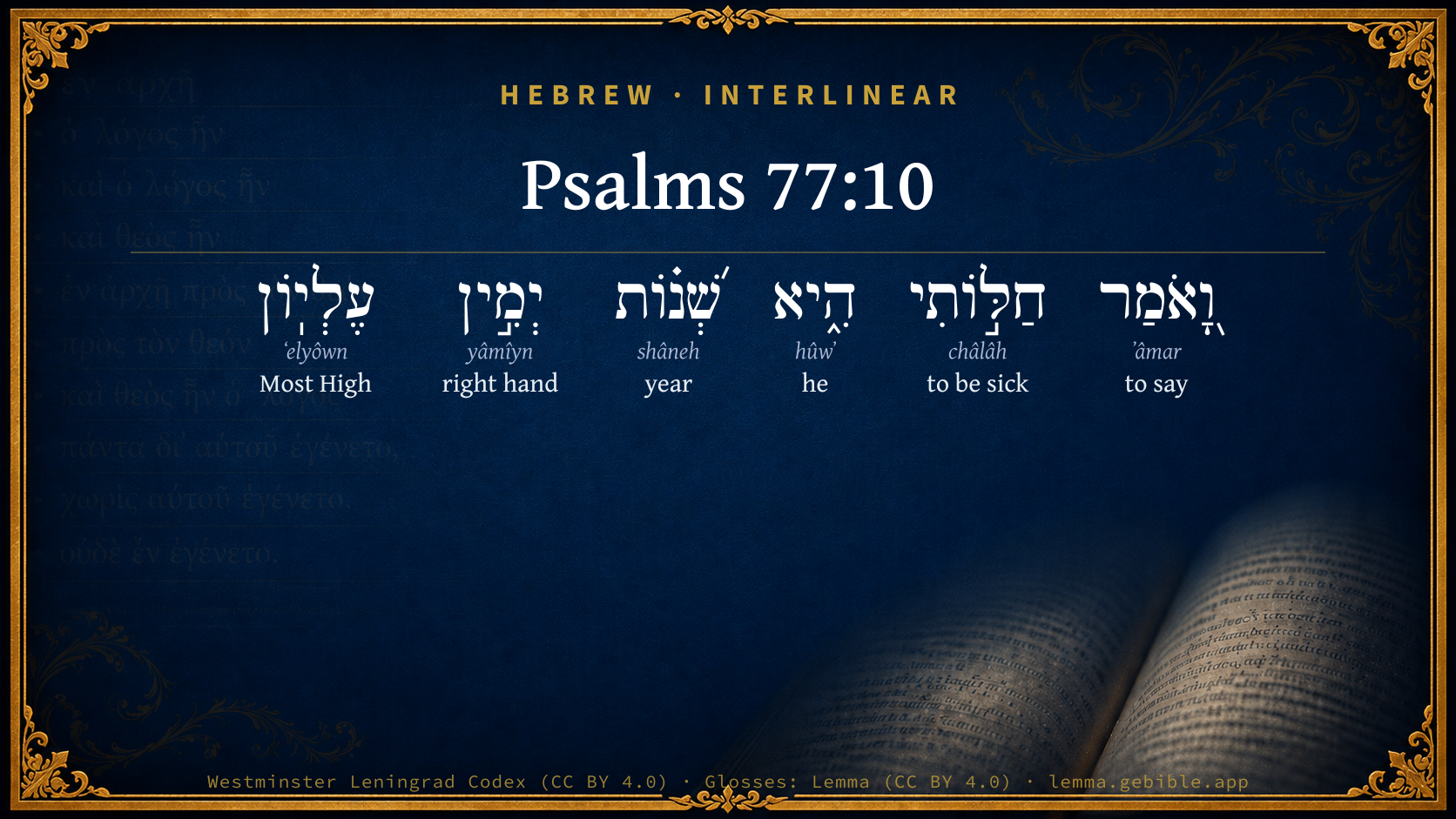
Hebrew (Westminster Leningrad Codex) Psalms 77:10 appears in the Hebrew Old Testament. The text above is from the Westminster Leningrad Codex. Each word links to its Strong’s number, a concise gloss, and parsing drawn from the Open Scriptures Hebrew Bible morphology. Click any word for its full Brown-Driver-Briggs (BDB) entry.
Download image
Cite this verse

Psalms 77:10 (World English Bible). Public Domain. Lemma interlinear Bible study tool, https://lemma.gebible.app/v/psalms/77/10.

Show BibTeX & RIS
BibTeX
RIS
English Translation
Then I thought, "I will appeal to this: The years of the right hand of the Most High."
World English Bible · Public Domain
Download a study sheet

One document with this verse’s original text, its word-by-word gloss line, the meaning frame, cross-references with their text, attributed commentary, and full source and license credits — printable, and it pastes into notes with its structure intact.

This verse Autodidact and up

Study sheet (.html) Plain text (.txt)

A passage Seminary Student

Up to 50 verses in one chapter. A passage sheet keeps up to 6 commentary sources and 12 cross-references per verse, in the order this page ranks them, and says so on the sheet whenever that leaves anything out. Ask for a single verse and you get the Autodidact verse sheet above.

Everything on this page stays free to read, with no account — the sheet is a download of what is already on screen, not access to it.

Want to remove ads? Support Godless Engineer
Compare translations 3

The same verse in 3 English versions, stacked beneath the original-language interlinear above. Click any original word for its lexicon entry.

Each is an independent rendering of the whole verse — the interlinear is not word-aligned to these translations.

Highlighted words mark where these versions differ — a whole-verse word diff, not a word-by-word alignment.

  • World English Bible Public Domain
    Then I thought, "I will appeal to this: The years of the right hand of the Most High."
  • King James Version Public Domain
    And I said, This is my infirmity: but I will remember the years of the right hand of the most High.
  • unfoldingWord Literal Text CC BY-SA 4.0
    And I said, “This is my wounding: the changing of the right hand of the Most High.”

unfoldingWord Literal Text — © unfoldingWord, licensed CC BY-SA 4.0. Word-aligned USFM3 via Door43 (git.door43.org/unfoldingWord/en_ult).

Versions to compare (up to 4)

3 of 4 selected

Show all 18 translations

Every available English version of this verse, each an independent rendering of the whole verse.

  • World English Bible Public Domain
    Then I thought, "I will appeal to this: The years of the right hand of the Most High."
  • Berean Standard Bible Public Domain
    So I said, “I am grieved that the right hand of the Most High has changed.”
  • Majority Standard Bible Public Domain
    So I said, “I am grieved that the right hand of the Most High has changed.”
  • King James Version Public Domain
    And I said, This is my infirmity: but I will remember the years of the right hand of the most High.
  • American Standard Version (1901) Public Domain
    And I said, This is my infirmity; `But I will remember' the years of the right hand of the Most High.
  • Revised Version (1885) Public Domain
    And I said, This is my infirmity; but I will remember the years of the right hand of the Most High.
  • Geneva Bible (1599) Public Domain
    And I sayde, This is my death: yet I remembred the yeeres of the right hand of the most High.
  • Douay-Rheims (1899) Public Domain
    Or will God forget to shew mercy? or will he in his anger shut up his mercies?
  • Young's Literal Translation Public Domain
    And I say: `My weakness is, The changes of the right hand of the Most High.'
  • Literal Standard Version CC BY-SA 4.0
    And I say: “My weakness is, || The changes of the right hand of the Most High.”
  • Unlocked Literal Bible CC BY-SA 4.0
    I said, “This is my sorrow: the changing of the right hand of the Most High toward us.”
  • unfoldingWord Literal Text CC BY-SA 4.0
    And I said, “This is my wounding: the changing of the right hand of the Most High.”
  • Darby Bible Public Domain
    Then said I, This is my weakness: -- the years of the right hand of the Most High
  • World Messianic Bible Public Domain
    Then I thought, “I will appeal to this: the years of the right hand of the Most High.”
  • Webster's Bible Public Domain
    \\77:9\\Hath God forgotten to be gracious? hath he in anger shut up his tender mercies? Selah.
  • Free Bible Version CC BY-SA 4.0
    Then I said, “This is what hurts me the most: the Most High doesn't treat me the way he used to.”
  • Bible in Basic English Public Domain
    And I said, It is a weight on my spirit; but I will keep in mind the years of the right hand of the Most High.
  • JPS Tanakh (1917) Public Domain
    (77-11) And I say: 'This is my weakness, that the right hand of the Most High could change.

Literal Standard Version (2020), Covenant Press — licensed CC BY-SA 4.0. Text via the HelloAO Bible API (eBible.org). Unlocked Literal Bible (unfoldingWord) — licensed CC BY-SA 4.0. Text via the HelloAO Bible API (eBible.org). unfoldingWord Literal Text — © unfoldingWord, licensed CC BY-SA 4.0. Word-aligned USFM3 via Door43 (git.door43.org/unfoldingWord/en_ult). Free Bible Version, Dr. Jonathan Gallagher — licensed CC BY-SA 4.0. Text via the HelloAO Bible API (eBible.org).

Word by word

More ways to search: Search by grammar → Find every occurrence → Compare this word →

Practice this passage: Drill this verse → Learn its vocabulary →

About this verse

These counts appear in no published source. They are computed here, from the morphology-tagged text and Lemma’s own curated glosses. What Lemma adds →

6
words
6
distinct lemmas
Wisdom
section

Shared distinctive vocabulary

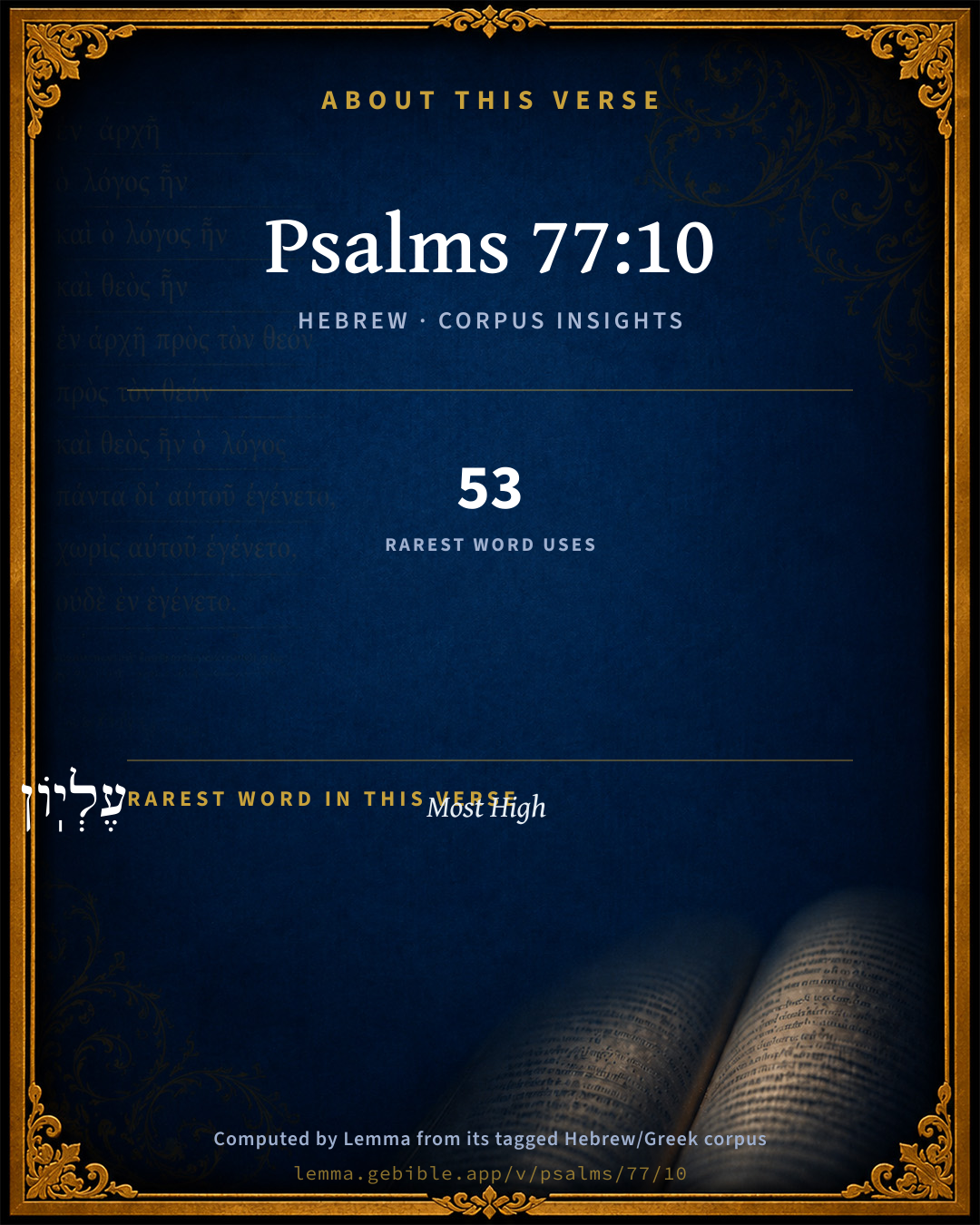
עֶלְיֽוֹן Most High H5945 occurs in 53 verses of the Hebrew Bible. Also found in:

Grammatical profile

  • 3 verbs
  • 1 noun
  • 1 adjective
  • 1 pronoun

Verb forms

  • וָ֭אֹמַר Qal · Sequential Imperfect
  • חַלּ֣וֹתִי Qal · Infinitive Construct
  • שְׁ֝נ֗וֹת Qal · Infinitive Construct

Hebrew & Septuagint length

In English translation the verse runs 18 words from the Hebrew and 19 from the Septuagint (LXX English) — closely comparable.

A rough comparison of the two English renderings, which tokenize alike — not a word-level alignment.

Word counts can differ between the Hebrew and the Greek without any difference in meaning — e.g. the Hebrew direct-object marker אֵת has no separate Greek word, and Greek often adds the article ὁ.

Cross-references

11

Topical passages linked to Psalms 77:10 in the Treasury of Scripture Knowledge — connected by theme and wording, ordered by reader-vote popularity; previews shown in the World English Bible.

  • Exodus 15:6 Your right hand, Yahweh, is glorious in power, Your right hand, Yahweh, dashes the enemy in pieces.
  • Job 42:3 You asked, 'Who is this who hides counsel without knowledge?' Therefore I have uttered that which I did not understand, Things too wonderful for me, which I didn't know.
  • Psalms 31:22 As for me, I said in my haste, "I am cut off from before your eyes." Nevertheless you heard the voice of my petitions when I cried to you.
  • Mark 9:24 Immediately the father of the child cried out with tears, "I believe. Help my unbelief!"
  • Psalms 77:5 I have considered the days of old, The years of ancient times.
  • Habakkuk 3:2–13 Yahweh, I have heard of your fame. I stand in awe of your deeds, Yahweh. Renew your work in the midst of the years. In the midst of the years make it known. In wrath, you remember mercy.
  • Numbers 23:21–22 He has not saw iniquity in Jacob; Neither has he seen perverseness in Israel: Yahweh his God is with him, The shout of a king is among them.
  • Deuteronomy 4:34 Or has God tried to go and take him a nation from the midst of [another] nation, by trials, by signs, and by wonders, and by war, and by a mighty hand, and by an outstretched arm, and by great terrors, according to all that Yahweh your God did for you in Egypt before your eyes?

Cross-references courtesy of OpenBible.info (CC BY 4.0).

Hebrew and Greek witnesses Masoretic Hebrew ↔ Greek Septuagint

The same verse in the two great witnesses to the Old Testament, shown verse-for-verse.

You’re reading Greek Psalm 76 (Hebrew Psalm 77). The Septuagint counts the superscription, so verse numbers can differ from the Hebrew — chapter-level alignment, not verse-by-verse. Numbering follows Rahlfs.

These are two independent witnesses, not word-aligned to each other, and the Septuagint is shown in lemma (dictionary) form.

Hebrew Psalms 77:10 Masoretic · Westminster Leningrad Codex

וָ֭אֹמַר חַלּ֣וֹתִי הִ֑יא שְׁ֝נ֗וֹת יְמִ֣ין עֶלְיֽוֹן

Then I thought, "I will appeal to this: The years of the right hand of the Most High."

World English Bible · Public Domain

Greek LXX Greek Psalm 76:10 Septuagint · lemma form

ἤ ἐπιλανθάνω ὁ οἰκτείρω ὁ θεός ἤ συνἔχω ἐν ὁ ὀργή αὐτός ὁ οἰκτιρμός αὐτός διάψαλμα

And I said, Now I have begun; this is the change of the right hand of the Most High.

LXX2012 (modern English Septuagint) · Public Domain

On this verse, Albert Barnes' Notes on the Bible discusses the Septuagint’s reading. Read the note in Commentary ↓

Hebrew: Westminster Leningrad Codex (CC BY 4.0). Greek: Septuagint (public domain); English from LXX2012 (modern English Septuagint) (Public Domain). How the Septuagint differs from the Hebrew →

Commentary

Notes on Psalms 77:10 from classic Christian and Jewish commentators (each source and its license shown beneath its notes). The classic Christian expositions comment on the surrounding passage and are grouped to its opening verse, so a note may address several verses; the Jewish commentaries on the Tanakh (Rashi and others) are per-verse, so they appear only where the commentator wrote on this verse.

Lemma curates 59 commentaries, every one of them public domain or Creative Commons licensed, each selected and text-cleaned for this edition rather than reprinted as found. About our sources →

The Cambridge Bible for Schools and Colleges

gen. ed. J. J. S. Perowne

10. And I said introduces the argument by which the Psalmist thrusts aside the possibility of an affirmative answer to his questionings. But the rest of the verse is obscure, and has been very variously explained. The precise sense of the word rendered my infirmity is doubtful; and in the second line the word sh’nôth may mean years, or, changing. If the rendering years is adopted, the verb I will remember must be supplied from Psa_77:11. Two explanations deserve consideration.

(i) This apparent desertion of Israel by God is my suffering, and I must bear it (cp. Jer_10:19); but for my consolation I will recall the years of the right hand of the Most High, “the years of ages past” (Psa_77:3), in which the sovereign power of the Ruler of the world was put forth on behalf of His people.

(ii) It is my weakness which prompts these questionings. To think that the right hand of the Most High doth change! that His power can ever grow feeble (Isa_50:2) or His will change (Mal_3:6)!

The explanation, ‘This is what grieveth me, that the right hand of the Most High doth change,’ is untenable, for Psa_77:10 clearly introduces the answer to his doubts.

The authority of the Ancient Versions is in favour of taking sh’nôth in the sense of change[42], but on the other hand the first explanation retains the sense in which the word has already occurred in Psa_77:5.

[42] The Targ. however gives alternative renderings.

10–15. The Psalmist resolves to recall the exhibition of God’s character in the deliverance of His people from Egypt.

10–20. The history of the past is the most convincing answer to these questions, the best cordial for his fainting spirits. Cp. Isa_63:7 ff.

The Cambridge Bible for Schools and Colleges (gen. ed. J. J. S. Perowne; Cambridge University Press, 1878–1918) — public domain. Text from a community e-Sword module.

Trapp's Complete Commentary

John Trapp

Psa 77:10 And I said, This [is] my infirmity: [but I will remember] the years of the right hand of the most High.

Ver. 10. And I said, This is my infirmity] My frailty and folly. Here he begins to recollect, and recall himself, as every good soul will, after its extravagancies and outbursts. Vatablus rendereth it, Mors mea est, This is my death; Beza, Caedes mea haec, This is my death wound, sc. whereof I should surely die, were it not for the change of God’s hand upon me.

But I will remember, &c.] This is supplied out of the following verse. Some make no such supply, but render the text thus, The right hand of the Most High can change these things. Others, This is the change of the right hand of the Most High, and is therefore to be taken patiently; shall we receive good at God’s hands, and not evil? Job 2:10. I am not utterly deserted, but only the case is a little altered, the right hand of the Most High alternated.

John Trapp, A Commentary or Exposition upon All the Books of the Old and New Testament (1647–1656) — public domain. Text from a community e-Sword module.

The Biblical Illustrator

Joseph S. Exell

Psa_77:10

I said, This is my infirmity.

Religious depression

I. The symptoms of religious depression. A settled depression of mind, in a perplexing debility and agitation of spirit, an apprehension of Gods indignation, a prevailing doubt of our pardon and acceptance before Him, a dark view of the events which occur in the course of Gods providential dealings with us, a succession of gloomy forebodings as to our future circumstances and destination, and a sinking of the heart, especially when we turn to subjects connected with our personal interest in the blessings of redemption.

II. The causes of it.

1. Bodily distemper.

2. An overscrupulous conscience.

3. A misapprehension of the doctrine of the remission of sins.

4. Some wilful sin, secretly cherished in the heart, or practised in the life.

5. Long-continued affliction.

6. The temptations of Satan.

7. Desertion, or the hiding of Gods countenance.

III. The cure. If the distressed Christian seems to labour under bodily maladies, or the effects of superstition, the minister will recommend in the first instance, A due attention to the health, and a more correct knowledge of the will of God. In cases of distress which seem to spring from a misapprehension of the plan of the Gospel, the minister will delight to expatiate on the love of God in Christ Jesus. This he will display to the fainting heart of the penitent. But, in the case of dejection of mind arising from some course of sin, which has been secretly or openly committed, the minister of Gods Word must adopt another method. Repent, and do your first works. Thus will the privileges and mercies of the Gospel be once more yours, and God will restore to you the joys of His salvation. Should, however, long-continued afflictions be the principal cause of depression of mind, the Christian minister will, with the psalmist, endeavour to take off the sufferers view from his own particular calamities, and direct it to Gods general dealings with His servants. Lastly, in the case of desertion, and, indeed, in all the preceding cases, the important suggestion is to be made that resignation to Gods holy will must be added to the humble use of all the means of grace. (Daniel Wilson.)

The best saints imperfect

I. The fact that the people of God, in the present world, are the subjects of manifold infirmities.

II. The reasons for which these infirmities are permitted.

1. To promote a spirit of humility and self-abasement.

2. To excite in us a spirit of watchfulness.

3. To increase our sympathy and compassion for others.

4. To induce us to make frequent application to the Great Physician.

5. To render heaven more attractive and endearing. (Expository Outlines.)

Spiritual infirmities

I. The nature of the psalmists infirmity.

1. A proneness to live too much on frames and feelings.

2. Forgetfulness of past mercies.

3. Distrust with respect to future appearances.

4. Refusing to be comforted in times of distress is another of the infirmities of good people.

5. Giving vent to distrustful thought in unbecoming language too frequently accompanies despondency.

II. The reasons why God suffers such infirmities to attend His people in this life. Iii. Conclusion.

1. We see that the best of saints have their infirmities. The most fragrant rose has its thorns, and the most shining Christian his shades.

2. There is some particular infirmity which every good man may call his own.

3. It becomes us well to know our particular infirmity, that we may guard against it; for to be without defence is the way to be overcome without resistance.

4. Having discovered what is our easily-besetting sin, let us bewail it before God, and seek for help against it. (B. Beddome, M. A.)

Technical training in the spiritual life

Whilst through the changing years we discover in ourselves many failings, most of us are humbled and distressed by special faults which tenaciously cling to us. These characteristic defects arise from personal temperament, or they are occasioned by circumstances, or perhaps they are the consequences of both.

1. We can sometimes effectually restrain personal faults by wisely determining our circumstances. Sick people are careful to choose for themselves a special climate when they are at liberty to do so. Ought not spiritual men to study climatology, escaping as far as possible the circumstances that would naturally develop their constitutional failing, surrounding themselves with the influences which heal and help? It is something more than folly, for the sake of taste, pride, or gain, to remain voluntarily in positions which are spiritually unfavourable.

2. We may observe this technical culture by abstaining from certain courses, legitimate in themselves, but which are dangerous to us. John Wesley relinquished the study of mathematics on this ground. Angelico would not paint a secular subject. Miss Havergal would not sing a secular song. Many Christians deny themselves in matters of appetite, being conscious that the indulgences which prove perfectly harmless to many are inexpedient to them.

3. We may discipline ourselves by persisting to do right things which are difficult and uncongenial to us, even when we do them with the least willingness and freedom. A German physician says: Precipitate men should accustom themselves to write and walk slowly. The irresolute should endeavour to perform their acts with rapidity. The gloomy, romantic dreamer should be trained to walk with head erect, to look others straight in the face, to speak in a loud, distinct tone of voice. Such habits exercise a great influence on both mind and body. The reasoning of this physician is, that right action has a tendency to induce right feeling. And there is a real place for such training in the spiritual life. Do good, even when your heart is not free to it. With a painful lack of sympathy, still do the right act, speak the proper thing, form the correct habit, follow the true course; and this method will exercise a most salutary influence, awakening and strengthening the soul, and at last filling the just form and action with the reality and force of life.

4. We ought to take special precautions against our characteristic failing. The man who sins with the tongue ought to set an express watch over the door of his lips. He whose peril is temper must keep his mouth as with a bridle. The man given to appetite must put a knife to his throat. He who suspects a snare in the cup is bound to fortify himself with vows and pledges. The slothful must set themselves large tasks, and rest not until they are discharged. (W. L. Watkinson.)

Temperamental limitations

We usually think of the world about us as being the chief arena in which we fight the battle of life, but really our greatest difficulty is with ourselves. Our constitutional temper and bias are the chief matters, and they very largely determine what our trouble shall be both as to its nature and degree.

1. Feebleness of constitution is a limitation of which many are painfully conscious: a frailty of physique which prevents them doing much that they would desire to do, and which betrays itself in nearly all that they manage to do. When Henry Ward Beecher was exhorted to take care of his health and strength, he replied, I have already more than I know what to do with. Many noble people are far from this enviable state. They take their place in the ranks and attempt their daily work, but with a lack of force that makes life much of a burden, and duty rarely a delight. They do not fulfil their promise, they start well and finish poorly, the outline they strike is beyond the picture, they are spasmodic, uncertain, ineffective. This is not exactly an intellectual defect. And it is just as little to the point to say that these people lack conscience or will; they want neither conscience nor will, they are simply destitute of that constitutional robustness and force of which Beecher had more than he knew what to do with. It is not a mental or moral defect, but purely a bodily infirmity which mars life and work that otherwise would give entire satisfaction. Resolute spirits surprise us with the wonders that can be wrought by frail mechanism, but many know by painful experience that a deficiency of native force has marred their whole life, spoiling thoughts, faculties, opportunities, and purposes which a flush of animal spirits would have converted into splendid achievement.

2. An intensity of constitution is the real infirmity of others. They are alarmingly vehement in speech and action. They flash in ordinary talk, and discharge the common business of life with explosive energy. Science has recently discovered that our hive-bees exhaust themselves prematurely by abnormal industry; they are not native to this country, and not having yet adapted themselves completely to a new environment, expend an excessive amount of force which involves their destruction. It is much the same with human beings of impassioned temperament. They do not so much burn out, as blaze out. No doubt they ought to restrain themselves, to check their rage, and act with becoming moderation; but of what use is advice of this sort? The Pacific Ocean may counsel the tempestuous Atlantic to cultivate stillness, and the Atlantic retort on the stagnation of the Pacific; but each remains true to its character. We can no more change our special constitutional qualities than we can change the colour of our eyes. The ardent temper, of which we are speaking, is attended by sorrows of its own. It is impossible to live an impulsive life without serious mistakes and bitter regrets. That temper also involves painful reactions and dejections. And it has its own subtle temptations and perils.

3. The hyper-sensitive constitution is another organ of martyrdom. Like Cowper, many noble souls are morbidly sensitive and shy. They seem born with a skin short, and feel with grievous acuteness a thousand things of which the ordinary man is positively unconscious, or to which he is practically indifferent. God alone understands what these neurotic, nervous, shrinking souls suffer in a rude world like this.

4. Only One knows all the mysteries of our personality, and we cannot live with Him too much. Let us go to Him for sympathy. Let us seek in His grace the strength to deal with the special need and peril of our nature. He can impart to the will of the delicate a force independent of bodily conditions; He can chasten the self-confident; endow with a saving instinct the impulsive; and the easily-wounded, weeping in secret places, He can sweetly soothe. He can so discipline us that our very defects and excesses may be made to yield the riches and beauty of moral and immortal perfection. (W. L. Watkinson.)

I will remember the years of the right hand of the Most High.

The years of the right hand of God

Here the eternity of God is contrasted with the hand-breadth measure of man. The Right Hand of the Most High; its work through the years that are past; what suggestions are here, to silence weak complaint, to lift the soul far up above the trouble of this world! Think of the right hand, and of what it can do; that most wonderful member of this body. Its offices are numberless; it is like the executive function in the political system. Whatever the mind think, whatever the will decree, whatever the heart desire: heart, will, mind, must wait till the hand can act. To tell the uses of the hand, and the purposes it serves, would be to give a catalogue of great part of the intelligent and conscious actions of men, wherein, to some extent or other, that member is employed. Even so wide is the scope of those acts of the Almighty, which are included in the symbolic speech about His Right Hand. It is, indeed, a glorious study, that of the years of the Right Hand of the Most High. They are long, very long; from them unroll, panorama-like, the events which make history; stamped on them everywhere is the impress of mind, design, force; knowing what may be, ordering what shall be, compelling every other power to yield at last, vanquished in its death. And against them appears what? The bubbles which men blow of the froth of their conceits; the vapour which our life is; the rise and fall of upstart opposers of God; the wiping out of kingdoms, philosophies, systems, as a man turneth a dish upside down. Fast do the adversaries fade away; they do but little harm; the cord is broken, the thread soon cut; the world forgets them, or remembers but to chide their folly. The eternal years of God drink up these little lives of ours, and all in them that is not made secure by faith and religion, even as the sun drinks up the mist, or the ocean takes in the drops from the passing clouds which break above it and vanish for ever. This is the way to confidence and rest. Retire within yourself, and meditate of the infinite power, the sure providence, the unchangeableness of the Most High. Consider the days of old, the years of His Right Hand. (Morgan Dix, D. D.)

The true focus

The psalmist really said, This is my infirmity--the years of the right hand of the Most High! He does not announce his intention to dwell upon them, but he announces the character of the years themselves. It is the suddenness of a quick appreciation of the true view of things. Do you not know what it is to suddenly adjust a picture, by the slightest touch of the hand, so that the whole thing is seen in its true focus? Yes, you have gained the real point of view. So it is here. From the midst of a God-questioning disposition, in which hope is lost, he suddenly says, This is my infirmity--the years of the right hand of the Most High! Now, what do you find? The second half of the psalm is the same picture in focus. The right hand is a symbol peculiar to Hebrew thought and literature, and is used perpetually to mark some great fact in the character and person of God. Law and righteousness, salvation and strength, action and love, and the deep, full satisfaction of every necessity of human life, in pleasures for evermore,--all these things, to the mind of the Hebrew, were wrapped up in that magnificent figure of the right hand of the Most High. The years of my life, now says the psalmist, are years conditioned in law and righteousness--years in which there is the perpetual outworking of salvation and the unceasing manifestation of strength; they are years in which God is active for me, years in which I am perpetually caressed by the love and tenderness of the Divine heart, years which, because they come from the hand of God, are years of the making of eternal and undying pleasure. It was a new light upon his own life, a new point of vision, a new outlook. The things which had issued in his dirge of wailing and sorrow were suddenly seen, from this new point of vision, to be working together for his good, thus giving a forecast of the New Testament statement. The years of the right hand of the Most High. There is a point of vision from which we may look upon the selfsame things, and may catch on them already the light and gleam of morning; a point from which, even to-day, I can look upon great grief and overwhelming sorrow, saying, Yes, that happened, not upon such a day of such a month, in such a year, but in one of the years of the right hand of the Most High. It was a part of the fiery law, a method of the Divine righteousness, a ministry of salvation, a manifestation of strength, a Divine action, a touch of the Divine love, it had within it the creation of joy for evermore. We can only say those things by faith to-day; not yet by sight, not yet by personal realization, but by faith. There is no agony of heart that we endure, if we know how to false it, that has not in it the element that shall make heaven. The years of the right hand of the Most High. I do not see the hand, I have only the years; but I know the hand is there. I know that somewhere beyond this, when the mists have rolled aside, and the life I am conscious of to-day shall have passed into fuller realization, then out of the darkness will the light come, and out of the agony of the moment will heavens pleasure have been evolved. (G. Campbell Morgan, M. A.)

Holy remembrance a means to recover out of distrust

I. The simple proposition. This is mine infirmity.

1. The saints and servants of God themselves have their infirmities.

(1) The reliques and remainders of the old man still abiding in them.

(2) Grace is wrought imperfectly in them.

2. Commonly they have some one more especially which they are addicted and inclined unto.

3. From the context we see what to judge of staggering at Gods promises and providences. It is a very great weakness and infirmity.

(1) There is ignorance and want of understanding.

(2) Infidelity.

(3) Impatience.

II. The personal reflection. I said.

1. The quickness of his apprehension, in that he spies and discerns this weakness and infirmity in himself, while he says it, it is evident he spies it and finds it out.

2. The tenderness of his conscience, not only in that he discerned this distemper and infirmity in himself, but likewise that he checked himself for it, for so we must here take it.

3. The ingenuity of his spirit. I said it not only to myself, and in mine own heart, but as there was occasion for it, I said it to others also, and acknowledged it likewise to them.

4. The ground hereof in the servants of God is--

(1) That wonderful exactness and curiousness and sincerity which is remarkable in them. Tender consciences lament even infirmities, whilst hardened hearts go away with greater sins.

(2) It proceeds from that love and entireness of affection, which a good Christian bears to God. Love is shy of anything which may be offensive to the party beloved, not only of greater injuries, but of smaller unkindnesses. It is troubled when it is anything defective in the expressions of love, where it is due, and it concerns it to be so, and so it is also here. A godly man has his heart and his soul full of the love of Christ, and therefore is troubled for anything which is displeasing to Christ; not only for unsavoury speeches, but for unruly affections, not only for ungodly deeds, but for ungodly thoughts, which have a mark also of sinfulness upon them.

(3) It arises also from Christian prudence, as considering whither infirmities tend, and what they will come to if they be not better prevented.

III. The pitching or fastening upon the remedy. I will remember, etc.

1. Take it according to the former translation, as it does exhibit to us the power of God. The right hand of the Lord can change all this. This was that whereby David did support himself in his present affliction, that the Lord was able to change and alter this his condition to him, and that for the better. Though God Himself be unchangeable considered in His own essence, yet His works and providences and dispensations have a variety in them, and all such as do perfect and accomplish His most unchangeable purpose and decree which He has set down with Himself. God does never less change His mind than when He does most change His carriage and practice and outward administrations, as being able from contrary means to bring about the same gracious ends and effects which He hath appointed to accomplish, so that this expression hath no repugnancy or inconsistency with it at all, but is freely admitted by us, and to be improved as it is here by the psalmist.

2. For this last here before us, that is this, I will remember the years of the right hand of the Most High, where the word remember is borrowed from the next-following verse to supply the sense of this, as otherwise being not in the text. Now, here David fetches a ground of comfort from Gods practice, as before he did from His power; there, from what God could do; here, from what He had done already in former times, and ages, and generations; he was resolved to reflect upon this, as a relief to him in his present infirmity. Now, there were two things especially which David here did reflect upon to this purpose, for the quieting of his spirit. The one was Gods dealings with His people formerly, as to point of seeming desertion and outward discouragement; and the other was Gods dealings with His people formerly, as to seasonable recovery and final acknowledgment. To each of these purposes would he remember the years of the right hand of the Most High, and each of them were a relief unto them. And there is very good ground to do so, because God is still the same; yesterday, and to-day, and for ever. He has the same love to His people still as ever, the same wisdom to advise them, and the same power to be active for them, and He will, therefore, change their conditions, because He does not change Himself. (T. Horton, D. D.)

The Biblical Illustrator, edited by Joseph S. Exell (c. 1880s–1900s) — public domain. Text from a community e-Sword module.

Joseph Benson's Commentary

Psa 77:10. And I said — I thus answered these objections; This is my infirmity — These suspicions of God’s faithfulness and goodness proceed from the weakness of my faith, and from the mistake of a diseased mind. But I will remember the years, &c. — That is, the years in which God hath done great and glorious works, which are often ascribed to God’s right hand in the Scriptures. It may be proper to observe here, that as the word שׁנות, shenoth, here rendered years, also signifies changes, the verse is rendered otherwise by some learned interpreters, without any such supplement as is in our translation, thus; This is my affliction, or grievance, the change of the right hand of the Most High — Namely, that that right hand of God, which formerly hath done such great and wonderful things for his people, is, at this time, not only not drawn forth for their defence, but is also stretched out against them. So Bishop Patrick. “This is the thing which sorely afflicts me, to see such alterations in the proceedings of the Most High, that the same hand which formerly protected us, now severely scourges us.” As if he had said, I could bear the malice and rage of our enemies, from whom we could not expect better things, but that our gracious and covenanted God should forsake and afflict his own people, is to me intolerable. The reader will observe that this interpretation proceeds on the supposition that the psalmist’s distress was occasioned by public, and not by private calamities, which supposition, however, does not seem to be sufficiently supported by the general tenor of the Psalm.

Joseph Benson's Commentary on the Old and New Testaments (1811–1818) — public domain. Text from a community e-Sword module.

J. A. Alexander on Psalms

Joseph Addison Alexander

11. (Psa 77:10). And I said, This is my affliction, the years of the right hand of the Highest. This may be regarded as the turning point of the entire composition. After all the repinings and misgivings just described, I said, at length, what I might and should have said before. My affliction, literally my sickness, that specific form of suffering beina put for suffering in general, as inflicted by the hand of God. The use of the word years seems to imply that the trial was one of long continuance. The divine name or description (Most High) suggests the duty and necessity of yielding to his sovereign pleasure.

Joseph Addison Alexander, The Psalms Translated and Explained (1850) — public domain. Text from a community e-Sword module.

Tyndale Open Study Notes

Tyndale Open Resources

77:10-12 The memories of God’s mighty works in the past fill the psalmist’s mind.

77:10 The psalmist fears that God’s hand of protection (44:3; 77:15; Exod 6:6) and favor (Pss 16:7-8; 110:1) is now against him for no apparent reason.

Tyndale Open Study Notes — © Tyndale Open Resources, licensed CC BY-SA 4.0. Text via the HelloAO Bible API.

Geneva Bible (1599)

Geneva Bible translators

Though I first doubted of my life, yet considering that God had his years, that is, change of times, and was accustomed also to lift up them, whom he hath beaten, I took heart again.

Geneva Bible (1599) marginal notes — public domain. Text via Bolls.life.

Adam Clarke's Commentary

Verse 10. And I said, This is my infirmity] The Hebrew is very obscure, and has been differently translated: ואמר חלותי היא שנות ימימן עליון vaomar challothi hi shenoth yemin elyon; "And I said, Is this my weakness? Years the right hand of the Most High." If חלותי challothi comes from חלה chalah, and signifies to pray, as De Dieu has thought, then his translation may be proper: Precari hoc meum est; mutare dextram Altissimi. "To pray, this my business; to change the right hand of the Most High." I can do nothing else than pray; God is the Ruler of events. Mr. N. M. Berlin translates, "Dolere meum hoc est; mutare est dextra Altissimi." To grieve is my portion; to change (my condition) belongs to the right hand of the Most High. Here שנות shenoth, which we translate years, is derived from שנה shanah, to change. This latter appears to me the better translation; the sum of the meaning is, "I am in deep distress; the Most High alone can change my condition." The old Psalter, following the Vulgate,-Et dixi, Nunc coepi: haec mutatio dexterae Excelsi,-translates: And I said, Now I began this chaunchyng of ryght hand of hihegh (highest) Alswa say, God sal noght kast al man kynde fra his sigt with outen ende: for nowe I began to understand the syker; (the truth;) that man sal be brogt to endles; and thar fore, now I said, that this chaunchyng fra wreth to mercy, is thrugh Ihu Criste that chaunges me fra ill to gude, fra noy to gladnes.

Once more, Coverdale, who is followed by Matthews and Becke, takes the passage by storm: "At last I came to this poynte, that I thought; O why art thou so foolish? The right hande of the Most Hyest can chaunge all."

Adam Clarke's Commentary on the Bible (1810–1826) — public domain. Text from a community e-Sword/MySword module.

John Calvin's Commentaries

10. And I said, My death, the years of the right hand, etc. This passage has been explained in various ways. Some deriving the word חלותי, challothi, from חלה, chalah, which signifies to kill, consider the prophet as meaning, that being overwhelmed with an accumulation of calamities, the only conclusion to which he could come was, that God had appointed him to utter destruction; and that his language is a confession of his having fallen into despair. Others translate it to be sick, to be infirm or enfeebled, which is much more agreeable to the scope of the passage. But they differ with respect to the meaning. According to some interpreters, the prophet accuses and reproves himself for his effeminacy of mind, and for not setting himself more manfully to resist temptation. This exposition may be admitted; for the people of God ordinarily gather courage after having for a time wavered under the shock of temptation. I, however, prefer a different interpretation, namely, that this was a disease merely temporary, and on this account, he compares it indirectly to death; even as it is said in Psalm 118:18,

“The Lord hath chastised me sore: but he hath not given me over unto death.” Also, “I shall not die, but live.” (Psalm 118:18)

He, therefore, I have no doubt, unburdens himself by cherishing the confident persuasion, that although he was at present cast down, it was only for a season, and that therefore it behoved him patiently to endure this sickness or disease, since it was not mortal. Nor are commentators agreed in the explanation of the second clause. Those who connect this verse with the preceding verses, think that the prophet was reduced to such a state of despondency at first, that he looked upon himself as utterly undone; and that afterwards he lifted up his head at times, even as those who are thrown into the deep in a shipwreck repeatedly rise above the water. Besides, they would have this to be understood as a word of encouragement addressed by some one to the prophet, desiring him to call to remembrance the years in which he had experienced that God was merciful to him. But it will be more appropriate to understand it thus:, Thou hast no reason to think that thou art now doomed to death, since thou art not laboring under an incurable disease, and the hand of God is wont to make whole those whom it has stricken. I do not reject the opinion of those who translate שנות, shenoth, by changes; for as the Hebrew verb שנה, shanah, signifies to change, or to do a thing again and again, the Hebrews have taken from it the word שנות, shenoth, which they employ to denote years, from their revolving character, from their turning round, as it were, in the same orbit. But in whatever way we may understand it, the comfort of which I have spoken will remain firm, which is, that the prophet, assuring himself of a favorable change in his condition, does not look upon himself as doomed to death. Others give a somewhat different interpretation, arriving at it in another way: as if the prophet had said, Why shouldst thou not patiently endure the severity of God at this time, when hitherto he has cherished thee by his beneficence? even as Job said,

“Shall we receive good at the hand of God, and shall we not also receive evil?” (Job 2:10)

But it is more probable that the prophet directs his view to the future, and means that it became him to await the years or revolutions of the right hand of the Most High, until lie should afford clear and undisputed evidence of the return of his favor towards him.

John Calvin's Commentaries (1540-1563) — public domain. Text from the Calvin Translation Society English edition (1840s-50s) via the Christian Classics Ethereal Library (ccel.org). Calvin's coverage is partial (roughly two-thirds of the Bible); uncommented books and verses are honest gaps, never fabricated. The 19th-century editor's footnotes and remarks are omitted so the notes are faithfully Calvin's own voice.

Ellicott's Commentary for English Readers

(10) And I said . . .—The word rendered “infirmity” may, by derivation, mean “wounding” or “piercing.” So Symmachus, “my wound;” Aquila, “my sickness.” Gesenius says, “that which makes my sickness.” If we keep this meaning we must understand mental sickness or “madness,” and understand the poet to say that to indulge in despairing cries is mere madness (comp. King Lear’s, “Oh! that way madness lies”), he will recall God’s ancient deliverances, and so re-establish his faith. But it seems more natural to take a sense which the cognate verb very commonly bears (Lev_19:8; Eze_36:22; Psa_74:7; Psa_89:39), and render, “I said this (such despair) is on my part profanation, profanation of the years of the right hand of the Most High.” To despair of continued help from One who had been so gracious in the past is a kind of blasphemy. The word “profanation” must be understood as repeated for the sake of the grammar.

A Bible Commentary for English Readers, edited by Charles John Ellicott (1878–1897) — public domain. Text from a community e-Sword module.

John Gill's Exposition

And I said, this is my infirmity,.... Referring either to what he had said in the preceding verses; and which is to be considered either as checking and correcting himself for what he had said, and acknowledging his evil in it; and it is as if he had said, this is a sin against God, that I am guilty of in questioning his love, and disbelieving his promises; it is an iniquity I am prone unto, a sin that easily besets me; it flows from the corruption of my nature, and the plague of my heart, and shows a distempered mind; it is owing to the weakness of my faith and judgment; I have said this rashly, and in haste, without well weighing and considering things, and I am sorry for it, I will stop and proceed no further: or else as comforting and encouraging himself in his melancholy circumstances; and the sense is, this is an "infirmity", an affliction and trouble that I am at present exercised with; but it is but a temporal one, it will not always last; I shall get over it, and out of it; it is a sickness, but not to death; and it is "mine", what is allotted to me; every man has his affliction and cross, and this is mine, and I must bear it patiently; see Jer 10:19, or else this refers to what follows, which some render, "the changes of the right hand of the most High" (s); and the meaning may be, this is my affliction and trouble, that there are changes in the right hand of the most High; that is, that that hand which used to be exerted in his favour, and against his enemies, was now withdrawn, and hid in his bosom; see Psa 74:11, and that which liberally distributed favours to him was now laid upon him in an afflictive way; and to this sense is the Targum,

"this is my infirmity, the change of the power of the right hand (or the powerful right hand) of the most High;''

though another Targum is,

"this is my prayer, &c. the years of the end from the right hand;''

and Aben Ezra makes mention of some as so interpreting the first clause, to which De Dieu agrees, who renders the whole, "and I said, this is my prayer, that the right hand of the most High might be changed"; that is, that his dispensations of providence might be changed; that he would bring him out of these afflicted, sorrowful, and melancholy circumstances, into a more comfortable one: as these words may be understood as what the psalmist comforted himself with, that there are "changes of the right hand of the most High"; I have been greatly troubled and distressed, and I have been so weak as to call in question the mercy and favour of God, and his promises to me, which I own is my sin; but I have reason to believe it will not be always thus with me, God will take off his hand, it shall not always lie thus heavy upon me; though he cause grief, he will have compassion, and turn again to me; there will be a change, and I will wait till that comes: but Kimchi thinks the word "I will remember", which stands at the beginning of the next verse, belongs to that and this; and is to be supplied here, as it is in our translation, and interprets the whole to the like sense;

but I will remember the years of the right hand of the most High; which the psalmist proposed to do as a means to remove his doubts, despondency, and unbelief, and to relieve and strengthen his faith; as that God was the most High in all the earth, and above his enemies; that he had a right hand of power, which in years past had been exerted on the behalf of his people, and on his behalf; which was not impaired and shortened, but the same as ever, and sooner or later would be again used in his favour.

(s) "mutationes sunt dexterae excelsi", Musculus, Muis; so Ainsworth.

John Gill's Exposition of the Whole Bible (1746–1763) — public domain (CC PDM 1.0). Text via the HelloAO Bible API.

Albert Barnes' Notes on the Bible

And I said, This is my infirmity - The meaning of this phrase is not, as would appear from our translation, that his reflections on the subject were to be traced to his weakness, or were a proof of weakness of mind, but that the subject overpowered him. This verse has been very variously rendered. The Septuagint and the Vulgate translate it, “And I said, now I begin; this is a change of the right hand of the Most High,” with what meaning it is difficult to see. Luther renders it, “But yet I said, I must suffer this; the right hand of the Most High can change all;” a beautiful sentiment, but probably not the idea in the original. The Hebrew means, “This makes me sick;” that is, “This distresses me; it afflicts me; it overwhelms me. Such reflections prostrate me, and I cannot bear up under them. I “must” seek relief. I “must” find it somewhere. I “must” take some view of this matter which will save me from these dreadful thoughts that overpower and crush the soul.” Any deep mental emotion may have this effect, and it is not strange that such a result should be produced by the momentous thoughts suggested by religion, as it sometimes attends even the manifestation of the divine mercy to the soul. Compare the notes at Dan 10:8-9. The course of thought which the psalmist pursued, and in which he found relief, is stated in the following verses. It consisted of an attempt to obtain, from the remembrance of the divine administration in past times, views of God which would lead to confidence in him. The views thus obtained, as will be seen, were two-fold:

(a) That, as far as his dealings could be understood, God was worthy of confidence; and

(b) That in the ways of God there are, and must be, many things which man cannot comprehend.

But I will remember the years of the right hand of the Most High - That is, the years when God displayed his power; when he reached out his right hand; when he manifested his true character; when there was a proper exhibition to the world of what he is, and of the true principles of his administration. The words “But I will remember” are not in the original, though, as they occur in the following verse, they are not improperly supplied by the translators. The original, however, is more striking and emphatic: “This makes me sick! The years of the right hand of the Most High!” The history of those years occurred to his mind. They rose to his view suddenly in his sorrow. They came before him in such a form and manner that he felt they should be inquired into. Their history should be examined. In that history - in those remembered years - “relief” might be found. It was natural to look there for relief. He instinctively turned, therefore, to examine the records of those years, and to inquire what testimony they bore in regard to God; what there might be in them that would give relief to a troubled heart.

Albert Barnes' Notes on the Bible (1834–1885) — public domain. Text from a community e-Sword/MySword module.

Matthew Poole's English Annotations

I said; I thus answered these objections.

This is my infirmity; these suspicions of God’s faithfulness and goodness proceed from the weakness of my faith, and from the mistake of a diseased mind.

But I will remember; which words may be understood out of the following verse, as other words frequently are in like cases.

The years of the right hand of the Most High; the years wherein God hath done great and glorious works, which are oft ascribed to God’s right hand, as Psa 17:7; 20:6; 45:4; 118:15. But the word rendered years doth also signify changing, and accordingly this verse is by other learned interpreters, and may well be, rendered otherwise, without any such supplement as is in our translation, thus, And I said,

This is my affliction or grievance, ( the sum of all, and the chief cause of my trouble and anxiety, is this,)

the change of the right hand of the Most High; that right hand which formerly hath done such great and wonderful things for his people, is at this time not only hid in God’s bosom, and not drawn forth for their defence, but is also stretched forth against them, and is the principal cause of all our present miseries. I could bear the malice and rage of our enemies, from whom we could not expect better things, but that our gracious and covenanted God should forsake and persecute his own people, this is that which makes it intolerable.

Matthew Poole's English Annotations on the Holy Bible (1683–1685) — public domain. Text from a community e-Sword/MySword module.

The Treasury of David

Charles H. Spurgeon

Ver. 10. And I said, This is my infirmity. He has won the day, he talks reasonably now, and surveys the field with a cooler mind. He confesses that unbelief is an infirmity, a weakness, a folly, a sin. He may also be understood to mean, "this is my appointed sorrow, "I will bear it without complaint. When we perceive that our affliction is meted out by the Lord, and is the ordained portion of our cup, we become reconciled to it, and no longer rebel against the inevitable. Why should we not be content if it be the Lord's will? What he arranges it is not for us to cavil at.

But I will remember the years of the right hand of the most High. Here a good deal is supplied by our translators, and they make the sense to be that the psalmist would console himself by remembering the goodness of God to himself and others of his people in times gone by: but the original seems to consist only of the words, "the years of the right hand of the most High, "and to express the idea that his long continued affliction, reaching through several years, was allotted to him by the Sovereign Lord of all. It is well when a consideration of the divine goodness and greatness silences all complaining, and creates a childlike acquiescence.

Whole Psalm. See Psalms on "Ps 77:1" for further information.

Ver. 10. This is my infirmity. Literally, this is my disease, --which appears to mean, This is my lot and I must bear it; lo! it is a partial evil, for which the equity of God's government should not be questioned. The authorised version, This is my infirmity, suggests, perhaps advisedly, another signification, viz., These thoughts are but hallucinations of my agony, --but to this gloss I should scruple to commit myself. C. B. Cayley.

Ver. 10. It is the infirmity of a believer to be thinking of himself, and drawing false inferences (for all such inferences are necessarily erroneous), from what he sees or feels, as to the light in which he is beheld and estimated on the part of God. It is his strength, on the other hand, to remember the right hand of the Most High--to meditate upon the changeless truth and mercy of that God who has committed himself in holiness to the believing sinner's sure salvation, by causing the Son of his love to suffer in our stead the dread reality of penal death. Arthur Pridham.

Ver. 10. Infirmity. An infirmity is this, --some sickness or indisposition of the soul, that arises from the weakness of grace. Or an infirmity is this, --when the purpose and inclination of the heart is upright, but a man wants strength to perform that purpose; when "the spirit is willing, but the flesh is weak" (Mt 26:41); when a man can say with the apostle, "To will is present with me; but how to perform that which is good I find not, "Ro 7:18. When the bent and inclination of the soul is right, but either through some violence of corruption or strength of temptation, a man is diverted and turned out of the way. As the needle in the seaman's compass, you know if it be right it will stand always northwards, the bent of it will be toward the North Pole, but being jogged and troubled, it may sometimes be put out of frame and order, yet the bent and inclination of it is still northward; this is an infirmity. James Nalton. 1664.

Ver. 10. It is unnecessary to state all the renderings which the learned have given of this verse. It is unquestionably ambiguous, as the word ytwlh may be derived from different roots, which have different significations. I derive it from lwx or llx which signifies to be in pain as a woman in labour, and as it is in the infinitive, I render it, "the time of my sorrow or pain." The next term, twgv, I derive from hgv to change, as the Chaldee does, Ainsworth, Hammond, and others; and I render it potentially. I consider the whole as a beautiful metaphor. The author considers himself as in distress, like a woman in travail; and like her, hopes soon to have his sorrow turned to joy. He confides in God's power to effect such a change; and hence naturally recollects the past instances of God's favour to his people. Benjamin Boothroyd.

Ver. 10. I will remember the years of the right hand of the Most High. Not the moments, nor the hours, nor days of a few short afflictions, that his left hand hath dealt to me: but the years of his right hand; those long, large, and boundless mercies wherewith he hath comforted me. Thomas Adams.

Ver. 10. I will remember the years, etc. The words in the Hebrew text are shenoth jemin gneljon, which I find to be variously rendered and translated by interpreters. I shall not trouble you with them all at this present time, but only take notice of two of them, which I conceive are the principal and most comprehensive; the one is our oldest English translation, and the other of our last and newest; the former reads the words thus: The right hand of the Most High can change all this. The latter reads the words thus, as we have it now before us, I will remember the years, etc. The main ground of this variation is the different exposition of the Hebrew word shenoth, which may be translated either to change, from the verb in the infinitive mood, or else may be translated years, from the noun in the plural number. This hath given the occasion to this difference and variety of translation, but the sense is very good and agreeable which way soever we take it-- First, take it according to the former translation, as it does exhibit to us the power of God. The right hand of the Lord can change all this. This was that whereby David did support himself in his present affliction; that the Lord was able to change and alter this his condition to him, and that for the better... For the second sense here before us, that's this: I will remember the years of the right hand of the Most High; where the word remember is borrowed from the next following verse, to supply the sense of this, as otherwise being not in the text. Now here the prophet David fetches a ground of comfort from God's practice, as before he did from his power; there, from what God could do; here, from what he has done already in former time, and ages, and generations. Thomas Horton.

Ver. 10. A confession applicable to many other matters. Such as, fear of death, fear of desertion, dread of public service, sensitiveness of neglect, etc.

Ver. 10. My infirmity. Different meanings of this word. These would furnish a good subject. Some infirmities are to be patiently endured, others gloried in, others taken in prayer to God for his Spirit's help, and others lamented and repented of.

Ver. 10-12. Remember, meditate, talk.

Psalms 77:11*

Ver. 10-12. Remember, meditate, talk.

Charles H. Spurgeon's The Treasury of David (1869–1885) — public domain. Psalms only. Text from a community e-Sword/MySword module.

Whedon's Commentary on the Bible

Daniel D. Whedon

10. The tone of the psalm abruptly changes. The remaining portion describes the grounds of his faith and hope.

This is my infirmity— Literally, This is my disease; that is, my complaint and despondency are the natural outworkings of my excessive sufferings.

Years of the right hand of the Most High—The transition is abrupt, like Habakkuk 3. The ellipsis is supplied, in our English version, by the words, “But I will remember,” which is in analogy with Psa_77:11. The idea is, that he would rally and sustain his faith and hope by recalling the great works of God toward his people of old, and his original purpose concerning them. This was a common antidote to unbelief and despair during the captivity, as the psalms of that period show. הלותי, (hallothee,) translated infirmity, in Piel takes the sense of entreaty, supplication, and many read it, “This is my entreaty—the years of the right hand,” etc. But the sense already given seems most natural and most in accordance with the connexion. By changing the Hebrew accents Dr. Conant reads the verse:—

“And I said, This is my infirmity!

Years of the right hand of the Most High Will I commemorate—the deeds of Jah,

For I will remember thy wonders of old.”

Daniel D. Whedon (gen. ed.), Commentary on the Old and New Testaments (1874–1909) — public domain. Text from a community e-Sword module.

The Pulpit Commentary

And I said, This is my infirmity; i.e. "the fault is not in God, but in myself in my own weakness and want of faith. But I will remember the years of the right hand of the Most High. There is no "I will remember" in the original, which expresses the thought of the writer imperfectly; but some such phrase must of necessity be supplied. The words are retained in the Revised Version and by Professor Cheyne. The remembrance of God"s mercies during the many years that are past is that which best sustains us in a time of severe trouble.

A supreme mental distress.

"That the right hand of the Highest hath changed." It is as if the psalmist were saying, "All this that I have been asking myself, and saddening myself with asking, seems impossible, and yet it is this very possibility of change in God toward me which so sorely perplexes and distresses me." "This is my sorrow, the changing of the right hand of the Most High." Do we not all feel that, if God be changed, then indeed the "whole foundation rocks"? We build our hopes on this abideth the same, and his years are throughout all generations." As the psalmist gradually comes to a better mind, he feels that his sorrow was really his infirmity, and in some sense his shame. No man can expect to be free from experience of mental distress; the question is Shall we give way to it, or shall we resist it? Here, in this psalm, we may find two things.

I A MAN A GOOD MAN DISPOSED TO TAKE DESPONDENT VIEWS. And there is always a self-strand in the spirit of the despondent. They keep too much in the self-sphere, looking within rather than "off unto Jesus." This man took despondent views:

1. Of life generally. We call those who put this tone on their reading of life pessimists men who can always see the "dark sides," and make "dark sides" when there are none to see. It is partly a nervous, anxious disposition, and may often be wisely dealt with as disease, whose cure may be found in abundance of God"s sweet sunshine, and the good cheer of pleasant human friendship.

2. Of their present circumstances. Some people always wear "smoked spectacles," and so nothing is bright to their view.

3. Of God"s dealings with them. They think so much more of the things, than of the love and wisdom that devise, arrange, and adapt them. Things are always variable; the love and the wisdom are always the same. The sea down below is always heaving and tossing; the heavens up above are always steadfast. There is variety in God"s working, but no variety in him.

II A MAN A GOOD MAN WHO SETS HIMSELF TO FIND A REMEDY FOR HIS DESPONDENCY. He resists the disposition to doubt, and will not let it get the mastery over him. He sets himself upon thinking well over two things.

1. His own frailty. He suspects that what he seems to see may be in himself. It may be like the tiny insect in the astronomer"s telescope, that seemed to show a huge creature eating up the moon. It is well always to suspect imperfection in our vision when doubts distress.

2. God"s power and purpose. If he cannot see these in his own small sphere, he can see them in the large spheres of the history of God"s Church. This is absolutely certain God works for ends of blessing, and God is able to accomplish that which he purposes. R.T.

The Pulpit Commentary (1880–1919), ed. H.D.M. Spence-Jones & Joseph S. Exell — public domain. Text from a community e-Sword module.

John Wesley's Explanatory Notes

I said - These suspicions of God's faithfulness proceed from the weakness of my faith. The years - The years wherein God hath done great and glorious works, which are often ascribed to God's right-hand.

John Wesley, Explanatory Notes Upon the Whole Bible (1754–1765) — public domain. Text via the GEBible commentary corpus.

Keil & Delitzsch

C. F. Keil & F. Delitzsch

With ואמר the poet introduces the self-encouragement with which he has hitherto calmed himself when such questions of temptation were wont to intrude themselves upon him, and with which he still soothes himself. In the rendering of הלּותי (with the tone regularly drawn back before the following monosyllable) even the Targum wavers between מרעוּתי (my affliction) and בּעוּתי (my supplication); and just in the same way, in the rendering of Psa 77:11, between אשׁתּניו (have changed) and שׁנין (years). שׁנות cannot possibly signify "change" in an active sense, as Luther renders: "The right hand of the Most High can change everything," but only a having become different (lxx and the Quinta ἀλλοίωσις, Symmachus ἐπιδευτέρωσις), after which Maurer, Hupfeld, and Hitzig render thus: my affliction is this, that the right hand of the Most High has changed. But after we have read שׁנות in Psa 77:6 as a poetical plural of שׁנה, a year, we have first of all to see whether it may not have the same signification here. And many possible interpretations present themselves. It can be interpreted: "my supplication is this: years of the right hand of the Most High" (viz., that years like to the former ones may be renewed); but this thought is not suited to the introduction with ואמר. We must either interpret it: my sickness, viz., from the side of God, i.e., the temptation which befalls me from Him, the affliction ordained by Him for me (Aquila ἀῤῥωστία μου), is this (cf. Jer 10:19); or, since in this case the unambiguous חלותי would have been used instead of the Piel: my being pierced, my wounding, my sorrow is this (Symmachus τρῶσίς μου, inf. Kal from חלל, Psa 109:22, after the form חנּות from חנן) - they are years of the right hand of the Most High, i.e., those which God's mighty hand, under which I have to humble myself (Pe1 5:6), has formed and measured out to me. In connection with this way of taking Psa 77:11, Psa 77:12 is now suitably and easily attached to what has gone before. The poet says to himself that the affliction allotted to him has its time, and will not last for ever. Therein lies a hope which makes the retrospective glance into the happier past a source of consolation to him. In Psa 77:12 the Chethb אזכיר is to be retained, for the כי in Psa 77:12 is thus best explained: "I bring to remembrance, i.e., make known with praise or celebrate (Isa 63:7), the deeds of Jāh, for I will remember Thy wondrous doing from days of old." His sorrow over the distance between the present and the past is now mitigated by the hope that God's right hand, which now casts down, will also again in His own time raise up. Therefore he will now, as the advance from the indicative to the cohortative (cf. Psa 17:15) imports, thoroughly console and refresh himself with God's work of salvation in all its miraculous manifestations from the earliest times. יהּ is the most concise and comprehensive appellation for the God of the history of redemption, who, as Habakkuk prays, will revive His work of redemption in the midst of the years to come, and bring it to a glorious issue. To Him who then was and who will yet come the poet now brings praise and celebration. The way of God is His historical rule, and more especially, as in Hab 3:6, הליכות, His redemptive rule. The primary passage Exo 15:11 (cf. Psa 68:25) shows that בּקּדשׁ is not to be rendered "in the sanctuary" (lxx ἐν τῷ ἁγίῳ), but "in holiness" (Symmachus ἐν ἁγιασμῷ). Holy and glorious in love and in anger. God goes through history, and shows Himself there as the incomparable One, with whose greatness no being, and least of all any one of the beingless gods, can be measured. He is האל, the God, God absolutely and exclusively, a miracle-working (עשׂה פלא, not עשׂה פלא cf. Gen 1:11)

(Note: The joining of the second word, accented on the first syllable and closely allied in sense, on to the first, which is accented on the ultima (the tone of which, under certain circumstances, retreats to the penult., נסוג אחור) or monosyllabic, by means of the hardening Dagesh (the so-called דחיק), only takes place when that first word ends in ה- or ה-, not when it ends in ה-.))

God, and a God who by these very means reveals Himself as the living and supra-mundane God. He has made His omnipotence known among the peoples, viz., as Exo 15:16 says, by the redemption of His people, the tribes of Jacob and the double tribe of Joseph, out of Egypt, - a deed of His arm, i.e., the work of His own might, by which He has proved Himself to all peoples and to the whole earth to be the Lord of the world and the God of salvation (Exo 9:16; Exo 15:14). בּזרוע, brachio scil. extenso (Exo 6:6; Deu 4:34, and frequently), just as in Psa 75:6, בּצוּאר, collo scil. erecto. The music here strikes in; the whole strophe is an overture to the following hymn in celebration of God, the Redeemer out of Egypt.

Keil & Delitzsch — Biblical Commentary on the Old Testament (1861–1891) — public domain (CC PDM 1.0). Text via the HelloAO Bible API. (Old Testament only.)

unfoldingWord translationNotes

Door43 World Missions Community

I said

Possible meanings are 1) the psalmist was speaking to himself or 2) the psalmist was speaking to Yahweh.

the changing of the right hand of the Most High toward us

The "right hand" is a metonym for power, authority or strength. AT: "the Most High no longer uses his power to help us" (See: Metonymy)

translationWords

Most High

unfoldingWord translationNotes — © Distant Shores Media and the Door43 World Missions Community, licensed CC BY-SA 4.0. Source: git.door43.org/Door43/en_tn.

Rashi

Rabbi Shlomo Yitzchaki (Rashi)

Has...forgotten to be gracious Heb. חנות, to be gracious, like עשוֹת, to do; ראוֹת, to see. Another explanation: חנות means gracious acts.

Has He, in anger, shut off His mercy forever Heb. קפץ, an expression of (Deut. 15:7): “and do not close (תקפץ) your hand,” i.e., has He shut off the mercy forever because of the anger?

Rashi on the Tanakh — English translations: “The Judaica Press complete Tanach with Rashi, translated by A. J. Rosenberg” (CC BY 4.0); “Pentateuch with Rashi's commentary by M. Rosenbaum and A.M. Silbermann, 1929-1934” (public domain); “The Metsudah Tanach series, Lakewood, N.J” (CC BY 4.0); and “The Book of Joshua, Metsudah Publications, 1997” (CC BY 4.0). Text via Sefaria.

Lesson kit

Teaching starters — assembled from the data on this page, not authored interpretation. Every prompt links to the verse data it draws on. Edit before teaching.

Psalms, in the Wisdom, opens this verse with 6 words (6 distinct Hebrew lemmas). Its most distinctive word is ʻelyôwn (“Most High”). A historical commentator’s framing appears above. Read the whole chapter for the surrounding context.

Discussion questions

  1. How does “Most High” (ʻelyôwn) shape what this verse is saying?
  2. How does Genesis 14:18, which shares the word «Most High», read alongside this verse?
  3. The translations on this page render this verse differently — a whole-verse word diff, not a word-by-word alignment. What might account for the different wordings?
  4. «וָ֭אֹמַר» is a Qal Sequential Imperfect verb. How does that grammatical form shape the action described?
  5. Compare how The Cambridge Bible for Schools and Colleges and Trapp's Complete Commentary read this verse. Where do they agree or differ?

Things to notice

Reading settings

Reading text

Shown beneath each verse's original-language words.

Old Testament
Old Testament edition

Read the OT as the Masoretic Hebrew (MT) or the Greek Septuagint (LXX).

English shown for the Greek Septuagint (in the Hebrew ↔ Greek comparison).

Comparing translations? Open the Compare panel on any verse page to stack up to four side by side.