Judges 3:7

Hebrew (Westminster Leningrad Codex) Judges 3:7 appears in the Hebrew Old Testament. The text above is from the Westminster Leningrad Codex. Each word links to its Strong’s number, a concise gloss, and parsing drawn from the Open Scriptures Hebrew Bible morphology. Click any word for its full Brown-Driver-Briggs (BDB) entry.
Download image
Cite this verse

Judges 3:7 (World English Bible). Public Domain. Lemma interlinear Bible study tool, https://lemma.gebible.app/v/judges/3/7.

Show BibTeX & RIS
BibTeX
RIS
English Translation
The children of Israel did that which was evil in the sight of Yahweh, and forgot Yahweh their God, and served the Baals and the Asheroth.
World English Bible · Public Domain
Download a study sheet

One document with this verse’s original text, its word-by-word gloss line, the meaning frame, cross-references with their text, attributed commentary, and full source and license credits — printable, and it pastes into notes with its structure intact.

This verse Autodidact and up

Study sheet (.html) Plain text (.txt)

A passage Seminary Student

Up to 50 verses in one chapter. A passage sheet keeps up to 6 commentary sources and 12 cross-references per verse, in the order this page ranks them, and says so on the sheet whenever that leaves anything out. Ask for a single verse and you get the Autodidact verse sheet above.

Everything on this page stays free to read, with no account — the sheet is a download of what is already on screen, not access to it.

Want to remove ads? Support Godless Engineer
Compare translations 3

The same verse in 3 English versions, stacked beneath the original-language interlinear above. Click any original word for its lexicon entry.

Each is an independent rendering of the whole verse — the interlinear is not word-aligned to these translations.

Highlighted words mark where these versions differ — a whole-verse word diff, not a word-by-word alignment.

  • World English Bible Public Domain
    The children of Israel did that which was evil in the sight of Yahweh, and forgot Yahweh their God, and served the Baals and the Asheroth.
  • King James Version Public Domain
    And the children of Israel did evil in the sight of the LORD, and forgat the LORD their God, and served Baalim and the groves.
  • unfoldingWord Literal Text CC BY-SA 4.0
    So the sons of Israel did evil in the eyes of Yahweh. And they forgot Yahweh their God and they served the Baals and the Asherahs.

unfoldingWord Literal Text — © unfoldingWord, licensed CC BY-SA 4.0. Word-aligned USFM3 via Door43 (git.door43.org/unfoldingWord/en_ult).

Versions to compare (up to 4)

3 of 4 selected

Show all 18 translations

Every available English version of this verse, each an independent rendering of the whole verse.

  • World English Bible Public Domain
    The children of Israel did that which was evil in the sight of Yahweh, and forgot Yahweh their God, and served the Baals and the Asheroth.
  • Berean Standard Bible Public Domain
    So the Israelites did evil in the sight of the LORD; they forgot the LORD their God and served the Baals and the Asherahs.
  • Majority Standard Bible Public Domain
    So the Israelites did evil in the sight of the LORD; they forgot the LORD their God and served the Baals and the Asherahs.
  • King James Version Public Domain
    And the children of Israel did evil in the sight of the LORD, and forgat the LORD their God, and served Baalim and the groves.
  • American Standard Version (1901) Public Domain
    And the children of Israel did that which was evil in the sight of Jehovah, and forgat Jehovah their God, and served the Baalim and the Asheroth.
  • Revised Version (1885) Public Domain
    And the children of Israel did that which was evil in the sight of the LORD, and forgat the LORD their God, and served the Baalim and the Asheroth.
  • Geneva Bible (1599) Public Domain
    So the children of Israel did wickedly in the sight of the Lord, and forgate the Lord their God, and serued Baalim, and Asheroth.
  • Douay-Rheims (1899) Public Domain
    And they did evil in the sight of the Lord, and they forgot their God, and served Baalim and Astaroth.
  • Young's Literal Translation Public Domain
    and the sons of Israel do the evil thing in the eyes of Jehovah, and forget Jehovah their God, and serve the Baalim and the shrines.
  • Literal Standard Version CC BY-SA 4.0
    and the sons of Israel do evil in the eyes of YHWH, and forget their God YHWH, and serve the Ba‘alim and the Asheroth.
  • Unlocked Literal Bible CC BY-SA 4.0
    The people of Israel did what was evil in the sight of Yahweh and forgot Yahweh their God. They worshiped the Baals and the Asherahs.
  • unfoldingWord Literal Text CC BY-SA 4.0
    So the sons of Israel did evil in the eyes of Yahweh. And they forgot Yahweh their God and they served the Baals and the Asherahs.
  • Darby Bible Public Domain
    And the people of Israel did what was evil in the sight of the LORD, forgetting the LORD their God, and serving the Ba'als and the Ashe'roth.
  • World Messianic Bible Public Domain
    The children of Israel did that which was evil in the LORD’s sight, and forgot the LORD their God, and served the Baals and the Asheroth.
  • Webster's Bible Public Domain
    And the children of Israel did evil in the sight of the LORD, and forgot the LORD their God, and served Baalim, and the groves.
  • Free Bible Version CC BY-SA 4.0
    The Israelites did what was evil in the Lord's sight. They ignored the Lord their God and worshiped the images of Baals and Asherahs.
  • Bible in Basic English Public Domain
    And the children of Israel did evil in the eyes of the Lord, and put out of their minds the Lord their God, and became servants to the Baals and the Astartes.
  • JPS Tanakh (1917) Public Domain
    And the children of Israel did that which was evil in the sight of the LORD, and forgot the LORD their God, and served the Baalim and the Asheroth.

Literal Standard Version (2020), Covenant Press — licensed CC BY-SA 4.0. Text via the HelloAO Bible API (eBible.org). Unlocked Literal Bible (unfoldingWord) — licensed CC BY-SA 4.0. Text via the HelloAO Bible API (eBible.org). unfoldingWord Literal Text — © unfoldingWord, licensed CC BY-SA 4.0. Word-aligned USFM3 via Door43 (git.door43.org/unfoldingWord/en_ult). Free Bible Version, Dr. Jonathan Gallagher — licensed CC BY-SA 4.0. Text via the HelloAO Bible API (eBible.org).

Word by word

More ways to search: Search by grammar → Find every occurrence → Compare this word →

Practice this passage: Drill this verse → Learn its vocabulary →

הָאֲשֵׁרֽוֹת
ʼăshêrâh
H842
“the · Asherah”
Particle, Definite Article + Noun, Proper
Part of Speech
Particle + Noun
Type
Proper
Full BDB Definition

Origin: from H833

TWOT: 183h

Ashera(h) = "groves (for idol worship)" - a Babylonian (Astarte)-Canaanite goddess (of fortune and happiness), the supposed consort of Baal, her images - the goddess, goddesses - her images - sacred trees or poles set up near an altar
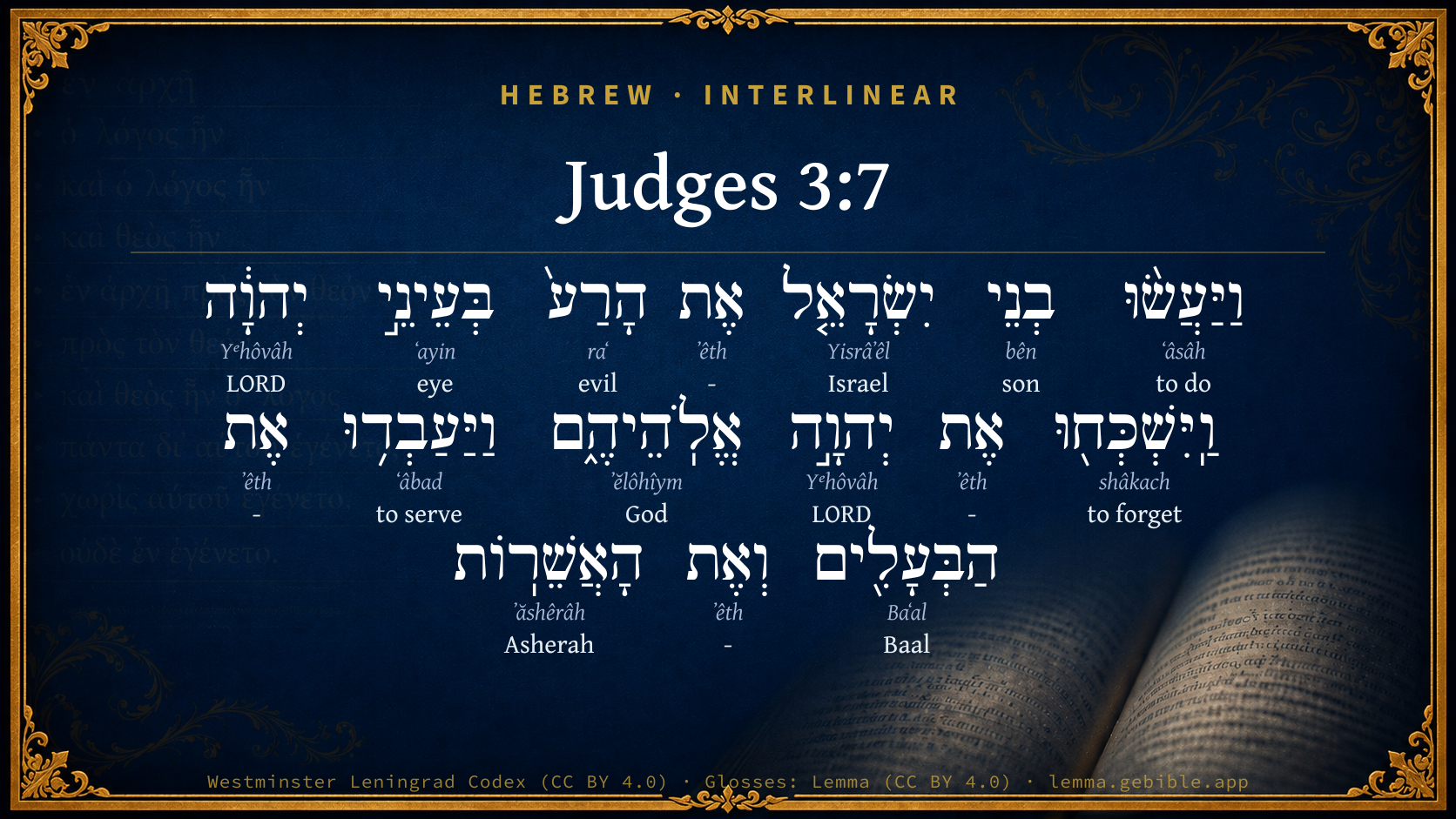
  1. וַיַּעֲשׂ֨וּ ʻâsâh H6213 “and · to do” Conjunction + Verb, Qal, Sequential Imperfect, 3rd Person, Masculine, Plural
  2. בְנֵי bên H1121 “sons of” Noun, Common, Masculine, Plural, Construct
  3. יִשְׂרָאֵ֤ל Yisrâʼêl H3478 “Israel” Noun, Proper
  4. אֶת ʼêth H853 “-” Particle, Direct Object
  5. הָרַע֙ raʻ H7451 “the · evil” Particle, Definite Article + Adjective, Adjective, Masculine, Singular, Absolute
  6. בְּעֵינֵ֣י ʻayin H5869 “in/at · eyes of” Preposition + Noun, Common, Both, Dual, Construct
  7. יְהוָ֔ה Yᵉhôvâh H3068 “LORD” Noun, Proper
  8. וַֽיִּשְׁכְּח֖וּ shâkach H7911 “and · to forget” Conjunction + Verb, Qal, Sequential Imperfect, 3rd Person, Masculine, Plural
  9. אֶת ʼêth H853 “-” Particle, Direct Object
  10. יְהוָ֣ה Yᵉhôvâh H3068 “LORD” Noun, Proper
  11. אֱלֹֽהֵיהֶ֑ם ʼĕlôhîym H430 “God(s) · their” Noun, Common, Masculine, Plural, Construct + Suffix, Personal, 3rd Person, Masculine, Plural
  12. וַיַּעַבְד֥וּ ʻâbad H5647 “and · to serve” Conjunction + Verb, Qal, Sequential Imperfect, 3rd Person, Masculine, Plural
  13. אֶת ʼêth H853 “-” Particle, Direct Object
  14. הַבְּעָלִ֖ים Baʻal H1168 “the · Baal” Particle, Definite Article + Noun, Proper
  15. וְאֶת ʼêth H853 “and · -” Conjunction + Particle, Direct Object

About this verse

These counts appear in no published source. They are computed here, from the morphology-tagged text and Lemma’s own curated glosses. What Lemma adds →

16
words
12
distinct lemmas
Historical
section

Shared distinctive vocabulary

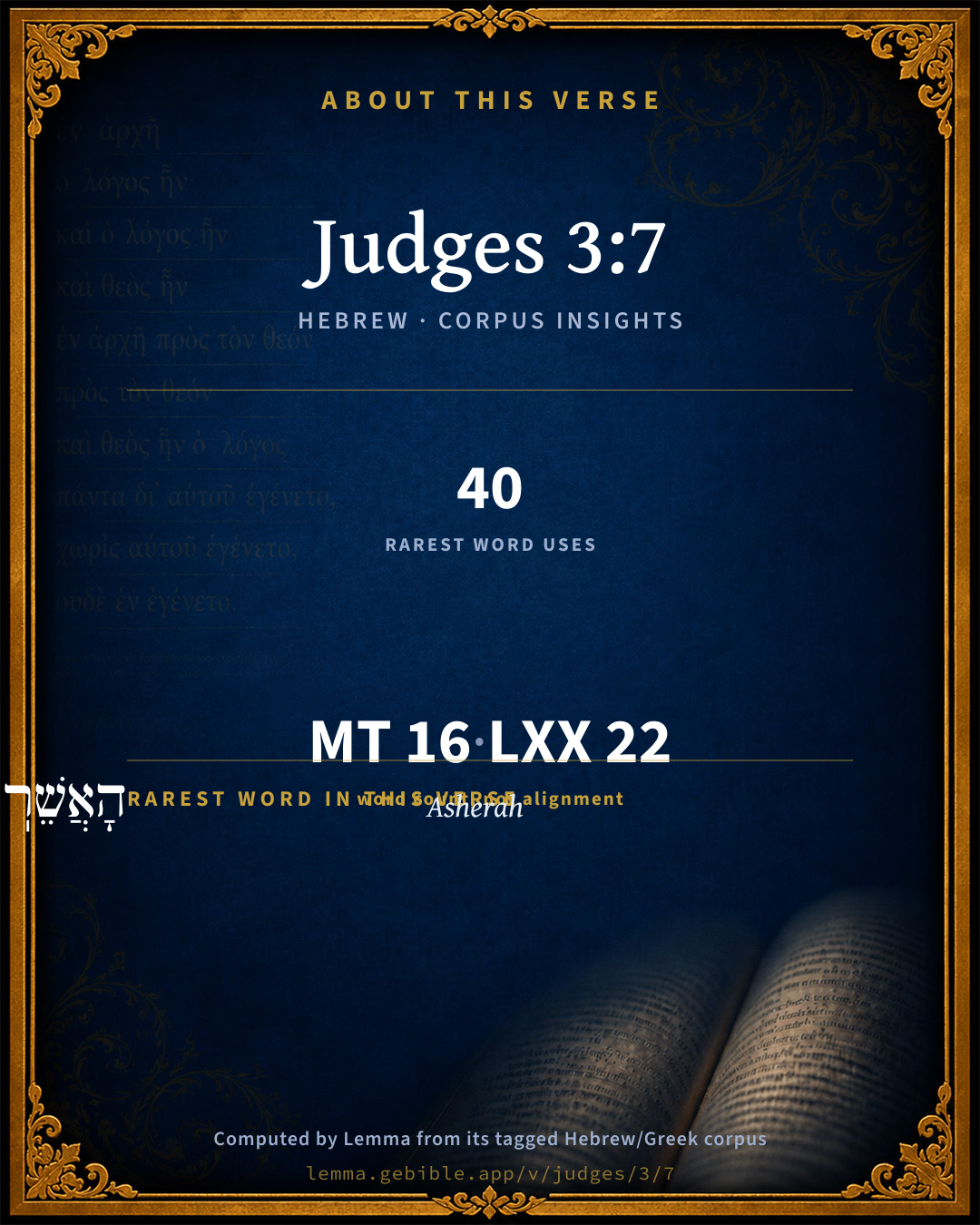
הָאֲשֵׁרֽוֹת Asherah H842 occurs in 40 verses of the Hebrew Bible. Also found in:

Grammatical profile

  • 3 verbs
  • 8 nouns
  • 1 adjective
  • 4 particles

Verb forms

  • וַיַּעֲשׂ֨וּ Qal · Sequential Imperfect
  • וַֽיִּשְׁכְּח֖וּ Qal · Sequential Imperfect
  • וַיַּעַבְד֥וּ Qal · Sequential Imperfect

Repetition

A word recurs within this verse — often emphatic in Hebrew:

  • יְהוָ֔ה LORD H3068 ×2

Hebrew & Septuagint length

In English translation the verse runs 26 words from the Hebrew and 25 from the Septuagint (LXX English) — closely comparable.

A rough comparison of the two English renderings, which tokenize alike — not a word-level alignment.

Word counts can differ between the Hebrew and the Greek without any difference in meaning — e.g. the Hebrew direct-object marker אֵת has no separate Greek word, and Greek often adds the article ὁ.

In the original languages it is 16 Hebrew tokens and 22 Greek tokens — but the two are counted differently (Hebrew bundles its prefixes and suffixes into one token; the Greek is in lemma form), so that isn’t a like-for-like length.

Cross-references

16

Topical passages linked to Judges 3:7 in the Treasury of Scripture Knowledge — connected by theme and wording, ordered by reader-vote popularity; previews shown in the World English Bible.

  • Exodus 34:13 but you shall break down their altars, and dash in pieces their pillars, and you shall cut down their Asherim;
  • Deuteronomy 4:9 Only take heed to yourself, and keep your soul diligently, lest you forget the things which your eyes saw, and lest they depart from your heart all the days of your life; but make them known to your children and your children's children;
  • 2 Kings 23:6 He brought out the Asherah from the house of Yahweh, outside of Jerusalem, to the brook Kidron, and burned it at the brook Kidron, and beat it to dust, and cast the dust of it on the graves of the common people.
  • Deuteronomy 16:21 You shall not plant you an Asherah of any kind of tree beside the altar of Yahweh your God, which you shall make you.
  • Judges 2:11–13 The children of Israel did that which was evil in the sight of Yahweh, and served the Baals;
  • Judges 3:12 The children of Israel again did that which was evil in the sight of Yahweh: and Yahweh strengthened Eglon the king of Moab against Israel, because they had done that which was evil in the sight of Yahweh.
  • Judges 6:25 It happened the same night, that Yahweh said to him, Take your father's bull, even the second bull seven years old, and throw down the altar of Baal that your father has, and cut down the Asherah that is by it;
  • 1 Kings 16:33 Ahab made the Asherah; and Ahab did yet more to provoke Yahweh, the God of Israel, to anger than all the kings of Israel who were before him.
  • 1 Kings 18:19 Now therefore send, and gather to me all Israel to Mount Carmel, and the prophets of Baal four hundred fifty, and the prophets of the Asherah four hundred, who eat at Jezebel's table.
  • 2 Kings 23:14 He broke in pieces the pillars, and cut down the Asherim, and filled their places with the bones of men.
  • 2 Chronicles 15:16 Also Maacah, the mother of Asa the king, he removed from being queen, because she had made an abominable image for an Asherah; and Asa cut down her image, and made dust of it, and burnt it at the brook Kidron.
  • 2 Chronicles 24:18 They forsook the house of Yahweh, the God of their fathers, and served the Asherim and the idols: and wrath came on Judah and Jerusalem for this their guiltiness.
  • 2 Chronicles 33:3 For he built again the high places which Hezekiah his father had broken down; and he reared up altars for the Baals, and made Asheroth, and worshiped all the host of the sky, and served them.
  • 2 Chronicles 33:19 His prayer also, and how [God] was entreated of him, and all his sin and his trespass, and the places in which he built high places, and set up the Asherim and the engraved images, before he humbled himself: behold, they are written in the history of Hozai.
  • 2 Chronicles 34:3 For in the eighth year of his reign, while he was yet young, he began to seek after the God of David his father; and in the twelfth year he began to purge Judah and Jerusalem from the high places, and the Asherim, and the engraved images, and the molten images.
  • 2 Chronicles 34:7 He broke down the altars, and beat the Asherim and the engraved images into powder, and hewed down all the sun-images throughout all the land of Israel, and returned to Jerusalem.

Cross-references courtesy of OpenBible.info (CC BY 4.0).

Hebrew and Greek witnesses Masoretic Hebrew ↔ Greek Septuagint

The same verse in the two great witnesses to the Old Testament, shown verse-for-verse.

These are two independent witnesses, not word-aligned to each other, and the Septuagint is shown in lemma (dictionary) form.

Hebrew Judges 3:7 Masoretic · Westminster Leningrad Codex

וַיַּעֲשׂ֨וּ בְנֵי יִשְׂרָאֵ֤ל אֶת הָרַע֙ בְּעֵינֵ֣י יְהוָ֔ה וַֽיִּשְׁכְּח֖וּ אֶת יְהוָ֣ה אֱלֹֽהֵיהֶ֑ם וַיַּעַבְד֥וּ אֶת הַבְּעָלִ֖ים וְאֶת הָאֲשֵׁרֽוֹת

The children of Israel did that which was evil in the sight of Yahweh, and forgot Yahweh their God, and served the Baals and the Asheroth.

World English Bible · Public Domain

Greek LXX Judges 3:7 Septuagint · lemma form

καί ποιέω ὁ υἱός ἰσραήλ ὁ πονηρός ἐναντίον κύριος καί ἐπιλανθάνω κύριος ὁ θεός αὐτός καί λατρεύω ὁ βααλιμ καί ὁ ἄλσος

And the children of Israel did evil in the sight of the Lord, and forgot the Lord their God, and served Baalim and the groves.

LXX2012 (modern English Septuagint) · Public Domain

On this verse, Whedon's Commentary on the Bible discusses the Septuagint’s reading. Read the note in Commentary ↓

Hebrew: Westminster Leningrad Codex (CC BY 4.0). Greek: Septuagint (public domain); English from LXX2012 (modern English Septuagint) (Public Domain). How the Septuagint differs from the Hebrew →

Targum (Aramaic paraphrase)

1

The Targum is the ancient Jewish Aramaic paraphrase of the Hebrew Scriptures — an interpretive translation, not the Hebrew text itself. Onkelos (literal) and Pseudo-Jonathan (expansive) render the Torah, and Jonathan the Prophets. Coverage is partial: where no permissively-licensed English translation exists for a verse, only the Aramaic is shown. This is verse-level text, not a word-by-word alignment to the Hebrew.

  1. Targum Jonathan Prophets (Joshua–Malachi)
    וַעֲבַדוּ בְנֵי יִשְׂרָאֵל יַת דְבִישׁ קֳדָם יְיָ וְאִתְנְשִׁיאוּ יַת פּוּלְחָנָא דַייָ אֱלָהָהוֹן וּפְלַחוּ יַת בְּעָלַיָא וְלַאֲשָׁרָתָא:

    (no public-domain English translation for this verse)

    Targum Jonathan — Aramaic: “Mikraot Gedolot” (public domain). English: “Sefaria Community Translation” (CC0 1.0 (public-domain dedication)); “London "Chaldee Paraphrase," 1871” (public domain). Text via Sefaria.

Commentary

Notes on Judges 3:7 from classic Christian and Jewish commentators (each source and its license shown beneath its notes). The classic Christian expositions comment on the surrounding passage and are grouped to its opening verse, so a note may address several verses; the Jewish commentaries on the Tanakh (Rashi and others) are per-verse, so they appear only where the commentator wrote on this verse.

Lemma curates 59 commentaries, every one of them public domain or Creative Commons licensed, each selected and text-cleaned for this edition rather than reprinted as found. About our sources →

Trapp's Complete Commentary

John Trapp

Jdg 3:7 And the children of Israel did evil in the sight of the LORD, and forgat the LORD their God, and served Baalim and the groves.

Ver. 7. And served Baalim and the groves.] That is, In the groves. The devil purposely chose those dark places, called Luci quia minime lucent, that his Tenebriones, children of darkness, might there more closely commit their deeds of darkness. Nos pudore pulso, said those worshippers of Priapus or Baalpeor, We cannot better please our god, than by banishing modesty.

John Trapp, A Commentary or Exposition upon All the Books of the Old and New Testament (1647–1656) — public domain. Text from a community e-Sword module.

Whedon's Commentary on the Bible

Daniel D. Whedon

CHUSHAN’S OPPRESSION, AND THE DELIVERANCE BY OTHNIEL, Jdg_3:7-11.

7. The children of Israel did evil — Matrimony strongly influences character. A pagan wife will paganize her husband, especially if that husband be so for backslidden as to trample down so plain a prohibition of such a marriage as is recorded in the book of the law. Deu_7:3. It did not require a supernatural prescience, but only a knowledge of the human heart, to make the prediction contained in Deu_7:4 : “For they will turn away thy sons from following me, that they may serve other gods.” “In such unequal matches,” says Henry, “there is more reason to fear that the bad will corrupt the good, than to hope that the good will reform the bad.” Hence to all Christians there is an apostolic prohibition, “Be not unequally yoked together with unbelievers,” 2Co_6:14.

And forgat… God — By long neglect of his service, and absence from his sanctuary and the appointed means of knowledge.

The groves — Hebrew, the Asheroth. Our translators have followed the Septuagint in rendering this word, groves. The Vulgate — Ashtaroth — comes nearer to the Hebrew, which signifies the image-pillars of Asherah, the Sidonian Astarte, the oriental Venus. From the fact that these images were the stumps of trees, several versions have translated the word Asheroth, trees or groves. Bertheau identifies Asheroth with Ashtareth, but supposes that the latter is rather the name of the goddess, while the former refers more specially to the idols erected to her honour. See on Jdg_2:13, and 1Ki_14:15.

Daniel D. Whedon (gen. ed.), Commentary on the Old and New Testaments (1874–1909) — public domain. Text from a community e-Sword module.

The Pulpit Commentary

Jud 3:7-11 This section introduces us into the actual narrative of the Book of Judges, the prefatory matter being now concluded. The whole book proceeds on the same model as this section does. The apostasy of Israel; their servitude under the oppressor sent to chastise them; their cry of distress and penitence; their deliverance by the judge raised up to save them; the rest which follows their deliverance. There is infinite variety in the details of the successive narratives, but they are all formed on the same plan.

The groves. The Asheroth, here and elsewhere (Jud_1:6:25, 26 Deu_16:21, etc.) wrongly rendered groves, were large wooden images or pillars in honour of Ashtoreth, and so are properly coupled with Baalim. This verse is in fact identical in meaning with Jud_1:2:13, of which it is a repetition. (see note to Jud_1:2:13,Jud_1:8:23)

Vers. 7-11. God"s scourge.

In a remarkable passage (Deu_32:8) Moses tells us that when the Most High divided to the nations their inheritance, he set the bounds of the people according to the number of the children of Israel. In like manner the sacred history teaches us how the movements of the nations and the restless invasions and conquests of heathen kings and warriors had a special relation to the chosen race. They indeed did not mean so. They were actuated merely by ambition, by the lust of conquest, by the appetite for plunder and dominion. But in the wonderful providence of God they were made instruments for chastening and correcting, or for saving and delivering, his people, as the case might be. Here we find the unsettled state of the Mesopotamian tribes, which led them beyond the borders of their own land, bringing them to Palestine at the very time when the Israelites in the wantonness of their fickle hearts had fallen away from the service of the living and true God to that of the idols of Canaan. There they were living at ease, having partly extirpated the Canaanites, and partly entered into league and amity with them. Seduced by their vices, captivated by their sensuous religion, they had forgotten all the works of God, and no longer trembled at his word, and did not feel their need of his favour. Yet a little while and their apostasy would have been complete, and the very end of their election would have failed. But this was not to be. So Chushanrishathaim, who had perhaps never heard of their names, and knew nothing of their religion or of their apostasy, mustered his hosts, marched his army, and at the critical moment fell like a rod upon the peccant people. We are left to imagine the misery of those eight years of servitude under a heathen tyrant: the injuries and indignities, the terror and unrest, the grinding servitude, the hard bondage, the bitterness of soul, the wasting and oppression of spirit. The crops for which they toiled eaten by another; their goodly houses tenanted by their foes, and themselves turned into the street; their wives and daughters bondwomen, and their sons made slaves; their national glory turned to shame, their cherished hopes withered into despair. And we are left to imagine how that misery bent the iron sinew of their neck, and brought them back to God. No doubt their self-confidence was broken down. Their illusive dreams of pleasure had ended in an awakening to their self-inflicted pain; sin appeared in its true colours as an enemy and betrayer; the false gods were found to be no helpers. Why not turn to God? He had been very good to them. Why had they ever forsaken him? He and he alone could save them, as he had saved their, fathers from the hands of Pharaoh. But would he? They would try. They would turn to him in penitence and prayer; they would confess their sins; they would humble themselves in his sight; they would call upon his blessed name; they would plead his covenant, his promises, the glory of his own great name. And they did so. Nor did they call in vain. Their cry of distress entered into the ears of the Lord of hosts. His wrath turned to pity; he who chastened when they sinned, now comforted when they prayed. He had sent a scourge; he now sends a deliverer. Chushan was invincible when his mission was to strike; but when his mission was ended his arm fell broken at his side. Othniel the deliverer went forth in the might of God"s Spirit, and Chushan"s power was gone. The waters of the Euphrates which had overflowed their banks were dried up again, and the land of Israel had rest for forty years. And so has it ever been. The obscurer movements of Philistines, and Ammonites, and Midianites, as well as the grand historic drama of Assyria, and Egypt, and Babylon, and Persia, and Greece, and Rome, have always had one special design in the correction or deliverance of God"s people. And though we have no inspired interpreter to expound to us the later movements of the peoples, yet may we be sure that the great events of modern history have been appointed to work out the purposes of God with reference to his Church, either for correction or deliverance, and that the rise and fall of empires, the ambition of kings and statesmen, the conquests of warriors, and the revolutions of peoples, will in the end be found to have been overruled for the glory of God, and for the extension of the kingdom of Jesus our Lord. And in this confidence the Church may rest and be at ease in her integrity, while she is careful not to provoke God"s anger by turning aside from his truth, or growing weary of his blessed service.

The Pulpit Commentary (1880–1919), ed. H.D.M. Spence-Jones & Joseph S. Exell — public domain. Text from a community e-Sword module.

Keil & Delitzsch

C. F. Keil & F. Delitzsch

II. History of the People of Israel under the Judges - Judges 3:7-16:31

In order that we may be able to take a distinct survey of the development of the Israelites in the three different stages of the their history duringthe times of the judges, the first thing of importance to be done is to determine the chronology of the period of the judges, inasmuch as not only have greatly divergent opinions prevailed upon this point, but hypotheses have been set up, which endanger and to some extent directly overthrow the historical character of the accounts which the book of Judges contains.

(Note: Rud. Chr. v. Bennigsen, for example, reckons up fifty different calculations, and the list might be still further increased by the addition of both older and more recent attempts (see Winer, Bibl. Real-Wrterb. ii. pp. 327-8). Lepsius (Chronol. der. Aeg. i. 315-6, 365ff. and 377-8) and Bunsen (Aegypten, i. pp. 209ff. iv. 318ff., and Bibelwerk, i. pp. 237ff.), starting from the position maintained by Ewald and Bertheau, that the chronological data of the book of Judges are for the most part to be regarded as round numbers, have sought for light to explain the chronology of the Bible in the darkness of the history of ancient Egypt, and with their usual confidence pronounce it an indisputable truth that the whole of the period of the Judges did not last longer than from 169 to 187 years.)

If we take a superficial glance at the chronological data contained in the book, it appears a very simple matter to make the calculation required, inasmuch as the duration of the different hostile oppressions, and also the length of time that most of the judges held their office, or at all events the duration of the peace which they secured for the nation, are distinctly given. The following are the numbers that we find: -

1. Oppression by Chushan-rishathaim, (Jdg 3:8), 8 years. Deliverance by Othniel, and rest, (Jdg 3:11), 40 years. 2. Oppression by the Moabites, (Jdg 3:14), 18 years. Deliverance by Ehud, and rest, (Jdg 3:30), 80 years. 3. Oppression by the Canaanitish king Jabin, (Jdg 4:3), 20 years. Deliverance by Deborah and Barak, and rest, (Jdg 5:31), 40 years. 4. Oppression by the Midianites, (Jdg 6:1), 7 years. Deliverance by Gideion, and rest, (Jdg 8:28) 40 years. Abimelech's reign, (Jdg 9:22), 3 years. Tola, judge, (Jdg 10:2), 23 years. Jair, judge, (Jdg 10:3), 22 years. Total, 301 years. 5. Oppression by the Ammonites, (Jdg 10:8), 18 years. Deliveance by Jephthah, who judged Israel, (Jdg 12:7), 6 years. Ibzan, judge, (Jdg 12:9), 7 years. Elon, judge, (Jdg 12:11), 10 years. Abdon, judge, (Jdg 12:14), 8 years. 6. Oppression by the Philistines, (Jdg 13:1), 40 years. At this time Samson judged Israel for 20 years (Jdg 15:20; Jdg 16:31 Total, 390 years. For if to this we add -

(a.) the time of Joshua, which is not distinctly mentioned, and 20 years. (b.) the time during which Eli was judge (Sa1 4:18) 40 years.

We obtain 450 years.

(Note: The earlier chronologists discovered a confirmation of this as the length of time that the period of the judges actually lasted in Act 13:20, where Paul in his speech at Antioch in Pisidia says, according to the textus receptus, "After that He gave unto them judges about the space of four hundred and fifty years until Samuel the prophet." The discrepancy between this verse and the statement in Kg1 6:1, that Solomon built the temple in the four hundred and eightieth year after the children of Israel were come out of Egypt, many have endeavoured to remove by a remark, which is correct in itself, viz., that the apostle merely adopted the traditional opinion of the Jewish schools, which had been arrive at by adding together the chronological data of the book of Judges, without entering into the question of its correctness, as it was not his intention to instruct his hearers in chronology. But this passage cannot prove anything at all; for the reading given in the lect. rec. is merely founded upon Cod Al., Vat., Ephr. S. rescr., but according to the Cod. Sinait., ed. Tischendorf and several minuscula, as well as the Copt. Sahid. Arm. Vers. and Vulg., is, καὶ καθελὠν ἔθνη ἑπτὰ ἐν γῇ Χαναὰν κατεκλληρονόμησεν αὐτοῖς τὴν γῆν αὐτῶν ὡς ἔτεσιν τετπακοσίοις καὶ πεντήκοντα, καὶ μετὰ ταῦτα ἔδωκεν κριτὰς ἕως Σαμουήλ τ. πρ. This text is rendered thus in the Vulgate: et destruens gentes septem in terra Chanaan sorte distribuit eis terram eorum quasi post quadringentos et quinquaginta annos: et post haec dedit judices usque ad Samuel prophetam, and can hardly be understood in any other sense than this, that Paul reckoned 450 as the time that elapsed between the call of Abraham (or the birth of Isaac) and the division of the land, namely 215 + 215 (according to the Alex. reading of Exo 12:40 : see the comm. on this passage) + 40 = 470, or about 450.)

And if we add still further -

(c.) The times of Samuel and Saul combined, 40 years. (d.) The reign of David (Sa2 5:4; Kg1 2:11), 40 years. (e.) The reign of Solomon to the building of the temple (Kg1 6:1), 3 years. The whole time from the entrance of Israel into Canaan to the building of the temple amounted to,

533 years. Or if we add the forty years spent in the wilderness, the time that elapsed between the exodus from Egypt and the building of the temple 573 years. But the interval was not so long as this; for, according to Kg1 6:1, Solomon built the house of the Lord in the 480th year after the children of Israel came out of Egypt, and in the fourth year of his reign. And no well-founded objections can be raised as to the correctness and historical credibility of this statement. It is true that the lxx have "the 440th year" instead of the 480th; but this reading is proved to be erroneous by Aquila and Symmachus, who adopt the number 480 in common with all the rest of the ancient versions, and it is now almost unanimously rejected (see Ewald, Gesch. ii. p. 479). In all probability it owed its origin to an arbitrary mode of computing the period referred to by reckoning eleven generations of forty years each (see Ed Preuss; die Zeitrechnung der lxx pp. 78ff.). On the other hand, the number 480 of the Hebrew text cannot rest upon a mere reckoning of generations, since the year and month of Solomon's reign are given in Kg1 6:1; and if we deduct this date from the 480, there remain 477 of 476 years, which do not form a cyclical number at all.

(Note: Bertheau has quite overlooked this when he endeavors to make the 480 years from the exodus to the building of the temple into a cyclical number, and appeals in support of this to Ch1 6:5., where twelve generations are reckoned from Aaron to Ahimaaz, the contemporary of David. But it is perfectly arbitrary on his part to include Ahimaaz who was a boy in the time of David (Sa2 15:27, Sa2 15:36; Sa2 18:19, Sa2 18:22, Sa2 18:27.), as the representative of a generation that was contemporaneous with David; whereas it was not Ahimaaz, but his father Zadok, i.e., the eleventh high priest from Aaron, who anointed Solomon as king (Kg1 1:39; Kg1 2:35), and therefore there had been only eleven high priests from the exodus to the building of the temple. If therefore this period was to be divided into generations of forty years each on the ground of the genealogies in the Chronicles, there could only be eleven generations counted, and this is just what the lxx have done.)

Again, the exodus of Israel from Egypt was an "epoch-making" event, which was fixed in the recollection of the people as no other ever was, so that allusions to it run through the whole of the Old Testament. Moreover, the very fact that it does not tally with the sum total of the numbers in the book of Judges is an argument in favor of its correctness; whereas all the chronological calculations that differ from this bring us back to these numbers, such, for example, as the different statements of Josephus, who reckons the period in question at 592 years in Ant. viii. 3, 1, and on the other hand, at 612 years in Ant. xx. 10 and c. Ap. ii. 2.

(Note: Josephus adds together the numbers which occur in the book of JudGes. Reckoning from the invasion of Chushan-rishathaim to the forty years' oppression of the Philistines (inclusive), these amount to 390 years, if we regard Samson's twenty years as forming part of the Philistine oppression, or to 410 years if they are reckoned separately. Let us add to this the forty years of the journey through the wilderness, the twenty-five years which Josephus assigns to Joshua (Ant. 5:1, 29), the forty years of Eli, the twelve years which he allots to Samuel before the election of Saul as king (6:13, 5), and the forty years which he reckons to Samuel and Saul together, and lastly, the forty and a half years of David's reign and the four years of Solomon's up to the time when the temple was built, and we obtain 40 + 25 + 40 + 12 + 40 + 401/2 + 4 = 2011/2 years; and these added to 390 make 5911/2, or added to 410 they amount to 611 years.)

Lastly, it may easily be shown that there are several things assumed in this chronological survey which have no foundation in the text. This applies both to the assumed succession of the Ammonitish and Philistine oppressions, and also to the introduction of the forty years of Eli's life as judge after or in addition to the forty years that the Philistines ruled over Israel.

The current view, that the forty years of the oppression on the part of the Philistines did not commence till after the death of Jephthah or Abdon, is apparently favored, no doubt, by the circumstance, that this oppression is not described till after the death of Abdon (Jdg 12:15), and is introduced with the usual formula, " And the children of Israel did evil again in the sight of the Lord," etc. (Jdg 13:1). But this formula, taken by itself, does not furnish any certain proof that the oppression which it introduces did not take place till after what has been already described, especially in the absence of any more definite statement, such as the clause introduced into Jdg 4:1, "when Ehud was dead," or the still more definite remark, that the land had rest so many years (Jdg 3:11, Jdg 3:30; Jdg 5:31; cf. Jdg 8:32). Now in the case before us, instead of any such statement as to time, we find the general remark in Jdg 10:6., that when the Israelites sank into idolatry again, Jehovah sold them into the hands of the Philistines, and into the hands of the children of Ammon; and after this there simply follows an account of the oppression on the part of the Ammonites, and the eventual deliverance effected by Jephthah (Judg 10:8-12:7), together with an enumeration of three judges who succeeded Jephthah (Jdg 12:8-15); but we learn nothing further about the oppression on the part of the Philistines which is mentioned in Jdg 10:7. When therefore, it is still further related, in Jdg 13:1, that the Lord delivered the Israelites into the hand of the Philistines forty years, this cannot possibly refer to another oppression on the part of the Philistines subsequent to the one noticed in Jdg 10:7; but the true explanation must be, that the historian proceeds here for the first time to describe the oppression noticed in Jdg 10:7, and introduces his description with the formula he generally adopted: "And the children of Israel did evil again in the sight of the Lord," etc. The oppression itself, therefore, commenced at the same time as that of the Ammonites, and continued side by side with it; but it lasted much longer, and did not come to an end till a short time before the death of Elon the judge. This is confirmed beyond all doubt by the fact, that although the Ammonites crossed the Jordan to fight against Judah, Benjamin, and Ephraim, it was chiefly the tribes of Israel who dwelt on the other side of the Jordan that were oppressed by them (Jdg 10:8, Jdg 10:9), and that it was only by these tribes that Jephthah was summoned to make war upon them, and was elected as their head and prince (Jdg 11:5-11), and also that it was only the Ammonites in the country to the east of the Jordan whom he subdued then before the Israelites (Jdg 11:32, Jdg 11:33). From this it is very evident that Jephthah, and his successors Ibzan, Elon, and Abdon, were not judges over all Israel, and neither fought against the Philistines nor delivered Israel from the oppression of the enemies who invaded the land from the south-west; so that the omission of the expression, "the land had rest," etc., from Judg 11 and Jdg 12:1-15, is very significant.

(Note: Even Hitzig, who denies that the oppression of the Philistines was contemporaneous with that of the Ammonites, is obliged to acknowledge that "it is true, the author first of all disposed very properly of the Ammonitish war before entering into the details of the war with the Philistines, with which it had no connection, and which was not brought to a close so soon." When therefore, notwithstanding this, he adduces as evidence that they were not contemporaneous, the fact that "according to the context, and to all analogy (cf. Jdg 4:1; Jdg 3:11, Jdg 3:12), the author intends to write, in Jdg 13:1, that after the death of Abdon, when there was no judge in Israel, the nation fell back into its former lawlessness, and as a punishment was given up to the Philistines," a more careful study of the passages cited (Jdg 4:1; Jdg 3:11, Jdg 3:12) will soon show that the supposed analogy does not exist at all, since the expression, "the land had rest," etc. really occurs in both instanced (se Jdg 3:11 and Jdg 3:31), whereas it is omitted before Jdg 13:1. The still further assertion, however, that the account of the Philistine war ought to have followed immediately upon that of the war with the Ammonites, if the intention was to describe this with equal fulness, has no force whatever. If neither Jephthah nor the three judges who followed him had anything to do with the Philistines, if they merely judged the tribes that were oppressed and threatened by the Ammonites, it was natural that everything relating to them should be attached to the account of the defeat of the Ammonites, in order that there might be no unnecessary separation of what was so intimately connected together. And whilst these objections are thus proved to have no force, the objection raised to the contemporaneous occurrence of the two oppressions is wrecked completely upon the distinct statement in Jdg 10:7, that Jehovah sold the Israelites into the hands of the Philistines and Ammonites, which Hitzig can only get over by declaring, without the slightest foundation, that the words "into the hands of the Philistines" are spurious, simply because they stand in the way of his own assumption.)

But if the Ammonitish and Philistine oppressions occurred at the same time, of course only one of them must be taken into account in our chronological calculations as to the duration of the period of the judges; and the one selected must be the one to the close of which the chronological data of the next period are immediately appended. But this is not the case with the account of the Ammonitish oppression, of the deliverance effected by Jephthah, and of the judges who succeeded him (Ibzan, Elon, and Abdon), because the chronological thread of this series of events is broken off with the death of Abdon, and is never resumed again. It is so, however, with the Philistine oppression, which is said to have lasted forty years, though the termination of it is not given in the book of JudGes. Samson merely began to deliver Israel out of the power of the Philistines (Jdg 13:5), but did not accomplish their complete deliverance. He judged Israel for twenty years in the days of the Philistines, i.e., during the oppression of the Philistines (Jdg 15:20); consequently the twenty years of his labours must not be taken into account in the chronology of the period of the judges, inasmuch as they are all included in the forty years of the Philistines' rule. At the death of Samson, with which the book of Judges closes, the power of the Philistines was not yet broken; and in Judg 4 of the first book of Samuel we find the Philistines still fighting against the Israelites, and that with such success that the Israelites were defeated by them, an even lost the ark of the covenant. This war must certainly be a continuation of the Philistine oppression, to which the acts of Samson belonged, since the termination of that oppression is not mentioned in the book of Judges; and on the other hand, the commencement of the oppression referred to in Sa1 4:9. is not given in the book of Samuel. Consequently even Hitzig supports the view which I have expressed, that the forty years' supremacy of the Philistines, noticed in Jdg 13:1, is carried on into the book of Samuel, and extends to Sa1 7:3, Sa1 7:7, and that it was through Samuel that it was eventually brought to a termination (Sa1 7:10.). But if this is established, then the forty years during which Eli was judge cannot have followed the Philistine oppression and the deeds performed by Samson, and therefore must not be reckoned separately. For since Eli died in consequence of the account of the capture of the ark by the Philistines (Sa1 4:18), and seven months (Sa1 6:1) and twenty years elapsed after this catastrophe before the Philistines were defeated and humiliated by Samuel (Sa1 7:2), only the last half of the forty years of Eli's judicial life falls within the forty years of the Philistine rule over Israel, whilst the first half coincides with the time of the judge Jair. Eli himself was not a judge in the strict sense of the word. He was neither commander of the army, nor secular governor of the nation, but simply the high priest; and in this capacity he administered the civil law in the supreme court, altogether independently of the question whether there was a secular governor at the time or not. After the death of Eli, Israel continued for more than twenty years utterly prostrate under the yoke of the Philistines. It was during this period that Samson made the Philistines feel the power of the God of Israel, though he could not deliver the Israelites entirely from their oppression. Samuel laboured at the same time, as the prophet of the Lord, to promote the inward and spiritual strength of Israel, and that with such success, that the people came to Mizpeh at his summons, and there put away the strange gods that they had hitherto worshipped, and worshipped the Lord alone; after which the Lord hearkened to Samuel's prayer, and gave them a complete victory over the Philistines (Sa1 7:2-11). After this victory, which was gained not very long after the death of Samson, Samuel undertook the supreme government of Israel as judge, and eventually at their own desire, and with the consent of God, gave them a king in the person of Saul the Benjaminite. This was not till Samuel himself was old, and had appointed as his successors in the office of judge his own sons, who did not walk in their father's ways (1 Sam. 8-10). Even under Saul, however Samuel continued to the very end of his life to labour as the prophet of the Lord for the well-being of Israel, although he laid down his office of judge as soon as Saul had been elected king. He announced to Saul how he had been rejected by God on account of his disobedience; he anointed David as king; and his death did not occur till after Saul had began to be troubled by the evil spirit, and to plot for David's life (Sa1 25:1), as we may learn from the fact that David fled to Samuel at Ramah when Saul resolved to slay him (Sa1 19:18)

How long Samuel judged Israel between the victory gained at Ebenezer (1 Sam. 7) and the election of Saul as king of Israel, is not stated in the Old Testament, nor even the length of Saul's reign, as the text of Sa1 13:1 is corrupt. But we shall not be very far from the truth, if we set down about forty years as the time covered by the official life of Samuel as judge after that event and the reign of Saul, and reckon from seventeen to nineteen years as the duration of Samuel's judgeship, and from twenty to twenty-two as the length of Saul's reign. For it is evident from the accounts that we possess of the lives and labours of Samuel and Saul, that Saul did not reign forty years (the time given by Paul in Act 13:21 according to the traditional opinion current in the Jewish schools), but at the most from twenty to twenty-two; and this is now pretty generally admitted (see at Sa1 13:1). When David was chosen king of Judah at Hebron after the death of Saul, he was thirty years old (Sa2 5:1-4), and can hardly have been anointed king by Samuel at Bethlehem before the age of twenty. For though his father Jesse was still living, and he himself was the youngest of Jesse's eight sons, and was feeding the flock (Sa1 16:6-12), and even after this is still described as נער (Sa1 17:42, Sa1 17:55), Jesse was זקן (an old man) at the time (Sa1 17:12), at any rate sixty years old or more, to that his eldest son might be forty years old, and David, the youngest, as much as twenty. For נער was not only applied to a mere boy, but to a young man approaching twenty; and the keeping of sheep was not merely as task performed by shepherd boys, but also by the grown-up sons of a family, among whom we must certainly reckon David, since he had already contended with lions and bears in the steppe, and slain these beasts of prey (Sa1 17:34-36), and shortly afterwards was not only recommended to king Saul by his courtiers, as "a mighty valiant man, and a man of war, and wise in speech," to cheer up the melancholy king by his playing upon the harp (Sa1 16:18), but also undertook to fight with the giant Goliath (1 Sam. 17), and was placed in consequence over the men of war, and was afterwards made captain of a thousand, and betrothed to his daughter Michal (Sa1 18:5, Sa1 18:13, Sa1 18:17.). But if David was anointed by Samuel at the age of about twenty years, Saul could not have reigned more than ten years after that time, as David was made king at the age of thirty. And he cannot have reigned much longer before that time. For, apart from the fact that everything which is related of his former wars and deeds could easily have occurred within the space of ten years, the circumstance that Samuel lived till the last years of Saul's reign, and died but a few years before Saul's death (Sa1 25:1), precludes the assumption that he reigned any longer than that. For Samuel was already so old that he had appointed his sons as judges, whereupon the people desired a king, and assigned as the reason, that Samuel's sons did not walk in his ways (Sa1 8:1-4), from which it is very evident that they had already filled the office of judge for some considerable time. If we add to this the fact that Samuel was called to be a prophet before the death of Eli, and therefore was no doubt twenty-five or thirty years old when Eli died, and that twenty years and seven months elapsed between the death of Eli and the defeat of the Philistines, so that Samuel may have been about fifty years old at that time, and that he judged the people from this time forward till he had become an old man, and then gave the nation a king in the person of Saul, we cannot assign more than forty years as the interval between the defeat of the Philistines and the death of Saul, without attributing to Samuel an age of more than ninety years, and therefore we cannot reckon more than forty or thirty-nine years as the time that intervened between the installation of Samuel in his office as judge and the commencement of the reign of Saul.

According to this, the chronology of the times of the judges may be arranged as follows: -

a. From the oppression of Cushan-rishathaim to the death of Jair the judge (vid. p. 202), 301 years. b. Duration of the Philistine oppression, 40 years. c. Judgeship of Samuel and reign of Saul, 39 years. d. David's reign (7 and 33 years) 40 years. e. Solomon's reign to the building of the temple, 3 years. 423 years. a. The wandering in the desert, 40 years. b. the time between the entrance into Canaan and the division of the land,

7 years. c. From the division of Canaan to the invasion of Chushan-rishathaim, 10 years. 480 years. These numbers are as thoroughly in harmony with Kg1 6:1, and also with the statement made by Jephthah in his negotiations with the king of the Ammonites, that Israel dwelt in Heshbon and the cities along the bank of the Arnon for three hundred years (Jdg 11:26), as we could possibly expect so general a statement in round numbers to be. For instance, as the chronological data of the book of Judges give 301 years as the interval between the invasion of Chushan-rishathaim and the commencement of the Ammonitish oppression, and as only about ten years elapsed between the division of Canaan, after which the tribes on the east of the Jordan first established themselves firmly in Gilead, and the invasion of Chushan, the Israelites had dwelt 310 years in the land on the other side of the Jordan at the time of Jephthah's negotiations with the Ammonites, or at the most 328, admitting that these negotiations may possibly not have taken place till towards the end of the eighteen years' oppression on the part of the Ammonites, so that Jephthah could appeal with perfect justice to the fact that they had been in possession of the land for 300 years.

This statement of Jephthah, however, furnishes at the same time an important proof that the several chronological data contained in our book are to be regarded as historical, and also that the events are to be reckoned as occurring successively; so that we have no right to include the years of oppression in the years of rest, as is frequently done, or to shorten the whole period from Othniel to Jephthah by arbitrary assumptions of synchronisms, in direct opposition to the text. This testimony removes all foundation from the hypothesis that the number forty which so frequently occurs is a so-called round number, that is to say, is nothing more than a number derived from a general estimate of the different periods according to generations, or cyclical periods. For if the sum total of the different chronological notices tallies on the whole with the actual duration of the period in question as confirmed by this testimony, the several notices must be regarded as historically true, and that all the more because the greater part of these data consist of such numbers as 6, 8, 18, 20, 22, 23, which can neither be called round nor cyclical. Moreover, the purely cyclical significance of the number forty among the Israelites must first of all be proved. Even Ewald (Gesh. ii. pp. 480, 481) most justly observes, that "it is very easy to say that the number forty was a round number in the case of different nations; but this round number must first of all have had its origin in life, and therefore must have had its limited application." If, however, we look more closely at the different occasions on which the space of forty years is mentioned, between the exodus from Egypt and the building of the temple, we shall find that at any rate the first and last passages contain very definite notices of time, and cannot possibly be regarded as containing merely round or cyclical numbers. In the case of the forty years' wandering in the wilderness, this is placed beyond the reach of doubt by the fact that even the months are given of both the second and fortieth years (Num 10:11; Num 20:1; Deu 1:3), and the intervening space is distinctly stated to have been thirty-eight years (Deu 2:14). And the forty years that David is said to have reigned also give the precise number, since he reigned seven and a half years at Hebron, and thirty-three at Jerusalem (Sa2 5:4, Sa2 5:5; Kg1 2:11). Between these two extreme points we certainly meet with the number forty five times: viz., forty years of rest under Othniel (Jdg 3:11), the same under Barak and Deborah (Jdg 5:31), and the same again Gideon (Jdg 8:28); also forty years of the oppression by the Philistines (Jdg 13:1), and the forty years that Eli was judge (Sa1 4:18); and in addition to these, we find eighty years of rest after Ehud's victory (Jdg 3:30). But there are also twelve or thirteen passages in which we find either odd numbers, or at all events numbers that cannot be called cyclical or round (viz., Jdg 3:8, Jdg 3:14; Jdg 4:3; Jdg 6:1; Jdg 9:22; Jdg 10:2, Jdg 10:3; Jdg 12:7, Jdg 12:9, Jdg 12:11, Jdg 12:14; Jdg 15:20; Jdg 16:31). What is there then to justify our calling the number forty cyclical or round? It is the impossibility or improbability that in the course of 253 years Israel should have had rest from hostile oppression on three occasions for forty years, and on one for eighty? Is there anything impossible in this? Certainly not. Is there even an improbability? If there be, surely improbabilities have very often been perfectly true. And in the case before us, the appearance itself loses all significance, when we consider that although if we take entire years the number forty is repeated, yet it cannot be taken so literally as that we are to understand that entire years are intended every time. If David's reign is reckoned as forty years in Sa2 5:4, although, according to Sa2 5:5, he reigned seven years and six months in Hebron and thirty-three years in Jerusalem, it may also be the case that, although forty years is the number given in the book of Judges, the period referred to may actually have been only thirty-nine years and a half, or may have been forty and a half. To this must be added the fact that the time during which the war with the enemy lasted is also included in the years of rest; and this must always have occupied several months, and may sometimes have lasted even more than a year.

Now, if we give all these circumstances their due weight, every objection that can be raised as to the correctness and historical credibility of the chronological data of the book of Judges vanishes away, whilst all the attempts that have been made to turn these data into round or cyclical numbers are so arbitrary as to need no special refutation whatever.

(Note: The principal representatives of this hypothesis are Ewald and his pupil Bertheau. According to Ewald Gesch. ii. pp. 473ff.), the twelve judges from Othniel to Samson form the historical groundwork of the book, although there are distinct traces that there were many more such rulers, because it was only of these that any reminiscences had been preserved. When, therefore, after the expiration of the whole of this period, the desire arose to bring out into distinct prominence the most important points connected with it, the first thing that was done was to group together these twelve judges, with such brief remarks as we find in the case of five of them (Tola, Jair, Ibzan, Elon, and Abdon) in Jdg 10:1-5 and Jdg 12:8-15. In their case, too, the precise time was given, so far as it could be still remembered. But, independently of this, the attempt was also made to connect the order of the many alternations of war and peace during these 480 years which occurred, according to Kg1 6:1, between the exodus from Egypt and the building of Solomon's temple, to certain grand and easily remembered divisions; and for this the number forty at once presented itself. For since, according to the oldest traditions, Israel spent forty years in the wilderness, and since David also reigned forty years, it might easily be regarded as a suitable thing to divide the whole into twelve equal parts, and to assign to each forty years a great hero and some striking event: e.g., (1) Moses and the wilderness; (2) Joshua and the prosperous rule of the elders; (3) the war with Chushan-rishathaim, and Othniel; (4) the Moabites and Ehud; (5) the Aramaeans and Jair; (6) the Canaanites under Jabin, and Deborah; (7) the Midianites and Gideon; (8) Tola, with whose opponents we are not acquainted; (9) the Ammonites and Philistines, or Jephthah and Samson; (10) the Philistines and Eli; (11) Samuel and Saul; (12) David. "Finally, then these twelve judges from Othniel to Samson were necessarily connected with this different mode of reckoning, so that the several numbers, as well as the order in which the judges occur, which show so evidently (?) that the last editor but one compiled the section extending from Judg 3-16 out of a great variety of sources, must have been the resultant of many chanGes." But Ewald looks in vain for any reason for this "must". And the question starts up at once, how could the idea ever have entered any one's mind of dividing these 480 years, from th

Keil & Delitzsch — Biblical Commentary on the Old Testament (1861–1891) — public domain (CC PDM 1.0). Text via the HelloAO Bible API. (Old Testament only.)

Geneva Bible (1599)

Geneva Bible translators

Trees or woods erected for idolatry.

Geneva Bible (1599) marginal notes — public domain. Text via Bolls.life.

Adam Clarke's Commentary

Verse 7. Served Baalim and the groves] No groves were ever worshipped, but the deities who were supposed to be resident in them; and in many cases temples and altars were built in groves, and the superstition of consecrating groves and woods to the honour of the deities was a practice very usual with the ancients. Pliny assures us that trees, in old times, served for the temples of the gods. Tacitus reports this custom of the old Germans; Quintus Curtius, of the Indians; and Caesar, and our old writers, mention the same of the Druids in Britain. The Romans were admirers of this way of worship and therefore had their luci or groves in most parts of the city, dedicated to some deity. But it is very probable that the word אשרות asheroth which we translate groves, is a corruption of the word עשתרות ashtaroth, the moon or Venus, (see on Jdg 2:13), which only differs in the letters ע ת, from the former. Ashtaroth is read in this place by the Chaldee Targum, the Syriac, the Arabic, and the Vulgate, and by one of Dr. Kennicott's MSS.

Adam Clarke's Commentary on the Bible (1810–1826) — public domain. Text from a community e-Sword/MySword module.

Ellicott's Commentary for English Readers

(7) Did evil in the sight of the Lord.—Rather, did the evil, as in Jdg_2:11.

And the groves.—Rather, and the Asheroth, i.e., the wooden images of the nature-goddess, Asherah (which are called also Asherim). The LXX. render the word Asherah by alsos, “a grove,” and other versions follow them. (Sec Exo_34:13; Deu_8:5; Deu_16:21; 2Ki_23:14, &c.) Thus Luther renders it die Hainen, and it used to be erroneously supposed that the word pointed to tree-worship. The Vulgate rundere it “Astaroth.” It seems, however, to be clear from the researches of Mövers and others that Asherah and Astarte were different though allied deities. For the latter, see Jdg_2:13. Asherah is from a root which means upright (like Orthia or Orthosia, a designation of Artemis, Herod. iv. 87), and her images are generally mentioned in connection with altars and images of Baal (Exo_34:13; Deu_7:5; Deu_12:3; 1Ki_14:23, &c.; Mic_6:12).

A Bible Commentary for English Readers, edited by Charles John Ellicott (1878–1897) — public domain. Text from a community e-Sword module.

The Cambridge Bible for Schools and Colleges

gen. ed. J. J. S. Perowne

7. did that which was evil] See Jdg_2:11 n.; forgat, cf. Deu_6:12; Deu_8:11 etc.; 1Sa_12:9; Hos_2:13; Jer_3:21.

the Baalim and the Asheroth] For the Baalim see Jdg_2:13 n. The word rendered groves by AV. (from the LXX ἄλσος, Vulgate lucus) is in Hebr. ashçroth (only here and 2Ch_19:3; 2Ch_33:3), usually ashçrim, plur. of ashçrah which denotes a wooden pole planted (Deu_16:21), or set up (2Ki_17:10), beside an altar, and venerated as a sacred symbol. It was a characteristic feature of the Canaanite sanctuaries, and from them it was adopted by the Israelites; thus at Ophrah an ashçrah stood by the altar of Baal (Jdg_6:25), at Samaria, Beth-el, Jerusalem by the altar of Jehovah (2Ki_13:6; 2Ki_23:6; 2Ki_23:15; cf. Deu_16:21 f.). It seems to have been a general symbol for deity. How it came to have this significance is disputed; some regard the sacred pole as a substitute for a tree and a relic of primitive tree-worship; others think that the name meant originally a sign-post, marking the precincts of the sanctuary, cf. Assyr. ashirtu ‘sanctuary,’ ‘temple.’ Here, however, and in a few other passages, ashçrah, like ‘Ashtoreth elsewhere (e.g. Jdg_2:13), is combined with Baal, and was served apparently as a divinity; cf. 2Ki_23:4 and 1Ki_15:13, 2Ki_21:7. Was ashçrah, then, a goddess, confused with ‘Ashtoreth and sometimes put in her place1[26]? From outside the O.T. we find undoubted evidence of a goddess Ashçrah, worshipped by the Babylonians in the remote period of Ḫammurabi (c. 2130 b.c.), and of Western or Canaanite origin; while the pr. name Abd-ashirta ‘servant of Ashçrah,’ which occurs frequently in the Amarna letters, implies her cult in Canaan in the xv cent. b.c.2[27] Still more decisive is the express mention of her name in the phrase ‘the finger of Ashirat,’ from one of the cuneiform tablets found at Taanach (Driver, Schweich Lects., p. 82). The goddess Ashratum, i.e. ‘the kindly,’ ‘the gracious,’ is simply the fem. of the god Ashur, sometimes written Ashir. In S. Arabia we meet with Athîrat, the wife of the moon-god; in N. Arabia (Têma) the name was pronounced Ashîra3[28]

[26] The confusion goes much further in the Versions, e.g. Vulg. here has Astaroth; but it is in no way due to any similarity in the names, which are quite distinct.

[27] The inscr. of Ḫammurabi which mentions Ash-ra-tum, ‘the bride of the king of heaven,’ is given by Hommel, Aufsätze u. Abhandlungen ii. 211 f. In the Amarna letters the pr. name alluded to is once written Ab-di-ash-ta-[ar]-ti, i.e. ‘servant of Ishtar,’ shewing how early the confusion between Ashçrah and ‘Ashtoreth began; see also Zimmern, Keilinschr. u. d. A. T.3 432 ff.

[28] For Athîrat in Minaean inscrr. see Hommel l.c. 206 ff., Expos. Times xi. (1899) 127; for the Aramaic inscr. of Têma see NSI. 195 ff. In the obscure expression ‘Ashtart in the ashçrah’ the name occurs once in Phoenician, inscr. of Ma‘sûb (NSI. 50). On some seals and gems, partly of Assyr.-Babyl., partly of Phoen. origin, an altar or a sacred tree is represented with what may be intended for a pole (or maṣṣçbah ‘pillar’) on either side.

. The bearing of this evidence upon the usage of the O.T. is not easy to make out; there was a goddess Ashçrah, though in the O.T. the name is probably not to be understood in this sense. At any rate the goddess never had a very distinct existence; in Babylonia she was overshadowed by Ishtar; in Canaan, at a later epoch, she was confused with, or absorbed into, the great Canaanite goddess ‘Ashtoreth, and survived merely in the name of the sacred pole, usually a general symbol for deity, but occasionally, as here, regarded as itself divine and worshipped. In this way, perhaps, we may do justice to all the facts.

7–11. Othniel delivers Israel from Cushan-rishathaim

The account of this deliverance is given as a typical illustration of the theory announced in Jdg_2:11-19. It is composed almost entirely of the standing formulae of the Deuteronomic editor. The other narratives of the Judges are founded upon some popular story, but there is no story here; the only details preserved are the bare names of the oppressor and the deliverer. As it stands this meagre notice can hardly be historical; but when we go behind it we seem to discover the faint tradition of an actual struggle.

The Cambridge Bible for Schools and Colleges (gen. ed. J. J. S. Perowne; Cambridge University Press, 1878–1918) — public domain. Text from a community e-Sword module.

John Gill's Exposition

And the children of Israel did evil in the sight of the Lord,.... Both by marrying with Heathens, and worshipping their gods:

and forgot the Lord their God; as if they had never heard of him, or known him, their Maker and Preserver, who had done so many great and good things for them:

and served Baalim, and the groves; of Baalim, see Jdg 2:11; the groves mean either idols worshipped in groves, as Jupiter was worshipped in a grove of oaks, hence the oak of Dodona; and Apollo in a grove of laurels in Daphne: there were usually groves where idol temples were built; and so in Phoenicia, or Canaan, Dido the Sidonian queen built a temple for Juno in the midst of the city, where was a grove of an agreeable shade (d): so Barthius (e) observes, that most of the ancient gods of the Heathens used to be worshipped in groves. And groves and trees themselves were worshipped; so Tacitus says (f) of the Germans, that they consecrated groves and forests, and called them by the names of gods. Groves are here put in the place of Ashtaroth, Jdg 2:13; perhaps the goddesses of that name were worshipped in groves; and if Diana is meant by Astarte, Servius (g) says that every oak is sacred to Jupiter and every grove to Diana; and Ovid (h) speaks of a temple of Diana in a grove. But as they are joined with Baalim, the original of which were deified kings and heroes, the groves may be such as were consecrated to them; for, as the same writer observes (i), the souls of heroes were supposed to have their abode in groves; See Gill on Exo 34:13 and See Gill on Deu 7:5. It was in this time of defection that the idolatry of Micah, and of the Danites, and the war of Benjamin about the Levite's concubine, happened, though related at the end of the book; so Josephus (k) places the account here.

(d) "Lucus in urbe fuit media", &c. Virgil. Aeneid. l. 1. (e) Animadv. ad Claudian. de raptu Proserp. l. 1. v. 205. (f) De mor. German. c. 9. Vid. Plin. l. 12. 1. (g) In Virgil. Georgic. l. 3. col. 295. (h) "Est nemus et piceis", &c. Ep. 12. v. 67. Vid. Metamorph. l. 11. Fab. 9. v. 560. (i) In Virgil. Aeneid. l. 1. col. 481. & in l. 3. col. 721. (k) Antiqu. l. 5. c. 2. & 3.

John Gill's Exposition of the Whole Bible (1746–1763) — public domain (CC PDM 1.0). Text via the HelloAO Bible API.

Albert Barnes' Notes on the Bible

And the groves - literally, Asheroth, images of Asherah (the goddess companion of Baal): see Deu 16:21 note.

Albert Barnes' Notes on the Bible (1834–1885) — public domain. Text from a community e-Sword/MySword module.

Haydock's Catholic Bible Commentary

Astaroth. Hebrew Asheroth, Septuagint, "the groves," (Menochius) of which Astaroth was the goddess, (Calmet) like Diana, chap. ii. 11. Various trees were sacred to idols. (Menochius)

George Leo Haydock (1774–1849), Haydock's Catholic Family Bible and Commentary, 1859 edition — public domain. Excludes Psalms (Douay-Rheims chapter numbering differs from Protestant) and Deuterocanonical books (Catholic canon only).

Matthew Poole's English Annotations

i.e. In the groves, in which the heathens usually worshipped their Baalims or idols. Or, the groves are here put metonymically for the idols of the groves, which are distinguished here from their

Baalim, which seem to have been worshipped in other places, as the prophets of Baal are distinguished from the prophets of the groves, 1Ki 18:19.

Matthew Poole's English Annotations on the Holy Bible (1683–1685) — public domain. Text from a community e-Sword/MySword module.

John Wesley's Explanatory Notes

And the groves - That is, in the groves, in which the Heathens usually worshipped their Baalim or idols.

John Wesley, Explanatory Notes Upon the Whole Bible (1754–1765) — public domain. Text via the GEBible commentary corpus.

Scofield Reference Notes

C. I. Scofield

Groves

Groves, like high places, have been associated with idolatrous worship from time immemorial. The Heb. asherah, trans. grove means also the idol enshrined there. Deu 16:21. This idol seems often to have been a sacred tree, the figure of which is constantly found on Assyrian monuments. In apostate Israel, however, such groves were associated with every form of idolatry, e.g. 2Ki 17:16; 2Ki 17:17.

(See Scofield "1Ki 3:2") and Ashtaroth See Scofield "Jdg 2:13".

The Scofield Reference Bible (1917 edition), notes by C. I. Scofield — public domain. Text from a community e-Sword module.

Kretzmann's Popular Commentary

Paul E. Kretzmann

Othniel Judge of Israel

v. 7. And the children of Israel did evil in the sight of the Lord, the usual formula introducing a chapter of oppression and deliverance, Jdg 2:11, and forgot the Lord, their God, and served Baalim and the groves, that is, Asherah, for in the heathen worship, the altar was consecrated to Baal, the pillar or treeidol to Astarte, or Ashtaroth, Jos 2:13.

v. 8. Therefore the anger of the Lord was hot against Israel, it was kindled, it flared up in an angry flame, and He sold them into the hand of Chushan-rishathaim, king of Mesopotamia, some mighty monarch toward the East; and the children of Israel served Chushan-rishathaim eight years, by being obliged to pay heavy tribute money.

v. 9. And when the children of Israel cried unto the Lord, as they felt the severity of the oppression more and more, the Lord raised up a deliverer to the children of Israel, a man who was to save them from the tyrant, who delivered them, even Othniel, the son of Xenaz, Caleb’s younger brother, the conqueror of Debir, Jos 1:13; Jos 15:16-17.

v. 10. And the Spirit of the Lord came upon him, filling him with extraordinary military ability and valor, as well as the wisdom necessary to decide difficult cases according to the Law, and he judged Israel, restored justice and order, and went out to war; and the Lord delivered Chushan-rishathaim, king of Mesopotamia, into his hand; and his hand prevailed against Chushan-rishathaim, he defeated the oppressor and threw off the burden which was bearing Israel down. Thus the consciousness of God and of the duty toward Jehovah was restored in Israel.

v. 11. And the land had rest forty years, the people being able to follow all the pursuits of peace without outside interference. And Othniel, the son of Kenaz, under whose blameless and happy rule the land had been restored to its former prosperity, died. Thus the children of Israel had received a lesson the force of which was to be impressed upon them for all times, for every proof of God’s kindness is intended to make men cling to Him in firm trust.

Paul E. Kretzmann, Popular Commentary of the Bible (1921–1924) — public domain. Text from a community e-Sword module.

unfoldingWord translationNotes

Door43 World Missions Community

what was evil in the sight of Yahweh

The sight of Yahweh represents Yahweh's judgment or evaluation. See how you translated this in Judges 2:11. AT: "what was evil in Yahweh's judgment" or "what Yahweh considered to be evil" (See: Metaphor)

forgot Yahweh their God

Here "forgot" is an idiom that means "they stopped obeying." (See: Idiom)

the anger of Yahweh was set on fire

Yahweh becoming very angry is spoken of as if his anger were something that could be set on fire. AT: "Yahweh became very angry" (See: Metaphor)

sold them into the hand of Cushan-Rishathaim

Allowing the people of Israel to be conquered is spoken of as if Yahweh sold them to Cushan-Rishathaim. AT: "allowed Cushan-Rishathaim and his army to defeat them" (See: Metaphor)

into the hand of Cushan-Rishathaim

Here "hand" is a metonym that represents power or control. Also, "Cushan-Rishathaim" is a synechdoche that represents himself and his army. (See: Metonymy and Synecdoche)

Cushan-Rishathaim

This is the name of a man. (See: How to Translate Names)

Aram Naharaim

This is the name of a country. (See: How to Translate Names)

translationWords

evil

Yahweh

worship

Baal

Asherah

hand

Mesopotamia

servant

year

unfoldingWord translationNotes — © Distant Shores Media and the Door43 World Missions Community, licensed CC BY-SA 4.0. Source: git.door43.org/Door43/en_tn.

Lesson kit

Teaching starters — assembled from the data on this page, not authored interpretation. Every prompt links to the verse data it draws on. Edit before teaching.

Judges, in the Historical, opens this verse with 16 words (12 distinct Hebrew lemmas). Its most distinctive word is ʼăshêrâh (“Asherah”). A historical commentator’s framing appears above. Read the whole chapter for the surrounding context.

Discussion questions

  1. The word ʼăshêrâh carries the sense “Asherah.” How does it shape the verse?
  2. Exodus 34:13 shares the word «Asherah» with this verse. How do the two illuminate each other?
  3. “LORD” occurs 2× in this one verse. What is the effect of the repetition?
  4. The translations on this page render this verse differently — a whole-verse word diff, not a word-by-word alignment. What might account for the different wordings?
  5. The verb «וַיַּעֲשׂ֨וּ» is Qal Sequential Imperfect. How does its form color the action?
  6. Reading how Trapp's Complete Commentary and Whedon's Commentary on the Bible read this verse, where do the two commentators agree and where do they part?

Things to notice

Reading settings

Reading text

Shown beneath each verse's original-language words.

Old Testament
Old Testament edition

Read the OT as the Masoretic Hebrew (MT) or the Greek Septuagint (LXX).

English shown for the Greek Septuagint (in the Hebrew ↔ Greek comparison).

Comparing translations? Open the Compare panel on any verse page to stack up to four side by side.