

Psalms 103:2

Hebrew (Westminster Leningrad Codex) Psalms 103:2 appears in the Hebrew Old Testament. The text above is from the Westminster Leningrad Codex. Each word links to its Strong’s number, a concise gloss, and parsing drawn from the Open Scriptures Hebrew Bible morphology. Click any word for its full Brown-Driver-Briggs (BDB) entry.
Download image
Cite this verse

Psalms 103:2 (World English Bible). Public Domain. Lemma interlinear Bible study tool, https://lemma.gebible.app/v/psalms/103/2.

Show BibTeX & RIS
BibTeX
RIS
English Translation
Praise Yahweh, my soul, And don't forget all his benefits;
World English Bible · Public Domain
Download a study sheet

One document with this verse’s original text, its word-by-word gloss line, the meaning frame, cross-references with their text, attributed commentary, and full source and license credits — printable, and it pastes into notes with its structure intact.

This verse Autodidact and up

Study sheet (.html) Plain text (.txt)

A passage Seminary Student

Up to 50 verses in one chapter. A passage sheet keeps up to 6 commentary sources and 12 cross-references per verse, in the order this page ranks them, and says so on the sheet whenever that leaves anything out. Ask for a single verse and you get the Autodidact verse sheet above.

Everything on this page stays free to read, with no account — the sheet is a download of what is already on screen, not access to it.

Want to remove ads? Support Godless Engineer
Compare translations 3

The same verse in 3 English versions, stacked beneath the original-language interlinear above. Click any original word for its lexicon entry.

Each is an independent rendering of the whole verse — the interlinear is not word-aligned to these translations.

Highlighted words mark where these versions differ — a whole-verse word diff, not a word-by-word alignment.

  • World English Bible Public Domain
    Praise Yahweh, my soul, And don't forget all his benefits;
  • King James Version Public Domain
    Bless the LORD, O my soul, and forget not all his benefits:
  • unfoldingWord Literal Text CC BY-SA 4.0
    Bless Yahweh, my soul! And do not forget all of his benefits.

unfoldingWord Literal Text — © unfoldingWord, licensed CC BY-SA 4.0. Word-aligned USFM3 via Door43 (git.door43.org/unfoldingWord/en_ult).

Versions to compare (up to 4)

3 of 4 selected

Show all 18 translations

Every available English version of this verse, each an independent rendering of the whole verse.

  • World English Bible Public Domain
    Praise Yahweh, my soul, And don't forget all his benefits;
  • Berean Standard Bible Public Domain
    Bless the LORD, O my soul, and do not forget all His kind deeds—
  • Majority Standard Bible Public Domain
    Bless the LORD, O my soul, and do not forget all His kind deeds—
  • King James Version Public Domain
    Bless the LORD, O my soul, and forget not all his benefits:
  • American Standard Version (1901) Public Domain
    Bless Jehovah, O my soul, And forget not all his benefits:
  • Revised Version (1885) Public Domain
    Bless the LORD, O my soul, and forget not all his benefits:
  • Geneva Bible (1599) Public Domain
    My soule, prayse thou the Lord, and forget not all his benefites.
  • Douay-Rheims (1899) Public Domain
    Bless the Lord, O my soul, and never forget all he hath done for thee.
  • Young's Literal Translation Public Domain
    Bless, O my soul, Jehovah, And forget not all His benefits,
  • Literal Standard Version CC BY-SA 4.0
    Bless, O my soul, YHWH, || And do not forget all His benefits,
  • Unlocked Literal Bible CC BY-SA 4.0
    I give praise to Yahweh with all my life, and I remember all of his good deeds.
  • unfoldingWord Literal Text CC BY-SA 4.0
    Bless Yahweh, my soul! And do not forget all of his benefits.
  • Darby Bible Public Domain
    Bless Jehovah, O my soul, and forget not all his benefits:
  • World Messianic Bible Public Domain
    Praise the LORD, my soul, and don’t forget all his benefits,
  • Webster's Bible Public Domain
    Bless the LORD, O my soul, and forget not all his benefits:
  • Free Bible Version CC BY-SA 4.0
    Let every part of me praise the Lord; don't let me forget the wonderful things he's done for me.
  • Bible in Basic English Public Domain
    Give praise to the Lord, O my soul; let not all his blessings go from your memory.
  • JPS Tanakh (1917) Public Domain
    Bless the LORD, O my soul, and forget not all His benefits;

Literal Standard Version (2020), Covenant Press — licensed CC BY-SA 4.0. Text via the HelloAO Bible API (eBible.org). Unlocked Literal Bible (unfoldingWord) — licensed CC BY-SA 4.0. Text via the HelloAO Bible API (eBible.org). unfoldingWord Literal Text — © unfoldingWord, licensed CC BY-SA 4.0. Word-aligned USFM3 via Door43 (git.door43.org/unfoldingWord/en_ult). Free Bible Version, Dr. Jonathan Gallagher — licensed CC BY-SA 4.0. Text via the HelloAO Bible API (eBible.org).

Word by word

More ways to search: Search by grammar → Find every occurrence → Compare this word →

Practice this passage: Drill this verse → Learn its vocabulary →

About this verse

These counts appear in no published source. They are computed here, from the morphology-tagged text and Lemma’s own curated glosses. What Lemma adds →

8
words
8
distinct lemmas
Wisdom
section

Notable vocabulary

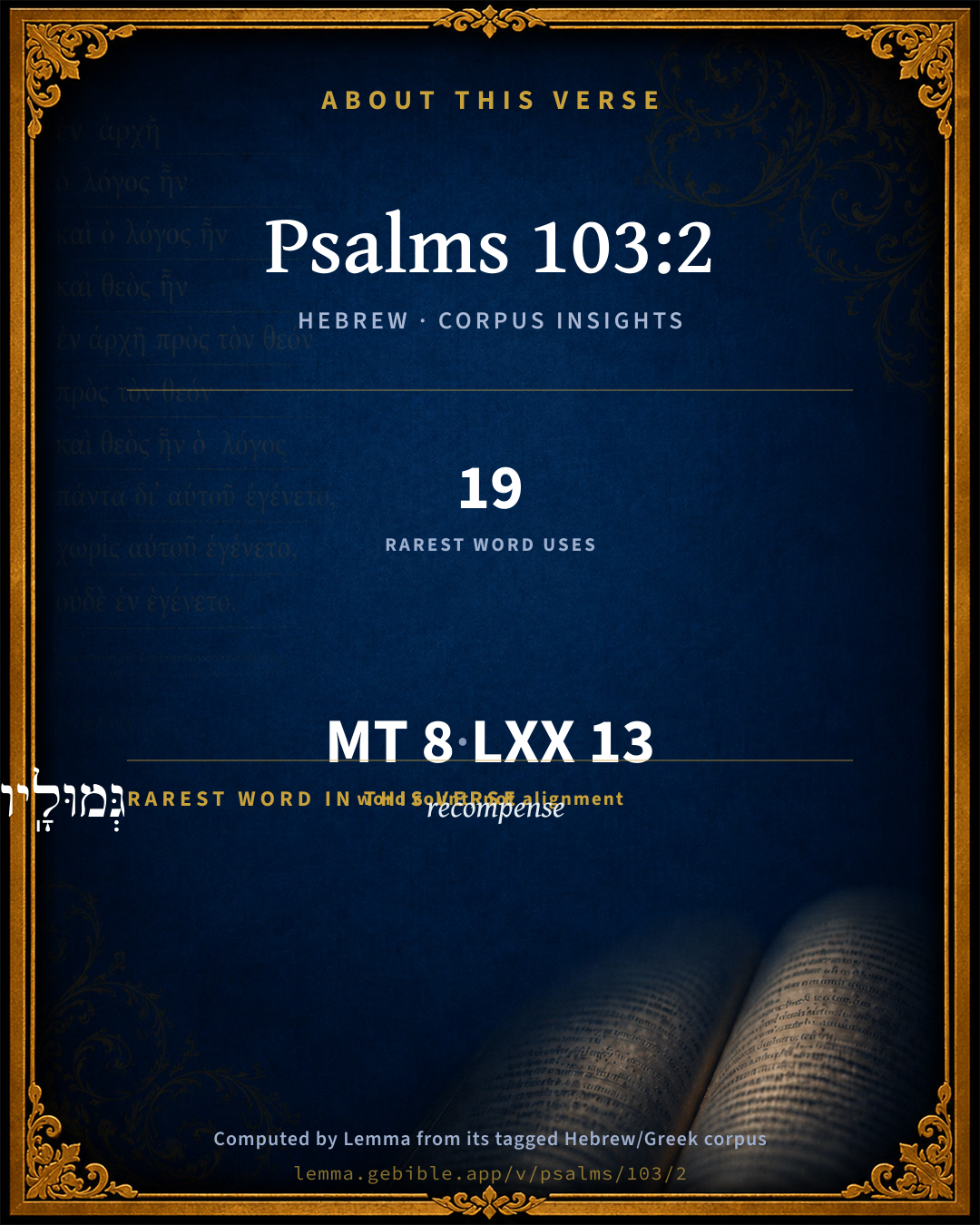
The rarest word here is גְּמוּלָֽיו recompense H1576 — appearing just 19 times in the whole Hebrew Bible.

Shared distinctive vocabulary

גְּמוּלָֽיו recompense H1576 occurs in 17 verses of the Hebrew Bible. Also found in:

Grammatical profile

  • 2 verbs
  • 4 nouns
  • 2 particles

Verb forms

  • בָּרֲכִ֣י Piel · Imperative
  • תִּ֝שְׁכְּחִ֗י Qal · Jussive

Hebrew & Septuagint length

In English translation the verse runs 10 words from the Hebrew and 12 from the Septuagint (LXX English) — closely comparable.

A rough comparison of the two English renderings, which tokenize alike — not a word-level alignment.

Word counts can differ between the Hebrew and the Greek without any difference in meaning — e.g. the Hebrew direct-object marker אֵת has no separate Greek word, and Greek often adds the article ὁ.

In the original languages it is 8 Hebrew tokens and 13 Greek tokens — but the two are counted differently (Hebrew bundles its prefixes and suffixes into one token; the Greek is in lemma form), so that isn’t a like-for-like length.

Cross-references

15

Topical passages linked to Psalms 103:2 in the Treasury of Scripture Knowledge — connected by theme and wording, ordered by reader-vote popularity; previews shown in the World English Bible.

  • Psalms 116:12 What will I give to Yahweh for all his benefits toward me?
  • Isaiah 63:7 I will make mention of the loving kindnesses of Yahweh, [and] the praises of Yahweh, according to all that Yahweh has bestowed on us, and the great goodness toward the house of Israel, which he has bestowed on them according to his mercies, and according to the multitude of his loving kindnesses.
  • Psalms 105:5 Remember his marvelous works that he has done; His wonders, and the judgments of his mouth,
  • Luke 17:15–18 One of them, when he saw that he was healed, turned back, glorifying God with a loud voice.
  • Deuteronomy 6:12 then beware lest you forget Yahweh, who brought you forth out of the land of Egypt, out of the house of bondage.
  • Deuteronomy 32:18 Of the Rock that became your father, you are unmindful, Have forgotten God who gave you birth.
  • Deuteronomy 32:6 Do you thus requite Yahweh, Foolish people and unwise? Isn't he your father who has bought you? He has made you, and established you.
  • 2 Chronicles 32:25 But Hezekiah didn't render again according to the benefit done to him; for his heart was lifted up: therefore there was wrath on him, and on Judah and Jerusalem.
  • Psalms 106:21 They forgot God, their Savior, Who had done great things in Egypt,
  • Deuteronomy 8:10–14 You shall eat and be full, and you shall bless Yahweh your God for the good land which he has given you.
  • Deuteronomy 8:2–4 You shall remember all the way which Yahweh your God has led you these forty years in the wilderness, that he might humble you, to prove you, to know what was in your heart, whether you would keep his commandments, or not.
  • Psalms 106:7 Our fathers didn't understand your wonders in Egypt. They didn't remember the multitude of your loving kindnesses, But were rebellious at the sea, even at the Red Sea.
  • Jeremiah 2:31–32 Generation, see the word of Yahweh. Have I been a wilderness to Israel? or a land of thick darkness? why say my people, We are broken loose; we will come no more to you?
  • Ephesians 2:11–13 Therefore remember that once you, the Gentiles in the flesh, who are called "uncircumcision" by that which is called "circumcision," (in the flesh, made by hands);
  • Isaiah 63:1 Who is this who comes from Edom, with dyed garments from Bozrah? this who is glorious in his clothing, marching in the greatness of his strength? I who speak in righteousness, mighty to save.

Cross-references courtesy of OpenBible.info (CC BY 4.0).

Hebrew and Greek witnesses Masoretic Hebrew ↔ Greek Septuagint

The same verse in the two great witnesses to the Old Testament, shown verse-for-verse.

You’re reading Greek Psalm 102 (Hebrew Psalm 103). The Septuagint counts the superscription, so verse numbers can differ from the Hebrew — chapter-level alignment, not verse-by-verse. Numbering follows Rahlfs.

These are two independent witnesses, not word-aligned to each other, and the Septuagint is shown in lemma (dictionary) form.

Hebrew Psalms 103:2 Masoretic · Westminster Leningrad Codex

בָּרֲכִ֣י נַ֭פְשִׁי אֶת יְהוָ֑ה וְאַל תִּ֝שְׁכְּחִ֗י כָּל גְּמוּלָֽיו

Praise Yahweh, my soul, And don't forget all his benefits;

World English Bible · Public Domain

Greek LXX Greek Psalm 102:2 Septuagint · lemma form

εὐλογέω ὁ ψυχή ἐγώ ὁ κύριος καί μή ἐπιλανθάνω πᾶς ὁ ἀνταπόδοσις αὐτός

Bless the Lord, O my soul, and forget not all his praises:

LXX2012 (modern English Septuagint) · Public Domain

Hebrew: Westminster Leningrad Codex (CC BY 4.0). Greek: Septuagint (public domain); English from LXX2012 (modern English Septuagint) (Public Domain). How the Septuagint differs from the Hebrew →

Commentary

Notes on Psalms 103:2 from classic Christian and Jewish commentators (each source and its license shown beneath its notes). The classic Christian expositions comment on the surrounding passage and are grouped to its opening verse, so a note may address several verses; the Jewish commentaries on the Tanakh (Rashi and others) are per-verse, so they appear only where the commentator wrote on this verse.

Lemma curates 59 commentaries, every one of them public domain or Creative Commons licensed, each selected and text-cleaned for this edition rather than reprinted as found. About our sources →

Trapp's Complete Commentary

John Trapp

Psa 103:2 Bless the LORD, O my soul, and forget not all his benefits:

Ver. 2. Bless the lord, O my soul] David found some dulness and drowsiness; hence he so oft puts the thorn to the breast; hence he so impetuously instigateth his soul, as one here phraseth it.

And forget not all his benefits] Forgetfulness is a grave; look to it: eaten bread is soon forgotten with us, as it is with children; neither perisheth anything so soon with many as a good turn, Aμναμονες οι βροτοι (Pindar). Alphonsus, king of Arragon, professed that he wondered not so much at his courtiers’ ingratitude to him (who had raised many of them from mean to great estates, which they little remembered) as at his own to God.

John Trapp, A Commentary or Exposition upon All the Books of the Old and New Testament (1647–1656) — public domain. Text from a community e-Sword module.

The Biblical Illustrator

Joseph S. Exell

Psa_103:2

Forget not all His benefits.

Remembrance of Gods benefits

I. Some of those things we have to remember.

1. The pardon of sin.

2. The various providential mercies we have received during our lives.

3. The hope of a renewed life beyond the grave.

II. Some of the advantages attending this recollection of the Divine goodness.

1. It will convince us of the fact of Gods providential care of us.

2. It will preserve us from undue despondency under the adverse providences of God.

3. It will help us to connect the thoughts of God with every detail of our common life.

III. A few directions for the discharge of this duty.

1. Take no step in life without a previous reference to the law of God.

2. Remember those seasons of life in which Divine providence appeared for you in a remarkable manner. All have such seasons: your first settlement in life--your going out into a situation--the choice of a trade or profession--the first definite step.

3. Remember that it will be utterly inexcusable hereafter if we pass through life without the recognition of God. (W. G. Barrett.)

Motives to gratitude

I. Some of the mercies which we are called on to acknowledge.

1. The possession of life.

2. The continuance of bodily health and enjoyment.

3. Protection from numerous dangers, and the supply of constantly returning wants.

II. The manner in which this acknowledgment should be made.

1. Grateful emotions should be felt in the heart.

2. The devout and grateful aspiration of the heart to God.

3. The offering of praise and thanksgiving in public, that others may be encouraged, and may unite with you in the delightful exercise.

4. Corresponding devotedness of life to God must accompany these feelings of the heart, and these public expressions of thanksgiving. (Essex Remembrancer.)

Why we should bless God for His mercies

I. For the sake of the mercies themselves. Are they not worth it? Is there a year, a day, an hour, which is not crowded with them?

II. For the sake of the giver. If they came from a dear earthly friend, should we not prize them for friendships sake? If they flowed from royal bounty, would we not be profuse in our praise and feel burdened with a sense of our obligation? But all our mercies are the gifts of God our Heavenly Father; they are the purchase of infinite love; they flow to us through Christ. We can render no returns for them save gratitude, praise and service.

III. For the sake of our example--our influence on others. The tone and tint of our religion go very far in impressing ethers. One happy, bright, ever rejoicing and praising Christian will impart cheer and life to a whole circle, while one gloomy, despondent, ever-mourning disciple will chill a prayer-meeting, and often a whole church.

IV. For their own sake. It is their birthright. It is honouring to God their Saviour. It is in harmony with the spirit and purpose of the Cross. It is the spirit of the heavenly world. It is the first notes of the song everlasting that will resound through all the mansions of glory and give expression to the gratitude and harmony of the redeemed. (Homiletic Review.)

The believer gratefully recounting his mercies

I. The exhortation given. Show that you do not slight the benefits which God has bestowed upon you, but hold them up, and evidence your gratitude before God and the Church.

1. Publicly.

2. In private.

3. By your actions.

II. The benefit declared. Who forgiveth all thine iniquities, Not a part of them; not the greatest sins which we may have committed, to the exclusion of the less.

III. The communication made. Who healeth all thy diseases. And truly our diseases are many. Look at the disease of the understanding. Although it may be brought by tuition to the comprehension of much that relates to our redemption, it is nevertheless totally incapable of comprehending Divine things, unless God heals it; for the understanding is so corrupted by sin, that the natural man receiveth not the things of the Spirit of God, neither can he know them. And how is this done? The operation of the Spirit of God consisteth in letting light into the understanding--the light of life--Jesus Christ our Lord. So there is the rectification of the will. Though our wills are naturally stubborn, and we are inclined to turn to that which is opposed to God, and to turn from God, yet let but the Holy Spirit enter into our understandings and our wills, and then we find rectitude. Thus He healeth our will. He further gives a direction to our affections. For the affections of the heart are all alienated. But God the Holy Spirit communicates an impulse to the soul, whereby the poisonous influences of this terrestrial atmosphere are so far counteracted that they shall not be fatal to our souls.

IV. A deliverance accomplished. Who redeemeth thy life from destruction--i.e. from the consequences of sin, from the love of sin, from the fear of death; and from eternal torment.

V. The reception of a promised blessing. Crowning the soul here denotes the application of these wonderful mercies, which God has communicated to us in Christ. It signifies the enjoyment of them all. It further signifies power over sin and Satan.

VI. The gratification of the spiritual appetite. Who satisfieth thy mouth with good things.

VII. thy youth is renewed like the eagles. This expression is used to signify, that saints, through the grace of God, even in old age become fat and flourishing, steadfast and unmovable, fruitful in every good word and work. They run and are not weary, they walk and do not faint; and they rejoice in the approach of their end. (T. B. Baker, M.A.)

The memory

By memory two things are designated, which are really very distinct; the one is the power of bringing past experience into consciousness; and the other is the power of retaining past experience in the mind out of consciousness. Suppose I meet a friend. He says to me as we meet, What is the Latin for door? I answer at once, Janua. The question has brought this Latin word at the moment into my consciousness, and we say that I remembered it. But if I am a Latin scholar there are thousands of Latin words in my mind; not in the sense of being at present in my consciousness--because all the Latin I am conscious of at the moment is janua--but in the sense that I am capable of bringing them into consciousness when required. Perhaps it would be a good thing if in English these two powers were designated by two words instead of one. They are in other languages. This is the difference in German between erinnerung and gedachtniss; and in French between the word souvenir and memoire. Perhaps in English the power of bringing past experience into present consciousness might be called recollection, while the word memory might be reserved for the other power of keeping past experience in the mind out of consciousness. This latter power of keeping past experience in the mind out of consciousness is in some respects the most extraordinary feature in the whole realm of psychology. You might put it in this way, that at the back of our present consciousness--I mean the consciousness of the moment--there stretches within us a vast treasury or magazine in which past impressions are stored. In some people it is larger, in others smaller; in some minds it may be slight, in others well arranged. You can hardly help thinking of it, in some people, as comparable to one of the huge warehouses of this city, where the passages are like streets for length, and there are ever so many departments, but everything is in its own place. Things that are like one another are found near one another, and the master has complete hold over all his possessions. But where is this storehouse? Has it a local habitation? Is it in the head, or where is it? Perhaps there is nothing which is so antagonistic to a materialistic view of the human mind. You know materialism holds that thought is simply a movement of matter; but if so, in what form do these modifications of matter continue so as to be remembered? If they were additions to the matter of the brain, however slight, they would very soon expand far beyond the holding power of the skull. If they were marks, like tracks or other marks, they would soon be covered up, so as to be wholly irrecoverable. The spiritual view looks on mind, as a whole, as a mystery; and it refers, especially this aspect of memory, to the region of mystery, and that is obviously where it belongs; and though in the act of remembering, as perhaps in every mental act, the mind uses the brain as its organ, the brain is no more to be identified with the mind than the musical instrument is to be identified with the person who is playing. Great, says St. Augustine in his confessions, great is the force of memory, O my God; a large and boundless chamber! Who ever sounded the bottom thereof? And men go abroad to admire the heights of mountains, the mighty billows of the sea, the broad tides of rivers, the compass of the ocean, and the circuits of the stars, and pass themselves by. The second power to which the name of memory is applied is the power of bringing past experience into present consciousness. Now, in comparison with the great magazine which I have described, this power of memory takes place on a very limited stage. It is as if in front of this silent magazine there were erected a platform, to which the images of the magazine could at any time be summoned. The summons occasionally is very slight. All that is necessary often is that a passing thought should appear on the platform, when immediately a thought like it comes from within. Perhaps a whole bevy of them may come. For instance, one will go home at the holiday time to his native place, and will take a walk in some scene of beauty which he used to frequent in his boyhood; and as you go along at every step the images of the past will throng out on you, the faces of your companions and their merry talk. On this seat, you will say to yourself, I used to sit with so-and-so by my side; at that turn of the road I once thought on such a subject; across the ravine some ones voice once called to me. Images will pour out of the past on you in a perfect tumult, and you will be astonished at the vividness and minuteness of the reproduction. At other times, however, the summons has to be louder and more urgent. Sometimes, when you call for the images of the past, they will not come. Perhaps the wrong ones come, and you have to order them back to their places again. However loud you call they will not come, and you may have to go into the magazine, and search about in odd corners, and tumble things over, and at last you say, Ah, there it is; I remember. Or perhaps after all your searching you are baffled, and you say, No, I am beaten; I cannot remember. If we remembered everything we should be embarrassed with our riches. As a rule, older impressions push out newer ones, though in old age this law is reversed, although in every mind there are some memories that never become dim:

Time but the impression deeper makes,

As streams their channels deeper wear.

But the rate at which memories become dim and sink out of sight is extremely different in different minds; and one of the excellences of what is called a good memory is to have a large domain of reminiscence permanently within ones grasp. Every man of great ability thus holds sway over a wide domain of acquisition and experience. Another excellence of memory is the power of committing things rapidly to heart., as we call it. This also varies exceedingly in different persons. In some it has been almost miraculous. It is said, for instance, that the scholar Scaliger committed the Iliad to heart in three weeks, and even more astonishing feats of memory have been accomplished by men who were not in the least distinguished in other directions. And a still more curious thing is that such persons have sometimes been able to retain the things they thus rapidly committed to memory. But, as a rule, what comes quickly goes quickly. An advocate, for instance, may get up quickly details of a complicated case, and perhaps along with that the outlines of a whole science, for a particular occasion, but as soon as the occasion is past, the whole thing goes out of his memory. Perhaps the most enviable excellence of memory is the copious and ready delivery of its contents as occasion requires. It is this that makes the happy historian, because, as he writes, he can recall parallel incidents from other histories. It is this that makes the good speaker, because, as he speaks, his memory calls principles and illustrations unto his mind from which he can select what is most suitable. It is this that makes the fortune of the conversationalist; whereas the speaker who has not this quality of memory makes all his best remarks to himself on the way home after the occasion is past. The conditions of a good memory are very simple and are worth remembering. The first is, that we must attend to things as they are entering the mind. The more we attend to them at the time they are entering the mind, the more easily will we remember. Then, secondly, we remember what we have repeatedly attended to. The oftener we think of things, the more likely are we to remember them. But most important of all is emotion--to mix things as they enter the mind with emotion. Now, this will easily guide us to the religious use of memory, and I cannot help regarding it as a fortunate circumstance that we are discussing this subject to-day, because there is no day so consecrated to memory as the last Sabbath of the year. Forget not all His benefits. That is the first religious use of memory. I am sure none of us can look back over the past year, however carelessly, without observing how good God has been to us, to our families, to our Church; but we shall remember these benefits the better the more we attended to them at the time when they happened. Even, however, if we did not attend to them then, we can compel the memory to give them up. We can go into the magazine which I described, and search for what we have lost or forgotten. We can go back to the beginning of the year, and trace downwards till to-day the footsteps of our Almighty Guide. Then the other great religious use of memory, especially on a day like this, is to remember our sins. Some of them, like Gods mercies, can he seen the moment we turn our eyes in that direction, because all of us during the year have committed some sins that burn in the memory. Others may need to be called up out of the place where they are loitering because at the time they were not much Observed, our consciences not being keen. It is only as we look back on a day like this, over an important stretch of life, that we see how little use we have made of golden opportunities; how little we have grown; how little we have done; how seldom we have prayed. It is no pleasing task thus to recall our sins of the past, but it may be a very salutary one. Better to recall them now than to recall them in a place of woe. Do you remember the first word spoken to one in that place? What did Abraham say to the rich man? It was, Son, remember. Memory is the worm that dieth not. (J. Stalker, D.D.)

Count up your mercies

I. The philosophy, which underlies all true praise of God, is exceedingly slender in its analysis; there is no ponderous weight or tedious intricacy in its development.

1. Grateful thanksgiving is the most reasonable of all human duties, for the earliest instincts of our redeemed nature turn us towards the immediate acknowledgment of our vast spiritual favours received. The common courtesies and interchanges of civilities in life require the outward expression of gratitude.

2. This decent duty is easily performed. Peace is very uncertain and hard to attain, for the devil is continually coining out accusations against each believer. Repentance in ourselves has sometimes to be sought carefully, and with as many tears; for the heart of man remains stony, and is frequently in exposure by reason of regnant corruption. Gratitude is so spontaneous and natural, that a generous and manly soul has often to cheek its profuse outflow by some external force of reserve. It is actually harder to repress it than to exercise it; one is compelled to be sullen, morose, or malicious, in keeping it back.

3. Praise is the oldest duty in performance on the records of the race. Before faith was required in the human heart, before there was the least reason for repentance, when our first parents dwelt in primal purity within the undefiled precincts of Paradise, even then they cherished the spirit of thankfulness, and sang their songs of simple adoration. Hence the privilege of blessing the Lord is older than justification, older than sanctification, older than prayer, older than sacrifice.

4. Grateful praise is the longest-lived of all human obligations. It is a duty and a privilege which will never end. As the supreme truths of celestial knowledge, and the supreme felicities of glorified enjoyment, which God means to give to the redeemed, are disclosed, our souls will assuredly swell with a fresh enthusiasm, our voices will grow tremulous in the expression of a new exultation. Thanksgiving is to enter into the serene perpetuity of eternal communion with each other and with God.

II. What are the advantages which accrue from the habit of grateful praise?

1. We need not go far to find vivid illustrations of the effects produced upon ones temper and heart by a songful spirit of grateful acknowledgment. We will admit that there is much to test human patience all around us; but the question is, What are we going to do about it? We can treat the world in one of two ways. We can carp at it, and grow morose in our feeling; or we can rise cheerfully above it, and diligently seek for those kind mitigations which Divine wisdom has made to accompany all our vexatious experiences. We can wear our lives out discontentedly, finding fault with everything that is an annoyance to us; or we can labour trustfully on, recognizing the good, and ingeniously endeavouring to counteract and balance the evil. What we think, settles what we shall become.

2. But now add to this, that a determinate cheerfulness of praise really seems to modify work. Gratitude transmutes our disciplines into evidences of love. It is related of one of the most distinguished clergymen in England, that he always read at the family: altar, on Saturday evening, this one hundred and third psalm. But his wife died. For a moment he waited; and then he said quietly, I see no reason why we should not choose our usual song to-night. There is in the writings of old Thomas Fuller one curiously quaint paragraph, which I have often wanted to quote: Lord, my voice by nature is harsh and untunable, and it is vain to lavish any art to better it. Can my singing of psalms be pleasing to Thy ears which is unpleasant to my own? Yet, though I cannot chant with the nightingale, or chirp with the blackbird, I had rather chatter with the swallow, yea, rather croak with the raven, than be altogether silent. Hadst Thou given me a better voice, I would have praised Thee with a better voice; now what my music wants in sweetness, let it have in sense--singing praises with my understanding. Yea, Lord, create in me a new heart, therein to make melody, and I will be contented with my old voice, until, in Thy due time, being admitted unto the choir of heaven, I have another, more harmonious, bestowed on me. He does the best work, in this moping, croaking age, whose cheerful face gives the benediction of a happy heart wherever a heavy step is treading along just behind him. Think of the martyr Ignatius exclaiming, Oh, would that I could do what would make all the earth adore Thee, and psalm to Thee. (C. S. Robinson, D.D.)

Yesterdays mercies forgotten

What recollections have we of the sunsets that delighted us last year? The energy of an impression fades from the memory and becomes more and more indistinct every day. We constantly affirm that the thunderstorm of last week was the most terrible one we ever saw in our lives, because we compare it, not with the thunderstorm of last year, but only with our faded and feeble recollection of it. (John Ruskin.)

Insufficient gratitude

It is no less certain, however, that we are not so wide awake to the wrongfulness of insufficient gratitude. We are all prone to let ourselves off too easily in this respect. We let slip the memory of benefits conferred, or we fail to see our obligation for acts of unselfish service rendered to us by our best friends. We take things too much as a matter of course, not only in human relationships, but in the sphere of religion. Dante has a place in the Inferno for those who were sullen and gloomy in Gods sweet air; failing to perceive or acknowledge the Divine benefits on earth, they were condemned to continue sullen in the under-world. We are not ungrateful, but our gratitude costs us little. (R. J. Campbell.)

The Biblical Illustrator, edited by Joseph S. Exell (c. 1880s–1900s) — public domain. Text from a community e-Sword module.

J. A. Alexander on Psalms

Joseph Addison Alexander

2. (Psa 103:2) Bless, 0 my soul, Jehovah, and forget not all his dealings. The positive exhortation is repeated as a kind of foil to the negative one following, in which there seems to be allusion to the frequent admonition in the Law to Israel, not to forget the Lord who brought him up out of the land of Egypt. See Deu 6:12; Deu 8:11; Deu 8:14. The last word in the verse before us is the passive participle of a verb which means to treat, and commonly to treat well. See above, on Psa 7:4. The idea here conveyed is that of treatment, determined by the context to be kind and gracious treatment. The latitude of meaning and the plural form are both represented in the English word dealings, which, though susceptible of either application can, in this connection, only have a good one.

Joseph Addison Alexander, The Psalms Translated and Explained (1850) — public domain. Text from a community e-Sword module.

Adam Clarke's Commentary

Verse 2. Forget not all his benefits] Call them into recollection; particularize the chief of them; and here record them for an everlasting memorial.

Adam Clarke's Commentary on the Bible (1810–1826) — public domain. Text from a community e-Sword/MySword module.

John Calvin's Commentaries

2. And forget not any of his benefits Here, he instructs us that God is not deficient on his part in furnishing us with abundant matter for praising him. It is our own ingratitude which hinders us from engaging in this exercise. In the first place, he teaches us that the reason why God deals with such liberality towards us is, that we may be led to celebrate his praise; but at the same time he condemns our inconstancy, which hurries us away to any other object rather than to God. How is it that we are so listless and drowsy in the performance of this the chief exercise of true religion, if it is not because our shameful and wicked forgetfulness buries in our hearts the innumerable benefits of God, which are openly manifest to heaven and earth? Did we only retain the remembrance of them, the prophet assures us that we would be sufficiently inclined to perform our duty, since the sole prohibition which he lays upon us is, not to forget them.

John Calvin's Commentaries (1540-1563) — public domain. Text from the Calvin Translation Society English edition (1840s-50s) via the Christian Classics Ethereal Library (ccel.org). Calvin's coverage is partial (roughly two-thirds of the Bible); uncommented books and verses are honest gaps, never fabricated. The 19th-century editor's footnotes and remarks are omitted so the notes are faithfully Calvin's own voice.

Ellicott's Commentary for English Readers

(2) Benefits.—Literally, actions, whether good or bad (Jdg_9:16; Pro_12:14). But what a significance in the restricted meaning “benefits.” God’s acts are all benefits.

A Bible Commentary for English Readers, edited by Charles John Ellicott (1878–1897) — public domain. Text from a community e-Sword module.

The Cambridge Bible for Schools and Colleges

gen. ed. J. J. S. Perowne

2. forget not] “Beware lest thou forget” is the often repeated warning of Deuteronomy (Deu_6:12; Deu_8:11; &c.). “Si oblivisceris tacebis” is St Augustine’s comment.

The Cambridge Bible for Schools and Colleges (gen. ed. J. J. S. Perowne; Cambridge University Press, 1878–1918) — public domain. Text from a community e-Sword module.

John Gill's Exposition

Bless the Lord, O my soul,.... Which is repeated to show the importance of the service, and the vehement desire of the psalmist, that his soul should be engaged in it:

and forget not all his benefits; not any of them; the least of them are not to be forgotten, being such as men are altogether unworthy of; they flow not from the merit of men, but from the mercy of God; and they are many, even innumerable; they are new every morning, and continue all the day; and how great must the sum of them be, and not one should be forgotten; and yet even good men are very apt to forget them; as the Israelites of old, who sung the praises of the Lord, and soon forgot his works: the Lord, knowing the weakness of his people's memories, has not only, under the Gospel dispensation, appointed an ordinance, to be continued to the end of the world, to commemorate a principal blessing and benefit of his, redemption by his Son; but has also promised his Spirit, to bring all things to their remembrance; and this they should be concerned for, that they do remember what God has done for them, in order both to show gratitude and thankfulness to him, and for the encouragement of their faith and hope in him.

John Gill's Exposition of the Whole Bible (1746–1763) — public domain (CC PDM 1.0). Text via the HelloAO Bible API.

Albert Barnes' Notes on the Bible

Bless the Lord, O my soul - The repetition here denotes the intensity or earnestness of the wish or desire of the psalmist. It is an emphatic calling upon his soul, that is, himself, never to forget the many favors which God was continually conferring upon him.

And forget not all his benefits - Any of his favors. This refers not to those favors in the aggregate, but it is a call to remember them in particular. The word rendered “benefits” - גמול gemûl - means properly an act, work, doing, whether good or evil, Psa 137:8; and then, “desert,” or what a man deserves “for” his act; “recompence.” It is rendered “deserving” in Jdg 9:16; benefit, as here, in 2Ch 32:25; “desert,” Psa 28:4; “reward,” Psa 94:2; Isa 3:11; Oba 1:15; “recompence,” Pro 12:14; Isa 35:4; Isa 59:18; Isa 66:6; Jer 51:6; Lam 3:64; Joe 3:4, Joe 3:7. The proper reference here is to the divine “dealings,” - to what God had done - as a reason for blessing his name. His “dealings” with the psalmist had been such as to call for praise and gratitude. What those “dealings” particularly were he specifies in the following verses. The call here on his soul is not to forget these divine dealings, as laying the foundation for praise. We shall find, when we reach the end of life, that all which God has done, however dark and mysterious it may have appeared at the time, was so connected with our good as to make it a proper subject of praise and thanksgiving.

Albert Barnes' Notes on the Bible (1834–1885) — public domain. Text from a community e-Sword/MySword module.

The Treasury of David

Charles H. Spurgeon

Ver. 2. Bless the LORD, O my soul. He is in real earnest, and again calls upon himself to arise. Had he been very sleepy before? Or was he now doubly sensible of the importance, the imperative necessity of adoration? Certainly, he uses no vain repetitions, for the Holy Spirit guides his pen; and thus he shews us that we have need, again and again, to bestir ourselves when we are about to worship God, for it would be shameful to offer him anything less than the utmost our souls can render. These first verses are a tuning of the harp, a screwing up of the loosened strings that not a note may fail in the sacred harmony.

And forget not all his benefits. Not so much as one of the divine dealings should be forgotten, they are all really beneficial to us, all worthy of himself, and all subjects for praise. Memory is very treacherous about the best things; by a strange perversity, engendered by the fall, it treasures up the refuse of the past and permits priceless treasures to lie neglected, it is tenacious of grievances and holds benefits all too loosely. It needs spurring to its duty, though that duty ought to be its delight. Observe that he calls all that is within him to remember all the Lord's benefits. For our task our energies should be suitably called out. God's all cannot be praised with less than our all.

Reader, have we not cause enough at this time to bless him who blesses us? Come, let us read our diaries and see if there be not choice favours recorded there for which we have rendered no grateful return. Remember how the Persian king, when he conld not sleep, read the chronicles of the empire, and discovered that one who had saved his life had never been rewarded. How quickly did he do him honour! The Lord has saved us with a great salvation, shall we render no recompense? The name of ingrate is one of the most shameful that a man can wear; surely we cannot be content to run the risk of such a brand. Let us awake then, and with intense enthusiasm bless Jehovah.

Ver. 2. Bless the Lord, O my soul. David found some dulness and drowsiness; hence he so often puts the thorn to his breast; hence he so impetuously instigateth his soul, as one here phraseth it. John Trapp.

Ver. 2. Forget not. This touches the secret spring of so much ingratitudeforgetfulness, the want of re-collection, or gathering together again of all the varied threads of mercy. Compare De 6:12; De 8:11, 14. "Si oblivisceris, tacebis" (If thou forgettest, thou wilt be silent). J. J. S. Perowne.

Ver. 2. Forget not all his benefits. That is, forget not any of his benefits, as the form of speech in the original doth import. David Dickson.

Ver. 2. Benefits. The word rendered "benefits" lwmg gemul, means properly an act, work, doing, whether good or evil, Ps 137:8; and then, desert, or what a man deserves for his act; recompense. It is rendered deserving in Jud 9:16; benefit, as here, in 2Ch 32:25; desert, Ps 28:4; reward, Ps 94:2 Isa 3:11 Ob 1:15; recompense, Pr 12:14 Isa 35:4 59:18 66:6 Jer 51:6 La 3:64 Joe 3:4, 7. The proper reference here is to the Divine dealings, to what God had done, as a reason for blessing his name. His dealings with the Psalmist had been such as to call for praise and gratitude. What those dealings particularly were he specifies in the following verses. Albert Barnes.

Ver. 2. Inquire into the causes of our frequent forgetfulness of the Lord's mercies, show the evil of it, and advise remedies.

Psalms 103:3*

Charles H. Spurgeon's The Treasury of David (1869–1885) — public domain. Psalms only. Text from a community e-Sword/MySword module.

Whedon's Commentary on the Bible

Daniel D. Whedon

2. Forget not all his benefits—A commandment of the law, Deu_6:12; Deu_8:11-14; (compare, also, Deu_32:15,) and a first duty of the creature. “He that has been blessed, and refuses to bless, has sunk from the state of a man to that of a beast.”— Hengstenberg.

All—That is, any; the same word as in Psa_147:20

Daniel D. Whedon (gen. ed.), Commentary on the Old and New Testaments (1874–1909) — public domain. Text from a community e-Sword module.

The Pulpit Commentary

Bless the Lord, O my soul. Repetition, in Holy Scripture, is almost always for the sake of emphasis. It is not vain repetition." Our Lord often uses it: "Verily, verily, I say unto you;" "My God, my God, why hast thou forsaken me?... Feed my sheep... Feed my sheep." And forget not all his benefits. (comp. Deu_6:12 Deu_8:11, Deu_8:14, etc.) Man is so apt to "forget," that he requires continual exhortation not to do so.

The Pulpit Commentary (1880–1919), ed. H.D.M. Spence-Jones & Joseph S. Exell — public domain. Text from a community e-Sword module.

Lesson kit

Teaching starters — assembled from the data on this page, not authored interpretation. Every prompt links to the verse data it draws on. Edit before teaching.

Psalms, in the Wisdom, opens this verse with 8 words (8 distinct Hebrew lemmas). Its most distinctive word is gᵉmûwl (“recompense”). A historical commentator’s framing appears above. Read the whole chapter for the surrounding context.

Discussion questions

  1. The word gᵉmûwl carries the sense “recompense.” How does it shape the verse?
  2. Judges 9:16 shares the word «recompense» with this verse. How do the two illuminate each other?
  3. These translations render this verse differently. What is at stake in choosing one wording over another?
  4. The verb «בָּרֲכִ֣י» is Piel Imperative. How does its form color the action?
  5. Reading how Trapp's Complete Commentary and The Biblical Illustrator read this verse, where do the two commentators agree and where do they part?

Things to notice

Reading settings

Reading text

Shown beneath each verse's original-language words.

Old Testament
Old Testament edition

Read the OT as the Masoretic Hebrew (MT) or the Greek Septuagint (LXX).

English shown for the Greek Septuagint (in the Hebrew ↔ Greek comparison).

Comparing translations? Open the Compare panel on any verse page to stack up to four side by side.