
Psalms 119:16

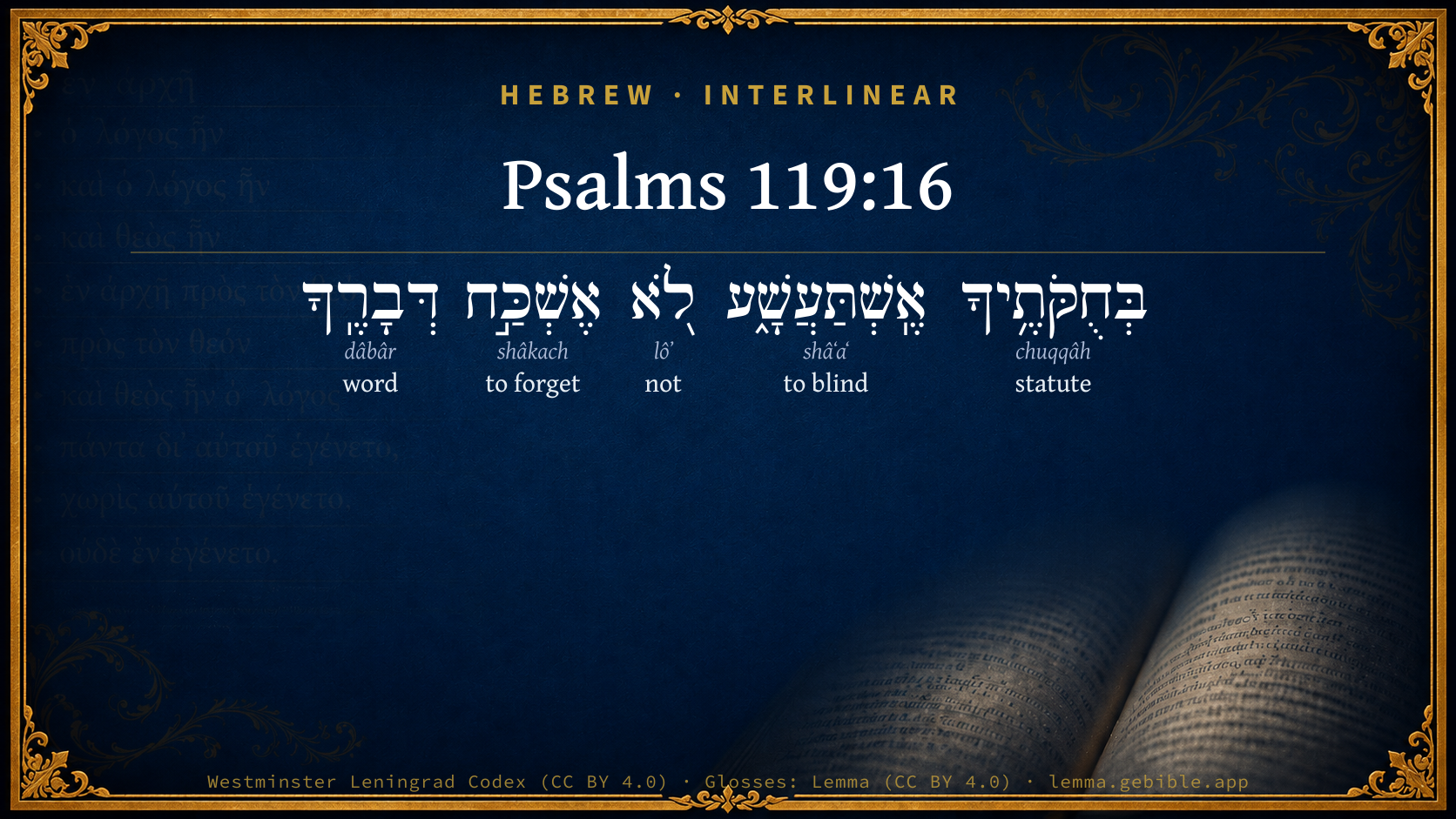
Hebrew (Westminster Leningrad Codex) Psalms 119:16 appears in the Hebrew Old Testament. The text above is from the Westminster Leningrad Codex. Each word links to its Strong’s number, a concise gloss, and parsing drawn from the Open Scriptures Hebrew Bible morphology. Click any word for its full Brown-Driver-Briggs (BDB) entry.
Download image
Cite this verse

Psalms 119:16 (World English Bible). Public Domain. Lemma interlinear Bible study tool, https://lemma.gebible.app/v/psalms/119/16.

Show BibTeX & RIS
BibTeX
RIS
English Translation
I will delight myself in your statutes. I will not forget your word.
World English Bible · Public Domain
Download a study sheet

One document with this verse’s original text, its word-by-word gloss line, the meaning frame, cross-references with their text, attributed commentary, and full source and license credits — printable, and it pastes into notes with its structure intact.

This verse Autodidact and up

Study sheet (.html) Plain text (.txt)

A passage Seminary Student

Up to 50 verses in one chapter. A passage sheet keeps up to 6 commentary sources and 12 cross-references per verse, in the order this page ranks them, and says so on the sheet whenever that leaves anything out. Ask for a single verse and you get the Autodidact verse sheet above.

Everything on this page stays free to read, with no account — the sheet is a download of what is already on screen, not access to it.

Want to remove ads? Support Godless Engineer
Compare translations 3

The same verse in 3 English versions, stacked beneath the original-language interlinear above. Click any original word for its lexicon entry.

Each is an independent rendering of the whole verse — the interlinear is not word-aligned to these translations.

Highlighted words mark where these versions differ — a whole-verse word diff, not a word-by-word alignment.

  • World English Bible Public Domain
    I will delight myself in your statutes. I will not forget your word.
  • King James Version Public Domain
    I will delight myself in thy statutes: I will not forget thy word.
  • unfoldingWord Literal Text CC BY-SA 4.0
    I delight in your statutes; I will not forget your word. GIMEL

unfoldingWord Literal Text — © unfoldingWord, licensed CC BY-SA 4.0. Word-aligned USFM3 via Door43 (git.door43.org/unfoldingWord/en_ult).

Versions to compare (up to 4)

3 of 4 selected

Show all 17 translations

Every available English version of this verse, each an independent rendering of the whole verse.

  • World English Bible Public Domain
    I will delight myself in your statutes. I will not forget your word.
  • Berean Standard Bible Public Domain
    I will delight in Your statutes; I will not forget Your word.
  • Majority Standard Bible Public Domain
    I will delight in Your statutes; I will not forget Your word.
  • King James Version Public Domain
    I will delight myself in thy statutes: I will not forget thy word.
  • American Standard Version (1901) Public Domain
    I will delight myself in thy statutes: I will not forget thy word.
  • Revised Version (1885) Public Domain
    I will delight myself in thy statutes: I will not forget thy word.
  • Geneva Bible (1599) Public Domain
    I will delite in thy statutes, and I will not forget thy worde.
  • Young's Literal Translation Public Domain
    In Thy statutes I delight myself, I do not forget Thy word.
  • Literal Standard Version CC BY-SA 4.0
    I delight myself in Your statutes, || I do not forget Your word.
  • Unlocked Literal Bible CC BY-SA 4.0
    I delight in your statutes; I will not forget your word.
  • unfoldingWord Literal Text CC BY-SA 4.0
    I delight in your statutes; I will not forget your word. GIMEL
  • Darby Bible Public Domain
    I delight myself in thy statutes; I will not forget thy word.
  • World Messianic Bible Public Domain
    I will delight myself in your statutes. I will not forget your word. GIMEL
  • Webster's Bible Public Domain
    I will delight myself in thy statutes: I will not forget thy word.
  • Free Bible Version CC BY-SA 4.0
    I will take pleasure in following your directions; I won't forget what you say. Gimel
  • Bible in Basic English Public Domain
    I will have delight in your rules; I will not let your word go out of my mind.
  • JPS Tanakh (1917) Public Domain
    I will delight myself in Thy statutes; I will not forget Thy word.

Literal Standard Version (2020), Covenant Press — licensed CC BY-SA 4.0. Text via the HelloAO Bible API (eBible.org). Unlocked Literal Bible (unfoldingWord) — licensed CC BY-SA 4.0. Text via the HelloAO Bible API (eBible.org). unfoldingWord Literal Text — © unfoldingWord, licensed CC BY-SA 4.0. Word-aligned USFM3 via Door43 (git.door43.org/unfoldingWord/en_ult). Free Bible Version, Dr. Jonathan Gallagher — licensed CC BY-SA 4.0. Text via the HelloAO Bible API (eBible.org).

Word by word

More ways to search: Search by grammar → Find every occurrence → Compare this word →

Practice this passage: Drill this verse → Learn its vocabulary →

אֶֽשְׁתַּעֲשָׁ֑ע
shâʻaʻ
H8173
“to blind”
Verb, Hithpalpel, Imperfect, 1st Person, Common, Singular
Part of Speech
Verb
Stem
Hithpalpel
Form
Imperfect
Person
1st Person
Gender
Common
Number
Singular
Full BDB Definition

Origin: a primitive root

TWOT: 2435 , 2436

to stroke, be smeared over, be blinded - (Qal) - to be smeared over, be blinded - to smear eyes shut - (Hiphil) to besmear (of eyes), smear over eyes - (Hithpalpel) to blind oneself, be blinded - to sport, take delight in - (Pilpel) to sport, delight in, take delight in, delight oneself - (Palpal) to be fondled - (Hithpalpel) to delight oneself
  1. בְּחֻקֹּתֶ֥יךָ chuqqâh H2708 “in/at · statutes · your” Preposition + Noun, Common, Both, Plural, Construct + Suffix, Personal, 2nd Person, Masculine, Singular
  2. לֹ֭א lôʼ H3808 “not” Particle, Negative
  3. אֶשְׁכַּ֣ח shâkach H7911 “to forget” Verb, Qal, Imperfect, 1st Person, Common, Singular
  4. דְּבָרֶֽךָ dâbâr H1697 “word · your” Noun, Common, Masculine, Singular, Construct + Suffix, Personal, 2nd Person, Masculine, Singular

About this verse

These counts appear in no published source. They are computed here, from the morphology-tagged text and Lemma’s own curated glosses. What Lemma adds →

5
words
5
distinct lemmas
Wisdom
section

Notable vocabulary

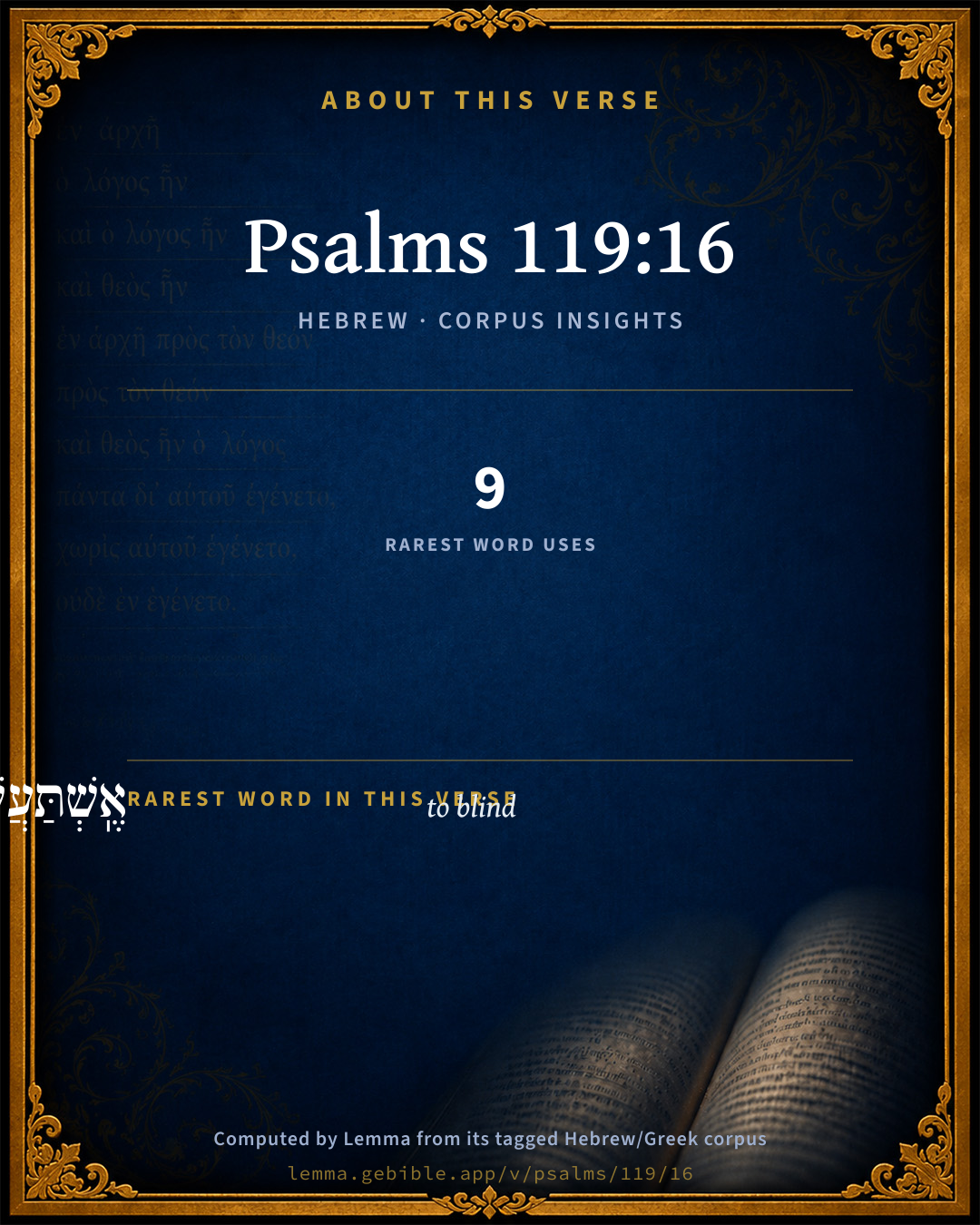
The rarest word here is אֶֽשְׁתַּעֲשָׁ֑ע to blind H8173 — appearing just 9 times in the whole Hebrew Bible.

Shared distinctive vocabulary

אֶֽשְׁתַּעֲשָׁ֑ע to blind H8173 occurs in 8 verses of the Hebrew Bible. Also found in:

Grammatical profile

  • 2 verbs
  • 2 nouns
  • 1 particle

Verb forms

  • אֶֽשְׁתַּעֲשָׁ֑ע Hithpalpel · Imperfect
  • אֶשְׁכַּ֣ח Qal · Imperfect

Hebrew & Septuagint length

In English translation the verse runs 13 words from the Hebrew and 12 from the Septuagint (LXX English) — closely comparable.

A rough comparison of the two English renderings, which tokenize alike — not a word-level alignment.

Word counts can differ between the Hebrew and the Greek without any difference in meaning — e.g. the Hebrew direct-object marker אֵת has no separate Greek word, and Greek often adds the article ὁ.

Cross-references

18

Topical passages linked to Psalms 119:16 in the Treasury of Scripture Knowledge — connected by theme and wording, ordered by reader-vote popularity; previews shown in the World English Bible.

  • Psalms 119:24 Indeed your statutes are my delight, And my counselors.
  • Psalms 119:47 I will delight myself in your commandments, Because I love them.
  • Proverbs 3:1 My son, don't forget my teaching; But let your heart keep my commandments:
  • Psalms 119:35 Direct me in the path of your commandments, For I delight in them.
  • Romans 7:22 For I delight in God's law after the inward man,
  • Psalms 119:70 Their heart is as callous as the fat, But I delight in your law.
  • Psalms 119:77 Let your tender mercies come to me, that I may live; For your law is my delight.
  • Psalms 119:83 For I have become like a wineskin in the smoke. I don't forget your statutes.
  • Psalms 119:92–93 Unless your law had been my delight, I would have perished in my affliction.
  • Psalms 119:109 My soul is continually in my hand, Yet I won't forget your law.
  • Psalms 119:141 I am small and despised. I don't forget your precepts.
  • Psalms 119:176 I have gone astray like a lost sheep. Seek your servant, for I don't forget your commandments.
  • Hebrews 10:16–17 "This is the covenant that I will make with them: 'After those days,' says the Lord, 'I will put my laws on their heart, I will also write them on their mind;'" then he says,
  • James 1:23–24 For if anyone is a hearer of the word and not a doer, he is like a man beholding his natural face in a mirror;
  • Psalms 1:2 But his delight is in Yahweh's law; On his law he meditates day and night.
  • Psalms 40:8 I delight to do your will, my God. Yes, your law is within my heart."
  • Psalms 119:14 I have rejoiced in the way of your testimonies, As much as in all riches.
  • Psalms 119:11 I have hidden your word in my heart, That I might not sin against you.

Cross-references courtesy of OpenBible.info (CC BY 4.0).

Hebrew and Greek witnesses Masoretic Hebrew ↔ Greek Septuagint

The same verse in the two great witnesses to the Old Testament, shown verse-for-verse.

You’re reading Greek Psalm 118 (Hebrew Psalm 119). The Septuagint counts the superscription, so verse numbers can differ from the Hebrew — chapter-level alignment, not verse-by-verse. Numbering follows Rahlfs.

These are two independent witnesses, not word-aligned to each other, and the Septuagint is shown in lemma (dictionary) form.

Hebrew Psalms 119:16 Masoretic · Westminster Leningrad Codex

בְּחֻקֹּתֶ֥יךָ אֶֽשְׁתַּעֲשָׁ֑ע לֹ֭א אֶשְׁכַּ֣ח דְּבָרֶֽךָ

I will delight myself in your statutes. I will not forget your word.

World English Bible · Public Domain

Greek LXX Greek Psalm 118:16 Septuagint · lemma form

ἐν ὁ δικαίωμα σύ μελετάω οὐ ἐπιλανθάνω ὁ λόγος σύ

I will meditate on your ordinances: I will not forget your words.

LXX2012 (modern English Septuagint) · Public Domain

Hebrew: Westminster Leningrad Codex (CC BY 4.0). Greek: Septuagint (public domain); English from LXX2012 (modern English Septuagint) (Public Domain). How the Septuagint differs from the Hebrew →

Commentary

Notes on Psalms 119:16 from classic Christian and Jewish commentators (each source and its license shown beneath its notes). The classic Christian expositions comment on the surrounding passage and are grouped to its opening verse, so a note may address several verses; the Jewish commentaries on the Tanakh (Rashi and others) are per-verse, so they appear only where the commentator wrote on this verse.

Lemma curates 59 commentaries, every one of them public domain or Creative Commons licensed, each selected and text-cleaned for this edition rather than reprinted as found. About our sources →

Trapp's Complete Commentary

John Trapp

Psa 119:16 I will delight myself in thy statutes: I will not forget thy word.

Ver. 16. I will delight myself] Deliciabor; the Arabic hath it, lectitabo leges tuas, I will oft read over thy laws.

I will not forget] Men do therefore forget the word, because they delight not in it; they seldom forget where they lay their money.

John Trapp, A Commentary or Exposition upon All the Books of the Old and New Testament (1647–1656) — public domain. Text from a community e-Sword module.

The Treasury of David

Charles H. Spurgeon

Ver. 16. I will delight myself in thy statutes. In this verse delight follows meditation, of which it is the true flower and outgrowth. When we have no other solace, but are quite alone, it will be a glad thing for the heart to turn upon itself, and sweetly whisper, "I will delight myself. What if no minstrel sings in the hall, I will delight myself. If the time of the singing of birds has not yet arrived, and the voice of the turtle is not heard in our land, yet I will delight myself." This is the choicest and noblest of all rejoicing; in fact, it is the good part which can never be taken from us; but there is no delighting ourselves with anything below that which God intended to be the soul's eternal satisfaction. The statute book is intended to be the joy of every loyal subject. When the believer once peruses the sacred pages his soul burns within him as he turns first to one and then to another of the royal words of the great King, words full and firm, immutable and divine.

I will not forget thy word. Men do not readily forget that which they have treasured up, that which they have meditated on (Ps 119:15), and that which they have often spoken of (Ps 119:13). Yet since we have treacherous memories it is well to bind them well with the knotted cord of "I will not forget."

Note how two "I wills" follow upon two "I haves." We may not promise for the future if we have altogether failed in the past; but where grace has enabled us to accomplish something, we may hopefully expect that it will enable us to do more.

It is curious to observe how this verse is moulded upon Ps 119:8: the changes are rung on the same words, but the meaning is quite different, and there is no suspicion of a vain repetition. The same thought is never given over again in this Psalm; they are dullards who think so. Something in the position of each verse affects its meaning, so that even where its words are almost identical with those of another the sense is delightfully varied. If we do not see an infinite variety of fine shades of thought in this Psalm we may conclude that we are colour blind; if we do not hear many sweet harmonies, we may judge our ears to be dull of hearing, but we may not suspect the Spirit of God of monotony.

Ver. 16. I will delight myself, etc. He protested before that he had great delight in the testimonies of God: now he saith he will still delight in them. A man truly godly, the more good he doth, the more he desires, delights and resolves to do. Temporisers, on the contrary, who have but a show of godliness, and the love of it is not rooted in their heart, how soon are they weary of well doing! If they have done any small external duty of religion, they rest as if they were fully satisfied, and there needed no more good to be done by them. True religion is known by hungering and thirsting after righteousness, by perseverance in well doing, and an earnest desire to do more.

But to this he adds that he will not forget the word. The graces of the Spirit do every one fortify and strengthen another; for ye see meditation helps consideration. Who can consider of that whereof he thinks not? Consideration again breeds delectation; and as here ye see, delectation strengthens memory: because he delights in the word he will not forget the word; and memory again renews meditation. Thus every grace of the Spirit helps another; and by the contrary, one of them neglected, works a wonderful decay of the remnant. William Cowper.

Ver. 16 I will delight myself When righteousness, from a matter of constraint becomes a matter of choice, it instantly changes its whole nature, and rises to a higher moral rank than before. The same God whom it is impossible to move by law's authority, moves of his own proper and original inclination in the very path of the law's righteousness. And so, we, in proportion as we are like unto God, are alive to the virtues of that same law, to the terror of whose severities we are altogether dead. We are no longer under a schoolmaster; but obedience is changed from a thing of force into a thing of freeness. It is moulded to a higher state and character than before. We are not driven to it by the God of authority. We are drawn to it by the regards of a now willing heart to all moral and all spiritual excellence. Thomas Chalmers, 1780-1847.

Ver. 16. Meditation must not be a dull, sad, and dispirited thing: not a driving like the chariots of the Egyptians when their wheels were taken off, but like the chariots of Amminadib (So 6:12) that ran swiftly. So let us pray, Lord, in meditation make me like the chariots of Amminadib, that my swift running may evidence my delight in meditating. Holy David makes delight such an ingredient or assistant here, that sometimes he calls the exercise of meditation by the name of "delight, "speaking in the foregoing verse of this meditation, "I will meditate of thy precepts, "and in Ps 119:16, I will delight myself in thy statutes; which is the same with meditation, only with superadding the excellent qualification due meditation should have; the name of delight is given to meditation because of its noble concomitant holy joy and satisfaction. Nathanael Ranew.

Ver. 16. Delight myself. The word is very emphatic: evetva, eshtaasha, I will skip about and jump for joy. Adam Clarke.

Ver. 16. I will not forget. Delight prevents forgetfulness: the mind will run upon that which the heart delighteth in; and the heart is where the treasure is (Mt 6:21). Worldly men that are intent upon carnal interests, forget the word, because it is not their delight. If anything displeases us, we are glad if we can forget it; it is some release from an inconvenience, to take off our thoughts from it; but it doubles the contentment of a thing that we are delighted in, to remember it, and call it to mind. In the outward school, if a scholar by his own averseness from learning, or by the severity and imprudence of his master, hath no delight in his book, all that he learns is lost and forgotten, it goeth in at one ear, and out at the other: but this is the true art of memory, to cause them to delight in what they learn. Such instructions as we take in with sweetness, they stick with us, and run in our minds night and day. So saith David here, I will delight myself in thy statutes: I will not forget thy word. Thomas Manton.

Ver. 16. Forget. I never yet heard of a covetous old man, who had forgotten where he had buried his treasure. Cicero de Senectute.

Ver. 16.

1. What there is to be delighted in.

2. What comes of such delight: "I will never forget."

3. What comes of such memory more delight.

Psalms 119:17*

Ver. 17-24 In this section the trials of the way appear to be manifest to the Psalmist's mind, and he prays accordingly for the help which will meet his case. As in the last eight verses he prayed as a youth newly come into the world, so here he pleads as a servant and a pilgrim, who growingly finds himself to be a stranger in an enemy's country. His appeal is to God alone, and his prayer is specially direct and personal. He speaks with the Lord as a man speaketh with his friend.

Charles H. Spurgeon's The Treasury of David (1869–1885) — public domain. Psalms only. Text from a community e-Sword/MySword module.

J. A. Alexander on Psalms

Joseph Addison Alexander

16. (Psa 119:16) In thy statutes I will delight myself; I will not forget thy word. Delight or enjoy myself, seek my pleasure, find my happiness. Hero ends the second stanza, in which all the verses except one (Psa 119:12) begin not only with the same letter but the same word, the preposition in.

Joseph Addison Alexander, The Psalms Translated and Explained (1850) — public domain. Text from a community e-Sword module.

Adam Clarke's Commentary

Verse 16. I will delight myself] The word is very emphatical: אשתעשע eshtaasha, I will skip about and jump for joy.

14. He must exult in God's word as his treasure, live in the spirit of obedience as his work, and ever glory in God, who has called him to such a state of salvation.

15. He must never forget what God has done for him, done in him, and promised farther to do; and he must not forget the promises he had made, and the vows of the Lord that are upon him. Any young man who attends to these fifteen particulars will get his impure way cleansed; victory over his sin; and, if he abide faithful to the Lord that bought him, an eternal heaven at last among them that are sanctified.

ANALYSIS OF LETTER BETH. - Second Division

In the first part the psalmist, having commended God's law, from its Author - God, and its end - happiness, shows us in the second part the efficacy and utility of it to a holy life, without which there can be no happiness. And in order to show this effect, he chooses the most unlikely subject.

I. A young man, in whom the law of the members is most strong; he wants experience; he is headstrong, and generally under the government, not of reason nor religion, but of his own passions.

II. The psalmist shows that, to cleanse the way of such, he must "take heed to them," watch over them, and "remember his Creator in the days of his youth."

As a man must become holy in order to be happy, he shows how this holiness is to be attained, and adduces his own experience.

1. Seek God with thy "whole heart." Be truly sensible of your wants.

2. Keep and remember what God says: "Thy words have I hidden," &c.

3. Reduce all this to practice: "That I might not sin against thee."

4. Bless God for what he has given: "Blessed art thou," &c.

5. Ask more: "Teach me thy statutes."

6. Be ready to communicate his knowledge to others: "With my lips have I declared."

7. Let it have a due effect on thy own heart: "I have rejoiced," &c.

8. Meditate frequently upon them: "I will meditate," &c.

9. Deeply reflect on them: "I will have respect," &c. As food undigested will not nourish the body, so the word of God not considered with deep meditation and reflection will not feed the soul.

10. Having pursued the above course, he should continue in it, and then his happiness would be secured: "I will not forget thy word. I will (in consequence) delight myself in thy statutes."

Adam Clarke's Commentary on the Bible (1810–1826) — public domain. Text from a community e-Sword/MySword module.

The Cambridge Bible for Schools and Colleges

gen. ed. J. J. S. Perowne

16. Cp. Psa_119:47; Psa_119:70.

The Cambridge Bible for Schools and Colleges (gen. ed. J. J. S. Perowne; Cambridge University Press, 1878–1918) — public domain. Text from a community e-Sword module.

John Gill's Exposition

Open thou mine eyes,.... The eyes of my heart or understanding, as Kimchi; or, "reveal mine eyes" (t); take off the veil from them: there is a veil of darkness and ignorance on the hearts of all men, with respect to divine and spiritual things; their understandings are darkened, yea, darkness itself. This veil must be removed; the scales must drop from their eyes; their eyes must be opened and enlightened, before they can discern spiritual things contained in the word of God; and even good men need to have the eyes of their understandings more and more enlightened into these things, as the psalmist here petitions, and the apostle prays for his Ephesians, Eph 1:17;

that I may behold wondrous things out of thy law; the law strictly taken, which had great and excellent things in it; and was wonderful for the compendiousness of it; for the justice, holiness, and equity of its precepts; especially for its spirituality, and above all for Christ, being the end of it; the two last more particularly could only be discerned by a spiritual man: or rather the five books of Moses, the almost only Scriptures extant in David's time, in which there were many wonderful things concerning Christ; some delivered by way of promise and prophecy of him, under the characters of the seed of the woman, the seed of Abraham, the Shiloh, and the great Prophet; and many others in dark figures, types, and shadows, which required a spiritual sight to look into; of which the rock and manna, the brasen serpent, passover, &c. are instances: but rather, as the word "law" signifies "doctrine", the doctrine of the Gospel may be meant; which contains mysteries in it, respecting the trinity of Persons in the Godhead, the person of Christ, his incarnation, sufferings and death; the blessings of grace through him; the doctrines of peace, pardon, righteousness, eternal life, and the resurrection of the dead; with many others.

(t) "revela oculos meos", Pagninus, Montanus, Musculus, Cocceius, Gejerus, Michaelis; "velamen detrahe oculis meis", Tigurine version.

John Gill's Exposition of the Whole Bible (1746–1763) — public domain (CC PDM 1.0). Text via the HelloAO Bible API.

Albert Barnes' Notes on the Bible

I will delight myself in thy statutes - I will find my happiness in thy laws. See Psa 1:2, note; Psa 112:1, note.

I will not forget thy word - I will not allow the world to crowd it out of my mind.

Albert Barnes' Notes on the Bible (1834–1885) — public domain. Text from a community e-Sword/MySword module.

The Pulpit Commentary

I will delight myself in thy statutes. (comp. vers. 24, 40, 47, 70, 77, etc.; and see also Psa_1:2) I will not forget thy Word. That which is "laid up in the heart" (ver. 11) can never be forgotten.

The Pulpit Commentary (1880–1919), ed. H.D.M. Spence-Jones & Joseph S. Exell — public domain. Text from a community e-Sword module.

Rashi

Rabbi Shlomo Yitzchaki (Rashi)

I shall occupy myself Heb. אשתעשע, I shall engage, like (Isa. 17:7): “man shall turn to his Maker”; (Exod. 5:9) “and let them not engage (ישעו) in useless things.”

Rashi on the Tanakh — English translations: “The Judaica Press complete Tanach with Rashi, translated by A. J. Rosenberg” (CC BY 4.0); “Pentateuch with Rashi's commentary by M. Rosenbaum and A.M. Silbermann, 1929-1934” (public domain); “The Metsudah Tanach series, Lakewood, N.J” (CC BY 4.0); and “The Book of Joshua, Metsudah Publications, 1997” (CC BY 4.0). Text via Sefaria.

Lesson kit

Teaching starters — assembled from the data on this page, not authored interpretation. Every prompt links to the verse data it draws on. Edit before teaching.

Psalms, in the Wisdom, opens this verse with 5 words (5 distinct Hebrew lemmas). Its most distinctive word is shâʻaʻ (“to blind”). A historical commentator’s framing appears above. Read the whole chapter for the surrounding context.

Discussion questions

  1. What does “to blind” (shâʻaʻ) contribute to the verse as a whole?
  2. Psalms 94:19 shares the word «to blind» with this verse. How do the two illuminate each other?
  3. These translations render this verse differently; the difference is in the English rendering, not the original. What questions does that raise?
  4. The verb «אֶֽשְׁתַּעֲשָׁ֑ע» is Hithpalpel Imperfect. How does its form color the action?
  5. Reading how Trapp's Complete Commentary and The Treasury of David read this verse, where do the two commentators agree and where do they part?

Things to notice

Reading settings

Reading text

Shown beneath each verse's original-language words.

Old Testament
Old Testament edition

Read the OT as the Masoretic Hebrew (MT) or the Greek Septuagint (LXX).

English shown for the Greek Septuagint (in the Hebrew ↔ Greek comparison).

Comparing translations? Open the Compare panel on any verse page to stack up to four side by side.