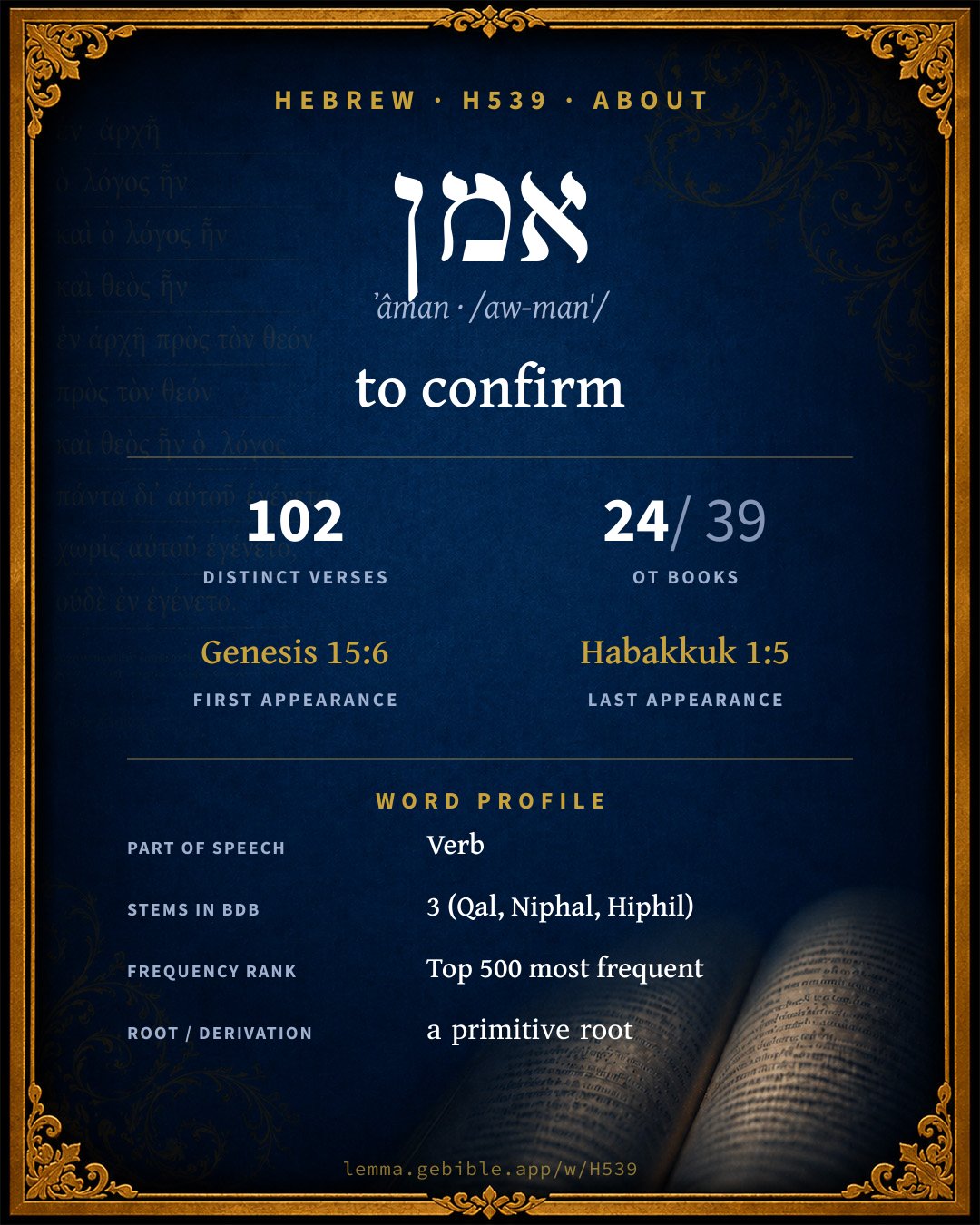
אָמַן
to confirm
‘to confirm’ is one of 4 main senses fuller range ↓
Full lexicon entry — Brown-Driver-Briggs (BDB)
From Brown-Driver-Briggs (BDB)
Where this word appears
See every Hiphil verb in the Hebrew Bible →
Grammar key — what these labels mean
Part of speech
- Verb
- An action or state-of-being word.
- Adjective
- A word that describes or qualifies a noun.
Stem
- Niphal
- Usually the simple passive or reflexive of the Qal (“he was written”). Here: ‘carried by a nurse Is 60’
- Hiphil
- The causative active stem (“he caused / brought about”). Here: ‘stand firm Jb 39’
- Qal
- The basic, simple active stem — the plain form of the verb (“he wrote”). Here: ‘as vb. support’
Form
- Participle Active
- A verbal adjective expressing ongoing or characteristic action (“writing / one who writes”).
- Imperfect
- An incomplete, ongoing, or future action (“he will / would write”).
- Perfect
- A completed action or state — Hebrew marks aspect (completeness) more than strict tense (“he wrote”).
- Sequential Imperfect
- An imperfect with prefixed waw — the standard past-narrative form (waw-consecutive imperfect).
- Jussive
- A third- or second-person volitional form expressing wish or command (“let him write”).
- Imperative
- A direct command (“write!”).
- Sequential Perfect
- A perfect with prefixed waw continuing a preceding imperfect or command (waw-consecutive perfect).
- Participle Passive
- A verbal adjective expressing action received (“written”).
State
- Absolute
- The independent form of a noun, not bound to a following word.
- Construct
- A noun bound to a following noun in a possessive / “of” relationship (the construct chain).
Person
- 3rd Person
- The one spoken about (“he / she / it / they”).
- 1st Person
- The speaker (“I / we”).
- 2nd Person
- The one addressed (“you”).
Gender
- Masculine
- Grammatically masculine.
- Feminine
- Grammatically feminine.
- Common
- Either gender — not distinguished for this form.
Number
- Singular
- One.
- Plural
- More than one (in Hebrew, generally three or more).
Grammatical forms 41 distinct
- Verb, Niphal, Participle Active, Masculine, Singular, Absolute 15 times (14%)
- Verb, Niphal, Participle Active, Masculine, Plural, Absolute 8 times (7%)
- Verb, Hiphil, Imperfect, 3rd Person, Masculine, Plural 7 times (6%)
- Verb, Hiphil, Imperfect, 3rd Person, Masculine, Singular 6 times (6%)
- Verb, Niphal, Participle Active, Feminine, Singular, Absolute 5 times (5%)
- Verb, Hiphil, Perfect, 1st Person, Common, Singular 5 times (5%)
- Verb, Hiphil, Perfect, 3rd Person, Common, Plural 5 times (5%)
- Verb, Hiphil, Perfect, 3rd Person, Masculine, Singular 5 times (5%)
+33 more forms (52 occurrences)
Parsed forms decoded from the imported morphology (morphhb / Westminster Leningrad Codex — WLC text public domain, morphhb tagging CC BY 4.0), counted across 108 parsed occurrences — not distinct verses.
Every verse where H539 appears — 102 distinct verses across 24 books. Click any verse to open its interlinear word-by-word view. Verse text shown in the World English Bible for context — . Each verse’s Hebrew form is shown with its reference; the English is not keyword-highlighted, since the data carries no word-level English alignment. Use “Compare translations” on any verse to read it across multiple English versions. This concordance covers the Hebrew Bible; Septuagint (Greek Old Testament) occurrences are not indexed here.
Genesis 3 verses
- Genesis 15:6 וְ/הֶאֱמִ֖ן conj + Hiphil pf 3ms He believed in Yahweh; and he reckoned it to him for righteousness.
- Genesis 42:20 וְ/יֵאָמְנ֥וּ conj + Niphal impf 3mp Bring your youngest brother to me; so will your words be verified, and you won't die." They did so.
- Genesis 45:26 הֶאֱמִ֖ין Hiphil pf 3ms They told him, saying, "Joseph is still alive, and he is ruler over all the land of Egypt." His heart fainted, for he didn't believe them.
Exodus 7 verses
- Exodus 4:1 יַאֲמִ֣ינוּ Hiphil impf 3mp Moses answered, "But, behold, they will not believe me, nor listen to my voice; for they will say, 'Yahweh has not appeared to you.'"
- Exodus 4:5 יַאֲמִ֔ינוּ Hiphil impf 3mp "That they may believe that Yahweh, the God of their fathers, the God of Abraham, the God of Isaac, and the God of Jacob, has appeared to you."
- Exodus 4:8 יַאֲמִ֣ינוּ וְ/הֶֽאֱמִ֔ינוּ Hiphil impf 3mp conj + Hiphil wpf 3cp "It will happen, if they will neither believe you nor listen to the voice of the first sign, that they will believe the voice of the latter sign.
- Exodus 4:9 יַאֲמִ֡ינוּ Hiphil impf 3mp It will happen, if they will not believe even these two signs, neither listen to your voice, that you shall take of the water of the river, and pour it on the dry land. The water which you take out of the river will become blood on the dry land."
- Exodus 4:31 וַֽ/יַּאֲמֵ֖ן conj + Hiphil wimpf 3ms The people believed, and when they heard that Yahweh had visited the children of Israel, and that he had seen their affliction, then they bowed their heads and worshiped.
- Exodus 14:31 וַ/יַּֽאֲמִ֨ינוּ֙ conj + Hiphil wimpf 3mp Israel saw the great work which Yahweh did to the Egyptians, and the people feared Yahweh; and they believed in Yahweh, and in his servant Moses.
- Exodus 19:9 יַאֲמִ֣ינוּ Hiphil impf 3mp Yahweh said to Moses, "Behold, I come to you in a thick cloud, that the people may hear when I speak with you, and may also believe you forever." Moses told the words of the people to Yahweh.
Numbers 4 verses
- Numbers 11:12 הָ/אֹמֵן֙ ptcl def.art + Qal ptcp.act ms Have I conceived all this people? have I brought them forth, that you should tell me, Carry them in your bosom, as a nursing-father carries the sucking child, to the land which you swore to their fathers?
- Numbers 12:7 נֶאֱמָ֥ן Niphal ptcp.act ms My servant Moses is not so; he is faithful in all my house:
- Numbers 14:11 יַאֲמִ֣ינוּ Hiphil impf 3mp Yahweh said to Moses, How long will this people despise me? and how long will they not believe in me, for all the signs which I have worked among them?
- Numbers 20:12 הֶאֱמַנְתֶּ֣ם Hiphil pf 2mp Yahweh said to Moses and Aaron, Because you didn't believe in me, to sanctify me in the eyes of the children of Israel, therefore you shall not bring this assembly into the land which I have given them.
Deuteronomy 5 verses
- Deuteronomy 1:32 מַאֲמִינִ֔ם Hiphil ptcp.act mp Yet in this thing you didn't believe Yahweh your God,
- Deuteronomy 7:9 הַֽ/נֶּאֱמָ֔ן ptcl def.art + Niphal ptcp.act ms Know therefore that Yahweh your God, he is God, the faithful God, who keeps covenant and loving kindness with them who love him and keep his commandments to a thousand generations,
- Deuteronomy 9:23 הֶֽאֱמַנְתֶּם֙ Hiphil pf 2mp When Yahweh sent you from Kadesh-barnea, saying, Go up and possess the land which I have given you; then you rebelled against the commandment of Yahweh your God, and you didn't believe him, nor listen to his voice.
- Deuteronomy 28:59 וְ/נֶ֣אֱמָנ֔וֹת וְ/נֶאֱמָנִֽים conj + Niphal ptcp.act fp conj + Niphal ptcp.act mp then Yahweh will make your plagues wonderful, and the plagues of your seed, even great plagues, and of long continuance, and sore sicknesses, and of long continuance.
- Deuteronomy 28:66 תַאֲמִ֖ין Hiphil impf 2ms and your life shall hang in doubt before you; and you shall fear night and day, and shall have no assurance of your life.
Judges 1 verse
Ruth 1 verse
1 Samuel 5 verses
- 1 Samuel 2:35 נֶאֱמָ֔ן נֶאֱמָ֔ן Niphal ptcp.act ms Niphal ptcp.act ms I will raise me up a faithful priest, that shall do according to that which is in my heart and in my mind: and I will build him a sure house; and he shall walk before my anointed forever.
- 1 Samuel 3:20 נֶאֱמָ֣ן Niphal ptcp.act ms All Israel from Dan even to Beersheba knew that Samuel was established to be a prophet of Yahweh.
- 1 Samuel 22:14 נֶאֱמָ֔ן Niphal ptcp.act ms Then Ahimelech answered the king, and said, Who among all your servants is so faithful as David, who is the king's son-in-law, and is taken into your council, and is honorable in your house?
- 1 Samuel 25:28 נֶאֱמָ֗ן Niphal ptcp.act ms Please forgive the trespass of your handmaid: for Yahweh will certainly make my lord a sure house, because my lord fights the battles of Yahweh; and evil shall not be found in you all your days.
- 1 Samuel 27:12 וַ/יַּאֲמֵ֥ן conj + Hiphil wimpf 3ms Achish believed David, saying, He has made his people Israel utterly to abhor him; therefore he shall be my servant forever.
2 Samuel 3 verses
- 2 Samuel 4:4 אֹֽמַנְתּ/וֹ֙ Qal ptcp.act fs cs + sfx pers 3ms Now Jonathan, Saul's son, had a son who was lame of his feet. He was five years old when the news came of Saul and Jonathan out of Jezreel; and his nurse took him up, and fled: and it happened, as she made haste to flee, that he fell, and became lame. His name was Mephibosheth.
- 2 Samuel 7:16 וְ/נֶאְמַ֨ן conj + Niphal wpf 3ms Your house and your kingdom shall be made sure for ever before you: your throne shall be established forever.
- 2 Samuel 20:19 אֱמוּנֵ֣י adj Adjective mp cs I am of those who are peaceable and faithful in Israel: you seek to destroy a city and a mother in Israel: why will you swallow up the inheritance of Yahweh?
1 Kings 3 verses
- 1 Kings 8:26 יֵאָ֤מֶן Niphal juss 3ms Now therefore, God of Israel, Please let your word be verified, which you spoke to your servant David my father.
- 1 Kings 10:7 הֶאֱמַ֣נְתִּי Hiphil pf 1cs However I didn't believe the words, until I came, and my eyes had seen it: and, behold, the half was not told me; your wisdom and prosperity exceed the fame which I heard.
- 1 Kings 11:38 נֶאֱמָן֙ Niphal ptcp.act ms It shall be, if you will listen to all that I command you, and will walk in my ways, and do that which is right in my eyes, to keep my statutes and my commandments, as David my servant did; that I will be with you, and will build you a sure house, as I built for David, and will give Israel to you.
2 Kings 3 verses
- 2 Kings 10:1 הָ/אֹמְנִ֥ים ptcl def.art + Qal ptcp.act mp Now Ahab had seventy sons in Samaria. Jehu wrote letters, and sent to Samaria, to the rulers of Jezreel, even the elders, and to those who brought up [the sons of] Ahab, saying,
- 2 Kings 10:5 וְ/הָ/אֹמְנִ֨ים conj + ptcl def.art + Qal ptcp.act mp He who was over the household, and he who was over the city, the elders also, and those who brought up [the children], sent to Jehu, saying, We are your servants, and will do all that you shall bid us; we will not make any man king: you do that which is good in your eyes.
- 2 Kings 17:14 הֶאֱמִ֔ינוּ Hiphil pf 3cp Notwithstanding, they would not hear, but hardened their neck, like the neck of their fathers, who didn't believe in Yahweh their God.
1 Chronicles 2 verses
- 1 Chronicles 17:23 יֵאָמֵ֖ן Niphal impf 3ms Now, Yahweh, let the word that you have spoken concerning your servant, and concerning his house, be established forever, and do as you have spoken.
- 1 Chronicles 17:24 וְ֠/יֵֽאָמֵן conj + Niphal impf 3ms Let your name be established and magnified forever, saying, Yahweh of Hosts is the God of Israel, even a God to Israel: and the house of David your servant is established before you.
2 Chronicles 5 verses
- 2 Chronicles 1:9 יֵֽאָמֵן֙ Niphal juss 3ms Now, Yahweh God, let your promise to David my father be established; for you have made me king over a people like the dust of the earth in multitude.
- 2 Chronicles 6:17 יֵֽאָמֵן֙ Niphal impf 3ms Now therefore, Yahweh, the God of Israel, let your word be verified, which you spoke to your servant David.
- 2 Chronicles 9:6 הֶאֱמַ֣נְתִּי Hiphil pf 1cs However I didn't believe their words, until I came, and my eyes had seen it; and, behold, the half of the greatness of your wisdom was not told me: you exceed the fame that I heard.
- 2 Chronicles 20:20 הַאֲמִ֜ינוּ וְ/תֵ֣אָמֵ֔נוּ הַאֲמִ֥ינוּ Hiphil impv 2mp conj + Niphal impf 2mp Hiphil impv 2mp They rose early in the morning, and went forth into the wilderness of Tekoa: and as they went forth, Jehoshaphat stood and said, Hear me, Judah, and you inhabitants of Jerusalem: believe in Yahweh your God, so shall you be established; believe his prophets, so shall you prosper.
- 2 Chronicles 32:15 תַּאֲמִ֣ינוּ Hiphil juss 2mp Now therefore don't let Hezekiah deceive you, nor persuade you after this manner, neither believe you him; for no god of any nation or kingdom was able to deliver his people out of my hand, and out of the hand of my fathers: how much less shall your God deliver you out of my hand?
Nehemiah 2 verses
- Nehemiah 9:8 נֶאֱמָ֣ן Niphal ptcp.act ms and found his heart faithful before you, and made a covenant with him to give the land of the Canaanite, the Hittite, the Amorite, and the Perizzite, and the Jebusite, and the Girgashite, to give it to his seed, and have performed your words; for you are righteous.
- Nehemiah 13:13 נֶאֱמָנִים֙ Niphal ptcp.act mp I made treasurers over the treasuries, Shelemiah the priest, and Zadok the scribe, and of the Levites, Pedaiah: and next to them was Hanan the son of Zaccur, the son of Mattaniah; for they were counted faithful, and their business was to distribute to their brothers.
Esther 1 verse
Job 10 verses
- Job 4:18 יַאֲמִ֑ין Hiphil impf 3ms Behold, he puts no trust in his servants. He charges his angels with error.
- Job 9:16 אַ֝אֲמִ֗ין Hiphil impf 1cs If I had called, and he had answered me, Yet would I not believe that he listened to my voice.
- Job 12:20 לְ/נֶאֱמָנִ֑ים prep + Niphal ptcp.act mp He removes the speech of those who are trusted, And takes away the understanding of the elders.
- Job 15:15 יַאֲמִ֑ין Hiphil impf 3ms Behold, he puts no trust in his holy ones; Yes, the heavens are not clean in his sight:
- Job 15:22 יַאֲמִ֣ין Hiphil impf 3ms He doesn't believe that he shall return out of darkness, He is waited for by the sword.
- Job 15:31 יַאֲמֵ֣ן Hiphil juss 3ms Let him not trust in emptiness, deceiving himself; For emptiness shall be his reward.
- Job 24:22 יַאֲמִ֥ין Hiphil impf 3ms Yet God preserves the mighty by his power. He rises up who has no assurance of life.
- Job 29:24 יַאֲמִ֑ינוּ Hiphil impf 3mp I smiled on them when they had no confidence. They didn't reject the light of my face.
- Job 39:12 הֲ/תַאֲמִ֣ין ptcl inter + Hiphil impf 2ms Will you confide in him, that he will bring home your seed, And gather the grain of your threshing floor?
- Job 39:24 יַ֝אֲמִ֗ין Hiphil impf 3ms He eats up the ground with fierceness and rage, Neither does he stand still at the sound of the trumpet.
Psalms 17 verses
- Psalms 12:1 אֱ֝מוּנִ֗ים adj Adjective mp Help, Yahweh; for the godly man ceases. For the faithful fail from among the children of men.
- Psalms 19:7 נֶ֝אֱמָנָ֗ה Niphal ptcp.act fs Yahweh's law is perfect, restoring the soul. Yahweh's testimony is sure, making wise the simple.
- Psalms 27:13 הֶ֭אֱמַנְתִּי Hiphil pf 1cs I am still confident of this: I will see the goodness of Yahweh in the land of the living.
- Psalms 31:23 אֱ֭מוּנִים adj Adjective mp Oh love Yahweh, all you his saints! Yahweh preserves the faithful, And pays back him who deals proudly in full.
- Psalms 78:8 נֶאֶמְנָ֖ה Niphal pf 3fs And might not be as their fathers, A stubborn and rebellious generation, A generation that didn't make their hearts loyal, Whose spirit was not steadfast with God.
- Psalms 78:22 הֶ֭אֱמִינוּ Hiphil pf 3cp Because they didn't believe in God, And didn't trust in his salvation.
- Psalms 78:32 הֶ֝אֱמִ֗ינוּ Hiphil pf 3cp For all this they still sinned, And didn't believe in his wondrous works.
- Psalms 78:37 נֶ֝אֶמְנ֗וּ Niphal pf 3cp For their heart was not right with him, Neither were they faithful in his covenant.
- Psalms 89:28 נֶאֱמֶ֥נֶת Niphal ptcp.act fs I will keep my loving kindness for him forevermore. My covenant will stand firm with him.
- Psalms 89:37 נֶאֱמָ֥ן Niphal ptcp.act ms It will be established forever like the moon, The faithful witness in the sky." Selah.
- Psalms 93:5 נֶאֶמְנ֬וּ Niphal pf 3cp Your statutes stand firm. Holiness adorns your house, Yahweh, forevermore.
- Psalms 101:6 בְּ/נֶֽאֶמְנֵי prep + Niphal ptcp.act mp cs My eyes will be on the faithful of the land, That they may dwell with me. He who walks in a perfect way, He will serve me.
- Psalms 106:12 וַ/יַּאֲמִ֥ינוּ conj + Hiphil wimpf 3mp Then they believed his words. They sang his praise.
- Psalms 106:24 הֶ֝אֱמִ֗ינוּ Hiphil pf 3cp Yes, they despised the pleasant land. They didn't believe his word,
- Psalms 111:7 נֶ֝אֱמָנִ֗ים Niphal ptcp.act mp The works of his hands are truth and justice. All his precepts are sure.
- Psalms 116:10 הֶ֭אֱמַנְתִּי Hiphil pf 1cs I believed, therefore I said, "I was greatly afflicted."
- Psalms 119:66 הֶאֱמָֽנְתִּי Hiphil pf 1cs Teach me good judgment and knowledge, For I believe in your commandments.
Proverbs 5 verses
- Proverbs 11:13 וְ/נֶאֱמַן conj + Niphal ptcp.act ms cs One who brings gossip betrays a confidence, But one who is of a trustworthy spirit is one who keeps a secret.
- Proverbs 14:15 יַאֲמִ֣ין Hiphil impf 3ms A simple man believes everything, But the prudent man carefully considers his ways.
- Proverbs 25:13 נֶ֭אֱמָן Niphal ptcp.act ms As the cold of snow in the time of harvest, So is a faithful messenger to those who send him; For he refreshes the soul of his masters.
- Proverbs 26:25 תַּֽאֲמֶן Hiphil juss 2ms When his speech is charming, don't believe him; For there are seven abominations in his heart:
- Proverbs 27:6 נֶ֭אֱמָנִים Niphal ptcp.act mp Faithful are the wounds of a friend; Although the kisses of an enemy are profuse.
Isaiah 14 verses
- Isaiah 1:21 נֶאֱמָנָ֑ה Niphal ptcp.act fs How the faithful city has become a prostitute! She was full of justice; righteousness lodged in her, But now murderers.
- Isaiah 1:26 נֶאֱמָנָֽה Niphal ptcp.act fs I will restore your judges as at the first, And your counselors as at the beginning. Afterward you shall be called 'The city of righteousness, A faithful town.'
- Isaiah 7:9 תַאֲמִ֔ינוּ תֵאָמֵֽנוּ Hiphil impf 2mp Niphal impf 2mp and the head of Ephraim is Samaria, and the head of Samaria is Remaliah's son. If you will not believe, surely you shall not be established.'"
- Isaiah 8:2 נֶאֱמָנִ֑ים Niphal ptcp.act mp and I will take to me faithful witnesses to record, Uriah the priest, and Zechariah the son of Jeberechiah.
- Isaiah 22:23 נֶאֱמָ֑ן Niphal ptcp.act ms I will fasten him as a nail in a sure place; and he shall be for a throne of glory to his father's house.
- Isaiah 22:25 נֶאֱמָ֑ן Niphal ptcp.act ms In that day, says Yahweh of hosts, shall the nail that was fastened in a sure place give way; and it shall be hewn down, and fall; and the burden that was on it shall be cut off; for Yahweh has spoken it.
- Isaiah 28:16 הַֽ/מַּאֲמִ֖ין ptcl def.art + Hiphil ptcp.act ms therefore thus says the Lord Yahweh, Behold, I lay in Zion for a foundation a stone, a tried stone, a precious corner -[stone] of sure foundation: he who believes shall not be in haste.
- Isaiah 33:16 נֶאֱמָנִֽים Niphal ptcp.act mp He shall dwell on high; his place of defense shall be the munitions of rocks; his bread shall be given [him]; his waters shall be sure.
- Isaiah 43:10 וְ/תַאֲמִ֨ינוּ conj + Hiphil impf 2mp You are my witnesses, says Yahweh, and my servant whom I have chosen; that you may know and believe me, and understand that I am he: before me there was no God formed, neither shall there be after me.
- Isaiah 49:7 נֶאֱמָ֔ן Niphal ptcp.act ms Thus says Yahweh, the Redeemer of Israel, [and] his Holy One, to him whom man despises, to him whom the nation abhors, to a servant of rulers: Kings shall see and arise; princes, and they shall worship; because of Yahweh who is faithful, [even] the Holy One of Israel, who has chosen you.
- Isaiah 49:23 אֹֽמְנַ֗יִ/ךְ Qal ptcp.act mp cs + sfx pers 2fs Kings shall be your nursing fathers, and their queens your nursing mothers: they shall bow down to you with their faces to the earth, and lick the dust of your feet; and you shall know that I am Yahweh; and those who wait for me shall not be disappointed.
- Isaiah 53:1 הֶאֱמִ֖ין Hiphil pf 3ms Who has believed our message? and to whom has the arm of Yahweh been revealed?
- Isaiah 55:3 הַ/נֶּאֱמָנִֽים ptcl def.art + Niphal ptcp.act mp Turn your ear, and come to me; hear, and your soul shall live: and I will make an everlasting covenant with you, even the sure mercies of David.
- Isaiah 60:4 תֵּאָמַֽנָה Niphal impf 3fp Lift up your eyes round about, and see: they all gather themselves together, they come to you; your sons shall come from far, and your daughters shall be carried in the arms.
Jeremiah 4 verses
- Jeremiah 12:6 תַּאֲמֵ֣ן Hiphil juss 2ms For even your brothers, and the house of your father, even they have dealt treacherously with you; even they have cried aloud after you: don't believe them, though they speak beautiful words to you.
- Jeremiah 15:18 נֶאֱמָֽנוּ Niphal pf 3cp Why is my pain perpetual, and my wound incurable, which refuses to be healed? will you indeed be to me as a deceitful [brook], as waters that fail?
- Jeremiah 40:14 הֶאֱמִ֣ין Hiphil pf 3ms and said to him, Do you know that Baalis the king of the children of Ammon has sent Ishmael the son of Nethaniah to take your life? But Gedaliah the son of Ahikam didn't believe them.
- Jeremiah 42:5 וְ/נֶאֱמָ֑ן conj + Niphal ptcp.pass ms Then they said to Jeremiah, Yahweh be a true and faithful witness among us, if we don't do according to all the word with which Yahweh your God shall send you to us.
Lamentations 2 verses
- Lamentations 4:5 הָ/אֱמֻנִים֙ ptcl def.art + Qal ptcp.pass mp Those who did feed delicately are desolate in the streets: Those who were brought up in scarlet embrace dunghills.
- Lamentations 4:12 הֶאֱמִ֨ינוּ֙ Hiphil pf 3cp The kings of the earth didn't believe, neither all the inhabitants of the world, That the adversary and the enemy would enter into the gates of Jerusalem.
Hosea 2 verses
- Hosea 5:9 נֶאֱמָנָֽה Niphal ptcp.act fs Ephraim will become a desolation in the day of rebuke. Among the tribes of Israel, I have made known that which will surely be.
- Hosea 11:12 נֶאֱמָֽן Niphal ptcp.act ms Ephraim surrounds me with falsehood, And the house of Israel with deceit; And Judah still us unruly with God, And is unfaithful to the Holy One.
Jonah 1 verse
Micah 1 verse
Habakkuk 1 verse
About this entry
At a glance — auto-summarized from this page’s data, not written by a person. Every figure links to its source below. This summary describes the numbers; it doesn’t interpret them.
The Hebrew verb אמן centers on the idea of “to confirm.” Where the King James Version says “faithful,” newer translations reach for “believe” (Berean Standard Bible); the renderings breakdown has the detail. It appears 102 verses across 24 books of the Hebrew Bible, among its common vocabulary. Debuting at Genesis 15:6, it then recurs through the corpus. Across 3 stems, its meaning turns on the binyan (Qal, Niphal). Dig into 102-verse concordance and the renderings breakdown below.
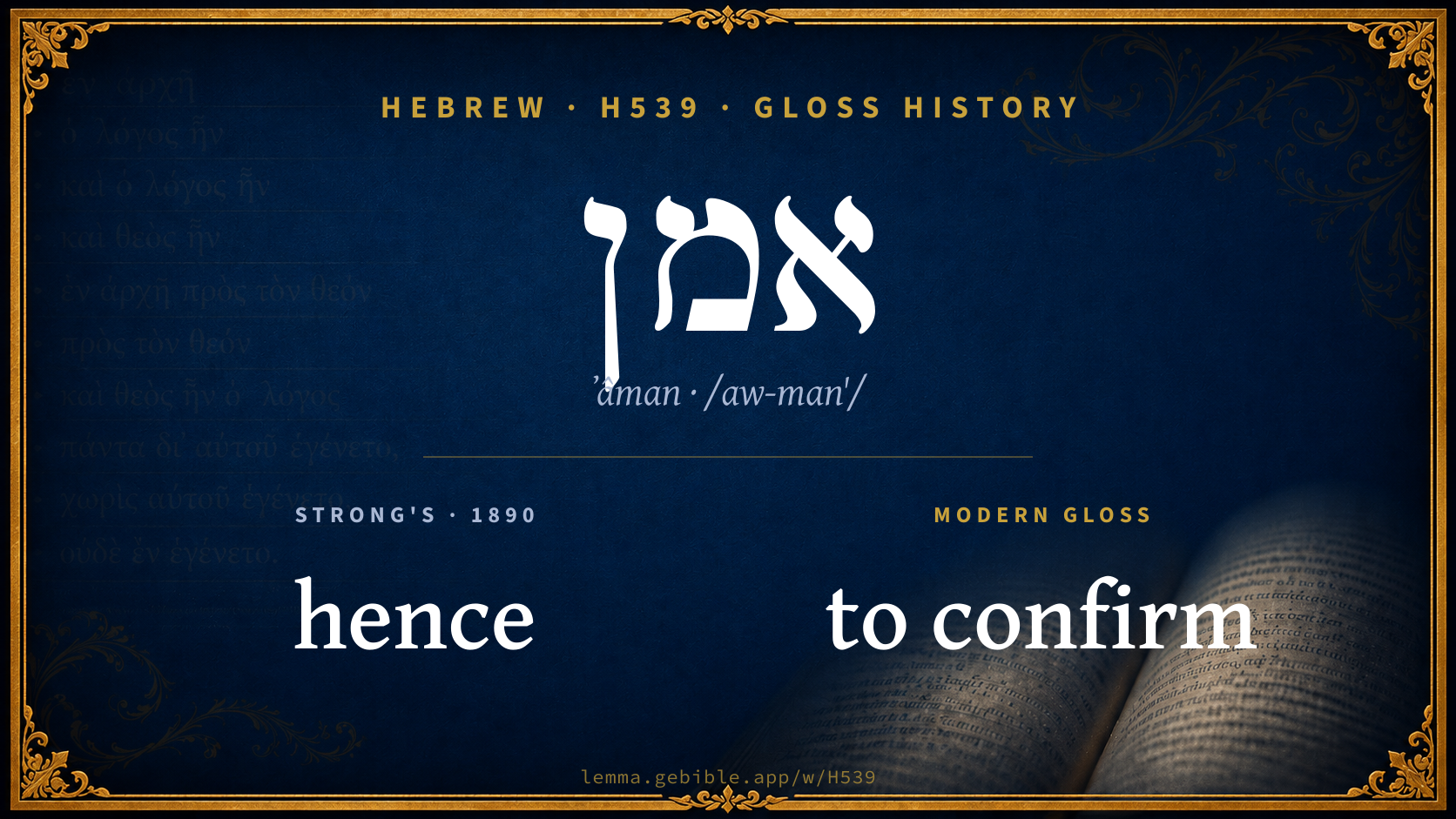
Gloss history
Strong's 1890 vs modern scholarship
About this word
Strong's H539 catalogs a Hebrew word from the Hebrew Old Testament.
These counts are not copied from any lexicon or concordance. They are computed here, from the morphology-tagged Hebrew Old Testament. What Lemma adds →
- 102
- distinct verses
- The word appears in 102 distinct verses.
- 24 / 39
- OT books
- The word appears in 24 of 39 Old Testament books.
- #401
- by frequency
- Top 500 most frequent Hebrew words (rank 401 of 8,640 Hebrew words by occurrence).
View all 102 occurrences in the concordance →
By section of the Old Testament
By traditional corpus
Conventional, traditional groupings — biblical authorship is debated, so this is a traditional corpus grouping, not an authorship claim. Each share is this word’s portion of its verses in that division of the Hebrew canon. Each figure is a share of the word’s 102 distinct verses.
- Writings (Ketuvim) 45 verses · 44%
- Prophets (Nevi'im) 38 verses · 37%
- Torah (Pentateuch) 19 verses · 19%
How translations render this word
Counts come from each version’s own published word-to-Strong’s tagging or interlinear alignment — an approximate guide to how each version renders this word, not a word-level alignment the data otherwise carries. Because each total is that version’s own tagged count, the per-version totals vary from one another and need not match the appearance or distinct-verse counts above. These counts may also differ from a printed concordance because Lemma counts each distinctly tagged rendering and does not collapse phrase taggings into a single head-word total. This is a fixed set of word-tagged versions (KJV, ASV, BSB, ULT) and does not change with the reading translation you choose elsewhere. Each version’s license is shown beside its name below (and on Sources).
BDB lists this Strong’s number as 5 distinct words (homographs). Each count above pools all of them and is not split by sense — see the Senses section below. A low-frequency rendering may belong to a different one of those words, not the primary meaning.
- King James Version†: Faithful 12×, Believed 6×, Sure 5×
- American Standard Version†: Faithful 12×, Believed 6×, Sure 5×
- Berean Standard Bible†: Believe 20×, Faithful 10×, Trust 7×
- unfoldingWord Literal Text†: Believe 25×, Faithful 12×, Trust 8×
King James Version Public Domain
Renders H539 across 108† tagged occurrences — most commonly:
Plus other, less common renderings. Plus 56 renderings that appear only once — usually multi-word phrases or single function words the recovered tagging swept in, not distinct renderings.
American Standard Version Public Domain
Renders H539 across 108† tagged occurrences — most commonly:
Plus other, less common renderings. Plus 57 renderings that appear only once — usually multi-word phrases or single function words the recovered tagging swept in, not distinct renderings.
Berean Standard Bible Public Domain
Renders H539 across 104† tagged occurrences — most commonly:
Plus 43 renderings that appear only once — usually multi-word phrases or single function words the recovered tagging swept in, not distinct renderings. Not rendered by a distinct English word in 1 further occurrence.
unfoldingWord Literal Text CC BY-SA 4.0
Renders H539 across 150† tagged occurrences — most commonly:
Plus other, less common renderings. Plus 49 renderings that appear only once — usually multi-word phrases or single function words the recovered tagging swept in, not distinct renderings.
16 senses and sub-senses in the full BDB
Hebrew verbs can shift meaning by stem (binyan): Qal is the basic action, Niphal is often passive or reflexive, Piel often intensifies or makes it factitive, and Hiphil is typically causative. The senses below are grouped under the stem BDB assigns to each.
What do BDB’s symbols mean?
BDB uses these scholarly abbreviations:
| Symbol | Meaning |
|---|---|
| 𝔊 | the Septuagint (the ancient Greek translation, LXX) |
| 𝔙 | the Vulgate (the Latin translation) |
| 𝔖 | the Syriac version (the Peshitta) |
| 𝔗 | the Targum (the Aramaic translation) |
| ψ | the Psalms |
| √ | root (the underlying root or stem) |
| ‖ | parallel passage (a synonymous or contrasted parallel) |
| † | the dagger: every passage where the word occurs is cited |
The 16 senses and sub-senses the full Brown-Driver-Briggs lexicon distinguishes for this word, in lexicon order (not ranked by frequency), with BDB’s own verbatim wording and sub-sense lettering. Shown in Hebrew script with BDB’s own scholarly abbreviations. The condensed entry is in the Lexicon Entry tab. See also the Forms in the corpus table below.
אמן I Amon, an Egyptian god Na 3
אמן II artificer, architect, master-workman, as firm and sure in his workmanship
אמן III m. (master-workman) (a) king of Judah 2 K 21
אמן IV confirm, support (cf. Arabic أَمِنَ, etc., v. infr.
Qal
- Pt. אֹמֵן;—
- 1. as vb. support, nourish 2 K 10:1, 5 Est 2:7. e.g. 2 Kings 10:1
- 2. as subst. foster-father Nu 11:12 (J) Is 49:23. e.g. Numbers 11:12
- 3. אֹמֶנֶת foster-mother, nurse Ru 4:16 2 S 4:4. e.g. Ruth 4:16
- 4. אֹמְנוֹת pillars, supporters of the door 2 K 18:16. Pt. pass. e.g. 2 Kings 18:16
- a. הָאֱמֻנִים those brought up (in scarlet) La 4:5. e.g. Lamentations 4:5
- b. אֱמוּנִים intrans. faithful (as firm, stable) as subst. m. faithful ones ψ 12:2 (> 𝔊 𝔖 al. faithfulness) 2 S 20:19 (cf. Arabic أمُنَ be faithful, أَمَنَ trust in, أَمَنَ be secure); ψ 31:23 faithful ones י׳ keepeth, אֱמוּנִים נֹצֵר י׳; but א׳ is here taken by 𝔊 Ri De Che as n. abstr. v. אֵמֻן. e.g. Psalms 12:2
Niphal
- נֶאֱמַן Pr 11:13 + (6 times); Impf. יֵאָמֵן, יֵאָ֫מֶן 1 K 8:26 + (9 times); Pt. נֶאֱמָן Pr 25:13 + (16 times) נֶאֱמָנָה Is 1:21 + (4 times); נֶאֱמֶנֶת ψ 89:29; נֶאֱמָנִים Pr 27:6 + (9 times); נֶאֱמָנוֹת Dt 28:59. e.g. Proverbs 11:13
- 1. carried by a nurse Is 60:4. e.g. Isaiah 60:4
- 2. made firm, sure, lasting: place Is 22:23, 25; name 1 Ch 17:24; waters Is 33:16 Je 15:18; an event Ho 5:9; sickness Dt 28:59; mercy Is 55:3. e.g. Isaiah 22:23
- 3. confirmed, established, sure: kingdom 2 S 7:16; house, dynasty 1 S 2:35; 25:28 1 K 11:38; prophet Samuel 1 S 3:20; cf. word-play אִם לֹא תַאֲמִינוּ לֹא תֵאָמֵנוּ = if ye believe not (have not firm confidence) ye will not be confirmed Is 7:9; הַאֲמִינוּ בי׳ וְתֵאָמֵנוּ = believe in Yahweh and ye will be confirmed 2 Ch 20:20. e.g. 2 Samuel 7:16
- 4. verified, confirmed: words of God 1 K 8:26 2 Ch 1:9; 6:17; 17:23; precepts ψ 111:7; testimonies ψ 19:8; 93:5; covenant ψ 89:29; words of men Gn 42:20 (E). e.g. 1 Kings 8:26
- 5. reliable, faithful, trusty: persons 1 S 2:35; 22:14 Jb 12:20 ψ 89:38; 101:6 Pr 25:13 Is 8:2 Ne 13:13; a city Is 1:21; האל הנאמן the faithful God Dt 7:9 cf. Is 49:7; נֶאֱמַן רוּחַ faithful in spirit (disposition) Pr 11:13; לְבָבוֹ נֶאֱמָן his heart faithful Ne 9:8; עֵד אֱמֶת וְנֶאֱמָן true and faithful witness Je 42:5; נאמנים פצעי אוהב faithful the wounds of a friend Pr 27:6; c. אֵת (אֶל) ψ 78:8; עִם Ho 12:1; בְּ of thing ψ 78:37; בְּכָל־בֵּיתִי in all my house (of Moses) Nu 12:7 (E). e.g. 1 Samuel 2:35
Hiphil
- הֶאֱמִין Gn 45:26 + (18 times); Impf. יַאֲמִין, יַאֲמֵן Jb 15:31 + (30 times); Imv. הַאֲמִינוּ 2 Ch 20:20 + (2 times); Pt. מַאֲמִין Dt 1:32 Is 28:16. e.g. Genesis 45:26
- 1. stand firm Jb 39:24 (c. neg. of the horse when the trumpet sounds Di De MV RVm; but neither believeth RV, hardly trusts Da). e.g. Job 39:24
- 2. trust, believe: (a) abs. Ex 4:31 (J) Is 7:9; 28:16 Hb 1:5 ψ 116:10 Jb 29:24; (b) with ל of person, trust to, believe Gn 45:26 (E) Ex 4:1, 8 (J) Je 40:14 2 Ch 32:15; with God Dt 9:23 Is 43:10; ל of thing Ex 4:8, 9 (J) ψ 106:24 1 K 10:7 2 Ch 9:6 Is 53:1 Pr 14:15; (c) with ב of person, trust in, believe in Ex 19:9 (J) 1 S 27:12 2 Ch 20:20 Jb 4:18; 15:15 Pr 26:25 Je 12:6 Mi 7:5; the usual construction with God Gn 15:6 (E) Ex 14:31 Nu 14:11 (J) 20:12 (P) Dt 1:32 2 K 17:14 2 Ch 20:20 ψ 78:22 Jon 3:5; with ב of thing Dt 28:66 Jb 15:31; 24:22; 39:12 ψ 78:32; 106:12; 119:66; (d) with כִּי trust or believe that Ex 4:5 (J) Jb 9:16 La 4:12; (e) so with infin. Jb 15:22 ψ 27:13 (sq. ל); also trust to do a thing, almost = allow, Ju 11:20. e.g. Exodus 4:31
Senses from the full Brown-Driver-Briggs lexicon (Brown, Driver, Briggs; Oxford 1906 — public domain), digitized via Sefaria, supplemented by the OpenScriptures HebrewLexicon (CC BY 4.0). Full attribution on Sources.
Word origin
I. n.pr. Amon, an Egyptian god Na 3:8 Je 46:25, comp. by Greeks with Zeus (Herod. ii, 42; Diod i. 13), Ἀμμῶν. He was originally the local deity of Thebes (= נֹא, called נֹא אָמוֹן Na 3:8, cf. א׳ מִנֹּא Je 46:25), but subsequently became the supreme god of the Egyptian Pantheon, the successor of the sun-god Ra and so-called Amon Ra. He was the secret god, who hid himself and was difficult to find (Amon = concealment, hidden); v. Rawl. Hist. Anc. Egypt, i, 322 Ebers. RiHWB. Je 46:25 Spiegelberg Randglossen, 43 ff. reads נֹא אָמוֹן (as Na 3:8) for אָמוֹן נֹא, and finds in both a Thebes in the Delta. (ii. iii. אָמוֹן v. p. 54.)
II. n.m. artificer, architect, master-workman, as firm and sure in his workmanship: וָאֶהְיֶה אֶצְלוֹ אָמוֹן I was at his side architect, master-workman (𝔊 𝔖 𝔙 Ges Ew De MV RV, > foster-son AE Ki AV) Pr 8:30; יֶתֶר הָֽאָמוֹן rest of the master-workmen Je 52:15 (Hi Gf De RVm, but rest of the multitude Ges MV RV et al., אמון = המון)—1. אָמוֹן v. supr. p. 51.
III. n.pr.m. (master-workman) (a) king of Judah 2 K 21:18, 19, 23, 24, 25 1 Ch 3:14 2 Ch 33:20, 21, 22, 23 25 Je 1:2; 25:3; (b) captain of a city 1 K 22:26 2 Ch 18:25; (c) one of the line of Solomon’s servants Ne 7:59 = אָמִי Ezr 2:57.
I. vb. confirm, support (cf. Arabic أَمِنَ, etc., v. infr.; Sab. אמן in deriv. & n.pr. cf. CIS iv. 1, 10 DHMZMG 1885, 598; Aramaic אֲמַן, ܐܡܢ in Haph. Ethiopic አምነ Assyrian in deriv.)—only
— Brown-Driver-Briggs (Oxford 1906, public domain), digitized via Sefaria, supplemented by the OpenScriptures HebrewLexicon (CC BY 4.0). See Sources.
Origin: a primitive root
Jastrow Dictionary
A second Hebrew/Aramaic lexicon for comparison, covering Aramaic and post-biblical (Talmudic, Targumic, Midrashic) usage that the biblical-Hebrew BDB does not. Matched by lemma rather than by Strong’s number, so a lemma may carry more than one Jastrow headword (shown separately below), and the entries cover usage well beyond the Bible.
אָמַן
- , v. אֵם; cmp. אַמָּה) to arrange in lines, array. Ukts. II, 5 nuts שאֲמָנָן which one arranged (Var. Ar. שחמרן which one piled).—Denom. אוּמָן expert, skilful, whence
- to make skilful, to train. Sabb. 103ᵃ מְאַמֵּן את ידו he trains his hand (practicing). V. next w.
אָמֵן I
- (√אם, v. אֵם; cmp. preced.) to be strong, enduring; (act. v. אָמַן to support, v. II Kings XVIII, 16 אֹמְנוֹת).—Pi. אִימֵּן, אִמֵּן to support; trnsf. to confirm, verify, approve. Tosef. Ter. I, 4 it is not the minor that made it T’rumah אלא אביו שאִימֵּן אחריו Var. (ed. Zuck. שאומן) but his father who confirmed his act (= ib. קיים על יד); Y. ib. 40ᵇ א׳ על ידו. Ib.ᶜ top מְאַמֵּין. e.g. 2 Kings 18:16
- (b. h.)
- 1. part. נֶאֱמָן m., נֶאֱמָנֶת f. approved, trustworthy, reliable. Peah VIII, 2 נֶאֱמָנִים על וכ׳ (the poor) may be relied upon concerning garnered fruit &c., i.e. if they declare the fruits to be the poor man’s share, they are exempt from tithes. Keth. I, 6 נאמנת her statement is acted upon as true. Ab. Zar. 16ᵇ נ׳ עלי הדיין my judge is a reliable witness concerning me, i.e. I appeal to thy own judgment that I could not have engaged in such follies.—Dem. II, 2 if one resolves להיות נ׳ to be one of the reliable (conscientious in giving tithes); a. fr.
- 2. to be confirmed. Y. Sot. II, 18ᵇ top אמן יֵאָמְנוּ הדברים Amen means, May the words (of the oath) be fulfilled.
- (b. h.) to declare trustworthy, to trust, believe in. Dem. VII, 1 והוא אינו מַאֲמִינוֹ but he (the invited guest) trusts him not in tithe affairs. Ib. 3; a. fr.—Ab. Zar. 16ᵇ הואיל וְהֶאֱמַנְתַּנִי עליך ed. Pes., En Yak. (v. Rabb. D. S. a. l. note; ed. הָאֳמַנְתִּי Hof.; since thou didst declare me a reliable witness unto thyself (appealing to my judgment), v. supra; [Ms. M. האמנת עלי thou reliedst on me]. Ch., v. הֵימַן.
אָמֵן II
- v. preced.) firm, straight, whence
- 1. Amen!, true! so may it be! Shebu. 36ᵃ א׳ בו שבועה וכ׳ in Amen is implied an oath, a promise, and a prayer for fulfillment. Ab. Zar. 65ᵃ; a. fr.
- 2. fem., the response Amen. Ber. 47ᵃ א׳ חטופה an Amen hastily pronounced (’men); א׳ קטופה an Amen cut short (ame-); א׳ יתומה an orphan Amen, the responder not having heard the benediction to which the Amen refers; Tosef. Meg. IV (III), 27.
A Dictionary of the Targumim, the Talmud Babli and Yerushalmi, and the Midrashic Literature (Marcus Jastrow; London, Luzac, 1903) — Public Domain. Digitized via Sefaria. Digitized via Sefaria. Full attribution on Sources.
Forms in the corpus
The 90 distinct written forms H539 takes in the Hebrew Bible, most frequent first — each parse links to that stem’s occurrences in the concordance. Hebrew forms include their vowel points and cantillation, so a single lemma takes many written forms.
The 60 most common forms are shown; 30 rarer forms follow in the full concordance.
Same root — word family
Other BDB entries built from the same root as H539, grouped by Strong’s listed origin. These share a root / origin per the lexicon — not necessarily a shared meaning. Each links to that word’s own entry.
Derived from this word
- אמון ʼâmôwn H525 craftsman
- אמון ʼêmûwn H529 faithfulness
- אמן ʼăman H540 to trust
- אמן ʼâmân H542 artisan
- אמן ʼâmên H543 truly
- אמן ʼômen H544 faithfulness
- אמת ʼemeth H571 faithfulness
Proper names from this root
People and places named from this root — a name, not an additional meaning of the word.
Compare all same-root words → Showing 4 of 10 — not the complete family. 2 of the same-root words are proper names (people or places). They share a root, not necessarily a meaning.
Septuagint verse parallels
This word appears in 89 verses that also exist in the Greek Old Testament (Septuagint), out of the 102 Hebrew verses it occurs in. You can read those verses in Greek by switching the Old Testament edition to the Septuagint.
Read these verses in the Septuagint
- Genesis 15:6
- Exodus 4:1
- Numbers 11:12
- Deuteronomy 1:32
- Judges 11:20
- Ruth 4:16
- 1 Samuel 2:35
- 2 Samuel 4:4
- 1 Kings 8:26
- 2 Kings 10:1
- 1 Chronicles 17:23
- 2 Chronicles 1:9
This is a verse-level parallel only — the same verses exist in both the Hebrew and Greek Old Testaments. No word-level Hebrew↔Greek correspondence is claimed: the data carries no such alignment, so no Greek word is shown as this Hebrew word’s translation. Coverage is not total — the Septuagint omits the deuterocanon and renumbers the Psalms, so some Hebrew verses have no direct Greek parallel.