
Jeremiah 12:6

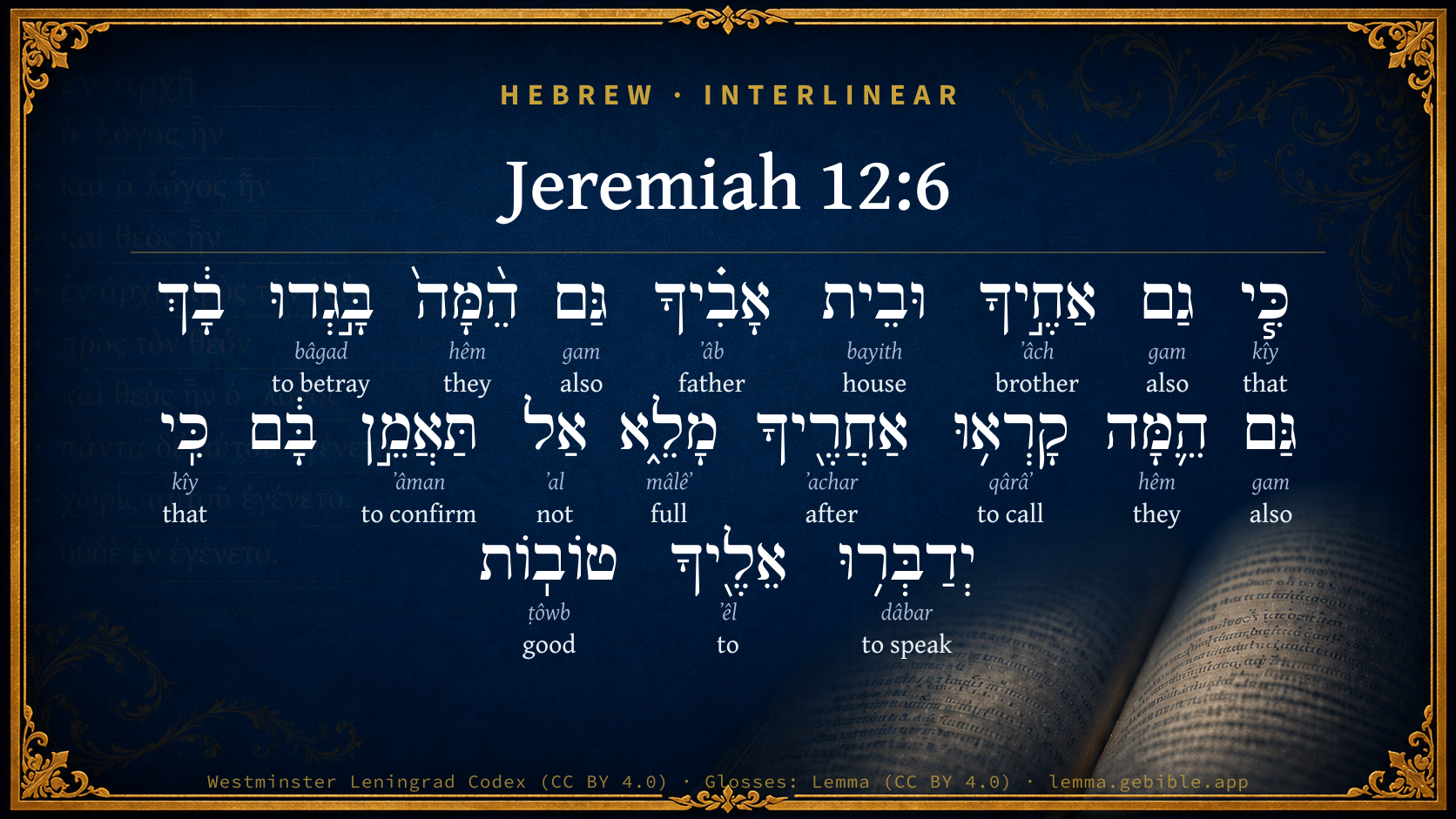
Hebrew (Westminster Leningrad Codex) Jeremiah 12:6 appears in the Hebrew Old Testament. The text above is from the Westminster Leningrad Codex. Each word links to its Strong’s number, a concise gloss, and parsing drawn from the Open Scriptures Hebrew Bible morphology. Click any word for its full Brown-Driver-Briggs (BDB) entry.
Download image
Cite this verse

Jeremiah 12:6 (World English Bible). Public Domain. Lemma interlinear Bible study tool, https://lemma.gebible.app/v/jeremiah/12/6.

Show BibTeX & RIS
BibTeX
RIS
English Translation
For even your brothers, and the house of your father, even they have dealt treacherously with you; even they have cried aloud after you: don't believe them, though they speak beautiful words to you.
World English Bible · Public Domain
Download a study sheet

One document with this verse’s original text, its word-by-word gloss line, the meaning frame, cross-references with their text, attributed commentary, and full source and license credits — printable, and it pastes into notes with its structure intact.

This verse Autodidact and up

Study sheet (.html) Plain text (.txt)

A passage Seminary Student

Up to 50 verses in one chapter. A passage sheet keeps up to 6 commentary sources and 12 cross-references per verse, in the order this page ranks them, and says so on the sheet whenever that leaves anything out. Ask for a single verse and you get the Autodidact verse sheet above.

Everything on this page stays free to read, with no account — the sheet is a download of what is already on screen, not access to it.

Want to remove ads? Support Godless Engineer
Compare translations 3

The same verse in 3 English versions, stacked beneath the original-language interlinear above. Click any original word for its lexicon entry.

Each is an independent rendering of the whole verse — the interlinear is not word-aligned to these translations.

Highlighted words mark where these versions differ — a whole-verse word diff, not a word-by-word alignment.

  • World English Bible Public Domain
    For even your brothers, and the house of your father, even they have dealt treacherously with you; even they have cried aloud after you: don't believe them, though they speak beautiful words to you.
  • King James Version Public Domain
    For even thy brethren, and the house of thy father, even they have dealt treacherously with thee; yea, they have called a multitude after thee: believe them not, though they speak fair words unto thee.
  • unfoldingWord Literal Text CC BY-SA 4.0
    For even your brothers and your father’s house, even they have betrayed you, even they have called after you fully. Do not trust in them, though they speak good things to you.

unfoldingWord Literal Text — © unfoldingWord, licensed CC BY-SA 4.0. Word-aligned USFM3 via Door43 (git.door43.org/unfoldingWord/en_ult).

Versions to compare (up to 4)

3 of 4 selected

Show all 18 translations

Every available English version of this verse, each an independent rendering of the whole verse.

  • World English Bible Public Domain
    For even your brothers, and the house of your father, even they have dealt treacherously with you; even they have cried aloud after you: don't believe them, though they speak beautiful words to you.
  • Berean Standard Bible Public Domain
    Even your brothers—your own father’s household—even they have betrayed you; even they have cried aloud against you. Do not trust them, though they speak well of you.
  • Majority Standard Bible Public Domain
    Even your brothers—your own father’s household—even they have betrayed you; even they have cried aloud against you. Do not trust them, though they speak well of you.
  • King James Version Public Domain
    For even thy brethren, and the house of thy father, even they have dealt treacherously with thee; yea, they have called a multitude after thee: believe them not, though they speak fair words unto thee.
  • American Standard Version (1901) Public Domain
    For even thy brethren, and the house of thy father, even they have dealt treacherously with thee; even they have cried aloud after thee: believe them not, though they speak fair words unto thee.
  • Revised Version (1885) Public Domain
    For even thy brethren, and the house of thy father, even they have dealt treacherously with thee; even they have cried aloud after thee: believe them not, though they speak fair words unto thee.
  • Geneva Bible (1599) Public Domain
    For euen thy brethren, and the house of thy father, euen they haue delt vnfaithfully with thee, and they haue cryed out altogether vpon thee: but beleeue them not, though they speake faire to thee.
  • Douay-Rheims (1899) Public Domain
    For even thy brethren, and the house of thy father, even they have fought against thee, and have cried after thee with full voice: believe them not when they speak good things to thee.
  • Young's Literal Translation Public Domain
    For even thy brethren and the house of thy father, Even they dealt treacherously against thee, Even they -- they called after thee fully, Trust not in them, when they speak to thee good things.
  • Literal Standard Version CC BY-SA 4.0
    For even your brothers and the house of your father, || Even they dealt treacherously against you, || Even they called after you fully, || Do not trust in them when they speak good things to you.
  • Unlocked Literal Bible CC BY-SA 4.0
    For even your brothers and your father's family have betrayed you and have loudly denounced you. Do not trust in them, even if they say nice things to you.
  • unfoldingWord Literal Text CC BY-SA 4.0
    For even your brothers and your father’s house, even they have betrayed you, even they have called after you fully. Do not trust in them, though they speak good things to you.
  • Darby Bible Public Domain
    For even thy brethren, and the house of thy father, even they have dealt treacherously with thee, even they have cried aloud after thee. Believe them not, though they speak good [words] unto thee.
  • World Messianic Bible Public Domain
    For even your brothers, and the house of your father, even they have dealt treacherously with you! Even they have cried aloud after you! Don’t believe them, though they speak beautiful words to you.
  • Webster's Bible Public Domain
    For even thy brethren, and the house of thy father, even they have dealt treacherously with thee; yes, they have called a multitude after thee: believe them not, though they speak fair words to thee.
  • Free Bible Version CC BY-SA 4.0
    Even your own brothers and your father's family have betrayed you; they have publicly criticized you. Don't trust them when they talk nicely to you!
  • Bible in Basic English Public Domain
    For even your brothers, your father's family, even they have been untrue to you, crying loudly after you: have no faith in them, though they say fair words to you.
  • JPS Tanakh (1917) Public Domain
    For even thy brethren, and the house of thy father, even they have dealt treacherously with thee, even they have cried aloud after thee; believe them not, though they speak fair words unto thee.'

Literal Standard Version (2020), Covenant Press — licensed CC BY-SA 4.0. Text via the HelloAO Bible API (eBible.org). Unlocked Literal Bible (unfoldingWord) — licensed CC BY-SA 4.0. Text via the HelloAO Bible API (eBible.org). unfoldingWord Literal Text — © unfoldingWord, licensed CC BY-SA 4.0. Word-aligned USFM3 via Door43 (git.door43.org/unfoldingWord/en_ult). Free Bible Version, Dr. Jonathan Gallagher — licensed CC BY-SA 4.0. Text via the HelloAO Bible API (eBible.org).

Word by word

More ways to search: Search by grammar → Find every occurrence → Compare this word →

Practice this passage: Drill this verse → Learn its vocabulary →

בָּ֣גְדוּ
bâgad
H898
“to betray”
Verb, Qal, Perfect, 3rd Person, Common, Plural
Part of Speech
Verb
Stem
Qal
Form
Perfect
Person
3rd Person
Gender
Common
Number
Plural
Full BDB Definition

Origin: a primitive root

TWOT: 198

to act treacherously, deceitfully, deal treacherously - (Qal) to act or deal treacherously, faithlessly, deceitfully, offend
  1. כִּ֧י kîy H3588 “that” Conjunction
  2. גַם gam H1571 “also” Adverb
  3. אַחֶ֣יךָ ʼâch H251 “brothers · your” Noun, Common, Masculine, Plural, Construct + Suffix, Personal, 2nd Person, Masculine, Singular
  4. וּבֵית bayith H1004 “and · house of” Conjunction + Noun, Common, Masculine, Singular, Construct
  5. אָבִ֗יךָ ʼâb H1 “father · your” Noun, Common, Masculine, Singular, Construct + Suffix, Personal, 2nd Person, Masculine, Singular
  6. גַּם gam H1571 “also” Particle, Accusative
  7. הֵ֨מָּה֙ hêm H1992 “they” Pronoun, Personal, 3rd Person, Masculine, Plural
  8. גַּם gam H1571 “also” Particle, Accusative
  9. הֵ֛מָּה hêm H1992 “they” Pronoun, Personal, 3rd Person, Masculine, Plural
  10. קָרְא֥וּ qârâʼ H7121 “to call” Verb, Qal, Perfect, 3rd Person, Common, Plural
  11. אַחֲרֶ֖יךָ ʼachar H310 “after · you” Preposition + Suffix, Personal, 2nd Person, Masculine, Singular
  12. מָלֵ֑א mâlêʼ H4392 “full” Adjective, Adjective, Masculine, Singular, Absolute
  13. אַל ʼal H408 “not” Particle, Negative
  14. תַּאֲמֵ֣ן ʼâman H539 “to confirm” Verb, Hiphil, Jussive, 2nd Person, Masculine, Singular
  15. כִּֽי kîy H3588 “that” Conjunction
  16. יְדַבְּר֥וּ dâbar H1696 “to speak” Verb, Piel, Imperfect, 3rd Person, Masculine, Plural
  17. אֵלֶ֖יךָ ʼêl H413 “to · you” Preposition + Suffix, Personal, 2nd Person, Masculine, Singular
  18. טוֹבֽוֹת ṭôwb H2896 “good” Adjective, Adjective, Feminine, Plural, Absolute

About this verse

These counts appear in no published source. They are computed here, from the morphology-tagged text and Lemma’s own curated glosses. What Lemma adds →

21
words
15
distinct lemmas
Prophets
section

Shared distinctive vocabulary

בָּ֣גְדוּ to betray H898 occurs in 39 verses of the Hebrew Bible. Also found in:

Grammatical profile

  • 4 verbs
  • 3 nouns
  • 2 adjectives
  • 2 pronouns
  • 4 prepositions
  • 2 conjunctions
  • 1 adverb
  • 3 particles

Verb forms

  • בָּ֣גְדוּ Qal · Perfect
  • קָרְא֥וּ Qal · Perfect
  • תַּאֲמֵ֣ן Hiphil · Jussive
  • יְדַבְּר֥וּ Piel · Imperfect

Repetition

Words recur within this verse — often emphatic in Hebrew:

  • גַם also H1571 ×3
  • כִּ֧י that H3588 ×2
  • הֵ֨מָּה֙ they H1992 ×2

Hebrew & Septuagint length

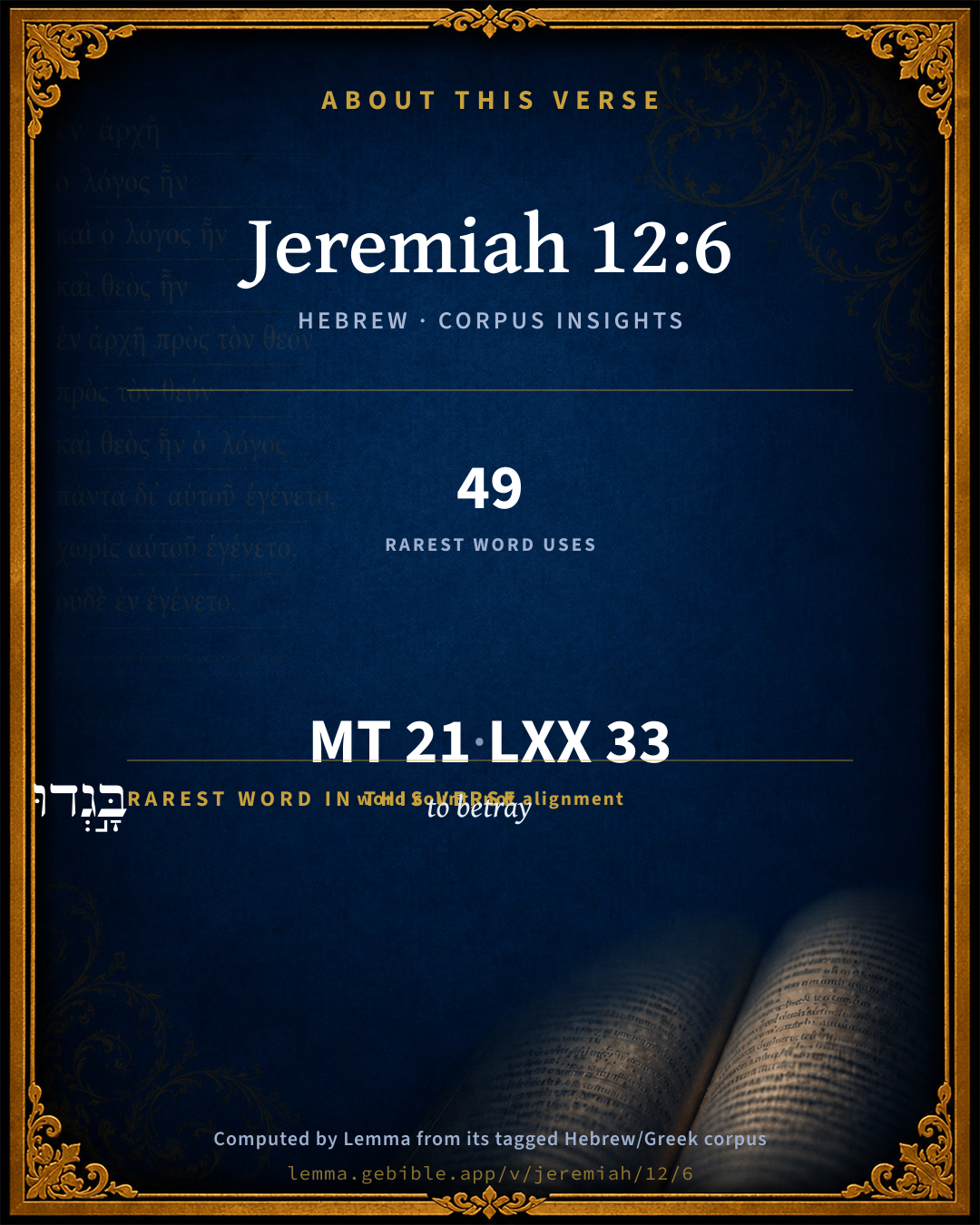
In the original languages it is 21 Hebrew tokens and 33 Greek tokens — but the two are counted differently (Hebrew bundles its prefixes and suffixes into one token; the Greek is in lemma form), so that isn’t a like-for-like length.

Cross-references

20

Topical passages linked to Jeremiah 12:6 in the Treasury of Scripture Knowledge — connected by theme and wording, ordered by reader-vote popularity; previews shown in the World English Bible.

  • Proverbs 26:25 When his speech is charming, don't believe him; For there are seven abominations in his heart:
  • Psalms 12:2 Everyone lies to his neighbor. They speak with flattering lips, and with a double heart.
  • Jeremiah 9:4 Take you heed everyone of his neighbor, and don't you trust in any brother; for every brother will utterly supplant, and every neighbor will go about with slanders.
  • Genesis 37:4–11 His brothers saw that their father loved him more than all his brothers, and they hated him, and couldn't speak peaceably to him.
  • Micah 7:5–6 Don't trust in a neighbor. Don't put confidence in a friend. With the woman lying in your embrace, Be careful of the words of your mouth!
  • Matthew 10:21 "Brother will deliver up brother to death, and the father his child. Children will rise up against parents, and cause them to be put to death.
  • Psalms 69:8 I have become a stranger to my brothers, An alien to my mother's children.
  • Jeremiah 11:19 But I was like a gentle lamb that is led to the slaughter; and I didn't know that they had devised devices against me, [saying], Let us destroy the tree with the fruit of it, and let us cut him off from the land of the living, that his name may be no more remembered.
  • Jeremiah 11:21 Therefore thus says Yahweh concerning the men of Anathoth, who seek your life, saying, You shall not prophesy in the name of Yahweh, that you not die by our hand;
  • Job 6:15 My brothers have dealt deceitfully as a brook, As the channel of brooks that pass away;
  • Jeremiah 20:10 For I have heard the defaming of many, terror on every side. Denounce, and we will denounce him, [say] all my familiar friends, those who watch for my fall; peradventure he will be persuaded, and we shall prevail against him, and we shall take our revenge on him.
  • Ezekiel 33:30–31 As for you, son of man, the children of your people talk of you by the walls and in the doors of the houses, and speak one to another, everyone to his brother, saying, Please come and hear what is the word that comes forth from Yahweh.
  • Matthew 22:16–18 They sent their disciples to him, along with the Herodians, saying, "Teacher, we know that you are honest, and teach the way of God in truth, no matter who you teach, for you aren't partial to anyone.
  • Acts 18:12 But when Gallio was proconsul of Achaia, the Jews with one accord rose up against Paul and brought him before the judgment seat,
  • Acts 19:24–29 For a certain man named Demetrius, a silversmith, who made silver shrines of Artemis, brought no little business to the craftsmen,
  • Acts 21:28–30 crying out, "Men of Israel, help! This is the man who teaches all men everywhere against the people, and the law, and this place. Moreover, he also brought Greeks into the temple, and has defiled this holy place!"
  • Isaiah 31:4 For thus says Yahweh to me, As the lion and the young lion growling over his prey, if a multitude of shepherds are called forth against him, will not be dismayed at their voice, nor abase himself for the noise of them: so will Yahweh of Hosts come down to fight on Mount Zion, and on the hill of it.
  • Mark 12:12 They tried to seize him, but they feared the multitude; for they perceived that he spoke the parable against them. They left him, and went away.
  • John 7:5 For even his brothers didn't believe in him.
  • Acts 16:22 The multitude rose up together against them, and the magistrates tore their clothes off of them, and commanded them to be beaten with rods.

Cross-references courtesy of OpenBible.info (CC BY 4.0).

Hebrew and Greek witnesses Masoretic Hebrew ↔ Greek Septuagint

The same verse in the two great witnesses to the Old Testament, shown verse-for-verse.

These are two independent witnesses, not word-aligned to each other, and the Septuagint is shown in lemma (dictionary) form.

Hebrew Jeremiah 12:6 Masoretic · Westminster Leningrad Codex

כִּ֧י גַם אַחֶ֣יךָ וּבֵית אָבִ֗יךָ גַּם הֵ֨מָּה֙ בָּ֣גְדוּ בָ֔ךְ גַּם הֵ֛מָּה קָרְא֥וּ אַחֲרֶ֖יךָ מָלֵ֑א אַל תַּאֲמֵ֣ן בָּ֔ם כִּֽי יְדַבְּר֥וּ אֵלֶ֖יךָ טוֹבֽוֹת

For even your brothers, and the house of your father, even they have dealt treacherously with you; even they have cried aloud after you: don't believe them, though they speak beautiful words to you.

World English Bible · Public Domain

Greek LXX Structure differs

In the Septuagint, Jeremiah is about an eighth shorter than the Hebrew and arranges its material differently — the Oracles Against the Nations (Hebrew chapters 46–51) appear in the middle of the Greek book, after 25:13. Because the chapter and verse boundaries do not line up, a verse-for-verse comparison with the Hebrew is not shown.

A verse-for-verse comparison isn’t shown here because the chapters and verses don’t line up. Switch to the LXX edition with the MT / LXX toggle above to read the Greek directly.

Hebrew: Westminster Leningrad Codex (CC BY 4.0). Greek: Septuagint (public domain); English from a public-domain English Septuagint. How the Septuagint differs from the Hebrew →

Targum (Aramaic paraphrase)

1

The Targum is the ancient Jewish Aramaic paraphrase of the Hebrew Scriptures — an interpretive translation, not the Hebrew text itself. Onkelos (literal) and Pseudo-Jonathan (expansive) render the Torah, and Jonathan the Prophets. Coverage is partial: where no permissively-licensed English translation exists for a verse, only the Aramaic is shown. This is verse-level text, not a word-by-word alignment to the Hebrew.

  1. Targum Jonathan Prophets (Joshua–Malachi)
    וּדְאַתְּ יִרְמְיָה בְּעֵי עֲלֵיהוֹן רַחֲמִין אֲרֵי יַת אֲחַךְ וּבֵית אֲבוּךְ אַף אִינוּן שַׁקָרוּ בָךְ אַף אִינוּן אֲמָרוּ עֲלָךְ מִילִין בִּישִׁין לָא תְהֵימָן בְּהוֹן אֲרֵי יֵימְרוּן עֲלָךְ פִּתְגָמִין תַּקְנִין:

    (no public-domain English translation for this verse)

    Targum Jonathan — Aramaic: “Mikraot Gedolot” (public domain). English: “Sefaria Community Translation” (CC0 1.0 (public-domain dedication)); “London "Chaldee Paraphrase," 1871” (public domain). Text via Sefaria.

Commentary

Notes on Jeremiah 12:6 from classic Christian and Jewish commentators (each source and its license shown beneath its notes). The classic Christian expositions comment on the surrounding passage and are grouped to its opening verse, so a note may address several verses; the Jewish commentaries on the Tanakh (Rashi and others) are per-verse, so they appear only where the commentator wrote on this verse.

Lemma curates 59 commentaries, every one of them public domain or Creative Commons licensed, each selected and text-cleaned for this edition rather than reprinted as found. About our sources →

Trapp's Complete Commentary

John Trapp

Jer 12:6 For even thy brethren, and the house of thy father, even they have dealt treacherously with thee; yea, they have called a multitude after thee: believe them not, though they speak fair words unto thee.

Ver. 6. For even thy brethren.] Let this comfort us in like case. Abel and John Diazius were butchered by their own unnatural brethren. Paul suffered most of all from his own countrymen.

Yea, they have called a multitude after thee.] {a} Or, With full mouth, as those did against Christ who cried, "Crucify him, crucify him"; and those against Paul, "Away with such a fellow from the earth"; and those against the primitive Christians, Christianos ad leones, To the lions with them. In Rhodanum, in Rhodanum, cried many at Geneva against Farellus, their faithful preacher, Into the river with him; but God preserved him from their fury, for the good of many other cities after that converted by him.

Believe them not, though they speak fair words to thee.] ‘Fair words make fools fain,’ we say; but be not light of belief, the world’s naught:

“ Mel in ore, verba lactis:

Fel in corde, fraus in factis. ”

“Honey in the mouth, with words of milk:

Gall in the heart, fruad in the act.”

{a} Clamant post te pleno gutture.

John Trapp, A Commentary or Exposition upon All the Books of the Old and New Testament (1647–1656) — public domain. Text from a community e-Sword module.

Tyndale Open Study Notes

Tyndale Open Resources

12:6 Jeremiah’s family was a microcosm of Judah; they would plot . . . against Jeremiah behind his back (11:9) while speaking pleasantly to his face. They wanted to convince him that the Lord would not let the Babylonians harm the people of Judah and Jerusalem, and they hoped to stop him from bringing shame on the family (cp. Mark 3:21).

Tyndale Open Study Notes — © Tyndale Open Resources, licensed CC BY-SA 4.0. Text via the HelloAO Bible API.

Jamieson, Fausset & Brown

Robert Jamieson, A. R. Fausset & David Brown

even thy brethren--as in Christ's case (Psa 69:8; Joh 1:11; Joh 7:5; compare Jer 9:4; Jer 11:19, Jer 11:21; Mat 10:36). Godly faithfulness is sure to provoke the ungodly, even of one's own family.

called a multitude after thee-- (Isa 31:4). JEROME translates, "cry after thee with a loud (literally, 'full') voice."

believe . . . not . . . though . . . speak fair-- (Pro 26:25).

Jamieson, Fausset & Brown — Commentary Critical and Explanatory on the Whole Bible (1871) — public domain (CC PDM 1.0). Text via the HelloAO Bible API.

Adam Clarke's Commentary

Verse 6. For even thy brethren, and the house of thy father] Thou hast none to depend on but God: even thy brethren will betray thee when they have it in their power.

Believe them not] Do not trust to them; do not commit thyself to them; they are in heart thy enemies, and will betray thee.

Adam Clarke's Commentary on the Bible (1810–1826) — public domain. Text from a community e-Sword/MySword module.

John Calvin's Commentaries

Here God addresses his Prophet, in order to confirm the whole of what we have observed. Jeremiah’s object was, as we have said, to set forth the judgment of God: he therefore undertook the part of art accuser, and shewed how intolerable was the impiety of the whole people. He afterwards shewed that he was a conqueror in the cause. And now God himself speaks: he first indeed reproves the people and condemns their insane presumption; and then he addresses the Prophet himself, as though he had said, “Thou hast faithfully pleaded my cause, and as thine own people are all perfidious, there is no reason for thee to doubt but that I will be thy defender.”

The Prophet no doubt was commanded to preach and to write in God’s name; and yet he had regard to the people, who would have hardened themselves against his preaching, had he not more fully set forth the dreadful judgment of God. Hence he says, Surely even thy brethren and the house of thy father, etc.: it is an amplification, when he says, that not only the citizens of Jerusalem and the whole people had conspired against the Prophet, but also his own relations and friends; Even thy brethren, he says, and the house of thy father, even these, etc. We see how emphatically God speaks; and there is an implied comparison between the citizens of Anathoth and the rest of the Jews, for they dealt not with a brother and one of themselves with any more courtesy than those not related to him. He repeats for the third time, Even these have cried after thee; that is, “They have so inimically persecuted thee, that even when thou hast yielded to their fury they were not pacified.” For to cry after one is all evidence of settled hatred; for when an enemy stands his ground and offers resistance, it is no wonder that we assail him; but when he turns his back and allows that he is conquered, and declines fighting, it seems that we are burning with a furious hatred, when we follow him and draw him to figlit against his will, even when he of his own accord avoids a contest. It was to set forth this blind fury that God said that they cried after Jeremiah.

He adds the word מלא, mela, which some render “with a full voice;” others, “in a troop,” or, “in a mass.” Either sense may be admitted; I will not therefore dwell on the point; for it makes but little difference whether we say that they followed the Prophet with loud clamor, or that they in a troop conspired against him.

He afterwards subjoins, Even though they speak to thee good things, that is, though they pretend to be friends and profess peace, yet trust them not God intimates by these words, that though the citizens of Anathoth did not openly rage against Jeremiah, they were yet full of perfidy: in short, he means that they were either wolves or foxes, for they fought against the Prophet, now by fraud, then openly. We hence see that God here condemns the people, and shews his approbation of what had been previously said by Jeremiah. He afterwards subjoins —

John Calvin's Commentaries (1540-1563) — public domain. Text from the Calvin Translation Society English edition (1840s-50s) via the Christian Classics Ethereal Library (ccel.org). Calvin's coverage is partial (roughly two-thirds of the Bible); uncommented books and verses are honest gaps, never fabricated. The 19th-century editor's footnotes and remarks are omitted so the notes are faithfully Calvin's own voice.

Ellicott's Commentary for English Readers

(6) Thy brethren.—It is not certain whether we are to think actually of the sons of the same father, or only of the men of Anathoth (Jer_11:23), as belonging to the same section of the priesthood. The language of Jer_9:5 favours the more literal rendering. In any case, it is interesting to note that the proverb which our Lord more than once quotes, “A prophet is not without honour save in his own country and in his own house” (Mat_13:57; Luk_4:24; Joh_4:44), probably had its origin in the sad experience of Jeremiah.

They have called a multitude after thee.—Better, have shouted a full shout (in our English phrase, “have raised a hue and cry”) after thee.

A Bible Commentary for English Readers, edited by Charles John Ellicott (1878–1897) — public domain. Text from a community e-Sword module.

The Cambridge Bible for Schools and Colleges

gen. ed. J. J. S. Perowne

6. even they have cried aloud after thee) Co. omits this clause, as it otherwise appears that the danger consisted of secret, not open attack. Gi. (Metrik) makes the whole v. to be an addition in which the metre is not clear.

The Cambridge Bible for Schools and Colleges (gen. ed. J. J. S. Perowne; Cambridge University Press, 1878–1918) — public domain. Text from a community e-Sword module.

John Gill's Exposition

For even thy brethren, and the house of thy father,.... The men of Anathoth;

even they have dealt treacherously with thee; by laying schemes, and consulting methods, to take away his life privately; his enemies were those of his own house; which is oftentimes the case of good men, and especially of such that are in public office:

yea, they have called a multitude after thee; a multitude of men, which they gathered together, and instigated to call after him in a clamorous and reproachful way: or,

they called after thee with a full voice, as the Vulgate Latin (z) version renders it; and which De Dieu approves of; they not only gathered a mob about him, and drew men after him, but they hooted him as he went along, and called aloud after him, giving him the most reproachful names they could think of:

believe them not, though they speak fair words to thee; this must be understood of some of them, who did not appear so openly against him, as to call after him, or gather a mob about him; but of such who pretended to be his friends, and to have respect for him, and yet had evil designs against him, and therefore were not to be trusted; their words were not to be believed; their company to be shunned; nor was he safe in their houses; nor was it safe for him to be with them, to eat with them, or converse with them.

(z) "illi clamarunt post te plena voce", V. L. Tigurine version, Calvin; "pleno gutture", Piscator, Cosceius.

John Gill's Exposition of the Whole Bible (1746–1763) — public domain (CC PDM 1.0). Text via the HelloAO Bible API.

Haydock's Catholic Bible Commentary

To thee. Edom, &c., made a league with Sedecias, which they broke. They always bore a hatred to the Jews, though sprung from the same stock, chap. xxvii. 1., and Lamentations iv. 21. (Calmet)

George Leo Haydock (1774–1849), Haydock's Catholic Family Bible and Commentary, 1859 edition — public domain. Excludes Psalms (Douay-Rheims chapter numbering differs from Protestant) and Deuterocanonical books (Catholic canon only).

Matthew Poole's English Annotations

The men of Anathoth, thine own town and country, and those of thy own family, have conspired evil against thee secretly.

They have called a multitude after thee; either they have exposed thee to the rage and rudeness of a multitude, or they have accused thee to a multitude. Though therefore they give thee many fair words, yet repose no trust nor confidence in them, but look to thyself.

Matthew Poole's English Annotations on the Holy Bible (1683–1685) — public domain. Text from a community e-Sword/MySword module.

Whedon's Commentary on the Bible

Daniel D. Whedon

6. Even thy brethren — Mentioned by way of emphatic specification, thus showing to Jeremiah how bitter was the experience before him, not only of loneliness and desolation, but even of persecution and personal danger.

Daniel D. Whedon (gen. ed.), Commentary on the Old and New Testaments (1874–1909) — public domain. Text from a community e-Sword module.

The Pulpit Commentary

An example of the "treachery" referred to in Ver. 1; a conspiracy against Jeremiah in his own family. Have called a multitude after thee; rather, have called aloud after thee, as one raises a hue and cry after a thief.

The Pulpit Commentary (1880–1919), ed. H.D.M. Spence-Jones & Joseph S. Exell — public domain. Text from a community e-Sword module.

John Wesley's Explanatory Notes

For even - The men of Anathoth, thine own town and country, and those of thy own family have conspired evil against thee secretly. A multitude - They have exposed thee to the rage of a multitude. Though - Tho' therefore they give thee fair words, yet repose no confidence in them.

John Wesley, Explanatory Notes Upon the Whole Bible (1754–1765) — public domain. Text via the GEBible commentary corpus.

Rashi

Rabbi Shlomo Yitzchaki (Rashi)

have called a gang after you Heb. מלא, a group of men.

Rashi on the Tanakh — English translations: “The Judaica Press complete Tanach with Rashi, translated by A. J. Rosenberg” (CC BY 4.0); “Pentateuch with Rashi's commentary by M. Rosenbaum and A.M. Silbermann, 1929-1934” (public domain); “The Metsudah Tanach series, Lakewood, N.J” (CC BY 4.0); and “The Book of Joshua, Metsudah Publications, 1997” (CC BY 4.0). Text via Sefaria.

Lesson kit

Teaching starters — assembled from the data on this page, not authored interpretation. Every prompt links to the verse data it draws on. Edit before teaching.

Jeremiah, in the Prophets, opens this verse with 21 words (15 distinct Hebrew lemmas). Its most distinctive word is bâgad (“to betray”). A historical commentator’s framing appears above. Read the whole chapter for the surrounding context.

Discussion questions

  1. The word bâgad carries the sense “to betray.” How does it shape the verse?
  2. Exodus 21:8 shares the word «to betray» with this verse. How do the two illuminate each other?
  3. “also” occurs 3× in this one verse. What is the effect of the repetition?
  4. These translations render this verse differently; the difference is in the English rendering, not the original. What questions does that raise?
  5. The verb «בָּ֣גְדוּ» is Qal Perfect. How does its form color the action?
  6. Reading how Trapp's Complete Commentary and Tyndale Open Study Notes read this verse, where do the two commentators agree and where do they part?

Things to notice

Reading settings

Reading text

Shown beneath each verse's original-language words.

Old Testament
Old Testament edition

Read the OT as the Masoretic Hebrew (MT) or the Greek Septuagint (LXX).

English shown for the Greek Septuagint (in the Hebrew ↔ Greek comparison).

Comparing translations? Open the Compare panel on any verse page to stack up to four side by side.