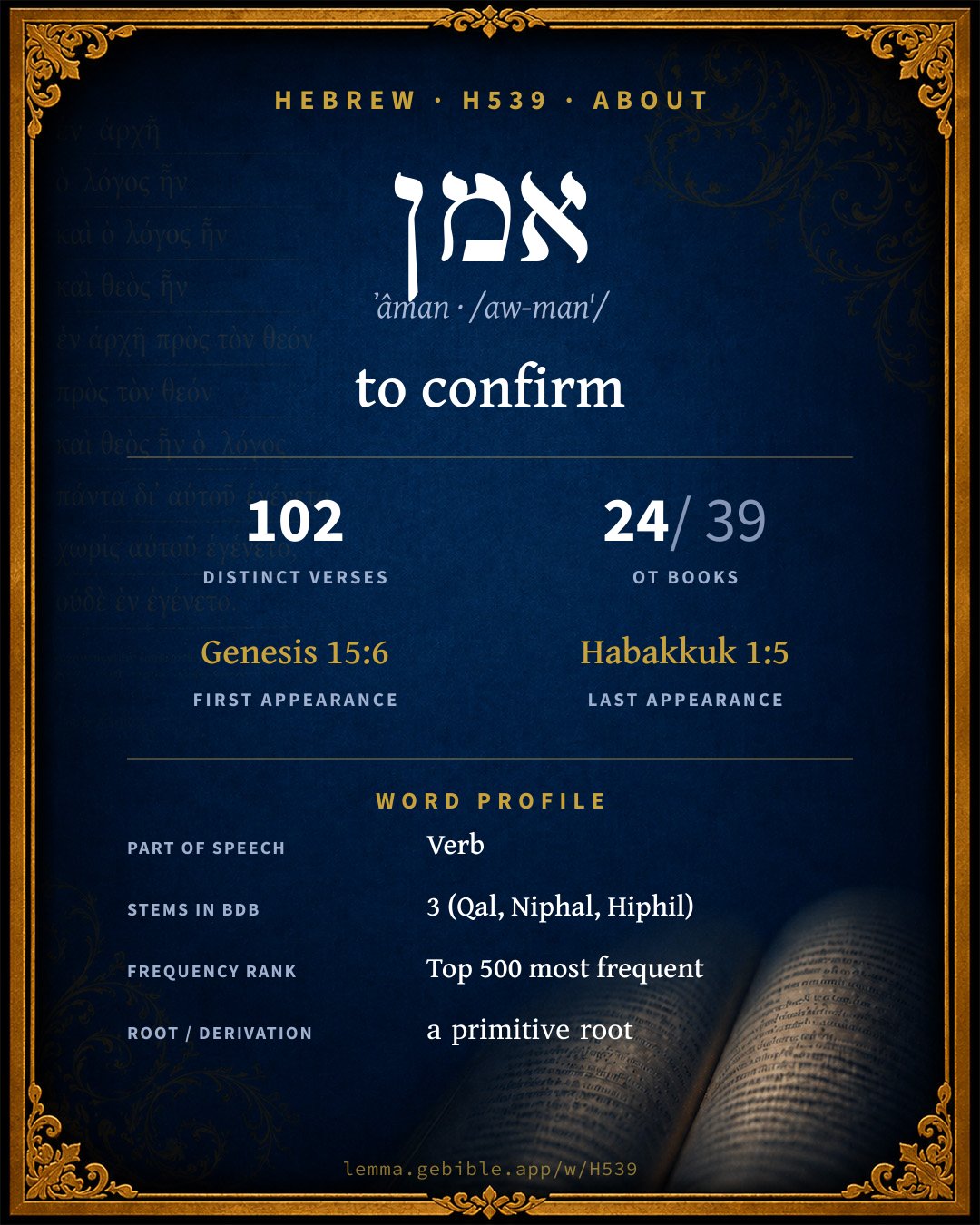
אָמַן
to confirm
‘to confirm’ is one of 4 main senses fuller range ↓
Full lexicon entry — Brown-Driver-Briggs (BDB)
From Brown-Driver-Briggs (BDB)
Where this word appears
Grammar key — what these labels mean
Part of speech
- Verb
- An action or state-of-being word.
- Adjective
- A word that describes or qualifies a noun.
Stem
- Niphal
- Usually the simple passive or reflexive of the Qal (“he was written”). Here: ‘carried by a nurse Is 60’
- Hiphil
- The causative active stem (“he caused / brought about”). Here: ‘stand firm Jb 39’
- Qal
- The basic, simple active stem — the plain form of the verb (“he wrote”). Here: ‘as vb. support’
Form
- Participle Active
- A verbal adjective expressing ongoing or characteristic action (“writing / one who writes”).
- Imperfect
- An incomplete, ongoing, or future action (“he will / would write”).
- Perfect
- A completed action or state — Hebrew marks aspect (completeness) more than strict tense (“he wrote”).
- Sequential Imperfect
- An imperfect with prefixed waw — the standard past-narrative form (waw-consecutive imperfect).
- Jussive
- A third- or second-person volitional form expressing wish or command (“let him write”).
- Imperative
- A direct command (“write!”).
- Sequential Perfect
- A perfect with prefixed waw continuing a preceding imperfect or command (waw-consecutive perfect).
- Participle Passive
- A verbal adjective expressing action received (“written”).
State
- Absolute
- The independent form of a noun, not bound to a following word.
- Construct
- A noun bound to a following noun in a possessive / “of” relationship (the construct chain).
Person
- 3rd Person
- The one spoken about (“he / she / it / they”).
- 1st Person
- The speaker (“I / we”).
- 2nd Person
- The one addressed (“you”).
Gender
- Masculine
- Grammatically masculine.
- Feminine
- Grammatically feminine.
- Common
- Either gender — not distinguished for this form.
Number
- Singular
- One.
- Plural
- More than one (in Hebrew, generally three or more).
Every verse where H539 appears in the Book of Esther — 1 distinct verse. Click any verse to open its interlinear word-by-word view. Verse text shown in the World English Bible for context — . Each verse’s Hebrew form is shown with its reference; the English is not keyword-highlighted, since the data carries no word-level English alignment. Use “Compare translations” on any verse to read it across multiple English versions. This concordance covers the Hebrew Bible; Septuagint (Greek Old Testament) occurrences are not indexed here.
Esther
About this entry
At a glance — auto-summarized from this page’s data, not written by a person. Every figure links to its source below. This summary describes the numbers; it doesn’t interpret them.
The Hebrew verb אמן centers on the idea of “to confirm.” Where the King James Version says “faithful,” newer translations reach for “believe” (Berean Standard Bible); the renderings breakdown has the detail. It appears 102 verses across 24 books of the Hebrew Bible, among its common vocabulary. Debuting at Genesis 15:6, it then recurs through the corpus. Across 3 stems, its meaning turns on the binyan (Qal, Niphal). Dig into 102-verse concordance and the renderings breakdown below.
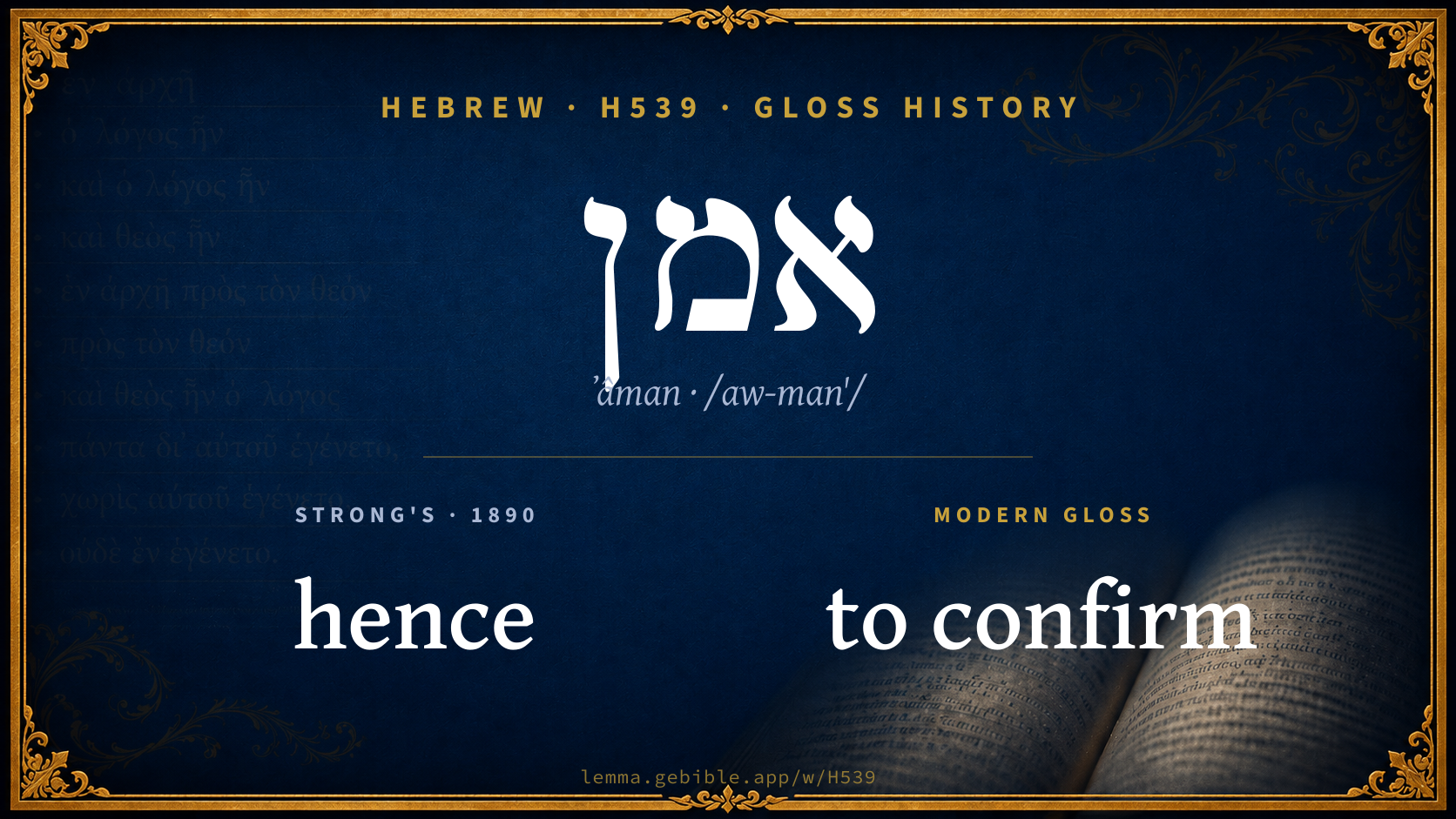
Gloss history
Strong's 1890 vs modern scholarship
About this word
Strong's H539 catalogs a Hebrew word from the Hebrew Old Testament.
These counts are not copied from any lexicon or concordance. They are computed here, from the morphology-tagged Hebrew Old Testament. What Lemma adds →
- 102
- distinct verses
- The word appears in 102 distinct verses.
- 24 / 39
- OT books
- The word appears in 24 of 39 Old Testament books.
- #401
- by frequency
- Top 500 most frequent Hebrew words (rank 401 of 8,640 Hebrew words by occurrence).
View all 102 occurrences in the concordance →
By section of the Old Testament
By traditional corpus
Conventional, traditional groupings — biblical authorship is debated, so this is a traditional corpus grouping, not an authorship claim. Each share is this word’s portion of its verses in that division of the Hebrew canon. Each figure is a share of the word’s 102 distinct verses.
- Writings (Ketuvim) 45 verses · 44%
- Prophets (Nevi'im) 38 verses · 37%
- Torah (Pentateuch) 19 verses · 19%
How translations render this word
Counts come from each version’s own published word-to-Strong’s tagging or interlinear alignment — an approximate guide to how each version renders this word, not a word-level alignment the data otherwise carries. Because each total is that version’s own tagged count, the per-version totals vary from one another and need not match the appearance or distinct-verse counts above. These counts may also differ from a printed concordance because Lemma counts each distinctly tagged rendering and does not collapse phrase taggings into a single head-word total. This is a fixed set of word-tagged versions (KJV, ASV, BSB, ULT) and does not change with the reading translation you choose elsewhere. Each version’s license is shown beside its name below (and on Sources).
BDB lists this Strong’s number as 5 distinct words (homographs). Each count above pools all of them and is not split by sense — see the Senses section below. A low-frequency rendering may belong to a different one of those words, not the primary meaning.
- King James Version†: Faithful 12×, Believed 6×, Sure 5×
- American Standard Version†: Faithful 12×, Believed 6×, Sure 5×
- Berean Standard Bible†: Believe 20×, Faithful 10×, Trust 7×
- unfoldingWord Literal Text†: Believe 25×, Faithful 12×, Trust 8×
King James Version Public Domain
Renders H539 across 108† tagged occurrences — most commonly:
Plus other, less common renderings. Plus 56 renderings that appear only once — usually multi-word phrases or single function words the recovered tagging swept in, not distinct renderings.
American Standard Version Public Domain
Renders H539 across 108† tagged occurrences — most commonly:
Plus other, less common renderings. Plus 57 renderings that appear only once — usually multi-word phrases or single function words the recovered tagging swept in, not distinct renderings.
Berean Standard Bible Public Domain
Renders H539 across 104† tagged occurrences — most commonly:
Plus 43 renderings that appear only once — usually multi-word phrases or single function words the recovered tagging swept in, not distinct renderings. Not rendered by a distinct English word in 1 further occurrence.
unfoldingWord Literal Text CC BY-SA 4.0
Renders H539 across 150† tagged occurrences — most commonly:
Plus other, less common renderings. Plus 49 renderings that appear only once — usually multi-word phrases or single function words the recovered tagging swept in, not distinct renderings.
16 senses and sub-senses in the full BDB
Hebrew verbs can shift meaning by stem (binyan): Qal is the basic action, Niphal is often passive or reflexive, Piel often intensifies or makes it factitive, and Hiphil is typically causative. The senses below are grouped under the stem BDB assigns to each.
What do BDB’s symbols mean?
BDB uses these scholarly abbreviations:
| Symbol | Meaning |
|---|---|
| 𝔊 | the Septuagint (the ancient Greek translation, LXX) |
| 𝔙 | the Vulgate (the Latin translation) |
| 𝔖 | the Syriac version (the Peshitta) |
| 𝔗 | the Targum (the Aramaic translation) |
| ψ | the Psalms |
| √ | root (the underlying root or stem) |
| ‖ | parallel passage (a synonymous or contrasted parallel) |
| † | the dagger: every passage where the word occurs is cited |
The 16 senses and sub-senses the full Brown-Driver-Briggs lexicon distinguishes for this word, in lexicon order (not ranked by frequency), with BDB’s own verbatim wording and sub-sense lettering. Shown in Hebrew script with BDB’s own scholarly abbreviations. The condensed entry is in the Lexicon Entry tab. See also the Forms in the corpus table below.
אמן I Amon, an Egyptian god Na 3
אמן II artificer, architect, master-workman, as firm and sure in his workmanship
אמן III m. (master-workman) (a) king of Judah 2 K 21
אמן IV confirm, support (cf. Arabic أَمِنَ, etc., v. infr.
Qal
- Pt. אֹמֵן;—
- 1. as vb. support, nourish 2 K 10:1, 5 Est 2:7. e.g. 2 Kings 10:1
- 2. as subst. foster-father Nu 11:12 (J) Is 49:23. e.g. Numbers 11:12
- 3. אֹמֶנֶת foster-mother, nurse Ru 4:16 2 S 4:4. e.g. Ruth 4:16
- 4. אֹמְנוֹת pillars, supporters of the door 2 K 18:16. Pt. pass. e.g. 2 Kings 18:16
- a. הָאֱמֻנִים those brought up (in scarlet) La 4:5. e.g. Lamentations 4:5
- b. אֱמוּנִים intrans. faithful (as firm, stable) as subst. m. faithful ones ψ 12:2 (> 𝔊 𝔖 al. faithfulness) 2 S 20:19 (cf. Arabic أمُنَ be faithful, أَمَنَ trust in, أَمَنَ be secure); ψ 31:23 faithful ones י׳ keepeth, אֱמוּנִים נֹצֵר י׳; but א׳ is here taken by 𝔊 Ri De Che as n. abstr. v. אֵמֻן. e.g. Psalms 12:2
Niphal
- נֶאֱמַן Pr 11:13 + (6 times); Impf. יֵאָמֵן, יֵאָ֫מֶן 1 K 8:26 + (9 times); Pt. נֶאֱמָן Pr 25:13 + (16 times) נֶאֱמָנָה Is 1:21 + (4 times); נֶאֱמֶנֶת ψ 89:29; נֶאֱמָנִים Pr 27:6 + (9 times); נֶאֱמָנוֹת Dt 28:59. e.g. Proverbs 11:13
- 1. carried by a nurse Is 60:4. e.g. Isaiah 60:4
- 2. made firm, sure, lasting: place Is 22:23, 25; name 1 Ch 17:24; waters Is 33:16 Je 15:18; an event Ho 5:9; sickness Dt 28:59; mercy Is 55:3. e.g. Isaiah 22:23
- 3. confirmed, established, sure: kingdom 2 S 7:16; house, dynasty 1 S 2:35; 25:28 1 K 11:38; prophet Samuel 1 S 3:20; cf. word-play אִם לֹא תַאֲמִינוּ לֹא תֵאָמֵנוּ = if ye believe not (have not firm confidence) ye will not be confirmed Is 7:9; הַאֲמִינוּ בי׳ וְתֵאָמֵנוּ = believe in Yahweh and ye will be confirmed 2 Ch 20:20. e.g. 2 Samuel 7:16
- 4. verified, confirmed: words of God 1 K 8:26 2 Ch 1:9; 6:17; 17:23; precepts ψ 111:7; testimonies ψ 19:8; 93:5; covenant ψ 89:29; words of men Gn 42:20 (E). e.g. 1 Kings 8:26
- 5. reliable, faithful, trusty: persons 1 S 2:35; 22:14 Jb 12:20 ψ 89:38; 101:6 Pr 25:13 Is 8:2 Ne 13:13; a city Is 1:21; האל הנאמן the faithful God Dt 7:9 cf. Is 49:7; נֶאֱמַן רוּחַ faithful in spirit (disposition) Pr 11:13; לְבָבוֹ נֶאֱמָן his heart faithful Ne 9:8; עֵד אֱמֶת וְנֶאֱמָן true and faithful witness Je 42:5; נאמנים פצעי אוהב faithful the wounds of a friend Pr 27:6; c. אֵת (אֶל) ψ 78:8; עִם Ho 12:1; בְּ of thing ψ 78:37; בְּכָל־בֵּיתִי in all my house (of Moses) Nu 12:7 (E). e.g. 1 Samuel 2:35
Hiphil
- הֶאֱמִין Gn 45:26 + (18 times); Impf. יַאֲמִין, יַאֲמֵן Jb 15:31 + (30 times); Imv. הַאֲמִינוּ 2 Ch 20:20 + (2 times); Pt. מַאֲמִין Dt 1:32 Is 28:16. e.g. Genesis 45:26
- 1. stand firm Jb 39:24 (c. neg. of the horse when the trumpet sounds Di De MV RVm; but neither believeth RV, hardly trusts Da). e.g. Job 39:24
- 2. trust, believe: (a) abs. Ex 4:31 (J) Is 7:9; 28:16 Hb 1:5 ψ 116:10 Jb 29:24; (b) with ל of person, trust to, believe Gn 45:26 (E) Ex 4:1, 8 (J) Je 40:14 2 Ch 32:15; with God Dt 9:23 Is 43:10; ל of thing Ex 4:8, 9 (J) ψ 106:24 1 K 10:7 2 Ch 9:6 Is 53:1 Pr 14:15; (c) with ב of person, trust in, believe in Ex 19:9 (J) 1 S 27:12 2 Ch 20:20 Jb 4:18; 15:15 Pr 26:25 Je 12:6 Mi 7:5; the usual construction with God Gn 15:6 (E) Ex 14:31 Nu 14:11 (J) 20:12 (P) Dt 1:32 2 K 17:14 2 Ch 20:20 ψ 78:22 Jon 3:5; with ב of thing Dt 28:66 Jb 15:31; 24:22; 39:12 ψ 78:32; 106:12; 119:66; (d) with כִּי trust or believe that Ex 4:5 (J) Jb 9:16 La 4:12; (e) so with infin. Jb 15:22 ψ 27:13 (sq. ל); also trust to do a thing, almost = allow, Ju 11:20. e.g. Exodus 4:31
Senses from the full Brown-Driver-Briggs lexicon (Brown, Driver, Briggs; Oxford 1906 — public domain), digitized via Sefaria, supplemented by the OpenScriptures HebrewLexicon (CC BY 4.0). Full attribution on Sources.
Word origin
I. n.pr. Amon, an Egyptian god Na 3:8 Je 46:25, comp. by Greeks with Zeus (Herod. ii, 42; Diod i. 13), Ἀμμῶν. He was originally the local deity of Thebes (= נֹא, called נֹא אָמוֹן Na 3:8, cf. א׳ מִנֹּא Je 46:25), but subsequently became the supreme god of the Egyptian Pantheon, the successor of the sun-god Ra and so-called Amon Ra. He was the secret god, who hid himself and was difficult to find (Amon = concealment, hidden); v. Rawl. Hist. Anc. Egypt, i, 322 Ebers. RiHWB. Je 46:25 Spiegelberg Randglossen, 43 ff. reads נֹא אָמוֹן (as Na 3:8) for אָמוֹן נֹא, and finds in both a Thebes in the Delta. (ii. iii. אָמוֹן v. p. 54.)
II. n.m. artificer, architect, master-workman, as firm and sure in his workmanship: וָאֶהְיֶה אֶצְלוֹ אָמוֹן I was at his side architect, master-workman (𝔊 𝔖 𝔙 Ges Ew De MV RV, > foster-son AE Ki AV) Pr 8:30; יֶתֶר הָֽאָמוֹן rest of the master-workmen Je 52:15 (Hi Gf De RVm, but rest of the multitude Ges MV RV et al., אמון = המון)—1. אָמוֹן v. supr. p. 51.
III. n.pr.m. (master-workman) (a) king of Judah 2 K 21:18, 19, 23, 24, 25 1 Ch 3:14 2 Ch 33:20, 21, 22, 23 25 Je 1:2; 25:3; (b) captain of a city 1 K 22:26 2 Ch 18:25; (c) one of the line of Solomon’s servants Ne 7:59 = אָמִי Ezr 2:57.
I. vb. confirm, support (cf. Arabic أَمِنَ, etc., v. infr.; Sab. אמן in deriv. & n.pr. cf. CIS iv. 1, 10 DHMZMG 1885, 598; Aramaic אֲמַן, ܐܡܢ in Haph. Ethiopic አምነ Assyrian in deriv.)—only
— Brown-Driver-Briggs (Oxford 1906, public domain), digitized via Sefaria, supplemented by the OpenScriptures HebrewLexicon (CC BY 4.0). See Sources.
Origin: a primitive root
Jastrow Dictionary
A second Hebrew/Aramaic lexicon for comparison, covering Aramaic and post-biblical (Talmudic, Targumic, Midrashic) usage that the biblical-Hebrew BDB does not. Matched by lemma rather than by Strong’s number, so a lemma may carry more than one Jastrow headword (shown separately below), and the entries cover usage well beyond the Bible.
אָמַן
- , v. אֵם; cmp. אַמָּה) to arrange in lines, array. Ukts. II, 5 nuts שאֲמָנָן which one arranged (Var. Ar. שחמרן which one piled).—Denom. אוּמָן expert, skilful, whence
- to make skilful, to train. Sabb. 103ᵃ מְאַמֵּן את ידו he trains his hand (practicing). V. next w.
אָמֵן I
- (√אם, v. אֵם; cmp. preced.) to be strong, enduring; (act. v. אָמַן to support, v. II Kings XVIII, 16 אֹמְנוֹת).—Pi. אִימֵּן, אִמֵּן to support; trnsf. to confirm, verify, approve. Tosef. Ter. I, 4 it is not the minor that made it T’rumah אלא אביו שאִימֵּן אחריו Var. (ed. Zuck. שאומן) but his father who confirmed his act (= ib. קיים על יד); Y. ib. 40ᵇ א׳ על ידו. Ib.ᶜ top מְאַמֵּין. e.g. 2 Kings 18:16
- (b. h.)
- 1. part. נֶאֱמָן m., נֶאֱמָנֶת f. approved, trustworthy, reliable. Peah VIII, 2 נֶאֱמָנִים על וכ׳ (the poor) may be relied upon concerning garnered fruit &c., i.e. if they declare the fruits to be the poor man’s share, they are exempt from tithes. Keth. I, 6 נאמנת her statement is acted upon as true. Ab. Zar. 16ᵇ נ׳ עלי הדיין my judge is a reliable witness concerning me, i.e. I appeal to thy own judgment that I could not have engaged in such follies.—Dem. II, 2 if one resolves להיות נ׳ to be one of the reliable (conscientious in giving tithes); a. fr.
- 2. to be confirmed. Y. Sot. II, 18ᵇ top אמן יֵאָמְנוּ הדברים Amen means, May the words (of the oath) be fulfilled.
- (b. h.) to declare trustworthy, to trust, believe in. Dem. VII, 1 והוא אינו מַאֲמִינוֹ but he (the invited guest) trusts him not in tithe affairs. Ib. 3; a. fr.—Ab. Zar. 16ᵇ הואיל וְהֶאֱמַנְתַּנִי עליך ed. Pes., En Yak. (v. Rabb. D. S. a. l. note; ed. הָאֳמַנְתִּי Hof.; since thou didst declare me a reliable witness unto thyself (appealing to my judgment), v. supra; [Ms. M. האמנת עלי thou reliedst on me]. Ch., v. הֵימַן.
אָמֵן II
- v. preced.) firm, straight, whence
- 1. Amen!, true! so may it be! Shebu. 36ᵃ א׳ בו שבועה וכ׳ in Amen is implied an oath, a promise, and a prayer for fulfillment. Ab. Zar. 65ᵃ; a. fr.
- 2. fem., the response Amen. Ber. 47ᵃ א׳ חטופה an Amen hastily pronounced (’men); א׳ קטופה an Amen cut short (ame-); א׳ יתומה an orphan Amen, the responder not having heard the benediction to which the Amen refers; Tosef. Meg. IV (III), 27.
A Dictionary of the Targumim, the Talmud Babli and Yerushalmi, and the Midrashic Literature (Marcus Jastrow; London, Luzac, 1903) — Public Domain. Digitized via Sefaria. Digitized via Sefaria. Full attribution on Sources.
Forms in the corpus
The 90 distinct written forms H539 takes in the Hebrew Bible, most frequent first — each parse links to that stem’s occurrences in the concordance. Hebrew forms include their vowel points and cantillation, so a single lemma takes many written forms.
The 60 most common forms are shown; 30 rarer forms follow in the full concordance.
Same root — word family
Other BDB entries built from the same root as H539, grouped by Strong’s listed origin. These share a root / origin per the lexicon — not necessarily a shared meaning. Each links to that word’s own entry.
Derived from this word
- אמון ʼâmôwn H525 craftsman
- אמון ʼêmûwn H529 faithfulness
- אמן ʼăman H540 to trust
- אמן ʼâmân H542 artisan
- אמן ʼâmên H543 truly
- אמן ʼômen H544 faithfulness
- אמת ʼemeth H571 faithfulness
Proper names from this root
People and places named from this root — a name, not an additional meaning of the word.
Compare all same-root words → Showing 4 of 10 — not the complete family. 2 of the same-root words are proper names (people or places). They share a root, not necessarily a meaning.
Septuagint verse parallels
This word appears in 89 verses that also exist in the Greek Old Testament (Septuagint), out of the 102 Hebrew verses it occurs in. You can read those verses in Greek by switching the Old Testament edition to the Septuagint.
Read these verses in the Septuagint
- Genesis 15:6
- Exodus 4:1
- Numbers 11:12
- Deuteronomy 1:32
- Judges 11:20
- Ruth 4:16
- 1 Samuel 2:35
- 2 Samuel 4:4
- 1 Kings 8:26
- 2 Kings 10:1
- 1 Chronicles 17:23
- 2 Chronicles 1:9
This is a verse-level parallel only — the same verses exist in both the Hebrew and Greek Old Testaments. No word-level Hebrew↔Greek correspondence is claimed: the data carries no such alignment, so no Greek word is shown as this Hebrew word’s translation. Coverage is not total — the Septuagint omits the deuterocanon and renumbers the Psalms, so some Hebrew verses have no direct Greek parallel.