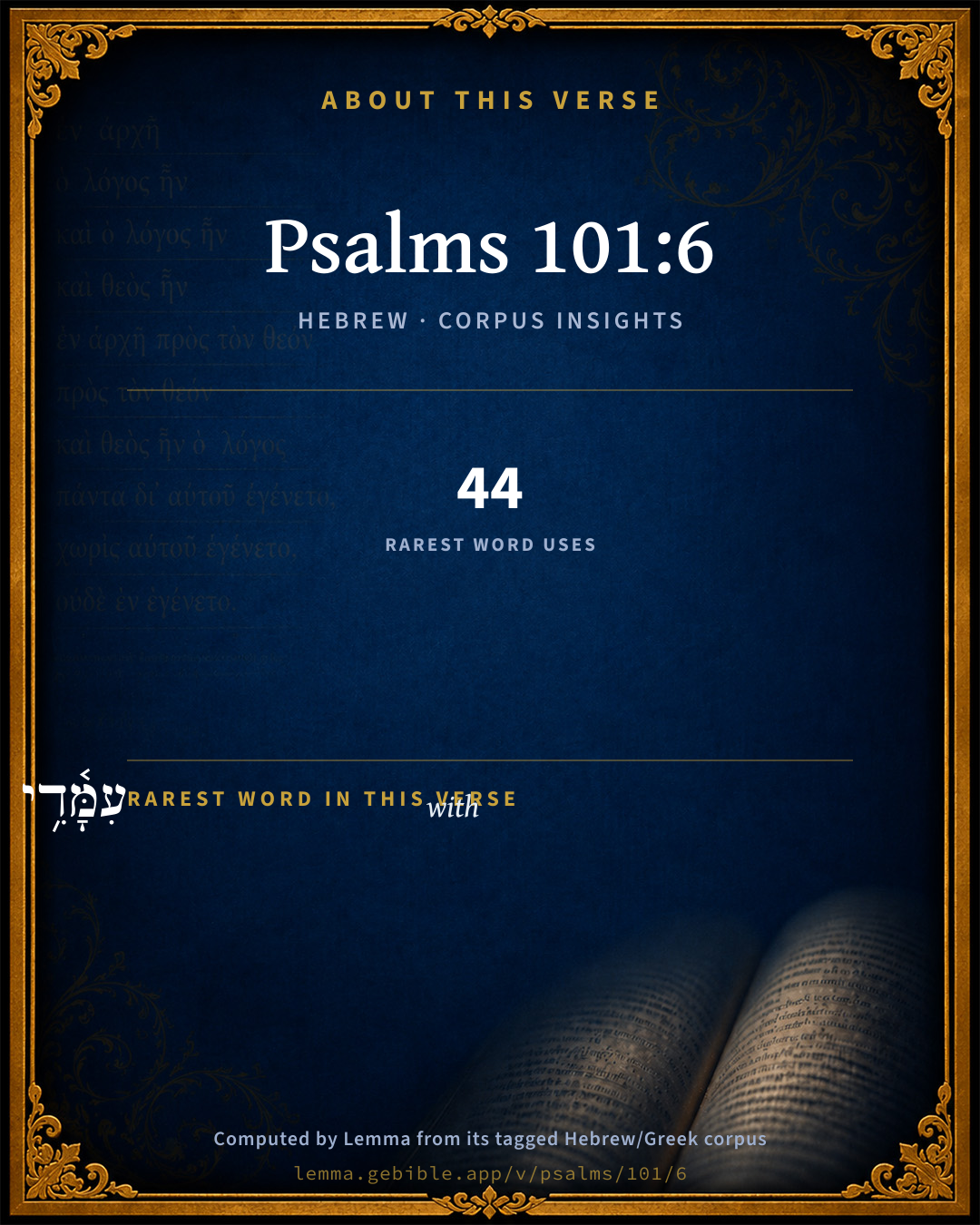
Psalms 101:6

Hebrew (Westminster Leningrad Codex) Psalms 101:6 appears in the Hebrew Old Testament. The text above is from the Westminster Leningrad Codex. Each word links to its Strong’s number, a concise gloss, and parsing drawn from the Open Scriptures Hebrew Bible morphology. Click any word for its full Brown-Driver-Briggs (BDB) entry.
Download image
Cite this verse

Psalms 101:6 (World English Bible). Public Domain. Lemma interlinear Bible study tool, https://lemma.gebible.app/v/psalms/101/6.

Show BibTeX & RIS
BibTeX
RIS
English Translation
My eyes will be on the faithful of the land, That they may dwell with me. He who walks in a perfect way, He will serve me.
World English Bible · Public Domain
Download a study sheet

One document with this verse’s original text, its word-by-word gloss line, the meaning frame, cross-references with their text, attributed commentary, and full source and license credits — printable, and it pastes into notes with its structure intact.

This verse Autodidact and up

Study sheet (.html) Plain text (.txt)

A passage Seminary Student

Up to 50 verses in one chapter. A passage sheet keeps up to 6 commentary sources and 12 cross-references per verse, in the order this page ranks them, and says so on the sheet whenever that leaves anything out. Ask for a single verse and you get the Autodidact verse sheet above.

Everything on this page stays free to read, with no account — the sheet is a download of what is already on screen, not access to it.

Want to remove ads? Support Godless Engineer
Compare translations 3

The same verse in 3 English versions, stacked beneath the original-language interlinear above. Click any original word for its lexicon entry.

Each is an independent rendering of the whole verse — the interlinear is not word-aligned to these translations.

Highlighted words mark where these versions differ — a whole-verse word diff, not a word-by-word alignment.

  • World English Bible Public Domain
    My eyes will be on the faithful of the land, That they may dwell with me. He who walks in a perfect way, He will serve me.
  • King James Version Public Domain
    Mine eyes shall be upon the faithful of the land, that they may dwell with me: he that walketh in a perfect way, he shall serve me.
  • unfoldingWord Literal Text CC BY-SA 4.0
    My eyes on the faithful of the land to sit with me; The walking in the way of integrity, he may serve me.

unfoldingWord Literal Text — © unfoldingWord, licensed CC BY-SA 4.0. Word-aligned USFM3 via Door43 (git.door43.org/unfoldingWord/en_ult).

Versions to compare (up to 4)

3 of 4 selected

Show all 18 translations

Every available English version of this verse, each an independent rendering of the whole verse.

  • World English Bible Public Domain
    My eyes will be on the faithful of the land, That they may dwell with me. He who walks in a perfect way, He will serve me.
  • Berean Standard Bible Public Domain
    My eyes favor the faithful of the land, that they may dwell with me; he who walks in the way of integrity shall minister to me.
  • Majority Standard Bible Public Domain
    My eyes favor the faithful of the land, that they may dwell with me; he who walks in the way of integrity shall minister to me.
  • King James Version Public Domain
    Mine eyes shall be upon the faithful of the land, that they may dwell with me: he that walketh in a perfect way, he shall serve me.
  • American Standard Version (1901) Public Domain
    Mine eyes shall be upon the faithful of the land, that they may dwell with me: He that walketh in a perfect way, he shall minister unto me.
  • Revised Version (1885) Public Domain
    Mine eyes shall be upon the faithful of the land, that they may dwell with me: he that walketh in a perfect way, he shall minister unto me.
  • Geneva Bible (1599) Public Domain
    Mine eyes shalbe vnto the faithfull of the lande, that they may dwell with me: he that walketh in a perfite way, he shall serue me.
  • Douay-Rheims (1899) Public Domain
    My eyes were upon the faithful of the earth, to sit with me: the man that walked in the perfect way, he served me.
  • Young's Literal Translation Public Domain
    Mine eyes are on the faithful of the land, To dwell with me, Whoso is walking in a perfect way, he serveth me.
  • Literal Standard Version CC BY-SA 4.0
    My eyes are on the faithful of the land, || To dwell with me, || Whoever is walking in a perfect way, he serves me.
  • Unlocked Literal Bible CC BY-SA 4.0
    I will look to the faithful of the land to sit at my side. Those who walk in the way of integrity may serve me.
  • unfoldingWord Literal Text CC BY-SA 4.0
    My eyes on the faithful of the land to sit with me; The walking in the way of integrity, he may serve me.
  • Darby Bible Public Domain
    Mine eyes shall be upon the faithful of the land, that they may dwell with me; he that walketh in a perfect way, he shall serve me.
  • World Messianic Bible Public Domain
    My eyes will be on the faithful of the land, that they may dwell with me. He who walks in a perfect way, he will serve me.
  • Webster's Bible Public Domain
    My eyes shall be upon the faithful of the land, that they may dwell with me: he that walketh in a perfect way, he shall serve me.
  • Free Bible Version CC BY-SA 4.0
    I look for faithful people to live with me; only those who are trustworthy will serve me.
  • Bible in Basic English Public Domain
    My eyes will be on those of good faith in the land, so that they may be living in my house; he who is walking in the right way will be my servant.
  • JPS Tanakh (1917) Public Domain
    Mine eyes are upon the faithful of the land, that they may dwell with me; he that walketh in a way of integrity, he shall minister unto me.

Literal Standard Version (2020), Covenant Press — licensed CC BY-SA 4.0. Text via the HelloAO Bible API (eBible.org). Unlocked Literal Bible (unfoldingWord) — licensed CC BY-SA 4.0. Text via the HelloAO Bible API (eBible.org). unfoldingWord Literal Text — © unfoldingWord, licensed CC BY-SA 4.0. Word-aligned USFM3 via Door43 (git.door43.org/unfoldingWord/en_ult). Free Bible Version, Dr. Jonathan Gallagher — licensed CC BY-SA 4.0. Text via the HelloAO Bible API (eBible.org).

Word by word

More ways to search: Search by grammar → Find every occurrence → Compare this word →

Practice this passage: Drill this verse → Learn its vocabulary →

עִמָּ֫דִ֥י
ʻimmâd
H5978
“with · me”
Preposition + Suffix, Personal, 1st Person, Common, Singular
Part of Speech
Preposition
Full BDB Definition

Origin: prol for H5973

TWOT: 1640b

with
  1. עֵינַ֤י ʻayin H5869 “eyes · my” Noun, Common, Both, Dual, Construct + Suffix, Personal, 1st Person, Common, Singular
  2. בְּנֶֽאֶמְנֵי ʼâman H539 “in/at · confirming” Preposition + Verb, Niphal, Participle Active, Masculine, Plural, Construct
  3. אֶרֶץ֮ ʼerets H776 “land” Noun, Common, Both, Singular, Absolute
  4. לָשֶׁ֪בֶת yâshab H3427 “to dwell” Preposition + Verb, Qal, Infinitive Construct
  5. הֹ֭לֵךְ hâlak H1980 “walking” Verb, Qal, Participle Active, Masculine, Singular, Absolute
  6. בְּדֶ֣רֶךְ derek H1870 “in/at · way” Preposition + Noun, Common, Both, Singular, Absolute
  7. תָּמִ֑ים tâmîym H8549 “complete” Adjective, Adjective, Masculine, Singular, Absolute
  8. ה֝֗וּא hûwʼ H1931 “he” Pronoun, Personal, 3rd Person, Masculine, Singular
  9. יְשָׁרְתֵֽנִי shârath H8334 “to minister · me” Verb, Piel, Imperfect, 3rd Person, Masculine, Singular + Suffix, Personal, 1st Person, Common, Singular

About this verse

These counts appear in no published source. They are computed here, from the morphology-tagged text and Lemma’s own curated glosses. What Lemma adds →

10
words
10
distinct lemmas
Wisdom
section

Shared distinctive vocabulary

עִמָּ֫דִ֥י with H5978 occurs in 44 verses of the Hebrew Bible. Also found in:

Grammatical profile

  • 4 verbs
  • 3 nouns
  • 1 adjective
  • 1 pronoun
  • 1 preposition

Verb forms

  • בְּנֶֽאֶמְנֵי Niphal · Participle Active
  • לָשֶׁ֪בֶת Qal · Infinitive Construct
  • הֹ֭לֵךְ Qal · Participle Active
  • יְשָׁרְתֵֽנִי Piel · Imperfect

Hebrew & Septuagint length

In English translation the verse runs 27 words from the Hebrew and 28 from the Septuagint (LXX English) — closely comparable.

A rough comparison of the two English renderings, which tokenize alike — not a word-level alignment.

Word counts can differ between the Hebrew and the Greek without any difference in meaning — e.g. the Hebrew direct-object marker אֵת has no separate Greek word, and Greek often adds the article ὁ.

Cross-references

15

Topical passages linked to Psalms 101:6 in the Treasury of Scripture Knowledge — connected by theme and wording, ordered by reader-vote popularity; previews shown in the World English Bible.

  • Psalms 119:63 I am a friend of all those who fear you, Of those who observe your precepts.
  • Luke 12:43–44 Blessed is that servant whom his lord will find doing so when he comes.
  • Revelation 21:3 I heard a loud voice out of heaven saying, "Behold, God's dwelling is with people, and he will dwell with them, and they will be his people, and God himself will be with them as their God.
  • John 12:26 If anyone serves me, let him follow me. Where I am, there will my servant also be. If anyone serves me, the Father will honor him.
  • Psalms 119:1–3 Blessed are those whose ways are blameless, Who walk according to Yahweh's law.
  • Romans 13:1–4 Let every soul be in subjection to the higher authorities, for there is no authority except from God, and those who exist are ordained by God.
  • Matthew 24:45 "Who then is the faithful and wise servant, whom his lord has set over his household, to give them their food in due season?
  • John 17:24 Father, I desire that they also whom you have given me be with me where I am, that they may see my glory, which you have given me, for you loved me before the foundation of the world.
  • Philippians 3:12–15 Not that I have already obtained, or am already made perfect; but I press on, if it is so that I may take hold of that for which also I was taken hold of by Christ Jesus.
  • Psalms 15:4 In whose eyes a vile man is despised, But who honors those who fear Yahweh; He who keeps an oath even when it hurts, and doesn't change;
  • Psalms 34:15 Yahweh's eyes are toward the righteous. His ears listen to their cry.
  • Proverbs 28:28 When the wicked rise, men hide themselves; But when they perish, the righteous thrive.
  • Proverbs 29:2 When the righteous thrive, the people rejoice; But when the wicked rule, the people groan.
  • John 14:3 If I go and prepare a place for you, I will come again, and will receive you to myself; that where I am, you may be there also.
  • Revelation 3:20–21 Behold, I stand at the door and knock. If anyone hears my voice and opens the door, then I will come in to him, and will dine with him, and he with me.

Cross-references courtesy of OpenBible.info (CC BY 4.0).

Hebrew and Greek witnesses Masoretic Hebrew ↔ Greek Septuagint

The same verse in the two great witnesses to the Old Testament, shown verse-for-verse.

You’re reading Greek Psalm 100 (Hebrew Psalm 101). The Septuagint counts the superscription, so verse numbers can differ from the Hebrew — chapter-level alignment, not verse-by-verse. Numbering follows Rahlfs.

These are two independent witnesses, not word-aligned to each other, and the Septuagint is shown in lemma (dictionary) form.

Hebrew Psalms 101:6 Masoretic · Westminster Leningrad Codex

עֵינַ֤י בְּנֶֽאֶמְנֵי אֶרֶץ֮ לָשֶׁ֪בֶת עִמָּ֫דִ֥י הֹ֭לֵךְ בְּדֶ֣רֶךְ תָּמִ֑ים ה֝֗וּא יְשָׁרְתֵֽנִי

My eyes will be on the faithful of the land, That they may dwell with me. He who walks in a perfect way, He will serve me.

World English Bible · Public Domain

Greek LXX Greek Psalm 100:6 Septuagint · lemma form

ὁ ὀφθαλμός ἐγώ ἐπί ὁ πιστός ὁ γῆ ὁ συν καταἧμαι αὐτός μετά ἐγώ πορεύομαι ἐν ὁδός ἄμωμος οὗτος ἐγώ λειτουργέω

My eyes shall be upon the faithful of the land, that they may dwell with me: he that walked in a perfect way, the same ministered to me.

LXX2012 (modern English Septuagint) · Public Domain

Hebrew: Westminster Leningrad Codex (CC BY 4.0). Greek: Septuagint (public domain); English from LXX2012 (modern English Septuagint) (Public Domain). How the Septuagint differs from the Hebrew →

Commentary

Notes on Psalms 101:6 from classic Christian and Jewish commentators (each source and its license shown beneath its notes). The classic Christian expositions comment on the surrounding passage and are grouped to its opening verse, so a note may address several verses; the Jewish commentaries on the Tanakh (Rashi and others) are per-verse, so they appear only where the commentator wrote on this verse.

Lemma curates 59 commentaries, every one of them public domain or Creative Commons licensed, each selected and text-cleaned for this edition rather than reprinted as found. About our sources →

Trapp's Complete Commentary

John Trapp

Psa 101:6 Mine eyes [shall be] upon the faithful of the land, that they may dwell with me: he that walketh in a perfect way, he shall serve me.

Ver. 6. Mine eyes shall be upon the faithful of the land] i.e. Let them live where they will, I will hearken them out, and find them out. The Rabbis say, that here David repenteth him of taking into his service and tuition those indebted and discontented persons, men of broken fortunes and loose manners, 1Sa 22:1-2, and resolveth to be better advised in the choosing and using of his retinue when he cometh to the kingdom, that his court might be like that of Cyrus, whereof Xenophon saith, that though a man should seek or choose blindfold, he could not miss of a good man (Cyrop. l. 8). Zonaros mainly commendeth Valentinian I and Leo Armeuius, emperors, for their good choice of both civil and military officers. He condemneth as much Macrinus for the contrary.

He shall serve me] λειτουργησει μοι, he shall be of honourable employment about me, as Joseph was to Pharaoh, Cromwell to Henry VIII, his vicar-general.

John Trapp, A Commentary or Exposition upon All the Books of the Old and New Testament (1647–1656) — public domain. Text from a community e-Sword module.

The Biblical Illustrator

Joseph S. Exell

Psa_101:6

Mine eyes shall be upon the faithful of the land, that they may dwell with me.

The King and His court

I. Who are these faithful men to whom Jesus, our King, will have respect at all times?

1. They are true in their dealings with God. How many a man has become a bankrupt by a lavish expenditure which exceeded his income! He said that he must keep up appearances, and he did keep up appearances till they became his ruin. God grant that you and I may never try to keep up appearances before Him! Be what you would seem to be; and in the presence of God never seem to be or dream of seeming to be what you are not. Thus I think we, first of all, know the faithful by their upright dealing with God.

2. This will lead them to be true in their dealings with men. That man is not faithful in Gods esteem who is not upright, honest, true to a hairs breadth, in his dealings with his fellow-men. We must stand to our bond even though we lose by it. We must be true to the word we speak though it be to our own hurt.

3. Such people will, in the next place, always be true in their dealings with men on Gods behalf. I think this passage bears very pertinently upon the minister, and upon the Sunday-school teacher, and upon the Christian worker.

4. These faithful men are thorough in all that they do. The psalmist says, He that walketh in a perfect way, he shall serve me. May I be permitted to say, especially to you who are commencing the Christian life, that if you wish to live near to God, and to be greatly used of Him, it is important that you should begin as you mean to go on, by endeavouring to walk in a perfect way? Be you determined that, if others do as they please, you are not accountable for their action; but you will do what you believe to be right. If you are a Christian, go through with it; be a follower of Christ in every respect as far as the Word of God and your own conscience lead you.

II. What will the King do with them?

1. His eye of search will seek them out. There is a working-man who, the other day, in the midst of a swearing company, rebuked the blasphemer, and spoke up for Christ. That noble action is not recorded in the newspaper, and never will be; but Gods eye is upon the faithful of the land.

2. His eye of favour will cheer them. God greatly favours and blesses those whom by His grace He makes to be faithful.

3. They shall dwell with God. Oh, this is a choice privilege! When grace makes a man faithful, God rewards his faithfulness by permitting him to dwell in close communion with his Lord. It is a wonderful thing to me that, if we have any good works, God always works them in us, and then he rewards us for them as if they were our own. He gives us grace, and then smiles on us because of the grace that He Himself gives.

4. They shall be Christs servants. I do not know which is the greater privilege, He shall dwell with me, or, He shall serve me. Perhaps the second is the higher. Have you ever thought what an honour it is to be permitted to do anything for God? For God to bless us, is great condescension on His part; but for Him to permit us to be of any use to Him, this is a wonderful honour from His right hand.

III. How may we get among these faithful ones?

1. Perhaps we can truly say, God helping us, we hope that we are among them. If so, it is He that hath made us, and not we ourselves. If there be any faithfulness, if there be any uprightness, unto God be the glory of it all. Pray that you may never lose your faithfulness, but that you may be kept even unto the end.

2. But now I speak to others who are not as yet faithful. You say, How are we to get among the faithful?

(1) Well, I should say, first, so far as you may be, and so far as your light goes, be faithful to-night, be honest in confessing sin. Before you sleep, put yourself before God just as you are.

(2) Then, next, be anxious to have a new heart and a right spirit.

(3) Be sincere in all your dealings with the living God.

(4) Depend continually on the Lord Jesus and His Word to make and keep you faithful. (C. H. Spurgeon.)

The Biblical Illustrator, edited by Joseph S. Exell (c. 1880s–1900s) — public domain. Text from a community e-Sword module.

J. A. Alexander on Psalms

Joseph Addison Alexander

6. (Psa 101:6) My eyes (are) on the faithful of the land, to dwell with me. (One) walking in a perfect way—he shall serve me. On the faithful, literally in or with them. See above, on Psa 34:15-16, and compare Psa 32:7. My eyes are on them is equivalent to saying, I will seek them out to dwell with me and serve me. The word translated faithful is properly a passive participle meaning trusted, relied upon, confided in. Another passive participle from the same root is commonly supposed to be used in the same sense, Psa 12:1; Psa 31:23. In the first words of the last clause there is manifest allusion to the, form of expression in Psa 101:2 above. This clause is to be understood exclusively, such a person and no other. Shall serve me, be employed by me, clothed with responsible and honourable offices.

Joseph Addison Alexander, The Psalms Translated and Explained (1850) — public domain. Text from a community e-Sword module.

Tyndale Open Study Notes

Tyndale Open Resources

101:6 The psalmist surrounds himself with people who are also committed to integrity (101:2).

Tyndale Open Study Notes — © Tyndale Open Resources, licensed CC BY-SA 4.0. Text via the HelloAO Bible API.

Geneva Bible (1599)

Geneva Bible translators

He showeth what is the true use of the sword: to punish the wicked, and to maintain the good.

Geneva Bible (1599) marginal notes — public domain. Text via Bolls.life.

Adam Clarke's Commentary

Verse 6. Mine eyes] My approbation.

Upon the faithful] The humble, upright followers of God.

That they may dwell with me] Be my confidants and privy counsellors. No irreligious or wicked man, whatever his abilities may be, shall be countenanced or supported by me. I will purify my court from the base, the irreligious, the avaricious, the venal, the profligate, and the wicked.

He that walketh in a perfect way] He that is truly religious.

He shall serve me.] Shall be my prime minister, and the chief officer in my army, and over my finances.

Adam Clarke's Commentary on the Bible (1810–1826) — public domain. Text from a community e-Sword/MySword module.

John Calvin's Commentaries

6 My eyes are towards the faithful of the land David here lays down another virtue of a wise prince, when he affirms that it will be his care to make all the faithful of the land his intimate friends, — that he will avail himself of their good offices, and have as domestic servants such only as are distinguished for personal worth. Some understand the words, that they may dwell with me, in a general sense thus: I will not neglect the good and inoffensive, nor will I suffer them to be unjustly molested; but I will secure, that under my administration, they shall live in a state of peace and tranquillity. But his meaning rather is, that he will exercise discretion and care, that, instead of taking persons into his service indiscriminately, he may wisely determine each man’s character, so as to have those who live a life of strict integrity as his most intimate friends, and that he may intrust them with the offices of state. He speaks of the faithful in the first place, because, although a man may possess talents of a high order, yet if he is not devoted to fidelity and integrity, he will never rightly execute the office of a judge. This is worthy of special notice; for although a prince may be the best of men, yet if his servants and officers are not of a corresponding character his subjects will experience hardly any advantage from his uncorrupted integrity. Servants are the hands of a prince, and whatever he determines for the good of his subjects they will wickedly overthrow it, provided they are avaricious, fraudulent, or rapacious. This has been more than sufficiently demonstrated by experience. The greater part of kings, indeed, passing over the good and the upright, or, which is worse, driving them away from them, purposely seek to have as servants those who are like themselves, and who may prove fit tools for their tyranny; yea, even good and well disposed princes often manifest so much indolence and irresolution as to suffer themselves to be governed by the worst counsels, and inconsiderately prostitute the offices of state by conferring them on the unworthy.

John Calvin's Commentaries (1540-1563) — public domain. Text from the Calvin Translation Society English edition (1840s-50s) via the Christian Classics Ethereal Library (ccel.org). Calvin's coverage is partial (roughly two-thirds of the Bible); uncommented books and verses are honest gaps, never fabricated. The 19th-century editor's footnotes and remarks are omitted so the notes are faithfully Calvin's own voice.

The Cambridge Bible for Schools and Colleges

gen. ed. J. J. S. Perowne

6. He is ever on the look out for men of probity and integrity to be his companions and confidential ministers.

he shall serve me] He shall minister unto me (R.V.).

The Cambridge Bible for Schools and Colleges (gen. ed. J. J. S. Perowne; Cambridge University Press, 1878–1918) — public domain. Text from a community e-Sword module.

John Gill's Exposition

Mine eyes shall be upon the faithful of the land,.... To look them out, bring them to court, and promote them to places of honour and trust; such an one was David himself, and such there were in the land of Israel, though but few, and of which he complains, Psa 12:1. Christ's eyes are upon faithful persons, on faithful ministers of the word, who preach the Gospel faithfully, administer the ordinances truly, are faithful to the souls of men in watching over them, reproving and exhorting them; his eyes are upon them to keep and preserve them, and to honour and reward them with a crown of life that fadeth not away; and his eyes are also on faithful members of churches, such who truly believe in him, who hold fast the faithful word, and keep close to his worship and ordinances; his eyes are upon them, to show favour to them, to bestow blessings upon them, and to protect and defend them, and preserve them from perishing:

that they may dwell with me; or, "sit with me" (p); at his table, or at the council board, or in judgment, and assist him in the affairs of government: so such as are faithful shall dwell with Christ both here and hereafter; they dwell in him and with him by faith, and have communion with him; they dwell in his house below, and shall dwell with him above for evermore:

he that walketh in a perfect way; in God's way, in the way he has prescribed and directed, to what is perfect; in a way agreeable to his word, in all his commandments and ordinances, in Christ, the way, the truth, and the life:

and in the way of perfect men (q), as it may be rendered; in the way that such walk; and though he does not walk perfectly, or without sin, yet sincerely and uprightly:

he shall serve me; be taken into my service, be employed by me, as a prime minister, a counsellor, a secretary of state, or in other lesser places under David. But, as it refers to Christ, it signifies that such an one shall be a servant of his, which is no small honour; for, where he is, there shall his servant be, Joh 12:26. The Targum is,

"he shall stand with my servants;''

in his house here, and at his right hand hereafter.

(p) "ad sedendum", Montanus; "ut sedeant", V. L. Gejerus. (q) "in via integra vel integri", Michaelis.

John Gill's Exposition of the Whole Bible (1746–1763) — public domain (CC PDM 1.0). Text via the HelloAO Bible API.

Albert Barnes' Notes on the Bible

Mine eyes shall be upon the faithful of the land ... - I will look to them to be employed in my house, and in my service. The word rendered “faithful” means those who are worthy of belief or confidence. It does not “necessarily” mean those who are pious or religious - though it is often used to denote such persons, in reference to the principal trait in the character of the pious, that is, confidence or faith in God. The essential meaning here is, that he would seek those who were trustworthy; on whom he could place reliance; whose truth, fidelity, and honesty he could confide in. This would be most certainly found in those who are “faithful” to God, and who would then be “faithful” to lower obligations. Undoubtedly, also, it is desirable, on some accounts, to have only such in our employ, if such can be found. But we are not to regard this passage as teaching the doctrine, even by the example of the psalmist, that we are to employ no persons but such as are truly religious. There are others who will be found faithful, honest, and reliable; and they have such a claim to our confidence as to impose on us a moral obligation to show them that confidence - so far, at least, that we shall not, by any act of ours, declare them not worthy of trust because they are not religious. Besides, it may be desirable, on many accounts, that persons who are not religious should be brought under the influence of religion in pious families, and enjoy the advantages which may be connected with a religious household. In seeking our own interest, and what will be for our own welfare and happiness, we should not be unmindful of what may be for the good of others. Religion may extend itself much in the world by thus bringing into the service of religious households those who may, by example, instruction, and prayer, be led to the possession and practice of true religion.

He that walketh in a perfect way ... - Margin, “perfect in the way.” The translation in the text is the more correct. The phrase means an upright man; a man of integrity. It does not necessarily imply that he is absolutely holy, or free from all sin, but that he is upright, consistent, honest: a man whose moral character is developed in proper proportions, or is such that it may be relied on. See the notes at Job 1:1.

Albert Barnes' Notes on the Bible (1834–1885) — public domain. Text from a community e-Sword/MySword module.

Matthew Poole's English Annotations

Mine eyes shall be upon the faithful; either,

1. To find them out. Or,

2. To favour or encourage them, as this phrase is oft used, as Psa 34:15; Jer 39:12; 40:4. The faithful; men of truth, justice, and integrity, who will be faithful, first to God, and then to me and to my people.

Dwell with me; or, to sit, or abide, or converse with me, in my house, and counsels, and public administrations.

In a perfect way; in the way of God’s precepts, which are pure and perfect.

He shall serve me in domestic and public employments.

Matthew Poole's English Annotations on the Holy Bible (1683–1685) — public domain. Text from a community e-Sword/MySword module.

The Treasury of David

Charles H. Spurgeon

Ver. 6. Mine eyes shall be upon the faithful of the land, that they may dwell with me. He would seek them out, engage their services, take care of them, and promote them to honour: this is a noble occupation for a king, and one which will repay him infinitely better than listening to the soft nothings of flatterers. It would be greatly for the profit of us all if we chose our servants rather by their piety than by their cleverness; he who gets a faithful servant gets a treasure, and he ought to do anything sooner than part with him. Those who are not faithful to God will not be likely to be faithful to men; if we are faithful ourselves, we shall not care to have those about us who cannot speak the truth or fulfil their promises; we shall not be satisfied until all the members of our family are upright in character.

He that walketh in a perfect way, he shall serve me. What I wish myself to be, that I desire my servant to be. Employers are to a great degree responsible for their servants, and it is customary to blame a master if he retains in his service persons of notorious character; therefore, lest we become partakers of other men's sins, we shall do well to decline the services of bad characters. A good master does well to choose a good servant; he may take a prodigal into his house for the sinner's good, but if he consults his own he will look in another quarter. Wicked nurses have great influence for evil over the minds of little children, and ungodly servants often injure the morals of the older members of the family, and therefore great care should be exercised that godly servants should be employed as far as possible. Even irreligious men have the sense to perceive the value of Christian servants, and surely their own Christian brethren ought not to have a lower appreciation of them.

Ver. 6. Mine eyes shall be upon the faithful. There is an eye of search, and an eye of favour: the one is for the seeking and finding them out, that they may serve; the other for countenancing of their persons, and rewarding of their service. George Hakewill.

Ver. 6. Mine eyes shall be upon the faithful of the land, etc. Christ's eyes are upon faithful persons, or faithful ministers of the word, who preach the Gospel faithfully, administer the ordinances truly, are faithful to the souls of men in watching over them, reproving and exhorting them; his eyes are upon them to keep and preserve them, and to honour and reward them with a crown of life that fadeth not away. His eyes are also on faithful members of churches, such who truly believe in him, who hold fast the faithful word, and keep close to his worship and ordinances; his eyes are upon them, to show fayour to them, to bestow blessings upon them, and to protect and defend them, and to preserve them from perishing: "That they may dwell with me; "or, sit with me; at his table, or at the council board, or in judgment, and assist him in the allairs of government; so such as are faithful shall dwell with Christ both here and hereafter; they dwell in him and with him by faith, and have communion with him; they dwell in his house below, and shall dwell with him above for evermore. John Gill.

Ver. 6. He that walketh it, a perfect way, he shall serve me. Art thou a godly master? When thou takest a servant into thy House, choose for God as well as thyself. Remember there is a work for God to be done by thy servant as well as by thyself: and shall he be fit for thy turn that is not for God's? Thou desirest the work should prosper thy servant takes in hand, dost thou not? And what ground hast thou, from the promise, to hope that the work should prosper in his hand that sins all the while he is doing of it? "The ploughing of the wicked is sin, "Pr 21:4. A godly servant is a greater blessing than we think on. He can work, and set God on work also, for his master's good: Ge 24:12, "O Lord God of my master Abraham, I pray thee, send me good speed this day, and shew kindness unto my master." And sure he did his master as much service by his prayer as by his prudence in that journey. If you were but to plant an orchard, you would get the best fruit trees, and not cumber your ground with crabs. There is more loss in a graceless servant in the house than a fruitless tree in the orchard. Holy David observed, while he was at Saul's court, the mischief of having wicked and ungodly servants, for with such was that unhappy king compassed, that David compares his court to the profane and barbarous heathens, among whom there was scarce more wickedness to be found: Ps 120:6. "Woe is me, that I sojourn in besech, that I dwell in the tents of, Kedar; "that is, among those who were as prodigiously wicked as any there. And no doubt but this made this gracious man in his banishment, before he came to the crown, having seen the evil of a disordered house, to resolve what he would do when God should make him the head of such a royal family. "He that worketh deceit shall not dwell within my house: he that telleth lies shall not tarry in my sight". He instanceth those hills, not as if he would'spend all his zeal against these, but because he had observed them principally to abound in Saul's court, by which he had suffered so much, as you may perceive by Psalm 120. William Guruall.

Ver. 6. The duty of believers who are wealthy to encourage and employ persons of pious character.

Psalms 101:7*

Charles H. Spurgeon's The Treasury of David (1869–1885) — public domain. Psalms only. Text from a community e-Sword/MySword module.

Whedon's Commentary on the Bible

Daniel D. Whedon

6. Mine eyes shall be upon the faithful—I will choose my officers of government with reference to their moral qualities and merit, rather than to the accidents of wealth or birth.

He that walketh in a perfect way—He alludes to Psa_101:2. He had chosen for himself the same.

Daniel D. Whedon (gen. ed.), Commentary on the Old and New Testaments (1874–1909) — public domain. Text from a community e-Sword module.

The Pulpit Commentary

Mine eyes shall be upon the faithful of the land; i.e. "my favour shall be shown to them; I will give them help and encouragement." That they may dwell with me; i.e. "frequent my court," either as officials or as simple courtiers. He that walketh in a perfect way (see the comment on ver. 2). He shall serve me; i.e. "shall be promoted to office under my government.

"I will walk within my house with a perfect heart.

The royal author may be using the term "house" as a figure for the kingdom he rules; but it is better to keep the term to his private and domestic sphere. Only he who can rule his own house is fit to rule the Church of God. Whatever a man"s professions may be, and whatever the exactness and abundance of a man"s ritual observances may be, a man"s religion is never really a better thing than it shows itself to be in his own home. The home is the first and nearest sphere in which the religious life finds expression. In the home sphere it should have its fullest force. Religion begins at home. It always should expand outward from the home. "It is in vain to talk of holiness if we can bring no letters testimonial from our holy walking with our relations." "It is easier for most men to walk with a perfect heart in the Church, or even in the world, than in their own families

I HOME RELIGION OUGHT TO BE EASY. Because usually the atmosphere is healthy and inspiring. If we are the heads of the house we can give the tone to the house. If we are but members, still our well being is the care of all, and if religion is our concern, we are, usually, at least unhindered. For our religious habits and duties we can easily make or find fitting time and place. But this ease of home religion may come to be a temptation and peril. Men, in every sphere, reach their noblest things, by mastering opposition. They tend to lose nobility and enterprise when a thing is easy. Easy religion very readily becomes weak religion. Religion cannot bear indulgence; it needs the bracing of hardship.

II HOME RELIGION OUGHT TO BE STEADFAST. Because there are no suddennesses, and no great variations, in the experiences and temptations of home to sway the religious barometer. The psalmist means by a "perfect heart" one quietly, steadily, persistently set on the right, the kind, and the good. The finest thing we can say of the pious man at home is that he is "always the same." It is in homes we can most fully exhibit that great grace, "patient continuance in well doing.

III HOME RELIGION OUGHT TO BE BEAUTIFUL. Because home is the sphere in which natural amiability and personal affection find their freest expression. And these, when sanctified by sincere and earnest piety, cannot fail to make attractive characters. Appeal to all experiences thus.

"Mine eyes shall be upon the faithful of the land.

Such only would the king seek for; such only would he gather to his court.

I THE UPRIGHT ARE ALWAYS WANTED. Men of probity and integrity are ever being sought for. For all service character is the supreme fitness. If it seems otherwise, and we find isolated instances in which the unprincipled seem to prosper, let us think of the thousand cases in which character even triumphs over ability, and much more over unscrupulousness. If a man has character, he has a commodity that is always marketable.

II THE UPRIGHT ARE ALWAYS TRUSTED. Illustrate by Joseph in Egypt, Nehemiah at Susa, and Daniel at Babylon. In that trust is the fullest recognition of the value of character.

III THE UPRIGHT ARE ALWAYS REWARDED. Depend upon it, kings always know when they have good counsellors, and masters know when they have faithful servants. And it is always the aim of masters to encourage those who serve them well. Say what men will, it is most largely true that the best things of this world come to the good. And it can always be said, with absolute confidence, that God is on the side of the upright, "the Rewarder of all those who diligently seek him. R.T.

The Pulpit Commentary (1880–1919), ed. H.D.M. Spence-Jones & Joseph S. Exell — public domain. Text from a community e-Sword module.

Lesson kit

Teaching starters — assembled from the data on this page, not authored interpretation. Every prompt links to the verse data it draws on. Edit before teaching.

Psalms, in the Wisdom, opens this verse with 10 words (10 distinct Hebrew lemmas). Its most distinctive word is ʻimmâd (“with”). A historical commentator’s framing appears above. Read the whole chapter for the surrounding context.

Discussion questions

  1. What does “with” (ʻimmâd) contribute to the verse as a whole?
  2. Genesis 3:12 shares the word «with» with this verse. How do the two illuminate each other?
  3. The translations on this page render this verse differently — a whole-verse word diff, not a word-by-word alignment. What might account for the different wordings?
  4. The verb «בְּנֶֽאֶמְנֵי» is Niphal Participle Active. How does its form color the action?
  5. Reading how Trapp's Complete Commentary and The Biblical Illustrator read this verse, where do the two commentators agree and where do they part?

Things to notice

Reading settings

Reading text

Shown beneath each verse's original-language words.

Old Testament
Old Testament edition

Read the OT as the Masoretic Hebrew (MT) or the Greek Septuagint (LXX).

English shown for the Greek Septuagint (in the Hebrew ↔ Greek comparison).

Comparing translations? Open the Compare panel on any verse page to stack up to four side by side.