
Psalms 111:7

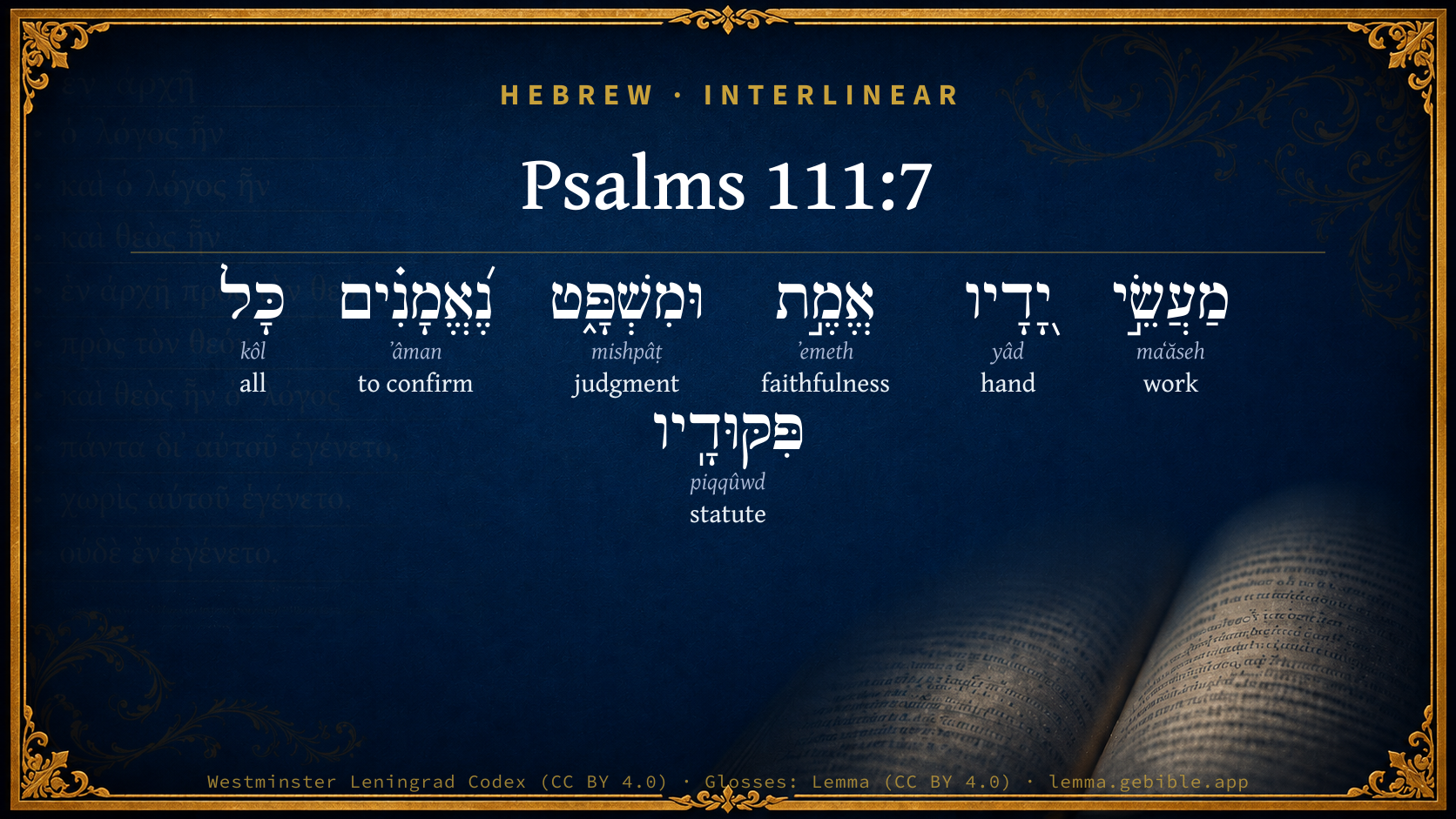
Hebrew (Westminster Leningrad Codex) Psalms 111:7 appears in the Hebrew Old Testament. The text above is from the Westminster Leningrad Codex. Each word links to its Strong’s number, a concise gloss, and parsing drawn from the Open Scriptures Hebrew Bible morphology. Click any word for its full Brown-Driver-Briggs (BDB) entry.
Download image
Cite this verse

Psalms 111:7 (World English Bible). Public Domain. Lemma interlinear Bible study tool, https://lemma.gebible.app/v/psalms/111/7.

Show BibTeX & RIS
BibTeX
RIS
English Translation
The works of his hands are truth and justice. All his precepts are sure.
World English Bible · Public Domain
Download a study sheet

One document with this verse’s original text, its word-by-word gloss line, the meaning frame, cross-references with their text, attributed commentary, and full source and license credits — printable, and it pastes into notes with its structure intact.

This verse Autodidact and up

Study sheet (.html) Plain text (.txt)

A passage Seminary Student

Up to 50 verses in one chapter. A passage sheet keeps up to 6 commentary sources and 12 cross-references per verse, in the order this page ranks them, and says so on the sheet whenever that leaves anything out. Ask for a single verse and you get the Autodidact verse sheet above.

Everything on this page stays free to read, with no account — the sheet is a download of what is already on screen, not access to it.

Want to remove ads? Support Godless Engineer
Compare translations 3

The same verse in 3 English versions, stacked beneath the original-language interlinear above. Click any original word for its lexicon entry.

Each is an independent rendering of the whole verse — the interlinear is not word-aligned to these translations.

Highlighted words mark where these versions differ — a whole-verse word diff, not a word-by-word alignment.

  • World English Bible Public Domain
    The works of his hands are truth and justice. All his precepts are sure.
  • King James Version Public Domain
    The works of his hands are verity and judgment; all his commandments are sure.
  • unfoldingWord Literal Text CC BY-SA 4.0
    The works of his hands truth and justice; all of his precepts are reliable.

unfoldingWord Literal Text — © unfoldingWord, licensed CC BY-SA 4.0. Word-aligned USFM3 via Door43 (git.door43.org/unfoldingWord/en_ult).

Versions to compare (up to 4)

3 of 4 selected

Show all 18 translations

Every available English version of this verse, each an independent rendering of the whole verse.

  • World English Bible Public Domain
    The works of his hands are truth and justice. All his precepts are sure.
  • Berean Standard Bible Public Domain
    The works of His hands are truth and justice; all His precepts are trustworthy.
  • Majority Standard Bible Public Domain
    The works of His hands are truth and justice; all His precepts are trustworthy.
  • King James Version Public Domain
    The works of his hands are verity and judgment; all his commandments are sure.
  • American Standard Version (1901) Public Domain
    The works of his hands are truth and justice; All his precepts are sure.
  • Revised Version (1885) Public Domain
    The works of his hands are truth and judgment; all his precepts are sure.
  • Geneva Bible (1599) Public Domain
    The workes of his handes are trueth and iudgement: all his statutes are true.
  • Douay-Rheims (1899) Public Domain
    That he may give them the inheritance of the Gentiles: the works of his hands are truth and judgment.
  • Young's Literal Translation Public Domain
    The works of His hands `are' true and just, Stedfast `are' all His appointments.
  • Literal Standard Version CC BY-SA 4.0
    The works of His hands [are] true and just, || All His appointments [are] steadfast.
  • Unlocked Literal Bible CC BY-SA 4.0
    The works of his hands are trustworthy and just; all his instructions are reliable.
  • unfoldingWord Literal Text CC BY-SA 4.0
    The works of his hands truth and justice; all of his precepts are reliable.
  • Darby Bible Public Domain
    The works of his hands are truth and judgment; all his precepts are faithful:
  • World Messianic Bible Public Domain
    The works of his hands are truth and justice. All his precepts are sure.
  • Webster's Bible Public Domain
    The works of his hands are verity and judgment; all his commandments are sure.
  • Free Bible Version CC BY-SA 4.0
    Everything he does can be depended on, and is right; all his commandments are trustworthy.
  • Bible in Basic English Public Domain
    The works of his hands are faith and righteousness; all his laws are unchanging.
  • JPS Tanakh (1917) Public Domain
    The works of His hands are truth and justice; all His precepts are sure.

Literal Standard Version (2020), Covenant Press — licensed CC BY-SA 4.0. Text via the HelloAO Bible API (eBible.org). Unlocked Literal Bible (unfoldingWord) — licensed CC BY-SA 4.0. Text via the HelloAO Bible API (eBible.org). unfoldingWord Literal Text — © unfoldingWord, licensed CC BY-SA 4.0. Word-aligned USFM3 via Door43 (git.door43.org/unfoldingWord/en_ult). Free Bible Version, Dr. Jonathan Gallagher — licensed CC BY-SA 4.0. Text via the HelloAO Bible API (eBible.org).

Word by word

More ways to search: Search by grammar → Find every occurrence → Compare this word →

Practice this passage: Drill this verse → Learn its vocabulary →

About this verse

These counts appear in no published source. They are computed here, from the morphology-tagged text and Lemma’s own curated glosses. What Lemma adds →

7
words
7
distinct lemmas
Wisdom
section

Notable vocabulary

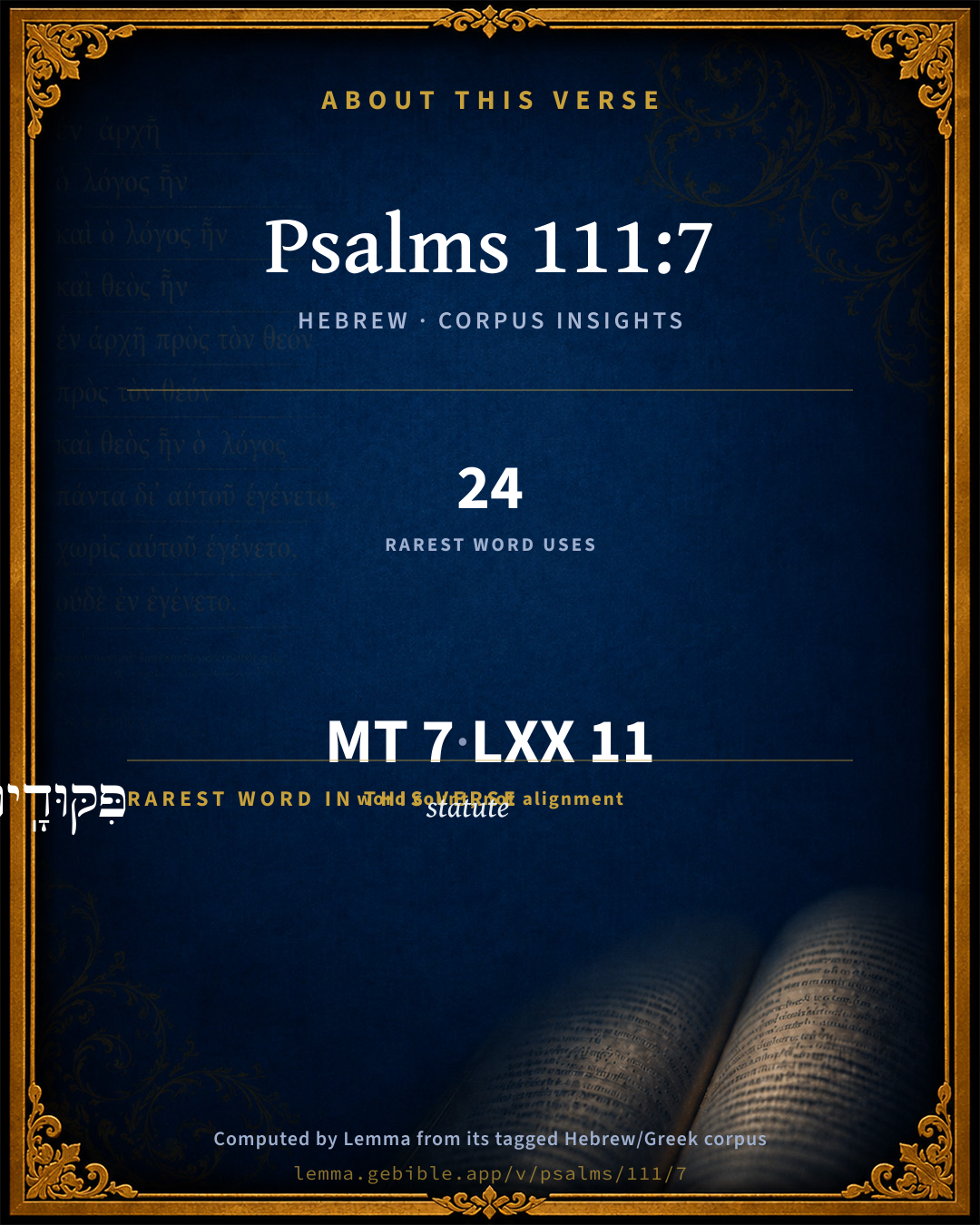
The rarest word here is פִּקּוּדָֽיו statute H6490 — appearing just 24 times in the whole Hebrew Bible.

Shared distinctive vocabulary

פִּקּוּדָֽיו statute H6490 occurs in 24 verses of the Hebrew Bible. Also found in:

Grammatical profile

  • 1 verb
  • 6 nouns

Verb forms

  • נֶ֝אֱמָנִ֗ים Niphal · Participle Active

Hebrew & Septuagint length

In English translation the verse runs 14 words from the Hebrew and 14 from the Septuagint (LXX English) — the same length.

A rough comparison of the two English renderings, which tokenize alike — not a word-level alignment.

Word counts can differ between the Hebrew and the Greek without any difference in meaning — e.g. the Hebrew direct-object marker אֵת has no separate Greek word, and Greek often adds the article ὁ.

In the original languages it is 7 Hebrew tokens and 11 Greek tokens — but the two are counted differently (Hebrew bundles its prefixes and suffixes into one token; the Greek is in lemma form), so that isn’t a like-for-like length.

Cross-references

12

Topical passages linked to Psalms 111:7 in the Treasury of Scripture Knowledge — connected by theme and wording, ordered by reader-vote popularity; previews shown in the World English Bible.

  • Psalms 19:7 Yahweh's law is perfect, restoring the soul. Yahweh's testimony is sure, making wise the simple.
  • Psalms 89:14 Righteousness and justice are the foundation of your throne. Loving kindness and truth go before your face.
  • Deuteronomy 32:4 The Rock, his work is perfect; For all his ways are justice: A God of faithfulness and without iniquity, Just and right is he.
  • Psalms 98:3 He has remembered his loving kindness and his faithfulness toward the house of Israel. All the ends of the earth have seen the salvation of our God.
  • Psalms 105:8 He has remembered his covenant forever, The word which he commanded to a thousand generations,
  • Psalms 119:151 You are near, Yahweh. All your commandments are truth.
  • Psalms 119:160 All of your words are truth. Every one of your righteous ordinances endures forever.
  • Revelation 15:3–4 They sang the song of Moses, the servant of God, and the song of the Lamb, saying, "Great and marvelous are your works, Lord God, the Almighty; Righteous and true are your ways, you King of the nations.
  • Psalms 85:10 Mercy and truth meet together. Righteousness and peace have kissed each other.
  • Psalms 93:5 Your statutes stand firm. Holiness adorns your house, Yahweh, forevermore.
  • Psalms 119:86 All of your commandments are faithful. They persecute me wrongfully. Help me!
  • 2 Timothy 2:13 If we are faithless, He remains faithful. He can't deny himself.

Cross-references courtesy of OpenBible.info (CC BY 4.0).

Hebrew and Greek witnesses Masoretic Hebrew ↔ Greek Septuagint

The same verse in the two great witnesses to the Old Testament, shown verse-for-verse.

You’re reading Greek Psalm 110 (Hebrew Psalm 111). The Septuagint counts the superscription, so verse numbers can differ from the Hebrew — chapter-level alignment, not verse-by-verse. Numbering follows Rahlfs.

These are two independent witnesses, not word-aligned to each other, and the Septuagint is shown in lemma (dictionary) form.

Hebrew Psalms 111:7 Masoretic · Westminster Leningrad Codex

מַעֲשֵׂ֣י יָ֭דָיו אֱמֶ֣ת וּמִשְׁפָּ֑ט נֶ֝אֱמָנִ֗ים כָּל פִּקּוּדָֽיו

The works of his hands are truth and justice. All his precepts are sure.

World English Bible · Public Domain

Greek LXX Greek Psalm 110:7 Septuagint · lemma form

ἔργον χείρ αὐτός ἀλήθεια καί κρίσις πιστός πᾶς ὁ ἐντολή αὐτός

The works of his hands are truth and judgment: all his commandments are sure:

LXX2012 (modern English Septuagint) · Public Domain

Hebrew: Westminster Leningrad Codex (CC BY 4.0). Greek: Septuagint (public domain); English from LXX2012 (modern English Septuagint) (Public Domain). How the Septuagint differs from the Hebrew →

Commentary

Notes on Psalms 111:7 from classic Christian and Jewish commentators (each source and its license shown beneath its notes). The classic Christian expositions comment on the surrounding passage and are grouped to its opening verse, so a note may address several verses; the Jewish commentaries on the Tanakh (Rashi and others) are per-verse, so they appear only where the commentator wrote on this verse.

Lemma curates 59 commentaries, every one of them public domain or Creative Commons licensed, each selected and text-cleaned for this edition rather than reprinted as found. About our sources →

Trapp's Complete Commentary

John Trapp

Psa 111:7 The works of his hands [are] verity and judgment; all his commandments [are] sure.

Ver. 7. The work of his hands] They speak him a true and just God. Chrysostom taketh truth here for mercy, and noteth that God usually mixeth mercy with justice; yet sometimes he sendeth an evil, an only evil, Eze 7:5

All his commandments] That is, his promises added to his commandments; or they are so called, because firm and sure, as the commandments of an emperor.

John Trapp, A Commentary or Exposition upon All the Books of the Old and New Testament (1647–1656) — public domain. Text from a community e-Sword module.

Joseph Benson's Commentary

Psa 111:7-9. The works of his hands — All that he doth, either on the behalf of his people, or against his or their enemies; are verity and judgment — Are exactly agreeable to his word or promises, and to the rules of eternal justice. All his commandments — His laws given to the Israelites, especially the moral law, considered with its sanctions, the promises made to the observers of it, and the threatenings denounced against transgressors; are sure — Constant and unchangeable, as being grounded upon the immutable rules of justice and equity. They stand fast, Hebrew, סמוכים, semuchim, they are established upon a sure foundation; and are done — Constituted or ordered; in truth and uprightness — With a sincere regard to the good and happiness of mankind, and without the least shadow of partiality or iniquity, and they will then appear in perfect glory and beauty, when all the arts and labours of man shall cease to exist. He sent redemption unto his people — That deliverance out of Egypt, which was a type and pledge of that greater and higher redemption, which is by the Messiah. He hath commanded — Appointed, or firmly established, by his power and authority; his covenant for ever — Through all successive generations of his people, to the end of the world; for the covenant is the same for substance in all ages, and differed only in circumstances. Holy and reverend is his name — Terrible to his enemies, venerable in his people’s eyes, and holy in all his dealings with all men.

Joseph Benson's Commentary on the Old and New Testaments (1811–1818) — public domain. Text from a community e-Sword module.

J. A. Alexander on Psalms

Joseph Addison Alexander

7. (Psa 111:7) The works of his hands are truth and judgment; sure (are) all his precepts. The second clause is not an iteration of the first, but an inference from it. If what God does himself is always done in faithfulness and justice to his people, then what he requires them to do must certainly be right and best, and his requisitions therefore may be trusted and confided in, the true sense of the adjective or participle here employed.

Joseph Addison Alexander, The Psalms Translated and Explained (1850) — public domain. Text from a community e-Sword module.

Geneva Bible (1599)

Geneva Bible translators

As God promised to take the care of his Church: so in effect doth he declare himself just and true in the government of the same.

Geneva Bible (1599) marginal notes — public domain. Text via Bolls.life.

Adam Clarke's Commentary

Verse 7. Verity and judgment] His works are verity or truth, because they were wrought for the fulfilment of the promises he made to their fathers. And they were just; for their punishment was in consequence of their infidelities: and the punishment of the Babylonians was only in consequence of their gross iniquities; and in both respects he had proved his work to be according to justice and judgment.

Adam Clarke's Commentary on the Bible (1810–1826) — public domain. Text from a community e-Sword/MySword module.

John Calvin's Commentaries

7 The works of his hands In the first clause of the verse he exclaims that God is known to be faithful and upright in his works, and then he goes on to extol the same truth and rectitude as pervading the doctrine of the law; the amount of which is, that a beautiful harmony characterises all the sayings and doings of God, because every where he shows himself to be just and faithful. We have a memorable proof of this fact in the redemption of his ancient people. Yet I doubt not, that, under the term, works, the prophet comprehends the constant government of the Church; because God daily and unceasingly shows that he is just and true, and unweariedly pursues the same course. Among men it is reckoned to be of more importance for one to be found just in practice than in profession; yet, as the doctrine of the law was the very life and safety of the people, the prophet very properly, and in several expressions, dwells upon the sentiment contained in the second clause of the verse; saying, all his statutes are true, they are established for ever, and are drawn up in perfect accordance with the strict law of truth and equity And assuredly, but for God’s having kept the people united to him by the sacred chain of the law, the fruit of their redemption would have been very small, and even that benefit would have soon been lost by them. We ought to observe, then, that this subject is brought prominently forward in this place; because, in attesting the eternal love of God, it became the means of imparting life.

John Calvin's Commentaries (1540-1563) — public domain. Text from the Calvin Translation Society English edition (1840s-50s) via the Christian Classics Ethereal Library (ccel.org). Calvin's coverage is partial (roughly two-thirds of the Bible); uncommented books and verses are honest gaps, never fabricated. The 19th-century editor's footnotes and remarks are omitted so the notes are faithfully Calvin's own voice.

The Cambridge Bible for Schools and Colleges

gen. ed. J. J. S. Perowne

7. verity and judgment] Truth and right. Jehovah’s actions are manifestations of His eternal attributes of truth and justice (Deu_32:4). He is constantly true to His promises, unfailingly just in His moral government of the world. The gift of Canaan to Israel was the fulfilment of His promise to the patriarchs, while the expulsion of its former inhabitants was a just retribution for their sins (Deu_9:4-5).

his commandments] R.V. his precepts, the various special injunctions in which man’s duties are set forth. These are sure, trustworthy, not mutable or arbitrary. By a natural transition the Psalmist passes from the mighty works which Jehovah has done for His people to the commandments which He has given them. The memories of Sinai naturally follow those of the Exodus. This verse is a reminiscence of Psa_19:7-9 : cp. also Psa_111:3 b with Psa_19:9 a. The word for precepts is peculiar to the Psalter: Psa_19:8; Psa_103:18; Psalms 119 (21 times).

The Cambridge Bible for Schools and Colleges (gen. ed. J. J. S. Perowne; Cambridge University Press, 1878–1918) — public domain. Text from a community e-Sword module.

John Gill's Exposition

The works of his hands are verity and judgment,.... His works of providence are just and true, particularly these which respected the driving the Canaanites out of their land, and settling the Israelites in it; these were done according to the truth of the divine promises and prophecies, and so were "verity" or "truth"; and for the sins of the Heathen, and by him who has a right to dispose of the earth and the fulness of it to whom he pleases, and so are "judgment" or righteous; and this holds good of his work of grace upon the heart, which is the work of his hands, and is "truth in the inward parts": and is created in righteousness and true holiness; and of all his acts of grace in election, redemption, &c. which are according to the truth of the divine nature and its perfections, and in which there is no unrighteousness. Some interpret this of the two tables of stone, which were the work, writing, and engraving of God, and on which were inscribed the judgments of the Lord; and are "true and righteous altogether". Aben Ezra understands it of the law implanted in the hearts of men.

All his commandments are sure: firm, and to be believed and complied with, either to destroy the nations, or to possess their land; or rather the commands of the moral law, which are firm and sure, one jot or tittle of which shall never pass away; all have been fulfilled by Christ, and remain with him a rule of walk and conversation; or the word which the Lord has commanded to a thousand generations, Psa 105:8 the covenant which is ordered in all things and sure; the promises of which are yea and amen in Christ; and the blessings of it, the sure mercies of David; and even the doctrines of the Gospel are the commandments and testimony of the Lord, which are sure, Psa 19:8 and to be believed, being the word of truth, the Gospel of our salvation, and coming from God, who cannot lie.

John Gill's Exposition of the Whole Bible (1746–1763) — public domain (CC PDM 1.0). Text via the HelloAO Bible API.

Albert Barnes' Notes on the Bible

The works of his hands - All that he does in the works of creation and providence; all in his acts toward the children of men.

Are verity - Truth. That is, They tend to establish and confirm the truth; they are done in the cause or the defense of truth. Truth in any case may be ascertained by what God “does,” for all that he defends and protects is “truth,” and his acts, therefore, may be regarded as an expression of what is true and right.

And judgment - In the cause of justice; or, in maintaining the principles of right. God never does anything to vindicate wrong. None of his acts can be fairly interpreted as having been done to sustain injustice, fraud, deceit, ambition, oppression, murder, or licentiousness. That he suffers free agents to do these things without interference is no evidence that he approves of them. That he “disapproves” of them is shown

(a) by his declarations;

(b) by his threatenings;

(c) by all that he does to punish the wicked here.

All his commandments are sure - His statutes; his ordinances. They are sure; that is, they are to be relied on; or, are worthy of confidence.

Albert Barnes' Notes on the Bible (1834–1885) — public domain. Text from a community e-Sword/MySword module.

Matthew Poole's English Annotations

The works of his hands; all that he doth, either on the behalf of his people, or against his or their enemies; of both which sorts of works he spoke in the foregoing verse.

Are verity and judgment; are exactly agreeable to his word or promises, and to the rules of justice. All his commandments; either,

1. His laws given to the Israelites, especially the moral law considered with its sanction, the promises made to the observers of it, and the threatenings denounced against transgressors. Or,

2. His works, as it is in the first clause, called his commands, because they were done by virtue of his decree, and by his power and authority; as in like manner God is said to command those blessings which he purposeth to give, and doth effectually procure, as Deu 28:8 Psa 42:8; 68:28; 133:3, and to command those creatures which he moveth and acteth as he pleaseth, as 1Ki 17:4; Mat 8:27.

Are sure, or faithful, or certain; constant and unchangeable, as his laws are, being grounded upon the immutable rules of justice or equity; infallible and irresistible, as his counsels and ways are.

Matthew Poole's English Annotations on the Holy Bible (1683–1685) — public domain. Text from a community e-Sword/MySword module.

The Treasury of David

Charles H. Spurgeon

Ver. 7. The works of his hands are verity and judgment. Truth and justice are conspicuous in all that Jehovah does. Nothing like artifice or crooked policy can ever be seen in his proceedings; he acts faithfully and righteously towards his people, and with justice and impartiality to all mankind. This also should lead us to praise him, since it is of the utmost advantage to us to live under a sovereign whose laws, decrees, acts, and deeds are the essence of truth and justice.

All his commandments are sure. All that he has appointed or decreed shall surely stand, and his precepts which he has proclaimed shall be found worthy of our obedience, for surely they are founded in justice and are meant for our lasting good. He is no fickle despot, commanding one thing one day and another another, but his commands remain absolutely unaltered, their necessity equally unquestionable, their excellence permanently proven, and their reward eternally secure. Take the word commandments to relate either to his decrees or his precepts, and we have in each case an important sense; but it seems more in accordance with the connection to take the first sense and consider the words to refer to the ordinances, appointments, or decrees of the great King.

Whatever the mighty Lord decrees,

Shall stand for ever sure.

The settled purpose of his heart

To ages shall endure.

Ver. 7. The works of God expound his word, in his works his word is often made visible. That's an excellent expression, The works of his hands are verity and judgment. The acts of God are verity, that is, God acts his own truths. As the works of our hands ought to be the verity and judgments of God, (every action of a Christian ought to be one of Christ's truths), so it is with God himself; the works of his hands are his own verity and judgments. When we cannot find the meaning of God in his word, we may find it in his works: his works are a comment, an infallible comment upon his word. Joseph Caryl.

Ver. 7-8. God is known to be faithful and just both in his works and in his word, insomuch that the most beautiful harmony is apparent between the things he has spoken and those he has done. This wonderfully confirms the hope and faith of the godly. Mollerus.

Psalms 111:8*

Charles H. Spurgeon's The Treasury of David (1869–1885) — public domain. Psalms only. Text from a community e-Sword/MySword module.

Whedon's Commentary on the Bible

Daniel D. Whedon

7. Verity and judgment—Truth and absolute administrative justice.

All his commandments are sure—That is, they are true, established. The words “sure” and “verity” in the preceding line are from a common root, the one being affirmed of the “works” of God, the other of his “precepts.”

Daniel D. Whedon (gen. ed.), Commentary on the Old and New Testaments (1874–1909) — public domain. Text from a community e-Sword module.

The Pulpit Commentary

The works of his hands are verity and judgment. All that God does is right and just in truth and uprightness" (ver. 8). All his commandments are sure; i.e. firm, unchangeable being based on truth and right.

The Pulpit Commentary (1880–1919), ed. H.D.M. Spence-Jones & Joseph S. Exell — public domain. Text from a community e-Sword module.

John Wesley's Explanatory Notes

The works - All that he doth on the behalf of his people, or against their enemies. Truth - Are exactly agreeable to his promises, and to justice. Commandments - His laws given to the Israelites, especially the moral law. Sure - Constant and unchangeable.

John Wesley, Explanatory Notes Upon the Whole Bible (1754–1765) — public domain. Text via the GEBible commentary corpus.

unfoldingWord translationNotes

Door43 World Missions Community

The works of his hands

Here the word "hands" refers to Yahweh, himself. AT: "The works that he does" (See: Synecdoche)

They are established forever

This means that Yahweh's instructions are unchangeable and will last forever. This can be stated in active form. AT: "He has established them forever" or "They will last forever" (See: Active or Passive)

to be observed faithfully and properly

Possible meanings are 1) Yahweh has given his instructions in a faithful and proper manner or 2) his people are to observe Yahweh's instructions in a faithful and proper manner. This can be stated in active form. AT: "for his people to observe them faithfully and properly" (See: Active or Passive)

holy and awesome is his name

Here the word "name" refers to Yahweh, himself. AT: "Yahweh is holy and awesome" (See: Metonymy)

translationWords

works

hand

trust

just

eternity

faithful

people of God

ordain

covenant

holy

awe

name

unfoldingWord translationNotes — © Distant Shores Media and the Door43 World Missions Community, licensed CC BY-SA 4.0. Source: git.door43.org/Door43/en_tn.

Lesson kit

Teaching starters — assembled from the data on this page, not authored interpretation. Every prompt links to the verse data it draws on. Edit before teaching.

Psalms, in the Wisdom, opens this verse with 7 words (7 distinct Hebrew lemmas). Its most distinctive word is piqqûwd (“statute”). A historical commentator’s framing appears above. Read the whole chapter for the surrounding context.

Discussion questions

  1. How does “statute” (piqqûwd) shape what this verse is saying?
  2. Psalms 19:8 shares the word «statute» with this verse. How do the two illuminate each other?
  3. These translations render this verse differently; the difference is in the English rendering, not the original. What questions does that raise?
  4. The verb «נֶ֝אֱמָנִ֗ים» is Niphal Participle Active. How does its form color the action?
  5. Reading how Trapp's Complete Commentary and Joseph Benson's Commentary read this verse, where do the two commentators agree and where do they part?

Things to notice

Reading settings

Reading text

Shown beneath each verse's original-language words.

Old Testament
Old Testament edition

Read the OT as the Masoretic Hebrew (MT) or the Greek Septuagint (LXX).

English shown for the Greek Septuagint (in the Hebrew ↔ Greek comparison).

Comparing translations? Open the Compare panel on any verse page to stack up to four side by side.