Lamentations 4:12

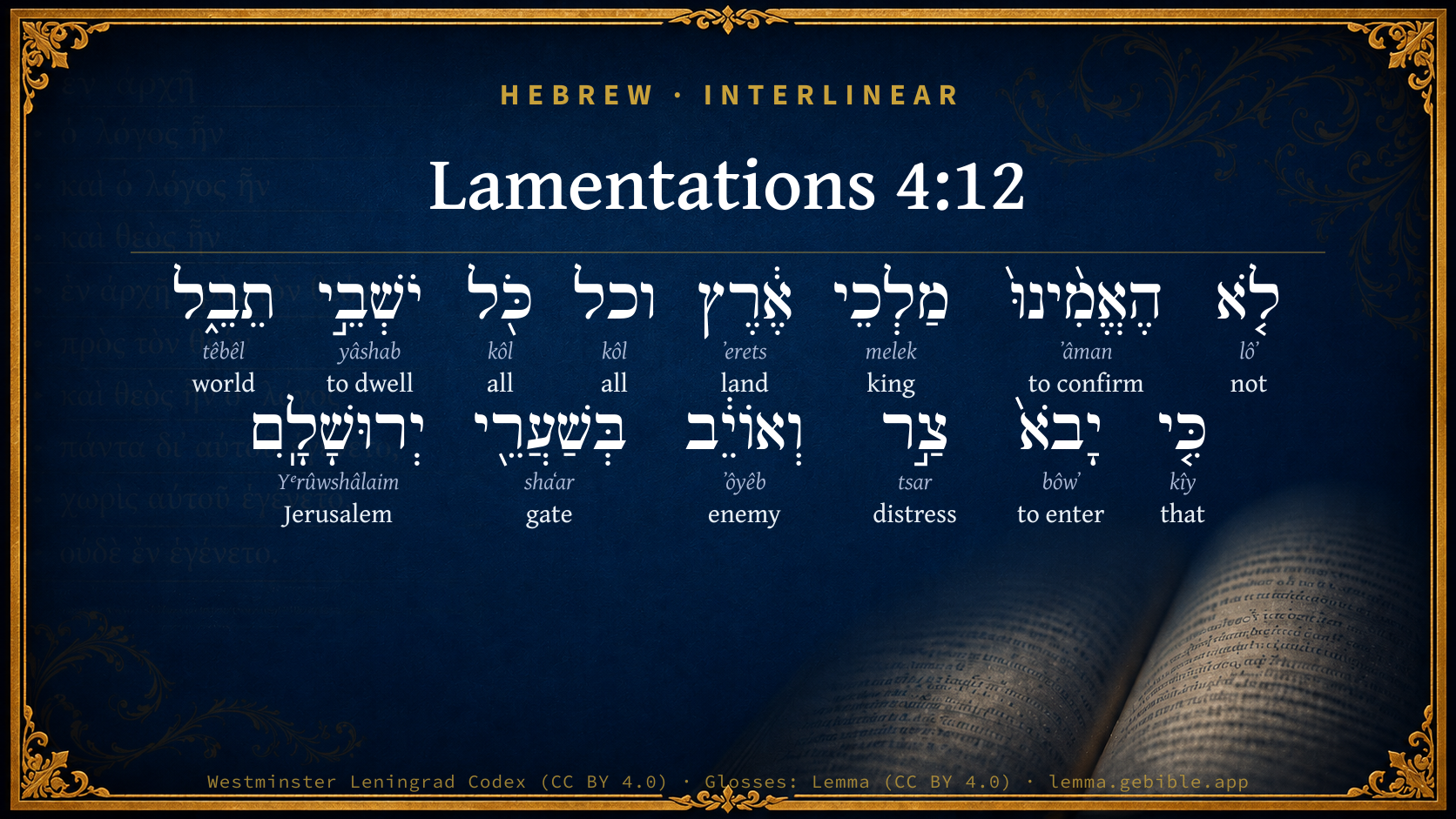
Hebrew (Westminster Leningrad Codex) Lamentations 4:12 appears in the Hebrew Old Testament. The text above is from the Westminster Leningrad Codex. Each word links to its Strong’s number, a concise gloss, and parsing drawn from the Open Scriptures Hebrew Bible morphology. Click any word for its full Brown-Driver-Briggs (BDB) entry.
Download image
Cite this verse

Lamentations 4:12 (World English Bible). Public Domain. Lemma interlinear Bible study tool, https://lemma.gebible.app/v/lamentations/4/12.

Show BibTeX & RIS
BibTeX
RIS
English Translation
The kings of the earth didn't believe, neither all the inhabitants of the world, That the adversary and the enemy would enter into the gates of Jerusalem.
World English Bible · Public Domain
Download a study sheet

One document with this verse’s original text, its word-by-word gloss line, the meaning frame, cross-references with their text, attributed commentary, and full source and license credits — printable, and it pastes into notes with its structure intact.

This verse Autodidact and up

Study sheet (.html) Plain text (.txt)

A passage Seminary Student

Up to 50 verses in one chapter. A passage sheet keeps up to 6 commentary sources and 12 cross-references per verse, in the order this page ranks them, and says so on the sheet whenever that leaves anything out. Ask for a single verse and you get the Autodidact verse sheet above.

Everything on this page stays free to read, with no account — the sheet is a download of what is already on screen, not access to it.

Want to remove ads? Support Godless Engineer
Compare translations 3

The same verse in 3 English versions, stacked beneath the original-language interlinear above. Click any original word for its lexicon entry.

Each is an independent rendering of the whole verse — the interlinear is not word-aligned to these translations.

Highlighted words mark where these versions differ — a whole-verse word diff, not a word-by-word alignment.

  • World English Bible Public Domain
    The kings of the earth didn't believe, neither all the inhabitants of the world, That the adversary and the enemy would enter into the gates of Jerusalem.
  • King James Version Public Domain
    The kings of the earth, and all the inhabitants of the world, would not have believed that the adversary and the enemy should have entered into the gates of Jerusalem.
  • unfoldingWord Literal Text CC BY-SA 4.0
    The kings of the earth did not believe, nor any of the dwellers of the world, that an adversary and an enemy would enter into the gates of Jerusalem. MEM

unfoldingWord Literal Text — © unfoldingWord, licensed CC BY-SA 4.0. Word-aligned USFM3 via Door43 (git.door43.org/unfoldingWord/en_ult).

Versions to compare (up to 4)

3 of 4 selected

Show all 18 translations

Every available English version of this verse, each an independent rendering of the whole verse.

  • World English Bible Public Domain
    The kings of the earth didn't believe, neither all the inhabitants of the world, That the adversary and the enemy would enter into the gates of Jerusalem.
  • Berean Standard Bible Public Domain
    The kings of the earth did not believe, nor any people of the world, that an enemy or a foe could enter the gates of Jerusalem.
  • Majority Standard Bible Public Domain
    The kings of the earth did not believe, nor any people of the world, that an enemy or a foe could enter the gates of Jerusalem.
  • King James Version Public Domain
    The kings of the earth, and all the inhabitants of the world, would not have believed that the adversary and the enemy should have entered into the gates of Jerusalem.
  • American Standard Version (1901) Public Domain
    The kings of the earth believed not, neither all the inhabitants of the world, That the adversary and the enemy would enter into the gates of Jerusalem.
  • Revised Version (1885) Public Domain
    The kings of the earth believed not, neither all the inhabitants of the world, that the adversary and the enemy should enter into the gates of Jerusalem.
  • Geneva Bible (1599) Public Domain
    The Kings of the earth, and all the inhabitants of the world would not haue beleeued that the aduersarie and the enemie should haue entred into the gates of Ierusalem:
  • Douay-Rheims (1899) Public Domain
    Lamed. The kings of the earth, and all the inhabitants of the world would not have believed, that the adversary and the enemy should enter in by the gates of Jerusalem.
  • Young's Literal Translation Public Domain
    Believe not did the kings of earth, And any of the inhabitants of the world, That come would an adversary and enemy Into the gates of Jerusalem.
  • Literal Standard Version CC BY-SA 4.0
    The kings of earth did not believe, || And any of the inhabitants of the world, || That an adversary and enemy would come || Into the gates of Jerusalem.
  • Unlocked Literal Bible CC BY-SA 4.0
    The kings of the earth did not believe, nor did any of the inhabitants of the world believe, that enemies or opponents could enter the gates of Jerusalem.
  • unfoldingWord Literal Text CC BY-SA 4.0
    The kings of the earth did not believe, nor any of the dwellers of the world, that an adversary and an enemy would enter into the gates of Jerusalem. MEM
  • Darby Bible Public Domain
    The kings of the earth, and all the inhabitants of the world, would not have believed that the adversary and the enemy should enter into the gates of Jerusalem.
  • World Messianic Bible Public Domain
    The kings of the earth didn’t believe, neither did all the inhabitants of the world, that the adversary and the enemy would enter into the gates of Jerusalem.
  • Webster's Bible Public Domain
    The kings of the earth, and all the inhabitants of the world, would not have believed that the adversary and the enemy would have entered into the gates of Jerusalem.
  • Free Bible Version CC BY-SA 4.0
    No king on earth—in fact nobody in all the world—thought that an enemy or attacker could enter the gates of Jerusalem.
  • Bible in Basic English Public Domain
    To the kings of the earth and to all the people of the world it did not seem possible that the attackers and the haters would go into the doors of Jerusalem.
  • JPS Tanakh (1917) Public Domain
    The kings of the earth believed not, neither all the inhabitants of the world, that the adversary and the enemy would enter into the gates of Jerusalem.

Literal Standard Version (2020), Covenant Press — licensed CC BY-SA 4.0. Text via the HelloAO Bible API (eBible.org). Unlocked Literal Bible (unfoldingWord) — licensed CC BY-SA 4.0. Text via the HelloAO Bible API (eBible.org). unfoldingWord Literal Text — © unfoldingWord, licensed CC BY-SA 4.0. Word-aligned USFM3 via Door43 (git.door43.org/unfoldingWord/en_ult). Free Bible Version, Dr. Jonathan Gallagher — licensed CC BY-SA 4.0. Text via the HelloAO Bible API (eBible.org).

Word by word

More ways to search: Search by grammar → Find every occurrence → Compare this word →

Practice this passage: Drill this verse → Learn its vocabulary →

תֵבֵ֑ל
têbêl
H8398
“world”
Noun, Common, Feminine, Singular, Absolute
Part of Speech
Noun
Type
Common
Gender
Feminine
Number
Singular
State
Absolute
Full BDB Definition

Origin: from H2986

TWOT: 835h

world
  1. לֹ֤א lôʼ H3808 “not” Particle, Negative
  2. הֶאֱמִ֨ינוּ֙ ʼâman H539 “to confirm” Verb, Hiphil, Perfect, 3rd Person, Common, Plural
  3. מַלְכֵי melek H4428 “kings of” Noun, Common, Masculine, Plural, Construct
  4. אֶ֔רֶץ ʼerets H776 “land” Noun, Common, Both, Singular, Absolute
  5. וכל kôl H3605 “and · all of” Conjunction + Noun, Common, Masculine, Singular, Construct
  6. כֹּ֖ל kôl H3605 “all of” Noun, Common, Masculine, Singular, Construct
  7. יֹשְׁבֵ֣י yâshab H3427 “dwelling” Verb, Qal, Participle Active, Masculine, Plural, Construct
  8. כִּ֤י kîy H3588 “that” Conjunction
  9. יָבֹא֙ bôwʼ H935 “to enter” Verb, Qal, Imperfect, 3rd Person, Masculine, Singular
  10. צַ֣ר tsar H6862 “distress” Noun, Common, Masculine, Singular, Absolute
  11. וְאוֹיֵ֔ב ʼôyêb H341 “and · enemy” Conjunction + Verb, Qal, Participle Active, Masculine, Singular, Absolute
  12. בְּשַׁעֲרֵ֖י shaʻar H8179 “in/at · gates of” Preposition + Noun, Common, Masculine, Plural, Construct
  13. יְרוּשָׁלִָֽם Yᵉrûwshâlaim H3389 “Jerusalem” Noun, Proper

About this verse

These counts appear in no published source. They are computed here, from the morphology-tagged text and Lemma’s own curated glosses. What Lemma adds →

14
words
13
distinct lemmas
Prophets
section

Shared distinctive vocabulary

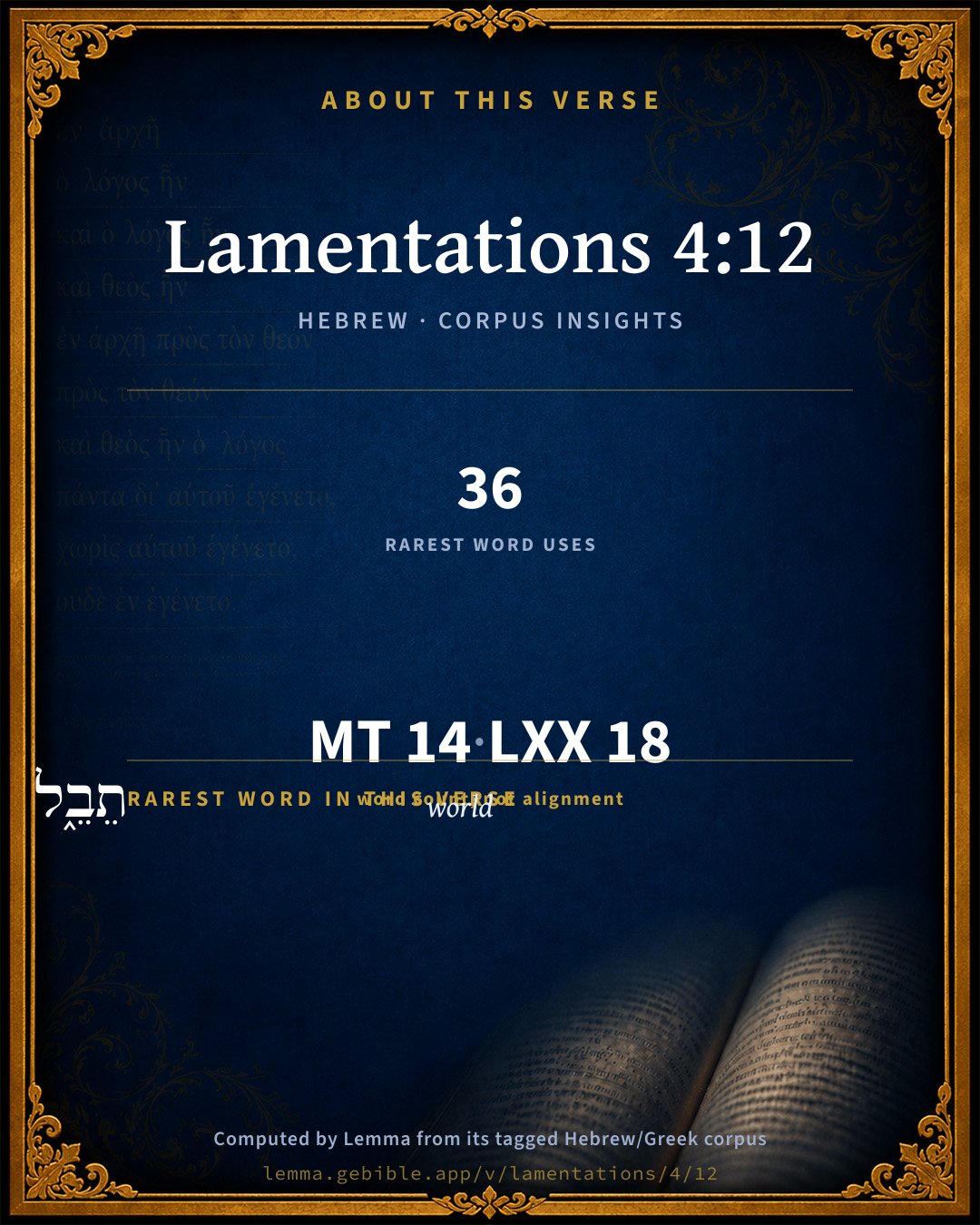
תֵבֵ֑ל world H8398 occurs in 36 verses of the Hebrew Bible. Also found in:

Grammatical profile

  • 4 verbs
  • 8 nouns
  • 1 conjunction
  • 1 particle

Verb forms

  • הֶאֱמִ֨ינוּ֙ Hiphil · Perfect
  • יֹשְׁבֵ֣י Qal · Participle Active
  • יָבֹא֙ Qal · Imperfect
  • וְאוֹיֵ֔ב Qal · Participle Active

Repetition

A word recurs within this verse — often emphatic in Hebrew:

Hebrew & Septuagint length

In English translation the verse runs 27 words from the Hebrew and 27 from the Septuagint (LXX English) — the same length.

A rough comparison of the two English renderings, which tokenize alike — not a word-level alignment.

Word counts can differ between the Hebrew and the Greek without any difference in meaning — e.g. the Hebrew direct-object marker אֵת has no separate Greek word, and Greek often adds the article ὁ.

In the original languages it is 14 Hebrew tokens and 18 Greek tokens — but the two are counted differently (Hebrew bundles its prefixes and suffixes into one token; the Greek is in lemma form), so that isn’t a like-for-like length.

Cross-references

4

Topical passages linked to Lamentations 4:12 in the Treasury of Scripture Knowledge — connected by theme and wording, ordered by reader-vote popularity; previews shown in the World English Bible.

  • Deuteronomy 29:24–28 even all the nations shall say, Why has Yahweh done thus to this land? what means the heat of this great anger?
  • Psalms 48:4–6 For, behold, the kings assembled themselves, They passed by together.
  • 1 Kings 9:8–9 Though this house is so high, yet shall everyone who passes by it be astonished, and shall hiss; and they shall say, Why has Yahweh done thus to this land, and to this house?
  • Jeremiah 21:13 Behold, I am against you, O inhabitant of the valley, [and] of the rock of the plain, says Yahweh; you that say, Who shall come down against us? or who shall enter into our habitations?

Cross-references courtesy of OpenBible.info (CC BY 4.0).

Hebrew and Greek witnesses Masoretic Hebrew ↔ Greek Septuagint

The same verse in the two great witnesses to the Old Testament, shown verse-for-verse.

These are two independent witnesses, not word-aligned to each other, and the Septuagint is shown in lemma (dictionary) form.

Hebrew Lamentations 4:12 Masoretic · Westminster Leningrad Codex

לֹ֤א הֶאֱמִ֨ינוּ֙ מַלְכֵי אֶ֔רֶץ וכל כֹּ֖ל יֹשְׁבֵ֣י תֵבֵ֑ל כִּ֤י יָבֹא֙ צַ֣ר וְאוֹיֵ֔ב בְּשַׁעֲרֵ֖י יְרוּשָׁלִָֽם

The kings of the earth didn't believe, neither all the inhabitants of the world, That the adversary and the enemy would enter into the gates of Jerusalem.

World English Bible · Public Domain

Greek LXX Lamentations 4:12 Septuagint · lemma form

οὐ πιστεύω βασιλεύς γῆ πᾶς ὁ καταοἰκέω ὁ οἰκέω ὅτι εἰςἔρχομαι ἐχθρός καί ἐκθλίβω διά ὁ πύλη ἰερουσαλήμ

LAMED. The kings of the earth, even all that dwell in the world, believed not that an enemy and oppressor would enter through the gates of Jerusalem.

LXX2012 (modern English Septuagint) · Public Domain

On this verse, Keil & Delitzsch discusses the Septuagint’s reading. Read the note in Commentary ↓

Hebrew: Westminster Leningrad Codex (CC BY 4.0). Greek: Septuagint (public domain); English from LXX2012 (modern English Septuagint) (Public Domain). How the Septuagint differs from the Hebrew →

Commentary

Notes on Lamentations 4:12 from classic Christian and Jewish commentators (each source and its license shown beneath its notes). The classic Christian expositions comment on the surrounding passage and are grouped to its opening verse, so a note may address several verses; the Jewish commentaries on the Tanakh (Rashi and others) are per-verse, so they appear only where the commentator wrote on this verse.

Lemma curates 59 commentaries, every one of them public domain or Creative Commons licensed, each selected and text-cleaned for this edition rather than reprinted as found. About our sources →

Trapp's Complete Commentary

John Trapp

Lam 4:12 The kings of the earth, and all the inhabitants of the world, would not have believed that the adversary and the enemy should have entered into the gates of Jerusalem.

Ver. 12. The kings of the earth, &c.] These, knowing how impregnable a piece Jerusalem was; how the Jebusites of old held out the tower of Zion against David; how long it had kept out Nebuchadnezzar - viz., for two years’ time almost; how it had been preserved by God against Sennacherib, &c., looked upon it as in a son insuperable, and could not but see a divine vengeance in the destruction of it.

John Trapp, A Commentary or Exposition upon All the Books of the Old and New Testament (1647–1656) — public domain. Text from a community e-Sword module.

Joseph Benson's Commentary

Lam 4:12. The kings of the earth, &c., would not have believed — “The city was so well fortified, and had been so often miraculously preserved by God from the attempts of its enemies, that it seemed incredible that it should at last fall into their hands.” — Lowth.

Joseph Benson's Commentary on the Old and New Testaments (1811–1818) — public domain. Text from a community e-Sword module.

Whedon's Commentary on the Bible

Daniel D. Whedon

SUFFERINGS OF THE PROPHETS AND PRIESTS, Lam_4:12-16.

12. Would not have believed — The city had indeed been previously captured by Shishak, king of Egypt, (1Ki_14:25-26,) and Joash, king of Israel, (2Ki_14:13-14,) but it had since been more strongly fortified, so as to be thought impregnable. Even now its capture had cost Nebuchadrezzar a most protracted and expensive siege.

Daniel D. Whedon (gen. ed.), Commentary on the Old and New Testaments (1874–1909) — public domain. Text from a community e-Sword module.

Keil & Delitzsch

C. F. Keil & F. Delitzsch

This judgment of wrath is a consequence of the sins of the prophets and priests (Lam 4:12-16), as well as of their vain trust on the help of man (Lam 4:17-20). Lam 4:12. The capture of Jerusalem by enemies (an event which none in all the world thought possible) has been brought on through the sins of the prophets and priests. The words, "the kings of the earth...did not believe that an enemy would come in at the gates of Jerusalem," are well explained by C. B. Michaelis, thus: reputando fortitudinem urbis, quae munitissima erat, tum defensorem ejus Jehovam, qui ab hostibus, ad internecionem caesis, urbem aliquoties, mirifice liberaverat, e.g., 2 Reg. 19:34. The words certainly form a somewhat overdrawn expression of deep subjective conviction; but they cannot properly be called a hyperbole, because the remark of Ngelsbach, that Jerusalem had been taken more than once before Nebuchadnezzar (Kg1 14:26; Kg2 14:13.; Ch2 33:11; Kg2 23:33.), seems incorrect. For the occasions upon which Jerusalem was taken by Shishak and by Joash king of Israel (1 Kings 14 and 2 Kings 14) belong to those earlier times when Jerusalem was far from being so strongly fortified as it afterwards became, in the times of Uzziah, Jotham, and Manasseh (Ch2 26:9; Ch2 27:3; Ch2 33:14). In Ch2 33:11, on the other hand, there is nothing said of Jerusalem being taken; and the capture by Pharaoh-Necho does not call for consideration, in so far as it forms the beginning of the catastrophe, whose commencement was thought impossible. Ewald wrongly connects Lam 4:13 with Lam 4:12 into one sentence, thus: "that an enemy would enter the gates of Jerusalem because of the sins of her prophets," etc. The meaning of these verses is thereby not merely weakened, but also misrepresented; and there is ascribed to the kings and inhabitants of the world an opinion regarding the internal evils of Jerusalem, which they neither pronounced nor could have pronounced.

Lam 4:12-14

Lam 4:12 contains an exclamation over the incredible event that has happened, and Lam 4:13 assigns the cause of it: the mediating and combining thought, "this incredible thing has happened," suggests itself. It has taken place on account of the sins of her prophets and priests, who have shed the blood of righteous men in Jerusalem. A historic proof of this is furnished in Jer 26:7., where priests and prophets indicted Jeremiah on a capital charge, because he had announced that Jerusalem and the temple would suffer the fate of Shiloh; from this, Ngelsbach rightly concludes that, in any case, the burden of the guilt of the martyr-blood that was shed falls on the priests and prophets. Besides this, cf. the denunciations of the conduct of the priests and prophets in Jer 6:13-15; Jer 23:11; Jer 27:10; Eze 22:25. - In Lam 4:14, Lam 4:15, there is described the fate of these priests and prophets, but in such a way that Jeremiah has, throughout, mainly the priests before his mind. We may then, without further hesitation, think of the priests as the subject of נעוּ, inasmuch as they are mentioned last. Kalkschmidt wrongly combines Lam 4:13 and Lam 4:14, thus: "because of the sins of the prophets...they wander about," etc.; in this way, the Israelites would be the subject to נעוּ, and in Lam 4:14 the calamitas ex sacerdotum prophetarumque sceleribus profecta would be described. This, however, is contradicted, not merely by the undeniable retrospection of the expression, "they have polluted themselves with blood" (Lam 4:14), to the shedding of blood mentioned in Lam 4:13, but also by the whole contents of Lam 4:14, especially the impossibility of touching their clothes, which does not well apply to the people of Israel (Judah), but only to the priests defiled with blood. Utterly erroneous is the opinion of Pareau, Ewald, and Thenius, that in Lam 4:14-16 there is "presented a fragment from the history of the last siege of Jerusalem," - a rupture among the besieged, headed by the most eminent of the priests and prophets, who, filled with frenzy and passion against their fellow-citizens, because they would not believe in the speedy return of the exiles, became furious, and caused their opponents to be murdered. Regarding this, there is neither anything historical known, nor is there any trace of it to be discovered in these verses. The words, "prophets and priests hesitated (or wavered) like blind men on the streets, soiled with blood, so that none could touch their clothes," merely state that these men, smitten of God in consequence of their blood-guiltiness, wandered up and down in the streets of the city, going about like blind men. This description has been imitated from such passages as Deu 28:28., Jer 23:12; Isa 29:9, where the people, and especially their leaders, are threatened, as a punishment, with blind and helpless staggering; but it is not to be referred to the time of the last siege of Jerusalem. עורים does not mean caedium perpetrandarum insatiabili cupiditate occaecati (Rosenmller), nor "as if intoxicated with blood that has been shed" (Ngelsbach), but as if struck with blindness by God, so that they could no longer walk with firm and steady step. "They are defiled with blood" is a reminiscence from Isa 59:3. As to the form נגאל, compounded of the Niphal and Pual, cf. Ewald, 132, b, and Delitzsch on Isaiah, l.c. בּלא יוּכלוּ, without one being able, i.e., so that one could not. As to the construction of יכול with a finite verb following, instead of the infinitive with ל, cf. Ewald, 285, c, c, and Gesenius, 142, 3, b.

Lam 4:15

"Yea, they (people) address to them the warning cry with which, according to Lev 13:45, lepers were obliged to warn those whom they met not to come near." Such is the language in which Gerlach has rightly stated the connection between Lam 4:14 and Lam 4:15. קראוּ למו is rendered by many, "people shouted out regarding them," de iis, because, according to Lev 13:45, it was the lepers who were to shout "Unclean!" to those they met; the cry therefore was not addressed to the unclean, but to those who, being clean, were not to defile themselves by touching lepers. But though this meaning may be taken from the language used (cf. Gen 20:13; Psa 3:3), yet here, where the call is addressed to persons, it is neither probable nor necessary. For it does not follow from the allusion to the well-known direction given to lepers, that this prescription is transferred verbatim to the present case. The call is here addressed to the priests, who are staggering towards them with blood-stained garments. These must get out of the way, and not touch those they meet. The sing. טמא .gni is accounted for by the allusion to Lev 13:45, and means, "Out of the way! there comes one who is unclean." The second half of the verse is variously viewed. נצוּ, as Milra, comes from נצה, which in Niphal means to wrangle, in Hiphil to stir up strife. The Vulgate, accordingly, translates jurgati quippe sunt, and Ewald still renders, "yet they quarrelled, yet they staggered." But this view is opposed by these considerations: (1.) כּי...גּם can neither introduce an antithesis, nor mean "yet...yet." (2.) In view of the shedding of blood, wrangling is a matter of too little importance to deserve mention. Luther's rendering, "because they feared and fled from them," is a mere conjecture, and finds no support whatever from the words employed. Hence Gesenius, in his Thesaurus, has rightly explained נצוּ, after נצא, Jer 48:9, "to fly, flee, or take to flight." Following him, the moderns translate: "because they had fled, they also staggered about." It is better to render כּי by quum, "when they fled," sc. to other nations, not specially to the Chaldeans. נעוּ is selected with reference to what precedes, but in the general meaning of roaming restlessly about. The idea is as follows: Not merely were they shunned at home, like lepers, by their fellow-countrymen, but also, when they wished to find a place of refuge beyond their native land, they were compelled to wander about without finding rest; for they said among the nations, "They shall no longer sojourn among us." Thus the curse came on them, Deu 28:65.

Lam 4:16

This was the judgment of God. His face (i.e., in this connection, His angry look; cf. Lev 17:10; Psa 21:10) has scattered them (חלּק as in Gen 49:7). No longer does He (Jahveh) look on the, sc. graciously. The face of the priests is not regarded. נשׂא, πρόσωπον λαμβάνειν, to regard the person of any one, i.e., to have respect to his position, dignity, and age: the expression is here synonymous with חנן, to show favour. The subject is indefinite, but the enemy is meant. Thus the threatening in Deu 28:50 is fulfilled on them. זקנים does not mean "elders," but "old men," for the words can be referred only to the priests and prophets formerly spoken of.

Lam 4:17-20

In spite of these facts, which show that God has poured out His fury on us, and that our prophets and priests have been smitten by God for their sins, we still wait, vainly relying on the help of man. In this way, Lam 4:17 is attached to what precedes, - not merely to Lam 4:16, but also the series of thoughts developed in Lam 4:12-16, viz., that in the capture of Jerusalem (which nobody thought possible) there is plainly made known the judgment of God upon the sins of His people and their leaders. It is with special emphasis that עודינה stands at the beginning of the verse: "still do our eyes continue to waste away." The form עודינה (Kethib), in place of which the Qeri subtitles עודינוּ, is abnormal, since עוד does not take plural forms of the suffix in any other instance, and ־נה does not occur elsewhere as a noun-suffix. The form is evidently copied from תּכלינה, and must be third fem. pl., as distinguished from the singular suffix עודנּה, Kg1 1:22. The Qeri עודינוּ, which is preferred by Michaelis, Pareau, Rosenmller, and Thenius, has for its basis the idea "we still were;" this is shown by the translation ἔτι ὄντων ἡμῶν of the lxx, and cum adhuc subsisteremus of Jerome. But this view of the word, like most of the Qeris, is a useless attempt at explanation; for עודינוּ alone cannot have the meaning attributed to it. and the supplements proposed, in statu priori, or "in the city," are but arbitrary insertions into the text. The combination עודינוּ תּכלינה, which is a rare one, evidently means, "our eyes are still pining (consuming) away," so that the imperfect is used with the meaning of the participle; cf. Ewald, 306, c, Rem. 2. The combination of כלה with אל is pregnant: "they consume away (while looking out) for our help;" cf. Deu 28:28; Psa 69:4. הבל is not an exclamation, "in vain!" (Thenius), but stands in apposition to "our help;" thus, "for our help, a help of vanity," i.e., for a vain help; cf. Ewald, 287, c. The vain help is more distinctly specified in the second member of the verse, as a looking out for a nation that will not help. צפיּה does not mean "the watch-tower" (Chald., Syr., etc.), - because "on the watch-tower" would require to be expressed by על; cf. Isa 21:8; Ch2 20:24, - but "watching." By the "nation that does not help," expositors, following Jer 37:7, think that Egypt is intended. But the words must by no means be referred to the event there described, inasmuch as we should then be obliged to take the verbs as preterites-a course which would not accord with the interchange of the imperfect (תּכלינה) with the perfect (צפּינוּ). A strange confusion would also arise, such as is made out by Vaihinger: for we would find the prophet placing his readers, in Lam 4:14, in the time of the siege of Jerusalem; then, in Lam 4:15, into the conquered city; and in Lam 4:17 and Lam 4:18, back once more into the beleaguered city, which we again, in Lam 4:19, see conquered (Gerlach). According to Lam 4:18-20, Judah is completely in the power of the Chaldeans; hence the subject treated of in Lam 4:17 is the looking out for the assistance of some nation, after the enemy had already taken Jerusalem and laid it in ashes. What the prophet denounces, then, is that help is still looked for from a nation which nevertheless will not help. In this, perhaps, he may have had Egypt before his mind; for, that the Jews, even after the destruction of Jerusalem, still looked for deliverance or help from Egypt, may be inferred partly from the fact that those who were left in the country fled thither for refuge, and partly from Eze 29:16. Only, the words are not to be restricted merely to this.

Lam 4:18-20

In order to show convincingly how vain it is to expect help from man, Jeremiah, in Lam 4:18-20, reminds his readers of the events immediately preceding the capture of the city, which have proved that nobody - not even the king himself - could avoid falling into the hands of the Chaldeans. Gerlach has correctly given the sense of these verses thus: "They still cling to their hopes, and are nevertheless completely in the power of the enemy, from whom they cannot escape. All their movements are closely watched; it is impossible for any one to deceive himself any longer: it is all over with the nation, now that all attempts at flight have failed (Lam 4:19), and that the king, 'the life's breath' of the nation, has fallen into the hands of the enemy." Gerlach and Ngelsbach have already very properly set aside the strange and fanciful idea of Ewald, that in Lam 4:18 it is still Egypt that is regarded, and that the subject treated of is, - how Egypt, merely through fear of the Chaldeans, had at that time publicly forbidden the fugitives to go to Palestine for purposes of grace and traffic. These same writers have also refuted the arbitrary interpretation put upon 'צדוּ צעדינוּ by Thenius and Vaihinger, who imagine there is a reference to towers used in a siege, from which the besiegers could not merely perceive all that was going on within the city, but also shoot at persons who showed themselves in exposed places. In reply to this, Ngelsbach appropriately remarks that we must not judge of the siege-material of the ancients by the range of cannon. Moreover, צוּד does not mean to spy out, but to search out, pursue; and the figure is taken from the chase. The idea is simply this: The enemy (the Chaldeans) watch us in our every step, so that we can no longer move freely about. Our end is near, yea, it is already come; cf. Eze 7:2-6. A proof of this is given in the capture of King Zedekiah, after he had fled in the night, Lam 4:19. For an elucidation of the matters contained in these verses, cf. Jer 39:4., Jer 52:7. The comparison of the enemy to eagles is taken from Deu 28:49, whence Jeremiah has already derived Lam 4:13 and 48:40. דּלק, prop. to burn, metaph. to pursue hotly, is here (poet.) construed with acc., but elsewhere with אחרי; cf. Gen 31:36; Sa1 17:53. "On the hills and in the wilderness," i.e., on every side, even in inaccessible places. "In the wilderness" alludes to the capture of Zedekiah; cf. Jer 39:5. "The breath of our nostrils" is an expression founded on Gen 2:7, and signifying "our life's breath." Such is the designation given to the king, - not Zedekiah in special, whose capture is here spoken of, because he ex initio magnam de se spem concitaverat, fore ut post tristia Jojakimi et Jechoniae fata pacatior res publica esset (Aben Ezra, Michaelis, Vaihinger), but the theocratic king, as the anointed of the Lord, and as the one who was the bearer of God's promise, 2 Sam 7. In elucidation of the figurative expression, Pareau has appropriately reminded is of Seneca's words (Clement. i. 4): ille (princeps) est spiritus vitalis, quem haec tot millia (civium) trahunt. "What the breath is, in relation to the life and stability of the body, such is the king in relation to the life and stability of the nation" (Gerlach). "Of whom we said (thought), Under his shadow (i.e., protection and covering) we shall live among the nations." It is not implied in these words, as Ngelsbach thinks, that "they hoped to fall in with a friendly heathen nation, and there, clustering around their king, as their protector and the pledge of a better future, spend their days in freedom, if no more," but merely that, under the protection of their king, they hoped to live even among the heathen, i.e., to be able to continue their existence, and to prosper as a nation. For, so long as there remained to them the king whom God had given, together with the promises attached to the kingdom, they might cherish the hope that the Lord would still fulfil to them these promises also. But this hope seemed to be destroyed when the king was taken prisoner, deprived of sight, and carried away to Babylon into captivity. The words "taken in their pits" are figurative, and derived from the capture of wild animals. שׁחית as in Psa 107:20. On the figure of the shadow, cf. Jdg 9:15; Eze 31:17.

Keil & Delitzsch — Biblical Commentary on the Old Testament (1861–1891) — public domain (CC PDM 1.0). Text via the HelloAO Bible API. (Old Testament only.)

Tyndale Open Study Notes

Tyndale Open Resources

4:12 Not a king . . . could march through the gates of Jerusalem: Since God had delivered Jerusalem from Sennacherib of Assyria more than a century earlier (2 Kgs 19:36-37), Judeans had strongly believed that not even the mightiest king, Nebuchadnezzar of Babylon, could defeat the city.

Tyndale Open Study Notes — © Tyndale Open Resources, licensed CC BY-SA 4.0. Text via the HelloAO Bible API.

Jamieson, Fausset & Brown

Robert Jamieson, A. R. Fausset & David Brown

Jerusalem was so fortified that all thought it impregnable. It therefore could only have been the hand of God, not the force of man, which overthrew it.

Jamieson, Fausset & Brown — Commentary Critical and Explanatory on the Whole Bible (1871) — public domain (CC PDM 1.0). Text via the HelloAO Bible API.

Adam Clarke's Commentary

Verse 12. The kings of the earth] Jerusalem was so well fortified, both by nature and art, that it appeared as a miracle that it should be taken at all.

Adam Clarke's Commentary on the Bible (1810–1826) — public domain. Text from a community e-Sword/MySword module.

John Calvin's Commentaries

He confirms the same thing; for when a thing incredible happens, either we are extremely stupid, or we must be moved and affected. The Prophet, then, now says that the destruction of the city of Jerusalem had been incredible, because God had defended it by his power; it was also so fortified that no one believed that it could be taken, and the grandeur of the city was known everywhere.

He then says that Jerusalem had been taken and overthrown, which no one of the heathens, neither their kings nor their people, had thought possible. It then follows that the city had been destroyed by God’s hand rather than by the power of enemies. Nebuchadnezzar had indeed brought a strong army, but the city was so well fortified that they thought that all attempts would be in vain. That the city, then, was taken and demolished, could not have been ascribed to human forces, but to a power hidden from the eyes of men. It then follows that it was God’s work, and indeed singular. We now, then, understand the design of the Prophet in saying that it was not believed by kings nor people that enemies could storm Jerusalem. And in continuation he adds, —

John Calvin's Commentaries (1540-1563) — public domain. Text from the Calvin Translation Society English edition (1840s-50s) via the Christian Classics Ethereal Library (ccel.org). Calvin's coverage is partial (roughly two-thirds of the Bible); uncommented books and verses are honest gaps, never fabricated. The 19th-century editor's footnotes and remarks are omitted so the notes are faithfully Calvin's own voice.

Ellicott's Commentary for English Readers

(12) Would not have believed.—In. looking to the fact that Jerusalem had been taken by Shishak (1Ki_14:26), Joash (2Ki_14:13), the statement seems at first hyperbolical. It has to be remembered, however, that since the latter of these two the city had been strongly fortified by Uzziah, Hezekiah, and Manasseh, and the failure of Sennacherib’s attempt had probably led to the impression that it was impregnable.

A Bible Commentary for English Readers, edited by Charles John Ellicott (1878–1897) — public domain. Text from a community e-Sword module.

The Cambridge Bible for Schools and Colleges

gen. ed. J. J. S. Perowne

12. all the inhabitants of the world] an ordinary form of Eastern hyperbole, suggesting to their minds only the same notion as our every body, the obvious limitations being given by the sense in each case. The preaching of Isaiah, supported as it was by the overthrow of Sennacherib (2Ki_19:34 f.), led to the belief, in spite of Jeremiah’s warnings, that Jerusalem could not be absolutely overthrown, a belief which the writer here evidently had shared. This circumstance of itself throws doubt upon Jeremiah’s authorship of this book. Jerusalem’s fortifications, in fact, had been much strengthened by Uzziah (2Ch_26:9), Jotham (ib. 2Ch_27:3), and Manasseh (ib. 2Ch_33:14).

The Cambridge Bible for Schools and Colleges (gen. ed. J. J. S. Perowne; Cambridge University Press, 1878–1918) — public domain. Text from a community e-Sword module.

John Gill's Exposition

The kings of the earth, and all the inhabitants of the world,.... Not only the neighbouring nations, and the kings of them, but even such in all parts of the world that knew anything of Jerusalem:

would not have believed that the adversary and the enemy would have entered into the gates of Jerusalem; when it was besieging, they did not believe it would be taken; and when they heard it was, it was incredible to them; it being so strongly fortified by art and nature, with mountains and hills, with walls and bulwarks, and had such a vast number of people in it; and, especially, was the city of the great God, who had so often and so signally preserved and saved it: the "adversary" and "enemy" are the same, and design the Chaldeans. The Targum distinguishes them, and makes Nebuchadnezzar the ungodly to be the adversary; and Nebuzaradan the enemy, who entered to slay the people of the house of Israel, in the gates of Jerusalem; this was a marvellous thing to the nations round about. Titus, when he took this city, acknowledged it was owing to God (b);

"God (says he) favouring us, we fought; God is he that has drawn the Jews out of these fortresses; for human hands and machines could have done nothing against these towers.''

(b) Joseph. De Bello Jud. l. 6. c. 9. sect. 1.

John Gill's Exposition of the Whole Bible (1746–1763) — public domain (CC PDM 1.0). Text via the HelloAO Bible API.

Albert Barnes' Notes on the Bible

Though Jerusalem had been several times captured 1Ki 14:26; 2Ki 14:13; 2Ki 23:33-35, yet it had been so strongly fortified by Uzziah and his successors as to have been made virtually impregnable. Its present capture by Nebuchadnezzar had cost him a year and a half’s siege.

Albert Barnes' Notes on the Bible (1834–1885) — public domain. Text from a community e-Sword/MySword module.

Haydock's Catholic Bible Commentary

Believed. God had so often protected this city against Sennacherib, Holofernes, &c. (Haydock) --- It had been also so strongly fortified, 2 Kings v. 6. (Calmet)

George Leo Haydock (1774–1849), Haydock's Catholic Family Bible and Commentary, 1859 edition — public domain. Excludes Psalms (Douay-Rheims chapter numbering differs from Protestant) and Deuterocanonical books (Catholic canon only).

Matthew Poole's English Annotations

Jerusalem was so naturally and artificially fortified, and so favoured by God, and taken notice of as a place which the Lord cared for, and watched over, that it could not have entered into the thoughts of any of those that were enemies to it, that they should ever have been able to make themselves masters of it.

Matthew Poole's English Annotations on the Holy Bible (1683–1685) — public domain. Text from a community e-Sword/MySword module.

The Pulpit Commentary

The kings of the earth, etc. And yet Jerusalem had been taken twice before its capture by Nebuchadnezzar. (see 1Ki_14:26 2Ki_14:13) How is the language of the second part to be accounted for? It will help us to an answer if we observe that the later Jews seem to have acquired an exorbitant confidence in their national future ever since the Book of Deuteronomy had become as it were canonical in the reign of Josiah. "The temple of Jehovah" was ever in their mouths, (Jer_7:9) and the strong outward regard paid to the directions of the Law seemed to them to justify their believing in the fulfilment of its promises. And, in fact, the grand deliverance of Jerusalem in the reign of Hezekiah might, even without this misunderstanding of Deuteronomy, have inspired a firm faith in the security of Jerusalem. A sacred poet had already, on the occasion of that deliverance, declared of the holy city that "God upholdeth the same forever", (Psa_48:8) and also (in vers. 4, 5) used the same hyperbole as the author of this lamentation to express the wide reaching interest felt in the fortunes of Jerusalem.

Incredible calamities.

Not only had Jerusalem believed herself invincible, But she had been so long preserved in safety and so signally delivered in extreme danger, as in the Assyrian invasion when Hezekiah was king, that neighbouring nations had come to look upon her as secure from harm, and to regard such calamities as those which came in the wake of the Chaldean invasion as incredible. There are men whose condition in the eyes of the world is as safe as that of Jerusalem was to the kings of the earth, and who nevertheless may fall into a greater ruin than the overthrow of Jerusalem.

I THE CAUSES OF POPULAR DISBELIEF IN APPROACHING CALAMITIES.

1. Self-confidence. Jerusalem believed herself to be safe. Proud in the favour of Heaven, she scorned to fear danger. This attitude of assurance impressed her neighbours. They thought there must be good ground for such loud bravado, or they did not think but simply acquiesced in the opinion of herself which the boastful city published abroad. Thus does the world often take men at their own estimates of themselves, not troubling to test these partial verdicts.

2. Previous security. Jerusalem seemed to bear a charmed life. She had braved many a fierce storm. The enemy had swept up to her very gates. But there they had been flung back by mysterious interventions of Providence. So the world believes in the prosperity of the prosperous. She indolently takes for granted that what has been will be.

II THE FOLLY OF POPULAR DISBELIEF IN APPROACHING CALAMITIES.

1. Insufficient evidence. The grounds of this notion are irrational. It is foolish to take people at their self-valuation; but it is more foolish for the people thus accepted to take the popular voice, which is only the echo of their own vanity, as a justification for it. And when the past security engenders confidence, they who do not know what subsequent changes of circumstances have taken place cannot reasonably give security for its continuance.

2. Ignorance of the real sources of prosperity and danger. The heathen kings knew not the God of Israel. They knew nothing of the secret of Jerusalem"s safety in the days of her prosperity, nor did they see the sure presages of her ruin, Worldly men, who do not understand wherein the safety of a soul consists, are poor judges of that soul"s prospects.

III THE DANGER OF POPULAR DISBELIEF IN APPROACHING CALAMITY. Though it is foolish it is influential, because it is readily accepted as an agreeable solace to fear. Thus Jerusalem was deluded by the flattery of her neighbours. When there is a general opinion that all is well it is hard for individual souls to see and feel their danger. In a condition of worldly ease the prophet of repentance is opposed by the mocking indifference of popular opinion, and souls are lulled to sleep with a hollow security that says, "Peace, peace," when there is no peace. The antidote to this dangerous anodyne of conscience must be sought in the Word of God, which speaks of judgment, and warns us to flee from the wrath to come for refuge where only safety can be found, not in the flattery of our neighbours, but at the cross of Christ.

The impregnable taken.

The natural position of Jerusalem was such as to mark it out for a stronghold, as to invite its possessors to fortify it and to deem themselves invincible. When David conquered it by daring and valour, he made it the metropolis of the nation. Succeeding king strengthened the walls and completed the fortifications, so that Jerusalem became one of the strongest fortresses of the ancient world. And at this time Nebuchadnezzar had only taken the city after a siege extending through a year and a half.

I THE IMPRESSIVE CONTRAST.

1. One such contrast was upon the surface and obvious to every eye. The mighty and apparently invincible was vanquished and desolated.

2. Another contrast was apparent to the mind of the observing and reflecting: the city favoured by God himself was abandoned, spoiled, and desolated. If Jehovah had not gone out of the gates, the Chaldeans could not have entered in.

3. The contrast was one universally amazing and astounding. "The kings of the earth, and all the inhabitants of the world, would not have believed it.

II THE INSPIRED EXPLANATION OF THIS CONTRAST. It was not chance, it was not "the fortune of war," it was not the consequence of some political machinations, some military strategy, that the proud city of Zion fell into the hands of the foreign conqueror. Unfaithfulness and rebellion against God were the true explanation. The Lord only forsakes those who forsake him. All men, all nations, endure chastisement for sin. Blessed be God! in the midst of wrath he remembers mercy. T.

A seeming impossibility achieved.

I THE VALUE OF A REPUTATION. Jerusalem had a far spread reputation for security. It was a reputation, too, which prevailed among those with whom it was desirable it should prevail, namely, the kings of the earth. A reputation for security is to a certain extent an element in security, and what we have to do is to let it have its just value. For instance, in a world where solicitations to evil abound it is well if those who have all the inclination to tempt us nevertheless say in their hearts that we are beyond such temptations, and therefore it would be mere waste of time to attack us. Jerusalem had probably escaped many sieges through this far-spread feeling.

II THE CAUSES OF THIS REPUTATION. Here is the value of history. A tradition springs up that Jerusalem is impregnable. Failures in attacking it are contrasted with successes in attacking other places. It is not that any particular invader fails, but different nations and different commanders. Furthermore, the people of Jerusalem come to accept what seems an unquestionable privilege. If it has come to be a foregone conclusion among their enemies that their city is impregnable, how much more may they themselves rest in such a conclusion! But what had made this conclusion possible? Was it the position of Jerusalem? No doubt this counted for something, for other walled places beside Jerusalem have had the reputation of being able to defy all attack. The great thing, however, was the purpose of God that Jerusalem should stand against its enemies. To him must be laid the origin of this wide and deep feeling. He who had been as a shield to the individual warrior became as a high and fenced wall to the city. Jerusalem is the contrast to Jericho. Well defended Jericho can be made to fall without any visible force, and Jerusalem can be made to stand against the most furious accumulations of the heathen.

III THE WORTHLESSNESS OF MERE REPUTATION. Reputation by itself is always to Be looked upon with caution. If we would have reputation to be a valuable element in judgment, it must be by asking in whose voice the reputation lies. The voice of the multitude, the voice that takes up a cry and as it were transmits an echo, what is it worth? The people of Jerusalem had come to rest in the comfortable feeling that their city was reckoned impregnable. Do not let our safety rest in what other people think about us. If our safety is not of God, if it does not rest in trusting him and obeying him, then sooner or later that will happen to us in our life which happened to Jerusalem. The walls of our life will be broken down, our most precious treasures taken away, our hearts made desolate. Y.

The Pulpit Commentary (1880–1919), ed. H.D.M. Spence-Jones & Joseph S. Exell — public domain. Text from a community e-Sword module.

Kretzmann's Popular Commentary

Paul E. Kretzmann

God’s Judgment a Consequence of the Sins of the Prophets and Priests

v. 12. The kings of the earth and all the inhabitants of the world would not have believed that the adversary and the enemy should have entered into the gates of Jerusalem. It had indeed been taken in the earlier years, by Shishak of Egypt and by Joash of Israel, 1 Kings 14; 2 Kings 14, but it had since been fortified to such an extent that it was regarded as impregnable; moreover, there was an idea prevailing among the surrounding nations that it was under the special protection of Jehovah. But the unheard-of had come to pass.

v. 13. For the sins of her prophets and the iniquities of her priests, Cf Jer 23:11-21; Jer 26:7-16, that have shed the blood of the just in the midst of her, practicing even in those days what the Lord accused them of six centuries later. Mat 23:31-37. Because the leaders and spiritual rulers of the people had been guilty of such sins, therefore the punishment of the Lord had come upon the city.

v. 14. They have wandered as blind men in the streets, they have polluted themselves with blood, or, "they," the priests and prophets, "reeled through the streets, defiled with the blood which they had shed," so that men could not touch their garments, for fear of contamination, of Levitical uncleanness.

v. 15. They, namely, the people of the city meeting them, cried unto them, Depart ye! It is unclean; depart, depart, touch not! thereby applying to them the call of warning used in the case of lepers, Lev 13:45, lest their blood-stained garments bring defilement. When they fled away and wandered, or when they had fled away and continued as fugitives in strange lands, they said among the heathen, They shall no more sojourn there, the heathen themselves being afraid of pollution and denying the exiled and fugitive priests a retreat in their midst.

v. 16. The anger of the Lord hath divided them, literally, "the countenance of Jehovah has scattered them"; He will no more regard them, no longer look upon them in mercy; they, the enemies, respected not the persons of the priests, they favored not the elders, had no compassion on them. The rank, station, and age of the priests no longer shielded them from humiliation and degradation.

v. 17. As for us, our eyes as yet failed for our vain help, that is, the Jews, still hoping for the assistance of Egypt and other allied nations, were deeply disappointed; in our watching we have watched for a nation that could not save us, as was shown also by the fact that the small band of people remaining after the murder of Gedaliah fled to Egypt. But all their hopes were in vain; they found that their trust had been misplaced.

v. 18. They hunt our steps that we cannot go in our streets, that is, the Chaldeans were so vigilant in their siege that there was no chance to escape. Our end is near, our days are fulfilled; for our end is come, it seemed that their very existence as a nation was at an end. The city was taken, the bulk of its population transported to Babylon or put to the sword, and the remaining fugitives scattered among the nations.

v. 19. Our persecutors are swifter than the eagles of the heaven, their pursuit having begun instantly and having been carried forward with the greatest energy; they pursued us upon the mountains, they laid wait for us in the wilderness, everywhere, even in the moat inaccessible places.

v. 20. The breath of our nostrils, namely, the king, who was needed for the life of the nation, the anointed of the Lord, was taken in their pits, caught by the enemies, of whom we said, Under his shadow we shall live among the heathen; they had hoped to live safe under his protection. But in spite of the gloomy picture there is still some hope for the future.

v. 21. Rejoice and be glad, O daughter of Edom, that dwellest in the land of Uz, on the border of the great Arabian Plain; that is, no matter if the Edomites were now exulting, the cup, namely, that of God’s punishment, also shall pass through unto thee; thou shalt be drunken, with the contents of this cup, and shalt make thyself naked, be heaped with shame as a result of the Chaldean conquest. On the other hand, there is comfort for the children of the Lord.

v. 22. The punishment of thine iniquity is accomplished, O daughter of Zion, her guilt being removed by the mercy of Jehovah; He will no more carry thee away into captivity, not cause another sentence of banishment to be executed; He will visit thine iniquity, O daughter of Edom; He will discover thy sins, that is, uncover them for the purpose of meting out His punishment. Thus the Messianic idea is brought out, even in the midst of misery and affliction, with the same comfort of the Gospel which is ours today.

Paul E. Kretzmann, Popular Commentary of the Bible (1921–1924) — public domain. Text from a community e-Sword module.

unfoldingWord translationNotes

Door43 World Missions Community

The kings of the earth did not believe, nor did any of the inhabitants of the world believe,

"The kings of the earth and the rest of the inhabitants of the world did not believe"

enemies or opponents

These two words mean basically the same thing and emphasize that these are people who desired to harm Jerusalem. AT: "any kind of enemy" or "any of Jerusalem's enemies" (See: Doublet)

the sins of her prophets and the iniquities of her priests

These two lines share similar meanings and emphasize that these spiritual leaders were largely responsible for the fall of Jerusalem. AT: "the terrible sins of her prophets and priests" (See: Parallelism)

who have shed the blood of the righteous

Both the priests and the prophets were guilty of murder. Here "shed the blood" represents murder. AT: "who have murdered the righteous" (See: Metonymy)

translationWords

king

earth

believe

adversary

gate

Jerusalem

sin

prophet

iniquity

priest

blood

righteous

unfoldingWord translationNotes — © Distant Shores Media and the Door43 World Missions Community, licensed CC BY-SA 4.0. Source: git.door43.org/Door43/en_tn.

Lesson kit

Teaching starters — assembled from the data on this page, not authored interpretation. Every prompt links to the verse data it draws on. Edit before teaching.

Lamentations, in the Prophets, opens this verse with 14 words (13 distinct Hebrew lemmas). Its most distinctive word is têbêl (“world”). A historical commentator’s framing appears above. Read the whole chapter for the surrounding context.

Discussion questions

  1. What does “world” (têbêl) contribute to the verse as a whole?
  2. 1 Samuel 2:8 shares the word «world» with this verse. How do the two illuminate each other?
  3. “all” occurs 2× in this one verse. What is the effect of the repetition?
  4. These translations render this verse differently. What is at stake in choosing one wording over another?
  5. The verb «הֶאֱמִ֨ינוּ֙» is Hiphil Perfect. How does its form color the action?
  6. Reading how Trapp's Complete Commentary and Joseph Benson's Commentary read this verse, where do the two commentators agree and where do they part?

Things to notice

Reading settings

Reading text

Shown beneath each verse's original-language words.

Old Testament
Old Testament edition

Read the OT as the Masoretic Hebrew (MT) or the Greek Septuagint (LXX).

English shown for the Greek Septuagint (in the Hebrew ↔ Greek comparison).

Comparing translations? Open the Compare panel on any verse page to stack up to four side by side.