
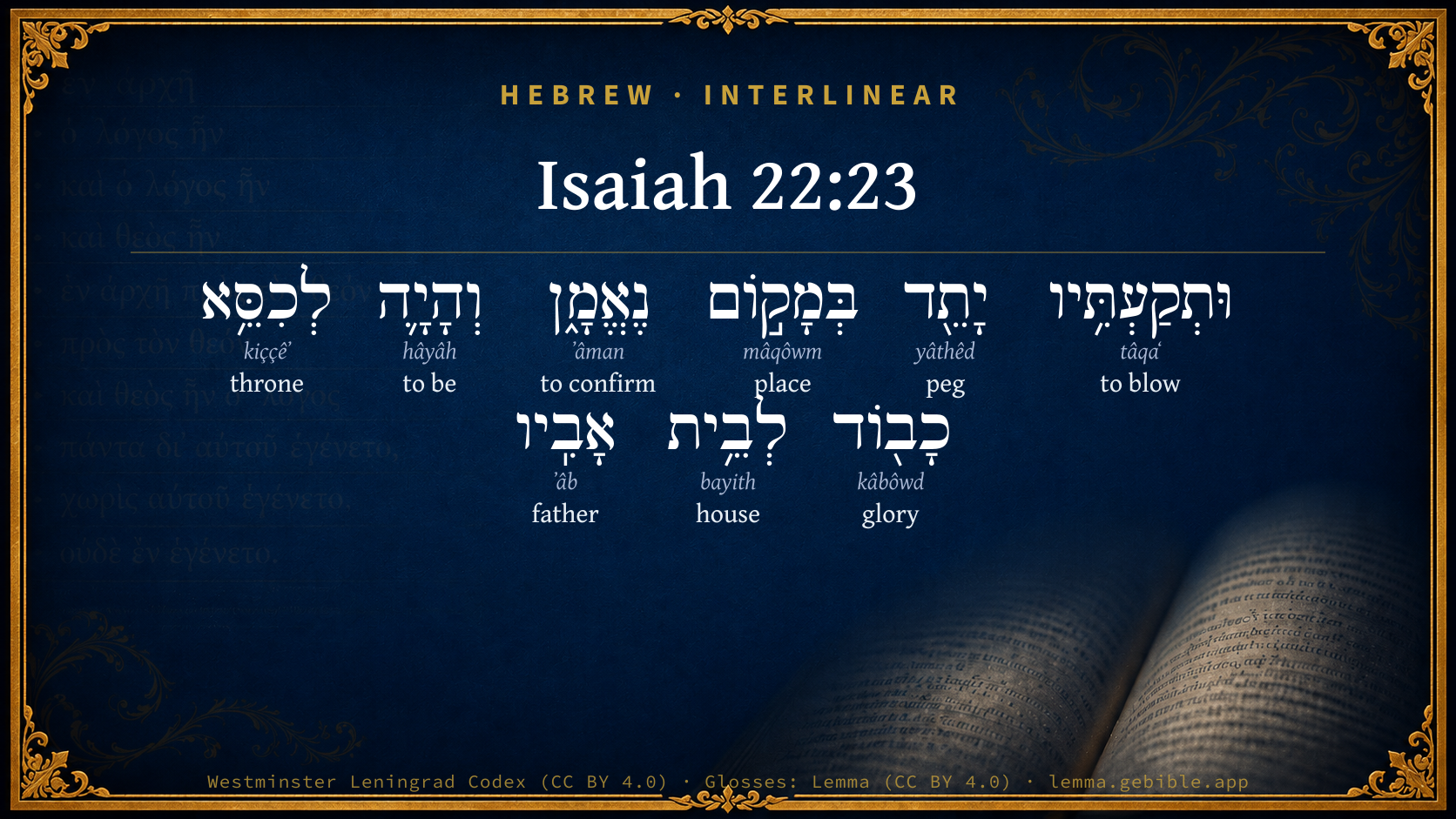
Isaiah 22:23

Hebrew (Westminster Leningrad Codex) Isaiah 22:23 appears in the Hebrew Old Testament. The text above is from the Westminster Leningrad Codex. Each word links to its Strong’s number, a concise gloss, and parsing drawn from the Open Scriptures Hebrew Bible morphology. Click any word for its full Brown-Driver-Briggs (BDB) entry.
Download image
Cite this verse

Isaiah 22:23 (World English Bible). Public Domain. Lemma interlinear Bible study tool, https://lemma.gebible.app/v/isaiah/22/23.

Show BibTeX & RIS
BibTeX
RIS
English Translation
I will fasten him as a nail in a sure place; and he shall be for a throne of glory to his father's house.
World English Bible · Public Domain
Download a study sheet

One document with this verse’s original text, its word-by-word gloss line, the meaning frame, cross-references with their text, attributed commentary, and full source and license credits — printable, and it pastes into notes with its structure intact.

This verse Autodidact and up

Study sheet (.html) Plain text (.txt)

A passage Seminary Student

Up to 50 verses in one chapter. A passage sheet keeps up to 6 commentary sources and 12 cross-references per verse, in the order this page ranks them, and says so on the sheet whenever that leaves anything out. Ask for a single verse and you get the Autodidact verse sheet above.

Everything on this page stays free to read, with no account — the sheet is a download of what is already on screen, not access to it.

Want to remove ads? Support Godless Engineer
Compare translations 3

The same verse in 3 English versions, stacked beneath the original-language interlinear above. Click any original word for its lexicon entry.

Each is an independent rendering of the whole verse — the interlinear is not word-aligned to these translations.

Highlighted words mark where these versions differ — a whole-verse word diff, not a word-by-word alignment.

  • World English Bible Public Domain
    I will fasten him as a nail in a sure place; and he shall be for a throne of glory to his father's house.
  • King James Version Public Domain
    And I will fasten him as a nail in a sure place; and he shall be for a glorious throne to his father's house.
  • unfoldingWord Literal Text CC BY-SA 4.0
    And I will drive him a peg into a place made firm, and he will be a throne of glory to the house of his father.

unfoldingWord Literal Text — © unfoldingWord, licensed CC BY-SA 4.0. Word-aligned USFM3 via Door43 (git.door43.org/unfoldingWord/en_ult).

Versions to compare (up to 4)

3 of 4 selected

Show all 18 translations

Every available English version of this verse, each an independent rendering of the whole verse.

  • World English Bible Public Domain
    I will fasten him as a nail in a sure place; and he shall be for a throne of glory to his father's house.
  • Berean Standard Bible Public Domain
    I will drive him like a peg into a firm place, and he will be a throne of glory for the house of his father.
  • Majority Standard Bible Public Domain
    I will drive him like a peg into a firm place, and he will be a throne of glory for the house of his father.
  • King James Version Public Domain
    And I will fasten him as a nail in a sure place; and he shall be for a glorious throne to his father's house.
  • American Standard Version (1901) Public Domain
    And I will fasten him as a nail in a sure place; and he shall be for a throne of glory to his father's house.
  • Revised Version (1885) Public Domain
    And I will fasten him as a nail in a sure place; and he shall be for a throne of glory to his father’s house.
  • Geneva Bible (1599) Public Domain
    And I will fasten him as a naile in a sure place, and hee shall be for the throne of glorie to his fathers house.
  • Douay-Rheims (1899) Public Domain
    And I will fasten him as a peg in a sure place, and he shall be for a throne of glory to the house of his father.
  • Young's Literal Translation Public Domain
    And I have fixed him a nail in a stedfast place, And he hath been for a throne of honour To the house of his father.
  • Literal Standard Version CC BY-SA 4.0
    And I have fixed him [as] a nail in a steadfast place, || And he has been for a throne of glory || To the house of his father.
  • Unlocked Literal Bible CC BY-SA 4.0
    I will fasten him, a peg in a secure place, and he will become a seat of glory for his father's house.
  • unfoldingWord Literal Text CC BY-SA 4.0
    And I will drive him a peg into a place made firm, and he will be a throne of glory to the house of his father.
  • Darby Bible Public Domain
    And I will fasten him [as] a nail in a sure place; and he shall be for a throne of glory to his father's house:
  • World Messianic Bible Public Domain
    I will fasten him like a nail in a sure place. He will be for a throne of glory to his father’s house.
  • Webster's Bible Public Domain
    And I will fasten him as a nail in a sure place; and he shall be for a glorious throne to his father's house.
  • Free Bible Version CC BY-SA 4.0
    I will drive him like a nail hammered securely into a wall. He will bring honor to his family.
  • Bible in Basic English Public Domain
    And I will put him like a nail in a safe place; and he will be for a seat of glory to his father's family.
  • JPS Tanakh (1917) Public Domain
    And I will fasten him as a peg in a sure place; and he shall be for a throne of honour to his father's house.

Literal Standard Version (2020), Covenant Press — licensed CC BY-SA 4.0. Text via the HelloAO Bible API (eBible.org). Unlocked Literal Bible (unfoldingWord) — licensed CC BY-SA 4.0. Text via the HelloAO Bible API (eBible.org). unfoldingWord Literal Text — © unfoldingWord, licensed CC BY-SA 4.0. Word-aligned USFM3 via Door43 (git.door43.org/unfoldingWord/en_ult). Free Bible Version, Dr. Jonathan Gallagher — licensed CC BY-SA 4.0. Text via the HelloAO Bible API (eBible.org).

Word by word

More ways to search: Search by grammar → Find every occurrence → Compare this word →

Practice this passage: Drill this verse → Learn its vocabulary →

יָתֵ֖ד
yâthêd
H3489
“peg”
Noun, Common, Feminine, Singular, Absolute
Part of Speech
Noun
Type
Common
Gender
Feminine
Number
Singular
State
Absolute
Full BDB Definition

Origin: from an unused root meaning to pin through or fast

TWOT: 932a

pin, stake, peg, nail - pin, peg, tent pin, tent stake - nail, pin (figuratively) - pin (used in weaving)
  1. וּתְקַעְתִּ֥יו tâqaʻ H8628 “and · to blow · him” Conjunction + Verb, Qal, Sequential Perfect, 1st Person, Common, Singular + Suffix, Personal, 3rd Person, Masculine, Singular
  2. בְּמָק֣וֹם mâqôwm H4725 “in/at · place” Preposition + Noun, Common, Masculine, Singular, Absolute
  3. נֶאֱמָ֑ן ʼâman H539 “confirming” Verb, Niphal, Participle Active, Masculine, Singular, Absolute
  4. וְהָיָ֛ה hâyâh H1961 “and · to be” Conjunction + Verb, Qal, Sequential Perfect, 3rd Person, Masculine, Singular
  5. לְכִסֵּ֥א kiççêʼ H3678 “to/for · throne of” Preposition + Noun, Common, Masculine, Singular, Construct
  6. כָב֖וֹד kâbôwd H3519 “glory” Noun, Common, Both, Singular, Absolute
  7. לְבֵ֥ית bayith H1004 “to/for · house of” Preposition + Noun, Common, Masculine, Singular, Construct
  8. אָבִֽיו ʼâb H1 “father · his” Noun, Common, Masculine, Singular, Construct + Suffix, Personal, 3rd Person, Masculine, Singular

About this verse

These counts appear in no published source. They are computed here, from the morphology-tagged text and Lemma’s own curated glosses. What Lemma adds →

9
words
9
distinct lemmas
Prophets
section

Notable vocabulary

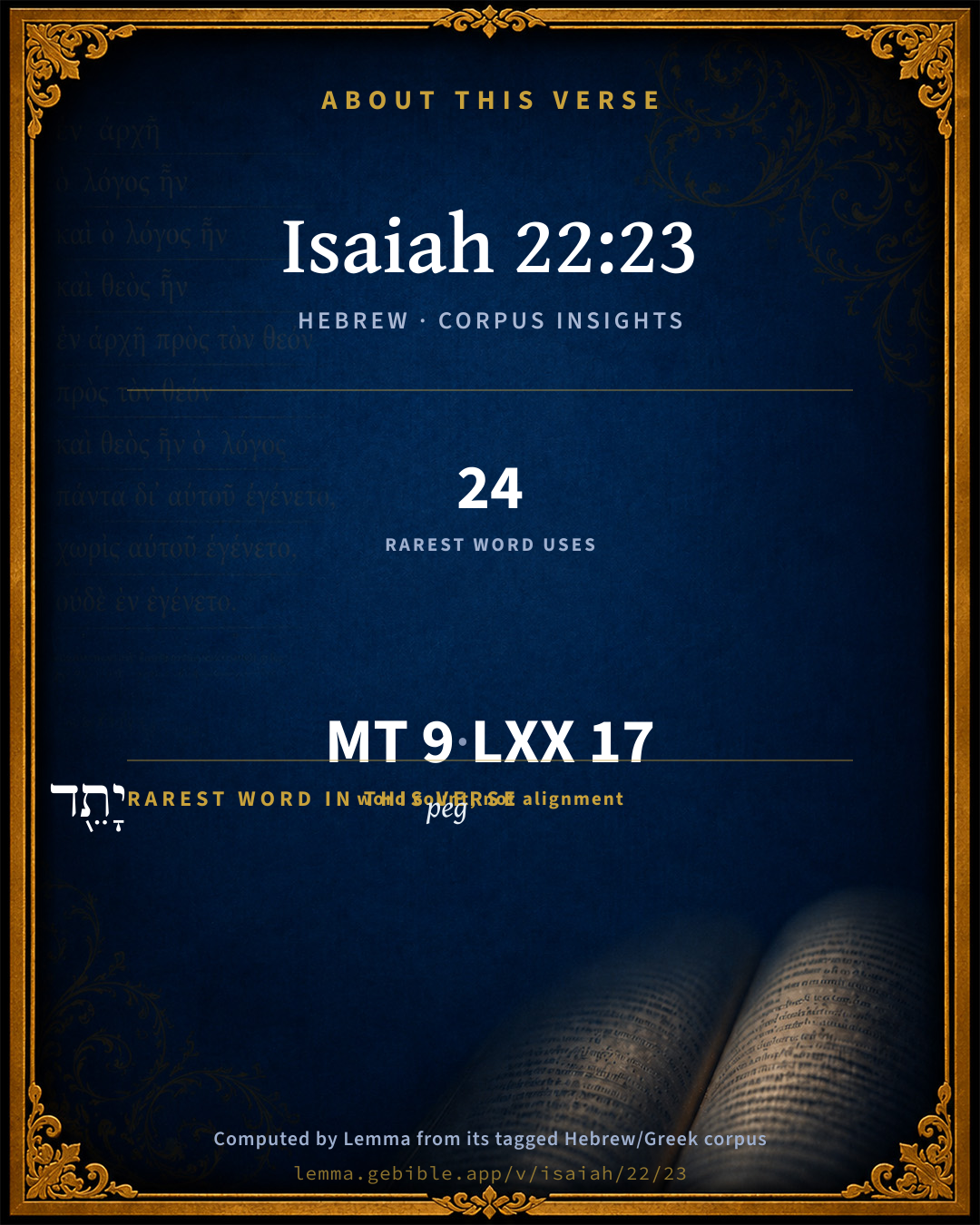
The rarest word here is יָתֵ֖ד peg H3489 — appearing just 24 times in the whole Hebrew Bible.

Shared distinctive vocabulary

יָתֵ֖ד peg H3489 occurs in 19 verses of the Hebrew Bible. Also found in:

Grammatical profile

  • 3 verbs
  • 6 nouns

Verb forms

  • וּתְקַעְתִּ֥יו Qal · Sequential Perfect
  • נֶאֱמָ֑ן Niphal · Participle Active
  • וְהָיָ֛ה Qal · Sequential Perfect

Hebrew & Septuagint length

In English translation the verse runs 24 words from the Hebrew and 23 from the Septuagint (LXX English) — closely comparable.

A rough comparison of the two English renderings, which tokenize alike — not a word-level alignment.

Word counts can differ between the Hebrew and the Greek without any difference in meaning — e.g. the Hebrew direct-object marker אֵת has no separate Greek word, and Greek often adds the article ὁ.

In the original languages it is 9 Hebrew tokens and 17 Greek tokens — but the two are counted differently (Hebrew bundles its prefixes and suffixes into one token; the Greek is in lemma form), so that isn’t a like-for-like length.

Cross-references

10

Topical passages linked to Isaiah 22:23 in the Treasury of Scripture Knowledge — connected by theme and wording, ordered by reader-vote popularity; previews shown in the World English Bible.

  • Ezra 9:8 Now for a little moment grace has been shown from Yahweh our God, to leave us a remnant to escape, and to give us a nail in his holy place, that our God may lighten our eyes, and give us a little reviving in our bondage.
  • Job 36:7 He doesn't withdraw his eyes from the righteous, But with kings on the throne, He sets them forever, and they are exalted.
  • 1 Samuel 2:8 He raises up the poor out of the dust, He lifts up the needy from the dunghill, To make them sit with princes, Inherit the throne of glory: For the pillars of the earth are Yahweh's, He has set the world on them.
  • Zechariah 10:4 From him will come forth the corner-stone, From him the nail, From him the battle bow, From him every ruler together.
  • Ecclesiastes 12:11 The words of the wise are like goads; and like nails well fastened are words from the masters of assemblies, which are given from one shepherd.
  • Luke 22:29–30 I confer on you a kingdom, even as my Father conferred on me,
  • Revelation 3:21 He who overcomes, I will give to him to sit down with me on my throne, as I also overcame, and sat down with my Father on his throne.
  • Genesis 45:9–13 Hurry, and go up to my father, and tell him, 'This is what your son Joseph says, "God has made me lord of all Egypt. Come down to me. Don't wait.
  • Esther 4:14 For if you altogether hold your peace at this time, then will relief and deliverance arise to the Jews from another place, but you and your father's house will perish: and who knows whether you haven't come to the kingdom for such a time as this?
  • Esther 10:3 For Mordecai the Jew was next to king Ahasuerus, and great among the Jews, and accepted of the multitude of his brothers, seeking the good of his people, and speaking peace to all his seed.

Cross-references courtesy of OpenBible.info (CC BY 4.0).

Hebrew and Greek witnesses Masoretic Hebrew ↔ Greek Septuagint

The same verse in the two great witnesses to the Old Testament, shown verse-for-verse.

These are two independent witnesses, not word-aligned to each other, and the Septuagint is shown in lemma (dictionary) form.

Hebrew Isaiah 22:23 Masoretic · Westminster Leningrad Codex

וּתְקַעְתִּ֥יו יָתֵ֖ד בְּמָק֣וֹם נֶאֱמָ֑ן וְהָיָ֛ה לְכִסֵּ֥א כָב֖וֹד לְבֵ֥ית אָבִֽיו

I will fasten him as a nail in a sure place; and he shall be for a throne of glory to his father's house.

World English Bible · Public Domain

Greek LXX Isaiah 22:23 Septuagint · lemma form

καί ἵστημι αὐτός ἄρχων ἐν τόπος πιστός καί εἰμί εἰς θρόνος δόξα ὁ οἶκος ὁ πατήρ αὐτός

And I will make him a ruler in a sure place, and he shall be for a glorious throne of his father's house.

LXX2012 (modern English Septuagint) · Public Domain

Hebrew: Westminster Leningrad Codex (CC BY 4.0). Greek: Septuagint (public domain); English from LXX2012 (modern English Septuagint) (Public Domain). How the Septuagint differs from the Hebrew →

Targum (Aramaic paraphrase)

1

The Targum is the ancient Jewish Aramaic paraphrase of the Hebrew Scriptures — an interpretive translation, not the Hebrew text itself. Onkelos (literal) and Pseudo-Jonathan (expansive) render the Torah, and Jonathan the Prophets. Coverage is partial: where no permissively-licensed English translation exists for a verse, only the Aramaic is shown. This is verse-level text, not a word-by-word alignment to the Hebrew.

  1. Targum Jonathan Prophets (Joshua–Malachi)
    וְאֶמַנִנֵיהּ אַמַרְכֶּל מְהֵימָן מְשַׁמֵשׁ בַּאֲתַר קַיָם וִיהֵי לְכוּרְסֵי יְקָר לְבֵית אֲבוּהִי:

    And I will appoint him a faithful chief-governor, an officer in a firm place, and he shall be for a glorious throne to his father's house.

    Targum Jonathan — Aramaic: “Mikraot Gedolot” (public domain). English: “Sefaria Community Translation” (CC0 1.0 (public-domain dedication)); “London "Chaldee Paraphrase," 1871” (public domain). Text via Sefaria.

Commentary

Notes on Isaiah 22:23 from classic Christian and Jewish commentators (each source and its license shown beneath its notes). The classic Christian expositions comment on the surrounding passage and are grouped to its opening verse, so a note may address several verses; the Jewish commentaries on the Tanakh (Rashi and others) are per-verse, so they appear only where the commentator wrote on this verse.

Lemma curates 59 commentaries, every one of them public domain or Creative Commons licensed, each selected and text-cleaned for this edition rather than reprinted as found. About our sources →

Trapp's Complete Commentary

John Trapp

Isa 22:23 And I will fasten him [as] a nail in a sure place; and he shall be for a glorious throne to his father’s house.

Ver. 23. And I will fasten him as a nail.] Paxilli simile et concinnum et amabile est. {a} On a nail are hung utensils of the house - any such thing as cannot stand by its own strength. Eliakim was to be a common support to the people, but especially to his father’s house.

And he shall be for a glorious throne.] He shall ennoble his whole stock and kindred.

{a} Sit princeps miscris paxillum, cui appendeant urceolos suos. - Scalt.

John Trapp, A Commentary or Exposition upon All the Books of the Old and New Testament (1647–1656) — public domain. Text from a community e-Sword module.

The Biblical Illustrator

Joseph S. Exell

Isa_22:23

And I will fasten him as a nail in a sure place

The fastening hold of Christ

The fastening force of Christ upon the soul of humanity is seen--

I.

IN HIS HOLD UPON THE GENERAL MIND OF THE WORLD. Who, throughout the history of the ages, have laid such a firm grip upon mankind as Christ has? It is true that Buddha, Zoroaster, Confucius, Mohammed, have had--and still have--a firm hold on millions of souls. Some of them have afar wider influence than that of Christ, but they are not fastened so firmly.

1. Philosophy shows this. Their systems--if systems they can be called--only appeal to certain faculties in human nature; Christ grasps the entire man--intellect, imagination, conscience, hope, fear, love.

2. History shows this. Heathenism does not encroach upon Christianity. Christians are not converted to Zoroaster, Confucius, etc., but their followers are converted to Christianity every day. Heathendom is contracting, Christendom is extending on all hands. Its language, its literature, its institutions, are pushing themselves everywhere. The nail is made so fast, that to extract it would be to tear the world to pieces.

II. IN HIS HOLD UPON THE CONSECRATED MIND OF HIS DISCIPLES. His hold here is far firmer than His hold on the general mind. He goes deeper into humanity, He takes hold of the entire soul, and makes it captive. Or, to change the figure, He strikes His roots into every faculty of the soul. He becomes to the human spirit in this case what the sap is to the tree. You must tear the soul to pieces--nay, you must annihilate it--before you can extract his nail. (Homilist.)

A nail in a sure place

I. THE LESSON OF THE NAIL; that little things may be very important things. We read when David prepared for the building of the temple, he prepared iron in abundance for the nails for the doors of the gates. So all preparation for training, for education, for the formation of character, is a kind of holy iron, hereafter to be fashioned into nails for the sure place. And if you turn to Ezr_9:8, you will find the good man even makes this a matter of prayer, that God would give him a nail in His holy place--that is, that he and his might have a place of security, howeverinsignificant it might be; for a nail, small as it is, speaks of security, it fastens things. There is an old proverb which says how, for want of a nail the shoe was lost, for want of a shoe the horse was lost, for want of a horse the rider was lost.

II. THE SURE PLACE. From which you learn, that even things good in themselves must be in a good place, in order that they may be of any good. For instance--

1. Good words, in order that they may do good, need good memories; and the good memory is the sure place.

2. A good example in a fruitful life is a nail in a sure place.

3. Faith fixed on a good object is a nail in a sure place. Faith is not always good; people may believe lies. If you look to Christ and trust in Him there will be the nail in the sure place.

III. THE LESSON OF THE FASTENING.

1. In order to the fastening a nail needs guiding. You will need strength, help, and guidance from God.

2. Fastened. Some things, once fixed, are fixed forever. What a dreadful thing it is, to think that this applies, so far as we are able to say and to see, to bad things! Habit fixes a man like a nail in a sure place, fixes his ways of thought and life so that it seems as if he is immovable; for every time we repeat a wrong thing, it is driven farther and farther into our life. See to it, as you value your happiness for time and eternity, that, if you are fastened as a nail in a sure place, it shall be a good place.

3. In a good place, fastened. Be steadfast, unmovable: act in such a manner that the bad people shall never have any hopes of getting you over on their side, or of drawing you out of your sure place. (Homilist.)

Nails in Eastern houses

These nails, or pegs, when employed in houses, were not driven into the walls after the building was finished, but were worked in while the building was going up. The strong hooks, or spikes, thus secured in the mortar answered the double purpose of clamp irons to hold the walls together, and of nails on which anything could be hung. (J. N. Norton.)

The nail in a sure place

The promise concerning Eliakim amounts to this: I will so build him up into My spiritual temple (so the Almighty may be supposed to say), that he himself may be securely fixed in it, and that others also may safely depend on him for help and counsel. As Eliakim was a type of Christ, we have in this similitude an instructive lesson, both of our duty and our happiness. On Him we must hang our hopes and interests, both with respect to our own salvation, and to the peace and prosperity of the Church.

I. Eliakim was a type of Christ IN BEING THE SUCCESSOR OF ONE WHO HAD PROVED HIMSELF UNWORTHY OF HIS OFFICE. As the haughty and unprincipled Shebna gave place to a man whom no selfish interests could possibly influence, so were the corrupt and evil-minded rulers of the Jewish nation to be set aside at the appearance of the Messiah who was to govern the world in righteousness.

II. Again, Eliakim was a type of Christ, IN THE AUTHORITY ENTRUSTED TO HIM. As the successor of the faithless Shebna was honoured by having the key of the house of David laid upon his shoulder, in token of the unlimited authority which he was thenceforth to exercise, so was the Lord Jesus to be entrusted with all power in heaven and earth; and we find Him adopting the same lofty terms to describe His own regal attributes Rev_3:7).

III. A third particular in which Eliakim may be considered as a type of Christ, is IN THE BENEFITS AND BLESSINGS SECURED BY HIS RIGHTEOUS RULE. Eliakim, we are told, was a father to the inhabitants of Jerusalem and to the house of Judah, but the benefits of the wisest administration of man are few and insignificant, when compared with those which are secured to the world by the glorious reign of the Prince of Peace. (J. N. Norton.)

The Biblical Illustrator, edited by Joseph S. Exell (c. 1880s–1900s) — public domain. Text from a community e-Sword module.

Joseph Benson's Commentary

Isa 22:23. I will fasten him as a nail — I will establish the power in his hands, as a nail is fixed in the strong walls or solid timber of a house. “In ancient times, and in eastern countries, as the way of life, so the houses were much more simple than ours at present. They had not that quantity and variety of furniture, nor those accommodations of all sorts, with which we abound. It was convenient, and even necessary for them, and it made an essential part in the building of a house, to furnish the inside of the several apartments with sets of spikes, nails, or large pegs, upon which to dispose of, and hang up, the several moveables and utensils in common use, and proper to the apartment. These spikes they worked into the walls at the first erection of them; the walls being of such materials that they could not bear their being driven into them afterward; and they were contrived so as to strengthen the walls by binding the parts together, as well as to serve for convenience. We see, therefore, that these nails were of necessary and common use, and of no small importance in all their apartments; conspicuous, and much exposed to observation; and if they seem to us mean and insignificant, it is because we are not acquainted with the thing itself, and have no name to express it by, but what conveys to us a low and contemptible idea. Grace hath been showed from the Lord our God, says Ezra, (Ezr 9:8,) to leave us a remnant to escape, and to give us a nail in his holy place; that is, as the margin of our Bible explains it, a constant and sure abode.” Bishop Lowth. And he shall be a glorious throne to his father’s house — By his prudent and righteous government he shall procure great glory, not only to himself, but to all that have any relation to him.

Joseph Benson's Commentary on the Old and New Testaments (1811–1818) — public domain. Text from a community e-Sword module.

Geneva Bible (1599)

Geneva Bible translators

I will establish him, and confirm him in his office: of this phrase, read Ezra 9:9.

Geneva Bible (1599) marginal notes — public domain. Text via Bolls.life.

Jamieson, Fausset & Brown

Robert Jamieson, A. R. Fausset & David Brown

nail . . . sure place--Large nails or pegs stood in ancient houses on which were suspended the ornaments of the family. The sense is: all that is valuable to the nation shall rest securely on him. In Ezr 9:8 "nail" is used of the large spike driven into the ground to fasten the cords of the tent to.

throne--resting-place to his family, as applied to Eliakim; but "throne," in the strict sense, as applied to Messiah, the antitype (Luk 1:32-33).

Jamieson, Fausset & Brown — Commentary Critical and Explanatory on the Whole Bible (1871) — public domain (CC PDM 1.0). Text via the HelloAO Bible API.

Adam Clarke's Commentary

Verse 23. A nail] In ancient times, and in the eastern countries, as the way of life, so the houses, were much more simple than ours at present. They had not that quantity and variety of furniture, nor those accommodations of all sorts, with which we abound. It was convenient and even necessary for them, and it made an essential part in the building of a house, to furnish the inside of the several apartments with sets of spikes, nails, or large pegs, upon which to dispose of and hang up the several movables and utensils in common use, and proper to the apartment. These spikes they worked into the walls at the first erection of them, the walls being of such materials that they could not bear their being driven in afterwards; and they were contrived so as to strengthen the walls by binding the parts together, as well as to serve for convenience. Sir John Chardin's account of this matter is this: - "They do not drive with a hammer the nails that are put into the eastern walls. The walls are too hard, being of brick; or, if they are of clay, too mouldering: but they fix them in the brick-work as they are building. They are large nails, with square heads like dice, well made, the ends being bent so as to make them cramp-irons. They commonly place them at the windows and doors, in order to hang upon them, when they like, veils and curtains." Harmer's Observ. i. p. 191. And we may add, that they were put in other places too, in order to hang up other things of various kinds; as appears from this place of Isaiah, and from Eze 15:3, who speaks of a pin or nail, "to hang any vessel thereon." The word used here for a nail of this sort is the same by which they express that instrument, the stake, or large pin of iron, with which they fastened down to the ground the cords of their tents. We see, therefore, that these nails were of necessary and common use, and of no small importance in all their apartments; conspicuous, and much exposed to observation: and if they seem to us mean and insignificant, it is because we are not acquainted with the thing itself, and have no name to express it but by what conveys to us a low and contemptible idea. "Grace hath been showed from the Lord our God," saith Ezra, Ezr 9:8, "to leave us a remnant to escape, and to give us a nail in his holy place:" that is, as the margin of our Bible explains it, "a constant and sure abode."

"He that doth lodge near her (Wisdom's) house,

Shall also fasten a pin in her walls."

Ecclus. 14:24.

The dignity and propriety of the metaphor appears from the Prophet Zechariah's use of it: -

"From him shall be the corner-stone, from him the nail,

From him the battle-bow,

From him every ruler together."

Zec 10:4.

And Mohammed, using the same word, calls Pharaoh the lord or master of the nails, that is, well attended by nobles and officers capable of administering his affairs. Koran, Sur. xxxviii. 11, and lxxxix. 9. So some understand this passage of the Koran. Mr. Sale seems to prefer another interpretation.

Taylor, in his Concordance, thinks יתד yathed means the pillar or post that stands in the middle, and supports the tent, in which such pegs are fixed to hang their arms, c., upon referring to Shaw's Travels, p. 287. But יתד yathed is never used, as far as appears to me, in that sense. It was indeed necessary that the pillar of the tent should have such pegs on it for that purpose; but the hanging of such things in this manner upon this pillar does not prove that יתד yathed was the pillar itself.

A glorious throne - "A glorious seat"] That is, his father's house and all his own family shall be gloriously seated, shall flourish in honour and prosperity; and shall depend upon him, and be supported by him.

Adam Clarke's Commentary on the Bible (1810–1826) — public domain. Text from a community e-Sword/MySword module.

Ellicott's Commentary for English Readers

(23) I will fasten him as a nail in a sure place . . .—The word for “nail” is used both for the peg that fastens a tent to the ground, as in the “stakes” of Isa_33:20; Isa_54:2; Jdg_4:21, or, as in Eze_15:3, for a nail driven into the wall. Here the context shows that the latter meaning is preferable. It was, as the sequel shows, a symbol of the support upon which others can depend. (Comp. the “nail in his holy place” of Ezr_9:8.)

He shall be for a glorious throne . . .—Another symbol of sovereignty follows. The form, throne of glory, is found in its highest application in 1Sa_2:8, and Jer_14:21; Jer_17:12. Such a throne, kingly in its state, is to be the pride of the hitherto obscure house of Eliakim.

A Bible Commentary for English Readers, edited by Charles John Ellicott (1878–1897) — public domain. Text from a community e-Sword module.

The Cambridge Bible for Schools and Colleges

gen. ed. J. J. S. Perowne

23. a nail] usually a “tent-peg” (and so probably in a figurative sense, Zec_10:4); but also (Eze_15:3) a peg on which household utensils are suspended. The latter idea (according to Isa_22:25) must be intended here.

a glorious throne] Better: a seat of honour.

to his father’s house]—all his nearest kindred, who are through him advanced from obscurity to great dignity.

The Cambridge Bible for Schools and Colleges (gen. ed. J. J. S. Perowne; Cambridge University Press, 1878–1918) — public domain. Text from a community e-Sword module.

John Gill's Exposition

And I will fasten him as a nail in a sure place,.... In a strong part of the wall or timber, where it shall not fail, or be removed, or cut down, and so let drop what is hung upon it: it denotes the stability and continuance of his government, and of the strength and support he should be of unto others; and well agrees with Christ his antitype; see Zac 10:4 and is expressive of the strength of Christ, as the mighty God; and as the man of God's right hand, made strong for himself; and as the able Saviour, and mighty Redeemer; and of the stability of his person, he is unchangeable, the same today, yesterday, and for ever; and of his office, as Mediator, Head, and Surety of the covenant; whose priesthood passes not from one to another, and whose kingdom is an everlasting one, and his truths and ordinances unshaken and immovable: the sure place in which he is fixed is both his church, where he is the everlasting Head, Husband, and Saviour of it; and heaven, where he is, and will be retained, until the time of the restitution of all things:

and he shall be for a glorious throne to his father's house; or make the throne of his father's house glorious, Eliakim being, as some have thought, of the blood royal; or he should be an honour and credit to his father's house, by his wise and faithful administration of the government committed to him. Christ is the brightness of his Father's glory; and, to them that believe, he is an honour; he is on a glorious throne himself, and he will bring all his Father's family to sit with him on the same throne, Sa1 2:8.

John Gill's Exposition of the Whole Bible (1746–1763) — public domain (CC PDM 1.0). Text via the HelloAO Bible API.

Albert Barnes' Notes on the Bible

And I will fasten him as a nail in a sure place - The word ‘nail’ here (יתד yâtēd) means properly a peg, pin, or spike; and is applied often to the pins or large spikes which were used to drive into the ground to fasten the cords of tents. It is also applied to the nails or spikes which are driven into walls, and on which are suspended the garments or the utensils of a family. In ancient times, every house was furnished with a large number of these pegs, or nails. They were not “driven” into the walls after the house was made, but they were “worked in” while the walls were going up. The houses were usually made of stone; and strong iron hooks, or spikes, were worked into the mortar while soft, and they answered the double purpose of nails to hang things on, and of cramp-irons, as they were so bent as to hold the walls together. These spikes are described by Sir John Chardin (Harmer’s “Observations,” vol. i. p. 191) as ‘large nails with square heads like dice, well made, the ends being so bent as to make them cramp-irons. They commonly,’ says he, ‘place them at the windows and doors, in order to hang upon them, when they like, veils and curtains.’ It was also the custom to suspend in houses, and especially temples, suits of armor, shields, helmets, swords, etc., that had been taken in war as spoils of victory, or which had been used by illustrious ancestors, and these spikes were used for that purpose also. The word is here applied to a leader, or officer; and it means that he would be fixed and permanent in his plans and office; and that as a pin in the wall sustained the ornaments of the house “safely,” so all the glory of the house of David, all that was dear and valuable to the nation, might be reposed on him Isa 22:24.

And he shall be for a glorious throne to his father’s house - A glorious seat; that is, all his family and kindred would be sustained, and honored by him; or their honor and reputation might rest securely on him, and his deeds would diffuse a luster and a glory over them all. Every virtuous, patriotic, benevolent, and pious son diffuses a luster on all his kindred; and this is one of the incitements to virtuous and elevated deeds which God has presented in the government of the world.

Albert Barnes' Notes on the Bible (1834–1885) — public domain. Text from a community e-Sword/MySword module.

Haydock's Catholic Bible Commentary

Peg, on which whatever is placed shall be secure, 1 Esdras ix. 8.

George Leo Haydock (1774–1849), Haydock's Catholic Family Bible and Commentary, 1859 edition — public domain. Excludes Psalms (Douay-Rheims chapter numbering differs from Protestant) and Deuterocanonical books (Catholic canon only).

Matthew Poole's English Annotations

I will fasten him; I will establish the power in his hands.

In a sure place; in the strong walls, or solid timber, in the house; which is opposed to Shebna’s instability, signified by a ball, Isa 22:18.

He shall be for a glorious throne to his father’s house; by his prudent and righteous government he shall procure great glory, not only to himself, but to all that have any relation to him. This also is opposed to what is said of Shebna in the end of Isa 22:18.

Matthew Poole's English Annotations on the Holy Bible (1683–1685) — public domain. Text from a community e-Sword/MySword module.

The Pulpit Commentary

I will fasten him as a nail in a sure place. (comp. Zec_10:4) The idea intended to be expressed is firmness and fixity of tenure. He shall be for a glorious throne to his father"s house (compare the next verse). All his relations, even the most remote, shall derive honor from him, and bask in the sunshine of his prosperity. So shall all members of the family of God, made sons of God by adoption in Christ, participate in the final glory of Christ in his eternal kingdom.

The sure nail as a type.

The idea may be the peg driven into the ground, round which to fasten the tent-ropes. But, more probably, the reference is to a peg in the wall, driven in so securely that things may be safely hung upon it. The word is here used metaphorically in application to the support which Eliakim would yield to all his dependent relations. It is the type of the man on whom others can depend. The following points will be readily worked out and illustrated.

I THE SORT OF MAN WHO CAN THUS BE A NAIL FOE OTHERS TO DEPEND ON.

II THE TYPE FULLY REALIZED IN THE LORD JESUS CHRIST.

III THE TYPE REALIZED, IN MEASURE, IN CHRIST-LIKE MEN AND WOMEN. Nothing better can be said of any of us than this Men trust us. What can be said of woman nobler than this, "The heart of her husband trusteth in her? R.T.

The Pulpit Commentary (1880–1919), ed. H.D.M. Spence-Jones & Joseph S. Exell — public domain. Text from a community e-Sword module.

John Wesley's Explanatory Notes

Fasten - I will establish the power in his hands. Sure place - In the strong walls, or solid timber, in the house. He shall be - By his prudent and righteous government he shall procure great glory, to all that have any relation to him.

John Wesley, Explanatory Notes Upon the Whole Bible (1754–1765) — public domain. Text via the GEBible commentary corpus.

J. A. Alexander on Isaiah

Joseph Addison Alexander

“And I will fasten him a nail in a sure place, and he shall be for a throne of glory to his father’s house.” The figure in the first clause naturally conveys the idea of security and permanence. The reference is not to the stakes or centre post of a tent, but to the large pegs, pins or nails often built into the walls of oriental houses for the purpose of suspending clothes or vessels. The last clause is obscure. The most natural interpretation of the words, and that most commonly adopted, is that the figure of a nail is here exchanged for that of a seat, this being common to the two, that they alike suggest the idea of support though in different ways. Those whom Eliakim was the means of promoting might be said, with a change of figure but without a change of meaning, both to sit and hang upon him. He was to be not only a seat but a seat of honor, which is nearer to the meaning of the Hebrew phrase than throne of glory.

Joseph Addison Alexander, The Prophecies of Isaiah (1846–1847; New York: Scribner, 1870–1878) — public domain. Text from a community e-Sword module.

unfoldingWord translationNotes

Door43 World Missions Community

General Information:

Yahweh continues to describe Eliakim, who will replace Shebna in the king's palace.

I will fasten him, a peg in a secure place

Yahweh causing Eliakim's authority to be strong and secure in the king's palace is spoken of as if Eliakim were a peg and Yahweh will set him firmly in the palace wall. (See: Metaphor)

he will become a seat of glory for his father's house

Here "seat of glory" represents a place of honor. AT: "Eliakim will bring honor to his family" (See: Metonymy)

his father's house

Here "house" represents family. AT: "his father's family" or "his family" (See: Metonymy)

They will hang on him all the glory of his father's house

Yahweh causing Eliakim's whole family to be honored because of Eliakim is spoken of as if Eliakim were a peg in the wall and his family were something that hangs on the peg. AT: "They will give honor to his whole family because of him" (See: Metaphor)

every small container from the cups to all the jugs

This continues to speak of Eliakim as a peg. His offspring will be like cups that hang on the peg. This means his descendants will be honored because of him. (See: Metaphor)

the cups to all the jugs

A cup is a small container that holds water. A jug is a larger container that holds water.

translationWords

glory

ancestor

house

offspring

descend

unfoldingWord translationNotes — © Distant Shores Media and the Door43 World Missions Community, licensed CC BY-SA 4.0. Source: git.door43.org/Door43/en_tn.

Rashi

Rabbi Shlomo Yitzchaki (Rashi)

And I will thrust him like a peg in a sure place (Jonathan renders:) And I will appoint him a faithful trustee, serving in a sure place. Jonathan renders נֶאֱמָן as sure, i.e., a place that is faithful to those who lean on it, for it shall not move. Another explanation is to reverse the word order of the verse: And I will thrust him a sure peg in a place.

Rashi on the Tanakh — English translations: “The Judaica Press complete Tanach with Rashi, translated by A. J. Rosenberg” (CC BY 4.0); “Pentateuch with Rashi's commentary by M. Rosenbaum and A.M. Silbermann, 1929-1934” (public domain); “The Metsudah Tanach series, Lakewood, N.J” (CC BY 4.0); and “The Book of Joshua, Metsudah Publications, 1997” (CC BY 4.0). Text via Sefaria.

Ibn Ezra

Rabbi Abraham ibn Ezra

יתד As a nail. כיתד ═ יתד. Comp. וכעיר ═ ועיר And like a wild ass (Job 11:12)

Ibn Ezra on the Tanakh — English translations: “Sefaria Community Translation” (CC0 1.0 (public-domain dedication)); “Yalkut, Sifsei Chachomim Chumash, Metsudah Publications, 2009” (CC BY 4.0); and “Commentary of Ibn Ezra on Isaiah - trans. by M. Friedlander, 1873” (public domain). Text via Sefaria.

Lesson kit

Teaching starters — assembled from the data on this page, not authored interpretation. Every prompt links to the verse data it draws on. Edit before teaching.

Isaiah, in the Prophets, opens this verse with 9 words (9 distinct Hebrew lemmas). Its most distinctive word is yâthêd (“peg”). A historical commentator’s framing appears above. Read the whole chapter for the surrounding context.

Discussion questions

  1. How does “peg” (yâthêd) shape what this verse is saying?
  2. Exodus 27:19 shares the word «peg» with this verse. How do the two illuminate each other?
  3. These translations render this verse differently. What is at stake in choosing one wording over another?
  4. The verb «וּתְקַעְתִּ֥יו» is Qal Sequential Perfect. How does its form color the action?
  5. Reading how Trapp's Complete Commentary and The Biblical Illustrator read this verse, where do the two commentators agree and where do they part?

Things to notice

Reading settings

Reading text

Shown beneath each verse's original-language words.

Old Testament
Old Testament edition

Read the OT as the Masoretic Hebrew (MT) or the Greek Septuagint (LXX).

English shown for the Greek Septuagint (in the Hebrew ↔ Greek comparison).

Comparing translations? Open the Compare panel on any verse page to stack up to four side by side.