
Psalms 106:24

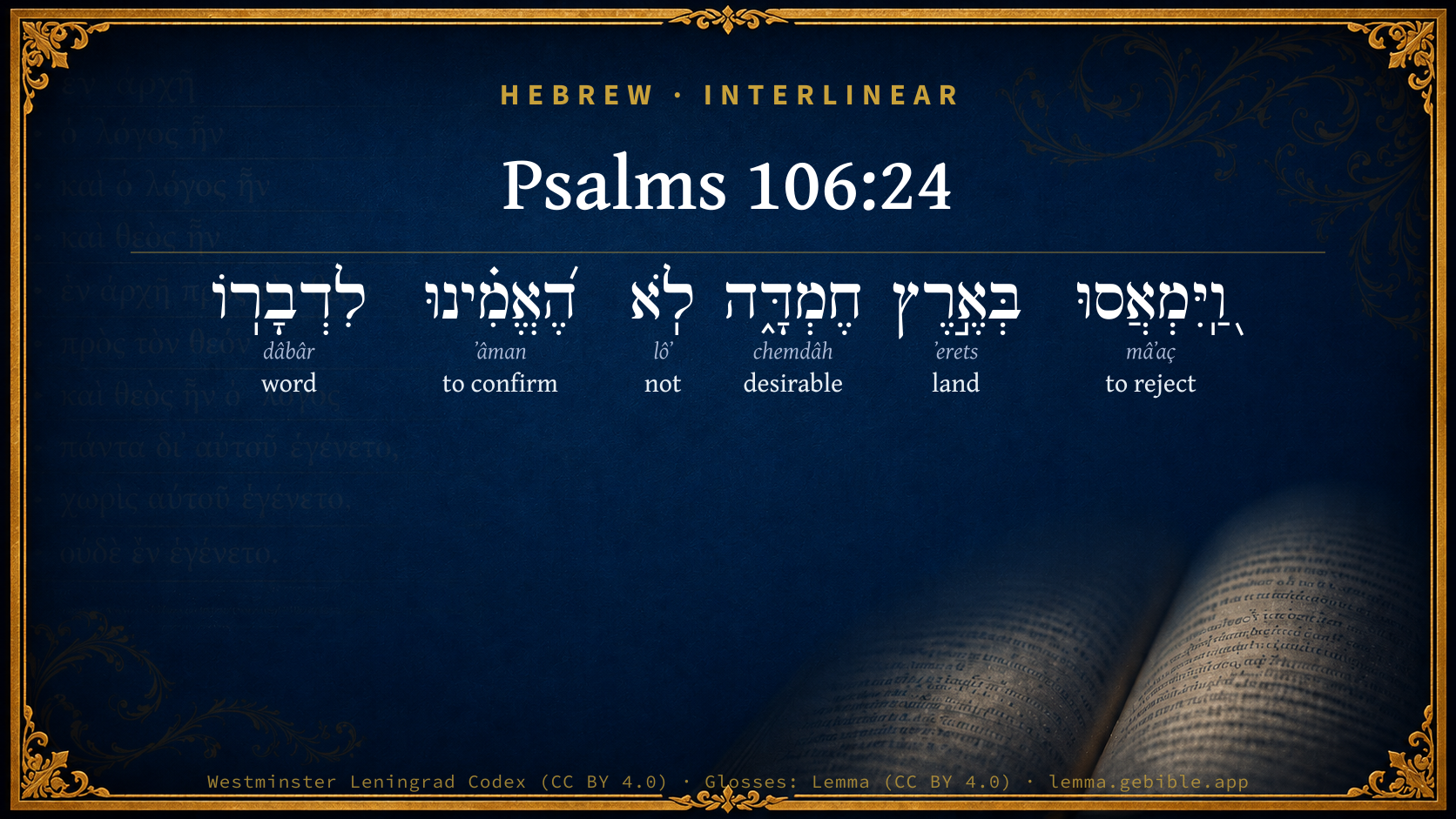
Hebrew (Westminster Leningrad Codex) Psalms 106:24 appears in the Hebrew Old Testament. The text above is from the Westminster Leningrad Codex. Each word links to its Strong’s number, a concise gloss, and parsing drawn from the Open Scriptures Hebrew Bible morphology. Click any word for its full Brown-Driver-Briggs (BDB) entry.
Download image
Cite this verse

Psalms 106:24 (World English Bible). Public Domain. Lemma interlinear Bible study tool, https://lemma.gebible.app/v/psalms/106/24.

Show BibTeX & RIS
BibTeX
RIS
English Translation
Yes, they despised the pleasant land. They didn't believe his word,
World English Bible · Public Domain
Download a study sheet

One document with this verse’s original text, its word-by-word gloss line, the meaning frame, cross-references with their text, attributed commentary, and full source and license credits — printable, and it pastes into notes with its structure intact.

This verse Autodidact and up

Study sheet (.html) Plain text (.txt)

A passage Seminary Student

Up to 50 verses in one chapter. A passage sheet keeps up to 6 commentary sources and 12 cross-references per verse, in the order this page ranks them, and says so on the sheet whenever that leaves anything out. Ask for a single verse and you get the Autodidact verse sheet above.

Everything on this page stays free to read, with no account — the sheet is a download of what is already on screen, not access to it.

Want to remove ads? Support Godless Engineer
Compare translations 3

The same verse in 3 English versions, stacked beneath the original-language interlinear above. Click any original word for its lexicon entry.

Each is an independent rendering of the whole verse — the interlinear is not word-aligned to these translations.

Highlighted words mark where these versions differ — a whole-verse word diff, not a word-by-word alignment.

  • World English Bible Public Domain
    Yes, they despised the pleasant land. They didn't believe his word,
  • King James Version Public Domain
    Yea, they despised the pleasant land, they believed not his word:
  • unfoldingWord Literal Text CC BY-SA 4.0
    Then they despised the delightful land; they did not believe his word,

unfoldingWord Literal Text — © unfoldingWord, licensed CC BY-SA 4.0. Word-aligned USFM3 via Door43 (git.door43.org/unfoldingWord/en_ult).

Versions to compare (up to 4)

3 of 4 selected

Show all 18 translations

Every available English version of this verse, each an independent rendering of the whole verse.

  • World English Bible Public Domain
    Yes, they despised the pleasant land. They didn't believe his word,
  • Berean Standard Bible Public Domain
    They despised the pleasant land; they did not believe His promise.
  • Majority Standard Bible Public Domain
    They despised the pleasant land; they did not believe His promise.
  • King James Version Public Domain
    Yea, they despised the pleasant land, they believed not his word:
  • American Standard Version (1901) Public Domain
    Yea, they despised the pleasant land, They believed not his word,
  • Revised Version (1885) Public Domain
    Yea, they despised the pleasant land, they believed not his word;
  • Geneva Bible (1599) Public Domain
    Also they contemned that pleasant land, and beleeued not his worde,
  • Douay-Rheims (1899) Public Domain
    And they set at nought the desirable land. They believed not his word,
  • Young's Literal Translation Public Domain
    And they kick against the desirable land, They have not given credence to His word.
  • Literal Standard Version CC BY-SA 4.0
    And they kick against the desirable land, || They have not given credence to His word.
  • Unlocked Literal Bible CC BY-SA 4.0
    Then they despised the fruitful land; they did not believe his promise,
  • unfoldingWord Literal Text CC BY-SA 4.0
    Then they despised the delightful land; they did not believe his word,
  • Darby Bible Public Domain
    And they despised the pleasant land; they believed not his word,
  • World Messianic Bible Public Domain
    Yes, they despised the pleasant land. They didn’t believe his word,
  • Webster's Bible Public Domain
    Yes, they despised the pleasant land, they believed not his word:
  • Free Bible Version CC BY-SA 4.0
    Later the people refused to enter the Promised Land; they didn't trust him to do as he'd promised.
  • Bible in Basic English Public Domain
    They were disgusted with the good land; they had no belief in his word;
  • JPS Tanakh (1917) Public Domain
    Moreover, they scorned the desirable land, they believed not His word;

Literal Standard Version (2020), Covenant Press — licensed CC BY-SA 4.0. Text via the HelloAO Bible API (eBible.org). Unlocked Literal Bible (unfoldingWord) — licensed CC BY-SA 4.0. Text via the HelloAO Bible API (eBible.org). unfoldingWord Literal Text — © unfoldingWord, licensed CC BY-SA 4.0. Word-aligned USFM3 via Door43 (git.door43.org/unfoldingWord/en_ult). Free Bible Version, Dr. Jonathan Gallagher — licensed CC BY-SA 4.0. Text via the HelloAO Bible API (eBible.org).

Word by word

More ways to search: Search by grammar → Find every occurrence → Compare this word →

Practice this passage: Drill this verse → Learn its vocabulary →

About this verse

These counts appear in no published source. They are computed here, from the morphology-tagged text and Lemma’s own curated glosses. What Lemma adds →

6
words
6
distinct lemmas
Wisdom
section

Notable vocabulary

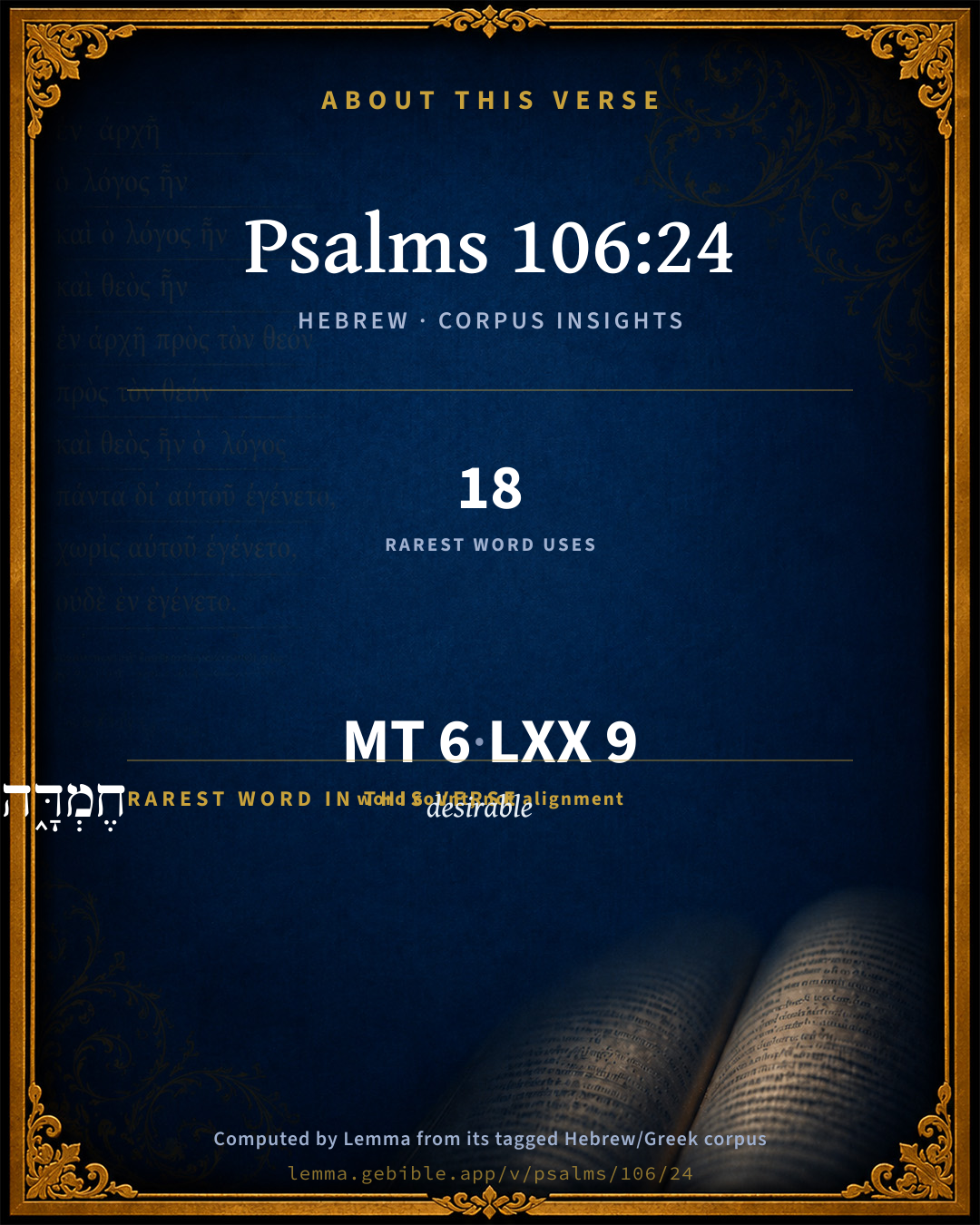
The rarest word here is חֶמְדָּ֑ה desirable H2532 — appearing just 18 times in the whole Hebrew Bible.

Shared distinctive vocabulary

חֶמְדָּ֑ה desirable H2532 occurs in 18 verses of the Hebrew Bible. Also found in:

Grammatical profile

  • 2 verbs
  • 3 nouns
  • 1 particle

Verb forms

  • וַֽ֭יִּמְאֲסוּ Qal · Sequential Imperfect
  • הֶ֝אֱמִ֗ינוּ Hiphil · Perfect

Hebrew & Septuagint length

In English translation the verse runs 11 words from the Hebrew and 13 from the Septuagint (LXX English) — closely comparable.

A rough comparison of the two English renderings, which tokenize alike — not a word-level alignment.

Word counts can differ between the Hebrew and the Greek without any difference in meaning — e.g. the Hebrew direct-object marker אֵת has no separate Greek word, and Greek often adds the article ὁ.

In the original languages it is 6 Hebrew tokens and 9 Greek tokens — but the two are counted differently (Hebrew bundles its prefixes and suffixes into one token; the Greek is in lemma form), so that isn’t a like-for-like length.

Cross-references

18

Topical passages linked to Psalms 106:24 in the Treasury of Scripture Knowledge — connected by theme and wording, ordered by reader-vote popularity; previews shown in the World English Bible.

  • Deuteronomy 1:32 Yet in this thing you didn't believe Yahweh your God,
  • Numbers 14:31 But your little ones, that you said should be a prey, them will I bring in, and they shall know the land which you have rejected.
  • Ezekiel 20:6 in that day I swore to them, to bring them forth out of the land of Egypt into a land that I had searched out for them, flowing with milk and honey, which is the glory of all lands.
  • Hebrews 3:18–19 To whom did he swear that they wouldn't enter into his rest, but to those who were disobedient?
  • Hebrews 4:6 Seeing therefore it remains that some should enter therein, and they to whom the good news was before preached failed to enter in because of disobedience,
  • Deuteronomy 8:7–9 For Yahweh your God brings you into a good land, a land of brooks of water, of springs and springs, flowing forth in valleys and hills;
  • Deuteronomy 11:11–12 but the land, where you go over to possess it, is a land of hills and valleys, [and] drinks water of the rain of the sky,
  • Jeremiah 3:19 But I said, How I will put you among the children, and give you a pleasant land, a goodly heritage of the hosts of the nations! and I said, You shall call me My Father, and shall not turn away from following me.
  • Matthew 22:5 But they made light of it, and went their ways, one to his own farm, another to his merchandise,
  • Hebrews 3:12 Beware, brothers, lest perhaps there be in any one of you an evil heart of unbelief, in falling away from the living God;
  • Hebrews 4:2 For indeed we have had good news preached to us, even as they also did, but the word they heard didn't profit them, because it wasn't mixed with faith by those who heard.
  • Hebrews 12:16 lest there be any sexually immoral person, or profane person, as Esau, who sold his birthright for one meal.
  • Jude 1:5 Now I desire to remind you, though you already know this, that the Lord, having saved a people out of the land of Egypt, afterward destroyed those who didn't believe.
  • Genesis 25:34 Jacob gave Esau bread and stew of lentils. He ate and drank, rose up, and went his way. So Esau despised his birthright.
  • Numbers 14:11 Yahweh said to Moses, How long will this people despise me? and how long will they not believe in me, for all the signs which I have worked among them?
  • Deuteronomy 9:23 When Yahweh sent you from Kadesh-barnea, saying, Go up and possess the land which I have given you; then you rebelled against the commandment of Yahweh your God, and you didn't believe him, nor listen to his voice.
  • Numbers 13:32 They brought up an evil report of the land which they had spied out to the children of Israel, saying, The land, through which we have gone to spy it out, is a land that eats up the inhabitants of it; and all the people who we saw in it are men of great stature.
  • Hebrews 4:14 Having then a great high priest, who has passed through the heavens, Jesus, the Son of God, let us hold tightly to our confession.

Cross-references courtesy of OpenBible.info (CC BY 4.0).

Hebrew and Greek witnesses Masoretic Hebrew ↔ Greek Septuagint

The same verse in the two great witnesses to the Old Testament, shown verse-for-verse.

You’re reading Greek Psalm 105 (Hebrew Psalm 106). The Septuagint counts the superscription, so verse numbers can differ from the Hebrew — chapter-level alignment, not verse-by-verse. Numbering follows Rahlfs.

These are two independent witnesses, not word-aligned to each other, and the Septuagint is shown in lemma (dictionary) form.

Hebrew Psalms 106:24 Masoretic · Westminster Leningrad Codex

וַֽ֭יִּמְאֲסוּ בְּאֶ֣רֶץ חֶמְדָּ֑ה לֹֽא הֶ֝אֱמִ֗ינוּ לִדְבָרֽוֹ

Yes, they despised the pleasant land. They didn't believe his word,

World English Bible · Public Domain

Greek LXX Greek Psalm 105:24 Septuagint · lemma form

καί ἐκοὐδενόω γῆ ἐπιθυμητή οὐ πιστεύω ὁ λόγος αὐτός

Moreover they set at nothing the desirable land, and believed not his word.

LXX2012 (modern English Septuagint) · Public Domain

On this verse, Keil & Delitzsch discusses the Septuagint’s reading. Read the note in Commentary ↓

Hebrew: Westminster Leningrad Codex (CC BY 4.0). Greek: Septuagint (public domain); English from LXX2012 (modern English Septuagint) (Public Domain). How the Septuagint differs from the Hebrew →

Commentary

Notes on Psalms 106:24 from classic Christian and Jewish commentators (each source and its license shown beneath its notes). The classic Christian expositions comment on the surrounding passage and are grouped to its opening verse, so a note may address several verses; the Jewish commentaries on the Tanakh (Rashi and others) are per-verse, so they appear only where the commentator wrote on this verse.

Lemma curates 59 commentaries, every one of them public domain or Creative Commons licensed, each selected and text-cleaned for this edition rather than reprinted as found. About our sources →

Trapp's Complete Commentary

John Trapp

Psa 106:24 Yea, they despised the pleasant land, they believed not his word:

Ver. 24. Yea, they despised the pleasant land] Heb. The land of desire, flowing with milk and honey, sumen totius terrae, as one calleth it; Egypt they preferred before it, though it were a gage of heaven; as Cardinal Bourbon did his part in Paris, before his part in paradise.

They believed not his word] sc. That he would, or indeed could, give them that good land. He that believeth not maketh God a liar.

John Trapp, A Commentary or Exposition upon All the Books of the Old and New Testament (1647–1656) — public domain. Text from a community e-Sword module.

The Biblical Illustrator

Joseph S. Exell

Psa_106:24-31

Yea, they despised the pleasant land.

The persistency of sin, the retribution of God, and the influence of saints

I. The awful persistency of sin (verses 24, 25, 28). You may reason with the sinner, convince him both of the folly and wrongness of his conduct. Trial after trial may come down upon him in consequence of his wicked conduct. You may threaten him with the terrors of death and the terrible retribution of the life beyond, still he continues blindly, and madly he pursues his course (Jer_13:23).

II. The fearful retribution of God (verse 29).

1. It was justly deserved. How great the provocation! The conscience of every sufferer will attest the justice of his fate.

2. It was a warning to others. The punishment that befalls one sinner says to every sinner, Take care. God punishes, not for the sake of inflicting pain, but for the sake of doing good. It is to arrest the progress of sin, which is a curse to the universe.

III. The social influence of saints (verse 30). Phinehas interposed as a magistrate to suppress sin and check its progress. This act of his was approved of God as a righteous act. It was rewarded by God by a perpetual priesthood (Num_25:10). It is said that one sinner destroyeth much good, but one saint may destroy more evil. Not until the last day, if then, shall we know the enormous amount of good that one good man may render to his age and even to his race. (Homilist.)

Contempt of the pleasant land

Take the text as descriptive of the feeling of too many Christians towards that in which we all profess our faith as the life everlasting or the life of the world to come. They thought scorn of that pleasant land. Ours is a freethinking and it is an outspoken generation. It is by no means uncommon to hear men say now, Give me earth and I will give you heaven. I cannot realize, and I see no beauty in, the life of that world. You tell me that it has streets of gold and gates of pearl. It is an orientalism of exaggeration which conveys to me no meaning at all. If it did convey a meaning, it would be an unattractive one. I greatly prefer the Old Testament phraseology. I can understand a land of wheat and barley, of fountains and streams, which God cares for, and upon which His eyes are open from the beginning to the end of the year. Such a land, with the addition of a wiping away of tears from all eyes and a cessation of pain and grief and death, speaks for itself. But you have made it so figurative, so metaphorical, so grotesque, that I cannot admire and I cannot long for it. They thought scorn of that pleasant land. I can see many things to account for this. I can suggest perhaps a few things in correction of it. Theologians and mystics have so described that land as to make it unlovely. They have painted it to the manly and the vigorous, to the large-hearted and the active-minded, as a world of absolute repose, of perpetual quiescence. They have painted it to the feeble and the invalid and the languid and the weary as a scene of perpetual devotions, of a day never clouded and a night as bright as the day--of a praise never silent, a sabbath never ending, a congregation never breaking up. The one kind of men demanded an activity which is absolutely refused them; the other a repose, spiritual as well as physical, which is resolutely shut out. All these descriptions are quite conjectural. Scripture tells of a new heaven and a new earth, and expressly adds in explanation this particular--wherein dwelleth righteousness. How can righteousness dwell in a land of mere inertion, mere torpor, or even unintermitted praise and song? Does not the very choice of the word suggest to us, though without detailing, a multitude of relationships, old perhaps as well as new, which shall give full scope to all the energies and all the activities which have here been coerced and counteracted alike by the weakness of the flesh and by the unwillingness of the spirit? Amongst all negatives and all conjectures, expanding the vision of the great future without stint or limit, we have one certainty and one positive--and with it we conclude. His servants shall serve Him--they shall see His face--His name shall be in their foreheads. Whose servants? whose face? whose name? Look above--you will find the answer in that great combination--God and the Lamb. Yet not their servants but His servants--not their faces but His face--nob their names but His name. Who now shall dare to think scorn of that pleasant land? God is there--there in a sense in which He is not here. Thine eyes shall see the King in His beauty, as He can only be seen in the land that is very far off. Who shall speak of that land in a tone half of condescension--Yes, if I must go hence, I will consent to go thither? Shall any one indeed find entrance there who can only say, I will not refuse--I have no objection? (Dean Vaughan.)

Contempt of the inheritance

I. The pleasant land. Palestine was a country in many views highly desirable--in itself compact, and possessing special facilities of commerce with Asia, Africa, and Europe, all the known quarters of the globe. As to its intrinsic character, we have it portrayed in Deu_8:7-9. Palestine, in all the glory of culture, must have been a pleasant land. We know, however, that this country, with all its distinguishing institutions, formed but a shadow of better things to come; and it becomes us now to be enjoying a land still more pleasant. The Kingdom of God has come to many thousands, has come with power; and its blessings, to which those of Judea were not for a moment to be compared, are brought nigh to the remotest and most unworthy. Its inhabitants He hath delivered from the curse of the law, being made a curse for them. Their depraved and perverse hearts He renovates by the agency of His good Spirit, purifying them unto Himself a peculiar people, zealous of good works. Whatever fightings they may have, they have peace with God; whatever vicissitudes, an immovable kingdom; whatever sorrows, everlasting consolation; whatever poverty, unsearchable riches; whatever disappointments and repulses, victory at last over sin and death and the grave. But I would point you to another land, in which the emblem of the text finds a more perfect accomplishment. True, we are here favoured with a morning, and the morning star shines bright: yet it is only the morning, and the shadows of the night largely intermingle with the dawning of the day. But in that better country which is an heavenly, sunshine is qualified by shadow no longer. There Jesus appears in all that glory which He had with the Father before the world was--the distinctive glory of mediatorial triumph and recompense enhancing His Divine effulgence--and the nations of them that are saved do walk in His light.

II. Contempt of the pleasant land. Every gift of God is good and nothing to be despised. Nay, not only are manifest mercies to be gratefully acknowledged, but we are forbidden to despise the chastening of the Lord, and enjoined to count it all joy when we fall into manifold temptations or trials. And how, then, can God look upon our conduct without anger when we treat with contempt a promised inheritance? As to the liability to this sin, it might appear that our inheritance being more valuable than that of the ancient and literal Canaan, it would be less readily and less probably disparaged. But alas! the things of God are not so appreciable to natural and unaided perception. The eye sees not their beauty, the ear hears not their melody, the nostrils smell not their odour, the tongue tastes not their deliciousness. We have had samples of heaven itself; its righteousness has come down to us; its celestial truth has been proclaimed to our guilty and perishing world; and humanity has discredited and disrelished all.

III. The source of the Israelites contempt. They believed not His word. If we had only full confidence in the Saviour, if we but eyed Him with a completion and constancy of trust at all commensurate with His trustworthiness, what distressing apprehensions of Him would vanish, what ravishing views of Him would succeed! How sure would heaven become! We should feel as secure of it as if we were already there, and something like as happy. (D. King, LL. D.)

Heaven

The Israelites in the wilderness are a recognized illustration of the Christians walk through the world. The promised land is a type of heaven. Is it not true, then, of thousands who have set their faces towards a better home, that, after a time, they think scorn of that pleasant land, and give no credence unto Gods Word? Why?

1. Because the land is hard to reach. Yes, it is hard, and it is easy: hard if the heart is absorbed by the world, the flesh, and the devil; easy, if the world has once been despised, the flesh once crucified, the devil put to scorn.

2. Others think scorn of that pleasant land because they cannot see it, and therefore hardly believe that it exists at all. If we are only to believe in what we see, there will be but little to believe in. We cannot see the Father or the Son or the Holy Ghost with the human eye; we cannot see the soul; we cannot see that the dead are living: but Jesus taught us, and our conscience teaches us to believe these things; and Jesus taught us also to believe in heaven. (W. R. Hutton, M.A.)

Despising Gods gifts

There can be no greater slight and dishonour to a giver than to have his gifts neglected. You give something that has perhaps cost you much, or which, at any rate, has your heart in it, to your child, or other dear one; would it not wound you, if a day or two after you found it tossing about among a heap of unregarded trifles? Suppose that some of those Rajahs that received presents on the recent royal visit to India had gone out from the durbar and flung them into the kennel, that would have been an insult and disaffection, would it not? But these illustrations are trivial by the side of our treatment of the giving God. (A. Maclaren, D.D.)

The Biblical Illustrator, edited by Joseph S. Exell (c. 1880s–1900s) — public domain. Text from a community e-Sword module.

Joseph Benson's Commentary

Psa 106:24-27. They despised the pleasant land — Canaan, which was so, not only in truth, but even by the relation of those spies, who discouraged them from entering into it. They preferred Egypt and their former bondage before it, Num 14:3-4, and did not think it deserving of a little hazard and difficulty in taking possession of it. They believed not his word — His promise of giving them the land, and subduing all their enemies before them, which they knew, by late and manifold experience, that God was both able and willing to do. And hearkened not unto the voice of the Lord — To God’s command, which was, that they should boldly and confidently enter into it. Therefore he lifted up his hand — He sware, as this phrase is commonly used. Of this dreadful and irrevocable sentence and oath of God, see Num 14:23. To overthrow their seed — He sware also, (though not at the same time,) that he would punish their sins, not only in their persons, but also in their posterity: see Exo 20:5; Exo 32:34.

Joseph Benson's Commentary on the Old and New Testaments (1811–1818) — public domain. Text from a community e-Sword module.

Keil & Delitzsch

C. F. Keil & F. Delitzsch

The fact to which the poet refers in Psa 106:24, viz., the rebellion in consequence of the report of the spies, which he brings forward as the fourth principal sin, is narrated in Num 13, Num 14. The appellation ארץ חמדּה is also found in Jer 3:19; Zac 7:14. As to the rest, the expression is altogether Pentateuchal. "They despised the land," after Num 14:31; "they murmured in their tents," after Deu 1:27; "to lift up the land" = to swear, after Exo 6:8; Deu 32:40; the threat להפּיל, to make them fall down, fall away, after Num 14:29, Num 14:32. The threat of exile is founded upon the two great threatening chapters, Lev 26; Deu 28:1; cf. more particularly Lev 26:33 (together with the echoes in Eze 5:12; Eze 12:14, etc.), Deu 28:64 (together with the echoes in Jer 9:15; Eze 22:15, etc.). Eze 20:23 stands in a not accidental relationship to Psa 106:26.; and according to that passage, וּלהפיל is an error of the copyist for וּלהפיץ (Hitzig).

Now follows in Psa 106:28-31 the fifth of the principal sins, viz., the taking part in the Moabitish worship of Baal. The verb נצמד (to be bound or chained), taken from Num 25:3, Num 25:5, points to the prostitution with which Baal Per, this Moabitish Priapus, was worshipped. The sacrificial feastings in which, according to Num 25:2, they took part, are called eating the sacrifices of the dead, because the idols are dead beings (nekroi', Wisd. 13:10-18) as opposed to God, the living One. The catena on Rev 2:14 correctly interprets: τὰ τοῖς εἰδώλοις τελεσθέντα κρέα.

(Note: In the second section of Aboda zara, on the words of the Mishna: "The flesh which is intended to be offered first of all to idols is allowed, but that which comes out of the temple is forbidden, because it is like sacrifices of the dead," it is observed, fol. 32b: "Whence, said R. Jehuda ben Bethra, do I know that that which is offered to idols (תקרובת לעבדה זרה) pollutes like a dead body? From Psa 106:28. As the dead body pollutes everything that is under the same roof with it, so also does everything that is offered to idols." The Apostle Paul declares the objectivity of this pollution to be vain, cf. more particularly Co1 10:28.)

The object of "they made angry" is omitted; the author is fond of this, cf. Psa 106:7 and Psa 106:32. The expression in Psa 106:29 is like Exo 19:24. The verb עמד is chosen with reference to Num 17:13. The result is expressed in Psa 106:30 after Num 25:8, Num 25:18., Num 17:13. With פּלּל, to adjust, to judge adjustingly (lxx, Vulgate, correctly according to the sense, ἐξιλάσατο), the poet associates the thought of the satisfaction due to divine right, which Phinehas executed with the javelin. This act of zeal for Jahve, which compensated for Israel's unfaithfulness, was accounted unto him for righteousness, by his being rewarded for it with the priesthood unto everlasting ages, Num 25:10-13. This accounting of a work for righteousness is only apparently contradictory to Gen 15:5.: it was indeed an act which sprang from a constancy in faith, and one which obtained for him the acceptation of a righteous man for the sake of this upon which it was based, by proving him to be such.

In Psa 106:32, Psa 106:33 follows the sixth of the principal sins, viz., the insurrection against Moses and Aaron at the waters of strife in the fortieth year, in connection with which Moses forfeited the entrance with them into the Land of Promise (Num 20:11., Deu 1:37; Deu 32:51), since he suffered himself to be carried away by the persevering obstinacy of the people against the Spirit of God (המרה mostly providing the future for מרה, as in Psa 106:7, Psa 106:43, Psa 78:17, Psa 78:40, Psa 78:56, of obstinacy against God; on את־רוּחו cf. Isa 63:10) into uttering the words addressed to the people, Num 20:10, in which, as the smiting of the rock which was twice repeated shows, is expressed impatience together with a tinge of unbelief. The poet distinguishes, as does the narrative in Num. 20, between the obstinacy of the people and the transgression of Moses, which is there designated, according to that which lay at the root of it, as unbelief. The retrospective reference to Num 27:14 needs adjustment accordingly.

Keil & Delitzsch — Biblical Commentary on the Old Testament (1861–1891) — public domain (CC PDM 1.0). Text via the HelloAO Bible API. (Old Testament only.)

J. A. Alexander on Psalms

Joseph Addison Alexander

24. (Psa 106:24) And they rejected the pleasant land, they did not believe his word. This refers to the refusal of the people to invade the land of Canaan in the first year of their exodus from Egypt, and to their believing the report of the ten spies in preference to God himself. See above; on Psa 78:22; Psa 78:32, and compare Num 14:31. The land of desire, the desired or desirable land, is a name also found in Jer 3:19.

Joseph Addison Alexander, The Psalms Translated and Explained (1850) — public domain. Text from a community e-Sword module.

Tyndale Open Study Notes

Tyndale Open Resources

106:24-25 The people disobeyed God’s command when they refused to enter the pleasant land (the Promised Land; see Jer 3:19). • they wouldn’t believe his promise: See Num 13:25–14:12.

Tyndale Open Study Notes — © Tyndale Open Resources, licensed CC BY-SA 4.0. Text via the HelloAO Bible API.

Geneva Bible (1599)

Geneva Bible translators

That is, Canaan, which was as it were an earnest penny of the heavenly inheritance.

Geneva Bible (1599) marginal notes — public domain. Text via Bolls.life.

John Calvin's Commentaries

24. And they despised It was an evident demonstration of the unconquerable wickedness of the Jews, that, after they had been in the jaws of destruction, and while they had scarcely escaped from danger so great and so imminent, they rose up in rebellion against God. What was the cause of this rebellion? The despising of the Holy Land, which of all things ought to have been most desired by them. The country of Canaan, which had been destined to them, as the place where they were to be brought up under God’s paternal care, and as a people separated from heathen nations were to worship him only, and which, also, was more especially to them a pledge of the heavenly inheritance, — this country here, and in several other passages, is very properly called the pleasant land Was it not, then, the basest ingratitude to despise the holy habitation of God’s chosen people? To the cause of this scorn the prophet refers, when he says, they did not believe God’s word For had they laid hold upon God’s promise with that faith which it was incumbent upon them to do, they would have been inflamed with such a strong desire for that land, that they would have surmounted all obstacles which might occur in their way to it. Meanwhile, not believing his word, they not only refuse the heritage which was offered to them, but excite a rebellion in the camp, as if they would rise up in arms against God.

John Calvin's Commentaries (1540-1563) — public domain. Text from the Calvin Translation Society English edition (1840s-50s) via the Christian Classics Ethereal Library (ccel.org). Calvin's coverage is partial (roughly two-thirds of the Bible); uncommented books and verses are honest gaps, never fabricated. The 19th-century editor's footnotes and remarks are omitted so the notes are faithfully Calvin's own voice.

Ellicott's Commentary for English Readers

(24-27) The rebellion that followed the report of the spies.

A Bible Commentary for English Readers, edited by Charles John Ellicott (1878–1897) — public domain. Text from a community e-Sword module.

The Cambridge Bible for Schools and Colleges

gen. ed. J. J. S. Perowne

24. They despised, or rejected (as Num_14:31), the pleasant land (Jer_3:19; Zec_7:14), the delightful and desirable land of Canaan; and disbelieved Jehovah’s promise to give it them (Deu_1:32).

24–27. A fifth instance of Israel’s sin; their unbelief and cowardice on the return of the spies (Num_13:14).

The Cambridge Bible for Schools and Colleges (gen. ed. J. J. S. Perowne; Cambridge University Press, 1878–1918) — public domain. Text from a community e-Sword module.

John Gill's Exposition

Yea, they despised the pleasant land,.... Or "land of desire" (r); the land of Canaan; a very delightful and desirable country, the glory of all lands, a land that abounded with everything for necessity and pleasure. The spies themselves, that brought an ill report of it, owned it was a land flowing with milk and honey; but that there were such difficulties to possess it which they thought insuperable: and hence the people despised it, inasmuch as, when they were bid to go and possess it, they refused, and did not choose to be at any difficulty in subduing the inhabitants of it, or run any risk or hazard of their lives in taking it, though the Lord had promised, to give it them, and settle them in it; but they seemed rather inclined to make themselves a captain, and return to Egypt, when they were just on the borders of Canaan; which was interpreted as despising the land, Num 14:1. This was a type of heaven, the good land afar off; the better country, the land of promise and rest; in which is fulness of provisions, and where there will be no hunger and thirst; where flows the river of the water of life, and stands the tree of life, bearing all manner of fruits; where there is fulness of joy, and pleasures for evermore: the most delightful company of Father, Son, and Spirit, angels and glorified saints; and nothing to disturb their peace and pleasure, neither from within nor from without. And yet this pleasant land may be said to be despised by such who do not care to go through any difficulty to it; to perform the duties of religion; to bear reproach for Christ's sake; to go through tribulation; to walk in the narrow and afflicted way, which leads unto it: and by all such who do not care to part with their sinful lusts and pleasure; but prefer them and the things of this world to the heavenly state.

They believed not his word; his word of promise, that he would be with them, and lead them into the pleasant land, and put them into the possession of it: which disbelief of his word was highly provoking to him; and therefore he swore they should not enter into his rest; and because of their unbelief they did not, Num 14:11. This is a very heinous sin, to disbelieve God that is true, and cannot lie; it is to make him a liar; nothing can more dishonour him; it is a departure from him, very provoking to him, and of very dangerous consequence; unbelievers shall have their part and portion in the lake which burns with fire and brimstone, Rev 21:8.

(r) "in term desiderii", Montanus, Cocceius, Gejerus, Michaelis.

John Gill's Exposition of the Whole Bible (1746–1763) — public domain (CC PDM 1.0). Text via the HelloAO Bible API.

Albert Barnes' Notes on the Bible

Yea, they despised the pleasant land - Margin, as in Hebrew, “land of desire.” That is, a country “to be desired,” - a country whose situation, climate, productions, made it desirable as a place of abode. Such Palestine was always represented to be to the children of Israel (Lev 20:24; Num 13:27; Num 14:8; Num 16:14; Deu 6:3; Deu 11:9; et al.;) but this land had to them, at the time here referred to, no attractions, and they rather desired to return again to Egypt; Num 11:5.

They believed not his word - His assurance in regard to the land to which they were going.

Albert Barnes' Notes on the Bible (1834–1885) — public domain. Text from a community e-Sword/MySword module.

Matthew Poole's English Annotations

Despised; preferring Egypt and the former bondage before it, Num 14:3,4, and not thinking it worthy of a little hazard and difficulty in taking the possession of it.

The pleasant land, Canaan; which was so not only in truth, Deu 11:11,12; Jer 3:19; Eze 20:6, but even by the relation of those spies who discouraged them from entering into it.

His word, i.e. his promise of giving them the land, and subduing all their enemies before them; which they knew by late and manifold experience that God was both able and willing to do.

Matthew Poole's English Annotations on the Holy Bible (1683–1685) — public domain. Text from a community e-Sword/MySword module.

The Treasury of David

Charles H. Spurgeon

Ver. 24. Yea, they despised the pleasant land. They spoke lightly of it, though it was the joy of all lands: they did not think it worth the trouble of seeking and conquering; they even spoke of Egypt, the land of their iron bondage, as though they preferred it to Canaan, the land which floweth with milk and honey. It is an ill sign with a Christian when he begins to think lightly of heaven and heavenly things; it indicates a perverted mind, and it is, moreover, a high offence to the Lord to despise that which he esteems so highly that he in infinite love reserves it for his own chosen. To prefer earthly things to heavenly blessings is to prefer Egypt to Canaan, the house of bondage to the land of promise.

They believed not his word. This is the root sin. If we do not believe the Lord's word, we shall think lightly of his promised gifts. "They could not enter in because of unbelief" this was the key which turned the lock against them. When pilgrims to the Celestial City begin to doubt the Lord of the way, they soon come to think little of the rest at the journey's end, and this is the surest way to make them bad travellers. Israel's unbelief demanded spies to see the land; the report of those spies was of a mingled character, and so a fresh crop of unbelief sprang up, with consequences most deplorable.

Ver. 24. Yea, they despised. When the promised inheritance of heaven (which was figured by the pleasant land of promise), is not counted worthy of all the pains and difficulties which can be sustained and met with in the way of going toward it; the promised inheritance is but little esteemed of, as appeareth in the Israelites, who for love of ease, and fear of the Canaanites, were ready to turn back to Egypt: They despised the pleasant land. David Dickson.

Ver. 24. They despised the pleasant land. This was a type of heaven, the good land afar off; the better country, the land of promise and rest; in which is fulness of provisions, and where there will be no hunger and thirst; where flows the river of the water of life, and stands the tree of life, bearing all manner of fruits; where there is fulness of joy and pleasures for evermore; the most delightful company of Father, Son, and Spirit, angels and glorified saints, and nothing to disturb their peace and pleasure neither from within nor from without. And yet this pleasant land may be said to be despised by such who do not care to go through any difficulty to it; to perform the duties of religion; to bear reproach for God's sake; to go through tribulation; to walk in the narrow and afflicted way which leads unto it; and by all such who do not care to part with their sinful lusts and pleasures; but prefer them and the things of this world to the heavenly state. John Gill.

Ver. 24. One great bar to salvation is spiritual sloth. It is said of Israel, They despised the pleasant land. What should be the reason? Canaan was a paradise of delight, a type of heaven; aye, but they thought it would cost them a great deal of trouble and hazard in the getting, and they would rather go without it, they despised the pleasant land. Are there not millions of us who would rather go sleeping to hell, than sweating to heaven? I have read of certain Spaniards that live near where there is great store of fish, yet are so lazy that they will not be at the pains to catch them, but buy of their neighbours: such a sinful stupidity and sloth is upon the most, that though Christ be near them, though salvation is offered in the Gospel, yet they will not work out salvation. Thomas Watson.

Ver. 24-25. Murmuring hath in it much unbelief and distrust of God. They believed not his word; but murmured in their tents. They could not believe that the wilderness was the way to Canaan, that God would provide and furnish a table for them there, and relieve them in all their straits. So it is with us in trouble. We quarrel with God's providence, because we do not believe his promises; we do not believe that this can be consistent with love, or can work for good in the end. John Willison, 1680-1750.

Ver. 24-26. Murmuring.

1. Arises from despising our mercies.

2. Is fostered by unbelief.

3. Is indulged in all sorts of places.

4. Makes men deaf to the Lord's voice.

5. Provokes great judgments from the Lord.

Ver. 24-27.

1. The Rest promised: "The pleasant land."

2. The Refusal of the Rest: "They despised", etc.

3. The Reason of the Refusal: unbelief. "They could not enter in because of unbelief."

G.R.

Psalms 106:25*

Charles H. Spurgeon's The Treasury of David (1869–1885) — public domain. Psalms only. Text from a community e-Sword/MySword module.

Whedon's Commentary on the Bible

Daniel D. Whedon

24. They despised the pleasant land—And so God despised and rejected them. So, in later times, they despised Christ and his offer of eternal life, and were again, and more fatally, despised and rejected. See Act_13:46; Act_18:6; Mat_21:43

Daniel D. Whedon (gen. ed.), Commentary on the Old and New Testaments (1874–1909) — public domain. Text from a community e-Sword module.

The Pulpit Commentary

Yea, they despised the pleasant land. The psalmist passes to the consideration of another sin. After the ill report of the spies, (Num_13:27-33) the Israelites "despised" the land promised to them, (Num_14:31) and relinquished all desire for it. They were ready to have turned back into Egypt. (Num_14:3) They believed not his word; i.e. his promise to give them the land. (Gen_15:18-21 Exo_23:31, etc.)

The Pulpit Commentary (1880–1919), ed. H.D.M. Spence-Jones & Joseph S. Exell — public domain. Text from a community e-Sword module.

John Wesley's Explanatory Notes

Despised - Preferring Egypt, and their former bondage, before it, Num. xiv, 3, 4.

John Wesley, Explanatory Notes Upon the Whole Bible (1754–1765) — public domain. Text via the GEBible commentary corpus.

unfoldingWord translationNotes

Door43 World Missions Community

grumbled

complained

his promise

This refers to Yahweh's promise that he would allow them to take the land of Canaan as their possession.

translationWords

fruit

promise

tent

obey

unfoldingWord translationNotes — © Distant Shores Media and the Door43 World Missions Community, licensed CC BY-SA 4.0. Source: git.door43.org/Door43/en_tn.

Rashi

Rabbi Shlomo Yitzchaki (Rashi)

They rejected the desirable land when the spies were sent out, and they brought calumny on the land (Num. 13:32).

Rashi on the Tanakh — English translations: “The Judaica Press complete Tanach with Rashi, translated by A. J. Rosenberg” (CC BY 4.0); “Pentateuch with Rashi's commentary by M. Rosenbaum and A.M. Silbermann, 1929-1934” (public domain); “The Metsudah Tanach series, Lakewood, N.J” (CC BY 4.0); and “The Book of Joshua, Metsudah Publications, 1997” (CC BY 4.0). Text via Sefaria.

Lesson kit

Teaching starters — assembled from the data on this page, not authored interpretation. Every prompt links to the verse data it draws on. Edit before teaching.

Psalms, in the Wisdom, opens this verse with 6 words (6 distinct Hebrew lemmas). Its most distinctive word is chemdâh (“desirable”). A historical commentator’s framing appears above. Read the whole chapter for the surrounding context.

Discussion questions

  1. How does “desirable” (chemdâh) shape what this verse is saying?
  2. How does Genesis 27:15, which shares the word «desirable», read alongside this verse?
  3. The translations on this page render this verse differently — a whole-verse word diff, not a word-by-word alignment. What might account for the different wordings?
  4. «וַֽ֭יִּמְאֲסוּ» is a Qal Sequential Imperfect verb. How does that grammatical form shape the action described?
  5. Compare how Trapp's Complete Commentary and The Biblical Illustrator read this verse. Where do they agree or differ?

Things to notice

Reading settings

Reading text

Shown beneath each verse's original-language words.

Old Testament
Old Testament edition

Read the OT as the Masoretic Hebrew (MT) or the Greek Septuagint (LXX).

English shown for the Greek Septuagint (in the Hebrew ↔ Greek comparison).

Comparing translations? Open the Compare panel on any verse page to stack up to four side by side.