Isaiah 8:2

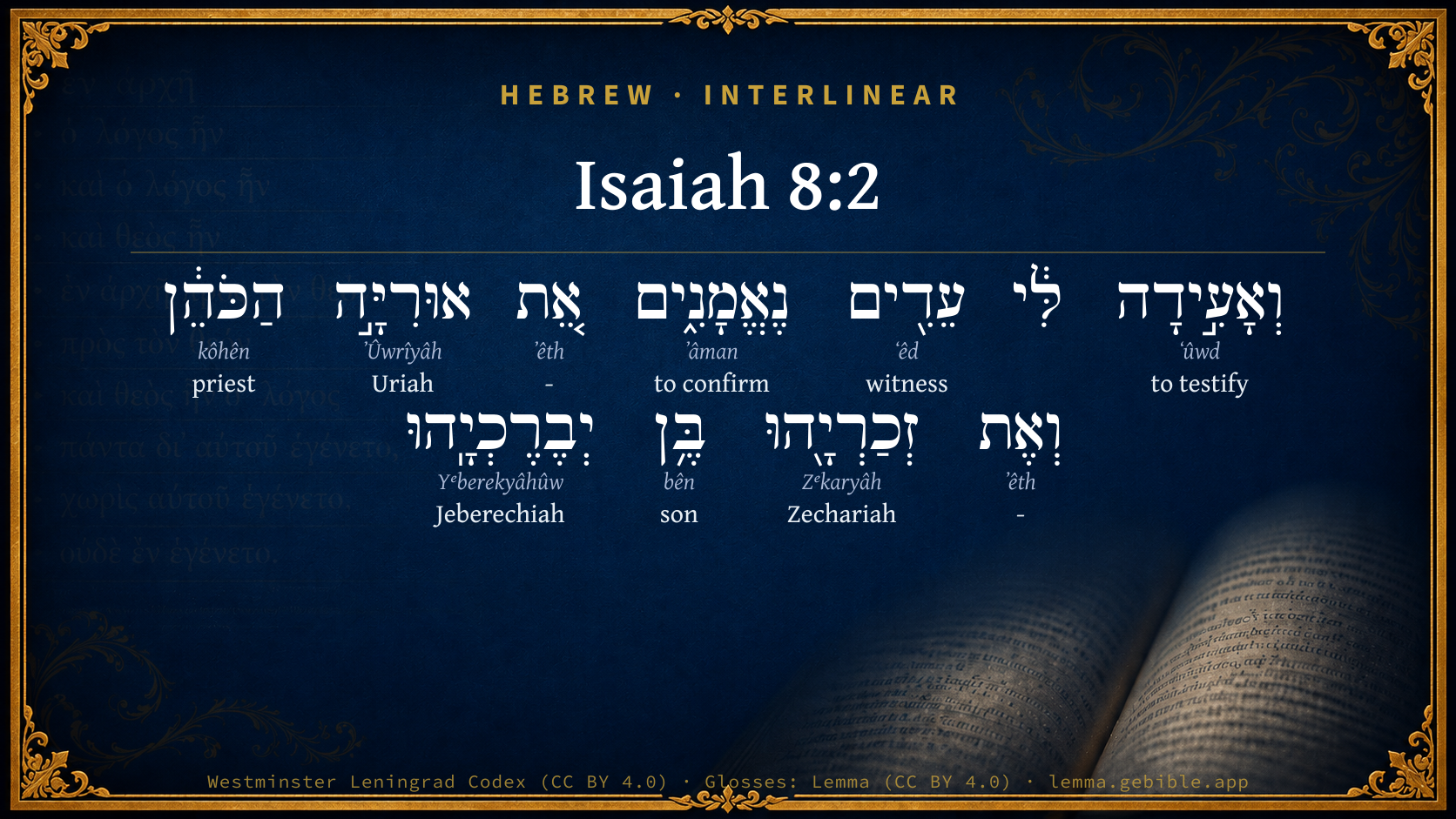
Hebrew (Westminster Leningrad Codex) Isaiah 8:2 appears in the Hebrew Old Testament. The text above is from the Westminster Leningrad Codex. Each word links to its Strong’s number, a concise gloss, and parsing drawn from the Open Scriptures Hebrew Bible morphology. Click any word for its full Brown-Driver-Briggs (BDB) entry.
Download image
Cite this verse

Isaiah 8:2 (World English Bible). Public Domain. Lemma interlinear Bible study tool, https://lemma.gebible.app/v/isaiah/8/2.

Show BibTeX & RIS
BibTeX
RIS
English Translation
and I will take to me faithful witnesses to record, Uriah the priest, and Zechariah the son of Jeberechiah.
World English Bible · Public Domain
Highlights
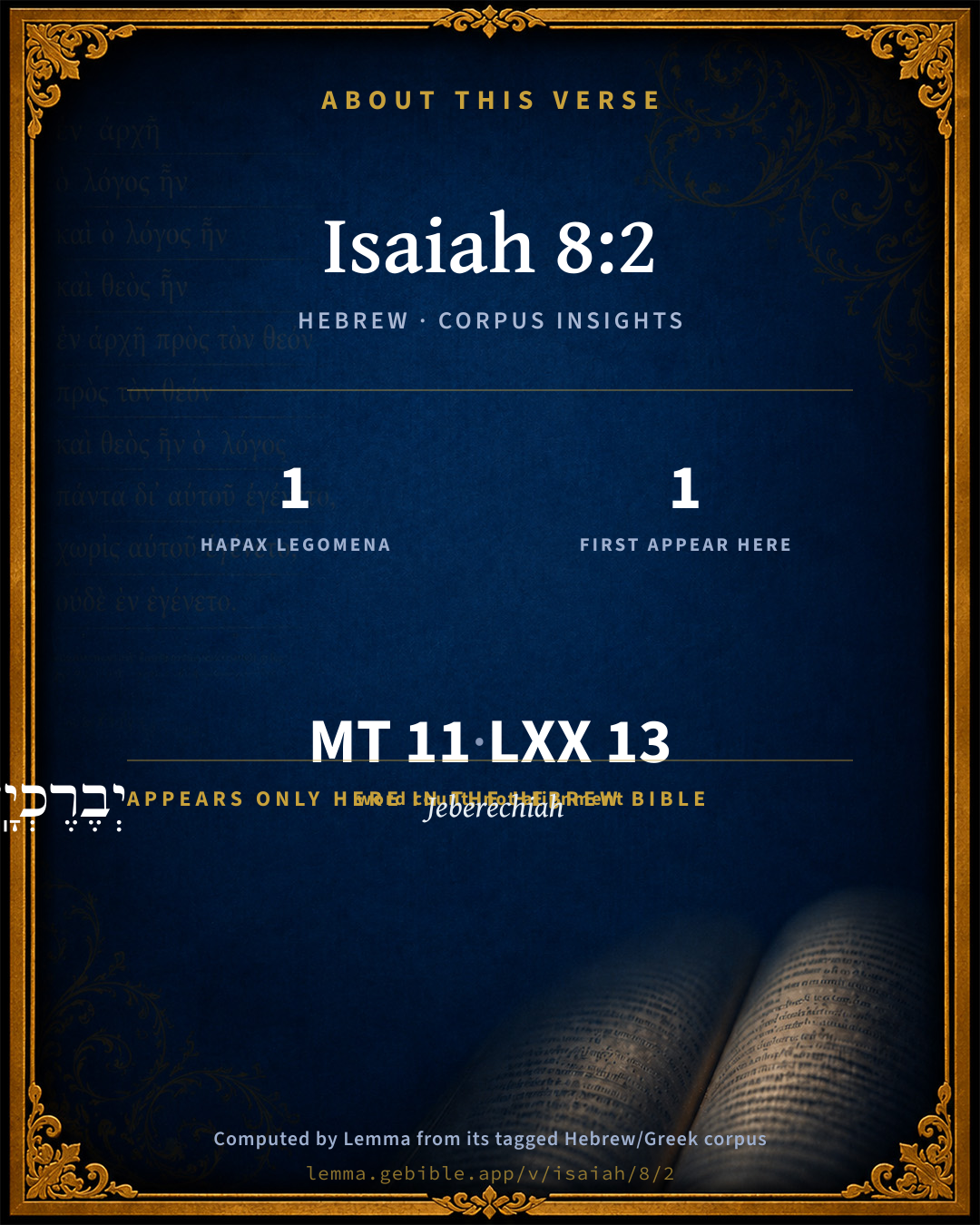
  • 1 hapax legomenon — only here in the Hebrew Bible
  • 1 first appearance in the Hebrew Bible
Full analysis ↓
Download a study sheet

One document with this verse’s original text, its word-by-word gloss line, the meaning frame, cross-references with their text, attributed commentary, and full source and license credits — printable, and it pastes into notes with its structure intact.

This verse Autodidact and up

Study sheet (.html) Plain text (.txt)

A passage Seminary Student

Up to 50 verses in one chapter. A passage sheet keeps up to 6 commentary sources and 12 cross-references per verse, in the order this page ranks them, and says so on the sheet whenever that leaves anything out. Ask for a single verse and you get the Autodidact verse sheet above.

Everything on this page stays free to read, with no account — the sheet is a download of what is already on screen, not access to it.

Want to remove ads? Support Godless Engineer
Compare translations 3

The same verse in 3 English versions, stacked beneath the original-language interlinear above. Click any original word for its lexicon entry.

Each is an independent rendering of the whole verse — the interlinear is not word-aligned to these translations.

Highlighted words mark where these versions differ — a whole-verse word diff, not a word-by-word alignment.

  • World English Bible Public Domain
    and I will take to me faithful witnesses to record, Uriah the priest, and Zechariah the son of Jeberechiah.
  • King James Version Public Domain
    And I took unto me faithful witnesses to record, Uriah the priest, and Zechariah the son of Jeberechiah.
  • unfoldingWord Literal Text CC BY-SA 4.0
    And I had faithful witnesses attest for me, Uriah the priest and Zechariah, the son of Jeberechiah.

unfoldingWord Literal Text — © unfoldingWord, licensed CC BY-SA 4.0. Word-aligned USFM3 via Door43 (git.door43.org/unfoldingWord/en_ult).

Versions to compare (up to 4)

3 of 4 selected

Show all 18 translations

Every available English version of this verse, each an independent rendering of the whole verse.

  • World English Bible Public Domain
    and I will take to me faithful witnesses to record, Uriah the priest, and Zechariah the son of Jeberechiah.
  • Berean Standard Bible Public Domain
    And I will appoint for Myself trustworthy witnesses—Uriah the priest and Zechariah son of Jeberekiah.”
  • Majority Standard Bible Public Domain
    And I will appoint for Myself trustworthy witnesses—Uriah the priest and Zechariah son of Jeberekiah.”
  • King James Version Public Domain
    And I took unto me faithful witnesses to record, Uriah the priest, and Zechariah the son of Jeberechiah.
  • American Standard Version (1901) Public Domain
    and I will take unto me faithful witnesses to record, Uriah the priest, and Zechariah the son of Jeberechiah.
  • Revised Version (1885) Public Domain
    and I will take unto me faithful witnesses to record, Uriah the priest, and Zechariah the son of Jeberechiah.
  • Geneva Bible (1599) Public Domain
    Then I tooke vnto me faithfull witnesses to recorde, Vriah the Priest, and Zechariah the sonne of Ieberechiah.
  • Douay-Rheims (1899) Public Domain
    And I took unto me faithful witnesses, Urias the priest, and Zacharias the son of Barachias.
  • Young's Literal Translation Public Domain
    And I cause faithful witnesses to testify to me, Uriah the priest, and Zechariah son of Jeberechiah.
  • Literal Standard Version CC BY-SA 4.0
    And I cause faithful witnesses to testify to me, Uriah the priest, and Zechariah son of Jeberechiah.
  • Unlocked Literal Bible CC BY-SA 4.0
    I will summon faithful witnesses to attest for me, Uriah the priest, and Zechariah son of Jeberekiah.”
  • unfoldingWord Literal Text CC BY-SA 4.0
    And I had faithful witnesses attest for me, Uriah the priest and Zechariah, the son of Jeberechiah.
  • Darby Bible Public Domain
    And I took unto me to witness, sure witnesses, Urijah the priest, and Zechariah the son of Jeberechiah.
  • World Messianic Bible Public Domain
    and I will take for myself faithful witnesses to testify: Uriah the priest, and Zechariah the son of Jeberechiah.”
  • Webster's Bible Public Domain
    And I took to me faithful witnesses to record, Uriah the priest, and Zechariah the son of Jeberechiah.
  • Free Bible Version CC BY-SA 4.0
    I will need Uriah the priest and Zechariah, son of Jeberekiah, to be my trustworthy witnesses.”
  • Bible in Basic English Public Domain
    And take true witnesses to the writing, Uriah the priest, and Zechariah, the son of Jeberechiah.
  • JPS Tanakh (1917) Public Domain
    and I will take unto Me faithful witnesses to record, Uriah the priest, and Zechariah the son of Jeberechiah.'

Literal Standard Version (2020), Covenant Press — licensed CC BY-SA 4.0. Text via the HelloAO Bible API (eBible.org). Unlocked Literal Bible (unfoldingWord) — licensed CC BY-SA 4.0. Text via the HelloAO Bible API (eBible.org). unfoldingWord Literal Text — © unfoldingWord, licensed CC BY-SA 4.0. Word-aligned USFM3 via Door43 (git.door43.org/unfoldingWord/en_ult). Free Bible Version, Dr. Jonathan Gallagher — licensed CC BY-SA 4.0. Text via the HelloAO Bible API (eBible.org).

Word by word

More ways to search: Search by grammar → Find every occurrence → Compare this word →

Practice this passage: Drill this verse → Learn its vocabulary →

About this verse

These counts appear in no published source. They are computed here, from the morphology-tagged text and Lemma’s own curated glosses. What Lemma adds →

11
words
9
distinct lemmas
Prophets
section

Notable vocabulary

1 hapax legomenon — a word that appears only here in the entire Hebrew Bible:

  • יְבֶרֶכְיָֽהוּ Jeberechiah H3000

First appearance in Scripture

This word makes its first canonical appearance in the Hebrew Bible here:

  • יְבֶרֶכְיָֽהוּ Jeberechiah H3000

Shared distinctive vocabulary

אוּרִיָּ֣ה Uriah H223 occurs in 33 verses of the Hebrew Bible. Also found in:

Grammatical profile

  • 2 verbs
  • 6 nouns
  • 1 preposition
  • 2 particles

Verb forms

  • וְאָעִ֣ידָה Hiphil · Cohortative
  • נֶאֱמָנִ֑ים Niphal · Participle Active

Hebrew & Septuagint length

In English translation the verse runs 19 words from the Hebrew and 14 from the Septuagint (LXX English) — closely comparable.

A rough comparison of the two English renderings, which tokenize alike — not a word-level alignment.

Word counts can differ between the Hebrew and the Greek without any difference in meaning — e.g. the Hebrew direct-object marker אֵת has no separate Greek word, and Greek often adds the article ὁ.

In the original languages it is 11 Hebrew tokens and 13 Greek tokens — but the two are counted differently (Hebrew bundles its prefixes and suffixes into one token; the Greek is in lemma form), so that isn’t a like-for-like length.

Cross-references

6

Topical passages linked to Isaiah 8:2 in the Treasury of Scripture Knowledge — connected by theme and wording, ordered by reader-vote popularity; previews shown in the World English Bible.

  • 2 Kings 16:10–11 King Ahaz went to Damascus to meet Tiglath Pileser king of Assyria, and saw the altar that was at Damascus; and king Ahaz sent to Urijah the priest the fashion of the altar, and the pattern of it, according to all the workmanship of it.
  • 2 Kings 16:15–16 King Ahaz commanded Urijah the priest, saying, On the great altar burn the morning burnt offering, and the evening meal-offering, and the king's burnt offering, and his meal-offering, with the burnt offering of all the people of the land, and their meal-offering, and their drink-offerings; and sprinkle on it all the blood of the burnt offering, and all the blood of the sacrifice: but the brazen altar shall be for me to inquire by.
  • 2 Kings 18:2 He was twenty-five years old when he began to reign; and he reigned twenty-nine years in Jerusalem: and his mother's name was Abi the daughter of Zechariah.
  • 2 Corinthians 13:1 This is the third time I am coming to you. "At the mouth of two or three witnesses shall every word established."
  • Ruth 4:2 He took ten men of the elders of the city, and said, Sit you down here. They sat down.
  • Ruth 4:10–11 Moreover Ruth the Moabitess, the wife of Mahlon, have I purchased to be my wife, to raise up the name of the dead on his inheritance, that the name of the dead not be cut off from among his brothers, and from the gate of his place: you are witnesses this day.

Cross-references courtesy of OpenBible.info (CC BY 4.0).

Hebrew and Greek witnesses Masoretic Hebrew ↔ Greek Septuagint

The same verse in the two great witnesses to the Old Testament, shown verse-for-verse.

These are two independent witnesses, not word-aligned to each other, and the Septuagint is shown in lemma (dictionary) form.

Hebrew Isaiah 8:2 Masoretic · Westminster Leningrad Codex

וְאָעִ֣ידָה לִּ֔י עֵדִ֖ים נֶאֱמָנִ֑ים אֵ֚ת אוּרִיָּ֣ה הַכֹּהֵ֔ן וְאֶת זְכַרְיָ֖הוּ בֶּ֥ן יְבֶרֶכְיָֽהוּ

and I will take to me faithful witnesses to record, Uriah the priest, and Zechariah the son of Jeberechiah.

World English Bible · Public Domain

Greek LXX Isaiah 8:2 Septuagint · lemma form

καί μάρτυς ἐγώ ποιέω πιστός ἄνθρωπος ὁ οὐρίας καί ὁ ζαχαριας υἱός βαραχιας

And make me witnesses of faithful men, Urias, and Zacharias the son of Barachias.

LXX2012 (modern English Septuagint) · Public Domain

On this verse, The Cambridge Bible for Schools and Colleges discusses the Septuagint’s reading. Read the note in Commentary ↓

Hebrew: Westminster Leningrad Codex (CC BY 4.0). Greek: Septuagint (public domain); English from LXX2012 (modern English Septuagint) (Public Domain). How the Septuagint differs from the Hebrew →

Targum (Aramaic paraphrase)

1

The Targum is the ancient Jewish Aramaic paraphrase of the Hebrew Scriptures — an interpretive translation, not the Hebrew text itself. Onkelos (literal) and Pseudo-Jonathan (expansive) render the Torah, and Jonathan the Prophets. Coverage is partial: where no permissively-licensed English translation exists for a verse, only the Aramaic is shown. This is verse-level text, not a word-by-word alignment to the Hebrew.

  1. Targum Jonathan Prophets (Joshua–Malachi)
    וְאַסְהֵיד קֳדָמַי סְהִידִין מְהֵמְנָן יַת לְוָטַיָא דַאֲמָרִית לְאַיְתָאָה בִּנְבוּאַת אוּרִיָה כַהֲנָא וְהָא אֲתוֹ אַף כֵּן כָּל נְחָמָתָא דַאֲמָרֵית לְאַיְתָאָה בִּנְבוּאַת זְכַרְיָה בַּר יְבָרֶכְיָה אֲנָא עֲתִיד לְאַיְתָאָה:

    And call to witness before me as faithful witnesses, the curses, which I have threatened to bring by the prophecy of Uriah the priest, and, behold, they have come. And also the consolations, which I promised to bring by the prophecy of Zechariah the son of Jeberechiah, I am about to bring.

    Targum Jonathan — Aramaic: “Mikraot Gedolot” (public domain). English: “Sefaria Community Translation” (CC0 1.0 (public-domain dedication)); “London "Chaldee Paraphrase," 1871” (public domain). Text via Sefaria.

Commentary

Notes on Isaiah 8:2 from classic Christian and Jewish commentators (each source and its license shown beneath its notes). The classic Christian expositions comment on the surrounding passage and are grouped to its opening verse, so a note may address several verses; the Jewish commentaries on the Tanakh (Rashi and others) are per-verse, so they appear only where the commentator wrote on this verse.

Lemma curates 59 commentaries, every one of them public domain or Creative Commons licensed, each selected and text-cleaned for this edition rather than reprinted as found. About our sources →

Trapp's Complete Commentary

John Trapp

Isa 8:2 And I took unto me faithful witnesses to record, Uriah the priest, and Zechariah the son of Jeberechiah.

Ver. 2. And I took unto me faithful witnesses.] So they might be, and yet not godly men; as Galba and our Richard III were said to be bad men, but yet good princes. Some think that this Uriah was the same with him that brought in the altar of Damascus. He had been better perhaps, but at last revolted; as did Demas, of whom Dorotheus saith that he became a priest in an idol temple at Thessalonica; and Damascen, who turned Mohammedan, as some write. Zechariah, the other witness, was a man of great eminence, as being grandfather, by the mother’s side, to good Hezekiah.

John Trapp, A Commentary or Exposition upon All the Books of the Old and New Testament (1647–1656) — public domain. Text from a community e-Sword module.

Joseph Benson's Commentary

Isa 8:2-3. And I took me faithful witnesses — Persons of unquestionable reputation, who should bear witness that the following name and prophecy were written and published by me, according to God’s command. It is likely these witnesses signed a copy of the prophecy with their own hands, and dated it according to the time it was declared by the prophet. And I went unto the prophetess — His own wife, so called, because she was the wife of a prophet, wives being frequently denominated from their husband’s titles. Or possibly she herself might be endowed with the gift of prophecy. Some commentators suppose that Isaiah married another wife on this occasion, and that the witnesses above mentioned were called to attest the matrimonial contract, according to the custom of the Jews. But there are no indications of this, and, as it is certain from the preceding chapter that he already had a wife, the mother of Shear-jashub, it seems highly improbable that he should take another. Others again suppose, that these witnesses, who were persons of rank, “were called on to attend the circumcision of the prophet’s son, and to attest the name by which he was called, as well as the prophecy, confirmed and illustrated by that name.”

Joseph Benson's Commentary on the Old and New Testaments (1811–1818) — public domain. Text from a community e-Sword module.

Geneva Bible (1599)

Geneva Bible translators

Because the thing was of great importance, he took these two witnesses, which were of credit with the people, when he set this up upon the door of the Temple, albeit Uriah was a flattering hypocrite, 2 Kings 16:11.

Geneva Bible (1599) marginal notes — public domain. Text via Bolls.life.

Jamieson, Fausset & Brown

Robert Jamieson, A. R. Fausset & David Brown

I took--rather, "The Lord said to me, that I should take," &c. [MAURER].

Uriah--an accomplice of Ahaz in idolatry, and therefore a witness not likely to assist the prophet of God in getting up a prophecy after the event (Kg2 16:10). The witnesses were in order that when the event should come, they might testify that the tablet containing the prophecy had been inscribed with it at the time that it professed.

Zechariah-- (Ch2 29:13).

Jamieson, Fausset & Brown — Commentary Critical and Explanatory on the Whole Bible (1871) — public domain (CC PDM 1.0). Text via the HelloAO Bible API.

Ellicott's Commentary for English Readers

(2) And I took unto me faithful witnesses.—That the prophet’s challenge to his gainsayers might be made more emphatic, the setting-up of the tablet is to be formally attested. And the witnesses whom the prophet calls were probably men of high position, among those who had been foremost in advising the alliance with Assyria. Of Uriah or Urijah, the priest, we know that he complied with the king’s desire to introduce an altar after the pattern which he had seen at Damascus (2Ki_16:10-11). Of Zechariah we know nothing; but the name was a priestly one (2Ch_24:20), and it has been conjectured, from his association with Isaiah, that he may have been the writer of a section of the book that bears the name of a later Zechariah (Zechariah 9-12), which bears traces of being of a much earlier date than the rest of the book. The combination of “Zachariah, son of Jeberechiah” reminds us of Zacharias, the son of Barachias, and points to a priestly family. (See Note on Mat_23:35.) In 2Ch_29:13 the name appears as belonging to the Asaph section of the Levites. A more probable view is that he was identical with the father of the queen then reigning, and was therefore the grandfather of Hezekiah (2Ch_29:1). Probably, looking to the prophet’s habit of tracing auguries in names, the two witnesses may have been partly chosen for the significance of those which they bore, Uriah, i.e., “Jah is my light,” Zechariah, i.e., “Jah will remember,” each of which comes in with a special appropriateness.

A Bible Commentary for English Readers, edited by Charles John Ellicott (1878–1897) — public domain. Text from a community e-Sword module.

The Cambridge Bible for Schools and Colleges

gen. ed. J. J. S. Perowne

2. And I took] The Hebr. pointing gives and I will take (as in R.V.). The speaker is still Jehovah. The LXX. and other old versions have the imperative (“and take for me”) which, as addressed to the prophet, reads more naturally. Uriah the priest is mentioned in 2Ki_16:10 ff.; Zechariah is unknown, although the name occurs in the nearly contemporary notices of 2Ch_26:5; 2Ch_29:13. He has even been identified, somewhat rashly, with the author of Zechariah 9-11 on the ground of Zec_1:1. It is not to be inferred that the two men were intimate friends of Isaiah, still less that they belonged to the band of his disciples (Isa_8:16); they are called to witness simply as responsible public persons, trusted by the people.

The Cambridge Bible for Schools and Colleges (gen. ed. J. J. S. Perowne; Cambridge University Press, 1878–1918) — public domain. Text from a community e-Sword module.

John Gill's Exposition

And I took unto me faithful witnesses to record,.... Not his marriage, nor the birth of his son, nor the name he gave him, but the prophecy written in the roll, concerning the spoiling of Syria and Israel, in a very short time; that so, when it came to pass, it might be a clear and certain point that it had been foretold by him:

Uriah the priest; of whom mention is made in Kg2 16:10 which some object to, because he proved a wicked man, and obeyed the king's command, contrary to the law of God, in building an altar according to the form of one at Damascus; but to this it is replied, that it was before this happened that Isaiah took him to be a witness; and besides, because of the authority of his office, and his familiarity with Ahaz, he must be allowed to be a proper and pertinent person to bear testimony in this case. Some indeed, and so the Jewish commentators, Jarchi, Aben Ezra, Kimchi, and Abarbinel, would have Uriah the prophet meant, who prophesied in the times of Jehoiakim, and was slain by him, Jer 26:20 to which it is objected, that he was no priest, as this was and, besides, was not born at this time; it was a hundred and forty years after that he lived:

and Zechariah the son of Jeberechiah; this was Zechariah the prophet, as the Targum, and all the Jewish writers, say (o); who lived in the times of Darius, which was two hundred and forty years after this; but most likely this Zechariah is he who was Ahaz's wife's father, Kg2 18:2 or rather, as Vitringa thinks, Zechariah a Levite, a son of Asaph, Ch2 29:13 though there are some learned men (p), who think the two prophets Uriah and Zechariah are meant, though then unborn; who prophesied of the like or same things as Isaiah did; and so were faithful witnesses of his prophecy, as of the calamities that should come on the land, the restitution of it to its former fruitfulness, and the coming of the Messiah; nor is the observation of Abarbinel to be despised, taken from the ancient Jews, that these are the words, not of the prophet, but of God himself; as also that they are to be read in the future tense, "and I will take to me", &c.

(o) T. Bab. Maccot, fol. 24. 2. (p) Cocceius, Witsius, Miscel. Sacr. tom. 1. l. 1. c. 20. sect. 8, 9, 10.

John Gill's Exposition of the Whole Bible (1746–1763) — public domain (CC PDM 1.0). Text via the HelloAO Bible API.

Albert Barnes' Notes on the Bible

And I took unto me faithful witnesses - What was the precise object in calling in these witnesses is not known. Some have supposed that it was to bear testimony to the marriage of the prophet at that time. But it may have been for the purpose of a public record of the prophecy; a record so made, that the precise time when it was delivered could be attested without dispute. The prophecy was an important one; and it was important to know, in the most authentic and undisputed manner, that such a prophecy had been delivered. It is probable that the prophecy, attested by the names of those two men, was suspended in some public place in the temple, so that it might be seen by the people, and allay their fears; and in order to remove from the multitude every suspicion that it was a prophecy after the event. That this was a real, and not a symbolic transaction, is perfectly manifest, not only from the narrative itself, but from Isa 8:18. They are called ‘faithful,’ not off account of their private character, but because their public testimony would be credited by the people.

To record - To bear witness.

Uriah the priest - This is, doubtless, the same man that is mentioned in 2Ki 16:10. He was a man of infamous character; the accomplice of Ahaz in corrupting the true religion; but still his testimony might be the more valuable to Ahaz, as he was associated with him in his plans.

And Zechariah ... - It is not certainly known who this was. Perhaps he was one of the Levites whose name is mentioned in 2Ch 29:13.

Albert Barnes' Notes on the Bible (1834–1885) — public domain. Text from a community e-Sword/MySword module.

Matthew Poole's English Annotations

Persons of unquestionable reputation, who should bear witness that the following name and prophecy was written and published by me, according to God’s command.

Matthew Poole's English Annotations on the Holy Bible (1683–1685) — public domain. Text from a community e-Sword/MySword module.

Whedon's Commentary on the Bible

Daniel D. Whedon

2. Uriah the priest — The same that was sent for to Damascus by Ahaz to take a complete pattern of a heathen altar which the king desired to be erected in the temple at Jerusalem. 2Ki_16:10. He was a bad man; a willing accomplice of Ahaz to introduce a corrupt religion into Jerusalem. Who Zechariah was is not so clear; possibly he was a Levite mentioned in 2Ch_29:13. Both were of the king’s party, as against the reform party of Isaiah; so that it could not be pretended that it was a prediction forged after the event.

Daniel D. Whedon (gen. ed.), Commentary on the Old and New Testaments (1874–1909) — public domain. Text from a community e-Sword module.

The Pulpit Commentary

And I took unto me; rather, and I will have taken for me. It is still God who is speaking. Uriah the priest. Probably the high priest of the time, mentioned in 2Ki_16:10-16, as the ready tool of Ahaz at a later date. Though a bad man, he may have been a trustworthy witness to a fact. Zechariah. Perhaps the father of Abi or Abijah, Ahaz"s queen. (2Ki_18:2 2Ch_29:1) It would serve to call public attention still more to the tablet, if it bore the names of two such eminent persons as witnesses.

The Pulpit Commentary (1880–1919), ed. H.D.M. Spence-Jones & Joseph S. Exell — public domain. Text from a community e-Sword module.

J. A. Alexander on Isaiah

Joseph Addison Alexander

In order to preclude all suspicion of its having been uttered after the event, the prophecy is not only recorded, but attested by two witnesses. “And I (Jehovah) will take to witness for me credible witnesses, to wit, Uriah the priest, and Zechariah, son of Jeberechiah.” Uriah is probably the same who connived at the king’s profanation of the temple (2Ki 16:10-16). The word credible does not relate to their true character or standing in the sight of God, but to their credit with the people, especially perhaps with the king, in which view, as well as on account of his official rank, Uriah was a very suitable witness. The same consideration makes it not improbable that the Zechariah mentioned here was the father-in-law of Ahaz (2Ki 18:2; 2Ch 29:1), perhaps the same that is mentioned as a Levite of the family of Asaph (2Ch 29:13).

Joseph Addison Alexander, The Prophecies of Isaiah (1846–1847; New York: Scribner, 1870–1878) — public domain. Text from a community e-Sword module.

Rashi

Rabbi Shlomo Yitzchaki (Rashi)

And I will call to testify for Myself also in those days, in the days of Jehoiakim, concerning that calamity, destined to befall them, two trustworthy witnesses, one to foretell for them the evil that was destined to come upon them, viz. Uriah the priest, whom Jehoiakim dispatched, as it is said (Jer. 26: 20): “And also a man was prophesying in the name of the Lord, Uriah the son of Shemaiah from Kiriath-jearim, and he prophesied concerning this city and concerning this land, according to all the words of Jeremiah.”

and Zechariah the son of Jeberechiah who prophesied in the second year of Darius (Zech. 8:4): “Old men and old women will again sit in the streets of Jerusalem.” Uriah is a sign for Zechariah. If you see that Uriah’s prophecy is fulfilled, you can expect that Zechariah’s will likewise be fulfilled, just as I have called to testify concerning Sennacherib, Amos and Isaiah; Amos for the calamity of the ten tribes (Amos 7:11): “And Israel shall surely be exiled,” and Isaiah for his promise to Hezekiah (Isaiah 32,33) [when he would reign].

Rashi on the Tanakh — English translations: “The Judaica Press complete Tanach with Rashi, translated by A. J. Rosenberg” (CC BY 4.0); “Pentateuch with Rashi's commentary by M. Rosenbaum and A.M. Silbermann, 1929-1934” (public domain); “The Metsudah Tanach series, Lakewood, N.J” (CC BY 4.0); and “The Book of Joshua, Metsudah Publications, 1997” (CC BY 4.0). Text via Sefaria.

Ibn Ezra

Rabbi Abraham ibn Ezra

. ואעידה According to some the א is here instead of ה. And take unto me faithful witnesses. According to others the future is used for the past: And I took unto me faithful witnesses. It may, however, be taken literally, that I should take as witnesses for me. The prophet did what God commanded, although it is not related in the text.

Uriah THE priest; Uriah was then high priest. Zachariah was likewise a great man; what our Sages say about the prophecies of Zachariah and Uriah is well known.

Ibn Ezra on the Tanakh — English translations: “Sefaria Community Translation” (CC0 1.0 (public-domain dedication)); “Yalkut, Sifsei Chachomim Chumash, Metsudah Publications, 2009” (CC BY 4.0); and “Commentary of Ibn Ezra on Isaiah - trans. by M. Friedlander, 1873” (public domain). Text via Sefaria.

Lesson kit

Teaching starters — assembled from the data on this page, not authored interpretation. Every prompt links to the verse data it draws on. Edit before teaching.

Isaiah, in the Prophets, opens this verse with 11 words (9 distinct Hebrew lemmas). Its most distinctive word is Yᵉberekyâhûw (“Jeberechiah”). A historical commentator’s framing appears above. Read the whole chapter for the surrounding context.

Discussion questions

  1. The word Yᵉberekyâhûw carries the sense “Jeberechiah.” How does it shape the verse?
  2. 1 word here appears nowhere else in the Hebrew Bible. Why might the author reach for such rare wording?
  3. This is the first place “Jeberechiah” appears in Scripture (first appears here). What does its debut here establish?
  4. How does 2 Samuel 11:3, which shares the word «Uriah», read alongside this verse?
  5. These translations render this verse differently; the difference is in the English rendering, not the original. What questions does that raise?
  6. «וְאָעִ֣ידָה» is a Hiphil Cohortative verb. How does that grammatical form shape the action described?
  7. Compare how Trapp's Complete Commentary and Joseph Benson's Commentary read this verse. Where do they agree or differ?

Things to notice

Reading settings

Reading text

Shown beneath each verse's original-language words.

Old Testament
Old Testament edition

Read the OT as the Masoretic Hebrew (MT) or the Greek Septuagint (LXX).

English shown for the Greek Septuagint (in the Hebrew ↔ Greek comparison).

Comparing translations? Open the Compare panel on any verse page to stack up to four side by side.