
Psalms 106:12

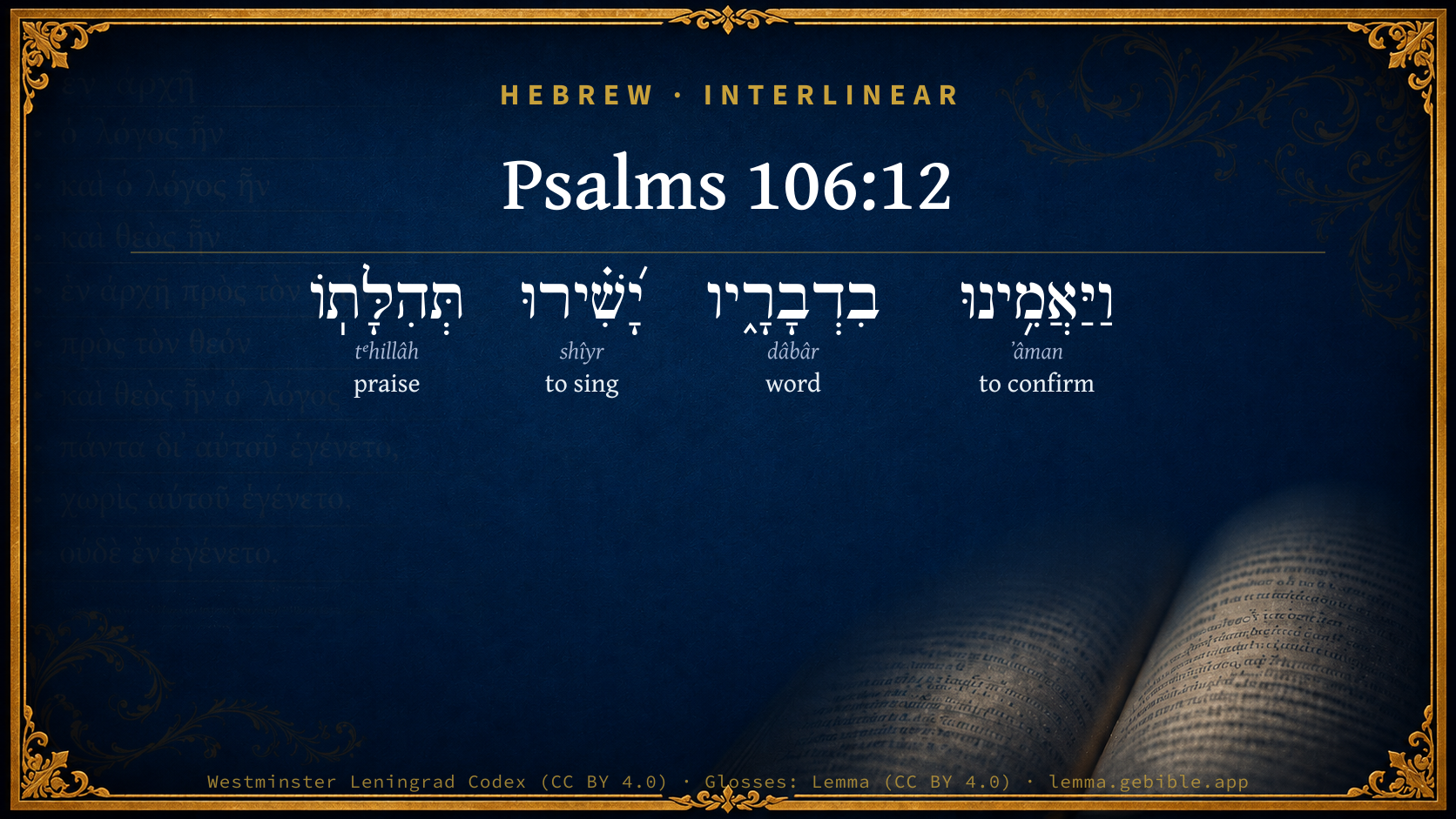
Hebrew (Westminster Leningrad Codex) Psalms 106:12 appears in the Hebrew Old Testament. The text above is from the Westminster Leningrad Codex. Each word links to its Strong’s number, a concise gloss, and parsing drawn from the Open Scriptures Hebrew Bible morphology. Click any word for its full Brown-Driver-Briggs (BDB) entry.
Download image
Cite this verse

Psalms 106:12 (World English Bible). Public Domain. Lemma interlinear Bible study tool, https://lemma.gebible.app/v/psalms/106/12.

Show BibTeX & RIS
BibTeX
RIS
English Translation
Then they believed his words. They sang his praise.
World English Bible · Public Domain
Download a study sheet

One document with this verse’s original text, its word-by-word gloss line, the meaning frame, cross-references with their text, attributed commentary, and full source and license credits — printable, and it pastes into notes with its structure intact.

This verse Autodidact and up

Study sheet (.html) Plain text (.txt)

A passage Seminary Student

Up to 50 verses in one chapter. A passage sheet keeps up to 6 commentary sources and 12 cross-references per verse, in the order this page ranks them, and says so on the sheet whenever that leaves anything out. Ask for a single verse and you get the Autodidact verse sheet above.

Everything on this page stays free to read, with no account — the sheet is a download of what is already on screen, not access to it.

Want to remove ads? Support Godless Engineer
Compare translations 3

The same verse in 3 English versions, stacked beneath the original-language interlinear above. Click any original word for its lexicon entry.

Each is an independent rendering of the whole verse — the interlinear is not word-aligned to these translations.

Highlighted words mark where these versions differ — a whole-verse word diff, not a word-by-word alignment.

  • World English Bible Public Domain
    Then they believed his words. They sang his praise.
  • King James Version Public Domain
    Then believed they his words; they sang his praise.
  • unfoldingWord Literal Text CC BY-SA 4.0
    Then they believed his words; they sang his praise.

unfoldingWord Literal Text — © unfoldingWord, licensed CC BY-SA 4.0. Word-aligned USFM3 via Door43 (git.door43.org/unfoldingWord/en_ult).

Versions to compare (up to 4)

3 of 4 selected

Show all 18 translations

Every available English version of this verse, each an independent rendering of the whole verse.

  • World English Bible Public Domain
    Then they believed his words. They sang his praise.
  • Berean Standard Bible Public Domain
    Then they believed His promises and sang His praise.
  • Majority Standard Bible Public Domain
    Then they believed His promises and sang His praise.
  • King James Version Public Domain
    Then believed they his words; they sang his praise.
  • American Standard Version (1901) Public Domain
    Then believed they his words; They sang his praise.
  • Revised Version (1885) Public Domain
    Then believed they his words; they sang his praise.
  • Geneva Bible (1599) Public Domain
    Then beleeued they his wordes, and sang prayse vnto him.
  • Douay-Rheims (1899) Public Domain
    And they believed his words: and they sang his praises.
  • Young's Literal Translation Public Domain
    And they believe in His words, they sing His praise,
  • Literal Standard Version CC BY-SA 4.0
    And they believe in His words, they sing His praise,
  • Unlocked Literal Bible CC BY-SA 4.0
    Then they believed his words, and they sang his praise.
  • unfoldingWord Literal Text CC BY-SA 4.0
    Then they believed his words; they sang his praise.
  • Darby Bible Public Domain
    Then believed they his words; they sang his praise.
  • World Messianic Bible Public Domain
    Then they believed his words. They sang his praise.
  • Webster's Bible Public Domain
    Then they believed his words; they sang his praise.
  • Free Bible Version CC BY-SA 4.0
    Then his people trusted in what he promised, and sang his praises.
  • Bible in Basic English Public Domain
    Then they had faith in his words; they gave him songs of praise.
  • JPS Tanakh (1917) Public Domain
    Then believed they His words; they sang His praise.

Literal Standard Version (2020), Covenant Press — licensed CC BY-SA 4.0. Text via the HelloAO Bible API (eBible.org). Unlocked Literal Bible (unfoldingWord) — licensed CC BY-SA 4.0. Text via the HelloAO Bible API (eBible.org). unfoldingWord Literal Text — © unfoldingWord, licensed CC BY-SA 4.0. Word-aligned USFM3 via Door43 (git.door43.org/unfoldingWord/en_ult). Free Bible Version, Dr. Jonathan Gallagher — licensed CC BY-SA 4.0. Text via the HelloAO Bible API (eBible.org).

Word by word

More ways to search: Search by grammar → Find every occurrence → Compare this word →

Practice this passage: Drill this verse → Learn its vocabulary →

תְּהִלָּתֽוֹ
tᵉhillâh
H8416
“praise · his”
Noun, Common, Feminine, Singular, Construct + Suffix, Personal, 3rd Person, Masculine, Singular
Part of Speech
Noun
Type
Common
Gender
Feminine
Number
Singular
State
Construct
Full BDB Definition

Origin: from H1984

TWOT: 500c

praise, song or hymn of praise - praise, adoration, thanksgiving (paid to God) - act of general or public praise - praise-song (as title) - praise (demanded by qualities or deeds or attributes of God) - renown, fame, glory - of Damascus, God - object of praise, possessor of renown (figuratively)
  1. וַיַּאֲמִ֥ינוּ ʼâman H539 “and · to confirm” Conjunction + Verb, Hiphil, Sequential Imperfect, 3rd Person, Masculine, Plural
  2. בִדְבָרָ֑יו dâbâr H1697 “in/at · words · his” Preposition + Noun, Common, Masculine, Plural, Construct + Suffix, Personal, 3rd Person, Masculine, Singular
  3. יָ֝שִׁ֗ירוּ shîyr H7891 “to sing” Verb, Qal, Imperfect, 3rd Person, Masculine, Plural

About this verse

These counts appear in no published source. They are computed here, from the morphology-tagged text and Lemma’s own curated glosses. What Lemma adds →

4
words
4
distinct lemmas
Wisdom
section

Shared distinctive vocabulary

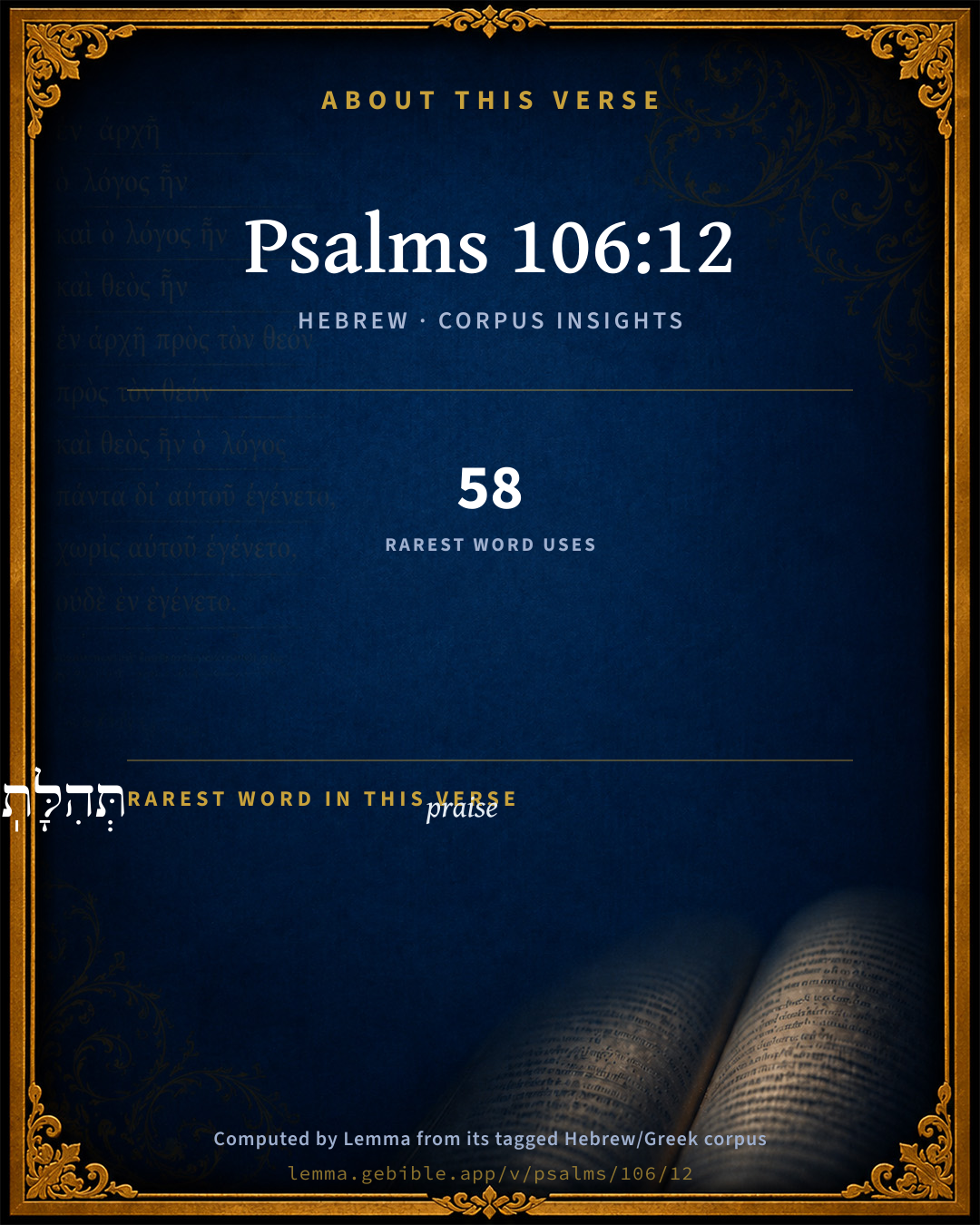
תְּהִלָּתֽוֹ praise H8416 occurs in 57 verses of the Hebrew Bible. Also found in:

Grammatical profile

  • 2 verbs
  • 2 nouns

Verb forms

  • וַיַּאֲמִ֥ינוּ Hiphil · Sequential Imperfect
  • יָ֝שִׁ֗ירוּ Qal · Imperfect

Hebrew & Septuagint length

In English translation the verse runs 9 words from the Hebrew and 9 from the Septuagint (LXX English) — the same length.

A rough comparison of the two English renderings, which tokenize alike — not a word-level alignment.

Word counts can differ between the Hebrew and the Greek without any difference in meaning — e.g. the Hebrew direct-object marker אֵת has no separate Greek word, and Greek often adds the article ὁ.

Cross-references

3

Topical passages linked to Psalms 106:12 in the Treasury of Scripture Knowledge — connected by theme and wording, ordered by reader-vote popularity; previews shown in the World English Bible.

  • Exodus 14:31–15:21 Israel saw the great work which Yahweh did to the Egyptians, and the people feared Yahweh; and they believed in Yahweh, and in his servant Moses.
  • Luke 8:13 Those on the rock are they who, when they hear, receive the word with joy; but these have no root, who believe for a while, then fall away in time of temptation.
  • John 8:30–31 As he spoke these things, many believed in him.

Cross-references courtesy of OpenBible.info (CC BY 4.0).

Hebrew and Greek witnesses Masoretic Hebrew ↔ Greek Septuagint

The same verse in the two great witnesses to the Old Testament, shown verse-for-verse.

You’re reading Greek Psalm 105 (Hebrew Psalm 106). The Septuagint counts the superscription, so verse numbers can differ from the Hebrew — chapter-level alignment, not verse-by-verse. Numbering follows Rahlfs.

These are two independent witnesses, not word-aligned to each other, and the Septuagint is shown in lemma (dictionary) form.

Hebrew Psalms 106:12 Masoretic · Westminster Leningrad Codex

וַיַּאֲמִ֥ינוּ בִדְבָרָ֑יו יָ֝שִׁ֗ירוּ תְּהִלָּתֽוֹ

Then they believed his words. They sang his praise.

World English Bible · Public Domain

Greek LXX Greek Psalm 105:12 Septuagint · lemma form

καί πιστεύω ἐν ὁ λόγος αὐτός καί εἶμι ὁ αἴνεσις αὐτός

Then they believed his words, and celebrated his praise.

LXX2012 (modern English Septuagint) · Public Domain

Hebrew: Westminster Leningrad Codex (CC BY 4.0). Greek: Septuagint (public domain); English from LXX2012 (modern English Septuagint) (Public Domain). How the Septuagint differs from the Hebrew →

Commentary

Notes on Psalms 106:12 from classic Christian and Jewish commentators (each source and its license shown beneath its notes). The classic Christian expositions comment on the surrounding passage and are grouped to its opening verse, so a note may address several verses; the Jewish commentaries on the Tanakh (Rashi and others) are per-verse, so they appear only where the commentator wrote on this verse.

Lemma curates 59 commentaries, every one of them public domain or Creative Commons licensed, each selected and text-cleaned for this edition rather than reprinted as found. About our sources →

Trapp's Complete Commentary

John Trapp

Psa 106:12 Then believed they his words; they sang his praise.

Ver. 12. Then believed they his words] Then for a flash, while the memory of the mercy was fresh and warm; but ere they were three days older they murmured again; it proved not so much as a nine days’ wonderment; they were soon at oldward.

They sang his praise] Exo 15:1-21 A temporary faith and joy.

John Trapp, A Commentary or Exposition upon All the Books of the Old and New Testament (1647–1656) — public domain. Text from a community e-Sword module.

J. A. Alexander on Psalms

Joseph Addison Alexander

12. (Psa 106:12) And they believe his words, they sing his praise. Then (and not till then) do they believe. This is not an encomium on their faith, but a confession of their unbelief. It was not till the promise was fulfilled that they believed it. With the first clause compare Exo 14:31; with the second, Exo 15:1.

Joseph Addison Alexander, The Psalms Translated and Explained (1850) — public domain. Text from a community e-Sword module.

Geneva Bible (1599)

Geneva Bible translators

The wonderful works of God caused them to believe for a time, and to praise him.

Geneva Bible (1599) marginal notes — public domain. Text via Bolls.life.

Adam Clarke's Commentary

Verse 12. Then believed they] Just while the miracle was before their eyes.

Adam Clarke's Commentary on the Bible (1810–1826) — public domain. Text from a community e-Sword/MySword module.

John Calvin's Commentaries

12. Then they believed his words In stating that they believed God’s word, and sang his praise, the prophet does not say this to their commendation, but rather to increase, in a twofold manner, their guilt; because, being convinced by such indubitable testimony, they yet instantly resumed their wonted disposition of mind, and began to rebel against God, as if they had never beheld his wonderful works. How very inexcusable was that impiety which in a moment could forget the remarkable benefits which they had been constrained to admit! Overpowered by the grandeur of God’s works, they were, he says, in spite of themselves, compelled to believe in God, and give glory to him, and thus the criminality of their rebellion was increased; because, although their stubbornness was overcome, yet they immediately relapsed into their former state of unbelief. A question, however, arises, seeing that true faith always corresponds with the nature of the word, and as the word is an incorruptible seed, so though it may happen to be almost, it never can be totally destroyed. But there is a temporary faith, as Mark calls it, (Mark 4:17) which is not so much a fruit of the Spirit of regeneration, as of a certain mutable affection, and so it soon passeth away. It is not a voluntary faith which is here extolled by the prophet, but rather that which is the result of compulsion, namely, because men, whether they will or not, by a sense which they have of the power of God, are constrained to show some reverence for him. This passage ought to be well considered, that men, when once they have yielded submission to God, may not deceive themselves, but may know that the touchstone of faith is when they spontaneously receive the word of God, and constantly continue firm in their obedience to it.

John Calvin's Commentaries (1540-1563) — public domain. Text from the Calvin Translation Society English edition (1840s-50s) via the Christian Classics Ethereal Library (ccel.org). Calvin's coverage is partial (roughly two-thirds of the Bible); uncommented books and verses are honest gaps, never fabricated. The 19th-century editor's footnotes and remarks are omitted so the notes are faithfully Calvin's own voice.

The Cambridge Bible for Schools and Colleges

gen. ed. J. J. S. Perowne

12. See Exo_14:31; Exo_15:1. The allusion to their momentary faith and gratitude emphasises the relapse which Psa_106:13 goes on to describe.

The Cambridge Bible for Schools and Colleges (gen. ed. J. J. S. Perowne; Cambridge University Press, 1878–1918) — public domain. Text from a community e-Sword module.

John Gill's Exposition

Then believed they his words,.... And not till then; for this is observed, not to their commendation, but to show the slowness of their hearts to believe; they believed on sight, but not before, as Thomas did; whereas, "blessed are they that have not seen, and yet have believed", Joh 20:29. When they saw the Egyptians dead on the sea shore, then they believed the Lord, and his servant Moses; what he said by his servant Moses, that he would save them from the Egyptians, whom they should see no more, that is, alive, Exo 14:13. The Targum is,

"and they believed in the name of his Word.''

They sang his praise; Moses with the men, and Miriam with the women; the song is recorded Exo 15:1 and thus when the people of God have got the victory over the antichristian beast, they will stand on a sea of glass and sing the song of Moses and of the Lamb, Rev 15:2.

John Gill's Exposition of the Whole Bible (1746–1763) — public domain (CC PDM 1.0). Text via the HelloAO Bible API.

Albert Barnes' Notes on the Bible

Then believed they his words - In immediate view of his interpositions in their behalf in conducting them through the Red Sea, and in the destruction of their enemies.

They sang his praise - In the song composed by Moses on the occasion of their deliverance. Exo. 15.

Albert Barnes' Notes on the Bible (1834–1885) — public domain. Text from a community e-Sword/MySword module.

The Treasury of David

Charles H. Spurgeon

Ver. 12. Then believed they his words. That is to say, they believed the promise when they saw it fulfilled, but not till then. This is mentioned, not to their credit, but to their shame. Those who do not believe the Lord's word till they see it performed are not believers at all. Who would not believe when the fact stares them in the face? The Egyptians would have done as much as this.

They sang his praise. How could they do otherwise? Their song was very excellent, and is the type of the song of heaven; but sweet as it was, it was quite as short, and when it was ended they fell to murmuring. "They sang his praise, "but "they soon forgat his works." Between Israel singing and Israel sinning there was scarce a step. Their song was good while it lasted, but it was no sooner begun than over.

Ver. 12. Then believed they his words. There is a temporary faith, as Mark calls it in (Mr 4:17), which is not so much a fruit of the Spirit of regeneration, as of a certain mutable affection, and so it soon passeth away. It is not a voluntary faith which is here extolled by the prophet, but rather that which is the result of compulsion, namely, because men, whether they will or not, by a sense which they have of the power of God, are constrained to show some reverence for him. This passage ought to be well considered, that men, when once they have yielded submission to God, may not deceive themselves, but may know that the touchstone of faith is when they spontaneously receive the word of God, and constantly continue firm in their obedience to it. John Calvin.

Ver. 12. Natural affections raised high in a profession of religion will withstand temptations for a fit, but wait till the stream runs lower, and you will see. What a fit of affection had the Israelites when their eyes had seen that miraculous deliverance at the Red Sea! What songs of rejoicing had they! what resolves never to distrust him again! Then believed they his words; they sang his praise. Satan doth not presently urge them to murmuring and unbelief, though that was his design, but he staid till the fit was over, and then he could soon tempt them to forget his works. Richard Gilpin in "A Treatise of Satan's Temptations", 1677.

Ver. 12. In the very brevity of this verse, the only one of its kind in the narrative portion of the psalm, we may well see how short lived were their gratitude, belief, and worship of God; as it follows at once, They soon forgat, etc. Neale and Littledale.

Ver. 12-13. They sang his praise. They soon forgat his works. This was said of that generation of the Israelites, which came out of Egypt. The chapter which contains the portion of their history here alluded to, begins with rapturous expressions of gratitude, and ends with the murmurs of discontent; both uttered by the same lips, within the short space of three days. Their expressions of gratitude were called forth by that wonderful display of the divine perfections, which delivered them from the host of Pharaoh, and destroyed their enemies. Their murmurs were excited by a comparatively trifling inconvenience, which in a few hours was removed. Of persons whose thanksgivings were so quickly, and so easily changed to murmurings, it might well be said, though they sang God's praises, "they soon forgat his works."

Unhappily, the Israelites are by no means the only persons of whom this may, in truth, be said. Their conduct, as here described, affords a striking exemplification of that spurious gratitude, which often bursts forth in a sudden flash, when dreaded evils are averted, or unexpected favours bestowed; but expires with the occasion that gave it birth; a gratitude resembling the joy excited in an infant's breast by the gift of some glittering toy, which is received with rapture, and pleases for an hour; but when the charm of novelty vanishes, is thrown aside with indifference; and the hand that bestowed it is forgotten. Springing from no higher principle than gratified self love, it is neither acceptable to God, nor productive of obedience to his laws; nor does it in any respect really resemble that holy, heaven born affection, whose language it often borrows, and whose name it assumes. It may be called, distinctively, the gratitude of sinners; who, as they love those that love them, will of course be grateful to those that are kind to them; grateful even to God when they view him as kind.

Of these instances, the first which I shall notice is furnished by the works of creation; or, as they are often, though not very properly, called, the works of nature. In so impressive a manner do these works present themselves to our senses; so much of variety, and beauty, and sublimity do they exhibit; such power, and wisdom, and goodness do they display; that perhaps no man, certainly no man who possesses the smallest share of sensibility, taste, or mental cultivation, can, at all times, view them without emotion; without feelings of awe, or wonder, or admiration, or delight.

But, alas, how transient, how unproductive of salutary effects, have all these emotions proved? Appetite and passion, though hushed for a moment, soon renewed their importunities; the glitter of wealth and distinction, and power, eclipsed, in our view, the glories of Jehovah; we sunk from that heaven toward which we seemed rising, to plunge afresh into the vortex of earthly pleasures and pursuits; we neglected and disobeyed him, whom we had been ready to adore; and continued to live without God, in a world which we had just seen to be full of his glory.

A second instance of a similar nature is afforded by the manner in which men are often affected by God's works of providence. In these works his perfections are so constantly, and often so clearly displayed; our dependence on them is at all times so real, and sometimes so apparent; and they bear, in many eases, so directly and evidently upon our dearest temporal interests, that even the most insensible cannot, always, regard them with indifference.

But the feeling is usually transient; and the acknowledgment is forgotten almost as soon as it is made.

In a similar manner are men often affected by God's works of grace; or those works whose design and tendency it is, to promote the spiritual and eternal interests of man. These works most clearly display, not only the natural, but the moral perfections of Jehovah. Here his character shines, full-orbed and complete.

That an exhibition of these wonders should make, at least, a temporary impression upon our minds, is no more than might naturally be expected. For a moment our hearts seem to be melted. We feel, and are ready to acknowledge, that God is good; that the Saviour is kind; that his love ought to be returned; that heaven is desirable! Like a class of hearers described by one great Teacher, we receive the word with joy; a joy not unmingled with something which resembles gratitude; and we sing, or feel as if we could with pleasure sing, God's praises. But we leave his house; the emotions there excited subside; like the earth, when partially softened by a wintry sun, our hearts soon regain their icy hardness; the wonders of divine grace are forgotten; and God has reason to say in sorrow and displeasure, Your goodness is as the morning cloud; and as the early dew it goeth away. Condensed from a Sermon by Edward Payson, 1783-1827.

Ver. 12-14. The faith of nature, based on sight, causes transient joy, soon evaporates, dies in utter unbelief, and conducts to greater sin.

Psalms 106:13*

Charles H. Spurgeon's The Treasury of David (1869–1885) — public domain. Psalms only. Text from a community e-Sword/MySword module.

Whedon's Commentary on the Bible

Daniel D. Whedon

12. Then believed they his words—So Exo_14:31. This was the immediate moral design of the miracle. All miracles are for the ultimate purpose of sustaining faith.

Daniel D. Whedon (gen. ed.), Commentary on the Old and New Testaments (1874–1909) — public domain. Text from a community e-Sword module.

The Pulpit Commentary

Then believed they his words. So in Exo_14:31, "The people feared the Lord and believed the Lord believed, that is, when they could no longer disbelieve. They sang his praise. The allusion is to the "Song of Moses", (Exo_15:1-18) in which the Israelites generally joined. (Exo_15:1, Exo_15:20)

The Pulpit Commentary (1880–1919), ed. H.D.M. Spence-Jones & Joseph S. Exell — public domain. Text from a community e-Sword module.

Lesson kit

Teaching starters — assembled from the data on this page, not authored interpretation. Every prompt links to the verse data it draws on. Edit before teaching.

Psalms, in the Wisdom, opens this verse with 4 words (4 distinct Hebrew lemmas). Its most distinctive word is tᵉhillâh (“praise”). A historical commentator’s framing appears above. Read the whole chapter for the surrounding context.

Discussion questions

  1. How does “praise” (tᵉhillâh) shape what this verse is saying?
  2. Exodus 15:11 shares the word «praise» with this verse. How do the two illuminate each other?
  3. The verb «וַיַּאֲמִ֥ינוּ» is Hiphil Sequential Imperfect. How does its form color the action?
  4. Reading how Trapp's Complete Commentary and J. A. Alexander on Psalms read this verse, where do the two commentators agree and where do they part?

Reading settings

Reading text

Shown beneath each verse's original-language words.

Old Testament
Old Testament edition

Read the OT as the Masoretic Hebrew (MT) or the Greek Septuagint (LXX).

English shown for the Greek Septuagint (in the Hebrew ↔ Greek comparison).

Comparing translations? Open the Compare panel on any verse page to stack up to four side by side.