
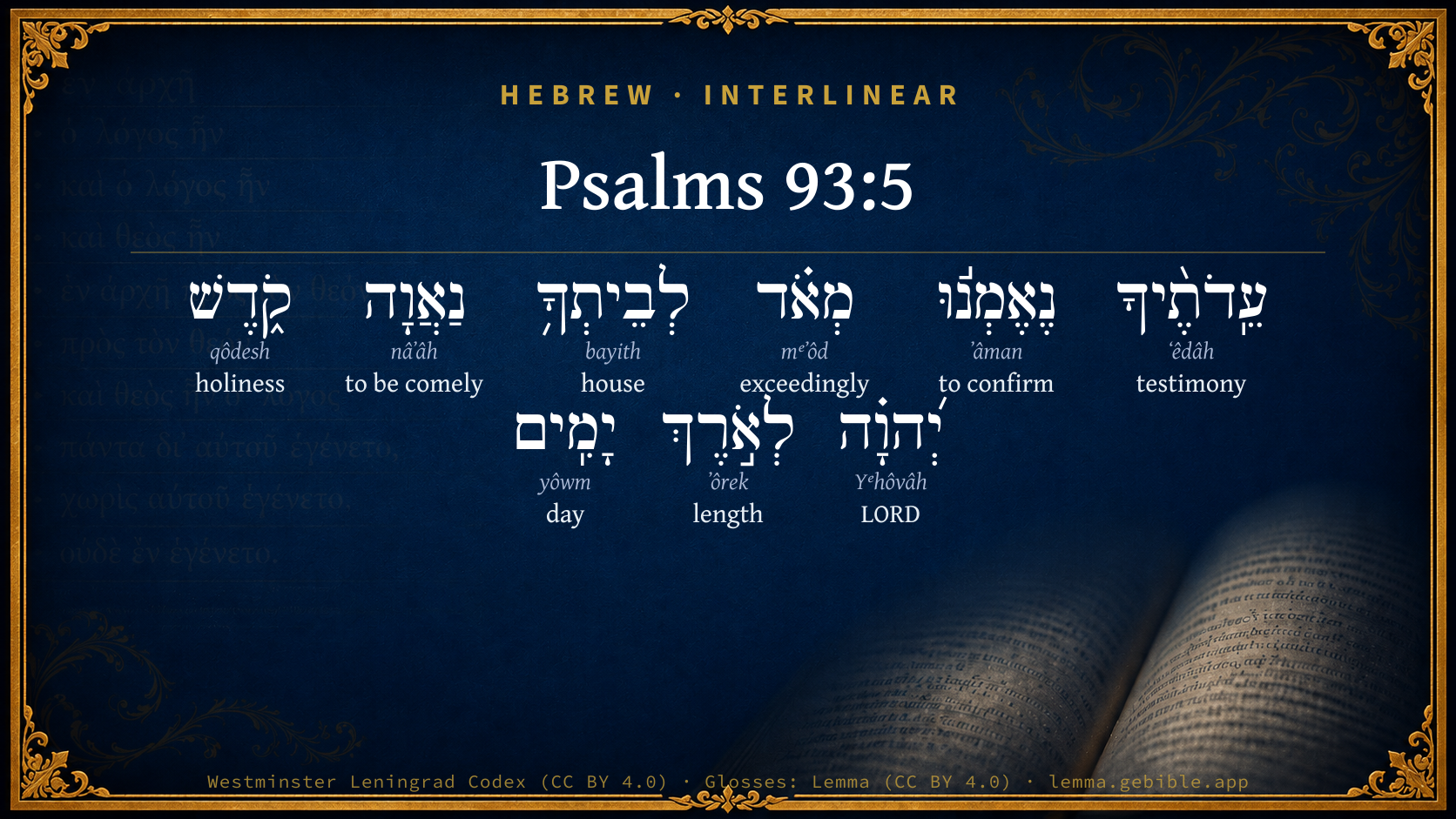
Psalms 93:5

Hebrew (Westminster Leningrad Codex) Psalms 93:5 appears in the Hebrew Old Testament. The text above is from the Westminster Leningrad Codex. Each word links to its Strong’s number, a concise gloss, and parsing drawn from the Open Scriptures Hebrew Bible morphology. Click any word for its full Brown-Driver-Briggs (BDB) entry.
Download image
Cite this verse

Psalms 93:5 (World English Bible). Public Domain. Lemma interlinear Bible study tool, https://lemma.gebible.app/v/psalms/93/5.

Show BibTeX & RIS
BibTeX
RIS
English Translation
Your statutes stand firm. Holiness adorns your house, Yahweh, forevermore.
World English Bible · Public Domain
Highlights
  • 1 first appearance in the Hebrew Bible
Full analysis ↓
Download a study sheet

One document with this verse’s original text, its word-by-word gloss line, the meaning frame, cross-references with their text, attributed commentary, and full source and license credits — printable, and it pastes into notes with its structure intact.

This verse Autodidact and up

Study sheet (.html) Plain text (.txt)

A passage Seminary Student

Up to 50 verses in one chapter. A passage sheet keeps up to 6 commentary sources and 12 cross-references per verse, in the order this page ranks them, and says so on the sheet whenever that leaves anything out. Ask for a single verse and you get the Autodidact verse sheet above.

Everything on this page stays free to read, with no account — the sheet is a download of what is already on screen, not access to it.

Want to remove ads? Support Godless Engineer
Compare translations 3

The same verse in 3 English versions, stacked beneath the original-language interlinear above. Click any original word for its lexicon entry.

Each is an independent rendering of the whole verse — the interlinear is not word-aligned to these translations.

Highlighted words mark where these versions differ — a whole-verse word diff, not a word-by-word alignment.

  • World English Bible Public Domain
    Your statutes stand firm. Holiness adorns your house, Yahweh, forevermore.
  • King James Version Public Domain
    Thy testimonies are very sure: holiness becometh thine house, O LORD, for ever.
  • unfoldingWord Literal Text CC BY-SA 4.0
    Your decrees are very trustworthy; holiness adorns your house, Yahweh, for length of days.

unfoldingWord Literal Text — © unfoldingWord, licensed CC BY-SA 4.0. Word-aligned USFM3 via Door43 (git.door43.org/unfoldingWord/en_ult).

Versions to compare (up to 4)

3 of 4 selected

Show all 18 translations

Every available English version of this verse, each an independent rendering of the whole verse.

  • World English Bible Public Domain
    Your statutes stand firm. Holiness adorns your house, Yahweh, forevermore.
  • Berean Standard Bible Public Domain
    Your testimonies are fully confirmed; holiness adorns Your house, O LORD, for all the days to come.
  • Majority Standard Bible Public Domain
    Your testimonies are fully confirmed; holiness adorns Your house, O LORD, for all the days to come.
  • King James Version Public Domain
    Thy testimonies are very sure: holiness becometh thine house, O LORD, for ever.
  • American Standard Version (1901) Public Domain
    Thy testimonies are very sure: Holiness becometh thy house, O Jehovah, for evermore.
  • Revised Version (1885) Public Domain
    Thy testimonies are very sure: holiness becometh thine house, O LORD, for evermore.
  • Geneva Bible (1599) Public Domain
    Thy testimonies are very sure: holinesse becommeth thine House, O Lord, for euer.
  • Douay-Rheims (1899) Public Domain
    Thy testimonies are become exceedingly credible: holiness becometh thy house, O Lord, unto length of days.
  • Young's Literal Translation Public Domain
    Thy testimonies have been very stedfast, To Thy house comely `is' holiness, O Jehovah, for length of days!
  • Literal Standard Version CC BY-SA 4.0
    Your testimonies have been very steadfast, || Holiness befits Your house, O YHWH, for [the] length of [Your] days!
  • Unlocked Literal Bible CC BY-SA 4.0
    Your solemn commands are very trustworthy; holiness adorns your house, Yahweh, forever.
  • unfoldingWord Literal Text CC BY-SA 4.0
    Your decrees are very trustworthy; holiness adorns your house, Yahweh, for length of days.
  • Darby Bible Public Domain
    Thy testimonies are very sure: holiness becometh thy house, O Jehovah, for ever.
  • World Messianic Bible Public Domain
    Your statutes stand firm. Holiness adorns your house, LORD, forever more.
  • Webster's Bible Public Domain
    Thy testimonies are very sure: holiness becometh thy house, O LORD, for ever.
  • Free Bible Version CC BY-SA 4.0
    Your laws are totally trustworthy. Your house, Lord, is holy forever.
  • Bible in Basic English Public Domain
    Your witness is most certain; it is right for your house to be holy, O Lord, for ever.
  • JPS Tanakh (1917) Public Domain
    Thy testimonies are very sure, holiness becometh Thy house, O LORD, for evermore.

Literal Standard Version (2020), Covenant Press — licensed CC BY-SA 4.0. Text via the HelloAO Bible API (eBible.org). Unlocked Literal Bible (unfoldingWord) — licensed CC BY-SA 4.0. Text via the HelloAO Bible API (eBible.org). unfoldingWord Literal Text — © unfoldingWord, licensed CC BY-SA 4.0. Word-aligned USFM3 via Door43 (git.door43.org/unfoldingWord/en_ult). Free Bible Version, Dr. Jonathan Gallagher — licensed CC BY-SA 4.0. Text via the HelloAO Bible API (eBible.org).

Word by word

More ways to search: Search by grammar → Find every occurrence → Compare this word →

Practice this passage: Drill this verse → Learn its vocabulary →

About this verse

These counts appear in no published source. They are computed here, from the morphology-tagged text and Lemma’s own curated glosses. What Lemma adds →

9
words
9
distinct lemmas
Wisdom
section

Notable vocabulary

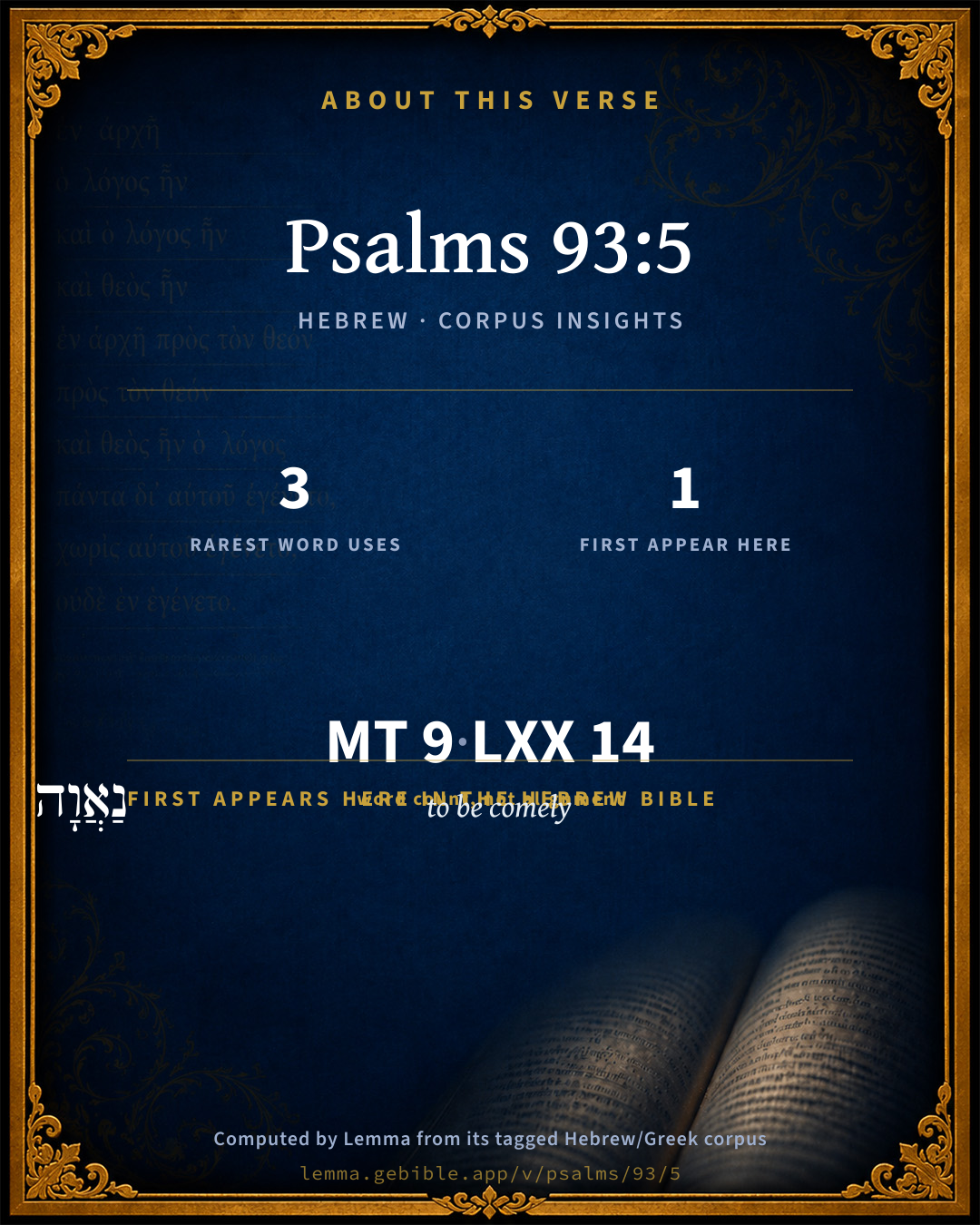
The rarest word here is נַאֲוָה to be comely H4998 — appearing just 3 times in the whole Hebrew Bible.

First appearance in Scripture

This word makes its first canonical appearance in the Hebrew Bible here:

  • נַאֲוָה to be comely H4998

Shared distinctive vocabulary

נַאֲוָה to be comely H4998 occurs in 3 verses of the Hebrew Bible. Also found in:

Grammatical profile

  • 2 verbs
  • 6 nouns
  • 1 adverb

Verb forms

  • נֶאֶמְנ֬וּ Niphal · Perfect
  • נַאֲוָה Niphal · Perfect

Hebrew & Septuagint length

In English translation the verse runs 10 words from the Hebrew and 14 from the Septuagint (LXX English) — closely comparable.

A rough comparison of the two English renderings, which tokenize alike — not a word-level alignment.

Word counts can differ between the Hebrew and the Greek without any difference in meaning — e.g. the Hebrew direct-object marker אֵת has no separate Greek word, and Greek often adds the article ὁ.

In the original languages it is 9 Hebrew tokens and 14 Greek tokens — but the two are counted differently (Hebrew bundles its prefixes and suffixes into one token; the Greek is in lemma form), so that isn’t a like-for-like length.

Cross-references

21

Topical passages linked to Psalms 93:5 in the Treasury of Scripture Knowledge — connected by theme and wording, ordered by reader-vote popularity; previews shown in the World English Bible.

  • Psalms 19:7–8 Yahweh's law is perfect, restoring the soul. Yahweh's testimony is sure, making wise the simple.
  • Psalms 29:2 Ascribe to Yahweh the glory due to his name. Worship Yahweh in holy array.
  • Psalms 119:111 I have taken your testimonies as a heritage forever, For they are the joy of my heart.
  • Leviticus 19:2 "Speak to all the congregation of the children of Israel, and tell them, 'You shall be holy; for I Yahweh your God am holy.
  • Psalms 119:129 Your testimonies are wonderful, Therefore my soul keeps them.
  • 1 Corinthians 3:16–17 Don't you know that you are a temple of God, and that God's Spirit lives in you?
  • Psalms 119:138 You have commanded your statutes in righteousness. They are fully trustworthy.
  • Psalms 119:144 Your testimonies are righteous forever. Give me understanding, that I may live.
  • Hebrews 12:14 Follow after peace with all men, and the sanctification without which no man will see the Lord,
  • Psalms 99:5 Exalt Yahweh our God. Worship at his footstool. He is Holy!
  • Psalms 99:9 Exalt Yahweh, our God. Worship at his holy hill, For Yahweh, our God, is holy!
  • Isaiah 8:20 To the law and to the testimony! if they don't speak according to this word, surely there is no morning for them.
  • Leviticus 10:3 Then Moses said to Aaron, "This is what Yahweh spoke of, saying, "'I will show myself holy to those who come near me, And before all the people I will be glorified.'" Aaron held his peace.
  • Matthew 24:35 Heaven and earth will pass away, but my words will not pass away.
  • John 4:24 God is spirit, and those who worship him must worship in spirit and truth."
  • Revelation 21:27 There will in no way enter into it anything profane, or one who causes an abomination or a lie, but only those who are written in the Lamb's book of life.
  • Psalms 5:4–7 For you are not a God who has pleasure in wickedness. Evil can't live with you.
  • Isaiah 52:11 Depart you, depart you, go you out from there, touch no unclean thing; go you out of the midst of her; cleanse yourselves, you who bear the vessels of Yahweh.
  • Hebrews 6:17–18 In this way God, being determined to show more abundantly to the heirs of the promise the immutability of his counsel, interposed with an oath;
  • 1 John 5:9–13 If we receive the witness of men, the witness of God is greater; for this is God's testimony which he has testified concerning his Son.
  • Zechariah 14:20–21 In that day there will be on the bells of the horses, "HOLY TO YAHWEH;" and the pots in Yahweh's house will be like the bowls before the altar.

Cross-references courtesy of OpenBible.info (CC BY 4.0).

Hebrew and Greek witnesses Masoretic Hebrew ↔ Greek Septuagint

The same verse in the two great witnesses to the Old Testament, shown verse-for-verse.

You’re reading Greek Psalm 92 (Hebrew Psalm 93). The Septuagint counts the superscription, so verse numbers can differ from the Hebrew — chapter-level alignment, not verse-by-verse. Numbering follows Rahlfs.

These are two independent witnesses, not word-aligned to each other, and the Septuagint is shown in lemma (dictionary) form.

Hebrew Psalms 93:5 Masoretic · Westminster Leningrad Codex

עֵֽדֹתֶ֨יךָ נֶאֶמְנ֬וּ מְאֹ֗ד לְבֵיתְךָ֥ נַאֲוָה קֹ֑דֶשׁ יְ֝הוָ֗ה לְאֹ֣רֶךְ יָמִֽים

Your statutes stand firm. Holiness adorns your house, Yahweh, forevermore.

World English Bible · Public Domain

Greek LXX Greek Psalm 92:5 Septuagint · lemma form

ὁ μαρτύριον σύ πιστόω σφόδρα ὁ οἶκος σύ πρέπω ἁγίασμα κύριος εἰς μακρότης ἡμέρα

Your testimonies are made very sure: holiness becomes your house, O Lord, for ever.

LXX2012 (modern English Septuagint) · Public Domain

Hebrew: Westminster Leningrad Codex (CC BY 4.0). Greek: Septuagint (public domain); English from LXX2012 (modern English Septuagint) (Public Domain). How the Septuagint differs from the Hebrew →

Commentary

Notes on Psalms 93:5 from classic Christian and Jewish commentators (each source and its license shown beneath its notes). The classic Christian expositions comment on the surrounding passage and are grouped to its opening verse, so a note may address several verses; the Jewish commentaries on the Tanakh (Rashi and others) are per-verse, so they appear only where the commentator wrote on this verse.

Lemma curates 59 commentaries, every one of them public domain or Creative Commons licensed, each selected and text-cleaned for this edition rather than reprinted as found. About our sources →

Adam Clarke's Commentary

Verse 5. Thy testimonies are very sure] Thou wilt as surely fulfil thy word as thou wilt keep possession of thy throne.

Holiness becometh thine house] Thy nature is holy, all thy works are holy, and thy word is holy; therefore, thy house - thy Church, should be holy. The building itself should be sanctified - should be so consecrated to thy worship alone, that it shall never be employed in any other service. The ministers of this Church should be holy, the members holy, the ordinances holy; its faith, its discipline, and its practice holy. And this at all times, and in all circumstances; for holiness becometh thine house - for ever," לארך ימים le-orech yamin, for length of days. During the whole lapse of time; till the sun and moon shall be no more. The old Psalter says the house of God is man's saule; and of this house holiness is נאוה naavah, "the ornament;" it produces that meek and quiet spirit which is in the sight of God of great price. No decoration of person nor simplicity of dress can supply the place of this heavenly clothing.

ANALYSIS OF THE NINETY-THIRD PSALM

In this Psalm it is the purpose of the prophet to comfort the Church, oppressed by tyrants and persecutors; and yet she shall not utterly fail. The gates of hell shall not prevail against her; because Christ sits in his Church as King. The sum of it is, -

I. The magnificence and power of Christ our eternal King, Ps 93:1-2.

II. That he defends his Church in the day of a storm, Ps 93:3-4.

III. That his laws are holy, and his Church also, Ps 93:5.

I. The prophet in the first verse describes our King:

First. From his office: -

1. "He reigns." He is the great and chief Monarch; he is no idle spectator of things below; but wisely, and justly, and powerfully administers all things.

2. He is a glorious King: "He is clothed with majesty."

3. He is a potent King: "The Lord is clothed with strength."

4. He is a warlike King: "He hath girded himself," buckled his sword upon his armour; for offence towards his enemies, for defence of his kingdom.

Secondly. From his kingdom: -

1. It is universal: "The world."

2. It is fixed, firm, and stable: "The world is also established, and cannot be moved."

3. It is an everlasting kingdom: "From everlasting to everlasting; thy throne is established of old: thou art from everlasting."

II. But in this his kingdom there are those who raise tumults, commotions, and rebellions. These he compares to swelling waters and foaming waves.

1. "The floods," that is, tyrants, persecutors, c., "have lifted up, O Lord, the floods have lifted up their voice the floods lift up their waves." The Church dwells in the sea; and the waves of tyranny, ambition, and malice, beat furiously upon it.

2. Well, be it so; yet "the Lord on high is mightier than the noise of many waters; yea than the mighty waves of the sea." He wonderfully and strangely hath showed his might in getting himself the victory over all persecutors, and propagating and enlarging his kingdom over all the earth in despite of his enemies.

III. 1. And as his kingdom is immovable, so are the laws by which it is governed fixed and unalterable also: "Thy testimonies are very sure." The Gospel is an eternal Gospel; the doctrine thereof is holy and inviolable; by which God hath declared his good will to man, and what he requires of all his loving subjects; which is, that they be a holy people. For,

2. "Holiness becomes thy house for ever." The temple, the priests, the people, must be a holy nation; for ever correspondent to the holiness of his law and testimonies: "Be ye holy, for I am holy." "Holiness becomes thy house, O Lord, for ever."

Adam Clarke's Commentary on the Bible (1810–1826) — public domain. Text from a community e-Sword/MySword module.

Trapp's Complete Commentary

John Trapp

Psa 93:5 Thy testimonies are very sure: holiness becometh thine house, O LORD, for ever.

Ver. 5. Thy testimonies are very sure] Thy promises infallible; and therefore rage the world never so, thou shalt still have a holy catholic Church, such as whose principles, practices, and aims are divine and supernatural; such as walk worthy of God in all well pleasing, and inasmuch as they have these rich promises, do cleanse themselves from all filthiness of flesh and spirit, perfecting holiness in the fear of God, 2Co 7:1.

Holiness becometh thine house] God looks to be served llke himself; he will be sanctified of all those that draw near unto him in holy duties, Lev 10:3. This the heathens were not altogether ignorant of, and therefore at their sacrifices the priests cried out τις τηδε, who is here? whereunto the people that were present answered, πολλοι τ αγαθοι τε παρεισι, here are many, and those good men all (Erasmi Praef. in Adag.)

- Procul, hinc procul, este profani.

John Trapp, A Commentary or Exposition upon All the Books of the Old and New Testament (1647–1656) — public domain. Text from a community e-Sword module.

The Biblical Illustrator

Joseph S. Exell

Psa_93:5

Thy testimonies are very sure.

Things that are sure

Men love things that are sure. Uncertainty is painful, and often maketh the heart sick. We cannot live upon shadows and clouds. It is no use building a house upon the sand.

I. The protection of God (Psa_18:2; Psa_125:2). God is our strength, our shelter, our shield, our sun, and for ever. Heaven and earth shall pass away, but my Fathers love shall be my portion, my joy, my immortal life. This is enough; I ask no more.

II. The fulfilment of Holy Scripture. The ruins of Tyre, Babylon, and Nineveh attest that there was in ancient years a sure word of prophecy, and, as time passes on, the Word of the Lord continueth to be its own witness. It needs no defence. The Bible, in the march of daily events, is fulfilled to the letter. Sooner shall the Nile cease to flow, to rise and fall, than the word of prophecy fail. So with the promises of the Bible. They are renewed every morning.

III. The confusion of slanderers. Let loose talkers remember (Pro_19:5). And if the liar and gossip should have annoyed you, let your soul find hope in this gracious promise (Pro_16:7). Go on your way, then, with a light step and a brave heart, and the Lord in whom you trust will deliver and comfort you.

IV. The harvest time. Science teaches you that the earths fertility is boundless. Cultivate it wisely, and it will blossom as the rose. And what saith the Scripture of God, and the earth which He made (Gen_8:22; Psa_145:15; Psa_23:1)? Fear not, then, to ask God for your daily bread. He hath promised it; He will give it.

V. The reward of true service. God is a good paymaster. He will not be debtor to any man. His reward will be abundant. Be brave and true, then, in the service of God.

VI. The remission of sins. This salvation is free. You need bring no silver, gold, or precious stones. This salvation is full. It is for every soul and for every sin. This salvation is everlasting. It begins on earth, and is continued in heaven.

VII. The resurrection of the just. (G. W. McCree.)

Holiness becometh Thine house, O Lord, for ever.--

The house of the Lord

I. The necessity of holiness.

1. The ministers of Gods house must be holy in manner, motive, life, doctrine.

2. They must preach holiness.

3. All in the Lords house are called to holiness. It is profitable to meditate beforehand on the glorious majesty and might of the Eternal Sovereign to whose palace we are going. It is dangerous to engage in worldly conversation, or irrelevant thoughts, up to the sacred porch.

II. The method of holiness. They do not show an intelligent appreciation of the holiness of the house of the Lord who are indifferent to the order and symmetry of its services. One step in public and united worship rests on another. If the first be missed it is not easy to reach the second. Be in time! There is a calm preliminary exercise indispensable to those who would be in time for the entire service. Looking round to know what people are coming in and going out is not the business of everybody. Let your thoughts be directed continually to the Lord. (E. J. Robinson.)

The beauty of holiness

Beauty is a strong and deep word, capable of the fullest possible meanings. There is nothing which appeals to the finer side of our emotional nature which may not be included in the word beautiful. Well, we find that God has added to His wisdom and power that great adornment which we call beauty; in all our natural relations with Him we are constantly meeting with it and being uplifted by it. It is the allurement which is ever seeking to draw us to better and noble ideals; it seems to give us glimpses into worlds of enjoyment which are in the nature of God Himself; it is the music which accompanies the march of knowledge, the glow and enthusiasm which dignifies the colder toils of mere science. Beauty! it is Gods mark upon the world. Well, but the inquirer asks, in my other relationship to God, the moral relationship, is there any adornment or accompaniment which may be said to be parallel to this? if God has adorned the work of His hands with this wonderful beauty, is there anything in the moral world corresponding, and the answer is, Yes. You have it again and again in the Hebrew phrase, the beauty of holiness. Holiness becometh thine house. The real beauty of religion gathers about the personal character; the adornment of a house of prayer is in the lives of the people who worship in it. Men and women who during the week have lived beautiful lives--just and honest, merciful and kind, intelligent and refined--if they gathered in the plainest meeting-house ever erected, and their worship was devoid of all ritual, would there not be a beauty in it which nothing sensuous could ever create, a spirit in it which would be an inspiration to all who were present? But for this worship they must come together. Solitary worship is impossible to most men; we must feel the common pulse of sympathy, and so coming together we make the reality of the worship. Holiness becometh thine house. They who bring into it the earnest desire to find the inspiration for the best and noblest life will bring with them the secrets of a beautiful worship. We shall utterly fail to accomplish this unless we seek to grow familiar with the beautiful aspects of Gods own will and character. It is an unfailing law that you grow like that with which you are most familiar. We carry about with us the manners of the place which commands most of our time and affection. Let our religion be the mere letter, the lifeless creed, the rigid formalism, and whatever fidelity and strength there may be about us, our life and our worship, there will have no beauty. We shall repel where we ought to attract. We shall wonder why others are so joyous and why to us there is so much constraint in religion. But we have to cultivate the other side, and it is the earnest endeavour of some of us to seek in our teaching always to discover that side--the side which allures, attracts by the noblest means. And we can hardly do that without striving to show the dangers and imperfections of the merely formal side of religion. To preach against a dead creed is not to say a word against a living, a beautiful belief. To denounce the orthodox uncharitable is not to say a word against the loving, vital theology of one whose beliefs are all warm with the love of God and of men. To point out the dangers of mere artistic performance in worship is not to deny to any man the right to express the sense of adoration in the way which seems to be most suitable. But we must stand by the living belief and the sincere worship, and they are inseparable from character, and character is fed by the living truths of God. Let us be quite frank with ourselves. Are we earnestly striving to be better men and women? Do we come to this act of worship with the honest desire to gain strength to conquer all our evil, and to become truthful, right-doing, brave, compassionate men and women? If that is our aim we bring the best adornment--a beauty greater than any of art or music--the holiness which becomes the house of God. (W. H. Harwood.)

Holiness becomes the worship and service of God

In the temple, every little ornament even of the mighty structure that crowned the cliffs of Zion was holy to the Lord. Not the great courts and inner shrines and pillared halls merely, but all. Not a carved pomegranate, not a bell, silver or golden, but was holy. The table and its lamps, with flowers of silver light, tent and staves, fluttering curtain and ascending incense, altar and sacrifice, breastplate and ephod, mitre and gem-clasped girdle, wreathen chains and jewelled hangings--over all was inscribed Holy, while within, in the innermost shrine, where God manifested Himself above the mercy-seat, was the Holiest. Thus the utter holiness of that God with whom they had to do was by every detail impressed upon the heart and conscience of ancient Israel. (A. B. Grosart.)

.

Psa_94:1-23

The Biblical Illustrator, edited by Joseph S. Exell (c. 1880s–1900s) — public domain. Text from a community e-Sword module.

Joseph Benson's Commentary

Psa 93:5. Thy testimonies — Thy words: either, 1st, Thy precepts, which are commonly called God’s testimonies. And so, having spoken of God’s kingdom, he now showeth that the laws of that kingdom are just, and true, and holy, which is a singular commendation of it. Or, rather, 2d, Thy promises, as may be gathered from the following words, are sure, or true, or faithful; which attribute properly belongs, and everywhere in Scripture is ascribed to, promises rather than to precepts. And the promises, no less than the precepts, are God’s testimonies, or the witnesses or declarations of his mind and will to mankind. And he seems here to speak of those great and precious promises concerning the erection and establishment of his kingdom in the world by the Messiah. Which promises, saith he, are infallibly true, and shall certainly be accomplished in thy time. Holiness becometh thy house — This is to be understood, either, 1st, Of God’s church or people, who are sometimes called his house, and whose business and delight are in God’s house and in his service there performed. So the sense is, It becometh thy people to be holy in all their approaches to thee, and worshipping of thee. Or, rather, 2d, Of God himself, who dwelt in his house, from whence he gave forth his oracles, and where all his testimonies were kept upon record. And so the sense is, Holiness is the constant ornament and glory of thy house. Or, it becometh thee, who dwellest in thy house, to be holy in all thy words and actions, and therefore thy testimonies are very sure, and thou wilt undoubtedly fulfil all thy promises, for “thou canst as soon renounce thy holiness as thy faithfulness in performing them.”

Joseph Benson's Commentary on the Old and New Testaments (1811–1818) — public domain. Text from a community e-Sword module.

J. A. Alexander on Psalms

Joseph Addison Alexander

5. (Psa 93:5) Thy testimonies are sure, very (sure); to thy house suits (or is becoming) holiness, Jehovah, unto length of days. The testimonies of God are all the provisions of his Law, as in Psa 19:7; Psa 25:10, but with special reference, in this as in several other cases, to its promises. See above, on Psa 60:1; Psa 80:1. The verb here used is a passive, meaning strictly to be founded, settled, or secured. From this clause is borrowed the form of expression in Rev 19:9; Rev 21:5; Rev 22:6. The intensive adverb very or exceedingly has the same effect as when in English we use an epithet and add extremely so or very much so. The verb translated suits (or is becoming) is the root of the adjective used in Psa 33:1. Compare my note on Isa 52:7. Holiness is by some understood to mean sacredness, immunity from profanation, and of course from violent intrusion. See above, on Psa 74:3. The house of God is here referred to, as the place where he dwelt with his people, and they with him. To length of days, see Psa 23:6.

Joseph Addison Alexander, The Psalms Translated and Explained (1850) — public domain. Text from a community e-Sword module.

Tyndale Open Study Notes

Tyndale Open Resources

93:5 Through his stable rule and royal laws, the Lord orders the world. • Your reign (literally your house): The house from which God reigns might be the Lord’s heavenly palace or the earthly Temple.

Tyndale Open Study Notes — © Tyndale Open Resources, licensed CC BY-SA 4.0. Text via the HelloAO Bible API.

Geneva Bible (1599)

Geneva Bible translators

Besides God’s power and wisdom in creating and governing, his great mercy also appeareth in that he hath given his people his word and covenant.

Geneva Bible (1599) marginal notes — public domain. Text via Bolls.life.

John Calvin's Commentaries

5 Thy testimonies are singularly true As yet the Psalmist has insisted upon the excellency of God in the work of creation, and the providential government of the world. Now he speaks of his distinguishing goodness to his chosen people, in making known to them the doctrine which bringeth salvation. He begins by commending the absolute trust-worthiness and truthfulness of the law of God. This being a treasure which was not extended to all nations promiscuously, he adds immediately that the house of God would be adorned with a glory which should last for ever. The Divine goodness is displayed in every part of the world, but the Psalmist justly considers it as of all others the most inestimable blessing, that God should have deposited in his Church the covenant of eternal life, and made his glory principally to shine out of it. Some translate the Hebrew word נאוה, naävah, desirable, as if the Psalmist had said that the adorning of the temple was precious; but the grammatical construction will not admit of this. By length of days is meant perpetual succession, and to this we find Isaiah referring in striking terms, that the Divine truth might be preserved in faithful custody through successive ages.

“Behold, I have put my word in thy mouth, in the mouth of thy seed, and of thy seed’s seed,” (Isaiah 59:21.)

John Calvin's Commentaries (1540-1563) — public domain. Text from the Calvin Translation Society English edition (1840s-50s) via the Christian Classics Ethereal Library (ccel.org). Calvin's coverage is partial (roughly two-thirds of the Bible); uncommented books and verses are honest gaps, never fabricated. The 19th-century editor's footnotes and remarks are omitted so the notes are faithfully Calvin's own voice.

Ellicott's Commentary for English Readers

(5) Thy testimonies.—This statement must be taken in close connection with that of the preceding verse. The permanence of the covenant, and of the outward signs that attest it, is to the Israelite proof of the superiority of the Divine power over the forces of nature. We may extend the thought, and say that the moral law is a truer evidence of the existence of God than the uniformity of natural laws.

A Bible Commentary for English Readers, edited by Charles John Ellicott (1878–1897) — public domain. Text from a community e-Sword module.

The Cambridge Bible for Schools and Colleges

gen. ed. J. J. S. Perowne

5. Thy testimonies] Many commentators explain testimonies to mean the promises and threatenings which have now been proved true, comparing the use of the cognate verb in Psa_50:7; Psa_81:8; Deu_8:19; &c. But this sense of the word is unsupported, and it is best to take it in its usual sense of the ‘law,’ regarded as bearing witness to Jehovah’s will and man’s duty. Cp. Psa_19:7; Psa_111:7. The transition seems somewhat abrupt; yet it is not inappropriate that the Psalm should close with a reference to the revelation which was the distinctive mark of Jehovah’s kingdom (Deu_4:7-8).

holiness &c.] God’s house may be either the Temple or the land. The Psalmist is confident that now the ideal will be realised. Jehovah has returned to dwell there, and it shall no more be defiled by Israel itself (Jer_7:30), no more be desecrated by heathen invaders (Joe_3:17; Isa_52:1).

for ever] R.V. for evermore; lit. for length of days (Psa_91:16).

The Cambridge Bible for Schools and Colleges (gen. ed. J. J. S. Perowne; Cambridge University Press, 1878–1918) — public domain. Text from a community e-Sword module.

John Gill's Exposition

Thy testimonies are very sure,.... Meaning not the works of God, of nature, and providence, which testify of his power and Godhead, and other perfections of it; rather the word of God, the Scriptures of truth, the law and Gospel; the one being a testimony of his will to be done by men, the other a testimony of his good will to men; which are sure and true, and to be believed; though it seems best of all to understand them of the promises of God, which testify what he will do, or shall be done hereafter, and which are all yea and amen in Christ; and especially those that respect his kingdom and interest, the glory, stability, and eternity of it, things which are the principal subjects of this psalm; all which promises are sure and certain, true and faithful, firm, and to be believed; see Gen 19:9,

holiness becometh thine house, O Lord, for ever; or "unto length of days" (d): holiness is a dress or clothing; though it is not the robe of a justifying righteousness, yet it is an inner garment, which makes the saints all glorious within; it is a very beautiful and becoming dress; it is called "the beauty of holiness", and it is always becoming; it becomes the church and people of God, all that are of the household of God, both now and for evermore; it will never be out of use; it will be more and more in use, both in the spiritual reign of Christ, and in the New Jerusalem church state, and in heaven to all eternity; see Zac 14:20.

(d) "in longitudinem dierum", Pagninus, Montanus, Junius & Tremellius, Piscator, &c.

Next: Psalms Chapter 94

John Gill's Exposition of the Whole Bible (1746–1763) — public domain (CC PDM 1.0). Text via the HelloAO Bible API.

Albert Barnes' Notes on the Bible

Thy testimonies are very sure - All that thou hast borne witness to; all that thou hast affirmed or declared to be true. This would embrace “all that” God has spoken, whether his law, his promises, his commands, his prophecies, or his statements of what has occurred and of what will occur. See the notes at Psa 19:7.

Holiness becometh thine house, O Lord - The psalm seems to have been intended to be used in the sanctuary, as a part of public worship, and the word “holiness” here would seem to mean a proper respect for God; confidence in him; a state of mind free from all doubt, and from all that is impure. Perhaps there may be here, also, the idea that in all the convulsions of the world; in all that threatens to overthrow truth and righteousness; in all the attacks which are made on the divine government; in all the efforts of the defenders of error, and in the midst of abounding iniquity, the church should maintain a firm adherence to the principles of “holiness,” to that which is right and true. There should be one place - the church - where there would be no wavering in regard to truth and holiness; one place, where the truth would be defended whatever commotions might be abroad. The main idea, therefore, in the psalm is, that, in view of the fact that God reigns, and that nothing can frustrate his plans, or disturb his throne, we should approach him with reverence, with humble trust, with sincere and pure hearts.

In a larger sense, also, in the largest sense conceivable - it is true that “holiness,” purity, freedom from evil thoughts, from a wanton eye and a wanton imagination, from unholy plans and purposes, should prevail in the house of God, and should be regarded as indispensable to proper worship. As heaven is pure, and as there shall enter there nothing “that defileth, neither whatsoever worketh abomination or maketh a lie” Rev 21:27, so in the place where we seek to prepare for that holy world - the sanctuary of God - nothing should be allowed to enter that is impure and polluting; nothing that tends to corrupt or defile the soul. It may be added, that attendance in a place of public worship is calculated to make the heart pure, and to banish unholy thoughts and purposes from the soul. A man who feels that he is in the presence of a holy God, will not be likely to welcome into his soul polluted images and unholy desires.

Forever - Margin, as in Hebrew, “to length of days.” The idea is, that it is always appropriate. See the notes at Psa 23:6.

Albert Barnes' Notes on the Bible (1834–1885) — public domain. Text from a community e-Sword/MySword module.

Matthew Poole's English Annotations

Thy testimonies, i.e. thy words; either,

1. Thy precepts, which are commonly called God’s testimonies. And so having spoken of God’s kingdom, he now showeth that the laws of that kingdom are just, and true, and holy; which is a singular commendation of it. Or,

2. Thy promises, as may be gathered from the following words,

are sure, or true, or faithful; which attribute properly belongs, and every where in Scripture is ascribed, to promises rather than to precepts. And the promises no less than the precepts are God’s testimonies, or the witnesses or declarations of his mind and will to mankind. And he seems here to speak of those great and precious promises concerning the erection and establishment of his kingdom in the world by the Messias; which, saith he, are infallibly true, and shall certainly be accomplished in thy time.

Holiness becometh thine house: this is to be understood, either,

1. Of God’s church or people, who are sometimes called God’s house, and whose business and delight is in God’s house and service there performed. So the sense is, It becometh thy people to be holy in all their approaches to thee, and worshippings of thee. Or rather,

2. Of God himself who dwelt in his house, from whence he gave forth his oracles, and where all his testimonies were kept upon record. This seems better to suit with the context, the business of this Psalm being rather to describe the dominion of God than the duty of his people. And so the sense seems to be this, Holiness is the constant ornament and glory of thy house. Or it becometh thee who dwellest in thy house to be holy in all thy words and actions; and therefore thy testimonies are very sure, and thou wilt undoubtedly fulfil all thy promises. For holiness seems to be here taken for God’s faithfulness, as it is Psa 60:6; 89:35; or, which comes to the same thing, for his justice or righteousness, whereby he is obliged to make good all his promises, as that word is very commonly used.

Matthew Poole's English Annotations on the Holy Bible (1683–1685) — public domain. Text from a community e-Sword/MySword module.

The Treasury of David

Charles H. Spurgeon

Ver. 5. Thy testimonies are very sure. As in providence the throne of God is fixed beyond all risk, so in revelation his truth is beyond all question. Other teachings are uncertain, but the revelations of heaven are infallible. As the rocks remain unmoved amid the tumult of the sea, so does divine truth resist all the currents of man's opinion and the storms of human controversy; they are not only sure, but very sure. Glory be to God, we have not been deluded by a cunningly devised fable: our faith is grounded upon the eternal truth of the Most High.

Holiness becometh thine house, 0 LORD, for ever. Truth changes not in its doctrines, which are very sure, nor holiness in its precepts, which are incorruptible. The teaching and the character of God are both unaltered. God has not admitted evil to dwell with him, he will not tolerate it in his house, he is eternally its enemy, and is for ever the sworn friend of holiness. The church must remain unchanged, and for ever be holiness unto the Lord; yea, her King will preserve her undefiled by the intruder's foot. Sacred unto the Lord is the church of Jesus Christ, and so shall she be kept evermore. "Jehovah reigns, "is the first word and the main doctrine of the psalm, and holiness is the final result; a due esteem for the great King will lead us to adopt a behaviour becoming his royal presence. Divine sovereignty both confirms the promises as sure testimonies, and enforces the precepts as seemly and becoming in the presence of so great a Lord.

The whole psalm is most impressive, and is calculated to comfort the distressed, confirm the timorous, and assist the devout. O thou who art so great and gracious a King, reign over us for ever! We do not desire to question or restrain thy power, such is thy character that we rejoice to see thee exercise the rights of an absolute monarch. All power is in thine hands, and we rejoice to have it so. Hosanna! Hosanna!

Ver. 5. Thy testimonies, i.e., thy words; either, 1. Thy precepts, which are commonly called God's testimonies. And so having spoken of God's kingdom, he now showeth that the laws of that kingdom are just, and true, and holy; which is a singular commendation of it. Or, 2. Thy promises, as may be gathered from the following words, "are sure, "or true, or faithful;which attribute properly belongs, and everywhere in Scripture is ascribed, to promises rather than to precepts. And the promises no less than the precepts are God's testimonies, or the witnesses or declarations of his mind and will to mankind. And he seems here to speak of those great and precious promises concerning the erection and establishment of his kingdom in the world by the Messias; which, saith he, are infallibly true, and shall certainly be accomplished in thy time. Matthew Pool.

Ver. 5. Holiness becometh thine house, O LORD. Singular things are expected of all that draw nigh to God in any duty, but especially in the office of the ministry; they must sanctify themselves with a singular care above that of the rest of the people. Those that stand in the presence of princes must be exact in their carriage. God appointed both the weights and measures of the sanctuary to be twice as large as those of the commonwealth, to shew that he expects much more of those that serve him there, than he doth of others. Holiness becomes every house well, but best God's; and every man, but most of all the minister, who is the mirror in which the people behold heaven, and the convoy to direct them thither. Now if the glass be spotted, instead of an angel they look upon a fury; and if the conduct be false, there is more danger in the guide than the way. None, therefore, are to walk so strictly as the ministry. Abraham Wright.

Ver. 5. Holiness becometh thine house, O LORD, for ever. No hangings, no tapestry become God's house so well as holiness; and no place is so proper as the house of God for this costly, comely furniture... The blind heathen were choice and devout in the service of dumb idols; they served them in white, an emblem of purity; they thought nothing too good for those false gods, for whom the worst was not bad enough. Solon, the Athenian lawgiver, enacted, that none should serve the gods obiter, or by the by, that their sacrificers should purify themselves some days beforehand. George Swinnock.

Ver. 5.

1. Faithfulness becometh the word of God.

2. Holiness becometh the house of God. G. R.

Ver. 5 (last clause).

1. Holiness becometh God's typical house, the temple.

2. His greater spiritual house, the church.

3. His smaller spiritual house, the believer.

4. His eternal house, heaven. C. A. D.

Charles H. Spurgeon's The Treasury of David (1869–1885) — public domain. Psalms only. Text from a community e-Sword/MySword module.

Whedon's Commentary on the Bible

Daniel D. Whedon

5. Thy testimonies—The words apply to the charges and declarations delivered to Moses for the people, constituting the entire torah, or system of the law, (Psa_19:7,) but is here specially used of the annexed promises of divine protection and favour to such as keep the law. Psa_94:12.

Are… sure—Literally, Have been amen. Compare 2Co_1:20; Rev_19:9; Rev_21:5; Rev_22:6. They have proved faithful and true through all this terrible ordeal of danger and suffering by the uproar and tumult of the nations.

Holiness becometh thine house— And therefore God will defend it against the daring assaults of wicked men, and purge his own people from corruptions by the terrible ordeal of judgments, like a summer threshing floor. The psalmist recognises the preserved sanctity of the house of God as the moral reason for the divine interference, and as the crowning glory of deliverance. Also, this recognition of the standing of the temple at the time offers a clew to the date of writing.

For ever—Hebrew, To length of days; and the duration of this term being determined by the nature of the subject, makes it “for ever.” Compare the same form in Psa_23:6. But when God’s own people forget that holiness is the chief adornment of them and the sanctuary where they worship, he will sweep them from the earth. See in 2Ch_36:15-19.

Daniel D. Whedon (gen. ed.), Commentary on the Old and New Testaments (1874–1909) — public domain. Text from a community e-Sword module.

The Pulpit Commentary

Thy testimonies are very sure. God"s "testimonies" are his commandments, considered as witnesses to man of his nature and his will respecting them. They are "very sure," i.e. firm and unalterable, partaking of his unchangeability. (Jam_1:17) Holiness becometh thine house, O Lord, forever. "Holiness" here seems to mean "sanctity," "inviolability". (Kay, Cheyne; comp. 1Sa_6:20 Isa_6:13) This is a tacit appeal to God to keep his temple free from all profanation and pollution in the future. The psalmist does not really ask that it shall continue inviolate "forever," but "to length of days," i.e. for an ample period.

God in revelation the same as God in nature.

"Thy testimonies are very sure." The use of this word "testimonies" in other psalms suggests that God"s witness to man in his revealed Word is meant by it. The unity of the psalm would, however, be preserved if we regarded the "testimonies" here as those which God makes to man through nature. The point of the verse is usually set forth in such a way as this: "The permanence of the covenant, and of the outward signs that attest it, is to the Israelite proof of the superiority of the Divine power over the forces of nature." "The moral Law is a truer evidence of the existence of God than the uniformity of natural law.

I REVELATION NEVER CONTRADICTS NATURE. When there are seeming contradictions, it is necessary to inquire whether we have the testimony of nature clear or confused. For man, interfering with Nature"s order, has confused her witness. And so it is necessary to inquire whether we have the revelation pure and simple, since there is often a material difference between what God has revealed, and what man makes of that which is revealed. The contradictions belong to the man mark put on revelation and nature. Both are from one hand and mind, and are in absolute harmony.

II REVELATION CONFIRMS NATURE. Set out an orderly scheme of nature religion; carefully fix its principles; and you will surely find they are the first principles of revelation. Indeed, revelation only comes to support primary principles of nature religion, because men overlay them with manufactured religious systems. Nature worship is quite a different thing from natural religion.

III REVELATION ENLARGES UPON NATURE. Nature sets forth mainly what may be called the physical attributes of God power, wisdom, etc. In a general way it shows God"s goodness, and, declaring that qualities attach to actions, prepares for the realization of God as Judge, Rewarder, and Punisher. Revelation deals fully with God"s moral qualities and relations; and has for its climax the disclosure of the Divine redemptive purpose, which, as wrought out, upholds every primary attribute of God that nature exhibits. R.T.

Holiness the characteristic of Divine authority.

The word "house" has been taken to mean God"s earthly temple. And some writers can see an allusion to the newly built temple of Zerubbabel. But it is better to regard the term "house" in the light of the psalm; and then it evidently means this world of created things and created beings, which God controls and rules. The psalm deals with the Kingship of God; his absolute power and authority in his world; and this last clause seems designed to meet the question which is at once called forth by the comparison of Jehovah with earthly kings. It would be an awful thing if we could know nothing of the character of the Being set in rule over us, who has such absolute, such irresistible, power. Our God may have it; for he is "holy in all his ways, and righteous in all his works.

I HOLINESS RULES ACCORDING TO THE PERFECT STANDARD.

II HOLINESS WORKS TOWARDS THE HIGHEST ENDS.

III HOLINESS IS CONSISTENT WITH NEEDFUL SEVERITIES.

IV HOLINESS INCLUDES PATIENT CONSIDERATIONS.

The rule of God can therefore be fully acquiesced in. Infinite goodness unites with infinite wisdom; these combine with infinite power; and all are toned by the infinite righteousness, which proves to be the infinite charity. Men may say rejoicingly, "The Lord God omnipotent reigneth," because they may be quite sure that "holiness characterizes his rule. R.T.

The Pulpit Commentary (1880–1919), ed. H.D.M. Spence-Jones & Joseph S. Exell — public domain. Text from a community e-Sword module.

John Wesley's Explanatory Notes

Testimonies-Thy promises, which no less than the precepts are God's testimonies, or the witnesses, or declarations of his will to mankind. He seems here to speak of those precious promises concerning the erection of his kingdom in the world by the Messiah. Holiness - It becometh thy people to be holy in all their approach to thee.

John Wesley, Explanatory Notes Upon the Whole Bible (1754–1765) — public domain. Text via the GEBible commentary corpus.

unfoldingWord translationNotes

Door43 World Missions Community

solemn

very serious

are very trustworthy

"always stay the same" or "never change"

holiness adorns your house

The psalmist speaks of Yahweh's house as if it were a woman wearing beautiful clothing or jewelry and of Yahweh's holiness as the beautiful clothing or jewelry. AT: "your house is beautiful because you are holy" or "your holiness makes your house beautiful the way beautiful clothes and jewelry make a woman more beautiful" (See: Metaphor)

your house

the temple in Jerusalem

adorns

makes beautiful

translationWords

command

trust

holy

house

Yahweh

eternity

unfoldingWord translationNotes — © Distant Shores Media and the Door43 World Missions Community, licensed CC BY-SA 4.0. Source: git.door43.org/Door43/en_tn.

Rashi

Rabbi Shlomo Yitzchaki (Rashi)

Your testimonies which Your prophets prophesied and promised concerning Your house, which is the dwelling of holiness.

are very faithful to Your house and to the length of days He looks forward to them, and although it has been a long time, they are very faithful to God.

dwelling Heb. נאוה, like (83:13): “the dwellings נְאוֹת of God,” an expression of נָוֶה. You should know [that this is so] because no instance of נָאוָה has a pronounced “aleph,” for they are an expression of נוֹי beauty, but this one has an “aleph” which is pronounced.

Rashi on the Tanakh — English translations: “The Judaica Press complete Tanach with Rashi, translated by A. J. Rosenberg” (CC BY 4.0); “Pentateuch with Rashi's commentary by M. Rosenbaum and A.M. Silbermann, 1929-1934” (public domain); “The Metsudah Tanach series, Lakewood, N.J” (CC BY 4.0); and “The Book of Joshua, Metsudah Publications, 1997” (CC BY 4.0). Text via Sefaria.

Lesson kit

Teaching starters — assembled from the data on this page, not authored interpretation. Every prompt links to the verse data it draws on. Edit before teaching.

Psalms, in the Wisdom, opens this verse with 9 words (9 distinct Hebrew lemmas). Its most distinctive word is nâʼâh (“to be comely”). A historical commentator’s framing appears above. Read the whole chapter for the surrounding context.

Discussion questions

  1. What does “to be comely” (nâʼâh) contribute to the verse as a whole?
  2. This is the first place “to be comely” appears in Scripture (first appears here). What does its debut here establish?
  3. How does Song of Solomon 1:10, which shares the word «to be comely», read alongside this verse?
  4. These translations render this verse differently. What is at stake in choosing one wording over another?
  5. «נֶאֶמְנ֬וּ» is a Niphal Perfect verb. How does that grammatical form shape the action described?
  6. Compare how Adam Clarke's Commentary and Trapp's Complete Commentary read this verse. Where do they agree or differ?

Things to notice

Reading settings

Reading text

Shown beneath each verse's original-language words.

Old Testament
Old Testament edition

Read the OT as the Masoretic Hebrew (MT) or the Greek Septuagint (LXX).

English shown for the Greek Septuagint (in the Hebrew ↔ Greek comparison).

Comparing translations? Open the Compare panel on any verse page to stack up to four side by side.