Isaiah 1:21

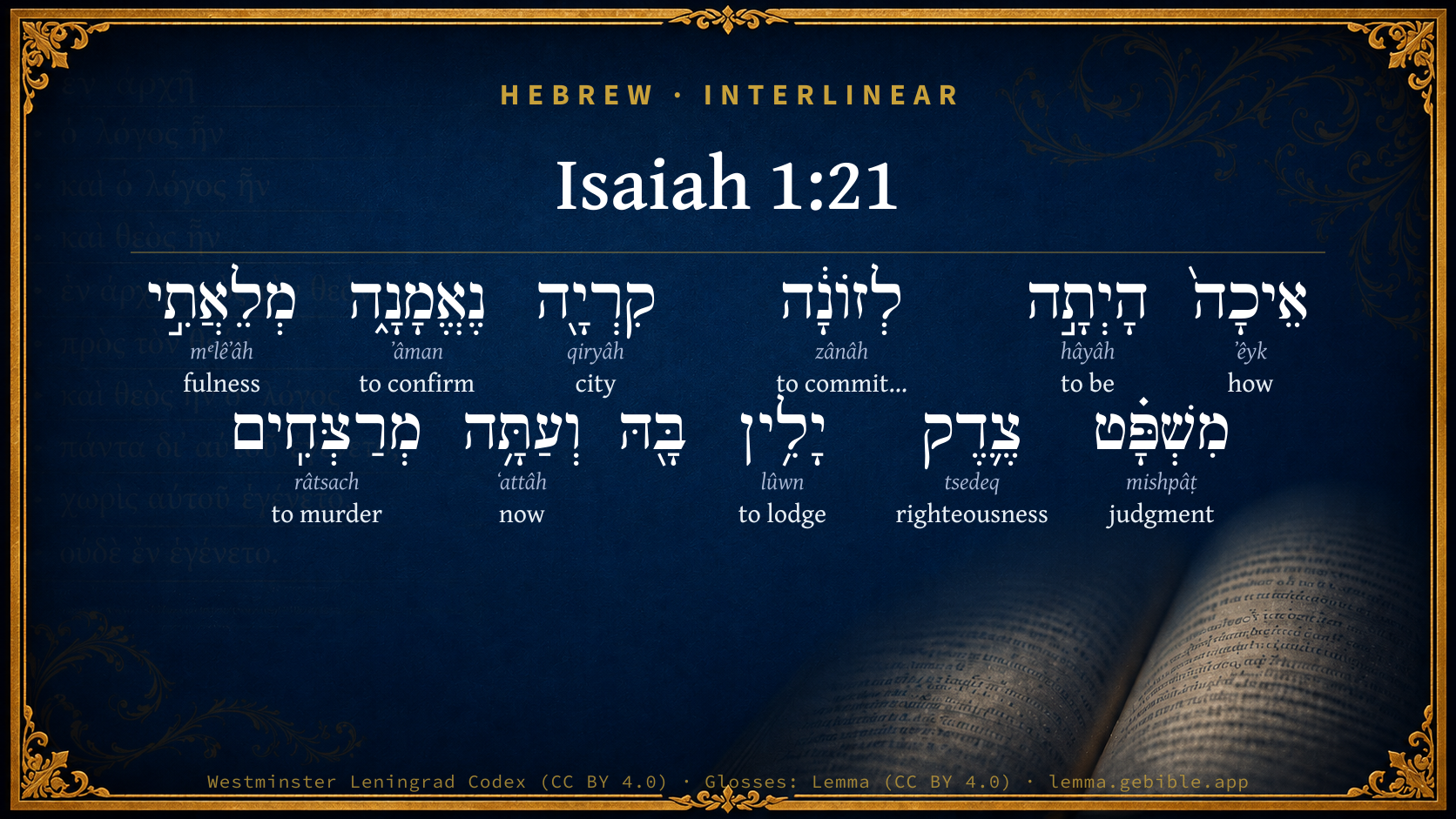
Hebrew (Westminster Leningrad Codex) Isaiah 1:21 appears in the Hebrew Old Testament. The text above is from the Westminster Leningrad Codex. Each word links to its Strong’s number, a concise gloss, and parsing drawn from the Open Scriptures Hebrew Bible morphology. Click any word for its full Brown-Driver-Briggs (BDB) entry.
Download image
Cite this verse

Isaiah 1:21 (World English Bible). Public Domain. Lemma interlinear Bible study tool, https://lemma.gebible.app/v/isaiah/1/21.

Show BibTeX & RIS
BibTeX
RIS
English Translation
How the faithful city has become a prostitute! She was full of justice; righteousness lodged in her, But now murderers.
World English Bible · Public Domain
Download a study sheet

One document with this verse’s original text, its word-by-word gloss line, the meaning frame, cross-references with their text, attributed commentary, and full source and license credits — printable, and it pastes into notes with its structure intact.

This verse Autodidact and up

Study sheet (.html) Plain text (.txt)

A passage Seminary Student

Up to 50 verses in one chapter. A passage sheet keeps up to 6 commentary sources and 12 cross-references per verse, in the order this page ranks them, and says so on the sheet whenever that leaves anything out. Ask for a single verse and you get the Autodidact verse sheet above.

Everything on this page stays free to read, with no account — the sheet is a download of what is already on screen, not access to it.

Want to remove ads? Support Godless Engineer
Compare translations 3

The same verse in 3 English versions, stacked beneath the original-language interlinear above. Click any original word for its lexicon entry.

Each is an independent rendering of the whole verse — the interlinear is not word-aligned to these translations.

Highlighted words mark where these versions differ — a whole-verse word diff, not a word-by-word alignment.

  • World English Bible Public Domain
    How the faithful city has become a prostitute! She was full of justice; righteousness lodged in her, But now murderers.
  • King James Version Public Domain
    How is the faithful city become an harlot! it was full of judgment; righteousness lodged in it; but now murderers.
  • unfoldingWord Literal Text CC BY-SA 4.0
    How the attested city has become a prostitute! full of justice; righteousness lodged in it; but now, murderers.

unfoldingWord Literal Text — © unfoldingWord, licensed CC BY-SA 4.0. Word-aligned USFM3 via Door43 (git.door43.org/unfoldingWord/en_ult).

Versions to compare (up to 4)

3 of 4 selected

Show all 18 translations

Every available English version of this verse, each an independent rendering of the whole verse.

  • World English Bible Public Domain
    How the faithful city has become a prostitute! She was full of justice; righteousness lodged in her, But now murderers.
  • Berean Standard Bible Public Domain
    See how the faithful city has become a harlot! She once was full of justice; righteousness resided within her, but now only murderers!
  • Majority Standard Bible Public Domain
    See how the faithful city has become a harlot! She once was full of justice; righteousness resided within her, but now only murderers!
  • King James Version Public Domain
    How is the faithful city become an harlot! it was full of judgment; righteousness lodged in it; but now murderers.
  • American Standard Version (1901) Public Domain
    How is the faithful city become a harlot! she that was full of justice! righteousness lodged in her, but now murderers.
  • Revised Version (1885) Public Domain
    How is the faithful city become an harlot! she that was full of judgment! righteousness lodged in her, but now murderers.
  • Geneva Bible (1599) Public Domain
    Howe is the faithfull citie become an harlot? it was full of iudgement, and iustice lodged therein, but now they are murtherers.
  • Douay-Rheims (1899) Public Domain
    How is the faithful city, that was full of judgment, become a harlot? justice dwelt in it, but now murderers.
  • Young's Literal Translation Public Domain
    How hath a faithful city become a harlot? I have filled it `with' judgment, Righteousness lodgeth in it -- now murderers.
  • Literal Standard Version CC BY-SA 4.0
    How has a faithful city become a harlot? I have filled it [with] judgment, || Righteousness lodges in it—now murderers.
  • Unlocked Literal Bible CC BY-SA 4.0
    How the faithful city has become a prostitute! She who was full of justice—she was full of righteousness, but now she is full of murderers.
  • unfoldingWord Literal Text CC BY-SA 4.0
    How the attested city has become a prostitute! full of justice; righteousness lodged in it; but now, murderers.
  • Darby Bible Public Domain
    How is the faithful city become a harlot! It was full of judgment; righteousness used to lodge in it, but now murderers.
  • World Messianic Bible Public Domain
    How the faithful city has become a prostitute! She was full of justice. Righteousness lodged in her, but now there are murderers.
  • Webster's Bible Public Domain
    How is the faithful city become a harlot! it was full of judgment; righteousness lodged in it; but now murderers.
  • Free Bible Version CC BY-SA 4.0
    The city that used to be faithful has turned into a prostitute! Once she operated on principles of justice and followed what was right, but now only murderers live there.
  • Bible in Basic English Public Domain
    The upright town has become untrue; there was a time when her judges gave right decisions, when righteousness had a resting-place in her, but now she is full of those who take men's lives.
  • JPS Tanakh (1917) Public Domain
    How is the faithful city become a harlot! She that was full of justice, righteousness lodged in her, but now murderers.

Literal Standard Version (2020), Covenant Press — licensed CC BY-SA 4.0. Text via the HelloAO Bible API (eBible.org). Unlocked Literal Bible (unfoldingWord) — licensed CC BY-SA 4.0. Text via the HelloAO Bible API (eBible.org). unfoldingWord Literal Text — © unfoldingWord, licensed CC BY-SA 4.0. Word-aligned USFM3 via Door43 (git.door43.org/unfoldingWord/en_ult). Free Bible Version, Dr. Jonathan Gallagher — licensed CC BY-SA 4.0. Text via the HelloAO Bible API (eBible.org).

Word by word

More ways to search: Search by grammar → Find every occurrence → Compare this word →

Practice this passage: Drill this verse → Learn its vocabulary →

מְלֵאֲתִ֣י
mᵉlêʼâh
H4395
“fulness of”
Adjective, Adjective, Feminine, Singular, Construct
Part of Speech
Adjective
Type
Adjective
Gender
Feminine
Number
Singular
State
Construct
Full BDB Definition

Origin: from H4392

TWOT: 1195c

fulness, full produce
  1. אֵיכָה֙ ʼêyk H349 “how” Particle, Interrogative
  2. הָיְתָ֣ה hâyâh H1961 “to be” Verb, Qal, Perfect, 3rd Person, Feminine, Singular
  3. לְזוֹנָ֔ה zânâh H2181 “to/for · committing fornication” Preposition + Verb, Qal, Participle Active, Feminine, Singular, Absolute
  4. קִרְיָ֖ה qiryâh H7151 “city” Noun, Common, Feminine, Singular, Absolute
  5. נֶאֱמָנָ֑ה ʼâman H539 “confirming” Verb, Niphal, Participle Active, Feminine, Singular, Absolute
  6. מִשְׁפָּ֗ט mishpâṭ H4941 “judgment” Noun, Common, Masculine, Singular, Absolute
  7. צֶ֛דֶק tsedeq H6664 “righteousness” Noun, Common, Masculine, Singular, Absolute
  8. יָלִ֥ין lûwn H3885 “to lodge” Verb, Qal, Imperfect, 3rd Person, Masculine, Singular
  9. וְעַתָּ֥ה ʻattâh H6258 “and · now” Conjunction + Adverb
  10. מְרַצְּחִֽים râtsach H7523 “murdering” Verb, Piel, Participle Active, Masculine, Plural, Absolute

About this verse

These counts appear in no published source. They are computed here, from the morphology-tagged text and Lemma’s own curated glosses. What Lemma adds →

12
words
11
distinct lemmas
Prophets
section

Notable vocabulary

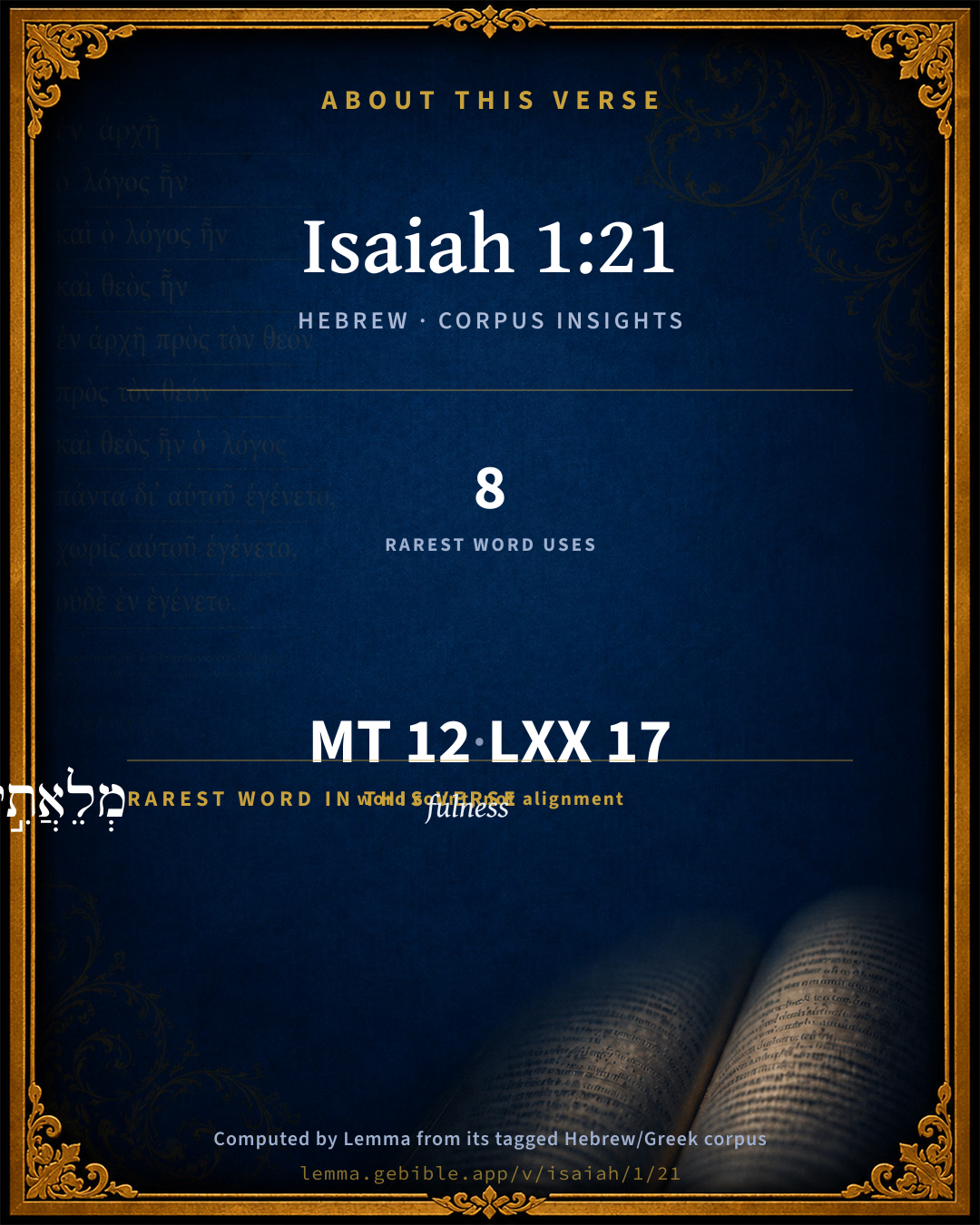
The rarest word here is מְלֵאֲתִ֣י fulness H4395 — appearing just 8 times in the whole Hebrew Bible.

Shared distinctive vocabulary

מְלֵאֲתִ֣י fulness H4395 occurs in 8 verses of the Hebrew Bible. Also found in:

Grammatical profile

  • 5 verbs
  • 3 nouns
  • 1 adjective
  • 1 preposition
  • 1 adverb
  • 1 particle

Verb forms

  • הָיְתָ֣ה Qal · Perfect
  • לְזוֹנָ֔ה Qal · Participle Active
  • נֶאֱמָנָ֑ה Niphal · Participle Active
  • יָלִ֥ין Qal · Imperfect
  • מְרַצְּחִֽים Piel · Participle Active

Hebrew & Septuagint length

In English translation the verse runs 20 words from the Hebrew and 19 from the Septuagint (LXX English) — closely comparable.

A rough comparison of the two English renderings, which tokenize alike — not a word-level alignment.

Word counts can differ between the Hebrew and the Greek without any difference in meaning — e.g. the Hebrew direct-object marker אֵת has no separate Greek word, and Greek often adds the article ὁ.

In the original languages it is 12 Hebrew tokens and 17 Greek tokens — but the two are counted differently (Hebrew bundles its prefixes and suffixes into one token; the Greek is in lemma form), so that isn’t a like-for-like length.

Cross-references

23

Topical passages linked to Isaiah 1:21 in the Treasury of Scripture Knowledge — connected by theme and wording, ordered by reader-vote popularity; previews shown in the World English Bible.

  • Ezekiel 22:1–23 Moreover the word of Yahweh came to me, saying,
  • Zephaniah 3:1–3 Woe to her who is rebellious and polluted, the oppressing city!
  • Zechariah 8:3 Thus says Yahweh: "I have returned to Zion, and will dwell in the midst of Jerusalem. Jerusalem shall be called 'The City of Truth;' and the mountain of Yahweh of Hosts, 'The Holy Mountain.'"
  • 2 Samuel 8:15 David reigned over all Israel; and David executed justice and righteousness to all his people.
  • 2 Chronicles 19:9 He charged them, saying, Thus shall you do in the fear of Yahweh, faithfully, and with a perfect heart.
  • Nehemiah 11:1 The princes of the people lived in Jerusalem: the rest of the people also cast lots, to bring one of ten to dwell in Jerusalem the holy city, and nine parts in the [other] cities.
  • Psalms 46:4 There is a river, the streams of which make the city of God glad, The holy place of the tents of the Most High.
  • Psalms 48:1 Great is Yahweh, and greatly to be praised, In the city of our God, in his holy mountain.
  • Psalms 48:8 As we have heard, so we have seen, In the city of Yahweh of Hosts, in the city of our God. God will establish it forever. Selah.
  • Isaiah 5:7 For the vineyard of Yahweh of Hosts is the house of Israel, And the men of Judah his pleasant plant: And he looked for justice, but, behold, oppression; For righteousness, but, behold, a cry of distress.
  • Isaiah 48:2 (for they call themselves of the holy city, and stay themselves on the God of Israel; Yahweh of Hosts is his name):
  • Isaiah 57:3–9 But draw near here, you sons of the sorceress, the seed of the adulterer and the prostitute.
  • Jeremiah 2:20–21 For of old time I have broken your yoke, and burst your bonds; and you said, I will not serve; for on every high hill and under every green tree you did bow yourself, playing the prostitute.
  • Jeremiah 3:1 They say, If a man put away his wife, and she go from him, and become another man's, will he return to her again? Won't that land be greatly polluted? But you have played the prostitute with many lovers; yet return again to me, says Yahweh.
  • Lamentations 1:8–9 Jerusalem has grievously sinned; therefore she is become as an unclean thing; All who honored her despise her, because they have seen her nakedness: Yes, she sighs, and turns backward.
  • Ezekiel 16:1–63 Again the word of Yahweh came to me, saying,
  • Hosea 11:12 Ephraim surrounds me with falsehood, And the house of Israel with deceit; And Judah still us unruly with God, And is unfaithful to the Holy One.
  • Micah 3:2–3 You who hate the good, And love the evil; Who tear off their skin, And their flesh from off their bones;
  • Luke 13:34 "Jerusalem, Jerusalem, that kills the prophets, and stones those who are sent to her! How often I wanted to gather your children together, like a hen gathers her own brood under her wings, and you refused!
  • Acts 7:52 Which of the prophets didn't your fathers persecute? They killed those who foretold the coming of the Righteous One, of whom you have now become betrayers and murderers.
  • Hebrews 12:22 But you have come to Mount Zion, and to the city of the living God, the heavenly Jerusalem, and to innumerable hosts of angels,
  • Revelation 11:2 Leave out the court which is outside of the temple, and don't measure it, for it has been given to the gentiles. They will tread the holy city under foot for forty-two months.
  • Revelation 11:8 Their dead bodies will be in the street of the great city, which spiritually is called Sodom and Egypt, where also their Lord was crucified.

Cross-references courtesy of OpenBible.info (CC BY 4.0).

Hebrew and Greek witnesses Masoretic Hebrew ↔ Greek Septuagint

The same verse in the two great witnesses to the Old Testament, shown verse-for-verse.

These are two independent witnesses, not word-aligned to each other, and the Septuagint is shown in lemma (dictionary) form.

Hebrew Isaiah 1:21 Masoretic · Westminster Leningrad Codex

אֵיכָה֙ הָיְתָ֣ה לְזוֹנָ֔ה קִרְיָ֖ה נֶאֱמָנָ֑ה מְלֵאֲתִ֣י מִשְׁפָּ֗ט צֶ֛דֶק יָלִ֥ין בָּ֖הּ וְעַתָּ֥ה מְרַצְּחִֽים

How the faithful city has become a prostitute! She was full of justice; righteousness lodged in her, But now murderers.

World English Bible · Public Domain

Greek LXX Isaiah 1:21 Septuagint · lemma form

πῶς γίγνομαι πόρνη πόλις πιστός σιων πλήρης κρίσις ἐν ὅς δικαιοσύνη κοιμάω ἐν αὐτός νῦν δέ φονευτής

How has the faithful city Sion, once full of judgment, become a harlot! wherein righteousness lodged, but now murderers.

LXX2012 (modern English Septuagint) · Public Domain

Hebrew: Westminster Leningrad Codex (CC BY 4.0). Greek: Septuagint (public domain); English from LXX2012 (modern English Septuagint) (Public Domain). How the Septuagint differs from the Hebrew →

Targum (Aramaic paraphrase)

1

The Targum is the ancient Jewish Aramaic paraphrase of the Hebrew Scriptures — an interpretive translation, not the Hebrew text itself. Onkelos (literal) and Pseudo-Jonathan (expansive) render the Torah, and Jonathan the Prophets. Coverage is partial: where no permissively-licensed English translation exists for a verse, only the Aramaic is shown. This is verse-level text, not a word-by-word alignment to the Hebrew.

  1. Targum Jonathan Prophets (Joshua–Malachi)
    אֵיכְדֵין תָּבוּ עוֹבְדָהָא לְמֶהֱוֵי כְטָעִיתָא קַרְתָּא מְהֵימַנְתָּא דַהֲוַת מַלְיָא עָבְדֵי דִינָא קוּשְׁטָא הֲוָה מִתְעֲבֵיד בָּהּ וּכְעַן אִינוּן קְטוֹלֵי נַפְשָׁן:

    How are the works of the faithful city become like those of an harlot! she was full of those who did judgment, truth was wrought in her; but now they are murderers!

    Targum Jonathan — Aramaic: “Mikraot Gedolot” (public domain). English: “Sefaria Community Translation” (CC0 1.0 (public-domain dedication)); “London "Chaldee Paraphrase," 1871” (public domain). Text via Sefaria.

Commentary

Notes on Isaiah 1:21 from classic Christian and Jewish commentators (each source and its license shown beneath its notes). The classic Christian expositions comment on the surrounding passage and are grouped to its opening verse, so a note may address several verses; the Jewish commentaries on the Tanakh (Rashi and others) are per-verse, so they appear only where the commentator wrote on this verse.

Lemma curates 59 commentaries, every one of them public domain or Creative Commons licensed, each selected and text-cleaned for this edition rather than reprinted as found. About our sources →

Matthew Henry's Commentary

Here, I. The woeful degeneracy of Judah and Jerusalem is sadly lamented. See, 1. What the royal city had been, a faithful city, faithful to God and the interests of his kingdom among men, faithful to the nation and its public interests. It was full of judgment; justice was duly administered upon the thrones of judgment which were set there, the thrones of the house of David, Psa 122:5. Men were generally honest in their dealings, and abhorred to do an unjust thing. Righteousness lodged in it, was constantly resident in their palaces and in all their dwellings, not called in now and then to serve a turn, but at home there. Note, Neither holy cities nor royal ones, neither places where religion is professed nor places where government is administered, are faithful to their trust if religion do not dwell in them. 2. What it had now become. That beauteous virtuous spouse was now debauched, and become an adulteress; righteousness no longer dwelt in Jerusalem (terras Astraea reliquit - Astrea left the earth); even murderers were unpunished and lived undisturbed there; nay, the princes themselves were so cruel and oppressive that they had become no better than murderers; an innocent man might better guard himself against a troop of banditti or assassins than against a bench of such judges. Note, It is a great aggravation of the wickedness of any family or people that their ancestors were famed for virtue and probity; and commonly those that thus degenerate prove the most wicked of all men. Corruptio optimi est pessima - That which was originally the best becomes when corrupted the worst, Luk 11:26; Ecc 3:16; See Jer 22:15-17. The degeneracy of Jerusalem is illustrated, (1.) By similitudes (Isa 1:22): Thy silver has become dross. This degeneracy of the magistrates, whose character is the reverse of that of their predecessors, is a great a reproach and injury to the kingdom as the debasing of their coin would be and the turning of their silver into dross. Righteous princes and righteous cities are as silver for the treasury, but unrighteous ones are as dross for the dunghill. How has the gold become dim! Lam 4:1. Thy wine is mixed with water, and so has become flat and sour. Some understand both these literally: the wine they sold was adulterated, it was half water; the money they paid was counterfeit, and so they cheated all they dealt with. But it is rather to be taken figuratively: justice was perverted by their princes, and religion and the word of God were sophisticated by their priests, and made to serve what turn they pleased. Dross may shine like silver, and the wine that is mixed with water may retain the colour of wine, but neither is worth any thing. Thus they retained a show and pretence of virtue and justice, but had no true sense of either. (2.) By some instances (Isa 1:23): "Thy princes, that should keep others in their allegiance to God and subjection to his law, are themselves rebellious, and set God and his law at defiance." Those that should restrain thieves (proud and rich oppressors, those worst of robbers, and those that designedly cheat their creditors, who are no better), are themselves companions of thieves, connive at them, do as they do, and with greater security and success, because they are princes, and have power in their hands; they share with the thieves they protect in their unlawful gain (Psa 50:18) and cast in their lot among them, Pro 1:13, Pro 1:14. [1.] The profit of their places is all their aim, to make the best hand they can of them, right or wrong. They love gifts, and follow after rewards; they set their hearts upon their salary, the fees and perquisites of their offices, and are greedy of them, and never think they can get enough; nay, they will do any thing, though ever so contrary to law and justice, for a gift in secret. Presents and gratuities will blind their eyes at any time, and make them pervert judgment. These they love and are eager in the pursuit of, Hos 4:18. [2.] The duty of their places is none of their care. They ought to protect those that are injured, and take cognizance of the appeals made to them; why else were they preferred? But they judge not the fatherless, take no care to guard the orphans, nor does the cause of the widow come unto them, because the poor widow has no bribe to give, with which to make way for her and to bring her cause on. Those will have a great deal to answer for who, when they should be the patrons of the oppressed, are their greatest oppressors.

II. A resolution is taken up to redress these grievances (Isa 1:24): Therefore saith the Lord, the Lord of hosts, the Mighty One of Israel - who has power to make good what he says, who has hosts at command for the executing of his purposes, and whose power is engaged for his Israel - Ah! I will ease me of my adversaries. Observe,

1. Wicked people, especially wicked rulers that are cruel and oppressive, are God's enemies, his adversaries, and shall so be accounted and so dealt with. If the holy seed corrupt themselves, they are the foes of his own house.

2. They are a burden to the God of heaven, which is implied in his easing himself of them. The Mighty One of Israel, that can bear any thing, nay, that upholds all things, complains of his being wearied with men's iniquities, Isa 43:24. Amo 2:13.

3. God will find out a time and a way to ease himself of this burden, by avenging himself on those that thus bear hard upon his patience. He here speaks as one triumphing in the foresight of it: Ah. I will ease me. He will ease the earth of the burden under which it groans (Rom 8:21, Rom 8:22), will ease his own name of the reproaches with which it is loaded. He will be eased of his adversaries, by taking vengeance on his enemies; he will spue them out of his mouth, and so be eased of them, Rev 3:16. He speaks with pleasure of the day of vengeance being in his heart, Isa 63:4. If God's professing people conform not to his image, as the Holy One of Israel (Isa 1:4), they shall feel the weight of his hand as the Mighty One of Israel: his power, which was wont to be engaged for them, shall be armed against them. In two ways God will ease himself of this grievance: -

(1.) By reforming his church, and restoring good judges in the room of those corrupt ones. Though the church has a great deal of dross in it, yet it shall not be thrown away, but refined (Isa 1:25): "I will purely purge away thy dross. I will amend what is amiss. Vice and profaneness shall be suppressed and put out of countenance, oppressors displaced, and deprived of their power to do mischief." When things are ever so bad God can set them to rights, and bring about a complete reformation; when he begins he will make an end, will take away all the tin. Observe, [1.] The reformation of a people is God's own work, and, if ever it be done, it is he that brings it about: "I will turn my hand upon thee; I will do that for the reviving of religion which I did at first for the planting of it." He can do it easily, with the turn of his hand; but he does it effectually, for what opposition can stand before the arm of the Lord revealed? [2.] He does it by blessing them with good magistrates and good ministers of state (Isa 1:26): "I will restore thy judges as at the first, to put the laws in execution against evil-doers, and thy counsellors, to transact public affairs, as at the beginning," either the same persons that had been turned out or others of the same character. [3.] He does it by restoring judgment and righteousness among them (Isa 1:27), by planting in men's minds principles of justice and governing their lives by those principles. Men may do much by external restraints; but God does it effectually by the influences of his Spirit, as a Spirit of judgment, Isa 4:4; Isa 28:6. See Psa 85:10, Psa 85:11. [4.] The reformation of a people will be the redemption of them and their converts, for sin is the worst captivity, the worst slavery, and the great and eternal redemption is that by which Israel is redeemed from all his iniquities (Psa 130:8), and the blessed Redeemer is he that turns away ungodliness from Jacob (Rom 11:26), and saves his people from their sins, Mat 1:21. All the redeemed of the Lord shall be converts, and their conversion is their redemption: "Her converts, or those that return of her (so the margin), shall be redeemed with righteousness." God works deliverance for us by preparing us for it with judgment and righteousness. [5.] The reviving of a people's virtues is the restoring of their honour: Afterwards thou shalt be called the city of righteousness, the faithful city; that is, First, "Thou shalt be so;" the reforming of the magistracy is a good step towards the reforming of the city and the country too. Secondly, "Thou shalt have the praise of being so;" and a greater praise there cannot be to any city than to be called the city of righteousness, and to retrieve the ancient honour which was lost when the faithful city became a harlot, Isa 1:21.

(2.) By cutting off those that hate to be reformed, that they may not remain either as snares or as scandals to the faithful city. [1.] it is an utter ruin that is here threatened. They shall be destroyed and consumed, and not chastened and corrected only. The extirpation of them will be necessary to the redemption of Zion. [2.] It is a universal ruin, which will involve the transgressors and the sinners together, that is, the openly profane that have quite cast of all religion, and the hypocrites that live wicked lives under the cloak of a religious profession - they shall both be destroyed together, for they are both alike an abomination to God, both those that contradict religion and those that contradict themselves in their pretensions to it. And those that forsake the Lord, to whom they had formerly joined themselves, shall be consumed, as the water in the conduit-pipe is soon consumed when it is cut off from the fountain. [3.] It is an inevitable ruin; there is no escaping it. First, Their idols shall not be able to help them, the oaks which they have desired, and the gardens which they have chosen; that is, the images, the dunghill-gods, which they had worshipped in their groves and under the green trees, which they were fond of and wedded to, for which they forsook the true God, and which they worshipped privately in their own garden even when idolatry was publicly discountenanced. "This was the practice of the transgressors and the sinners; but they shall be ashamed of it, not with a show of repentance, but of despair, Isa 1:29. They shall have cause to be ashamed of their idols; for, after all the court they have made to them, they shall find no benefit by them; but the idols themselves shall go into captivity," Isa 46:1, Isa 46:2. Note, Those that make creatures their confidence are but preparing confusion for themselves. You were fond of the oaks and the gardens, but you yourselves shall be, 1. "Like an oak without leaves, withered and blasted, and stripped of all its ornaments." Justly do those wear no leaves that bear no fruit; as the fig-tree that Christ cursed. 2. "Like a garden without water, that is neither rained upon nor watered with the foot (Deu 11:10), that had no fountain (Sol 4:15), and consequently is parched, and all the fruits of it gone to decay." Thus shall those be that trust in idols, or in an arm of flesh, Jer 17:5, Jer 17:6. But those that trust in God never find him as a wilderness, or as waters that fail, Jer 2:31. Secondly, They shall not be able to help themselves (Isa 1:31): "Even the strong man shall be as tow not only soon broken and pulled to pieces, but easily catching fire; and his work (so the margin reads it), that by which he hopes to fortify and secure himself, shall be as a spark to his own tow, shall set him on fire, and he and his work shall burn together. His counsels shall be his ruin; his own skin kindles the fire of God's wrath, which shall burn to the lowest hell, and none shall quench it." When the sinner has made himself as tow and stubble, and God makes himself to him as a consuming fore, what can prevent the utter ruin of the sinner?

Now all this is applicable, 1. To the blessed work of reformation which was wrought in Hezekiah's time after the abominable corruptions of the reign of Ahaz. Then good men came to be preferred, and the faces of the wicked were filled with shame. 2. To their return out of their captivity in Babylon, which had thoroughly cured them of idolatry. 3. To the gospel-kingdom and the pouring out of the Spirit, by which the New Testament church should be made a new Jerusalem, a city of righteousness. 4. To the second coming of Christ, when he shall thoroughly purge his floor, his field, shall gather the wheat into his barn, into his garner, and burn the chaff, the tares, with unquenchable fire.

Matthew Henry's Commentary on the Whole Bible (1708–1710) — public domain (CC PDM 1.0). Text via the HelloAO Bible API.

Trapp's Complete Commentary

John Trapp

Isa 1:21 How is the faithful city become an harlot! it was full of judgment; righteousness lodged in it; but now murderers.

Ver. 21. How is the faithful city.] Here beginneth, as some think, a new sermon; and it beginneth, as Jeremiah’s Lamentations do, with an Ecack, "How!" a particle of admiration mixed with grief {a} - q.d., Proh pudor! proh dolor! Oh shameful! oh doleful! What a strange business is this! and how unworthily is this matter carried! Here is a city so altered that ye can scarce know her to be the same. Ye may seek Jerusalem in Jerusalem and not find her; tota est iam Roma lupanar. {b} See Eze 16:15; Eze 16:23; Eze 23:3-21.

Become an harlot?] In meretricem; not a privy harlot only, but a prostituted harlot, a very prostibulum meretrix meretricissima, utpote quae cubile dilatavit {Isa 57:3} Tibias devaricavit {Eze 16:28} Such a trite harlot is the great whore of Babylon at this day, whose faithfulness was once famous all the world over. {Rom 1:8} But now, O quantum haec Niobe! One of her own sons once complained that of gold she was become silver, of silver brass, and that she was ready to degenerate into dirt, and worse. {c}

It was full of judgment.] Top full. Sad that it was so. Fuimus Troes. It is a misery to have been happy.

Righteousness lodged there.] Not in Melchizedek’s days only, who was king of righteousness, according to his name, and king also of Salem, afterwards called Jerusalem, but also in the reigns of David, Solomon, Jehoshaphat, and other good princes. But now no such matter - nay, the contrary, like as the Prince of Orange his country is fertile of all fruits save oranges, whence the French proverb, En Orenge it n’y a point de oranges. {d}

But now murderers.] Hierapolis was become a very Poneropolis, the city of God a den of thieves, or, as the Papists maliciously say of Geneva, a professed sanctuary of roguery. By murderers here may be meant persecutors of the pious, and oppressors of the poor man, whose livelihood is his life. {Mar 12:40 Luk 8:43} A poor man in his house is like a snail in his shell; crush that, and you kill him.

{a} Nota et admirantis, et deplorantis.

{b} Mantuan.

{c} Ex aurea factam argenteam, ex argentea ferream, ex ferrea terream, superesse ut in stercus abiret. - Theod.

{d} Urias Augustinianus, circa A.D. 1414.

John Trapp, A Commentary or Exposition upon All the Books of the Old and New Testament (1647–1656) — public domain. Text from a community e-Sword module.

Albert Barnes' Notes on the Bible

How is - This is an expression of deploring, or lamenting. It indicates that that had occurred which was matter of grief. The prophet had stated the principles of the divine government; had urged the people to reason with God; and had affirmed his willingness to pardon. But it was seen that they would not repent. They were so wicked and perverse, that there was no hope of their reformation. His mind is full of this subject; he repeats the charge of their wickedness Isa 1:21-23, and states what must be the consequences.

The faithful city - Jerusalem. It is represented here under the image of a wife - once faithful to her husband; once a devoted and attached partner. Jerusalem was thus once. In former days, it was the seat of the pure worship of God; the place where his praise was celebrated, and where his people came to offer sincere devotion. In the Scriptures, the church is often represented under the image of a wife, to denote the tenderness and sacredness of the union; Hos 2:19-20; Isa 62:5; Isa 54:6; Rev 21:9.

An harlot - She has proved to be false, treacherous, unfaithful. The unfaithfulness of the people of God, particularly their idolatry, is often represented under the idea of unfaithfulness to the marriage contract; Jer 3:8-9; Jer 5:7; Jer 13:27; Jer 23:14; Eze 16:32; Eze 23:37; Jos 2:2; Jos 4:2.

It was full of judgement - It was distinguished for justice and righteousness.

Lodged in it - This is a figurative expression, meaning that it was characterized as a righteous city. The word ילין yālı̂yn is from לוּן lûn, to pass the night, to remain through the night Gen 19:2; and then to lodge, to dwell; Psa 25:13; Job 17:2; Job 29:19. In this place it has the sense of abiding, remaining, continuing permanently. Jerusalem was the home of justice, where it found protection and safety.

Now murderers - By murderers here are meant probably unjust judges; people who did not regard the interests of the poor, the widow, and the orphan; and who therefore, by a strong expression, are characterized as murderers. They had displaced justice from its home; and had become the permanent inhabitants of the city; compare the note at Isa 1:15.

Albert Barnes' Notes on the Bible (1834–1885) — public domain. Text from a community e-Sword/MySword module.

The Biblical Illustrator

Joseph S. Exell

Isa_1:21

How is the faithful city become an harlot

The faithful city a harlot

A dirge in dirge metre over Jerusalem.

Harlot is unfaithful wife. In Isaiah unfaithfulness is declension from social and civil righteousness. (A. B. Davidson, LL. D.)

Spiritual harlotry

It is not merely gross outward idolatry, that makes the Church of God a harlot, but the defection of the heart, however this may, at any time, express itself; for which reason Jesus also could call the generation of His time γενεὰ μοιχαλίς, in spite of the strict worship of Jehovah carried on in the Pharisaic spirit. For, as shown by the verse before us, the basis of that marriage-relation was justice and righteousness in the widest sense. (F. Delitzsch.)

An aggravation of guilt

It is a great aggravation of the wickedness of any family or people that their ancestors were famed for virtue and probity; and commonly those that thus degenerate prove the most wicked of all other. Corruptio optimi est pessima--that which was originally the best becomes, when corrupted, the worst (Luk_11:26; Jer_22:15-17). (M. Henry.)

Righteousness lodged in it

Jerusalem, the righteous city

Righteousness was not merely like a passing guest in the city, but she who came down from above had there fixed her permanent abode; there she used to tarry day and night, as if it were her home. When the prophet refers to former days, he has in his mind the times of David and Solomon, but especially those of Jehoshaphat, who (about 150 years before Isaiah appeared) restored the administration of justice which had fallen into neglect since the latter years of Solomon and the days of Rehoboam and Abijah,--a point to which the reformation of Asa had not extended,--and who reorganised all in the spirit of the law. (F. Delitzsch.)

The Biblical Illustrator, edited by Joseph S. Exell (c. 1880s–1900s) — public domain. Text from a community e-Sword module.

Joseph Benson's Commentary

Isa 1:21. How is the faithful city — Jerusalem, which in the reign of former kings was faithful to God; become a harlot — Filled with idolatry, called whoredom in the Scriptures. It was full of judgment, &c. — Judgment was truly and duly executed in all its courts, and righteousness, or justice, lodged, or had its seat in it; but now murderers — Under that one gross kind, he comprehends all sorts of unrighteous men and practices.

Joseph Benson's Commentary on the Old and New Testaments (1811–1818) — public domain. Text from a community e-Sword module.

Whedon's Commentary on the Bible

Daniel D. Whedon

AN EXCLAMATION AGAINST THE CITY, Isa_1:21-31.

21-23. By a Hebrew character called Piskah, after Isa_1:20 a long pause is indicated. Though invited to repent, the people, it seems, make no promise, not even a response, and the prophet’s tone now becomes elegiac.

How is the faithful city — The once faithful. Lam_1:3. Reading it thus, the rhythm is better seen: “How is she become a harlot — the faithful citadel. She that was full of judgment, wherein righteousness did lodge, and now murderers.” The “city,” or citadel, is Zion. Isa_1:27. (Just this was the case with Jerusalem when destroyed by the Chaldaeans, and afterward by the Romans.)

Thy silver is… dross, thy wine mixed with water — These are symbols of great moral deterioration. So far, figures; but in the next verse, plain, bluntly-literal predicates occur.

Princes… rebellious — Are utterly corrupt and lawless.

Companions of thieves — In public responsibilities they are confederate with plunderers. No justice done without bribery; no hearing given to the fatherless and widow, because the latter are too poor to give bribes.

Daniel D. Whedon (gen. ed.), Commentary on the Old and New Testaments (1874–1909) — public domain. Text from a community e-Sword module.

The Pulpit Commentary

ISAIAH"S LAMENT OVER JERUSALEM. The exhortation to amendment has been made the results have been set forth; the temporal reward has been promised; the temporal vengeance, unless they amend, threatened. Time must be allowed the people for the prophet"s words to reach them, and do their work upon them, i.e. either soften or harden them. Meanwhile, Isaiah reflects on the condition of Jerusalem, and the unlikelihood of its rulers turning to God in consequence of his preaching.

How is the faithful city become a harlot! Not here an idolatress, but one that has left her first love, and turned to other attractions. Faithful once to her lord her spouse (Cant., passim), she has now cast him off she is an adulterous wife, she no longer obeys or loves her husband. It was full of judgment; righteousness, etc. "She that was full" (Revised Version). Under Solomon (1Ki_3:9-28) and again under Jehoshaphat. (2Ch_19:5-11) It is not clear when the systematic perversion of justice by the rulers began. Perhaps it originated in the latter part of Uzziah"s reign, when the royal authority was weakened by being divided between Uzziah and Jotham. (2Ch_26:21) But now murderers (see the last note on ver. 15).

Vers. 21-23. The grievousness of the sin of oppression in God"s sight.

The Israelites of Isaiah"s time were guilty of many heinous sins, as we see by later chapters. They were idolaters, (Isa_2:8) haughty, (Isa_2:11, Isa_2:17) wanton, (Isa_3:16) covetous, (Isa_5:8) drunken Isa_5:11), perverse, (Isa_5:20) vain. (Isa_5:21) But of all their sins, none seems to have so much offended God as their oppression of the poor and weak. The prophet refers to it over and over Isa_1:15, Isa_1:21, 23 3:5, 12, 14, 15 5:7, 23, etc.), He denounces it in the strongest terms. (Isa_1:15, Isa_1:23) He represents it as an especial offence to Jehovah. (Isa_3:15 Isa_5:7) The reasons would seem to be

I BECAUSE OPPRESSION IS A BREACH OF TRUST. To oppress another we must have authority over him, and all authority is committed to man by God, as a trust. "Thou couldest have no power at all against me except it were given thee from above". (Joh_19:11) God entrusts us with power over others for their benefit and for our own moral training. He puts us in his place, to act for him, to be his instruments: "By me kings reign, and princes decree justice". (Pro_8:15) Abuse of our position is breach of trust; it is to use the power God has committed to us for a purpose the very opposite to that which he intended. It is flagrant rebellion against him.

II BECAUSE IT IS CRUEL AND INHUMAN. excellent to have a giant"s strength, But tyrannous to use it like a giant.

Weakness naturally makes an appeal to our emotions of pity and compassion. To injure the defenseless, to hurt, crush, ruin the poor and the weak, instead of being their champion, is to be wanting altogether in manhood. It is to be at once unjust and cowardly. Oppressors have always been the objects of general hatred and condemnation. Rameses II, Nebuchadnezzar, Tarquin, Nero, Bajazet, have left an evil memory behind them, which will continue while the world endures. Oppressors are of various kinds. Some are emperors or kings, some princes, some judges, and other public personages. But there is far more oppression in private life titan in public. Slave-owners, and still more, slave-drivers, are apt to be fearful oppressors, making the lives of hundreds a burden to them. Even employers of free labor are often oppressors, when they take advantage of competition to beat down wages below the rate at which life can be sustained in decent comfort. Masters often act oppressively towards their servants, heads of schools towards their pupils, even parents towards their children. Of all the evils "done under the sun, "there is none more widespread than oppression, (Ecc_4:1) and none more hateful.

III BECAUSE IT OUTRAGES GOD"S ATTRIBUTE OF JUSTICE. To be just is of the very essence of God"s nature. "Shall not the Judge of all the earth do right?". (Gen_18:25) Exact justice is what he deals out even to the feeblest, the weakest, the most contemptible of his creatures. And he "has made man upright". (Ecc_7:29) He has implanted in man a sense of justice, the reflex of his own attribute, and made him to be self-condemned if he transgresses it. God"s law of conduct, "Do unto others as thou wouldst have them do to thee, "is a law of strict, equal justice, and if carried out would put an end to all oppression and wrong. Thus, when men oppress their fellow-men, they disobey both God"s inward and his outward law; nay, more, they outrage him by showing contempt for one of his highest attributes.

Vers. 21-31. Divine dealing with the degenerate.

We have here

I DEPLORABLE DEGENERACY.

1. Degeneracy of character. "How is the faithful city become a harlot!" etc. (vers. 21, 23). There is nothing more melancholy than the sight of a people or city or of a human being fallen from spiritual and moral integrity to a depth of sin and folly devoutness exchanged for impiety, conscientiousness for unscrupulousness, self-restraint and self-respect for laxity or even for licentiousness, spiritual excellency for moral unloveliness. But many illustrations confront us, both in history and experience.

2. Degeneracy of power. The result of this spiritual decline is weakness: the silver becomes dross, the wine is mixed with water (ver. 22). The sinner is not long before he finds that there is "no might in his hand" Deu_28:32). Sin saps the life-blood from the soul, and leaves it strengthless and useless. It makes him to be as an Oriental garden from which the life-giving waters have been withdrawn, as a tree whose leaves have faded and fallen (ver. 30) everything is parched, barren, fruitless.

II DIVINE VISITATION. This includes:

1. Punishment; the outpouring of wrath upon the wicked, involving

(1) personal ruin (vers. 24, 28); and this

(2) the result of the sinner"s evil deeds: the man himself is as tow, and his work (not the maker of it) is as a spark which enkindles it (ver. 31). The "work" of the drunkard, i.e. his intemperance, consumes him it wastes his estate, it enfeebles his strength, it reduces the number of his friends, it brings him to destruction; and so with other vices which are the "works" of the unholy; they burn and they consume, and nothing quenches them. One part of the Divine punishment is

(3) the shame with which the guilty are confounded: "They shall be ashamed... and confounded" (ver. 29). It is one of the constant penalties of sin that, when enjoyment is over, then comes shame and confusion of face. The soul is smitten with a sense of abasement; it suffers the smartings of conscience, the pangs of remorse.

2. Purification. (Vers. 25-27.) God would turn his hand his hand that healed and saved; and, in his purity, would purge away the dross, and restore to the favored city its ancient righteousness. Penalty would become correction, and correction would end in transformation and redemption. Whether God visits

(1) nations, or

(2) churches, or

(3) individual souls,

it is that they may "come to themselves;" that they may return unto him; that they may be purified of their iniquity, their pride, their selfishness, their worldliness, their self-indulgence; and that they may rejoice in his holy service. C.

The Pulpit Commentary (1880–1919), ed. H.D.M. Spence-Jones & Joseph S. Exell — public domain. Text from a community e-Sword module.

The Preacher's Complete Homiletical Commentary

Joseph S. Exell (gen. ed.)

AN ILLUSTRIOUS INHABITANT

Isa_1:21. Righteousness lodged in it.

I. A High Commendation. Righteousness lodged in the city—not merely visited it as a passing guest, but dwelt in it as a permanent abode [Alexander and Kay—“had its home there”]. No greater praise could be spoken of any city, nor can be uttered of any man.

1. Let us do what we can to make our city worthy of this high commendation. Much can be done in this direction by the combined, resolute, and persevering efforts of good men.

2. Let us try to deserve it individually. This may involve many sacrifices, but they will be more than compensated. Righteousness is a royal guest, ennobling and enriching those with whom she dwells, and peace, prosperity, and joy invariably follow in her train.

II. A mournful condemnation. Righteousness lodged in the city; lodged, not lodges! That noble and Divine inhabitant is departed. The palace in which she dwelt is in ruins.

1. Of how many cities may this mournful declaration be made! The cities in which Christianity achieved some of its first and noblest triumphs are now Mohammedan and semi-heathen. They did not hold fast the truth, and now they are given over to error. We boast that this is a Christian land, but its relapse into practical heathenism is not impossible. In every action there is a constant gravitation towards evil, which can only be resisted and overcome by constant effort and earnest prayer. Let the churches of this land lay this solemn fact to heart.

2. Of how many men may this declaration be made! How many even of the openly vicious and criminal were once respectable members of society—yea, even honoured members of churches! They were men “subject to like passions as we are;” and in what they are we have solemn warnings as to what we may become. Let those who are most exalted, not in privileges only, but in moral excellence, also watch and pray, lest sin enter even their hearts, and expel that Divine guest whose presence secures so many blessings and warrants so many hopes.

MORAL DECLENSION

Isa_1:21-23. How is the faithful city become an harlot! [430] It was full of judgment; righteousness lodged in it; but now murderers [433] Thy silver is become dross, thy wine mixed with water: thy princes are rebellious, and companions of thieves: every one loveth gifts, and followeth after rewards: they judge not the fatherless, neither doth the cause of the widow come unto them.

[430] “The faithful city is become an harlot:”—Jerusalem, the daughter of Zion, the wife of the Holy One of Israel, has broken the bond of her covenant with Him, has set at nought the Divine constitution and order in which He originally placed, and has continued to sustain her: and, as the outward consequence and sign of this spiritual defection, has actually fallen to the worship of other gods. Throughout this prophecy Isaiah dwells chiefly on the sins of the princes and rulers of the nation, and only incidentally on those of the people; and accordingly he now dilates on the characteristic vices of the former, which are the fruits of their national unfaithfulness. Social and political morality have vanished along with religious faith; thieves and murderers are found instead of virtuous citizens; the nobles and men in authority are the first to break the laws they should enforce; the administration of justice is so corrupt that the judges take bribes, connive at the robbers whose booty they share, and permit the rich man to pervert the law for the oppression of the fatherless and widow, who have no patrons to demand, and no money to buy, justice: and thus the aristocracy, setting aside all belief that they hold their wealth and power in trust from God for the benefit of the people under them, do but employ these as irresistible engines for breaking down all rights that can oppose them in their pursuit of luxury and vice.—Strachey.

[433] Jerusalem was once full of such right; and Righteousness was not merely there in the form of a hastily-passing guest, but had come down from above to take up her permanent abode in Jerusalem: she tarried there day and night, as if it were her home. The prophet had in his mind the times of David and Solomon, and also more especially the time of Jehoshaphat (about one hundred and fifty years before Isaiah’s appearance), who restored the administration of justice, which had fallen into neglect since the closing years of Solomon’s reign and the time of Rehoboam and Abijah, to which Asa’s reformation had not extended, and reorganised it entirely in the spirit of the law. It is possible also that Jehoiada, the high priest in the time of Joash, may have revived the institutions of Jehoshaphat so far as they had fallen into disuse under his three godless successors; but even in the second half of the reign of Joash the administration of justice fell into the same disgraceful state, at least as compared with the times of David, Solomon, and Jehoshaphat, as that in which Isaiah found it. The glaring contrast between the present and the past is indicated by the expression “and now.”—Delitsch.

I. Moral declensions may take place in the best of men. “The faithful city—silver—wine—princes,” the very best things depraved.

II. There are no limits to the moral declensions that may take place in the best of men. “The faithful city is become an harlot,” &c. We have here an argument—

1. For universal humility (1Co_10:12; Gal_6:1).

2. For universal watchfulness (Mar_14:38).

3. For universal prayer (Psa_19:12-13; Psa_139:23-24).

The Preacher's Complete Homiletical Commentary (gen. ed. Joseph S. Exell; Funk & Wagnalls, c. 1892) — public domain (pre-1929). A full-Bible homiletical/sermon-outline anthology covering 65 of 66 books (2 John is absent from the source module). Text from a community e-Sword module.

Tyndale Open Study Notes

Tyndale Open Resources

1:21 The image of Jerusalem as a prostitute represents Judah’s unfaithfulness to God (see Jer 3:6-14; Ezek 16:25-26; Hos 1–3).

Tyndale Open Study Notes — © Tyndale Open Resources, licensed CC BY-SA 4.0. Text via the HelloAO Bible API.

Geneva Bible (1599)

Geneva Bible translators

That is, Jerusalem, which had promised fidelity unto me, as a wife to her husband.

Given to covetousness and extortion, which he signified before by blood, verse 15.

Geneva Bible (1599) marginal notes — public domain. Text via Bolls.life.

Jamieson, Fausset & Brown

Robert Jamieson, A. R. Fausset & David Brown

faithful--as a wife (Isa 54:5; Isa 62:5; Hos 2:19-20).

harlot-- (Eze 16:28-35).

righteousness lodged-- (Pe2 3:13).

murderers--murderous oppressors, as the antithesis requires (see on Isa 1:15; Jo1 3:15).

Jamieson, Fausset & Brown — Commentary Critical and Explanatory on the Whole Bible (1871) — public domain (CC PDM 1.0). Text via the HelloAO Bible API.

Adam Clarke's Commentary

Verse 21. Become a harlot] See before, the Discourse on the Prophetic Style; and see Lowth's Comment on the place, and De Sacr. Poes. Hebr. Prael. xxxi.

Adam Clarke's Commentary on the Bible (1810–1826) — public domain. Text from a community e-Sword/MySword module.

Ellicott's Commentary for English Readers

(21) How is the faithful city become an harlot! . . .—The opening word, as in Lam_1:1, is the key-note of an elegiac wail, which opens a new section. The idea of prostitution as representing apostasy from Jehovah was involved in the thought that Israel was the bride whom He had wooed and won (Hosea 1-3; Jer_2:2). The imagery was made more impressive by the fact that actual prostitution entered so largely into the ritual of many of the forms of idolatry to which the Israelites were tempted (Num_25:1-2). So Ezekiel (Eze_16:1-14) develops the symbolism with an almost terrible fulness. So our Lord spoke of the Pharisees as an “adulterous generation” (Mat_12:39). The fact that Hosea, an earlier contemporary, had been led to tell how he had been taught the truth thus set forth by a living personal experience, is not without significance in its bearing on the genesis of Isaiah’s thoughts.

Righteousness lodged in it; but now murderers.—Better, assassins. The word implies not casual homicide, but something like the choice of murder and robbery as a profession. Hosea (Hos_6:9) had painted a like picture as true of Samaria. The traveller who sojourned in Jerusalem, the poor who lived there, were exposed to outrage and murder; and all this was passing before men’s eyes at the very time when they were boasting, as it were, of their “glorious reformation.”

A Bible Commentary for English Readers, edited by Charles John Ellicott (1878–1897) — public domain. Text from a community e-Sword module.

The Cambridge Bible for Schools and Colleges

gen. ed. J. J. S. Perowne

21. a harlot] The idea conveyed is perhaps rather deterioration of character than infidelity to the marriage bond with Jehovah, an image not used by Isaiah (as by Hos.).

righteousness (çédeq) is the principle of right action in individuals or the community; judgment (mishpâṭ) the embodiment of that principle in judicial decisions, use and wont, and the like. These qualities constituted the “faithfulness,” trustworthiness, of the city.

The Cambridge Bible for Schools and Colleges (gen. ed. J. J. S. Perowne; Cambridge University Press, 1878–1918) — public domain. Text from a community e-Sword module.

John Gill's Exposition

How is the faithful city become a harlot!.... The city of Jerusalem, in which were the temple, and the pure worship of God, and was in the tribe of Judah, which ruled with God, and was very faithful with the saints when the ten tribes revolted, and fell in with the sin of Jeroboam; but now, in Isaiah's time, was become like a treacherous wife to her husband, unfaithful to the Lord, went after other lovers, committed spiritual adultery, that is, idolatry, with stocks and stones; and in the times of Christ were a wicked and an adulterous generation, corrupting the word and worship of God; see Mat 12:39.

it was full of judgment; strict justice was exercised privately between man and man, as well as in the public courts of judicature;

righteousness lodged in it; that is, righteous men, who walked in all the commandments of the Lord, and lived soberly, righteously, and godly; see Pe2 3:13.

but now murderers: of the prophets whom they stoned, who were sent unto them, and of the Lord Jesus Christ, of whom they were the betrayers and murderers; see Mat 23:37.

John Gill's Exposition of the Whole Bible (1746–1763) — public domain (CC PDM 1.0). Text via the HelloAO Bible API.

Matthew Poole's English Annotations

How, a note of admiration at so strange, and sad, and sudden a change,

is the faithful city, Jerusalem, which in the reign of former kings was faithful to God,

become an harlot is filled with idolatry, which is commonly called whoredom.

It was full of judgment; judgment was duly and truly executed in all its courts. Righteousness lodged in it; it was famous for being the seat of justice, which did not only pass through it, like a wayfaring man, but had its settled abode in it.

But now murderers; under that one gross kind he comprehends all sorts of unrighteous men and practices, as may be gathered by the opposition. Only their connivance at that horrid crime of murder is noted, to assure us that Other crimes of a lower nature were not only unpunished, but even encouraged.

Matthew Poole's English Annotations on the Holy Bible (1683–1685) — public domain. Text from a community e-Sword/MySword module.

John Wesley's Explanatory Notes

The city - Jerusalem, which in the reign of former kings was faithful to God. An harlot - Is filled with idolatry. Murderers - Under that one gross kind, he comprehends all sorts of unrighteous men and practices.

John Wesley, Explanatory Notes Upon the Whole Bible (1754–1765) — public domain. Text via the GEBible commentary corpus.

Keil & Delitzsch

C. F. Keil & F. Delitzsch

"How is she become a harlot, the faithful citadel! she, full of right, lodged in righteousness, and now-murderers." It is the keynote of an elegy (kinah) which is sounded here. איכה, and but rarely איך, which is an abbreviated form, is expressive of complaint and amazement. This longer form, like a long-drawn sigh, is a characteristic of the kinah. The kinoth (Lamentations) of Jeremiah commence with it, and receive their title from it; whereas the shorter form is indicative of scornful complaining, and is characteristic of the mâshōl (e.g., Isa 14:4, Isa 14:12; Mic 2:4). From this word, which gives the keynote, the rest all follows, soft, full, monotonous, long drawn out and slow, just in the style of an elegy. We may see clearly enough that forms like מלאתי for מלאת, softened by lengthening, were adapted to elegiac compositions, from the first v. of the Lamentations of Jeremiah, where three of these forms occur. Jerusalem had previously been a faithful city, i.e., one stedfastly adhering to the covenant of Jehovah with her (vid., Psa 78:37).

(Note: We have translated the word kiryah "citadel" (Burg), instead of "city;" but Burg also became the name of the town which sprang up around the citadel, and the persons living in and around the Burg or citadel were called burgenses, "burghers." Jerusalem, which was also called Zion, might be called, with quite as much right, a citadel (Burg), as a city.)

This covenant was a marriage covenant. And she had broken it, and had thereby become a zonâh (harlot) - a prophetic view, the germs of which had already been given in the Pentateuch, where the worship of idols on the part of Israel is called whoring after them (Deu 31:16; Exo 34:15-16; in all, seven times). It was not, however, merely gross outward idolatry which made the church of God a "harlot," but infidelity of heart, in whatever form it might express itself; so that Jesus described the people of His own time as an "adulterous generation," notwithstanding the pharisaical strictness with which the worship of Jehovah was then observed. For, as the v. before us indicates, this marriage relation was founded upon right and righteousness in the broadest sense: mishpat, "right," i.e., a realization of right answering to the will of God as positively declared; and tzedek, "righteousness," i.e., a righteous state moulded by that will, or a righteous course of conduct regulated according to it (somewhat different, therefore, from the more qualitative tzedâkâh). Jerusalem was once full of such right; and righteousness was not merely there in the form of a hastily passing guest, but had come down from above to take up her permanent abode in Jerusalem: she tarried there day and night as if it were her home. The prophet had in his mind the times of David and Solomon, and also more especially the time of Jehoshaphat (about one hundred and fifty years before Isaiah's appearance), who restored the administration of justice, which had fallen into neglect since the closing years of Solomon's reign and the time of Rehoboam and Abijah, to which Asa's reformation had not extended, and re-organized it entirely in the spirit of the law. It is possible also that Jehoiada, the high priest in the time of Joash, may have revived the institutions of Jehoshaphat, so far as they had fallen into disuse under his three godless successors; but even in the second half of the reign of Joash, the administration of justice fell into the same disgraceful state, at least as compared with the times of David, Solomon, and Jehoshaphat, as that in which Isaiah found it. The glaring contrast between the present and the past is indicated by the expression "and now." In all the correct MSS and editions, mishpat is not accented with zakeph, but with rebia; and bâh, which ought to have zakeph, is accented with tiphchah, on account of the brevity of the following clause. In this way the statement as to the past condition is sufficiently distinguished from that relating to the present.

(Note: It is well known that rebia has less force as a disjunctive than tiphchah, and that zakeph is stronger then either. With regard to the law, according to which bâh has rebia instead of zakeph, see Br, Thorath Emeth, p. 70. To the copies enumerated by Luzzatto, as having the correct accentuation (including Brescia 1494, and Venice, by J. B. Chayim, 1526), we may add Plantin (1582), Buxtorf (1618), Nissel (1662), and many others (cf., Dachselt's Biblia accentuata, which is not yet out of date).)

Formerly righteousness, now "murderers" (merazzechim), and indeed, as distinguished from rozechim, murderers by profession, who formed a band, like king Ahab and his son (Kg2 6:32). The contrast was as glaring as possible, since murder is the direct opposite, the most crying violation, of righteousness.

Keil & Delitzsch — Biblical Commentary on the Old Testament (1861–1891) — public domain (CC PDM 1.0). Text via the HelloAO Bible API. (Old Testament only.)

J. A. Alexander on Isaiah

Joseph Addison Alexander

Here the Prophet seems to pause for a reply, and on receiving no response to the promises and invitations of the foregoing context, bursts forth into a sudden exclamation at the change which Israel has undergone, which he then describes both in figurative and literal expressions, vs. 21-23. In the verse before us he contrasts her former state, as the chaste bride of Jehovah, with her present pollution, the ancient home of justice with the present haunt of cruelty and violence. “How has she become a harlot” (faithless to her covenant with Jehovah), “the faithful city” (including the ideas of a city and a state, urbs et civitas, the body politic, the church of which Jerusalem was the center and metropolis), “full of justice” (i.e., once full), “righteousness lodged” (i.e., habitually, had its home, resided) “in it, and now murderers,” as the worst class of violent wrong-doers, whose name suggests though it does not properly include all others. The particle at the beginning of the verse is properly interrogative, but like the English “how” is also used to express surprise. “How has she become” (i.e., how could she possibly become?, how strange that she should become).

Joseph Addison Alexander, The Prophecies of Isaiah (1846–1847; New York: Scribner, 1870–1878) — public domain. Text from a community e-Sword module.

Kretzmann's Popular Commentary

Paul E. Kretzmann

The Lord’s Complaint against Jerusalem

v. 21. How is the faithful city, Jerusalem with its representative inhabitants, formerly excelling in faithfulness to Jehovah, become an harlot, given to spiritual adultery or idolatry! It was full of judgment, justice in agreement with the Law of God being practiced in the city; righteousness lodged in it, being at home there at one time; but now murderers, for violence, tyranny, oppression are transgressions of the Fifth Commandment.

v. 22. Thy silver, the princes and rulers, which formerly distinguished the city, is become dross, thy wine, the leaders and nobles, mixed with water, that is, the judges and rulers of the city had turned from integrity and sincerity to moral impurity;

v. 23. thy princes are rebellious, obstinately opposing God and His covenant, and companions of thieves, thinking only of ways and means to satisfy their greed; every one loveth gifts, expecting bribes, and followeth after rewards, openly seeking money for selling right to the highest bidder; they judge not the fatherless, that is, they do not see to it that orphans receive justice, neither doth the cause of the widow come unto them, so that they might receive that which is due to them. Such is ever the case in times of apostasy; for it is then that tyranny and oppression, faithlessness and blasphemy, reign, and the efforts. of the few believers seem to count almost for nothing.

v. 24. Therefore saith the Lord, the Lord of hosts, the Mighty One of Israel, He who possesses absolute power over all the fortunes and actions of men, Ah! I will ease Me of Mine adversaries, have the satisfaction of punishing them for their attitude against Him, and avenge Me of Mine enemies, by punishing them in His wrath and thus working satisfaction to His holiness;

v. 25. and I will turn My hand upon thee, namely, against Jerusalem, the faithless, sinful city, and purely purge away thy dross, melting it out with lye, removing the obstinate and wicked leaders, and take away all thy tin, the lead mixed with the precious metal, the ungodly in high and low places;

v. 26. and I will restore thy judges as at the first, men possessing the integrity of the original days, and thy counselors as at the beginning, in the golden period of Israel’s history. Afterward thou shalt be called The City of Righteousness, the Faithful City, where true righteousness and dependable loyalty would be found always. We have here a reference to the true Israel of the New Testament, to the Church of Jesus Christ, in the perfection of its nature as wrought by Jesus Christ.

v. 27. Zion shall be redeemed with judgment, through the redemption of the Messiah, and her converts with righteousness, for with the guilt of mankind laid upon Christ and the full atonement demanded of Him, the way is paved for the complete appeasing of God’s wrath, the basis of justification.

v. 28. And the destruction of the transgressors and of the sinners shall be together, for rejecting the Lord, and they that forsake the Lord, refusing to change their evil mind, shall be consumed, this being the fate of all obstinate sinners at all times.

v. 29. For they shall be ashamed of the oaks, or terebinths, which ye have desired, they will be brought to shame on account of the groves where they practiced idolatry, and ye shall be confounded for the gardens that ye have chosen, where idolatry and other vices held full sway.

v. 30. For ye shall be as an oak whose leaf fadeth, dying for want of nourishment, and as a garden that hath no water, whose flowers and fruits are bound to die.

v. 31. And the strong shall be as tow, that is, the well-to-do will be as a lamp-wick, and the maker of it as a spark, rather, his work as a spark, for the idol causes a consuming fire, which devours the idolaters themselves, and they shall both burn together, and none shall quench them. When the final Judgment comes and the fate of men has been decided, then the verdict of condemnation will strike the ungodly, and their worm will not die, neither will their fire be quenched, and they will be an abomination to all flesh.

Paul E. Kretzmann, Popular Commentary of the Bible (1921–1924) — public domain. Text from a community e-Sword module.

unfoldingWord translationNotes

Door43 World Missions Community

General Information:

Isaiah speaks to the people of Judah in the form of a poem. (See: Parallelism)

How the faithful city

This exclamation shows Isaiah's anger and sadness about the people of Jerusalem. AT: "See how the people of Jerusalem, who had been faithful to God" (See: Metonymy)

has become a prostitute

Isaiah compared the people to a woman who is not loyal to her husband but who sleeps with other men for money. The people were no longer loyal to God but were worshiping false gods. AT: "acts like a prostitute" (See: Metaphor)

She who was full of justice

The word "she" refers to Jerusalem and its people. Those who wrote the Bible often refer to cities as women. AT: "The people of Jerusalem were fair and did what was right" (See: Metaphor)

but now she is full of murderers

The word "she" refers to Jerusalem and its people. Those who wrote the Bible often refer to cities as women. AT: "but now the people of Jerusalem are murderers" (See: Metaphor)

Your silver has become impure, your wine mixed with water

Possible meanings are that Isaiah uses silver and wine as metaphors for 1) the people of Jerusalem. AT: "You are like silver that is no longer pure, and like wine that is mixed with water" or 2) the good deeds that the people formerly did. AT: "You used to do good deeds, but now your bad deeds make your good deeds worthless" (See: Metaphor)

silver ... impure

Someone needs to clean silver often or it will no longer shine brightly.

wine ... water

Wine with water in it has little taste and so is no better than water.

translationWords

faithful

prostitute

just

righteous

wine

unfoldingWord translationNotes — © Distant Shores Media and the Door43 World Missions Community, licensed CC BY-SA 4.0. Source: git.door43.org/Door43/en_tn.

Rashi

Rabbi Shlomo Yitzchaki (Rashi)

a harlot Astray from her God.

city which was faithful and full of justice, and righteousness would lodge therein, but now murderers.

full of justice Heb. מְלֵאֲתִי מִשְׁפָּט [equivalent to מְלֵאַתמִשְׁפָּט, the ‘yud’ being superfluous,] as in (Lamentations 1:1) רַבָּתִי עָם, “great in population” [equivalent to רַבַּתעָם].

in which righteousness would lodge The daily dawn sacrifice would atone for the sins [committed] at night, and the daily afternoon [sacrifice] would atone for those of the day. Another explanation is that they would allow capital cases to rest overnight when they could find no merit for him, [i.e., for the defendant;] they would not conclude his verdict until the morrow, perhaps they would find a merit for him, and now they have become murderers. [We find in] Pesikta [d’Rav Kahana p. 121a]: Rabbi Menahem bar Oshia [according to Parshandatha,] Rabbi Phinehas in the name of Rabbi Oshia said: Four hundred eighty-one synagogues were in Jerusalem, corresponding to the numerical value of מְלֵאֲתִי.

and now murderers They killed Uriah; they killed Zechariah.

Rashi on the Tanakh — English translations: “The Judaica Press complete Tanach with Rashi, translated by A. J. Rosenberg” (CC BY 4.0); “Pentateuch with Rashi's commentary by M. Rosenbaum and A.M. Silbermann, 1929-1934” (public domain); “The Metsudah Tanach series, Lakewood, N.J” (CC BY 4.0); and “The Book of Joshua, Metsudah Publications, 1997” (CC BY 4.0). Text via Sefaria.

Ibn Ezra

Rabbi Abraham ibn Ezra

The prophet has thus reproved the people but they do not listen.

How is the faithful city become an harlot. Jerusalem is like a woman that has become faithless to her husband, after having been a faithful wife.

מלאתי Full of. The י is paragogic as in גנבתי the theft of (Gen. 31:39.)

ילין Was lodging. The future is here used for the imperfect, which has no special form in Hebrew.

מרצחים Murderers. Literally, they that cause to murder. It is participle Piel, and has a causative meaning, referring to the judges.

Ibn Ezra on the Tanakh — English translations: “Sefaria Community Translation” (CC0 1.0 (public-domain dedication)); “Yalkut, Sifsei Chachomim Chumash, Metsudah Publications, 2009” (CC BY 4.0); and “Commentary of Ibn Ezra on Isaiah - trans. by M. Friedlander, 1873” (public domain). Text via Sefaria.

Lesson kit

Teaching starters — assembled from the data on this page, not authored interpretation. Every prompt links to the verse data it draws on. Edit before teaching.

Isaiah, in the Prophets, opens this verse with 12 words (11 distinct Hebrew lemmas). Its most distinctive word is mᵉlêʼâh (“fulness”). A historical commentator’s framing appears above. Read the whole chapter for the surrounding context.

Discussion questions

  1. How does “fulness” (mᵉlêʼâh) shape what this verse is saying?
  2. How does Exodus 22:29, which shares the word «fulness», read alongside this verse?
  3. The translations on this page render this verse differently — a whole-verse word diff, not a word-by-word alignment. What might account for the different wordings?
  4. «הָיְתָ֣ה» is a Qal Perfect verb. How does that grammatical form shape the action described?
  5. Compare how Matthew Henry's Commentary and Trapp's Complete Commentary read this verse. Where do they agree or differ?

Things to notice

Reading settings

Reading text

Shown beneath each verse's original-language words.

Old Testament
Old Testament edition

Read the OT as the Masoretic Hebrew (MT) or the Greek Septuagint (LXX).

English shown for the Greek Septuagint (in the Hebrew ↔ Greek comparison).

Comparing translations? Open the Compare panel on any verse page to stack up to four side by side.