
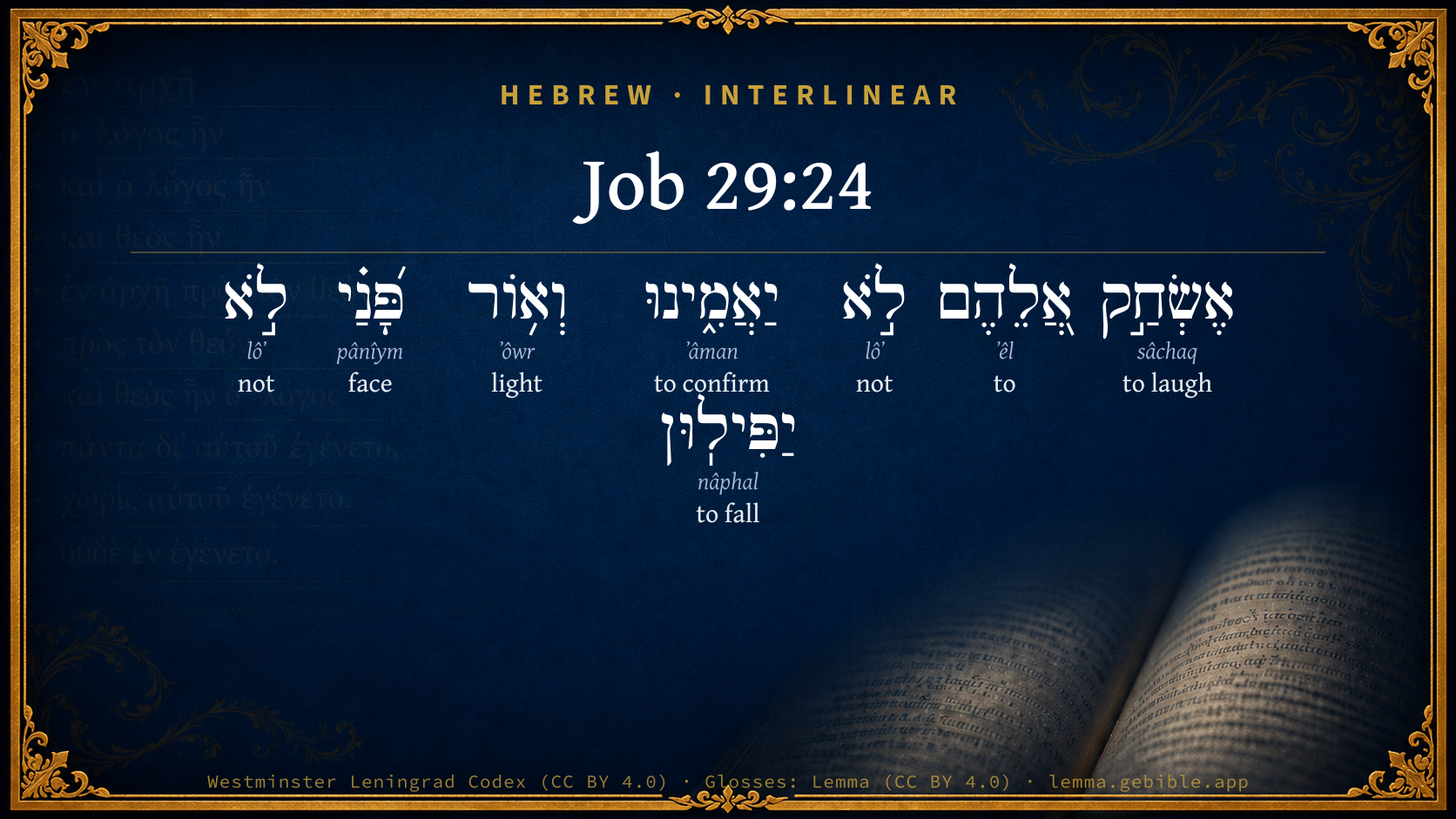
Job 29:24

Hebrew (Westminster Leningrad Codex) Job 29:24 appears in the Hebrew Old Testament. The text above is from the Westminster Leningrad Codex. Each word links to its Strong’s number, a concise gloss, and parsing drawn from the Open Scriptures Hebrew Bible morphology. Click any word for its full Brown-Driver-Briggs (BDB) entry.
Download image
Cite this verse

Job 29:24 (World English Bible). Public Domain. Lemma interlinear Bible study tool, https://lemma.gebible.app/v/job/29/24.

Show BibTeX & RIS
BibTeX
RIS
English Translation
I smiled on them when they had no confidence. They didn't reject the light of my face.
World English Bible · Public Domain
Download a study sheet

One document with this verse’s original text, its word-by-word gloss line, the meaning frame, cross-references with their text, attributed commentary, and full source and license credits — printable, and it pastes into notes with its structure intact.

This verse Autodidact and up

Study sheet (.html) Plain text (.txt)

A passage Seminary Student

Up to 50 verses in one chapter. A passage sheet keeps up to 6 commentary sources and 12 cross-references per verse, in the order this page ranks them, and says so on the sheet whenever that leaves anything out. Ask for a single verse and you get the Autodidact verse sheet above.

Everything on this page stays free to read, with no account — the sheet is a download of what is already on screen, not access to it.

Want to remove ads? Support Godless Engineer
Compare translations 3

The same verse in 3 English versions, stacked beneath the original-language interlinear above. Click any original word for its lexicon entry.

Each is an independent rendering of the whole verse — the interlinear is not word-aligned to these translations.

Highlighted words mark where these versions differ — a whole-verse word diff, not a word-by-word alignment.

  • World English Bible Public Domain
    I smiled on them when they had no confidence. They didn't reject the light of my face.
  • King James Version Public Domain
    If I laughed on them, they believed it not; and the light of my countenance they cast not down.
  • unfoldingWord Literal Text CC BY-SA 4.0
    I smiled on them they did not believe, and they did not cause the light of my face to fall.

unfoldingWord Literal Text — © unfoldingWord, licensed CC BY-SA 4.0. Word-aligned USFM3 via Door43 (git.door43.org/unfoldingWord/en_ult).

Versions to compare (up to 4)

3 of 4 selected

Show all 18 translations

Every available English version of this verse, each an independent rendering of the whole verse.

  • World English Bible Public Domain
    I smiled on them when they had no confidence. They didn't reject the light of my face.
  • Berean Standard Bible Public Domain
    If I smiled at them, they did not believe it; the light of my countenance was precious.
  • Majority Standard Bible Public Domain
    If I smiled at them, they did not believe it; the light of my countenance was precious.
  • King James Version Public Domain
    If I laughed on them, they believed it not; and the light of my countenance they cast not down.
  • American Standard Version (1901) Public Domain
    I smiled on them, when they had no confidence; And the light of my countenance they cast not down.
  • Revised Version (1885) Public Domain
    If I laughed on them, they believed it not; and the light of my countenance they cast not down.
  • Geneva Bible (1599) Public Domain
    If I laughed on them, they beleeued it not: neither did they cause the light of my countenance to fall.
  • Douay-Rheims (1899) Public Domain
    If at any time I laughed on them, they believed not, and the light of my countenance fell not on earth.
  • Young's Literal Translation Public Domain
    I laugh unto them -- they give no credence, And the light of my face cause not to fall.
  • Literal Standard Version CC BY-SA 4.0
    I laugh at them—they give no credence, || And do not cause the light of my face to fall.
  • Unlocked Literal Bible CC BY-SA 4.0
    I smiled on them when they did not expect it; they did not reject the light of my face.
  • unfoldingWord Literal Text CC BY-SA 4.0
    I smiled on them they did not believe, and they did not cause the light of my face to fall.
  • Darby Bible Public Domain
    [If] I laughed on them, they believed [it] not; and they troubled not the serenity of my countenance.
  • World Messianic Bible Public Domain
    I smiled on them when they had no confidence. They didn’t reject the light of my face.
  • Webster's Bible Public Domain
    If I laughed on them, they believed it not; and the light of my countenance they cast not down.
  • Free Bible Version CC BY-SA 4.0
    When I smiled at them they could hardly believe it; my approval meant all the world to them.
  • Bible in Basic English Public Domain
    I was laughing at them when they had no hope, and the light of my face was never clouded by their fear.
  • JPS Tanakh (1917) Public Domain
    If I laughed on them, they believed it not; and the light of my countenance they cast not down.

Literal Standard Version (2020), Covenant Press — licensed CC BY-SA 4.0. Text via the HelloAO Bible API (eBible.org). Unlocked Literal Bible (unfoldingWord) — licensed CC BY-SA 4.0. Text via the HelloAO Bible API (eBible.org). unfoldingWord Literal Text — © unfoldingWord, licensed CC BY-SA 4.0. Word-aligned USFM3 via Door43 (git.door43.org/unfoldingWord/en_ult). Free Bible Version, Dr. Jonathan Gallagher — licensed CC BY-SA 4.0. Text via the HelloAO Bible API (eBible.org).

Word by word

More ways to search: Search by grammar → Find every occurrence → Compare this word →

Practice this passage: Drill this verse → Learn its vocabulary →

About this verse

These counts appear in no published source. They are computed here, from the morphology-tagged text and Lemma’s own curated glosses. What Lemma adds →

8
words
7
distinct lemmas
Wisdom
section

Shared distinctive vocabulary

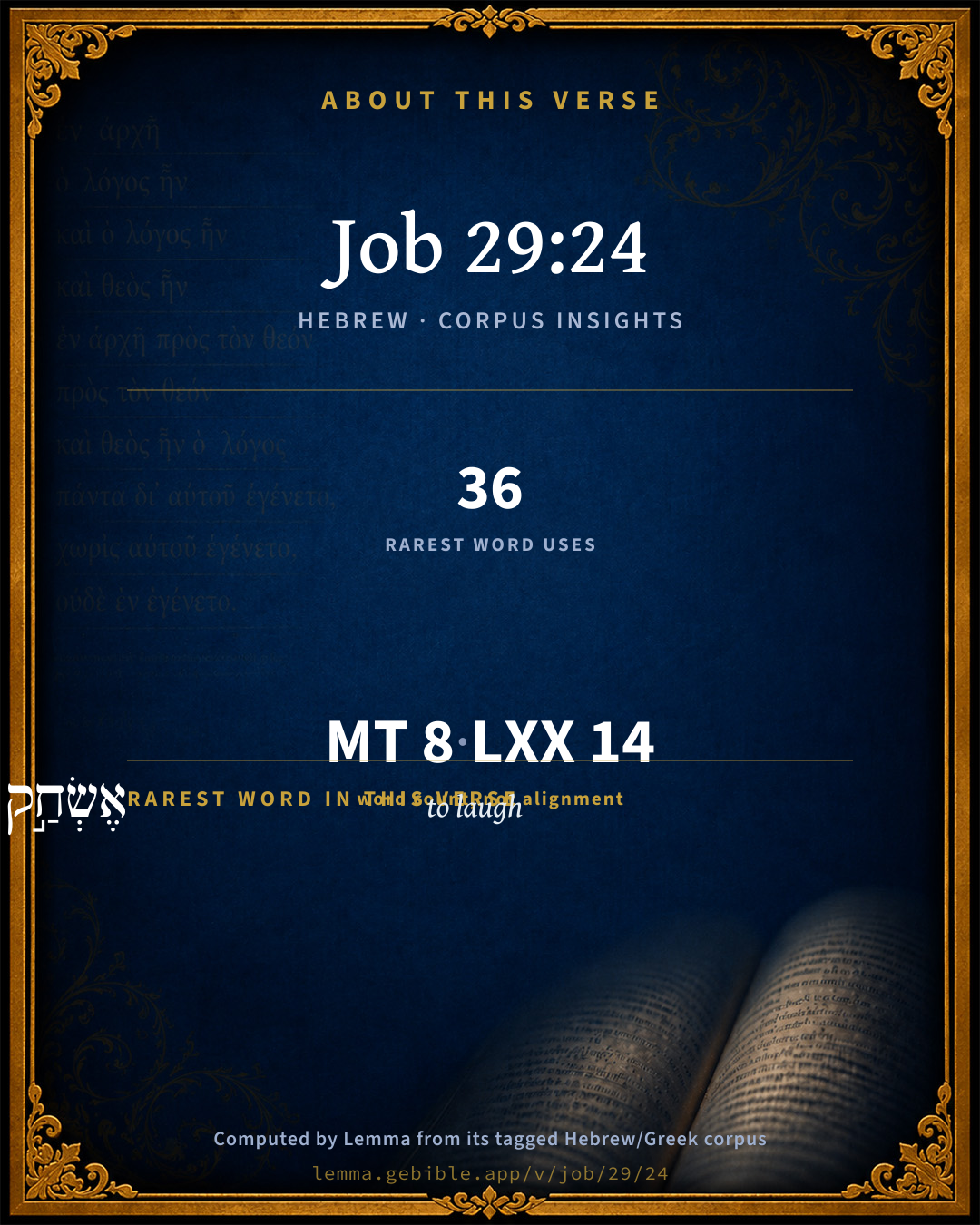
אֶשְׂחַ֣ק to laugh H7832 occurs in 36 verses of the Hebrew Bible. Also found in:

Grammatical profile

  • 3 verbs
  • 2 nouns
  • 1 preposition
  • 2 particles

Verb forms

  • אֶשְׂחַ֣ק Qal · Imperfect
  • יַאֲמִ֑ינוּ Hiphil · Imperfect
  • יַפִּילֽוּן Hiphil · Imperfect

Repetition

A word recurs within this verse — often emphatic in Hebrew:

Hebrew & Septuagint length

In English translation the verse runs 17 words from the Hebrew and 20 from the Septuagint (LXX English) — closely comparable.

A rough comparison of the two English renderings, which tokenize alike — not a word-level alignment.

Word counts can differ between the Hebrew and the Greek without any difference in meaning — e.g. the Hebrew direct-object marker אֵת has no separate Greek word, and Greek often adds the article ὁ.

In the original languages it is 8 Hebrew tokens and 14 Greek tokens — but the two are counted differently (Hebrew bundles its prefixes and suffixes into one token; the Greek is in lemma form), so that isn’t a like-for-like length.

Cross-references

5

Topical passages linked to Job 29:24 in the Treasury of Scripture Knowledge — connected by theme and wording, ordered by reader-vote popularity; previews shown in the World English Bible.

  • Psalms 4:6 Many say, "Who will show us any good?" Yahweh, let the light of your face shine on us.
  • Psalms 89:15 Blessed are the people who learn to acclaim you. They walk in the light of your presence, Yahweh.
  • Psalms 126:1 When Yahweh brought back those who returned to Zion, We were like those who dream.
  • Genesis 45:26 They told him, saying, "Joseph is still alive, and he is ruler over all the land of Egypt." His heart fainted, for he didn't believe them.
  • Luke 24:41 While they still didn't believe for joy, and wondered, he said to them, "Do you have anything here to eat?"

Cross-references courtesy of OpenBible.info (CC BY 4.0).

Hebrew and Greek witnesses Masoretic Hebrew ↔ Greek Septuagint

The same verse in the two great witnesses to the Old Testament, shown verse-for-verse.

These are two independent witnesses, not word-aligned to each other, and the Septuagint is shown in lemma (dictionary) form.

Hebrew Job 29:24 Masoretic · Westminster Leningrad Codex

אֶשְׂחַ֣ק אֲ֭לֵהֶם לֹ֣א יַאֲמִ֑ינוּ וְא֥וֹר פָּ֝נַ֗י לֹ֣א יַפִּילֽוּן

I smiled on them when they had no confidence. They didn't reject the light of my face.

World English Bible · Public Domain

Greek LXX Job 29:24 Septuagint · lemma form

ἐάν γελάω πρός αὐτός οὐ μή πιστεύω καί φῶς ὁ πρόσωπον ἐγώ οὐ ἀποπίπτω

Were I to laugh on them, they would not believe it; and the light of my face has not failed.

LXX2012 (modern English Septuagint) · Public Domain

Hebrew: Westminster Leningrad Codex (CC BY 4.0). Greek: Septuagint (public domain); English from LXX2012 (modern English Septuagint) (Public Domain). How the Septuagint differs from the Hebrew →

Commentary

Notes on Job 29:24 from classic Christian and Jewish commentators (each source and its license shown beneath its notes). The classic Christian expositions comment on the surrounding passage and are grouped to its opening verse, so a note may address several verses; the Jewish commentaries on the Tanakh (Rashi and others) are per-verse, so they appear only where the commentator wrote on this verse.

Lemma curates 59 commentaries, every one of them public domain or Creative Commons licensed, each selected and text-cleaned for this edition rather than reprinted as found. About our sources →

Trapp's Complete Commentary

John Trapp

Job 29:24 [If] I laughed on them, they believed [it] not; and the light of my countenance they cast not down.

Ver. 24. If I laughed on them, they believed it not] They took it for a great favour, and could hardly think that I would grace them so far as to smile upon them, or jest with them; which if I did at any time, they were over joyed, Ecc 10:19. Ingenii fructus tenuissimus eat risus, saith Cicero (de Orat. lib. 2). To break a jest is no such witty thing as men conceit it. Howbeit, a harmless jest (that hath nothing in it which may justly grieve or offend another) may very well consistent with piety and Christian gravity; whatever some sour Anabaptists have held to the contrary. Jocularity indeed and scurrility are strictly forbidden, and reckoned among those τα ανηκοντα, things that conduce not to the main end of our lives, Eph 5:4. But Socrates would be very merry when he liked his company; yet so as that his mirth should be some way profitable, saith Xenophon, lib. 4, de Dict. et Fact. (Socr.) And Erasmus did the Papists more prejudice by his jesting, saith a grave author, than Luther did by his stomaching and storming. Good men’s jests should have something in them of seriousness and usefulness. All their speeches should be seasoned with salt of grace; and in the midst of their recreations they should show that their best affections are upon better things. Great care must be taken, that too much familiarity with those below us breed not contempt; which some think is means by the next clause, "And the light of my countenance they cast not down"; or, Yet the light, &c., that is, they did not slight me because of this familiar carriage; they did not therefore count me ridiculous and vain as men did that Rodulphus, the 35th archbishop of Canterbury, that succeeded Anselm; whom, for his jesting and merry toys, unbeseeming the gravity of his age and place, they surnamed or rather nicknamed, Nugax, the trifler. Sed authoritatem meam non spernebant, nihilomin, us me reverebantur, They despised not mine authority, they reverenced me no whit the less (Vatablus); but rather they took care that nothing might be done whereby of merry I might be made sad; they cherished this sign of complacency in me as a rare thing, and so much the more accepted as less expected and unusual; neither would they be so bold and so bob with me as to return me jest for jest, as if I had been their compeer and hail fellow well met. One paraphrast, Mr Abbot, senseth the whole verse thus: If I by my smiles gave any intimation of my suspicion of any report or business, it was presently distrusted and dissented from of all the rest. And on the other hand; my least countenance or show of approbation to any cause was observed of others, as a rule to go by. He goes on to give the meaning of the next words thus:

John Trapp, A Commentary or Exposition upon All the Books of the Old and New Testament (1647–1656) — public domain. Text from a community e-Sword module.

Joseph Benson's Commentary

Job 29:24. If I laughed on them — That is, carried myself familiarly and pleasantly with them; they believed it not — It was so acceptable to them to see me well pleased with them, and cheerful among them, that they could scarcely believe their eyes and ears which testified that it was so. And the light of my countenance they cast not down — My familiarity with them did not produce presumption in them to say or do any thing that might grieve me, or make my countenance to fall. They were very cautious not to abuse my smiles, nor to give me any occasion to change my countenance or carriage toward them.

Joseph Benson's Commentary on the Old and New Testaments (1811–1818) — public domain. Text from a community e-Sword module.

Geneva Bible (1599)

Geneva Bible translators

That is, they thought it not to be a rest, or they thought not that I would condescend unto them.

They were afraid to offend me and cause me to be angry.

Geneva Bible (1599) marginal notes — public domain. Text via Bolls.life.

Jamieson, Fausset & Brown

Robert Jamieson, A. R. Fausset & David Brown

When I relaxed from my wonted gravity (a virtue much esteemed in the East) and smiled, they could hardly credit it; and yet, notwithstanding my condescension, they did not cast aside reverence for my gravity. But the parallelism is better in UMBREIT'S translation, "I smiled kindly on those who trusted not," that is, in times of danger I cheered those in despondency. And they could not cast down (by their despondency) my serenity of countenance (flowing from trust in God) (Pro 16:15; Psa 104:15). The opposite phrase (Gen 4:5-6). "Gravity" cannot well be meant by "light of countenance."

Jamieson, Fausset & Brown — Commentary Critical and Explanatory on the Whole Bible (1871) — public domain (CC PDM 1.0). Text via the HelloAO Bible API.

Adam Clarke's Commentary

Verse 24. I laughed on them, they believed it not] Similar to that expression in the Gospel, Lu 24:41: And while they believed not for joy, and wondered, he said __. Our version is sufficiently perspicuous, and gives the true sense of the original, only it should be read in the indicative and not in the subjunctive mood: I laughed on them - they believed it not. We have a similar phrase: The news was too good to be true.

The light of my countenance] This evidence of my benevolence and regard. A smile is, metaphorically, the light of the countenance.

They cast not down.] They gave me no occasion to change my sentiments or feelings towards them. I could still smile upon them, and they were then worthy of my approbation. Their change he refers to in the beginning of the next chapter.

Adam Clarke's Commentary on the Bible (1810–1826) — public domain. Text from a community e-Sword/MySword module.

Ellicott's Commentary for English Readers

(24) If I laughed on them.—That is, “They would not believe that I could be so affable to them, could so condescend to them—they looked up to me with the greatest deference.”

A Bible Commentary for English Readers, edited by Charles John Ellicott (1878–1897) — public domain. Text from a community e-Sword module.

The Cambridge Bible for Schools and Colleges

gen. ed. J. J. S. Perowne

24. The verse means rather,

I laughed on them, when they had no confidence,

And the light of my countenance they cast not down.

Job, with his broader insight and more capable counsel, smiled on those who were perplexed and despondent; what seemed insurmountable difficulty or threatened disaster to them, seemed to him a thing easy to overcome and nothing to create alarm; while on the other hand the despondency of others was never able to cloud the cheerfulness of his countenance, so full was his mind of resource.

The Cambridge Bible for Schools and Colleges (gen. ed. J. J. S. Perowne; Cambridge University Press, 1878–1918) — public domain. Text from a community e-Sword module.

John Gill's Exposition

If I laughed on them, they believed it not,.... Not that he at any time laughed at them, by way of derision; but when in a cheerful frame of mind, or in a merry mood, he used freedom and familiarity, and jested with them; but they could not believe that he did jest, or was in jest, he being a man always of such gravity and seriousness, that they concluded the smile on his countenance, and the pleasant turn of his expression, had a serious meaning in them; or such familiarity with them was so pleasing to them, that they could scarcely for joy believe that he did condescend to indulge such an air of pleasantry: or as Mr. Broughton renders it, and so some others to the same sense, "they would not be bold" (i); familiarity with them did not breed contempt, as it sometimes does; they did not presume upon it, and grow bold and insolent, and make him their equal, and jest with him again; but still there was an awe upon them, and they behaved with reverence to him; and to show how great it was is the design of the expression:

and the light of my countenance they cast not down; they did not ruffle his mind, or disturb the serenity of it; or cause him to change his countenance, through any bold and indecent behaviour towards him, encouraged by the freedom and pleasantry he used with them; they did not put him to shame, or provoke him to anger and displeasure by any unbecoming deportment; they kept their distance, they did not detract from his authority and majesty, or in the least lessen that, but behaved with the same reverence and regard to him they ever did; see Gen 4:6.

(i) "non tamen sibi sumebant audaciam", Michaelis; "neque tam audaces fiunt", Reimar apud Schultens.

John Gill's Exposition of the Whole Bible (1746–1763) — public domain (CC PDM 1.0). Text via the HelloAO Bible API.

Albert Barnes' Notes on the Bible

If I laughed on them they believed it not - There is considerable variety in the interpretation of this member of the verse. Dr. Good renders it, “I smiled upon them, and they were gay.” Herder, If I laughed at them, they were not offended.” Coverdale,” When I laughed, they knew well it was not earnest.” Schultens, “I will laugh at them, they are not secure.” But Rosenmuller, Jun. et Trem., Noyes and Umbreit, accord with the sense given in our common translation. The Hebrew literally is, “Should I laugh upon them, they did not confide;” and, according to Rosenmuller, the meaning is, “Such was the reverence for my gravity, that if at any time I relaxed in my severity of manner, they would scarcely believe it, nor did they omit any of their reverence toward me, as if familiarity with the great should produce contempt.” Grotius explains it to mean, “Even my jests, they thought, contained something serious.” The word used here, however (שׂחק śâchaq), means not only to laugh or smile upon, but; to laugh at, or deride; Psa 52:6; Job 30:1; compare Job 5:22; Job 39:7; Job 22:19. It seems to me, that the sense is that so great was his influence, that he was able to control them even with a smile, without saying a word; that if, when a measure was proposed in debate, he should even smile, though he said nothing, they would have no confidence in it, but would at once abandon it as unwise. No higher influence than this can be well conceived, and this exposition accords with the general course of remark, where Job traces along the various degrees of his influence until he comes to this, the highest of them all.

And the light of my countenance they cast not down - His smile of favor on an undertaking, or his smile at the weakness or lack of wisdom of any thing proposed, they could not resist. It settled the matter. They had not power by their arguments or moral courage to resist him even if he did not say a word, or even to change the aspect of his countenance. A look, a token of approbation or disapprobation from him, was enough.

Albert Barnes' Notes on the Bible (1834–1885) — public domain. Text from a community e-Sword/MySword module.

Haydock's Catholic Bible Commentary

Earth, with neglect. (Calmet) --- My attendants could scarcely believe their own eyes, through joy, (Haydock) when I assumed a more familiar air with them. (Calmet) --- They still revered my authority. (Menochius)

George Leo Haydock (1774–1849), Haydock's Catholic Family Bible and Commentary, 1859 edition — public domain. Excludes Psalms (Douay-Rheims chapter numbering differs from Protestant) and Deuterocanonical books (Catholic canon only).

Matthew Poole's English Annotations

If I laughed on them, or sported or jested with them, i.e. carried myself familiarly and pleasantly with them.

They believed it not; it was so acceptable to them to see me well-pleased with them, that they could scarce believe their eyes and ears that it was so: compare Gen 45:26; Psa 126:1.

The light of my countenance they cast not down; my familiarity did not breed contempt or presumption in them to say or do any thing that might grieve me, or make my countenance to fall, as it doth in case of shame or sorrow, Gen 4:5. They were very cautious not to abuse my smiles, nor to give me any occasion to change my countenance or carriage towards them.

Matthew Poole's English Annotations on the Holy Bible (1683–1685) — public domain. Text from a community e-Sword/MySword module.

Whedon's Commentary on the Bible

Daniel D. Whedon

24. Believed it not — They could not believe that he would condescend so much as to smile upon them. According to others, “I smiled upon them,” to infuse confidence, when “they believed not” — were despairing.

Light of my countenance — A figure common to the Scriptures founded upon emotional expression through the face. Anger darkens, benignity and grace light up, the countenance. To cast down its light, then, would be to disturb its serenity, or cause sadness.

Daniel D. Whedon (gen. ed.), Commentary on the Old and New Testaments (1874–1909) — public domain. Text from a community e-Sword module.

The Pulpit Commentary

If I laughed on them, they believed it not; rather, if I smiled on them. If, as a mark of favour, I smiled on any, they thought it such graciousness and condescension that they could scarcely believe it possible. And the light of my countenance they cast not down. They never put me out of countenance, or made me sad and gloomy, by opposing my views and ranging themselves against me.

The Pulpit Commentary (1880–1919), ed. H.D.M. Spence-Jones & Joseph S. Exell — public domain. Text from a community e-Sword module.

John Wesley's Explanatory Notes

Laughed - Carried myself so familiarly with them, that they could scarce believe their eyes and ears. Cast not down - They were cautious not to give me any occasion to change my countenance towards them.

John Wesley, Explanatory Notes Upon the Whole Bible (1754–1765) — public domain. Text via the GEBible commentary corpus.

Rashi

Rabbi Shlomo Yitzchaki (Rashi)

they would not believe it that I was jesting with them, because of my esteem[ed position].

and they would not cast down the light of my countenance They were afraid to get near me and to become familiar with me.

Rashi on the Tanakh — English translations: “The Judaica Press complete Tanach with Rashi, translated by A. J. Rosenberg” (CC BY 4.0); “Pentateuch with Rashi's commentary by M. Rosenbaum and A.M. Silbermann, 1929-1934” (public domain); “The Metsudah Tanach series, Lakewood, N.J” (CC BY 4.0); and “The Book of Joshua, Metsudah Publications, 1997” (CC BY 4.0). Text via Sefaria.

Lesson kit

Teaching starters — assembled from the data on this page, not authored interpretation. Every prompt links to the verse data it draws on. Edit before teaching.

Job, in the Wisdom, opens this verse with 8 words (7 distinct Hebrew lemmas). Its most distinctive word is sâchaq (“to laugh”). A historical commentator’s framing appears above. Read the whole chapter for the surrounding context.

Discussion questions

  1. How does “to laugh” (sâchaq) shape what this verse is saying?
  2. Judges 16:25 shares the word «to laugh» with this verse. How do the two illuminate each other?
  3. “not” occurs 2× in this one verse. What is the effect of the repetition?
  4. These translations render this verse differently. What is at stake in choosing one wording over another?
  5. The verb «אֶשְׂחַ֣ק» is Qal Imperfect. How does its form color the action?
  6. Reading how Trapp's Complete Commentary and Joseph Benson's Commentary read this verse, where do the two commentators agree and where do they part?

Things to notice

Reading settings

Reading text

Shown beneath each verse's original-language words.

Old Testament
Old Testament edition

Read the OT as the Masoretic Hebrew (MT) or the Greek Septuagint (LXX).

English shown for the Greek Septuagint (in the Hebrew ↔ Greek comparison).

Comparing translations? Open the Compare panel on any verse page to stack up to four side by side.