
Psalms 89:28

Hebrew (Westminster Leningrad Codex) Psalms 89:28 appears in the Hebrew Old Testament. The text above is from the Westminster Leningrad Codex. Each word links to its Strong’s number, a concise gloss, and parsing drawn from the Open Scriptures Hebrew Bible morphology. Click any word for its full Brown-Driver-Briggs (BDB) entry.
Download image
Cite this verse

Psalms 89:28 (World English Bible). Public Domain. Lemma interlinear Bible study tool, https://lemma.gebible.app/v/psalms/89/28.

Show BibTeX & RIS
BibTeX
RIS
English Translation
I will keep my loving kindness for him forevermore. My covenant will stand firm with him.
World English Bible · Public Domain
Download a study sheet

One document with this verse’s original text, its word-by-word gloss line, the meaning frame, cross-references with their text, attributed commentary, and full source and license credits — printable, and it pastes into notes with its structure intact.

This verse Autodidact and up

Study sheet (.html) Plain text (.txt)

A passage Seminary Student

Up to 50 verses in one chapter. A passage sheet keeps up to 6 commentary sources and 12 cross-references per verse, in the order this page ranks them, and says so on the sheet whenever that leaves anything out. Ask for a single verse and you get the Autodidact verse sheet above.

Everything on this page stays free to read, with no account — the sheet is a download of what is already on screen, not access to it.

Want to remove ads? Support Godless Engineer
Compare translations 3

The same verse in 3 English versions, stacked beneath the original-language interlinear above. Click any original word for its lexicon entry.

Each is an independent rendering of the whole verse — the interlinear is not word-aligned to these translations.

Highlighted words mark where these versions differ — a whole-verse word diff, not a word-by-word alignment.

  • World English Bible Public Domain
    I will keep my loving kindness for him forevermore. My covenant will stand firm with him.
  • King James Version Public Domain
    My mercy will I keep for him for evermore, and my covenant shall stand fast with him.
  • unfoldingWord Literal Text CC BY-SA 4.0
    I will keep my covenant faithfulness for him forever, and my covenant will be confirmed to him.

unfoldingWord Literal Text — © unfoldingWord, licensed CC BY-SA 4.0. Word-aligned USFM3 via Door43 (git.door43.org/unfoldingWord/en_ult).

Versions to compare (up to 4)

3 of 4 selected

Show all 18 translations

Every available English version of this verse, each an independent rendering of the whole verse.

  • World English Bible Public Domain
    I will keep my loving kindness for him forevermore. My covenant will stand firm with him.
  • Berean Standard Bible Public Domain
    I will forever preserve My loving devotion for him, and My covenant with him will stand fast.
  • Majority Standard Bible Public Domain
    I will forever preserve My loving devotion for him, and My covenant with him will stand fast.
  • King James Version Public Domain
    My mercy will I keep for him for evermore, and my covenant shall stand fast with him.
  • American Standard Version (1901) Public Domain
    My lovingkindness will I keep for him for evermore; And my covenant shall stand fast with him.
  • Revised Version (1885) Public Domain
    My mercy will I keep for him for evermore, and my covenant shall stand fast with him.
  • Geneva Bible (1599) Public Domain
    My mercie will I keepe for him for euermore, and my couenant shall stande fast with him.
  • Douay-Rheims (1899) Public Domain
    And I will make him my firstborn, high above the kings of the earth.
  • Young's Literal Translation Public Domain
    To the age I keep for him My kindness, And My covenant `is' stedfast with him.
  • Literal Standard Version CC BY-SA 4.0
    For all time I keep for him My kindness, || And My covenant [is] steadfast with him.
  • Unlocked Literal Bible CC BY-SA 4.0
    I will extend my covenant faithfulness to him forever; and my covenant with him will be secure.
  • unfoldingWord Literal Text CC BY-SA 4.0
    I will keep my covenant faithfulness for him forever, and my covenant will be confirmed to him.
  • Darby Bible Public Domain
    My loving-kindness will I keep for him for evermore, and my covenant shall stand fast with him;
  • World Messianic Bible Public Domain
    I will keep my loving kindness for him forever more. My covenant will stand firm with him.
  • Webster's Bible Public Domain
    \\89:27\\Also I will make him my first-born, higher than the kings of the earth.
  • Free Bible Version CC BY-SA 4.0
    I will love him faithfully forever; my agreement with him shall never come to an end.
  • Bible in Basic English Public Domain
    I will keep my mercy for him for ever; my agreement with him will not be changed.
  • JPS Tanakh (1917) Public Domain
    (89-29) For ever will I keep for him My mercy, and My covenant shall stand fast with him.

Literal Standard Version (2020), Covenant Press — licensed CC BY-SA 4.0. Text via the HelloAO Bible API (eBible.org). Unlocked Literal Bible (unfoldingWord) — licensed CC BY-SA 4.0. Text via the HelloAO Bible API (eBible.org). unfoldingWord Literal Text — © unfoldingWord, licensed CC BY-SA 4.0. Word-aligned USFM3 via Door43 (git.door43.org/unfoldingWord/en_ult). Free Bible Version, Dr. Jonathan Gallagher — licensed CC BY-SA 4.0. Text via the HelloAO Bible API (eBible.org).

Word by word

More ways to search: Search by grammar → Find every occurrence → Compare this word →

Practice this passage: Drill this verse → Learn its vocabulary →

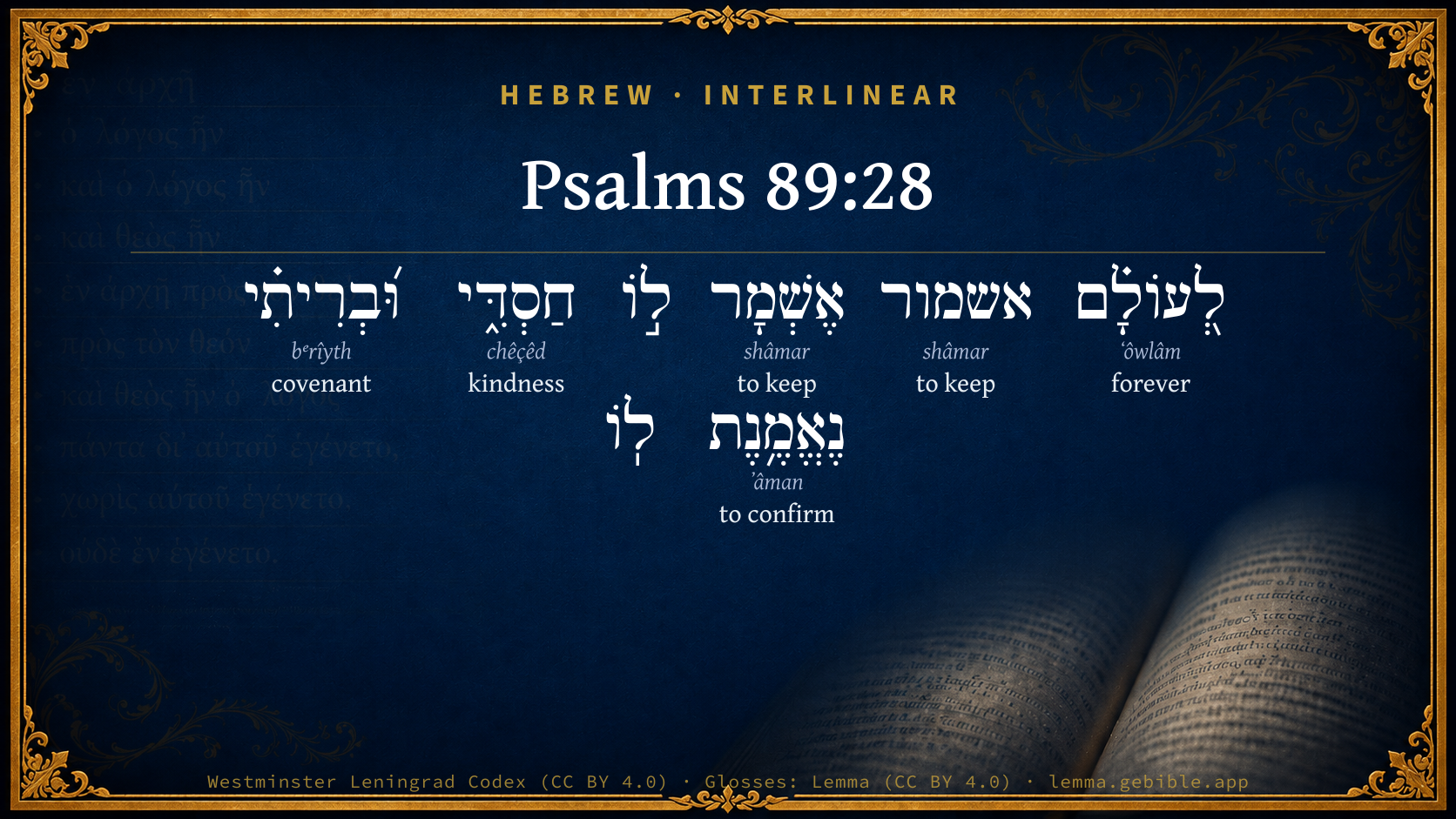
נֶאֱמֶ֥נֶת
ʼâman
H539
“confirming”
Verb, Niphal, Participle Active, Feminine, Singular, Absolute
Part of Speech
Verb
Stem
Niphal
Form
Participle Active
Gender
Feminine
Number
Singular
State
Absolute
Full BDB Definition

Origin: a primitive root

TWOT: 116

to support, confirm, be faithful - (Qal) - to support, confirm, be faithful, uphold, nourish - foster-father (substantive) - foster-mother, nurse - pillars, supporters of the door - (Niphal) - to be established, be faithful, be carried, make firm - to be carried by a nurse - made firm, sure, lasting - confirmed, established, sure - verified, confirmed - reliable, faithful, trusty - (Hiphil) - to stand firm, to trust, to be certain, to believe in - stand firm - trust, believe
  1. לְ֭עוֹלָ֗ם ʻôwlâm H5769 “to/for · forever” Preposition + Noun, Common, Masculine, Singular, Absolute
  2. אשמור shâmar H8104 “to keep” Verb, Qal, Imperfect, 1st Person, Common, Singular
  3. אֶשְׁמָר shâmar H8104 “to keep” Verb, Qal, Imperfect, 1st Person, Common, Singular
  4. חַסְדִּ֑י chêçêd H2617 “kindness · my” Noun, Common, Masculine, Singular, Construct + Suffix, Personal, 1st Person, Common, Singular
  5. וּ֝בְרִיתִ֗י bᵉrîyth H1285 “and · covenant · my” Conjunction + Noun, Common, Feminine, Singular, Construct + Suffix, Personal, 1st Person, Common, Singular

About this verse

These counts appear in no published source. They are computed here, from the morphology-tagged text and Lemma’s own curated glosses. What Lemma adds →

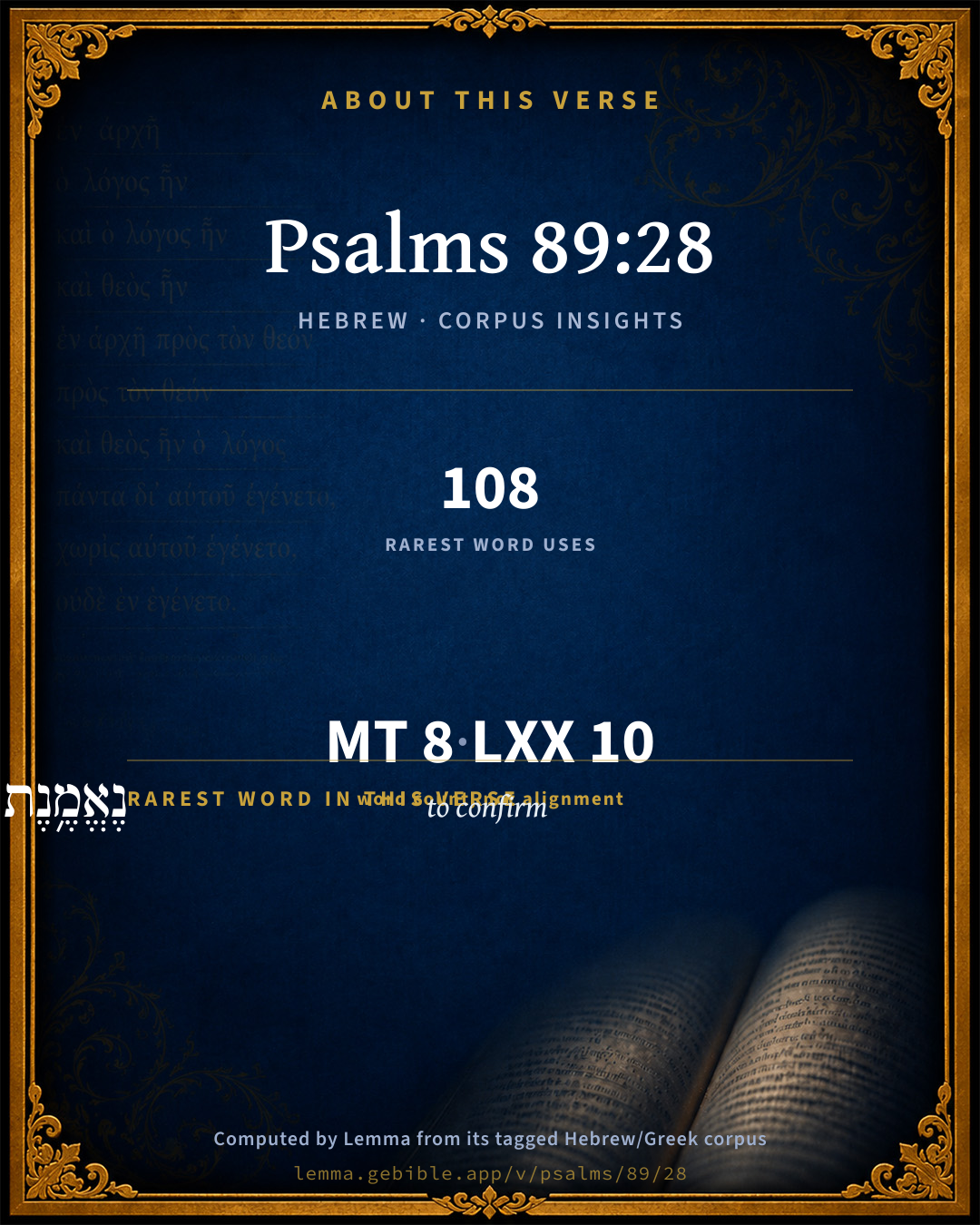
8
words
5
distinct lemmas
Wisdom
section

Grammatical profile

  • 3 verbs
  • 3 nouns
  • 2 prepositions

Verb forms

  • אשמור Qal · Imperfect
  • אֶשְׁמָר Qal · Imperfect
  • נֶאֱמֶ֥נֶת Niphal · Participle Active

Repetition

A word recurs within this verse — often emphatic in Hebrew:

  • אשמור to keep H8104 ×2

Hebrew & Septuagint length

In English translation the verse runs 16 words from the Hebrew and 17 from the Septuagint (LXX English) — closely comparable.

A rough comparison of the two English renderings, which tokenize alike — not a word-level alignment.

Word counts can differ between the Hebrew and the Greek without any difference in meaning — e.g. the Hebrew direct-object marker אֵת has no separate Greek word, and Greek often adds the article ὁ.

In the original languages it is 8 Hebrew tokens and 10 Greek tokens — but the two are counted differently (Hebrew bundles its prefixes and suffixes into one token; the Greek is in lemma form), so that isn’t a like-for-like length.

Cross-references

9

Topical passages linked to Psalms 89:28 in the Treasury of Scripture Knowledge — connected by theme and wording, ordered by reader-vote popularity; previews shown in the World English Bible.

  • Isaiah 55:3 Turn your ear, and come to me; hear, and your soul shall live: and I will make an everlasting covenant with you, even the sure mercies of David.
  • Jeremiah 33:20–21 Thus says Yahweh: If you can break my covenant of the day, and my covenant of the night, so that there shall not be day and night in their season;
  • Acts 13:32–34 We bring you good news of the promise made to the fathers,
  • 2 Samuel 7:15–16 but my loving kindness shall not depart from him, as I took it from Saul, whom I put away before you.
  • 2 Samuel 23:5 Most assuredly my house is not so with God; Yet he has made with me an everlasting covenant, Ordered in all things, and sure: For it is all my salvation, and all [my] desire, Although he doesn't make it grow.
  • Psalms 89:33–34 But I will not completely take my loving kindness from him, Nor allow my faithfulness to fail.
  • Psalms 111:5 He has given food to those who fear him. He always remembers his covenant.
  • Psalms 111:9 He has sent redemption to his people. He has ordained his covenant forever. His name is holy and awesome!
  • Isaiah 54:10 For the mountains may depart, and the hills be removed; but my loving kindness shall not depart from you, neither shall my covenant of peace be removed, says Yahweh who has mercy on you.

Cross-references courtesy of OpenBible.info (CC BY 4.0).

Hebrew and Greek witnesses Masoretic Hebrew ↔ Greek Septuagint

The same verse in the two great witnesses to the Old Testament, shown verse-for-verse.

You’re reading Greek Psalm 88 (Hebrew Psalm 89). The Septuagint counts the superscription, so verse numbers can differ from the Hebrew — chapter-level alignment, not verse-by-verse. Numbering follows Rahlfs.

These are two independent witnesses, not word-aligned to each other, and the Septuagint is shown in lemma (dictionary) form.

Hebrew Psalms 89:28 Masoretic · Westminster Leningrad Codex

לְ֭עוֹלָ֗ם אשמור אֶשְׁמָר ל֣וֹ חַסְדִּ֑י וּ֝בְרִיתִ֗י נֶאֱמֶ֥נֶת לֽוֹ

I will keep my loving kindness for him forevermore. My covenant will stand firm with him.

World English Bible · Public Domain

Greek LXX Greek Psalm 88:28 Septuagint · lemma form

καΐἐγώ πρωτότοκος τίθημι αὐτός ὑψηλός παρά ὁ βασιλεύς ὁ γῆ

I will keep my mercy for him for ever, and my covenant shall be firm with him.

LXX2012 (modern English Septuagint) · Public Domain

Hebrew: Westminster Leningrad Codex (CC BY 4.0). Greek: Septuagint (public domain); English from LXX2012 (modern English Septuagint) (Public Domain). How the Septuagint differs from the Hebrew →

Commentary

Notes on Psalms 89:28 from classic Christian and Jewish commentators (each source and its license shown beneath its notes). The classic Christian expositions comment on the surrounding passage and are grouped to its opening verse, so a note may address several verses; the Jewish commentaries on the Tanakh (Rashi and others) are per-verse, so they appear only where the commentator wrote on this verse.

Lemma curates 59 commentaries, every one of them public domain or Creative Commons licensed, each selected and text-cleaned for this edition rather than reprinted as found. About our sources →

Trapp's Complete Commentary

John Trapp

Psa 89:28 My mercy will I keep for him for evermore, and my covenant shall stand fast with him.

Ver. 28. My mercy will I keep for hint] It shall be ready at all times for his relief, even the sure mercies of David, neither will I utterly take it from him, as I did from Saul.

And my covenant shall stand fast with him] Faster than the mountains, Isa 54:10, firmer than the courses of sun and moon, day and night, Jer 31:35-36; Jer 33:20-21.

John Trapp, A Commentary or Exposition upon All the Books of the Old and New Testament (1647–1656) — public domain. Text from a community e-Sword module.

Joseph Benson's Commentary

Psa 89:28-34. My mercy — Declared and promised to him and his seed, as it here follows; will I keep for him for evermore — Nothing shall alter my kind intentions, but I will mercifully fulfil all my promises to him; and my covenant shall stand fast, &c. — Of which see notes on 2Sa 7:12-13. His seed will I make to endure for ever — That is, to sit upon the throne for ever, as the next words explain it. This was accomplished only in Christ, the eternal king of the church and of the world, who was of David’s seed according to the flesh. And his throne as the days of heaven — As long as the world shall have a being, or for ever, as was now said. It shall be as unchangeable and durable as the heavens themselves, which are of an incorruptible nature. If his children forsake my law — Of this and the following verses, to Psa 89:34, see the notes on 2Sa 7:14-16.

Joseph Benson's Commentary on the Old and New Testaments (1811–1818) — public domain. Text from a community e-Sword module.

J. A. Alexander on Psalms

Joseph Addison Alexander

29. (Psa 89:28) For ever will I keep for him my mercy, and my covenant is sure to him. For ever, literally to eternity. Keep, i.e. keep it in reserve for him. My covenant, or conditional promise. See above, on Psa 89:3. Sure, or more exactly, made sure, ratified, confirmed. Compare Isa 55:3.

Joseph Addison Alexander, The Psalms Translated and Explained (1850) — public domain. Text from a community e-Sword module.

John Calvin's Commentaries

28. And I will keep my mercy to him for ever. We see how God frequently repeats, that he had set up the kingdom of David with the express design of establishing it for ever. By placing his mercy first in order, and then adding his covenant, he points out the cause of this covenant, intimating in one word, that it is gratuitous, and that his grace is not only the foundation on which it rests, but also the cause why it is preserved inviolate. The amount is, that God will be always merciful to David, in order that his covenant may never fail. From this it follows, that its inviolability depends upon the mere good pleasure of God. In the next verse, God expresses the effect of his truth, declaring, that the posterity of David will sit for ever on the royal throne. There being nothing under heaven of long continuance, the days of heaven is an expression employed to denote everlasting duration. Whence it follows, that this prophecy cannot have its full accomplishment in any till we come to Christ, in whom alone, in the strict and proper sense, this everlasting duration is to be found.

John Calvin's Commentaries (1540-1563) — public domain. Text from the Calvin Translation Society English edition (1840s-50s) via the Christian Classics Ethereal Library (ccel.org). Calvin's coverage is partial (roughly two-thirds of the Bible); uncommented books and verses are honest gaps, never fabricated. The 19th-century editor's footnotes and remarks are omitted so the notes are faithfully Calvin's own voice.

The Cambridge Bible for Schools and Colleges

gen. ed. J. J. S. Perowne

28, 29. The emphasis is on for evermore. The permanence of the promise is expressed in the strongest terms. Cp. 2Sa_7:13; 2Sa_7:16.

Once more too the notes of lovingkindness and faithfulness are sounded, for the word rendered shall stand fast is from the same root as the word for faithfulness; hence R.V. marg. shall be faithful.

as the days of heaven] I.e. for ever; the heaven is the emblem of permanence as well as stability. Again a phrase originally referring to the nation (Deu_11:21) is applied to the king.

The Cambridge Bible for Schools and Colleges (gen. ed. J. J. S. Perowne; Cambridge University Press, 1878–1918) — public domain. Text from a community e-Sword module.

John Gill's Exposition

His seed also will I make to endure for ever,.... Not a race of kings from David, which ended at the Babylonish captivity; not the natural seed of David, not the Messiah himself, who sprung from him, but the Messiah's spiritual seed, which were given him by the Father, adopted through him, regenerated by his Spirit and grace, begotten through his Gospel, and the ministry of it, and born again in his church, and to whom he stands in the relation of the everlasting Father, Isa 9:6. The "enduring" of these "for ever" may denote the final perseverance of particular believers; which may be concluded from the relation of Christ, as an everlasting Father to them, who therefore must continue as his children; from his affection to them, from which there can be no separation; from their security in and by him, being in his hand, and in his heart; from their adoption, which is never revoked, being sons they are no more servants; from their regeneration of incorruptible seed; and from the nature of faith, which can never be lost: they that trust in the Lord are as Mount Zion, which endures for ever, Psa 125:1 or it may be expressive of the duration of the church of Christ in general, throughout all periods of time, notwithstanding the malice and opposition of men and devils against it; see Mat 16:18,

and his throne as the days of heaven; a phrase signifying a great length of time, Deu 11:21 yea, invariable constancy and duration, Jer 31:25 and indeed the throne of Christ is for ever and ever, and will be when the present earth and heavens are fled away, Psa 45:6. Christ is upon a throne now in heaven, the same with his divine Father's; and here he must sit and reign, till all enemies are put under him; and he will be on a throne of glory when he judges the world, and in the New Jerusalem state for the space of a thousand years; and, after that, he will reign with his saints, and they with him, for evermore; his throne and kingdom are everlasting, Isa 9:7.

John Gill's Exposition of the Whole Bible (1746–1763) — public domain (CC PDM 1.0). Text via the HelloAO Bible API.

Albert Barnes' Notes on the Bible

My mercy will I keep for him for evermore - I will not withdraw my favor from him, nor from his posterity, Psa 89:33-36. In him, and in his Great Descendant, the throne shall be established forever. This dominion will not be like the changing dynasties of this world, but will be perpetual and eternal.

And my covenant shall stand fast with him - See 2Sa 7:14-16; 2Sa 23:5. It shall be firm, or established with him and his family.

Albert Barnes' Notes on the Bible (1834–1885) — public domain. Text from a community e-Sword/MySword module.

Matthew Poole's English Annotations

My mercy, declared and promised to him and his seed, as it here follows. My covenant; of which see 2Sa 7:12,13, &c.

Matthew Poole's English Annotations on the Holy Bible (1683–1685) — public domain. Text from a community e-Sword/MySword module.

The Treasury of David

Charles H. Spurgeon

Ver. 28. My mercy will I keep for him for evermore. The kings of David's line needed mercy, and mercy prevented their house from utterly perishing until the Son of Mary came. He needs no mercy for himself, but he is a representative man, and the mercy of God is required for those who are in him: for such mercy is kept for ever.

And my covenant shall stand fast with him. With Jesus the covenant is ratified both by blood of sacrifice and by oath of God, it cannot be cancelled or altered, but is an eternal verity, resting upon the veracity of one who cannot lie. What exultation fills our hearts as we see that the covenant of grace is sure to all the seed, because it stands fast with him with whom we are indissolubly united.

Ver. 28. My mercy will I keep for him for evermore. How will he keep his mercy for Christ for evermore? Very simply, I think. Is not Christ the Fountain of all mercy to us? Is it not the mercy of God the Father flowing to us through Christ that we enjoy? Is he not the Depository of it all? God says, then, I will keep it for him; for ever and ever shall it be lodged in Christ, and Isis people shall enjoy it throughout eternity. Capel Molyneux, 1855.

Ver. 28-30. Here is comfort to those who are true branches, and continue to bring forth fruit in the midst of all the trials that befall them, that God will not suffer them to be cut off by their corruption. If anything in them should provoke God to do it, it must be sin. Now for that, you see how Christ promises that God will take order therewith, and will purge it out of them. This is the covenant made with David, (as he was a type of Christ, with whom the same covenant is made sure and firm,)that if his seed forsake my law, and walk not in my judgments, What! presently turn them out of doors, and cut them off, as those he meant to have no more to do with? What! nothing but utter rejection? Is there no means of reclaiming them? Never a rod in the house? Yesthen will I visit their transgression with the rod, and their iniquity with stripes, whip out their stubbornness and sinfulness; but my loving kindness will I not utterly take from him as I did from Saul, as it is in 1Ch 17:13.

Let the saints consider this, that they may return when they are fallen, and submit to him and his nature, and suffer him to do what he will with them, and endure cutting, and lancing, and burning, so long as he cuts them not off; endure chastening, and all his dealings else, knowing that all the fruit is but to take away the sin, to make them "partakers of his holiness"; and "if by any means", as Paul speaks of himself, (Php 3:11), be the means what it will, it is no matter. And God, if at any time he seems to cut thee off, yet it is but as the incestuous Corinthian was cut off, `that the flesh might be destroyed, and the spirit saved.' Thomas Goodwin.

Psalms 89:29*

Charles H. Spurgeon's The Treasury of David (1869–1885) — public domain. Psalms only. Text from a community e-Sword/MySword module.

The Pulpit Commentary

My mercy will I keep for him for evermore. (comp. 2Sa_7:15, "My mercy shall not depart away from him And my covenant shall stand fast with him. (see 2Sa_7:16 2Sa_23:5)

The Pulpit Commentary (1880–1919), ed. H.D.M. Spence-Jones & Joseph S. Exell — public domain. Text from a community e-Sword module.

Rashi

Rabbi Shlomo Yitzchaki (Rashi)

shall make him a firstborn I shall make him great.

Rashi on the Tanakh — English translations: “The Judaica Press complete Tanach with Rashi, translated by A. J. Rosenberg” (CC BY 4.0); “Pentateuch with Rashi's commentary by M. Rosenbaum and A.M. Silbermann, 1929-1934” (public domain); “The Metsudah Tanach series, Lakewood, N.J” (CC BY 4.0); and “The Book of Joshua, Metsudah Publications, 1997” (CC BY 4.0). Text via Sefaria.

Lesson kit

Teaching starters — assembled from the data on this page, not authored interpretation. Every prompt links to the verse data it draws on. Edit before teaching.

Psalms, in the Wisdom, opens this verse with 8 words (5 distinct Hebrew lemmas). Its most distinctive word is ʼâman (“to confirm”). A historical commentator’s framing appears above. Read the whole chapter for the surrounding context.

Discussion questions

  1. What does “to confirm” (ʼâman) contribute to the verse as a whole?
  2. How does Isaiah 55:3, which shares this passage’s theme, read alongside this verse?
  3. What does the repetition of “to keep” (2× in this one verse) do in this verse?
  4. These translations render this verse differently. What is at stake in choosing one wording over another?
  5. «אשמור» is a Qal Imperfect verb. How does that grammatical form shape the action described?
  6. Compare how Trapp's Complete Commentary and Joseph Benson's Commentary read this verse. Where do they agree or differ?

Things to notice

Reading settings

Reading text

Shown beneath each verse's original-language words.

Old Testament
Old Testament edition

Read the OT as the Masoretic Hebrew (MT) or the Greek Septuagint (LXX).

English shown for the Greek Septuagint (in the Hebrew ↔ Greek comparison).

Comparing translations? Open the Compare panel on any verse page to stack up to four side by side.