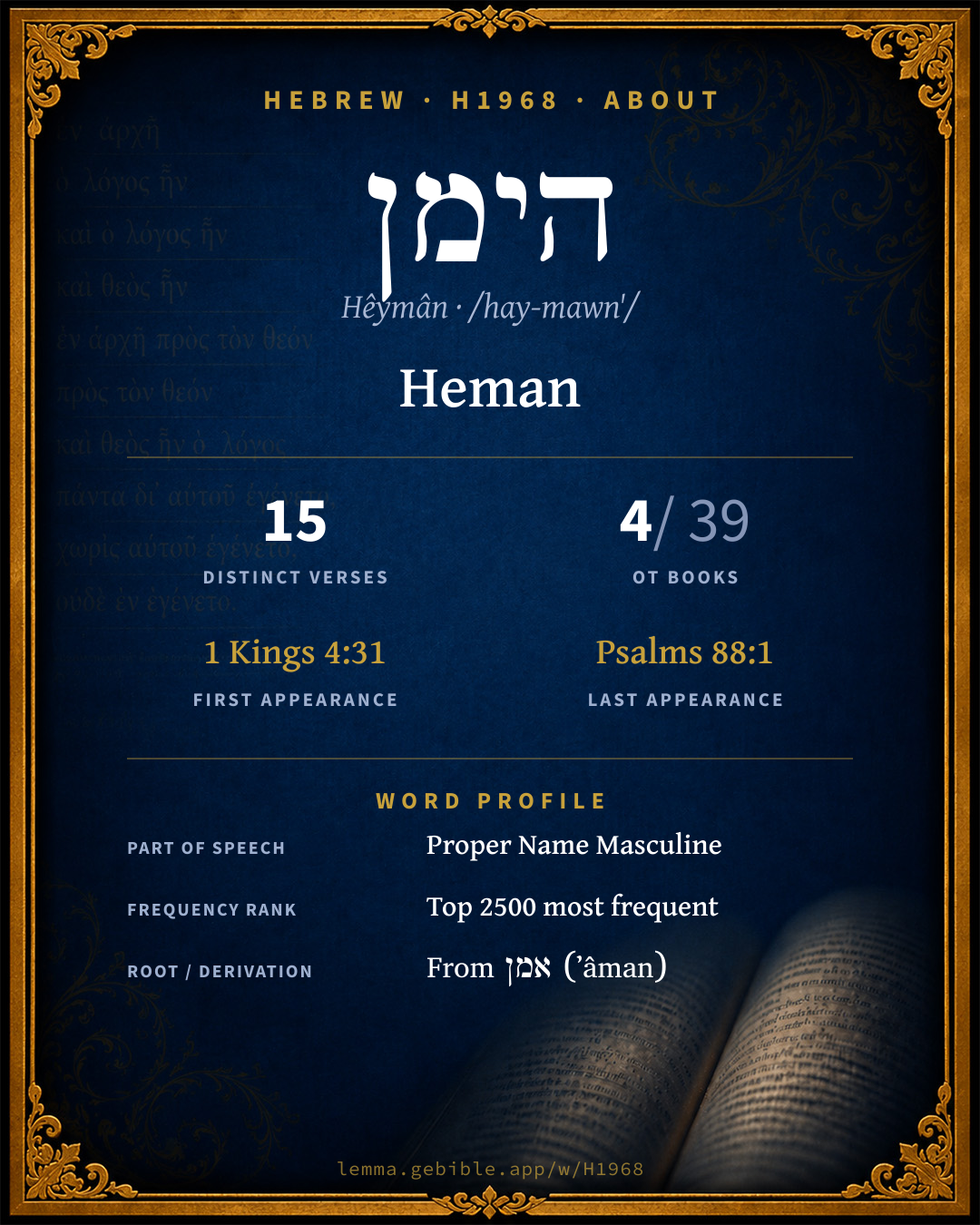
הֵימָן
Heman
BDB lists 4 entries for ‘Heman’ fuller range ↓
Full lexicon entry — Brown-Driver-Briggs (BDB)
From Brown-Driver-Briggs (BDB)
Where this word appears
Grammar key — what these labels mean
Part of speech
- Noun
- A naming word — a person, place, thing, or idea.
Noun type
- Proper
- A name of a specific person, place, or people (e.g. Abraham, Zion, Israel).
Every verse where H1968 appears — 15 distinct verses across 4 books. Click any verse to open its interlinear word-by-word view. Verse text shown in the World English Bible for context — . Each verse’s Hebrew form is shown with its reference; the English is not keyword-highlighted, since the data carries no word-level English alignment. Use “Compare translations” on any verse to read it across multiple English versions. This concordance covers the Hebrew Bible; Septuagint (Greek Old Testament) occurrences are not indexed here.
1 Kings 1 verse
1 Chronicles 10 verses
- 1 Chronicles 2:6 וְ/הֵימָ֛ן conj + n Proper The sons of Zerah: Zimri, and Ethan, and Heman, and Calcol, and Dara; five of them in all.
- 1 Chronicles 6:33 הֵימָן֙ n Proper These are those who waited, and their sons. Of the sons of the Kohathites: Heman the singer, the son of Joel, the son of Samuel,
- 1 Chronicles 15:17 הֵימָ֣ן n Proper So the Levites appointed Heman the son of Joel; and of his brothers, Asaph the son of Berechiah; and of the sons of Merari their brothers, Ethan the son of Kushaiah;
- 1 Chronicles 15:19 הֵימָ֥ן n Proper So the singers, Heman, Asaph, and Ethan, [were appointed] with cymbals of brass to sound aloud;
- 1 Chronicles 16:41 הֵימָ֣ן n Proper and with them Heman and Jeduthun, and the rest who were chosen, who were mentioned by name, to give thanks to Yahweh, because his loving kindness endures forever;
- 1 Chronicles 16:42 הֵימָ֨ן n Proper and with them Heman and Jeduthun [with] trumpets and cymbals for those that should sound aloud, and [with] instruments for the songs of God; and the sons of Jeduthun to be at the gate.
- 1 Chronicles 25:1 וְ/הֵימָ֣ן conj + n Proper Moreover, David and the captains of the host set apart for the service certain of the sons of Asaph, and of Heman, and of Jeduthun, who should prophesy with harps, with psalteries, and with cymbals: and the number of those who did the work according to their service was:
- 1 Chronicles 25:4 לְ/הֵימָ֑ן הֵימָ֡ן prep + n Proper n Proper Of Heman; the sons of Heman: Bukkiah, Mattaniah, Uzziel, Shebuel, and Jerimoth, Hananiah, Hanani, Eliathah, Giddalti, and Romamti-ezer, Joshbekashah, Mallothi, Hothir, Mahazioth.
- 1 Chronicles 25:5 לְ/הֵימָ֗ן לְ/הֵימָ֗ן prep + n Proper prep + n Proper All these were the sons of Heman the king's seer in the words of God, to lift up the horn. God gave to Heman fourteen sons and three daughters.
- 1 Chronicles 25:6 וְ/הֵימָֽן conj + n Proper All these were under the hands of their father for song in the house of Yahweh, with cymbals, psalteries, and harps, for the service of the house of God; Asaph, Jeduthun, and Heman being under the order of the king.
2 Chronicles 3 verses
- 2 Chronicles 5:12 לְ/הֵימָ֣ן prep + n Proper also the Levites who were the singers, all of them, even Asaph, Heman, Jeduthun, and their sons and their brothers, arrayed in fine linen, with cymbals and psalteries and harps, stood at the east end of the altar, and with them one hundred twenty priests sounding with trumpets;)
- 2 Chronicles 29:14 הֵימָ֖ן n Proper and of the sons of Heman, Jehuel and Shimei; and of the sons of Jeduthun, Shemaiah and Uzziel.
- 2 Chronicles 35:15 וְ/הֵימָ֤ן conj + n Proper The singers the sons of Asaph were in their place, according to the commandment of David, and Asaph, and Heman, and Jeduthun the king's seer; and the porters were at every gate: they didn't need to depart from their service; for their brothers the Levites prepared for them.
Psalms 1 verse
About this entry
At a glance — auto-summarized from this page’s data, not written by a person. Every figure links to its source below. This summary describes the numbers; it doesn’t interpret them.
הימן (Hêymân) is a Hebrew name most often rendered “Heman.” It clusters heavily in 1 Chronicles, which alone accounts for 67% of its uses. With 15 verses in 4 books, it is an uncommon word in the Hebrew Bible. Debuting at 1 Kings 4:31, it then recurs through the corpus. The sections below give every occurrence and version rendering.
Gloss history
Strong's 1890 vs modern scholarship
About this word
Strong's H1968 catalogs a Hebrew word from the Hebrew Old Testament.
These counts are not copied from any lexicon or concordance. They are computed here, from the morphology-tagged Hebrew Old Testament. What Lemma adds →
- 15
- distinct verses
- The word appears in 15 distinct verses.
- 4 / 39
- OT books
- The word appears in 4 of 39 Old Testament books.
- #1,671
- by frequency
- Top 2500 most frequent Hebrew words (rank 1,671 of 8,640 Hebrew words by occurrence).
View all 15 occurrences in the concordance →
Most concentrated in
- 1 Chronicles 10 verses 67%
- 2 Chronicles 3 verses 20%
- 1 Kings 1 verse 7%
By section of the Old Testament
By traditional corpus
Conventional, traditional groupings — biblical authorship is debated, so this is a traditional corpus grouping, not an authorship claim. Each share is this word’s portion of its verses in that division of the Hebrew canon. Each figure is a share of the word’s 15 distinct verses.
- Writings (Ketuvim) 14 verses · 93%
- Prophets (Nevi'im) 1 verse · 7%
How translations render this word
Counts come from each version’s own published word-to-Strong’s tagging or interlinear alignment — an approximate guide to how each version renders this word, not a word-level alignment the data otherwise carries. Because each total is that version’s own tagged count, the per-version totals vary from one another and need not match the appearance or distinct-verse counts above. These counts may also differ from a printed concordance because Lemma counts each distinctly tagged rendering and does not collapse phrase taggings into a single head-word total. This is a fixed set of word-tagged versions (KJV, ASV, BSB, ULT) and does not change with the reading translation you choose elsewhere. Each version’s license is shown beside its name below (and on Sources).
BDB lists this Strong’s number as 2 distinct words (homographs). Each count above pools all of them and is not split by sense — see the Senses section below. A low-frequency rendering may belong to a different one of those words, not the primary meaning.
- King James Version†: Heman 17×
- American Standard Version†: Heman 15×
- Berean Standard Bible†: Heman 13×
- unfoldingWord Literal Text†: Heman 16×
King James Version Public Domain
Renders H1968 across 17† tagged occurrences — most commonly:
American Standard Version Public Domain
Renders H1968 across 16† tagged occurrences — most commonly:
Plus 1 rendering that appears only once — usually multi-word phrases or single function words the recovered tagging swept in, not distinct renderings.
Berean Standard Bible Public Domain
Renders H1968 across 15† tagged occurrences — most commonly:
Plus 2 renderings that appear only once — usually multi-word phrases or single function words the recovered tagging swept in, not distinct renderings. Not rendered by a distinct English word in 2 further occurrences.
unfoldingWord Literal Text CC BY-SA 4.0
Renders H1968 across 16† tagged occurrences — most commonly:
Senses in BDB
The 4 senses BDB distinguishes for this word, in lexicon order (not ranked by frequency or importance). The full entry — with sub-senses — is in the Lexicon Entry tab.
- Heman = "faithful"
- a wise man to whom Solomon was compared
- son of Joel, grandson of Samuel, and a Levitical singer and author of PS 88
- a seer
Word origin
n.pr.m. Heman (faithful, cf. Aramaic מְהֵימָן, ܡܗܰܝܡܰܢ ) a wise man with whom Solomon is compared 1 K 5:11, where app. son of Mahol (Klo sons of the dance); named with 3 others, one being Ethan the Ezrahite; 1 Ch 2:6 a Heman is named with same 3 + 1 other, & all called sons of Zerah of Judah; Heman appears ψ 88:1 also as the Ezrahite (v. sub זרח), cf. Ethan supr.; in other passages Heman is a Levite; specif. Kohathite, son of Joel, called the singer (הַמְשׁוֹרֵר) 1 Ch 6:18 (‖ Asaph v 24, Ethan v 29); Heman, Asaph & Ethan named as the singers (הַמְשֹׁרְרִים) 1 Ch 15:17, 19; cf. Heman & Jeduthun 16:41, 42 (‖ Asaph v 37); Heman, Asaph & Jeduthun 25:6 2 Ch 5:12; 35:15; elsewhere בְּנֵי אָסָף וְהֵימָן וִידוּתוּן 1 Ch 25:1 cf. v 4(×2), 5(×2); בְּנֵי הֵימָן 2 Ch 29:14 (‖ בְּנֵי ידוּתוּן); 1 Ch 25:5 Heman is called חֹזֵה הַמֶּלָךְ בְּדִבְרֵי הָאֱלֹהִים (cf. Asaph 2 Ch 29:30, Jeduthun 2 Ch 35:15).—On question of identity of Heman in these various connections, v. Thes Comm.
— Brown-Driver-Briggs (Oxford 1906, public domain), digitized via Sefaria, supplemented by the OpenScriptures HebrewLexicon (CC BY 4.0). See Sources.
Derived from אמן (ʼâman) (H539) — to confirm.
Jastrow Dictionary
A second Hebrew/Aramaic lexicon for comparison, covering Aramaic and post-biblical (Talmudic, Targumic, Midrashic) usage that the biblical-Hebrew BDB does not. Matched by lemma rather than by Strong’s number, so a lemma may carry more than one Jastrow headword (shown separately below), and the entries cover usage well beyond the Bible.
הֵימַן
- (Af. of אמן; = h. הֶאֱמִין) to credit, trust, confide; to loan on trust; to admit as evidence. Targ. O. Gen. XV, 6. Targ. ib. XLV, 26; a. fr.—B. Kam. 115ᵃ הֵימוּנֵי הֵימְניה he loaned him on trust (without a pawn). Keth. 22ᵇ הֵמְנוּהָ רבנן כבי תרי the Rabbis declared his evidence as legal as if there had been two witnesses. Shebu. 41ᵇ לא לדידיה הֵימְנֵיה he did not trust him by himself (without witnesses). Y. Ber. II, 4ᶜ top לאילין דברישך הֵימְנִית I trusted those (T’fillin) on thy head; a. fr.—Part. pass. מְהֵימַן (= h. נֶאֱמָן) faithful, reliable; credited, admitted as evidence. Targ. Num. XII, 7 (Y. II הֵימַן); a. fr.—Sabb. 10ᵇ דמתרגמינן אלהא מְהֵימְנָא for we translate (Deut. VII, 9) &c. (only the participle being used as a divine attribute, not the abstract noun).—Keth. 27ᵇ מְהֵימְנָא she is admitted &c. Ib. מהימני (corr. acc.). Y. Gitt. V, 47ᵃ [read:] בעי בר נש מיתן כמה ומתקרי׳ מ׳ a man would sacrifice any amount in order to be called trustworthy; Y. B. Kam. IV, 4ᵇ bot. הימן; a. fr.—B. Mets. 86ᵇ לא מהימנא לך (ed. (= מהימן אנא, part. act.) I do not trust thee (Mss. לא הימן ביה he (Abraham) did not rely on him). e.g. Deuteronomy 7:9
A Dictionary of the Targumim, the Talmud Babli and Yerushalmi, and the Midrashic Literature (Marcus Jastrow; London, Luzac, 1903) — Public Domain. Digitized via Sefaria. Digitized via Sefaria. Full attribution on Sources.
Forms in the corpus
The 15 distinct written forms H1968 takes in the Hebrew Bible, most frequent first — each parse links to that state’s occurrences in the concordance. Hebrew forms include their vowel points and cantillation, so a single lemma takes many written forms.
| Form | Parsing | Example | Uses |
|---|---|---|---|
| הֵימָ֣ן | Noun, Proper | 1 Chronicles 15:17 | 2 |
| לְ/הֵימָ֗ן | Noun, Proper | 1 Chronicles 25:5 | 2 |
| הֵימָ֖ן | Noun, Proper | 2 Chronicles 29:14 | 1 |
| הֵימָ֡ן | Noun, Proper | 1 Chronicles 25:4 | 1 |
| הֵימָ֥ן | Noun, Proper | 1 Chronicles 15:19 | 1 |
| הֵימָ֨ן | Noun, Proper | 1 Chronicles 16:42 | 1 |
| הֵימָן֙ | Noun, Proper | 1 Chronicles 6:33 | 1 |
| וְ/הֵימָ֛ן | Noun, Proper | 1 Chronicles 2:6 | 1 |
| וְ/הֵימָ֣ן | Noun, Proper | 1 Chronicles 25:1 | 1 |
| וְ/הֵימָ֤ן | Noun, Proper | 2 Chronicles 35:15 | 1 |
| וְ/הֵימָ֧ן | Noun, Proper | 1 Kings 4:31 | 1 |
| וְ/הֵימָֽן | Noun, Proper | 1 Chronicles 25:6 | 1 |
| לְ/הֵימָ֑ן | Noun, Proper | 1 Chronicles 25:4 | 1 |
| לְ/הֵימָ֣ן | Noun, Proper | 2 Chronicles 5:12 | 1 |
| לְ/הֵימָ֥ן | Noun, Proper | Psalms 88:1 | 1 |
Same root — word family
Other BDB entries built from the same root as H1968, grouped by Strong’s listed origin. These share a root / origin per the lexicon — not necessarily a shared meaning. Each links to that word’s own entry.
Derives from
Shares the same root
- אמון ʼâmôwn H525 craftsman
- אמון ʼêmûwn H529 faithfulness
- אמן ʼăman H540 to trust
- אמן ʼâmân H542 artisan
- אמן ʼâmên H543 truly
- אמן ʼômen H544 faithfulness
- אמת ʼemeth H571 faithfulness
Proper names from this root
People and places named from this root — a name, not an additional meaning of the word.
Compare all same-root words → Showing 4 of 10 — not the complete family. 1 of the same-root words is a proper name (a person or place). They share a root, not necessarily a meaning.
Bible dictionary
Public-domain dictionary articles matched to this entry by name (Heman). A biblical name can be shared by more than one person or place, so an article may treat several.
Easton's Bible Dictionary · M. G. Easton, 1897
Faithful. (1.) 1 Kings 4:31; 1 Chr. 2:6, a son of Zerah, noted for his wisdom. (2.) Grandson of Samuel (1 Chr. 6:33; 15:17), to whom the 88th Psalm probably was inscribed. He was one of the "seers" named in 2 Chr. 29:14, 30, and took a leading part in the administration of the sacred services.
Smith's Bible Dictionary · William Smith, 1863
(faithful)
+ Son of Zerah. (1 Chronicles 2:6; 1 Kings 4:31) + Son of Joel and grandson of Samuel the prophet, a Kohathite. He is called "the singer," rather the musician, (1 Chronicles 6:33) and was the first of the three Levites to whom was committed the vocal and instrumental music of the temple service in the reign of David. (1 Chronicles 15:16-22) The 88th Psalm is ascribed to him. (B.C. 1014.)
Hitchcock's Bible Names Dictionary · Roswell D. Hitchcock, 1869
their trouble; tumult; much; in great number
Classic public-domain reference works; full attribution on Sources.
Septuagint verse parallels
This word appears in 14 verses that also exist in the Greek Old Testament (Septuagint), out of the 15 Hebrew verses it occurs in. You can read those verses in Greek by switching the Old Testament edition to the Septuagint.
Read these verses in the Septuagint
This is a verse-level parallel only — the same verses exist in both the Hebrew and Greek Old Testaments. No word-level Hebrew↔Greek correspondence is claimed: the data carries no such alignment, so no Greek word is shown as this Hebrew word’s translation. Coverage is not total — the Septuagint omits the deuterocanon and renumbers the Psalms, so some Hebrew verses have no direct Greek parallel.