
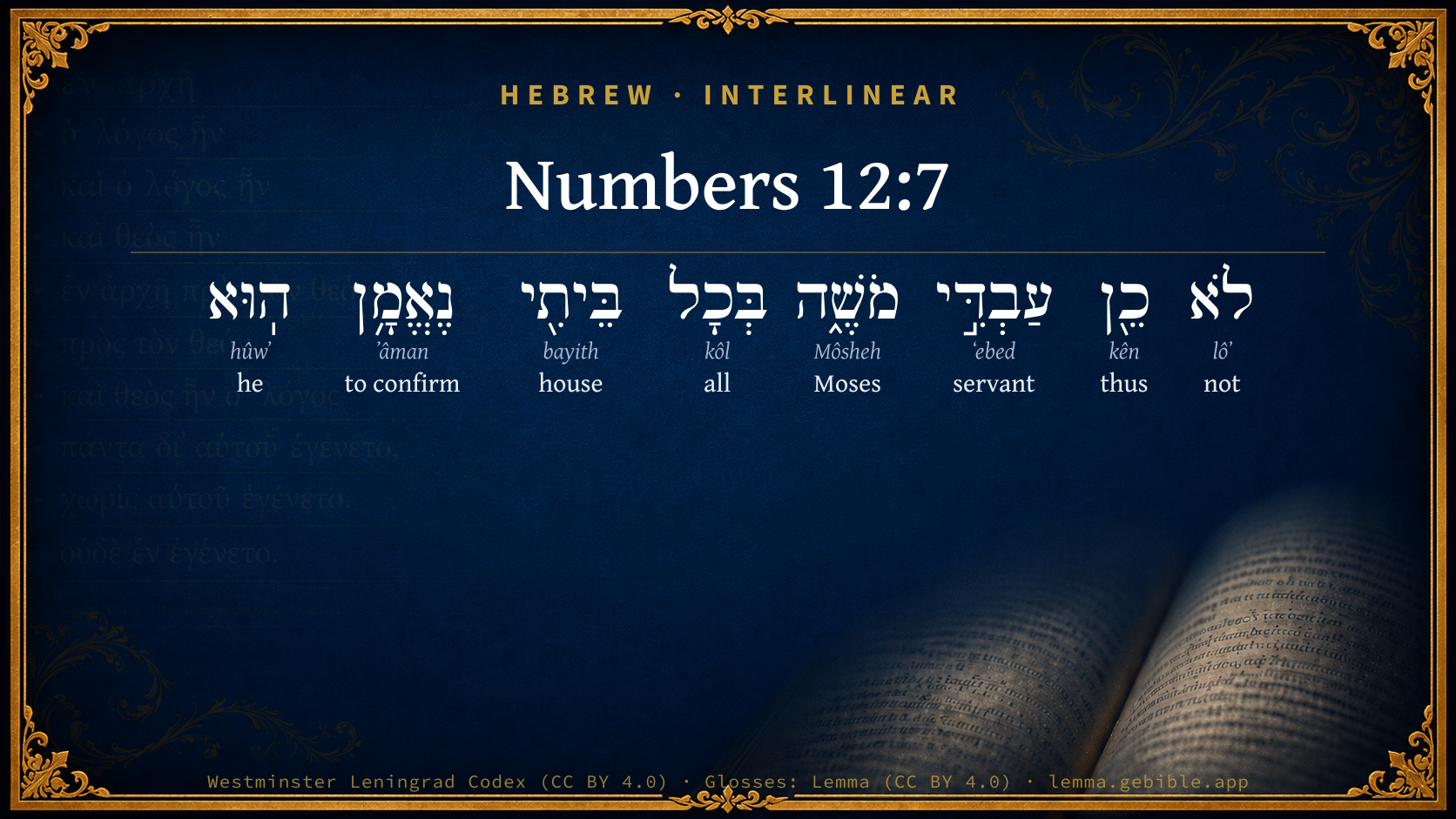
Numbers 12:7

Hebrew (Westminster Leningrad Codex) Numbers 12:7 appears in the Hebrew Old Testament. The text above is from the Westminster Leningrad Codex. Each word links to its Strong’s number, a concise gloss, and parsing drawn from the Open Scriptures Hebrew Bible morphology. Click any word for its full Brown-Driver-Briggs (BDB) entry.
Download image
Cite this verse

Numbers 12:7 (World English Bible). Public Domain. Lemma interlinear Bible study tool, https://lemma.gebible.app/v/numbers/12/7.

Show BibTeX & RIS
BibTeX
RIS
English Translation
My servant Moses is not so; he is faithful in all my house:
World English Bible · Public Domain
Download a study sheet

One document with this verse’s original text, its word-by-word gloss line, the meaning frame, cross-references with their text, attributed commentary, and full source and license credits — printable, and it pastes into notes with its structure intact.

This verse Autodidact and up

Study sheet (.html) Plain text (.txt)

A passage Seminary Student

Up to 50 verses in one chapter. A passage sheet keeps up to 6 commentary sources and 12 cross-references per verse, in the order this page ranks them, and says so on the sheet whenever that leaves anything out. Ask for a single verse and you get the Autodidact verse sheet above.

Everything on this page stays free to read, with no account — the sheet is a download of what is already on screen, not access to it.

Want to remove ads? Support Godless Engineer
Compare translations 3

The same verse in 3 English versions, stacked beneath the original-language interlinear above. Click any original word for its lexicon entry.

Each is an independent rendering of the whole verse — the interlinear is not word-aligned to these translations.

Highlighted words mark where these versions differ — a whole-verse word diff, not a word-by-word alignment.

  • World English Bible Public Domain
    My servant Moses is not so; he is faithful in all my house:
  • King James Version Public Domain
    My servant Moses is not so, who is faithful in all mine house.
  • unfoldingWord Literal Text CC BY-SA 4.0
    Not so my servant Moses; in all my house he, he is faithful.

unfoldingWord Literal Text — © unfoldingWord, licensed CC BY-SA 4.0. Word-aligned USFM3 via Door43 (git.door43.org/unfoldingWord/en_ult).

Versions to compare (up to 4)

3 of 4 selected

Show all 18 translations

Every available English version of this verse, each an independent rendering of the whole verse.

  • World English Bible Public Domain
    My servant Moses is not so; he is faithful in all my house:
  • Berean Standard Bible Public Domain
    But this is not so with My servant Moses; he is faithful in all My house.
  • Majority Standard Bible Public Domain
    But this is not so with My servant Moses; he is faithful in all My house.
  • King James Version Public Domain
    My servant Moses is not so, who is faithful in all mine house.
  • American Standard Version (1901) Public Domain
    My servant Moses is not so; he is faithful in all my house:
  • Revised Version (1885) Public Domain
    My servant Moses is not so; he is faithful in all mine house:
  • Geneva Bible (1599) Public Domain
    My seruant Moses is not so, who is faithfull in all mine house.
  • Douay-Rheims (1899) Public Domain
    But it is not so with my servant Moses a who is most faithful in all my house:
  • Young's Literal Translation Public Domain
    not so My servant Moses; in all My house he `is' stedfast;
  • Literal Standard Version CC BY-SA 4.0
    Not so My servant Moses; He [is] steadfast in all My house.
  • Unlocked Literal Bible CC BY-SA 4.0
    My servant Moses is not like that. He is faithful in all my house.
  • unfoldingWord Literal Text CC BY-SA 4.0
    Not so my servant Moses; in all my house he, he is faithful.
  • Darby Bible Public Domain
    Not so my servant Moses: he is faithful in all my house.
  • World Messianic Bible Public Domain
    My servant Moses is not so. He is faithful in all my house.
  • Webster's Bible Public Domain
    My servant Moses is not so, who is faithful in all my house.
  • Free Bible Version CC BY-SA 4.0
    But it's not like this with my servant Moses, who of all my people is the one who is faithful.
  • Bible in Basic English Public Domain
    My servant Moses is not so; he is true to me in all my house:
  • JPS Tanakh (1917) Public Domain
    My servant Moses is not so; he is trusted in all My house;

Literal Standard Version (2020), Covenant Press — licensed CC BY-SA 4.0. Text via the HelloAO Bible API (eBible.org). Unlocked Literal Bible (unfoldingWord) — licensed CC BY-SA 4.0. Text via the HelloAO Bible API (eBible.org). unfoldingWord Literal Text — © unfoldingWord, licensed CC BY-SA 4.0. Word-aligned USFM3 via Door43 (git.door43.org/unfoldingWord/en_ult). Free Bible Version, Dr. Jonathan Gallagher — licensed CC BY-SA 4.0. Text via the HelloAO Bible API (eBible.org).

Word by word

More ways to search: Search by grammar → Find every occurrence → Compare this word →

Practice this passage: Drill this verse → Learn its vocabulary →

נֶאֱמָ֥ן
ʼâman
H539
“confirming”
Verb, Niphal, Participle Active, Masculine, Singular, Absolute
Part of Speech
Verb
Stem
Niphal
Form
Participle Active
Gender
Masculine
Number
Singular
State
Absolute
Full BDB Definition

Origin: a primitive root

TWOT: 116

to support, confirm, be faithful - (Qal) - to support, confirm, be faithful, uphold, nourish - foster-father (substantive) - foster-mother, nurse - pillars, supporters of the door - (Niphal) - to be established, be faithful, be carried, make firm - to be carried by a nurse - made firm, sure, lasting - confirmed, established, sure - verified, confirmed - reliable, faithful, trusty - (Hiphil) - to stand firm, to trust, to be certain, to believe in - stand firm - trust, believe
  1. לֹא lôʼ H3808 “not” Particle, Negative
  2. כֵ֖ן kên H3651 “thus” Adverb
  3. עַבְדִּ֣י ʻebed H5650 “servant · my” Noun, Common, Masculine, Singular, Construct + Suffix, Personal, 1st Person, Common, Singular
  4. מֹשֶׁ֑ה Môsheh H4872 “Moses” Noun, Proper
  5. בְּכָל kôl H3605 “in/at · all of” Preposition + Noun, Common, Masculine, Singular, Construct
  6. בֵּיתִ֖י bayith H1004 “house · my” Noun, Common, Masculine, Singular, Construct + Suffix, Personal, 1st Person, Common, Singular
  7. הֽוּא hûwʼ H1931 “he” Pronoun, Personal, 3rd Person, Masculine, Singular

About this verse

These counts appear in no published source. They are computed here, from the morphology-tagged text and Lemma’s own curated glosses. What Lemma adds →

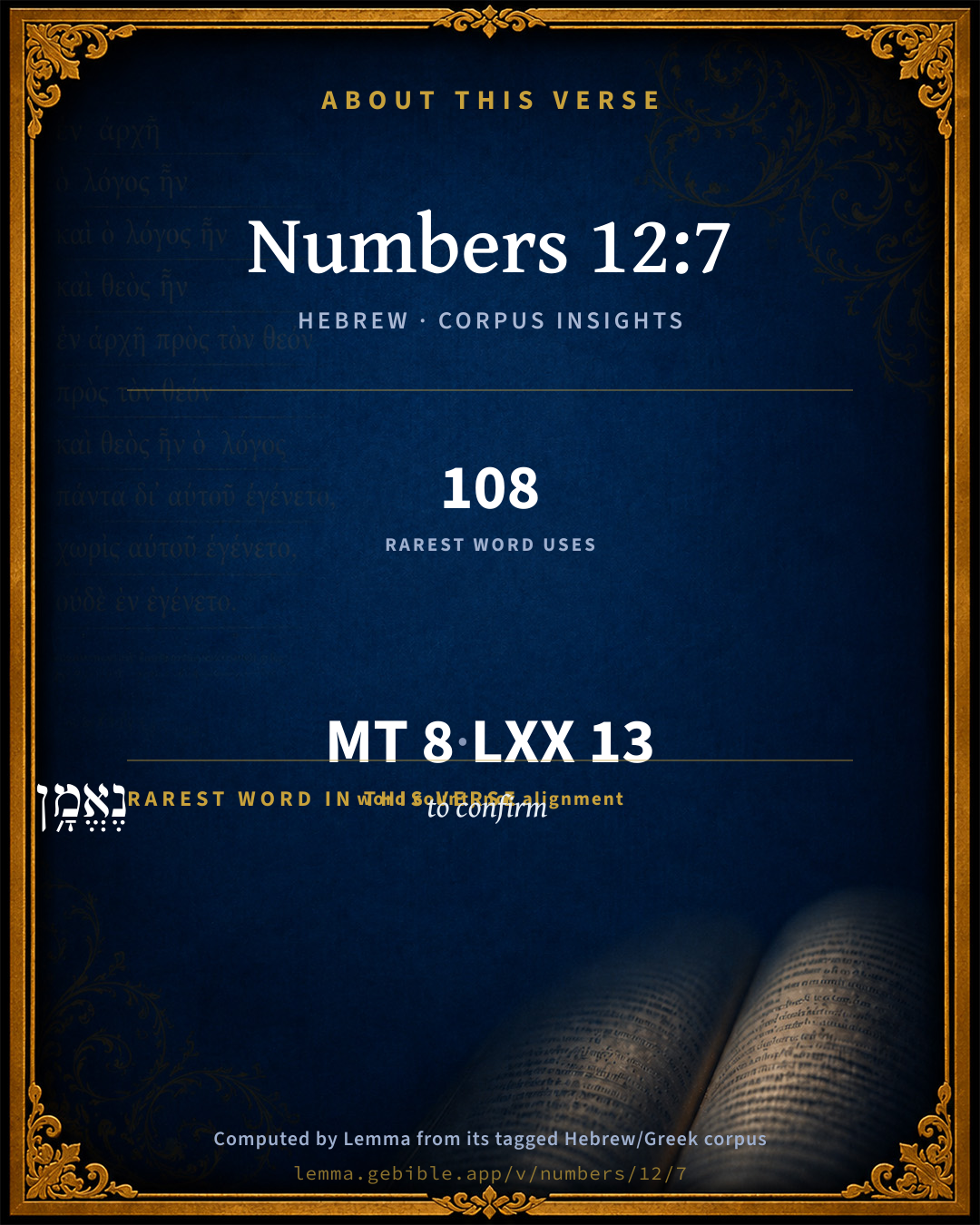
8
words
8
distinct lemmas
Pentateuch
section

Grammatical profile

  • 1 verb
  • 4 nouns
  • 1 pronoun
  • 1 adverb
  • 1 particle

Verb forms

  • נֶאֱמָ֥ן Niphal · Participle Active

Hebrew & Septuagint length

In English translation the verse runs 13 words from the Hebrew and 13 from the Septuagint (LXX English) — the same length.

A rough comparison of the two English renderings, which tokenize alike — not a word-level alignment.

Word counts can differ between the Hebrew and the Greek without any difference in meaning — e.g. the Hebrew direct-object marker אֵת has no separate Greek word, and Greek often adds the article ὁ.

In the original languages it is 8 Hebrew tokens and 13 Greek tokens — but the two are counted differently (Hebrew bundles its prefixes and suffixes into one token; the Greek is in lemma form), so that isn’t a like-for-like length.

Cross-references

11

Topical passages linked to Numbers 12:7 in the Treasury of Scripture Knowledge — connected by theme and wording, ordered by reader-vote popularity; previews shown in the World English Bible.

  • Hebrews 3:2–6 who was faithful to him who appointed him, as also was Moses in all his house.
  • Joshua 1:1 Now it happened after the death of Moses the servant of Yahweh, that Yahweh spoke to Joshua the son of Nun, Moses' minister, saying,
  • Psalms 105:26 He sent Moses, his servant, And Aaron, whom he had chosen.
  • Matthew 11:11 Most assuredly I tell you, among those who are born of women there has not arisen anyone greater than John the Baptizer; yet he who is least in the Kingdom of Heaven is greater than he.
  • 1 Corinthians 4:2 Here, moreover, it is required of stewards, that they be found faithful.
  • Deuteronomy 18:18 I will raise them up a prophet from among their brothers, like you; and I will put my words in his mouth, and he shall speak to them all that I shall command him.
  • Matthew 11:9 But why did you go out? To see a prophet? Yes, I tell you, and much more than a prophet.
  • Acts 3:22–23 For Moses indeed said to the fathers, 'The Lord God will raise up a prophet for you from among your brothers, like me. You shall listen to him in all things whatever he says to you.
  • Acts 7:31 When Moses saw it, he wondered at the sight. As he came close to see, a voice of the Lord came to him,
  • 1 Timothy 3:15 but if I wait long, that you may know how men ought to behave themselves in the house of God, which is the assembly of the living God, the pillar and ground of the truth.
  • 1 Peter 2:4–5 coming to him, a living stone, rejected indeed by men, but chosen by God, precious.

Cross-references courtesy of OpenBible.info (CC BY 4.0).

Hebrew and Greek witnesses Masoretic Hebrew ↔ Greek Septuagint

The same verse in the two great witnesses to the Old Testament, shown verse-for-verse.

These are two independent witnesses, not word-aligned to each other, and the Septuagint is shown in lemma (dictionary) form.

Hebrew Numbers 12:7 Masoretic · Westminster Leningrad Codex

לֹא כֵ֖ן עַבְדִּ֣י מֹשֶׁ֑ה בְּכָל בֵּיתִ֖י נֶאֱמָ֥ן הֽוּא

My servant Moses is not so; he is faithful in all my house:

World English Bible · Public Domain

Greek LXX Numbers 12:7 Septuagint · lemma form

οὐ οὕτως ὁ θεράπων ἐγώ μωυσῆς ἐν ὅλος ὁ οἶκος ἐγώ πιστός εἰμί

My servant Moses is not so; he is faithful in all my house.

LXX2012 (modern English Septuagint) · Public Domain

On this verse, The Pulpit Commentary discusses the Septuagint’s reading. Read the note in Commentary ↓

Hebrew: Westminster Leningrad Codex (CC BY 4.0). Greek: Septuagint (public domain); English from LXX2012 (modern English Septuagint) (Public Domain). How the Septuagint differs from the Hebrew →

Targum (Aramaic paraphrase)

2

The Targum is the ancient Jewish Aramaic paraphrase of the Hebrew Scriptures — an interpretive translation, not the Hebrew text itself. Onkelos (literal) and Pseudo-Jonathan (expansive) render the Torah, and Jonathan the Prophets. Coverage is partial: where no permissively-licensed English translation exists for a verse, only the Aramaic is shown. This is verse-level text, not a word-by-word alignment to the Hebrew.

  1. Targum Onkelos Torah (Genesis–Deuteronomy)
    לָא כֵן עַבְדִי משֶׁה בְּכָל בֵּיתִי מְהֵימָן הוּא

    (no public-domain English translation for this verse)

    Targum Onkelos — Aramaic: “Onkelos Genesis” (public domain); “Onkelos Exodus” (public domain); “Onkelos Leviticus” (public domain); “Onkelos Numbers” (public domain); “Onkelos Deuteronomy” (public domain). English: “Sefaria Community Translation” (CC0 1.0 (public-domain dedication)); “J.W. Etheridge. The Targums of Onkelos and Jonathan Ben Uzziel on the Pentateuch. London: Longmans, Green, 1862” (public domain). Text via Sefaria.

  2. Targum Pseudo-Jonathan Torah (Genesis–Deuteronomy)
    לָא כְדֵין אָרְחָא דְמשֶׁה עַבְדִי בְּכָל בֵּית יִשְרָאֵל עַמִי מְהֵימָן הוּא

    Not so is the way with Mosheh My servant; in all the house of Israel My people he is faithful.

    Targum Pseudo-Jonathan — Aramaic: “Targum Jonathan on Genesis” (public domain); “Targum Jonathan on Exodus” (public domain); “Targum Jonathan on Leviticus” (public domain); “Targum Jonathan on Numbers” (public domain); “Targum Jonathan on Deuteronomy” (public domain). English: “The Targum of Jonathan ben Uzziel, trans. J. W. Etheridge, London, 1862” (public domain). Text via Sefaria.

Commentary

Notes on Numbers 12:7 from classic Christian and Jewish commentators (each source and its license shown beneath its notes). The classic Christian expositions comment on the surrounding passage and are grouped to its opening verse, so a note may address several verses; the Jewish commentaries on the Tanakh (Rashi and others) are per-verse, so they appear only where the commentator wrote on this verse.

Lemma curates 59 commentaries, every one of them public domain or Creative Commons licensed, each selected and text-cleaned for this edition rather than reprinted as found. About our sources →

Trapp's Complete Commentary

John Trapp

Num 12:7 My servant Moses [is] not so, who [is] faithful in all mine house.

Ver. 7. My servant Moses is not so.] God had never so much magnified Moses to them, but for their envy. We cannot devise to pleasure God’s servants so much as by despiting them. Quisquis volens detrahit famae meae, nolens addit mercedi meae, saith Augustine; He that willingly detracteth from mine honour, doth, though against his will, add to my reward.

John Trapp, A Commentary or Exposition upon All the Books of the Old and New Testament (1647–1656) — public domain. Text from a community e-Sword module.

Joseph Benson's Commentary

Num 12:7. My servant Moses is not so — He is a prophet of a higher rank.

To him I impart my mind in a far more noble and clear way. Who is faithful in all my house — God had set him over all Israel, who were his house, his family, or chosen people, and Moses was faithful in the performance of the trust reposed in him, executing all the divine commands, and doing nothing partially or of himself, as he was now falsely accused. In this he was an eminent type of Christ, as the apostle represents him, Heb 3:1-6.

Joseph Benson's Commentary on the Old and New Testaments (1811–1818) — public domain. Text from a community e-Sword module.

Geneva Bible (1599)

Geneva Bible translators

In all Israel which was his Church.

Geneva Bible (1599) marginal notes — public domain. Text via Bolls.life.

Adam Clarke's Commentary

Verse 7. Moses - is faithful] נאמן neeman, a prefect or superintendent. So Samuel is termed, 1Sa 2:35; 1Sa 3:20; David is so called, 1Sa 18:27, Neeman, and son-in-law of the king. Job 12:20, speaks of the Neemanim as a name of dignity. It seems also to have been a title of respect given to ambassadors, Pr 13:17; Pr 25:13. Calmet well observes that the word fidelity is often used for an employ, office, or dignity, and refers to 1Ch 9:22, 1Ch 9:26, 1Ch 9:31; 2Ch 31:12, 2Ch 31:15; 2Ch 34:12, &c. Moses was a faithful, well-tried servant in the house of God, and therefore he uses him as a familiar, and puts confidence in him.

Adam Clarke's Commentary on the Bible (1810–1826) — public domain. Text from a community e-Sword/MySword module.

Ellicott's Commentary for English Readers

(7) My servant Moses . . . —Better, Not so (in regard to) my servant Moses; he is faithful. Reference is made to these words in Heb_3:5 : “And Moses verily was faithful in all his house,” i.e., in the whole of the Mosaic economy or dispensation, or the house of Israel, which is spoken of as God’s house. A contrast is drawn in Num_12:6 between the vocation of Moses as a servant in the house of God and that of Christ as a Son over His own house.

A Bible Commentary for English Readers, edited by Charles John Ellicott (1878–1897) — public domain. Text from a community e-Sword module.

The Cambridge Bible for Schools and Colleges

gen. ed. J. J. S. Perowne

7. faithful in all my house] i.e. in everything that has to do with Israel, who are often called the ‘house of Israel.’ The passage is referred to in Heb_3:2; Heb_3:5, where it is understood to mean that Moses was faithful in such a way that his influence (like that of a trusted servant) extended over the whole of the Old Dispensation, as that of Christ (the Son) does over the New.

The Cambridge Bible for Schools and Colleges (gen. ed. J. J. S. Perowne; Cambridge University Press, 1878–1918) — public domain. Text from a community e-Sword module.

John Gill's Exposition

My servant Moses is not so,.... Or such a prophet; he is not so used; it was not in such a manner the Lord spake to him; not in visions and dreams, as he had to Abraham and Jacob, and did to others in later times:

who is faithful in all mine house; in the house of Israel, or among that people which were the Lord's family, where Moses was a servant and steward, and did all things according to the will of the Lord, the master of the family; he faithfully delivered to them all the laws, statutes, and ordinances, which he appointed to be observed by them: unless this is to be understood of the tabernacle, which was the house of God, in which he dwelt, and which was made, and all things in it, exactly according to the pattern given by the Lord to Moses: see Heb 3:2.

John Gill's Exposition of the Whole Bible (1746–1763) — public domain (CC PDM 1.0). Text via the HelloAO Bible API.

Haydock's Catholic Bible Commentary

Faithful: Hebrew Neeman, steward or master of the palace. Such was Samuel, 1 Kings iii. 20; David, (Calmet) 1 Kings xxii. 14; Naaman, the general of Syria, 2 Kings v.; and Bacchides, 1 Machabees vii. (Haydock) --- Ambassadors had this title, (Proverbs xiii. 17,) and fidelity often denotes an office, 1 Paralipomenon ix. 22. Job (xii. 20,) speaks of the Namonim. (Calmet) --- But none among the Israelites was more justly entitled to this honour than Moses. He announced the word of God without any mixture of falsehood, and did not arrogate to himself more than his due, as Aaron seems to have done, ver. 2. (Haydock)

George Leo Haydock (1774–1849), Haydock's Catholic Family Bible and Commentary, 1859 edition — public domain. Excludes Psalms (Douay-Rheims chapter numbering differs from Protestant) and Deuterocanonical books (Catholic canon only).

Matthew Poole's English Annotations

i.e. Whom I have set over all my house, i.e. my church and people, and therefore over you, and who hath discharged his office faithfully, and not partially and selfseekingly, as you falsely accuse him.

Matthew Poole's English Annotations on the Holy Bible (1683–1685) — public domain. Text from a community e-Sword/MySword module.

Whedon's Commentary on the Bible

Daniel D. Whedon

7. Faithful — Tried, trustworthy, and true. The root of the Hebrew word is amen. See Rev_3:14.

All mine house — The whole family of Israel, to the government of which Moses had been called. Baumgarten says that the house is “primarily his dwelling, the holy tent.” But in this sense the word “all” would be out of place. Moreover, after the consecration of Aaron the tabernacle was in his charge. The duties of Moses were not sacerdotal, but administrative and prophetic. Not to the priests, but to Moses and succeeding prophets, was intrusted the office of receiving and declaring the holy oracles which make wise unto salvation. The aggregate of believers in Jesus Christ are now God’s house. Heb_3:6.

Daniel D. Whedon (gen. ed.), Commentary on the Old and New Testaments (1874–1909) — public domain. Text from a community e-Sword module.

The Pulpit Commentary

My servant Moses is not so. No words could more clearly and sharply draw the distinction between Moses and the whole laudabilis numerus of the prophets. It is strange that, in the face of a statement so general and so emphatic, it should have been doubted whether it applied to such prophets as Isaiah or Daniel. It was exactly in "visions" and in "dreams," i.e., under the peculiar psychological conditions so-called, that these greatest of prophets received their revelations from heaven. The exceeding richness and wonder of some of these revelations did not alter the mode in which they were received, nor raise them out of the ordinary conditions of the gradus propheticus. As prophets of future things they were much greater than Moses, and their writings may be to us far more precious; but that does not concern the present question, which turns exclusively upon the relation between the Divine Giver and the human receiver of the revelation. If words mean anything, the assertion here is that Moses stood on an altogether different footing from the "prophet of the Lord" in respect of the communications which he received from the Lord. It is this essential superiority of position on the part of Moses which alone gives force and meaning to the important declarations of Deuteronomy Joh_1:21 Joh_6:14 Joh_7:40, Joh_18:15; &c. Moses had ;no successor in his relations with God until that Son of man came, who was "in heaven" all the time he walked and spake on earth. Who is faithful in all mine house, man with B means to be proved, or attested, and so established. (cf. 1Sa_3:20 1Sa_22:14) The Septuagint gives the true sense, en olw tw oikw mou pistov , and so it is quoted in the Epistle to the Hebrews. (Num_3:2) The "house" of God, as the adjective "whole" shows, is not the tabernacle, but the house of Israel; the" word "house" standing for household, family, nation, as so often in the sacred writings. (see Gen_46:27 Lev_10:6 Heb_3:6)

The Pulpit Commentary (1880–1919), ed. H.D.M. Spence-Jones & Joseph S. Exell — public domain. Text from a community e-Sword module.

John Wesley's Explanatory Notes

In all my house - That is, whom I have set over all my house, my church and people, and therefore over you; and who hath discharged his office faithfully, and not partially as you falsely accuse him.

John Wesley, Explanatory Notes Upon the Whole Bible (1754–1765) — public domain. Text via the GEBible commentary corpus.

Ibn Ezra

Rabbi Abraham ibn Ezra

In My entire house — as a member of the household, who may enter without permission, and if he needs something he can speak about it anytime. To Aharon and Miriam, on the other hand, Hashem would only reveal Himself in a dream, and if not, they had no permission to ask.

Ibn Ezra on the Tanakh — English translations: “Sefaria Community Translation” (CC0 1.0 (public-domain dedication)); “Yalkut, Sifsei Chachomim Chumash, Metsudah Publications, 2009” (CC BY 4.0); and “Commentary of Ibn Ezra on Isaiah - trans. by M. Friedlander, 1873” (public domain). Text via Sefaria.

Lesson kit

Teaching starters — assembled from the data on this page, not authored interpretation. Every prompt links to the verse data it draws on. Edit before teaching.

Numbers, in the Pentateuch, opens this verse with 8 words (8 distinct Hebrew lemmas). Its most distinctive word is ʼâman (“to confirm”). A historical commentator’s framing appears above. Read the whole chapter for the surrounding context.

Discussion questions

  1. How does “to confirm” (ʼâman) shape what this verse is saying?
  2. Hebrews 3:2–6 shares this passage’s theme. How do the two illuminate each other?
  3. These translations render this verse differently; the difference is in the English rendering, not the original. What questions does that raise?
  4. The verb «נֶאֱמָ֥ן» is Niphal Participle Active. How does its form color the action?
  5. Reading how Trapp's Complete Commentary and Joseph Benson's Commentary read this verse, where do the two commentators agree and where do they part?

Things to notice

Reading settings

Reading text

Shown beneath each verse's original-language words.

Old Testament
Old Testament edition

Read the OT as the Masoretic Hebrew (MT) or the Greek Septuagint (LXX).

English shown for the Greek Septuagint (in the Hebrew ↔ Greek comparison).

Comparing translations? Open the Compare panel on any verse page to stack up to four side by side.