
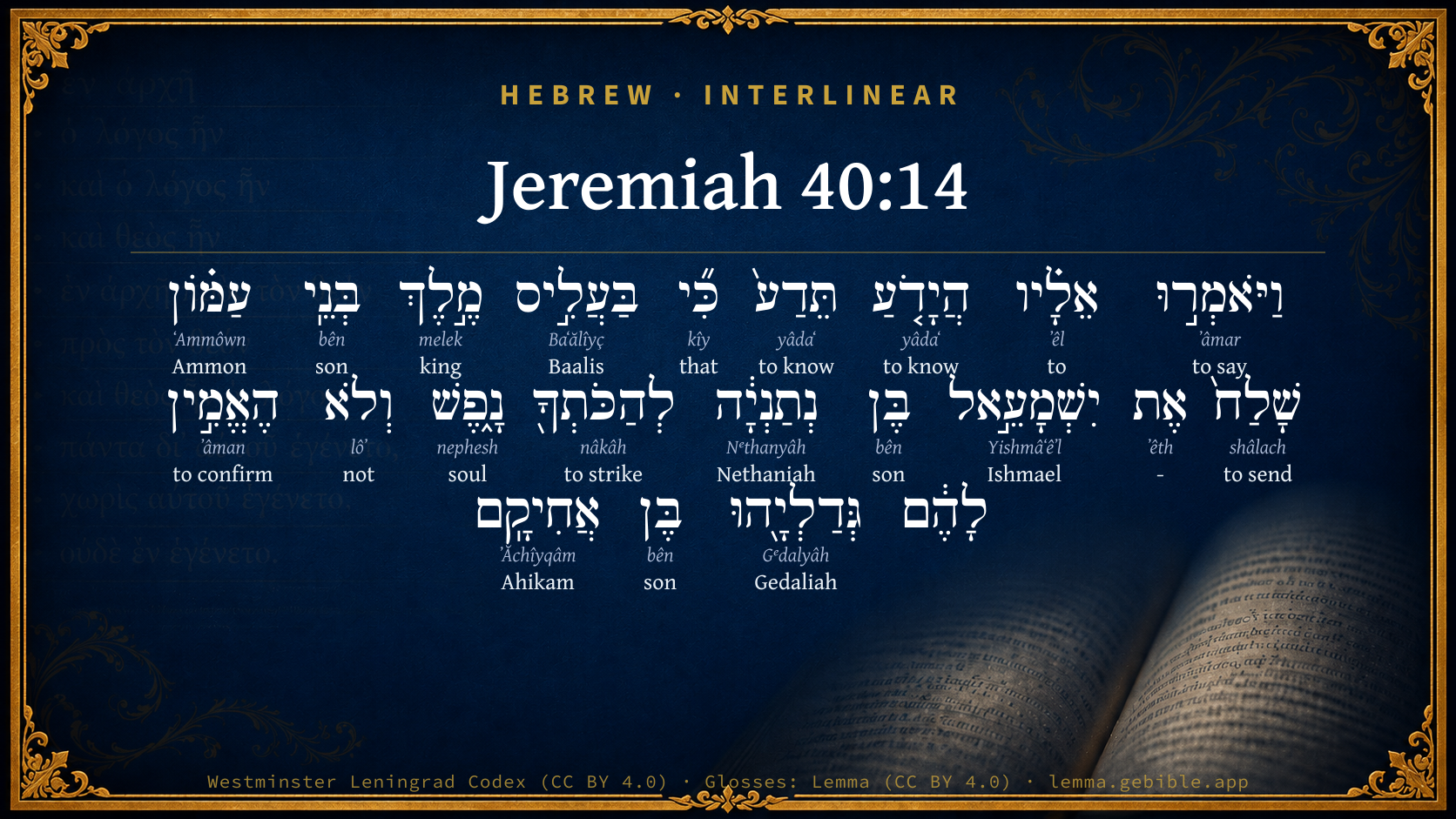
Jeremiah 40:14

Hebrew (Westminster Leningrad Codex) Jeremiah 40:14 appears in the Hebrew Old Testament. The text above is from the Westminster Leningrad Codex. Each word links to its Strong’s number, a concise gloss, and parsing drawn from the Open Scriptures Hebrew Bible morphology. Click any word for its full Brown-Driver-Briggs (BDB) entry.
Download image
Cite this verse

Jeremiah 40:14 (World English Bible). Public Domain. Lemma interlinear Bible study tool, https://lemma.gebible.app/v/jeremiah/40/14.

Show BibTeX & RIS
BibTeX
RIS
English Translation
and said to him, Do you know that Baalis the king of the children of Ammon has sent Ishmael the son of Nethaniah to take your life? But Gedaliah the son of Ahikam didn't believe them.
World English Bible · Public Domain
Highlights
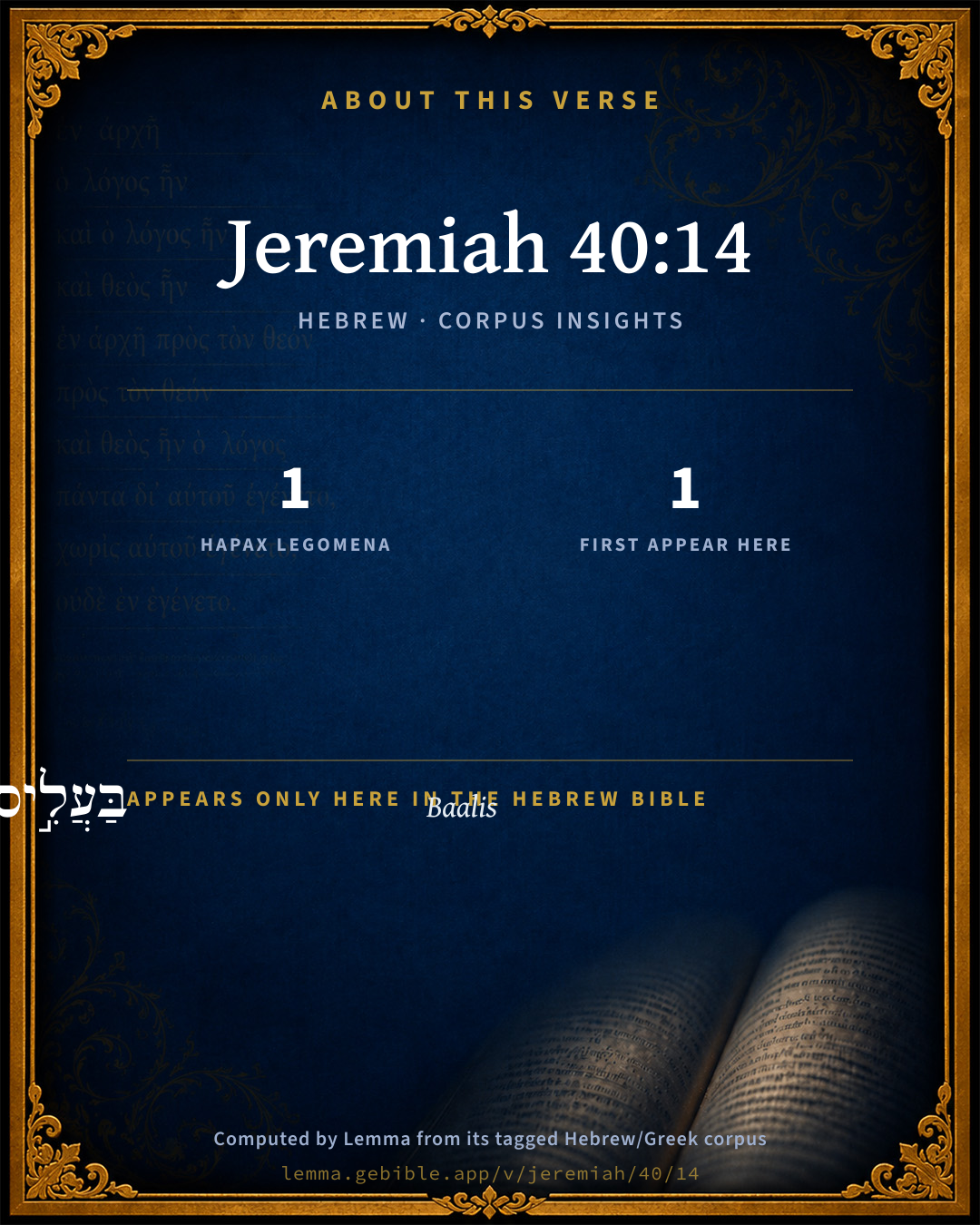
  • 1 hapax legomenon — only here in the Hebrew Bible
  • 1 first appearance in the Hebrew Bible
Full analysis ↓
Download a study sheet

One document with this verse’s original text, its word-by-word gloss line, the meaning frame, cross-references with their text, attributed commentary, and full source and license credits — printable, and it pastes into notes with its structure intact.

This verse Autodidact and up

Study sheet (.html) Plain text (.txt)

A passage Seminary Student

Up to 50 verses in one chapter. A passage sheet keeps up to 6 commentary sources and 12 cross-references per verse, in the order this page ranks them, and says so on the sheet whenever that leaves anything out. Ask for a single verse and you get the Autodidact verse sheet above.

Everything on this page stays free to read, with no account — the sheet is a download of what is already on screen, not access to it.

Want to remove ads? Support Godless Engineer
Compare translations 3

The same verse in 3 English versions, stacked beneath the original-language interlinear above. Click any original word for its lexicon entry.

Each is an independent rendering of the whole verse — the interlinear is not word-aligned to these translations.

Highlighted words mark where these versions differ — a whole-verse word diff, not a word-by-word alignment.

  • World English Bible Public Domain
    and said to him, Do you know that Baalis the king of the children of Ammon has sent Ishmael the son of Nethaniah to take your life? But Gedaliah the son of Ahikam didn't believe them.
  • King James Version Public Domain
    And said unto him, Dost thou certainly know that Baalis the king of the Ammonites hath sent Ishmael the son of Nethaniah to slay thee? But Gedaliah the son of Ahikam believed them not.
  • unfoldingWord Literal Text CC BY-SA 4.0
    They said to him, “Do you realize that Baalis king of the people of Ammon sent Ishmael son of Nethaniah to murder you?” But Gedaliah son of Ahikim did not believe them.

unfoldingWord Literal Text — © unfoldingWord, licensed CC BY-SA 4.0. Word-aligned USFM3 via Door43 (git.door43.org/unfoldingWord/en_ult).

Versions to compare (up to 4)

3 of 4 selected

Show all 18 translations

Every available English version of this verse, each an independent rendering of the whole verse.

  • World English Bible Public Domain
    and said to him, Do you know that Baalis the king of the children of Ammon has sent Ishmael the son of Nethaniah to take your life? But Gedaliah the son of Ahikam didn't believe them.
  • Berean Standard Bible Public Domain
    and said to him, “Are you aware that Baalis king of the Ammonites has sent Ishmael son of Nethaniah to take your life?” But Gedaliah son of Ahikam did not believe them.
  • Majority Standard Bible Public Domain
    and said to him, “Are you aware that Baalis king of the Ammonites has sent Ishmael son of Nethaniah to take your life?” But Gedaliah son of Ahikam did not believe them.
  • King James Version Public Domain
    And said unto him, Dost thou certainly know that Baalis the king of the Ammonites hath sent Ishmael the son of Nethaniah to slay thee? But Gedaliah the son of Ahikam believed them not.
  • American Standard Version (1901) Public Domain
    and said unto him, Dost thou know that Baalis the king of the children of Ammon hath sent Ishmael the son of Nethaniah to take thy life? But Gedaliah the son of Ahikam believed them not.
  • Revised Version (1885) Public Domain
    and said unto him, Dost thou know that Baalis the king of the children of Ammon hath sent Ishmael the son of Nethaniah to take thy life? But Gedaliah the son of Ahikam believed them not.
  • Geneva Bible (1599) Public Domain
    And said vnto him, Knowest thou not that Baalis the King of the Ammonites hath sent Ishmael the sonne of Nethaniah to slay thee? But Gedaliah the sonne of Ahikam beleeued them not.
  • Douay-Rheims (1899) Public Domain
    And they said to him: Know that Baalis the king of the children of Ammon hath sent Ismahel the son of Nathanias to kill thee. And Godolias the son of Ahicam believed them not.
  • Young's Literal Translation Public Domain
    and they say unto him, `Dost thou really know that Baalis king of the sons of Ammon hath sent Ishmael son of Nethaniah to smite thy soul?' And Gedaliah son of Ahikam hath not given to them credence.
  • Literal Standard Version CC BY-SA 4.0
    and they say to him, “Do you really know that Ba‘alis king of the sons of Ammon has sent Ishmael son of Nethaniah to strike your soul?” And Gedaliah son of Ahikam has not given credence to them.
  • Unlocked Literal Bible CC BY-SA 4.0
    They said to him, “Do you realize that Baalis king of the people of Ammon sent Ishmael son of Nethaniah to murder you?” But Gedaliah son of Ahikim did not believe them.
  • unfoldingWord Literal Text CC BY-SA 4.0
    They said to him, “Do you realize that Baalis king of the people of Ammon sent Ishmael son of Nethaniah to murder you?” But Gedaliah son of Ahikim did not believe them.
  • Darby Bible Public Domain
    and said unto him, Dost thou indeed know that Baalis the king of the children of Ammon hath sent Ishmael the son of Nethaniah to smite thee to death? But Gedaliah the son of Ahikam believed them not.
  • World Messianic Bible Public Domain
    and said to him, “Do you know that Baalis the king of the children of Ammon has sent Ishmael the son of Nethaniah to take your life?” But Gedaliah the son of Ahikam didn’t believe them.
  • Webster's Bible Public Domain
    And said to him, Dost thou certainly know that Baalis the king of the Ammonites hath sent Ishmael the son of Nethaniah to slay thee? But Gedaliah the son of Ahikam believed them not.
  • Free Bible Version CC BY-SA 4.0
    and told him, “Do you know that Baalis king of the Ammonites has sent Ishmael son of Nethaniah to kill you?” But Gedaliah didn't believe them.
  • Bible in Basic English Public Domain
    And said to him, Has it come to your knowledge that Baalis, the king of the children of Ammon, has sent Ishmael, the son of Nethaniah, to take your life? But Gedaliah, the son of Ahikam, put no faith in what they said.
  • JPS Tanakh (1917) Public Domain
    and said unto him: 'Dost thou know that Baalis the king of the children of Ammon hath sent Ishmael the son of Nethaniah to take thy life?' But Gedaliah the son of Ahikam believed them not.

Literal Standard Version (2020), Covenant Press — licensed CC BY-SA 4.0. Text via the HelloAO Bible API (eBible.org). Unlocked Literal Bible (unfoldingWord) — licensed CC BY-SA 4.0. Text via the HelloAO Bible API (eBible.org). unfoldingWord Literal Text — © unfoldingWord, licensed CC BY-SA 4.0. Word-aligned USFM3 via Door43 (git.door43.org/unfoldingWord/en_ult). Free Bible Version, Dr. Jonathan Gallagher — licensed CC BY-SA 4.0. Text via the HelloAO Bible API (eBible.org).

Word by word

More ways to search: Search by grammar → Find every occurrence → Compare this word →

Practice this passage: Drill this verse → Learn its vocabulary →

בַּעֲלִ֣יס
Baʻălîyç
H1185
“Baalis”
Noun, Proper
Part of Speech
Noun
Type
Proper
Full BDB Definition

Origin: probably from a derivative of H5965 with prepositional prefix

TWOT: None

Baalis = "lord of the banner: in causing the joy" - king of the Ammonites at the time of the destruction of Jerusalem by Nebuchadnezzar
  1. וַיֹּאמְר֣וּ ʼâmar H559 “and · to say” Conjunction + Verb, Qal, Sequential Imperfect, 3rd Person, Masculine, Plural
  2. אֵלָ֗יו ʼêl H413 “to · him” Preposition + Suffix, Personal, 3rd Person, Masculine, Singular
  3. הֲיָדֹ֤עַ yâdaʻ H3045 “to know” Particle, Interrogative + Verb, Qal, Infinitive Absolute
  4. תֵּדַע֙ yâdaʻ H3045 “to know” Verb, Qal, Imperfect, 2nd Person, Masculine, Singular
  5. כִּ֞י kîy H3588 “that” Conjunction
  6. מֶ֣לֶךְ melek H4428 “king of” Noun, Common, Masculine, Singular, Construct
  7. בְּנֵֽי bên H1121 “sons of” Noun, Common, Masculine, Plural, Construct
  8. עַמּ֗וֹן ʻAmmôwn H5983 “Ammon” Noun, Proper
  9. שָׁלַח֙ shâlach H7971 “to send” Verb, Qal, Perfect, 3rd Person, Masculine, Singular
  10. אֶת ʼêth H853 “-” Particle, Direct Object
  11. יִשְׁמָעֵ֣אל Yishmâʻêʼl H3458 “Ishmael” Noun, Proper
  12. בֶּן bên H1121 “son of” Noun, Common, Masculine, Singular, Construct
  13. נְתַנְיָ֔ה Nᵉthanyâh H5418 “Nethaniah” Noun, Proper
  14. לְהַכֹּתְךָ֖ nâkâh H5221 “to strike · you” Preposition + Verb, Hiphil, Infinitive Construct + Suffix, Personal, 2nd Person, Masculine, Singular
  15. נָ֑פֶשׁ nephesh H5315 “soul” Noun, Common, Both, Singular, Absolute
  16. וְלֹא lôʼ H3808 “and · not” Conjunction + Particle, Negative
  17. הֶאֱמִ֣ין ʼâman H539 “to confirm” Verb, Hiphil, Perfect, 3rd Person, Masculine, Singular
  18. גְּדַלְיָ֖הוּ Gᵉdalyâh H1436 “Gedaliah” Noun, Proper
  19. בֶּן bên H1121 “son of” Noun, Common, Masculine, Singular, Construct
  20. אֲחִיקָֽם ʼĂchîyqâm H296 “Ahikam” Noun, Proper

About this verse

These counts appear in no published source. They are computed here, from the morphology-tagged text and Lemma’s own curated glosses. What Lemma adds →

22
words
18
distinct lemmas
Prophets
section

Notable vocabulary

1 hapax legomenon — a word that appears only here in the entire Hebrew Bible:

  • בַּעֲלִ֣יס Baalis H1185

First appearance in Scripture

This word makes its first canonical appearance in the Hebrew Bible here:

  • בַּעֲלִ֣יס Baalis H1185

Shared distinctive vocabulary

נְתַנְיָ֔ה Nethaniah H5418 occurs in 20 verses of the Hebrew Bible. Also found in:

Grammatical profile

  • 6 verbs
  • 11 nouns
  • 2 prepositions
  • 1 conjunction
  • 2 particles

Verb forms

  • וַיֹּאמְר֣וּ Qal · Sequential Imperfect
  • הֲיָדֹ֤עַ Qal · Infinitive Absolute
  • תֵּדַע֙ Qal · Imperfect
  • שָׁלַח֙ Qal · Perfect
  • לְהַכֹּתְךָ֖ Hiphil · Infinitive Construct
  • הֶאֱמִ֣ין Hiphil · Perfect

Repetition

Words recur within this verse — often emphatic in Hebrew:

  • בְּנֵֽי son H1121 ×3
  • הֲיָדֹ֤עַ to know H3045 ×2

Cross-references

13

Topical passages linked to Jeremiah 40:14 in the Treasury of Scripture Knowledge — connected by theme and wording, ordered by reader-vote popularity; previews shown in the World English Bible.

  • Jeremiah 41:10 Then Ishmael carried away captive all the residue of the people who were in Mizpah, even the king's daughters, and all the people who remained in Mizpah, whom Nebuzaradan the captain of the guard had committed to Gedaliah the son of Ahikam; Ishmael the son of Nethaniah carried them away captive, and departed to go over to the children of Ammon.
  • 2 Samuel 10:1–6 It happened after this, that the king of the children of Ammon died, and Hanun his son reigned in his place.
  • Jeremiah 25:21 Edom, and Moab, and the children of Ammon;
  • 1 Samuel 11:1–3 Then Nahash the Ammonite came up, and encamped against Jabesh Gilead: and all the men of Jabesh said to Nahash, Make a covenant with us, and we will serve you.
  • Proverbs 26:23–26 Like silver dross on an earthen vessel Are the lips of a fervent one with an evil heart.
  • Isaiah 26:10 Let favor be shown to the wicked, yet will he not learn righteousness; in the land of uprightness will he deal wrongfully, and will not see the majesty of Yahweh.
  • Jeremiah 40:8 then they came to Gedaliah to Mizpah, [to wit], Ishmael the son of Nethaniah, and Johanan and Jonathan the sons of Kareah, and Seraiah the son of Tanhumeth, and the sons of Ephai the Netophathite, and Jezaniah the son of the Maacathite, they and their men.
  • Jeremiah 41:2 Then arose Ishmael the son of Nethaniah, and the ten men who were with him, and struck Gedaliah the son of Ahikam the son of Shaphan with the sword, and killed him, whom the king of Babylon had made governor over the land.
  • Jeremiah 49:1–6 Of the children of Ammon. Thus says Yahweh: Has Israel no sons? has he no heir? why then does Malcam possess Gad, and his people well in the cities of it?
  • Ezekiel 25:2–6 Son of man, set your face toward the children of Ammon, and prophesy against them:
  • Amos 1:13–15 Thus says Yahweh: "For three transgressions of the children of Ammon, yes, for four, I will not turn away its punishment; Because they have ripped open the pregnant women of Gilead, That they may enlarge their border.
  • Micah 7:5 Don't trust in a neighbor. Don't put confidence in a friend. With the woman lying in your embrace, Be careful of the words of your mouth!
  • 1 Corinthians 13:5–7 doesn't behave itself inappropriately, doesn't seek its own way, is not provoked, takes no account of evil;

Cross-references courtesy of OpenBible.info (CC BY 4.0).

Hebrew and Greek witnesses Masoretic Hebrew ↔ Greek Septuagint

The same verse in the two great witnesses to the Old Testament, shown verse-for-verse.

These are two independent witnesses, not word-aligned to each other, and the Septuagint is shown in lemma (dictionary) form.

Hebrew Jeremiah 40:14 Masoretic · Westminster Leningrad Codex

וַיֹּאמְר֣וּ אֵלָ֗יו הֲיָדֹ֤עַ תֵּדַע֙ כִּ֞י בַּעֲלִ֣יס מֶ֣לֶךְ בְּנֵֽי עַמּ֗וֹן שָׁלַח֙ אֶת יִשְׁמָעֵ֣אל בֶּן נְתַנְיָ֔ה לְהַכֹּתְךָ֖ נָ֑פֶשׁ וְלֹא הֶאֱמִ֣ין לָהֶ֔ם גְּדַלְיָ֖הוּ בֶּן אֲחִיקָֽם

and said to him, Do you know that Baalis the king of the children of Ammon has sent Ishmael the son of Nethaniah to take your life? But Gedaliah the son of Ahikam didn't believe them.

World English Bible · Public Domain

Greek LXX Structure differs

In the Septuagint, Jeremiah is about an eighth shorter than the Hebrew and arranges its material differently — the Oracles Against the Nations (Hebrew chapters 46–51) appear in the middle of the Greek book, after 25:13. Because the chapter and verse boundaries do not line up, a verse-for-verse comparison with the Hebrew is not shown.

A verse-for-verse comparison isn’t shown here because the chapters and verses don’t line up. Switch to the LXX edition with the MT / LXX toggle above to read the Greek directly.

Hebrew: Westminster Leningrad Codex (CC BY 4.0). Greek: Septuagint (public domain); English from a public-domain English Septuagint. How the Septuagint differs from the Hebrew →

Targum (Aramaic paraphrase)

1

The Targum is the ancient Jewish Aramaic paraphrase of the Hebrew Scriptures — an interpretive translation, not the Hebrew text itself. Onkelos (literal) and Pseudo-Jonathan (expansive) render the Torah, and Jonathan the Prophets. Coverage is partial: where no permissively-licensed English translation exists for a verse, only the Aramaic is shown. This is verse-level text, not a word-by-word alignment to the Hebrew.

  1. Targum Jonathan Prophets (Joshua–Malachi)
    וַאֲמָרוּ לֵיהּ הֲמִידַע תֵּדַע אֲרֵי בַעֲלִיס מַלְכָּא דִבְנֵי עַמוֹן שְׁלַח יַת יִשְׁמְעֵאל בַר נְתַנְיָה לְמִקְטְלָךְ נְפַשׁ וְלָא הֶאֱמִין לְהוֹן גְדַלְיָה בַּר אֲחִיקָם:

    (no public-domain English translation for this verse)

    Targum Jonathan — Aramaic: “Mikraot Gedolot” (public domain). English: “Sefaria Community Translation” (CC0 1.0 (public-domain dedication)); “London "Chaldee Paraphrase," 1871” (public domain). Text via Sefaria.

Commentary

Notes on Jeremiah 40:14 from classic Christian and Jewish commentators (each source and its license shown beneath its notes). The classic Christian expositions comment on the surrounding passage and are grouped to its opening verse, so a note may address several verses; the Jewish commentaries on the Tanakh (Rashi and others) are per-verse, so they appear only where the commentator wrote on this verse.

Lemma curates 59 commentaries, every one of them public domain or Creative Commons licensed, each selected and text-cleaned for this edition rather than reprinted as found. About our sources →

Trapp's Complete Commentary

John Trapp

Jer 40:14 And said unto him, Dost thou certainly know that Baalis the king of the Ammonites hath sent Ishmael the son of Nethaniah to slay thee? But Gedaliah the son of Ahikam believed them not.

Ver. 14. That Baalis the king of the Ammonites.] Set on work by Beelzebub the prince of devils to hinder so good a work.

But Gedaliah believed them not.] No more did Julius Caesar those that forewarned him of the conspiracy against him. The Duke of Guise, the same day that he was slain by the command of Henry III, King of France, had a scroll laid under his napkin, as he sat at dinner, wherein was written, that his life was in danger; he underwrote: They dare not; and so threw it from him under the table. But it proved that they both dared to do it, and did do it, the same day. {a} Gedaliah, likely, thought that Ishmael dared not attempt anything against him, because of the Babylonians; besides, he knew his own innocence, and Ishmael’s pretended familiarity with him, which he might think the other captains envied. Sure it is, that good Gedaliah was too secure. Nam qui omnia credit, et qui nihil credit, ex aequo peccat. {b} It is no less a fault to believe nothing, than to believe everything; sine vano publica fama. Reports are neither to be overly heeded, nor overly slighted, especially where life is concerned.

{a} Speed, 1212.

{b} Seneca.

John Trapp, A Commentary or Exposition upon All the Books of the Old and New Testament (1647–1656) — public domain. Text from a community e-Sword module.

Tyndale Open Study Notes

Tyndale Open Resources

40:14 Ammon was a small highland nation east of the Jordan Valley. • Ishmael son of Nethaniah had royal blood in his veins (2 Kgs 25:25).

Tyndale Open Study Notes — © Tyndale Open Resources, licensed CC BY-SA 4.0. Text via the HelloAO Bible API.

Geneva Bible (1599)

Geneva Bible translators

For under the color of entertaining of Ishmael, he sought only to make them destroy one another.

Geneva Bible (1599) marginal notes — public domain. Text via Bolls.life.

Jamieson, Fausset & Brown

Robert Jamieson, A. R. Fausset & David Brown

Baalis--named from the idol Baal, as was often the case in heathen names.

Ammonites--So it was to them that Ishmael went after murdering Gedaliah (Jer 41:10).

slay--literally, "strike thee in the soul," that is, a deadly stroke.

Ishmael--Being of the royal seed of David (Jer 41:1), he envied Gedaliah the presidency to which he thought himself entitled; therefore he leagued himself with the ancient heathen enemy of Judah.

believed . . . not--generous, but unwise unsuspiciousness (Ecc 9:16).

Jamieson, Fausset & Brown — Commentary Critical and Explanatory on the Whole Bible (1871) — public domain (CC PDM 1.0). Text via the HelloAO Bible API.

Adam Clarke's Commentary

Verse 14. But Gedaliah the son of Ahikam believed then not.] The account given of this man proves him to have been a person of uncommon greatness of soul. Conscious of his own integrity and benevolence, he took the portrait of others from his own mind; and therefore believed evil of no man, because he felt none towards any in his own breast. He may be reproached for being too credulous and confident: but any thing of this kind that may be justly charged against him serves only to show the greatness of his mind. A little soul is ever suspicious, and ready to believe the worst of every person and thing. A great mind acts always on the contrary.

Adam Clarke's Commentary on the Bible (1810–1826) — public domain. Text from a community e-Sword/MySword module.

John Calvin's Commentaries

They therefore came and said, that Ishmael the son of Nethaniah was suborned by the king of Ammon It may have been that the king of Ammon had hoped to be the king of Judea, or to have all that land as his own after the departure of the Chaldean army. But as his expectation was disappointed, he began to attempt another tiling, to render the land desolate by creating disturbances. Such then seems to have been the reason why he induced Ishmael to undertake the impious and abominable act of killing Gedaliah.

As to Gedaliah having no faith in their words, a question may be here raised, How was it that God suffered this holy man, endued with such rare virtues, to be basely killed by a traitor and an assassin? In the first place, we must hold it as true, that God’s judgments are just, though they correspond not with our notions. It seems indeed, at the first glance, very unaccountable, that Gedaliah should have been slain, who yet had emerged, as it were, from death, and had obtained favor with the Chaldeans; but it was God’s purpose to take him to himself, and at the same time to execute his vengeance to the utmost on the people; for we shall see that those who had been left were wholly unworthy of God’s favor; and we shall also see, that as mad wild beasts they ran headlong to death, and never ceased to provoke God’s wrath against them.

Let us then learn from this passage, that when God calls his servants from this world, he regards their salvation, so that death is for their good. For Gedaliah might have seen, that had he lived longer, things more bitter than hundred deaths would have happened to him. It was then God’s will to take him in time, before he was overwhelmed with sorrows. For it was no small cause of grief to see the people obstinately struggling against the goodness of God, until their final ruin came. This obstinacy then might have been the cause of incredible sorrow to the holy man: hence the Lord removed him in due time. In the meantime, as I have said, he opened a way for his wrath, so that after it became evident that the remnant that had been saved were wholly unworthy of mercy, they were destroyed together with the rest.

But, in the second place, we see that there was a fault mixed with virtue in Gedaliah. Love, indeed, is not suspicious, as Paul says, and ought not easily to admit an accusation. (1 Corinthians 13:5.) But he ought to have been circumspect, not only for his own sake, but because his death brought with it the ruin of the whole people. He ought then to have been more cautious. But we hence learn how difficult it is even for the best of men, endued with peculiar virtues, so to conduct themselves, as not to deviate on either side. It was a. praiseworthy simplicity that Gedaliah did not suspect that Ishmael would be so perfidious and so wicked; but as in this instance he shewed no regard for himself nor for the public safety, he was to be blamed. But, as I have said, it was God’s purpose to remove him to his rest, for had he lived, he would have been a hundred times overwhelmed with troubles. Ungodly men may blast the memory of the holy man, because he had been so stupid: but as I have already said, that as he must have deviated either on this or that side, it was better that Ishmael should not be accused until he was found guilty. Gedaliah’s only mistake was, that he disregarded the treachery of which he had been warned. It now follows —

John Calvin's Commentaries (1540-1563) — public domain. Text from the Calvin Translation Society English edition (1840s-50s) via the Christian Classics Ethereal Library (ccel.org). Calvin's coverage is partial (roughly two-thirds of the Bible); uncommented books and verses are honest gaps, never fabricated. The 19th-century editor's footnotes and remarks are omitted so the notes are faithfully Calvin's own voice.

Ellicott's Commentary for English Readers

(14) Dost thou certainly know that Baalis . . .—The king of the Ammonites so named appears from Jer_27:3 to have been in alliance with Zedekiah; and Ishmael, as belonging to the royal house of Judah, seems to have been still plotting with him against the authority of the Chaldæans. Open resistance being now impossible, they have recourse to assassination. The plot becomes known, and Johanan, faithful to his new protector, warns him against it, but, as the sequel shows, in vain. Gedaliah, in the guileless trustfulness of his character, does not believe that Ishmael is capable of such a crime, and will not sanction another crime by way of precaution.

A Bible Commentary for English Readers, edited by Charles John Ellicott (1878–1897) — public domain. Text from a community e-Sword module.

The Cambridge Bible for Schools and Colleges

gen. ed. J. J. S. Perowne

14. Baalis the king of the children of Ammon] It is easier to see the motives of Ishmael than those of his instigator Baalis. The former no doubt felt aggrieved that he, although of royal birth (Jer_41:1), should be set aside in favour of Gedaliah, and at once determined to get rid of him and take his place. Baalis may have had a spite against Gedaliah and his family as friends of Jeremiah, and as having probably taken the side of that prophet openly, when (ch. 27) he sent back the messengers of Ammon and the other neighbouring nations, refusing the alliance against the Chaldaeans which they had desired; or it may have been a design against Palestine generally which influenced him on this occasion, and the belief that, if he were to get rid of Gedaliah and the firm and peaceful rule which he seemed to be inaugurating, there would be more chance for himself in carrying out his plans of conquest.

The Cambridge Bible for Schools and Colleges (gen. ed. J. J. S. Perowne; Cambridge University Press, 1878–1918) — public domain. Text from a community e-Sword module.

John Gill's Exposition

And said unto him, dost thou certainly know,.... Not that they thought he did know, or that the thing was so flagrant that he must know it; but that he might be assured of the truth of it, from the information they were now about to give him: or, "dost thou not in knowing know?" (x) it is most certainly true; and thou mayest depend upon it that it is real matter of fact:

that Baalis the king of the Ammonites hath sent Ishmael the son of Nethaniah to slay thee? very probably Ishmael, with the forces under him, fled to the king of the Ammonites upon the taking of Jerusalem; who, out of ill will to the Jews, always bore them by the Ammonites, envying their reestablishment under Gedaliah, and hoping to make a prey of them if their governor was removed, moved it to this young prince to dispatch him; and who might be forward enough to undertake it, being displeased that Gedaliah should be governor, which he might think was an office he had a better right to, being of the seed royal; and therefore readily agreed to be sent on this bloody errand, to take away the governor's life: or, "to smite him in the soul"; or "to smite his soul" (y); that is, to give him a mortal blow, his death's wound, to separate soul and body:

but Gedaliah the son of Ahikam believed them not; being a good man, and knowing he had done nothing to disoblige him, could not believe a person of such birth and dignity would ever be guilty of such an action: very likely Ishmael had behaved in a very princely complaisant manner, and had expressed a great affection for the governor, and had been very familiar with him; and being of the seed royal, it is highly probable Gedaliah had shown a distinguished regard to him, which he might think was the reason of this charge being brought against him, out of envy to him; however, since it came from such a body of men, though he was not over credulous, yet he ought to have inquired into it, and provided for his own safety, and the public good, against the worst that might happen.

(x) "nonne cognoscendo cognosces", Pagninus, Montanus. (y) "ut percutiat animam tuam", Munster; "te in anima", Pagninus; "secundum animam", Piscator; "ad percutiendum te (quoad) animam", Schmidt.

John Gill's Exposition of the Whole Bible (1746–1763) — public domain (CC PDM 1.0). Text via the HelloAO Bible API.

Albert Barnes' Notes on the Bible

It is difficult to say what object Baalis can have had in murdering Gedaliah. As an ally of Zedekiah Jer 27:3, he may have had a spite against the family of Ahikam for opposing, as most probably they did at Jeremiah’s instigation, the league proposed Jer. 27. Ishmael’s motive was envy and spite at seeing a subject who had always opposed the war now invested with kingly power, in place of the royal family.

Albert Barnes' Notes on the Bible (1834–1885) — public domain. Text from a community e-Sword/MySword module.

Haydock's Catholic Bible Commentary

Baalis. Queen. (Grotius) --- The Ammonites sought the entire ruin of the Jews.

George Leo Haydock (1774–1849), Haydock's Catholic Family Bible and Commentary, 1859 edition — public domain. Excludes Psalms (Douay-Rheims chapter numbering differs from Protestant) and Deuterocanonical books (Catholic canon only).

Matthew Poole's English Annotations

Dost thou, for dost thou not; for not is plainly understood, as the sense makes evident. Whether this Baalis be a proper name of the

king of the Ammonites, or, as some think, an appellative name, signifying the lady or the queen regent, is uncertain. What made the prince of the Ammonites do this can be but guessed; probably the old hatred they had to Israel, or hopes that they should have the better fishing in these waters when they were troubled. Gedaliah seems a man of a good humour, not too credulous, and believes not the information.

Matthew Poole's English Annotations on the Holy Bible (1683–1685) — public domain. Text from a community e-Sword/MySword module.

Whedon's Commentary on the Bible

Daniel D. Whedon

14. Baalis the king of the Ammonites — From Jer_27:3, we learn that this man was an ally of the king of Judah. Why he should seek to assassinate Gedaliah who had shown so friendly a disposition toward the Jews, does not appear.

Ishmael — He may have been a willing instrument of this atrocious conspiracy because of his personal enmity to Gedaliah. He was of the royal line, being a descendant of David, and perhaps could ill brook the lordship of this alien and infidel.

Believed them not — Generous men are slowest to believe evil of their fellows.

Daniel D. Whedon (gen. ed.), Commentary on the Old and New Testaments (1874–1909) — public domain. Text from a community e-Sword module.

The Pulpit Commentary

Baalis the king of the Ammonites. Perhaps the same king referred to in Jer_27:3 as seeking alliance with Zedekiah. He was naturally opposed to the Babylonian official, Gedaliah. Hath sent Ishmael. Ishmael was connected with the royal family, (Jer_41:1) and was probably jealous of Gedaliah.

The Pulpit Commentary (1880–1919), ed. H.D.M. Spence-Jones & Joseph S. Exell — public domain. Text from a community e-Sword module.

Lesson kit

Teaching starters — assembled from the data on this page, not authored interpretation. Every prompt links to the verse data it draws on. Edit before teaching.

Jeremiah, in the Prophets, opens this verse with 22 words (18 distinct Hebrew lemmas). Its most distinctive word is Baʻălîyç (“Baalis”). A historical commentator’s framing appears above. Read the whole chapter for the surrounding context.

Discussion questions

  1. What does “Baalis” (Baʻălîyç) contribute to the verse as a whole?
  2. This verse holds 1 word here found nowhere else in the Hebrew Bible. What might the rare word draw attention to?
  3. The word “Baalis” first appears here in Scripture. What is being introduced at this debut?
  4. 2 Kings 25:23 shares the word «Nethaniah» with this verse. How do the two illuminate each other?
  5. “son” occurs 3× in this one verse. What is the effect of the repetition?
  6. The translations on this page render this verse differently — a whole-verse word diff, not a word-by-word alignment. What might account for the different wordings?
  7. The verb «וַיֹּאמְר֣וּ» is Qal Sequential Imperfect. How does its form color the action?
  8. Reading how Trapp's Complete Commentary and Tyndale Open Study Notes read this verse, where do the two commentators agree and where do they part?

Things to notice

  • 1 word in this verse appears nowhere else in the Hebrew Bible.
  • 1 word makes its first canonical appearance in Scripture here.
  • These translations choose different wording for 20 words in this verse.
  • “son” occurs 3× in this single verse.
  • 18 distinct Hebrew lemmas span 22 words in this verse.

Reading settings

Reading text

Shown beneath each verse's original-language words.

Old Testament
Old Testament edition

Read the OT as the Masoretic Hebrew (MT) or the Greek Septuagint (LXX).

English shown for the Greek Septuagint (in the Hebrew ↔ Greek comparison).

Comparing translations? Open the Compare panel on any verse page to stack up to four side by side.