
Job 39:24

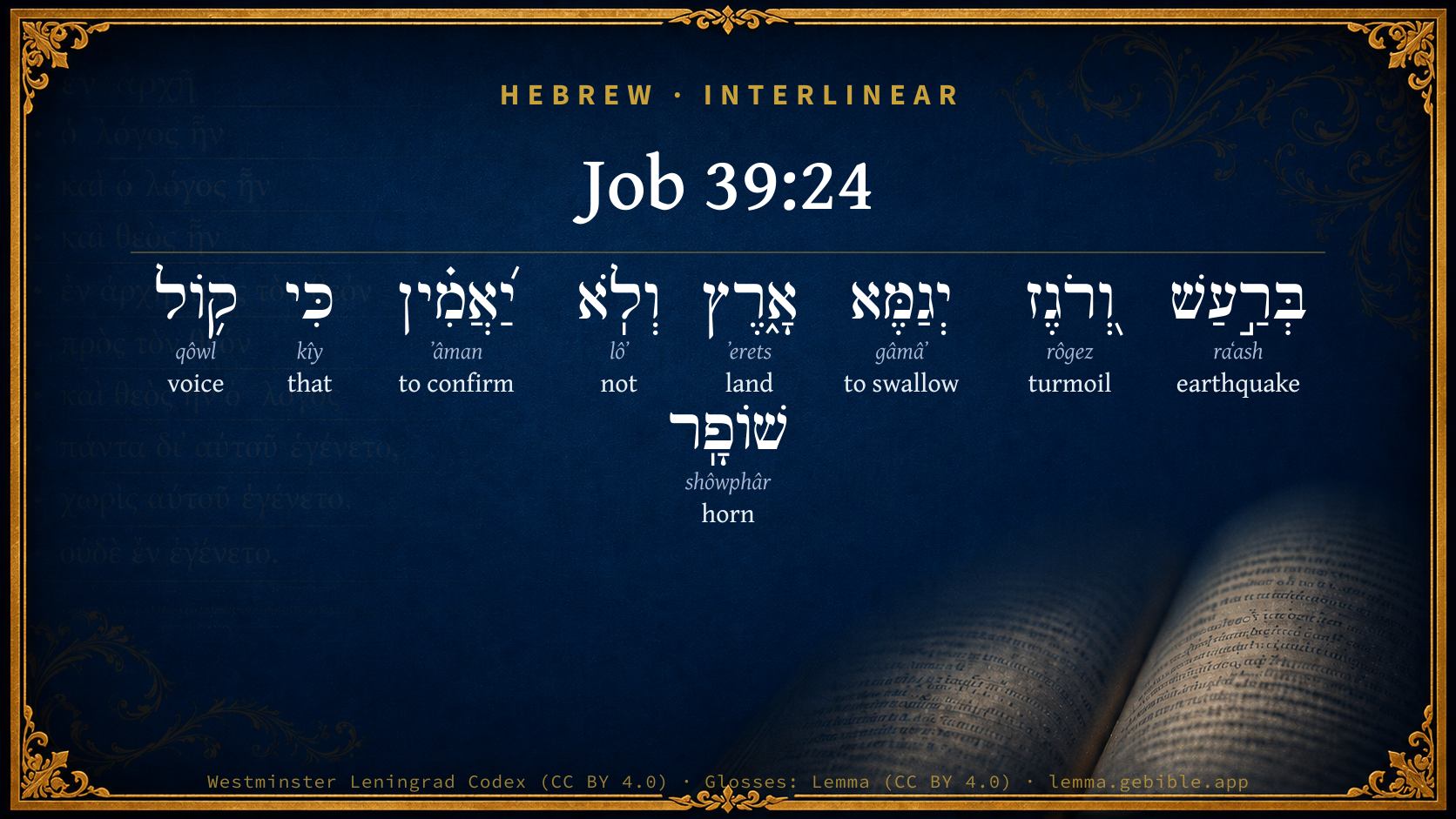
Hebrew (Westminster Leningrad Codex) Job 39:24 appears in the Hebrew Old Testament. The text above is from the Westminster Leningrad Codex. Each word links to its Strong’s number, a concise gloss, and parsing drawn from the Open Scriptures Hebrew Bible morphology. Click any word for its full Brown-Driver-Briggs (BDB) entry.
Download image
Cite this verse

Job 39:24 (World English Bible). Public Domain. Lemma interlinear Bible study tool, https://lemma.gebible.app/v/job/39/24.

Show BibTeX & RIS
BibTeX
RIS
English Translation
He eats up the ground with fierceness and rage, Neither does he stand still at the sound of the trumpet.
World English Bible · Public Domain
Download a study sheet

One document with this verse’s original text, its word-by-word gloss line, the meaning frame, cross-references with their text, attributed commentary, and full source and license credits — printable, and it pastes into notes with its structure intact.

This verse Autodidact and up

Study sheet (.html) Plain text (.txt)

A passage Seminary Student

Up to 50 verses in one chapter. A passage sheet keeps up to 6 commentary sources and 12 cross-references per verse, in the order this page ranks them, and says so on the sheet whenever that leaves anything out. Ask for a single verse and you get the Autodidact verse sheet above.

Everything on this page stays free to read, with no account — the sheet is a download of what is already on screen, not access to it.

Want to remove ads? Support Godless Engineer
Compare translations 3

The same verse in 3 English versions, stacked beneath the original-language interlinear above. Click any original word for its lexicon entry.

Each is an independent rendering of the whole verse — the interlinear is not word-aligned to these translations.

Highlighted words mark where these versions differ — a whole-verse word diff, not a word-by-word alignment.

  • World English Bible Public Domain
    He eats up the ground with fierceness and rage, Neither does he stand still at the sound of the trumpet.
  • King James Version Public Domain
    He swalloweth the ground with fierceness and rage: neither believeth he that it is the sound of the trumpet.
  • unfoldingWord Literal Text CC BY-SA 4.0
    With shaking and rage it swallows the ground, and it does not stand still when the sound of the horn.

unfoldingWord Literal Text — © unfoldingWord, licensed CC BY-SA 4.0. Word-aligned USFM3 via Door43 (git.door43.org/unfoldingWord/en_ult).

Versions to compare (up to 4)

3 of 4 selected

Show all 18 translations

Every available English version of this verse, each an independent rendering of the whole verse.

  • World English Bible Public Domain
    He eats up the ground with fierceness and rage, Neither does he stand still at the sound of the trumpet.
  • Berean Standard Bible Public Domain
    Trembling with excitement, he devours the distance; he cannot stand still when the ram’s horn sounds.
  • Majority Standard Bible Public Domain
    Trembling with excitement, he devours the distance; he cannot stand still when the ram’s horn sounds.
  • King James Version Public Domain
    He swalloweth the ground with fierceness and rage: neither believeth he that it is the sound of the trumpet.
  • American Standard Version (1901) Public Domain
    He swalloweth the ground with fierceness and rage; Neither believeth he that it is the voice of the trumpet.
  • Revised Version (1885) Public Domain
    He swalloweth the ground with fierceness and rage; neither believeth he that it is the voice of the trumpet.
  • Geneva Bible (1599) Public Domain
    He diggeth in the valley, and reioyceth in his strength: he goeth foorth to meete the harnest man.
  • Douay-Rheims (1899) Public Domain
    Chasing and raging he swalloweth the ground, neither doth he make account when the noise of the trumpet soundeth.
  • Young's Literal Translation Public Domain
    With trembling and rage he swalloweth the ground, And remaineth not stedfast Because of the sound of a trumpet.
  • Literal Standard Version CC BY-SA 4.0
    He swallows the ground with trembling and rage, || And does not remain steadfast || Because of the sound of a horn.
  • Unlocked Literal Bible CC BY-SA 4.0
    He swallows up ground with fierceness and rage; at the trumpet's sound, he cannot stand in one place.
  • unfoldingWord Literal Text CC BY-SA 4.0
    With shaking and rage it swallows the ground, and it does not stand still when the sound of the horn.
  • Darby Bible Public Domain
    He swalloweth the ground with fierceness and rage, and cannot contain himself at the sound of the trumpet:
  • World Messianic Bible Public Domain
    He eats up the ground with fierceness and rage, neither does he stand still at the sound of the shofar.
  • Webster's Bible Public Domain
    \\39:21\\He paweth in the valley, and rejoiceth in his strength: he goeth on to meet the armed men.
  • Free Bible Version CC BY-SA 4.0
    Shaking with rage it gallops across the ground; it cannot remain still when the trumpet sounds.
  • Bible in Basic English Public Domain
    He is stamping with joy in the valley; he makes sport of fear.
  • JPS Tanakh (1917) Public Domain
    He swalloweth the ground with storm and rage; neither believeth he that it is the voice of the horn.

Literal Standard Version (2020), Covenant Press — licensed CC BY-SA 4.0. Text via the HelloAO Bible API (eBible.org). Unlocked Literal Bible (unfoldingWord) — licensed CC BY-SA 4.0. Text via the HelloAO Bible API (eBible.org). unfoldingWord Literal Text — © unfoldingWord, licensed CC BY-SA 4.0. Word-aligned USFM3 via Door43 (git.door43.org/unfoldingWord/en_ult). Free Bible Version, Dr. Jonathan Gallagher — licensed CC BY-SA 4.0. Text via the HelloAO Bible API (eBible.org).

Word by word

More ways to search: Search by grammar → Find every occurrence → Compare this word →

Practice this passage: Drill this verse → Learn its vocabulary →

About this verse

These counts appear in no published source. They are computed here, from the morphology-tagged text and Lemma’s own curated glosses. What Lemma adds →

9
words
9
distinct lemmas
Wisdom
section

Notable vocabulary

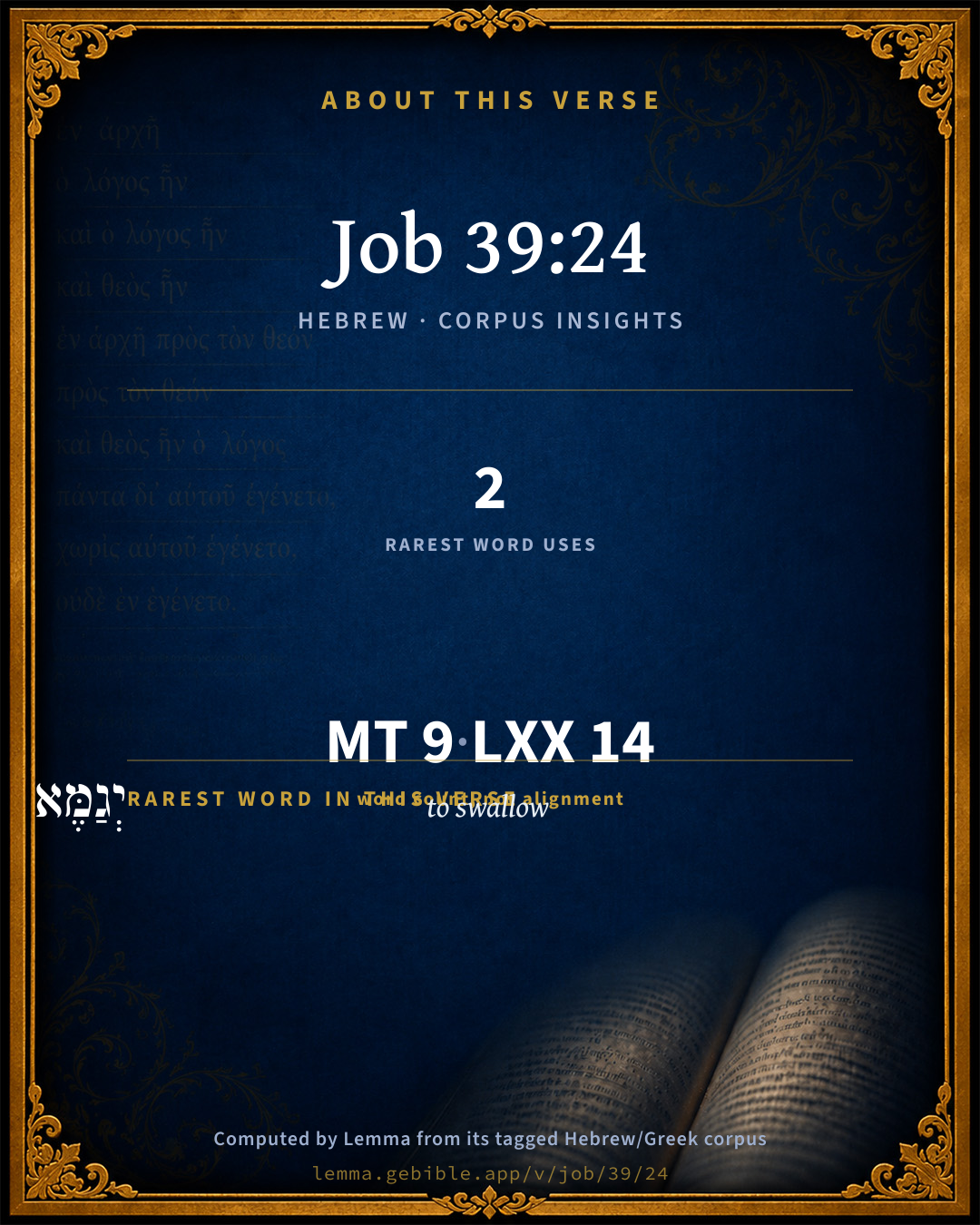
The rarest word here is יְגַמֶּא to swallow H1572 — appearing just 2 times in the whole Hebrew Bible.

Shared distinctive vocabulary

יְגַמֶּא to swallow H1572 occurs in 2 verses of the Hebrew Bible. Also found in:

Grammatical profile

  • 2 verbs
  • 5 nouns
  • 1 conjunction
  • 1 particle

Verb forms

  • יְגַמֶּא Piel · Imperfect
  • יַ֝אֲמִ֗ין Hiphil · Imperfect

Hebrew & Septuagint length

In English translation the verse runs 20 words from the Hebrew and 9 from the Septuagint (LXX English) — the Septuagint runs noticeably shorter here. See the side-by-side →

A rough comparison of the two English renderings, which tokenize alike — not a word-level alignment.

Word counts can differ between the Hebrew and the Greek without any difference in meaning — e.g. the Hebrew direct-object marker אֵת has no separate Greek word, and Greek often adds the article ὁ.

In the original languages it is 9 Hebrew tokens and 14 Greek tokens — but the two are counted differently (Hebrew bundles its prefixes and suffixes into one token; the Greek is in lemma form), so that isn’t a like-for-like length.

Cross-references

7

Topical passages linked to Job 39:24 in the Treasury of Scripture Knowledge — connected by theme and wording, ordered by reader-vote popularity; previews shown in the World English Bible.

  • Job 9:16 If I had called, and he had answered me, Yet would I not believe that he listened to my voice.
  • Job 29:24 I smiled on them when they had no confidence. They didn't reject the light of my face.
  • Job 37:20 Shall it be told him that I would speak? Or should a man wish that he were swallowed up?
  • Jeremiah 4:19 My anguish, my anguish! I am pained at my very heart; my heart is disquieted in me; I can't hold my peace; because you have heard, O my soul, the sound of the trumpet, the alarm of war.
  • Amos 3:6 Does the trumpet alarm sound in a city, Without the people being afraid? Does evil happen to a city, And Yahweh hasn't done it?
  • Luke 24:41 While they still didn't believe for joy, and wondered, he said to them, "Do you have anything here to eat?"
  • Habakkuk 1:8–9 Their horses also are swifter than leopards, and are more fierce than the evening wolves. Their horsemen press proudly on. Yes, their horsemen come from afar. They fly as an eagle that hurries to devour.

Cross-references courtesy of OpenBible.info (CC BY 4.0).

Hebrew and Greek witnesses Masoretic Hebrew ↔ Greek Septuagint

The same verse in the two great witnesses to the Old Testament, shown verse-for-verse.

Here the Septuagint runs noticeably shorter than the Hebrew — LXX2012 (modern English Septuagint) 9 words vs World English Bible 20. A rough length comparison of the two English translations, not a word-level alignment — read both below.

These are two independent witnesses, not word-aligned to each other, and the Septuagint is shown in lemma (dictionary) form.

Hebrew Job 39:24 Masoretic · Westminster Leningrad Codex

בְּרַ֣עַשׁ וְ֭רֹגֶז יְגַמֶּא אָ֑רֶץ וְלֹֽא יַ֝אֲמִ֗ין כִּי ק֥וֹל שׁוֹפָֽר

He eats up the ground with fierceness and rage, Neither does he stand still at the sound of the trumpet.

World English Bible · Public Domain

Greek LXX Job 39:24 Septuagint · lemma form

καί ὀργή ἀπο ἀναἵζω ὁ γῆ καί οὐ μή πιστεύω ἕως ἄν σημαίνω σάλπιγξ

and he will not believe until the trumpet sounds.

LXX2012 (modern English Septuagint) · Public Domain

On this verse, Haydock's Catholic Bible Commentary discusses the Septuagint’s reading. Read the note in Commentary ↓

Hebrew: Westminster Leningrad Codex (CC BY 4.0). Greek: Septuagint (public domain); English from LXX2012 (modern English Septuagint) (Public Domain). How the Septuagint differs from the Hebrew →

Commentary

Notes on Job 39:24 from classic Christian and Jewish commentators (each source and its license shown beneath its notes). The classic Christian expositions comment on the surrounding passage and are grouped to its opening verse, so a note may address several verses; the Jewish commentaries on the Tanakh (Rashi and others) are per-verse, so they appear only where the commentator wrote on this verse.

Lemma curates 59 commentaries, every one of them public domain or Creative Commons licensed, each selected and text-cleaned for this edition rather than reprinted as found. About our sources →

Trapp's Complete Commentary

John Trapp

Job 39:24 He swalloweth the ground with fierceness and rage: neither believeth he that [it is] the sound of the trumpet.

Ver. 24. He swalloweth the ground with fierceness] He runs over it as fast as if he did swallow it up at a draught, Terrain prae cursus celeritate, ebibare, et epotare videtur (Merc.). A hyperbolic metaphor.

With fierceness and rage] Or, With commotion or unquietness, In fremitu et commotione. There is an elegance in the original that cannot be interpreted in English.

Neither believeth he that it is the sound of the trumpet] He is so overjoyed, when that sign is given, to begin the battle. Others, he cannot stand still when he hath once heard the sound of the trumpet.

John Trapp, A Commentary or Exposition upon All the Books of the Old and New Testament (1647–1656) — public domain. Text from a community e-Sword module.

Tyndale Open Study Notes

Tyndale Open Resources

39:24 The ram’s horn was sounded in combat to call for the charge (Josh 6:4-6).

Tyndale Open Study Notes — © Tyndale Open Resources, licensed CC BY-SA 4.0. Text via the HelloAO Bible API.

Geneva Bible (1599)

Geneva Bible translators

He beateth with his hoof.

Geneva Bible (1599) marginal notes — public domain. Text via Bolls.life.

Jamieson, Fausset & Brown

Robert Jamieson, A. R. Fausset & David Brown

swalloweth--Fretting with impatience, he draws the ground towards him with his hoof, as if he would swallow it. The parallelism shows this to be the sense; not as MAURER, "scours over it."

neither believeth--for joy. Rather, "he will not stand still, when the note of the trumpet (soundeth)."

Jamieson, Fausset & Brown — Commentary Critical and Explanatory on the Whole Bible (1871) — public domain (CC PDM 1.0). Text via the HelloAO Bible API.

Ellicott's Commentary for English Readers

(24) Neither believeth he—i.e., he disregardeth the summons of the trumpet, as though he did not believe that it gave the call to war.

A Bible Commentary for English Readers, edited by Charles John Ellicott (1878–1897) — public domain. Text from a community e-Sword module.

The Cambridge Bible for Schools and Colleges

gen. ed. J. J. S. Perowne

24. neither believeth he] That is, most probably, he hardly trusts his ears for gladness.

The Cambridge Bible for Schools and Colleges (gen. ed. J. J. S. Perowne; Cambridge University Press, 1878–1918) — public domain. Text from a community e-Sword module.

John Gill's Exposition

He swalloweth the ground with fierceness and rage,.... Being so eager for the battle, and so full of fierceness and rage, he bounds the plain with such swiftness that he seems rather to swallow up the ground than to run upon it;

neither believeth he that it is the sound of the trumpet; for joy at hearing it; or he will not trust to his ears, but will see with his eyes whether the battle is ready, and therefore pushes forward. Mr. Broughton and others read it, "he will not stand still at the noise of the trumpet"; and the word signifies firm and stable, as well as to believe; when he hears the trumpet sound, the alarm of war, as a preparation for the battle, he knows not how to (a) stand; there is scarce any holding him in, but he rushes into the battle at once, Jer 8:6.

(a) "Stare loco nescit". Virgil. Georgic. l. 3. v. 84. "Ut fremit acer equus", &c. Ovid. Metamorph. l. 3. Fab. 10. v. 704.

John Gill's Exposition of the Whole Bible (1746–1763) — public domain (CC PDM 1.0). Text via the HelloAO Bible API.

Albert Barnes' Notes on the Bible

He swalloweth the ground - He seems as if he would absorb the earth. That is, he strikes his feet into it with such fierceness, and raises up the dust in his prancing, as if he would devour it. This figure is unusual with us, but it is common in the Arabic. See Schultens, “in loc.,” and Bochart, “Hieroz,” P. i. L. ii. c. viii. pp. 143-145. So Statius:

Stare loco nescit, pereunt vestigia mille

Ante fugam, absentemque ferit gravis ungula campum.

Th’ impatient courser pants in every’ vein,

And pawing seems to beat the distant plain;

Hills, vales, and floods, appear already cross’d,

And ere he starts a thousand steps are lost.

Pope

Neither believeth he that it is the sound of the trumpet - This translation by no means conveys the meaning of the original. The true sense is probably expressed by Umbreit. “He standeth not still when the trumpet soundeth; “that is, he becomes impatient; he no longer confides in the voice of the rider and remains submissive, but he becomes excited by the martial clangor, and rushes into the midst of the battle. The Hebrew word which is employed (יאמין ya'âmiyn) means properly “to prop, stay, support”; then “to believe, to be firm, stable”; and is that which is commonly used to denote an act of “faith,” or as meaning “believing.” But the original sense of the word is here to be retained, and then it refers to the fact that the impatient horse no longer stands still when the trumpet begins to sound for battle.

Albert Barnes' Notes on the Bible (1834–1885) — public domain. Text from a community e-Sword/MySword module.

Haydock's Catholic Bible Commentary

Ground. This expression is still used by the Arabs, to denote velocity. (Grotius) --- Septuagint, "in wrath he will make the earth disappear." (Haydock) --- Mox sanguis venis melior calet, ire viarum

Longa volunt latumque fuga consumere campum. (Nemesianus)

--- Account. Hebrew, "believe that," or "stops not when." He is so eager to rush forward to battle.

Si qua sonum procul arma dedere,

Stare loco nescit, micat auribus et tremit artus. (Georg. iii.)

George Leo Haydock (1774–1849), Haydock's Catholic Family Bible and Commentary, 1859 edition — public domain. Excludes Psalms (Douay-Rheims chapter numbering differs from Protestant) and Deuterocanonical books (Catholic canon only).

Matthew Poole's English Annotations

The sense is either,

1. He is so earnest and eager upon the battle, that he rusheth into it with all speed; and runs over the ground so swiftly, that he might seem to have swallowed it tap. Or,

2. He is so full of war-like rage and fury, that he not only champs his bridle, but is ready to tear and devour the very ground on which he goes. And the phrase here used is not unusual, both in Arabic and in other authors; of which see my Latin Synopsis on this place.

He is so pleased with the approach of the battle, and the sound of the trumpet calling to it, that he could scarce believe his cars for gladness: compare Gen 45:26; Luk 24:41. Or thus, he cannot stand still, or firm, (as this verb and Hie derivative from it is used, not only in the Chaldee and Syriac dialect, but also in the Hebrew, as Deu 28:59; 1Sa 2:35) when the trumpet soundeth; his rider can hardly keep him still, but he strives and longs to run to the fight.

Matthew Poole's English Annotations on the Holy Bible (1683–1685) — public domain. Text from a community e-Sword/MySword module.

Whedon's Commentary on the Bible

Daniel D. Whedon

24. He swalloweth the ground — יגמא, swalloweth, from which גמא, “bulrush” is derived, because of its sucking, or “swallowing,” the water. See note, Job_8:11. The Arab, in common with the Eastern and classic poets, to the present day, applies the metaphor of the text to the horse. In like manner Shakspeare: —

And starting so,

He seemed in running to devour the way.

Henry IV., Sec. Part.

Believeth he — Furst, Hitzig, and others would read, יאמין, standeth he still. The reading of the text, believeth, is equally well supported, (Schlottmann, Conant, and Dillmann,) and is much more forcible. He cannot trust (believe) his ears, so joyous is the trumpet blast. AEschylus says of the war-horse: “Impatiently he awaits the call of the trumpet.” — Septem., etc., 394. Compare Job_9:16; Job_39:12.

Daniel D. Whedon (gen. ed.), Commentary on the Old and New Testaments (1874–1909) — public domain. Text from a community e-Sword module.

The Pulpit Commentary

He swalloweth the ground with fierceness and. rage. This is a common metaphor to denote the rapidity with which the horse covers the space that lies before him. Virgil has, "Corripiuut spatia" ("AEnid," 5:316); Silius ltalions, "Campum volatu rapucre" (3:308); Shakespeare, "He seemed in running to devour the way." Arab poets have similar expressions (see Bochart, "Hieroz.," pt. 1. bk. 2. p. 8). Neither beiieveth he that it is the sound of the trumpet. (So Schultens, Canon Cook, and our Revisers.) But most recent critics prefer to render, "He standeth not still when the trumpet soundeth," and compare Virgil"s "Stare loco nescit" ("Georg.," 3:84).

The Pulpit Commentary (1880–1919), ed. H.D.M. Spence-Jones & Joseph S. Exell — public domain. Text from a community e-Sword module.

John Wesley's Explanatory Notes

Swalloweth - He is so full of rage and fury, that he not only champs his bridle, but is ready to tear and devour the very ground on which he goes. Believeth - He is so pleased with the approach of the battle, and the sound of the trumpet calling to it, that he can scarce believe his ears for gladness.

John Wesley, Explanatory Notes Upon the Whole Bible (1754–1765) — public domain. Text via the GEBible commentary corpus.

unfoldingWord translationNotes

Door43 World Missions Community

Connecting Statement:

Yahweh continues to challenge Job.

He

The word "He" refers to the horse.

swallows up ground

The horse runs over the ground so quickly that the ground passes by like water that a person drinks. AT: "runs very fast over the ground" (See: Metaphor)

with fierceness and rage

The horse is very excited, so he moves quickly and strongly.

at the trumpet's sound

It can be stated that someone blows the trumpet. AT: "when someone blows a trumpet to announce that a battle has begun" (See: Assumed Knowledge and Implicit Information)

he cannot stand in one place

"he is too excited to stand still"

he says, 'Aha

The word "Aha" is a sound people make when they discover something. The horse makes a sound because he has discovered the battle. (See: Personification)

the thunderous shouts

It is implied that the horse hears these things. AT: "he hears the thunderous shouts" (See: Assumed Knowledge and Implicit Information)

the outcries

"the battle cries." People have special shouts that they use in war to show their great strength and bravery and to scare the enemy.

translationWords

rage

trumpet

commander

unfoldingWord translationNotes — © Distant Shores Media and the Door43 World Missions Community, licensed CC BY-SA 4.0. Source: git.door43.org/Door43/en_tn.

Rashi

Rabbi Shlomo Yitzchaki (Rashi)

he hollows out the ground Heb. יגמא. He makes holes (גומות) with his feet. Another explanation: יְגַמֶא is like (Gen. 24:17), “Let me please swallow (הגמיאיני).”

and he does not believe out of the great joy that he longs for battle.

that it is the sound of a shofar of battle.

Rashi on the Tanakh — English translations: “The Judaica Press complete Tanach with Rashi, translated by A. J. Rosenberg” (CC BY 4.0); “Pentateuch with Rashi's commentary by M. Rosenbaum and A.M. Silbermann, 1929-1934” (public domain); “The Metsudah Tanach series, Lakewood, N.J” (CC BY 4.0); and “The Book of Joshua, Metsudah Publications, 1997” (CC BY 4.0). Text via Sefaria.

Lesson kit

Teaching starters — assembled from the data on this page, not authored interpretation. Every prompt links to the verse data it draws on. Edit before teaching.

Job, in the Wisdom, opens this verse with 9 words (9 distinct Hebrew lemmas). Its most distinctive word is gâmâʼ (“to swallow”). The Greek Septuagint runs shorter here. A historical commentator’s framing appears above. Read the whole chapter for the surrounding context.

Discussion questions

  1. How does “to swallow” (gâmâʼ) shape what this verse is saying?
  2. How does Genesis 24:17, which shares the word «to swallow», read alongside this verse?
  3. The Septuagint runs shorter here than the Hebrew. What might account for the difference?
  4. The translations on this page render this verse differently — a whole-verse word diff, not a word-by-word alignment. What might account for the different wordings?
  5. «יְגַמֶּא» is a Piel Imperfect verb. How does that grammatical form shape the action described?
  6. Compare how Trapp's Complete Commentary and Tyndale Open Study Notes read this verse. Where do they agree or differ?

Things to notice

Reading settings

Reading text

Shown beneath each verse's original-language words.

Old Testament
Old Testament edition

Read the OT as the Masoretic Hebrew (MT) or the Greek Septuagint (LXX).

English shown for the Greek Septuagint (in the Hebrew ↔ Greek comparison).

Comparing translations? Open the Compare panel on any verse page to stack up to four side by side.