Deuteronomy 28:66

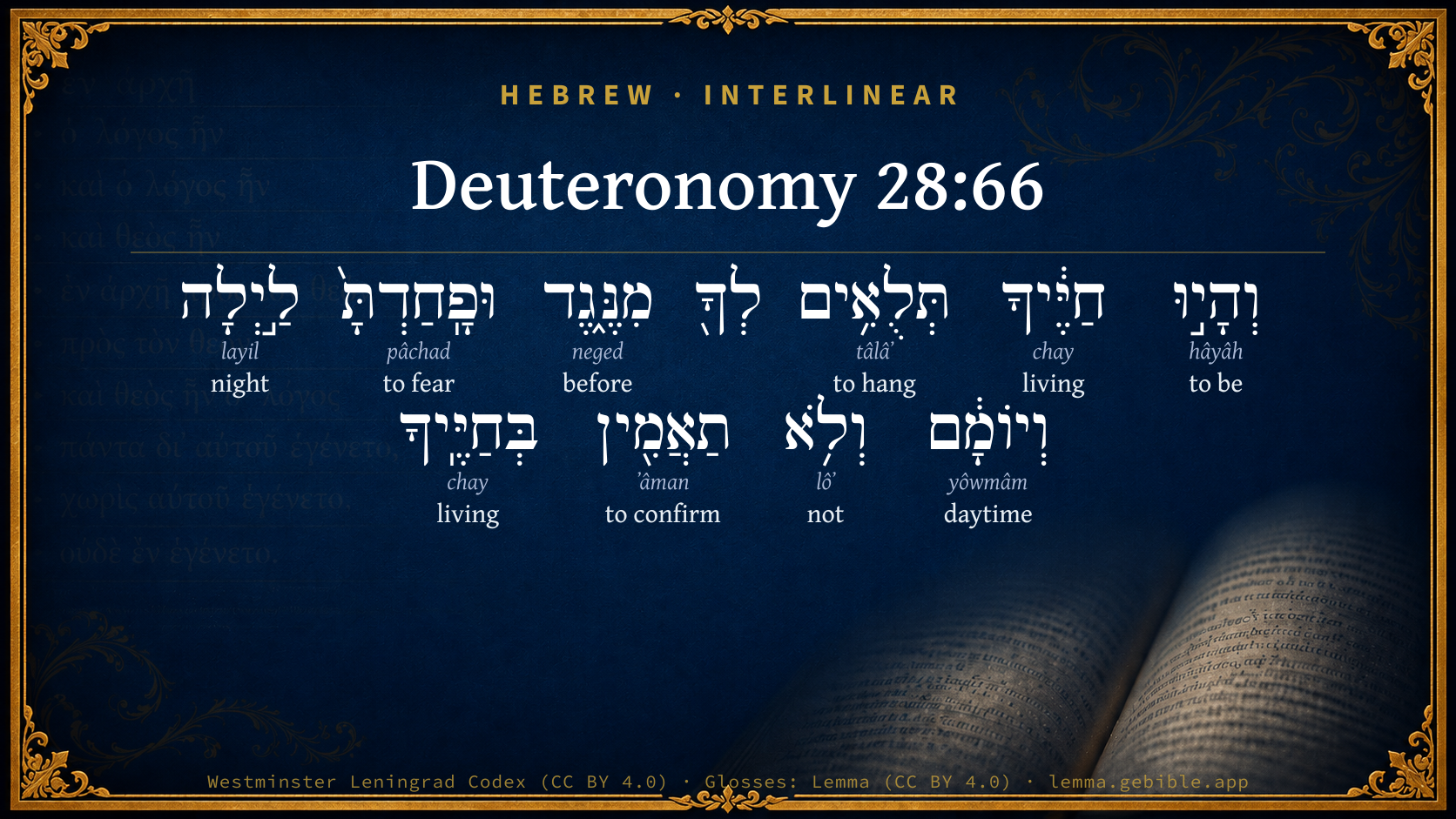
Hebrew (Westminster Leningrad Codex) Deuteronomy 28:66 appears in the Hebrew Old Testament. The text above is from the Westminster Leningrad Codex. Each word links to its Strong’s number, a concise gloss, and parsing drawn from the Open Scriptures Hebrew Bible morphology. Click any word for its full Brown-Driver-Briggs (BDB) entry.
Download image
Cite this verse

Deuteronomy 28:66 (World English Bible). Public Domain. Lemma interlinear Bible study tool, https://lemma.gebible.app/v/deuteronomy/28/66.

Show BibTeX & RIS
BibTeX
RIS
English Translation
and your life shall hang in doubt before you; and you shall fear night and day, and shall have no assurance of your life.
World English Bible · Public Domain
Highlights
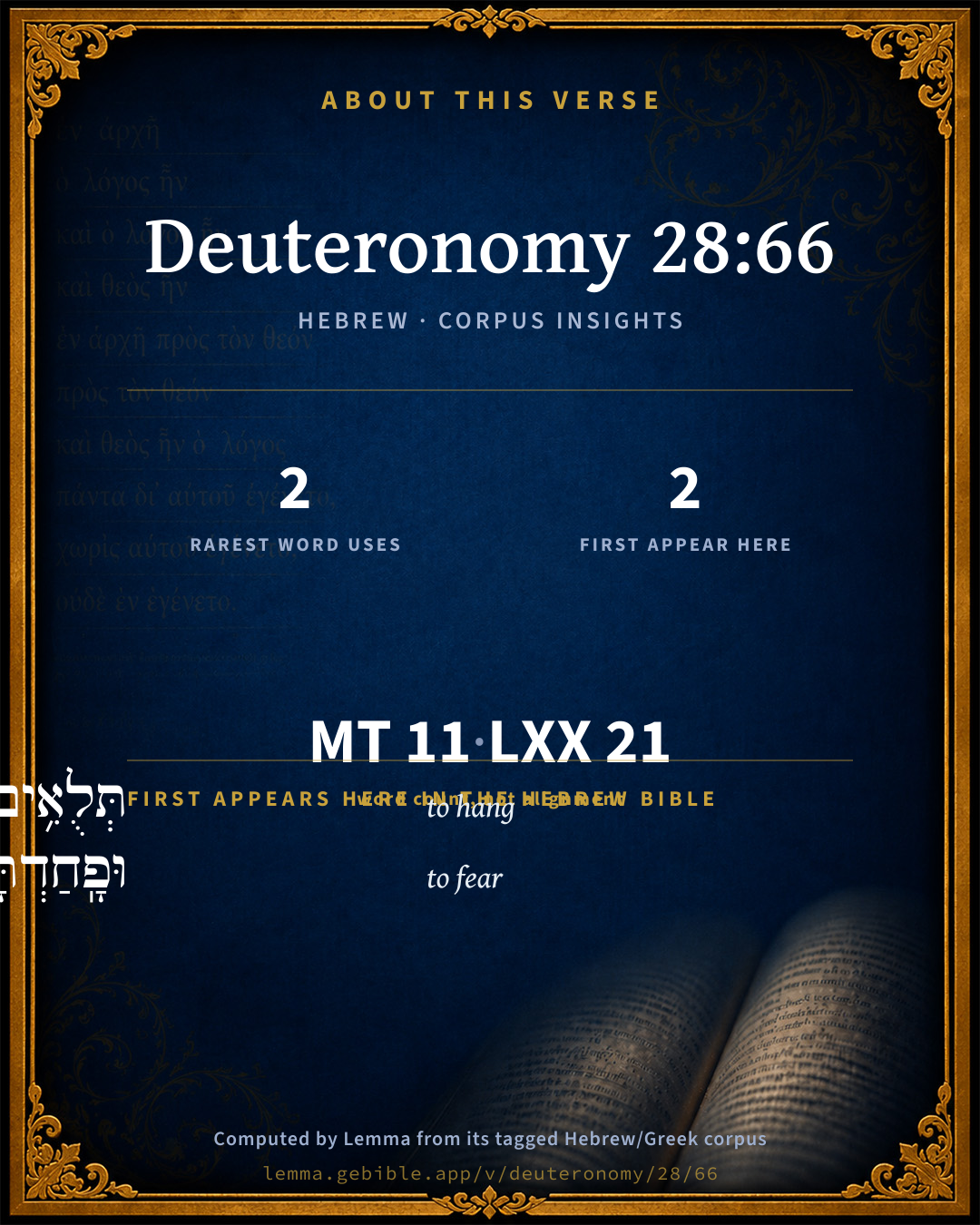
  • 2 first appearances in the Hebrew Bible
Full analysis ↓
Download a study sheet

One document with this verse’s original text, its word-by-word gloss line, the meaning frame, cross-references with their text, attributed commentary, and full source and license credits — printable, and it pastes into notes with its structure intact.

This verse Autodidact and up

Study sheet (.html) Plain text (.txt)

A passage Seminary Student

Up to 50 verses in one chapter. A passage sheet keeps up to 6 commentary sources and 12 cross-references per verse, in the order this page ranks them, and says so on the sheet whenever that leaves anything out. Ask for a single verse and you get the Autodidact verse sheet above.

Everything on this page stays free to read, with no account — the sheet is a download of what is already on screen, not access to it.

Want to remove ads? Support Godless Engineer
Compare translations 3

The same verse in 3 English versions, stacked beneath the original-language interlinear above. Click any original word for its lexicon entry.

Each is an independent rendering of the whole verse — the interlinear is not word-aligned to these translations.

Highlighted words mark where these versions differ — a whole-verse word diff, not a word-by-word alignment.

  • World English Bible Public Domain
    and your life shall hang in doubt before you; and you shall fear night and day, and shall have no assurance of your life.
  • King James Version Public Domain
    And thy life shall hang in doubt before thee; and thou shalt fear day and night, and shalt have none assurance of thy life:
  • unfoldingWord Literal Text CC BY-SA 4.0
    And it will happen, your life will hang before you, and you will fear, night and day, and you will have no certainty in your life.

unfoldingWord Literal Text — © unfoldingWord, licensed CC BY-SA 4.0. Word-aligned USFM3 via Door43 (git.door43.org/unfoldingWord/en_ult).

Versions to compare (up to 4)

3 of 4 selected

Show all 18 translations

Every available English version of this verse, each an independent rendering of the whole verse.

  • World English Bible Public Domain
    and your life shall hang in doubt before you; and you shall fear night and day, and shall have no assurance of your life.
  • Berean Standard Bible Public Domain
    So your life will hang in doubt before you, and you will be afraid night and day, never certain of survival.
  • Majority Standard Bible Public Domain
    So your life will hang in doubt before you, and you will be afraid night and day, never certain of survival.
  • King James Version Public Domain
    And thy life shall hang in doubt before thee; and thou shalt fear day and night, and shalt have none assurance of thy life:
  • American Standard Version (1901) Public Domain
    and thy life shall hang in doubt before thee; and thou shalt fear night and day, and shalt have no assurance of thy life.
  • Revised Version (1885) Public Domain
    and thy life shall hang in doubt before thee; and thou shalt fear night and day, and shalt have none assurance of thy life:
  • Geneva Bible (1599) Public Domain
    And thy life shall hang before thee, and thou shalt feare both night and day, and shalt haue none assurance of thy life.
  • Douay-Rheims (1899) Public Domain
    And thy life shall be as it were hanging before thee. Thou shalt fear night and day, neither shalt thou trust thy life.
  • Young's Literal Translation Public Domain
    and thy life hath been hanging in suspense before thee, and thou hast been afraid by night and by day, and dost not believe in thy life;
  • Literal Standard Version CC BY-SA 4.0
    and your life has been hanging in suspense before you, and you have been afraid by night and by day, and you do not have assurance in your life;
  • Unlocked Literal Bible CC BY-SA 4.0
    Your life will hang in doubt before you; you will fear every night and day and will have no certainty at all in your life.
  • unfoldingWord Literal Text CC BY-SA 4.0
    And it will happen, your life will hang before you, and you will fear, night and day, and you will have no certainty in your life.
  • Darby Bible Public Domain
    And thy life shall hang in suspense before thee; and thou shalt be in terror day and night and shalt be afraid of thy life.
  • World Messianic Bible Public Domain
    Your life will hang in doubt before you. You will be afraid night and day, and will have no assurance of your life.
  • Webster's Bible Public Domain
    And thy life shall hang in doubt before thee; and thou shalt fear day and night, and shalt have no assurance of thy life:
  • Free Bible Version CC BY-SA 4.0
    You will see your life hanging in the balance as you doubt. You will be afraid day and night, terrified you won't survive.
  • Bible in Basic English Public Domain
    Your very life will be hanging in doubt before you, and day and night will be dark with fears, and nothing in life will be certain:
  • JPS Tanakh (1917) Public Domain
    And thy life shall hang in doubt before thee; and thou shalt fear night and day, and shalt have no assurance of thy life.

Literal Standard Version (2020), Covenant Press — licensed CC BY-SA 4.0. Text via the HelloAO Bible API (eBible.org). Unlocked Literal Bible (unfoldingWord) — licensed CC BY-SA 4.0. Text via the HelloAO Bible API (eBible.org). unfoldingWord Literal Text — © unfoldingWord, licensed CC BY-SA 4.0. Word-aligned USFM3 via Door43 (git.door43.org/unfoldingWord/en_ult). Free Bible Version, Dr. Jonathan Gallagher — licensed CC BY-SA 4.0. Text via the HelloAO Bible API (eBible.org).

Word by word

More ways to search: Search by grammar → Find every occurrence → Compare this word →

Practice this passage: Drill this verse → Learn its vocabulary →

תְּלֻאִ֥ים
tâlâʼ
H8511
“hung”
Verb, Qal, Participle Passive, Masculine, Plural, Absolute
Part of Speech
Verb
Stem
Qal
Form
Participle Passive
Gender
Masculine
Number
Plural
State
Absolute
Full BDB Definition

Origin: a primitive root

TWOT: None

(Qal) to hang, hang to, cling to
  1. וְהָי֣וּ hâyâh H1961 “and · to be” Conjunction + Verb, Qal, Sequential Perfect, 3rd Person, Common, Plural
  2. חַיֶּ֔יךָ chay H2416 “living things · your” Noun, Common, Masculine, Plural, Construct + Suffix, Personal, 2nd Person, Masculine, Singular
  3. מִנֶּ֑גֶד neged H5048 “from · before” Preposition + Preposition
  4. וּפָֽחַדְתָּ֙ pâchad H6342 “and · to fear” Conjunction + Verb, Qal, Sequential Perfect, 2nd Person, Masculine, Singular
  5. לַ֣יְלָה layil H3915 “night” Noun, Common, Masculine, Singular, Absolute
  6. וְיוֹמָ֔ם yôwmâm H3119 “and · daytime” Conjunction + Adverb
  7. וְלֹ֥א lôʼ H3808 “and · not” Conjunction + Particle, Negative
  8. תַאֲמִ֖ין ʼâman H539 “to confirm” Verb, Hiphil, Imperfect, 2nd Person, Masculine, Singular
  9. בְּחַיֶּֽיךָ chay H2416 “in/at · living things · your” Preposition + Noun, Common, Masculine, Plural, Construct + Suffix, Personal, 2nd Person, Masculine, Singular

About this verse

These counts appear in no published source. They are computed here, from the morphology-tagged text and Lemma’s own curated glosses. What Lemma adds →

11
words
9
distinct lemmas
Pentateuch
section

Notable vocabulary

The rarest word here is תְּלֻאִ֥ים to hang H8511 — appearing just 2 times in the whole Hebrew Bible.

First appearance in Scripture

These words make their first canonical appearance in the Hebrew Bible here:

  • תְּלֻאִ֥ים to hang H8511
  • וּפָֽחַדְתָּ֙ to fear H6342

Shared distinctive vocabulary

תְּלֻאִ֥ים to hang H8511 occurs in 2 verses of the Hebrew Bible. Also found in:

Grammatical profile

  • 4 verbs
  • 3 nouns
  • 2 prepositions
  • 1 adverb
  • 1 particle

Verb forms

  • וְהָי֣וּ Qal · Sequential Perfect
  • תְּלֻאִ֥ים Qal · Participle Passive
  • וּפָֽחַדְתָּ֙ Qal · Sequential Perfect
  • תַאֲמִ֖ין Hiphil · Imperfect

Repetition

A word recurs within this verse — often emphatic in Hebrew:

  • חַיֶּ֔יךָ living H2416 ×2

Hebrew & Septuagint length

In English translation the verse runs 24 words from the Hebrew and 29 from the Septuagint (LXX English) — closely comparable.

A rough comparison of the two English renderings, which tokenize alike — not a word-level alignment.

Word counts can differ between the Hebrew and the Greek without any difference in meaning — e.g. the Hebrew direct-object marker אֵת has no separate Greek word, and Greek often adds the article ὁ.

In the original languages it is 11 Hebrew tokens and 21 Greek tokens — but the two are counted differently (Hebrew bundles its prefixes and suffixes into one token; the Greek is in lemma form), so that isn’t a like-for-like length.

Cross-references

4

Topical passages linked to Deuteronomy 28:66 in the Treasury of Scripture Knowledge — connected by theme and wording, ordered by reader-vote popularity; previews shown in the World English Bible.

  • Deuteronomy 28:67 In the morning you shall say, Would it were even! and at even you shall say, Would it were morning! for the fear of your heart which you shall fear, and for the sight of your eyes which you shall see.
  • Lamentations 1:13 From on high has he sent fire into my bones, and it prevails against them; He has spread a net for my feet, he has turned me back: He has made me desolate and faint all the day.
  • Hebrews 10:27 but a certain fearful expectation of judgment, and a fierceness of fire which will devour the adversaries.
  • Revelation 6:15–17 The kings of the earth, the princes, the commanding officers, the rich, the strong, and every slave and free person, hid themselves in the caves and in the rocks of the mountains.

Cross-references courtesy of OpenBible.info (CC BY 4.0).

Hebrew and Greek witnesses Masoretic Hebrew ↔ Greek Septuagint

The same verse in the two great witnesses to the Old Testament, shown verse-for-verse.

These are two independent witnesses, not word-aligned to each other, and the Septuagint is shown in lemma (dictionary) form.

Hebrew Deuteronomy 28:66 Masoretic · Westminster Leningrad Codex

וְהָי֣וּ חַיֶּ֔יךָ תְּלֻאִ֥ים לְךָ֖ מִנֶּ֑גֶד וּפָֽחַדְתָּ֙ לַ֣יְלָה וְיוֹמָ֔ם וְלֹ֥א תַאֲמִ֖ין בְּחַיֶּֽיךָ

and your life shall hang in doubt before you; and you shall fear night and day, and shall have no assurance of your life.

World English Bible · Public Domain

Greek LXX Deuteronomy 28:66 Septuagint · lemma form

καί εἰμί ὁ ζωή σύ κρεμάζω ἀπέναντι ὁ ὀφθαλμός σύ καί φοβέω ἡμέρα καί νύξ καί οὐ πιστεύω ὁ ζωή σύ

And your life shall be in suspense before your eyes; and you shall be afraid by day and by night, and you shall have no assurance of your life.

LXX2012 (modern English Septuagint) · Public Domain

Hebrew: Westminster Leningrad Codex (CC BY 4.0). Greek: Septuagint (public domain); English from LXX2012 (modern English Septuagint) (Public Domain). How the Septuagint differs from the Hebrew →

Targum (Aramaic paraphrase)

2

The Targum is the ancient Jewish Aramaic paraphrase of the Hebrew Scriptures — an interpretive translation, not the Hebrew text itself. Onkelos (literal) and Pseudo-Jonathan (expansive) render the Torah, and Jonathan the Prophets. Coverage is partial: where no permissively-licensed English translation exists for a verse, only the Aramaic is shown. This is verse-level text, not a word-by-word alignment to the Hebrew.

  1. Targum Onkelos Torah (Genesis–Deuteronomy)
    וִיהוֹן חַיָיךְ תְּלָן לָךְ מִקָבֵל וּתְהֵי תָוֵה לֵילְיָא וִימָמָא וְלָא תְהֵימִין בְּחַיָיךְ

    (no public-domain English translation for this verse)

    Targum Onkelos — Aramaic: “Onkelos Genesis” (public domain); “Onkelos Exodus” (public domain); “Onkelos Leviticus” (public domain); “Onkelos Numbers” (public domain); “Onkelos Deuteronomy” (public domain). English: “Sefaria Community Translation” (CC0 1.0 (public-domain dedication)); “J.W. Etheridge. The Targums of Onkelos and Jonathan Ben Uzziel on the Pentateuch. London: Longmans, Green, 1862” (public domain). Text via Sefaria.

  2. Targum Pseudo-Jonathan Torah (Genesis–Deuteronomy)
    וִיהוֹן חַיֵיכוֹן תַּלְיַין לְכוֹן מִקְבֵיל וְתֶהֱווֹן דַחֲלִין יֵימָם וְלֵילֵי וְלָא תְהֵימְנוּן בְּחַיֵיכוֹן

    And your life will be in suspense; you will be in dread day and night, and have no assurance of your life.

    Targum Pseudo-Jonathan — Aramaic: “Targum Jonathan on Genesis” (public domain); “Targum Jonathan on Exodus” (public domain); “Targum Jonathan on Leviticus” (public domain); “Targum Jonathan on Numbers” (public domain); “Targum Jonathan on Deuteronomy” (public domain). English: “The Targum of Jonathan ben Uzziel, trans. J. W. Etheridge, London, 1862” (public domain). Text via Sefaria.

Commentary

Notes on Deuteronomy 28:66 from classic Christian and Jewish commentators (each source and its license shown beneath its notes). The classic Christian expositions comment on the surrounding passage and are grouped to its opening verse, so a note may address several verses; the Jewish commentaries on the Tanakh (Rashi and others) are per-verse, so they appear only where the commentator wrote on this verse.

Lemma curates 59 commentaries, every one of them public domain or Creative Commons licensed, each selected and text-cleaned for this edition rather than reprinted as found. About our sources →

Trapp's Complete Commentary

John Trapp

Deu 28:66 And thy life shall hang in doubt before thee; and thou shalt fear day and night, and shalt have none assurance of thy life:

Ver. 66. And thy life shall hang in doubt.] Semper et indesinenter desperabis de vita; thou shalt live in continual expectation of death: as Tiberius caused such to do as he most hated, for a singular punishment.

John Trapp, A Commentary or Exposition upon All the Books of the Old and New Testament (1647–1656) — public domain. Text from a community e-Sword module.

Joseph Benson's Commentary

Deu 28:66. Thy life shall hang in doubt — Either because thou art in the hands of thy enemies that have power, and want not the will, to destroy thee; or because of the terrors of thy own mind, and the guilt of thy conscience making thee to fear, even where no fear is.

Joseph Benson's Commentary on the Old and New Testaments (1811–1818) — public domain. Text from a community e-Sword module.

Geneva Bible (1599)

Geneva Bible translators

Or, thou shall be in doubt of thy life.

Geneva Bible (1599) marginal notes — public domain. Text via Bolls.life.

Ellicott's Commentary for English Readers

(66) Thy life shall hang in doubt before thee.—“Perhaps 1 shall die to-day by the sword that cometh upon me” (Rashi).

A Bible Commentary for English Readers, edited by Charles John Ellicott (1878–1897) — public domain. Text from a community e-Sword module.

The Cambridge Bible for Schools and Colleges

gen. ed. J. J. S. Perowne

66. and thy life shall be hanging before thee] Shall be in suspense, as on a thread. As indicated later in the v., thou shalt have no assurance of thy life. The vb is the same as that whose part. is rendered of long continuance in Deu_28:59. Cp. Job_24:22, R.V. marg.

The Cambridge Bible for Schools and Colleges (gen. ed. J. J. S. Perowne; Cambridge University Press, 1878–1918) — public domain. Text from a community e-Sword module.

Haydock's Catholic Bible Commentary

Thy life, being in danger from all sides. The Fathers explain this verse of the behaviour of the Jews towards their Messias, who was crucified before their eyes; and still they will not believe in him, though he is their life, (chap. xxx. 20,) the way, the truth, and the life, John xiv. 6., and i. 4. (St. Leo; St. Augustine, contra Faustus xvi. 22, &c.) (Haydock)

George Leo Haydock (1774–1849), Haydock's Catholic Family Bible and Commentary, 1859 edition — public domain. Excludes Psalms (Douay-Rheims chapter numbering differs from Protestant) and Deuterocanonical books (Catholic canon only).

Matthew Poole's English Annotations

Either because thou art in the hands of thy enemies, that have power, and want not will, to destroy thee; or because of the terrors of thy own mind, and the guilt of thy conscience, making thee to fear, even where no great cause to fear is.

Matthew Poole's English Annotations on the Holy Bible (1683–1685) — public domain. Text from a community e-Sword/MySword module.

Whedon's Commentary on the Bible

Daniel D. Whedon

66. And thy life shall hang in doubt before thee — The Hebrew reads, Thy life is hanging before thee. It will ever be in present and pressing danger.

Daniel D. Whedon (gen. ed.), Commentary on the Old and New Testaments (1874–1909) — public domain. Text from a community e-Sword module.

The Pulpit Commentary

Thy life shall hang in doubt before thee; literally, Thy life shall be hung up before thee; i.e. shall be like an object suspended by a thread which hangs dangling before the view, ready to fall or to be cut down at any moment. Comp.

Omnia sunt hominum tenui pendentia filo Et subito casu quae valuere ruunt. (Ovid, "Epp. ex Ponto," 4:3, 35. )

The Pulpit Commentary (1880–1919), ed. H.D.M. Spence-Jones & Joseph S. Exell — public domain. Text from a community e-Sword module.

John Wesley's Explanatory Notes

Thy life shall hang in doubt - Either because thou art in the hands of thy enemies that have power, and want no will, to destroy thee: or because of the terrors of thy own mind, and the guilt of thy conscience making thee to fear, even where no fear is.

John Wesley, Explanatory Notes Upon the Whole Bible (1754–1765) — public domain. Text via the GEBible commentary corpus.

Rashi

Rabbi Shlomo Yitzchaki (Rashi)

חייך תלאים לך THY LIFE SHALL HANG BEFORE THEE — because of uncertainty. — Anything that is uncertain may be termed תלוי (“hanging”); You will always be saying: “Perhaps I shall die to-day through the sword that is coming upon us”. — Our Rabbis interpreted this to refer to one who is obliged to buy produce in the market (who does not possess any of his own),

ולא תאמין בחייך AND THOU SHALT HAVE NONE ASSURANCE OF THY LIFE — this they refer to one who must rely on the baker (cf. Menachot 103b).

Rashi on the Tanakh — English translations: “The Judaica Press complete Tanach with Rashi, translated by A. J. Rosenberg” (CC BY 4.0); “Pentateuch with Rashi's commentary by M. Rosenbaum and A.M. Silbermann, 1929-1934” (public domain); “The Metsudah Tanach series, Lakewood, N.J” (CC BY 4.0); and “The Book of Joshua, Metsudah Publications, 1997” (CC BY 4.0). Text via Sefaria.

Lesson kit

Teaching starters — assembled from the data on this page, not authored interpretation. Every prompt links to the verse data it draws on. Edit before teaching.

Deuteronomy, in the Pentateuch, opens this verse with 11 words (9 distinct Hebrew lemmas). Its most distinctive word is tâlâʼ (“to hang”). A historical commentator’s framing appears above. Read the whole chapter for the surrounding context.

Discussion questions

  1. The word tâlâʼ carries the sense “to hang.” How does it shape the verse?
  2. 2 words make their first appearance in Scripture here. What does this debut establish?
  3. How does Hosea 11:7, which shares the word «to hang», read alongside this verse?
  4. What does the repetition of “living” (2× in this one verse) do in this verse?
  5. The translations on this page render this verse differently — a whole-verse word diff, not a word-by-word alignment. What might account for the different wordings?
  6. «וְהָי֣וּ» is a Qal Sequential Perfect verb. How does that grammatical form shape the action described?
  7. Compare how Trapp's Complete Commentary and Joseph Benson's Commentary read this verse. Where do they agree or differ?

Things to notice

Reading settings

Reading text

Shown beneath each verse's original-language words.

Old Testament
Old Testament edition

Read the OT as the Masoretic Hebrew (MT) or the Greek Septuagint (LXX).

English shown for the Greek Septuagint (in the Hebrew ↔ Greek comparison).

Comparing translations? Open the Compare panel on any verse page to stack up to four side by side.