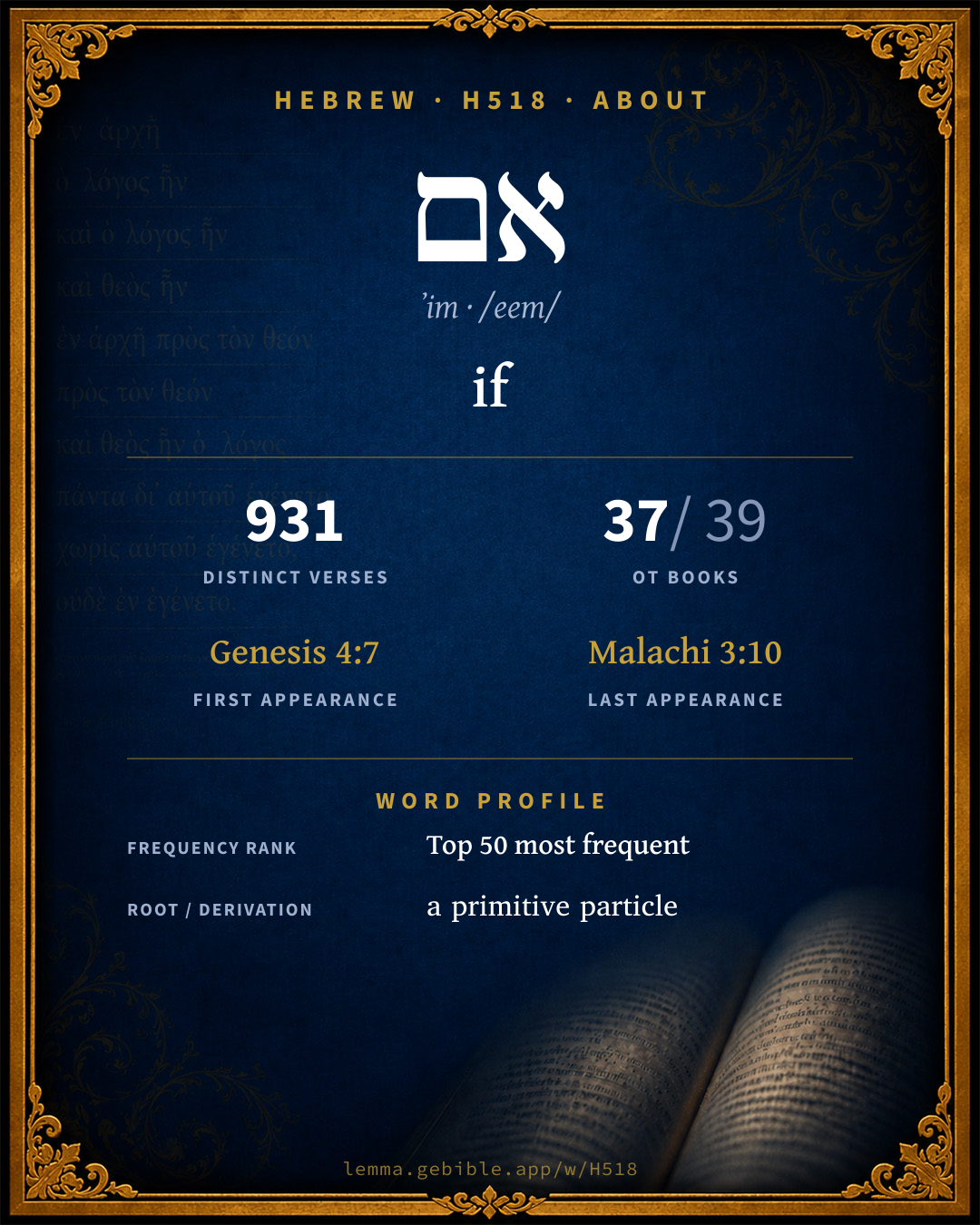
אִם
if
‘if’ is one of 8 main senses fuller range ↓
Full lexicon entry — Brown-Driver-Briggs (BDB)
From Brown-Driver-Briggs (BDB)
Where this word appears
Grammar key — what these labels mean
Part of speech
- Conjunction
- A joining word (e.g. “and,” “but”) linking words or clauses.
Every verse where H518 appears in the Book of Numbers — 60 distinct verses. Click any verse to open its interlinear word-by-word view. Verse text shown in the World English Bible for context — . Each verse’s Hebrew form is shown with its reference; the English is not keyword-highlighted, since the data carries no word-level English alignment. Use “Compare translations” on any verse to read it across multiple English versions. This concordance covers the Hebrew Bible; Septuagint (Greek Old Testament) occurrences are not indexed here.
Numbers
- Numbers 5:8 וְ/אִם conj + conj But if the man has no kinsman to whom restitution may be made for the guilt, the restitution for guilt which is made to Yahweh shall be the priest's; besides the ram of the atonement, by which atonement shall be made for him.
- Numbers 5:19 אִם וְ/אִם conj conj + conj The priest shall cause her to swear, and shall tell the woman, 'If no man has lain with you, and if you haven't gone aside to uncleanness, being under your husband, be free from this water of bitterness that brings a curse.
- Numbers 5:27 אִֽם conj When he has made her drink the water, then it shall happen, if she is defiled, and has committed a trespass against her husband, that the water that causes the curse will enter into her and become bitter, and her body will swell, and her thigh will fall away: and the woman will be a curse among her people.
- Numbers 5:28 וְ/אִם conj + conj If the woman isn't defiled, but is clean; then she shall be free, and shall conceive seed.
- Numbers 10:4 וְ/אִם conj + conj If they blow but one, then the princes, the heads of the thousands of Israel, shall gather themselves to you.
- Numbers 10:30 אִם conj He said to him, I will not go; but I will depart to my own land, and to my relatives.
- Numbers 11:12 אִם conj Have I conceived all this people? have I brought them forth, that you should tell me, Carry them in your bosom, as a nursing-father carries the sucking child, to the land which you swore to their fathers?
- Numbers 11:15 וְ/אִם אִם conj + conj conj If you deal thus with me, please kill me out of hand, if I have found favor in your sight; and let me not see my wretchedness.
- Numbers 11:22 אִ֣ם conj Shall flocks and herds be slain for them, to suffice them? or shall all the fish of the sea be gathered together for them, to suffice them?
- Numbers 11:23 אִם conj Yahweh said to Moses, Has Yahweh's hand grown short? now shall you see whether my word shall happen to you or not.
- Numbers 12:6 אִם conj He said, Hear now my words: if there be a prophet among you, I Yahweh will make myself known to him in a vision, I will speak with him in a dream.
- Numbers 13:18 אִם conj and see the land, what it is; and the people who dwell therein, whether they are strong or weak, whether they are few or many;
- Numbers 13:19 אִם אִ֥ם conj conj and what the land is that they dwell in, whether it is good or bad; and what cities they are that they dwell in, whether in camps, or in strongholds;
- Numbers 13:20 אִם אִם conj conj and what the land is, whether it is fat or lean, whether there is wood therein, or not. Be of good courage, and bring of the fruit of the land. Now the time was the time of the first-ripe grapes.
- Numbers 14:8 אִם conj If Yahweh delight in us, then he will bring us into this land, and give it to us; a land which flows with milk and honey.
- Numbers 14:23 אִם conj surely they shall not see the land which I swore to their fathers, neither shall any of those who despised me see it:
- Numbers 14:28 אִם conj Tell them, As I live, says Yahweh, surely as you have spoken in my ears, so will I do to you:
- Numbers 14:30 אִם אִם conj conj surely you shall not come into the land, concerning which I swore that I would make you dwell therein, save Caleb the son of Jephunneh, and Joshua the son of Nun.
- Numbers 14:35 אִם conj I, Yahweh, have spoken, surely this will I do to all this evil congregation, who are gathered together against me: in this wilderness they shall be consumed, and there they shall die.
- Numbers 15:24 אִ֣ם conj then it shall be, if it be done unwittingly, without the knowledge of the congregation, that all the congregation shall offer one young bull for a burnt offering, for a sweet savor to Yahweh, with the meal-offering of it, and the drink-offering of it, according to the ordinance, and one male goat for a sin-offering.
- Numbers 15:27 וְ/אִם conj + conj If one person sin unwittingly, then he shall offer a female goat a year old for a sin-offering.
- Numbers 16:29 אִם conj If these men die the common death of all men, or if they be visited after the visitation of all men; then Yahweh hasn't sent me.
- Numbers 16:30 וְ/אִם conj + conj But if Yahweh make a new thing, and the ground open its mouth, and swallow them up, with all that appertain to them, and they go down alive into Sheol; then you shall understand that these men have despised Yahweh.
- Numbers 17:13 הַ/אִ֥ם ptcl inter + conj Everyone who comes near, who comes near to the tent of Yahweh, dies: shall we perish all of us?
- Numbers 19:12 וְ/אִם conj + conj the same shall purify himself therewith on the third day, and on the seventh day he shall be clean: but if he doesn't purify himself the third day, then the seventh day he shall not be clean.
- Numbers 20:19 וְ/אִם conj + conj The children of Israel said to him, We will go up by the highway; and if we drink of your water, I and my cattle, then will I give the price of it: let me only, without [doing] anything [else], pass through on my feet.
- Numbers 21:2 אִם conj Israel vowed a vow to Yahweh, and said, If you will indeed deliver this people into my hand, then I will utterly destroy their cities.
- Numbers 21:9 אִם conj Moses made a serpent of brass, and set it on the standard: and it happened, that if a serpent had bitten any man, when he looked to the serpent of brass, he lived.
- Numbers 22:18 אִם conj Balaam answered the servants of Balak, If Balak would give me his house full of silver and gold, I can't go beyond the word of Yahweh my God, to do less or more.
- Numbers 22:20 אִם conj God came to Balaam at night, and said to him, If the men are come to call you, rise up, go with them; but only the word which I speak to you, that shall you do.
- Numbers 22:34 אִם conj Balaam said to the angel of Yahweh, I have sinned; for I didn't know that you stood in the way against me: now therefore, if it displease you, I will get me back again.
- Numbers 24:13 אִם conj If Balak would give me his house full of silver and gold, I can't go beyond the word of Yahweh, to do either good or bad of my own mind; what Yahweh speaks, that will I speak?
- Numbers 24:22 אִם conj Nevertheless Kain shall be wasted, Until Asshur shall carry you away captive.
- Numbers 26:33 אִם conj Zelophehad the son of Hepher had no sons, but daughters: and the names of the daughters of Zelophehad were Mahlah, and Noah, Hoglah, Milcah, and Tirzah.
- Numbers 26:65 אִם conj For Yahweh had said of them, They shall surely die in the wilderness. There was not left a man of them, save Caleb the son of Jephunneh, and Joshua the son of Nun.
- Numbers 27:9 וְ/אִם conj + conj If he have no daughter, then you shall give his inheritance to his brothers.
- Numbers 27:10 וְ/אִם conj + conj If he have no brothers, then you shall give his inheritance to his father's brothers.
- Numbers 27:11 וְ/אִם conj + conj If his father have no brothers, then you shall give his inheritance to his kinsman who is next to him of his family, and he shall possess it: and it shall be to the children of Israel a statute [and] ordinance, as Yahweh commanded Moses.
- Numbers 30:5 וְ/אִם conj + conj But if her father disallow her in the day that he hears, none of her vows, or of her bonds with which she has bound her soul, shall stand: and Yahweh will forgive her, because her father disallowed her.
- Numbers 30:6 וְ/אִם conj + conj If she be [married] to a husband, while her vows are on her, or the rash utterance of her lips, with which she has bound her soul,
- Numbers 30:8 וְ֠/אִם conj + conj But if her husband disallow her in the day that he hears it, then he shall make void her vow which is on her, and the rash utterance of her lips, with which she has bound her soul: and Yahweh will forgive her.
- Numbers 30:10 וְ/אִם conj + conj If she vowed in her husband's house, or bound her soul by a bond with an oath,
- Numbers 30:12 וְ/אִם conj + conj But if her husband made them null and void in the day that he heard them, then whatever proceeded out of her lips concerning her vows, or concerning the bond of her soul, shall not stand: her husband has made them void; and Yahweh will forgive her.
- Numbers 30:14 וְ/אִם conj + conj But if her husband altogether hold his peace at her from day to day, then he establishes all her vows, or all her bonds, which are on her: he has established them, because he held his peace at her in the day that he heard them.
- Numbers 30:15 וְ/אִם conj + conj But if he shall make them null and void after that he has heard them, then he shall bear her iniquity.
- Numbers 32:5 אִם conj They said, If we have found favor in your sight, let this land be given to your servants for a possession; don't bring us over the Jordan.
- Numbers 32:11 אִם conj Surely none of the men who came up out of Egypt, from twenty years old and upward, shall see the land which I swore to Abraham, to Isaac, and to Jacob; because they have not wholly followed me:
- Numbers 32:17 אִם conj but we ourselves will be ready armed to go before the children of Israel, until we have brought them to their place: and our little ones shall dwell in the fortified cities because of the inhabitants of the land.
- Numbers 32:20 אִֽם אִם conj conj Moses said to them, If you will do this thing, if you will arm yourselves to go before Yahweh to the war,
- Numbers 32:23 וְ/אִם conj + conj But if you will not do so, behold, you have sinned against Yahweh; and be sure your sin will find you out.
- Numbers 32:29 אִם conj Moses said to them, If the children of Gad and the children of Reuben will pass with you over the Jordan, every man who is armed to battle, before Yahweh, and the land shall be subdued before you; then you shall give them the land of Gilead for a possession:
- Numbers 32:30 וְ/אִם conj + conj but if they will not pass over with you armed, they shall have possessions among you in the land of Canaan.
- Numbers 33:55 וְ/אִם conj + conj But if you will not drive out the inhabitants of the land from before you, then shall those who you let remain of them be as pricks in your eyes, and as thorns in your sides, and they shall vex you in the land in which you dwell.
- Numbers 35:16 וְ/אִם conj + conj But if he struck him with an instrument of iron, so that he died, he is a murderer: the murderer shall surely be put to death.
- Numbers 35:17 וְ/אִ֡ם conj + conj If he struck him with a stone in the hand, by which a man may die, and he died, he is a murderer: the murderer shall surely be put to death.
- Numbers 35:20 וְ/אִם conj + conj If he thrust him of hatred, or hurled at him, lying in wait, so that he died,
- Numbers 35:22 וְ/אִם conj + conj But if he thrust him suddenly without enmity, or hurled on him anything without lying in wait,
- Numbers 35:26 וְ/אִם conj + conj But if the manslayer shall at any time go beyond the border of his city of refuge, where he flees,
- Numbers 35:33 אִ֖ם conj So you shall not pollute the land in which you are: for blood, it pollutes the land; and no expiation can be made for the land for the blood that is shed therein, but by the blood of him who shed it.
- Numbers 36:4 וְ/אִם conj + conj When the jubilee of the children of Israel shall be, then will their inheritance be added to the inheritance of the tribe whereunto they shall belong: so will their inheritance be taken away from the inheritance of the tribe of our fathers.
About this entry
At a glance — auto-summarized from this page’s data, not written by a person. Every figure links to its source below. This summary describes the numbers; it doesn’t interpret them.
אם — transliterated ʼim — is a Hebrew word carrying the sense “if.” The lexicon spreads it across several senses; see its full sense range. Spanning 931 verses in 37 books, it ranks among the most common words of the Hebrew Bible. Its earliest occurrence is Genesis 4:7. Each statement above links to its evidence; the full detail follows below.
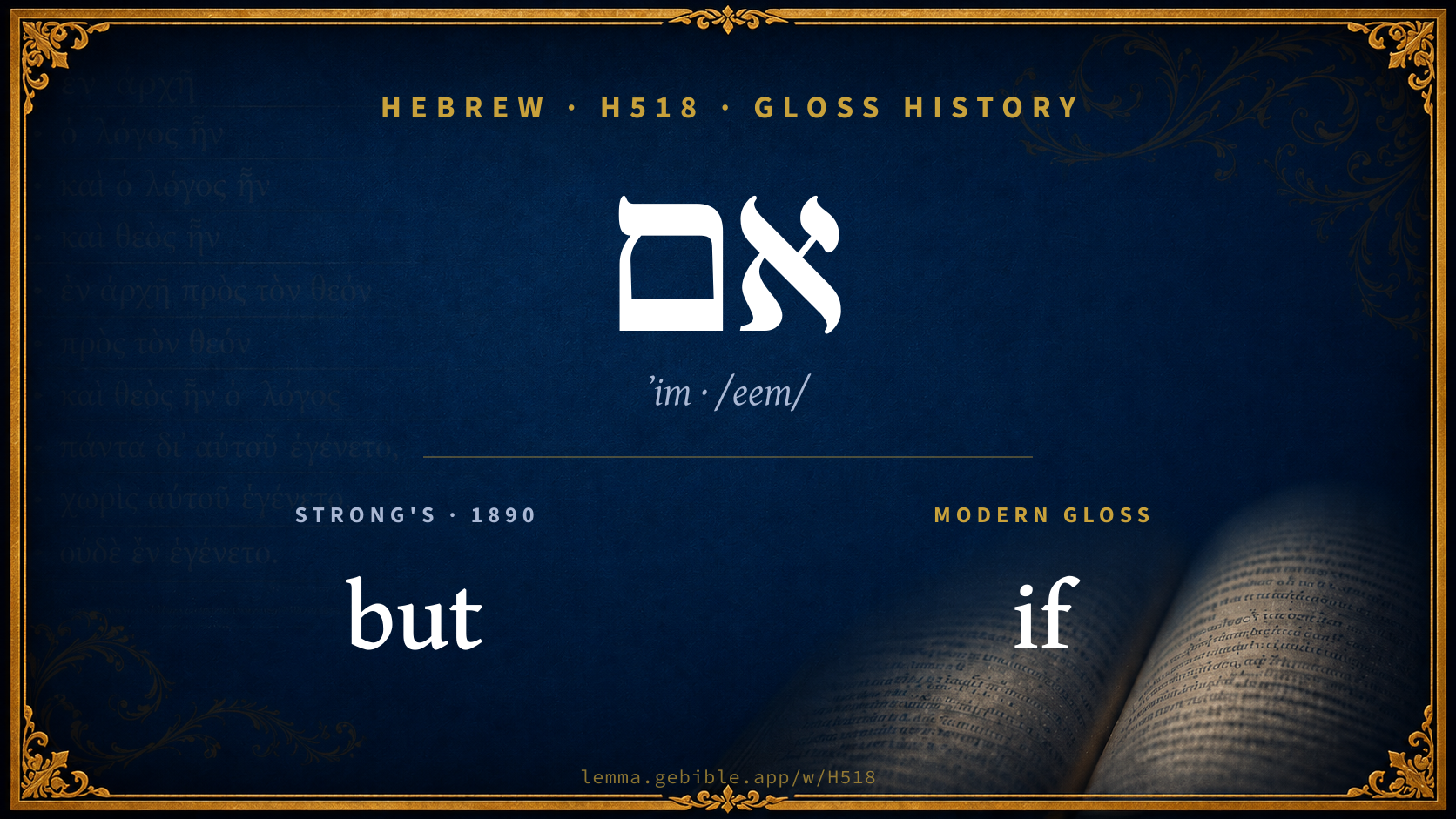
Gloss history
Strong's 1890 vs modern scholarship
About this word
Strong's H518 catalogs a Hebrew word from the Hebrew Old Testament.
These counts are not copied from any lexicon or concordance. They are computed here, from the morphology-tagged Hebrew Old Testament. What Lemma adds →
- 931
- distinct verses
- The word appears in 931 distinct verses.
- 37 / 39
- OT books
- The word appears in 37 of 39 Old Testament books.
- #39
- by frequency
- Top 50 most frequent Hebrew words (rank 39 of 8,640 Hebrew words by occurrence).
View all 931 occurrences in the concordance →
By section of the Old Testament
By traditional corpus
Conventional, traditional groupings — biblical authorship is debated, so this is a traditional corpus grouping, not an authorship claim. Each share is this word’s portion of its verses in that division of the Hebrew canon. Each figure is a share of the word’s 931 distinct verses.
- Prophets (Nevi'im) 377 verses · 40%
- Torah (Pentateuch) 295 verses · 32%
- Writings (Ketuvim) 259 verses · 28%
How translations render this word
Counts come from each version’s own published word-to-Strong’s tagging or interlinear alignment — an approximate guide to how each version renders this word, not a word-level alignment the data otherwise carries. Because each total is that version’s own tagged count, the per-version totals vary from one another and need not match the appearance or distinct-verse counts above. These counts may also differ from a printed concordance because Lemma counts each distinctly tagged rendering and does not collapse phrase taggings into a single head-word total. This is a fixed set of word-tagged versions (KJV, ASV, BSB, ULT) and does not change with the reading translation you choose elsewhere. Each version’s license is shown beside its name below (and on Sources).
- King James Version: If 4×, But 2×, I will not 2×
- American Standard Version: If 4×, But 2×, Him 2×
- Berean Standard Bible: If 522×, Or 64×, When 25×
- unfoldingWord Literal Text: If 701×, Or 65×, Except 36×
King James Version Public Domain
Renders H518 across 43 tagged occurrences — most commonly:
Plus 29 renderings that appear only once — usually multi-word phrases or single function words the recovered tagging swept in, not distinct renderings. Not rendered by a distinct English word in 1 further occurrence.
American Standard Version Public Domain
Renders H518 across 43 tagged occurrences — most commonly:
Plus 29 renderings that appear only once — usually multi-word phrases or single function words the recovered tagging swept in, not distinct renderings.
Berean Standard Bible Public Domain
Renders H518 across 867 tagged occurrences — most commonly:
Plus other, less common renderings. Plus 56 renderings that appear only once — usually multi-word phrases or single function words the recovered tagging swept in, not distinct renderings. Not rendered by a distinct English word in 202 further occurrences.
unfoldingWord Literal Text CC BY-SA 4.0
Renders H518 across 1,048 tagged occurrences — most commonly:
Plus other, less common renderings. Plus 36 renderings that appear only once — usually multi-word phrases or single function words the recovered tagging swept in, not distinct renderings.
8 senses and sub-senses in the full BDB
What do BDB’s symbols mean?
BDB uses these scholarly abbreviations:
| Symbol | Meaning |
|---|---|
| 𝔊 | the Septuagint (the ancient Greek translation, LXX) |
| 𝔙 | the Vulgate (the Latin translation) |
| 𝔖 | the Syriac version (the Peshitta) |
| 𝔗 | the Targum (the Aramaic translation) |
| ψ | the Psalms |
| √ | root (the underlying root or stem) |
| ‖ | parallel passage (a synonymous or contrasted parallel) |
| † | the dagger: every passage where the word occurs is cited |
The 8 senses and sub-senses the full Brown-Driver-Briggs lexicon distinguishes for this word, in lexicon order (not ranked by frequency), with BDB’s own verbatim wording and sub-sense lettering. Shown in Hebrew script with BDB’s own scholarly abbreviations. The condensed entry is in the Lexicon Entry tab. See also the Forms in the corpus table below.
- 1. hypoth. part. if.
- a. construction (v. more fully Dr§ 136–138, 143 Friedrich Die Hebr. Condit. sätze 1884): (1) with impf. (continued by pff. & waw consec.; apod. usually begins with pf. & waw consec. or bare impf.; or, if necess., with imper. or juss.) (a) of future time: Gn 18:26 אִם־אֶמְצָא if I shall find 50 righteous in Sodom, וְנָשָׂאתִי I will pardon, etc., 24:8; 32:9 Dt 19:8 f. 1 K 1:52 b; 6:12 ψ 89:31–33; Gn 42:37 Ju 13:16 1 K 1:52 a ψ 132:12. (b) of past time (rare, but classical): Gn 31:8 אִם יֹאמַר if ever he said … וְיָֽלְדוּ then they used to bear, etc., Ex 40:37; & in the protestations Jb 31:7, 13, 16, 25 etc. (alternating with pff., v. infr., & with jussives in apod.) (c) assuming a purely imaginary case (with impf. in both clauses, like the double opt. in Greek), if, though: Gn 13:16 so that אִם־יוּכַל if a man were able to number the stars, thy seed also יִמָּנֶה might be numbered, Nu 22:18 Is 1:18 אִם־יִהְיוּ ח׳ כַּשָּׁנִים יַלְבִּינוּ though your sins were as scarlet, they should become white as snow, Am 9:2–4 אִם־יַחְתְּרוּ though they were to dig into Sheôl, from thence תִּקָּחֵם would my hand fetch them, ψ 27:3; 139:8 +. (2) with pt. (expressing either a present process, or an approaching future: apod. as 1 a) Gn 24:42, 49 Ju 6:36 (+ ישׁ) 9:15; 11:9 אִם מְשִׁיבִים אַתֶּם if ye are going to bring me back וְנָתַן י׳ then י׳ will, etc.; similarly with יֵשׁ or אֵין Gn 44:26 Ex 22:2 1 S 20:8; 23:23; & with no explicit copula Dt 22:2; 25:2 Lv 1:3, 14, etc. (3) with perf. (a) of fut. or pres. time (continued by pff. & waw consec.: apod. as 1 a) Gn 43:9 אִם־לֹא הֲבִיאֹתִיו אֵלָיךָ וְהִצַּגְתִּיו לְפָנֶיךָ if I do not bring him back (si eum non reduxero) and set him before thee, I will be guilty for ever, 47:6 if thou knowest that there are men of worth among them וְשַׂמְתָּם then make them, etc., Ju 16:17 2 S 15:33 2 K 7:4 ψ 41:7; 94:18 Jb 7:4; 9:30 f. 10:14 אִם חָטָאתִי וּשְׁמַרְתָּ֑נִי if I sin, thou watchest me. On אִם־נָא Gn 18:3 al. v. נָא. (b) of past time, whether (α) in actual fact, or (β) in an assumed case (the pf. is here continued by the impf. and waw consec.; apod. begins as before). (4) (a) Ju 9:16–19 אִם … עֲשִׂיתֶם if ye have done honestly וַתַּמְלִיכוּ and have made Abimelech king …, 1 S 26:19; especially in protestations, as ψ 7:4 אִם עָשִׂיתִי זאת if I have done this …, let the enemy pursue my soul, etc. Je 33:25 f. Jb 31:5 f. 9, etc. (b) Nu 5:27 if she have defiled herself וַתִּמְעֹל and been faithless, וּבָאוּ then shall they come, etc., 15:24; 35:22–24. (c) with bare pf. in apod., in sense of If … had …, only Dt 32:30 אִם־לֹא כִּי were it not that …, ψ 73:15. (לוּ is more usual in such cases.) (5) with inf. once (si vera l.) Jb 9:27 אִם אָמְרִי = if I say (lit. if (there is) my saying).—Note that the vb. following אִם is often strengthened by the inf. abs., as Ex 15:26; 19:5; 21:5; 22:3, 12, 16, 22 Ju 11:30; 14:12; 16:11 etc.; cf. DrSm 1:20, 6. e.g. Genesis 18:26
- b. Special uses: (1) repeated אִם … אִם whether … or (sive … sive) Ex 19:13 Dt 18:3 2 S 15:21; similarly אִם … וְאִם Gn 31:52 Je 42:6 Ez 2:5 Ec 11:3; 12:14 (cf. ܐܶܢ … ܐܶܢ, ܘܶܐܢ … ܐܢ PS250; وَإِنْ … إِنْ & وَإِمَّا … إِمَّا); cf. Pr 2:3. (2) After an oath (expressed, or merely implied) אִם (the formula of imprecation being omitted) becomes an emph. negative, and אִם־לֹא an emph. affirmative: 2 S 11:11 by thy life אִם־אֶעֱשֶׂה אֶת־הַדָּבָר הַזֶּה (may God bring all manner of evil upon me) if I do this thing! = surely I will not do this thing! (cf. the full phrases in 1 S 3:17 2 K 6:31) Gn 14:23; 42:15 Nu 14:23 1 S 3:14; 19:6 2 K 2:2; 3:14 & often; Is 22:14 ψ 89:36; 95:11 Jb 6:28; אִם־לֹא Nu 14:28 Jos 14:9 1 K 20:23 2 K 9:26 Is 5:9; 14:24 Je 15:11; 49:20 Jb 1:11 + especially Ez; after a neg. clause, emphasizing a contrasted idea, Gn 24:38 (where the expl. by Aramaic אֶלָּא is not supported by Heb. usage), cf. Je 22:6. Repeated, אִם … וְאִם 2 S 20:20 2 K 3:14 Is 62:8 Je 38:16; Ez 14:16. In adjurations (with 2nd or 3rd ps.) = that not Gn 21:23; 26:29; 31:50 1 S 24:22 1 K 1:51 Ct 2:7; 3:5 +. Of past or present time: 1 S 25:34 as י׳ liveth (I say) that, unless thou hadst hastened …, כִּי אִם נוֹתַר that surely there had not been left …! 17:55 as thy soul liveth אִם־יָדָֽעְתִּי if I know it! 1 K 17:12; 18:10—both אִם־יֵשׁ (כִּי in 1 K 17:12 introduces the fact sworn to, & need not be translated; so 2 S 3:35: v. כִּי); ψ 131:2 אִם־לֹא (after a neg. clause: cf. supr. Gn 24:38). Cf. Str§ 90. (3) Part. of wishing, if but …! oh that …! (rare) ψ 81:9 If thou wouldest hearken to me! 95:7; 139:19 Pr 24:11 1 Ch 4:10. Cf. Ex 32:32. With imv. (si vera l.) Jb 34:16 וְאִם־בִּֽינָה; and with an anacoluthon, Gu 23:13 (P) אִם־אַתָּה לוּ שְמָעֵנִי if thou!—oh that thou wouldst hear me! (4) Nearly = when—with the pf.: (a) of past, Gn 38:9 Nu 21:9 וְהָיָה אִם־נָשַׁךְ … וְהִבִּיט and it used to be, if or when a serpent had bitten a man, that he would look, etc., Ju 6:3 ψ 78:34 (v. Dr§ 136 δ Obs.); Am 7:2. (b) of pres. or fut., Is 4:4 אִם רָחַץ when the Lord shall have washed, 24:13; 28:25; cf. Nu 36:4 (with the impf.) e.g. Exodus 19:13
- c. Compounded with other particles:—(α) בִּלְתִּי אִם except if, except, †Gn 47:18 Ju 7:14 Am 3:3, 4. (β) הֲלוֹא אִם †2 K 20:19 (for which Is 39:8 has simply כִּי), perhaps Is it not (good), if …? (De Di). (γ) כִּי־אִם, q.v. (δ) עַד אִם †Gn 24:19, 33 Is 30:17 Ru 2:21, & עַד אֲשֶׁר אִם †Gn 28:15 Nu 32:17 Is 6:11, until, proposes until if or when. (ε) רַק אִם if only (v. sub רַק). אִם־לֹא in Ez 3:6b is very difficult. The Vrss render If I had sent, etc., implying לֻא for אִם־לֹא (for Ew’s אִם־לֻא = אִלּוּ, q.v., is precarious): Ges Hi Co ‘but (אִם־לֹא after a neg., cf. supr. Gn 24:38 ψ 131:2) unto them (Isr.) have I sent thee: they can understand thee’ (but understand is a dub. rendering of שָׁמַע אֶל). e.g. Genesis 47:18
- 2. Interrog.part.
- a. in direct qu.: (a) alone (not freq. and usually = Num? expecting the answer No, especially in a rhet. style): Gn 38:17 1 K 1:27; Ju 5:8 מָגֵן אִם־יֵרָאֶה וָרֹמַח was there a shield to be seen or a spear …? Is 29:16; and repeated Am 3:6 Je 48:27 Jb 6:12. (b) more freq. in disjunctive interrogation: (α) הֲ … אִם, expressing a real alternative Jos 5:13 הֲלָנוּ אַתָּה אִם־לְצָרֵינוּ art thou for us, or for our enemies? Ju 9:2 1 K 22:6, 15: more often expressing a merely formal alternative, especially in poetry (a rhetorical Num?) Gn 37:8 Nu 11:12, 22 Ju 11:25b 2 S 19:36 Is 10:15; 66:8 Je 3:5 Hb 3:8 ψ 77:10; 78:20 Jb 4:17; 6:5, 6; 10:4, 5; 11:7 etc. (β) הֲ … וְאִם (rarer than הֲ … אִם, but similar in use) 2 S 24:13 (a real alt.); Is 49:24; 50:2 Je 5:9 (v 29 אִם) 14:22 Jo 1:2; 4:4 Jb 8:3; 11:2; 21:4; 22:3; 34:17; 40:8f. (formal); Gn 17:17 P (with an anacol.) shall a child …? וְאִם־שָׂרָה הֲבַת־תִּשְׁעִים שָׁנָה תֵּלֵד or Sarah,—shall she that is 90 years old bear? Pr 27:24 (וְאִם after neg. clause). e.g. Genesis 38:17
- b. in oblique interrogation, if, whether: (a) alone, after verbs of seeing, inquiring, etc. 2 K 1:2 Je 5:1; 30:6 Mal 3:10 ψ 139:24 Ct 7:13 La 1:12 Ezr 2:59; once מִי יוֹדֵעַ אִם who knoweth if …? i. e. (like haud scio an) perhaps Est 4:14 (older syn. מִי יוֹדֵעַ alone: see 2 S 12:22 Jo 2:14 Jon 3:9). (b) disjunctively הֲ … אִם Gn 27:21 Nu 13:18–20; so אִם … וְאִם Jos 24:15. e.g. 2 Kings 1:2
- c. compounded with הֲ, הַאִם †Nu 17:28 הַאִם תַּמְנוּ לִגְוֹעַ prob. an emph. Num? Shall we ever have finished dying? Jb 6:13 difficult: perhaps Is it that my help is not in me? (a forcible means of expressing that that which might be thought impossible is nevertheless the case); Hi as an aposiop., If my help is not in me (am I still to wait)? (The view that הַאִם = הֲלֹא nonne? is inconsistent with the fact that אִם in a question has regularly the force of Num?) e.g. Numbers 17:28
Senses from the full Brown-Driver-Briggs lexicon (Brown, Driver, Briggs; Oxford 1906 — public domain), digitized via Sefaria, supplemented by the OpenScriptures HebrewLexicon (CC BY 4.0). Full attribution on Sources.
Word origin
conj. (= Aramaic ܐܶܢ if [and in ܐܶܠܴܐ, אֶלָּא = ܐܶܢ ܠܴܐ if not, except], Arabic إِنْ if [and in إِلَّا = إِنْ لَا if not, except], Ethiopic እመ if = מָה + אִם (إِنْ + مَا) [and in አላ if not, but], Assyrian šumma; SAr. hm; Arabic أَمْ (Lat. an?) = أَاِمْ, cf. הַאִם: v. NöM p. 208, ZMG 1886, p. 739; WAG i. § 367 e 𝔗Onk Jon. אִם, 𝔗Hag אין.)
— Brown-Driver-Briggs (Oxford 1906, public domain), digitized via Sefaria, supplemented by the OpenScriptures HebrewLexicon (CC BY 4.0). See Sources.
Origin: a primitive particle
Jastrow Dictionary
A second Hebrew/Aramaic lexicon for comparison, covering Aramaic and post-biblical (Talmudic, Targumic, Midrashic) usage that the biblical-Hebrew BDB does not. Matched by lemma rather than by Strong’s number, so a lemma may carry more than one Jastrow headword (shown separately below), and the entries cover usage well beyond the Bible.
אִם
- 1. if, when. Mekh. Yithro, end כל א׳ שבתורה רשות every Im (If) in the Torah refers to voluntary actions (which you may or may not do) except three &c. Y. Gitt. VII, 48ᵈ בגין דאמר א׳ because he said, If (I die), i.e. conditional divorce. Succ. 53ᵃ א׳ אני כאן when I am here; a. fr.
- 2. whether. Yoma III, 1; a. fr.—א׳ … א׳ whether … or. Y. Pes. VI, beg. 33ᵃ א׳ פסח וכ׳ whether or not the Passover ceremonies supersede the Sabbath; a. fr. [Ib. אם יש תוחלת read יש וכ׳ אפשר, as before.]—אִם כֵּן (abbrev. א"כ) if this be so. Ber. I, 1; a. fr.—אֶלָּא אִם כֵּן (abbr. אא"כ) only when indeed, not until, unless. Keth. 76ᵃ; a. fr.
אֵם
- 1. mother, freq. = my mother. Sabb. 134ᵃ; a. fr.—Y. M. Kat. III, beg. 81ᶜ הניח חק אִמֹּו left his mother’s lap (Palestine).—Num. R. s. 10 (ref. to immo Prov. XXXI, 1) אמו זו … התורה וכ׳ ‘his mother’ that means the Law which trained Solomon and which is called a mother of those studying it, as you read (Prov. II, 3; text אִם is read אֵם ēm). e.g. Proverbs 31:1
- 2. womb, mouth of the womb. Ḥull. III, 2 (54ᵃ) ניטלה האם וכ׳ if the mouth of the womb is absent, cut out. Bekh. IV, 4 (28ᵇ).—Trnsf. legitimate existence, authority. Succ. 6ᵇ, a. fr. יש א׳ למסורת the traditional Scripture text (letters without vowels) is authoritative in Biblical interpretation, opp. יש א׳ למקרא the traditional reading (vowels) must guide us, e.g. בחלב (Ex. XXIII, 19) may be read בַּחֲלֵב as the traditional vocalization, or בְּחֵלֶב in the fat of.— Pl. אִמָּהוֹת, אִימָּהוֹת. Kidd. IV, 4 her genealogy must be traced back ארבע א׳ to the mothers of four generations (on each side) which is eight mothers. Y. Snh. II, 20ᵇ bot. they are not אֲמָהוֹת אלא אִימָּהוֹת maid-servants but mothers (of the nation).—Trnsf. א׳ של בצלים seed-onions. Peah III, 4. Erub. 29ᵃ; a. e.—Ch. אִימָּא. [Koh. R. to XII, 7 א׳ דבצלי׳, v. אַמָּה.] e.g. Exodus 23:19
A Dictionary of the Targumim, the Talmud Babli and Yerushalmi, and the Midrashic Literature (Marcus Jastrow; London, Luzac, 1903) — Public Domain. Digitized via Sefaria. Digitized via Sefaria. Full attribution on Sources.
Forms in the corpus
The 30 distinct written forms H518 takes in the Hebrew Bible, most frequent first — each parse links to that state’s occurrences in the concordance. Hebrew forms include their vowel points and cantillation, so a single lemma takes many written forms.
| Form | Parsing | Example | Uses |
|---|---|---|---|
| אִם | Conjunction | Amos 3:3 | 708 |
| וְ/אִם | Conjunction | Amos 9:3 | 214 |
| אִֽם | Conjunction | Amos 6:12 | 39 |
| וְ/אִ֣ם | Conjunction | Ecclesiastes 11:3 | 12 |
| וְ/אִ֨ם | Conjunction | Genesis 17:17 | 11 |
| וְ/אִם֙ | Conjunction | Genesis 4:7 | 11 |
| אִ֣ם | Conjunction | Esther 2:15 | 10 |
| אִ֚ם | Conjunction | Genesis 34:15 | 9 |
| אִ֥ם | Conjunction | Ezra 2:59 | 9 |
| וְ/אִֽם | Conjunction | Amos 9:2 | 7 |
| וְֽ/אִם | Conjunction | Deuteronomy 22:25 | 5 |
| אִ֤ם | Conjunction | Habakkuk 3:8 | 4 |
| וְ/אִ֡ם | Conjunction | Exodus 21:29 | 4 |
| וְ/אִ֥ם | Conjunction | Jeremiah 5:2 | 3 |
| אִ֖ם | Conjunction | Nehemiah 2:2 | 2 |
| אִ֡ם | Conjunction | Judges 6:37 | 2 |
| אם | Conjunction | Jeremiah 39:12 | 2 |
| וְ/אִ֖ם | Conjunction | Jeremiah 12:17 | 2 |
| וְ/אִ֤ם | Conjunction | 1 Samuel 2:25 | 2 |
| וְ/אִ֧ם | Conjunction | 1 Kings 20:18 | 2 |
| וְ/אִם֮ | Conjunction | Leviticus 13:53 | 2 |
| וְ֠/אִם | Conjunction | Leviticus 27:7 | 2 |
| אִ֗ם | Conjunction | 1 Kings 1:27 | 1 |
| אִ֛ם | Conjunction | Jeremiah 2:31 | 1 |
| אִ֨ם | Conjunction | Jeremiah 22:28 | 1 |
| אִם֙ | Conjunction | Genesis 15:4 | 1 |
| הַ/אִ֥ם | Conjunction | Numbers 17:13 | 1 |
| הַ/אִ֬ם | Conjunction | Job 6:13 | 1 |
| וְ/אִ֛ם | Conjunction | Leviticus 19:7 | 1 |
| וְ/אִם֩ | Conjunction | Joshua 24:15 | 1 |
Septuagint verse parallels
This word appears in 899 verses that also exist in the Greek Old Testament (Septuagint), out of the 931 Hebrew verses it occurs in. You can read those verses in Greek by switching the Old Testament edition to the Septuagint.
Read these verses in the Septuagint
- Genesis 4:7
- Exodus 1:16
- Leviticus 1:3
- Numbers 5:8
- Deuteronomy 1:35
- Joshua 2:14
- Judges 2:22
- Ruth 2:21
- 1 Samuel 1:11
- 2 Samuel 3:13
- 1 Kings 1:27
- 2 Kings 1:2
This is a verse-level parallel only — the same verses exist in both the Hebrew and Greek Old Testaments. No word-level Hebrew↔Greek correspondence is claimed: the data carries no such alignment, so no Greek word is shown as this Hebrew word’s translation. Coverage is not total — the Septuagint omits the deuterocanon and renumbers the Psalms, so some Hebrew verses have no direct Greek parallel.